
Appropriating Activity Theory #9: The ECHO Way (2021)
This post is part of the "Appropriating Activity Theory" series, which reflects my creative journey of engaging with Activity Theory from 2015 to 2025.
by Oliver Ding
January 13, 2026
In the past several days, I had a conversation with a friend who is an education researcher at a university. Her recent focus is on the development of the Ed.D. program at the university and general reflection on educational practice.
Both Ed.D. (Doctor of Education) and Ph.D. (Doctor of Philosophy) provide the doctoral degree, yet they differ in purpose and program design. While the Ed.D. focuses on professional development, the Ph.D. guides students toward an academic pathway. In my friend's case, the Ed.D. program is designed as a part-time learning program for educational professionals.
This conversation echoes my long-term interest in the connection between Theory and Practice. More specifically, she mentioned Donald Schön and his metaphor of the "high ground" and the "swamp." It inspired me to revisit what I wrote in my 2021 manuscript, The ECHO Way: When Theory Meets Practice.
1
As a serial creator and a lifelong thinker, I have always been passionate about the intersection of intellectual development and life reflection. My early foundations were built upon the bedrock of Action Science (Chris Argyris) and the seminal concepts of Theory in Practice and The Reflective Practitioner (Donald Schön). These thinkers instilled in me a fundamental question: How do we bridge the gap between what we know and what we do?
In 2014, my intellectual horizon expanded as I began diving into Ecological Psychology and Activity Theory. This shift from individual reflection to ecological and social-historical perspectives changed everything. By 2015, I wrote my first learning autobiography, which ignited a deep fascination with biographical studies and the "life theme" as a unit of analysis.
This period was marked by prolific tool-making. In 2016, I developed the Career Landscape framework—inspired by Activity Theory and Communities of Practice—and a suite of practical instruments: the Learning Autobiography Guide, Learning & Reflective Cards, and the Learning & Reflective Canvas.
The true turning point arrived between September 2018 and March 2019, when I wrote the book draft "Curativity: The Ecological Approach to Curatorial Practice." This was a profound act of self-reflection on my own life theme of curation. By synthesizing the "Gibson — Lakoff — Schön" account, I moved beyond being a consumer of theory to becoming a creator of the Ecological Practice Approach.
This first theoretical creation was more than a book; it was a reflection on my method of connecting Theory and Practice. From 2019 to 2021, this journey centered around a simple diagram—a creative heuristic tool—that would eventually evolve into The ECHO Way. This three-year journey involved several strategic moves to scale its initial focus, a story I began detailing in Appropriating Activity Theory #4: When Vygotsky Meets Dewey (2019).
2
In 2020, I began applying Curativity Theory to the field of Knowledge Curation. On June 26, 2020, I published the article HERO U — A New Framework for Knowledge Heroes. Two months later, I started testing this framework by diving into Activity Theory—a venture I named the Activity U project. This was my first major experiment in single-theory curation.
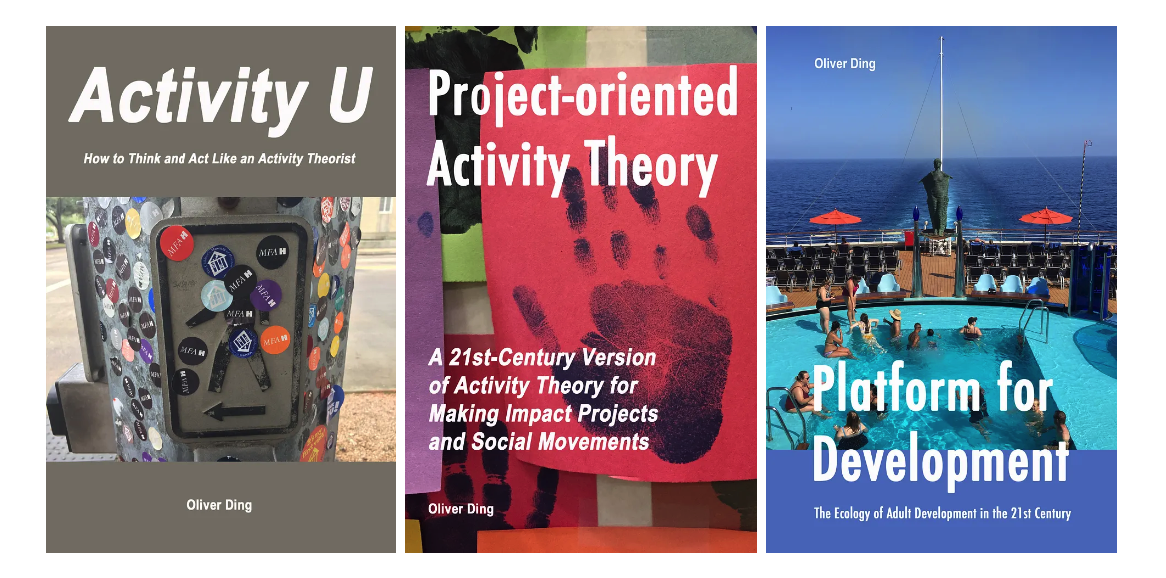
The results were transformative. Guided by the HERO U framework, I experienced an unprecedented burst of creative energy. From August 2020 to March 2021, I authored three book drafts in English:
- Activity U: How to Think and Act Like an Activity Theorist
- Project-oriented Activity Theory
- Platform for Development: The Ecology of Adult Development in the 21st Century
By April 2021, while sharing these reflections in an online program, the HERO U framework evolved into a more profound synthesis. I titled this 312-page Chinese manuscript THE ECHO WAY (回映之道). Its subtitle, When Theory Meets Practice, reflected a situational application of my Echozone model and captured the dominant theme of my intellectual life.
Looking back, this three-year journey (2019–2021) was a strategic scaling of focus, characterized by three distinct movements:
- 2019: The React Project → Practice-based Reflection
- 2020: The Activity U Project → Theory-based Curation
- 2021: The ECHO Way project → Theory — Practice Dialogue
However, the real journey is more complicated than this simple narrative, as illustrated in the diagram below.
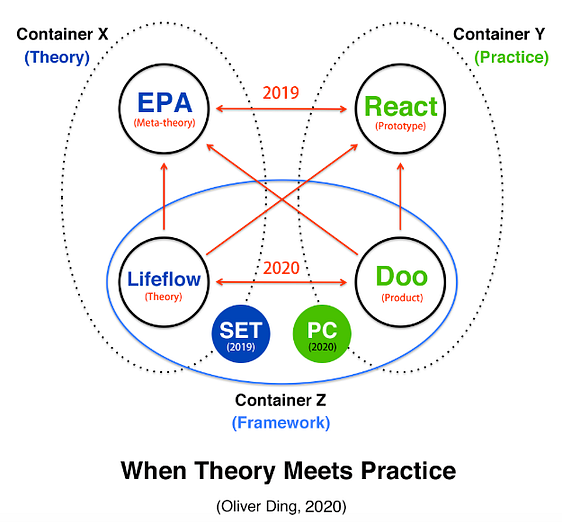
In 2019, I created the WXMY diagram, a foundational heuristic that catalyzed the development of new diagrams and knowledge frameworks. During the same year, I prototyped a web application through the React Project and initiated a reflective inquiry, Rethink Social Design, which led to the creation of the “SET” framework.
In 2020, I worked on the DOO Project, the operational outcome of the React Project. Following its release, I conducted three months of user interviews, then wrote a whitepaper that integrated theoretical perspectives. This led to the Platform Container framework, designed to analyze digital transformation.
The "ECHO" happened when I compared the SET framework (2019) with the Platform Container framework (2020). I realized that there are distinct levels of knowing, an insight that directly inspired the When Theory Meets Practice model. This marked my pivot from practice-led inquiry to theory-led curation. I moved from the single-theory focus of Activity U to the multiple-theory exploration of the D as Diagramming project in 2021.
The ECHO Way was the ultimate summary of this journey—a record of how a simple diagram can echo across different domains to create a symphony of new knowledge.
3
Donald Schön pioneered the movement of "Reflection-in-Action," establishing the researcher reflecting on their own practice as a legitimate research methodology. My book, The ECHO Way, is a case study that adopts this very approach. By exploring my intellectual life, the ECHO Framework emerged—a scaffolding tool designed to bridge the gap between "Theory" and "Practice" for knowledge workers.
From a near-term perspective, I completed the manuscript Curativity in 2019, which defined "Knowledge Curation" as a unique type of knowledge practice. The ECHO project can be seen as a direct application of Knowledge Curation. From a long-term perspective, I have been deeply interested in the trajectories of intellectual exploration, knowledge creation, and mental growth; this framework serves as a milestone summary of that lifelong journey.
The book is structured into three parts, each focusing on one module of the ECHO Framework. Through this structure, I curated my experiences into knowledge models and diagrams, while integrating relevant concepts from other theorists as references:
Part I of the book introduces the first module: the ECHO Model. This model categorizes "Epistemic Objects" between theory and practice into six levels: Meta-theory, Specific Theory, Abstract Models, Concrete Models, Domain Practice, and General Practice. I applied this to three specific cases: Tacit Knowledge, Activity Theory, and the concept of Affordance. Within the exploration of Affordance, I also proposed the "Conceptual Dynamics" model to examine the evolution of theoretical concepts.
Part II introduces the second module: the ECHO Container. This module incorporates "Personal Epistemic States" into the framework, forming a complete triad of "Epistemic Object – Epistemic Activity – Epistemic Subject." I identified seven states critical to knowledge creation: Resource, Domain, Tool, Problem, Method, Concept, and Diagram. This section extracts operational tools from my knowledge curation projects, such as the ECHO Canvas, ECHO Diagrams, and Intermediate Constructs.
Part III introduces the third module: The ECHO Way. Looking from outside the framework, this part draws on creativity research theories as overarching guiding principles and theoretical resources for my knowledge creation activities. Looking from outside the framework, this part draws on creativity research and sociological theories as an overarching guiding principle. It represents the "Way of the Intermediary"—the philosophy of the creator who navigates the Echozone.
The core of this work is a personal intellectual journey. However, to make it universal, the final chapter extends the ECHO Framework into a general epistemological framework, particularly suited for "Cross-boundary Innovation."
4
While Donald Schön’s concept of "Reflection-in-Action" provided the initial spark for my journey, my 2021 manuscript The ECHO Way marks a significant theoretical departure and upgrade. By evolving "Reflection" into "Echoness," I have moved from a psychological account of individual practice to an Ecological Epistemology of the creative life.
The distinction between the ECHO Way and Schön’s reflective framework can be summarized in five key dimensions:
A. From Single Context to Parallel Contexts
Schön’s cases typically focus on a professional working within a "single context" along a linear timeline—a designer at a drafting table or a musician in a session. However, my experience as a creator involves "Parallel Creations." At any given moment, I am navigating multiple projects (such as the three concurrent book drafts in 2020). Echoness captures the resonance between these parallel threads—how an insight in Activity Theory "echoes" into a project on Ecological Psychology. Schön’s reflection is a solo; the ECHO Way is a symphony.
B. From Individual Practice to Individual Ecology
Schön’s "Reflectivity" centers on an individual’s internal conversation with a specific situation. "Echoness" expands this scope to the entire Individual Ecology. It is not just about reflecting on my actions, but about responding to the "echoes" of people, objects, and ideas within my environment.
C. From Reflection to Resonance
While reflection is a subjective construction—an individual’s interpretation of experience—Echoness incorporates Resonance. Resonance is the "fit" and feedback between the individual and their ecology. It is not just looking in a mirror (Reflection); it is hearing the environment speak back (Echo).
D. From "Anti-Theory" to "Embracing Rationality"
A subtle but crucial difference lies in our intellectual stance. Schön developed his framework partly to challenge "Technical Rationality," which can sometimes lead to an anti-theoretical or anti-intellectual bias. In contrast, the ECHO Way embraces scientific rationality. I view academic theories not as rigid constraints, but as "Scaffolding Tools" that practitioners can use to elevate their understanding. For me, "Appropriating Theory" is a rational, creative act of curation.
E. From Professional Practice to the Lifescope
Schön focuses on the "Professional Practitioner." My work, especially as it evolved into the Creative Life Curation framework in 2022, adopts a much larger scale. I utilize five units of analysis: Action, Project, Journey, Landscape, and Lifescope. While Schön’s focus is on the Action level (the immediate situation), I treat the Project as the primary unit of analysis (similar to his "practice" but more structured). The ECHO Way views knowledge creation against the backdrop of an individual’s entire life journey.
From "Theory-Practice Connection" to "Universal Dialogue"
Finally, while the 2021 version of the ECHO Way focused on the boundary between Theory and Practice, it has since evolved. By 2022, it became a general model for Cross-boundary Communication, and in 2024, it served as the cornerstone for my book Mapping Creative Dialogue. What began as a tool for connecting theory and practice has matured into a universal framework for navigating the complex resonances of a creative life.
5
While the HERO U model from 2021 successfully explains how an individual navigates the "High Ground" and the "Swamp," my recent conversation about Ed.D. programs reminds us that the "Swamp" is more complex than I previously imagined. It is not merely a matter of cognitive complexity, but of social complexity.
This is where the ECHO Framework evolves. In my recent work, Developmental Projects: The Project Engagement Approach to Adult Development (released on November 30, 2025), I expanded the framework to address this complexity. This approach, inspired by Andy Blunden’s notion of the "project as a unit of analysis," seeks to establish the "Project" as a conceptual foundation for cross-disciplinary research.
The Cultural Projection Model expands Activity Theory’s internalization-externalization principle by introducing the "Outside — Projecting — Inside" triad as a basic ecological form. Although initiated in 2021, the newest version curates my latest thinking on social engagement.
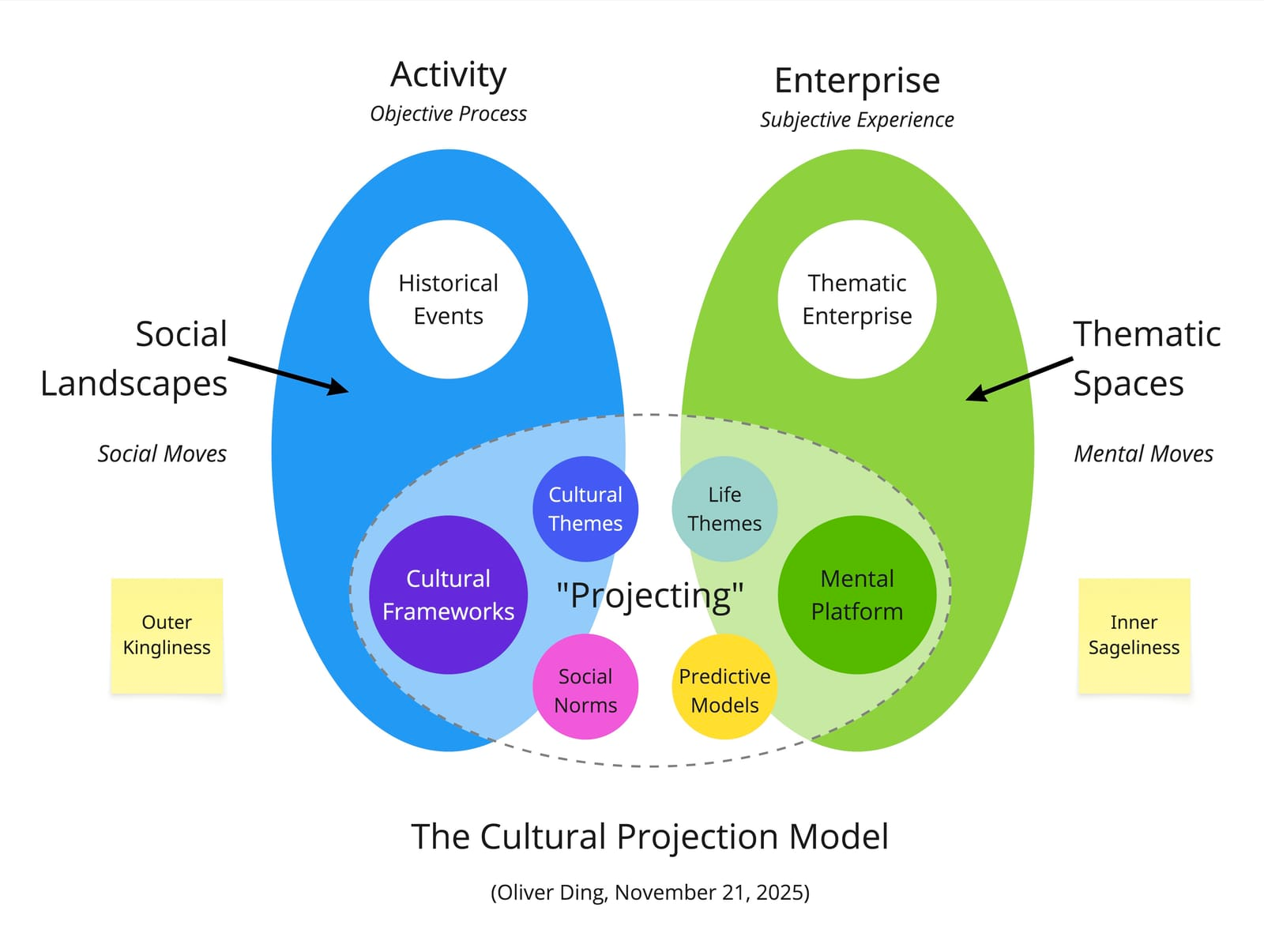
The model is indeed a direct application of the ECHO Framework. If we compare it to the 2021 WXMY (When X Meets Y) model, we discover a profound structural mapping:
- Outside (Outer Kingliness) maps to Container X: It represents the Social Landscapes and Objective Processes of the world, where Cultural Frameworks and Cultural Themes frame social moves.
- Inside (Inner Sageliness) maps to Container Y: It represents the individual's Mental Platform and Thematic Enterprise, where Predictive Models and Life Themes guide mental moves.
- Projecting maps to Container Z: This is the most critical realization—Projecting IS the Echozone.
In both the 2021 and 2025 versions, the Echozone (Z) is not a static space for organizing notes; it is a dynamic process of "doing" and "acting." It is here that "Echoness" (resonance) is transformed into transformative action.
The Cultural Frameworks and Mental Platforms within the "Projecting" container act as the "acoustic tuning" of the Echozone. They determine how the "sounds" of our internal predictive models are translated into Developmental Projects—the social moves that can be heard and felt in the Outside world.
For an Ed.D. researcher or any professional practitioner, this means their "Project"—be it a dissertation or a workplace intervention—is the Echozone where their internal intellectual growth (Inside) meets social reality (Outside). The ECHO Way is not just about reflecting on the past; it is about the power of projecting your internal resonance to shape the future social landscape.
Furthermore, this model offers a lens for policymakers. By designing programs that alter Cultural Frameworks, Themes, and Social Norms, they are essentially shaping the social environments for these developmental projects. In turn, how practitioners launch and perform their projects provides the necessary feedback to inspire the next generation of social settings.
6
On April 24, 2025, I published a case study titled The ECHO Journey (2019–2021).
Today, this journey is unfolding again.
v1.0 - January 13, 2026 - 2,307 words