
Cognitive Container of Cultural Projection
Connecting Mental Models and Cultural Medium
by Oliver Ding
February 26, 2026
This article is part of the ongoing development of the Anticipatory Cultural Sociology (ACS) framework, contributing to the Cultural Projection series.
The Cultural Projection model was originally introduced in Developmental Projects: The Project Engagement Approach to Adult Development (2025), where it served as a framework for understanding how individuals move between the outside and inside of projects. In January 2026, Cultural Projection became a central concern of the ACS theoretical enterprise.
In Design-oriented Project Engagement, the Discover-Design-Deliver Model is introduced as an operational framework of Cultural Projection. The model introduces the Mental Models — Cultural Medium fit as a core objective; however, the details of how this fit operates do not become clear.
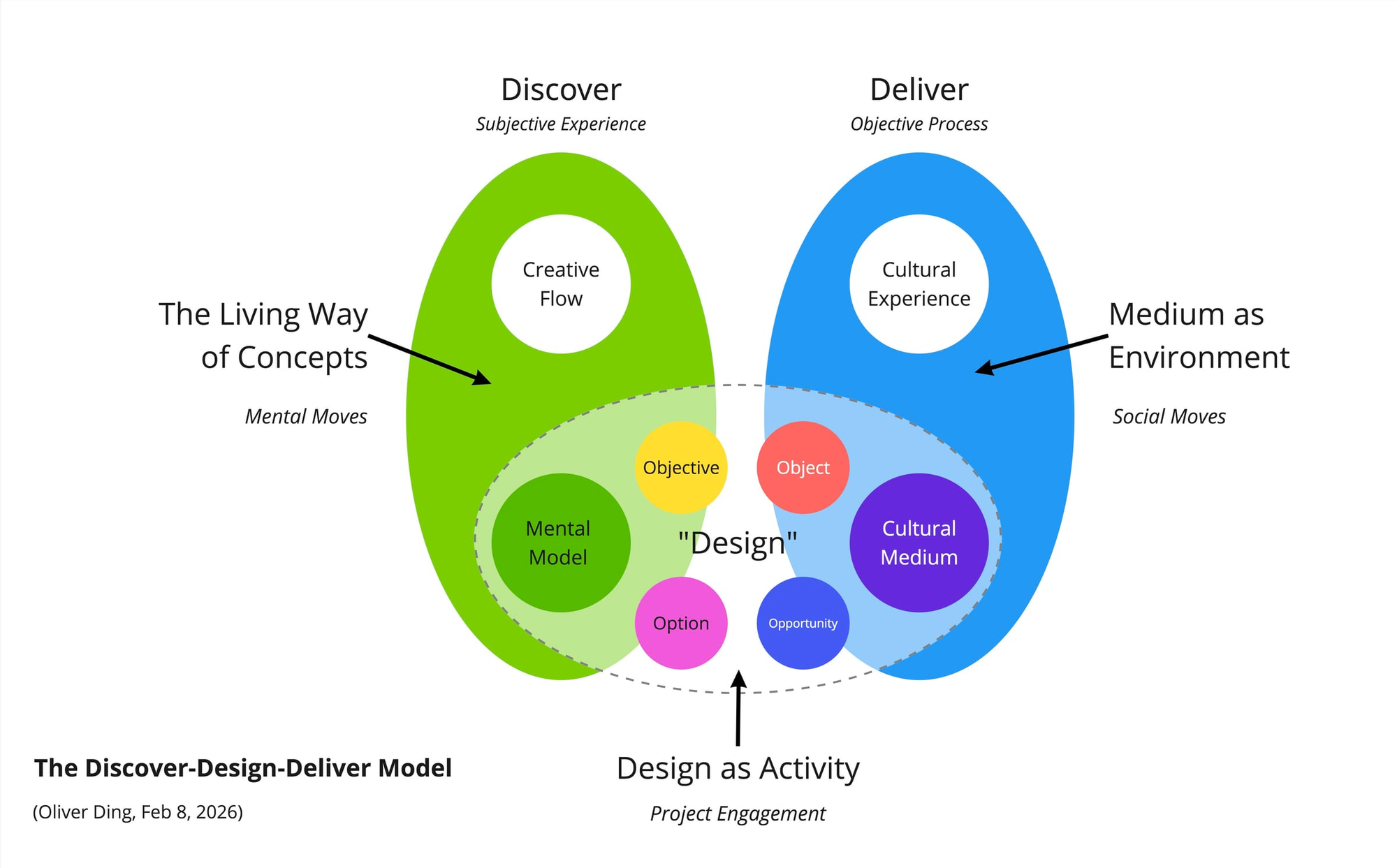
In this article, we take a further step to build a new model to investigate this issue.
Drawing on the theoretical resources of ACS, and specifically on the spatial logic of the World of Life framework, this article places Folkentity at the center of the World of Life, defines two distinct boundaries — one structural, one projective — and identifies the space between them as a Cognitive Container.
Within this container, four concepts — Representation, Medium, Artifact, and Genre — are re-anchored, assigned exclusive, non-overlapping functions, and finally strategically curated into a nested whole.
The goal is not a comprehensive review of existing literature. It is a theoretical construction — a new way of holding these four concepts together that makes them more useful for the ACS enterprise.
Contents
Part 1: Theoretical Foundation
1.1 The Culture as Thematic Enterprise Framework
1.2 Evolving Concept System
1.3 Double Genidentity
1.4 Double Curativity
1.5 Cultural Attachance
Part 2: World of Life and the Cognitive Container
2.1 The World of Life and Its Four Boundaries
2.2 Folkentity as the Center
2.3 Two Boundaries and the Cognitive Container
2.4 Locating the Four Elements
Part 3: Representation
3.1 Definition and Origin
3.2 Representation as Cognitive Interface
3.3 A Typology of Cognitive Representation
3.4 Academic Decoupling
Part 4: Genre
4.1 Definition and Origin
4.2 Genre as Emergent Form
4.3 Genre as “Motivation Crystallized”
4.4 Academic Decoupling
Part 5: Artifact
5.1 Definition and Origin
5.2 Artifact as the Material Substrate
5.3 Artifact Across the Mind-Folk-World Spectrum
5.4 Artifact and the Other Elements
Part 6: Medium
6.1 Definition and Origin
6.2 Medium as Shared Communicative Carrier
6.3 Medium and Cultural Experience
6.4 Academic Decoupling
Part 7: The Strategic Curation
7.1 The Configuration
7.2 The Double Structure of Cultural Projection
7.3 The Nested Structure
7.4 The Mental Models — Cultural Medium Fit, Revisited
Conclusion: Three Theoretical Contributions
Part 1: Theoretical Foundation
This article adopts several principles of the ACS framework as a meta-framework to guide the conceptual thinking and framework development. The process itself is a test of ACS.
1.1 Foundational Principles
The ACS framework (v1.0) was launched as a curated meta-framework on January 5, 2026. The Landscape of Anticipatory Cultural Sociology featured six meta-frameworks, supported by nine related book drafts.
- The Path of Creative Life and the Fleeting Moment
- The HLS Framework (v3.0)
- The Cultural Projection Model (2025)
- The AAS Framework (2021, 2022, 2024, 2025)
- The Cultural Genidentity Model (2025)
- The Culture as Thematic Enterprise Framework (2025)
The framework itself is a large concept system, including the following members:
- Five subsystems
- Seven principles
- Five mechanisms
- Six faces of concept systems
- Six types of ecological opportunities
- Eight thematic schemas of social life
In this article, we will adopt the following principles as a strategic framework to guide the conceptual creative process:
- Evolving Concept System
- Double Genidentity
- Double Curativity
- Cultural Attachance
1.2 Evolving Concept System
This principle views Concept Systems as the basic unit of culture. Unlike traditional theories of concepts and concept systems, my approach is based on Thematic Space Theory, which was inspired by the Ecological Practice Approach, the “Themes of Practice” approach, and the “Project Engagement” approach.
I consider the notion of “Themes of Practice” as a process-type concept rather than a substance-type concept. Thus, it is not a new category of themes but a transformational process between individual life themes and collective cultural themes. It refers to both concept and action. It connects mind and practice, indicating the transformation of both the individual and society.
Inspired by this principle, the terms Representation, Medium, Artifact, and Genre are not solid concepts, but “themes of practice” across disciplines: in media studies, cultural anthropology, literary theory, semiotics, design research, and sociology. Each field has developed its own usage, its own internal consistency, and its own implicit assumptions.
In the ACS framework, we further relocate these concepts to the World of Life.
1.3 Double Genidentity
The concept of Genidentity was developed by Kurt Lewin in his early work. To operationalize the concept, I proposed the following working definition:
A thing’s Genidentity is defined by Essential Differences with Situated Dynamics.
This allowed me to transform a philosophical concept into a usable one for empirical research.
In early 2025, I worked on the GO Theory project (GO stands for Genidentity-Opportunity) and developed the Double Genidentity principle.
The primary focus of Social Life Development is the Genidentity of Things, while the primary focus of Creative Life Development is the Genidentity of Creative Life.
It bridges two domains, unifying the concepts of Social Life and Creative Life through the dynamics of themes and identities and their transformation over time.
The GO Theory project focuses on the dynamic and interactive processes between creators and the social landscapes in which they are embedded.
Inspired by this principle, the four concepts are re-anchored, given exclusive and non-overlapping functions.
1.4 Double Curativity
Curativity refers to the potential action opportunities of turning pieces into a meaningful whole. Curativity promotes a sense of wholeness by cultivating the ability to assemble individual pieces into a cohesive and meaningful whole.
In philosophy and mathematical logic, the study of parts and the wholes they form is known as mereology. While I also explore the relationship between pieces and the whole, my focus is fundamentally different from mereology.
My objective is not abstract theorizing about parts and wholes, but rather the practice and activity of “curating pieces into a meaningful whole” — a process rooted in action, experience, and value. This perspective shifts the discussion from static conceptual structures to dynamic, purposeful activity.
Thus, I coined the new term Curativity to describe my objective. The basic assumption is: “In order to effectively curate pieces into a meaningful whole, we need Container to contain pieces and shape them.”
Within the ACS framework, the Double Curativity principle is used to understand both individual and collective levels. Actors not only take actions but also curate their actions into a meaningful whole, such as projects, journeys, landscapes, and so on. The Curativity of Actions operates behind the Micro-AAS. At a broader scale, both the Cultural and Historical Systems are emergent and curated. The Curativity of Actions similarly operates behind the Macro-AAS.
Inspired by the principle, I further discovered a space between the World of Life and Folkentity, serving as the cognitive container of cultural development. Four concepts are relocated into this space, forming a new, meaningful whole.
1.5 Cultural Attachance
Attachance emphasizes potential action opportunities provided by actual actions, particularly those involving attaching and detaching.
In 2023 and 2024, I applied this concept to study creative cognition, social cognition, and strategic cognition, resulting in three book drafts: Mental Moves, Social Moves, and Strategic Moves.
The concepts of Mental Moves and Social Moves are featured in the ACS Framework and are considered two key mechanisms of cultural development.
Inspired by this principle, four concepts are detached from their original domains and attached to the ACS framework.
Part 2: World of Life and the Cognitive Container
Part 2 introduces the spatial logic that organizes the rest of this article. It maps the World of Life and its four boundaries, places Folkentity at the center, and identifies the Cognitive Container as the interface zone between the Folkentity’s projective boundary and the structural limits of the world.
2.1 The World of Life and Its Four Boundaries
In the ACS framework, the World of Life is a structured space with determinate boundaries that mark the edges of the operational zone where cultural development actually occurs.
Following the analysis developed in the Worldentity article and the Six Faces of Concept Systems, the World of Life has four boundaries:
- Upper boundary: Spirituality — the limit of ultimate meaning and transcendent significance
- Lower boundary: Science — the limit of material patterns and natural laws
- Left boundary: Individuals — where life originates, where personal enterprises begin
- Right boundary: Collectives — where social formations emerge, where cultural movements crystallize
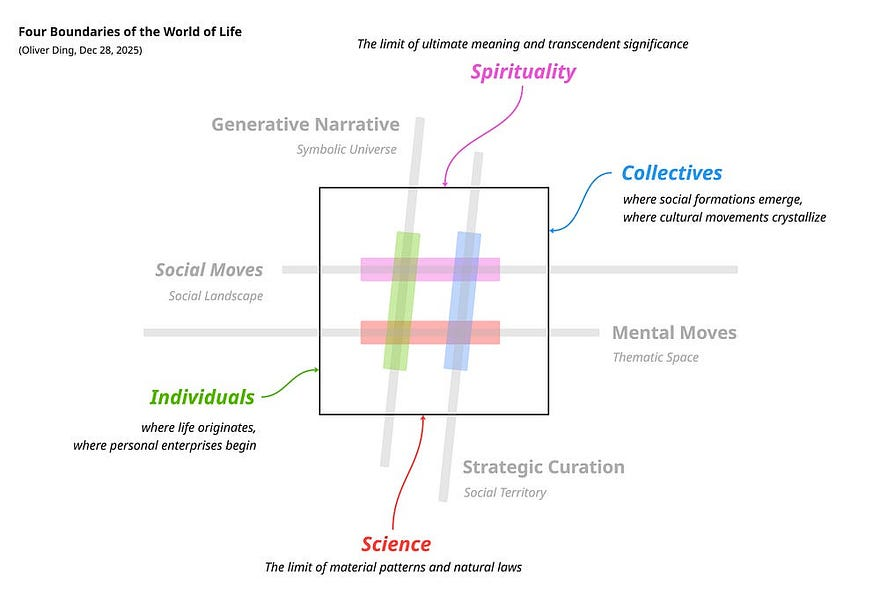
These four boundaries define a bounded operational field. Within this field, cultural life unfolds: individuals develop Mental Platforms, communities form around shared projects, and Thematic Creations move through the stages of Mindentity, Folkentity, and Worldentity.
This structure was further operationalized in Personal Orientation of Cultural Projection, where the four boundaries were used to locate the four elements of personal orientation — Doctrine, Persona, Position, and Posture — that individuals bring to the threshold of a project.
The present article applies the same structural logic, but from a different starting point and toward a different question.
2.2 Folkentity as the Center
In Personal Orientation of Cultural Projection, the analysis began with the individual person: how a person orients themselves within the World of Life in order to engage in Cultural Projection. This article begins from the other side of the same encounter: Folkentity.
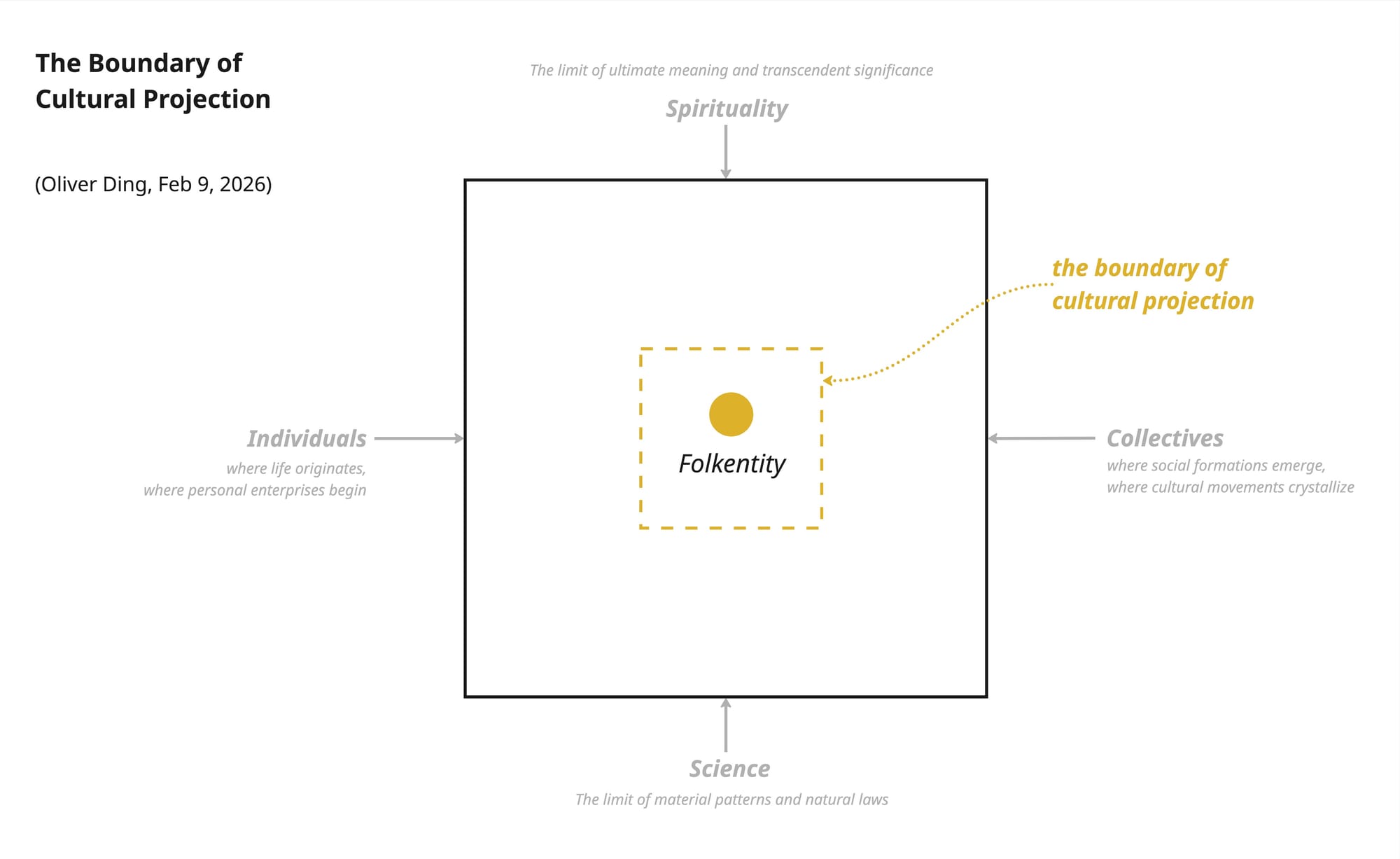
A Folkentity is a thematic creation that has entered collective life as an active object of Cultural Projection. It is neither purely private (Mindentity) nor yet structurally given (Worldentity). It exists in the shared, actively-maintained middle space — held by a community, reproduced through ongoing participation, and developed through collective project engagement.
Folkentity is placed at the center of the World of Life because it is the gravitational center around which Cultural Projection activity organizes itself. It is what individuals and communities project toward, what they anchor their development projects around, what makes the World of Life a shared rather than merely parallel space.
2.3 Two Boundaries and the Cognitive Container
When a Folkentity actively projects into the World of Life, two distinct boundaries come into view.
The first is the World of Life boundary: the four structural edges described above.
The second is the Folkentity’s projective boundary: the limit of what a given collective thematic creation can directly occupy and sustain through its own community’s ongoing engagement. This is what the diagram represents as the boundary of cultural projection — a smaller, inner square, with Folkentity at its center.
The space between these two boundaries is neither inside the Folkentity nor fully beyond its reach. It is an interface zone — the territory through which Cultural Projection must pass as it moves from the cognitive interior of a community toward the structural features of the World of Life.
This interface zone is what we call the Cognitive Container of Cultural Projection.
2.4 Locating the Four Elements
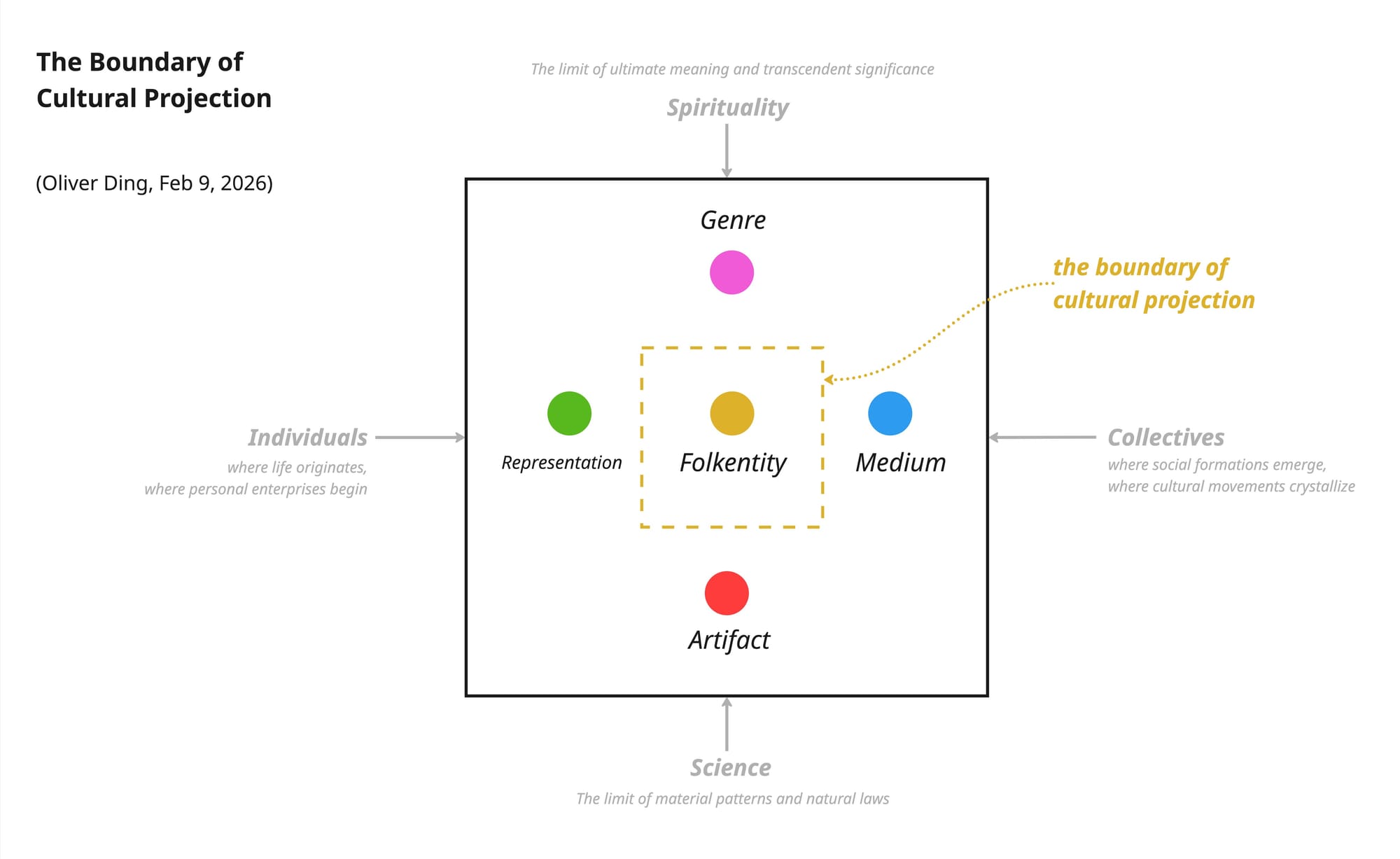
The Cognitive Container is organized by the same four-directional structure as the World of Life itself. This produces a creative heuristic for concept placement: each concept must be anchored to the dimension of the Cognitive Container that corresponds to its most essential, exclusive function.
The outcome of this heuristic is represented in the diagram (see Fig. 1). Through a search of the existing conceptual repertoire — guided by the Double Genidentity principle, which requires strict functional differentiation — four concepts emerge as the natural inhabitants of the four dimensions:
- Representation near the left boundary: Individuals
- Genre near the upper boundary: Spirituality
- Artifact near the lower boundary: Science
- Medium near the right boundary: Collectives
Parts 3 through 6 examine each in detail.
Part 3: Representation
Part 3 introduces Representation — the cognitive face of Cultural Projection, operating at the interface between a Folkentity and the individual persons who encounter it.
3.1 Definition and Origin
Representation is defined as the individual-cognitive function of Cultural Projection: the process through which a Folkentity becomes cognitively available to individual persons.
In cognitive science and semiotics, representation is commonly understood as a brain-internal symbolic operation — a mental state that stands for something else in the world. This framing treats representation as a purely inner affair, concerned with the mechanics of how the mind maps reality.
In the ACS framework, representation is reframed. It is not an inner mental state but an interface operation — the cognitive face the Folkentity turns toward individual persons. Representation is how a thematic creation takes form in a person’s mind as a schema, a model, a structure of understanding. It is the moment when the structure of the Folkentity becomes a mental structure for the person encountering it.
This reframing was crystallized through the analysis of Cultural Projection. When an individual projects into a Folkentity — when they move from outside to inside a project — Representation is what makes that crossing cognitively possible. Without a representational interface, the Folkentity remains opaque: present in the world but not accessible to the individual’s understanding.
3.2 Representation as Cognitive Interface
The key distinction this framework introduces is between inner thought and outer representation. Representation, in the ACS sense, is not thinking itself — it is the externalization of thinking into a form that can interface with projects and other persons.
In conventional cognitive psychology, “representation” often refers to internal computational processes. The ACS framework emphasizes that representation always involves a specific cognitive posture toward the object — a choice of how to externalize and give form to one’s understanding. This is representation as cognitive action, not just cognitive state.
In the DDD Model developed in Design-oriented Project Engagement, Mental Model is the concept closest to this dimension. Representation is the more fundamental layer: it is how Mental Models take form and become available to project engagement. The Mental Models side of the “Mental Models — Cultural Medium” fit begins here.
3.3 A Typology of Cognitive Representation
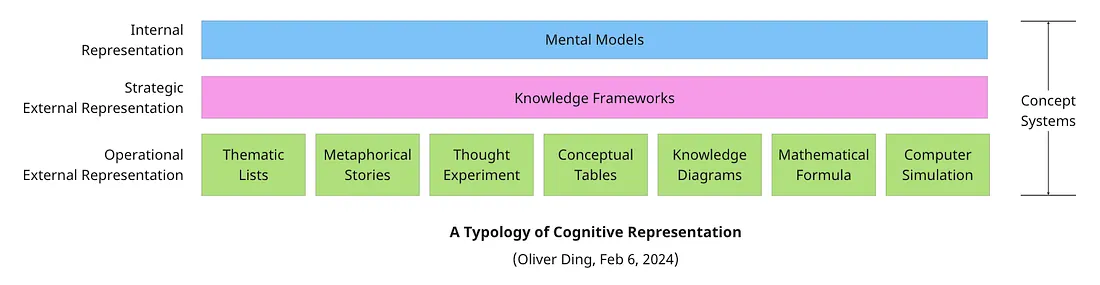
Because Representation is an interface operation, it takes many concrete forms. In February 2024, while working on Creative Diagramming: The Fifth Way of Knowing and Early Discovery, I developed a typology of cognitive representation that provides a systematic view of these forms.
The typology begins with a foundational distinction between Internal Representation and External Representation.
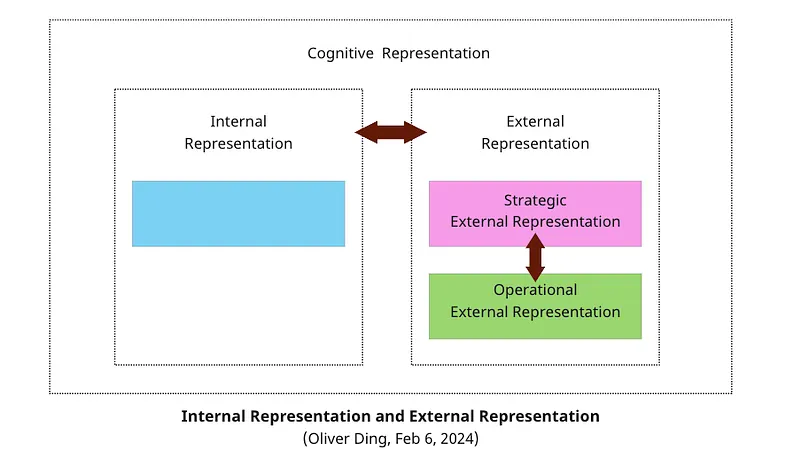
Internal Representation corresponds to Mental Models — the cognitive structures that individuals build and maintain within their own minds. These are not directly observable; they are the implicit frameworks through which experience is organized, problems are understood, and possibilities are perceived.
External Representation is what can be shared, read, discussed, and built upon. It is Representation in its most socially active form — the cognitive interface that actually operates in the Cognitive Container of Cultural Projection. External Representation divides further into two levels:
- Strategic External Representation: Knowledge Frameworks — the higher-order organizing structures through which Mental Models are systematized and made communicable. These operate at the level of conceptual architecture.
- Operational External Representation: the concrete, directly usable forms through which conceptual structures are expressed, tested, and developed.
Together, Internal Representation, Strategic External Representation, and Operational External Representation constitute what the typology calls Cognitive Representation — the full layered structure through which a Folkentity’s concept system interfaces with individual minds.
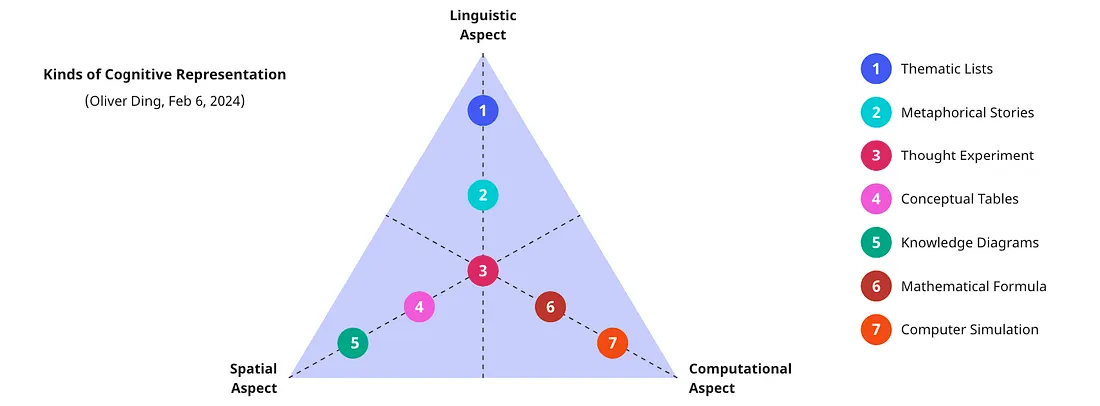
The typology identifies seven types of Operational External Representation, organized along three aspects — Linguistic, Spatial, and Computational:
- Thematic Lists — linguistically organized; loose coupling of related concepts
- Metaphorical Stories — linguistically organized; mapping structure through narrative analogy
- Thought Experiments — at the intersection of all three aspects; using language to trace precise logical scenarios
- Conceptual Tables — spatial aspect; structuring relationships through systematic grid arrangements
- Knowledge Diagrams — spatial aspect; using visual-spatial structure to represent relational logic directly
- Mathematical Formula — computational and linguistic; precise symbolic encoding of relationships
- Computer Simulation — computational; dynamic modeling of system behavior
The three aspects — Linguistic, Spatial, Computational — form a triangular space in which the seven types can be compared and positioned. Thematic Lists and Metaphorical Stories sit closer to the Linguistic apex; Knowledge Diagrams and Conceptual Tables sit closer to the Spatial apex; Mathematical Formulae and Computer Simulations sit closer to the Computational apex. Thought Experiment occupies a central position, drawing on all three.
This typology has direct implications for how Folkentities develop their Representation function. A nascent thematic creation may begin with Thematic Lists — loose collections of related concepts that lack a tight logical structure. As the creation matures, it develops more structurally precise forms: Knowledge Diagrams that make spatial relationships visible, Knowledge Frameworks that systematize the conceptual architecture, and eventually Mathematical Formulae or Simulations where precision demands it.
The movement from Internal Representation to Strategic External Representation to Operational External Representation is not a one-time transition but an ongoing dynamic. Individuals who engage with a Folkentity cycle between these levels: their Mental Models are shaped by the external representations they encounter, and the external representations they create in turn reshape the Folkentity’s cognitive interface for the next person who approaches it.
3.4 Academic Decoupling
The mainstream treatment of representation conflates it with broader semiotic processes. In Activity Theory, for instance, artifacts are defined broadly to include both material tools and psychological signs — effectively collapsing Representation and Artifact into a single category of “mediating artifacts.”
The ACS framework decouples these. Representation is strictly the cognitive-individual interface; Artifact is the material substrate. The same physical object (a book) involves both: its physical form is an Artifact, while the conceptual framework it encodes is a Representation. These are not the same function operating through the same mechanism — they operate at different boundaries of the Cognitive Container and serve different purposes in Cultural Projection.
Part 4: Genre
Part 4 introduces Genre — the meaning-normative face of Cultural Projection, operating at the interface between a Folkentity and the ultimate horizons of significance in the World of Life.
4.1 Definition and Origin
Genre is defined as the meaning-normative function of Cultural Projection: the system of shared expectations and value commitments through which a Folkentity connects to the symbolic universe and establishes its ultimate orientation.
In conventional usage — across literary theory, film studies, and rhetoric — genre is understood primarily as classification. A genre is a type: tragedy, comedy, thriller, sonnet, documentary. This understanding captures something real: genres do classify. But classification is the surface of what genre does. The deeper function is normative.
Genre names the standards of excellence, the forms of legitimate contribution, and the sense of what the creation is ultimately for. It is not just “this is a philosophical text” but “this is what philosophy is for — this is what good philosophy looks like — this is what it means to contribute meaningfully to philosophical inquiry.” Genre is what makes Representation culturally legible rather than merely cognitively accessible.
But Genre is not merely a pre-existing template into which works are inserted. It is also what crystallizes in the space between what a Medium makes possible and what human expression reaches toward. Genre is both constraint and creation — the normative form that emerges when the “how” of Medium meets the “why” of expressive impulse. Every Genre was once an improvisation, a tentative answer to “why does this matter?” that happened to work, to resonate, to get picked up and repeated until it sedimented into shared expectation.
4.2 Genre as Emergent Form
Genre is not a label attached to works but a form that emerges from the ongoing encounter between what Media enable and what expression demands.
The placement of Genre at the upper boundary — Spirituality — is the most distinctive move in this framework, and the one most at odds with conventional treatments.
In standard media theory, genre is understood as operating within a medium: the horror genre exists within cinema; the sonata form exists within Western classical music. Genre is a subdivision of Medium.
The ACS framework inverts this relationship. Genre is not inside Medium — it is emergent from the encounter between Medium and expressive impulse. Genre operates at the Spirituality boundary because it provides the “coordinates of world logic” — the existential norms that give human expression its ultimate orientation. But these coordinates are not handed down from a transcendent realm; they crystallize in practice, in the space between what a Medium makes possible and what human expression reaches toward.
Genre’s position at the Spirituality boundary is not the position of a pre-existing idea descending into matter. It is the position of meaning that has risen from practice, condensed into form, and now stands as a normative horizon for those who come after. Genre, in this sense, is closer to what Wittgenstein called forms of life than to what media theorists call content categories. It is not a label attached to works; it is a framework of value that makes certain works meaningful and others meaningless.
4.3 Genre as “Motivation Crystallized”
If Genre is an emergent form, then its emergence follows a characteristic path: motivation crystallizes into expectation, expectation into norm, norm into Genre.
One productive way to understand Genre’s position is through a contrast with the other three concepts:
- Artifact answers: How is this made? (physical constraints, material form)
- Medium answers: Who can receive this? (social protocols, collective reach)
- Representation answers: How is this understood? (cognitive access, mental models)
- Genre answers: Why does this matter? (ultimate meaning, normative standards)
Genre is motivation crystallized into form. This crystallization is possible precisely because Genre occupies the position it does — at the Spirituality boundary, detached from the constraints of Artifact, Medium, and Representation. Because Genre does not depend on any particular material form, any particular social protocol, or any particular cognitive schema, it retains a degree of creative freedom that the other three elements do not have.
This creative freedom finds direct empirical support in the work of Clay Spinuzzi, whose research on genre in organizational settings documents precisely this phenomenon. In Tracing Genres through Organizations (2003), Spinuzzi observes that alongside officially designed texts and formal genres, workers constantly generate informal genres — improvised, unofficial forms of expression: handwritten notes on printed documents, personal shorthand systems, ad hoc annotation conventions, spontaneous workarounds. These informal genres are not failures of compliance with the official system; they are creative responses to the gap between the existing genre system and the actual demands of practice.
For the ACS framework, this observation illuminates two things. First, Genre operates with a genuine creative autonomy that the other three elements do not share. Second, Spinuzzi’s informal genres illuminate how new Genres emerge in the context of Folkentity development. A Folkentity does not simply inherit an existing Genre from its cultural environment. As it develops — as its community encounters the limits of available expressive forms — it begins to generate its own informal genres: provisional ways of naming, framing, and presenting the thematic creation that do not yet exist in the surrounding culture. These informal genres are the earliest signs of a Folkentity’s creative ambition exceeding its inherited Genre constraints.
This is the creative freedom that the Spirituality boundary affords: the space to invent, before the invention can be institutionalized. It is the space between Medium and expressive impulse — where the “how” of what is possible meets the “why” of what is needed, and new Genres begin to crystallize.
4.4 Academic Decoupling
The most significant decoupling this framework achieves is separating Genre from Medium.
In mainstream media ecology, following McLuhan and Postman, genre tends to be treated as a function of medium — each medium generates its own characteristic genres. This analysis is valuable, but it subordinates Genre to Medium and prevents us from seeing Genre’s independent normative operation.
The ACS framework treats Genre as operating at a different boundary — and therefore with a different function — than Medium. Medium operates at the social-environmental level; Genre operates at the meaning-normative level. The same Genre can persist across different Media: philosophical dialogue as a Genre appears in written texts, in oral seminars, in digital discussion threads. The Genre maintains its normative commitments — what counts as good philosophical thinking — across all these Media. This independence is precisely what the Spirituality boundary marks.
A note of clarification: this independence is normative continuity, not existential separation. Genre persists across Media, but it never exists apart from Media. It is the “why” that travels; Medium is the “how” that carries it. The travel is real, but so is the carrying.
Part 5: Artifact
Part 5 introduces Artifact — the material-operational face of Cultural Projection, operating at the interface between a Folkentity and the physical constraints of the world.
5.1 Definition and Origin
Artifact is defined as the material-operational function of Cultural Projection: the persistent material form through which a Folkentity acquires a physical presence in the world, subject to the constraints of natural laws.
The concept of artifact appears across many disciplines, each emphasizing different aspects: in archaeology, it is a human-made physical object; in design, it is the product of intentional fabrication; in Activity Theory, it is the mediating tool that connects subject and object in purposive action. Across these traditions, what is shared is the emphasis on making — an artifact is something produced.
In the ACS framework, Artifact is anchored to the Science boundary: the limit of material patterns and natural laws. This placement clarifies what the concept distinctively tracks — not just the fact of production but the material constraints that production must obey and work with.
5.2 Artifact as the Material Substrate
Artifacts are the “hard landing point” of Cultural Projection — the level at which a thematic creation confronts physical reality directly.
A theory as an artifact exists in books, papers, slide decks, and codebases. These are not merely convenient carriers; they impose genuine material constraints on what the theory can be and how it can be accessed. A book has weight and size; it can be destroyed or preserved; it requires paper and ink or electricity and storage. These material constraints shape, in subtle but real ways, how the thematic creation can develop and where it can travel.
This is why Artifact faces the Science boundary. Science, as the lower boundary of the World of Life, represents the limit of material patterns and natural laws. Artifacts are not exempt from these patterns — they are constituted by them. The affordances of a physical book (its portability, its linearizing of content, its capacity to be annotated) derive from its material form in exactly the way that Gibson’s ecological psychology describes affordances: as real features of the environment that enable and constrain action.
Unlike Medium, which exists through social recognition, Artifact exists through material presence. A stone tool is an Artifact whether or not anyone recognizes it as such; its material reality is independent of collective acknowledgment. This is the mark of the Science boundary: what is true of an Artifact remains true regardless of what any community believes about it.
5.3 Artifact Across the Mind-Folk-World Spectrum
One of the most productive features of locating Artifact in the Cognitive Container is that it reveals Artifact’s operation across all three ontological states of thematic creation.
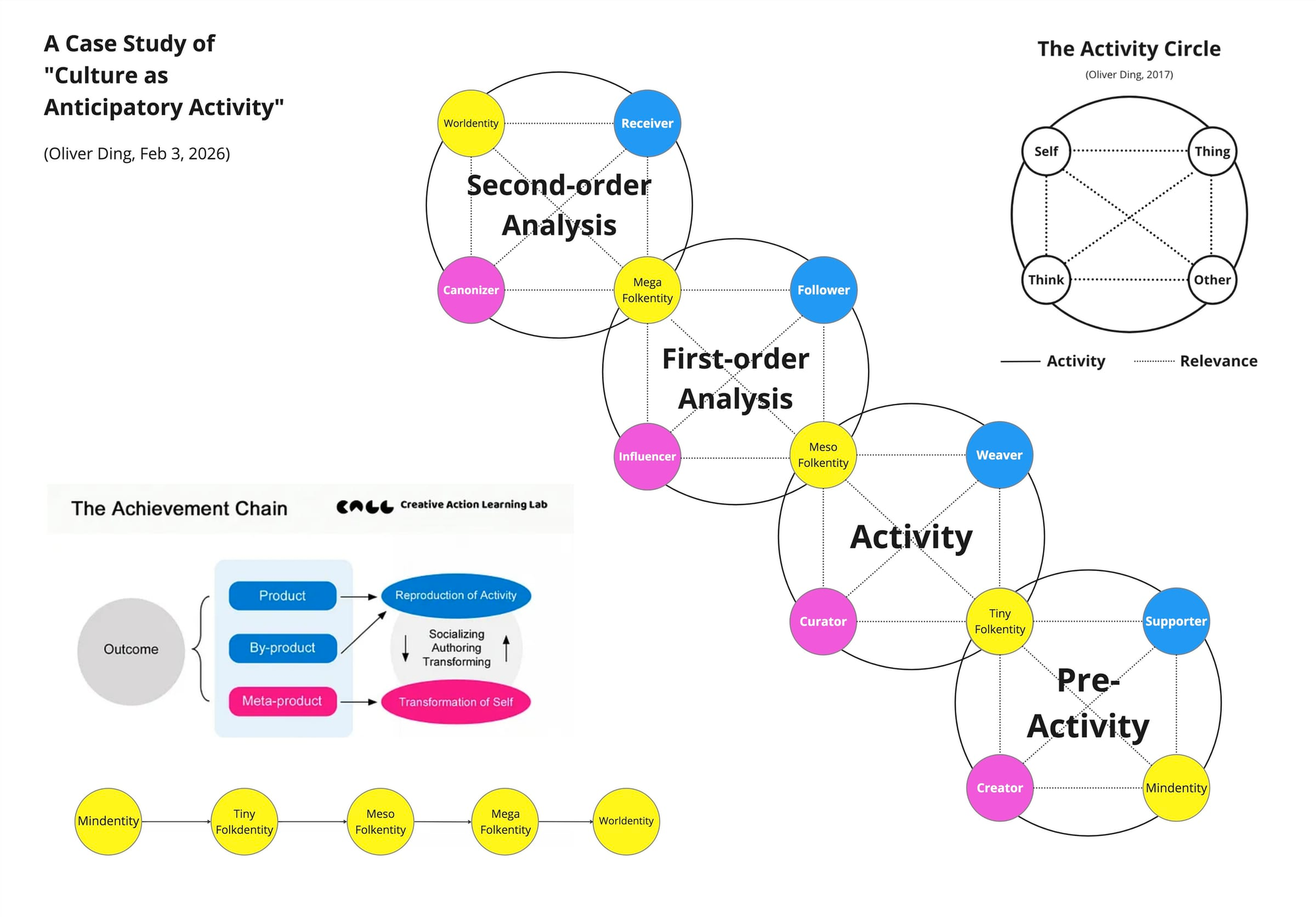
At the Mindentity stage, a thematic creation already has material form — notes, private drafts, personal diagrams — though it has not yet entered social life. These are Artifacts in the full sense: material objects subject to physical constraints. The private notebook is as much an Artifact as the published book; what differs is not its material status but its social reach. The constraints are the same: the notebook can be lost, its ink can fade, its pages can burn.
At the Folkentity stage, Artifacts multiply and diversify as the community develops its thematic creation through collective project engagement. The range of Artifacts expands — from founding documents to tools to institutional forms — each carrying the Folkentity’s structure into new material configurations. Here, the material constraints become matters of collective concern: the community must preserve its texts, maintain its tools, and ensure the physical continuity of its practices.
At the Worldentity stage, Artifacts achieve their maximum durability and autonomy. The pyramids, Newton’s Principia, the Linux kernel: these are Artifacts whose material persistence no longer depends on the ongoing effort of any particular community. They have, in a sense, solved the problem of material continuity — and this solution is part of what constitutes their status as Cultural Givenness. They are now part of the material world that every new community encounters as already there.
5.4 Artifact and the Other Elements
The relationship between Artifact and the other three elements in the Cognitive Container deserves careful attention.
Artifact is not simply “the thing” while the others are “aspects of the thing.” All four elements are aspects of how a Folkentity projects into the World of Life. But Artifact is the one that faces material reality most directly — it is the hardest, least negotiable face of the projection.
A community can choose its Genre — can decide what norms of excellence it will commit to. It can choose its Medium — can decide which social environments it will inhabit. It can shape how Representation works — can develop new diagrams, new narratives, new ways of making itself cognitively accessible. But it cannot choose to be free of material constraints. Every Artifact must be made of something, must exist somewhere, and must obey the physical laws that govern its material form.
This irreducibility is what gives Artifact its distinctive character — and what makes its functional separation from Medium, Representation, and Genre essential for precise analysis.
Part 6: Medium
Part 6 introduces Medium — the social-environmental face of Cultural Projection, operating at the interface between a Folkentity and the collective formations of the World of Life.
6.1 Definition and Origin
Medium is defined as the social-environmental function of Cultural Projection: the socially recognized communicative carrier through which a Folkentity reaches collective life and Cultural Experience becomes possible at different scales.
The concept of Medium is most powerfully articulated in Marshall McLuhan’s media theory, particularly as developed in Media and Formal Cause (McLuhan & McLuhan, 2011). McLuhan’s central insight — “the medium is the message” — is precisely a claim about formal cause: what matters is not merely the content conveyed, but the way the medium itself shapes the pattern of experience. A medium is not a neutral channel; it is “an invisible, ever-present vortex of services and disservices” — the formal environment within which perception, relation, and participation take shape.
This insight has often been obscured by subsequent readings that reduce “medium” to technological platforms or physical channels — print, television, the internet — as if the medium were simply the material object that carries content. Such readings collapse Medium into what the ACS framework calls Artifact, losing sight of what is genuinely distinctive about the medium’s work.
The ACS framework reclaims McLuhan’s attention to formal environment while giving it analytical precision. Medium, in our terms, is a communicative carrier — a channel that enables meaning to travel from some to others. But what makes a carrier communicative is not its material properties alone; it is social recognition. A channel functions as a Medium only insofar as a collective acknowledges it as a legitimate way for a Folkentity to reach its members. This social recognition is what distinguishes Medium from Artifact: Artifacts exist materially whether anyone acknowledges them or not; Media exist only in and through collective acknowledgment.
Medium thus faces the Collectives boundary because its operation is fundamentally social. It answers not “why does this matter?” (that is Genre) nor “how is this made?” (that is Artifact) nor “how is this understood?” (that is Representation), but “who can receive this?” — and under what social conditions, at what scales of collective life.
6.2 Medium as Shared Communicative Carrier
Medium, at its core, is a shared communicative carrier — a channel that functions not because of its material properties alone, but because a collective acknowledges it as a legitimate way for a Folkentity to reach its members. It is the common ground that makes communication possible: the shared understanding that “this is how we exchange meaning here.”
To call Medium a “shared communicative carrier” is to say two things.
First, it is a carrier: it enables meaning to travel from some to others, across space and time. This is what distinguishes Medium from Genre (which provides normative orientation) and from Representation (which provides cognitive content). Medium is the “how” of transmission — the channel through which a Folkentity reaches collective life.
Second, it is shared: it functions only insofar as a collective recognizes it as legitimate. A carrier that no one acknowledges as a way to communicate is not a Medium; it is just a physical object. This social recognition is what distinguishes Medium from Artifact. Artifacts exist materially whether anyone acknowledges them or not; Media exist only in and through collective acknowledgment.
Because Medium is a shared communicative carrier, every Medium carries with it social protocols — the implicit and explicit rules that govern how the carrier is used, who can use it, what counts as legitimate communication within it. These protocols are not the Medium itself; they are the operating rules that make the carrier usable. But they are inseparable from it: a carrier without protocols is just a physical channel, not a Medium.
The ACS framework separates these functions. The physical book is an Artifact; the conventions of scholarly publishing — what counts as a valid citation, what makes an argument credible, who is authorized to review — constitute the social protocols of that Medium. The smartphone’s hardware is Artifact; the platform norms, messaging etiquette, and community expectations that govern its use constitute the social protocols of that Medium. The material carrier enables communication; the shared protocols define what counts as communication in the first place.
This is why Medium faces the Collectives boundary: its operation is fundamentally social. It is not about what the object is (that is Artifact) but about what the collective agrees to treat as a legitimate communicative channel. A carrier is a Medium only insofar as it is shared — only insofar as a community recognizes it as “the way we do things here.”
6.3 Medium and Cultural Experience
If Medium’s essence is being a shared communicative carrier, its consequence is the shaping of Cultural Experience. The same Folkentity, carried by different Media, produces fundamentally different Cultural Experiences.
Consider a philosophical dialogue as Genre:
- In an academic journal (Medium), it becomes a contribution to scholarly literature, subject to peer review, citation counts, and disciplinary gatekeeping
- In a classroom (Medium), it becomes a pedagogical tool, shaped by curriculum constraints, student comprehension levels, and institutional learning objectives
- In a podcast (Medium), it becomes public intellectual discourse, shaped by audience engagement, episode length, and the host’s interview style
- In an online forum (Medium), it becomes participatory conversation, shaped by threading algorithms, moderation policies, and community norms
The Genre (philosophical dialogue) remains recognizable across these Media, but the Cultural Experience — what it feels like to encounter it, what it demands of participants, what kinds of responses it invites — differs dramatically. Because each Medium is a different shared communicative carrier, with different social protocols, the experience of participating in it is fundamentally different.
Because the carrier is shared — because everyone participates in the same protocols — the experience is collective, not merely individual. This is the mark of Medium’s work: it transforms a cognitive encounter (Representation) and a normative orientation (Genre), carried through material form (Artifact), into a collective event, something that happens among people who share the same communicative ground.
This observation has direct implications for understanding how Folkentities grow. A Folkentity’s trajectory from Tiny to Meso to Mega scale is, in significant part, a story of Medium transitions: the same thematic creation finding new social environments that can carry it to wider collectives. Each new Medium brings new social protocols, new forms of validation, and new communities of reception. A Folkentity that cannot find new Media to inhabit remains Tiny; one that successfully migrates across Media can achieve global reach.
6.4 Academic Decoupling
The term “medium” (and its plural “media”) is used across disciplines in remarkably varied ways. As Janet H. Murray observes in Inventing the Medium (2012), “in common parlance the word ‘medium’ can refer to anything from a set of charcoal pencils to a multinational entertainment corporation, encompassing technologies as tangible as marble sculpture or as imperceptible as radio waves” (pp. 29–30).
Murray herself offers a considered definition: “for our purposes, a medium is any combination of materials and cultural practices that is used by human beings to support the intentional communication of meaning.” She further specifies that “the materials and cultural practices that make up any medium serve three nested processes: inscription, transmission, and representation.”
This definition is thoughtfully constructed, yet it illustrates a tendency the ACS framework deliberately avoids: making “medium” an expansive category that encompasses multiple distinct functions. In Murray’s formulation, “medium” includes:
- Materials (which the ACS framework assigns to Artifact)
- Cultural practices (which span Genre and the social recognition dimension of Medium)
- Inscription, transmission, and representation (which the ACS framework separates into Artifact, Medium, and Representation)
This expansiveness is useful for certain purposes — it allows designers to see the whole communicative situation as their canvas. But for analytical precision, it conflates phenomena that operate according to different logics: material constraints, social recognition, normative frameworks, and cognitive structures.
The ACS framework takes the opposite approach. Rather than expanding “medium” to cover everything involved in communication, we narrow it to a single, distinct function: the socially recognized communicative carrier. Other functions are assigned to other concepts:
- Artifact handles material constraints and physical persistence
- Genre handles normative frameworks and questions of ultimate meaning
- Representation handles cognitive content and symbolic structure
This narrowing is not a rejection of broader definitions like Murray’s. It is a division of labor. By giving each function its own concept and its own boundary within the Cognitive Container, the ACS framework enables questions that broader definitions obscure: How does a change in material substrate (Artifact) affect what can be transmitted through a socially recognized carrier (Medium)? How does a new Genre emerge within an existing Medium? How does the same Representation function across different Media and Genres?
In short: we do not attempt to improve upon the many existing uses of “medium.” We simply reserve the term for one specific job — tracking the social recognition that makes a communicative carrier legitimate — and rely on other concepts to do the rest.
Part 7: The Strategic Curation
Part 7 brings the four elements together, revealing the structure they form when curated through the principle of Double Curativity.
7.1 The Configuration
We have now examined each of the four elements that constitute the Cognitive Container of Cultural Projection:
- Representation, near the left boundary of Individuals: the individual-cognitive interface through which a Folkentity becomes accessible to personal understanding
- Genre, near the upper boundary of Spirituality: the meaning-normative framework through which representations acquire cultural grammar and ultimate orientation
- Artifact, near the lower boundary of Science: the material-operational substrate through which a Folkentity acquires persistent physical form
- Medium, near the right boundary of Collectives: the social-environmental protocol through which a Folkentity reaches collective life and generates Cultural Experience at different scales
These four elements are not separate “factors” that independently contribute to Cultural Projection. They form a configuration — a dynamic whole in which each element shapes and is shaped by the others.
7.2 The Double Structure of Cultural Projection
Each of the four elements carries a double structure that mirrors the spatial logic of Cultural Projection itself. Each operates at two levels simultaneously: facing outward from the Folkentity toward the relevant boundary of the World of Life, and facing inward from that boundary back toward the Folkentity and its community.
Representation faces both the individual person (what the Folkentity offers as a cognitive interface) and the Folkentity’s own structure (which the individual’s understanding reflects back and enriches).
Genre faces both the symbolic universe (where the Folkentity claims its place in the normative order) and the community’s practice (which the normative order shapes and orients).
Artifact faces both the material world (which the Folkentity must engage on physical terms) and the community’s productive activity (through which those material constraints are navigated and worked with).
Medium faces both the wider collectives (which the Folkentity reaches through socially recognized carriers) and the community’s own social organization (which those carriers simultaneously enable and constrain).
7.3 The Nested Structure
The four elements do not merely coexist within the Cognitive Container — they stand in a relationship of containment and dependency that the Container(Containee) schema makes precise.
The nesting logic follows a clear direction: from the most intimate interface with individual cognition, outward through normative meaning, material form, and finally social recognition.
Representation (innermost) — the external symbol system through which a Folkentity becomes accessible to cognitive engagement. Representation is the public face of the thematic creation: the code, the diagram, the text, the notation — any structured set of symbols that can be perceived, manipulated, and interpreted by individuals. It is the external form that Mental Models encounter and work with. Without Representation, there is no cognitive access — no public thing for minds to grasp.
Genre (second layer) — Representation does not float free; it is always already shaped by Genre. Genre provides the normative framework within which representations become legible and culturally meaningful: it tells participants what standards apply, what counts as a valid contribution, what the creation is ultimately oriented toward. Genre gives Representation its cultural grammar. Without Genre, representations are cognitively available but culturally unmoored.
Artifact (third layer) — Genre-shaped representations must be anchored in material form. Artifact is the level at which the meaning-structure acquires physical presence, subject to the constraints of natural laws. It carries Representation and Genre across time and space as a durable object in the world.
Medium (outermost) — Materially anchored meaning-structures become cultural only when they are carried by socially recognized channels. Medium is the outermost layer because social recognition is the condition that must be in place for all the inner layers to function as Cultural Projection. Without Medium, even the most durable Artifact remains a physical object rather than a communicative carrier — a stone with markings, not a message for a community.
The nested structure can be written as:
Medium { Artifact [ Genre ( Representation ) ] }
This formula expresses the analytical relationship among the four elements: Representation is always encountered within a Genre; Genre is always realized through an Artifact; Artifact always operates within a socially recognized Medium. Each outer layer provides the enabling condition for the inner layers to function as culture.
7.4 The Mental Models — Cultural Medium Fit, Revisited
The DDD Model identified the Mental Models — Cultural Medium fit as the core of the DESIGN container, but left its internal logic underspecified. This article now provides the answer — not as a two-term relationship, but as a four-element structure distributed across the four boundaries of the Cognitive Container.
The fit is not a binary correspondence between two things. It is the condition achieved when all four elements are functioning coherently together:
- when Representation makes the thematic creation cognitively accessible to individuals
- when Genre provides the normative framework that gives that representation its cultural meaning and orientation
- when Artifact grounds the meaning-structure in persistent material form, subject to physical constraints
- when Medium constitutes the socially recognized communicative carrier through which the creation reaches collective life at different scales
A Folkentity does not simply “have” these four elements; they are the products of ongoing choices by its community. This is where strategic curation enters. The community curates:
- which Representations best capture the thematic creation’s cognitive core
- which Genre provides the appropriate normative orientation
- which Artifacts offer the most durable and appropriate material form
- which Media serve as the most effective socially recognized carriers at different scales of collective life
Strategic curation is the art of aligning these choices — of ensuring that Representation, Genre, Artifact, and Medium work together rather than at cross-purposes. A mismatch at any layer can derail the entire projection: a Genre that conflicts with the Medium’s social protocols, an Artifact that cannot carry the Representation reliably, a Representation that fails to make cognitive contact with its intended participants.
The fit, when achieved, is the alignment of all four: a Folkentity that can be understood (Representation), that means something (Genre), that persists (Artifact), and that reaches people through socially recognized channels at appropriate scales (Medium). When any one of these is missing or misaligned, the fit fails — not because two things don’t match, but because the Cognitive Container is incomplete. Strategic curation is the practice of maintaining this completeness across the life of the Folkentity.
Conclusion
This article has made three theoretical contributions.
The first is a move from the DDD Model to its underlying anatomy. The Mental Models — Cultural Medium fit, identified in Design-oriented Project Engagement as the core of the DESIGN container, has here been unpacked into a four-element structure that reveals the distinct cognitive, normative, social, and material dimensions of that fit. What appeared as a binary relationship is shown to be a nested configuration with its own internal logic.
The second is a structural contribution to the World of Life framework. A new spatial layer has been named and mapped: the Cognitive Container of Cultural Projection, the interface zone between the Folkentity’s projective boundary and the structural limits of the World of Life. Four concepts — Representation, Genre, Artifact, Medium — find their location within this zone, each anchored to one dimension, each given a function that is exclusively its own.
In identifying this zone, this article contributes to the ongoing project of filling in the World of Life framework. Just as Personal Orientation mapped the space between the individual and the project, this article maps the space between the Folkentity and the World of Life.
The Folkentity that projects into the world does not do so through a single operation. It operates simultaneously through Representation (making itself cognitively available to persons), through Genre (connecting itself to the normative universe of meaning), through Artifact (grounding itself in the material constraints of the physical world), and through Medium (reaching the social formations of collective life). Together, assembled as:
Medium { Artifact [ Genre ( Representation ) ] }
— these constitute the full face of Cultural Projection: how a thematic creation inhabits the world.
Finally, with the four elements differentiated and their nested relationship established as Medium { Artifact [ Genre ( Representation ) ] }, we gain not only analytical precision but also the ability to anticipate, monitor, and shape a Folkentity’s development — a practice this article calls strategic curation.
References
- The Cultural Projection Model 2025 (Oliver Ding, November 2025)
- Design-oriented Project Engagement (Oliver Ding, February 2026)
- Folkentity: The Object of Cultural Projection (Oliver Ding, February 2026)
- Worldentity: The Cultural Givenness of Thematic Creation (Oliver Ding, February 2026)
- Personal Orientation of Cultural Projection (Oliver Ding, February 2026)
- Weave the Culture: One Meta-Framework and Four Mechanisms of Cultural Development (Oliver Ding, 2025)
- Curativity as Action Opportunity (Oliver Ding)
- Culture as Anticipatory Activity: Mindentity, Folkentity, and Worldentity (Oliver Ding, 2026)
Version 1.0 - February 26, 2026 - 7,911 words