
Culture as Anticipatory Activity
The Ontology of Thematic Creation and Agency Cascade
by Oliver Ding
February 21, 2026
This article is part of the ongoing development of Anticipatory Cultural Sociology (ACS), contributing to the Ontology of Thematic Creation series. It integrates three recently developed concepts—Mindentity, Folkentity, and Worldentity—through the Agency Cascade model, and reads this integration against the background of the "Culture as Thematic Enterprise" framework.
Contents
Introduction: Three Concepts, One Ontological Spectrum
1. Deepening the Foundation: From Operations to Ontology
1.1 The Existing Framework
1.2 The Theoretical Foundation: Attachance and Self-Us-Awe
2. The Agency Cascade: Four Levels of Cultural Development
Level 1 — Pre-Activity: Creator and Supporter
Level 2 — Activity: Curator and Weaver
Level 3 — First-Order Analysis: Influencer and Follower
Level 4 — Second-Order Analysis: Canonizer and Receiver
3. Transitions: Attachance as the Engine of the Cascade
4. The Ontological Depth of the Operational Framework
Conclusion
Introduction: Three Concepts, One Ontological Spectrum
In the past several weeks, three articles have established the Ontology of Thematic Creation for Anticipatory Cultural Sociology. Each article introduces a concept that names a distinct mode of existence for thematic creations in the social world.
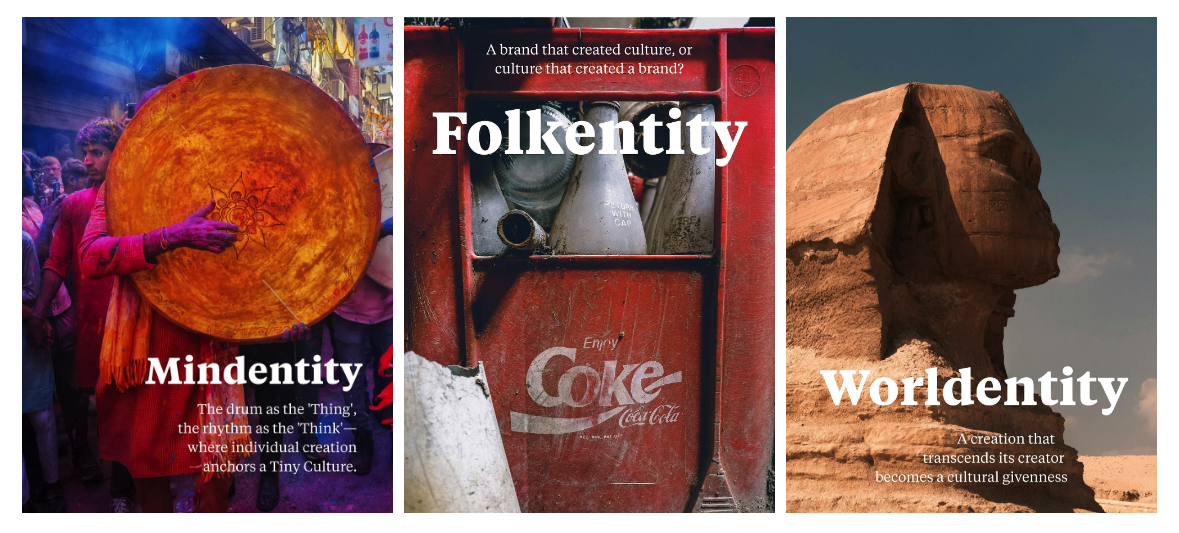
Mindentity is the First Principle of Thematic Creation: all results of thematic creation exist first as Mindentities, anchored in the creator's psychological ownership, prior to any external reward, recognition, or collective engagement. Before a creative work becomes a product, an organization, or a cultural landmark, it is a Mindentity—existing through the creator's control, intimate knowledge, and self-investment, and beginning its journey toward ecological objectification.
Folkentity is the Missing Middle: the ontological status of thematic creations that have entered collective life as active objects of Cultural Projection. A Folkentity is collectively held, collectively reproduced, and collectively developed—sustained by the distributed psychological ownership and generative projectivity of a community of participants. It is neither "mine" nor "already there for the world"—it is, in a precise sense, ours.
Worldentity is the Cultural Givenness of thematic creation: the ontological status of creations that have transcended their creators and communities to become given structures in the World of Life. A Worldentity is "already there"—encountered by subsequent generations as a structural feature of their world, independent of any individual's ownership or any community's ongoing effort. The Egyptian pyramids, a two-hundred-year-old village couplet, a mother tongue: these are Worldentities.
Together, the three concepts form a complete ontological spectrum:
Self — Us — Awe
The Mindentity belongs to the Self; the Folkentity belongs to Us; the Worldentity inspires Awe—that particular experience of encountering something given, something larger than any individual or community, something that simply is.
This article has two tasks. The first is to explain the theoretical foundations of this ontological spectrum—how it emerges from Attachance Theory and the Self-Us-Awe schema. The second is to show how this spectrum unfolds dynamically through the Agency Cascade model, in which each level of cultural development anticipates and enables the next. Together, these two moves constitute a significant deepening of the "Culture as Thematic Enterprise" framework—moving it from an operational description of cultural development to an ontological account of what thematic creations are, and how they become what they are.
1. Deepening the Foundation: From Operations to Ontology
The Existing Framework
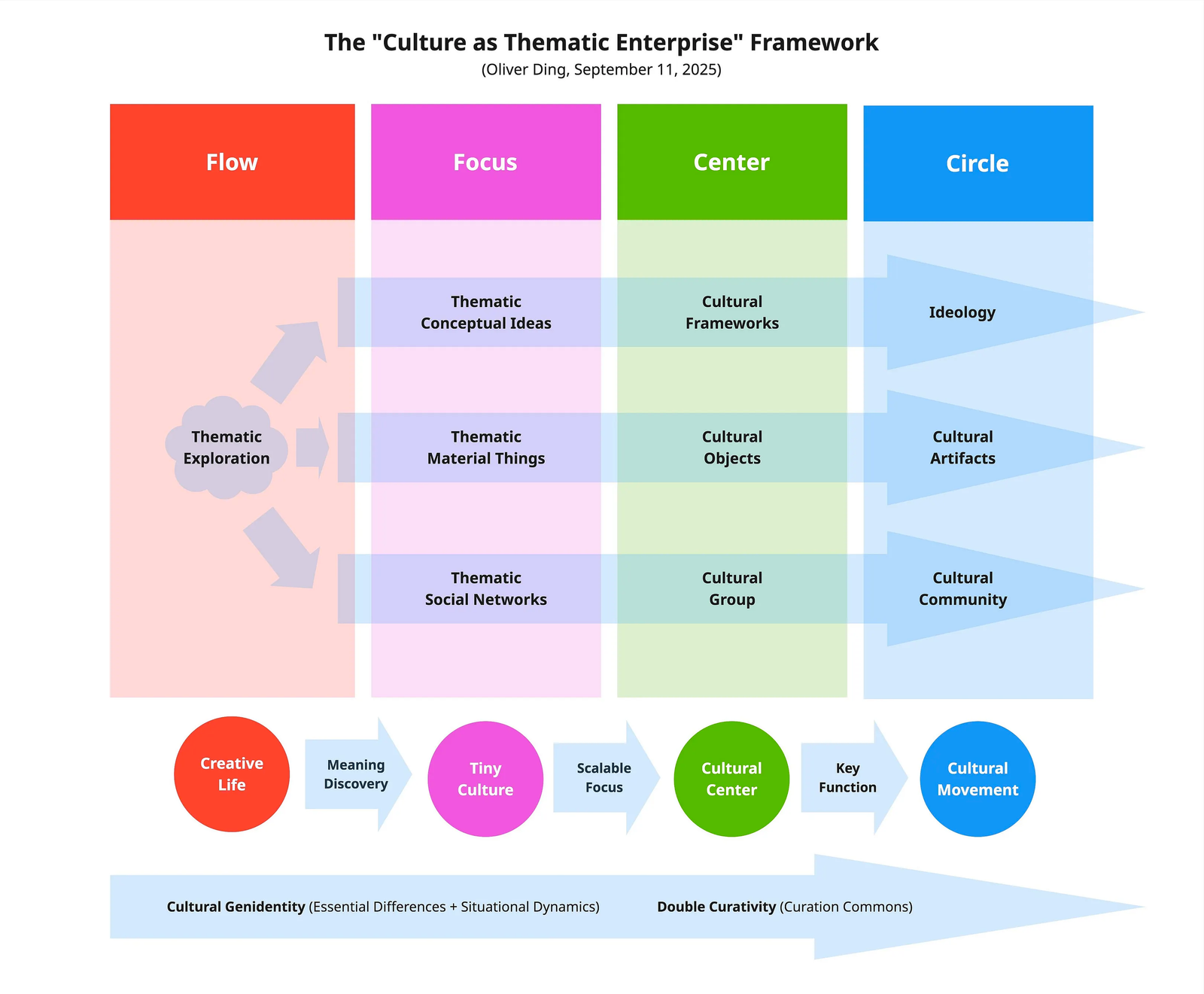
The "Culture as Thematic Enterprise" framework, developed in September 2025, describes how individual creative exploration naturally evolves through four stages: Creative Life (meaning discovery) → Tiny Culture (scalable focus) → Cultural Center (key function) → Cultural Movement. Each stage has independent value, and evolution happens organically rather than by design.
The framework is organized by the Flow-Focus-Center-Circle schema, and identifies three parallel tracks of cultural development across these stages:
- Thematic Conceptual Ideas → Cultural Frameworks → Ideology
- Thematic Material Things → Cultural Objects → Cultural Artifacts
- Thematic Social Networks → Cultural Group → Cultural Community
This is a rich and generative framework. But it is primarily an operational account—describing what creators and communities do, what forms they produce, what tracks development follows. What it does not yet address is the ontological question: what is the thematic creation itself at each stage of its development? What is its mode of existence as it moves from individual creative act to cultural given?
This is the gap that the Ontology of Thematic Creation fills. The three concepts—Mindentity, Folkentity, Worldentity—do not replace the operational framework. They deepen it by providing an ontological layer beneath the operational one. The same thematic creation that is operationally a Thematic Conceptual Idea or a Cultural Framework is ontologically a Mindentity, a Folkentity, or a Worldentity—depending on its social life, its relationship to psychological ownership, and its degree of Cultural Givenness.
This deepening is the move from ACS v1.0 to ACS v1.1.
The Theoretical Foundation: Attachance and Self-Us-Awe
The ontological spectrum of Mindentity-Folkentity-Worldentity is not merely descriptive. It has a theoretical foundation in Attachance Theory and the Self-Us-Awe schema.
Attachance Theory, a core principle of ACS, addresses the ecological meaning and value of attaching and detaching acts—the process of moving between containers. The basic model of Attachance thinking is: Container [Configuration (Elements)], in which creative life proceeds through a series of attach and detach movements between containers of different kinds.
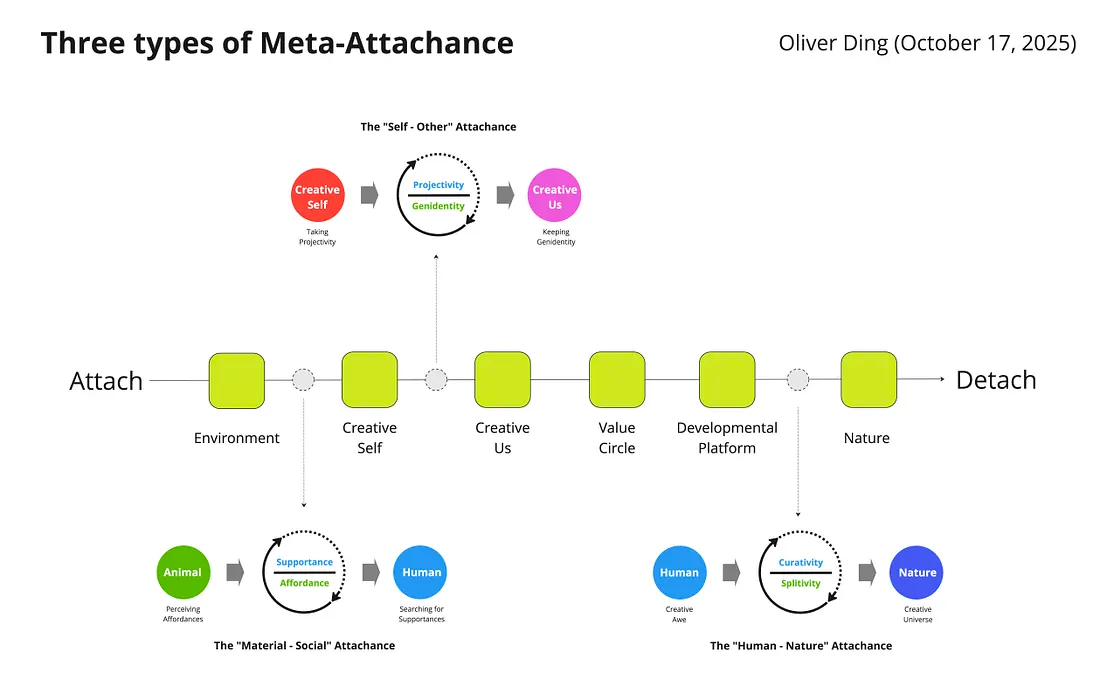
Three meta-attachances are particularly fundamental to understanding creative life:
- Material-Social Attachance: the acts of attaching and detaching between the material environment and the Creative Self
- Self-Other Attachance: the acts of attaching and detaching between Creative Self and Creative Us
- Human-Nature Attachance: the acts of attaching and detaching between Creative Us and Nature—the Creative Universe, the realm of Awe
These three meta-attachances correspond to three domains of creative life, captured in the Self-Us-Awe schema. The schema, inspired by Ping-keung Lui's theoretical sociology (Subjectivity → Intersubjectivity → Otherness), maps these three domains:
- Self (Subjectivity): the domain of individual creative activity, psychological ownership, and personal investment
- Us (Intersubjectivity): the domain of collective engagement, shared ownership, and community development
- Awe (Otherness): the domain of what exceeds human agency—the given structures of the world that we encounter as "already there"
The three ontological concepts map directly onto this schema:
- Mindentity exists in the Self domain—anchored in psychological ownership, beginning ecological objectification
- Folkentity exists in the Us domain—sustained by collective engagement, dependent on ongoing community participation
- Worldentity exists in the Awe domain—achieving autonomous existence as Cultural Givenness, no longer dependent on any Self or Us
This is the first theoretical function of Attachance in this article: it provides the ontological foundation for the Self-Us-Awe spectrum, showing that the three modes of thematic creation correspond to three fundamental domains of human creative life, each characterized by a distinctive form of Attachance.
2. The Agency Cascade: Four Levels of Cultural Development
The ontological spectrum—Self, Us, Awe—tells us what thematic creations are at different stages of their social life. The Agency Cascade tells us how they get there.
The Agency Cascade model emerged from the analysis of nested anticipatory structures in the "Education as Anticipatory Activity" framework. Its core principle: at each level of a nested system, the "Other" of that level becomes the "Self" of the next. Agency does not simply reside within individuals—it cascades through levels of social structure, each anticipating and enabling the next.
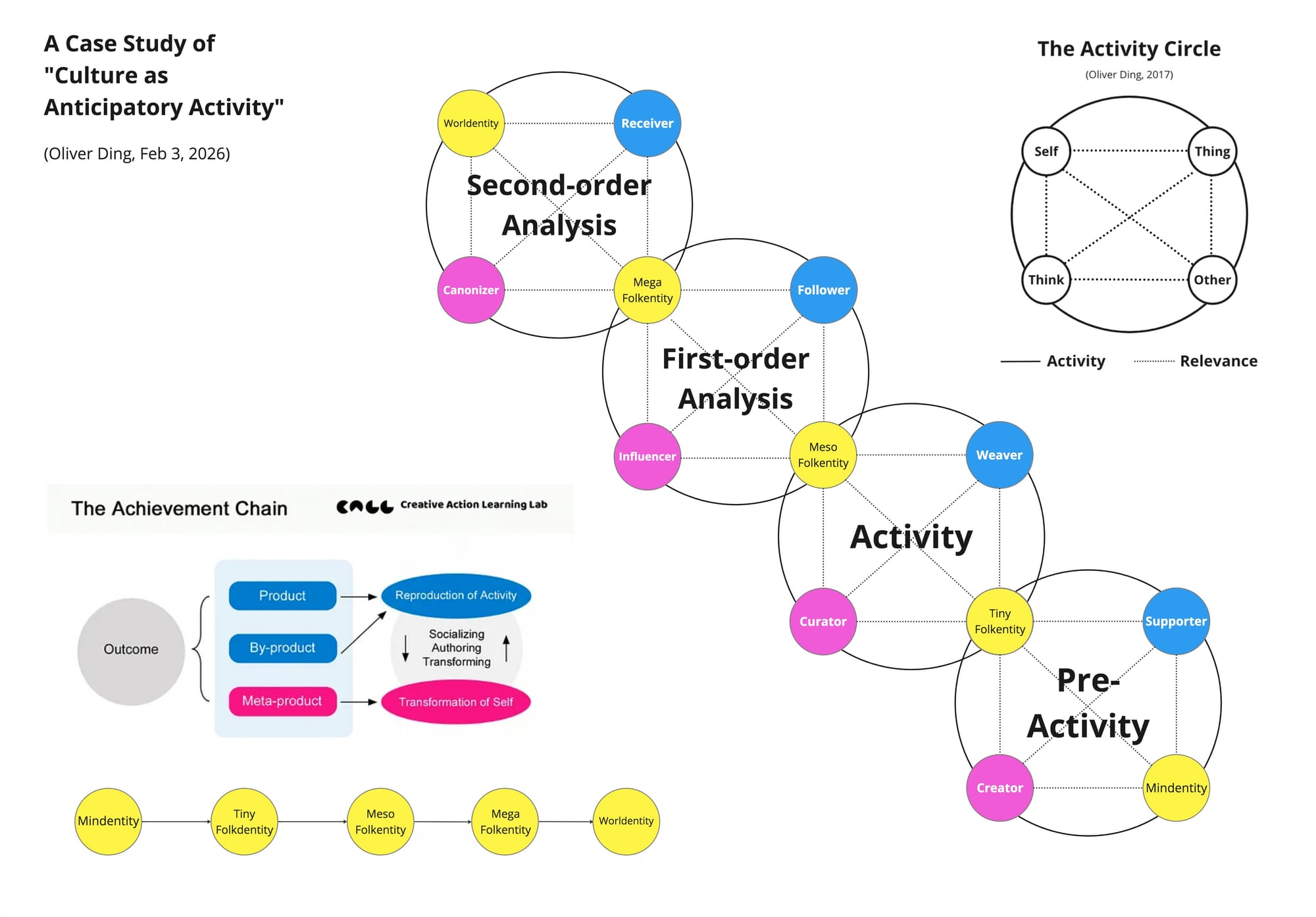
In the "Culture as Anticipatory Activity" framework, this cascade operates across four levels, each structured by the Activity Circle (Self / Other / Thing / Think). The cascade is the dynamic unfolding of the thematic creation's journey from Mindentity to Worldentity—from Self to Awe.
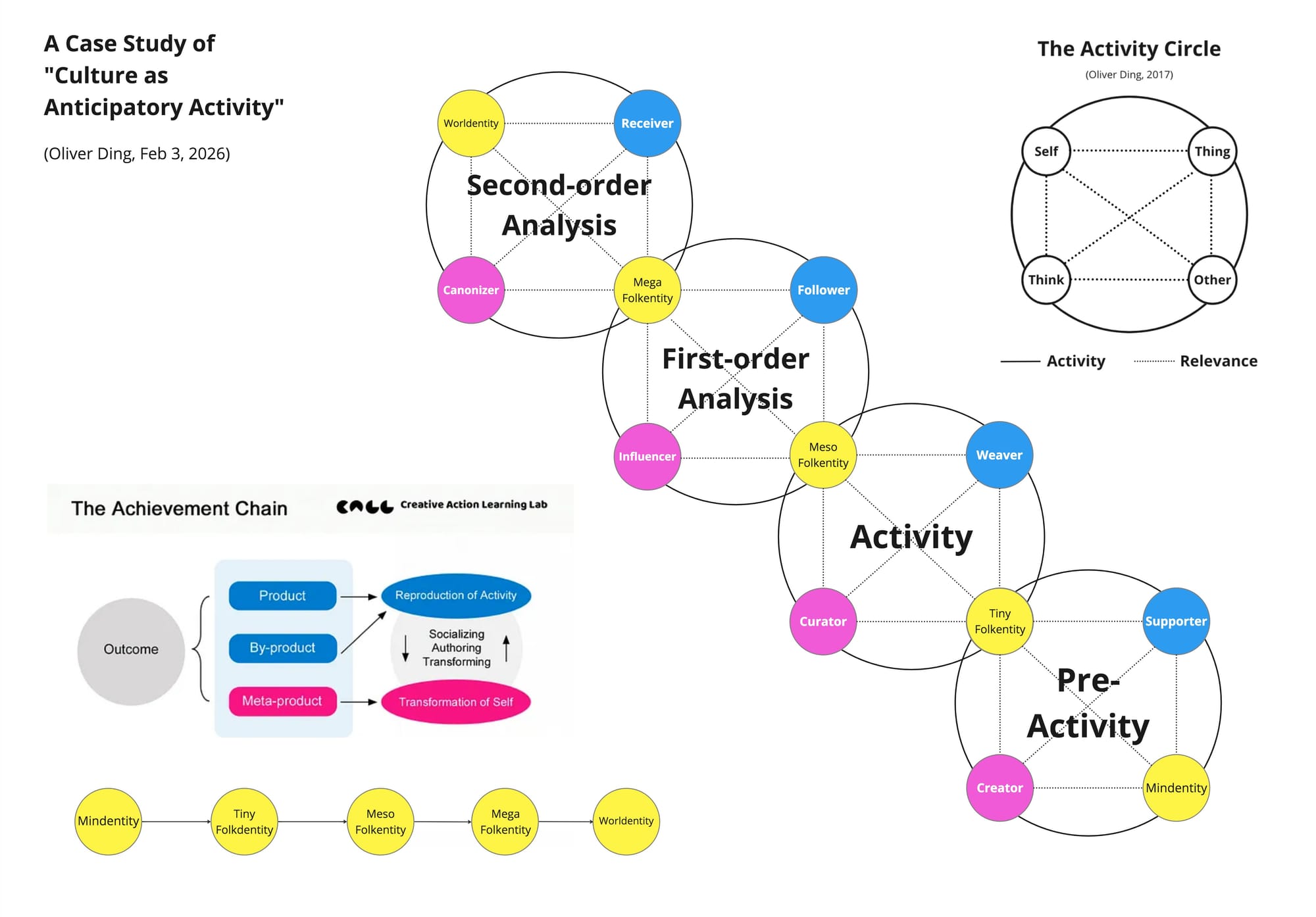
A crucial feature of this cascade: each new level does not replace the previous ones. The human relationships established at each stage persist into subsequent stages. What changes is the focus—each new level introduces a new form of Self-Other interaction, appropriate to new forms of complexity.
Level 1 — Pre-Activity: Creator and Supporter
Thing = Mindentity / Think = Tiny Folkentity
At the origin of every cultural creation stands a creator with a Mindentity. The Thing—the concrete anchor of this level—is the Mindentity itself: a creative result existing entirely within the creator's psychological ownership, not yet entered into collective life.
The Think—the predictive model, the anticipated future—is the Tiny Folkentity: the imagined community of early participants who might engage with this creation. The creator does not yet have a community; they have a vision of one. Every structural choice made at this stage is oriented toward that anticipated first engagement.
The new human relationship that emerges at this level is between Creator and Supporter—the first person or persons who recognize value in the Mindentity and invest their engagement in it. This is the most intimate and most theoretically neglected transition in cultural development. Traditional cultural sociology tends to begin its analysis with groups already formed, social pressures already operating. ACS insists that all collective cultural life begins here: in the anticipatory space between a Mindentity and its first imagined community.
This level corresponds to the Creative Life stage of the "Culture as Thematic Enterprise" framework—meaning discovery, the initial thematic exploration from which everything else may grow.
Level 2 — Activity: Curator and Weaver
Thing = Tiny Folkentity / Think = Meso Folkentity
At the second level, the Tiny Folkentity has formed. A small, intimate community—a Tiny Culture—has coalesced around the Mindentity, and the creation has become genuinely ours: a Folkentity at its most nascent scale. The Thing is now this collective reality; the Think anticipates growth into a Meso Folkentity—a broader field in which the creation becomes a major reference point for a professional community or subculture.
To support this anticipation, the community must engage in substantial ecological objectification: developing conceptual documents, material tools, and social networks—the three tracks of the "Culture as Thematic Enterprise" framework in active operation. This is the stage at which Thematic Enterprise genuinely begins to take shape.
The new human relationship that emerges is between Curator and Weaver—one who organizes meaning and maintains coherence, and one who builds connections and extends networks. The Creator-Supporter bond remains; what is added is this new functional differentiation appropriate to the growing complexity of collective life.
This level corresponds to the Tiny Culture stage—scalable focus, the first sustained collective effort to build something together.
Level 3 — First-Order Analysis: Influencer and Follower
Thing = Meso Folkentity / Think = Mega Folkentity
At the third level, the creation has achieved substantial social thickness. The Meso Folkentity is the infrastructure of a professional community or specialized field—a stable, recognized formation with its own norms, platforms, and internal culture. The Thing has real weight. The Think now anticipates a qualitative leap: crossing local boundaries into Mega-scale social influence.
This is the stage of flourishing—the Thematic Enterprise at its most generative, expanding beyond its original community into broader social consciousness. The creation begins to approach what might be called Cultural Givenness ante portas: people start to take it for granted, even before it has achieved true Worldentity status.
The new human relationship that emerges is between Influencer and Follower—one who shapes direction across communities, and one who engages from a distance, without personal connection to the creation's origins. The earlier bonds persist; what is added is this new scale of social reach and influence.
This level corresponds to the Cultural Center stage—key function, the moment at which the creation becomes load-bearing for a broader ecology.
Level 4 — Second-Order Analysis: Canonizer and Receiver
Thing = Mega Folkentity / Think = Worldentity
The fourth level stands at the threshold of Worldentity. The Thing—a Mega Folkentity—is already present everywhere. The Think is the ultimate anticipation: that this creation will cease to require the effort of any particular community to sustain it, that it will become a structural given of the world itself.
But this Think is, in the end, self-dissolving. When the anticipation is realized, it no longer needs to be thought. The Mega Folkentity collapses into Worldentity—no longer sustained by Us, now simply encountered as Awe. The Creative Givenness described in the Worldentity framework settles into place: temporal precedence, social presence, contingent necessity.
The new human relationship that emerges is between Canonizer and Receiver—one who formalizes and institutionalizes, fixing the creation in the cultural record, and one who inherits it as a given. Unlike the Follower, who still actively chooses to engage, the Receiver encounters the creation as simply part of the world—Cultural Givenness in its purest form.
This level corresponds to the Cultural Movement stage—the broadest circle of cultural engagement, approaching the horizon where culture and world become indistinguishable.
3. Transitions: Attachance as the Engine of the Cascade
The four levels describe the structure of the cascade. But what drives movement between levels? What enables a Mindentity to become a Tiny Folkentity, a Tiny Folkentity to grow into a Meso Folkentity, and eventually a Mega Folkentity to collapse into Worldentity?
The answer lies in the second theoretical function of Attachance in this article: Attachance as the dynamic mechanism of the Agency Cascade.
Each transition between levels is, in ACS terms, an Attachance event—a movement between containers, involving both detachment from one configuration and attachment to another. And each such Attachance event has two simultaneous dimensions:
- A Mental Move: the moment of perceiving a new Attachance—becoming aware of a new possibility, recognizing that a new form of engagement is now available or necessary. This is a shift in the predictive model, a re-orientation of the Think.
- A Social Move: the moment of entering a new human relationship—the actual attachment to a new community configuration, with its new patterns of Self-Other interaction.
Mental Move and Social Move are not sequential. They co-occur in the Attachance event: the recognition of a new possibility and the act of moving toward it happen together, each enabling the other.
Concretely, across the cascade:
Transition 1 → 2 (Mindentity → Tiny Folkentity): The creator perceives the possibility of the first community—a Self-Other Attachance in its most nascent form. The Mental Move is the imagination of "we"; the Social Move is the first act of sharing, the first invitation to a Supporter. The Mindentity begins its transformation into Folkentity.
Transition 2 → 3 (Tiny Folkentity → Meso Folkentity): The intimate community perceives the possibility of broader reach—a larger field in which the creation might become a standard or reference point. The Mental Move is the recognition of that possibility; the Social Move is the emergence of Curator and Weaver roles, the first systematic efforts at ecological objectification. The Tiny Folkentity begins its growth toward Meso scale.
Transition 3 → 4 (Meso Folkentity → Mega Folkentity): The professional community perceives the possibility of crossing its boundaries—of entering the broader social world beyond its specialized field. The Mental Move is the recognition of this threshold; the Social Move is the emergence of Influencer and Follower dynamics, the expansion of engagement beyond direct community membership.
Transition 4 → Worldentity (Mega Folkentity → Worldentity): This final transition has a different character. It is not driven by a community's anticipation in the same way. It happens—gradually, unevenly, often invisibly—as the Mega Folkentity's Cultural Givenness accumulates to the point where active maintenance becomes unnecessary. The Human-Nature Attachance is complete: Us gives way to Awe. The creation has ceased to require us; it simply is.
4. The Ontological Depth of the Operational Framework
We are now in a position to return to the "Culture as Thematic Enterprise" framework and read it at a new depth.
The framework's three operational tracks—conceptual, material, social—describe what creators and communities do as thematic creation develops. The Ontology of Thematic Creation describes what the creation is at each stage of that development.
These two levels are not parallel descriptions of the same thing. They are different analytical dimensions of the same phenomenon:
The operational level asks: What activities constitute cultural development? The ontological level asks: What mode of existence does the thematic creation have at each moment of that development?
A Thematic Conceptual Idea is, ontologically, a Mindentity—it exists in the creator's psychological ownership. As it enters the focus stage and becomes a Cultural Framework engaged by a community, it is becoming a Folkentity—its mode of existence is shifting from individual ownership to collective engagement. When it achieves the status of, say, an unquestioned disciplinary foundation that every practitioner inherits as given, it has become a Worldentity.
The same creation, the same operational trajectory—but ontologically, a profound transformation has occurred.
This is what it means to say that the Ontology of Thematic Creation deepens the "Culture as Thematic Enterprise" framework. The operational framework describes the surface; the ontological framework describes what is happening beneath that surface, in the mode of existence of the creation itself.
And this deepening is not merely descriptive. It is normative and practical: understanding the ontological status of a thematic creation at any given moment allows creators and communities to act more precisely. When does a Mindentity need protection rather than exposure? When does a Folkentity need consolidation rather than expansion? When has a creation already crossed into Worldentity—and what does that mean for the communities that still think of it as theirs?
Conclusion
This article has integrated three recently developed concepts—Mindentity, Folkentity, Worldentity—through two theoretical frameworks: the Self-Us-Awe schema (grounded in Attachance Theory) and the Agency Cascade model. The result is a unified account of thematic creation that is simultaneously ontological (what creations are) and dynamic (how they become what they are).
The Self-Us-Awe schema provides the ontological map: Mindentity in the Self domain, Folkentity in the Us domain, Worldentity in the Awe domain—each corresponding to a meta-attachance that characterizes a fundamental domain of creative life.
The Agency Cascade provides the developmental engine: four levels of cultural activity, each with its distinctive Self-Other configuration, each anticipating the next, driven by Attachance events that are simultaneously Mental Moves and Social Moves.
Together, they reframe the central question of cultural sociology. The question is not simply "how does culture change?" but "how do thematic creations move through ontological states, from Self through Us toward Awe, through cascading acts of anticipation and attachment?" This is what it means for culture to be anticipatory activity.
For the Anticipatory Cultural Sociology framework, this article marks a transition. ACS v1.0 assembled a landscape of frameworks, placing them in productive proximity. ACS v1.1 begins the work of genuine theoretical integration—developing a common ontological foundation beneath the operational frameworks, connecting the micro-dynamics of individual creation to the macro-dynamics of cultural development. The journey from Mindentity to Worldentity, read through the Agency Cascade, is one path through that integrated landscape. Others remain to be explored.
Related articles
- Tiny Culture: The “Culture as Thematic Enterprise” Framework (September 2025)
- The Landscape of Anticipatory Cultural Sociology (January 2026)
- Education as Anticipatory Activity (January 2026)
- Activity Analysis Network #10: Re-visiting, Re-building, and Agency Cascade (January 2026)
- Mindentity: The Ontology of Thematic Creation (January 2026)
- Worldentity: The Cultural Givenness of Thematic Creation (February 2026)
- Folkentity: The Object of Cultural Projection (February 2026)
- Meta-Attachance and Creative Life Coordinate (October 2025)
v1.0 — February 21, 2026 - 3,219 words