
Design-oriented Project Engagement

The Discover-Design-Deliver Model
by Oliver Ding
February 24, 2026
This article is part of the ongoing development of Anticipatory Cultural Sociology (ACS), contributing to the Cultural Projection series.
Originally, the Cultural Projection model was introduced in Developmental Projects: The Project Engagement Approach to Adult Development (Nov 2025). Later, in January 2026, it became a core member of a curated framework for the ACS theoretical enterprise.
In this article, I revisited the basic model of Platform Ecology, which was initiated in Platform for Development: The Ecology of Adult Development in the 21st Century (March 2021), and connected it with the ACS framework. The outcome is a new meta-framework:
Culture {Platform [Project (People)]}
This nested structure echoes the HLS framework, the map of ACS. HLS stands for History{Life[Self(Body)]}, a nested structure that is guided by the Container(Containee) schema.
After setting the meta-framework, I adopted the ECHO Way, a three-container model to curate a series of models, each corresponding to one layer of the meta-framework.
- Culture: The Cultural Projection Model
- Platform: The Concept-fit for Platform Innovation Model
- Project: The Developmental Project Model
- People: The Career-fit for Personal Innovation Model
However, the Development Project Model serves as "Project I," a component of the ECHO Way. From the perspective of ACS, there is a need to use the ECHO Way to develop a new model, to investigate the relationship between thematic creations and people who engage with them in various ways, as we see in Culture as Anticipatory Activity.
This insight inspired me to develop the Discover-Design-Deliver Model and further define Design-oriented Project Engagement, a sub-application of the Project Engagement approach.
Table of Contents
Part 1: Theoretical Foundation
1.1 The Container (Containee) Schema
1.2 The Platform Ecology Model
1.3 The Origins of Anticipatory Cultural Sociology
Part 2: The ECHO Way as Meta-framework
2.1 The ECHO Way
2.2 Culture: The Cultural Projection Model
2.3 Platform: The Concept-fit for Platform Innovation Model
2.4 Project: Mental Models and Predictive Models
2.5 People: The Career-fit for Personal Innovation Model
2.6 Design-oriented Project Engagement
Part 3: Developing the Discover-Design-Deliver Model
3.1 The Revisiting Moment
3.2 The Rebuilding: Thematic Reconfiguration
3.3 The Resulting Thematic Architecture
Part 4: DISCOVER—The Living Way of Concepts
4.1 Creative Flow: The Pre-Conceptual Source
4.2 The Living Way of Concepts: Six Operations
Part 5: DESIGN as Activity
5.1 Design as Ecological Objectification
5.2 Meta-Process and Concrete Methods
5.3 Concrete Design Methods—The Ecological Practice Design Example
5.4 Concrete Design Methods—The Mindware Development Example
Part 6: DELIVER—Medium as Environment
6.1 Cultural Medium as Container
6.2 Thematic Creation as Outcome
6.3 Diverse Social Environments
6.4 Current Limitations
Conclusion: The Creative Engine of World of Life
Part 1: Theoretical Foundation
Three theoretical foundations underpin the entire framework developed in this article: the Container(Containee) schema, the Platform Ecology model, and the origins of Anticipatory Cultural Sociology. Together they establish the ontological, ecological, and sociological ground from which the DDD Model emerges.
1.1 The Container (Containee) Schema
The ACS project adopts the HLS framework to understand the social world through a five-system lens: Body System, Mental System, Behavioral System, Cultural System, and Historical System.
HLS stands for History{Life[Self(Body)]}, a nested structure that is guided by the Container(Containee) schema.
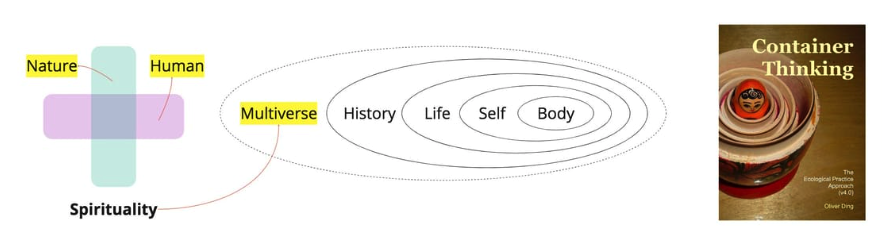
For the ACS project, the HLS framework provides a theoretical ontology of the social world, offering a structured context in which concept systems can be understood and mapped.
The Container(Containee) schema comes from Container Thinking: The Ecological Practice Approach (v4.0). The Ecological Practice Approach, born in 2019, was initially called the Gibson-Lakoff-Schön Approach, drawing from the theoretical contributions of James J. Gibson, George Lakoff, and Donald Schön. The historical development of the approach can be framed as five versions:
- 2019: The "Toolkit" version (Beta)
- 2020: The "Germ-cell" version (1.0)
- 2021: The "Hierarchy" version (2.0)
- 2023: The "Social (Cognition)" version (3.0)
- 2025: The "Meta" version (4.0)
These versions present a story of the organic growth of a theoretical enterprise. Each version contributes to the enterprise by adding new knowledge elements while preserving the Genidentity of the knowledge system—its core value and uniqueness.
In 2025, I developed a set of meta-frameworks to highlight a unified worldview and scientific perspective.
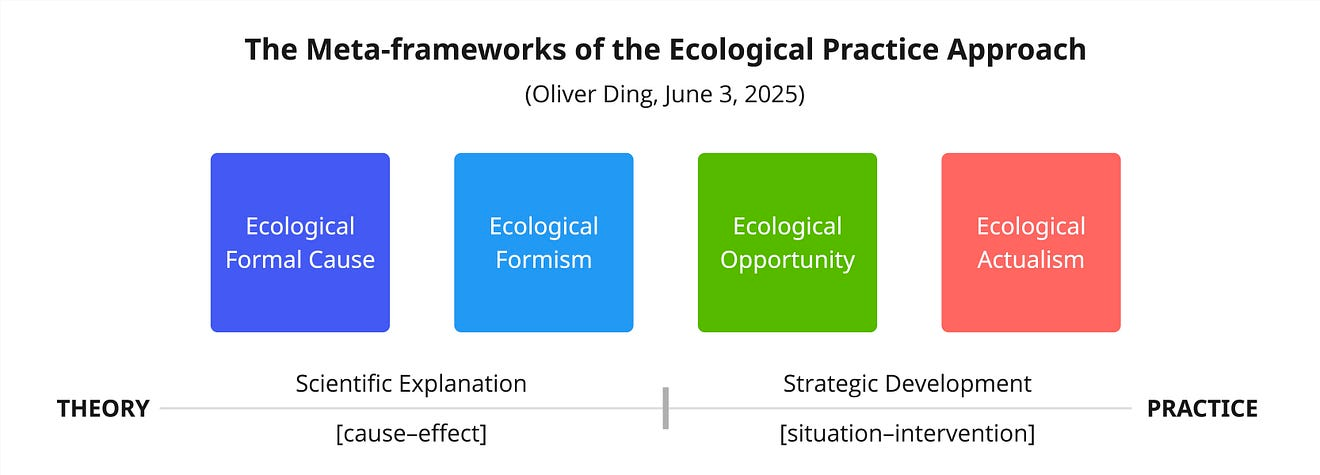
At the THEORY side, the approach is framed as a scientific project with two meta-frameworks: Ecological Formal Cause and Ecological Formism. On the PRACTICE side, it is presented as a practical project with two meta-frameworks: Ecological Opportunity and Ecological Actualism.
The Container(Containee) schema represents both a scientific explanation based on Ecological Formal Cause and a meta-framework as a creative heuristic.
1.2 The Platform Ecology Model
I started the Platform Ecology project in 2019. The major outcome of the project is a book (draft) titled Platform for Development: The Ecology of Adult Development in the 21st Century (2021). Platform Ecology refers to my vision of applying the ecological practice approach to study platform-related social practices. I consider it a knowledge enterprise that could lead to different projects, such as the Platform-for-Development framework, Platform as Container, Platform Innovation as Concept-fit, etc.
The Platform Ecology project aims to explore platform-based social practices, especially the Platform—People relationship. The configurational model is structured as:
Platformba{Platform[Project(People)]}
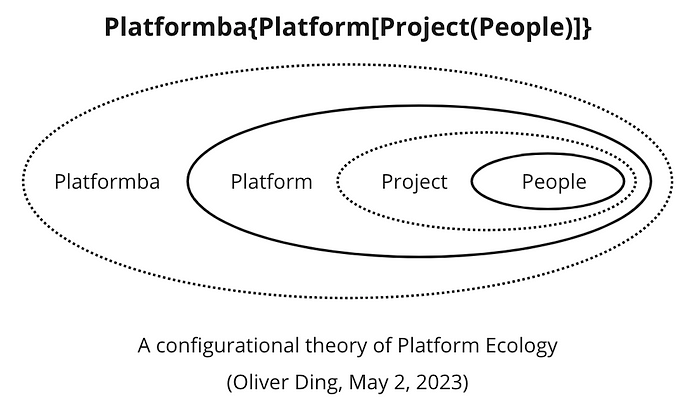
In order to describe the platform-based various activities and social practices, I coin the term Platform-ba, which means platform-based social field. While a Platform has a solid boundary, its Platform-ba has a soft boundary. Platform-based activities can happen both inside and outside the platform.
In the context of the ACS framework, we can scale the Platform Ecology model to a general model by using the term Culture to replace Platform-ba:
Culture {Platform [Project (People)]}
This nested structure echoes the HLS framework, the ACS map.
1.3 The Origins of Anticipatory Cultural Sociology
Anticipatory Cultural Sociology (ACS) emerged as a named theoretical enterprise in January 2026, but its roots reach back to the close of 2025. In late December 2025, while developing the Meta-frameworks book manuscript, the World of Life framework took shape as a theoretical companion to the World of Activity model—the conceptual heart of Creative Life Theory (v3.0, v3.1).
World of Life (World of Activity)
Creative Life Theory (v3.0, v3.1), developed throughout 2025 and documented in Lake 42: The Great Confluence, focused primarily on the World of Activity—the individual creator's perspective on social life. It asked: how does a person engage with projects, develop thematic enterprises, and navigate the flow of creative existence? The individual was the primary unit of analysis.
ACS shifts the emphasis to the World of Life—the broader social context in which creative activity occurs and through which it has consequences. The central question becomes: how do Concept Systems, developed through individual creative activity, become Thematic Creations that shape social life? How does the subjective become cultural? ACS names this movement and commits to understanding it theoretically and practically.
The first phase of ACS development curated six meta-frameworks, together constituting The Landscape of Anticipatory Cultural Sociology (January 2026):
- The Path of Creative Life and the Fleeting Moment
- The HLS Framework (v3.0)
- The Cultural Projection Model (2025)
- The AAS Framework (2021, 2022, 2024, 2025)
- The Cultural Genidentity Model (2025)
- The Culture as Thematic Enterprise Framework (2025)
These are all meta-frameworks: they describe deep structures, fundamental mechanisms, and the broad principles of cultural development. They are essential theoretical architecture. But as ACS development continued into February 2026, a structural gap became evident: these frameworks answer what and why, but not how.
The recent direction of ACS development has focused on elaborating the concept of Thematic Creation and its internal structure:
Thematic Creation(Concept System → Ecological Objectification → Embodied Experience → Collective Engagement)
The four elements in brackets are not a path toward Thematic Creation—they are its internal structure. Thematic Creation is itself the movement from Concept System through Ecological Objectification into Embodied Experience and Collective Engagement. This formula describes what Thematic Creation is and how it unfolds.
This thread connects the meta-frameworks and points toward the middle layer ACS requires. On February 23, 2026, the publication of Culture as Anticipatory Activity completed the ontological grounding of Thematic Creation, establishing what it is. The present work addresses how the Ecological Objectification moment—the inscription of Concept Systems into cultural containers—actually operates.
Part 2: The ECHO Way as Meta-framework
With the meta-framework Culture {Platform [Project (People)]} established, this part maps four existing models onto its four layers using the ECHO Way as an organizing tool. The goal is not merely to curate these models but to reveal the consistent logic running through them—and to identify where a new model is needed.
2.1 The ECHO Way
The ECHO Way is a three-container model, which is based on the Container(Containee) schema. Its basic model was formed by three containers: Container X, Container Y, and Container Z.
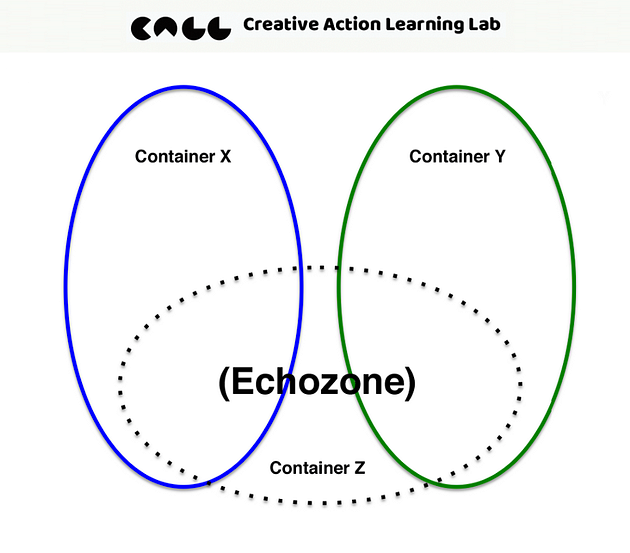
The ECHO Way expanded the basic model to three parts:
- Theme U
- Project I
- Container Z
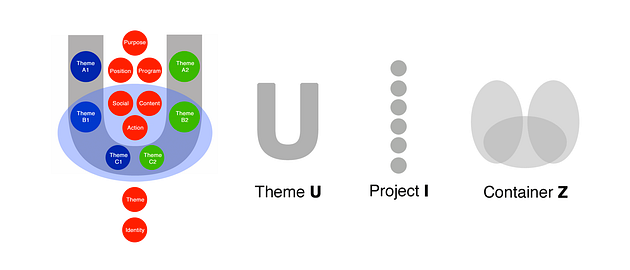
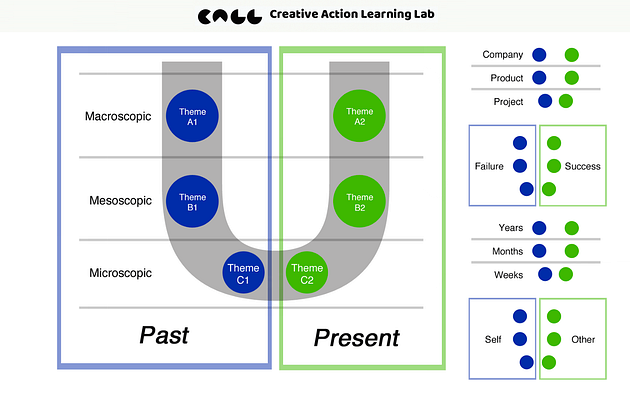
The Theme U diagram presents six themes in a U shape. Theme U is not only about six themes but also about representing complex thematic relationships with spatial mediation—for example, to explain Pairs of Opposite Themes.
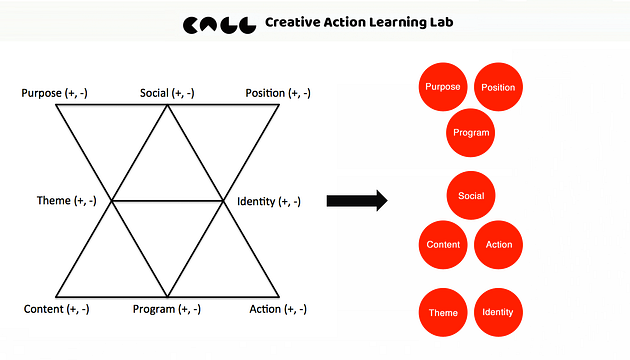
The Project I diagram is inspired by the Developmental Project Model, modified to enable Diagram Blending, which can be used for curating two or more frameworks together. This means the ECHO Way is not a primary framework since it connects to other frameworks.
The Container Z, also called Echozone, provides a concrete approach to transformation by engaging with opposite themes. The ECHO Way is about the fit between two sides, and that fit happens at the Echozone.
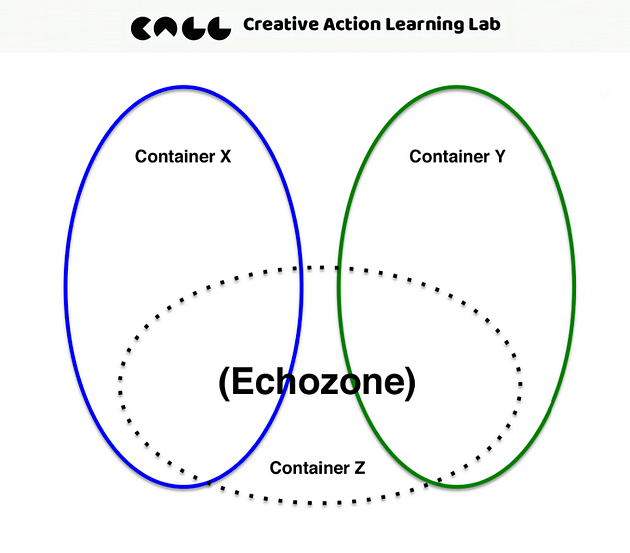
The ECHO Way is defined as a practical framework for guiding research, design, and development in the real-life world. As a knowledge framework, it has three components: diagrams, concepts, and methods.
In the following sections, based on the Culture {Platform [Project (People)]} schema, several examples were curated into a toolkit for the ACS project.
2.2 Culture: The Cultural Projection Model
The Cultural Projection Model emerged in October–November 2025 as a culmination of the Project Engagement Approach's development from 2021 to 2025. It was designed to curate newly developed ideas around the "Outside—Projecting—Inside" triad, building upon Activity Theory's internalization-externalization principle.
The model is framed by three conceptual containers:
- Container X: Activity (Objective Process) — Social Landscapes and Social Moves
- Container Y: Enterprise (Subjective Experience) — Thematic Spaces and Mental Moves
- Container Z: Projecting (Cultural Projection) — the movement between outside and inside positions
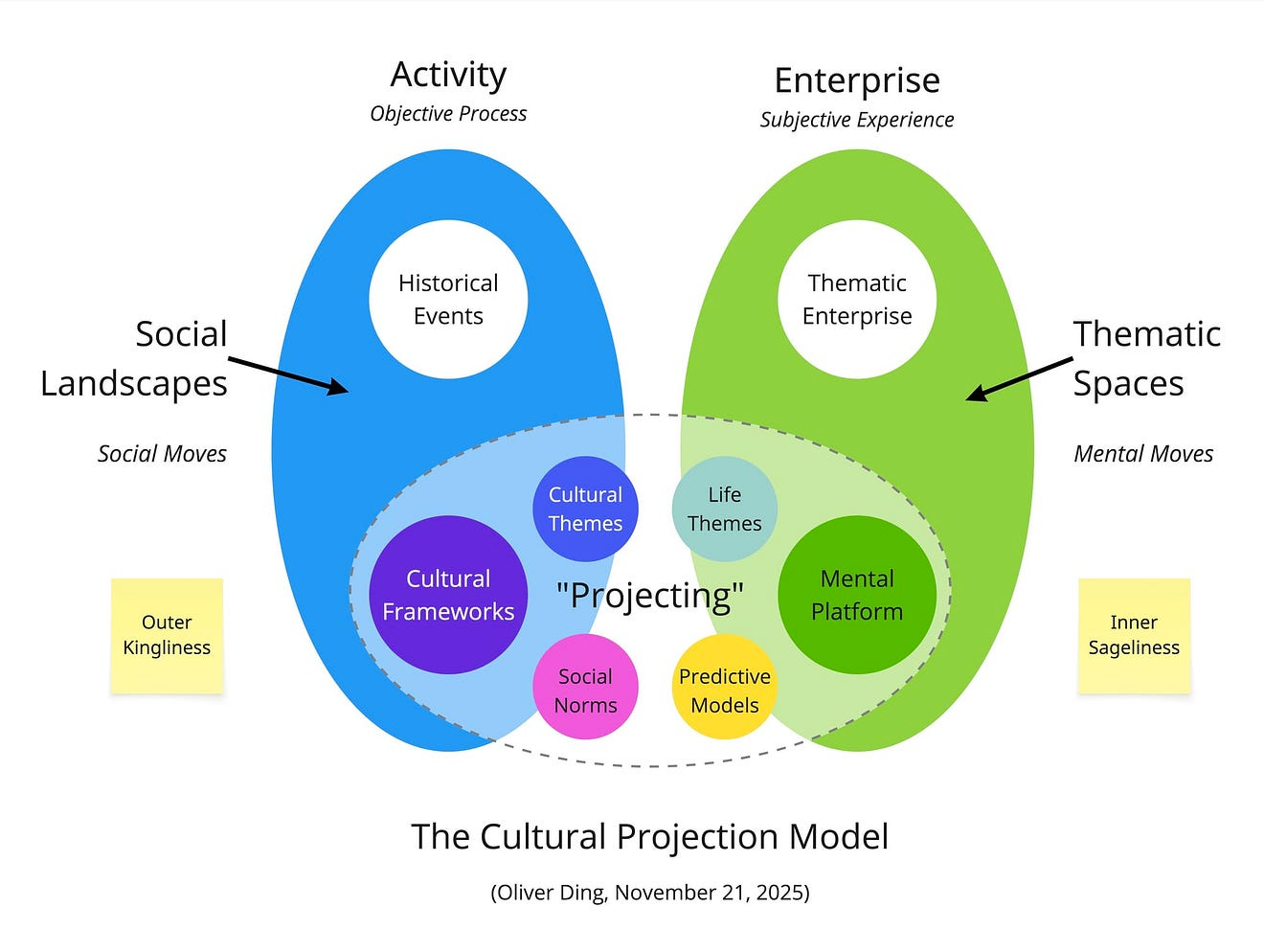
The model visually integrates objective processes (Activity) and subjective experience (Enterprise) through Projecting. The approach facilitates two crucial intellectual conversations:
First, Project Engagement Approach vs. Ecological Practice Approach: This dialogue bridges Activity Theory and Ecological Psychology. It introduced the concept of Projectivity, which refers to potential action opportunities for development. Like Gibson's Affordance and my concept of Supportance, Projectivity captures the deep structure of the reciprocal relationship between environment and organism.
Second, Activity Theory (Internalization-Externalization) vs. Confucian Thought (Inner Sageliness-Outer Kingliness): By placing Inner Sageliness (referring to subjective elements like Mental Platform, Life Themes) and Outer Kingliness (referring to objective elements like Cultural Frameworks, Social Norms) into the Cultural Projection Model, this dialogue identifies a deeper structural resonance between the two traditions.
This cross-cultural comparison suggests that the "Outside—Projecting—Inside" triad is potentially a cross-cultural general structure of social formation.
The concepts of "Cultural Frameworks" and "Mental Platforms" are key concepts of the model.
2.3 Platform: The Concept-fit for Platform Innovation Model
The ACS framework considers six types of concept systems situated within the HLS framework: Knowledge Frameworks, Cultural Frameworks, Institutional Frameworks, Mental Platforms, Strategic Frameworks, and Spiritual Frameworks.
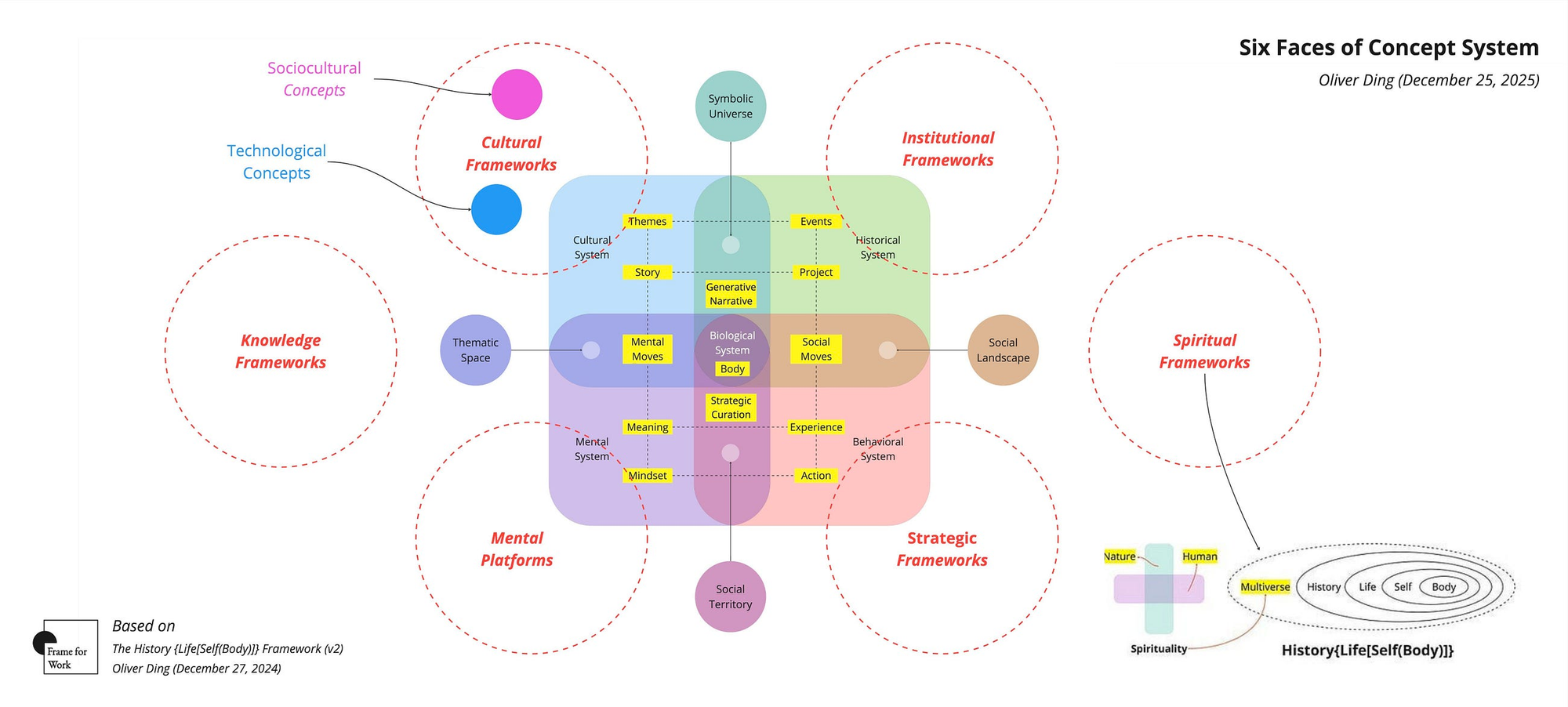
I also highlight two sub-types of Cultural Frameworks: Sociocultural Concepts and Technological Concepts, a distinction derived from my early work on the Concept-fit model for Platform Innovation. In 2021, I wrote Platform Innovation as Concept-fit, introducing a model to understand the technology—culture relationship. The model employed the Theme U framework to develop three levels of concept-fit between the Sociocultural field and the Technological field.
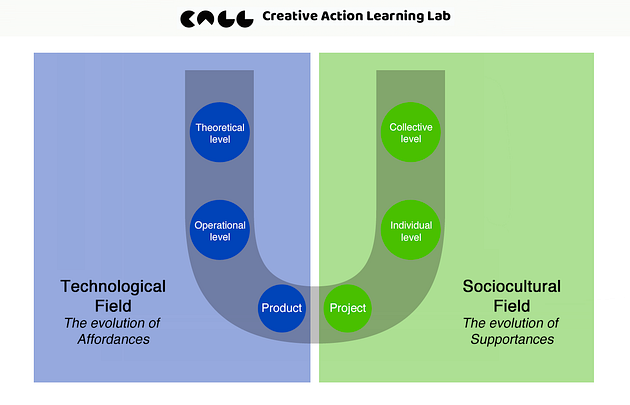
The Technological field reflects the evolution of affordances, while the Sociocultural field reflects the evolution of supportances. The concept of Affordance was introduced by ecological psychologist James J. Gibson in The Ecological Approach to Visual Perception. Inspired by affordance, I coined the term Supportance, a theoretical concept to describe potential supportive possibilities for action within the relationship between the social environment and the person. Supportance, like Affordance, points to potential action possibilities; however, it applies primarily to the social and cultural environment, whereas Affordance is grounded in perceptual psychology and the material world.
The distinction between Sociocultural and Technological Concepts corresponds to the distinction between social and material environments. To resolve the structural tension between these two types of concepts, the Concept-fit model serves as a specialized tool within this narrative process, harmonizing technical possibilities with cultural meanings to ensure that innovation is both functional and socially resonant.
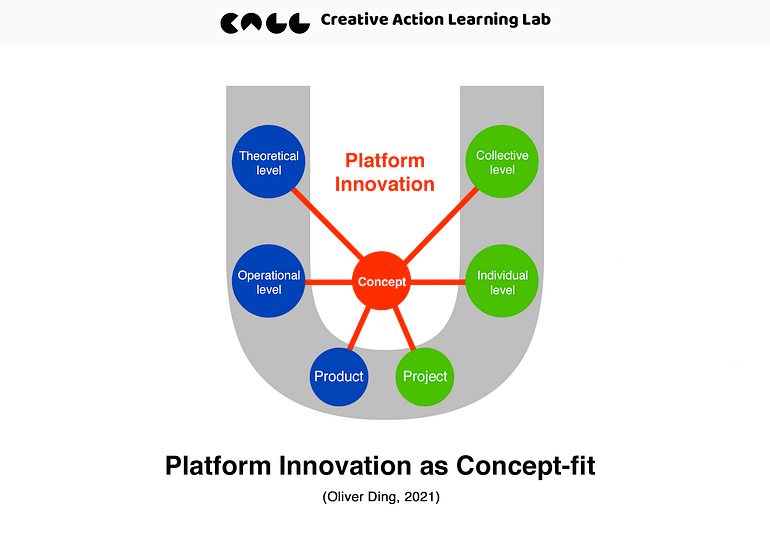
The framework suggests a three-step model of platform innovation: Step 1: Orientation Development; Step 2: Product Development; Step 3: Market Development. These three steps correspond to three movements of formation of concept: "Universal," "Individual," and "Particular."
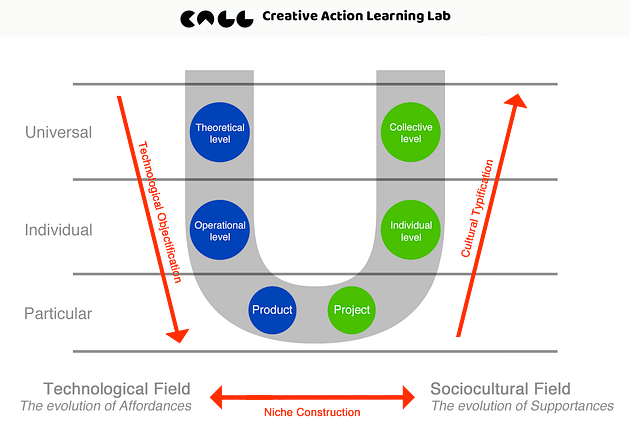
At the abstract level, I consider platform-based social innovation as the outcome of three movements of transformation: Technological Objectification, Cultural Typification, and Niche Construction.
2.4 Project: Mental Models and Predictive Models
In the ECHO Way model, the "Project I" part refers to a project that runs around the whole process. In the context of the ACS framework, it is more important to connect the "Knowledge—Wisdom—Activity" schema for discussion.
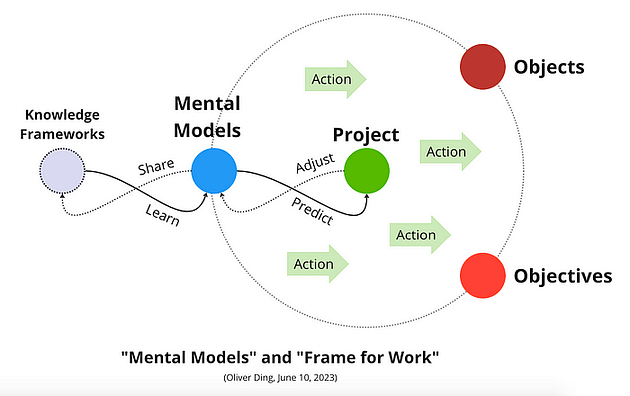
For a particular project, a person will develop a particular model to help predict the development of the project. The model can be explicit, such as a diagram with a document. However, the model can be tacit—the person just uses her mind without any instruments to display the model.
The mutual relationship between Mental Models (Predictive Models) and a Project is dynamic. The "Predict—Adjust" interactions echo the "Learn—Share" interactions. While the former is about mental moves between Knowledge and Wisdom, the latter is about mental moves between Wisdom and Activity. This meta-framework views a knowledge framework and a diagram not as static knowledge representations, but as a developmental dynamic process within a creative territory for exploration, reflection, and curation.
2.5 People: The Career-fit Model for Personal Innovation
At the individual level, a model called Career-fit was developed in 2021, based on my own personal experience.
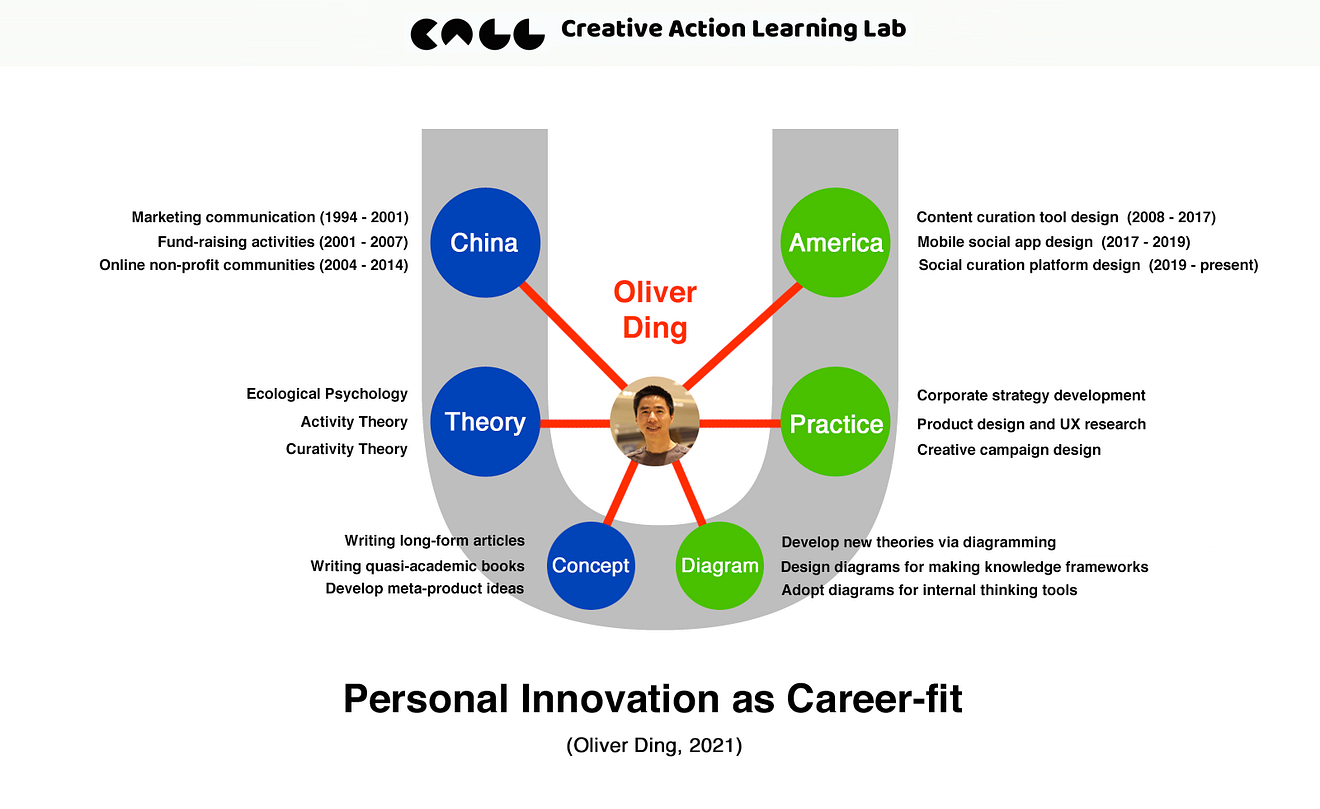
I named this framework Career-fit. It consists of four key elements: Experience, Themes, Projects, and Opportunities. The model roughly outlines the following five steps for personal innovation: reflect on career experience; discover pairs of opposing themes; fit each pair of opposing themes; join or initiate relevant projects; and align career themes with career opportunities.
Career themes are also concepts. To fit a pair of opposing themes, we can do so across three dimensions: the individual, the particular, and the universal.
By combining the general Career-fit framework and the eight elements of the Developmental Project Model, we obtain a new diagram.
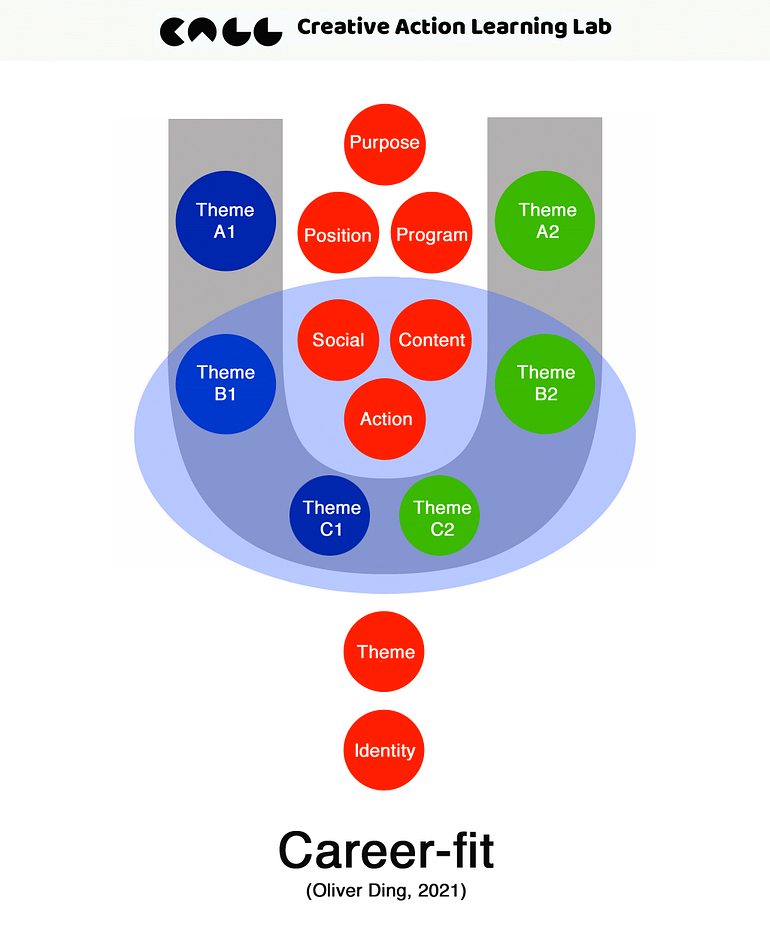
This resulting diagram can be viewed as “an ecological approach” to career development, as it reflects the structure of “organism (personal career themes) — action (fitting) — environment (impact projects).”
Now, let’s apply the Career-fit framework to examine the personal innovation behind the Activity U project. I started the Activity U project on August 19, 2020. Initially, I created a diagram called “Activity U” as a test of the “HERO U” framework. I wrote a post explaining the diagram, originally titled “Activity U: The Landscape of Activity Theory.” Later, I added “(Part I)” to the title, and the post expanded from a single article into a series.
Now, let’s focus on the Echozone of the Activity U project. The diagram below highlights the Echozone with annotations to illustrate the process of fitting career themes with developmental projects.
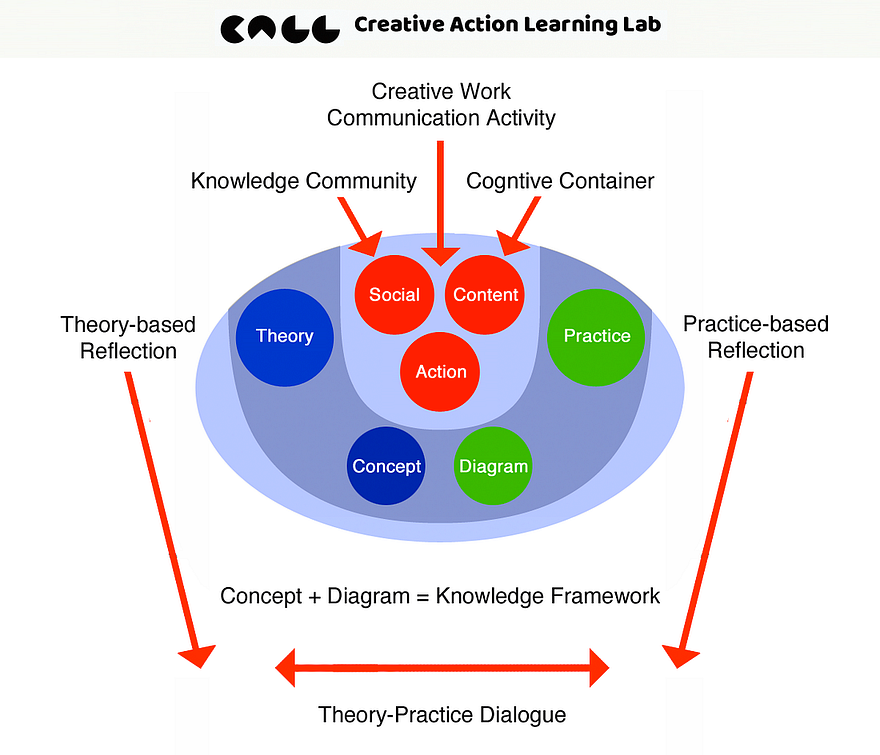
In the Echozone of this project, the fit between “Theory vs. Practice” is explored through three movements: Practice-based Reflection (building preliminary models using intuition), Theory-based Reflection (refining these models with theoretical resources), and Theory-Practice Dialogue (transforming models into frameworks and testing them through case studies). The fit between “Concept vs. Diagram” is captured in one formula: Concept + Diagram = Knowledge Framework.
The experience of the Echozone is the most exciting and also the most challenging part of putting the model into practice.
2.6 Design-oriented Project Engagement
These frameworks were developed for different purposes under different projects at different times. Yet, putting them together, we see a consistent mental model both in thinking and acting. All of them were guided by the Project Engagement approach.
However, the Development Project Model serves as "Project I," a component of the ECHO Way. From the perspective of ACS, there is a need to use the ECHO Way to develop a new model, to investigate the relationship between thematic creations and people who engage with them in various ways, as we see in Culture as Anticipatory Activity.
This insight inspired me to develop the Discover-Design-Deliver Model and further define Design-oriented Project Engagement, a sub-application of the Project Engagement approach.
Part 3: Developing the Discover-Design-Deliver Model
The DDD Model did not emerge from abstract design—it was born from a moment of recognition. This part traces that moment, the thematic reconfiguration it triggered, and the resulting architecture of eight core themes distributed across three containers.
3.1 The Revisiting Moment
In January 2026, while organizing earlier writings, I rediscovered a document from January 2023 titled "Design as Activity (a short note)". This was not a deliberate search—the document had been largely forgotten after its publication on Medium. But encountering it in the new context of ACS framework development created a moment of recognition.
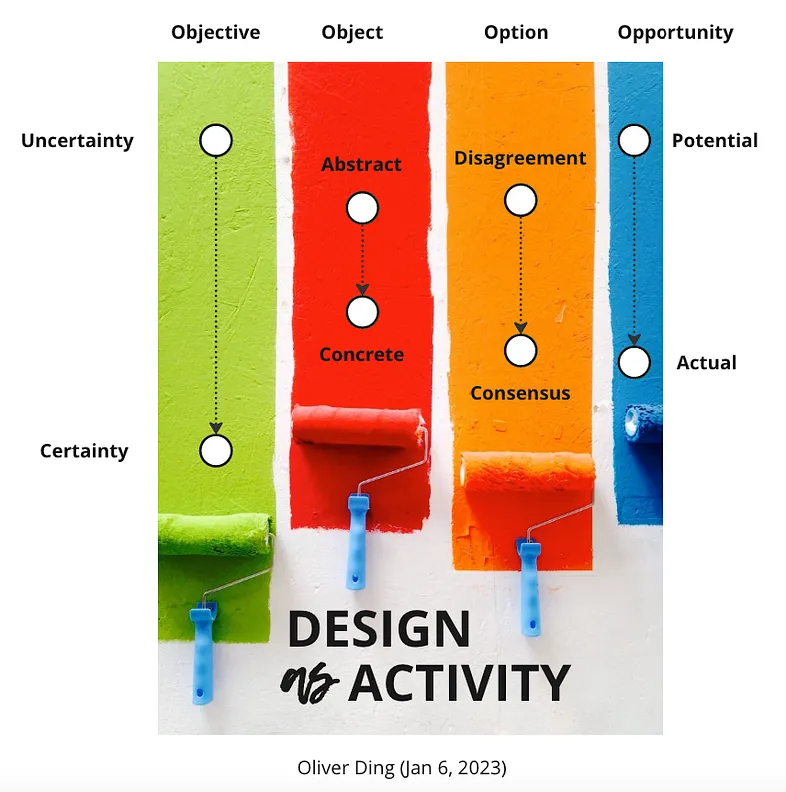
The 2023 document proposed a Theory-based "Process" view of Design, contrasting with practice-based models like Design Thinking. Inspired by Activity Theory, it identified four significant aspects of Design as Activity:
- Objective: anticipation and goals (Move from Uncertainty to Certainty)
- Object: things you are working on (Move from Abstract to Concrete)
- Option: opinions and decisions (Move from Disagreement to Consensus)
- Opportunity: serendipity and emergence (Move from Potential to Actual)
The note made a crucial claim: "These four tendencies set a deep frame for Design Activity in general. You can call it a 'meta-process' of Design."
The recognition in 2026: these four aspects could serve as thematic resources for specifying Container Z, providing exactly the operational specificity that was missing.
3.2 The Rebuilding: Thematic Reconfiguration
Integrating new themes isn't a simple addition—it requires rebuilding the entire thematic architecture. The four design aspects catalyzed a complete reconfiguration of the three-container structure:
- Container Z → DESIGN: Renamed to reflect new thematic content. Core themes: Objective, Object, Option, Opportunity.
- Container Y → DISCOVER: Emphasizing the generative, exploratory nature of subjective experience.
- Container X → DELIVER: Emphasizing the environmental, infrastructural nature of the objective process.
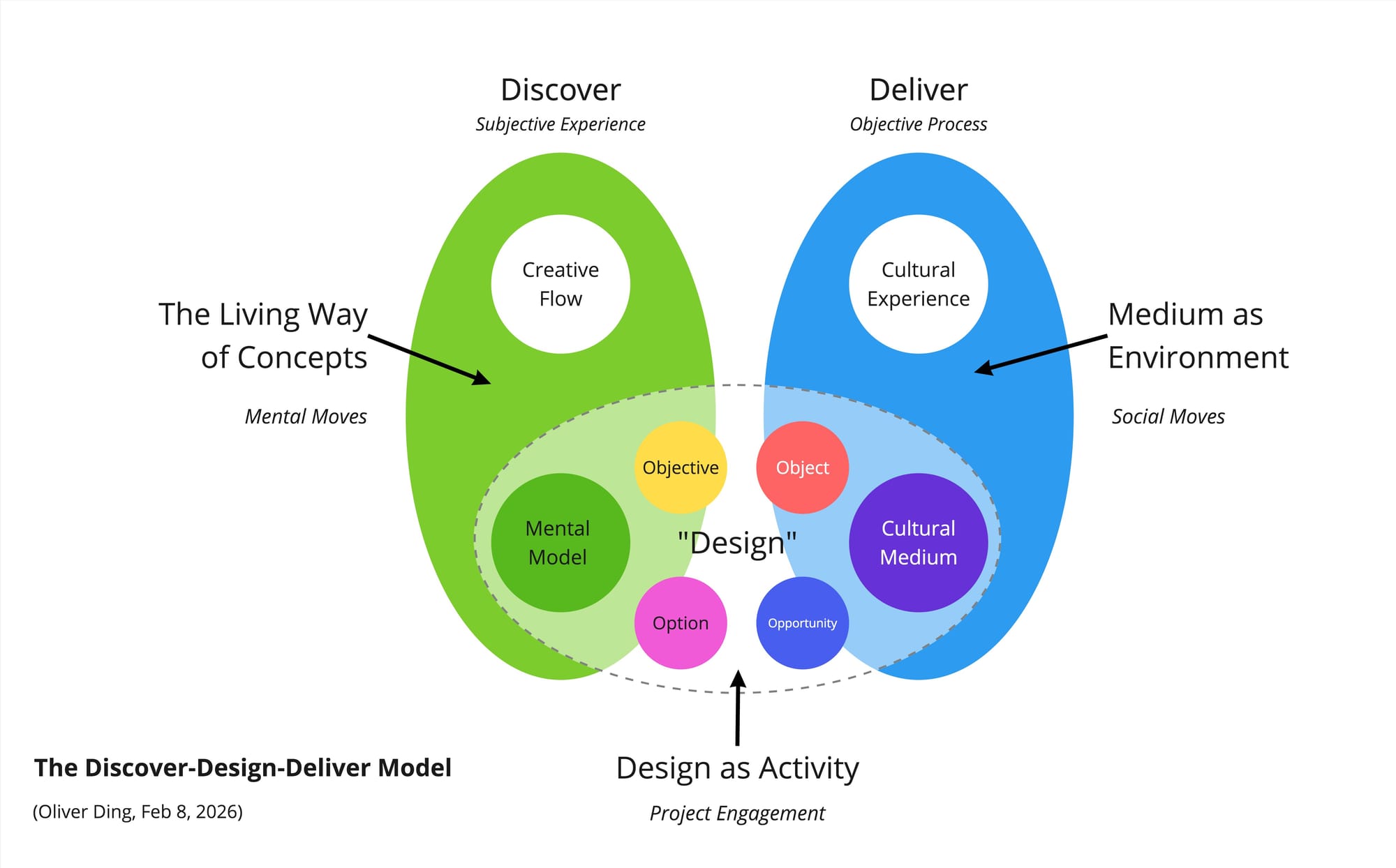
A fundamental insight emerged: theme-sharing creates organic connections between containers. Mental Model is shared between DISCOVER and DESIGN (the Discover→Design interface), while Cultural Medium is shared between DESIGN and DELIVER (the Design→Deliver interface). This produces the content-container pairing at the heart of the model:
Mental Model (content) ↔ Cultural Medium (container)
These two shared themes mark the two interfaces of the DESIGN container—one facing inward toward the subjective world of DISCOVER, the other facing outward toward the social world of DELIVER. What unfolds between these two interfaces is Design-oriented Project Engagement: a complex, sustained Activity that cannot be reduced to a single operation.
A sense of this complexity is already visible in the Echozone experience described in section 2.5—the long, embodied journey of fitting Theory vs. Practice and Concept vs. Diagram, moving through Practice-based Reflection, Theory-based Reflection, and Theory-Practice Dialogue over months of work. And that was the experience of a single person. In most design projects, this complexity is multiplied: multiple participants bring different Mental Models, negotiate across Objective, Object, Option, and Opportunity simultaneously, and work together toward a shared Cultural Medium. Design-oriented Project Engagement names this full, lived complexity—not a step, but a way of inhabiting a project.
3.3 The Resulting Thematic Architecture
Total Configuration: 8 Core Themes
- DISCOVER: Creative Flow (unique) + Mental Model (shared with Design)
- DESIGN: Mental Model (shared) + Objective + Object + Option + Opportunity + Cultural Medium (shared)
- DELIVER: Cultural Medium (shared with Design) + Cultural Experience (unique)
The new model is named the Discover-Design-Deliver model, or DDD model. There is a deep connection between the DDD model and the Cultural Projection model. Mental Model corresponds to Mental Platform; Cultural Medium corresponds to Cultural Framework.
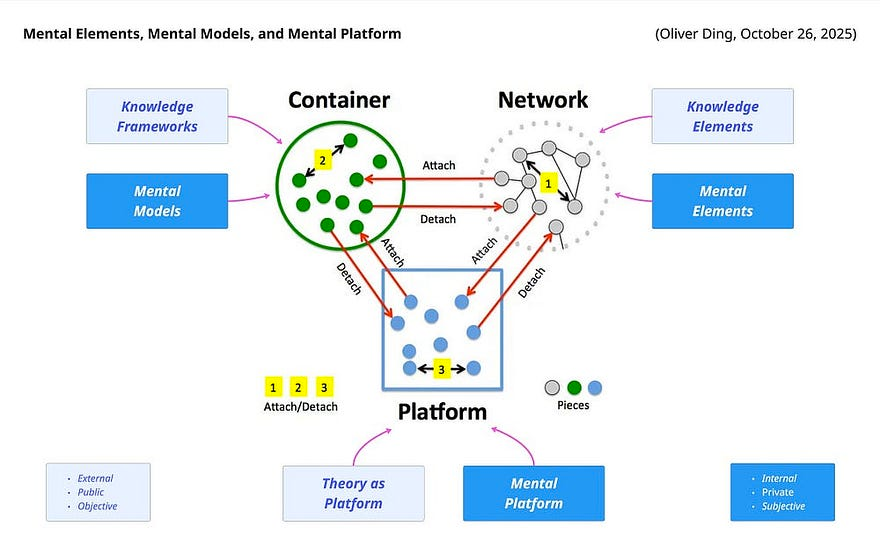
When a concept system supports the development of a Creative Enterprise, it functions as a Mental Platform. A Knowledge Framework can be internalized and transformed into Mental Models; in this movement, we detach from the outside space and attach to the inside space. Conversely, a Mental Platform can be externalized as a product, becoming a Theory as Platform. When a mental model is used to manage a project, it functions as a Predictive Model. When a series of mental models are used to manage a series of projects (an enterprise), they function as a Strategic Framework. In this way, the DDD model is a perfect operational framework of the Cultural Projection model.
Part 4: DISCOVER—The Living Way of Concepts
DISCOVER is where everything begins—in the continuous stream of lived experience that precedes all explicit understanding. This part examines how Creative Flow gives rise to Mental Models through six interconnected operations, constituting what has been called the Living Way of Concepts.
4.1 Creative Flow: The Pre-Conceptual Source
The DISCOVER container begins with Creative Flow—the continuous stream of lived experience from which all structured understanding emerges. Flow is not random or chaotic. It has textures, rhythms, patterns. But these patterns are initially implicit—available to awareness without yet being articulated as explicit concepts. Creative Flow is the pre-conceptual substrate of subjective experience.
The term "Flow" can also be understood as a structure of the "Flow-Focus-Center-Circle" schema, a scale-free model that integrates different layers of existence into a unified model for understanding creative life and activity:
- Flow → Experiential Layer: The continuous stream of lived experience
- Focus → Consciousness Layer: The intentional structure of awareness
- Center → Action Layer: The organizational structure of practical activities
- Circle → Social Interaction Layer: The networked relations of collective engagement
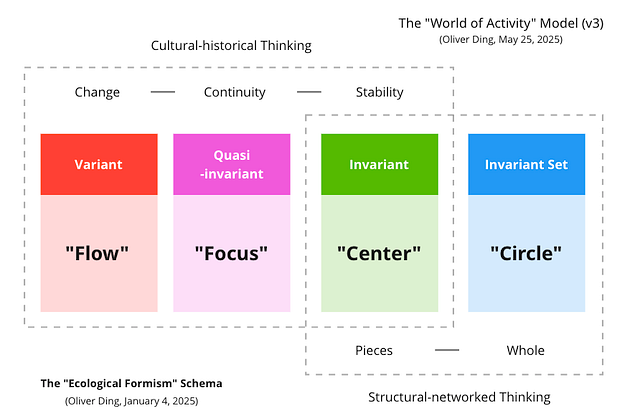
Traditional approaches study these layers separately. The "Flow-Focus-Center-Circle" schema reveals their mutual implication. Experience already contains consciousness structures. Consciousness embeds action tendencies. Actions are inherently social. Social interactions manifest individual experiences. This creates a dynamic system where each layer unfolds from and returns to the others, forming an ecological approach to the evolving creative self and social cognition.
4.2 The Living Way of Concepts: Six Operations
Mental Moves transform Creative Flow into Mental Models through six interconnected operations, which were described as the Living Way of Concepts in Lake 42: The Great Confluence:
- Thematic Exploration: Venturing into new conceptual territories through direct engagement.
- Thematic Conversation: Dialogue as catalyst for insight, where intersubjective exchange generates new understanding.
- Strategic Curation: Guiding creative elements to their proper thematic spaces within meta-frameworks.
- Embodied Experience: Grounding abstract concepts in lived reality.
- Conceptual Thinking: Developing frameworks and models through systematic reflection.
- Continuous Objectification: Transforming insights into shareable forms—articles, diagrams, book drafts.
The product of these six operations is Mental Models—structured concept systems that are situated, dynamic, integrated, and operational. Mental Models are what a Design-oriented Project Engagement carries from the DISCOVER world into the DESIGN world.
Part 5: DESIGN as Activity
DESIGN is the heart of the DDD Model—and the most theoretically demanding container. This part argues that Design, understood as Activity, cannot be reduced to a single operation or a linear process. It is a complex, sustained engagement structured by four simultaneous dimensions, and it is this complexity that makes Design the creative engine of cultural development.
5.1 Design as Ecological Objectification
DESIGN occupies Container Z—the transformation zone between the subjective world of DISCOVER and the social world of DELIVER. What happens in this zone is Design-oriented Project Engagement: the sustained, complex Activity through which Mental Models (developed in DISCOVER) eventually find their way into Cultural Medium (to be delivered in DELIVER).
From the perspective of ACS, this Activity can be understood as Ecological Objectification—the process through which subjective understanding becomes objective cultural reality, embedded in the social ecology. But it is important to be precise: Ecological Objectification is not the name of a single operation within Design-oriented Project Engagement. It is the theoretical characterization of what that entire complex Activity achieves over time. A designer, or a team of designers, does not "perform inscription"—they engage in months or years of exploration, negotiation, creation, and iteration. Ecological Objectification names the significance of that journey from the vantage point of ACS theory.
The four tendencies—Objective, Object, Option, Opportunity—constitute the deep frame of this Activity. They operate simultaneously, not sequentially:
- Objective: uncertainty → certainty
- Object: abstract → concrete
- Option: disagreement → consensus
- Opportunity: potential → actual
These four dimensions are not steps to be completed but tensions to be navigated—simultaneously present throughout the entire engagement. In a single-person project, they describe the inner movements of a creative mind at work. In a multi-person design project, they describe the terrain of collaboration: different participants pulling in different directions across all four dimensions at once, working toward a shared outcome that none of them could have specified at the outset. This is why the four-dimensional framework is both analytically precise and practically resonant—it captures the full complexity of Design as Activity without reducing it to a procedure.
5.2 Meta-Process and Concrete Methods: A Two-Layer Structure
The DESIGN container operates on two distinct layers:
- Layer 1: Meta-Process (Deep Frame) — The four tendencies as a theory-based understanding of design activity, applicable across all methodologies.
- Layer 2: Concrete Methods (Operational Tools) — Specific design methodologies that operationalize the meta-process: Design Thinking, Service Design, Participatory Design, Mindware Development, and others.
The key insight: the four tendencies don't prescribe specific methods. Instead, they provide a framework for understanding what any design method is fundamentally doing. This two-layer structure maintains theoretical coherence while enabling methodological plurality.
5.3 Concrete Design Methods—The Ecological Practice Design Example
The Ecological Practice Design approach operates on two distinct but connected layers, which correspond to a research-to-design movement.
The first layer is the Lifesystem Framework, which serves as a research and analysis instrument. The Lifesystem Framework provides a structured way to model social practices through eight operational concepts (Actor, Group, Material, Information, Resource, Intention, Result, Reward) and the "Lifeway—Lifeform" hierarchical loop. This framework is descriptive: it enables ecological observation, qualitative data collection, and systematic analysis of how people engage with environments and each other. It answers the question: What is actually happening in this practice?
The second layer draws on the theoretical concepts of the Ecological Practice Approach—Affordance, Supportance, Attachance, and Curativity—as heuristic orientations for design and intervention. These concepts are not prescriptive design steps; they are lenses that orient thinking toward what is possible:
- Affordance → Material Adaptability: what does the material environment offer for action?
- Supportance → Social Adaptability: what does the social environment offer for engagement?
- Attachance → Sense of Boundaryless: how can attaching and detaching movements open new territories?
- Curativity → Sense of Wholeness: how can pieces be turned into a meaningful whole?
In the DDD framework, the Lifesystem Framework operates primarily at the DISCOVER stage—providing the analytical categories through which Creative Flow is made legible, and Mental Models are built. The theoretical concepts of the Ecological Practice Approach then inform the DESIGN stage: they guide how the designer reads the situation, identifies opportunities, and makes intervention choices. The movement from research (Lifesystem) to design (Ecological Practice concepts) is a natural transition—from systematic understanding of a practice toward deliberate action within it.
5.4 Concrete Design Methods—The Mindware Development Example
The Mindware Development approach emerged from the three-dimension model developed in 2023: Mental Platform → Material Container → Behavioral Network. This model provides a framework for understanding how concept-related products develop across three interconnected dimensions.
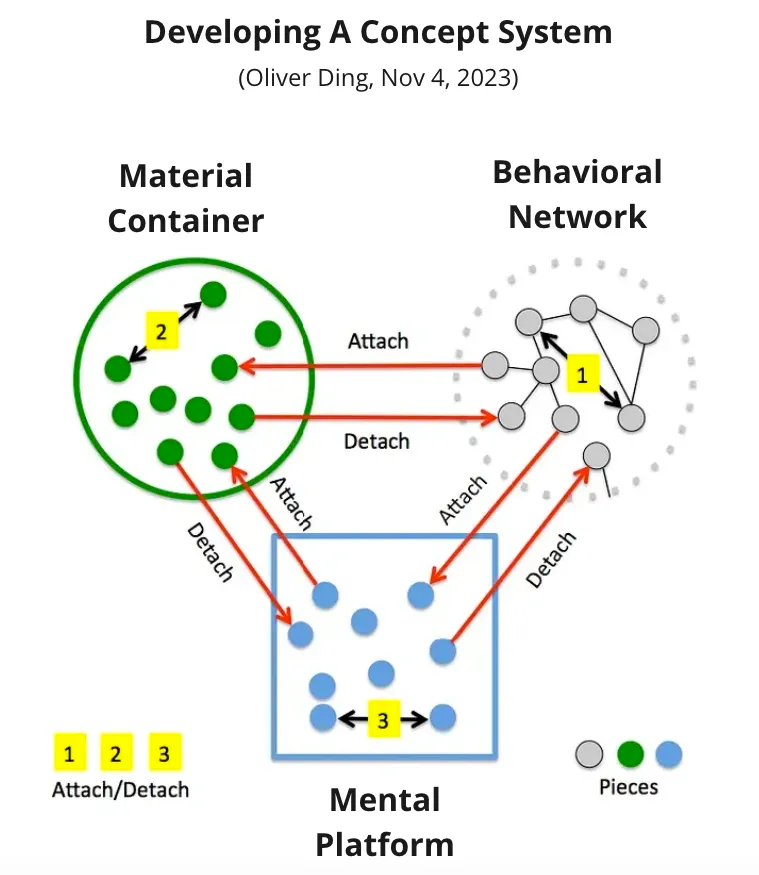
In 2024, this theoretical model was applied to a concrete design project—combining a psychological assessment software's concept system with a meta-diagram to create a board game. The key insight: "If we attach the Concept System to the Spatial Structure, we get the core of a mindware." This practical experience was then systematized into the Mindware Development Method and Canvas (May 2024).
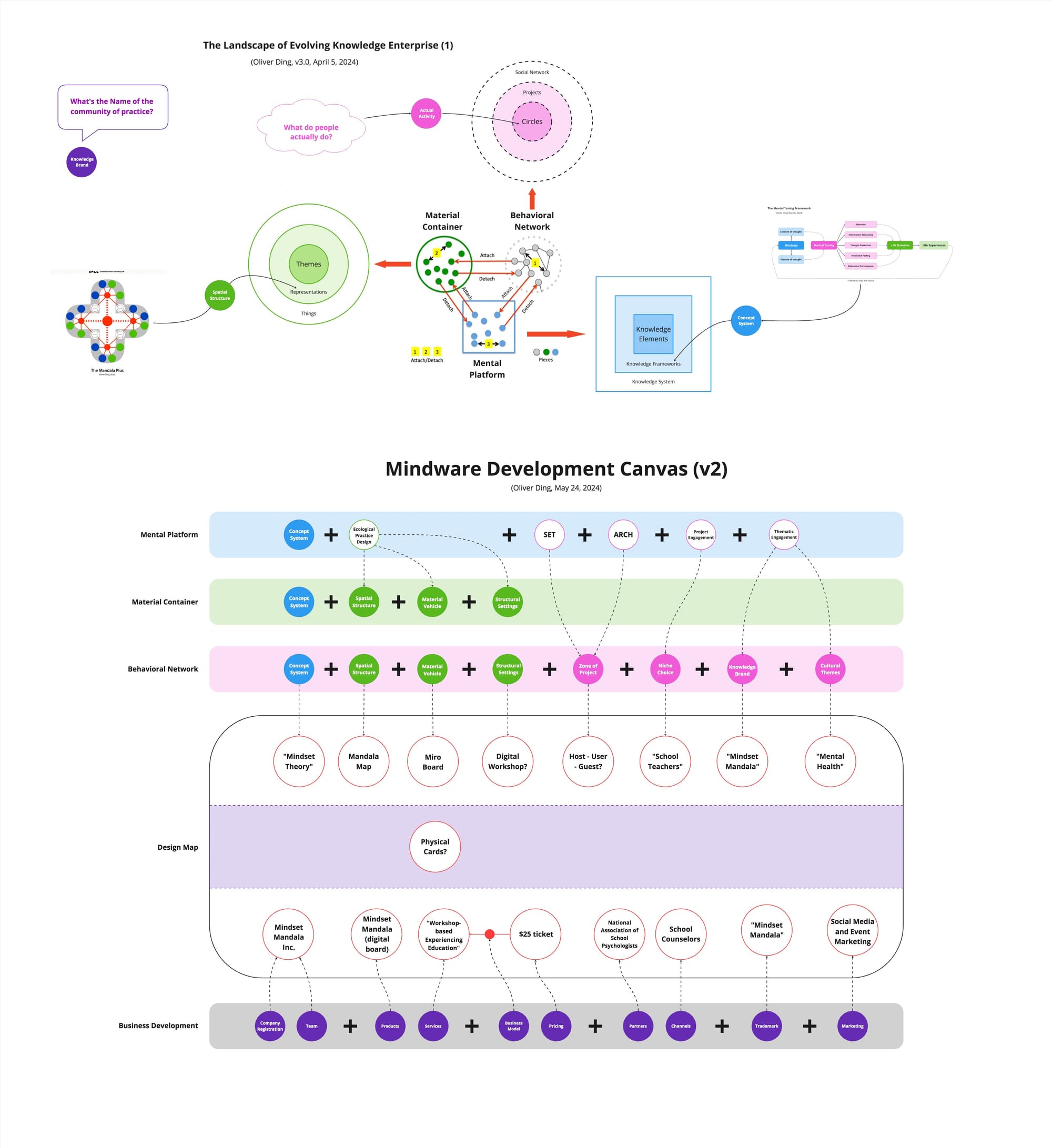
The Mindware Development approach—developed independently from the Cultural Projection Model—addresses the exact same problem the DDD Model addresses theoretically. Both describe the same fundamental operation—Ecological Objectification—though they arrived at it through independent paths. This convergence suggests both are capturing a fundamental pattern in how Thematic Creation occurs.
Part 6: DELIVER—Medium as Environment
DELIVER is where Thematic Creation enters the world. This part examines Cultural Medium not as a passive container but as an active environment—one that shapes the Cultural Experience it hosts. It also situates the DELIVER layer within the broader landscape of social environments that ACS seeks to understand.
6.1 Cultural Medium as Container
The DELIVER container is structured around a fundamental pairing: Cultural Medium (container) ↔ Cultural Experience (what happens in the container). But to understand what "Cultural Medium as environment" really means, we need to go deeper than the container metaphor alone.
Two theoretical traditions converge here. The first is the Container (Containee) schema developed in the Ecological Practice Approach (v4.0), which understands the medium in terms of formal cause. In the Aristotelian sense, formal cause is not the agent that produces an effect, but the organizing principle that gives shape to what comes into being. It does not push, force, or determine; rather, it provides the form within which events take on intelligible structure.
The second is Marshall McLuhan's media theory, especially as articulated in Media and Formal Cause (Marshall McLuhan & Eric McLuhan, 2011). McLuhan's central insight—"the medium is the message"—is precisely a claim about formal cause: what matters is not merely the content conveyed, but the way the medium itself shapes the pattern of experience. As Eric McLuhan summarizes, Marshall McLuhan conceived of a medium as “an invisible, ever-present vortex of services and disservices”—a description that captures the environmental operation of formal cause. A medium is not a neutral channel; it is the form within which perception, relation, and participation take shape.
For the DDD Model, this means Cultural Medium is not a passive storage for Thematic Creations. As an environment endowed with its own formal configuration, it provides the structural conditions within which content becomes accessible, participation becomes possible, and engagement acquires recognizable shape.
The same Thematic Creation entering different Cultural Mediums will therefore give rise to different Cultural Experiences—not because the content itself changes, but because the form within which it unfolds differs. For this reason, the choice of Cultural Medium in Design-oriented Project Engagement is not a logistical afterthought; it is a constitutive design decision.
6.2 Thematic Creation as Outcome
When Mental Models are successfully inscribed into Cultural Medium through Design activity, Thematic Creation unfolds. Thematic Creation is not a static endpoint but a living process: Concept System → Ecological Objectification → Embodied Experience → Collective Engagement. The new cultural entity exists in the social world, generates Cultural Experience for those who engage with it, and can itself become a resource for further Concept System development.
This completes the movement described in the ontological grounding of ACS: Thematic Creation is neither purely subjective (it exists in cultural reality) nor purely objective (it carries the intentionality of its designers). It is the ecological meeting point of Concept System and Cultural Medium—the outcome of Ecological Objectification.
6.3 Diverse Social Environments
The social environments into which Thematic Creations are delivered are not a homogeneous backdrop. Each type of social environment constitutes a distinctive Cultural Medium—with its own structure, its own thematic logic, and its own conditions for how Cultural Experience unfolds.
In Developmental Projects: The Project Engagement Approach to Adult Development (2025), I identified eight types of social environments, each understood as the emergent product of a series of developmental projects organized around a distinctive double-theme schema:
- Family — organized around the "Love — Legacy" thematic schema
- School — organized around the "Teach — Learn" thematic schema
- Organization — organized around the "Collaboration — Achievement" thematic schema
- Community — organized around the "Connection — Exploration" thematic schema
- Market — organized around the "Search — Change" thematic schema
- Technological Platform — organized around the "Affordance — Supportance" thematic schema
- City — organized around the "Local — Global" thematic schema
- Theory — organized around the "Theme — Concept" thematic schema
From the perspective of the DDD Model, the eight types do not themselves correspond directly to specific Cultural Mediums. Rather, in the course of their development, projects of each type gradually discover and align with Cultural Mediums that are highly compatible with their own thematic schemas.
The double-theme schema that defines each social environment is not merely a description of its historical formation—it is also the thematic structure through which that environment receives, interprets, and transforms any Thematic Creation delivered into it.
When the same Thematic Creation enters different Cultural Mediums, it generates very different Cultural Experiences, shaped by the dominant thematic logic of each environment.
This observation opens a significant research agenda for ACS. Understanding how different Cultural Mediums frame Cultural Experience—how a theoretical work is interpreted differently within a School, a Market, or a Theory-oriented environment, or how a community design project is received within a Family versus a City context—thus becomes a central question for Anticipatory Cultural Sociology.
This direction connects the DELIVER layer of the DDD Model directly to the broader ACS enterprise: the study of how Concept Systems, developed through individual creative activity, become Thematic Creations that shape social life across diverse Cultural Mediums.
6.4 Current Limitations
The DELIVER container is the least developed aspect of the DDD Model. What remains underdeveloped: the mechanisms of how design outputs become institutionalized into Cultural Medium, systematic frameworks for analyzing Cultural Experience qualities, and methods for studying medium-experience relationships.
This is not a gap to be quickly filled—it reflects the genuine early stage of this line of thinking within ACS, and awaits future theoretical development.
Conclusion: The Creative Engine of World of Life
Design is the creative engine of the World of Life. Every social environment we inhabit—every institution, community, platform, and theory—has been shaped by Design-oriented activities that transformed subjective understanding into cultural reality. To understand Design as Activity, in the full complexity of its four dimensions (Objective, Object, Option, Opportunity), is to understand one of the most fundamental mechanisms through which human life continuously recreates itself.
The Discover-Design-Deliver Model provides what the six ACS meta-frameworks could not: an operational middle layer that makes the core movement of cultural development concrete and actionable. DISCOVER develops Concept Systems through the Living Way of Concepts. DESIGN enacts the complex, sustained Activity through which Mental Models find their way into Cultural Medium. DELIVER is where Thematic Creation enters the social world and generates Cultural Experience across diverse environments. Together, the three containers give ACS both analytical precision and practical reach.
This article also connects three major theoretical enterprises—ACS, Platform Ecology, and Project Engagement—into a unified operational logic. The meta-framework Culture {Platform [Project (People)]} now has a concrete process model at its heart. Design-oriented Project Engagement is revealed as one specific type of developmental project: the type through which Concept Systems become Thematic Creations that shape social environments. Each of the eight social environment types identified in Developmental Projects—Family, School, Organization, Community, Market, Technological Platform, City, Theory—can now be examined through this lens: what Design-oriented Project Engagements have shaped it, and what new ones might transform it? This is where the ACS enterprise opens toward its next frontier.
v1.0 - February 19, 2026
v2.0 - February 24, 2026 - 6,135 words