
Engaging with Others for Developing Anticipated Identity
Creative Predecessors as Projections of the Self We Are Becoming
by Oliver Ding
March 26, 2026
This article is the third in the Revisiting-Rebuilding series. The theoretical framework developed here builds on "Revisiting, Rebuilding, Re-engaging with Past Selves" (March 2026) and "Revisiting-Rebuilding: Agency Cascade and the Transformation of Self" (March 2026).
Introduction
The two preceding articles in this series established a systematic theoretical framework connecting the Revisiting-Rebuilding (RR) practice to creative identity development. Revisiting, Rebuilding, Re-engaging with Past Selves introduced the foundational concepts: Past Selves as dormant resources, the four types of identity that brings together diachronic and synchronic dimensions of creative development. Revisiting-Rebuilding: Agency Cascade and the Transformation of Self formalized this into a comprehensive model — the Creative Identity Cascade — grounded in the Agency Cascade and organized around the polar relationship between Creative Identity and Anticipated Identity.
Both articles, however, shared a significant structural limitation: their cases were drawn entirely from the author's engagement with his own past work. The RR practice they analyzed was self-referential in the strict sense — a Self engaging with its own prior Selves. The social dimension of the Activity Circle, the Self-Other structure that is foundational to the Agency Cascade model, remained largely undeveloped in relation to identity.
This article addresses that limitation directly.
It proposes that RR practice can occur not only between a creator and their own past selves, but between a creator and their creative predecessors — those who came before, whose work is already present in the world, and whose enacted creative identities remain available as resources. When a creator engages deeply with a predecessor's body of work, something more than intellectual borrowing occurs. The engagement is simultaneously a form of identity development: the creator is not only absorbing ideas but actively selecting, through the lens of their own Anticipated Identity, what in the predecessor's work is generative for the self they are becoming.
The central claim of this article is: Engaging with creative predecessors is a form of developing Anticipated Identity. The choice of which predecessor to engage, which aspects of their work to focus on, and how to rebuild what is found there — all of these are driven by the creator's own Anticipated Identity, the creative identity they are becoming. The predecessor's work does not create the Anticipated Identity; rather, the Anticipated Identity already forming within the creator determines what in the predecessor's work can be seen, selected, and transformed into a resource.
This claim is developed through five parts. Part 1 revisits the theoretical foundations established in previous articles, with particular attention to the elements that make the social expansion of RR practice possible. Part 2 develops the conceptual framework for understanding Others as Creative Predecessors, drawing on Alfred Schutz's phenomenological sociology and introducing the key theoretical propositions of this article. Part 3 presents a series of case studies — the author's sustained engagements with Howard Gruber, Roger Barker, Michael Cole, Andy Blunden, Ping-keung Lui, and Robert Kegan — read through the lens of Anticipated Identity development. Part 4 introduces the concept of Creative Identity Resonance — a complementary model that addresses the synchronic, horizontal dimension of creative identity development in social space. Part 5 synthesizes the cases and draws out the broader theoretical implications.
Table of Contents
Introduction
Part 1: Theoretical Foundations
1.1 The Creative Identity Cascade: A Brief Revisit
1.2 The Four Types of Identity: Anticipated Identity and the RR Practice
1.3 The Agency Cascade and the Self-Other Distinction
1.4 The Limitation of Previous RR Cases: The Missing Social Dimension
Part 2: Others as Creative Predecessors
2.1 The Social World and Its Others: Schutz's Framework
2.2 Creative Predecessors: A Focused Definition
2.3 Revisiting Others: The Core Theoretical Proposition
2.4 Engaging with Symbolic Mentors
Part 3: Engaging with Others — Six Case Studies
3.1 Engaging with Howard Gruber (2016–2025)
3.2 Engaging with Roger Barker (2018–2021)
3.3 Engaging with Michael Cole (2018–2025)
3.4 Engaging with Andy Blunden (2020–2025)
3.5 Engaging with Ping-keung Lui (2022–2025)
3.6 Engaging with Robert Kegan (2023–2025)
Part 4: Creative Identity Resonance
4.1 What It Is
4.2 Its Function
4.3 Its Relationship to the Creative Identity Cascade
4.4 Its Relationship to Thematic Identity Curation
Part 5: Synthesis and Conclusions
5.1 The Social Expansion of RR Strategy
5.2 Anticipated Identity as Selection Filter
5.3 A Structural Typology of Predecessor Engagement
5.4 The Social Expansion: Three Theoretical Propositions
Conclusion
Part 1: Theoretical Foundations
1.1 The Creative Identity Cascade: A Brief Revisit
The Creative Identity Cascade Model, developed in Revisiting-Rebuilding: Agency Cascade and the Transformation of Self, proposes that creative work unfolds not as the expression of a single stable identity but as the progressive transformation through a cascade of creative identities, each enabled by the one before. Its structural principle: the Other of each level becomes the Self of the next — Other N → Self N+1.
In the LARGE Method case study that anchored the previous article, this cascade unfolded over eight years across four levels: Practitioner → Reflector → Modeler → Curator → Platformer. At each level, the creator inhabits one identity while anticipating the next. The Anticipated Identity is not merely a cognitive representation of a hoped-for future self. It is structurally the Other of the current Activity Circle — the creative identity that present activity is already oriented toward and developing into.
This cascade structure is the foundation for understanding how engaging with creative predecessors contributes to identity development. The Anticipated Identity that drives each level of the cascade does not arise in a vacuum — it is shaped in part by the creator's encounters with predecessors whose work makes certain creative identities imaginable, demonstrable, and reachable. The predecessor does not create the Anticipated Identity, but their work can activate and clarify what is already forming within the creator.
1.2 The Four Types of Identity: Anticipated Identity and the RR Practice
The four types of identity — Projected, Narrative, Creative, and Anticipated — are not static categories but dynamic modes through which identity is enacted and transformed across project engagements.
Of these four, Anticipated Identity occupies a structurally privileged position in relation to the RR practice. In the Weave structure, Anticipated Identity is the product of the Rebuilding × Analyzing intersection: it is the emerging vision of the next creative identity, orienting present Rebuilding toward the future self. This means that every act of Revisiting-Rebuilding is implicitly organized around an Anticipated Identity — the creator returns to earlier work not randomly but in the direction of who they are becoming.
The previous articles developed this relationship primarily in the temporal direction: the Anticipated Identity of today draws on the Creative Identity of yesterday. This article extends it into the social direction: the Anticipated Identity already forming within the creator also determines how they engage with creative predecessors — which predecessor's work they are drawn to, which aspects resonate, and what they are able to rebuild from what they find.
1.3 The Agency Cascade and the Self-Other Distinction
The Agency Cascade is built on the Activity Circle, whose four core elements are Self, Other, Thing, and Think. The core principle of the cascade — that the Other at each level becomes the Self of the next — is fundamentally a principle about the Self-Other relationship. Agency is not located in a fixed individual; it cascades through levels of social structure, each level's Other becoming the next level's Self.
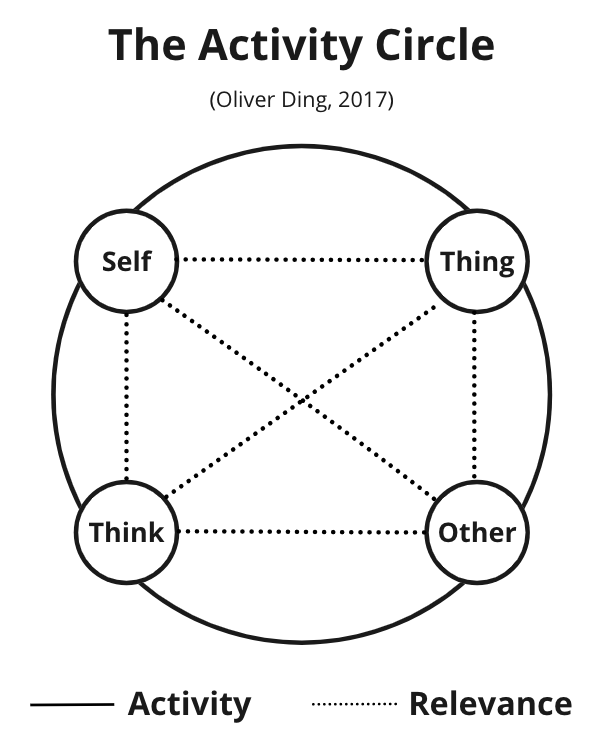
In Agency Cascade and the Transformation of Self, this principle was applied diachronically to the same individual: the Other of the present level is the future Self of the creator. This application was theoretically productive, but it left the synchronic, social dimension of the Self-Other relation largely in the background.
The Agency Cascade model is itself designed with the Self-Other social structure as foundational. In its original formulation for cultural sociology, each level describes a relationship between two distinct roles — Creator and Supporter, Curator and Weaver, Influencer and Follower. The model presupposes a social world in which identity is always constituted in relation to Others.
It is precisely this social foundation that enables the extension developed in this article. Once we recognize that the Self-Other structure is constitutive of identity development — that identity cannot be developed in isolation — the question naturally arises: which Others? The answer that this article proposes: for a creator engaged in sustained intellectual development, the most formative Others are often not contemporaneous collaborators but creative predecessors whose work has already shaped the terrain in which the creator moves.
1.4 The Limitation of Previous RR Cases: The Missing Social Dimension
The RR case studies developed in the previous two articles were all drawn from a single domain: the author engaging with his own prior work. The Mindentity concept, the LARGE Method, the Learning Landscape, Significant Themes — in each case, the creator returned to something he himself had produced. The Past Self encountered in Revisiting was literally a past version of the same person.
This self-referential structure is not a limitation of the RR strategy itself. It is a limitation of the specific cases chosen to illustrate it. The strategy is capable of operating across a broader social space — and this article begins to develop that broader application.
The Revisiting move, as defined in the Weave structure, involves returning to a past creative identity that was enacted. When that creative identity is one's own, the return is autobiographical. But the structural logic of Revisiting does not require that the past creative identity be one's own. What it requires is that the past creative identity be accessible — through its material traces, its works, its frameworks, its recorded intellectual trajectory. A predecessor's work provides exactly this kind of access.
This structural equivalence between revisiting one's own past selves and revisiting a predecessor's enacted creative identity is the theoretical hinge on which this article turns.
Part 2: Others as Creative Predecessors
2.1 The Social World and Its Others: Schutz's Framework
To develop a theoretically precise account of creative predecessors, this article draws on Alfred Schutz's phenomenological sociology of the social world. In The Phenomenology of the Social World and related works, Schutz articulated a systematic typology of the Others we encounter within the social world, organized by the degree to which direct interaction and mutual verification of subjective meaning are possible.
Schutz distinguished three primary domains:
- Contemporaries (Mitwelt): Those who exist at the same time as oneself but with whom direct face-to-face interaction may or may not occur. Knowledge of contemporaries is typified and indirect — we understand them through general types and anonymous roles rather than through direct personal encounter.
- Predecessors (Vorwelt): Those who existed before oneself and whose world has already passed. Predecessors cannot be encountered in direct interaction; their subjective meaning-contexts are accessible only through the objective meaning-contexts they have left behind — texts, institutions, artifacts, recorded intellectual trajectories. As Schutz noted, the world of predecessors is one "into which I cannot act, but my acts may refer to it and my interpretations may be directed toward the subjective meanings of those who are its inhabitants."
- Successors (Folgewelt): Those who will exist after oneself. They cannot be experienced directly; one's actions may be directed toward them, but they cannot respond.
For the purposes of this article, what is most significant in Schutz's typology is the characterization of predecessors. Unlike contemporaries, predecessors cannot respond, revise their positions, or enter into dialogue. What they leave behind is fixed — a "world of predecessors" constituted by objective meaning-contexts: texts, diagrams, methods, arguments, enacted theoretical trajectories. Engagement with predecessors is, in Schutz's terms, necessarily an interpretive engagement with these objective meaning-contexts.
This has a direct implication for the RR framework: when a creator engages with a predecessor's work, the Revisiting move is always an act of interpretation — of bringing the predecessor's enacted creative identity into contact with one's own present standpoint, without the possibility of direct verification or dialogue. The Rebuilding move is correspondingly more autonomous: what the creator makes of the predecessor's work is determined entirely by the creator's own current creative identity and Anticipated Identity, not by any feedback from the predecessor.
2.2 Creative Predecessors: A Focused Definition
Schutz's category of "predecessors" is broad — it encompasses all who have come before. For the purposes of this article, a more focused term is needed: creative predecessors.
A creative predecessor, as used here, refers to a creator whose work preceded one's own in two senses: chronologically (their work was produced before mine) and developmentally (their creative identity was enacted before mine could engage with it). Two further characteristics follow from this definition:
First, creative predecessors need not be deceased. What distinguishes a predecessor is not the absence of the person but the prior existence and independent completion of their creative work. A living scholar whose major contributions were formed before one's engagement with them functions, for the purposes of this article, as a creative predecessor. Whether one has had direct personal interaction with them is secondary to the central fact: their enacted creative identity is available through their work, independently of any direct relationship.
Second, the focus of this article is specifically on intellectual and creative predecessors — those whose creative identities are enacted through bodies of theoretical work, frameworks, methods, and scholarly practice. This is not because other types of predecessors are unimportant, but because the case studies examined in Part 3 all involve intellectual engagement of this specific kind.
This definition deliberately diverges from Schutz's strictly phenomenological use of "predecessor" (which requires that the person be deceased and entirely unavailable for interaction) in order to focus on what is theoretically essential: the prior and independent existence of an enacted creative identity that a later creator can engage with through its material traces.
2.3 Revisiting Others: The Core Theoretical Proposition
The central theoretical proposition of this article can now be stated precisely:
Revisiting a creative predecessor's work has the same structural logic as Revisiting one's own Past Selves — with one critical difference: the creative identity being revisited belongs to another person, and its function in the RR practice is specifically to serve as a resource for developing one's own Anticipated Identity.
In the self-referential RR practice, the structure is:
- A Past Self (an earlier enacted creative identity) is revisited
- Through Rebuilding, it is transformed into a resource for the Present Self
- The entire process is oriented by the Anticipated Identity — who I am becoming determines what I return to and what I make of it
In the Other-directed RR practice developed here, the structure is structurally parallel:
- A predecessor's enacted creative identity is revisited through their work
- Through Rebuilding, their ideas, methods, and frameworks are transformed into resources for the Present Self
- The entire process is oriented by the Anticipated Identity — who I am becoming determines which predecessor I engage, which aspects of their work I focus on, and what I make of what I find
The key theoretical insight: the selection of which creative predecessor to engage is not arbitrary or merely intellectual. It is driven by the creator's Anticipated Identity. The creator is drawn to a particular predecessor — and to particular aspects of that predecessor's work — because their own Anticipated Identity, already forming, determines what can be recognized as relevant, significant, and generative. The predecessor's work does not produce the Anticipated Identity; it is the Anticipated Identity that selects what in the predecessor's work becomes a resource.
This is the structural meaning of the subtitle: creative predecessors as projections of the self we are becoming. The word "projections" here operates in the active, outward direction — it is the creator who projects their Anticipated Identity onto the predecessor's work, finding in it what corresponds to who they are becoming. The predecessor is not the source of the self; the self, in its anticipatory movement, finds in the predecessor's work a surface on which its own direction becomes visible.
2.4 Engaging with Symbolic Mentors
This theoretical proposition connects directly to a concept developed in creativity research: the symbolic mentor. Mihaly Csikszentmihalyi, drawing on Daniel Levinson's work on mentoring relationships, introduced this concept to describe an inspiring figure from the past whom a creative person has never met, but who nonetheless teaches them a great deal about the nature and standards of a domain of interest.
Csikszentmihalyi's account richly describes what symbolic mentors do — they transmit the nature and standards of a domain — but it leaves a crucial question unanswered: why does a particular symbolic mentor become significant for a particular individual? Why this predecessor and not another?
The RR framework developed in this article offers a mechanism: the selection of a symbolic mentor is driven by the individual's Anticipated Identity — the creative identity they are becoming. We are drawn to predecessors whose work resonates with the identity we are already in the process of developing toward. The symbolic mentor is not randomly chosen, and their significance is not produced by the mentor's identity alone; it is produced by the match between what the creator's Anticipated Identity can recognize and what the predecessor's work makes available to be recognized.
The symbolic mentor can be understood as a specific subcategory within the broader category of creative predecessors — specifically, those predecessors with whom one has had no direct interaction, and whose influence operates entirely through their work and intellectual legacy. All symbolic mentors are creative predecessors in the sense defined here; not all creative predecessors are symbolic mentors (some may be living figures with whom direct dialogue is possible).
When we engage with a symbolic mentor, we are engaging in a form of Revisiting-Rebuilding. The Revisiting is the act of returning to their texts, their intellectual trajectories, the creative identity they enacted. The Rebuilding is the act of transforming what we find there through the lens of our own present creative identity — selecting, reframing, and curating their contributions into our own developing theoretical system. The relationship is not passive reception but active construction, and it is guided throughout by the Anticipated Identity we are striving toward.
This moves the analysis from a descriptive account (symbolic mentors matter) to a generative one: we choose symbolic mentors because they help us become who we are trying to be, and we transform their work through the lens of who we already are.
Part 3: Engaging with Others — Six Case Studies
The following case studies trace the author's sustained engagements with six creative predecessors, ordered by the chronology of initial encounter. Each case is read not as an intellectual biography of the predecessor, nor as a comprehensive account of what was learned, but specifically through the lens developed in Part 2: what Anticipated Identity was driving this engagement, and how did that Anticipated Identity determine what in the predecessor's work was selected, focused on, and rebuilt?
3.1 Engaging with Howard Gruber (2016–2025)
Howard Ernest Gruber (1922–2005) was an American psychologist and a pioneer in the psychological study of creativity. His central contribution was the Evolving Systems Approach, which understood the creative individual as an organized system of three dynamic subsystems — knowledge, purpose, and affect — developing over long timescales through sustained purposeful engagement with a network of enterprises.
The author's engagement with Gruber spans nearly a decade and passes through four structurally distinct phases — each driven by a different forming Anticipated Identity, each activating different dimensions of Gruber's work.
Phase 1: Resonance (2016). The initial encounter occurred in 2016, when the author was in the midst of a sustained project on learning and personal development. Having written his first learning autobiography in 2015, he spent 2016 developing a series of tools and knowledge models oriented toward learning and career development. Gruber's work was his preferred reading that year — and the reason is structurally legible: Gruber's historical-cognitive method, which studies creative individuals through the detailed longitudinal reconstruction of their intellectual trajectories, resonated directly with the author's own practice of learning autobiography. The Anticipated Identity forming at this moment was that of a reflective practitioner who studies learning through biographical reconstruction. Gruber's method confirmed that this was a legitimate and generative mode of inquiry.
Phase 2: Practical Appropriation (2019–2022). A second phase of engagement began as the author moved from learning reflection toward the building of his own knowledge enterprise. During this period, Gruber's concept of the Network of Enterprises became a direct organizational tool: the author used it to structure his growing network of projects, which eventually developed into the framework of multiple knowledge centers constituting a larger enterprise network. This practical appropriation was not mere application — it generated its own theoretical momentum. The sustained use of Gruber's concept in organizing actual creative practice became one of the generative pressures that drove the development of the Project Engagement approach (v2.1) in 2022. The Anticipated Identity driving this phase was that of a knowledge enterprise builder — someone constructing and managing a structured network of creative projects oriented toward a long-term intellectual purpose.
Phase 3: Research Adoption (2022). In early 2022, the author found the conditions to begin what he had long been moving toward: a research project explicitly modeled on Gruber's historical-cognitive method. Named the Slow Cognition project, it set out to study the long-cycle intellectual development of professionals through detailed case analysis — exactly the kind of longitudinal, case-based, historically sensitive inquiry that Gruber had pioneered in his study of Darwin. The Anticipated Identity driving this phase was that of a creative life researcher — someone who applies systematic research methods to the study of how creative individuals develop over extended timescales. The project moved rapidly: by the end of 2022, it had evolved into Creative Life Theory v1.0, generating four book drafts, one of which — Creative Life Curation — became the author's own research methodology and subsequently gave rise to a series of further studies and manuscripts.
Phase 4: Retrospective and New Sparks (2025). The 2025 case study — the article The "Mapping Network of Enterprises" Journey (2020–2025) — was itself an act of Revisiting-Rebuilding: a retrospective account of how the engagement with Gruber had unfolded across five years. In the course of writing this retrospective, new theoretical insights emerged. Most significantly, Gruber's concept of Self as Center — his proposition that in a fluid and complex world, the creative individual maintains orientation by treating the Self as a mobile center of synthesis rather than relying on external maps — was recognized as a direct precursor to the author's own FFCC model (Flow-Focus-Center-Circle). The concept, encountered years earlier, could only be fully rebuilt at this later stage of development, when the author's own theoretical framework had reached the point where Gruber's insight could be received at its full depth and curated as a structural element of an original model.
What Anticipated Identity was driving this engagement across its four phases? Each phase was driven by a different forming identity: the reflective practitioner (2016), the knowledge enterprise builder (2019–2022), the creative life researcher (2022), and the theoretical system-builder engaged in retrospective curation (2025). The Gruber case thus illustrates not only that Anticipated Identity drives engagement with a predecessor, but that a single predecessor's work contains multiple dimensions that different Anticipated Identities, forming at different moments, will successively activate. Gruber was not encountered once; he was encountered four times, and each time a different aspect of his work became generative — because each time a different Anticipated Identity determined what could be seen and used.
Crucially, the engagement did not remain at the level of adoption. By 2022, the author began deliberately moving beyond Gruber's framework — extending it toward a broader sociological and ontological foundation that Gruber's approach, grounded in psychological realism, could not provide. This movement of productive departure is itself an RR dynamic: having Rebuilt what Gruber offered through an increasingly developed Creative Identity, the author's Anticipated Identity had evolved to a point where the predecessor's framework, fully appropriated, became a foundation to develop beyond. The predecessor remains formative even as the relationship becomes one of creative divergence.
3.2 Engaging with Roger Barker (2018–2021)
Roger Barker (1903–1990) was an American psychologist whose Behavior Settings theory provided one of the most rigorous frameworks for understanding the ecology of human behavior. Where mainstream psychology studied behavior extracted from context, Barker studied behavior in situ — in the naturally occurring settings that organize and constrain it. His early fieldwork with Herbert Wright, including One Boy's Day (1951) and Midwest and Its Children (1955), documented these principles with the patience of a naturalist, mapping the behavior settings of an entire small town over years of sustained observation.
The author encountered Barker's work in 2018 alongside James Gibson's ecological psychology — reading both while simultaneously accompanying his two young sons through their daily lives. This conjunction of theoretical study and lived observation was not incidental. The author brought Barker's Behavior Settings to his sons' skating lessons at the ice rink, reading the book in the stands while watching the children move through exactly the kind of structured ecological setting Barker described. He took his sons regularly to the NASA facility nearby, photographing the environments and applying Barker's analytical framework to what he observed there. Theoretical reading and ecological observation were conducted in the same moment, in the same place — a practice of embodied verification that itself modeled the kind of researcher the author was becoming.
What Anticipated Identities were driving this engagement? Two distinct forming identities were at work, each activating a different dimension of the predecessor's work — and both in service of a deeper, more enduring vision: the long-term project of connecting theory and practice.
The first was the forming identity of an ecological empirical researcher — someone who studies human behavior in its natural settings with disciplined observational practice. It was this identity that made Barker's meticulous fieldwork methodology visible as significant: not just as historical background, but as a model for how to conduct serious ecological inquiry in everyday life. The ice rink and the NASA facility were not merely illustrations; they were the author's own first attempts to enact this identity — to be, in practice, the kind of researcher who brings analytical frameworks into direct contact with lived situations.
The second was the forming identity of a middle-range model developer — someone who builds theoretical frameworks that operate between grand theory and empirical observation, providing the connective tissue that allows each to inform the other. It was this identity that made the gap between Gibson's body-scale affordances and Barker's city-scale behavior settings visible as a productive theoretical space. Gibson provided the inspiration for revolutionary conceptual invention; Barker provided the model for rigorous, empirically grounded framework construction. The result of holding both together was the Ecological Zone Framework: a middle-range framework designed to bridge the micro-ecological and macro-ecological scales by introducing an intermediate level organized around dyadic interpersonal interaction.
Both identities served the deeper vision. The ecological empirical researcher approaches the connection between theory and practice from the practice side — grounding theoretical concepts in observed reality. The middle-range model developer approaches it from the theory side — building frameworks precise enough to guide empirical inquiry without losing their generative theoretical character. Together, they constitute the two directions of a single sustained commitment.
The effects of this engagement extended well beyond 2018. The ice rink experience — observing the author's own children navigating the ecological forces of language, proximity, and shared activity in a structured social setting — became direct case material for the Lifesystem Framework, one of the foundational elements of the Ecological Practice Approach. The theoretical development continued along the same intended direction: in 2020, while writing the After Affordance manuscript, the author consolidated the Ecological Zone Framework into the Infoniche Framework — a more developed theoretical construct that carried forward the core ecological insight while extending its analytical reach. In 2021, writing Platform for Development: The Ecology of Adult Development in the 21st Century, the author applied the Infoniche Framework to the study of developmental platforms — examining how ecological structures at the interpersonal scale shape the conditions for adult development in institutional and digital contexts. What began as several years of sustained observation of his own children's daily lives — a long-term ecological fieldwork conducted in the midst of family life itself — had, by 2021, become a sustained theoretical lineage: Ecological Zone → Infoniche → Developmental Platform research. This was not an oblique or accidental outcome — it was the direct realization of what the engagement with Barker had set out to produce: a rigorous, empirically grounded ecological framework for understanding human development in situated social environments.
3.3 Engaging with Michael Cole (2018–2025)
Michael Cole (b. 1938) is an American cultural psychologist whose work bridges Cultural-Historical Psychology, Vygotsky's legacy, and American anthropology. His contributions span three distinct registers: theoretical framework-building (Cultural Psychology, 1996), institutional creation (the Laboratory of Comparative Human Cognition, LCHC, founded at UC San Diego), and platform development (Mind, Culture, and Activity, the international journal he co-founded, which has served as the primary development platform for the Cultural-Historical Activity Theory tradition). The engagement with Cole unfolded across multiple years and activated each of these registers at different moments.
The initial encounter in 2018 was primarily theoretical. Reading Cultural Psychology, the author encountered a diagram in which Cole juxtaposed and superimposed different systems of child mediation to reveal the skeletal structure of an interpsychological system. This moment registered as a "dramatic turning point" — the recognition that theoretical frameworks could be constructed with the same structural creativity normally associated with formal modeling. The Anticipated Identity driving this moment was that of a theoretical framework-builder: someone who uses existing theoretical resources not to apply them but to construct new conceptual architectures from them.
A second, structurally more significant engagement emerged in 2023, when the author was conducting research on knowledge centers as a central theme of Creative Life Theory. LCHC became a primary case study — not for its theoretical content but for its institutional form: a creator who does not only produce theoretical innovation but establishes a knowledge center that sustains and develops a research tradition over decades. The Anticipated Identity driving this engagement was that of a knowledge center builder — someone who understands that the long-term development of a theoretical enterprise requires institutional infrastructure, not only intellectual output.
Mind, Culture, and Activity added a further dimension. The journal was not merely a publication venue; it functioned as a development platform — providing the organizational form through which the Activity Theory tradition could maintain its internal coherence while accommodating multiple diverging streams and national traditions. For the author, studying this journal as a case became the recognition that a creator can operate at an even higher level: not only building a knowledge center but creating a platform that supports other creators and sustains the development of an entire theoretical tradition.
A third moment arrived in 2025, through a conversation with a scholar of long experience in Activity Theory research. Discussing how the CHAT tradition had managed to maintain theoretical coherence across its many diverging branches, the author found himself describing Cole's synthesis — the consolidation of Cultural-Historical Activity Theory as a curatorial theoretical framework — as an act of theoretical curation: a creative move that preserved the internal logic of a tradition by actively organizing its multiple streams into a coherent whole. This conversation directly shaped the development of the Weave the Theory model in 2026, which brings together creativity and curativity as the two complementary axes of theoretical work.
What Anticipated Identities were driving these engagements? Three distinct forming identities activated three different dimensions of Cole's creative legacy, all in service of the same underlying long-term vision — connecting theory and practice through the construction of knowledge enterprises that outlast any single project. The theoretical framework-builder (2018) engaged with Cole's conceptual architecture. The knowledge center builder (2023) engaged with Cole's institutional practice. The theoretical curator (2025) engaged with Cole's role in sustaining the coherence of an intellectual tradition. Each engagement found in Cole's work reflected what the author's Anticipated Identity at that moment could recognize and mobilize.
3.4 Engaging with Andy Blunden (2020–2025)
Andy Blunden (b. 1945) is an independent Marxist philosopher and Activity theorist whose work centers on the concept of project as the unit of analysis for Activity Theory. His key contribution — developed across An Interdisciplinary Theory of Activity (2010) and Concepts: A Critical Approach (2014) — is the proposition that activity is fundamentally the formation of a concept, and that the project is the irreducible unit through which this formation occurs. Blunden's reconstruction of Activity Theory traces its roots from Goethe, Hegel, and Marx, presenting an immanent critique of contemporary CHAT and proposing "project" rather than "activity system" as the foundational unit of analysis — one that he insists belongs simultaneously to psychology and sociology, bridging individual meaning-making and collective social practice.
The author's encounter with Blunden was unexpected. In the second half of 2020, while conducting the Activity U project — a panoramic mapping of Activity Theory — the author came across Blunden's 2010 book almost by accident. At that point, the author had already been studying Activity Theory for five years. The encounter landed with the force of a revelation: here was a thinker who had reconstructed the entire tradition from a different theoretical-methodological foundation. The question of the unit of analysis opened a possibility the author had not previously recognized — that Activity Theory could be rebuilt, not merely applied.
Further reading produced a second, more personal resonance. The author recognized that Blunden's "activity as formation of concept" could serve as theoretical support for Themes of Practice — a concept the author had developed independently in 2019 while writing the Curativity manuscript. This convergence between an externally encountered theoretical proposition and an internally developing concept was decisive. It motivated a sustained creative response: the book draft Project-oriented Activity Theory (2021), in which the author introduced Blunden's theoretical approach through a series of original diagrams and simultaneously developed the Project Engagement model — the author's most significant original framework in the Activity Theory domain. A brief email exchange with Blunden in late 2020 added personal momentum: Blunden encouraged the author not to retell others' stories but to explore his own theoretical direction and write from his own experience — a signal from a recognized independent figure that carried significant weight.
What Anticipated Identities were driving this engagement? Two distinct but interconnected forming identities were at work simultaneously.
The first was that of an independent theoretical builder — someone who appropriates theoretical resources and transforms them into original conceptual architectures, working outside institutional structures. It was this forming identity that made Blunden's intellectual profile recognizable as significant: not his political philosophy, but the structural form of his practice — an independent thinker reconstructing a century-old tradition from first principles.
The second was that of an interdisciplinary theorist — someone committed to building frameworks that bridge disciplines rather than operating within any single one. Blunden's insistence that "project" serves as the foundational unit of both psychology and sociology simultaneously — a concept that connects individual meaning-making with collective social practice — resonated deeply with an ambition the author had already been pursuing independently. In 2019, the author's Curativity Theory had been built around precisely this concern: addressing the fragmentation of knowledge by turning scattered pieces into meaningful wholes. Blunden's interdisciplinary ambition provided, from within the Activity Theory tradition, theoretical grounding for a direction the author was already moving toward. Both forming identities served the same deeper long-term vision: connecting theory and practice across disciplinary boundaries.
The engagement moves through three distinct phases: appropriation and systematization (2020–2022); active concept formation in practice, through the network of knowledge centers (2022–2023); and mature theoretical synthesis, producing the Evolving Concept System model and Grasping the Concept (2023). A particularly revealing structural feature is the temporal inversion between practice and theory: the three books through which the engagement culminated were completed in reverse chronological order relative to the intellectual development they traced — the foundational curation of Blunden's framework was compiled last, in 2024, when the author needed to teach a Fellow member the theoretical resources he had himself internalized years earlier. The student had to become a creator before he could adequately teach the teacher's ideas.
From 2023 to the present, the author's sustained concern has remained consistent: how concept systems are genuinely formed and developed in social life. The early focus was on knowledge engagement; more recently, it has shifted toward cultural innovation. But the foundational question traces directly back to the encounter with Blunden in 2020, and to his core proposition that activity, at its most fundamental, is the formation of a concept.
3.5 Engaging with Ping-keung Lui (2022–2025)
Ping-keung Lui (b. 1957) is a Hong Kong sociologist and the founder of the Trojan Society for Theoretical Sociology. His central project is the construction of a comprehensive theoretical sociology — moving from foundational ontology through realism to hermeneutics — that can function as a candidate paradigm for sociology as a whole. His theoretical architecture is grounded in a foundational ontology of action: the body is in action, action is in the fleeting moment, the fleeting moment is in the body — drawing on Saint Augustine, Heidegger, and Merleau-Ponty.
The engagement with Lui unfolded across four phases spanning 2022 to 2025, each driven by a different forming Anticipated Identity.
Phase 1: Resonance (Before April 2022). Before direct contact was established, the author and a sociologist friend were already reading Lui's articles together and discovering a structural convergence: Lui's foundational ontological construction resonated with the author's own Ecological Practice Approach, whose core concept of Container(Containee) — derived from Johnson and Lakoff's container schema in cognitive linguistics, but ecologized — appeared to be structurally compatible with Lui's proposition that the body, action, and the fleeting moment are mutually contained. This initial resonance was driven by an Anticipated Identity as a theoretical curator — someone seeking structural convergence across independent theoretical traditions and organizing them into a coherent whole.
Phase 2: Discussion, Reflection, and Curation (April–December 2022). In April 2022, the author initiated email correspondence with Lui directly. Reading Lui's work through the lens of Activity Theory prompted a sustained reflection: is Activity Theory a sociological theory? This question, sharpened through correspondence, drove the development of Project Engagement (v2.1) in mid-2022. In October 2022, the author performed a major theoretical curation operation: using Lui's meta-framework of Ontology → Realism → Hermeneutics as a structural container, he curated three separate theoretical orientations into a coherent whole, producing both a semiotic system diagram and the manuscript foundation of Creative Life Strategy. The Anticipated Identity driving this phase was that of a theoretical curator — someone who uses a predecessor's meta-framework not to describe that predecessor's theory but as a structural scaffold for organizing one's own.
In November 2022, a productive divergence occurred. Analyzing Lui's Semiotic System method — which removes spatial structure from diagrams, retaining only conceptual relationships — as a counterexample to the author's own diagramming typology, the author revised his classification model. The revision generated the Universal Reference model, which was immediately renamed the World of Activity — a concept that became the core of Creative Life Theory v2.0 throughout 2023 and 2024, and which in 2025 was further developed into an independent theoretical construct, becoming the foundational core of Creative Life Theory v3.0. This is a textbook instance of the By-product Effect: the most significant outcome of the engagement with Lui's diagramming method was not what was sought, but what arrived obliquely.
Phase 3: Deep Re-engagement (January–April 2023). At Christmas 2022, Lui sent the author a copy of his out-of-print book Gaze, Action, and the Social World — a gesture that marked the transition from correspondence to genuine intellectual fellowship. From January to April 2023, the author read this work chapter by chapter, writing detailed notes that were eventually compiled into a separate manuscript. Through this sustained reading, a broader theoretical vision crystallized. Lui's theoretical sociology was building a bridge between philosophy of science and sociology — and in his writings and the volumes of email and WeChat discussions with younger scholars over many years, the author could see where Lui had placed his own creative life: theoretical sociology was Lui's lifelong vocation, his life's work explicitly conceived as such. This recognition triggered a direct personal reflection. Applying the ECHO Way model to map his own creative life in the same spirit, the author arrived at a parallel commitment: Creative Life Theory as a bridge between sociology and psychology, drawing on theoretical sociology, activity theory, ecological psychology, and creativity research as its four foundational streams — a lifelong project explicitly conceived as such. The Anticipated Identity driving this phase was that of a lifelong theoretical system-builder — someone who conceives their intellectual project at the scale of a career-spanning theoretical enterprise, not a series of discrete publications.
Phase 4: Meta-framework Continuity (2024–2025). The Ontology → Realism → Hermeneutics meta-framework, appropriated in 2022, continued to generate theoretical offspring. In 2025, the Self-Life-Mind meta-framework — a central organizing structure in Creative Life Theory v3.0 and v3.1 — was directly inspired by this three-level architecture. In late 2024, an email exchange with Lui gave rise to the idea of studying meta-frameworks themselves: the role of conceptual systems and cultural frameworks in social life. This became the Meta-frameworks manuscript drafted in 2025 and the founding vision of the Frame for Work knowledge center, established in January 2025.
What Anticipated Identities were formed through these four phases of engagement? Three distinct Creative Identities emerged, each activated by a different dimension of Lui's work.
The first is that of a theoretical curator. Lui's theoretical sociology is itself a large-scale theoretical curation project: across decades, he has assembled a comprehensive theoretical architecture — from foundational ontology through realism to hermeneutics — drawing on Saint Augustine, Heidegger, Merleau-Ponty, Weber, Giddens, and Saussure, curating them into a coherent whole that preserves the distinctiveness of each source while organizing them under a single theoretical vision. Engaging with this project activated in the author the Anticipated Identity of someone capable of curating multiple theoretical traditions into an original synthesis — an identity that directly shaped the development of Creative Life Theory as a curation project across multiple theoretical streams.
The second is that of a methodological innovator. Lui's Semiotic System method — which removes the spatial structure from diagrams, retaining only conceptual relationships as a network of keywords — is a genuinely original methodological contribution. It inverts the conventional logic of diagramming: instead of using spatial arrangement to convey conceptual relationships, it makes the conceptual network itself the only content. Encountering this method as a counterexample to his own diagramming typology activated in the author the Anticipated Identity of someone who develops original methodological tools, not merely applying existing methods but inventing new ones suited to the specific demands of theoretical work.
The third is that of a creative mentor. Reading the volumes of email and WeChat discussions between Lui and his younger scholar-friends — conversations spanning years, characterized by patient intellectual encouragement and sustained pedagogical generosity — the author saw a model of creative life in which intellectual development is inseparable from the support of others. Lui's practice of sustained engagement with younger scholars, his willingness to send out-of-print books across distances, his decades-long commitment to a community of theoretical inquiry — all of this activated an Anticipated Identity oriented not only toward personal theoretical development but toward the creative mentoring of others' discovery. This dimension connects directly to the Supportive Life Discovery model that has been a recurring theme in the author's own work.
Taken together, the Lui case illustrates several features that are theoretically significant for this article. It is simultaneously an engagement with a creative predecessor and a dialogical collaboration with a living contemporary — demonstrating that the structural logic of Other-directed RR practice applies regardless of whether direct interaction is possible. It also demonstrates that a predecessor's contribution to the Anticipated Identity of a later creator is not exhausted in a single encounter: Lui's meta-framework continued generating new theoretical offspring three years after the initial appropriation, in ways that the author could not have anticipated at the time of the original engagement. The Anticipated Identity does not select once and stop; it returns to the same predecessor as it develops, finding new dimensions available at each stage.
3.6 Engaging with Robert Kegan (2023–2025)
Robert Kegan (b. 1946) is an American developmental psychologist at Harvard Graduate School of Education whose career traces a sustained arc from theoretical construction to practical intervention. His major works — The Evolving Self (1982), In Over Our Heads (1994), Immunity to Change (2009), and An Everyone Culture (2016) — move across four decades from the foundational Subject-Object framework of adult development to its organizational applications, co-authored with Lisa Laskow Lahey.
The author's engagement with Kegan began in 2023 as part of a broader project in Psychological Knowledge Engagement — a sustained effort to study significant knowledge figures as case studies in theoretical framework-building. The initial engagement produced a detailed curation of Kegan's knowledge enterprise using the Knowledge Discovery Canvas. A second, distinct engagement followed: the appropriation of the Five Orders of Consciousness model — specifically its "Underlying Structure" dimension, describing a developmental sequence of Part-Whole relationships — as a framework for analyzing the author's own creative journey from 2020 to 2025.
What Anticipated Identity was driving this engagement? The answer requires distinguishing two separate moments, each driven by a different forming identity.
The first — the curation of Kegan's knowledge enterprise — was driven by an identity the author has since named explicitly: that of a knowledge ecologist. What made Kegan significant was not any single concept but the total shape of his career. Mapping Kegan's work across the four quadrants of Theory, Practice, Ends, and Means, the author found that Kegan's enterprise occupied all four domains with genuine depth — a complete coverage that represented, in the author's developing framework of knowledge engagement, the highest form a knowledge enterprise could take. It was this forming Anticipated Identity — as someone who studies and maps the ecology of knowledge enterprises — that determined what in Kegan's career became visible as exemplary.
The second moment — the appropriation of the Five Orders model — was driven by a different forming identity: that of a creative development researcher. The parallel with Kegan's developmental psychology is real but asymmetrical. Kegan attends to how ordinary adults develop mental complexity under cultural pressure; the author's concern is how a creative individual develops in relation to the knowledge enterprise he is himself constructing. It was this forming identity that made the Underlying Structure dimension available for creative reattachment — lifted from its original psychological context and rebuilt as a framework for mapping the long-term evolution of a personal knowledge enterprise.
The reattachment proved generative. The five stages of the author's Evolving Knowledge Enterprise — HERO U, Knowledge Curation, Knowledge Engagement, Knowledge Enterprise, and Creative Enterprise — mapped onto Kegan's five orders with unexpected precision, revealing a pattern the author named the "Embedded Scale" type of Dramatic Life Pattern. The engagement also produced a productive critique: finding Kegan's model too coarse at the level of primary themes, the author expanded it into a three-level hierarchical framework by introducing meta-level and sub-level themes — rebuilding the predecessor's scaffold into something of greater analytical resolution.
The Kegan case is structurally distinctive among the cases in this article in one important respect: it contains two separate engagements, each driven by a different Anticipated Identity, with the same predecessor's body of work. This illustrates a general principle: a predecessor's work does not have a single fixed meaning for the creator who engages with it. Different Anticipated Identities, forming at different moments, will activate different dimensions of the same predecessor's work. The predecessor's work is not the variable; the creator's Anticipated Identity is.
Part 4: Creative Identity Resonance
4.1 What It Is
The six case studies in Part 3 have been analyzed primarily through the lens of Anticipated Identity — the creative identity the author was becoming, and how it drove the selection and rebuilding of each predecessor's work. But the cases reveal a second structural dimension that has not yet been named.
Each engagement with a predecessor did not only draw on an Anticipated Identity; it also, over time, produced one. The Anticipated Identity that drove the engagement — the forming sense of who the author was becoming — was gradually enacted through the practice of the engagement itself: through the reading, the note-taking, the diagram-making, the framework-building, the case studies. What began as anticipation became, through activity, a Creative Identity — an identity constituted through concrete creative action.
This means that across the nine years and six engagements documented in Part 3, a series of Creative Identities was formed: reflective practitioner through biographical reconstruction, ecological empirical researcher, middle-range model developer, theoretical framework-builder, knowledge center builder, theoretical curator, lifelong theoretical system-builder, knowledge ecologist, and creative development researcher — among others.
When we set aside the temporal sequence in which these identities were formed — compressing the timeline into a single synchronic landscape — something becomes visible that the chronological analysis alone cannot show: these Creative Identities are not isolated. Placed together on the same landscape, they begin to resonate with one another. The ecological empirical researcher and the middle-range model developer reinforce each other — both serve the same commitment to connecting theory and practice. The knowledge center builder and the theoretical curator amplify each other — both address the institutional and curation dimensions of a knowledge enterprise. The lifelong theoretical system-builder and the independent theoretical builder share a structural orientation toward sustained, autonomous construction.
This is what the present article proposes to call Creative Identity Resonance: the configuration in which a creator's own multiple enacted Creative Identities — formed across different projects, different engagements, different periods — activate simultaneously when placed on a common landscape, and begin to trigger one another, producing an emergent understanding of the self that no single identity would have generated alone.
The concept draws on the broader framework of Agency Resonance developed in the Anticipatory Cultural Sociology project, which describes a structural configuration in which multiple activity circles activate laterally and begin to resonate — producing emergent developments through networked activation rather than hierarchical cascade. Creative Identity Resonance applies this structural logic specifically to the domain of creative identity development: it is Agency Resonance operating at the level of a creator's own enacted Creative Identities, viewed together across a compressed temporal landscape.
A crucial clarification: Creative Identity Resonance is not the same as Anticipated Identity as a selection filter, nor is it primarily about the relationship between the author's Creative Identity and the predecessors' Creative Identities. The selection filter describes how the not-yet-enacted Anticipated Identity drives the choice of predecessors and the aspects of their work engaged. Resonance describes how the creator's own already-enacted Creative Identities — the sediment of past engagements and activities — form a networked structure that is more than the sum of its parts. The predecessors are the occasion for the formation of these identities; the resonance is among the identities themselves.
4.2 Its Function
The Creative Identity Resonance Landscape has two complementary functions: retrospective mapping and prospective orientation.
As a retrospective map, the Resonance Landscape makes visible the structural coherence of a creator's Creative Identities across time. When compressed into a synchronic view, the landscape reveals which Creative Identities are present, how they relate to one another, where the network is dense and mutually reinforcing, and where it is sparse or underdeveloped. Dense resonance clusters indicate domains in which the creator's identity is richly constituted and internally consistent. Sparse areas indicate domains where Creative Identities are isolated — not yet in resonance with others — or where dimensions of the creator's work remain underdeveloped relative to others.
As a prospective orientation, the Resonance Landscape can be read forward in time. Given the current state of the landscape — the existing network of Creative Identities, their resonance patterns, the direction of the research program — it becomes possible to ask: what Creative Identity is not yet present but whose absence creates a structural gap in the network? What kind of engagement — with what kind of predecessor, or what kind of project — would generate the missing identity and complete the resonance structure? This prospective function gives Creative Identity Resonance the same heuristic power as the Creative Identity Cascade: both can be used not only to understand where one has been but to orient toward where one is going.
The landscape is also movable in time. Positioned at any past moment, it shows the state of the resonance network at that point — which Creative Identities were already in place, which had not yet formed, which resonances were already active, and which were dormant. Positioned at a projected future moment, it allows the creator to sketch what the network might look like if certain engagements are pursued — which new identities might form, which existing resonances might deepen, and what new emergent patterns might become visible.
In the cases examined in this article, a retrospective reading of the Resonance Landscape reveals a network organized around the author's research program and methodological vision. The identities that have formed across the six engagements are not random — they constitute a coherent portrait of a creator committed to the study of knowledge creation, ecological observation, theoretical construction, institutional development, and paradigm-level synthesis. Viewed together, they form a landscape that is richer and more structurally coherent than any single identity could be.
4.3 Its Relationship to the Creative Identity Cascade
Creative Identity Resonance and the Creative Identity Cascade are complementary tools that address different structural dimensions of creative identity development. Their relationship can be stated precisely.
The Creative Identity Cascade is diachronic and vertical. It describes how a creator's identity transforms across time — how the Other of one level becomes the Self of the next, how past creative identities are reactivated and rebuilt through the RR strategy, how the cascade of enacted identities constitutes the developmental trajectory of a creative life. Its unit of analysis is the temporal sequence of identity transformations. Its primary question is: across time, who have I been becoming?
Creative Identity Resonance is synchronic and horizontal. It describes how a creator's multiple enacted Creative Identities — formed across different engagements and periods — stand in structural correspondence with one another when placed on a common landscape. Its unit of analysis is the structural network of identity resonances at a given moment. Its primary question is: across the landscape of my enacted Creative Identities, which ones resonate, which ones are isolated, and what does the pattern reveal?
The two tools are not only compatible but mutually illuminating. The Cascade reveals the vertical depth of a Creative Identity — how it was constituted through successive transformations over time. The Resonance Landscape reveals its horizontal breadth — how it is positioned within a network of co-existing Creative Identities at any given moment. A creator who can read both their Cascade and their Resonance Landscape has a substantially richer understanding of their creative identity than one who can read only one.
There is also a dynamic relationship between the two. As the Creative Identity develops through the Cascade — moving from one level to the next — the Resonance Landscape changes accordingly. New Creative Identities are added to the landscape; new resonances become available that were not accessible at earlier levels; older resonances may deepen as new identities are formed that connect previously isolated nodes. The landscape is not static; it is the synchronic cross-section of a diachronic process. Reading the Cascade and the Resonance Landscape together gives a full stereoscopic view of creative identity development — in time and in social space simultaneously.
4.4 Its Relationship to Thematic Identity Curation
Creative Identity Resonance is closely related to a framework developed earlier within Creative Life Theory: the Thematic Identity Curation model. Understanding this relationship clarifies both what Creative Identity Resonance contributes and how it fits within the broader theoretical system.
Thematic Identity Curation describes the process through which a creator actively curates the thematic spaces and creative identities that have emerged across their projects — recognizing which themes and identities are present, identifying resonances and convergences among them, and deliberately developing the connections that will allow them to form a coherent whole. It is a curatorial practice: the creator acts as the curator of their own creative life, arranging and developing the elements that have formed through activity into a meaningful, structured enterprise.
The original Thematic Identity Curation model approaches creative identity development from the direction of themes: it begins with creative themes, develops them through Themes of Practice, and executes specific projects that gradually transform thematic engagement into identity. The movement is from theme → practice → identity. Creative Identity Resonance, by contrast, begins from the other end: it starts with the Creative Identities that have already been formed through activity, places them on a common landscape, and reads the resonance structure among them. The movement is from identity → landscape → pattern recognition.
The two models thus have different points of departure and different emphases. But they are not unrelated. If each Creative Identity is understood as centered on a particular creative theme — the ecological empirical researcher centered on ecological observation, the theoretical curator centered on curation as a mode of theoretical work, the knowledge center builder centered on the theme of knowledge organization — then the resonance network among Creative Identities is simultaneously a resonance network among creative themes. In this light, Creative Identity Resonance offers an alternative pathway toward the goals of Thematic Identity Curation: instead of beginning with themes and moving toward identity, the creator can begin with their enacted Creative Identities, read the resonance landscape, and work backward to discover which thematic spaces those identities represent and how they relate. The two models become complementary entry points into the same underlying territory of creative life development.
In the cases examined in this article, the six engagements with predecessors produced a set of Creative Identities that are themselves the raw material for Thematic Identity Curation. The Resonance Landscape — populated by ecological empirical researcher, middle-range model developer, theoretical framework-builder, knowledge center builder, theoretical curator, lifelong theoretical system-builder, knowledge ecologist, and creative development researcher — is precisely the kind of landscape that Thematic Identity Curation is designed to work with. The curating move would be to recognize which of these identities are already in resonance, which are isolated and need development, and which new identities — not yet formed — would complete the network and deepen the coherence of the whole.
This relationship also clarifies the specific contribution of the Other-directed RR practice developed in this article. The engagement with creative predecessors is not only a means of developing Anticipated Identity in the moment of engagement; it is a means of populating the Resonance Landscape with richly constituted Creative Identities that can then become the object of Thematic Identity Curation. The predecessor engagement generates the raw material; the Resonance Landscape makes the structure of that material visible; Thematic Identity Curation transforms it into a coherent creative enterprise.
Part 5: Synthesis and Conclusions
5.1 The Social Expansion of RR Strategy
The six cases examined in Part 3 — spanning Gruber (2016–2025), Barker and Cole (2018–2025), Blunden (2020–2025), Lui (2022–2025), and Kegan (2023–2025) — reveal a consistent structural pattern, despite their different contexts, different theoretical traditions, and different types of relationships.
In each case:
The engagement was driven by Anticipated Identity. In each case, the author's forming Anticipated Identity determined which predecessor was engaged and which aspects of their work became significant. Gruber's Network of Enterprises and By-product Effect were selected because the author was already developing toward an identity as a historical-cognitive theorist of creative life. Barker's ecological fieldwork was selected because the author was already developing toward an identity as a naturalistic observer. Cole's framework-building moves, institutional practice, and theoretical curation role were selected because the author was successively developing toward identities as a theoretical framework-builder, knowledge center builder, and theoretical curator. Blunden's independent appropriation practice was selected because the author was already developing toward an identity as an independent theoretical builder. Lui's paradigm-building ambition was selected because the author was already developing toward an identity as an independent theoretical system-builder. Kegan's case adds a further dimension: two distinct Anticipated Identities — knowledge ecologist and creative development researcher — activated two entirely different dimensions of the same predecessor's work in two separate moments of engagement. In each case, the Anticipated Identity was the filter; the predecessor's work was the material filtered.
The engagement was structured as Revisiting-Rebuilding. In each case, the author returned to the predecessor's work repeatedly over time, each return enabled by a more developed Creative Identity that could extract and rebuild what earlier engagements could not yet reach. The temporal inversions — most visible in the Blunden case — are structural features of this dynamic, not accidents of circumstance.
The engagement produced by-products for other projects. Consistent with Gruber's By-product Effect and the Achievement Chain, the most significant outcomes of each engagement were often not what was originally sought. Cole provided emotional permission to build original frameworks. Lui provided a structural scaffold for curating separate theoretical streams. Gruber provided the Self-as-Center concept that became the seed of the World of Activity model.
The Anticipated Identity was cumulative and composite. No single predecessor provided a complete image of the future self, nor did any predecessor produce the Anticipated Identity. Rather, the Anticipated Identity, as it developed across years, successively activated different aspects of different predecessors' work: Gruber for the long-term developmental perspective across four phases; Barker for the ecological empirical practice and middle-range model development, both serving the deeper vision of connecting theory and practice; Cole for framework-building, knowledge center construction, and theoretical curation across three phases; Blunden for the mode of independent theoretical appropriation; Lui for the scale of theoretical ambition; Kegan for two distinct dimensions activated by two different forming identities. The Anticipated Identity selected from each predecessor what it needed at the stage of development at which the engagement occurred, and as the Anticipated Identity itself developed, earlier predecessors could be returned to and activated at greater depth.
5.2 Anticipated Identity as Selection Filter
The cases reveal a specific mechanism that can now be named precisely: Anticipated Identity as a ,selection filter.
When a creator engages with intellectual predecessors, they do not engage equally with everything the predecessor produced. They select: which predecessor to read, which works to focus on, which concepts to pursue, which structural moves to adopt. These selections are not random, and they are not explained purely by intellectual curiosity or disciplinary convention. They are shaped by the creator's Anticipated Identity — the creative identity they are becoming.
Examining the six cases together, however, reveals that this selection mechanism operates not on a single flat surface but across three nested layers, each with a different degree of stability and a different scope of influence.
The deepest layer is the research program — the overarching intellectual project that gives direction to a creative life over years and decades. In the author's case, this is the project initiated by Curativity Theory (2019), developed through Knowledge Curation (2020), and formalized as Creative Life Theory (2022): the sustained study of knowledge creators — how they innovate, how they develop knowledge centers, how they construct theoretical platforms. This research program is the most stable layer; it does not change between engagements, and it is not produced by any single engagement. It is the organizing purpose that all engagements serve.
The middle layer is the long-term methodological vision — in this case, the sustained commitment to connecting theory and practice. This is not a research object but a way of working: every framework developed should be both theoretically grounded and empirically applicable; every engagement with a predecessor should serve both theoretical development and practical construction. This vision is slightly more flexible than the research program — it can be refined and extended — but it is no less stable as an orienting force.
The surface layer consists of the specific Anticipated Identities activated in particular engagements at particular moments: ecological empirical researcher, theoretical curator, knowledge center builder, lifelong theoretical system-builder. These are the most visible and the most variable — they change as the creator develops, and different predecessors activate different surface identities at different times.
The three layers work together as a nested filter. The research program determines which type of predecessor is worth engaging at all — only those whose work is relevant to the study of creative knowledge development. The methodological vision determines which dimension of the predecessor's work becomes salient — those aspects that connect theoretical innovation with practical application. The surface Anticipated Identity determines the specific concepts, methods, or structural moves that are selected and rebuilt in a given engagement.
This layered structure also explains why the engagements described in Part 3 form such a coherent whole despite spanning nine years and six different predecessors. They are coherent not because the author consciously planned them as a curriculum, but because all of them were organized — at each layer — by the same nested filter. The research program provided the direction; the methodological vision provided the standard; the surface Anticipated Identity provided the specific lens for each encounter.
This mechanism also explains the timing of intellectual engagements: why certain predecessors become significant at particular moments in a creative life, and not at others. Gruber became significant in 2016 when the surface Anticipated Identity of biographical-reflective practitioner was forming. The same work, encountered five years earlier or by a creator with a different research program, would have activated nothing comparable.
5.3 A Structural Typology of Predecessor Engagement
Across the cases, a structural typology of predecessor engagement begins to emerge. Two dimensions are particularly significant.
The first dimension concerns the type of Creative Identity formed through the engagement. The cases reveal that these identities can be organized according to the four thematic areas of the Knowledge Discovery Canvas:
The Theory area (theoretical development — knowledge for all) encompasses identities oriented toward building original theoretical frameworks: theoretical framework-builder (Cole 2018), independent theoretical builder and interdisciplinary theorist (Blunden), theoretical curator (Cole 2025, Lui), lifelong theoretical system-builder (Lui 2023), and theoretical system-builder (Gruber 2025).
The End area (empirical research — knowledge for all) encompasses identities oriented toward studying and researching creative and social phenomena: historical-cognitive theorist of creative life (Gruber 2016–2022), creative life researcher (Gruber 2022), ecological empirical researcher (Barker), methodological innovator (Lui), knowledge ecologist and creative development researcher (Kegan).
The Means area (intervention and curation — knowledge for us) encompasses identities oriented toward building knowledge infrastructures and supporting others: knowledge enterprise builder (Gruber 2019–2022), knowledge center builder (Cole 2023), middle-range model developer (Barker), meta-framework explorer (Lui 2024–2025), and creative mentor (Lui).
The Practice area (life reflection — knowledge for me) encompasses identities oriented toward reflective engagement with one's own creative life: reflective practitioner (Gruber 2016) and lifelong theoretical system-builder as vocation (Lui 2023 — in the specific sense of setting Creative Life Theory as a lifelong personal commitment).
This four-area distribution is itself a finding. The Theory and End areas are the most densely populated across the six cases — reflecting the author's research program, which is primarily oriented toward theoretical development and empirical study of creative knowledge. The Means area is present but less dense. The Practice area is the sparsest,is engaged suggesting that while self-reflective identity work is present, it is not the dominant mode through which predecessor engagements generate new Creative Identities. The distribution mirrors the author's own knowledge enterprise, where theoretical construction and empirical research have been the primary activities, with practical intervention and life reflection as supporting dimensions.
The second dimension concerns the mode of engagement: whether the predecessor is engaged interpretively (their work is available only through texts, without direct dialogue) or dialogically (direct interaction supplements textual engagement). In the cases examined here, Gruber, Barker, Cole, and Kegan are engaged interpretively; Lui is engaged both interpretively and dialogically; Blunden is engaged primarily interpretively. This distinction matters theoretically, though it does not fundamentally alter the RR dynamic. In the dialogical mode, the Rebuilding can be partially tested against the predecessor's own responses. In the purely interpretive mode, the Rebuilding is fully autonomous. Both modes are structured by the creator's Anticipated Identity.
5.4 The Social Expansion: Three Theoretical Propositions
This article has proposed a social expansion of the RR strategy — an extension of its application from the self-referential (engaging with one's own past selves) to the other-directed (engaging with creative predecessors). The theoretical implications of this expansion can be summarized in three propositions.
First, Anticipated Identity is the active agent in the engagement with creative predecessors — and it operates at multiple layers. The previous articles treated Anticipated Identity primarily as a forward-looking orientation: the creator's vision of the future self they are becoming. This article reveals its additional function as a layered selection mechanism in the social space. At the surface, specific forming identities determine which aspects of a predecessor's work are recognized as significant in a given engagement. At the middle layer, a sustained methodological vision — such as the commitment to connecting theory and practice — determines which dimensions of the predecessor's work are structurally relevant. At the deepest layer, an overarching research program — such as the study of how knowledge creators develop their enterprises — determines which predecessors are worth engaging at all. The engagement does not produce the Anticipated Identity; the Anticipated Identity, at all three layers, makes the engagement productive.
This layered account of Anticipated Identity also points to a broader theoretical distinction that separates the identity framework developed in Creative Life Theory from most existing identity theories. Conventional identity theories tend to operate at the macro level — identifying stable categories, developmental stages, or overarching narrative structures that describe who a person is across long periods. The framework developed here operates differently: it insists on the primacy of Microdynamics — the fine-grained, project-by-project, engagement-by-engagement shifts in identity that accumulate over time — while providing, through Curation, the means for achieving a global, multi-level grasp of what those micro-shifts have produced. The identity names generated in the case studies of this article — reflective practitioner, ecological empirical researcher, theoretical curator, creative mentor — are not imposed from outside or derived from a fixed typology. They are recognized from within, in the specific texture of each engagement, and left in their particularity. The work of integrating them into a coherent whole belongs not to the analysis but to the subsequent practice of Thematic Identity Curation — which is precisely the point at which the micro and the macro meet.
Second, creative predecessors function as diachronic Others. The Agency Cascade model distinguishes synchronic Others (contemporaries who inhabit the same activity space) from the diachronic Self-Other structure through which a creator's own identity develops across time. This article introduces a third structural position: the diachronic Other — a predecessor whose enacted creative identity, now fixed in their works, serves as a resource for the creator's Anticipated Identity development. This diachronic Other is not the creator's own past self, but another person's past self — accessible through the material traces of their creative work.
Third, Engaging with Others and Developing Anticipated Identity are not two separate processes — and their outcome extends beyond Anticipated Identity itself. They are the same process viewed from two different angles. When a creator engages deeply with a creative predecessor, they are simultaneously engaging with an Other and developing their Anticipated Identity. The engagement is the development. But the development does not stop at Anticipated Identity. As each Anticipated Identity is gradually enacted through the practice of engagement — through the reading, the framework-building, the case studies, the writing — it becomes a Creative Identity: a concrete, lived creative self that has been genuinely inhabited. These enacted Creative Identities, formed across multiple engagements over time, are the raw material of Creative Identity Resonance and, ultimately, of Thematic Identity Curation. The engagement with predecessors thus contributes to creative identity development at two levels simultaneously: it develops the Anticipated Identity in the moment of engagement, and it populates the Resonance Landscape with enacted Creative Identities that can be curated into a coherent creative enterprise over time.
Conclusion
This article has extended the Revisiting-Rebuilding strategy into the social dimension of the Self-Other relationship. Its central contribution is the proposition that engaging with creative predecessors is a form of developing Anticipated Identity — driven by the Anticipated Identity already forming within the creator, which determines which predecessors are engaged, which aspects of their work are selected, and what is rebuilt from what is found. The RR dynamics of Revisiting and Rebuilding apply to this engagement with the same structural logic as they apply to one's own past selves, with the Anticipated Identity serving in both cases as the orienting force.
A further contribution is the recognition that Anticipated Identity operates not as a single flat orientation but as a three-layer nested structure: a surface layer of specific forming identities activated in particular engagements; a middle layer of sustained methodological vision that organizes how the creator works; and a deep layer of overarching research program that provides the direction of the entire creative life. The coherence of a creator's engagements with predecessors across years and decades is not accidental — it is produced by the stability of these deeper layers, which ensure that even surface-level Anticipated Identities, as they change and develop, continue to serve the same underlying intellectual project.
Six case studies — Howard Gruber, Roger Barker, Michael Cole, Andy Blunden, Ping-keung Lui, and Robert Kegan — provide the empirical ground for the theoretical claims developed in this article. Across nine years and six predecessors, the engagements reveal a consistent structural pattern: the Anticipated Identity, operating as a three-layer nested filter, determines which predecessors are engaged, which dimensions of their work become generative, and what is rebuilt from what is found. Multiple engagements — Gruber across four phases, Cole across three, Lui across four, Kegan in two distinct moments — demonstrate that a single predecessor's work is not exhausted in a single encounter: as the Anticipated Identity develops, earlier predecessors can be returned to and activated at greater depth, yielding dimensions that were not accessible before.
A further contribution of this article is the introduction of Creative Identity Resonance as a new theoretical model complementary to the Creative Identity Cascade. Where the Cascade describes the vertical, diachronic dimension of creative identity development — how identity transforms across time through successive enactments — Creative Identity Resonance describes the horizontal, synchronic dimension: how the multiple Creative Identities formed through engagement with predecessors, when placed on a common landscape with the time axis compressed, enter into structural resonance with one another, revealing patterns of coherence, reinforcement, and gap that no single identity could make visible alone. This landscape is movable: read backward, it shows the state of the resonance network at any past moment; read forward, it orients the creator toward the next productive engagements by revealing which dimensions of creative identity are still underdeveloped.
Creative Identity Resonance also connects to the existing framework of Thematic Identity Curation, offering an alternative entry point into the same territory. Where Thematic Identity Curation moves from themes through practice toward identity, Creative Identity Resonance begins from enacted identities and reads backward toward the thematic spaces they represent — providing a complementary pathway for the creator who begins with who they have become rather than with what they intend to explore.
The expansion proposed here — from self-referential to other-directed RR practice — opens the theme of Revisiting and Rebuilding: A Strategy for Creative Identity Development onto the social space of Self-Other relations that is foundational to the Agency Cascade model from which it derives. This expansion is not additive; it reveals a dimension that was always already implicit in the theoretical architecture. The Self that Revisits and Rebuilds is always already a Self in a social world, oriented toward Others — including Others who came before, and whose creative lives continue to serve as resources for those still in the process of becoming.
v1.0 — March 26, 2026 - 12,943 words