
Folkentity: The Object of Cultural Projection
Mindentity, Folkentity, and Worldentity
by Oliver Ding
February 20, 2026
This article is part of the ongoing development of Anticipatory Cultural Sociology (ACS), specifically contributing to the Ontology of Thematic Creation—a theoretical framework for understanding how thematic creations come into being, develop, and settle into the social world.
Contents
1. Introduction: The Missing Middle
2. The Problem: What Lies Between?
3. Introducing Folkentity
4. Benefits and Challenges of the Concept
5. The Folkentity Framework: A 2×2 Structure
5.1 Psychological Ownership × Thematic Creation
5.2 Psychological Ownership × Thematic Enterprise
5.3 Projectivity × Thematic Creation
5.4 Projectivity × Thematic Enterprise
6. Three Scales of Folkentity
6.1 Tiny Folkentity
6.2 Meso Folkentity
6.3 Mega Folkentity
- The Agency Cascade: Tiny → Meso → Mega
- Conclusion: Folkentity in the Ontology of Thematic Creation
1. Introduction: The Missing Middle
In recent theoretical work, I have introduced two concepts to anchor the ontology of thematic creation.
Mindentity describes the ontological status of a creative result at its origin—existing through the creator's psychological ownership (control, intimate knowledge, self-investment) and beginning its ecological objectification (symbolic, instrumental, practical). It marks the first boundary crossing from the purely internal toward the social world. The First Principle of Thematic Creation states: all results of thematic creation exist first as Mindentities—prior to recognition, reward, or institutionalization.
Worldentity describes the opposite endpoint: a thematic creation that has become a "given structure" in the World of Life—something that subsequent generations encounter as "already there," independent of its original creator's ownership or intention. Its characteristic mode of existence is Cultural Givenness, defined by three dimensions: Temporal Precedence, Social Presence, and Contingent Necessity.
Together, these two concepts anchor the spectrum of thematic creation's social life. But between them lies a vast and largely uncharted territory—the space where most thematic creations actually live, and where the most consequential cultural dynamics unfold.
This article introduces Folkentity to name and theorize this middle ground.
2. The Problem: What Lies Between?
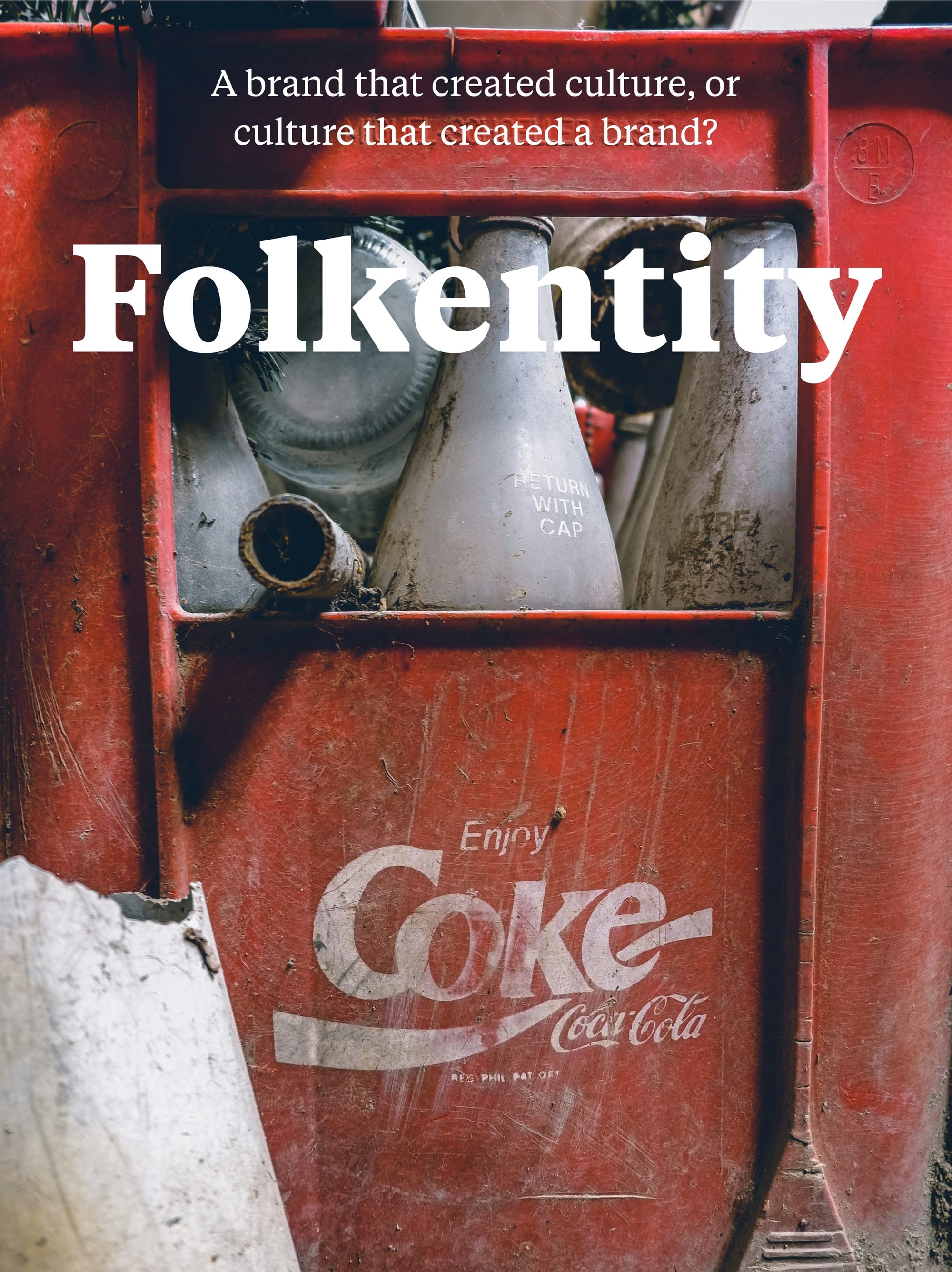
Consider Coca-Cola. It is not a Mindentity—it long ago escaped the psychological ownership of any single creator. John Pemberton, who mixed the original formula in 1886, has been gone for over a century. The Coca-Cola Company has gone through countless transformations of ownership, management, and strategy.
But nor is it a Worldentity. Coca-Cola remains legally owned, commercially managed, and institutionally controlled by The Coca-Cola Company. Unlike the Egyptian pyramids—which exist autonomously, serving as "already there" structures for humanity—Coca-Cola depends on continuous corporate activity for its reproduction, distribution, and meaning-making.
Yet Coca-Cola is undeniably more than a Mindentity. It has penetrated billions of lives across every continent. It has been woven into local celebrations, rituals of hospitality, and daily routines that no single corporate decision can fully control. In countless communities, Coca-Cola exists as something people genuinely feel belongs to their shared life—not just a product they consume.

This is the theoretical gap that Folkentity addresses: the ontological status of thematic creations that have exceeded individual psychological ownership, yet have not achieved the autonomous Cultural Givenness of Worldentity. They are neither "mine" nor "already there for the world"—they are, in a precise sense, ours.
3. Introducing Folkentity
A Folkentity is a thematic creation that has entered collective life as an active object of Cultural Projection—sustained by the psychological ownership and project engagement of a community of participants, yet still dependent on that community's ongoing activity for its existence and vitality.
The term draws on "folk"—not in the narrow sense of folk tradition or peasant culture, but in its broader sense: the people, a community, those who share a world of activity. A Folkentity belongs to the folk in this sense: it is collectively held, collectively reproduced, and collectively developed.
Three characteristics distinguish Folkentity from its two ontological neighbors:
From Mindentity, Folkentity differs in that psychological ownership is no longer singular. The creator's exclusive control, intimate knowledge, and self-investment have been joined—and increasingly supplemented—by the psychological ownership of supporters, contributors, and participants. The thematic creation has become a shared object.
From Worldentity, Folkentity differs in that its existence remains dependent on active collective engagement. A Worldentity persists whether or not any particular person attends to it—the pyramids stand regardless of tourism flows. A Folkentity requires the ongoing participation of its community to remain vital. If that community dissolves or loses interest, the Folkentity may fade, fragment, or revert toward Mindentity status.
Its distinctive feature is that it serves as the primary object of Cultural Projection—the thematic creation around which communities form, projects multiply, and cultural life most actively unfolds. It is not a resting point but a generative center.
4. Benefits and Challenges of the Concept
Why Folkentity Is Theoretically Necessary
The introduction of Folkentity resolves several theoretical difficulties.
First, it completes the ontological spectrum. Without Folkentity, the transition from Mindentity to Worldentity appears as a mysterious leap—how does a creator's personal project become a civilization's given structure? Folkentity names the intermediate territory where this transformation is actually negotiated, contested, and achieved.
Second, it provides the appropriate unit of analysis for most cultural phenomena. The vast majority of thematic creations that matter to communities—open source software projects, religious movements, academic disciplines, social enterprises, fan cultures, local traditions—are neither Mindentities nor Worldentities but Folkentities. They are collectively held, actively maintained, and vigorously debated.
Third, it connects the ontology of thematic creation to the dynamics of Cultural Projection. In ACS, Cultural Projection describes the mechanism by which individual mental platforms engage with cultural frameworks through developmental projects. Folkentity is the object of this projection—the thematic creation that both invites and organizes collective engagement.
The Theoretical Challenges
The concept of Folkentity also presents genuine theoretical difficulties that must be acknowledged.
The first challenge is boundary determination. Unlike Mindentity (defined by the presence of psychological ownership and ecological objectification) or Worldentity (defined by Cultural Givenness), the boundaries of Folkentity are inherently dynamic. How much collective engagement constitutes a Folkentity? How does one distinguish a nascent Folkentity from a Mindentity with a small audience?
The second challenge is scale independence without scale indifference. Folkentities exist at radically different scales—from a three-person research group to a global movement. The concept must accommodate this range without treating all Folkentities as equivalent. Scale matters, but it is not the only thing that matters.
The third challenge is the ownership paradox. Many significant Folkentities—including Coca-Cola—are legally owned by commercial entities, yet culturally experienced as belonging to communities. This paradox cannot be dissolved theoretically; it must be held as a constitutive tension within the concept itself.
5. The Folkentity Framework: A 2×2 Structure
To address these challenges and provide a rigorous analytical tool, I propose a 2×2 framework for understanding Folkentity's internal structure. This framework departs from the approach used in the Mindentity analysis (which organized six dimensions into Subjective and Objective axes) and adopts a structure more appropriate to Folkentity's distinctive ontological character.
The Mindentity framework centered on a single Subject—the creator—and their relationship to a single Object—the creative result. Folkentity's ontological character is more complex: it involves multiple subjects, multiple objects, and the dynamic interplay between them.
The framework organizes Folkentity along two dimensions:
Columns (Object dimension):
- Thematic Creation: the core creative result itself—the concept, artifact, practice, or work that anchors collective engagement
- Thematic Enterprise: the broader ecosystem of projects, relationships, and activities that develop around the core creation
Rows (Engagement dimension):
- Psychological Ownership: the sense of belonging, investment, and identification that participants develop in relation to the Folkentity
- Projectivity: the perception and pursuit of action opportunities—the disposition to initiate or join projects organized around the Folkentity
This yields four cells, each capturing a distinct dimension of how Folkentities exist and develop in collective life.
5.1 Psychological Ownership × Thematic Creation
This cell describes how participants develop a sense that the core thematic creation belongs to them—not in a legal sense, but in the psychological sense theorized by Pierce, Kostova, and Dirks: a felt sense of "mine-ness" or, in the collective case, "ours-ness."
For a Folkentity, this collective psychological ownership is constitutive. When Bitcoin's early adopters spoke of "our network" or "our revolution," they were not confused about intellectual property. They were expressing a genuine psychological relationship to a shared thematic creation—one that had become part of their identity, their community, and their sense of meaningful participation in something larger than themselves.
This dimension explains why Folkentities can generate extraordinary motivation and loyalty that no purely legal or commercial relationship can produce. The psychological ownership of participants is not derivative of the creator's original ownership; it is independently constituted through engagement, contribution, and identification.
Collective psychological ownership of the thematic creation is, in this sense, the affective foundation of Folkentity existence.
5.2 Psychological Ownership × Thematic Enterprise
As a Folkentity develops, psychological ownership expands beyond the core thematic creation to encompass the broader thematic enterprise—the entire ecology of projects, communities, practices, and institutions that have grown up around it.
This expansion is theoretically significant. When participants identify not just with Bitcoin as a technology but with the crypto ecosystem, the values it embodies, and the community it constitutes, their psychological ownership has migrated to the enterprise level. This enterprise-level ownership is both more durable and more generative than object-level ownership alone: it motivates contribution to the broader ecology, not just engagement with the core creation.
For Coca-Cola, this dynamic operates in complex ways. Corporate strategy attempts to manage enterprise-level ownership—building brand communities, sponsoring cultural events, associating the product with shared values. But genuine enterprise-level psychological ownership often develops independently of corporate intention, as communities appropriate the Folkentity into their own cultural projects.
This cell thus captures how Folkentities become embedded in collective identity at a level that transcends any particular artifact or project.
5.3 Projectivity × Thematic Creation
Projectivity refers to the perception of action opportunities—the disposition to see possibilities for initiating or joining projects. In the ACS framework, projectivity is a fundamental feature of anticipatory activity: to be an agent in the World of Activity is to perceive affordances for action and to act on them.
When a thematic creation achieves Folkentity status, it generates what I call double projectivity: it simultaneously affords the opportunity to initiate projects (developing new applications, creating derivative works, building complementary tools) and to participate in existing projects (joining ongoing efforts, contributing to established initiatives, entering established communities).
This double projectivity is what makes Folkentities generative. The core thematic creation becomes a platform from which an expanding ecology of projects emerges. Bitcoin's blockchain generated countless projects—alternative cryptocurrencies, decentralized applications, NFT platforms, DeFi protocols—each initiated by actors who perceived action opportunities in the original creation.
The ecological objectification described in the Mindentity framework here undergoes a qualitative transformation: it is no longer the creator objectifying their vision, but a community of actors objectifying their own engagements with a shared creation. The result is what the folkentity note describes as proliferating derivative objectification—the multiplication of artifacts, tools, platforms, and practices organized around the core creation.
5.4 Projectivity × Thematic Enterprise
At the enterprise level, projectivity takes on a different character. Participants no longer perceive opportunities simply in relation to the core creation, but in relation to the entire thematic ecosystem—its open problems, its institutional gaps, its unrealized possibilities.
This enterprise-level projectivity is the engine of what I will call, in the next article, the Agency Cascade: the dynamic by which Folkentities generate successive waves of cultural engagement, each building on and extending what preceded it.
For Coca-Cola, enterprise-level projectivity manifests in the vast ecology of businesses, cultural practices, and community activities organized around the brand—from local bottlers to global marketing agencies, from art installations to political boycotts. None of these were planned by the original creators; all of them reflect participants perceiving and pursuing action opportunities within the thematic enterprise.
This cell captures the self-amplifying character of mature Folkentities: the larger the enterprise, the more opportunities it presents; the more opportunities it presents, the more participants it attracts; the more participants it attracts, the larger the enterprise becomes.
6. Three Scales of Folkentity
Folkentities exist at different scales, and scale is not merely a quantitative variable. As Folkentities grow from small communities to broad movements, their internal dynamics change qualitatively. I distinguish three scales:
Tiny Folkentity
A Tiny Folkentity corresponds to what the "Culture as Thematic Enterprise" framework calls the Tiny Culture stage. It involves a small, intimate community—a core team, a research group, an early adopter circle—in which participants have direct relationships with each other and with the creator.
In a Tiny Folkentity, psychological ownership is intensely personal and shared: members feel that the creation is genuinely "ours" in the richest sense, because they have been directly involved in its development. Projectivity is high and direct: every member can see clear opportunities to contribute, and does so.
The vulnerability of Tiny Folkentities is their dependence on this intimate community. They retain strong Mindentity characteristics—if the core participants lose interest or the community fragments, the Folkentity may collapse. Bitcoin in the six months after Satoshi Nakamoto's initial release—when Hal Finney was the first to receive a transaction—exemplifies this scale.
Meso Folkentity
A Meso Folkentity corresponds to the Cultural Center stage. It has grown beyond the intimate community into a broader field—a professional community, a subculture, an industry sector—in which most participants do not know each other personally but share common references, norms, and commitments.
At this scale, informal rules and jargon emerge. Ecological objectification stabilizes into recognized platforms, documents, and tools. Psychological ownership becomes more distributed and less personal—participants identify with the thematic enterprise as a whole rather than with specific individuals.
The Ethereum developer community in its early years exemplifies this scale: large enough that most participants had never met, yet small enough that shared culture and mutual recognition remained vivid.
Mega Folkentity
A Mega Folkentity operates at the scale of a cultural movement or a cross-sectoral phenomenon. It has achieved what might be called a Cultural Givenness ante portas—people begin to take it for granted, to treat it as simply part of the landscape, even though it has not yet achieved true Worldentity status.
At this scale, most participants no longer know the origin story. The creator's identity fades from practical consciousness. Psychological ownership becomes diffuse—felt as cultural belonging rather than personal investment. Projectivity operates through large, established institutions and platforms.
Coca-Cola is a Mega Folkentity. The open-source movement is a Mega Folkentity. The TEDx program is approaching this status. None of these has achieved Worldentity status—they remain owned, managed, contested, and dependent on ongoing social reproduction. But they operate at a scale and with a taken-for-grantedness that approaches the threshold of Cultural Givenness.
7. The Agency Cascade: Tiny → Meso → Mega
The three scales of Folkentity are not merely a typology. In ACS terms, they constitute an Agency Cascade—a dynamic in which each scale anticipates and enables the next.
A Tiny Folkentity does not merely exist at a small scale; it anticipates Meso development. The early Bitcoin community was not simply a small group of enthusiasts—it was an anticipatory formation, oriented toward a future in which the network would be larger, more robust, and more consequential. This anticipatory orientation shaped every decision: the architecture Nakamoto chose, the norms Finney and others established, the documentation they produced.
A Meso Folkentity, in turn, anticipates Mega development—or, in many cases, actively resists it. The tension between a community's intimate culture and the pressures of mass adoption is one of the defining dramas of Folkentity development. Some Meso Folkentities successfully navigate the transition to Mega scale while preserving their core character. Others fracture under the pressure.
A Mega Folkentity stands at the threshold of Worldentity. Whether it crosses that threshold depends on whether it achieves autonomous Cultural Givenness—whether it can persist without the ongoing effort of any particular community to sustain it. Most Mega Folkentities never make this crossing; they remain permanently at the threshold, sustained by the continued efforts of corporations, movements, or institutions.
This cascade structure—in which each scale anticipates and enables the next—is the subject of the next article in this series, Culture as Anticipatory Activity. There, I will develop the concept of the Agency Cascade as a central mechanism of cultural development in the ACS framework.
8. Conclusion: Folkentity in the Ontology of Thematic Creation
The concept of Folkentity completes the triadic ontology of thematic creation introduced in this series.
Mindentity names the beginning: the creative result as it exists in the creator's psychological ownership, prior to collective engagement.
Folkentity names the middle: the thematic creation as it exists in collective life—sustained by distributed psychological ownership and generative projectivity, organized around both the core creation and the broader thematic enterprise, and existing at scales from intimate community to cultural movement.
Worldentity names the end: the thematic creation as Cultural Givenness, "already there" for subsequent generations, autonomous from any particular community's ongoing effort.
Between these three poles, the entire drama of cultural innovation unfolds. Most of what we care about in cultural life—the movements we join, the tools we use, the communities we inhabit, the traditions we maintain—exists in Folkentity form: neither purely private nor yet autonomous from collective effort, but actively alive in the shared world of human activity.
To understand cultural development is, in large part, to understand how Folkentities are born, how they grow, and how—in rare and remarkable cases—they achieve the autonomous structural reality of Worldentity. That is the task to which Anticipatory Cultural Sociology is committed.
This article is part of the ongoing development of Anticipatory Cultural Sociology (ACS). An early thematic collection of ACS working papers is available on Possible Press.
v1.0 – February 2026 - 3,039 words