
World of Life: Four Negative Frontiers of Knowledge Engagement

A Thematic Conversation and a Reflection
by Oliver Ding
March 7, 2026
In the summer of 2024, I exchanged a series of emails with a friend I will call Vera. She is someone I deeply respect — perceptive, candid, and guided by a very different inner compass than mine. She had been reading my work, and she wrote to me with a kind of directness that I have come to value precisely because it is rare.
Her observation was simple: my writing lacked emotional presence. Not in the sense of being cold or indifferent, but in a more fundamental way — she said that when she faced my texts without activating her analytical mind, almost nothing came through. The writing did not carry energy. It did not arrive.
I remember how I responded. I sent her diagrams. I explained my theoretical framework for why emotion was a secondary variable in my models. I pointed her to my visual design work as evidence that I did, in fact, have an emotional register. I was not being defensive — I genuinely believed I was answering her question. I was, as I now understand, doing exactly what she was describing.
Vera did not continue the correspondence after a point. She had said what she came to say.
1
What she had identified was real. But I could not receive it then — not because I disagreed, but because I was operating from a different identity. I was a theorist and a scientist. In that role, the absence of emotion in a text is not a flaw but a norm. Precision requires it. A physics equation does not grieve; a conceptual framework does not long for things. The emotional register and the theoretical register belong to different registers of expression, and I had not yet found a way to hold them together.
The shift came not through argument but through practice. Over 2024 and into 2025, my work moved from knowledge innovation toward cultural innovation — a transition I made deliberately, with a clear awareness that the two operate by different standards. A scientific concept system demands precision and accountability to evidence. A cultural concept system demands resonance and transmissibility. These are genuinely different criteria. To work at the cultural level means accepting that emotion is not noise to be filtered out — it is the medium through which concepts travel.
Once I understood this, something Vera had said years earlier returned to me with new weight. She had compared my writing to music — specifically to the experience of listening to music. When you listen, she wrote, you do not activate your analytical mind. You receive. And yet you receive something real — something that touches a dimension of experience that language alone cannot reach.
I thought about this for a long time. And gradually I came to what feels to me like the most important insight of 2026 so far: the origin of a theme is always connected to intuition, and intuition is always connected to emotion. A theme does not begin as a concept. It begins as a felt sense — a vibration in the body before the mind has named it. The work of a creative life is, in part, to trace that vibration back to its source and forward into form.
2
These reflections led me, eventually, to a question about the structure of the knowledge ecosystem itself. Why is it that certain kinds of knowledge reach millions of people, while other kinds — sometimes deeper, more carefully built — reach almost no one? And why do some knowledge systems that are, by rigorous standards, epistemically dubious, persist for centuries?
The framework I have developed for understanding cultural development — the World of Life — offers a way to think about this. The World of Life is bounded by four edges, each representing a fundamental dimension of human existence:
Spirituality marks the upper boundary — the limit of ultimate meaning, transcendent significance, the questions that exceed what any empirical method can answer.
Science marks the lower boundary — the limit of material patterns and natural laws, the domain of the measurable, the testable, the reproducible.
Individuals mark the left boundary — the origin point of all cultural creation, where life begins, where personal enterprise takes root, where the interior world generates its first gestures outward.
Collectives mark the right boundary — where social formations crystallize, where cultural movements find their shape, where the individual gesture becomes shared inheritance.
Within the square these four boundaries define, cultural development happens. Knowledge flows, concepts travel, practices take root or dissolve.
But each boundary also has what I have come to think of as a negative frontier — a direction of drift that, when entered, transforms the generative potential of that boundary into something closed, extractive, or entropic.
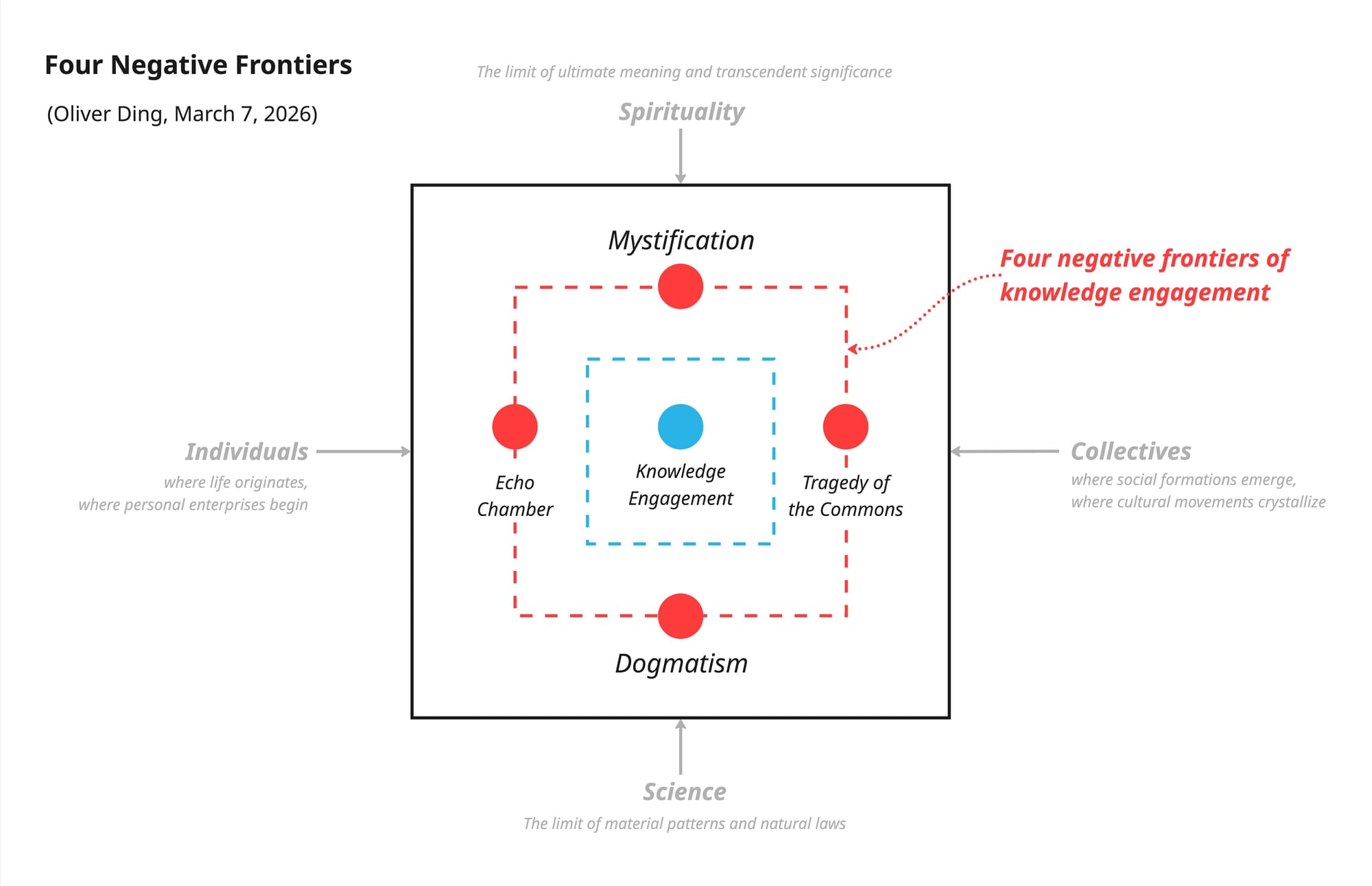
In my recent ACS 1.1 project, I have been using the World of Life four-boundary diagram frequently as an analytical tool — but this time, the usage is different. The diagram above makes the spatial logic visible. The inner square marks the territory of Knowledge Engagement — the working space where cultural development actually happens. The four boundaries of the World of Life (Spirituality, Science, Individuals, Collectives) define its edges.
Beyond those edges, a second square frames the four negative frontiers: Mystification, Dogmatism, Echo Chamber, and Tragedy of the Commons. They are not distant dangers. They occupy the zone just outside the working space, adjacent to every boundary, always within drift.
3
At the Spirituality boundary, the negative frontier is mystification.
The human need for ultimate meaning is real and ancient. Tarot cards, the I Ching, countless divinatory and spiritual systems — they have persisted for millennia not because they are scientifically valid but because they respond to something genuine: the need to find orientation in the opacity of a life. I do not dismiss this. I respect the need.
But mystification turns that need into a closed system. It makes the interpretive authority inaccessible, the concepts immune to questioning, the boundary between insight and manipulation deliberately blurred. The system sustains itself not through the quality of its knowledge but through the management of mystery. Once entered, this negative frontier makes genuine inquiry impossible — because inquiry requires the possibility of being wrong, and mystification forecloses that possibility by design.
Vera operated near this boundary, in the territory of the spiritual and the somatic. I kept a respectful distance. What she was reaching for — an intelligence of the body, a knowledge that precedes language — I find genuinely interesting. But the mystified version of that territory I cannot follow.
At the Science boundary, the negative frontier is dogmatism.
Science is, in principle, the most anti-dogmatic of all epistemologies. It is constituted by the commitment to revise in the face of evidence. And yet scientific culture can calcify. Frameworks that were once genuinely open can become orthodoxies. "Not sufficiently rigorous" can become a way of dismissing what has not yet been formalized. The authority of method can be used to shut down the insights that methods have not yet learned to measure.
There is a structural irony here that I find worth sitting with: mystification and dogmatism are mirror images. One closes knowledge by making it too sacred to question; the other closes knowledge by making its standards of questioning so narrow that only already-accepted knowledge can pass through. Both produce the same result — a system that cannot learn.
For a long time, I worked primarily in the Science boundary zone. The movement toward cultural innovation was, among other things, a deliberate step away from the dogmatic version of that zone — a recognition that the standards appropriate to scientific concept systems are not the only standards worth honoring.
At the Individuals boundary, the negative frontier is the echo chamber.
The individual is the irreducible source of creative life. No framework, no institution, no collective movement generates anything without the particular person who first saw something, named it, reached for it. The primacy of individual experience is not a romantic notion — it is a structural fact about where creation begins.
But there is a drift that can happen when the individual becomes the only reference point. Andy Blunden, a philosopher I have corresponded with for years, described it to me with an image I have never forgotten: the echo chamber. A person whose thinking develops entirely in conversation with itself — however vast, however internally sophisticated — is eventually surrounded by the amplified sound of its own voice. The chamber does not feel closed from the inside. It often feels like the most expansive and resonant space imaginable. That is part of what makes it dangerous.
I have felt this pull. Thirty-plus books written, most of them unpublished, most of them in dialogue primarily with each other — there is a version of this story that is an echo chamber. The question I have been living with is how to stay genuinely permeable to other voices without losing the thread of my own.
At the Collectives boundary, the negative frontier is the tragedy of the commons.
The collective is where cultural inheritance accumulates — where the work of individual creators, over generations, becomes the shared property of a civilization. This is one of the most remarkable things about human life: that the insights of people long dead remain available to us, that we can stand on ground that others laid.
But collective inheritance requires stewardship. It requires people who are willing to do the work of advancing public knowledge — not just drawing on what exists, but contributing to what will exist. The tragedy of the commons is not caused by malice. It is the structural outcome when everyone rationally maximizes their own extraction from a shared resource without anyone taking responsibility for its renewal. The commons does not collapse because bad people destroyed it. It collapses because no one felt responsible for it.
This is, I think, the most underappreciated of the four negative frontiers. Mystification is visible. Dogmatism is visible. Even the echo chamber has recognizable symptoms. But the slow depletion of public knowledge through collective non-investment is harder to see — until the ecosystem has already thinned.
4
In March 2021, while writing a long essay on Platform Innovation as Concept-fit, I reviewed Ronald Finke's Creative Realism framework as part of the theoretical resources section. At the time, I used it to think about the philosophical stance behind platform innovation as a creative social practice. Looking at it now alongside the Four Negative Frontiers, I notice a structural resonance worth recording.

Finke's framework organizes ideas along two dimensions — Creative vs. Conservative, and Realistic vs. Idealistic — producing four quadrants: Creative Realism, Creative Idealism, Conservative Realism, and Conservative Idealism. His argument is that the most significant innovations cluster in Creative Realism: imaginative in their divergence, yet structurally grounded in realistic problems and constraints.
- Conservative Realism: Most ideas are generated in traditional, highly structured fields such as engineering, medicine, government, and law. These ideas focus on realistic issues and problems but are generally conservative, often excessively.
- Creative Idealism: Most crackpot ideas are often quite original but excessively fanciful. For instance, many New Age concepts would fall into this category, such as the claim that razor blades will stay sharper when placed inside miniature pyramids.
- Conservative Idealism: Some common ideas are unrealistic to begin with, such as conventional misconceptions and irrational prejudices — for example, the belief, once quite common, that women are inherently inferior to men.
- Creative Realism: Ideas in this category show imaginative divergence and yet are structurally connected to realistic issues and concepts. Examples of Creative Realism are Invention and Design, Scientific Theories, Art/Music/Film, and Everyday Thinking.
The parallel to the Four Negative Frontiers is not exact, but it is suggestive. Mystification maps onto the negative pole of Creative Idealism — highly original, unmoored from reality, sustained by the management of mystery rather than the quality of insight. Dogmatism maps onto the negative pole of Conservative Realism — attentive to real problems, but so resistant to revision that the very openness that gives science its power is foreclosed. The Echo Chamber maps onto the negative pole of Conservative Idealism — self-enclosed, unreachable by evidence, a system that confirms itself.
The Tragedy of the Commons is not a failure of individual cognition at all. It is a structural failure of collective stewardship, the slow depletion of the shared field that Creative Realism depends on but cannot, by itself, maintain.
This points to an essential difference between the two frameworks. Finke works within the World of Activity — the world as perceived and navigated by a single individual, the horizon of one person's creative engagement. The World of Life operates at a different scale: it describes the social world as a structural whole, the field within which individual worlds of activity are embedded and from which they draw their conditions of possibility. The nesting of World of Activity within World of Life is what allows the Four Negative Frontiers to capture something Finke's framework cannot — the collective dynamics that individual creative realism neither produces nor controls. A person can practice Creative Realism with full integrity and still contribute, through collective inaction, to the Tragedy of the Commons. The two frameworks are not in competition; they operate at different levels of the same reality. But the nested structure is more complete.
What Finke calls Creative Realism is, in the terms of this essay, Knowledge Engagement — the blue center of the diagram, the territory where rigorous imagination meets honest constraint. Two frameworks, from different directions, describe the same navigational challenge.
5
Four boundaries. Four negative frontiers. And in the middle, the territory where cultural development actually happens — where knowledge can be rigorous without being dogmatic, resonant without being mystified, individual without being isolated, collective without being exploitative.
This is the space that knowledge innovators inhabit, or try to inhabit. And their particular burden — the thing I have come to think of as something close to a vocation — is to remain alert at all four edges simultaneously. Not to approach the Spirituality boundary without keeping the Science boundary in view. Not to honor individual insight while forgetting the obligation to the commons. Not to maintain the standards of rigorous knowledge while drifting into the closed certainty of a dogmatic system.
Vera could not enter my texts without her analytical mind because I had not yet learned to carry the emotional dimension of knowledge into the work itself. What she was asking for — I understand it now — was not sentiment. It was energy. The felt sense that something alive is present in the writing, that the person who made it was moved by it, that the concepts were born out of contact with real experience rather than constructed in isolation from it.
I am still learning how to do this. The ecological metaphors, the thematic cards, the music-narrative experiments — these are my current attempts. They are not decorations applied to existing theoretical content. They are ways of discovering what the content actually is, by finding the image or structure that carries it without draining it of life.
The knowledge innovator's fate is to work near all four edges and be consumed by none of them. To carry the rigor without the dogma. To honor the transcendent without the mystification. To stay rooted in individual experience without losing the capacity to be genuinely surprised by another. To contribute to the commons rather than merely drawing on it.
This is not a comfortable fate. But it is, I think, the only honest position available to someone who takes knowledge seriously and takes people seriously at the same time.
v1.0 - March 7, 2026 - 2604 words