
From GO Theory to ACS and Beyond
The "GO Theory" Trilogy
by Oliver Ding
March 29, 2026
Around October 2024, I set three goals for the GO Theory project. The initials GO stand for Genidentity and Opportunity.
The first was to launch a book draft around the concept of Genidentity. The second was to run a creative dialogue between Creative Life Theory and the Ecological Practice Approach. The third — the most ambitious — was to move into the field of cultural development by building the Cultural Genidentity Framework. The ambition behind all three goals was the same: to broaden the scope of my theoretical work from individual life development toward Social Life Development.
GO Theory was designed to nest Creative Life Development inside a larger container:
Social Life Development (Creative Life Development)
In practice, the first half of 2025 unfolded differently than planned. Rather than pursuing these goals directly, I worked on them through Indirect Activity — developing adjacent projects whose by-products fed into GO Theory. The most significant outcome was the World of Activity toolkit, which included a systematic exploration of the dialectical relationship between Theme and Identity. These were genuine achievements. But they remained at the level of individual development. The third goal — entering the territory of cultural development — had not yet been reached.
On June 18, 2025, I curated these outcomes into GO Theory: Genidentity, Opportunity, and World of Activity (book, v1.0) and declared it Phase I. The subtitle names what had actually been accomplished: Genidentity, Opportunity, and World of Activity. Phase II — the move into cultural development — remained ahead.
What Phase II needed was a new ontological foundation. To analyze Social Life Development at the cultural level, I needed a framework for the social world itself — not just a framework for the individual moving through it. That foundation arrived on December 31, 2025, with the completion of Meta-frameworks: Creative Heuristics for Individual and Social Development (book, v1.0, 2025). This manuscript established the World of Life as a new social world ontology — a larger container holding the World of Activity within it:
World of Life (World of Activity)
Where the World of Activity frames the course of an individual's creative life, the World of Life frames the broader social and cultural terrain in which that life unfolds.
On January 5, 2026, the Anticipatory Cultural Sociology (ACS) project was formally named. In the months since, the work has centered on deep exploration of the World of Life — including the landscape you are reading now.
I did not plan it this way. But looking back, it is now clear: ACS is actually Phase II of GO Theory. The third goal set in October 2024 — moving into cultural development — is now being pursued in earnest. The vocabulary is the same: Genidentity, Opportunity, World of Activity. But the container has expanded. The question is no longer only how a creative individual develops within their life course. It is how cultural enterprises develop within the World of Life.
And looking further still, a larger picture has come into view. GO Theory is not only the name for Phase II. It is the name for the theoretical platform itself — now carrying a fuller title:
GO Theory: The World of Life (World of Activity) Approach
The initials GO stand for Generation and Orientation — the two directions that define the platform's theoretical character. Generation names the productive, emergent, forward-moving dimension of cultural and individual life: things are created, enterprises unfold, meaning accrues. Orientation names the positional, directional, sense-making dimension: actors are always somewhere, always facing some directions rather than others, always situated within a World of Life that both enables and limits — and always anticipating, projecting themselves toward futures that are not yet given but are already shaping present action.
This platform has its own knowledge ecosystem, built on three meta-frameworks completed between November 2025 and February 2026:
- Ontology: The History{Life[Self(Body)]} Framework (HLS Framework, v3.0, 2025) — the map of the social world, introduced in Meta-frameworks: Creative Heuristics for Individual and Social Development (book, v1.0, 2025), December 2025
- Epistemology: The Ecological Formism Framework (v2.0, 2025) — the structure of knowledge systems, introduced in Ecological Formism (book, v1, 2025), November 2025
- Methodology: The LARGE Method (v3.0, 2026) — the meta-method governing all methods within the platform, February 2026
These three meta-frameworks are not external scaffolding. They are the internal architecture of GO Theory itself — the ontological, epistemological, and methodological foundations on which the five theoretical enterprises build.
On this platform, five theoretical enterprises operate, each occupying a distinct position within the World of Life:
- Life as Activity (including the Project Engagement Approach) — at the center, attending to the structure of activity itself, the operational language shared by all the other enterprises
- Anticipatory Cultural Sociology — at the Collectives boundary, attending to cultural development at the collective scale
- Strategic Developmental Psychology — at the Individuals boundary, attending to individual life development at the personal scale
- Cognitive Hydrology — at the Spirituality boundary, attending to the flow of ideas and meaning in creative life
- Platform Ecology — at the Science boundary, attending to the ecological and structural conditions of platform development
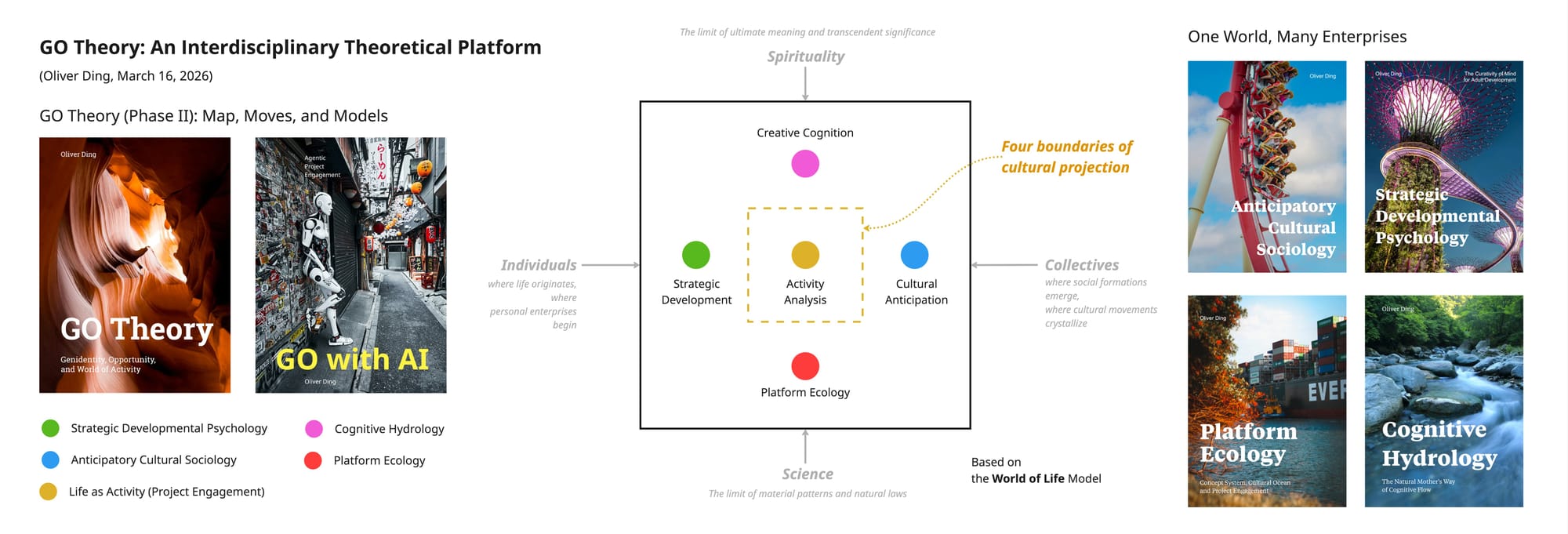
These five enterprises are equal. None is the foundation of the others. Each occupies a different position within the World of Life, which means each brings a genuinely different theoretical perspective. And because they share the same spatial foundation — the same map, the same boundaries, the same operating concepts — they naturally support one another, forming a network of enterprises rather than a hierarchy.
The development of GO Theory can now be read as a trilogy:
- GO Theory: Genidentity, Opportunity, and World of Activity (June 2025) — Phase I, the individual level
- Meta-frameworks: Creative Heuristics for Individual and Social Development (December 2025) — the ontological foundation, World of Life as a social world map
- Anticipatory Cultural Sociology: Creation, Projection, and Agency (March 2026) — Phase II, the cultural level
Three books, three movements, one theoretical platform still unfolding.
One World. Many Enterprises. The platform is open.
v1.0 - March 30, 2026 - 1006 words