
GO with AI, Re-education Tax, and Anticipatory Medium
A Typology of Cultural Medium
by Oliver Ding
February 27, 2026
This article is part of the ongoing development of the Anticipatory Cultural Sociology (ACS) framework, contributing to the Cultural Projection series.
It also serves as the first article in the GO with AI series, which applies the Genidentity-Opportunity (GO) approach to the emerging field of human-AI collaboration — examining how AI tool become sites where Social Life Development and Creative Life Development intersect, and where new forms of creative agency are enacted and supported.
Contents
Introduction: A Tax Nobody Talks About
Part 1: From Space to Time — Deepening the Cultural Medium Framework
1.1 The Spatial Structure and Its Limits
1.2 What Existing Media Theory Offers — and Does Not
Part 2: LARGE as a Heuristic Lens
Part 3: Three Types of Cultural Medium
3.1 Reflective Medium
3.2 Transformative Medium
3.3 Anticipatory Medium
Part 4: Four Theoretical Perspectives on Anticipatory Medium
4.1 Activity Theory: The Anticipatory Structure of Action
4.2 Memory Theory: Three Levels, Three Gaps
4.3 Conversation Theory: The Missing Temporal Dimension
4.4 Thematic Space Theory: Precise Localization
4.5 Convergence: The Definition of Anticipatory Medium
Part 5: Situating the Typology in Media Theory
Part 6: Revisiting the Conversation Surfaces
6.1 A Typological Reading of Eight Surfaces
6.2 What CLAUDE.md Does Not Yet Do: First-order and Second-order Activity
Conclusion: Time, Space, and the Path to Weave the Medium
Introduction: A Tax Nobody Talks About
Every practitioner who works with AI tools across sustained projects eventually encounters a hidden cost. Peter Tuddenham, a systems scientist who has studied Claude’s eight conversation interfaces in depth, has a name for it: the Re-education Tax.
The mechanism is simple and frustrating. You spend an hour in a conversation with an AI assistant, developing a shared understanding of your project — its context, its principles, its current state, the decisions already made. The conversation ends. The next session begins, and you start from zero. Everything accumulated has vanished. The tax is paid again.
Tuddenham’s analysis of Claude’s Conversation Surfaces — the eight distinct interfaces through which users engage with the system — reveals that only one of them provides a genuine solution to this problem: CLAUDE.md in Claude Code. This is a file placed at the project root that the system automatically loads at the start of every session. It is, in my terms, a “README for the AI.”
The contrast with a conventional README is instructive:

What makes CLAUDE.md theoretically interesting is not its technical mechanism but its temporal orientation. A conventional README documents what has happened and what exists now. CLAUDE.md does something different: it encodes what the project expects to happen — the rules, the objectives, the next steps, the decision history. It is not a record of the past; it is a preparation for the future.
This observation is the starting point for this article. The Re-education Tax exists because current AI tools lack what CLAUDE.md provides: a medium that carries anticipation forward across time. To name this phenomenon precisely, and to understand its theoretical significance, we need a concept that does not yet exist in the standard vocabulary of media theory.
That concept is Anticipatory Medium.
Part 1: From Space to Time — Deepening the Cultural Medium Framework
1.1 The Spatial Structure and Its Limits
The preceding article in this series, Cognitive Container of Cultural Projection, established a new framework for understanding Cultural Medium. The framework’s core move was to place Folkentity at the center of the World of Life, identify the interface zone between Folkentity’s projective boundary and the structural limits of the world, and name this zone the Cognitive Container of Cultural Projection.
Within this container, four concepts were re-anchored to the four boundaries of the World of Life, each given an exclusive and non-overlapping function:
- Representation (Individuals boundary): the individual-cognitive interface through which a Folkentity becomes accessible to personal understanding
- Genre (Spirituality boundary): the meaning-normative framework that gives representations their cultural grammar and ultimate orientation
- Artifact (Science boundary): the material-operational substrate through which a Folkentity acquires persistent physical form
- Medium (Collectives boundary): the socially recognized communicative carrier through which a Folkentity reaches collective life
These four elements are not separate components but a nested whole, expressed in the formula:
Medium { Artifact [ Genre ( Representation ) ] }
This is the spatial structure of the Cultural Medium framework: it tells us where each element is anchored in the World of Life, how they relate to each other, and what function each serves in Cultural Projection.

But a spatial structure, however precise, captures only one dimension of a living framework. The Cognitive Container tells us where the four elements are and what they do. It does not yet tell us when — how the entire configuration is oriented in time, whether it faces the past, inhabits the present, or reaches toward the future.
The CLAUDE.md case makes this gap visible. The difference between CLAUDE.md and a Memory system is not about spatial location or functional role — both operate within the Medium boundary, both involve the Collectives dimension. The difference is temporal: Memory systems look backward; CLAUDE.md looks forward. This is a distinction the spatial framework, by itself, cannot capture.
1.2 What Existing Media Theory Offers — and Does Not
Before developing our own framework, it is worth asking whether existing media theory can provide the resources we need.
The tradition offers several powerful tools. Harold Innis distinguished time-biased media (durable, favoring continuity across generations) from space-biased media (light, favoring territorial extension). This is a temporal typology of sorts — but it operates at the civilizational scale, concerned with how empires persist or expand across centuries. The intimate temporal question — how a medium orients a creator’s activity toward their own past, present, or anticipated future within a project — lies entirely outside Innis’s frame.
Marshall McLuhan’s insight that “the medium is the message” directs attention to the formal environment each medium creates. But this analysis operates at the level of sensory ratios and collective social configurations, not the temporal structure of individual or collaborative creative anticipation. McLuhan tells us what a medium does to perception; he does not tell us how a medium positions a user in time relative to their own ongoing enterprise.
Harry Pross’s four-level typology (Primary through Quaternary media, classified by technological participation) is concerned with the question “what technology is involved?” — not with temporal orientation. The same social media platform is Quaternary in Pross’s system, whether it is being used to retrieve old posts, engage in live conversation, or plan a future project.
Gordon Pask’s Conversation Theory, the framework that Tuddenham draws on directly, analyzes how different interfaces structure the conversation between participants. It is sensitive to the form of dialogue but does not distinguish media by their temporal orientation. Pask’s concern is with the quality of the conversational exchange in the present, not with whether the medium is designed to carry past traces or future anticipations.
Mediatization theory (Hjarvard, Couldry, Hepp) provides rich accounts of how media logic shapes social institutions over time. But its temporal dimension is again civilizational or institutional — how media transform society over decades — rather than operational: how a specific medium orients a creator’s activity within their own project timeline.
The gap is consistent across traditions. Media theory has developed excellent tools for understanding what media carry, how they shape perception, how they transform social structure, and what technologies they require. What it has not developed is a typology based on temporal orientation at the level of creative practice: does this medium primarily support looking backward, acting in the present, or anticipating the future?
This is the resource we need, and it is the resource we must develop ourselves.
Part 2: LARGE as a Heuristic Lens
Lacking external resources, we turn to our own theoretical toolkit. The LARGE Method, developed as a meta-methodology for creative life, proves to be exactly the heuristic we need. It is formalized as:
L(A · R · G) = E
Its five principles are:
- L — Landscape: Synchronic view of the whole
- A — Anticipation: Orienting toward the future
- R — Reflection: Learning from the past
- G — Generation: Creating in the present
- E — Enterprise: Diachronic unfolding of projects
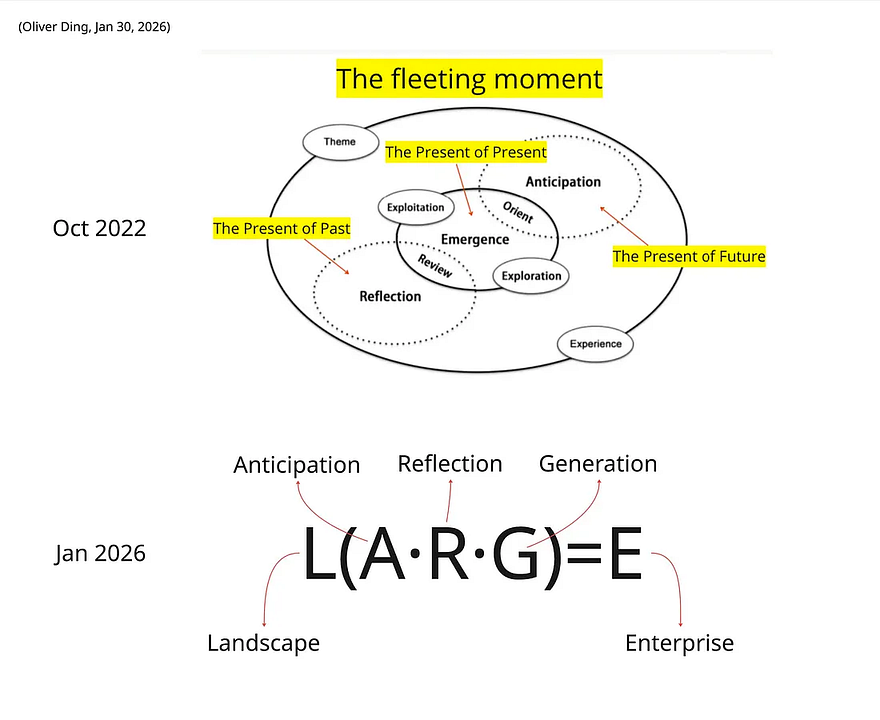
The power of LARGE as a heuristic here is that it makes the temporal structure of creative activity explicit. Three of its five principles — Anticipation, Reflection, and Generation — name three distinct temporal orientations: toward the future, toward the past, and in the present. L provides the synchronic overview; E provides the diachronic arc of the whole enterprise.
When we apply this temporal structure to media, a question emerges: what is the primary temporal orientation of a given medium? Does it primarily support looking backward (Reflection), acting in the present (Generation), or anticipating the future (Anticipation)?
This question generates a natural typology. Not all media are neutral with respect to time. Some are designed primarily to preserve and retrieve the past. Some are designed primarily to support real-time engagement. And some — the category that existing theory has neglected — are designed primarily to encode and carry forward expectations about the future.
These three types can be named:
- Reflective Medium — oriented toward the past (R)
- Transformative Medium — oriented toward the present (G)
- Anticipatory Medium — oriented toward the future (A)
This is not a claim that every medium belongs exclusively to one type. The same platform can function as different types depending on how it is used. But the typology identifies a primary temporal function that any given medium or medium-use tends to serve.
Part 3: Three Types of Cultural Medium
3.1 Reflective Medium
A Reflective Medium is one whose primary function is to preserve, organize, and make retrievable the traces of past activity. Its underlying mental model is referential: it is consulted when one needs to refer back to what has already happened, what has already been said, what has already been decided.
In the Claude Conversation Surfaces framework, Memory systems function as Reflective Media. They store fragments of past conversations, making them searchable and retrievable. The Past Chat Search feature is explicitly referential — it is a medium for going back.
More broadly, archives, logs, annotation systems, and knowledge bases tend toward the Reflective function. Their value lies in their fidelity to the past and their ability to surface relevant history on demand.
The characteristic experience of Reflective Media is orientation: they help users understand where they are by showing where they have been. The limitation of purely Reflective Media is that they do not, by themselves, generate forward momentum. They are essential for grounding, but not for propulsion.
3.2 Transformative Medium
A Transformative Medium is one whose primary function is to enable real-time engagement, interaction, and transformation. Its underlying mental model is interventional: it is used to act upon a situation in the present, to reshape what is happening now.
The Context Window of an AI conversation is the paradigmatic Transformative Medium. Within a session, it enables a continuous dialogue in which each exchange transforms the shared understanding of the moment. The medium is live, dynamic, and present-tense.
More broadly, real-time collaboration tools, live conversations, and interactive design environments tend toward the Transformative function. Their value lies in their responsiveness and their capacity to support creative work in the moment.
The characteristic experience of Transformative Media is engagement: they create the sense of being fully present with a problem, working on it as it unfolds. The limitation of purely Transformative Media is their impermanence — what happens in the context of a session does not automatically persist. Without a mechanism for carrying forward what has been built, each session starts from scratch, and the Re-education Tax becomes inevitable.
3.3 Anticipatory Medium
An Anticipatory Medium is one whose primary function is to encode, carry forward, and activate expectations about future activity. Its underlying mental model is anticipatory: it is designed not to document the past or enable the present, but to prepare and orient the future.
CLAUDE.md is the clearest example of an Anticipatory Medium in the current landscape of AI tools. Analyzed through the full four-element structure of the Cognitive Container, its anticipatory character becomes visible at every layer:
Representation (cognitive interface): CLAUDE.md encodes the project’s conceptual architecture — its objectives, principles, and current state — as external representations that the AI can parse and act upon. These are not records of past thinking but structured cognitive interfaces designed for future reading. The typology of representation moves from loose thematic lists (an early CLAUDE.md) toward more precise knowledge frameworks (a mature one) as the project develops.
Genre (normative orientation): CLAUDE.md has crystallized a new Genre — “README for the AI” — that did not previously exist. This Genre carries specific normative commitments: what counts as a good CLAUDE.md (complete, transparent, actionable), what a bad one looks like (vague, outdated, over-detailed), and what the creation is ultimately oriented toward (sustained, autonomous human-AI collaboration). The Genre is anticipatory in that it defines excellence in terms of future performance, not past record.
Artifact (material substrate): CLAUDE.md exists as a markdown file under Git version control — a material form subject to the constraints of the Science boundary. Its physical persistence is what makes the anticipatory function possible: the file must exist, be findable, and be readable at the moment of the next session. The choice of markdown and Git is not arbitrary; these material forms afford version control, diff tracking, and collaborative editing — all oriented toward the file’s future use.
Medium (social carrier): CLAUDE.md operates within the Claude Code environment as a socially recognized protocol. The system is designed to load it automatically — this social recognition is what elevates the file from a personal note to a Medium. The collective acknowledgment here is built into the platform architecture: the protocol says, “this is how we carry anticipation forward in this environment.”
Its five core content elements are all oriented toward the future:
- Object & Objective — defines the direction toward which activity is oriented
- Rules — encodes the conventions that will govern future action
- Current State — marks the starting point for the next activity cycle
- Next Steps — specifies what is anticipated to happen
- Decision History — preserves the reasons behind choices, so they do not need to be re-litigated
What makes Anticipatory Media theoretically distinctive is their relationship to agency. Reflective Media are consulted by agents looking backward. Transformative Media are inhabited by agents acting in the present. Anticipatory Media are authored by agents looking forward — and then read by future agents (whether human or AI) who act in accordance with what was anticipated.
This creates a unique temporal structure: the author of CLAUDE.md is acting in the present, but their activity is directed toward a future moment of reading. The reader of CLAUDE.md is acting in a present that was anticipated by a past author. Anticipatory Medium bridges two presents across a temporal gap — and in doing so, it makes sustained human-AI collaboration possible without paying the Re-education Tax at every session boundary.
Part 4: Four Theoretical Perspectives on Anticipatory Medium
The three-type typology established in Part 3 identifies Anticipatory Medium as a distinct category. But naming a category is not the same as understanding it. This part deepens the concept through four theoretical perspectives, each of which illuminates a different dimension of what Anticipatory Medium is and how it works. The convergence of these four perspectives is the theoretical contribution of this article.
4.1 Activity Theory: The Anticipatory Structure of Action
The Anticipatory Activity System (AAS) framework, developed from the intersection of Activity Theory and Robert Rosen’s Anticipatory System Theory, provides the ontological foundation for understanding Anticipatory Medium.
Rosen’s core insight is the definition of an anticipatory system: “a natural system that contains an internal predictive model of itself and of its environment, which allows it to change state at an instant in accord with the model’s predictions pertaining to a later instant.” This is the fundamental distinction between an anticipatory system and a reactive system. A reactive system only responds to changes that have already occurred. An anticipatory system’s present behavior is already shaped by a model of what will happen — its present state is partially determined by its anticipated future.
The AAS framework gives this insight a precise structural form. At the center of the model is a four-node tension field:
Self, Other, Present, Future
These four nodes are not sequential stages but simultaneous poles of tension within every activity. The Self acts in the Present while oriented toward a Future in relation to Others. Activity is the dynamic navigation of this four-way tension.
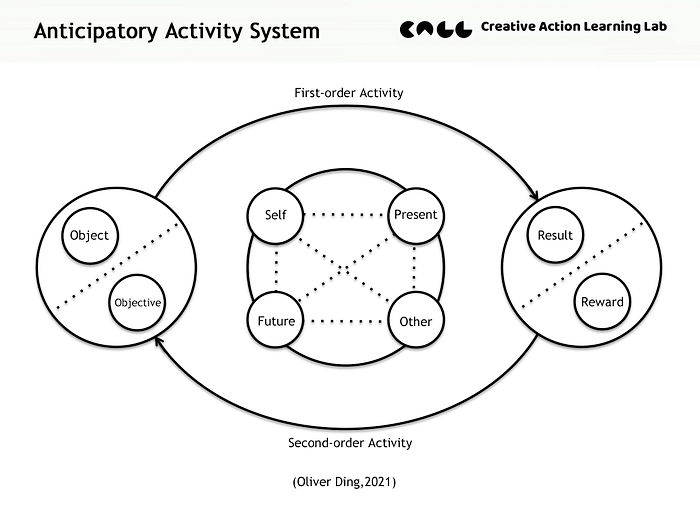
From this structure, the AAS framework identifies two critical gaps:
The Object — Objective Gap: Object (what is acted upon, belonging to the Present) and Objective (what the motive is about, belonging to the Future) are structurally distinct. This distinction draws on both Leontiev’s predmet (which refers to motivation) and Engeström’s object (which refers to the raw material or problem space). The gap between them is not a failure of activity but its engine: the present engagement with the Object is always already oriented by the anticipated Objective. Activity collapses into mere reaction when this gap disappears.
The Result — Reward Gap: Result (what is actually produced) and Reward (what was anticipated as the value of the outcome) are equally distinct. The Result belongs to the present of completion; the Reward was anticipated before the activity began. The gap between them is where learning, adjustment, and the refinement of Predictive Models occurs.
The AAS operates at two scales simultaneously. The Micro-AAS corresponds to the individual level — the Mental System and Behavioral System — where personal anticipatory activity unfolds through First-order Activity (direct engagement with Object and Objective) and Second-order Activity (reflection on and adjustment of the activity system itself). The Macro-AAS corresponds to the collective level — the Cultural System and Historical System — where shared anticipatory structures drive cultural development.
Applied to human-AI collaboration, this framework reveals the Re-education Tax in precise terms. The Predictive Model that orients a sustained project — the internal model of what the project is, where it is going, and how to proceed — exists in the human’s cognitive system. When a session ends and the AI “forgets,” the Object — Objective structure does not disappear from the human’s mind, but it vanishes entirely from the system that is supposed to support it. The next session begins without a Predictive Model: the AI is structurally reactive, unable to anticipate, because it has no model of the project’s future to act upon.
Anticipatory Medium, from the AAS perspective, is a medium that externalizes and persists the Predictive Model across the Object — Objective gap. It gives the AI system what it structurally lacks: a model of the anticipated future that can orient present behavior. CLAUDE.md is not simply a memory file — it is an externalized Predictive Model, carrying the Object — Objective structure of a project across the session boundary so that the next activity can be anticipatory rather than reactive.
4.2 Memory Theory: Three Levels, Three Gaps
Cognitive psychology distinguishes three levels of memory that operate according to different mechanisms and timescales: short-term memory (immediate, highly limited capacity, seconds to minutes), working memory (the active workspace where information is held and manipulated during ongoing cognitive tasks), and long-term memory (persistent storage that can retain information across days, years, or a lifetime).
This classical framework, when applied analogically to human-AI collaboration, offers a productive lens for understanding the structural source of the Re-education Tax. The analogy is not perfect — AI systems do not have memory in the neurological sense — but the structural parallel is illuminating.
The AI’s Context Window functions as working memory: it holds everything currently active in the conversation — up to 200K tokens — and makes it available for immediate processing. Within a session, this working memory is capacious and effective. But like working memory in cognitive psychology, it does not persist: when the session ends, the context clears. The AI has no mechanism analogous to consolidation — the process by which human working memory transfers information into long-term storage.
This is the fundamental asymmetry of human-AI collaboration. The human brings long-term memory to every session: the project’s history, the decisions already made, the directions explored and abandoned, the evolving understanding of what the work is about. The AI brings only working memory — powerful within the session, but reset at every boundary.
Reflective Media (Memory systems, Past Chat Search) are attempts to give the AI a partial substitute for long-term memory: retrievable traces of past sessions. But these are fragments, not a structured understanding. They address the symptom — the AI’s inability to remember — without addressing the structure: the anticipatory orientation that long-term memory enables in human cognition.
Anticipatory Medium addresses the problem differently. Rather than trying to give the AI something like long-term memory (which would require storing and retrieving vast, unstructured histories), it externalizes the specific anticipatory structure that the next session needs: not everything that has happened, but what is expected to happen, and under what conditions. CLAUDE.md is not a memory prosthetic — it is a structured anticipatory brief that compensates for the absence of long-term memory by making explicit what a human collaborator would simply remember.
4.3 Conversation Theory: The Missing Temporal Dimension
Gordon Pask’s Conversation Theory, developed in the 1970s, provides a sophisticated account of how different conversational interfaces structure the exchange between participants. Pask’s central insight is that conversation is not merely information transfer but a process of concept-sharing and understanding-building that is shaped by the medium through which it occurs.
Tuddenham’s analysis of Claude’s eight Conversation Surfaces is explicitly Paskian: each Surface creates a different conversational environment, with different affordances for the kinds of understanding that can develop within it.
But Conversation Theory, as developed by Pask and applied by Tuddenham, lacks a temporal typology. It can distinguish how different surfaces structure conversation — synchronously or asynchronously, with more or less memory, with more or less interactivity. What it cannot distinguish is the primary temporal orientation of a conversational medium: whether it is designed to carry the past into the present, support the present as it unfolds, or carry the present’s anticipations into the future.
Anticipatory Medium fills this gap in Conversation Theory. It adds a temporal dimension to the analysis of conversational surfaces: not just “how does this surface structure conversation?” but “toward which moment in time is this surface primarily oriented?” CLAUDE.md, on this analysis, is not simply a memory mechanism or a context-enrichment tool — it is a conversational medium oriented toward the future, structuring conversations that have not yet happened.
4.4 Thematic Space Theory: Precise Localization
Thematic Space Theory provides the most precise localization of what Anticipatory Medium is and is not. This theory has been developed by the author over the past several years and does not yet have a single systematic book-length treatment; rather, it has emerged organically across a series of projects and manuscripts, including Knowledge Discovery (2022), Mental Moves (2023), Social Moves (2023), and Strategic Moves (2024). Its concepts appear throughout these works as a consistent underlying framework for understanding how thematic spaces are structured, navigated, and developed in both individual and collaborative contexts.
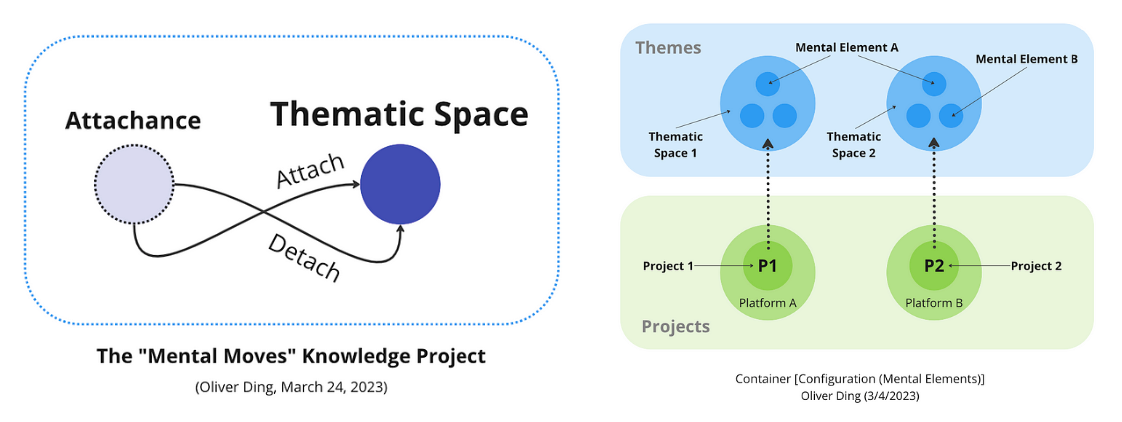
In this framework, a thematic space refers to a cognitive space containing an abundance of creative elements centered around a particular theme. It is not a solid construction but a dynamic and developmental space — like a lake and its water flows. For the present discussion, a creator’s cognitive landscape is strategically curated into a network of thematic spaces in order to serve the needs of project engagement across different scales: the enterprise level (a series of projects), the project level (a particular project), and the action level (a concrete task under a project).
The enterprise level: impossible scope. CLAUDE.md is not the externalization of the entire network of all thematic spaces — that would require a document of impossible scope, containing the creator’s entire conceptual universe. A serious creative practitioner may have spent years building up interconnected thematic spaces across multiple domains, each containing its own rich accumulation of concepts, intuitions, frameworks, and insights. No single document could faithfully represent this landscape, nor should it attempt to. The enterprise-level network belongs to the human’s cognitive system; it cannot and should not be delegated to an external file.
The project level: a more complex situation. The situation becomes more nuanced when we consider an individual thematic space at the project level. Consider a creator who has spent years developing a thematic space around a particular domain — building up a rich, interconnected landscape of concepts, intuitions, half-formed frameworks, and accumulated insights — while at the working level, only occasional projects are actually underway at any given time. When such a creator attempts to write a CLAUDE.md for one of these projects, they face a task that is far harder than it appears: how do you write a document that effectively makes explicit, for a project, the relevant contents of a thematic space that has never itself been fully articulated?
Writing CLAUDE.md in this situation is not simply describing a project. It is the act of selecting, combining, and stabilizing creative elements from a dynamic thematic space — elements that have existed as tacit knowledge, as intuitions, as implicit frameworks — and giving them a fixed, explicit, operational form. This is, in essence, the externalization of tacit knowledge: one of the most demanding cognitive operations in creative work. The document that results is not just a project description; it is a crystallization of what the creator knows but has not yet fully said.
This challenge points to something important about the relationship between Anticipatory Medium and Thematic Space Theory. A CLAUDE.md is always, in part, a negotiation between the fluidity of the thematic space and the fixity that an operational document requires. The difficulty of writing it well is not a failure of the tool — it is a faithful reflection of the genuine cognitive labor involved in moving from a living thematic space to a structured anticipatory artifact.
4.5 Convergence: The Definition of Anticipatory Medium
The four perspectives converge on a definition that is richer than any single framework could produce:
Anticipatory Medium is a medium that externalizes and carries the anticipatory structure of a Project — encoding its objectives, rules, current state, and next steps — so that future activity can proceed without reconstructing this structure from scratch. It operates at the Activity Space level of memory, below the Thematic Space and above the Context Space. It is a conversational medium with a future orientation, completing the temporal dimension that existing media theory has not addressed.
This definition has four components, each contributed by one theoretical perspective:
- externalizes and carries the anticipatory structure of a Project — Activity Theory
- compensates for the absence of long-term memory through explicit anticipatory structure — Memory Theory
- a conversational medium with a future orientation — Conversation Theory
- the anticipatory core, not the full Thematic Space — Thematic Space Theory
Together, they constitute a theoretically grounded concept, not merely a descriptive label for a useful file format.
Compared to Pross’s four-level typology (Primary through Quaternary media, classified by technological participation), the ACS typology operates on a different axis. The same social media platform (Quaternary in Pross’s system) can function as Reflective (when used to look back at old posts), Transformative (when used for real-time conversation), or Anticipatory (when used to publish a strategic roadmap). Pross’s question is “what technology is involved?”; the ACS question is “what temporal orientation does this use serve?”
Compared to Innis’s time-biased / space-biased distinction, the ACS typology operates at a different scale. Innis is concerned with civilizational effects over centuries; the ACS typology is concerned with the temporal structure of individual and collective creative activity within projects and enterprises. Innis asks how media shape the duration of empires; ACS asks how media position creators in relation to their own past, present, and anticipated future.
Compared to Mediatization theory (Hjarvard, Couldry, Hepp), the ACS typology introduces an explicit agency dimension that mediatization tends to underplay. Mediatization theory is concerned with how media logic shapes social institutions; it tends to cast human agents as adapting to or resisting media logic. The ACS typology, by contrast, asks how agents author media (especially Anticipatory Media) as instruments of their own forward-directed activity. This is the distinction between media as environment (mediatization) and media as a tool of anticipatory agency (ACS).
The deepest resonance is with the tradition of media as cognitive artifacts (following Vygotsky), which understands media as extensions of human cognition. Anticipatory Media are cognitive artifacts of a particular kind: they externalize not memory (which would make them Reflective) but anticipation — the cognitive capacity to act in the present based on models of future states. In Anticipatory Cultural Sociology, anticipation is understood as the fundamental temporal structure of cultural development. Anticipatory Media are the material infrastructure of that structure.
Part 5: Situating the Typology in Media Theory
With the typology established and Anticipatory Medium theoretically grounded through four perspectives, we can return to the existing frameworks surveyed in Part 1.2 and clarify their relationship to our contribution — not to borrow resources we have already developed independently, but to locate our work within the broader landscape.
The Reflective / Transformative / Anticipatory typology operates on a different axis from all existing frameworks, which is precisely why none of them could provide the resource we needed.
Compared to Pross’s four-level typology, our typology asks a different question. Pross asks, “What technology is involved?”; we ask, “What temporal orientation does this use serve?” The same Quaternary medium (social media) can function as Reflective (retrieving old posts), Transformative (live conversation), or Anticipatory (publishing a project roadmap). The axes are orthogonal: Pross’s levels and our types can coexist within the same analytical framework without conflict.
Compared to Innis’s time-biased / space-biased distinction, our typology operates at a different scale. Innis is concerned with civilizational effects over centuries; we are concerned with the temporal orientation of creative practice within projects and enterprises. Innis asks how media shape the duration of empires; we ask how media position creators in relation to their own anticipated future. The questions are related but not the same.
Compared to McLuhan’s “the medium is the message,” our contribution adds specificity where McLuhan provides generality. McLuhan shows that every medium creates a formal environment that shapes experience; we show that one critical dimension of that formal environment is temporal orientation — whether the medium faces backward, inhabits the present, or reaches forward. This is a refinement within McLuhan’s framework, not a departure from it.
Compared to Pask’s Conversation Theory, our contribution adds a temporal dimension that Pask’s framework does not include. Pask analyzes how conversational interfaces structure understanding; we add that conversational interfaces also have primary temporal orientations that shape what kinds of understanding can develop across time. Anticipatory Medium is precisely the conversational interface type that Pask’s framework cannot classify.
Compared to Mediatization theory, our typology operates at a different level of analysis. Mediatization theory studies how media logic transforms social institutions over decades; our typology studies how individual and collaborative creative practice is temporally oriented within specific media environments. The two levels of analysis are complementary: mediatization theory explains the macro conditions under which Anticipatory Media emerge; our typology explains what they are and how they function at the operational level.
The consistent finding is that existing frameworks have not developed tools for understanding temporal orientation at the level of creative practice. This is the specific contribution of the present article.
Part 6: Revisiting the Conversation Surfaces
6.1 A Typological Reading of Eight Surfaces
With the typology in hand, we can return to Tuddenham’s eight Conversation Surfaces and read them with new precision.
The eight surfaces are distributed across the three medium types as follows:
Primarily Reflective:
- Memory systems (store and retrieve past conversation fragments)
- Past Chat Search (makes previous sessions retrievable)
Primarily Transformative:
- Claude.ai Chat (Web) — real-time conversational engagement
- Claude Mobile App — real-time engagement in mobile context
- Context Window — the live interface of any active session
- Artifacts — interactive outputs produced within sessions
Primarily Anticipatory:
- CLAUDE.md in Claude Code — the paradigmatic Anticipatory Medium, automatically loaded, structuring future sessions
- Projects / Custom Instructions — partial Anticipatory Medium, enabling rules and objectives to persist across conversations, though with significant limitations in depth and flexibility
Mixed or underdeveloped:
- Claude Cowork — handles one-time tasks; task descriptions function as momentary anticipation but are not persistent
- Claude in Chrome — browsing agent with limited cross-session continuity
- API — the infrastructure level; what is built on top of it determines its temporal orientation
Tuddenham’s core finding — that only CLAUDE.md provides a fully realized solution to the Re-education Tax — now has a theoretical explanation. The Re-education Tax is the cost paid when Anticipatory Medium is absent from a sustained collaboration. Without a medium that carries anticipation forward, every session must rebuild the anticipatory structure from scratch. The Tax is not a technical problem but a medium-design problem: the absence of Anticipatory Medium forces the creator to perform, in real time, the anticipatory work that a well-designed medium would do automatically.
6.2 What CLAUDE.md Does Not Yet Do: First-order and Second-order Activity
Yet from the AAS framework, a deeper limitation of CLAUDE.md also becomes visible. As a product of engineering practice rather than theoretical design, CLAUDE.md effectively addresses First-order Activity — the direct engagement with Object and Objective within a project. Its five elements (Object & Objective, Rules, Current State, Next Steps, Decision History) are all oriented toward task-level anticipation: what to do, how to do it, where we are, what comes next.
What CLAUDE.md does not address is Second-order Activity — the exploratory level at which the activity system itself becomes the object of inquiry. Unlike First-order Activity, which operates within a given structure of objectives and rules, Second-order Activity has no fixed objective at the outset. It is a process of open exploration: examining whether the current objectives are still the right ones, whether the rules of collaboration need revision, and whether the project’s direction should fundamentally change. Its defining characteristic is that it begins without a clear destination — and its outcome, when successful, is precisely the production of a new, well-grounded objective and a new set of rules. At that moment, the exploratory Second-order Activity transforms back into First-order Activity, now operating within a renewed structure.
The AAS framework understands the entire anticipatory activity system as cycling through this loop repeatedly. This cycle matters for a deep reason: high-quality objectives are hard to arrive at. They do not emerge automatically from routine work — they require dedicated reflection, experimentation, and the willingness to question what seemed settled. Moreover, as environments change, the cycle serves two distinct adaptive functions: generating short-term adjustments that respond to immediate shifts, and cultivating longer-term strategies that transcend current conditions rather than merely reacting to them.
This omission is understandable: CLAUDE.md emerged from practitioners solving a concrete problem, not from theorists designing a complete system. But from the ACS/AAS perspective, it points toward an important direction for future design. A theoretically grounded Anticipatory Medium should support both levels: First-order anticipation (task-level Predictive Models) and Second-order anticipation (meta-level reflection on and redesign of the collaboration system itself).
This distinction matters especially in the AI era. If First-order Activity is what AI systems are increasingly capable of executing autonomously, then Second-order Activity — the reflective redesign of how humans and AI systems work together — is precisely where human agency becomes most distinctive and most valuable. An Anticipatory Medium that supports only First-order Activity risks reducing the human to a task-setter rather than an architect of the collaboration itself. The fuller vision of Anticipatory Medium, grounded in AAS, is one that creates space for both levels — and this is the direction that future design of human-AI collaboration tools should pursue.
Conclusion: Time, Space, and the Path to Weave the Medium
This article has made three contributions.
First, it has introduced the concept of Anticipatory Medium — a medium whose primary function is to encode, carry forward, and activate expectations about future activity. This concept fills a gap that the spatial framework of the Cognitive Container could not address: the temporal orientation of the four-element configuration as a whole.
Second, it has proposed a three-type typology of Cultural Medium organized by temporal orientation: Reflective (past, referential mental model), Transformative (present, interventional mental model), and Anticipatory (future, anticipatory mental model). This typology was derived using the LARGE Method’s temporal structure — Reflection (R), Generation (G), Anticipation (A) — as a heuristic lens, and demonstrated through the concrete analysis of Claude’s eight Conversation Surfaces.
Third, it has shown that the four-element Cognitive Container structure (Representation, Genre, Artifact, Medium) operates differently under each temporal orientation. The full analysis of CLAUDE.md as Anticipatory Medium revealed how all four elements — Representation, Genre, Artifact, and Medium — are simultaneously configured in an anticipatory direction, not just the outer Medium layer.
Within the Cultural Projection series, this article completes a two-step deepening of the Cultural Medium framework. The preceding article, Cognitive Container of Cultural Projection, established the spatial structure: where the four elements are anchored in the World of Life and how they nest together. The present article adds the temporal structure: how the entire configuration orients itself toward past, present, or future.
These two structures — spatial and temporal — now stand ready to be woven together. The Weave Basic Form, which frames activity as the synthesis of synchronic and diachronic dimensions, offers the natural vehicle for this integration.
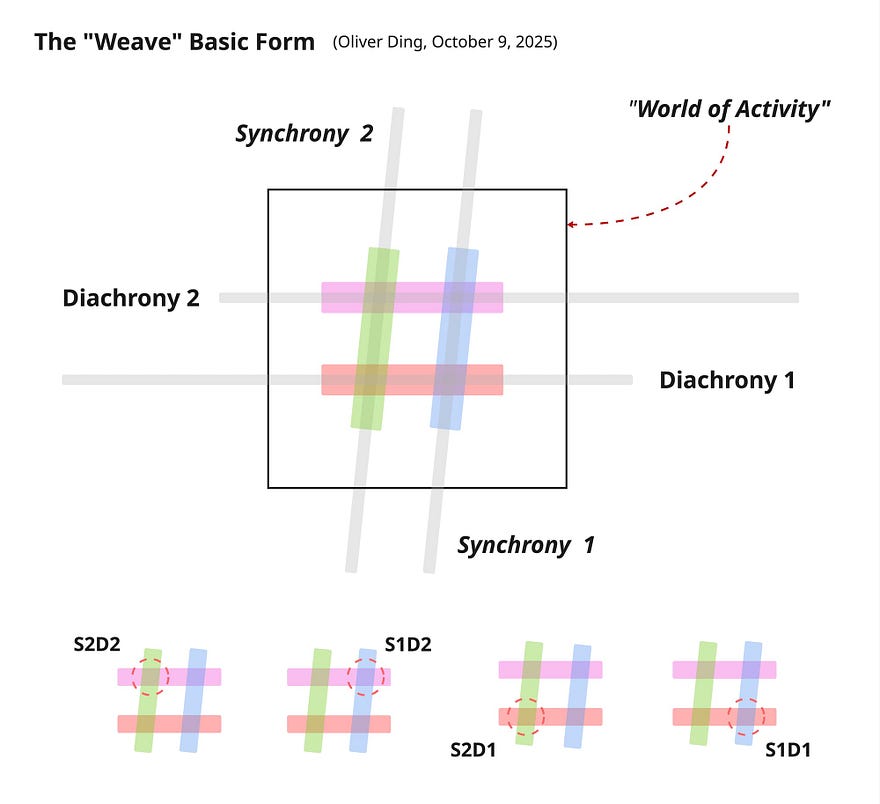
Applied to Cultural Medium, it would produce a Weave the Medium model: the spatial structure of the Cognitive Container as the synchronic dimension, the temporal typology of Reflective / Transformative / Anticipatory as the diachronic dimension, and four Weave-points where the two intersect.
This integration is the next step. The present article establishes the temporal half of what that model will require.
Related Articles
- Design-oriented Project Engagement
- Personal Orientation of Cultural Projection
- Cognitive Container of Cultural Projection
- Culture as Anticipatory Activity
- The Landscape of Anticipatory Cultural Sociology
v1.0 - February 27, 2026 - 6,479 words