
The L3D Model (v1.0, 2026)
A Knowledge Framework for Supportive Life Discovery
by Oliver Ding
March 3, 2026

At the beginning of each year, I set a number of annual themes — the primary threads of exploration for the year ahead. In early January 2026, I designated Supportive Life Discovery as one of my annual themes for the year. It responds to a series of Life Discovery projects I undertook in the first half of 2022, and to the three-volume archival book draft that emerged from them. In that earlier phase, I was the subject of Life Discovery: I engaged in practice and action to gain embodied experience of the concept, providing an empirical foundation for the AAS project development I was pursuing at the time. This year, the orientation has shifted. I have also designated the LARGE Method as an annual theme — the meta-framework organizing my methodological work. Supportive Life Discovery reflects how I am now exploring Life Discovery at the methodological level: this time, other people are the protagonists, and I am the supporting role.
This article introduces the L3D model (v1.0) — a knowledge framework developed on March 3, 2026, to provide SLD with a concrete theoretical architecture and advance the theme's further development. The immediate occasion was a conversation with Bob, a reader engaged with questions of personal development and self-directed learning.
Bob had been reading Lake 42: The Great Confluence — the manuscript documenting the development of Creative Life Theory v3.0–v3.1 — and had found two of its distilled knowledge models, "Finding the Coordinate" and "Anchoring the Center," complex and difficult to apply immediately. In subsequent exchanges, something further became visible beneath the surface: Bob was also navigating a period of anxiety and disorientation in the face of the rapid acceleration of AI development. Our exchange revealed a familiar pattern: the frameworks were not wrong, but the reception conditions were not yet in place. The soil had not been prepared.
What Bob encountered was not complexity in the usual sense — the book was not too difficult — but a kind of cognitive distance: the theoretical world of the book had not yet connected to his own lived experience, themes, and questions. He was at a pre-activity stage, needing first a period of cognitive preparation: developing the orientations and habits of mind that make genuine discovery possible. This recognition triggered a recall: a framework developed a decade earlier — the Learning Landscape (2015–2016) — was precisely designed for this situation. Combined with the recently developed DDD model (Discover–Design–Deliver, February 2026), the four-layer structure of the L3D model took shape in a single working session.
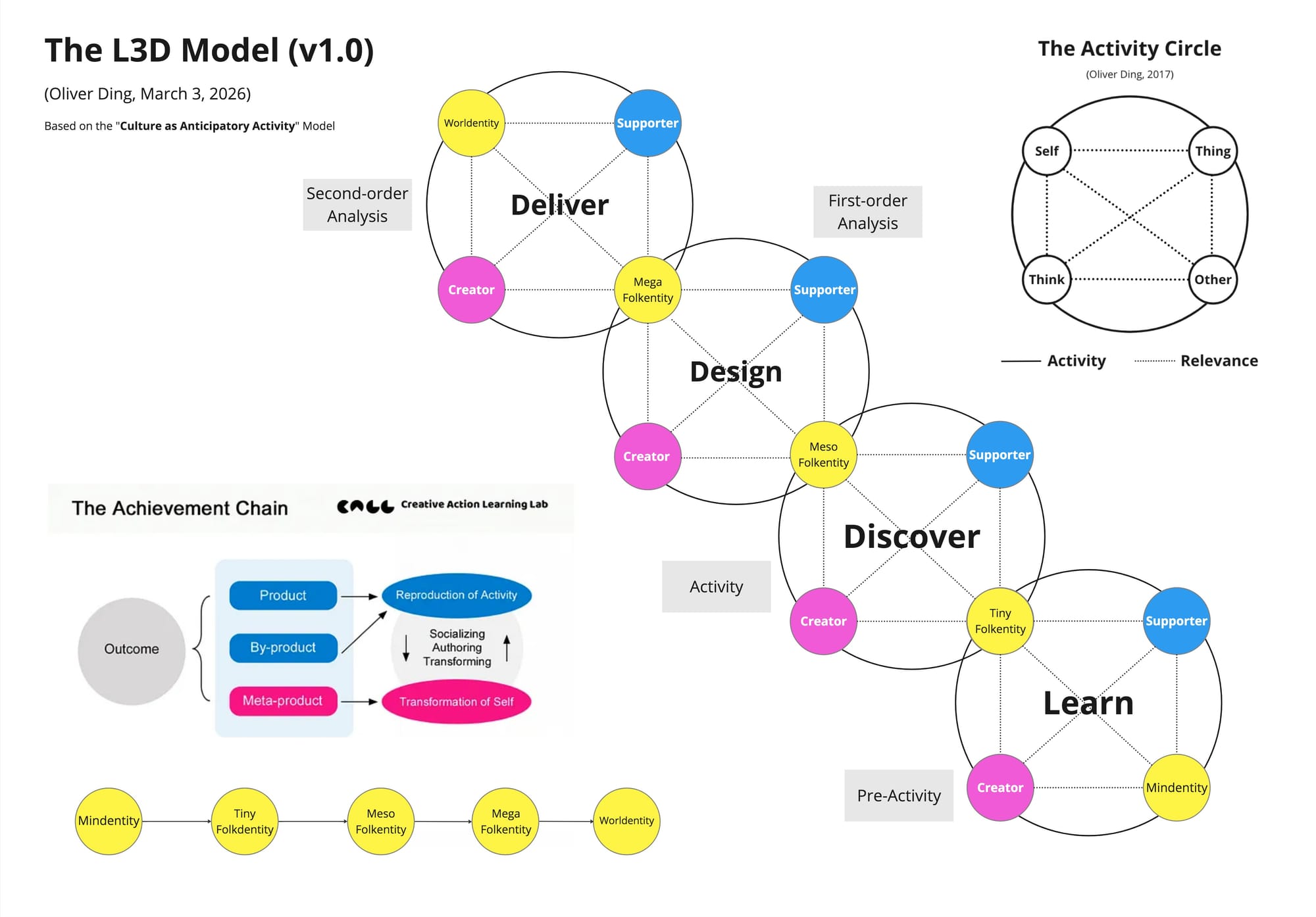
The model has since been applied in two downstream contexts: the four-layer structure design of Supportive Life Discovery, and the pedagogical architecture of Cognitive Hydrology Pedagogy (v1.0). This article serves as a reference introduction for both applications and for any future work that draws on the L3D framework.
Contents
1. The Foundation: The Agency Cascade
2. The Transformation: From Agency Cascade to L3D
3. The DDD Core: Discover, Design, Deliver
4. The Learn Stage: The Learning Landscape Revisited
4.1 Why Pre-Activity Matters
4.2 The Learning Landscape: Four Perspectives
4.3 Theoretical Grounding: The World of Life Correspondence
5. The Complete Architecture
5.1 Internalization and Externalization
5.2 The SLD Four-Layer Structure
5.3 The Cognitive Hydrology Pedagogy Application
6. Supportive Self-Actualization
Conclusion
1. The Foundation: The Agency Cascade
The theoretical foundation of the L3D model is the Agency Cascade, developed in Culture as Anticipatory Activity (February 2026) as part of the Anticipatory Cultural Sociology (ACS) framework.
The Agency Cascade describes how thematic creations move through four levels of cultural development, each structured by the Activity Circle (Self-Other-Thing-Think). Its core principle: at each level, the "Other" of that level becomes the "Self" of the next. Agency does not reside within individuals alone — it cascades through levels of social structure, each anticipating and enabling the next.
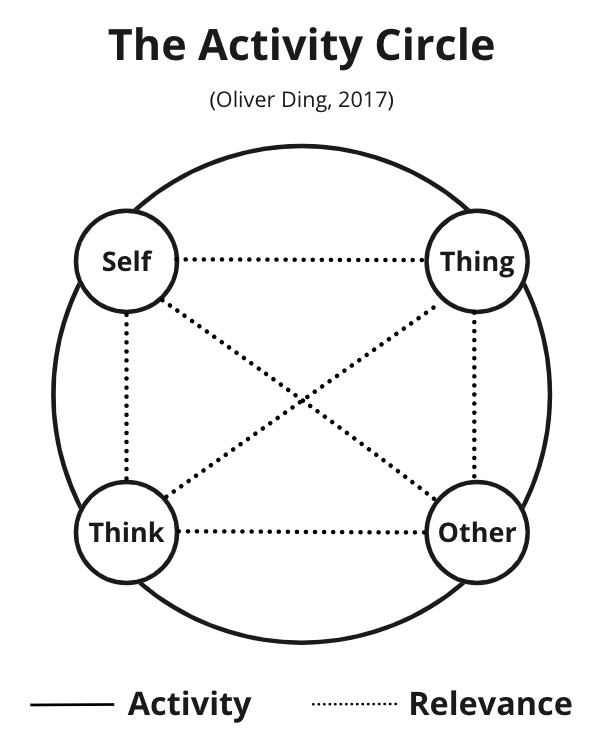
The four levels are:
Level 1 — Pre-Activity: Creator and Supporter The Mindentity — a thematic creation still belonging to the Self — is the Thing at this level. The Think anticipates a Tiny Folkentity: the first collective engagement. The human relationship is between Creator, who originates the creation, and Supporter, who provides the enabling conditions for it to take its first steps into the social world.
Level 2 — Activity: Curator and Weaver The Tiny Folkentity is now the Thing — a small community has formed around the creation. The Think anticipates a Meso Folkentity: a more organized, stable collective form. The new relationship is between Curator, who shapes and maintains the emerging collective identity, and Weaver, who connects threads across the growing community.
Level 3 — First-Order Analysis: Influencer and Follower The Meso Folkentity is the Thing — a professional community or specialized field with its own norms and platforms. The Think anticipates Mega-scale social influence. The relationship is between Influencer, who shapes direction across communities, and Follower, who engages from a distance without personal connection to the creation's origins.
Level 4 — Second-Order Analysis: Canonizer and Receiver The Mega Folkentity is the Thing — the creation is present everywhere. The Think anticipates Worldentity: the creation becoming Cultural Givenness, no longer sustained by any community but simply encountered as part of the world. The relationship is between Canonizer, who fixes the creation in the cultural record, and Receiver, who inherits it as a given.
The cascade describes the full arc of thematic creation: from the private territory of the Self, through collective engagement, toward cultural permanence. It is simultaneously a map of cultural development and a framework for understanding where any creator currently stands in relation to their work.
2. The Transformation: From Agency Cascade to L3D
The L3D model takes the Agency Cascade's four-level structure and reframes it as a framework for the individual creator's own developmental journey. The four levels are renamed:
| Agency Cascade | L3D Model |
|---|---|
| Pre-Activity | Learn |
| Activity | Discover |
| First-Order Analysis | Design |
| Second-Order Analysis | Deliver |
This renaming is not cosmetic. It represents a shift in the primary perspective: from describing how thematic creations move through the social world (the Agency Cascade's concern) to describing how a creator moves through four qualitatively different modes of engagement with their own creative life (the L3D model's concern).
In the Agency Cascade, the levels describe the social ontology of a thematic creation — what kind of collective entity it has become, and what level of cultural reach it has achieved. Each level has its own distinctive Self–Other pairing: Creator and Supporter at Level 1, Curator and Weaver at Level 2, Influencer and Follower at Level 3, Canonizer and Receiver at Level 4. These different role names reflect the qualitatively different forms of social relationship that characterize each stage of a thematic creation's journey through the social world.
The L3D model, situated within the Supportive Life Discovery theme, applies a different logic. Because its focus is the development of a person across four levels of life discovery activity, within the context of cultural innovation — rather than the social trajectory of a thematic creation — the Self–Other configuration is unified across all four circles: in every circle, Self = Creator (the person engaged in their own life discovery) and Other = Supporter (whoever provides enabling support at that level). The role names no longer change from circle to circle. What changes is the nature of the activity being supported and the kind of support required at each level.
This is a significant structural adaptation. In the Agency Cascade, the Self at each level is a different kind of actor because the social scale of the creation has changed. In the L3D model, the Self is always the same person — the creator of their own life — moving through four increasingly complex and socially extended forms of engagement. The Supporter's role shifts accordingly: from cognitive companion (Learn), to thematic interlocutor (Discover), to framework guide (Design), to methodological resource (Deliver).
Each of the four elements in L3D corresponds to one of the four levels of the Agency Cascade, and this correspondence is not merely structural — it is substantive. The most telling alignment is Discover ↔ Activity: genuine life discovery is an Activity-level engagement, not a pre-activity preparation (that is Learn) and not an analytical operation (that is Design or Deliver). This correspondence names precisely what Supportive Life Discovery is about: helping a person reach and sustain the Activity level — where real thematic engagement, real mental model development, and real creative flow become possible. Learn prepares the ground; Discover is where the work of discovery actually happens; Design and Deliver are the analytical and contributive extensions of what has been discovered. The circles are not stages to be completed and left behind — each continues to operate within later, more complex configurations.
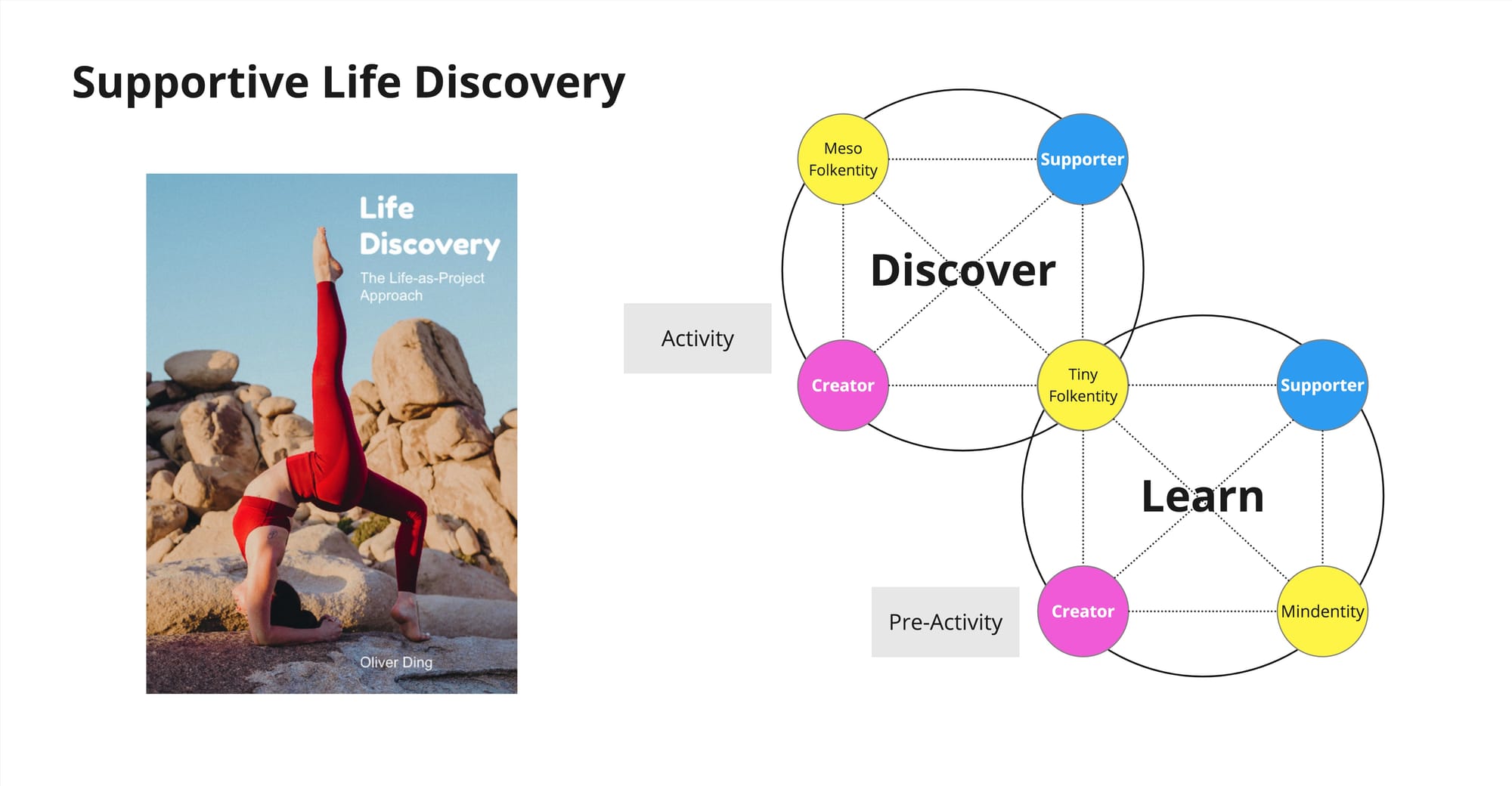
This means that within the SLD framework, Discover is not simply one element among four — it is the anchor. The other three circles are defined in relation to it. Learn is what a person needs before they can genuinely discover: the cognitive preparation that makes the Activity level accessible. Design is what follows discovery: the move from thematic insight into concrete project engagement, where the ideas and objectives found in Discover are brought into deliberate execution. Deliver extends further still: the contribution of designed outcomes to the broader social world. The further from Discover, the more mediated and socially extended the activity becomes.
This anchor logic also opens the door to flexible program design. In practice, SLD interventions can be calibrated to the situation. For example, to train a creator's capacity across the full cycle, a program might deliberately narrow the object and objective of each circle — keeping the scope small and the threshold low — so that the creator can complete an entire Learn–Discover–Design–Deliver loop within a bounded context. The structure remains intact; what changes is the scale. This flexibility is a practical strength of the L3D model: the same four-circle architecture can support both the full arc of a long-term creative life and a focused short-term developmental program.
Crucially, each circle in the L3D model is a complete Anticipatory Activity System in its own right, containing both first-order activity (Performance: goal-directed, procedurally clear) and second-order activity (Discovery: exploratory, oriented toward developing the conditions for future performance).
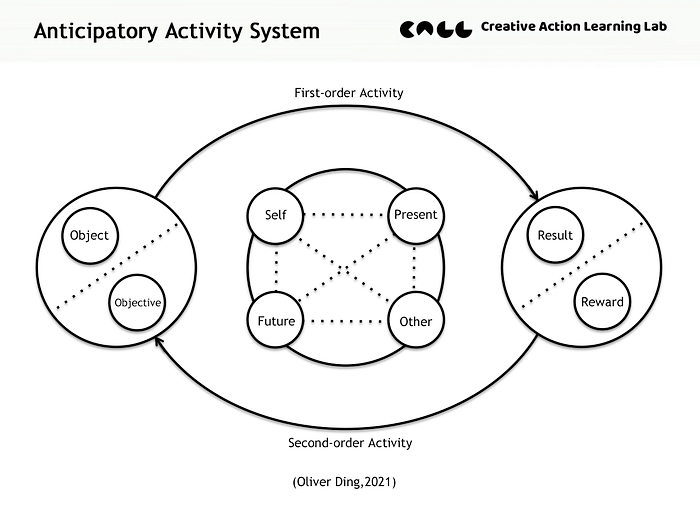
The L3D model's primary focus is on the second-order dimension of each circle — the discovery-oriented work that most people find difficult, and that Supportive Life Discovery is specifically designed to support.
3. The DDD Core: Discover, Design, Deliver
The three outer circles of the L3D model — Discover, Design, Deliver — are drawn directly from the DDD model (Discover–Design–Deliver), developed in Design-oriented Project Engagement (February 2026) as an operational framework for Anticipatory Cultural Sociology.
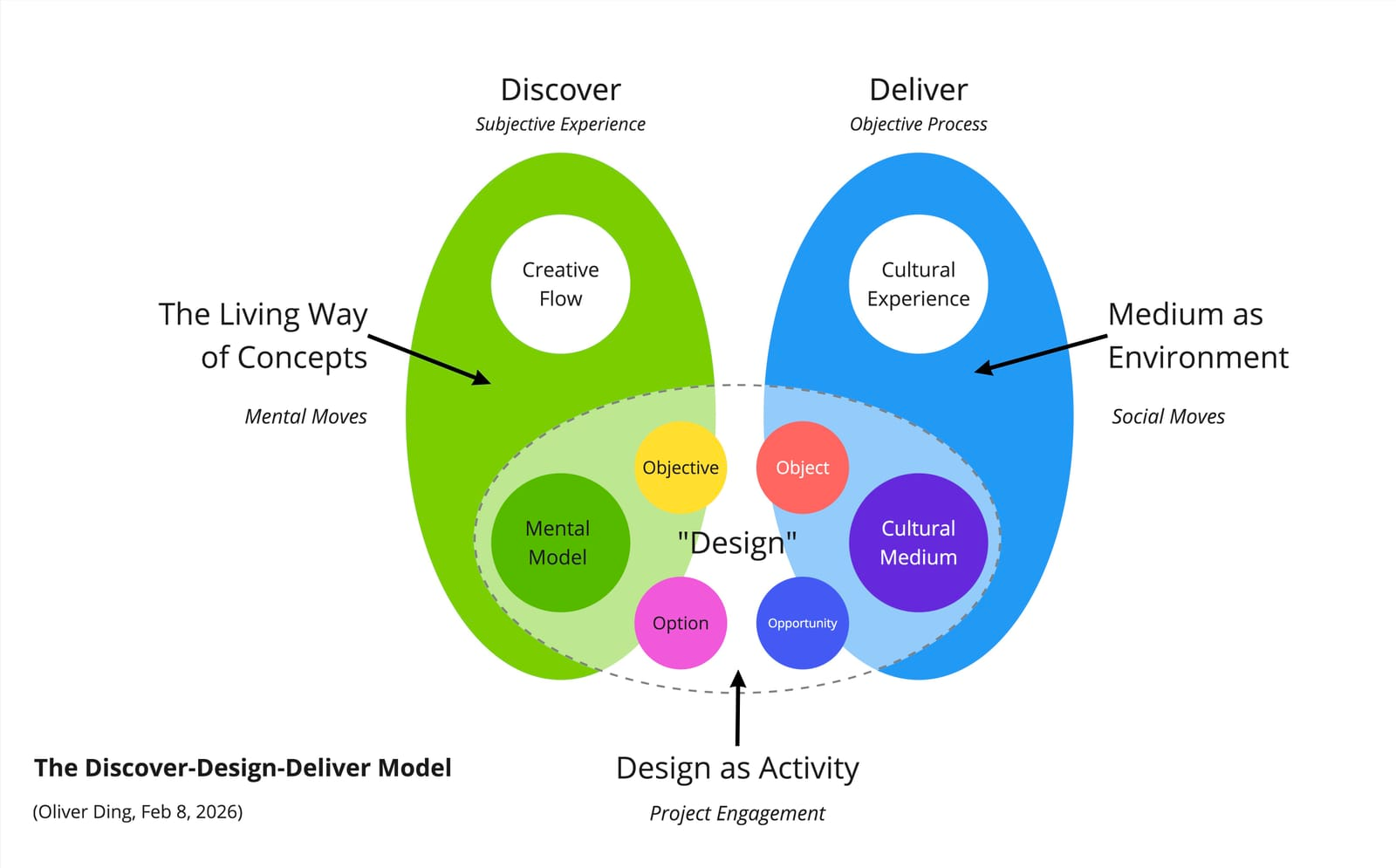
The DDD model describes the complete movement of a concept system from individual creation to social contribution:
Discover corresponds to the Activity level. Its domain is Creative Flow: the stage at which a creator develops mental models by exploring themes in authentic engagement. The cognitive work here is navigating the flood of experience and information, identifying which themes carry genuine significance, and allowing mental models to develop through sustained thematic attention. The characteristic challenge is maintaining open inquiry without premature closure — staying with a theme long enough for its deeper structure to emerge.
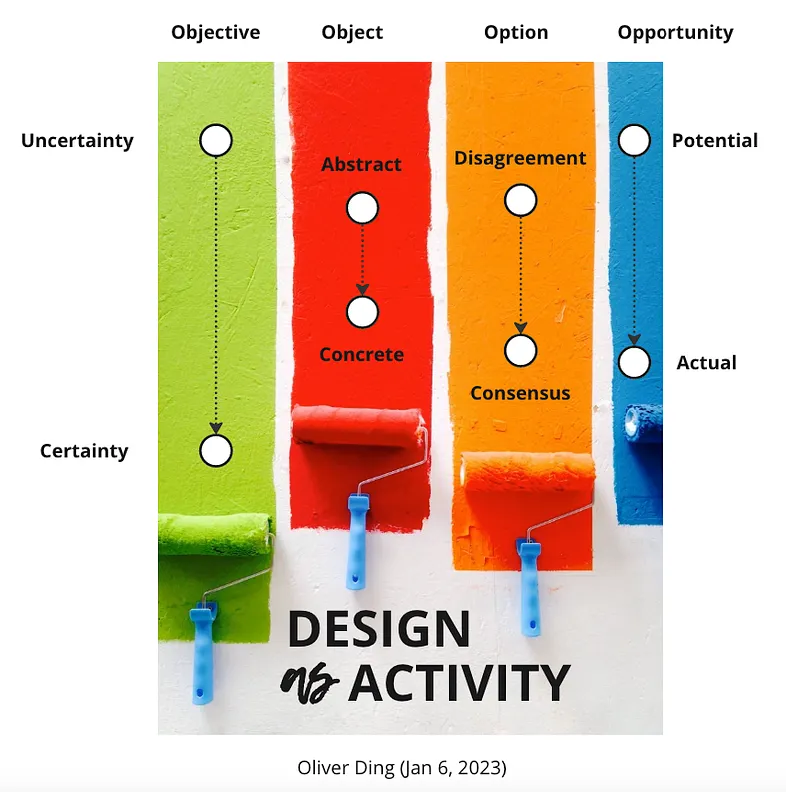
Design corresponds to the First-Order Analysis level. Its domain is Design-oriented Project Engagement: the sustained, complex activity through which mental models are transformed into thematic creation. Design is the heart of the DDD model and its most theoretically demanding container. It is not a single operation but a multi-dimensional engagement structured by four simultaneous tensions: Objective (uncertainty → certainty), Object (abstract → concrete), Option (disagreement → consensus), Opportunity (potential → actual). These are not steps to be completed sequentially but orientations to be navigated throughout the entire design engagement.
Deliver corresponds to the Second-Order Analysis level. Its domain is Cultural Experience: the stage at which thematic creation enters the social world and generates experience across diverse environments. Deliver is where the creator's work transitions from a personal or community asset into a contribution to shared knowledge — a cultural medium that others can receive, interpret, and build upon.
Together, the Discover–Design–Deliver model traces the movement from subjective mental models to objective cultural contribution: the externalization arc of the creative life.
4. The Learn Stage: The Learning Landscape Revisited
The addition of Learn as the first circle — the pre-activity stage that precedes and enables the DDD process — is the L3D model's most significant structural contribution. It is also the one most directly grounded in a specific theoretical history.
4.1 Why Pre-Activity Matters
Bob's situation made the problem concrete. He was intellectually engaged with questions of personal development, but the soil was not yet ready: encountering theoretical frameworks produced information overload rather than insight, and he remained susceptible to being pulled by external agendas rather than his own developing themes. The frameworks being offered were not wrong — the reception conditions were not yet in place.
This is not unusual. Most people who want to engage seriously with their own thematic development are, at the outset, at the pre-activity stage. They have not yet developed the cognitive orientations — the habits of mind, the disciplined engagement with theory, domain, practice, and narrative — that make genuine discovery possible. Without this preparation, Discover, Design, and Deliver remain aspirational rather than operational.
The Learn stage addresses this directly. Its purpose is not to teach content but to develop the cognitive infrastructure — the internalized orientations — that make creative engagement with the world possible.
4.2 The Learning Landscape: Four Perspectives
The framework for the Learn stage is the Learning Landscape, originally developed in 2015 and revised into its current four-perspective structure in 2016. The 2026 revisiting — triggered by the Bob conversation — did not change the framework's structure. It revealed the theoretical foundation that had always been there.
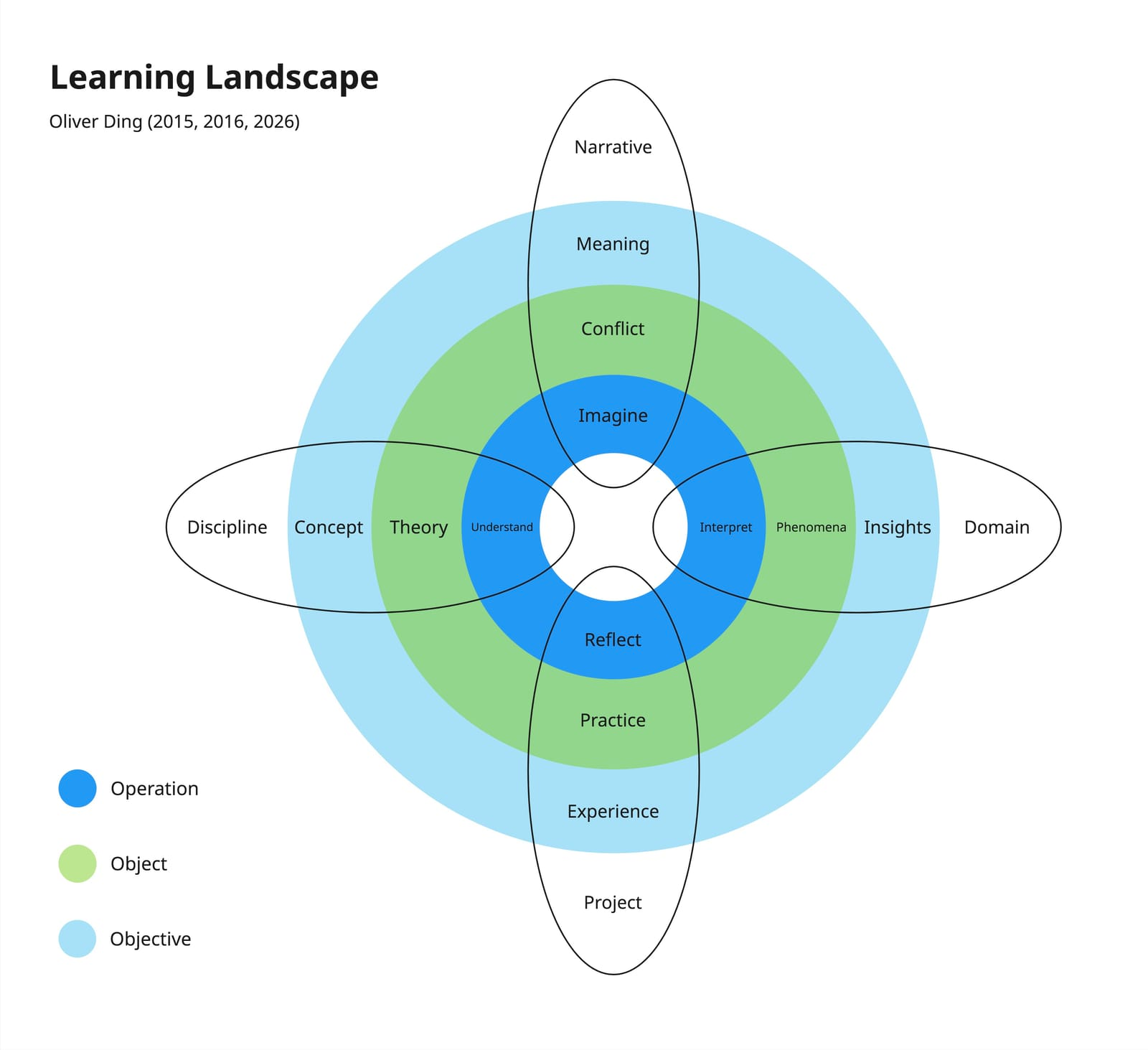
The Learning Landscape organizes adult learning around four perspectives, each with its own Object, Operation, and Objective:
| Perspective | Object | Operation | Objective |
|---|---|---|---|
| Discipline | Theory | Understand | Concepts |
| Domain | Phenomena | Interpret | Insights |
| Project | Practice | Reflect | Experience |
| Narrative | Conflict | Imagine | Meaning |
Each perspective represents a distinct mode of cognitive engagement with the world:
The Discipline Perspective engages with theoretical traditions — the accumulated frameworks, concepts, and laws through which different fields understand their domains. The cognitive operation is understanding: not passive reception but active engagement with the structure of ideas. The yield is concepts — the building blocks of a personal knowledge system.
The Domain Perspective engages with phenomena in specific professional and social contexts. The cognitive operation is interpretation: reading the patterns of a field, discerning what is actually happening beneath surface appearances. The yield is insights — the field-specific understanding that comes from sustained attention to how things actually work.
The Project Perspective engages with practice: the concrete actions, decisions, and experiences of one's own projects. The cognitive operation is reflection: turning experience into learning by examining what happened, why, and what it means. The yield is experience in the deep sense — not mere time served, but understanding forged through action and reflection.
The Narrative Perspective engages with the story of one's own life: the conflicts, turning points, and meanings that give a creative life its direction. The cognitive operation is imagining: not fantasy, but the narrative act of holding tensions, exploring what matters, and finding coherence across the arc of a life. The yield is meaning — the orientation that makes sustained creative work possible.
These four perspectives are not steps to be completed in sequence. They are simultaneously active orientations, each developing through ongoing engagement. A person who cultivates all four is developing the complete cognitive infrastructure for creative life.
4.3 Theoretical Grounding: The World of Life Correspondence
The 2026 revisiting of the Learning Landscape produced a significant theoretical discovery: the four perspectives correspond precisely to the four boundaries of the World of Life — the ontological meta-framework of ACS.
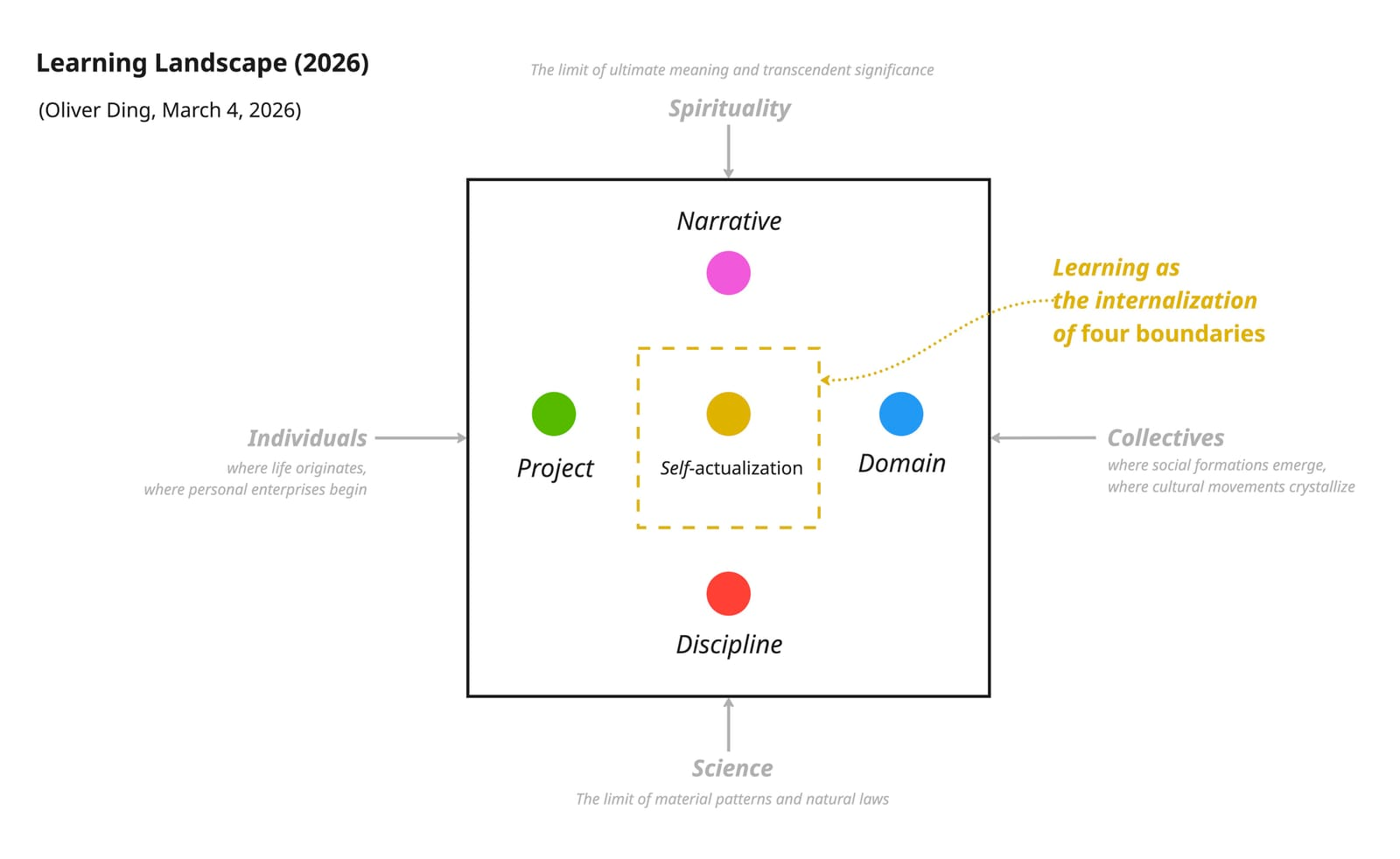
| World of Life Boundary | Learning Landscape Perspective |
|---|---|
| Science / Ecology (lower) | Discipline |
| Collectives (right) | Domain |
| Individuals (left) | Project |
| Spirituality (upper) | Narrative |
This correspondence was not designed. The 2015 Learning Landscape was assembled empirically, from observation and practice. The World of Life framework was developed theoretically, from ontological reflection. That the two structures align so precisely indicates that both had, through different routes, arrived at the same fundamental insight about the structure of human engagement with the social world.
The correspondence transforms the Learning Landscape's theoretical status. Before 2026, it was an empirically assembled framework: these perspectives seemed important, based on observation. After 2026, it is a theoretically necessary framework: there are four perspectives because there are four fundamental dimensions of the social world, and learning is the process through which those dimensions are internalized as cognitive orientations.
This gives the Learn stage a precise theoretical definition: Learn is the internalization of the four boundaries of the World of Life. Through the Discipline Perspective, a person internalizes the structured knowledge of Science and Ecology. Through the Domain Perspective, they internalize the dynamics of Collectives. Through the Project Perspective, they internalize the conditions of Individual agency. Through the Narrative Perspective, they internalize the dimension of Spirituality — ultimate meaning and orientation.
5. The Complete Architecture
5.1 Internalization and Externalization
Viewed as a whole, the L3D model describes a complete movement of internalization followed by externalization — a breath in and a breath out.
Learn is the internalization phase: the process by which a person takes the four boundaries of the World of Life inward, building the cognitive infrastructure — concepts, insights, experience, meaning — that makes creative engagement possible. It is not preparation that gets left behind once the "real work" begins. It is the ongoing practice of maintaining and deepening the cognitive orientations that make all subsequent creative engagement meaningful.
Discover, Design, Deliver are the externalization phases: the process by which that internalized infrastructure is projected outward into the social world — as thematic exploration (Discover), as designed thematic creation (Design), and as cultural contribution (Deliver).
This internalization–externalization movement is not a one-time cycle. It is continuous and recursive: what is delivered returns as new material for learning; what is discovered opens new domains for internalization. The L3D model describes not a linear progression but a sustained creative rhythm.
5.2 The SLD Four-Layer Structure
In the Supportive Life Discovery framework, the L3D model maps directly onto a four-layer service design:
- Learn: Cognitive preparation and upgrade — developing the mental orientations that make discovery possible
- Discover: Finding life themes and coordinates — the first-order activity of thematic exploration
- Design: Framework intervention and analysis — bringing theoretical frameworks to bear on the person's thematic situation
- Deliver: Methodological delivery and ongoing support — providing tools and practices the person can sustain independently
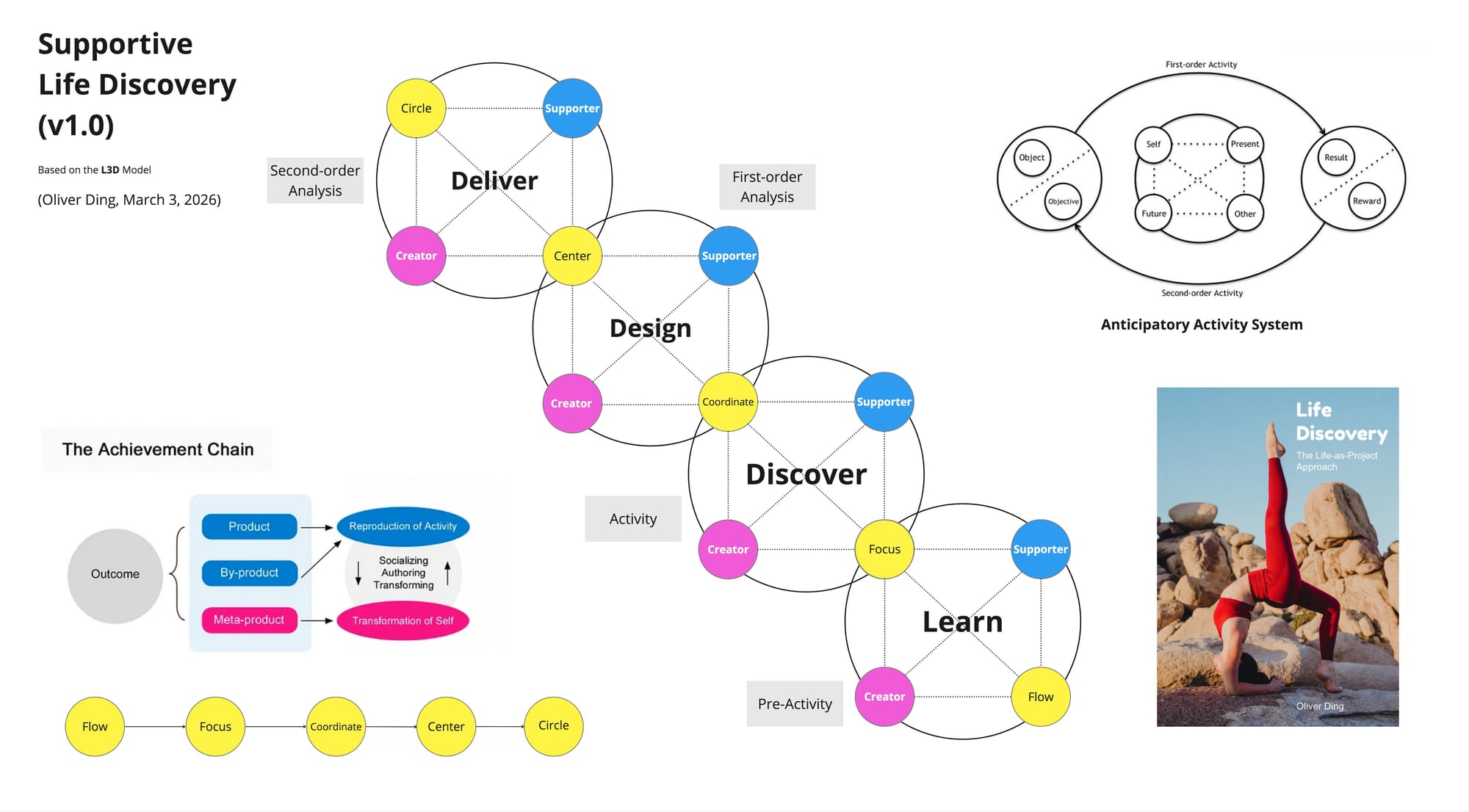
Each layer is a complete Activity Circle in its own right, containing both performance-oriented and discovery-oriented dimensions. The SLD practitioner's role shifts across layers: in Learn, primarily a cognitive companion; in Discover, a thematic interlocutor; in Design, a framework guide; in Deliver, a methodological resource.
The Supportive Life Discovery diagram (v1.0) also specifies the Achievement Chain for the SLD context. The Achievement Chain is a fixed structural template applicable across models — describing the outcome structure of any activity. In the SLD diagram, its specific content is:
Flow → Focus → Coordinate → Center → Circle
This fills the Achievement Chain template with the concrete developmental trajectory that SLD activity produces in the Creator: from the undifferentiated stream of lived experience (Flow), through the emergence of intentional thematic attention (Focus), to the identification of a personal creative coordinate (Coordinate), toward the establishment of a sustained creative center (Center), and finally into a network of collective engagement (Circle). The Coordinate is the pivotal transition point — it is what genuine Discover activity produces, and what makes Design and Deliver possible.
This differs from the L3D model, which retains the Achievement Chain content directly from Culture as Anticipatory Activity without modification. The SLD diagram adjusts this content to reflect the specific developmental trajectory of a person moving through the life discovery process.
5.3 The Cognitive Hydrology Pedagogy Application
Cognitive Hydrology Pedagogy (v1.0) is a pilot project within the Supportive Life Discovery theme — a concrete, focused instance of SLD centered on the exploratory activities that Cognitive Hydrology itself calls forth. Rather than addressing the full breadth of life discovery, it narrows the scope to one specific pathway: thematic development and concept creation as practiced within the Cognitive Hydrology framework. In this sense, it is SLD made actionable within a defined thematic territory.
Within this pedagogy, the L3D model occupies a precise theoretical position within a three-dimensional architecture: Form (FFCC) — Method (L3D) — Moves (the six Slow Cognition operations).
The Flow–Focus–Center–Circle (FFCC) schema provides Form: it describes where the learner is — the ecological configuration of their creative life at a given stage. L3D provides Method: it describes what the learner does within any given form — the directed process of Learn → Discover → Design → Deliver. The six Slow Cognition operations provide Moves: the cognitive grammar available at any moment, not bound to any particular stage or form.
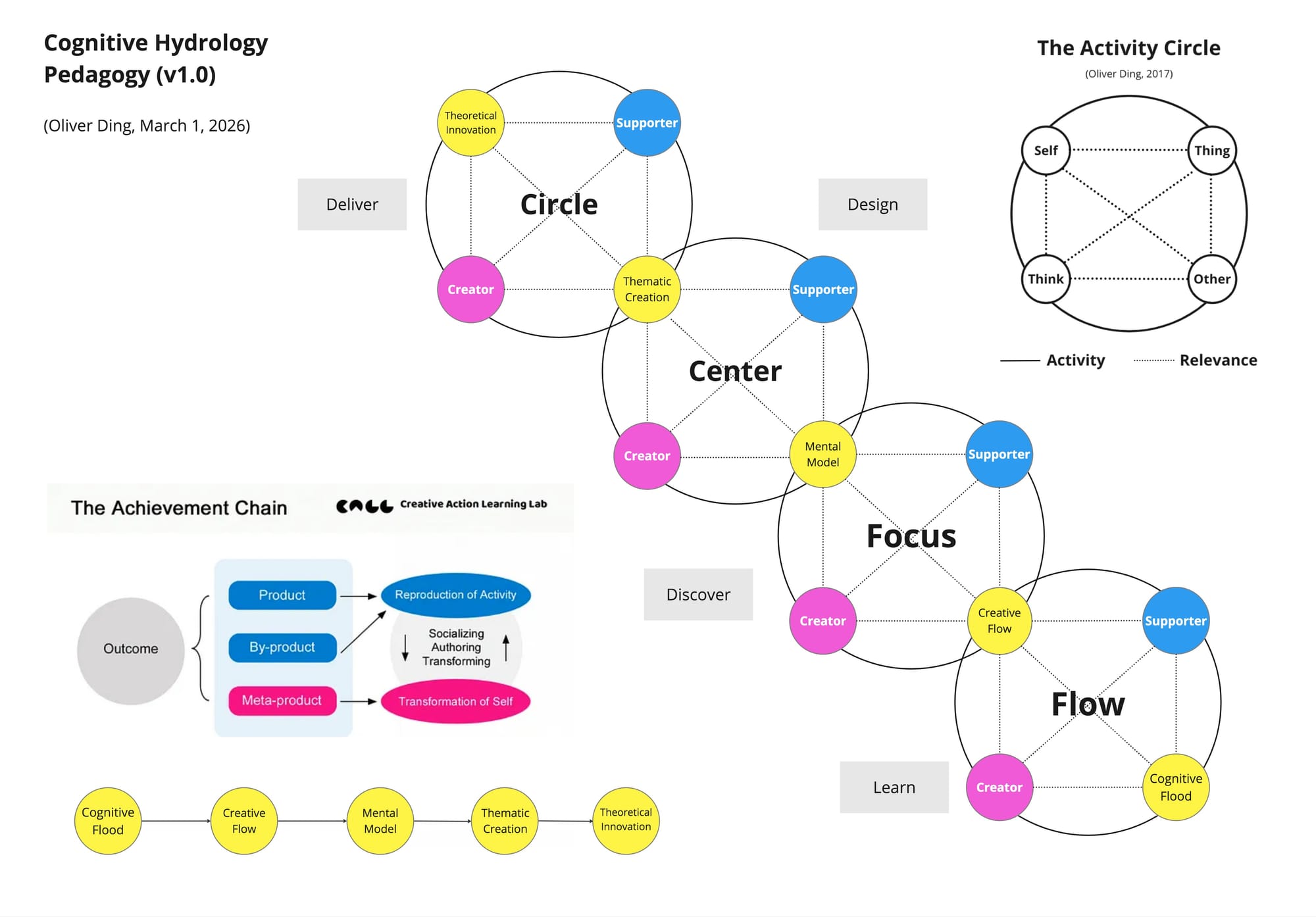
These three dimensions are not competing descriptions of the same thing. They operate at different levels and contribute different things to the pedagogy. This structural distinction is also visually encoded in the Cognitive Hydrology Pedagogy diagram (v1.0): the FFCC labels (Flow, Focus, Center, Circle) are placed at the center of each circle, while the L3D labels (Learn, Discover, Design, Deliver) are placed outside the circles. Form is inside; Method is outside.
Within this architecture, the four L3D elements align with the four forms of the FFCC schema:
| L3D Element | Form | Quality |
|---|---|---|
| Learn | Flow | Variable — the ongoing stream of lived experience |
| Discover | Focus | Quasi-invariant — the intentional structure of consciousness |
| Design | Center | Invariant — the organizational structure of sustained creative work |
| Deliver | Circle | Set of invariants — the network of collective engagement |
The Achievement Chain in the Cognitive Hydrology Pedagogy diagram specifies the concrete developmental trajectory this pedagogy produces in the learner:
Cognitive Flood → Creative Flow → Mental Model → Thematic Creation → Theoretical Innovation
This chain describes the specific cognitive journey of a Cognitive Hydrology practitioner: beginning in the undifferentiated flood of information and experience (Cognitive Flood), finding one's way into genuine creative engagement (Creative Flow), building stable mental models through sustained thematic attention (Mental Model), transforming those models into thematic creations (Thematic Creation), and ultimately contributing to theoretical innovation (Theoretical Innovation). Each node corresponds to one of the four FFCC stages, with Cognitive Flood and Creative Flow both belonging to the Flow stage — marking the critical transition that the Learn stage is designed to support.
The Learn stage — corresponding to Flow — provides the entry point into Cognitive Hydrology practice: developing the four perspectives of the Learning Landscape as the cognitive orientations through which a person moves from Cognitive Flood toward genuine Creative Flow.
6. Supportive Self-Actualization
The L3D model, viewed from a wider angle, describes something more fundamental than a framework for life discovery activity. It describes the structure of self-actualization.
The internalization of the four boundaries is not merely a cognitive achievement. It is the concrete path of self-actualization. The concept of self-actualization, traced back to Aristotle's entelechy (ἐντελέχεια) — "the state of having one's end within oneself" — points to a process by which a living being realizes its potential through continuous effort. In the framework of Anticipatory Cultural Sociology (ACS), self-actualization is reframed as an anticipatory activity: not a final state to be achieved, but an ongoing process of orienting oneself toward future possibilities and acting from that orientation.
Adult learning, understood through this lens, is how a person gradually builds the cognitive infrastructure needed to engage fully and freely with the social world — across all four of its boundaries. It is how one becomes capable of acting not just within one or two familiar dimensions, but across the full range of human experience: theoretical understanding, social interpretation, practical reflection, and narrative meaning-making.
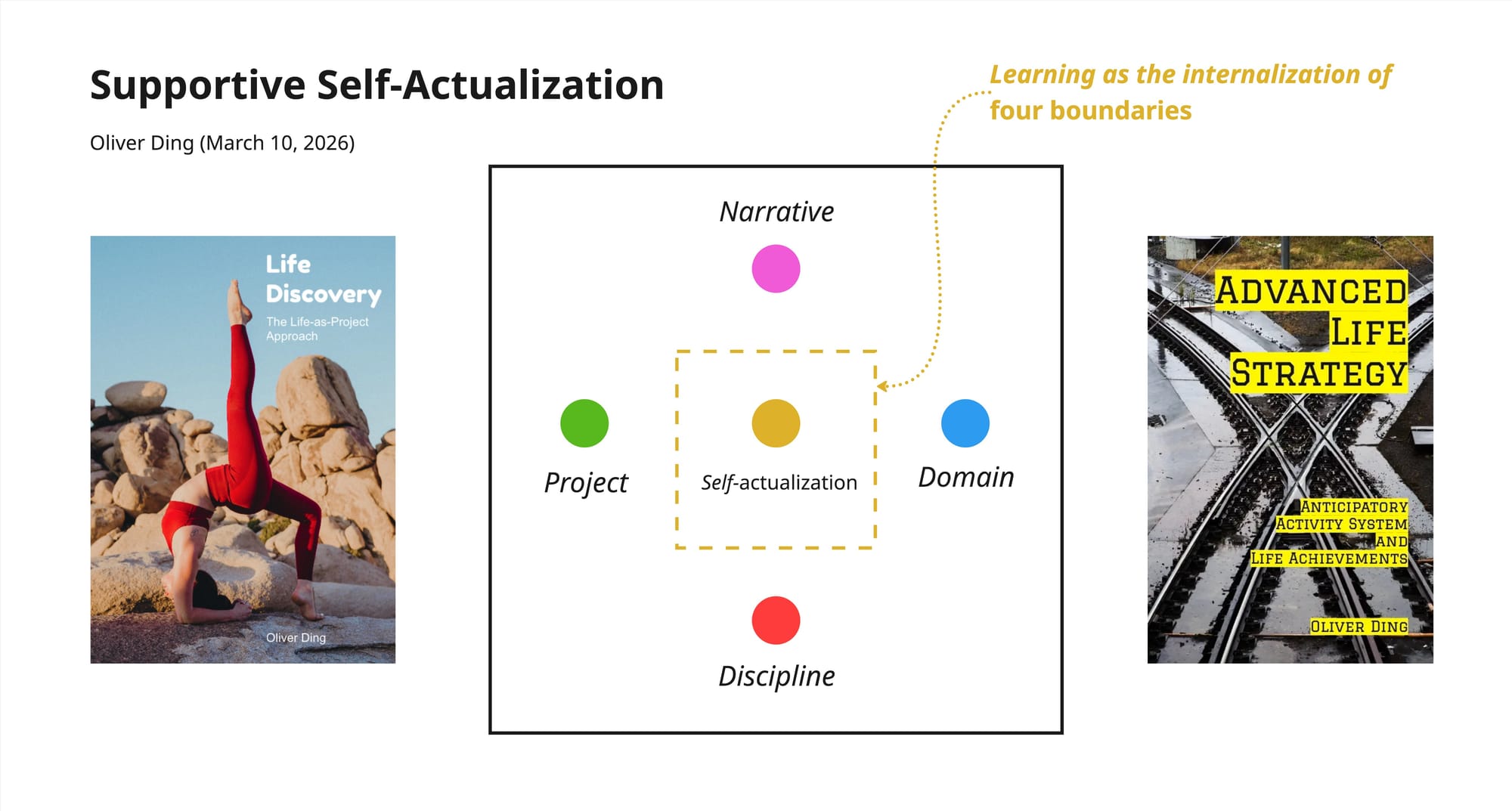
This is not preparation for living. It is itself a form of living — the form that makes genuine creative engagement possible.
Supportive Life Discovery, then, is not simply a service or a methodology. It is a practice of supporting another person's self-actualization — accompanying them as they internalize the four boundaries, develop their life themes, and move from cognitive preparation (Learn) through genuine discovery (Discover) into the full arc of creative contribution (Design, Deliver). The Supporter's role, across all four circles, is to hold the space in which this process can unfold at its own pace and in its own direction.
Conclusion
The L3D model is not a learning model, nor simply a cultural development model. It is a framework that bridges the two: connecting the individual creator's cognitive development (the Learn stage, grounded in the Learning Landscape) with the social arc of thematic creation (the DDD core, grounded in the Agency Cascade and the DDD model).
Its central proposition is that genuine creative engagement with the world — genuine discovery, genuine design, genuine contribution — depends on prior internalization of the world's fundamental dimensions. You cannot meaningfully discover your life themes if you have not developed the conceptual, interpretive, reflective, and narrative orientations through which themes become visible. You cannot design thematic creations if you have not built the mental models from which design can emerge. You cannot deliver cultural contributions if you have not engaged seriously enough with a domain and community to have something genuinely worth offering.
The Learn stage is not preliminary work to be completed before the real creative life begins. It is the foundational practice that makes the real creative life possible — and its continuation, at every scale of the L3D cycle, is what sustains it.
Understood in its fullest sense, the L3D model is a framework for Supportive Self-Actualization: supporting another person as they gradually internalize the four boundaries of the World of Life, develop their life themes, and move through the complete arc of creative engagement. The Supporter does not direct this process — they hold the space in which it can unfold. And the model provides the structure within which that space is defined.
v1.0 - March 3, 2026 - 4,396 words