
Learning Landscape: Revisiting from the World of Life Perspective

Revisiting and Rebuilding the Learning Landscape conceptual deck (2015)
by Oliver Ding
March 4, 2026
In early 2026, while developing the Supportive Life Discovery project — a framework for supporting individuals through the key transitions and challenges of adult life — I found myself returning to a conceptual deck I had created in November 2015: the Learning Landscape framework.
Around 2012–2015, I was actively involved in youth civic communities and educational organizations, promoting ideas of open education and social learning. During that period, I also served as an advisor to a youth education company and co-founded a social learning community platform with friends. These rich practical experiences led me to think seriously about adult learning after university — and I wrote a series of conceptual decks exploring these questions.
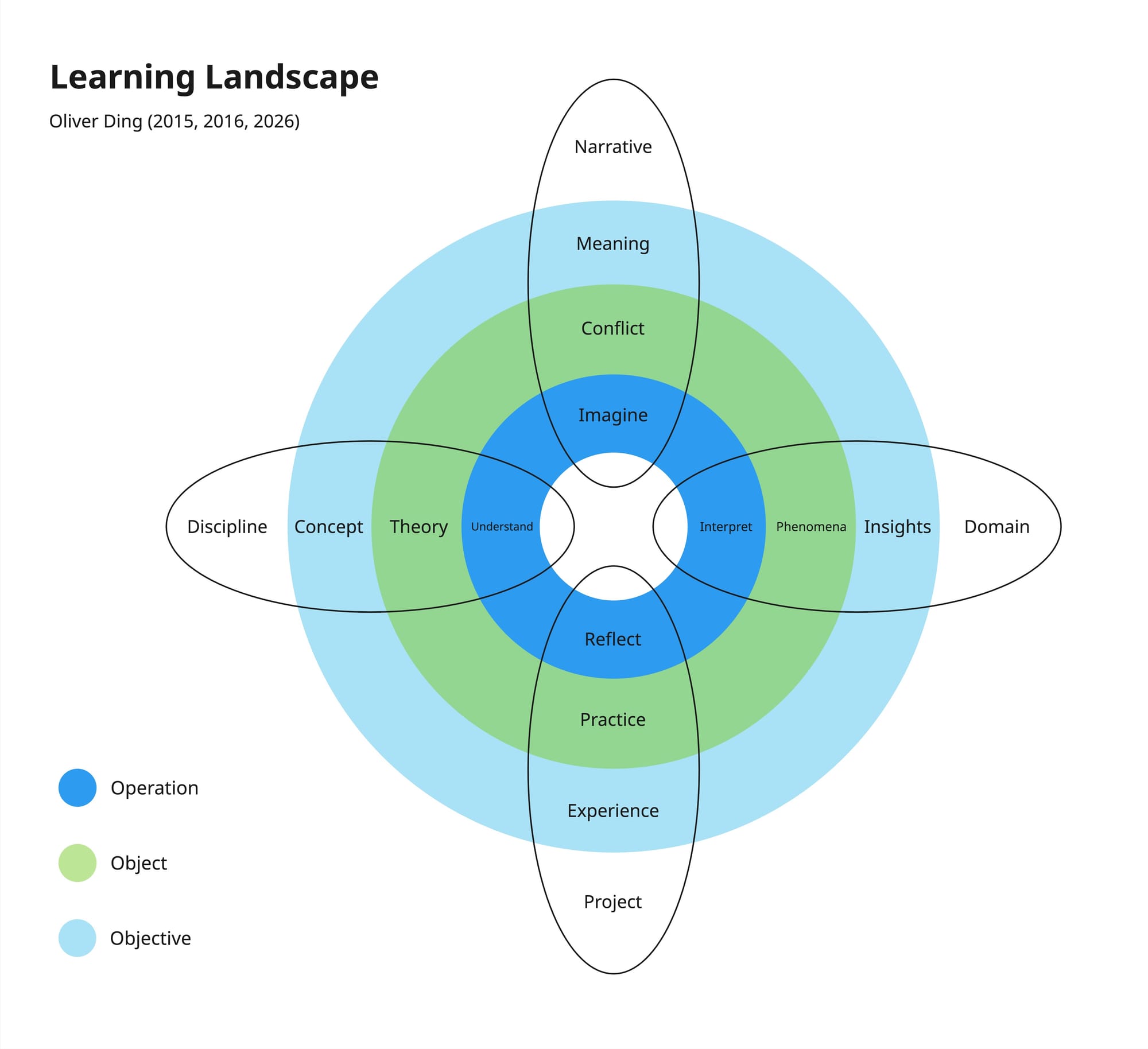
One of them introduced the framework, which I called the Learning Landscape, featuring three perspectives and one core. Later, in 2016, it was redesigned as a 3x4 framework, including four perspectives, each operating through three layers. The diagram below is a translation of the original 2016 Chinese diagram.
Years later, while developing the World of Life theoretical framework, Anticipatory Cultural Sociology (ACS), and Cognitive Hydrology, I unexpectedly found myself revisiting this early framework. What surprised me was the depth of resonance I discovered: these early practice-based reflections had, without my knowing it at the time, anticipated patterns that my theory-based reflections are only now able to name.
The World of Life is an ontological framework for understanding the social world — the space in which human beings act, create, and develop together. It proposes that this space is defined by four boundaries — four fundamental dimensions that structure any human engagement with the world:
- The Individual Boundary — the dimension of personal agency, subjectivity, and inner life
- The Collective Boundary — the dimension of social relations, communities, and shared practices
- The Science/Ecology Boundary — the dimension of knowledge, natural laws, and material reality
- The Spirituality Boundary — the dimension of meaning, purpose, and ultimate orientation
These four boundaries are not just categories. They define the outer limits of the space in which a human life unfolds. Everything a person does, thinks, creates, or becomes happens within — and in relation to — these four dimensions.
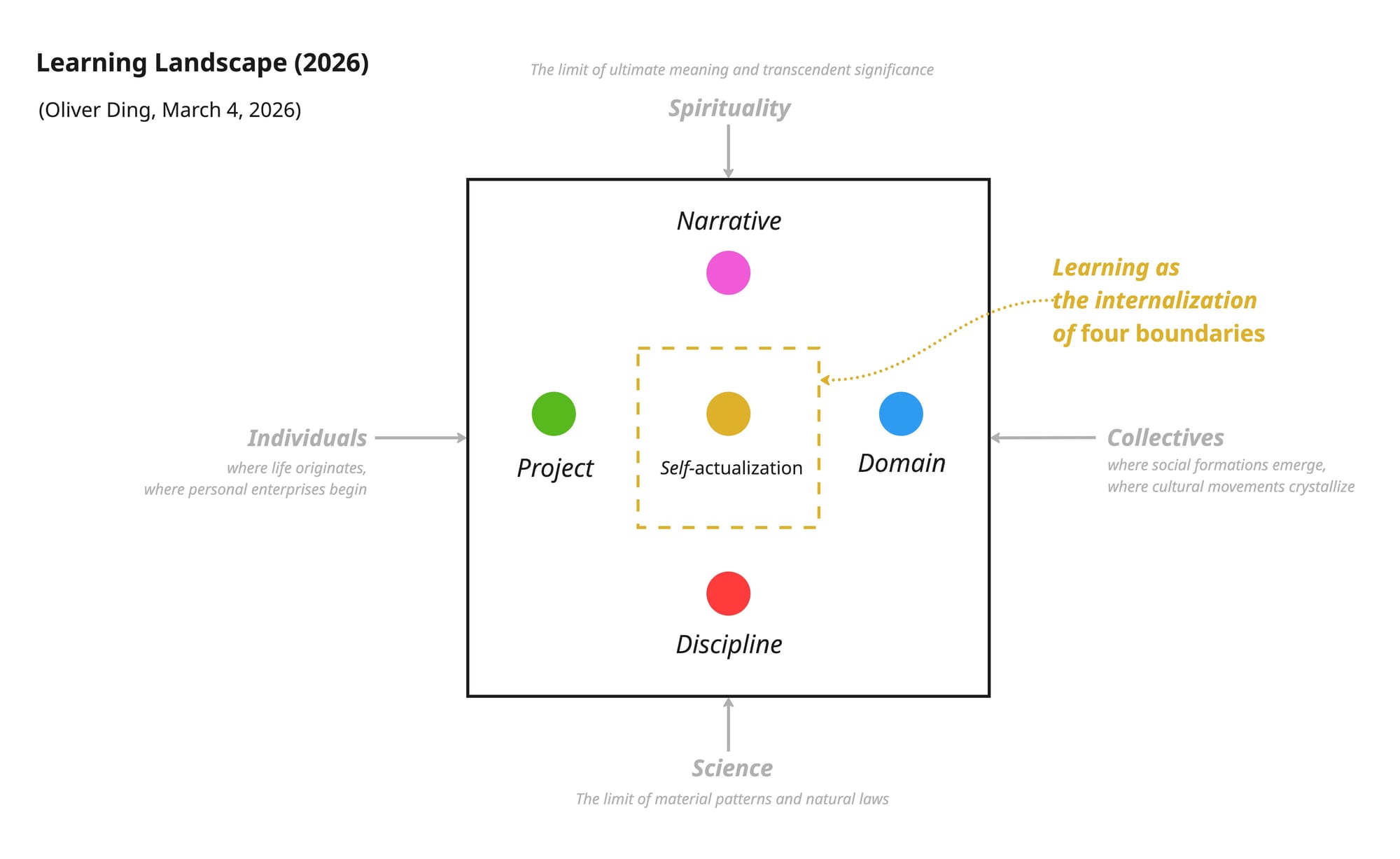
The revisiting of the 2015/2016 Learning Landscape framework inspired me to rebuild it with the World of Life approach. After placing four perspectives of Learning Landscape into the square of World of Life, a new insight emerged: Learning can be understood as the internalization of four boundaries of World of Life. Furthermore, the goal of learning could be understood as Self-actualization, traced back to Aristotle's entelechy (ἐντελέχεια) — "the state of having one's end within oneself" — points to a process by which a living being realizes its potential through continuous effort.
This article will offer more details of this revising and rebuilding.
Contents
1. A Problem That Formal Education Doesn't Solve
2. The World of Life: Four Boundaries
3. A New Definition of Adult Learning
3.1 Ontology: What adult learning is
3.2 Realism: How adult learning works
3.3 Hermeneutics: Why adult learning matters
4. The Four Perspectives
4.1 The Discipline Perspective → Science/Ecology Boundary
4.2 The Domain Perspective → Collective Boundary
4.3 The Project Perspective → Individual Boundary
4.4 The Narrative Perspective → Spirituality Boundary
5. The Version History: How the Framework Found Its Structure
5.1 2015: Three Perspectives and a Hidden Center
5.2 2016: The Fourth Perspective Emerges
5.3 2026: The Theoretical Foundation Revealed
6. Learning and Creating: Internalization and Externalization
7. James March and the Three Layers
8. Ten Years Later
8.1 What Each Perspective Became
8.2 The Whole Mind, Revisited
8.1 Why This Matters for Cognitive Hydrology
9. Creative Outcome
A Personal Note
1. A Problem That Formal Education Doesn't Solve
When you graduate from school or university, something strange happens. For years, your learning had a structure: a curriculum, a teacher, a syllabus, a schedule. Then, suddenly, that structure disappears — and you are left with the question that institutions never quite prepared you to answer:
What should I learn next, and how?
This is not a trivial problem. The world keeps changing. Knowledge keeps expanding. Your career keeps evolving. And without the scaffolding of formal education, most people fall back on one of two default strategies: learning whatever seems immediately useful for their current job, or consuming a constant stream of content without any organizing principle at all.
Neither strategy leads anywhere interesting.
In 2015, after several years of grappling with this problem — both personally and through conversations with young professionals — I developed a framework I called the Learning Landscape. It was an attempt to answer a deceptively simple question: What does it actually look like to grow as a thinking, creating adult?
The framework proposed four perspectives — four distinct lenses through which a person can orient their learning. At the time, the framework was largely empirical: these perspectives seemed important, based on observation and experience. Below is the original Chinese diagram of the framework.
Ten years later, I can offer something more. Revisiting the Learning Landscape from the perspective of a theoretical framework I have since developed — the World of Life — reveals that the four perspectives were not arbitrary. They have a theoretical foundation. And that foundation changes what the Learning Landscape actually is.
2. The World of Life: Four Boundaries
The concept of "World of Life" was introduced as the context of "World of Activity" in September 2025. Later, I used it to name a new curated knowledge system in December 2025. Finally, four boundaries of the "World of Life" were introduced as well.
The World of Life is an ontological framework for understanding the social world — the space in which human beings act, create, and develop together. It proposes that this space is defined by four boundaries — four fundamental dimensions that structure any human engagement with the world:
- The Individual Boundary — the dimension of personal agency, subjectivity, and inner life
- The Collective Boundary — the dimension of social relations, communities, and shared practices
- The Science/Ecology Boundary — the dimension of knowledge, natural laws, and material reality
- The Spirituality Boundary — the dimension of meaning, purpose, and ultimate orientation
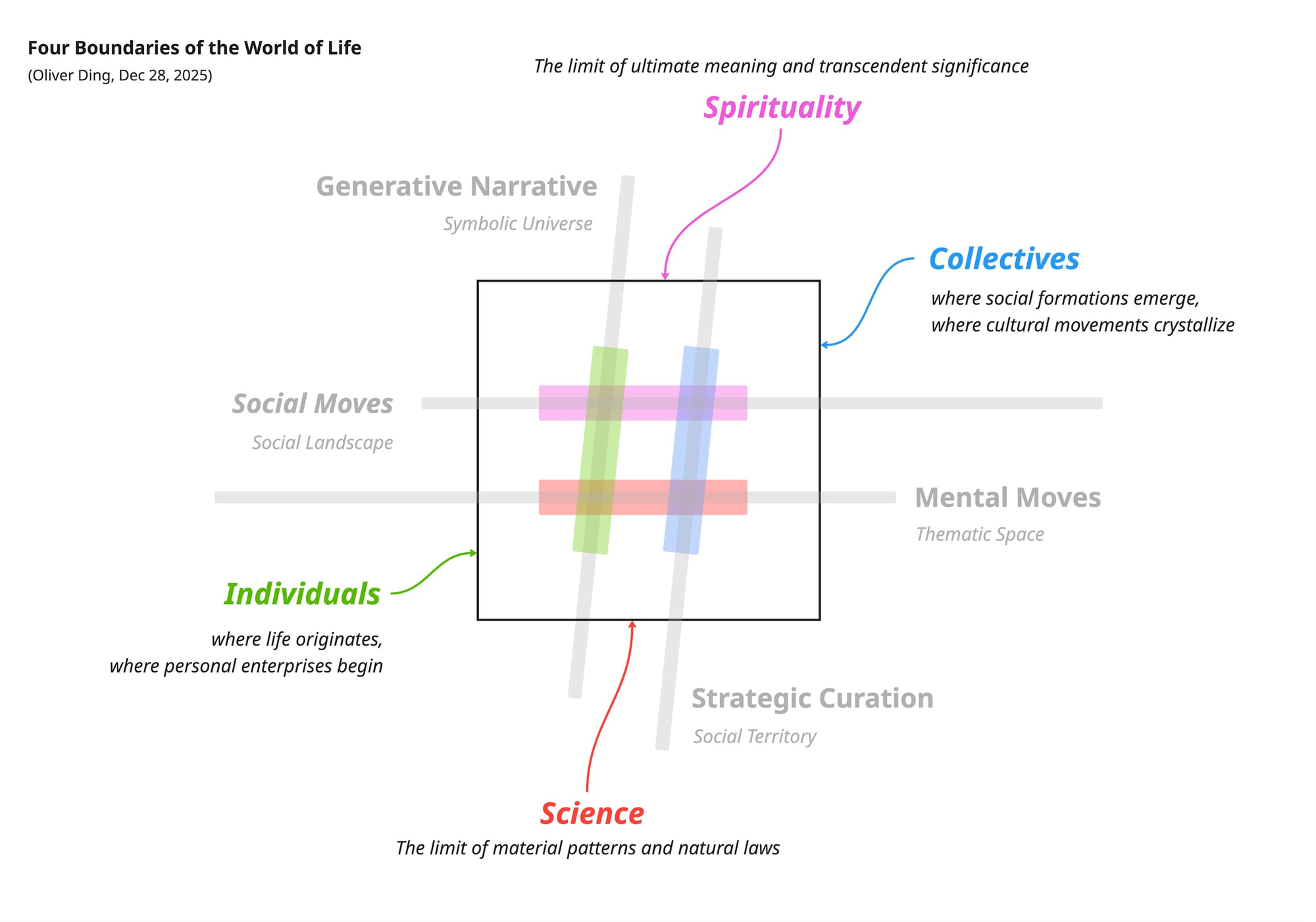
These four boundaries are not just categories. They define the outer limits of the space in which a human life unfolds. Everything a person does, thinks, creates, or becomes happens within — and in relation to — these four dimensions.
The question that the Learning Landscape, in retrospect, was always trying to answer is this: How does a person engage with all four boundaries, rather than just one or two?
3. A New Definition of Adult Learning
The World of Life perspective allows us to offer a three-layer definition of adult learning, organized through the Ontology—Realism—Hermeneutics schema developed by theoretical sociologist Ping-keung Lui.
3.1 Ontology: What adult learning is
Adult learning is the internalization of the four boundaries of the World of Life into one's own mind.
This is not the accumulation of information, not the development of skills in isolation, but the gradual process by which a person takes the structure of the social world — its four fundamental dimensions — and makes that structure part of themselves. There are four perspectives because there are four boundaries. They are these four perspectives — and not others — because each one corresponds to a specific boundary of the World of Life. This theoretical derivation gives the framework a necessity it could not claim when it was assembled empirically in 2015.
3.2 Realism: How adult learning works
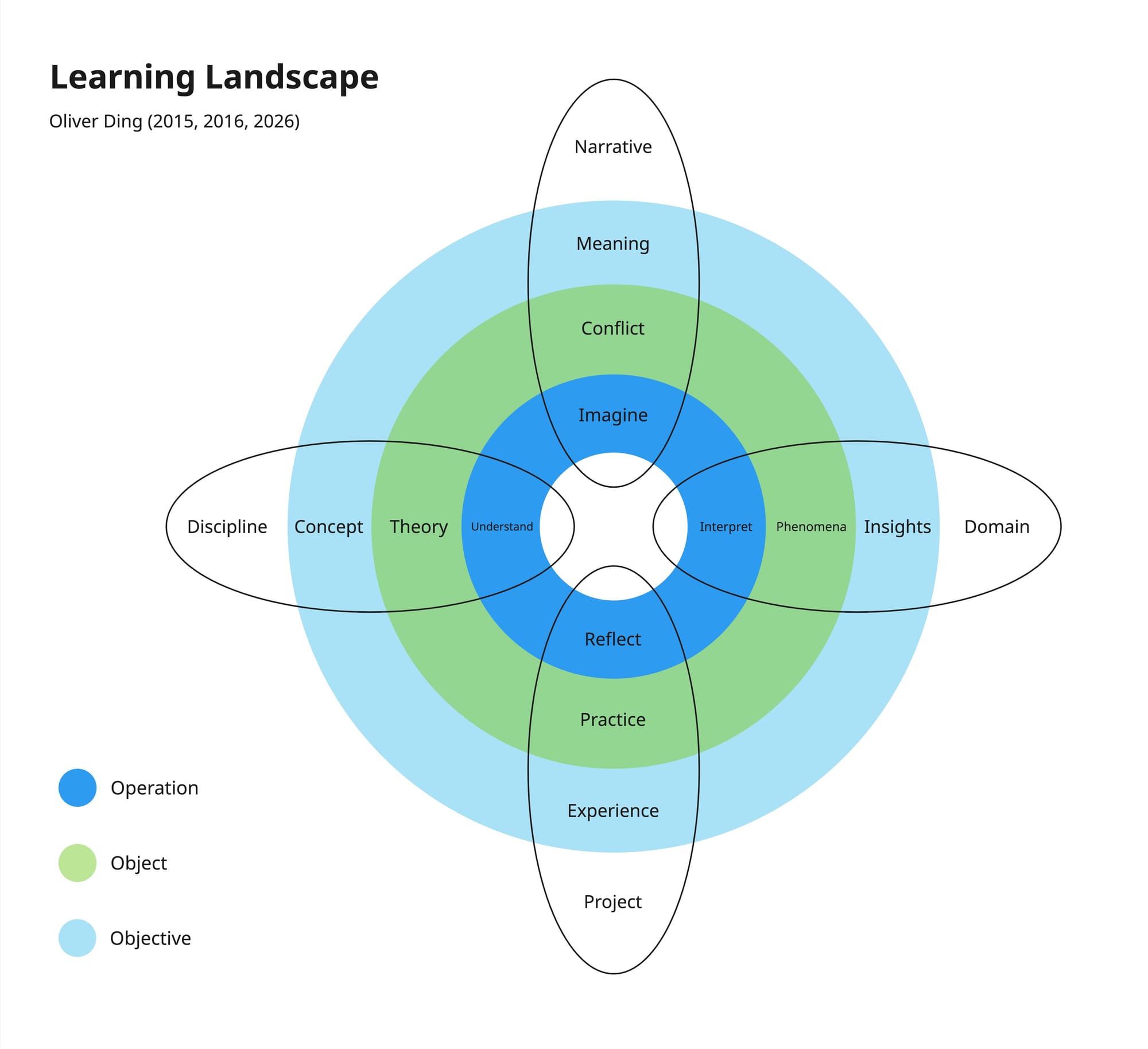
The internalization of the four boundaries is not an abstract process. It has a concrete structure: a 3×4 architecture of twelve elements — four perspectives, each operating through three layers.
Each perspective has the same structure: an Object (what is being engaged), an Operation (how the learner engages), and an Objective (what the learner seeks to gain). This three-layer structure was not derived from the World of Life framework itself, but emerged from a parallel encounter with James March's observation that learning always involves three simultaneous elements: learning what to do, learning how to do it, and learning what to hope for. Applied at the individual cognitive level, these three elements map precisely onto Object, Operation, and Objective.
The result is a 3×4 matrix — twelve specific cognitive elements — that gives the ontological proposition its operational form:
| Perspective | Object | Operation | Objective |
|---|---|---|---|
| Discipline | Theory | Understand | Concepts |
| Domain | Phenomena | Interpret | Insights |
| Project | Practice | Reflect | Experience |
| Narrative | Conflict | Imagine | Meaning |
3.3 Hermeneutics: Why adult learning matters
The internalization of the four boundaries is not merely a cognitive achievement. It is the concrete path of self-actualization.
The concept of self-actualization, traced back to Aristotle's entelechy (ἐντελέχεια) — "the state of having one's end within oneself" — points to a process by which a living being realizes its potential through continuous effort. In the framework of Anticipatory Cultural Sociology (ACS), self-actualization is reframed as an anticipatory activity: not a final state to be achieved, but an ongoing process of orienting oneself toward future possibilities and acting from that orientation.
Adult learning, understood through this lens, is how a person gradually builds the cognitive infrastructure needed to engage fully and freely with the social world — across all four of its boundaries. It is how one becomes capable of acting not just within one or two familiar dimensions, but across the full range of human experience: theoretical understanding, social interpretation, practical reflection, and narrative meaning-making.
This is not preparation for living. It is itself a form of living — the form that makes genuine creative engagement possible.
4. The Four Perspectives
Each perspective can be stated as a single precise movement:
- Discipline Perspective: understand theory, gain concepts
- Domain Perspective: interpret phenomena, gain insights
- Project Perspective: reflect on practice, gain experience
- Narrative Perspective: imagine conflict, gain meaning
Each perspective has the same three-layer structure — an operation directed at an object, oriented toward an objective:
- Object Layer: the cognitive objects a learner engages with — what is being engaged (Theory / Phenomena / Practice / Conflict)
- Operation Layer: the cognitive acts directed at those objects — how the learner engages (Understand / Interpret / Reflect / Imagine)
- Objective Layer: the cognitive outcomes the learner is oriented toward — what the learner seeks to gain (Concepts / Insights / Experience / Meaning)
The four perspectives together form a complete map — like four petals of a flower sharing a common center. But now we can see what that center is: the World of Life itself, with its four boundaries waiting to be internalized.
4.1 The Discipline Perspective → Science/Ecology Boundary
Understand theory, gain concepts.
The Discipline Perspective corresponds to the Science/Ecology boundary — the dimension of knowledge, natural laws, and material reality. To engage with this boundary through learning means to take theoretical traditions seriously: following arguments, tracing intellectual lineages, building a genuine theoretical foundation.
The cognitive operation is understanding — not passive reading, but active engagement that builds structure. The object is theory — the accumulated frameworks, concepts, and debates of a discipline. The objective is concepts — durable, transferable mental tools that help you see patterns across different situations.
A person who has genuinely inhabited a discipline doesn't just know facts; they carry conceptual lenses that change how they perceive the world. Without concepts, experience cannot be properly interpreted.
4.2 The Domain Perspective → Collective Boundary
Interpret phenomena, gain insights.
The Domain Perspective corresponds to the Collective boundary — the dimension of social relations, communities, and shared practices. Skills and competencies do not develop in isolation; they emerge through participation in collective domains of practice, through engagement with what is actually happening in the social world.
The cognitive operation is interpreting — not just observing, but making sense of what you see: noticing patterns, identifying anomalies, asking what a phenomenon means within its social context. The object is phenomena — the actual events, behaviors, and developments in a specific domain. The objective is insights — recognitions of something significant that is not immediately obvious.
Where the Discipline Perspective looks inward into bodies of theory, the Domain Perspective looks outward into the collective world. Without it, theoretical learning becomes sterile.
4.3 The Project Perspective → Individual Boundary
Reflect on practice, gain experience.
The Project Perspective corresponds to the Individual boundary — the dimension of personal agency, subjectivity, and inner life. It is through concrete projects — through doing, deciding, failing, and adjusting — that the individual boundary is most directly engaged. Action is the most personal thing a person can do.
The cognitive operation is reflecting — not just completing work, but thinking carefully about what the work reveals: your assumptions, your methods, your blind spots, your growing capacities. The object is practice — the concrete projects and activities through which you engage with the world. The objective is experience — not in the passive sense of "time spent," but in the active sense of transformed understanding.
Without reflection, people can repeat the same year of work ten times and call it a decade of experience, while actually having gained very little. Reflection is what turns action into learning.
4.4 The Narrative Perspective → Spirituality Boundary
Imagine conflict, gain meaning.
The Narrative Perspective corresponds to the Spirituality boundary — the dimension of meaning, purpose, and ultimate orientation. This is the perspective that most learning frameworks overlook entirely, and it is not coincidental that it was also the last to be articulated explicitly in the development of the Learning Landscape (added in 2016, a year after the original three).
The Spirituality boundary is the most difficult to operationalize — it points toward what transcends the material, the social, and even the individual. Its internalization in learning takes the form of narrative: the stories through which a person understands the arc of their own development, the conflicts that give a life its shape and direction.
The cognitive operation is imagining — specifically, imagining conflict: the tensions, dilemmas, and turning points through which a life becomes a story rather than a sequence of events. The object is conflict — not in a negative sense, but in the narrative sense: the productive tensions that give a life its shape and direction. The objective is meaning — the sense that your life and work hang together coherently, that your struggles serve a purpose, that your development has a direction.
5. The Version History: How the Framework Found Its Structure
5.1 Three Perspectives and a Hidden Center (2015)
The original Learning Landscape (v1.0, November 2015) proposed three perspectives — Discipline, Domain, and Project — organized as a triangle, with a fourth element at the center: the Life Theme. The diagram below is the translation of the original Chinese diagram.
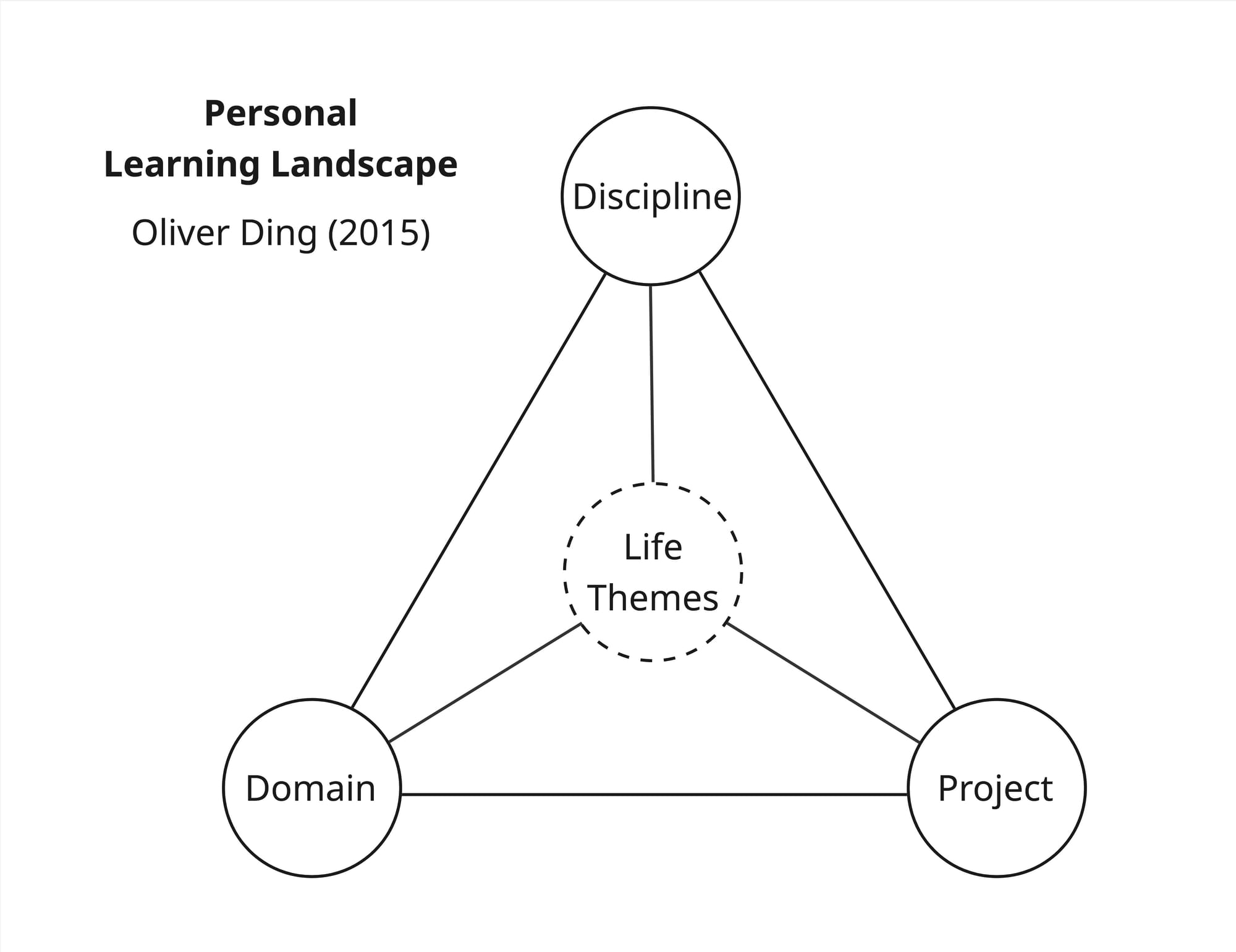
In this version, the Life Theme was not presented as a perspective alongside the other three. It was the hidden interior — the implicit organizing principle that gave the other three their direction. The diagram showed it as a dashed circle at the center: internal, indirect, approached only through the outer three.
From the Learning Landscape, I further developed a Whole Mind Framework. The traditional notion of mind — internal, invisible, not directly improvable — was placed at the center. Around it, the three perspectives formed an outer triangle: Knowledge (Discipline Perspective), Skills (Domain Perspective), and Action (Project Perspective). Life Theme was positioned outside the triangle, pointing inward toward the mind through a dotted arrow. The diagram below is the translation of the original Chinese diagram.
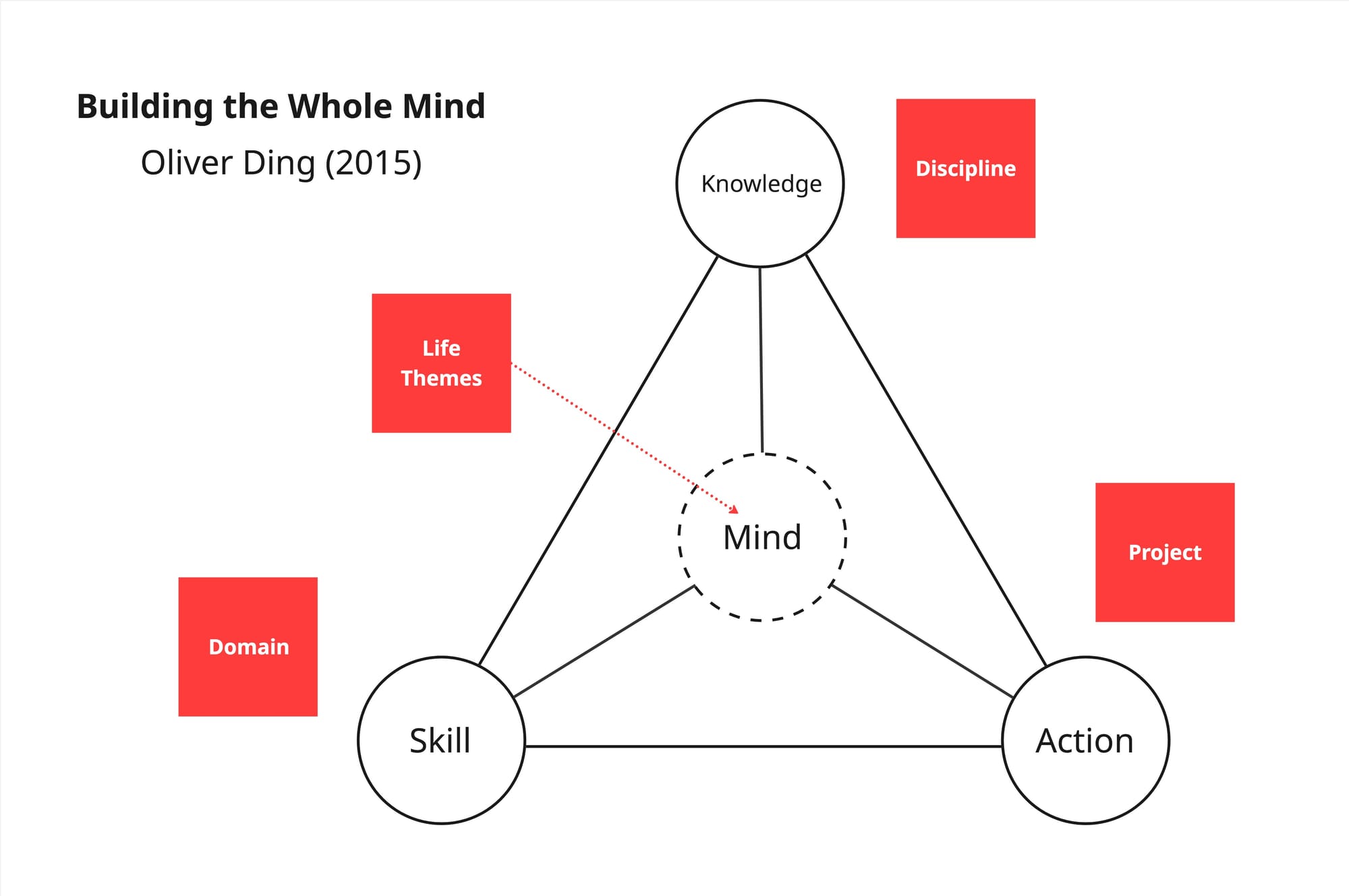
The framework's core proposition was: the mind is internal; it can only be improved indirectly through external knowledge, skills, and action. The four elements — knowledge, skills, action, and mind — corresponded precisely to the three perspectives and the life theme. This was the first articulation of what would later become the four-perspective structure.
But at this stage, the Spirituality boundary was not yet fully internalized as a cognitive perspective. The mind and life theme remained implicit — pointing inward from outside the framework, rather than standing as an equal fourth perspective.
5.2 The Fourth Perspective Emerges (2016)
In May 2016, the framework was redesigned. The Career Theme moved from the center to the periphery, becoming the Narrative Perspective — an explicit fourth perspective, equal in status to the other three. The center emptied. The diagram below is the original Chinese diagram.
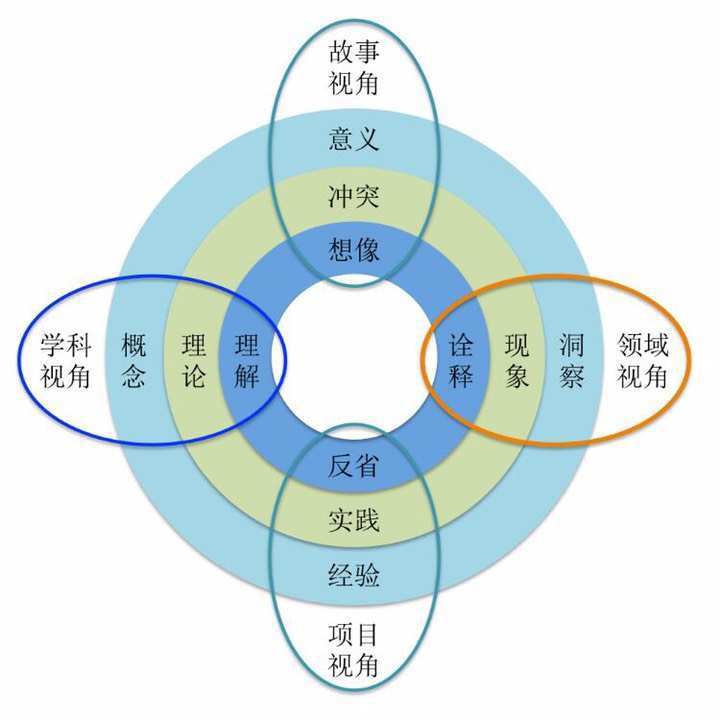
This was not a minor revision. It was a structural transformation: what had been hidden became visible; what had been implicit became explicit. The four-petaled flower replaced the triangle-with-center. The Spirituality boundary, previously approached only indirectly, now had its own cognitive operation: imagine conflict, gain meaning.
The three layers — Object, Operation, Objective — also became fully visible in this version, each perspective now carrying its own complete cognitive arc.
5.3 The Theoretical Foundation Revealed (2026)
The 2026 revisiting does not change the structure of the framework. It reveals why the structure is what it is.
The four perspectives correspond to the four boundaries of the World of Life. The framework was not empirically assembled — it was theoretically necessary. And this theoretical necessity gives the Learning Landscape a foundation it did not explicitly have in 2015 or 2016.
6. Learning and Creating: Internalization and Externalization
The Learning Landscape does not stand alone. In the broader framework I have been developing — particularly the L3D model (Learn → Discover → Design → Deliver) — it occupies a specific and essential position.

Learn is the internalization phase: the process by which a person takes the four boundaries of the World of Life inward, building the cognitive infrastructure — concepts, insights, experience, meaning — that makes creative engagement possible.
Discover, Design, and Deliver are the externalization phases: the process by which a person takes that internalized cognitive infrastructure and projects it outward, engaging with the World of Life through creation, contribution, and delivery. More details can be found in Design-oriented Project Engagement.
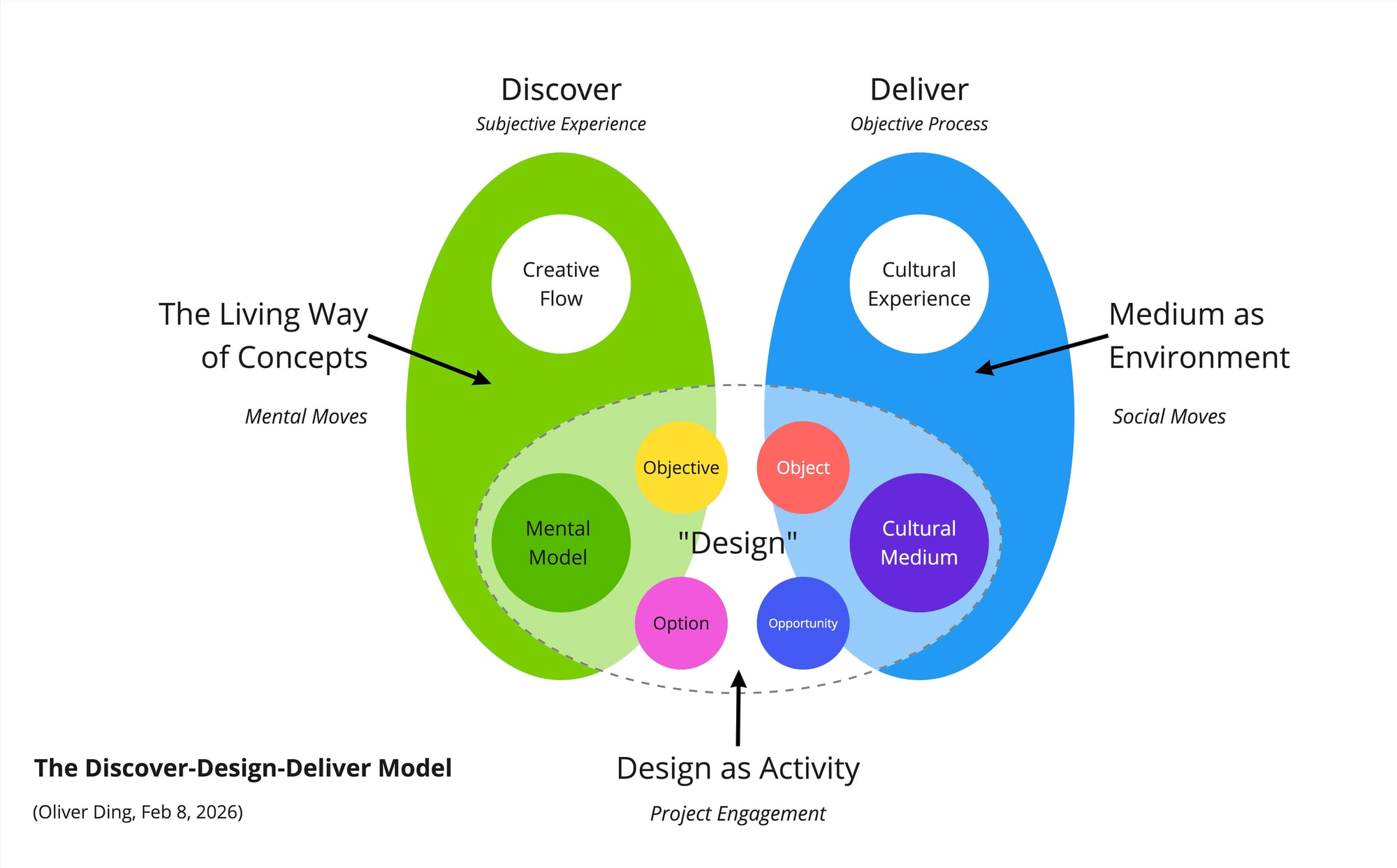
The complete L3D cycle is therefore a movement of internalization followed by externalization — a breath in and a breath out. The World of Life's four boundaries are first taken in (Learn), then engaged outward (3D).
This structure resonates with what I described in Homecoming as "engaging with the four boundaries" through creative life. The mechanism of that engagement is now clearer: you can only genuinely engage with the four boundaries of the world if you have first internalized them as cognitive perspectives. Learning is not preparation for living — it is the internalization that makes genuine engagement possible.
7. James March and the Three Layers
The management theorist James March, in The Ambiguities of Experience, identified three simultaneous elements of learning in organizations:
"The first is learning what to do: looking for a good (or best) alternative technology, strategy, partner, etc. The second is learning how to do it: refining and improving competence with an alternative. The third is learning what to hope for: modifying the aspiration level for performance."
March was writing about organizations. The Learning Landscape addresses something different: the cognitive development of an individual adult over time. The two frameworks operate at different scales and are not directly comparable.
Nevertheless, March's three-part structure illuminates the three-layer architecture of the Learning Landscape from a different angle:
- Learning what to do — engaging with the Object Layer: what cognitive objects are being engaged (Theory / Phenomena / Practice / Conflict)
- Learning how to do it — cultivating the Operation Layer: which cognitive operations are being performed (Understand / Interpret / Reflect / Imagine)
- Learning what to hope for — orienting toward the Objective Layer: what the learner is seeking to gain (Concepts / Insights / Experience / Meaning)
The Operation Layer is the most distinctive feature of this architecture. It proposes that the cognitive act itself — the specific way a person engages with an object — is not fixed or generic, but distinct for each perspective, and itself developable. To understand is not the same as to interpret, which is not the same as to reflect, which is not the same as to imagine. Each operation has its own logic, its own difficulties, and its own rewards.
8. Ten Years Later
8.1 What Each Perspective Became
Looking back, the four perspectives were not just a learning framework. They were four seeds that, over a decade, grew into four distinct theoretical enterprises — each one an externalization of what had first been internalized.
The Discipline Perspective became the foundation for Cognitive Hydrology — a theoretical framework for understanding how ideas flow, converge, and develop across a creative life. The practice of drawing systematically from multiple theoretical traditions (Ecological Psychology, Activity Theory, Phenomenology) to build new knowledge frameworks is the Discipline Perspective lived at scale.
The Domain Perspective evolved into the Platform Ecology project — a sustained engagement with how platforms, communities, and knowledge ecosystems actually function in contemporary professional life. Interpreting phenomena, pursued over years, becomes a theoretical enterprise.
The Project Perspective became the Project Engagement theoretical approach — a systematic framework for understanding how projects function as sites of creative and cognitive development. Reflecting on practice, done rigorously enough, generates theory.
The Narrative Perspective became the foundation for Creative Life Theory and Thematic Development Study — the investigation of how themes evolve across a creative life. Imagining conflict and seeking meaning, sustained across decades, becomes a method for understanding the self in development.
8.2 The Whole Mind, Revisited
In December 2025, I developed The Curativity of Mind — a framework built on four dimensions: Knowledge (what the mind uses), Context (where the mind operates), Activity (what the mind does), and Function (how the mind works). At the time, I had no awareness of any connection to the 2015 Learning Landscape. The two frameworks were developed independently, a decade apart.
It was only through today's revisiting that the structural resonance became visible: the four dimensions of the 2025 framework correspond precisely to the four elements of the 2015 Whole Mind Framework. This is itself a demonstration of what revisiting can reveal — connections that were real but invisible until a new theoretical vantage point made them legible.
Neither the 2015 nor the 2025 version used the term "Whole Mind" explicitly. But the underlying conviction was consistent across both: a deep dissatisfaction with the traditional view that confines mind to the brain alone. Throughout this decade of work, I have consistently refused to treat mind as something separate from knowledge, action, and social context. The mind is not a container sitting behind the eyes — it is constituted through what it knows, what it does, and where it operates. The Learning Landscape, from the very beginning, was an expression of this conviction: to develop the mind is to engage seriously with theory, with one's domain, with one's projects, and with the narrative of one's own life.
8.3 Why This Matters for Cognitive Hydrology
The Learning Landscape connects naturally to Cognitive Hydrology — and specifically, to its theory of knowledge, its theory of the learner, and its vision of what learning is ultimately for.
Knowledge as flow, not accumulation. Mainstream pedagogy assumes knowledge is something to be acquired, built up, and stored. Cognitive Hydrology proposes a different image: knowledge is not a structure but a flow. The cognitive flood — the endless stream of perception, information, and experience — reaches every person every day. Most of it dissipates without a trace. The question is not how to capture more of it, but how to develop the sensitivity to recognize significant patterns within it, and to allow convergence when multiple streams are ready to meet.
The learner as a creative self in development. Mainstream pedagogy describes the learner at a moment — in terms of competencies, prior knowledge, or motivational states. Cognitive Hydrology proposes a different portrait: the learner is a creative self in development, who across years and decades develops signature themes that organize their intellectual and creative life. The fundamental difficulty is not a lack of knowledge but a lack of orientation — the capacity to move from cognitive flood to creative flow: to develop thematic focus amid overwhelming information, and to lift experience into concept over long time scales.
Learning as a way of living, not a system for efficiency. Cognitive Hydrology is not a framework for learning efficiently. It is a framework for living a creative life centered on thematic development and concept creation. From this perspective, the Learning Landscape offers something concrete: a method for practicing all four orientations around a theme or concept, rather than remaining confined to a single perspective. A learner can engage with the same theme through theory (Discipline), through observation of real phenomena (Domain), through reflective practice (Project), and through narrative meaning-making (Narrative) — and it is the interplay of these four that generates genuine thematic depth over time.
Cognitive Hydrology is itself a theoretical enterprise grounded in the World of Life — specifically, a theory of how cognition and knowledge move, gather, and develop within the social world. The Learning Landscape, as the internalization of the World of Life's four boundaries, is naturally its companion framework at the level of the individual learner.
But the connection does not stop there. Because the Learning Landscape is grounded in the World of Life rather than in any single theoretical tradition, it can support multiple theoretical enterprises that share the same ontological foundation. Anticipatory Cultural Sociology (ACS), Strategic Developmental Psychology, and Platform Ecology — each of these develops a different dimension of the World of Life. The four perspectives of the Learning Landscape provide a common cognitive ground from which any of these enterprises can be entered, sustained, and deepened.
In this sense, the Learning Landscape is not the entry point to one journey. It is the cognitive preparation for engaging seriously with the world — in any of its four dimensions, through any of the theoretical traditions that illuminate them. And with this revisiting, it may well become a theoretical enterprise in its own right.
9. Creative Outcome
The Learning Landscape Framework (2026) was created over approximately 30 hours across multiple sessions on March 4–6, 2026.
What began as a revisit-rebuild exercise with a 2015 document evolved into a substantial theoretical development.
A detailed Revisiting–Rebuilding Case Study was conducted, documenting the theoretical and practical insights generated during the process.
These materials have been edited into a package and released by Possible Press, comprising the following contents:
#00 - The Translation of the 2016 Chinese Diagram
#01 - Learning Landscape: Revisiting from the World of Life Perspective
#02 - Revisiting and Rebuilding: The Learning Landscape Framework (2015-2026)
#03 - The Concept of "World of Life"
#04 - The L3D Model (v1.0) - diagram
#05 - Design-oriented Project Engagement (The Discover-Design-Deliver Model)
#06 - Cognitive Hydrology Pedagogy (v1.0)
#07 - 学习图景(Learning Landscape) - original Chinese deck
#08 - Decoding the "Learning Landscape" Framework (2015) - An introduction generated by AI
The new framework also contributes to the development of Cognitive Hydrology Pedagogy (v1.0), a pedagogical framework for thematic exploration and concept development.
A Personal Note
In the summer of 2025, I traveled to Fuzhou — the city where I had lived for nearly twenty years before moving to the United States. During that trip, I reopened my 2015 autobiography and read it through the lens of the theoretical frameworks I had developed in the intervening decade. Homecoming, the book that emerged from that journey, is, as I described it, "a book about how the 2025 'I' employs theory-based reflection to reflect on the practice-based reflection that the 2015 'I' made about my past self."
That 2015 autobiography was not separate from the Learning Landscape — it was part of the same exploration. Writing one's life story is itself an act of learning: it is the Narrative Perspective in practice, the attempt to imagine the conflicts of one's own life and discover the meaning within them. The autobiography and the framework were two faces of the same inquiry, written at the same moment, by the same person trying to understand what it meant to keep growing.
This article is a parallel movement. The 2015 Learning Landscape was itself a piece of practice-based reflection — I was summarizing, from the inside, what seemed to be working in my own development and in conversations with others. The 2026 revisiting applies theory-based reflection to that earlier practice: the World of Life framework, Cognitive Hydrology, and the Ontology—Realism—Hermeneutics schema provide the theoretical vantage point from which the earlier intuitions can now be properly named and grounded.
What surprises me, in both cases, is the degree of resonance. The 2015 framework was not wrong — it was, in retrospect, theoretically necessary. The practice had anticipated the theory. The four perspectives were already there, already corresponding to four boundaries, already expressing a conviction about the wholeness of mind that a decade of theoretical work would eventually articulate.
This is, perhaps, what makes revisiting worthwhile: not to correct the past, but to discover that it already knew more than it could say.
v1.0 — March 4, 2026 - 4,784 words