
[Meta-framework] The LARGE Method (2026)
![[Meta-framework] The LARGE Method (2026)](/content/images/size/w960/2026/02/The-LARGE-Method---Feb-4---2026---Oliver-Ding-1.jpg)
A Meta-framework of Methods
by Oliver Ding
February 3, 2026
In October 2025, I had a thematic conversation on my methods with a friend via email. From January 26 to 27, 2026, I reflected on the email and revisited more methods I developed over the past years. This reflection encouraged me to develop a meta-framework that would serve as the principles underlying these methods.
Eventually, I found a model whose name perfectly inspired this discovery: the LARGE Method. Originally developed in 2018 as a meta-framework for the learning and reflection project (LAR), it consisted of six words — Learn, Action, Reflect, Generate, Explore, and Exploit — forming the acronym LARGE.
However, this time, I redefined it as a formula:
L(A·R·G)=E
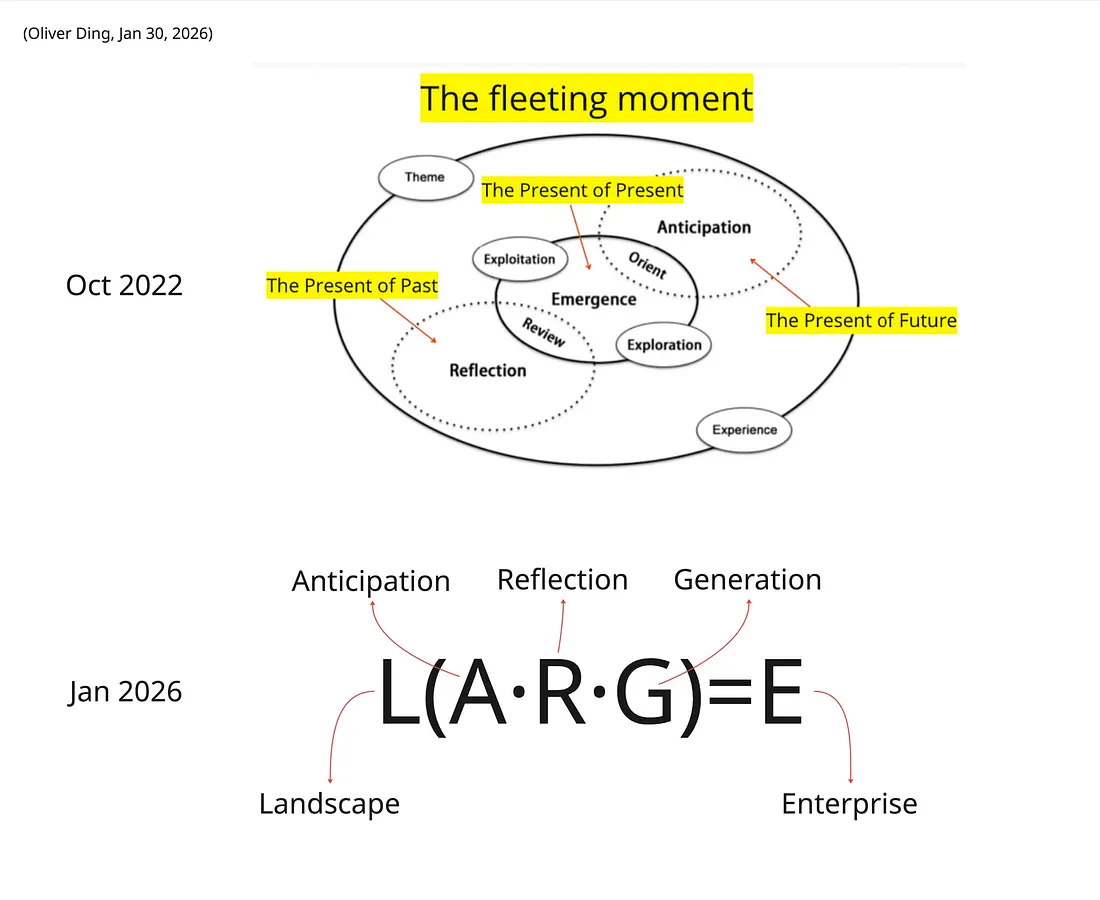
Now it represents five themes:
- L: Landscape
- A: Anticipation
- R: Reflection
- G: Generation
- E: Enterprise
These themes refer to five methodological principles, forming a meta-method:
- Landscape: Synchronic view of the whole
- Anticipation: Orienting toward the future
- Reflection: Learning from the past
- Generation: Creating in the present
- Enterprise: Diachronic unfolding of projects
The diagram below uses the Living Coordinate model to create a framework of the LARGE Method (2026).
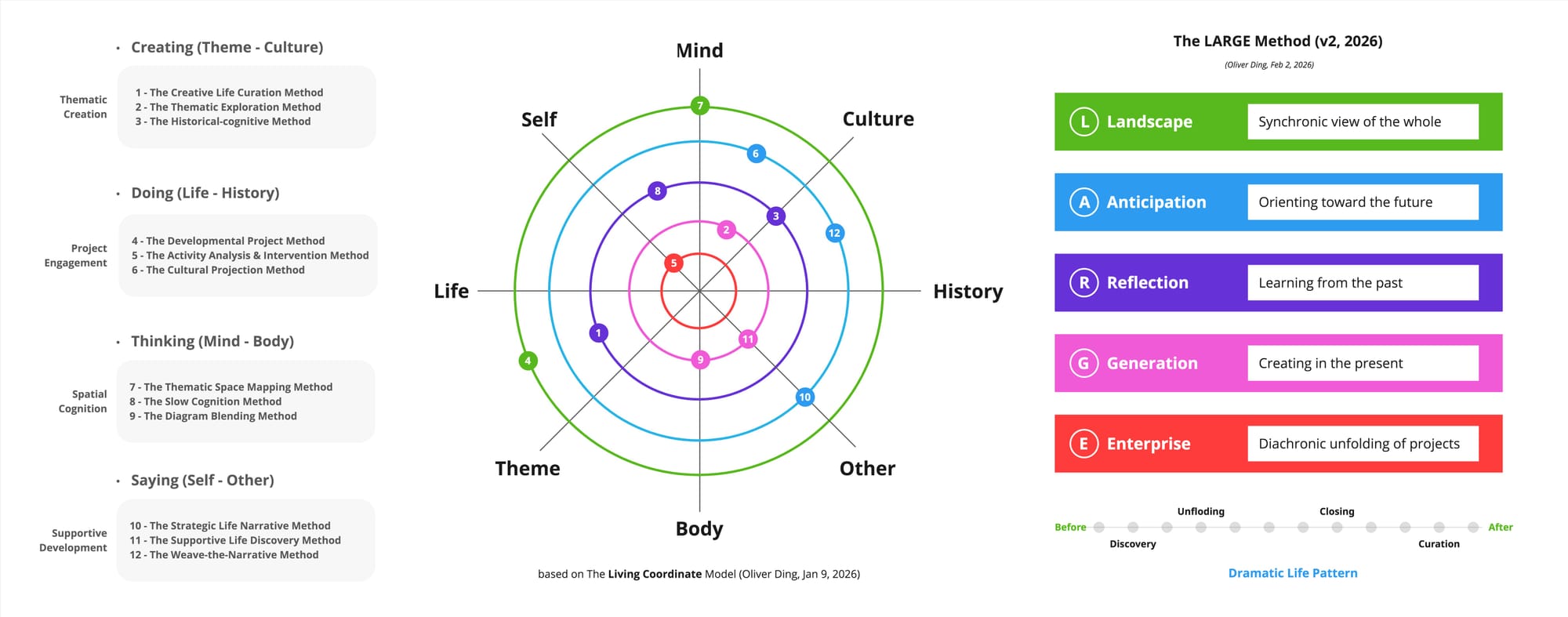
The Living Coordinate model was originally composed of two parts: a 3D coordinate system and a series of circles. The LARGE Method extends this structure by adopting a 4D coordinate and five circles.
On the right side, five methodological principles are presented within five different color boxes, which correspond to five circles within the center diagram.
On the right side of the diagram, five methodological principles are presented in five differently colored boxes, each corresponding to one of the five circles in the central diagram. On the left side, four dimensions are unfolded into four thematic spaces, which are used to situate examples of my methods.
Creating (Theme — Culture) | Theamtic Creation
- #1 — The Creative Life Curation Method
- #2 — The Thematic Exploration Method
- #3 — The Historical-cognition Method
Doing (Life — History) | Project Engagement
- #4 — The Developmental Project Method
- #5 — The Activity Analysis & Intervention Method
- #6 — The Cultural Projection Method
Thinking (Mind — Body) | Spatial Cognition
- #7 — The Thematic Space Mapping Method
- #8 — The Slow Cognition Method
- #9 — The Diagram Blending Method
Saying (Self — Other) | Supportive Development
- #10 — The Strategic Life Narrative Method
- #11 — The Supportive Life Discovery Life Method
- #12 — The Weave-the-Narrative Method
Together, these methods reveal four central focuses of my work: Thematic Creation, Project Engagement, Spatial Cognition, and Supportive Development. Framed by five principles and four focuses, the LARGE Method functions as a comprehensive methodology for my own creative life.
Several days ago, I completed the first version of the LARGE Method. The diagram below shows the initial version.
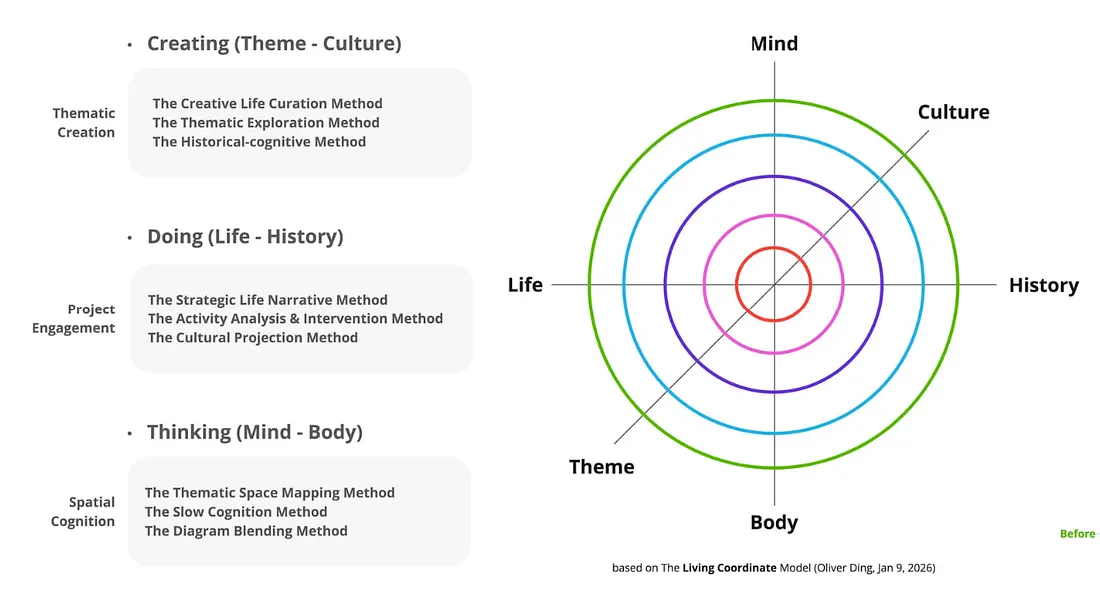
Today, I realized that my methods of narrative and social engagement needed to be explicitly incorporated into the map. As a result, I modified the diagram by expanding the original 3D coordinate into a 4D coordinate. A new thematic space and three additional method examples were added to the left side.
This decision is easy to test.
Let us consider the Ecological Formism Framework (v2.0), which I developed on November 3, 2025.
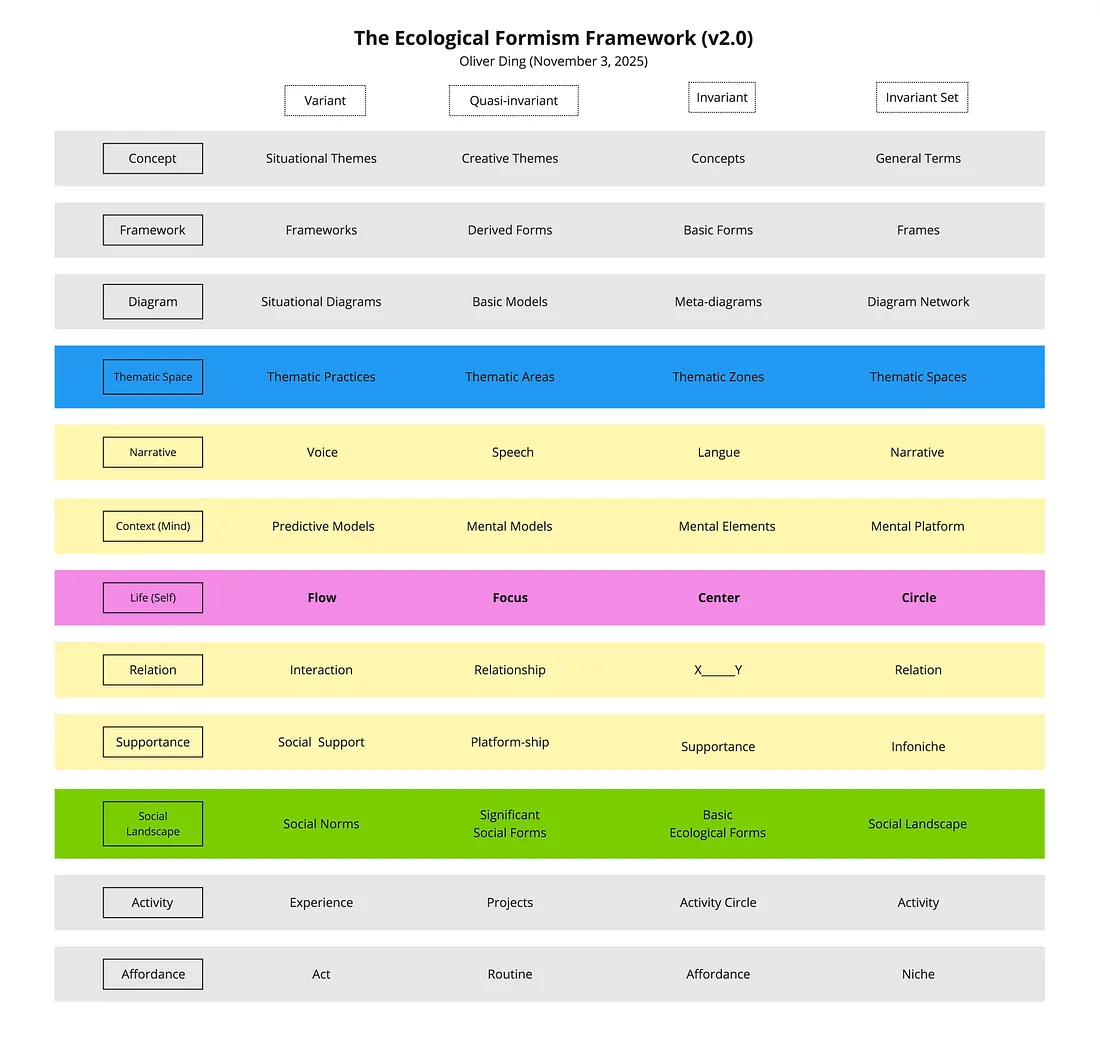
This framework applies the “Variant — Quasi-invariant — Invariant — Invariant Set” schema across twelve units of analysis:
- Concept
- Framework
- Diagram
- Thematic Space
- Narrative
- Context (Mind)
- Life (Self)
- Relation
- Supportance
- Social Landscape
- Activity
- Affordance
Each unit of analysis corresponds to a distinct knowledge system that I have been developing over the years.
The following units of analysis align directly with the fourth dimension newly added to the LARGE Method:
- Narrative
- Relation
- Supportance
Other units of analysis correspond to the remaining dimensions:
- Creating (Theme — Culture): Concept, Framework, Diagram
- Doing (Life — History): Life (Self), Activity, Social Landscape
- Thinking (Mind — Body): Affordance, Context (Mind), Thematic Space
This alignment represents a perfect match.
Between November 2025 and January 2026, I completed three meta-frameworks that together define my personal knowledge ecosystem:
- Ontology: The History{Life[Self(Body)]} Framework (also known as the HLS framework) (v3.0, 2025)
- Epistemology: The Ecological Formism Framework (v2.0, 2025)
- Methodology: The LARGE Method (v3.0, 2026)
The Ecological Formism Framework (v2.0) defines my knowledge systems and was introduced in Ecological Formism (book, v1, 2025) in November 2025.
The methods underlying these knowledge systems are structured through the LARGE Method (v3.0).
Finally, the HLS Framework (v3.0) provides an ontology of the social world, introduced in Meta-frameworks: Creative Heuristics for Individual and Social Development (book, v1.0, 2025) in December 2025.
This is the remarkable outcome of a great confluence.