
Meta-frameworks (book, v1.0, 2025)
Creative Heuristics for Individual and Social Development
by Oliver Ding
December 31, 2025
On the final day of 2025, marking the close of the first quarter of the twenty-first century, I write this introduction to a new possible book, Meta-frameworks: Creative Heuristics for Individual and Social Development, to close a multi-year journey of theorizing creative life.
This book grows out of a long-term engagement with themes, concepts, knowledge frameworks, and creative work. Its starting point was not an abstract interest in meta-frameworks, but a practical problem: how individuals and groups work with concept systems over time, how frameworks emerge through use, and how they evolve as projects accumulate. As this journey continued, my work gradually moved toward meta-frameworks as a response to increasing complexity — not as finished systems, but as tools for orientation, dialogue, and sustained inquiry.
Moving beyond traditional views of meta-frameworks as purely cognitive instruments, this book situates them within the social world. It examines how meta-frameworks function as creative heuristics — how they are formed, tested, revised, and sometimes outgrown — and how these processes support both individual creative life and broader cultural development.
If you are interested in evolving concept systems rather than fixed answers or reusable templates, this book is written for you.
Contents
- A Creative Theme and an Anticipatory Book
- An Evolving Enterprise in 2025
- Re-conceptualize Meta-frameworks
- Designing a New Possible Book
- The Core Theoretical Foundations
- How to Read This Book
- Table of Contents
A Creative Theme and an Anticipatory Book
In December 2024, I completed the book Frame for Work. The following month, January 2025, I launched a new knowledge center to support its further development. Later, I selected “Meta-Frameworks” as the annual theme for 2025.
The “Meta-Frameworks” theme emerged from a thematic conversation between my mentor Lui and me in late 2024. On January 5, 2025, I released a thematic card about it on Possible Press.
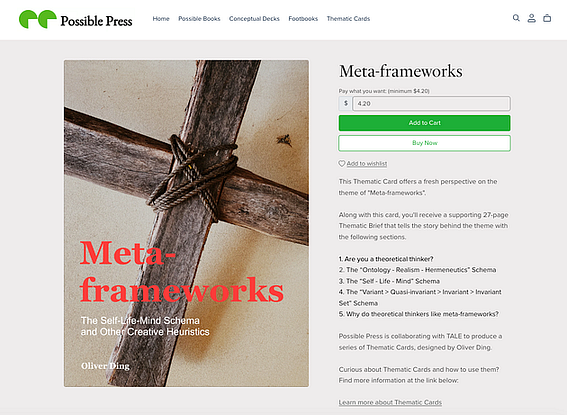
This card came with a 27-page Thematic Brief that delves deeper into the story behind the theme.
The Thematic Brief includes the following sections:
1. Are You a Theoretical Thinker?
2. The “Ontology — Realism — Hermeneutics” Schema
3. The “Self — Life — Mind” Schema
4. The “Variant > Quasi-invariant > Invariant > Invariant Set” Schema
5. Why Do Theoretical Thinkers Love Meta-frameworks?
Originally, I used “The Self-Life-Mind Schema and Other Creative Heuristics” as a creative clue to the theme.
The Self-Life-Mind Schema was born in May 2024; it was inspired by Lui’s theoretical sociology. From May 2024 to December 2024, I used the schema as a meta-framework for a series of knowledge projects, resulting in several new models and book drafts.
It is a perfect case of what Andrew Abbott treated as creative heuristics for social sciences in Methods of Discovery (2004).
Beyond the perspective of creative cognition, I also explored the cultural anticipation perspective of Meta-Frameworks during my conversation with Lui.
Over the past 12 months, I have continued using the Self-Life-Mind Schema as a meta-framework for my creative journey. From June 2025 to the present, it has guided me in developing versions 3.0 to 3.1 of the Creative Life Theory.
On February 6, 2025, I compiled a list of 38 meta-frameworks I had created over the past several years. Since then, I have regularly published articles introducing these meta-frameworks in the Frame for Work publication on Medium.
Originally, in my conversation with Lui, an anticipatory book on the Self–Life–Mind Schema was planned. The ontological work at the Frame for Work knowledge center further developed this idea.
However, my creative journey throughout 2025 dramatically altered my original plan for the anticipatory book.
An Evolving Enterprise in 2025
In 2025, particularly during the second half of the year, my creative focus centered on Creative Life Theory v3.0, which gave rise to a series of book drafts. The work during this period, especially the three drafts produced in the third quarter, explored Meta-Frameworks, Mental Platforms, and Cultural Frameworks. These developments significantly reshaped my original expectations for the anticipatory book.
- November 7, 2025 — Ecological Formism: A Meta-Framework of Meta-Frameworks
- November 30, 2025 — Developmental Projects: The Project Engagement Approach to Adult Development
- December 13, 2025 — The Curativity of Mind: Mental Curation, Mental Platforms, and Mental Moves
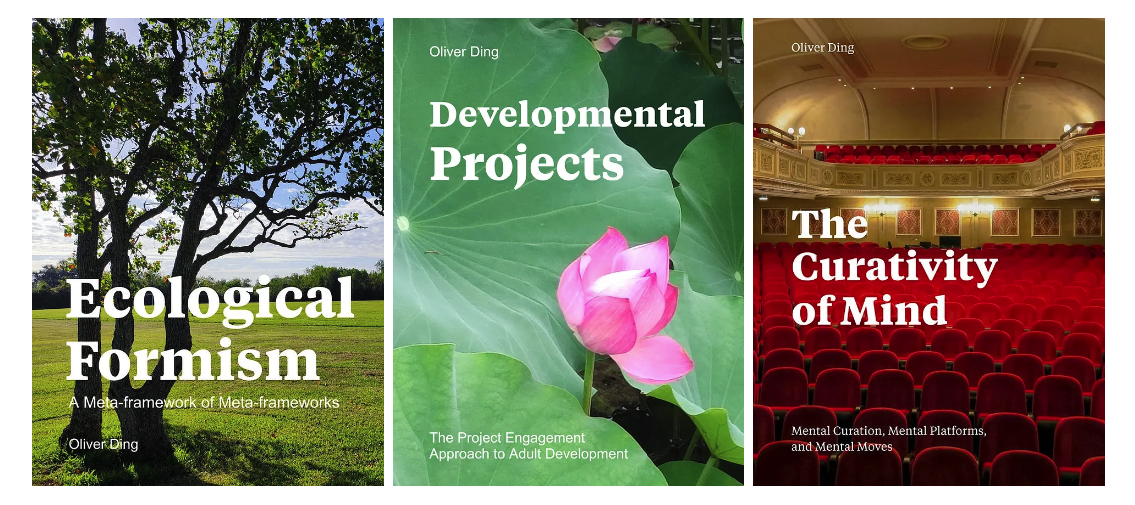
Ecological Formism marked a key milestone in my journey of exploring an evolving concept system. From 2023 to the present, the Theme–Concept–Framework Transformation Model has guided my exploration of the development of knowledge systems, resulting in a series of book drafts (see the diagram below).

- Clues → Meaning Discovery (Jan 2024)
- Themes → Thematic Exploration (June 2023)
- Concepts → Grasping the Concept (Nov 2023)
- Concepts → Activity as Formation of Concept (June 2024)
- Frameworks → Frame for Work (Dec 2024)
- Meta-Framework → Ecological Formism (Nov 2025)
- Meta-Frameworks → Meta-Frameworks (coming soon)
The possible book Meta-Frameworks was initially planned as the culmination of this journey.
In Developmental Projects, I reviewed the “Outside — Projecting — Inside” principle and introduced the Cultural Projection Model to connect Mental Platform and Cultural Framework through the “Projecting” mechanism.
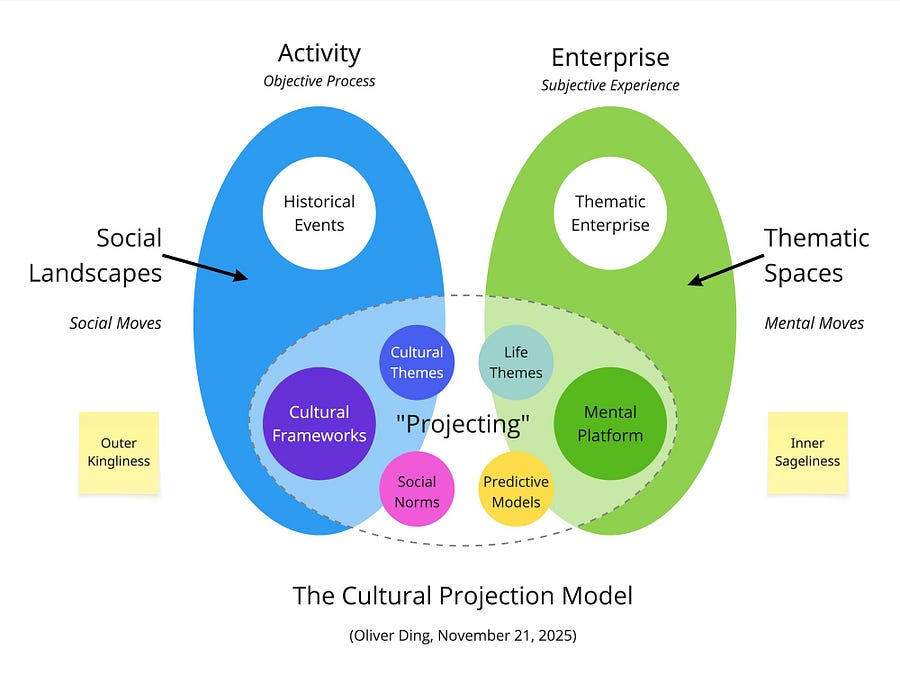
The model visually integrates objective processes (Activity) and subjective experience (Enterprise) through Projecting. It also facilitates two crucial intellectual conversations:
- Project Engagement Approach vs. Ecological Practice Approach
- Activity Theory (Internalization-Externalization) vs. Confucian Thought (Inner Sageliness-Outer Kingliness)
This cross-cultural comparison suggests that the “Outside — Projecting — Inside” triad is potentially a cross-cultural general structure of social formation.
The book draft is structured around the understanding that Developmental Projects serve as the fundamental unit of action that drives the maturation of a Creative Enterprise. The Project Engagement Approach models this entire developmental process, from initial conceptualization to a scaled platform.
The Curativity of Mind further offers the “Function — Context — Knowledge — Activity” framework to reflect on how the mind works from the Context(Mind) perspective, introducing the Mental Platform Theory.

The Mental Platform emerges as the theme that bridges the Context and Knowledge dimensions. This theme investigates the structural products of curatorial activity — the dynamic, self-organizing concept systems that the mind continuously builds.
When these concept systems are connected to a concrete context — such as the Creative Enterprise emphasized in Creative Life Theory — they reveal their functional role in supporting purposeful activity. It is this contextualized, functionalized concept system that constitutes the Mental Platform.
Re-conceptualize Meta-frameworks
These lines of new insights and models encouraged me to re-conceptualize the Meta-frameworks project in a new context: creative heuristics for individual and social development. The term “creative heuristics” refers to both the creative cognitive perspective and the social development perspective. Moreover, Cultural Frameworks became the center focus of the possible book.
On December 19, 2025, I released version 3.0 of the History{Life[Self(Body)]} framework (also known as the HLS framework), utilizing it as a meta-framework for the Meta-frameworks project.
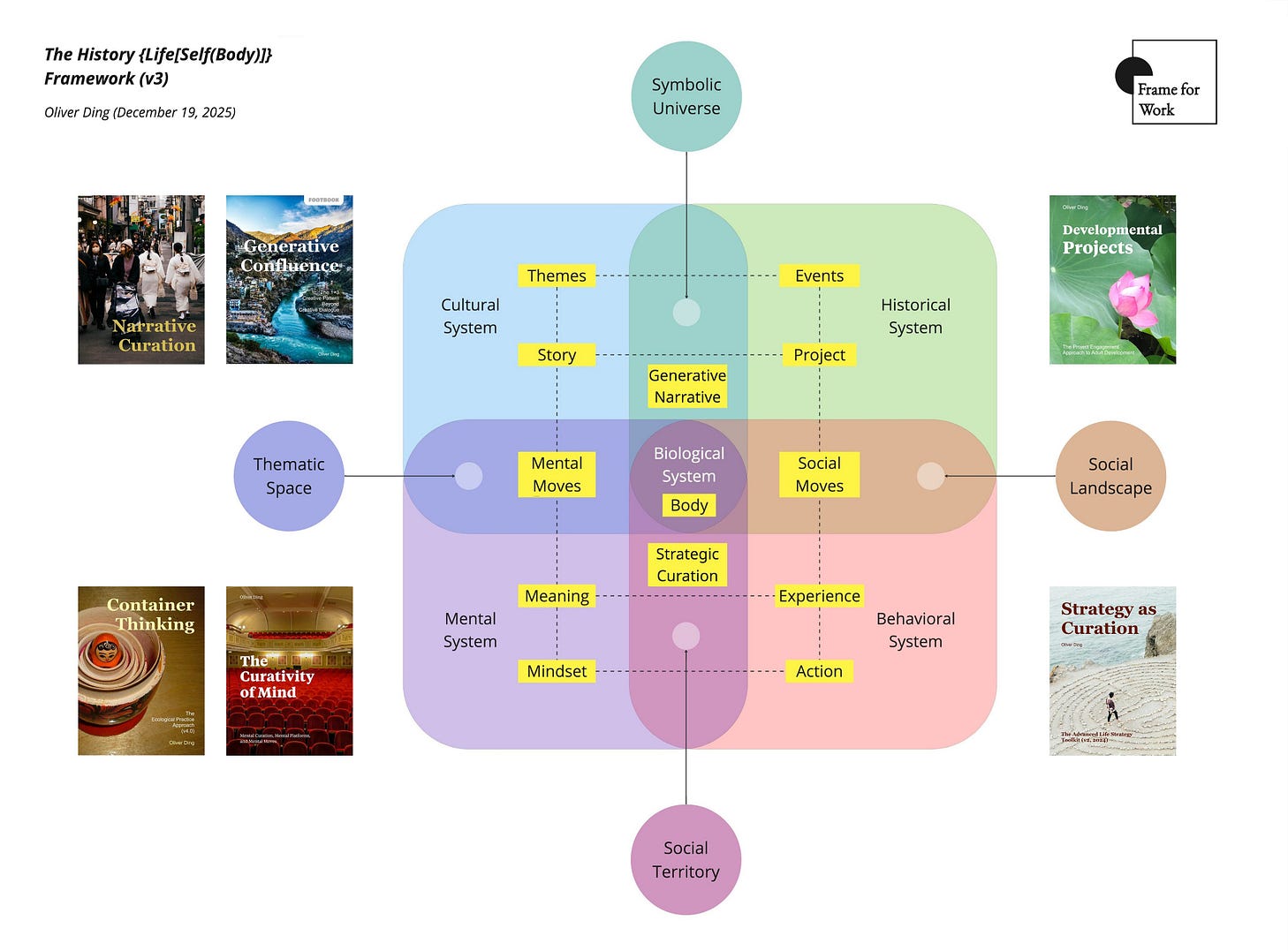
After connecting the new framework (v3.0) with the Meta-frameworks project, I realized that the following four concepts represent the Four Mechanisms of Cultural Development:
- Mental Moves
- Social Moves
- Strategic Curation
- Generative Narrative
On December 21, 2025, I created the Weave-the-Culture Model to highlight these four mechanisms (see the diagram below).
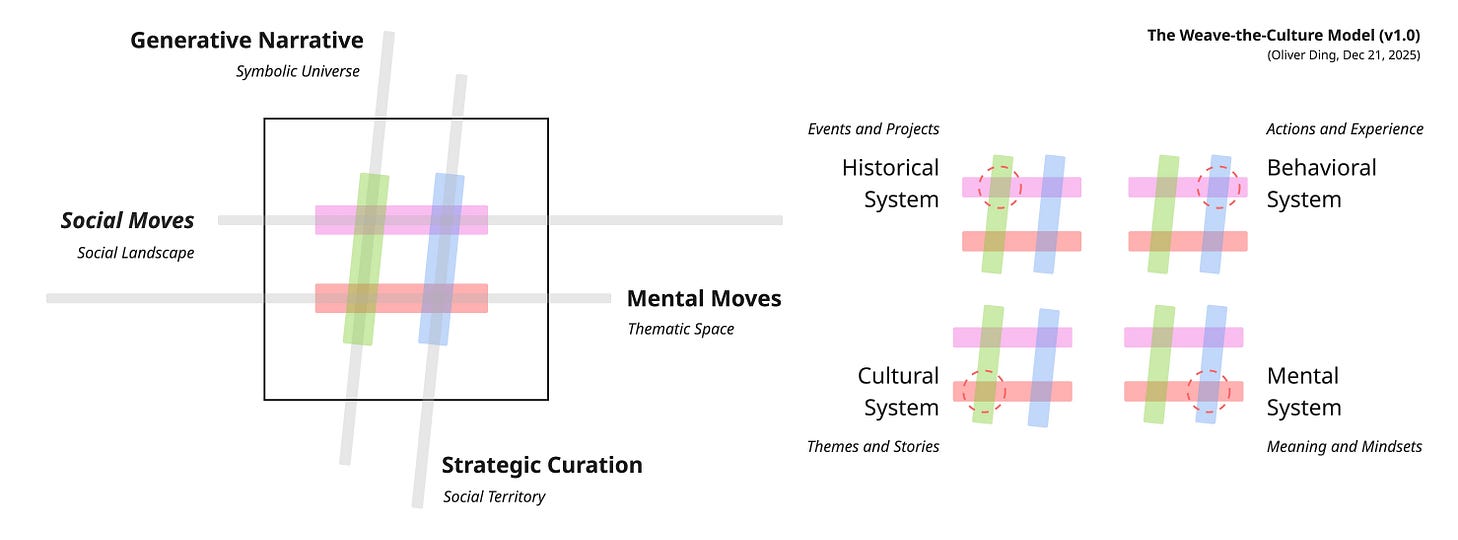
The diagram above is based on the Weave Basic Form, a super-simple diagram that frames the activity as the synthesis of two diachronic dimensions and two synchronic dimensions. The model consists of four Weave-points (S1D1, S1D2, S2D1, S2D2), each representing a structural nexus where one synchronic dimension intersects with one diachronic dimension.
In the Weave-the-Culture Model, Mental Moves and Social Moves are two diachronic dimensions, while Strategic Curation and Generative Narrative are two synchronic dimensions.
The central object of these four mechanisms is the Cultural Framework, which is a type of concept system. The central context is not only the Cultural System, but all five systems as a whole.
The “Four Mechanisms of Cultural Development” view is similar to the Context (Mind) view adopted in The Curativity of Mind; the two projects can be understood as mirror strategies, neither confined to traditional boundaries.
The development of Cultural Frameworks is situated not only within the Cultural System but also across the Mental, Behavioral, Historical, and Body Systems as a whole.
Starting in December 2024, I gradually shifted from Knowledge Engagement to Cultural Development. Over the past 12 months, I have worked on several projects related to Cultural Development, such as the Tiny Culture project (see the diagram below), the “Culture as Thematic Enterprise” Framework, the Frame-for-Work Canvas, and the Cultural Projection Model (2025).
On December 20, 2025, I formally started the Meta-frameworks project. After reflecting on the landscape, the journey, and the situation, I wrote three new articles to set the theoretical foundation for the new possible book:
- The History{Life[Self(Body)]} Framework (v3.0) — Part 1, Part 2, Part 3
- Six Faces of the Concept System
- Weave the Culture: One Meta-Framework and Four Mechanisms of Cultural Development
Finally, centered around the Weave-the-Culture Model, I curated a series of related knowledge models and methods, forming a comprehensive Weave-the-Culture toolkit.
Designing a New Possible Book
Building on these foundational works, the new possible book, Meta-frameworks: Creative Heuristics for Individual and Social Development, is designed as eight parts:
- Preface: Creative Heuristics for Individual and Social Development
- Introduction: Theoretical Foundation
- Part 1: Frame for Frame — Historical Development
- Part 2: The “Self-Life-Mind” Journey and Reflection
- Part 3: Mental Moves
- Part 4: Social Moves
- Part 5: Strategic Curation
- Part 6: Generative Narrative
- Part 7: Embodied Social Forms
- Part 8: Create, Curate, and Weave
- Epilogue: Beyond Creative Life
Version 1.0 of the possible book collects new articles on the theoretical foundations, along with related articles I have written over the past several years. This collection also functions as a knowledge curation, weaving together insights developed across different projects into a coherent and meaningful whole.
The Core Theoretical Foundations
A Meta-framework is a framework that functions to support the learning, use, and development of other regular frameworks. In my view, a framework is a concept system — a network of concepts with a coordinating mechanism.
In Part 2 of Six Faces of the Concept System, I explore the essence of concept systems from six perspectives:
- Scale
- Hierarchy
- Boundary
- Function
- Representation
- Genidentity
To understand how concept systems impact social life, I adopted the HLS framework to understand the social world through a five-system lens:
- Body System
- Mental System
- Behavioral System
- Cultural System
- Historical System
The HLS framework was inspired by Robert Rosen’s Anticipatory System Theory, particularly his concepts of Natural Systems and Formal Systems. It conceptualizes the social world as a nested Anticipatory Activity System (AAS):
- Micro-AAS corresponds to the Mental System (Natural System).
- Macro-AAS corresponds to the Cultural System (Historical System).
For the Meta-frameworks project, the HLS framework provides a theoretical ontology of the social world, offering a structured context in which concept systems can be understood and mapped.
Building on the map, I further defined the Six Faces of Concept System:
- Knowledge Frameworks
- Mental Platforms
- Strategic Frameworks
- Cultural Frameworks
- Institutional Frameworks
- Spiritual Frameworks

In the middle of the diagram, four mappings are observed between four faces of the concept system and four core systems of the social world:
- Mental Platforms — Mental System
- Strategic Frameworks — Behavioral System
- Cultural Frameworks — Cultural System
- Institutional Frameworks — Historical System
Outside this central area, two types of concept systems — Knowledge Frameworks and Spiritual Frameworks — do not correspond directly to the core map of the social world. Their displacement toward the extreme poles of truth and meaning will be discussed in Part 3.
These mappings also reveal that two models share the same deep structure. The HLS Framework is a nested Anticipatory Activity System (AAS) structure: the Behavioral System (Mental System) represents the micro-AAS, while the Historical System (Cultural System) represents the macro-AAS. The micro-AAS corresponds to individuals, and the macro-AAS to collective society.
At the individual level, Mental Platforms belong to people, serving as the source of Strategic Frameworks, which target particular creative enterprises composed of a series of developmental projects.
At the collective level, Cultural Frameworks belong to social groups, while Institutional Frameworks emerge as evolving outcomes of Cultural Frameworks. In other words, past generations of Cultural Frameworks serve as the source of present Institutional Frameworks.
While Institutional Frameworks represent the crystallized history of human activity, Spiritual and Knowledge Frameworks represent the anticipatory horizon, pushing the Cultural System beyond its current limits.
Concept systems at individual and collective levels can influence each other. Individuals may adopt Cultural Frameworks to develop their Mental Platforms, while publicly shared Mental Platforms can contribute to new Cultural Frameworks. Similarly, some Institutional Frameworks can inspire Strategic Frameworks, and shared Strategic Frameworks can become part of Institutional Frameworks.
The story of the HLS Framework reveals an important insight: a Meta-framework does not need to be fully articulated to serve its purpose. At the very least, each iteration of a Meta-framework can function as a powerful Creative Heuristic tool.
In practice, every framework serves as a creative heuristic, whether it is a rigorous scientific law or a speculative cultural norm. What matters most is the selection of the appropriate framework for a given project at the right time and for the right audience. This process — selecting, comparing, evaluating, and organizing frameworks — is precisely what requires a Meta-framework.
In The History{Life[Self(Body)]} Framework (v3.0) — Part 2: Functioning as a Creative Heuristic, I focused on how different versions of the HLS Framework function as creative heuristics, defined by the following five key features:
- Organizing Experiences and Insights
- Supporting Ontological Exploration
- Facilitating Creative Dialogue
- Catalyzing Theoretical Innovation
- Deriving Situational Models
These features can be applied to all Meta-frameworks.
While these five features define how a Meta-framework functions as an individual tool, we need a more robust set of principles to guide collective cultural transformation.
In Weave the Culture: One Meta-Framework and Four Mechanisms of Cultural Development, seven foundational principles are introduced to establish a meta-framework for understanding cultural innovation.
- Embodied Social Forms
- Evolving Concept Systems
- Double Anticipation
- Double Genidentity
- Double Curativity
- Cultural Attachance
- Generative Confluence
Building on this foundation, the article maps three pathways that connect individual creative life with collective cultural movements and synthesizes these insights into an operational toolkit with three specialized modules.
Finally, the article introduces four dynamic mechanisms — Mental Moves, Social Moves, Strategic Curation, and Generative Narrative — that drive cultural innovation. These mechanisms are core parts of the new possible book.
Cultural development, in this view, is a continuous, dynamic anticipatory activity of creating and curating concept systems and transforming them into thematic enterprises by weaving active agency and evolving structure within the social world.
How to Read This Book
This book is structured as both a theoretical presentation and a comprehensive archive. The primary purpose is to present a series of knowledge frameworks and concept systems that constitute the theoretical foundation of the “Meta-frameworks” theme and how concept systems impact cultural development. These frameworks are concentrated in recently developed articles, which form the backbone of the book’s argument. The other articles, mostly written in earlier years, are included as reference materials, providing a complete archive of the intellectual journey behind these ideas.
For readers who want to grasp the essential frameworks quickly, I recommend prioritizing the following recent works:
Start Here:
- Preface: Creative Heuristics for Individual and Social Development (This article)
Theoretical Foundation:
- The History{Life[Self(Body)]} Framework (v3.0) — Part 1
- The History{Life[Self(Body)]} Framework (v3.0) — Part 2
- The History{Life[Self(Body)]} Framework (v3.0) — Part 3
- Six Faces of the Concept System
- Weave the Culture: One Meta-Framework and Four Mechanisms of Cultural Development
Case Studies:
- The “Self-Life-Mind” Schema and Creative Self (chapter 2)
- The Landscape of Creative Life Theory (v3.0) and Two Meta-Frameworks (chapter 10)
Applications:
- The Cultural Projection Model (2025) (chapter 3)
- Tiny Culture: The “Culture as Thematic Enterprise” Framework (chapter 3)
- Cultural Frameworks: A Canvas for Reflection and Innovation (chapter 3)
End Here:
- Epilogue: Beyond Creative Life
These articles together provide a complete view of the Meta-frameworks, Concept Systems, Cultural Frameworks, and Generative Narrative, along with their practical applications through the Weave-the-Culture toolkit. If you wish to explore the historical development, detailed case studies, or specific applications beyond these foundational frameworks, the full table of contents will guide you to articles of particular interest.
Light Possible Book
For readers who want to grasp the essential frameworks quickly, the articles mentioned above have been curated into a Light Edition of the possible book.
It was released on Possible Press:
https://possiblepress.net/b/MzaPH
- 11 filed
- 232 minutes of reading time
- 61,480 words (about 123 single-spaced pages)

Full Possible Book
Some numbers about v1.0 of the full possible book:
- 8 parts
- 24 chapters
- 86 articles
- 1,494 minutes of reading time
- 395,910 words (about 792 single-spaced pages)
Table of Contents
Introduction: Theoretical Foundation
This book builds on traditional views on frameworks and concept systems as static cognitive tools, and redefines them as Creative Heuristics that drive both individual and social development.
The theoretical foundation is built upon three core pillars through three new theoretical articles, introduced in the previous section:
- The History{Life[Self(Body)]} Framework (v3.0) — Part 1 (13 min)
- The History{Life[Self(Body)]} Framework (v3.0) — Part 2 (15 min)
- The History{Life[Self(Body)]} Framework (v3.0) — Part 3 (17 min)
- Six Faces of the Concept System (27 min)
- Weave the Culture: One Meta-Framework and Four Mechanisms of Cultural Development (44 min)
Part 1:Frame for Frame
Part 1 collects articles that represent the historical development of my engagement with concept systems and meta-frameworks. Starting with the Theme-Concept-Frameworks transformation, expanding to Creative Life Theory, and then shifting to Cultural Innovation.
Chapter 1: Meta-frameworks for Knowledge Engagement
- The “Theme-Concept-Framework” Transformation — 3 min
- Castle and Forest: A Metaphor for the Contemporary Knowledge Ecosystem — 11 min
- Creativity, Curativity, and Theoretical Activity — 2,542 words, 9 min
Chapter 2: Meta-frameworks for Creative Life Theory
- The “Self-Life-Mind” Schema and Creative Self — 15 min
- The Curativity of Mind: Function, Context, Knowledge, and Activity — 22 min
- The Enterprise Development Framework — 45 min
Chapter 3: Meta-frameworks for Cultural Innovation
- The Cultural Projection Model (2025) — 8,781 words, 33 min
- Tiny Culture: The “Culture as Thematic Enterprise” Framework — 4 min
- Cultural Frameworks: A Canvas for Reflection and Innovation — 3,657 words, 13 min
Part 2: The “Self-Life-Mind” Journey and Reflection
This part presents a “Big Case Study” of the “Self-Life-Mind” schema, tracing its complete life cycle through a four-stage evolutionary model: Precursor — Practice — Bloom — Echo. This case study reveals the dynamic movement between thematic schemas, concept systems, and mental platforms, demonstrating how a meta-framework matures through embodied experience.
- Precursor (The “Ontology — Realism — Hermeneutics” Schema): Exploring the philosophical roots that provided the initial structural DNA for the schema.
- Practice (2024: The Heuristic Phase): Documenting how the schema was tested across various projects throughout 2024. While these projects were preliminary, they provided the essential embodied experience and “heuristic” power needed for deeper internalization.
- Bloom (2025: The Predictive Model): Showing how the schema matured into the meta-framework for Creative Life Theory (v3.0). During this phase, the previous year’s practice paid off, enabling an unprecedented creative explosion — completing six book manuscripts within six months by serving as a high-level “Predictive Model.”
- Echo (The “Living Way” of Development): This reflective stage reveals the “Living Way” — my unique methodology for developing concepts and concept systems by weaving thematic exploration, conceptual thinking, and embodied experience. Through several parallel cases, it demonstrates how individual concepts evolve into independent theoretical entities that eventually gravitate toward and aggregate within the “Self-Life-Mind” framework, forming a unified new theoretical enterprise.
Chapter 4: The “Ontology — Realism — Hermeneutics” Schema
- The Utilization of Theoretical Resources — 14 min
- Three Paths of Creative Life and A Semiotic System — 7,399 words, 28 min
- Strategy as Curation (book, v1, 2024) — 10 min
Chapter 5: The “Self-Life-Mind” Schema as a Creative Heuristic
- Three Creative Themes and One Meta-framework — 12 min
- The Strategic Life Development Toolkit — 19 min
- Strategic Life (book, v1, 2024) — 10 min
- Strategic Life: The Theme of “HELLO THEORY” and Three Possible Projects — 18 min
- Ecological Strategic Cognition: A Theory of Strategy (v1, 2024) — 17 min
- SEE THE MOVE: The Strategic Life Narrative Practice #0 (Introduction) — 17 min
Chapter 6: The “Self-Life-Mind” Schema as a Predictive Model
- The “Theorizing Creative Life” Project — 44 min
- Being by Doing: World of Activity and Creative Life Theory (v3.0) — 19 min
- The Bloom of Enterprise — 3 min
- The Birth of the “Self-Us-Awe” Schema — 16 min
- The Weave-the-Life Framework (v2.0) — 2943 words, 11 min
- The Weave-the-Mind Framework — 31 min
Chapter 7: The Living Way of Meta-Frameworks
- Knowledge Center: Center, Circle, and Genidentity (book, v1, 2024) — 27 min
- World of Activity: Chronos Space, Aion Space, and World of Activity — 35 min
- Developmental Project: The Living Way of the “Developmental Project” Concept — 9,095 words, 34 min
- Mental Platform: Mental Platform Theory: Building a Mental Platform — 27min
- The Path of Creative Life in a Trip — 13 min
Part 3: Mental Moves
Mental Moves refer to the internal shifts in an individual’s cognitive perspective. Whether it is switching between different Predictive Models or reframing a problem through a new Mental Platform, these moves are the starting point of all cultural creation. The concept of Mental Moves and its associated methods provide a practical framework for studying individual engagement with concept systems.
In this part, we explore the three dimensions of these cognitive transformations:
- Moves to Others (As Means): Using meta-frameworks as tools to facilitate external knowledge engagement and problem-solving.
- Moves to Self (As End): Treating the meta-framework as the object of development itself, leading to a top-down construction.
- Self-driven Mental Shifts: The internal, often spontaneous, reorganization of one’s mental moves between different mental platforms.
Chapter 8: Meta-frameworks as Means
While meta-frameworks are concept systems by nature, their primary function here is to support the development of other concept systems. This chapter identifies six ways of deploying meta-frameworks: Single Evolution, Creative Dialogue, Generative Confluence, Self-referential Strategy, External Comparison, and Collaborative Chorus.
- Single Evolution | The “Evolving Knowledge Enterprise” Journey (2020–2025) — 43 min
- Creative Dialogue | The “Activity — Opportunity” Thematic Dialogue — 4613 words, 17 min
- Generative Confluence | The Footbook of Generative Confluence |The Weave-the-Narrative Framework — 16 min
- Self-referential Strategy | Self-referential Strategy for Developing Mental Platform — 1725 words, 6 min
- External Comparison | Mapping Knowledge Elements and Meaning Control System — 13 min
- Collaborative Chorus | [Meta-framework] The Birth of the “Self-Us-Awe” Schema — 16 min
Chapter 9: Meta-frameworks as End
A meta-framework can also evolve from the top down to establish its own autonomous knowledge system. The core challenge lies in the transition from a singular meta-framework to a network of Derivative Frameworks. This chapter explores this evolution, drawing from the development of Ecological Formism and the practical strategies required to expand a schema into a comprehensive theoretical structure.
- [Meta-Framework] Building the Ecological Formism Framework (v2.0) — 10 min
The development of Ecological Formism is more than constructing a 4×12 table; it is a journey of adaptive wisdom, revealing the skills and attentiveness involved in working with complex schemas.
Several practical strategies for systemic development are highlighted:
- Ecological Metaphor — The Art of Ecological Metaphor — 11/7/2025–4 min
- Meta-diagrams — The Dialectic Room: A Meta-diagram for Innovation — 10/31/2025–3,739 words, 14 min
- Spatial Grammar — The Ap-Re-Co Framework (v1, 2025) — 11/4/2025–5 min
- Graphical Space Affordance— Activity, Knowledge, and Moving on Diagrams — 2/1/2024–12 min
- Self-referential — Three Types of Self-referential Activity — 11/5/2025 — 5 min
Chapter 10: Mental Platforms Shifting
When an individual consistently employs a specific meta-framework, it functions as their Mental Platform. As one compares, evaluates, and contrasts multiple frameworks, they may shift their preference from one platform to another to better suit their creative needs or to revitalize a maturing project. This chapter explores the strategic “shifting” of these internal landscapes.
- Narrative (Curation): the Weave-the-Narrative Framework (Comparing Hegel’s Conceptual Theory with the Weave Basic Form) — 16 min
- The Landscape of Creative Life Theory (v3.0) and Two Meta-Frameworks (Shifting meta-frameworks across different developmental stages of the same creative enterprise) — 16 min
- The Ecological Practice Design Toolkit (V2, 2023) (A 2023 audit leading to the intentional revival of the Network — Container — Platform schema) — 14 min
Part 4: Social Moves
As the counterpart to Mental Moves, Social Moves describe the changes in an actor’s position within a Social Landscape. They involve navigating social norms, institutional boundaries, and collective expectations. By understanding Social Moves, we can track how an individual’s subjective intent begins to acquire objective weight within the “Outside” world.
Chapter 11: Knowledge Ecosystem
This chapter focuses on the social moves of knowledge creators. It utilizes the Knowledge Discovery Canvas to map potential paths across four thematic areas and applies Activity Circle and a typology of activity to analyze the structural dynamics of a psychological counseling platform.
- Psychological Knowledge Engagement and Robert Kegan’s Knowledge Enterprise — 59 min
- One Map and Four Paths — 17 min
- Psychological Counseling Platform: A Case Study of “Social Moves” — 510 words, 2 min
Chapter 12: Social Landscape
This chapter employs multiple knowledge canvases to map the social landscape across different domains, revealing the spatial structures that define our social world.
- The Social Landscape Framework (v2, 2025) — 14 min
- The Sociotech Landscape Canvas (v1, 2025) — 10 min
- The House of Project Engagement — 2,794 words, 10 min
Chapter 13: Cultural Attachances
Both Mental Moves and Social Moves are fundamentally based on Attachance Theory. This chapter explores the latest developments in Attachance Theory, especially its application in interpreting the social world.
- The Birth of the “Self-Us-Awe” Schema — 16 min
- Creative Life Coordinate (2025) — 17 min
- Attachance Theory: The Weave-the-Whole Framework — 11 min
Part 5: Strategic Curation
Strategic Curation is the art of “weaving” disparate elements — ideas, objects, and people — into a meaningful whole. Operating primarily on the individual side, this mechanism focuses on the Achievement Chain.
It explains how a creator curates various frameworks to achieve an “Objective-Object Fit,” transforming fragmented life experiences into coherent Thematic Enterprises (or Tiny Culture).
Chapter 14: Strategic Curation Activity
- A Five-space Model for Strategic Curation Activity — 1,617 words, 6 min
- The Object — Objective Fit and Opportunity Discovery — 12 min
- Field Curation: Pieces, Container, Platform, and Network — 8 min
Chapter 15: Mapping Strategic Moves
- Slow Cognition: The Development of AAS (August 21, 2021 — August 26, 2022) — 4,012 words, 15 min
- Do These Five Diagrams Present a Meaningful Creative Journey? — 17 min
- See the Move: Four Looks at the World of Activity Approach — 16 min
Chapter 16: Strategic Themes and Beyond
- Scalable Focus: Primary Theme and Other Strategic Objects — 18 min
- Exploring Creative Thematic Spaces with the Knowledge Discovery Canvas — 24 min
- The Ecological Strategic Cognition Frameworks (v2.4) — 3 min
Part 6: Generative Narrative
Generative Narrative serves as a strategic “triple-play” for cultural innovation. It functions as a coordinated set of moves — combining Narrative (Curation), Creative Dialogue, and Generative Confluence — to bridge differences and build understanding. Rather than focusing solely on production, this mechanism aims to resolve conflicts and reach consensus, weaving disparate social experiences and creative dialogues into a coherent narrative that fosters new traditions and collective resonance.
Chapter 17: Narrative (Curation)
This chapter represents a pivotal mechanism for cultural innovation, shifting the focus from individual subjectivity — often associated with strategic curation — to the realm of social interaction and inter-subjectivity. Three related frameworks are highlighted.
- From Creative Life Curation to Strategic Life Narrative — 14 min
- The Weave-the-Narrative Framework — 16 min
- Product, Langue, and Speech — 14 min
Chapter 18: Creative Dialogue
The cultural system is inherently heterogeneous and competitive. Creative Dialogue is crucial for addressing the tensions between opposing themes and frameworks. This chapter recommends several tools to achieve successful creative dialogues.
- Platform Innovation as Concept-fit — 49 min
- The ECHO Way (v2.0) — 15 min
- The Dialectic Room: A Meta-diagram for Innovation — 3,739 words, 14 min
Chapter 19: Generative Confluence
Unlike geographic confluence, where streams lose their identity, Generative Confluence describes a pattern where distinct concept systems become interconnected to generate a new creative center while maintaining their own developmental trajectories. This pattern goes beyond simple dialogue, fostering the birth of entirely new creative enterprises.
- From Generative Confluence to Generative Narrative — 6 min
- The Footbook of Generative Confluence — 16 min
- The Life Coordinate Framework (v2, 2023) — 37 min
Part 7: Embodied Social Forms
Embodied Social Forms serve as the “meta-framework of meta-frameworks” for understanding individual and social development. This approach posits that all mental and social moves can be traced back to Basic Ecological Forms — pre-linguistic, embodied experiences rooted in human spatial cognition.
By linking the Body System to higher-level cultural structures, this framework traces how micro-level embodied experiences shape macro-level Significant Social Forms.
Chapter 20: Before | After (Retrospection, Anticipation, and The Gap)
This chapter focuses on one of the six Basic Ecological Forms: Before | After. It explores the temporal continuity of creative work, where current projects act as responses to previous ones. Through the “GAP Project” cases, we analyze how intervals between formal projects serve as spaces for either “after” (retrospection) or “before” (anticipation).
- [Wonder and Wander] The Re-engagement Journey (2024–2025) — 25 min
- A 5-year Creative Journey and Two “GAP” Projects — 17 min
- The Art of Situational Note-taking: Running the “GAP” Project — 24 min
Chapter 21: Basic Ecological Forms and Ecological Dynamics
By grounding social cognition in embodied spatial experiences (such as Up-Down, Inside-Outside, and Before-After), the chapter offers a value-neutral lens to observe the complex patterns of growth and transformation.
Additionally, this chapter presents an in-depth analysis of the “Before | After” ecological form. This serves as a primary demonstration of how any basic ecological form can be further explored and decoded.
- The Hometown (Home) structure and Basic Ecological Forms — 9 min
- The Ecological Dynamics of the World of Activity — 10 min
- Before | After: The Eight Mechanisms of Change — 2 min
Chapter 22: Genidentity, Curativity, and Generative Anticipation
Building upon the basic ecological forms and the ecological dynamics framework, this chapter explores the mechanisms of long-term development and intergenerational transmission. It integrates the Anticipatory Activity System (AAS) and the HLS frameworks to explain how individual thematic enterprises evolve into lasting cultural legacies.
- Double Genidentity: Love, Learn, and Legacy (Why?) — 23 min
- The Genidentity of Knowledge System — 5 min
- Double Curativity: The Meaning of the Social World and Its Consequences — 20 min
- Inheritance: Generative Anticipation, Thematic Enterprise, and Tiny Culture — 10 min
Part 8: Create, Curate, and Weave
Part 8 bridges the gap between individual creative action and the macro-structure of the social world. It focuses on the mechanisms of Cultural Projection and the systematic curation of meta-frameworks. By moving from the “Projecting” triad to the “Grand Weaving” of the HLS framework, this final part provides a dynamic, actionable model for understanding how private developmental projects transform into the primary meta-frameworks of our collective culture.
Chapter 23: Cultural Projection Model and Primary Meta-frameworks
This chapter introduces the Cultural Projection Model, which utilizes the “Outside — Projecting — Inside” triad as a basic ecological form to describe how individuals engage with social environments. This model serves as a vital bridge, connecting Mental Platforms (internal) with Cultural Frameworks (external) through the medium of the project.
By applying the Cultural Projection Model and the Project Engagement Approach, we can understand social groups not as static entities, but as the dynamic outcomes of developmental projects. Within this view, the thematic schemas of these social groups emerge as the primary meta-frameworks of the social world.
- The Cultural Projection Model (2025) — 8,781 words, 33 min
- Social Group and Primary Meta-frameworks — 3 min
Chapter 24: The Grand Weaving
This concluding chapter applies the “Variant — Quasi-invariant — Invariant — Invariant Set” schema to curate the HLS framework with other meta-frameworks:
- Invariant Set: The HLS Framework (as the map of the Social World)
- Invariant: The Container (Containee) Model
- Quasi-invariant: The Network-Container-Platform Schema
- Variant: Platform Ecology / The Weave Basic Form
This theoretical curation transforms the HLS framework from a static ontological map of the social world into a dynamic, actionable model for understanding how individuals navigate and curate their creative lives within the complex textures of history and environment.
Within this system, the World of Activity toolkit primarily addresses the Life(Self) layer, whereas the World of Life encompasses broader layers, including History (Culture) and Context (Mind). This highlights the hierarchical and interconnected nature of the knowledge ecosystem developed throughout the book.
- Double Curativity: The Meaning of the Social World and Its Consequences
- The History{Life[Self(Body)]} Framework (v3.0) — Part 3: Reflection
- The Landscape of “World of Activity” — 20 min
- The Weave-the-Mind Framework — 31 min
- The Weave-the-Life Framework (v2.0) — 2,943 words, 11 min
- Weave the Culture: One Meta-Framework and Four Mechanisms of Cultural Development
Epilogue: Beyond Creative Life
In these final words, I briefly review the development of Creative Life Theory from v2.0 to v3.1. The switching from the Self-Life-Mind schema to the HLS framework marks a strategic pivot from Individual Life Development to Cultural Life Development, framing meta-frameworks as living systems that grow through dialogue and evolve through practice.
- Beyond Creative Life: From Generative Confluence to Generative Narrative — 12 min
v1.0 - December 31, 2025 - 5,674 words