
Personal Orientation of Cultural Projection
Posture, Persona, Position, and Doctrine
by Oliver Ding
February 25, 2026
This article is part of the ongoing development of the Anticipatory Cultural Sociology (ACS) framework, contributing to the Cultural Projection series.
The Cultural Projection model was originally introduced in Developmental Projects: The Project Engagement Approach to Adult Development (2025), where it served as a framework for understanding how individuals move between the outside and inside of projects. In January 2026, Cultural Projection became a central concern of the ACS theoretical enterprise.
The present article revisits and rebuilds one of the foundational concepts of this approach: Projectivity, first introduced in 2021 at the ontological level. Projectivity names the fundamental possibility space within which human development through projects unfolds. However, ontology alone is not sufficient for the ACS project. What is needed is an operational framework — one that explains how Projectivity is actually perceived, evaluated, and taken up in the flow of cultural life.
This move from ontology to operation parallels the development undertaken in Design-oriented Project Engagement, where earlier theoretical foundations were extended into more concrete frameworks for analysis and practice. Here, the same logic applies: building on the ontological structure of Projectivity, this article moves to the operational level, examining what persons actually bring to the threshold of a project.
In The Landscape of Anticipatory Cultural Sociology, “Project Engagement” is identified as one of five mechanisms of cultural development. Building on this foundation, this article further develops a fourfold structure of Personal Orientation — Posture, Persona, Position, and Doctrine — that constitutes the operational ground from which individuals actualize the Projectivity that cultural life presents.
In doing so, it uncovers a structural finding that runs across all four elements: each carries a double structure, operating simultaneously outside the project as a general orientation, and inside the project as its specific instantiation.
Contents
Part 1: Theoretical Foundation
1.1 The Concept of Projectivity
1.2 Primary Projectivity
1.3 Secondary Projectivity
1.4 Tertiary Projectivity
1.5 How Do People Actualize Projectivity
Part 2: World of Life
2.1 The Landscape of the World of Life
2.2 Three Pathways of Cultural Development
2.3 Life, Project, and History
Part 3: Personal Orientation
3.1 The Boundary of Projection
3.2 Locating the Four Elements
Part 4: Posture
4.1 Definition and Origin
4.2 Posture as Quasi-Invariant
4.3 Dimensions of Posture: An Example from Knowledge Engagement
Part 5: Persona
5.1 Definition and Origin
5.2 How Persona Works: The Persona Dynamics Framework
5.3 The Four Dimensions of Persona
Part 6: Position
6.1 Definition and Origin
6.2 Position and the Division of Labor
6.3 Varieties of Position
Part 7: Doctrine
7.1 Definition and Origin
7.2 Doctrine as “Of the Mind”
7.3 Doctrine, Purpose, and the Developmental Project Model
Part 8: The Fourfold Structure of Personal Orientation
8.1 The Configuration of Personal Orientation
8.2 The Four Elements at the Boundary of Projection
Conclusion: The Personal Ground of Cultural Projection
Part 1: Theoretical Foundation
Part 1 revisits the concept of Projectivity, first introduced in Project-oriented Activity Theory (2021), and examines its three types: Primary, Secondary, and Tertiary. It then identifies the limits of the existing ontological framework and poses the operational question that drives the rest of this article.
1.1 The Concept of Projectivity
In Project-oriented Activity Theory (2021), I introduced the concept of Projectivity at the ontological level:
Potential action opportunities for individuals to initiate or join projects, enabling them to actualize their development in collaboration with others.
The chart below presents three similar concepts: Affordance, Supportance, and Projectivity. These concepts share the same deep structure: the reciprocal relationship between Environment and Organism. In Project-oriented Activity Theory, the Project can be considered the Environment.
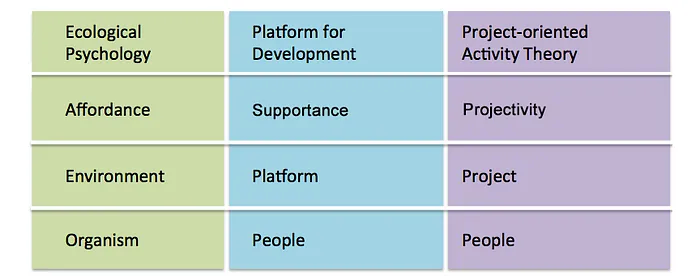
Projectivity is not a property of either the individual or the environment alone. Just as Affordance in ecological psychology refers simultaneously to features of the environment and the organism’s capacities to perceive and act upon them, Projectivity refers to the whole formed by:
- The social and cultural world, with its events, established projects, and emergent themes
- The person, with their ingrained tendencies, possible selves, social locations, and meaning systems
These are not two separate “sides” that later come into contact. They are analytically distinguishable dimensions of a single reality: the ongoing life of persons-in-culture, always already immersed in a world of potential projects.
From this ontological foundation, three processual concepts were derived:
- Projecting: The ongoing activity of perceiving, evaluating, and orienting toward Projectivity
- Projection: The moment of actualizing Projectivity — taking up a potential and entering a project
- Project: An intentional, organized series of actions directed toward a purpose.
While ecological psychologists use the concept “ecological information” to specify affordances, Project-oriented Activity Theory employs the term “sense-maker” to serve a similar function.
1.2 Primary Projectivity
Primary Projectivity refers to potential action opportunities for initiating a brand-new project. Its sense-maker is Events — changes in the social and cultural environment that signal the possibility of something new.
As Andy Blunden notes in Collaborative Projects: An Interdisciplinary Study (2014):
“What distinguishes Activity Theory from Phenomenology and Existentialism is that for Activity Theory, the project has its origin and existence in the societal world in which the person finds themself… a project is found and realized as something existing in the world.”
Primary Projectivity is that “something existing in the world” — but this “something” is not purely environmental. It is always already for someone: an Event becomes an invitation only in relation to a person capable of perceiving it as such. The same technological breakthrough may appear as an occasion for action to one person and as background noise to another.
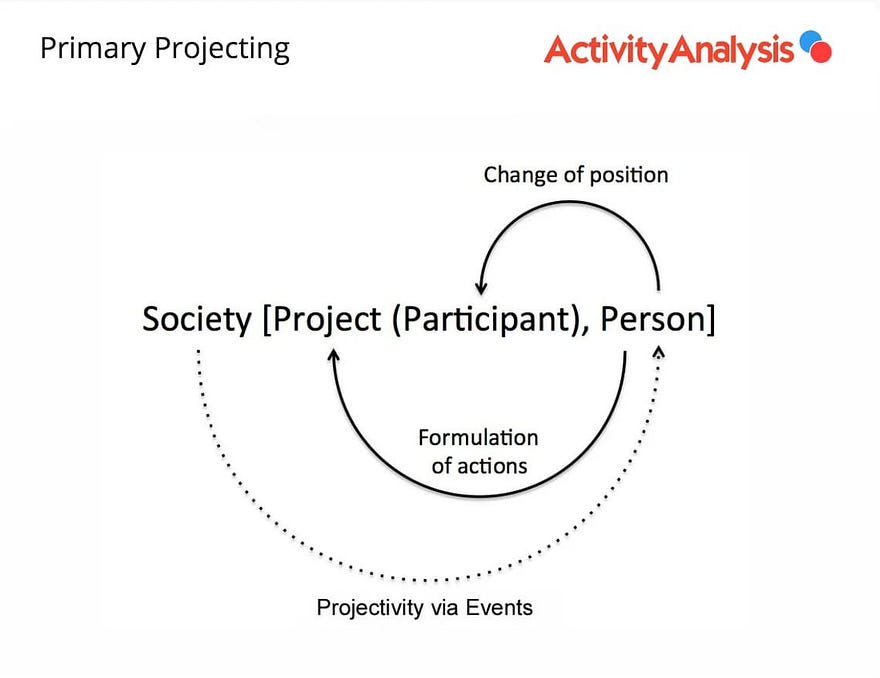
The diagram above illustrates the spatial logic of Primary Projectivity. A person perceives and recognizes projectivity offered by society through the sense-maker of Events. The person then actualizes this projectivity by formulating actions. The outcome is the initiation of a brand-new project, which transitions the person from an “outside” position (external to the project) to an “inside” position (as a participant). By changing their position, the person becomes a participant in the project, taking on the role of its founder or initiator.
1.3 Secondary Projectivity
Secondary Projectivity refers to potential action opportunities for participating in an already-established project. Its sense-maker is the Identity of the project — the perceived meaning derived from the sum of its objectifications.
The spatial logic for Secondary Projectivity follows the same principles as Primary Projectivity. The diagram below illustrates an abstract model of secondary projecting with two people and one project. Participant A is the person who initiates the project, while Participant B perceives the Secondary Projectivity and decides to participate.
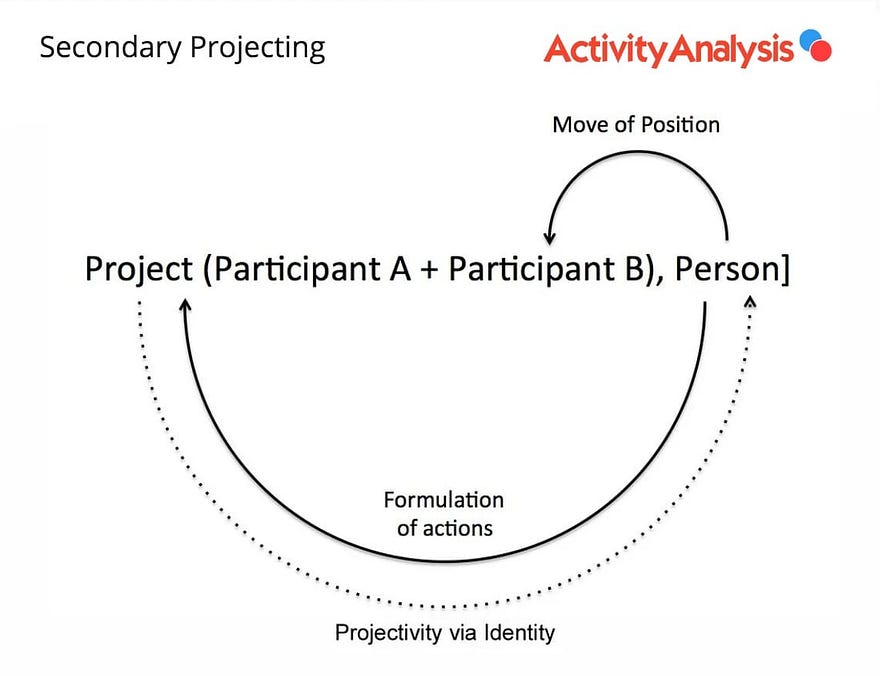
The essence of this spatial logic lies in the synchronization of action formulation and position movement. The second person moves from the outside space of the project into its inside space while actualizing the Secondary Projectivity of the project by taking real actions. It is crucial to emphasize the spatial boundary of the project. Before becoming Participant B, the individual perceives the Secondary Projectivity only through the sense-maker — the Identity of the Project — because they are outside the project’s inside space.
The Identity of the Project is defined as the perceived meaning derived from the sum of the objectifications of the project.
Once a project is initiated, it begins to produce objectifications:
- Symbolic: names, keywords, documents, hashtags
- Instrumental: tools, artifacts, platforms
- Practical: normalized practices, routines, ways of doing
These objectifications collectively form the project’s Identity — an ideal abstract entity that invites participation. A project’s Identity is not a fixed thing radiating invitation; it is perceived Identity, encountered differently by different persons depending on who they are and where they stand.
1.4 Tertiary Projectivity
Tertiary Projectivity refers to potential action opportunities for initiating a new project inspired by an existing one. Its sense-maker is the Theme of the project — its underlying concept, its motivating idea.
Persons inside a project experience its Theme differently than those outside. Through participation, they grasp not only what the project does, but what it means — the concept that orients its practices. This understanding can generate a new possibility: a project that extends, opposes, or transforms the original Theme into something new.
The diagram below illustrates our spatial logic. In this scenario, Participant A is within the space of Project A. By perceiving the Tertiary Projectivity of Project A, they act to initiate Project B. This action signifies a movement from the inside space of Project A to the inside space of Project B. By actualizing Tertiary Projectivity, the participant transitions between these two spaces, creating a new project inspired by the established one.
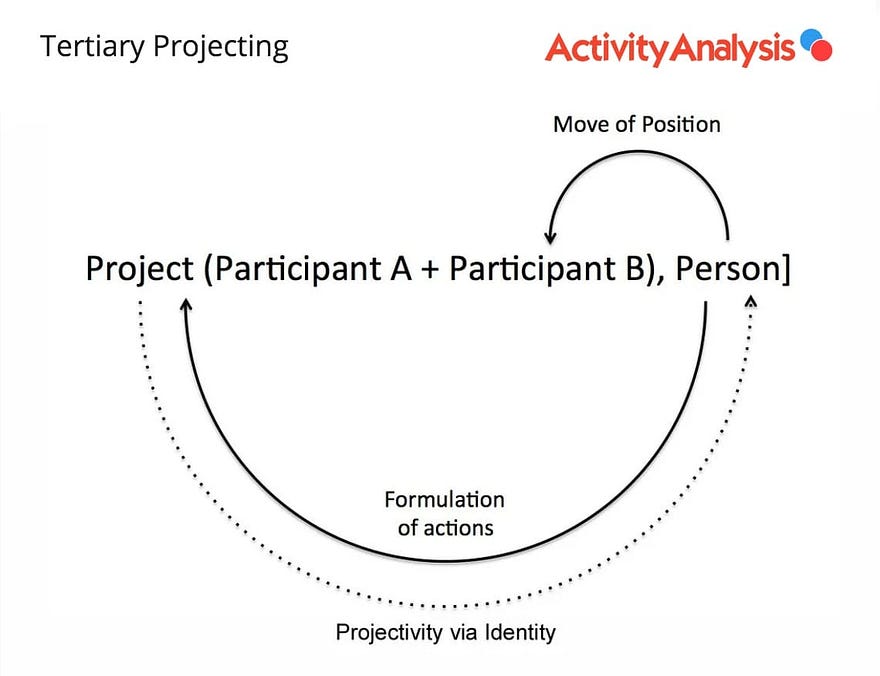
As Blunden argues, acquiring a concept means making a commitment, and in the course of pursuing that commitment, the project comes up against difficulties and conflicts. From these crises, new projects may emerge — born from the Theme of the old, yet carrying it forward into a new form.
This analysis directly informs Tertiary Projectivity. A potential new project (Project B) may either support or oppose the established project (Project A). Participants in Project A may choose to leave it and join Project B, reflecting the spatial dynamics and transformative nature of projects.
1.5 How Do People Actualize Projectivity
The three types of Projectivity — Primary, Secondary, Tertiary — name the possibilities that constitute cultural life. But possibilities do not actualize themselves. They require Projection: the moment when a person takes up a particular possibility, crossing from potential into actual participation in a project.
The ontology of Projectivity is expressed through a spatial logic — the movement between “outside” and “inside” a project. This spatial logic already provides an intuitive operational guide: one perceives Projectivity from the outside, formulates actions, and crosses into the inside. However, this account emphasizes formal cause — the structure and form of the movement — while leaving efficient cause largely unaddressed. It tells us what the movement looks like, but not what drives it from within the person.
The present article develops a new operational framework from the perspective of the individual. At the operational level, we need to understand how Projection happens — what structures within the person shape their perception of possibilities, their experience of fit, their movement toward actualization. Four elements constitute this personal orientation:
- Posture: The ingrained tendency to engage with objects, tools, and environments in characteristic ways
- Persona: The repertoire of possible selves one can imagine inhabiting
- Position: The sense of where one belongs in social space
- Doctrine: The system of meaning and value that orients one’s commitments
Each aligns with a different boundary of the World of Life, and each plays a distinct role in how persons actualize Projectivity. Part 2 briefly situates these elements within the broader World of Life framework, and Part 3 develops each in detail.
Part 2: World of Life
To address the operational question posed in Part 1, we need a map — a conceptual topography that situates the elements of personal orientation within a larger landscape. The World of Life framework provides this map.
Originally developed through the HLS Framework (History[Life[Self(Body)]]) and the Six Faces of Concept Systems, the World of Life framework offers a structured representation of the terrain where cultural development happens.
2.1 The Landscape of the World of Life
In The History{Life[Self(Body)]} Framework (v3.0) — Part 3: Reflection, I adopted the Ecological Formism framework to connect the HLS framework with four other frameworks, forming a new integrated knowledge system:
World of Life (World of Activity)
Invariant Set: The HLS Framework (as the map of the Social World)
Invariant: The Container (Containee) Model
Quasi-invariant: The Network-Container-Platform Schema
Variant: Platform Ecology / The Weave Basic Form
The HLS Framework provides the structural foundation of the social world — History{Life[Self(Body)]} — defining five major systems (Body, Mental, Behavioral, Cultural, Historical) and their nested relationships.
Based on the HLS Framework, I further introduced the Six Faces of Concept Systems, which identifies how concept systems are distributed within this structure: Mental Platforms, Strategic Frameworks, Cultural Frameworks, and Institutional Frameworks at the center, while Knowledge Frameworks and Spiritual Frameworks appear as two outliers marking the boundaries.
These two outliers, identified in the Six Faces model, mark the upper and lower boundaries of the operational zone where cultural development happens. From this insight, I created a simple square to represent the World of Life.
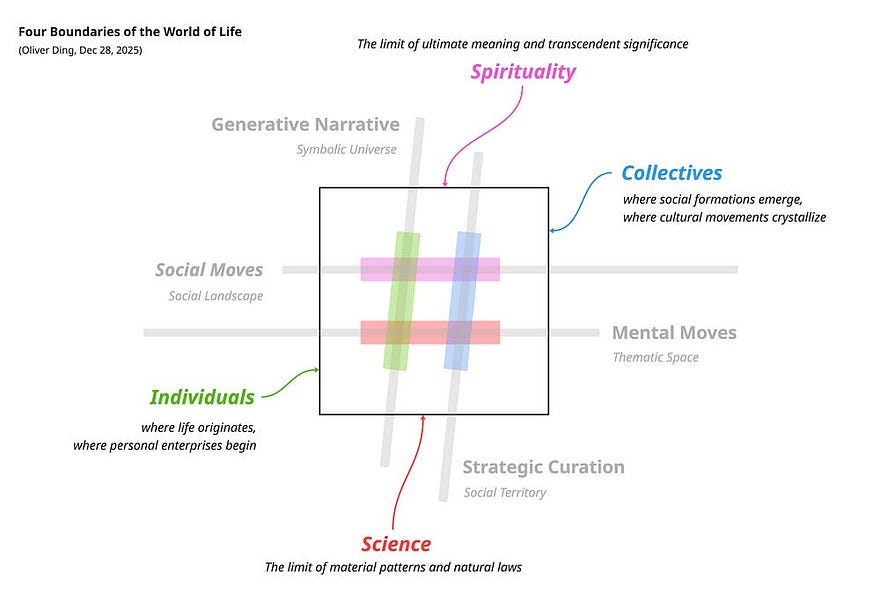
- Upper boundary: Spirituality — the limit of ultimate meaning and transcendent significance
- Lower boundary: Science — the limit of material patterns and natural laws
- Left side: Individuals — where life originates, where personal enterprises begin
- Right side: Collectives — where social formations emerge, where cultural movements crystallize
This structure echoes the square of World of Activity (see the diagram below).

More details can be found in Lifescope: The World of Activity for Creative Life Curation.
2.2 Three Pathways of Cultural Development
Based on the landscape of the World of Life, three pathways weave together a series of concepts, mapping the journey of cultural development:
The Individual Pathway:
Mental Platform + Strategic Frameworks → Strategic Curation → Objective → Object Fit → Achievement Chain → Thematic Enterprise → Tiny Culture
This pathway traces how personal enterprises, rooted in individual mental platforms and strategic frameworks, unfold through curated actions toward achievements that eventually crystallize into tiny cultures — small-scale cultural formations that may or may not spread beyond their origin.
The Collective Pathway:
Cultural Frameworks + Institutional Frameworks → Generative Narrative → Sociocultural-Technological Fit → Event Chain → Social Movement → Mega Culture
This pathway traces how broader cultural and institutional frameworks generate narratives that, when they achieve fit with sociotechnical conditions, unfold through chains of events into social movements and ultimately mega-cultures — large-scale cultural formations that shape entire societies.
The Connecting Bridge:
Project Engagement: Outside, Projecting, and Inside → Mental Platforms + Cultural Frameworks → Events + Projects → Mental Moves + Social Moves → Enterprise + Activity → Life Themes + Cultural Themes → Life + History
This bridge is where the individual and collective pathways meet. Project Engagement mediates between personal enterprise and social movement, between life themes and cultural themes, between the unfolding of an individual life and the unfolding of history itself.
The three pathways together show that cultural development is not a single process but a textured field with distinct dynamics at different scales. The individual pathway emphasizes how persons cultivate meaning through sustained engagement with themes; the collective pathway emphasizes how movements crystallize around shared narratives; the connecting bridge reveals that these are not separate realms but moments in a single reality, joined by the projects that persons undertake together.
2.3 Life, Project, and History
The connecting bridge introduces a fundamental insight: project is the unit that joins life and history.
As Andy Blunden notes, a project-oriented approach belongs to both psychology and sociology:
“A project is a focus for an individual’s motivation, the indispensable vehicle for the exercise of their will and thus the key determinant of their psychology and the process which produces and reproduces the social fabric. Projects, therefore, give direct expression to the identity of the sciences of the mind and the social sciences. Projects belong to both; a project is a concept of both psychology and sociology.” (2014, p.15)
From this perspective, Life can be understood as the diachronic unfolding of a chain of projects. A person’s real existence is a sequence of concrete actions, and the notion of project offers a way to curate and integrate these actions into a coherent whole. Just as a sentence gives form to individual words, a project gives form to individual actions — and a life, in turn, takes shape as the meaningful sequence of projects a person undertakes.
Similarly, History can be understood as the diachronic unfolding of a chain of events. What we call history is not a random succession of occurrences but a structured narrative in which events gain meaning through their relation to one another — and through their relation to the projects that persons and collectives undertake.
The Life-History Topology models this relationship:
Life emerges from the diachronic unfolding of the chain of projects; History emerges from the diachronic unfolding of the chain of events.
Projects are the mediating term. A project is simultaneously:
- A unit of individual life (a chapter in a personal story)
- A unit of collective history (an event in a social movement)
- A site where personal orientation meets cultural possibility
This is why the World of Life framework matters for understanding personal orientation. Projects are not entered in a vacuum — they are entered by persons who are already oriented, already situated within the landscape the World of Life describes. With this map in place, Part 3 turns to the question of what that orientation actually consists of.
Part 3: Personal Orientation
Part 3 introduces the concept of the Boundary of Projection and locates the four elements of personal orientation within the World of Life. It prepares the ground for Parts 4 through 7, where each element is examined in detail.
3.1 The Boundary of Projection
The World of Life, as mapped in Part 2, is defined by four boundaries: Spirituality above, Science below, Individuals to the left, and Collectives to the right. Within this terrain, projects emerge as the sites where cultural development actually happens — where individual enterprise meets collective movement, where meaning takes material form, where life and history intertwine.
But between the project and the four boundaries of the World of Life, there exists a boundary zone. This is the space where Projection occurs: the threshold that individuals cross when they move from potential participation to actual engagement, from “outside” to “inside” a project.
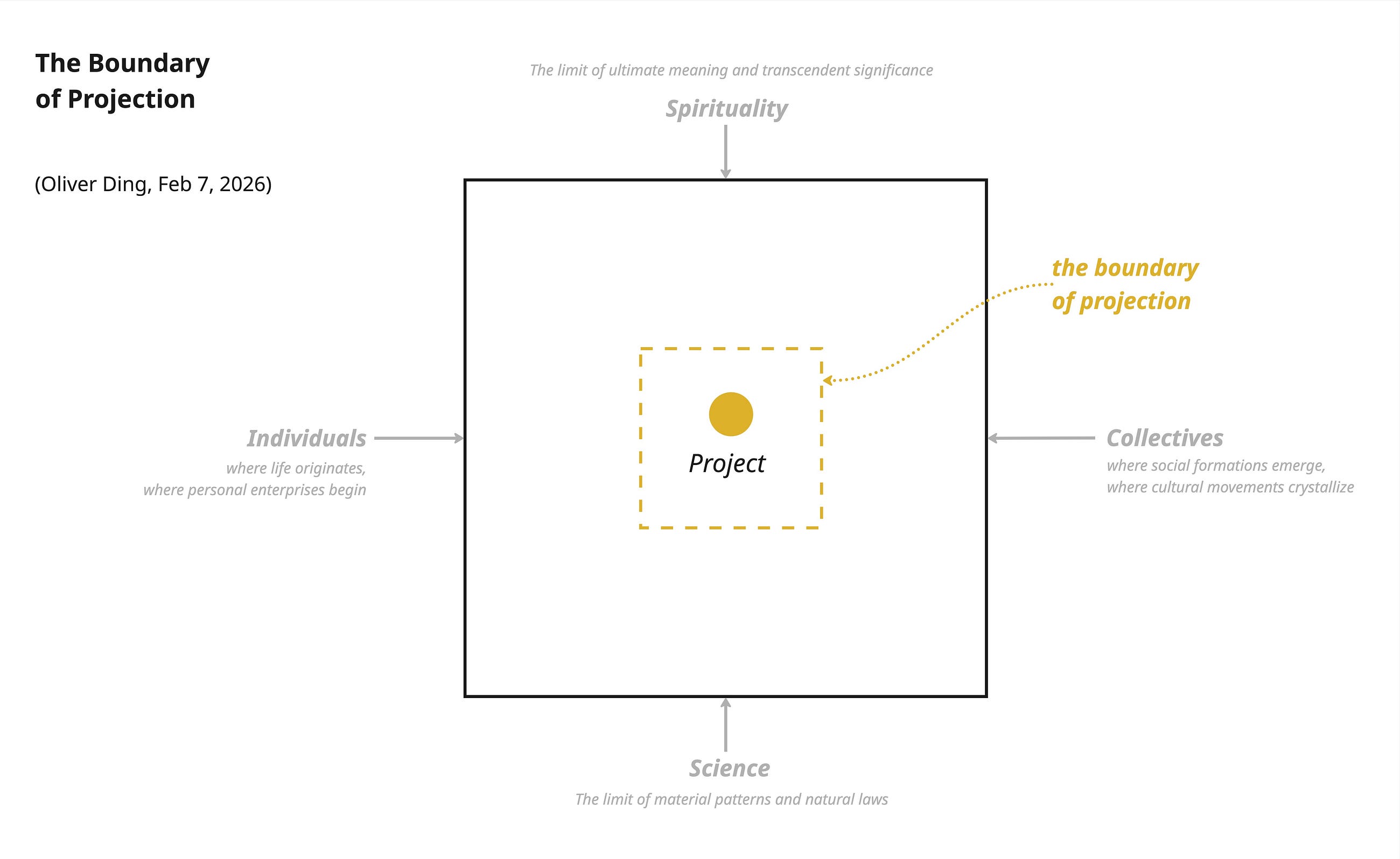
I call this the Boundary of Projection.
It is not a line but a region — a space of mediation where the fundamental dimensions of the World of Life (meaning, materiality, individuality, collectivity) become translated into the concrete structures of personal orientation that individuals bring to their encounter with projects.
Here, I use a square to represent the boundary of projection in order to fit the visual style of the World of Life, which is different from the Projectivity diagrams. Yet, the deep spatial logic remained the same.
3.2 Locating the Four Elements
On February 7, 2026, while revisiting the Knowledge Engagement Framework (v4.0, 2023), I began to consider how personal orientation might be structured at this boundary. The insight emerged through a kind of conceptual detective work: if the World of Life has four boundaries, then the Boundary of Projection — the region where individuals meet projects — might be organized by four corresponding elements, each rooted in one boundary yet oriented toward the project at the center.
This was a creative heuristic: let the structure of the World of Life suggest where to look, then search my existing conceptual repertoire for candidates that might fit. The outcome is represented in the diagram below.
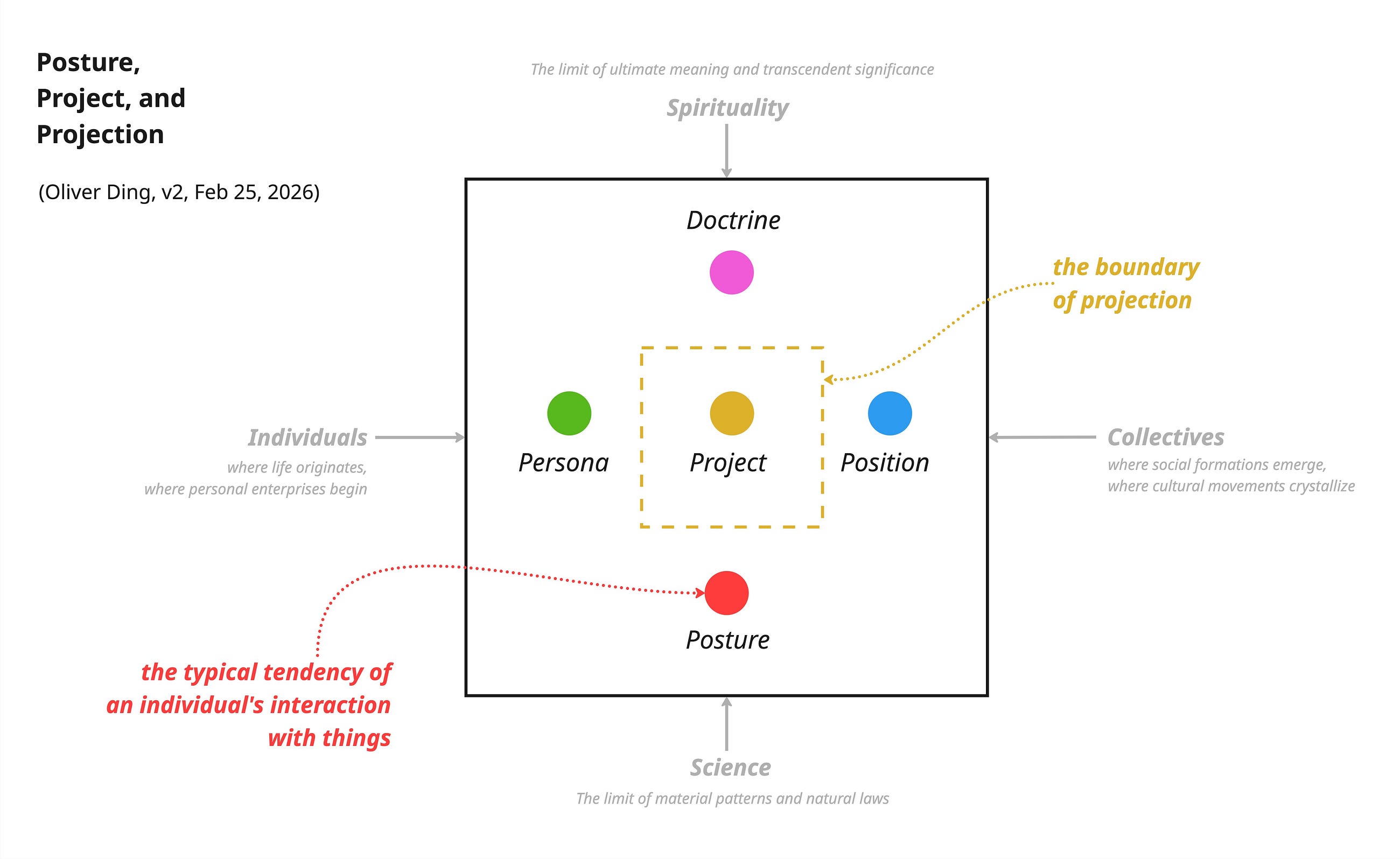
The upper boundary — Spirituality, the limit of ultimate meaning — suggested an element concerned with why projects matter in the largest sense. Here, I found Purpose, a concept I had developed in the Developmental Project Model (2021). Later, reflecting on its systematic character and inspired by recent reading in cognitive military studies, I renamed it Doctrine to emphasize that this is not fleeting motivation but crystallized meaning, a network of faith and knowledge reinforced by experience.
The left boundary — Individuals, where personal enterprises begin — pointed toward an element concerned with self and identity. Here, I found Persona, drawing on my work on “Possible Personas,” SET, and the Persona Dynamics framework. Persona names the repertoire of possible selves that individuals bring to projects — the senses of “who I might become” that projects offer to actualize.
The right boundary — Collective, where social formations emerge — suggested an element concerned with location in social space. Here, I found Position, developed in DEKIN (2018), and the Developmental Project Model (2021). Position names the place an individual would occupy within a project, and through the project, within larger social fields.
The lower boundary — Science, the limit of material patterns and natural laws — pointed toward an element concerned with how individuals engage with the material world. Here I found Posture, a concept that had been implicit in my work for years but only now found its systematic location. Posture names the ingrained tendency through which a person interacts with objects, tools, and environments — the most fundamental layer of orientation, rooted in the body’s characteristic ways of encountering the world.
Thus, through a heuristic guided by the World of Life’s spatial structure and a search of my own conceptual history, the four elements emerged:
- Posture (near the lower boundary: Science)
- Persona (near the left boundary: Individuals)
- Position (near the right boundary: Collective)
- Doctrine (near the upper boundary: Spirituality)
Each is rooted in one region of the World of Life, yet each faces inward toward the project. Together, they constitute the personal orientation that individuals bring to the Boundary of Projection — the structured readiness that shapes how they perceive, evaluate, and ultimately actualize the Projectivity that cultural life presents.
4. Posture
Part 4 introduces Posture — the most fundamental layer of personal orientation, operating at the level of action rather than project, describing a person’s characteristic tendency in engaging with objects, tools, and environments.
4.1 Definition and Origin
Posture is defined as a quality of ecological engagement between a particular individual and surrounding things. It indicates the typical tendency through which a person interacts with objects, including both concrete artifacts (such as books) and abstract objects (such as knowledge and conceptual systems), as well as environments.
The concept emerged from a realization in February 2026, while revisiting the Knowledge Engagement Framework (v4.0). I had long understood this framework primarily as an application of the Project Engagement approach from the perspective of Knowledge Projects. But on that day, I recognized that the framework operates at a more fundamental level — the level of Action, rather than Project. A project is a structured series of actions; Posture names the typical tendency that animates actions themselves, prior to their organization into projects.
This distinction placed Posture near the lower boundary of the World of Life: Science, the limit of material patterns and natural laws. This insight is significant, as it suggests that Posture should be understood as a new member of the Ecological Practice Approach.
4.2 Posture as Quasi-Invariant
The concept of Posture describes a fit between aspects of the subject and aspects of the object, taking into account both individual differences and shared, recurring tendencies.
If Personality is treated as an invariant, then Posture should be understood as a quasi-invariant, while Situation refers to a variant.
Posture thus operates as a mediating ecological pattern through which subjects encounter both material and symbolic objects.
4.3 Dimensions of Posture: An Example from Knowledge Engagement
At present, I have not yet developed a detailed framework for the dimensions of Posture. However, we can use the Knowledge Engagement Framework (v4.0) as an illustrative example. If a person is engaged in knowledge-related projects — working with concepts, theories, frameworks, and other intellectual artifacts — then the dimensions articulated in that framework can serve to describe relevant Postures.
The Knowledge Engagement Framework (v4.0) identifies eighteen dimensions organized into six sections. Each section names a domain of knowledge engagement, and within each, specific dimensions characterize how a person typically orients toward knowledge-related objects and activities.
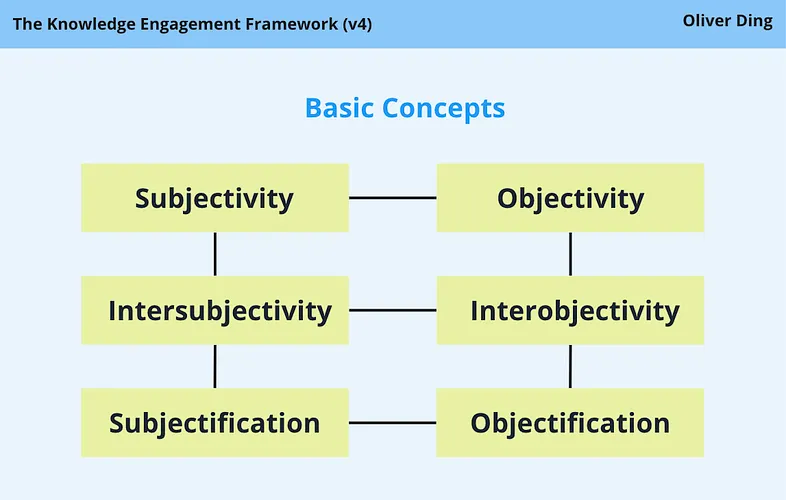
Subjectivity (Actor without considering other elements):
- Interdisciplinary: Theme vs. Identity
- Mental: Rational vs. Emotional
- Motivation: Intrinsic vs. Extrinsic
Subjectification (Turning experiences into knowledge):
- Source: Pervasive vs. Proximal
- Scope: Wide vs. Deep
- Cognitive: Language vs. Space
Objectivity (Knowledge without considering other elements):
- Transdisciplinary: Theory vs. Practice
- Temporal: Synchrony vs. Diachrony
- Structure: Uniqueness vs. Wholeness
Objectification (Making knowledge artifacts):
- Representation: Model vs. Story
- Economical: Commons vs. Commodity
- Technological: Craft vs. Automation
Intersubjectivity (Interactions between actors):
- Attachance: Attach vs. Detach
- Supportance: Engage vs. Cope
- Curativity: Creation vs. Curation
Interobjectivity (Interactions between knowledge artifacts):
- Arrangement: Hierarchy vs. Network
- Independence: Independent vs. Dependent
- Relation: Opposition vs. Complement
These dimensions illustrate how Posture might be articulated in one domain — knowledge work — and suggest that similar articulations could be developed for other domains. A person’s Posture toward knowledge is their characteristic tendency across these dimensions.
Although Posture manifests differently across domains, the meta-framework that organizes the Knowledge Engagement Framework — Subjectivity, Subjectification, Objectivity, Objectification, Intersubjectivity, Interobjectivity — is itself domain-general. These six categories name fundamental dimensions of how any person engages with any world: the inner realm of mental life, the process of turning experience into personal knowledge, the outer realm of objects and artifacts, the process of giving form to ideas, the social space between persons, and the relational space between artifacts themselves.
Thus, while the specific dimensions listed above describe Posture in knowledge work, the same meta-categories could be used to articulate Posture in other domains — craft, sport, art, care. In each case, we would ask: What is the person’s characteristic tendency in relation to their own subjectivity? In turning experience into skill? In engaging with the objects of their domain? In giving form to their vision? In relating to others? In relating the artifacts they create to the larger world of artifacts? The answers would differ, but the questions would remain the same.
5. Persona
Part 5 introduces Persona — the repertoire of possible selves an individual brings to the Boundary of Projection, operating at the intersection of personal identity and social role.
5.1 Definition and Origin
Persona refers to the repertoire of possible selves that an individual can imagine inhabiting. It occupies a middle ground between the psychological concept of Self and the sociological concept of Social Role — a mediating entity that allows us to understand how individuals navigate pluralistic social interactions, particularly in the age of digital platforms.
The concept emerged from my work on the SET framework (Social Engagement Theory) in 2019, which aimed to understand social interaction design at the pan-interpersonal level. Traditional social psychological and sociological theories tend to use real interpersonal actions or social roles as their units of analysis. Inspired by interaction design and digital social practices, I adopted the term “Persona” from the field of User Experience to define a middle entity between Person and Social Role:
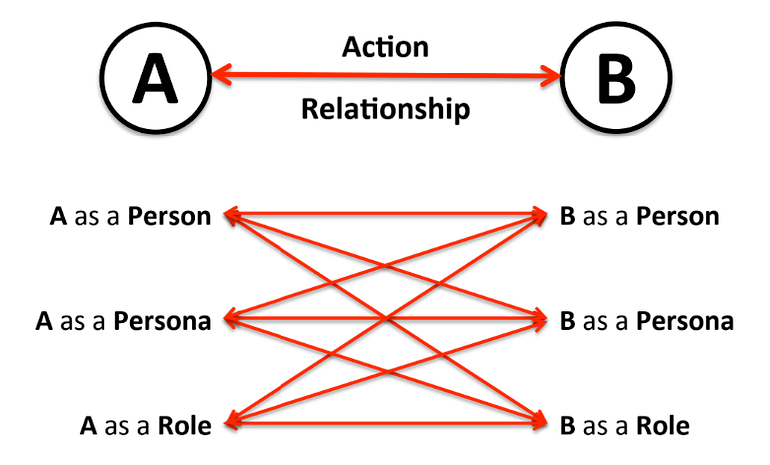
This triadic structure allows us to research how individuals present themselves differently across contexts while maintaining continuity of self, and how social roles are instantiated through specific personas rather than directly through persons.
5.2 How Persona Works: The Persona Dynamics Framework
The Persona Dynamics Framework brings together three intellectual sources:
- The original Persona Dynamics concept from SET (2019)
- Possible Selves Theory (Markus & Nurius, 1986)
- The Anticipatory Activity System (AAS) framework (2022)
The framework is represented by the diagram below:
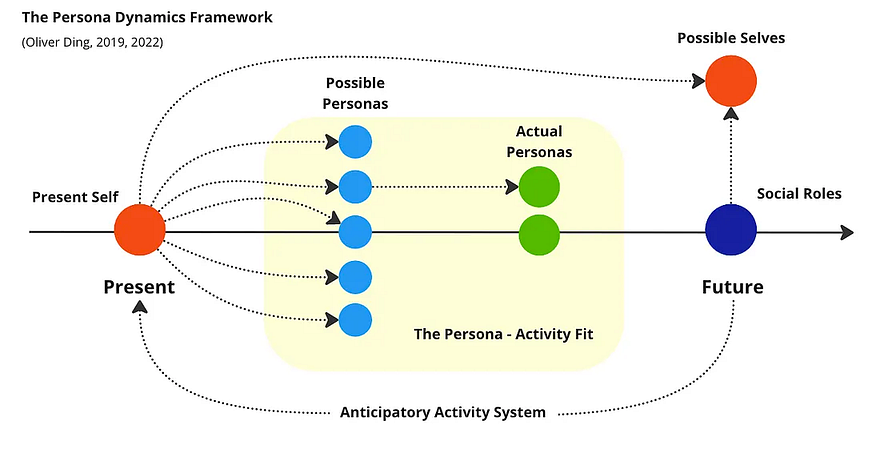
A person may imagine many possible personas, but only some achieve the fit with actual activity that transforms them into actual personas. Over time, some actual personas may crystallize into social roles — but this is not automatic, nor is it the only desirable outcome.
The key to transformation is the Persona-Activity Fit. When a person thinks about their possible selves and decides to act on one particular possible self, this decision activates an Anticipatory Activity System — a future-oriented structure that organizes action toward the realization of that possible self.
If we put these two concepts together, we can find a path to actualize possible selves. Possible Selves provide the motivational horizon; Possible Personas provide the actionable interface through which that horizon can be approached.
The Persona Dynamics Framework was built on the Anticipatory Activity System (AAS) Framework. The Persona — Activity Fit can be further understood as the fit between a Persona and a Project.
5.3 The Four Dimensions of Persona
The Persona Dynamics framework and the Identity framework, developed within the Project Engagement approach, have evolved along separate paths — yet they converge on the same underlying reality. Persona, as used in this article, is a collective term. In the actual unfolding of a person’s engagement with projects, it takes four distinct forms:
- The persona as lived in creative action → Creative Identity
- The persona as envisioned future self → Anticipated Identity
- The persona as perceived by others within a project → Projected Identity
- The persona as integrated into life narrative → Narrative Identity
Creative Identity operates in the Aion Space — the realm of generative, enfolded time. It is the identity that emerges through concrete actions guided by autonomous will and subjective exploration, experienced in the midst of creative activity.
Anticipated Identity also belongs to the Aion Space. It is a forward-looking identity representing an individual’s vision of their future self, aligned with Possible Selves theory. This future-oriented form of Persona shapes motivation and long-term commitment.
Projected Identity operates in the Chronos Space — linear, sequential time. It is the identity shaped by external roles and responsibilities within a project, how one is perceived and situated within its social structure.
Narrative Identity also belongs to the Chronos Space. It is the self constructed and communicated through personal storytelling — the persona as it has been reflected upon, integrated, and made coherent over time.
With this correspondence established, the two frameworks become mutually translatable.
6. Position
Part 6 introduces Position — the social dimension of personal orientation, examining where a project would place an individual both within its own division of labor and within the broader landscape of their development.
6.1 Definition and Origin
Position is a concept widely used across sociology, organizational theory, and related disciplines to describe the location an individual occupies within social space — the roles, statuses, and relationships that situate them relative to others.
In my own work, Position has been developed primarily within the Developmental Project Model (2021), where it is one of the eight core elements of a developmental project, alongside Purpose, Program, Social, Content, Action, Theme, and Identity. Here, Position names the division of labor within the project — where one stands in relation to other participants, and how that standing shapes access to resources, information, and recognition.
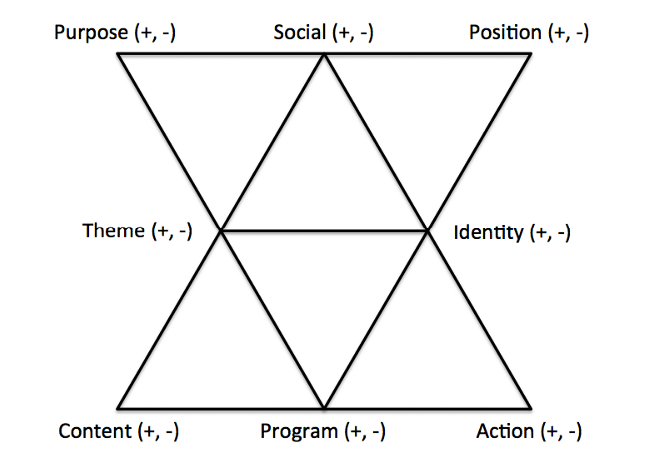
In this article, however, Position carries a double meaning — and both dimensions enter into an individual’s consideration at the Boundary of Projection. On one hand, there is the position one would occupy within the project itself. On the other hand, there is the broader social position the project might afford beyond its boundaries — how participation might open new trajectories, expand one’s standing in a field, or provide opportunities unavailable in one’s current role. A person may ask: does this project offer a position that serves my longer-term development? Or: does this project give me access to a kind of work my current position does not allow?
These two dimensions — position within the project and position beyond it — together constitute what is at stake when an individual considers where a project might place them in the social world.
6.2 Position and the Division of Labor
Position is rooted in the division of labor — a core concept in the Activity Theory tradition. In Activity Theory, the division of labor refers to how tasks, responsibilities, and power are distributed among participants in any collective activity. It shapes who does what, who has access to what resources, and who relates to whom.
When an individual considers joining a project, this division of labor carries with it:
- Expectations: what someone in this position is supposed to do
- Resources: what someone in this position can access
- Relationships: who someone in this position connects to
- Recognition: how someone in this position is seen by others
The question “Where will I stand?” is thus also a question about what one will be expected to contribute, what one will have access to, whom one will work with, and how one will be recognized. These are not secondary considerations but central to the experience of participation and the developmental possibilities a project affords.
Position also has a temporal dimension. It is not fixed but can shift as one moves through projects. A person may enter a project at one position and, through their participation, move to another. These positional shifts are part of what makes projects developmental — they offer opportunities to occupy new locations in the division of labor that were previously inaccessible.
6.3 Varieties of Position
The concept of Position becomes more concrete when we consider the different types of positions that actually exist in social life.
The DEKIN Innovation System (2018) — which introduced Position as a mediation between People and Practice — offers a typology that is particularly well-suited to the concerns of ACS. DEKIN was developed to understand the landscape of innovation in the digital age, focusing on how social positions enable and constrain different kinds of creative work. This focus on innovation, anticipation, and cultural production makes it directly relevant to the study of how individuals project themselves into projects.
The framework identifies twelve types of social positions commonly found in innovation-related endeavors, organized into three groups, each with a distinct orientation:
D-positions:
- D1=Design
- D2=Development
- D3=Decision
- D4=Distribution
C-positions:
- C1=Consumer
- C2=Connector
- C3=Curator
- C4=Creator
R-positions:
- R1=Review
- R2=Research
- R3=Reward
- R4=Reflection
There is also a key for each group of positions. The key to D-positions is Capability. The key to C-positions is Utility. The key to R-positions is Influence.
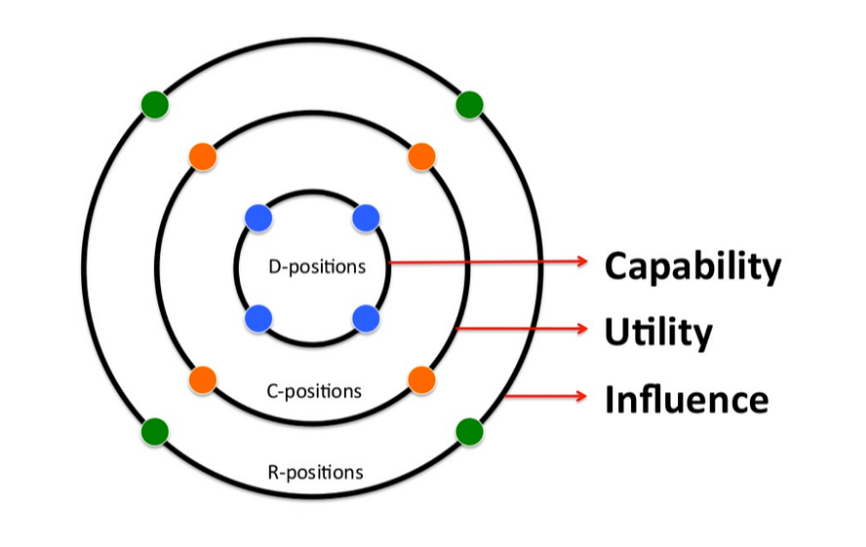
This insight points out three innovative paths: servicing D-positions by enhancing capability, servicing C-positions by enriching utility, and servicing R-positions by engaging influence.
These twelve types are offered here as an illustrative example rather than a definitive taxonomy. The inquiry into varieties of Position remains open for further development, as different domains and different kinds of projects may call for different ways of understanding the social locations individuals occupy.
7. Doctrine
Part 7 introduces Doctrine — the deepest layer of personal orientation, a network of faith and knowledge that answers why any project ultimately matters.
7.1 Definition and Origin
Doctrine refers to the system of meaning and value that orients an individual’s commitments. It answers the question that arises at the Boundary of Projection: Why does this project matter to me, ultimately?
In earlier versions of the Developmental Project Model (2021), this element was named Purpose — the motivation and direction that draws an individual toward a project. Purpose remains a valuable concept, capturing the intentional dimension of project engagement. However, recent reading has led me to adopt a more robust concept that better captures the depth and systematic character of this element.
In exploring the foundations of cognitive military studies, I encountered the work of Robert Frank Futrell (1917–1999), the preeminent historian and theorist of the United States Air Force. In his two-volume masterwork Ideas, Concepts, Doctrine: Basic Thinking in the United States Air Force, Futrell offers a redefinition of Doctrine that resonates profoundly with the upper boundary of the World of Life — the realm of Spirituality, ultimate meaning, and transcendent significance.
Futrell’s insight is that doctrine is not merely a set of rules or procedures written in manuals. It is, fundamentally, “of the mind” — a network of faith and knowledge reinforced by experience. This definition captures precisely what the fourth element of personal orientation requires: a structure that is both cognitive and committed, both knowledge and belief, both personal and shareable.
7.2 Doctrine as “Of the Mind”
Futrell’s central passage deserves full quotation:
“At the heart of warfare lies doctrine. It represents the central beliefs for waging war in order to achieve victory. Doctrine is of the mind, a network of faith and knowledge reinforced by experience which lays the pattern for the utilization of men, equipment, and tactics. It is the building material for strategy.”
This formulation contains several essential insights for understanding Doctrine as an element of personal orientation:
First, doctrine is “of the mind.” It is not an external text but an internal cognitive schema — a way of seeing and interpreting the world that operates before and beneath explicit decision-making. Without doctrine, Futrell suggests, weapons are merely cold steel; with doctrine, fragments are “welded” into coherent capability. In the context of cultural projection, Doctrine is the internal framework through which individuals perceive what matters and why.
Second, doctrine is a “network of faith and knowledge.” Futrell explicitly includes faith — belief that cannot be fully verified — alongside knowledge. This is crucial for understanding how Doctrine operates at the Boundary of Projection. Individuals come to projects not only with what they know but with what they believe: assumptions about what is valuable, convictions about what is worth pursuing, commitments that may exceed any available evidence. This faith component gives Doctrine its motivational power and its resilience under pressure.
Third, doctrine is “reinforced by experience.” Doctrine is not static. It is shaped by what one encounters, what one attempts, what succeeds, and what fails. Yet it is not merely a summary of experience; it is the framework that makes experience meaningful in the first place. This recursive relation — Doctrine shaping experience, experience reinforcing or challenging Doctrine — is central to the dynamics of cultural projection.
Fourth, doctrine “lays the pattern” for action. Doctrine is not an end in itself. It is the generative source of strategy, the “building material” from which specific plans and actions are constructed. In the language of personal orientation, Doctrine is what enables individuals to move from general commitment to concrete participation — to see, in the particular project before them, an instantiation of what they ultimately value.
7.3 Doctrine, Purpose, and the Developmental Project Model
In the Developmental Project Model, Purpose asks: Why do you want to initiate or join this project? This remains a vital question. But within the fourfold structure of personal orientation, Purpose and Doctrine are not alternatives — they operate at different levels.
Doctrine is trans-situational: it is the system of meaning and value that persists across projects, orienting an individual’s commitments from outside any particular engagement. Purpose is its inside counterpart: the instantiation of Doctrine within a specific project, the form that ultimate meaning takes when it meets a concrete situation.
This relationship mirrors the structure found in Position — where the individual’s broader social trajectory (outside) and their role within the project’s division of labor (inside) are two dimensions of a single orientation. Similarly, Doctrine names the outside dimension of meaning, and Purpose names the inside dimension. Neither replaces the other; together they constitute the full depth of why a project matters to a person.
Within the ACS framework, this relationship has a direct structural grounding. A Mental Platform is a concept system that a person habitually employs; when brought to bear on the development of an enterprise, it becomes a Strategic Framework. Doctrine is a core component of this Strategic Framework — it is the meaning system that orients the entire enterprise. Each enterprise contains specific projects, and each project operates with a Predictive Model. Purpose is a core component of this Predictive Model — it is the concrete instantiation of Doctrine within a specific project. Just as the Predictive Model remains connected to the Strategic Framework that contains it, Purpose remains connected to the Doctrine from which it is generated.
8. The Fourfold Structure of Personal Orientation
Part 8 brings the four elements together, revealing their shared double structure and the configuration they form at the Boundary of Projection.
8.1 The Four Elements Revisited
We have now examined each of the four elements that constitute the personal orientation individuals bring to the Boundary of Projection:
- Posture, near the lower boundary of Science: the ingrained tendency through which a person engages with objects, tools, and environments — the most fundamental layer of orientation, rooted in the body’s characteristic ways of encountering the world
- Persona, near the left boundary of Individuals: the repertoire of possible selves one can imagine inhabiting — the sense of “who I might become” through participation in projects.
- Position, near the right boundary of Collective: the location one occupies within social space — the roles, statuses, and relationships that situate a person relative to others in the division of labor.
- Doctrine, near the upper boundary of Spirituality: the system of meaning and value that orients commitment — a network of faith and knowledge, reinforced by experience, that answers why a project matters ultimately.
These four elements are not separate “factors” that independently influence Projection. They form a configuration — a dynamic whole in which each element shapes and is shaped by the others.
The fourfold structure of personal orientation is not an end in itself. It is what individuals bring to the Boundary of Projection: the configuration of tendencies, imaginings, locations, and commitments that shapes how they perceive, evaluate, and ultimately take up the Projectivity that cultural life presents.
When Projection occurs — when an individual crosses from “outside” to “inside” a project — this configuration is not left behind. It enters the project with the individual, shaping how they participate, what they contribute, and what they become. The personal orientations of multiple participants interact within the project, sometimes harmonizing, sometimes conflicting, always shaping the cultural life.
8.2 The Double Structure of Personal Orientation
Each of the four elements carries a double structure that mirrors the spatial logic of Projection itself. Each operates at two levels simultaneously: outside the project, as a general orientation that persists across engagements; and inside the project, as the specific form that orientation takes within a particular endeavor.
Posture shapes how a person engages with the objects and environments of a project — both as a general tendency brought from outside, and as a concrete mode of engagement enacted within.
Persona names the repertoire of possible selves from outside the project, and the actual persona activated and perceived within it.
Position encompasses both the broader social trajectory a project might afford beyond its boundaries and the specific location within its division of labor.
Doctrine is the trans-situational meaning system from outside, of which Purpose — the motivational orientation toward a specific project — is the inside instantiation.
This double structure is not accidental. It reflects the fundamental logic of Projection: the moment when outside meets inside, when general orientation becomes specific participation. The four elements are the dimensions through which this crossing is prepared, perceived, and enacted.
A person may not be fully aware that these four elements are already at work — quietly filtering which Projectivities come into view, which feel compelling, and which recede unnoticed. Purpose, often treated as the primary driver of project engagement, is in fact only one of these four elements — and only one dimension of a more complex orientation.
Conclusion: The Personal Ground of Cultural Projection
This article has made two theoretical moves. The first is a move from ontology to operation: Projectivity, introduced in 2021 as a fundamental ontological concept, has here been extended to the operational level through the fourfold structure of personal orientation. The second is a structural finding: each of the four elements — Posture, Persona, Position, and Doctrine — carries a double structure, operating simultaneously outside the project as a general orientation and inside the project as its specific instantiation. This double structure reflects the fundamental spatial logic of Projection itself: the movement from outside to inside that constitutes cultural participation.
In identifying this outside zone — the space between the project and the four boundaries of the World of Life — this article also contributes to the World of Life framework itself. A new spatial layer has been named and is being mapped. The World of Life, as the meta-framework of the ACS project, is gradually being filled in, as concepts from different traditions find their location within it.
The individual who stands at the Boundary of Projection is never empty-handed. It is through Posture that one engages; through Persona that one imagines; through Position that one stands; through Doctrine that one cares. Together, they constitute the personal ground from which all cultural projection springs.
Version 1.0 - February 25, 2026 - 7,317 words