
Activity Analysis Network #6: Project as Social Environment

This is the 6th issue of the Activity Analysis Center's newsletter
by Oliver Ding
November 30, 2025
Hi, and welcome to Activity Analysis Network, a newsletter hosted by the Activity Analysis Center.
Each issue is organized around the "Flow - Focus - Center - Circle" schema, the primary model of the World of Activity Toolkit (v1, 2025).
As a biweekly newsletter, I share summaries of new articles from the Activity Analysis Center, along with updates on related activities, including some of my own published work elsewhere.
In this issue (#6), I’m thrilled to announce a major milestone: a recently completed manuscript, Developmental Projects: The Project Engagement Approach to Adult Development. Three in-depth theoretical articles in this issue lay the groundwork for this new book, marking an exciting step forward in exploring projects as social environments of adult development.
Flow
The historical development of the Activity Analysis Center and my experience of daily life
In my ongoing series, "Appropriating Activity Theory," I share a story of engaging with Andy Blunden's Creative Ideas.
In late May 2024, something unexpected happened. A friend from California began participating in activities at the Activity Analysis Center I had established. This casual involvement prompted me to formalize what would become the Fellow Project, with her as the Center's inaugural Fellow member.
Her research interests centered on cross-cultural communication and cultural concepts. When discussing potential theoretical frameworks, I immediately thought of Andy Blunden's Project-oriented Activity Theory — specifically his proposition that "Activity is Formation of a Concept," which he developed by integrating Hegel's concept theory with Vygotsky's cultural-historical psychology.
What began as a simple mentoring relationship would soon reveal something profound about my own intellectual journey.
In mid-June, I began compiling learning materials on Project-oriented Activity Theory for my first Fellow. On June 16, while organizing relevant articles, I edited a new book draft: Activity as Formation of Concept. The manuscript collected 22 articles with a total reading time of 463 minutes (approximately 245 pages).
After completing the draft, I made an unexpected discovery that would fundamentally reshape my understanding of my own theoretical development.
I realized this new book formed a trilogy with two other manuscripts I had written:
- Grasping the Concept: The Territory of Concepts and Concept Dynamics (November 2023)
- Center, Circle, and Genidentity: The Dynamics of Networked Knowledge Centers (June 2024)
- Activity as Formation of Concept: Engaging with Andy Blunden's Approach to Activity Theory (June 2024)
But here was the striking revelation: the chronological order of their editorial completion was the exact reverse of my actual creative journey. This discovery revealed what I would later call the "Double Trajectories of Concept Development."
Focus
The Thematic Foci of the Activity Analysis Center
In the past two weeks, my focus has been on the Activity Theory’s internalization-externalization principle and the Cultural Projection Model (2025).
The “Internalization — externalization” principle is a key principle of Activity Theory. Internalization refers to the way culturally mediated, social, and material actions are transformed into internal psychological functions. Through participation in shared activities, individuals take up tools, signs, and practices from their environment and reorganize them as part of their own cognitive processes.
Externalization describes the opposite movement: the expression or projection of internal psychological structures into new artifacts, representations, or forms of practice. By creating tools, models, or novel patterns of activity, individuals reshape their environment and expand the possibilities for collective action. Together, internalization and externalization form a continuous cycle through which human cognition and social activity co-evolve.
While building on this principle, the “Activity as Project Engagement” principle introduces the “Outside — Projecting — Inside” triad as a basic ecological form that expands the internalization–externalization principle to describe how people engage with social environments. A project is defined as a primary type of social environment. When remaining outside a project, a person observes its ongoing activities. At some point, the person perceives an opportunity to participate and takes action to move toward the inside of the project. This projecting movement includes three types: primary projecting, the initiation of a new project, which corresponds to externalization; secondary projecting, joining an existing project, which corresponds to internalization; and tertiary projecting, leaving an existing project to initiate a new one inspired by it, which corresponds again to externalization.
The “Outside — Projecting — Inside” triad describes a cyclical pattern of movement between a person and a project as a social environment. These social moves echo the mental moves represented by the internalization–externalization cycle, linking changes in social actions with changes in psychological processes.
From 2021 to the present, the “Outside — Projecting — Inside” triad, as a basic ecological form, also supports the development of a series of new ideas emerged in the developmental journey of the Project Engagement Approach. The diagram below curates the newest developed ideas together, forming the Cultural Projection Model.
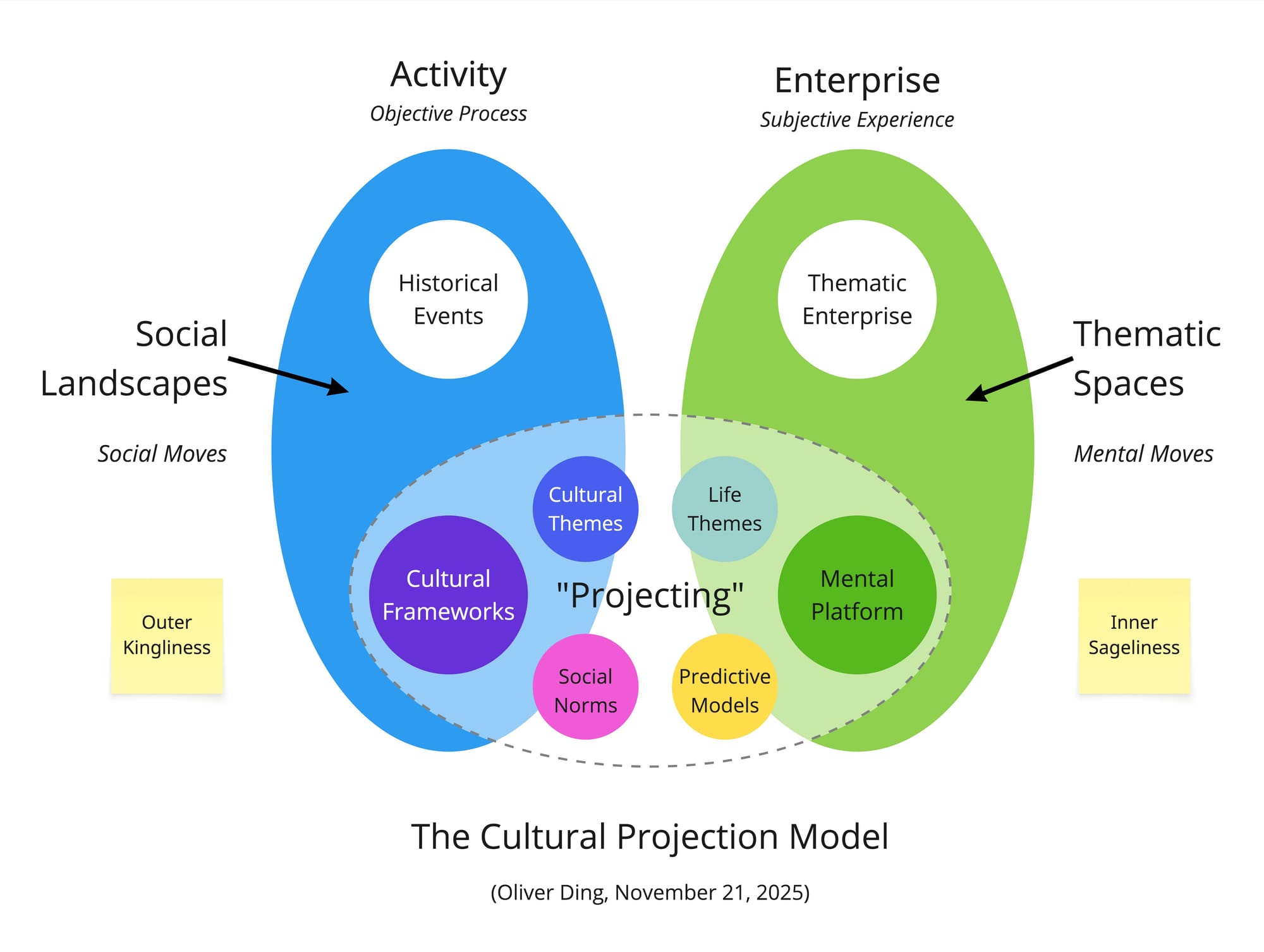
In The Cultural Projection Model (2025), I review the “Outside — Projecting — Inside” triad and related early key concepts and the later development of the Project Engagement Approach. Ideas inside the Cultural Projection Model are further explored in the article.
CENTER
The Core of the Activity Analysis Center
Currently, the Activity Analysis Center hosts two major theoretical enterprises:
- The Life-as-Activity Approach (the Project Engagement Approach is part of this family)
- The World of Activity Approach
The Project Engagement Approach is a project-centered social theory inspired by Andy Blunden’s notion of the “project as a unit of analysis of activity.” Since 2021, its development has aimed to establish “Project” as a conceptual foundation for cross-disciplinary research, creative dialogue, and deeper reflection on human development.
Over the past several years, the creative journey behind the approach has produced several book drafts:
- Project-oriented Activity Theory (2021)
- Project Engagement (2022, Chinese)
- Advanced Life Strategy (2022)
- Mapping Developmental Projects (2023)
- Mapping Creative Dialogue (2024)
- Inside, Outside, and Projectivity (2024, Chinese)
- Strategic Moves (2204)
Version 3.1 of the approach was first introduced in the Chinese draft Inside, Outside, and Projectivity (August 2024). Because this major conceptual update existed only in Chinese, I had long wanted to produce an English manuscript that could present v3.1 in a systematic and accessible way. The idea of preparing an English book gradually became more concrete as I continued writing articles, case studies, and diagrams throughout 2024 and 2025.
The publication of The Creative Identity Engagement Framework on November 12, 2025, marked a turning point. It prompted me to consider gathering recent writings — on themes, identity, enterprise, and adult development — into a new book draft. Several case studies on gap projects also revealed recurring developmental patterns, suggesting that the time had come to curate and synthesize these materials.
From November 15 to November 30, I worked on editing a new possible book: Developmental Projects: The Project Engagement Approach to Adult Development.
This book explores the living way of the “Developmental Project” concept. The concept was not born fully formed; rather, it emerged gradually through a series of knowledge projects undertaken between 2020 and 2025. This journey demonstrates how theoretical concepts themselves develop through practice.
Across these years, the continuous application of the concept in diverse contexts expanded both its meaning and its significance, particularly its “developmental” dimension, which had been largely overlooked in the early stages. This evolution reached a critical point in 2025 during what I later called the Creative Swapping moment.
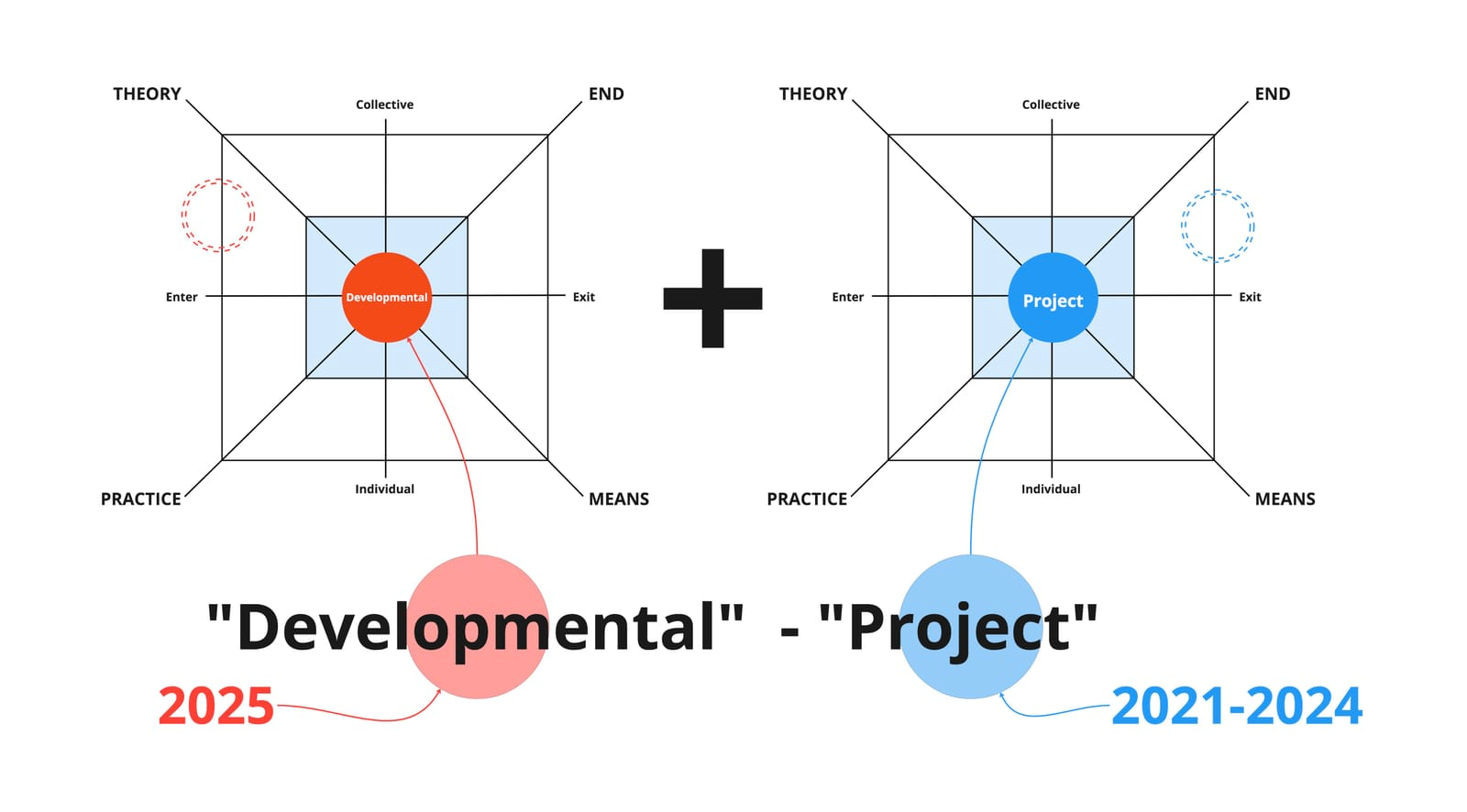
In that moment, the theoretical focus dynamically shifted from “Project” (the central concern from 2021 to 2024) to “Development”. This shift offers a new lens for revisiting and curating earlier works within the broader context of adult development.
See the links below:
- Developmental Projects (book, v1, 2025)
- Toward a Project-Oriented Ecology of Adult Development
- The Living Way of the “Developmental Project” Concept
- The Cultural Projection Model: Outside, Projecting, and Inside
- Toward Dramatic Life Pattern
- The Mind Map of Developmental Projects
CIRCLE
The Context of the Activity Analysis Center
Over the past several years, I worked on several theoretical projects, such as the Ecological Practice Approach, Curativity Theory, Creative Life Theory, and Thematic Space Theory.
Inspired by creativity researcher Howard Gruber's idea of "Network of Enterprises," I used the "Knowledge Center" approach to manage this large knowledge system. Each knowledge center hosts one or two related theoretical approaches.
- CALL (Creative Action Learning Lab): the Ecological Practice Approach and Creative Life Theory
- Curativity Center: Curativity Theory
- TALE (Thematic Analysis Learning Engagement): Thematic Space Theory
- Frame for Work: A theory about Knowledge Frameworks
Within the past two weeks, several earlier ideas have been revisited and developed further in a series of articles:
- Rethinking Social Design: Revisiting Social Engagement Theory (2019) - This article revisits a private conceptual deck from 2019, offering a fresh perspective on social engagement theory.
- Field Curation: Pieces, Container, Platform, and Network (a short note) - Although a new creative theme, this work applies the Curativity Theory developed in 2019 to the level of “field,” exploring how curated knowledge and activities can be organized across broader contexts.
- [Meta-Framework] The Ap-Re-Co Framework (v1, 2025) - Originating from an intriguing experiment in early November, this framework has been recently iterated as part of an ongoing effort to explore new approaches to the Subject-Object Relation—a central issue in social science.
Together, these works reflect a continuing thread of exploration—revisiting past ideas, extending them to new domains, and experimenting with frameworks that push the boundaries of knowledge and activity analysis.
World
Me, You, and We

My name is Oliver Ding. I am the founder of the Activity Analysis Center. I am based in Houston, Texas, US.
Where are you?
v1.0 - November 30, 2025 - 1,616 words