
Revisiting and Rebuilding: A Strategy for Creative Identity Development (Possible Book, 2026)

Introduction and Table of Contents
by Oliver Ding
April 6, 2026
In early March 2026, a reader named Bob came to me with a difficulty. He had been reading Lake 42: The Great Confluence — the manuscript I had completed in early February 2026, documenting the development of Creative Life Theory v3.0–v3.1 — and found two of its central models hard to apply to his own situation. As we exchanged messages, something else became visible beneath the surface: Bob was navigating a period of real disorientation, trying to orient himself in a landscape that kept shifting under his feet with the rapid acceleration of AI development.
I recognized his situation immediately. Not because I had read about it, but because I had lived it.
Around 2015, I was that person. Deeply engaged with learning communities, working as an advisor to a youth education company, co-founding social learning networks, and writing my first learning autobiography. I was in what I now understand as a pre-activity stage — not yet in the mode of theoretical creation, but in the mode of exploration and engagement, trying to make sense of a world that was also changing fast around me. The questions I was holding were real and urgent, but I did not yet have the frameworks to make them fully legible, even to myself.
Seeing Bob, I saw my own past self. And in that recognition, something shifted.
I had been running the Revisiting and Rebuilding practice for several months by then — returning to past creative work through a regular column, rebuilding concepts and frameworks that had lain dormant for years. But until that moment with Bob, I had understood RR primarily as a creative strategy: a way of recovering intellectual assets, compounding theoretical value over time. What the encounter with Bob revealed was something deeper. Re-engaging with past work is, at its deepest level, re-engaging with past selves — with the versions of yourself who inhabited earlier thematic spaces, who held certain questions, who made certain choices, who could not yet articulate what they knew.
That recognition is the real origin of this book.
A few days after the exchange with Bob, I returned to a conceptual deck I had created in 2015 — written in Chinese, an internal document produced for a youth education company, not a public theoretical statement. Sixty-five slides. The person who made it was working in a different medium, for a different purpose, in a different theoretical vocabulary. He was embedded in communities, thinking through questions of adult learning and professional development from the inside, as someone who cared about these questions not as theoretical objects but as lived realities.
That person was a past self. And revisiting his work — really revisiting it, not just citing it — meant re-engaging with him: recognizing what he had seen, understanding why he had structured things the way he had, finding in his intuitions the seeds of frameworks that only became nameable a decade later.
From that deck, two separate RR operations emerged on consecutive days. The first revealed that the Learning Landscape framework he had assembled empirically in 2015 was, in fact, theoretically necessary — its four perspectives corresponding precisely to four boundaries of the World of Life, a framework that would only be developed a decade later through entirely independent theoretical work. Practice had anticipated theory. The second step extracted eight developmental themes that had been compressed into three slides, and rebuilt them into a complete framework, now called the Significant Themes Framework — nine documents, hundreds of paragraphs, a full theoretical architecture.
Three slides. Two days. Two different types of rebuilding. One past self, revisited.
This is what the Revisiting and Rebuilding strategy actually is, at its deepest level: not a productivity technique, not a method for recycling old ideas, but a sustained relationship between who you are now and who you have been — a practice of recovering, transforming, and carrying forward the creative intelligence embedded in your own past.
What began as a creative practice had become, by March 2026, a strategy for developing creative identity. To understand why, it helps to understand what RR actually is — and what it is not.
At its most basic, Revisiting and Rebuilding is a temporal pattern: you make something, you move on, and then — months or years later — you return to what you made and build something new from it. That structure is simple. Almost every serious creator does something like it, at least occasionally and intuitively. What makes RR practice distinctive is not the temporal structure itself, but the mindset it requires. The past is not an archive to be consulted but a depth to be explored. Dormant work is not failed work but unfinished work, waiting for the conditions that will allow it to be completed. A concept that stalled in 2017 is not a dead end — it is an epistemic seed carrying structural DNA that may only become legible years later, when the right theoretical resources finally exist to name what it was already doing. This shift in how you understand your own creative past changes everything about how you engage with it.
But the temporal structure and the mindset are still not enough. The actual creative work of RR practice involves a great deal more: specific strategies and techniques for deciding what to revisit and when, for identifying which historical version of a concept provides the richest foundation for rebuilding, for recognizing structural resonances across distant theoretical traditions, for scanning past projects for Side Episodes whose hidden thematic lines can be curated into new Main projects. These are learnable skills. They are not guaranteed by the temporal pattern alone — they have to be cultivated deliberately. In the cases documented in Part 2, these strategies appear again and again: the present project calling the past forward, the dormant concept finding its completion through resources accumulated elsewhere, the by-product of one endeavor becoming the center of the next.
The combination of this temporal structure, this mindset, and these creative strategies produces something that goes beyond a productivity technique or a method for recovering intellectual assets. It produces a toolkit for creative identity development. Because every act of revisiting is also an encounter with a past self — the version of you who made that work, who held those questions, who could not yet articulate what they knew. And every act of rebuilding is a transformation: not of the material alone, but of the relationship between who you were and who you are now. Over time, RR practice makes visible the full cascade of creative identities you have enacted across a creative life — the Practitioner, the Reflector, the Modeler, the Curator — and reveals how each one prepared the conditions for the next. The Self-Other relationship, usually understood as a relationship between persons, also operates across time: the past self becomes the Other through whom the present self develops. This is the deepest claim of this book, and the cases in Part 2 are its evidence.
The possible book is organized to reflect these three dimensions — temporal structure, creative strategy, and identity development — across six parts.
Part 1: A Creative Journey documents the development of the RR practice itself — how it emerged from an editorial constraint, how it evolved from revisiting into rebuilding, how it became a research project, and how the recognition of past selves arrived as its deepest discovery. This is the story of where this book came from.
Part 2: Advancing and Analyzing presents the core case studies — seven chapters, each a double entry: the creative work itself (A) and the case analysis of how that work came to be (B). These are the empirical heart of the book. The cases span eight to eleven years of creative development, documenting four distinct types of RR operation: ontological completion, methodological elevation, foundational revelation, and component liberation.
Part 3: Significant Themes collects the most significant by-product of the RR practice: a framework for understanding the key developmental themes of a creative life. These are not abstract typologies but lived patterns — the turning points and transitions that any person who develops seriously as a creator will encounter. The section also includes a case study of Re-engagement as a lived annual theme, connecting the book's theoretical concerns to the specific creative season in which it was written.
Part 4: Five-space Model presents a strategic mapping tool developed in 2022 that provides a more detailed architecture for the kind of Strategic Curation that RR practice requires. If RR is the practice, this is the map of the strategic terrain it operates within.
Part 5: Creative Identity Cascade brings together the theoretical framework that makes sense of why RR practice matters for identity development. These chapters address the Self-Other relationship, the cascade of creative identities across time, and the deeper social and cultural dimensions of what it means to develop a creative life. The theoretical framework was developed independently of the practice, but the two belong together — and placing this part after the cases allows the theory to be read with the evidence already in view.
Part 6: Weave the Life presents the analytical tools — the Weave family of models — that provide the methodological infrastructure for thinking about how creative life unfolds across time and space. This is where the abstract analytical apparatus finds its most complete expression, and where the book's concerns extend from the individual creative life to the broader question of how knowledge ecologies are built across scales.
The Epilogue returns to the question of midlife — the specific temporal location from which this book was written, and which gives the RR strategy its most personal resonance. Every creative person eventually reaches a point where the past is substantial enough to be a real resource, and the future is still open enough to be genuinely shaped. That is the moment RR practice is most alive.
A word about how this book came to be.
The bulk of its content emerged between January and March 2026, during the development of Anticipatory Cultural Sociology (ACS) from v1.0 to v2.0. The RR strategy was one of the key creative strategies driving that development — each new ACS framework created the conditions for revisiting earlier work, and each revisiting produced material that advanced the ACS project forward. In this sense, this book and the ACS manuscript are a pair: two parallel developments, each feeding the other, each advancing and analyzing simultaneously. They are themselves an instance of the AA cycle — Advancing and Analyzing — that is one of the central concepts of the RR practice.
This relationship has a precedent that is worth noting. Lake 42: The Great Confluence, the manuscript completed in early February 2026, documented the development of Creative Life Theory v3.0–v3.1 through the lens of Generative Confluence — the pattern in which multiple streams of creative work converge, without losing their individual identities, to generate a new theoretical center. At the end of that manuscript, I discovered that Generative Confluence itself has a fractal structure: the same pattern of convergence appears simultaneously at the scale of a single creative session, at the scale of a months-long project, and at the scale of a decade-long theoretical enterprise. I named it Fractal Confluence.
Working on this book, I made a similar discovery about RR.
The RR practice has a fractal structure. The same pattern — return to earlier work, recognize its new significance in the current context, rebuild it as a component of current development — appears at every scale simultaneously.
At the scale of an afternoon's writing, it appears when an argument reaches backward for illustration and pulls earlier work into the present text — a micro-revisiting triggered not by deliberate planning but by the argument's own needs.
At the scale of a week, it appears when one revisiting operation creates the conditions for a second, as happened on March 4 and 5 when the same 2015 deck yielded two entirely different types of rebuilding on consecutive days.
At the scale of years, it appears in the eight- and eleven-year trajectories documented in the case studies — concepts developing across decades, dormant periods accumulating the resources that make rebuilding possible.
At the scale of a creative life, it appears in the second wave of work re-engaging the first wave, the present self in dialogue with the succession of past selves who left material traces still present in the world.
This fractal character has a further dimension that is worth naming: the practice is self-referential. The LARGE Method — which now serves as the governing meta-method of the entire framework — was itself produced through RR practice. The principle that explains RR practice is itself a product of RR practice. The framework is self-grounding.
And this book is another instance. Writing it required returning to the work of the past seven months, recognizing what had emerged, and rebuilding it into a coherent whole that could not have been assembled in advance. The book is itself an RR operation — a Curation, in the technical sense of the Ecological Practice Approach, turning dispersed pieces into a meaningful whole.
Something could be reborn from the past. This book is evidence of that.
How to Read This Book
If your time is limited, Part 1 is the place to begin and, if necessary, to end. It is the distilled essence of the entire collection — richer and more detailed than this preface, but still a coherent whole on its own. After reading Part 1, the table of contents will help you find the parts that speak most directly to your own situation and interests.
But there is another way to read this book — one that is more in the spirit of the practice it describes.
Treat any part of this book as a trigger. Read a case, encounter a concept, follow an argument — and then pause. Ask yourself: does this activate something in my own past? Is there a concept I developed years ago that this reminds me of? A project I set aside that suddenly looks different in this light? A by-product of earlier work that might now be ready for its own development?
The RR practice is not something you observe from the outside. It is something you enact. This book is an invitation to that enactment — to bring your own past into conversation with what you find here, and to see what gets reborn in the process.
Preface
- Something Could Be Reborn from the Past
Part 1: A Creative Journey
This part is the narrative foundation of the entire collection. It tells the story of how the Revisiting and Rebuilding practice came into being — not as a planned research project, but as something that emerged from an editorial constraint, evolved through sustained engagement with past work, and gradually revealed itself as a strategy for creative identity development.
The journey began in September 2025 with the opening of the Appropriating Activity Theory column, embedded within the biweekly Activity Analysis Network newsletter. A simple structural decision — the column entry would always be written last, shaped by what the current fortnight had actually produced — turned out to be the hinge on which everything turned. The past was summoned by the present, not browsed at will. What began as revisiting became rebuilding. What began as a creative practice became, by March 2026, a research project.
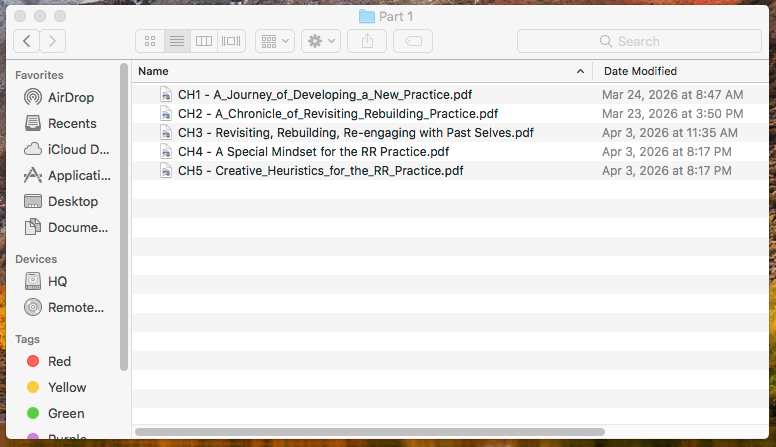
Chapter 1 documents this journey in full: the editorial rhythm that initiated it, the annual themes that framed it, the moment it became a formal research project, the encounter with Bob that revealed its deepest dimension. Chapter 2 provides a chronological chronicle of all documented RR instances across the period. Chapter 3 introduces the theoretical framework that makes sense of the journey: the concept of Past Selves as the deeper object of RR practice, and the Life-as-Activity Approach that grounds it.
Two shorter essays follow as preparation for the case studies in Part 2: A Special Mindset for the RR Practice describes the cognitive reorientations that make RR practice possible, and Creative Heuristics for the RR Practice describes the specific strategies and techniques that have proven most generative. Together, they provide a map of the terrain that the cases in Part 2 navigate in detail.
Part 1 is the distilled essence of the collection. Readers with limited time will find everything they need here. Those who continue will find Part 1 expanding, chapter by chapter, across the five parts that follow.
Chapter 1: A Journey of Developing a New Practice (Possible Press Only)
- The Beginning - A Column Born from a Completed Journey (September 2025)
- The Annual Theme: Re-engagement and Co-becoming (December 31, 2025)
- RR as an Organizing Strategy: The Four Bureaus of Agency (Journary - March 2016)
- RR Becomes a Research Project (January 25, 2026)
- Bob and the Mirror of a Past Self (March 2026)
- The 2018 Watershed: How the Past Got Left Behind
- Re-engaging with Past Selves: A New Theme Emerges (March 2026)
- Weaving the RR Journey
- The Fractal Pattern
Chapter 2: A Chronicle of Revisting-Rebuilding Practice
- The Practitioner’s Archive
- The Theorist’s Archive
Chapter 3: Revisiting, Rebuilding, Re-engaging with Past Selves
- The Selves We Might Have Been — and the Selves We Actually Were
- From Possible Selves to Past Selves: A Theoretical Extension
- The LARGE Method as First Principle
- The Life-as-Activity Approach: Activity-Centered and Cognition-Sensitive
- Activity and Cognition: Why Past Selves Are More Than Memories
- The Microdynamics of Creative Identity: A More Flexible Architecture
- Weaving Time and Space
- Identity as Resource, Not Constraint
- An Invitation
Chapter 4: A Special Mindset for the RR Practice
- The Past Is a Depth, Not an Archive
- Unfinished, Not Failed
- Dormancy Is Accumulation
- Main and Side Are Not Fixed
- Identity as Resource, Not Constraint
Chapter 5: Creative Heuristics for the RR Practice
- The Present Calls the Past Forward
- Not the First Version - the Optimal Version
- Dormancy Is Not Inactivity
- Structural Resonance as a Trigger for Integration
- Two Types of Rebuilding from the Same Source
- The History Versus the Logic of a Development
- Curation Creates Future Splitivity
- Scanning Side Episodes for Hidden Themes
Part 2:Advancing and Analyzing
This part is the empirical heart of the collection: seven case studies, each documenting a specific instance of Revisiting and Rebuilding practice across time spans ranging from eight to eleven years. Each chapter is organized as a double entry — A and B — directly enacting the AA (Advancing and Analyzing) principle that gives this part its name.
The A entry is the creative output itself: the framework, concept, or method that emerged from the RR operation. The B entry is the case study of how that output came to be — the historical sequence of events, the triggers and mental moves, the type of rebuilding involved, the theoretical resources that made it possible. Reading A and B together, the reader encounters both the product of creative work and the process that generated it. These are two different kinds of knowledge, and both are necessary for understanding what RR practice actually does.
The seven cases are not uniform. The first two — A Thematic Trip and Activity as Container — were written before the RR research method had fully crystallized, and carry a more essayistic character. The remaining five — the LARGE Method, Mindentity, the DDD Model, the Learning Landscape, and the Significant Themes Framework — are formal case studies produced after the method's establishment in January 2026, with increasing analytical precision and comparative depth.
This variation is itself meaningful. Reading across the seven cases, the reader witnesses the RR research method growing and maturing — the B entries becoming more structured, the comparative analysis becoming richer, the vocabulary more precise. Part 2 is not only a collection of case studies. It is a record of a research method finding its form.
Across the seven cases, four distinct types of RR operation are documented: ontological completion (Mindentity), methodological elevation (LARGE Method), foundational revelation (Learning Landscape), and component liberation (Significant Themes). Together they demonstrate that RR is not a single operation but a family of operations, unified by the structural feature of returning to dormant work with accumulated theoretical resources, and differentiated by the type of transformation that results.
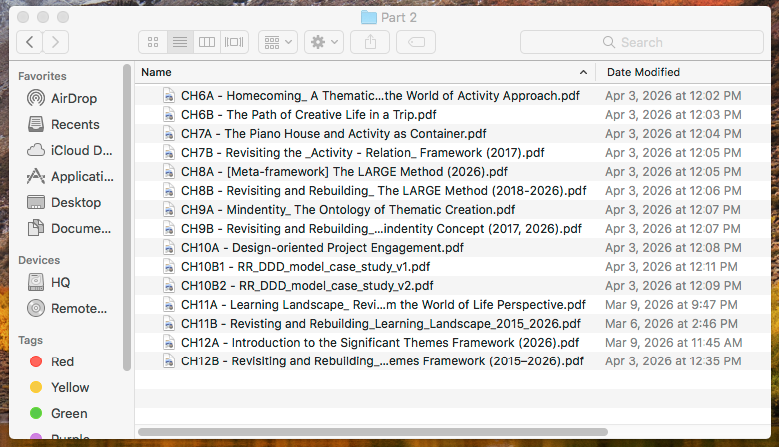
Chapter 6: A Thematic Trip
- A - A Thematic Trip and the World of Activity Approach
- B - The Path of Creative Life in a Trip
Chapter 7: Activity as Container
- A - The Piano House and Activity as Container
- B - Revisiting the "Activity - Relation" Framework (2017)
Chapter 8: The LARGE Method
- A - [Meta-framework] The LARGE Method (2026)
- B - Revisiting and Rebuilding: The LARGE Method (2018-2026)
Chapter 9: The Concept of Mindentity
- A - Mindentity: The Ontology of Thematic Creation
- B - Revisiting and Rebuilding: The Mindentity Concept (2017, 2026)
Chapter 10: The Discover-Design-Deliver Model
- A - Design-oriented Project Engagement
- B1 - Revisiting and Rebuilding: The Discover-Design-Deliver Model (2023-2026) - v1.0
- B2 - Revisiting and Rebuilding: The Discover-Design-Deliver Model (2023-2026) - v2.0
Chapter 11: Learning Landscape
- A - Learning Landscape: Revisiting from the World of Life Perspective
- B - Revisiting and Rebuilding: The Learning Landscape Framework (2015-2026)
Chapter 12: The Significant Themes Framework
- A - Introduction to the Significant Themes Framework (2026, v1)
- B - Revisiting and Rebuilding: The Significant Themes Framework (2015–2026)
Part 3: Significant Themes
This part originated as a by-product. While working on the Significant Themes case study in Part 2, a complete framework emerged for understanding the key developmental themes of a creative life — the recurring patterns of transition, transformation, and redirection that any person who develops seriously as a creator will encounter. That framework, and the case studies it generated, constitute this part.
The Significant Themes Framework is organized around the FFCC schema (Flow-Focus-Center-Circle) and structured through Ecological Formism into four layers: Invariant (the FFCC schema itself), Quasi-invariant (cross-human developmental patterns), Variant (situationally triggered themes), and Invariant Set (Life Themes as an open category). This architecture ensures that the framework maintains abstract simplicity while accommodating the full diversity of lived creative development.
Chapter 11 presents the framework in full. Chapters 12 and 13 develop eight case studies — four Regular Significant Themes (Cutting the Flow, Blooming the Center, Rescue the Center, Flourishing the Circle) and four Special Significant Themes (Study Abroad and Repatriation, Becoming a Mother, Inheritance and Transcendence, Aging and Caring). Each case study uses the Weave-the-System analytical method to develop the theme across four dimensions: Life Performance, Life Discovery, Detecting Contradictions, and Exploring Themes.
Chapter 14 adds a further dimension: the Re-engagement theme, which served as one of the author's annual themes for 2026 and directly shaped the development of the RR practice documented in Part 1. Re-engagement is presented here as a situated case study — a specific individual, at a specific period, enacting a significant theme. It connects the book's theoretical concerns to the particular creative season in which it was written, and demonstrates how a significant theme operates not only as a typological category but as a lived orientation.
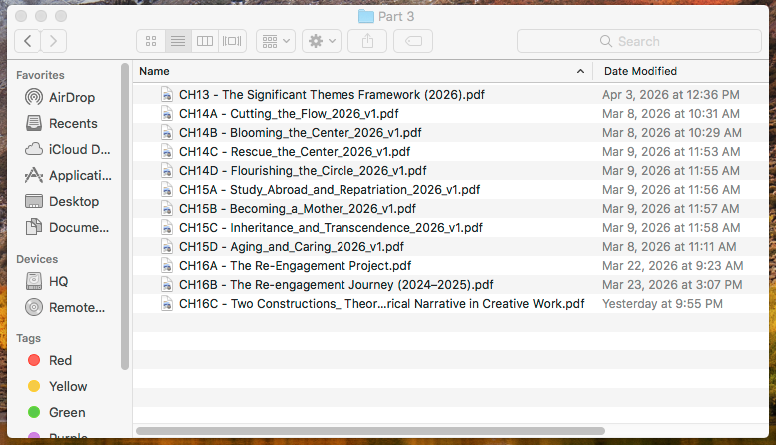
Chapter 13: The Significant Themes Framework (2026, v1) - Full version
Chapter 14: Regular Significant Themes (4 case studies)
- Cutting the Flow (2026, v1)
- Blooming the Center (2026, v1)
- Rescue the Center (2026, v1)
- Flourishing the Circle (2026, v1)
Chapter 15: Special Significant Themes (4 case studies)
- Study Abroad and Repatriation (2026, v1)
- Becoming a Mother (2026, v1)
- Inheritance and Transcendence (2026, v1)
- Aging and Caring (2026, v1)
Chapter 16: The “Re-engagement” Theme
- The Re-Engagement Project
- The Re-Engagement Journey (2024-2025)
- Two Constructions: Theoretical Statement and Historical Narrative in Creative Work
Part 4:Five-space Model
This part presents a strategic mapping tool developed in 2022, well before the RR practice had taken its current form. The Five-space Model organizes the terrain of Strategic Curation activity across five thematic spaces: Experience Space (facts of the past), Challenge Space (problems of the present), Response Space (solutions for the future), Reference Space (validated knowledge for thinking), and Speculative Space (imaginative and counterfactual thinking).
At the time of its development, the Five-space Model was used as a framework for understanding Ecological Strategic Cognition — how a creator navigates the full strategic landscape of a knowledge development project. It proved useful in practice, but its connection to the broader theoretical architecture was not yet fully articulated.
Placed here, after the case studies of Part 2 and the life themes of Part 3, the Five-space Model finds its most natural theoretical home. Strategic Curation is one of the core mechanisms of the Anticipatory Cultural Sociology (ACS) framework, and the LARGE Method — developed to its full form in Part 2 — provides the governing meta-method for the kind of temporal and spatial thinking the Five-space Model operationalizes. The model can now be understood as a concrete implementation of the LARGE Method's principles at the level of individual strategic decisions: how to position past experience, present challenges, future responses, reference knowledge, and speculative thinking in relation to each other within a single creative session or project.
For readers engaged in their own knowledge development projects, this part offers the most directly applicable tools in the collection — a practical map for thinking through the strategic dimensions of any RR operation, and a framework for understanding how different types of knowledge interact within the creative process.
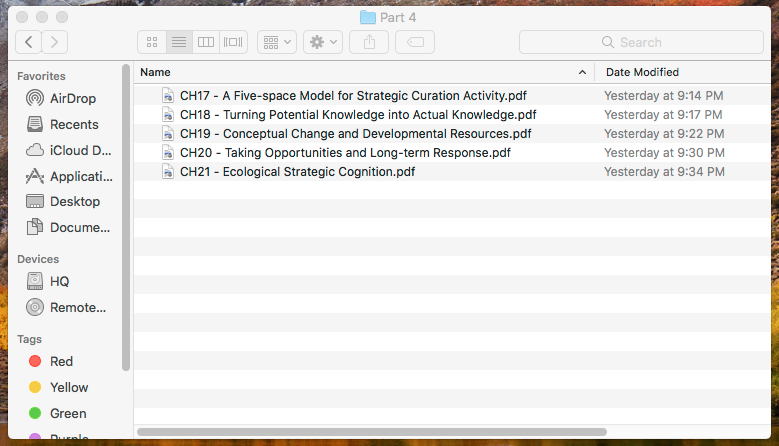
Chapter 17: A Five-space Model for Strategic Curation Activity
Chapter 18: Turning Potential Knowledge into Actual Knowledge
Chapter 19: Conceptual Change and Developmental Resources
Chapter 20: Taking Opportunities and Long-term Response
Chapter 21: Ecological Strategic Cognition
Part 5:Creative Identity Cascade
This part arrives after the cases, the themes, and the strategic tools — deliberately so. The theoretical framework it presents is most legible when read with the evidence of the preceding parts already in view. The concepts introduced here — the Agency Cascade, the four types of creative identity, the Self-Other relationship across time — will not feel like abstractions imposed from outside but like names for patterns the reader has already encountered in the cases and themes.
The central claim of this part is that creative development unfolds not as the expression of a single, stable identity but as a progressive cascade through a series of creative identities, each enabled by the one before it. In the Agency Cascade model, the Other of each level becomes the Self of the next: the Practitioner becomes the Reflector, the Reflector becomes the Modeler, the Modeler becomes the Curator. Each transition is a genuine transformation — not just a change in what you do, but a change in who you are.
This cascade operates not only across the levels of a single creative life but across time. When the present self revisits the work of a past self, the past creative identity — the one who made that work — becomes the Other through whom the present self develops. Revisiting and Rebuilding is, at its deepest level, the enactment of this diachronic Self-Other relationship: the past self becomes the raw material that the present self transforms through the act of rebuilding.
The chapters in this part also address the relational dimensions of creative identity development — how identity develops not only through solo creative work but through engagement with others, how one person's creative development can support another's, and how the broader cultural and social dimensions of identity connect to the individual creative enterprise. These concerns link Part 5 directly to the Supportive Life Discovery framework introduced in the Epilogue.
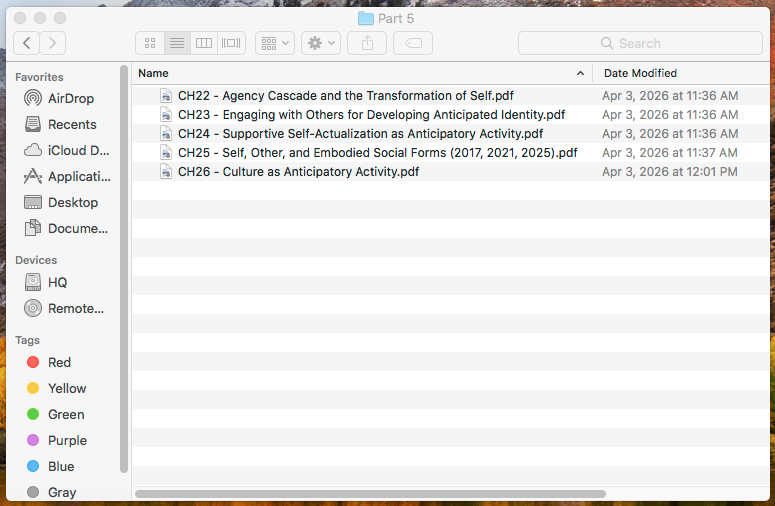
Chapter 22: Revisiting-Rebuilding: Agency Cascade and the Transformation of Self
- Theoretical Foundations
- The LARGE Method Case Study
- Creative Identity Cascade
- Comparative Framework Analysis
- Synthesis
- Conclusion
Chapter 23: Engaging with Others for Developing Anticipated Identity
- Theoretical Foundations
- Others as Creative Predecessors
- Engaging with Others — Six Case Studies
- Creative Identity Resonance
- Synthesis and Conclusions
Chapter 24: Supportive Self-Actualization as Anticipatory Activity
- Self, Other, and Ecological Relevance
- Expanding the Boundaries of Self
- Reconsidering Self-Actualization
- Positive and Negative Frontiers
- Supportive Life Discovery
- Theoretical Reflection
- Conclusion: Self, Other, and Social Forms
Chapter 25: Self, Other, and Embodied Social Forms (2017, 2021, 2025)
- This post is part of the "Appropriating Activity Theory" series, which reflects my creative journey of engaging with Activity Theory from 2015 to 2025.
Chapter 26: Culture as Anticipatory Activity: The Agency Cascade Model
- Three Concepts, One Ontological Spectrum
- Deepening the Foundation: From Operations to Ontology
- The Agency Cascade: Four Levels of Cultural Development
- Transitions: Attachance as the Engine of the Cascade
- The Ontological Depth of the Operational Framework
- Conclusion
Part 6:Weave the Life
This part presents the analytical infrastructure that runs beneath the entire collection: the Weave family of models, a distinctive knowledge system built around a single basic form — the # symbol — that supports both diachronic and synchronic analysis simultaneously.
The Weave basic form generates a family of related models, each addressing a different level or dimension of creative life analysis. The Weave-the-Life Framework (v2.0) provides the foundational architecture, showing how individual projects unfold into the larger fabric of a life. Weave-the-System is the analytical method used in Part 3 to develop each Significant Theme across four dimensions. Weave-the-Theory is the model used in Chapter 26 to analyze the RR journey itself at the level of theoretical development — tracing how a theme becomes a model, a model becomes a concept, and a concept becomes a governing principle. Weave 42, the final chapter, extends the framework to its largest scale: the building of knowledge ecologies across scales.
The Weave knowledge system is not merely a set of diagrams. It is a thinking infrastructure — one that has proven capable of operating at the scale of a single afternoon's creative session and at the scale of a decade-long research program. Its key property is that it holds diachronic and synchronic dimensions together: the vertical threads run through time, the horizontal threads cut across the present moment, and where they intersect, the specific creative acts and outcomes of a life become analytically visible.
The final two chapters bring the Weave tools to bear on the question of creative identity development. The Thematic Identity Curation Framework and the Aion-Chronos-Kairos Schema together provide the methodological apparatus for curating life themes and identities across the dimensions of time — connecting the analytical tools of Part 6 to the theoretical framework of Part 5, and closing the circle of the collection.
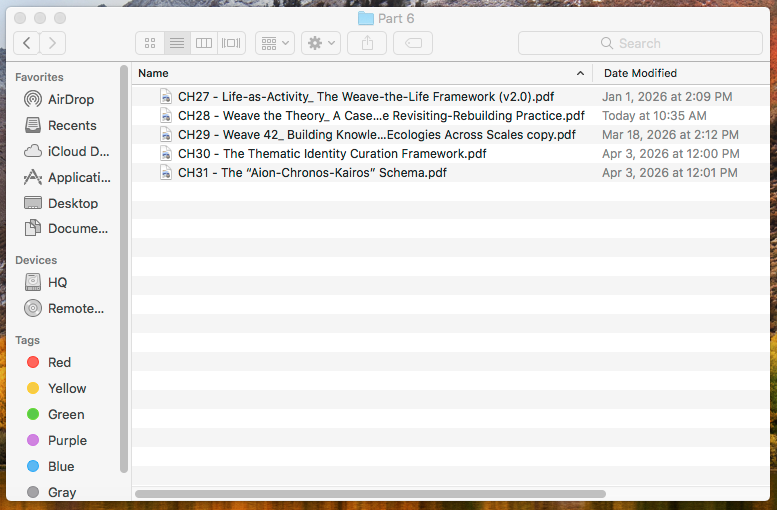
Chapter 27: Life-as-Activity: The Weave-the-Life Framework (v2.0)
- The Initial Idea: The Weave-the-Life Model
- A Series of Frameworks
- The Weave-the-System Framework
- The Weave-the-Project Framework
- The Weave-the-Case Framework
- Connect the Chain, Weave the Life
Chapter 28: Weaving the RR Journey
- The Weave-the-Theory Framework
- Theme: Revisiting–Rebuilding
- Model: AA and the Creative Identity Cascade
- Concept: Re-Engagement
- Principle: L(A·R·G)=E
Chapter 29: Weave 42: Building Knowledge Ecologies Across Scales
- The Art of Methodological Delivery
- The Invariant Layer — Generating the Basic Form
- The Quasi-Invariant Layer — Generating Derived Frameworks
- The Variant Layer — Applying Frameworks to Situational Cases
- Weave, Ecological Formism, and the Knowledge Ecology
- A Knowledge Ecology in Mind
Chapter 30: The Thematic Identity Curation Framework
- Themes, Identity, and Project Engagement
- Thematic Curation as Identity Building
- Thematic Echo
- Thematic Blend
- Case Study: The Thematic Blend of "Theoretical Integration"
- Thematic Integration
- Creative Projects
- The Power of Creative Space
- Identity Development
- The Microdynamics of Creative Identity
- Conclusion: Bridging Thematic Curation and Identity Development
Chapter 31: The “Aion-Chronos-Kairos” Schema
- Aion, Chronos, and Kairos
- Aion Space, Chronos Space, and Time Curation
- Aion Space, Chronos Space, and Space Curation
- Projected Identity @ Chronos Space
- Creative Identity @ Aion Space
- Anticipated Identity @ Aion Space
- Narrative Identity @ Chronos Space
- Kairos Space, Attachance, and Curativity
- Wonder and Wander
Epilogue: The World of Activity of Mid-life
- The Mid-career Curation Program (2024)
- From Creative Life Theory to the World of Activity
- The L3D Model and Supportive Life Discovery
- The World of Activity Toolkit v2.0
- Returning to Mid-life
v1.0 - April 6, 2026 - 5,345 words