
Revisiting and Rebuilding: The Mindentity Concept (2017, 2026)
An experimental exploration of an overlooked creative cognitive process
by Oliver Ding
with Google Notebook LM & Claude
January 25, 2026
Contents
1. Introduction: The Creative Heuristic of ‘Revisiting and Rebuilding’
1.1 The Purpose of this Analysis
1.2 The Case Study: A Historical Overview
2. Revisiting the Genesis: ‘Mindentity’ in 2017
2.1 The Core Definition and ‘Talent Ecosystem’ Framework
2.2 The Analytical Lens: The ‘Resource-Development’ Perspective
2.3 A Novel Contribution: The Concept of ‘Occupancy’
3. Rediscovering the Breakthrough: ‘Mindentity’ in 2018
3.1 Four Catalyzing Insights
3.2 The Breakthrough: A New Ontological Foundation
3.3 From Economic Specificity to Ontological Framework
3.4 Theoretical Integration: The ABCD Framework
3.5 Community Theory Validation
4. Rebuilding for the Present: Recontextualizing ‘Mindentity’ in 2026
4.1 Project Engagement: The “Culture as Thematic Enterprise” Framework 4.2 Rediscovering Mindentity: A New Formation and Mental Moves
4.3 Reattaching Mindentity: A New Synthesis and Strategic Curation
5. The ‘Revisiting and Rebuilding’ Heuristic in Practice
5.1 Deconstructing the Process: Key Principles
5.2 Practical Guidance and Considerations
5.3 The Unique Value of the Heuristic
6. Contribution to Anticipatory Cultural Sociology
6.1 Showcases of Core Mechanisms
6.2 The Nature of Concept System Creation
6.3 Practical and Theoretical Synthesis
Revisiting and Rebuilding: The Mindentity Concept (2017, 2026)
An experimental exploration of an overlooked creative cognitive process
by Google Notebook LM & Claude
Based on Oliver Ding’s creations
January 24, 2206
Contents
1. Introduction: The Creative Heuristic of ‘Revisiting and Rebuilding’
1.1 The Purpose of this Analysis
1.2 The Case Study: A Historical Overview
2. Revisiting the Genesis: ‘Mindentity’ in 2017
2.1 The Core Definition and ‘Talent Ecosystem’ Framework
2.2 The Analytical Lens: The ‘Resource-Development’ Perspective
2.3 A Novel Contribution: The Concept of ‘Occupancy’
3. Rediscovering the Breakthrough: ‘Mindentity’ in 2018
3.1 Four Catalyzing Insights
3.2 The Breakthrough: A New Ontological Foundation
3.3 From Economic Specificity to Ontological Framework
3.4 Theoretical Integration: The ABCD Framework
3.5 Community Theory Validation
4. Rebuilding for the Present: Recontextualizing ‘Mindentity’ in 2026
4.1 Project Engagement: The “Culture as Thematic Enterprise” Framework 4.2 Rediscovering Mindentity: A New Formation and Mental Moves
4.3 Reattaching Mindentity: A New Synthesis and Strategic Curation
5. The ‘Revisiting and Rebuilding’ Heuristic in Practice
5.1 Deconstructing the Process: Key Principles
5.2 Practical Guidance and Considerations
5.3 The Unique Value of the Heuristic
6. Contribution to Anticipatory Cultural Sociology
6.1 Showcases of Core Mechanisms
6.2 The Nature of Concept System Creation
6.3 Practical and Theoretical Synthesis
1. Introduction: The Creative Heuristic of ‘Revisiting and Rebuilding’
This document presents an experimental exploration into a powerful yet often overlooked creative cognitive process: “Revisiting and Rebuilding.”
Its purpose is to analyze how an early-stage concept, even one that has lain dormant for years, can be revived, re-contextualized within a current intellectual landscape, and integrated into new theoretical structures to expand its original meaning and utility.
This process is not merely an act of retrieval but a deliberate strategy for intellectual innovation, creating a dialogue between past and present work.
1.1 The Purpose of this Analysis
The core objective of this analysis is to deconstruct and understand a practical heuristic for intellectual innovation by using Oliver Ding’s “Mindentity” concept as a detailed case study. By tracing the evolution of this single idea from its inception to its recent reintegration, this exploration tests a method for fostering conceptual continuity and evolving a personal body of knowledge over time.
The journey of “Mindentity” serves as a tangible example of how old intellectual assets can be repurposed to solve new theoretical problems.
Beyond demonstrating a creative heuristic, this case study serves a dual theoretical purpose: it provides empirical evidence for two core mechanisms of the Anticipatory Cultural Sociology (ACS) framework — Mental Moves and Strategic Curation — while illustrating how concept systems are created through anticipatory activity in cultural development.
1.2 The Case Study: A Historical Overview of the ‘Mindentity’ Concept
The central subject of this analysis is the “Mindentity” concept, which underwent a three-stage evolution.
First conceived in August 2017 within the context of a “Talent Ecosystem,” the concept represented a novel organizational form designed for the mind-economy.
The concept experienced a critical reconceptualization in January 2018 through email exchanges that fundamentally shifted its ontological foundation. This breakthrough, documented in informal correspondence, stripped away the economic specificity while establishing a new ontological framework (Legal Level vs. Psychological Level) and analytical template that would prove crucial eight years later.
After a period of dormancy from 2018–2025, the concept re-engaged in January 2026 with strategic integration into the Anticipatory Cultural Sociology (ACS) framework, specifically within the “Culture as Thematic Enterprise” model.
This report will trace this three-stage trajectory:
- Examining the 2017 genesis and its theoretical context
- Analyzing the 2018 breakthrough — a previously overlooked but crucial stage that achieved definitional clarity
- Exploring the 2026 strategic integration that completed the analytical framework through mental moves and strategic curation
Understanding this complete trajectory is essential for appreciating how the “Revisiting and Rebuilding” heuristic operates in practice, and more importantly, how it demonstrates the operation of core mechanisms within Anticipatory Cultural Sociology.
2. Revisiting the Genesis: Mindentity in 2017
To understand the strategic value of “Revisiting and Rebuilding,” one must first grasp the original state of the asset being revisited. A concept’s origin contains the intellectual DNA that informs its future potential.
This section dissects the initial 2017 formulation of “Mindentity” as presented in the “Mindentity_v5” conceptual deck, establishing a clear baseline for its later transformation.
2.1 The Core Definition and ‘Talent Ecosystem’ Framework
In its 2017 incarnation, the concept of “Mindentity” was explicitly defined as an abbreviation for “Mind-economy Entity”. It was positioned as a novel organizational form designed to operate within a broader “Talent Ecosystem”. This ecosystem was composed of three core elements, creating a dynamic social space for development:
● Individual
● Organization
● Field, a concept explicitly borrowed from the work of French sociologist Pierre Bourdieu
Within this structure, a Mindentity offered individuals a new mode of existence and interaction. The 2017 framework further proposed a typology of Mindentities (Types A, B, and C) that functioned as different mediating structures between the individual, the organization, and the field, highlighting its nuanced role within the ecosystem.
2.2 The Analytical Lens: The ‘Resource-Development’ Perspective
The 2017 framework was analyzed through a primary lens called the “Resource-Development” perspective. This multi-layered approach integrated theories from various disciplines to examine how individuals and groups acquire and utilize resources for their own development. The perspective was constituted by four distinct analytical levels:
● Macro-resourceLevel: Drawing from the fields of Biological Evolution and Niche Construction Theory, this level examined large-scale environmental and adaptive pressures.
● Micro-resourceLevel: Focusing on the immediate environment, this level drew from Ecological Psychology and James J. Gibson’s Affordance Theory.
● CulturalDevelopmentLevel: This level applied concepts from Sociology, particularly Ann Swidler’s theory of “Culture as a toolkit,” viewing culture as a resource for action.
● Self-developmentLevel: Drawing from Developmental Psychology, this level utilized “Constructive-developmental” theory to understand individual growth.
The original formulation explicitly categorized these levels, with the Macro-resource and Micro-resource tiers oriented toward “Resource” and the Cultural Development and Self-development tiers oriented toward “Development”.
2.3 A Novel Contribution: The Concept of ‘Occupancy’
In a move to correct a perceived asymmetry in Gibson’s Affordance theory, Ding introduced the complementary concept of “Occupancy”.
Where Affordance describes what the environment offers an individual (an active perspective), Occupancy describes how the environment, objects, and activities claim an individual’s resources (a passive perspective). It represents a fundamental shift in voice from “we use an object” to “we are occupied by an object.”
This concept is illustrated through several tangible examples:
● The piano occupies us.
● The bicycle occupies us.
● A birthday party occupies us.
● An ideology occupies us.
The framework further distinguishes between positive occupancy (an activity that benefits the individual) and negative occupancy (an activity that is detrimental, such as an addiction). This original concept provided a powerful tool for analyzing the microdynamics of resource allocation at the individual level.
With this detailed look at the past established, we can now turn to the concept’s re-emergence in a new and dynamic intellectual context.
With the 2017 formulation now established, we might expect the next section to jump directly to 2026. However, careful examination of Ding’s archives reveals a critical intermediate stage that has been overlooked in previous accounts: the January 2018 conceptual breakthrough that fundamentally transformed the concept’s definition and theoretical foundation.
This discovery changes our understanding of what was actually “revisited” in 2026. The 2026 work did not build on the 2017 version, but rather adopted and extended the 2018 refinement. Understanding this intermediate stage is crucial for grasping both the “Revisiting and Rebuilding” heuristic and the role of Mental Moves in conceptual development.
3. Rediscovering the Breakthrough: Mindentity in 2018
Between the 2017 “Mindentity_v5” presentation and its 2026 revival lies a critical but previously overlooked intermediate stage: a January 2018 email exchange that fundamentally redefined the concept’s theoretical foundation.
This section reveals that the “Revisiting and Rebuilding” process was not a simple 2017→2026 leap, but rather a 2017→2018→2026 trajectory, where the 2018 refinement provided the conceptual DNA for the 2026 integration.
3.1 Four Catalyzing Insights
In a January 25, 2018 email to his friend Neo, Ding outlined four distinct lines of thought that converged to produce a breakthrough in understanding Mindentity:
Insight 1: The Concept of “Internet Entity”
While analyzing internet industry development through a “Container View”, Ding introduced the term “Entity” to designate containers that host people’s activities online. He identified four archetypal internet entities:
- Platform (e.g., WeChat, Facebook, Google)
- Media (e.g., NYTimes.com, TED.com)
- Community (e.g., decentralized communities across platforms)
- Tool (e.g., Workflowy, Evernote)
This work established “Entity” as a legal-level concept with clear physical or corporate boundaries.
Insight 2: Blockchain and Organizational Ambiguity
While studying blockchain materials in late 2017, Ding noticed a paradox: blockchain projects often lacked clear legal status or organizational form, yet possessed an undeniable social reality through consensus and community participation.
The existing legal framework could not adequately classify these formations. Ding realized that Mindentity could accommodate this new organizational mode that existed beyond traditional legal categories — a serendipitous validation of the concept’s theoretical power.
Insight 3: Psychological Ownership Theory
In early January 2018, Ding encountered a pivotal paper on Psychological Ownership from organizational behavior research. The theory distinguishes between:
- Legal Ownership: formal, juridical possession
- Psychological Ownership: the feeling that “this is mine”
The theory identifies three sources of psychological ownership:
- Control: exclusive authority over the object
- Intimate Knowledge: deep, detailed understanding
- Self-Investment: time, energy, and personal data embedded in the object
This distinction provided a methodological template: just as psychological ownership operates at a different ontological level than legal ownership, Mindentity could be defined at the psychological level as distinct from Entity at the legal level.
Insight 4: The Kindergarten Case
Ding’s son’s kindergarten was acquired by another institution. Despite the ownership change and name change, the core experience — teachers, curriculum, daily routines — remained largely unchanged.
This personal observation illustrated a crucial point: the same Entity (legal form) can persist despite transformations in ownership, while the Mindentity (psychological reality) can remain stable across legal discontinuities.
Ding’s wife, a professional tax advisor, reinforced this insight by noting that tax identification numbers remain constant despite name changes, just as Social Security numbers persist when women change surnames after marriage.
3.2 The Breakthrough: A New Ontological Foundation
These four insights converged to produce a fundamental reconceptualization. On January 25, 2018, Ding proposed a new ontological framework distinguishing two levels:
Entity
- Operates at the Legal Level
- Clear physical or corporate boundaries
- Formal ownership structure
Mindentity
- Operates at the Psychological Level
- Defined by psychological reality and consensus
- May lack clear legal boundaries
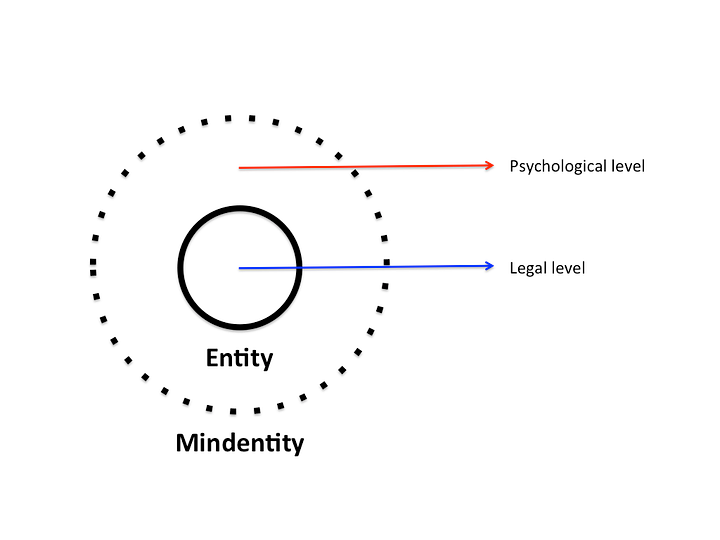
This framework established an ontological distinction without yet formulating a complete formal definition of what Mindentity is. This led to the formulation of four principles:
Principle 1: All Entities are Mindentities.
Principle 2: Not all Mindentities are Entities — Mindentity is a broader ontological category.
Principle 3: All Entities have both a legal definition and a psychological meaning.
Principle 4: Some Mindentities have ambiguous or absent legal definition, but possess clear psychological meaning.
3.3 From Economic Specificity to Ontological Framework
The critical transformation in 2018 was the shift from economic context to ontological analysis:
2017 Framing:
- Mindentity = “Mind-economy Entity”
- Specific organizational form within Talent Ecosystem
- Economic and organizational focus
2018 Reconceptualization:
- Shifted to ontological distinction: Legal Level vs. Psychological Level
- Established four principles about Entity-Mindentity relationship
- Introduced Psychological Ownership as an analytical template
- But did not yet formulated in a concise formal definition
This 2018 reconceptualization provided crucial conceptual resources — an ontological framework and analytical template — that would enable the 2026 definitional and formational work. The economic specificity was stripped away, but the full definitional articulation remained to be developed.
3.4 Theoretical Integration: The ABCD Framework
Neo’s January 27, 2018 response introduced a relevant framework from Li Xiaoxu’s book, proposing four worlds:
- A (Atom): Physical world
- B (Bit): Signal world
- C (Conscious): Consciousness world
- D (iDea): Realm of ideas
Neo suggested that Entity and Mindentity, as well as ownership and the sense of ownership, belong to the C-D worlds — the realm of consciousness and ideas.
Ding’s response refined this further, proposing a micro-macro structure for each level:
- Physical world: Atom (micro) — Entity (macro)
- Bit world: Signal (micro) — Algorithm (macro)
- Mental world: Consciousness (micro) — Ideas (macro)
This exchange clarified that Mindentity operates at the macro level of the mental world — it is not merely individual consciousness, but shared ideas and collective psychological reality. However, this theoretical positioning still did not provide a complete formal definition of Mindentity’s dimensions or operational characteristics.
3.5 Community Theory Validation
Shortly after (date unclear from email), Ding encountered research on virtual communities that reinforced his framework. He discovered the concept of “Psychological Sense of Community” defined as:
“Members’ feeling of shared emotional attachment, belonging, influence, and the integration and fulfillment of needs that makes the community different from simply a group of individuals.” (McMillian & Chavis, 1986)
This validated that:
- The distinction between legal form and psychological reality was already established in community research
- Virtual communities demonstrate that psychological sense can exist without clear physical or legal boundaries
- His Mindentity concept aligned with existing theoretical traditions
Ding reflected:
“This Psychological Sense of Community is exactly a kind of psychological feeling. This is consistent with my approach of distinguishing ‘Entity’ from ‘Mindentity.’ Conversely, this also supports my defination of Mindentity.”
4. Rebuilding for the Present: Re-engaging with ‘Mindentity’ in 2026
This section bridges the past and the present, exploring the intellectual landscape into which the “Mindentity” concept was revived. After nearly eight years of dormancy, the concept’s re-emergence appears to be a deliberate act of theoretical development and theoretical formulation, reflecting a significant shift in the author’s overarching project — from an economic and organizational focus toward a grander theory of cultural innovation. This new context provided the ideal environment to strategically revive the “Mindentity” concept, giving it a new purpose and a more central role.
4.1 Project Engagement: The ‘Culture as Thematic Enterprise’ Framework
In 2025, Ding introduced the “Culture as Thematic Enterprise” framework, a comprehensive model designed to articulate how individual creative life can evolve into broader cultural movements. The framework outlines a four-stage evolutionary path for cultural innovation, where each stage possesses independent value but can lead organically to the next.
- Creative Life: The initial stage of personal meaning discovery and thematic exploration.
- Tiny Culture: The development of a scalable focus around a central theme or idea.
- Cultural Center: The establishment of a key function that supports and organizes the tiny culture.
- Cultural Movement: The expansion of the cultural center into a broader social phenomenon.
This entire process is organized by the “Flow-Focus-Center-Circle” schema, a scale-free model that integrates different layers of existence. Rather than being purely abstract, the schema’s operation can be understood through a personal anecdote Ding provided from his morning run on September 11th:
- Flow (Experiential Layer): While jogging, Ding saw flags at half-mast, which immediately brought the date, 9/11, into his lived experience.
- Focus (Consciousness Layer): This visual trigger activated a thematic connection in his consciousness, linking the memory of 9/11 to a past “Curation as Memorial” project and his more recent work on “Thematic Enterprise as Tiny Culture.”
- Center (ActionLayer): The convergence of these focused themes crystallized into a concrete decision — an action to reactivate his Curation Commons project.
- Circle (Social Interaction Layer): This personal decision was then situated within the broader social context of 9/11, historical conflicts, and ongoing ideological tensions shaping society.
This example grounds the schema in a tangible cognitive process, demonstrating how it connects personal experience to collective action and social meaning.
On January 5, 2026, Ding curated the framework with others to form a new thematic enterprise: the “Anticipatory Cultural Sociology (ACS)” Framework.
In this new framework, the social world is understood as a nested AAS (Anticipatory Activity System), while Cultural development, in this view, is a continuous, dynamic anticipatory activity of creating and curating concept systems and transforming them into thematic enterprises by weaving active agency and evolving structure within the social world.
This framework makes it necessary to clarify the status of early creative results that exist before they become enterprises — a gap addressed by the concept of Mindentity.
4.2 Rediscovering Mindentity: A New Formation and Mental Moves
Within this new landscape, the “Mindentity” concept was reintroduced and fundamentally reformulated, stripped of its original “Mind-economy Entity” label and repositioned within the broader “Anticipatory Cultural Sociology” framework.
The 2018 email provided crucial conceptual resources that informed the 2026 work:
- Ontological Framework: The Legal Level vs. Psychological Level distinction
- Four Principles: Articulating the relationship between Entity and Mindentity
- Analytical Template: The Psychological Ownership framework with three dimensions (Control, Intimate Knowledge, Self-Investment)
However, the 2018 work did not formulate a complete formal definition of Mindentity. What it provided was a conceptual framework and analytical starting point — the full definitional and formational work remained to be done.
In 2026, Mindentity was given a dual-dimension definition that bridges the creator’s internal world with the external ecological system:
The Subjective Dimension: Psychological Ownership
- Control: exclusive authority over the object’s evolution
- Intimate Knowledge: deep understanding of its internal logic
- Self-Investment: time, energy, and identity embedded in it
The Objective Dimension: Ecological Objectification
- Symbol: naming and rendering communicable
- Instrument: creating tangible artifacts
- Practice: embedding into recurring social practices
A Mindentity reaches Minimum Viable Unit (MVU) status when both dimensions are present, even in minimal form.
In the ACS framework, Mindentity is positioned within the Result–Reward schema. In this schema, Mindentity functions as the Result that exists first without external reward, purely as a manifestation of the creator’s psychological ownership and ecological objectification. It marks the moment when creative intention becomes a tangible reality and private vision attains its first form of public existence.
This systematic positioning leads to the formulation of the First Principle of Thematic Creation: all results of thematic creation are Mindentity first. Before recognition, before reward, before legal status or institutional validation, the creative work exists as Mindentity — anchored in the creator’s psychological ownership (control, intimate knowledge, self-investment) and beginning its journey toward ecological objectification (symbolic, instrumental, practical).
The 2026 dual-dimension framework was not a simple direct application of 2018’s conceptual resources. In January 2026, while developing the analytical framework for Mindentity within the ACS project, Ding performed mental moves across multiple thematic spaces:
From the “Psychological Ownership” thematic space, he retrieved the three-dimensional structure encountered in the 2018 email:
- Control
- Intimate Knowledge
- Self-Investment
From the “Activity Theory” thematic space, he retrieved the objectification of concept framework developed through recent engagement with Andy Blunden’s work:
- Symbol (Symbolic Objectification)
- Instrument (Instrumental Objectification)
- Practice (Practical Objectification)
These two sets of dimensions converged in a thematic space for the present project engagement, the “ACS” thematic space, where they were synthesized into a 6-dimensional analytical framework:
Subjective Dimension (from 2018):
- Control
- Intimate Knowledge
- Self-Investment
Objective Dimension (from 2026):
- Symbol
- Instrument
- Practice
This convergence was not pre-planned but emerged from the situated project engagement of the ACS thematic enterprise in January 2026.
What changed from 2018 to 2026 was the construction of a complete dual-dimension framework:
2018: Conceptual foundation
- Ontological framework (Legal vs. Psychological)
- Four principles
- Analytical template (3 dimensions from Psychological Ownership)
2026: Dual-dimension definition and complete framework
- Subjective dimension: Psychological Ownership (3 dimensions from 2018)
- Objective dimension: Ecological Objectification (3 dimensions from Activity Theory)
- MVU standard: Both dimensions must be present
- Strategic positioning within ACS
The 2026 work transformed 2018’s conceptual foundation into a complete analytical framework through mental moves — bringing together the psychological dimensions from 2018 with the ecological dimensions from recent Activity Theory engagement to construct an operationalizable dual-dimension framework.
4.3 Reattaching Mindentity: A New Synthesis and Strategic Curation
After setting the new foundation of the Mindentity concept, Ding further curated it into the ACS framework, especially pairing it with the Tiny Culture concept within the “Cultural as Theamtic Enterprise” framework.
Within the “Culture as Thematic Enterprise” framework, which outlines a four-stage evolutionary path (Creative Life → Tiny Culture → Cultural Center → Cultural Movement), Mindentity occupies a crucial position.
It serves as the Container-Containee structure with Tiny Culture:
- Mindentity (Containee): The “Thing” — a concrete anchor point, the Object around which social activity can coalesce
- Tiny Culture (Container): The “Think” — the social consciousness that forms around the Mindentity
This positioning reveals the First Principle of Thematic Creation: All results of thematic creation exist first as Mindentities — prior to recognition, reward, or institutionalization. This principle addresses a gap in cultural sociology by providing the missing ontological layer between individual creation and social institution.
The brilliance of the “Revisiting and Rebuilding” heuristic is demonstrated in the seamless integration of the old concept into the new framework. The revisited “Mindentity” and the new “Tiny Culture” concept form a powerful conceptual link. A group defined by “psychological reality and consensus” serves as the ontological precondition for the emergence of a “Tiny Culture.”
This integration creates a tight conceptual lock. A Mindentity, as a collective ideological form, represents the initial crystallization of a shared idea or belief system. This ideological core is precisely the “scalable focus” that the 2025 framework identifies as the key feature of a Tiny Culture. The rebuilt Mindentity thus becomes a foundational building block in the cultural innovation process, solving the key problem of how abstract ideas begin to take tangible, social form. This strategic synthesis moves the analysis from the specifics of the case study to a broader reflection on the creative methodology it so clearly demonstrates.
To deepen the Strategic Curation, the Activity Circle model is adopted as a meta-framework to understand the Tiny Culture (Mindentity) structure.
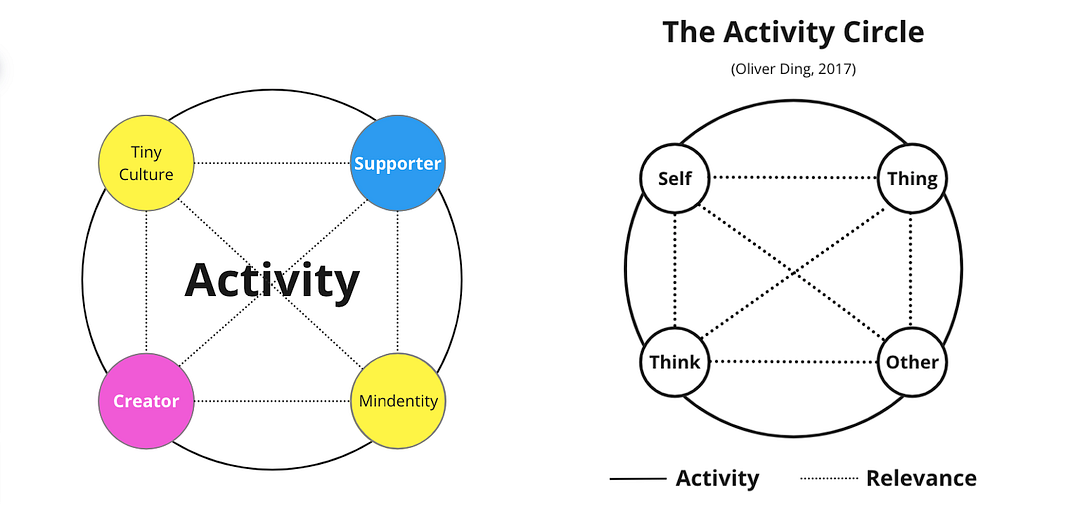
Within the framework, Tiny Culture corresponds to Focus. The Tiny Culture (Mindentity) represents a dual-focus perspective:
- Creator: the Mindentity itself
- Suppter: the Tiny Culture that engages with it
Both operate within a shared Activity Circle.
The Creator produces the Mindentity, while the Supporter cultivates the Tiny Culture by interacting with it.
This specific Activity Circle reveals a fundamental dynamic in cultural formation:
- The Mindentity serves as the “Thing”: a concrete anchor point, the Object around which social activity can coalesce. Without a Mindentity (whether it be a possible book, a software project, a theoretical framework, or an artistic creation), there is no tangible focal point for collective engagement.
- The Tiny Culture functions as the “Think”: the social consciousness that forms around the Mindentity. It emerges from the collective meaning generated by early supporters, contributors, and participants who recognize its value and invest their energy in engaging with, developing, and propagating it.
Together, this structure highlights how personal creative results (Mindentities) and emergent social consciousness (Tiny Culture) co-evolve, forming the building blocks of cultural formation.
By positioning Mindentity before Tiny Culture in the developmental sequence, we complete a crucial piece of the ontology of Thematic Enterprise. The Mindentity is the distinct object — the Result in the “Result–Reward” schema — that exists first without external reward, purely as a manifestation of the creator’s psychological ownership and ecological objectification. It marks the moment when creative intention becomes tangible reality and private vision attains its first form of public existence.
The Tiny Culture then emerges as the first social container, enabling the Mindentity to transform from individual creation into collective culture. It provides the crucial middle layer — the “missing link” in traditional cultural sociology — between the isolated creator and larger social institutions. Through Tiny Culture, the Mindentity gains initial social validation, undergoes early testing and refinement, achieves its first translations into accessible forms, and receives the protection necessary for continued development.
5. The “Revisiting and Rebuilding” Heuristic in Practice
The intellectual journey of the “Mindentity” concept from 2017 to 2026 serves as a powerful and practical illustration of the “Revisiting and Rebuilding” heuristic. This concluding section extracts the core principles of this creative method, assesses its value, and offers guidance based on the evidence presented in the case study. The heuristic is not merely about recycling old ideas but about creating a deeper, more interconnected body of work over time.
5.1 Deconstructing the Process: Key Principles of the Heuristic
Based on the Mindentity case study, the “Revisiting and Rebuilding” process can be understood through four key cognitive operations:
Situational Project Engagement
- A present project (e.g., developing the ACS framework) triggers recall of earlier conceptual work
- The recall is selective: which past work is relevant to the current project?
- In this case, the ACS project needed an ontological concept for early creative results → triggered Mindentity recall
- The recall process may identify multiple historical versions of the concept
Identifying Optimal Historical Versions
- Not all historical versions are equal — some represent breakthrough moments
- Assess which version achieved the most useful conceptual framework
- In this case, the 2018 email version provided a superior ontological foundation compared to the 2017 presentation version
- The optimal version becomes the conceptual foundation for further definitional and formational work
Mental Moves Across Thematic Spaces
- Retrieve relevant elements from different thematic spaces accumulated over time
- Bring them together in the present working memory through situated cognitive operations
- Combine them to construct what the current task requires
- In this case:
- Detach from the “Psychological Ownership” space (2018) → 3 subjective dimensions
- Detach from the “Activity Theory” space (recent years) → 3 objective dimensions
- Attach to the “ACS” thematic space (January 2026) → 6-dimensional analytical framework
Strategic Curation and Integration
- Place the newly constructed framework into the current theoretical architecture
- Establish strategic relationships with contemporary concepts
- Determine its function within the larger theoretical structure
- In this case:
- Mindentity (with 6-D framework) → ontological foundation of Tiny Culture
- Positioned within the “Culture as Thematic Enterprise” framework
- Integrated into the broader ACS project
This is not a linear sequence of planned steps, but a dynamic process where:
- Present projects create conditions for specific mental moves
- Historical versions are assessed and selected based on current needs
- Elements from different thematic spaces converge in working memory
- Strategic curation determines the architectural role in evolving theory
The process exemplifies how concept systems and knowledge frameworks are created through anticipatory activity — responding to emerging theoretical needs while drawing on accumulated intellectual resources.
5.2 Practical Guidance and Considerations
The case study provides several actionable insights for knowledge workers seeking to develop concept systems through anticipatory cultural activity:
Maintain Accessible Archives of Conceptual Work
- Keep records in multiple forms: formal publications, informal emails, personal notes
- Different forms capture different aspects of conceptual development
- The 2018 email captured a definitional breakthrough that formal writing might have missed
- Accessibility matters: you need to be able to retrieve when projects demand
Pay Attention to Informal Communications
- Sometimes, the most important conceptual work happens outside formal channels
- The 2018 email exchange with Neo achieved ontological clarity that the 2017 conceptual deck lacked
- Casual conversations can crystallize ideas in ways structured writing cannot
- Document these moments — they may become crucial resources years later
Recognize Framework Incompleteness
- A concept can have a clear ontological framework but remain definitionally and analytically incomplete
- The 2018 version established the ontological foundation but lacked a complete formal definition and operational dimensions
- Framework completion may require theoretical resources not yet acquired
- Accept that some concepts need time before the right resources become available
Let Present Projects Drive Mental Moves
- Don’t force connections between old and new work
- Let specific tasks create the cognitive conditions for productive combinations
- The 2026 framework emerged naturally from the ACS project’s specific needs
- Project-driven convergence is more productive than planned integration
Acquire Diverse Theoretical Resources
- Different theoretical traditions offer complementary perspectives
- Psychological Ownership theory (2018) provided subjective dimensions
- Activity Theory (recent years) provided objective dimensions
- The Activity Circle model provided a meta-framework for strategic curation
- Their combination in working memory created a complete framework
- Theoretical diversity enables richer mental moves
Practice Strategic Curation
- Think architecturally about how concepts relate within larger frameworks
- Consider the strategic role each concept plays in your theoretical structure
- Mindentity’s value increased dramatically when positioned as Tiny Culture’s foundation
- Strategic placement transforms isolated concepts into load-bearing theoretical elements
Recognize ACS Mechanisms in Your Own Work
- Project Engagement: working conditions and situational demands
- Mental Moves: retrieval and combination across thematic spaces
- Strategic Curation: architectural placement within frameworks
- Identifying these mechanisms in your practice makes them more intentional
- This awareness enables more sophisticated concept system development
It is necessary to state that this assessment is grounded solely in the internal logic and evidence presented across Oliver Ding’s work.
5.3 The Unique Value of the Heuristic
The true power of this heuristic, as demonstrated by the Mindentity case, lies in its ability to compound intellectual interest. By refusing to discard early conceptual work, the creator transforms isolated insights into a coherent, longitudinal research program, where new frameworks retroactively enrich the meaning of older ideas. This approach fosters profound continuity, allowing ideas to mature and deepen over extended periods.
By creating a dialogue between past and present selves, the “Revisiting and Rebuilding” heuristic enables a creator to build a cohesive, resilient, and deeply interconnected body of knowledge that grows more valuable with each iteration.
Compound Intellectual Value Through Mental Moves
By maintaining accessible archives and performing mental moves across accumulated thematic spaces, creators build increasingly sophisticated frameworks. Each new combination enriches the overall body of work, creating compound intellectual value over time.
The Mindentity case illustrates this clearly: the 2017 work provided initial ideas, the 2018 work achieved definitional clarity, recent Activity Theory studies provided analytical dimensions, and the 2026 work synthesized everything into a complete framework. None of these stages was wasted — each contributed essential elements that could be retrieved when needed.
Project-Driven Convergence Creates Innovation
The most productive combinations emerge when present projects create specific cognitive demands that trigger recall and synthesis from multiple thematic spaces. This is more powerful than planned integration because:
- Present Projects reveal precisely what’s needed
- Convergence is guided by practical requirements
- Unnecessary elements are naturally excluded
- The result is precisely fitted to current purposes
The ACS project created exactly the conditions for Psychological Ownership and Activity Theory dimensions to converge, producing a framework that neither tradition could have generated alone.
Temporal Flexibility Across Years
Ideas developed years apart, in different contexts, for different purposes, can productively combine in present working conditions when projects require it. The temporal gaps become irrelevant — what matters is the situated cognitive operation in the present.
The seven years between 2018 and 2026 were not “waiting time” but rather periods of:
- Acquiring new theoretical resources (Activity Theory)
- Developing broader frameworks (ACS)
- Creating conditions for productive convergence
Framework Construction Through Mental Moves
Sometimes “rebuilding” means discovering that an old concept provides a solid foundation that needs definitional formulation and framework construction rather than radical reimagining.
The 2026 work built on the 2018 ontological foundation by:
- Formulating the dual-dimension definition (psychological + ecological)
- Constructing the complete 6-dimensional analytical framework
- Establishing the MVU standard
- Positioning within the ACS architecture
This wasn’t a revision of an existing definition, but the construction of a complete framework based on conceptual resources accumulated across different periods and thematic spaces.
6. Contribution to Anticipatory Cultural Sociology
This case study goes beyond demonstrating a creative heuristic — it provides empirical evidence for the operation of three core mechanisms within Anticipatory Cultural Sociology.
6.1 Showcases of Core Mechanisms
Project Engagement: The situational conditions that create cognitive demands for conceptual work. The case shows how the ACS project in January 2026 created specific requirements — the need for an ontological concept to explain early creative results before they become formal enterprises. This project context triggered the recall of Mindentity and created the conditions for subsequent mental moves and strategic curation. Without this project engagement, the dormant concept would have remained inactive.
Mental Moves: The dynamic, situated retrieval and combination of elements from different thematic spaces. The case illustrates how Psychological Ownership theory (2018) and Activity Theory objectification (recent years) converged in January 2026 working memory to create the 6-dimensional Mindentity framework. This was not a pre-planned pairing but a situated cognitive response to the task of framework construction.
Strategic Curation: The deliberate synthesis and architectural placement of conceptual resources within evolving theoretical contexts. The case shows how the completed Mindentity framework was strategically positioned as the ontological foundation of Tiny Culture within the Culture as Thematic Enterprise framework, creating new theoretical relationships that reveal cultural formation processes.
Together, these mechanisms reveal how cultural innovation operates through anticipatory activity: creators continuously curate accumulated intellectual resources through mental moves across thematic spaces, performing strategic curation to construct frameworks and advance their knowledge enterprises.
6.2 The Nature of Concept System Creation
The Mindentity case demonstrates that creating concept systems — whether knowledge frameworks, cultural frameworks, or mental platforms — is fundamentally an anticipatory activity.
The entire trajectory from 2017 to 2026 shows how concept systems evolve not through linear planning but through dynamic interplay between mental moves and strategic curation, responding to emerging theoretical needs while drawing on accumulated resources from multiple thematic spaces.
Cultural development, as the ACS framework proposes, is “a continuous, dynamic anticipatory activity of creating and curating concept systems and transforming them into thematic enterprises by weaving active agency and evolving structure within the social world.”
The Mindentity case provides a concrete instantiation of this process, showing how:
- Individual creators perform mental moves to construct frameworks
- Strategic curation positions these frameworks within larger theoretical structures
- The accumulated result contributes to cultural development
- The process is continuous, dynamic, and anticipatory rather than planned
6.3 Practical and Theoretical Synthesis
In this sense, the “Revisiting and Rebuilding” heuristic itself can be understood as a practical instantiation of ACS mechanisms, offering knowledge workers a concrete method for participating in the continuous, dynamic process of cultural development through concept system creation.
The heuristic is not merely a personal productivity technique but a way of engaging in cultural innovation. By practicing mental moves and strategic curation, individual creators contribute to the broader enterprise of developing concept systems that shape cultural understanding.
This synthesis of practical method and theoretical mechanism demonstrates the unique value of the heuristic: it enables individual participation in cultural development while simultaneously providing empirical evidence for how that development occurs. The Mindentity case thus serves both as practical guidance and theoretical validation, embodying the very anticipatory cultural activity it helps explain.
References
Conceptual Deck (Chinese)
- Mindentity: The Development — Resource Perspective to Talent Ecosystem (Oliver Ding, 2017) — a 72-slide conceptual deck
Private Communication (Chinese)
- A Thematic Conversation on Mindentity (Oliver Ding and Neo, 2018) — Chinese
Articles (English)
- The “Culture as Thematic Enterprise” Framework (Oliver Ding, 2025)
- Mindentity: The Ontology of Thematic Creation (Oliver Ding, 2026)
- The Landscape of Anticipatory Cultural Sociology (Oliver Ding, 2026)
v1.0 - January 25, 2026 - 6059 words
A Note on Collaborative Writing
January 24-25, 2026
This article emerged through a three-way collaborative process involving Oliver Ding, Google Notebook LM, and Claude (Anthropic's AI assistant).
Oliver Ding's Initial Design
Ding identified and defined the "Revisiting and Rebuilding" pattern based on his experience developing the Mindentity concept from 2017 to 2026. He drafted the basic structure for analyzing this creative heuristic and prepared the foundational materials, including the 2017 Mindentity presentation, the 2026 article "Mindentity: The Ontology of Thematic Creation," and the 2018 email exchange with his friend Neo.
Google Notebook LM's Contribution
Based on the materials and instructions provided by Ding, Google Notebook LM generated the initial analytical report. LM's contribution transformed Ding's structural framework into a detailed narrative analysis, elaborating on the heuristic's operations and providing a systematic examination of the conceptual evolution.
Identifying and Addressing the Critical Gap
During review, Ding identified that the LM report had overlooked a crucial intermediate stage: the January 2018 email exchange that fundamentally transformed the Mindentity concept. The original report presented a simple 2017→2026 trajectory, missing the 2018 conceptual breakthrough.
Through discussion with Claude, Ding explained the 2018 email's significance: it established the ontological framework (Legal Level vs. Psychological Level), formulated four principles, and introduced the Psychological Ownership dimensions. Claude then drafted a new Section 3 ("Rediscovering the Breakthrough: 'Mindentity' in 2018") based on Ding's guidance, restructuring the narrative as a three-stage evolution: 2017 (initial formulation) → 2018 (conceptual breakthrough) → 2026 (framework completion and strategic integration).
Theoretical Corrections and Refinements
After reviewing Claude's drafts, Ding identified critical theoretical errors that required correction:
- Wrong temporal conception: Claude's initial drafts used teleological language, suggesting concepts "wait" for future opportunities or undergo "preparation periods." Ding corrected this fundamentally wrong conception of time, explaining that the proper framework uses either memory theory (retrieval into present working memory) or thematic space theory (Mental Moves)—both emphasizing present-moment cognitive operations rather than static waiting. All teleological language was systematically removed.
- Definition vs. Formation confusion: Ding clarified that 2018 provided a conceptual foundation but did not formulate a formal, concise definition, while 2026 performed both definitional formulation (dual-dimension definition) and framework construction (6-D analytical framework). The document was revised to accurately reflect this distinction throughout.
Strategic Transformation: From Heuristic Case to ACS Demonstration
As the revision progressed, Ding shared deeper theoretical perspectives about how the article should function within his broader Anticipatory Cultural Sociology (ACS) project. This shifted the article's purpose from a standalone methodological case study to an empirical demonstration of ACS core mechanisms:
- Project Engagement: The ACS project creates specific cognitive demands
- Mental Moves: Dynamic retrieval and combination across thematic spaces (Psychological Ownership + Activity Theory → 6-D framework)
- Strategic Curation: Architectural placement within theoretical frameworks (Mindentity → Tiny Culture → ACS)
Claude drafted a new Section 6 ("Contribution to Anticipatory Cultural Sociology"), positioning the Mindentity case as evidence for how concept systems are created through anticipatory cultural activity. The article was reframed from analyzing a creative heuristic to demonstrating the very ACS mechanisms it describes—becoming a self-referential instantiation of the theory.
Role Distribution
Oliver Ding:
- Identified and defined the "Revisiting and Rebuilding" pattern
- Drafted the basic research structure
- Provided all source materials and theoretical frameworks
- Identified critical gaps and errors in both LM and Claude outputs
- Supplied all theoretical corrections and conceptual innovations
- Directed the strategic transformation of the article's function
- All intellectual property (ACS framework, Mindentity concept, "Revisiting and Rebuilding" heuristic, theoretical insights) belongs to Ding
Google Notebook LM:
- Transformed Ding's structural framework into a detailed narrative analysis
- Generated an initial systematic examination of the conceptual evolution
- Created the foundational draft for further refinement
Claude:
- Drafted new sections based on Ding's guidance
- Organized complex theoretical material into a coherent text
- Identified inconsistencies requiring correction
- Iteratively revised based on Ding's theoretical corrections
- Served as writing collaborator under Ding's theoretical direction
The final article represents Ding's theoretical vision, developed through sequential collaboration with two AI systems—first LM's generative elaboration of Ding's framework, then Claude's iterative refinement under close authorial guidance.