
Revisiting, Rebuilding, Re-engaging with Past Selves
An Introduction to the Revisiting-Rebuilding Strategy
by Oliver Ding
March 19, 2026
This introduction is part of the Revisiting-Rebuilding collected volume. The theoretical framework developed here is presented in full in the lead article: "Revisiting-Rebuilding: Agency Cascade and the Transformation of Self — A LARGE Strategy for Creative Identity Development" (March 2026).
The Selves We Might Have Been — and the Selves We Actually Were
In 1986, Hazel Markus and Paula Nurius introduced a concept that has since become one of the most generative ideas in social psychology: Possible Selves. Their core proposition was simple and powerful: people do not only have a sense of who they are now. They carry within themselves representations of who they might become — hoped-for selves, feared selves, expected selves. These imagined future identities are not mere fantasies. They function as cognitive bridges between the present self and future behavior, shaping motivation, regulating action, and giving direction to a life.
Markus and Nurius identified three broad categories of possible selves: those we hope for, those we expect, and those we fear. The framework captured something real about how people orient themselves toward the future — and it opened a productive line of research into the role of self-imagination in human development.
But the framework is oriented entirely toward the future. It asks: Who might you become? It does not ask the equally important question: who have you already been? And it provides no systematic answer to the most practical question of all: what should I do, right now, for my future self?
This limitation is not merely theoretical. Decades of research following Markus and Nurius have grappled with a stubborn gap: the gap between imagining a possible self and actually becoming it. Critics pointed out that possible selves, remaining as pure mental representations, are vulnerable to becoming what they explicitly warned against — sophisticated forms of daydreaming. Without a concrete mechanism connecting the imagined future self to present behavior, the vision floats free of action. Daphna Oyserman's Identity-Based Motivation model represented a significant attempt to bridge this gap, reframing difficulties encountered in pursuit of a possible self as signals of importance rather than signals of impossibility. This was a genuine advance — but it remained, at its core, a cognitive intervention: a way of reinterpreting the meaning of obstacles, not a structural integration of identity and activity.
More fundamentally, the Possible Selves framework — and most of the research it generated — treated the past as mere background. The past self is present in this literature primarily as a contrast point: who you were before you became who you are now. It is not treated as a resource, as a reservoir of dormant creative identities that can be reactivated, rebuilt, and brought into productive relationship with the present self and the anticipated future self. The result is a temporal architecture with a systematic blind spot: a framework oriented entirely toward the future, with no systematic account of how past, present, and future selves can be developed together as a coherent whole.
This collection of essays is built around exactly that missing dimension. It begins not with Possible Selves but with Past Selves — the creative identities a person has actually enacted across the succession of projects, roles, and engagements that constitute a creative life. And it proposes that these Past Selves are not simply memories. They are dormant resources, waiting to be reactivated. More than that: it proposes a framework in which past, present, and future selves are systematically developed together — not as sequential stages, but as simultaneously active dimensions of a creative life.
Furthermore, once Past Selves are established as a legitimate theoretical category alongside Present Selves and Possible Selves, a new possibility opens up: the three can be curated together into a coherent, dynamic framework of creative identity development. This is precisely what the Life-as-Activity Approach makes possible. By grounding all three in activity — in the concrete projects, engagements, and outcomes through which identity is enacted and transformed — it provides the structural architecture for treating past, present, and future selves not as separate psychological domains but as three dimensions of a single, ongoing creative life.
From Possible Selves to Past Selves: A Theoretical Extension
Markus and Nurius's framework has three features worth examining carefully, because each one points toward a limitation that the framework developed in this collection is designed to address.
First, Possible Selves are purely cognitive. They exist in imagination — as mental representations of future states. What a person hopes to become, fears becoming, or expects to become are all internal, subjective constructions. The framework does not connect these imagined selves to the concrete activities through which identity is actually enacted, shaped, and recognized by others.
The most significant attempt to address this limitation from within the Possible Selves tradition is Daphna Oyserman's Identity-Based Motivation (IBM) model. Oyserman argued that the key to closing the gap between vision and action lies in how individuals interpret the difficulties they encounter: when difficulties are read as signals that a goal matters rather than signals that it is impossible, possible selves become genuinely motivating. This is a valuable cognitive intervention. But it remains a repair within the existing framework — a way of reinterpreting the meaning of obstacles — rather than a structural solution to the gap between representation and action.
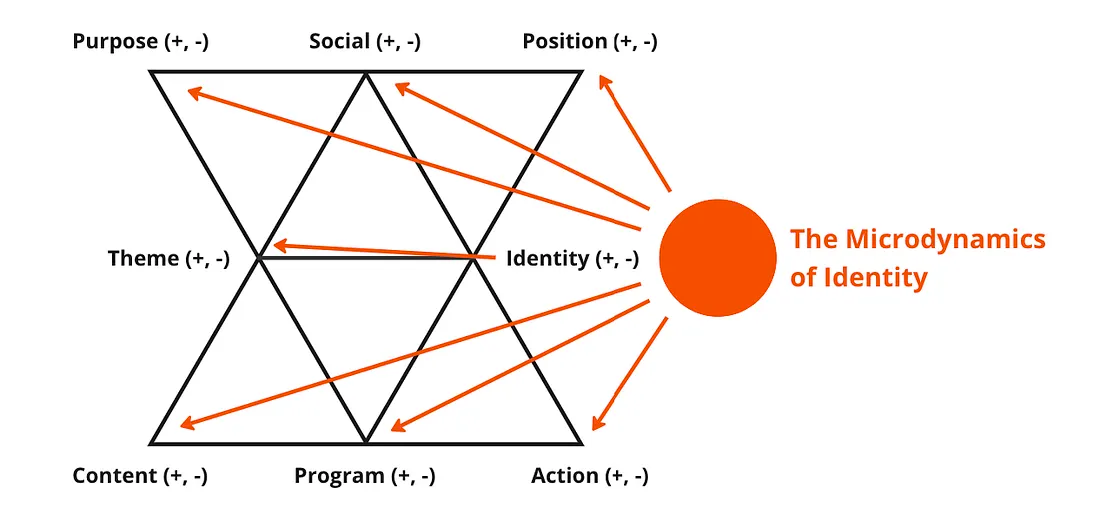
The framework developed in this collection takes a more fundamental approach. Rather than reinterpreting the meaning of obstacles, it dissolves the gap by grounding identity in activity from the outset. In the Developmental Project Model — a core component of the Life-as-Activity Approach — Theme and Identity are not separate psychological states but constitutive elements of every project engagement. Identity is not a mental representation that precedes action; it is enacted, shaped, and recognized through the specific roles, relationships, and recognitions that projects make available. This means that developing a creative identity and engaging in creative activity are not two separate processes connected by a motivational bridge. They are the same process, examined from two different angles.
Second, Possible Selves are only future-oriented. Traditional psychological frameworks have tended to treat the past in one of two ways: as a burden or as mere background. The burden view is familiar — childhood trauma, family of origin, formative wounds that constrain present agency. The background view is more neutral but equally limiting: the past as context, as the story of how you got here, relevant only insofar as it explains the present. Neither view treats the past as a reservoir of resources.
Markus and Nurius were themselves critics of static self-concepts — their insistence on the dynamic, future-oriented nature of the self was a genuine theoretical advance. But in their focus on what a person might become, they largely left the past unexamined. Past selves appear in their framework primarily as contrast points: who you were before, against which the hoped-for or feared future self is defined. The past is not absent, but it is not active. It is a backdrop, not a resource.
The past, in Markus and Nurius's framework, is largely absent — treated as mere background rather than as a reservoir of reactivatable creative identities.
Third, the three-category typology — hoped-for, expected, feared — is a useful creative heuristic, but it is a fixed classification oriented entirely toward the future. It does not provide tools for analyzing how past, present, and future selves can be developed together as a coherent whole. In the framework developed here, this typology is understood as one starting point among several — valuable for initial reflection, but not the final word on how selves across time should be analyzed and worked with.
Markus and Nurius made a genuine and lasting contribution. They established a dynamic, forward-looking theory of the self that broke decisively with the static self-concepts that had dominated psychology, and their framework has spread widely — into education, health psychology, career development, and cultural psychology. The influence of Possible Selves theory across disciplines is a testament to how powerfully it captured something real about human motivation and development.
Yet the theory they built, for all its dynamism, lacks two structural dimensions that a complete account of creative identity development requires. The first is a complete temporal structure: a systematic framework for understanding how past, present, and future selves interact and develop together — not as a sequence, but as simultaneously active dimensions of a creative life. The second is a spatial structure: an account of how identity is not only a cognitive representation but is enacted within, shaped by, and inseparable from the activity space a person inhabits — the projects, roles, relationships, and environments through which the self becomes real.
The framework developed across this collection addresses all three limitations through two meta-frameworks that together provide both temporal and spatial coverage.
The LARGE Method (L(A·R·G)=E) serves as the governing meta-method: it provides the first principles through which Reflection (past), Generation (present), and Anticipation (future) operate together within the spatial awareness of Landscape, producing Enterprise across time. It is not a theory of identity but a methodology — a set of governing principles for how to work with identity across time and space.
The Life as Activity Approach provides the theoretical architecture: a family of frameworks that integrates cognition and activity, showing how identity is not a mental representation but is constituted, recognized, and developed through the concrete engagements of a creative life — in projects, roles, relationships, and the evolving structure of a World of Activity.
Together, these two meta-frameworks make possible a concrete operational approach to creative identity development that does not reject Markus and Nurius's contribution, but extends it through a richer theoretical architecture grounded in both activity and cognition, and oriented toward past, present, and future simultaneously.
The LARGE Method as First Principle
The governing meta-method of this collection is the LARGE Method (2026), expressed as the formula:
L(A·R·G)=E
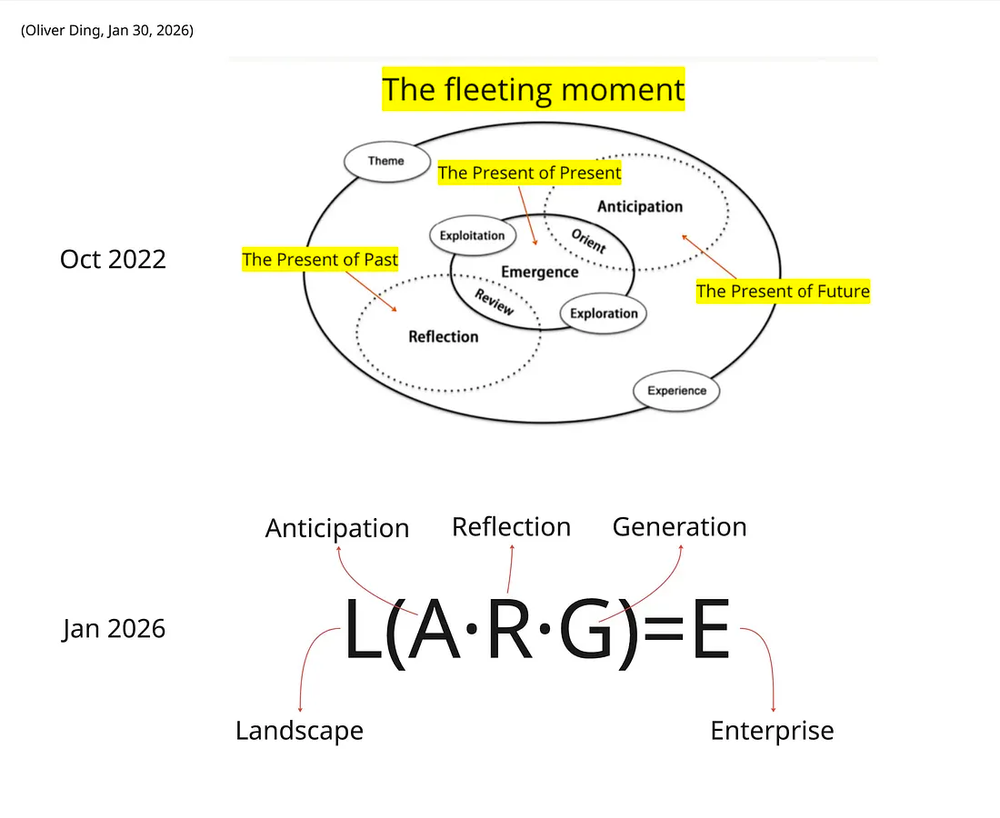
Its five principles — Landscape, Anticipation, Reflection, Generation, Enterprise — provide the first principles through which Past Selves, Present Selves, and Possible Selves can all be understood and worked with simultaneously.
- L (Landscape) provides the synchronic view of the whole: the ability to see one's full self-trajectory at once — past, present, and anticipated — as a coherent landscape rather than a series of disconnected moments.
- A (Anticipation) corresponds to Possible Selves: the forward orientation toward the creative identity one is becoming. But in our framework, Anticipation is not only imagination — it is the active pull of the Anticipated Identity on present behavior, shaping what projects are pursued, what resources are mobilized, and what creative identity is being developed toward.
- R (Reflection) corresponds to Past Selves: the act of returning to earlier creative identities, recognizing what was enacted, and recovering what remains generative. Reflection is not nostalgia. It is a deliberate cognitive and practical move — the Revisiting half of the Revisiting-Rebuilding strategy.
- G (Generation) corresponds to Present Selves: the act of creating in the present, transforming what has been Revisited into something new. Generation is the Rebuilding half of the strategy — not repetition but transformation.
- E (Enterprise) names the long-arc trajectory through which Past, Present, and Possible Selves unfold together across time. Enterprise is not a single project but the coherent developmental structure that holds all the projects — and all the selves — together.
The multiplicative relationship in L(A·R·G)=E is significant. Anticipation, Reflection, and Generation must all operate together. Without Reflection, there is no access to Past Selves. Without Anticipation, there is no direction. Without Generation, there is no transformation. And without Landscape, none of the three can be seen in relation to each other. The formula names a governing logic, not a sequence.
The Life-as-Activity Approach: Activity-Centered and Cognition-Sensitive
The theoretical framework underlying this collection is the Life-as-Activity Approach (v3.2, 2025) — a family of activity-centered knowledge frameworks developed over the past decade. Its name echoes a founding intuition of Activity Theory itself: Leontiev once considered calling his framework "Life Theory," before settling on "Activity" as a more analytically precise term. The Life-as-Activity Approach recovers that original ambition, treating life — both individual and social — as a form of activity.
The approach comprises several interconnected frameworks, each addressing a different level of analysis:
- Activity as Project Engagement — the foundational ontology, establishing the project as the unit of analysis that bridges individual psychology and social structure. Life is a chain of projects; by joining and leaving projects, we enact our significant life themes.
- The Activity Circle — a model of intersubjective activity structured around four elements: Self, Other, Thing, and Think. It is the core structural unit from which the Agency Cascade is derived — the model that reveals how creative identities cascade through levels, with the Other of each level becoming the Self of the next.
- The Developmental Project Model — an eight-element framework describing any developmental project, including Purpose, Position, Social, Content, Action, Theme, and Identity. The Microdynamics of Creative Identity emerges directly from this model: every time you join or leave a project, your identity evolves.
- The Anticipatory Activity System (AAS) — a system-level framework modeling the structure of Self, Other, Present, and Future across multiple projects. It distinguishes First-order Activity (performance-oriented, Advancing) from Second-order Activity (discovery-oriented, Analyzing) — a distinction that underlies the dual-center pattern of creative development explored throughout this collection.
- Weave-the-Life — a framework that bridges Activity as Project Engagement and the Life-History Topology, explaining how individual projects unfold into the larger fabric of a life. Its weave structure — four dimensions intersecting to produce four weave-points — is the direct ancestor of the Weave pattern developed in this collection for Revisiting-Rebuilding.
Together, these frameworks constitute an approach that is simultaneously activity-centered and cognition-sensitive: it insists that identity, knowledge, and development cannot be understood apart from the concrete activities through which they are constituted, while also attending to the anticipatory, reflective, and generative dimensions of human cognition. This integration is what makes the Life-as-Activity Approach particularly well-suited to the question of Past Selves — and to the Revisiting-Rebuilding strategy that this collection introduces.
Activity and Cognition: Why Past Selves Are More Than Memories
The deepest limitation of the Possible Selves framework, for the purposes of this collection, is its purely cognitive orientation. In Markus and Nurius's account, selves — whether possible or present — are mental representations. They exist inside the person's head.
The framework developed here insists on a different ontology: identity is enacted through activity. Creative identity does not exist prior to the projects, engagements, and activities through which it is constituted. It is not a mental state that precedes action; it is the outcome of action, recognized by others and internalized by the self through the succession of project engagements that constitute a creative life.
This is what makes Past Selves more than memories. When a person enacted a past creative identity — as a Practitioner, a Reflector, a Modeler, a Curator — they did not just think certain thoughts. They produced outcomes: works, frameworks, relationships, and methods. These outcomes are still present in the world. The work exists. The frameworks can be retrieved. The methods can be reapplied. The Past Self left material traces — and those traces are the raw material of Revisiting-Rebuilding.
This is why the strategy is called Revisiting-Rebuilding, not simply "remembering." Revisiting means returning to the actual material produced by a past creative identity — the work, the frameworks, the by-products — and recognizing it from the standpoint of the present self. Rebuilding means transforming that material through the more developed creative identity of the present. The result is not a repetition of the past but a new creation that could not have existed without it.
The Microdynamics of Creative Identity: A More Flexible Architecture
Within this framework, the three-category typology of Possible Selves — hoped-for, expected, feared — is understood as one creative heuristic among several. It remains useful as a starting point for reflection. But the framework developed here provides a more flexible and more analytically precise architecture through the Microdynamics of Creative Identity and four identity types.
The Microdynamics of Creative Identity names the continuous, fine-grained process through which identity evolves across project engagements. Every time a person joins a project or leaves one, their identity shifts — incrementally, in response to the specific roles, relationships, and recognitions that the project makes available. This process is ongoing and dynamic, not reducible to a fixed typology.
Four types of identity describe the dimensions across which this process unfolds:
- Projected Identity — identity shaped by external roles and responsibilities in collaborative projects. This is how others see who you are through what you do. Past Selves often appear first as Projected Identities: the role you played in a project, the position you occupied, the way others recognized your contribution.
- Narrative Identity — the self constructed and communicated through personal storytelling. The coherent arc that connects past selves to present self to anticipated future self. Narrative Identity is the thread that makes a creative life legible — to others and to oneself.
- Creative Identity — the identity enacted through concrete actions guided by autonomous will and subjective exploration. This is the Self of the present Activity Circle: who you are becoming through what you are making right now. It is the enacted Present Self.
- Anticipated Identity — the forward-looking vision of the future self, aligned with the concept of Possible Selves. But in our framework, Anticipated Identity is not only a cognitive representation. It is the Other of the current Activity Circle — the creative identity that the present Creative Identity is already developing toward, through the specific activities and projects being pursued now.
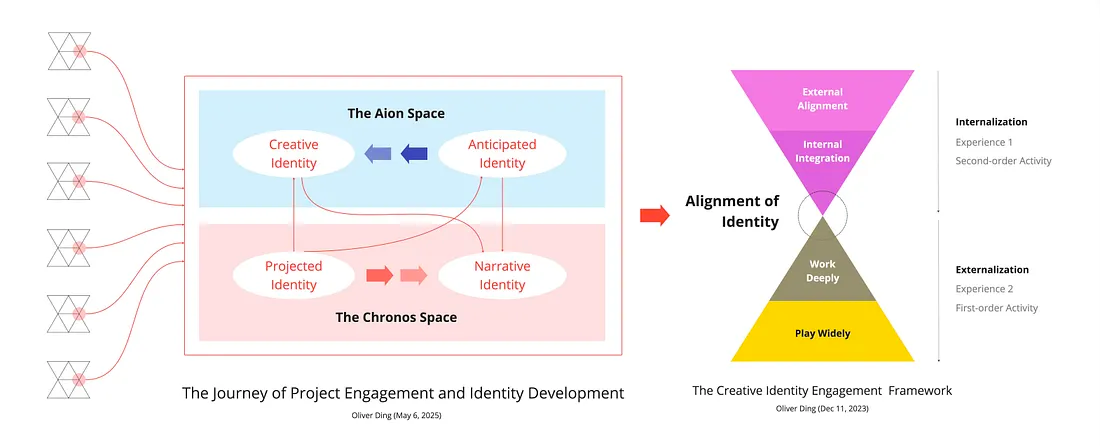
These four types are not a fixed classification system to be applied mechanically. They are flexible lenses that can be applied differently depending on the project, the life stage, and the question being asked. In any given moment, a creator is simultaneously: inhabiting a Creative Identity (present self), constructing a Narrative Identity (the story connecting past and present), being recognized through a Projected Identity (how others see them), and oriented toward an Anticipated Identity (who they are becoming).
Weaving Time and Space
The Revisiting-Rebuilding strategy operates across two dimensions simultaneously: time and space.
Time is the diachronic dimension — the succession of past, present, and future selves across a creative life. The Revisiting move is temporal: returning to a past creative identity that was enacted in a specific period, within specific projects, producing specific outcomes. The Rebuilding move is also temporal: bringing that past self into the present and transforming it through the more developed standpoint of the current creative identity.
Space is the synchronic dimension — the activity space of the present moment, in which different creative identities, thematic spaces, and project chains coexist simultaneously. At any given moment, a creator inhabits a World of Activity with multiple centers: some stable and well-established (Surviving Centers), others exploratory and generative (Thriving Centers). Past Selves are not only in the past — they are present as dormant resources within this activity space, waiting to be retrieved and reactivated.
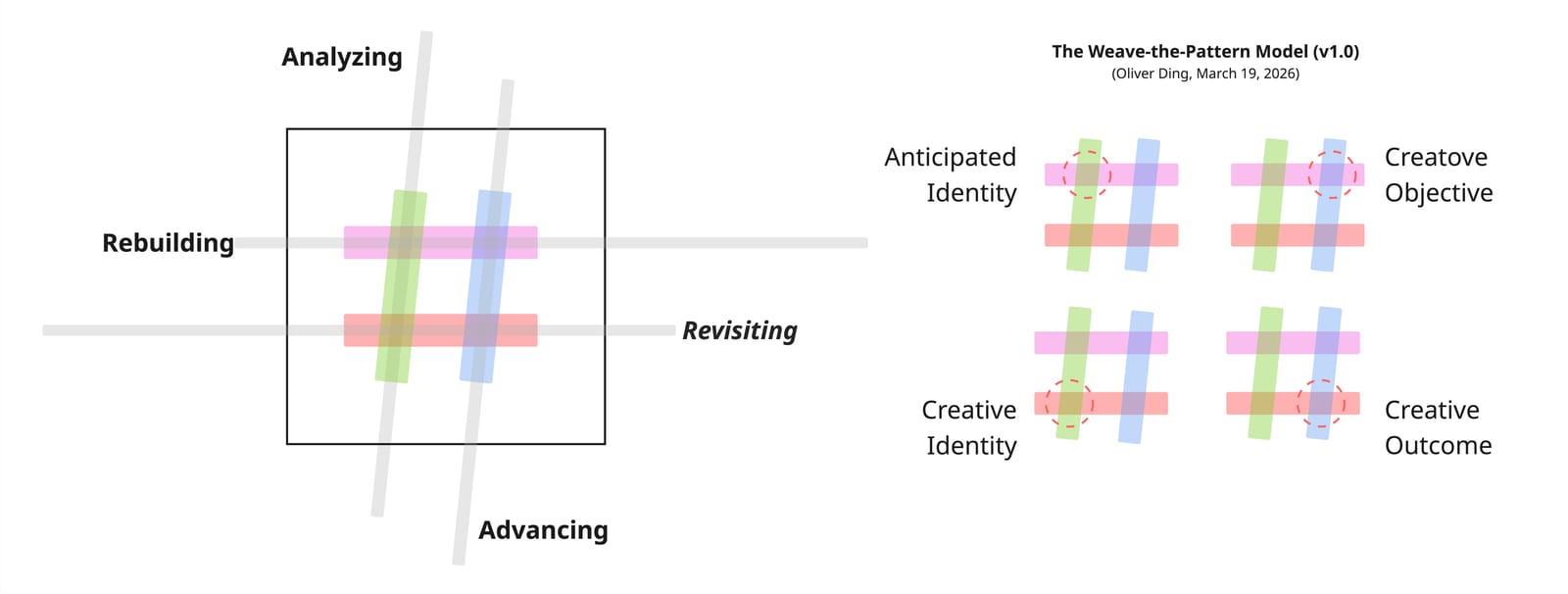
The Weave structure captures how these two dimensions interact. Two diachronic lines — Revisiting and Rebuilding — run through time. Two synchronic lines — Advancing (first-order activity, the Activity dimension) and Analyzing (second-order activity, the Identity dimension) — operate in the present moment. Where these lines intersect, four weave-points emerge:
| Weave-point | Name | What it involves |
|---|---|---|
| Revisiting × Advancing | Creative Outcome | Past works, frameworks, and by-products that carry unrealized generative potential |
| Revisiting × Analyzing | Creative Identity | Past creative identities that were once enacted and can be reactivated |
| Rebuilding × Advancing | Creative Object | The concrete object of present work, gathering both past and present materials |
| Rebuilding × Analyzing | Anticipated Identity | The emerging vision of the next creative identity, orienting present Rebuilding toward the future self |
This weave structure is what makes Revisiting-Rebuilding a comprehensive strategy rather than a simple technique. It simultaneously addresses past outcomes (Creative Outcome), past identities (Creative Identity), present work (Creative Object), and future orientation (Anticipated Identity). All four are engaged at once — woven together into the fabric of a creative life.
Identity as Resource, Not Constraint
The deepest practical implication of this framework is a shift in how we understand identity itself.
In much popular discourse, identity is understood as something that constrains: you are what you are, and the question is how to live within — or escape from — that definition. In the Markus and Nurius framework, identity is more dynamic, but still primarily cognitive: possible selves are mental representations that motivate behavior.
In the framework developed here, identity is a resource — and specifically, a resource that can be mobilized across time, in both directions.
- Past Selves are resources that can be Revisited and reactivated. The creative identity you enacted as a Practitioner, a Reflector, a Modeler — each of these is not gone. It is dormant. The RR strategy provides the mechanism for recovering it, bringing it into contact with your present creative identity, and transforming it into something new.
- Possible Selves — or in our framework, Anticipated Identities — are resources that can be actively chosen. The future is not singular: there are multiple possible creative identities that could be developed from the current position. In different projects, at different stages, a creator can actively orient toward different Anticipated Identities, adjusting their present activity accordingly. Identity is not a destination but a direction — and the direction can be chosen, revised, and refined.
- Present Selves — the current Creative Identity — are the meeting point of past and future: shaped by what has been reactivated from the past, oriented toward what has been chosen from the future.
This is what it means to treat identity as a resource rather than a constraint: to recognize that the full range of who you have been, who you are, and who you might become are all available to you — as materials for the ongoing creative work of building a life.
An Invitation
The essays collected in this volume are case studies, theoretical explorations, and practical frameworks — all oriented toward one practical invitation:
Return to what you have made. Look at who you were when you made it. Ask what you could make of it now, with everything you have learned and developed since.
The past is not a closed archive. It is a depth that rewards those willing to dive — and patient enough to surface with something that could not have been found before.
Something could be reborn from the past.
v1.0 — March 19, 2026 - 3,774 words