
Appropriating Activity Theory #14: Self, Other, and Embodied Social Forms (2017, 2021, 2025)
This post is part of the "Appropriating Activity Theory" series, which reflects my creative journey of engaging with Activity Theory from 2015 to 2025.
by Oliver Ding
March 31, 2026
Yesterday, I published the ACS manuscript, Anticipatory Cultural Sociology: Creation, Projection, and Agency, documenting the development from v1.0 through v2.0 and the final synthesis. In that process, I developed the Agency Cascade model from the Activity Circle, which in turn brought forth the Bureau of Agency and three related agency models. Since late March, I have been focusing on the Self–Other relationship within the Activity Circle, producing a series of articles on that theme.
This article traces that thread from its origins. It revisits the explorations of Self, Other, and their relational structure across nearly a decade of work — from the Thing-People Relation model of 2017 through the Typology of Relevance in 2021, the birth of the Activity Circle in 2022, and now the articulation of Embodied Social Forms within the ACS project in 2025–2026.
The purpose is not merely to document a history but to reveal a deeper coherence: that the practice of grounding social forms in Basic Ecological Forms was already operative in 2017 — and that what the recent work on Embodied Social Forms provides is not a new method, but the explicit naming of something that had been running beneath the surface from the very beginning.
1
In 2017, I wrote a conceptual deck to introduce my ideas about the "Activity as Container" perspective, which resulted in the "Activity–Relation" Framework — the seed of the Activity Circle model. The full story behind that deck is told in Appropriating Activity Theory #7: The Piano House and Activity as Container.
The conceptual deck was part of a four-project creative journey running from July 2017 to February 2018. Its immediate predecessor was the "Friendship Books" campaign of July 2025 — a 30-day project inspired by Matt Cutts' "Try Something New for 30 Days" initiative, in which I selected one or two books each day and mentioned friends relevant to those books on social media. After the campaign ended, I realized it was time to reflect on the Book–Human relation, a theme I had carried for many years under the broader heading of the Object–Subject relation.
On August 22, 2017, I completed a 95-slide conceptual deck titled The Book-Human Relation, which proposed a simple model using four terms:
- This Person
- This Book
- That Person
- That Book
At the end of the deck, I extended the model into an abstract framework: the Thing-People Relation model.
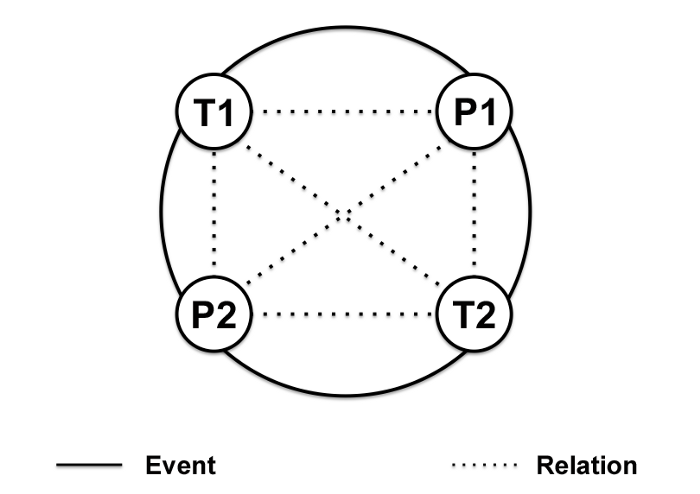
The "Activity as Container" project went further, becoming a reflection on my engagement with Activity Theory, Ecological Psychology, Distributed Cognition, and related social theories from 2014 to 2018. The final result was a 242-slide deck. The primary model it produced — the Thing-People Relation model — uses four nodes: T1 (Thing, Here), T2 (Thing, There), P1 (People, Here), P2 (People, There), enclosed within a circle representing a single event.
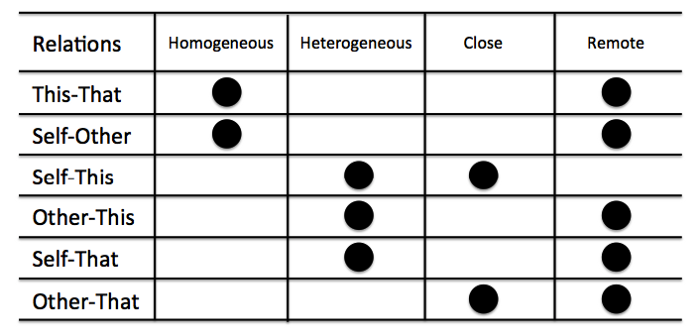
This meta-diagram identifies six types of relations organized across four dimensions. The pair Homogeneous–Heterogeneous refers to Categorical Difference; the pair Close–Remote refers to Spatial Difference. The six relation types — This-That, Self-Other, Self-This, Other-This, Self-That, Other-That — emerge from different configurations of these two dimensions.
Later, I renamed this model the Activity Circle. It is now part of the Life-as-Activity Approach.
2
On November 19, 2021, I published D as Diagramming: An Integrated Framework for Studying Knowledge Diagrams (Part 2), which discussed my "Relevance" thematic space and a practical perspective I called "Cultural Significance."
After revisiting Alfred Schutz's Relevance Theory, I developed a typology of Relevance organized around three ecological aspects. The model further explored the Self–Other relationship that was implicit in the Thing-People Relation model.
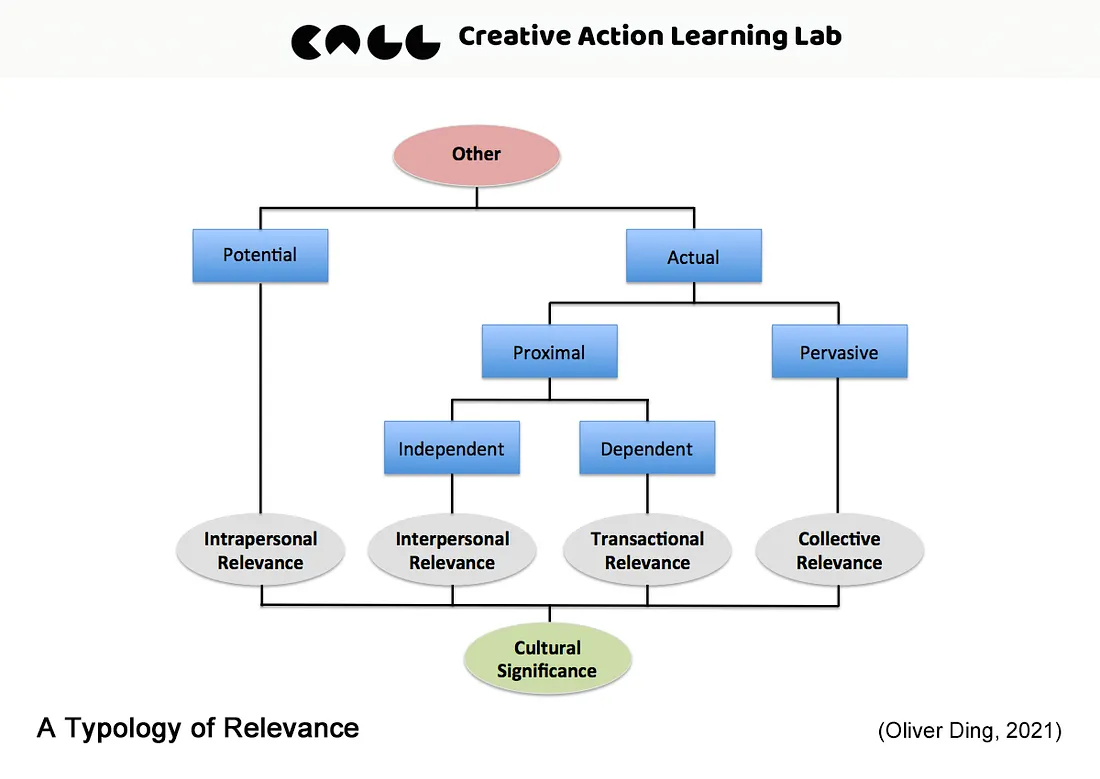
The typology identifies four types of relevance:
Intrapersonal Relevance: The Other is potential, not actual. If a person has no direct interaction with actual other people, they consider whether their work is relevant to predecessors or contemporaries with whom contact is possible but not yet established. For example, when I compare my typology with Schutz's while writing an article, Schutz is a predecessor who cannot respond; his presence is potential, not actual.
Interpersonal Relevance: The Other is actual, but the Self–Other dyad is not considered as a whole, because they do not share reciprocity of motives. Getting good feedback from others depends on the relevance of one's work from the Other's perspective — a one-directional consideration.
Transactional Relevance: The Other is actual, and the Self–Other dyad is considered as a whole. Both parties share reciprocity of motives, challenges, and background knowledge. In Schutz's terms, this type achieves high relevance across all three dimensions: motivational, thematic, and interpretational.
Collective Relevance: The Other is pervasive, not proximal. The Self–Other relationship becomes a Self–Group relationship. This refers to Schutz's social domains of relevance.
The framework is organized around three core distinctions:
- Potential vs. Actual: Is the Other a real, present interlocutor, or one whose presence is imagined or anticipated?
- Proximal vs. Pervasive: Is the Other a specific, proximate person, or a diffuse collective presence?
- Independent vs. Dependent: Is the Self–Other relationship treated as two separate entities, or as a unified whole?
These four types of Relevance provide a framework for understanding Cultural Significance as used in the Diagramming as Practice framework.
3
Following the Typology of Relevance, I constructed a companion model: the Relevance and Diagramming model. Inspired by the Thing-People Relation model, it shares the same four-node circular structure with Self and Other as two of its poles — but the other two nodes, Diagram and Thought, are not homogeneous objects of the same kind. Diagram is an external visual artifact; Thought is an internal mental content. The structure is borrowed; the nodes are transformed.
The model places four nodes within a circle: Self, Diagram, Other, and Thought.
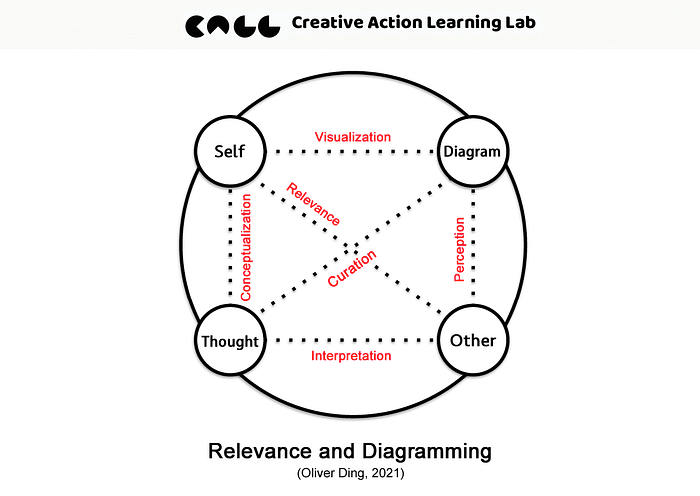
Two terms in the model are marked in red to signal their centrality:
Visualization: The Self–Diagram relation. Knowledge diagrams combine visualization and conceptualization, raising the classical issue of form and content. A great knowledge diagram achieves a perfect form-content fit — requiring three things: a unique conceptualization, a unique visualization, and a successful match between the two.
Conceptualization: The Self–Thought relation. Together with Visualization, it defines the dual challenge of diagrammatic knowledge work.
The other relations in the model: Curation names the Diagram–Thought relation, since the Visualization–Conceptualization fit is a curatorial process. Relevance names the Self–Other relation. Perception names the Other–Diagram relation, since Others must perceive the meanings of visual graphics. Interpretation names the Other–Thought relation — a dynamic interactive process through which Others negotiate meaning with the author of a diagram.
This model was the direct seed of the Activity Circle. Diagram corresponds to Thing; Thought corresponds to Think. But the birth of the Activity Circle model required one further trigger.
4
In 2022, I encountered Benny Karpatschof's 2000 book Human Activity: Contributions to the Anthropological Sciences from a Perspective of Activity Theory. Though I had read widely in Activity Theory, Karpatschof's approach opened a new door. His most important contribution was to bring Sign, Meaning, and Concept back into Activity Theory.
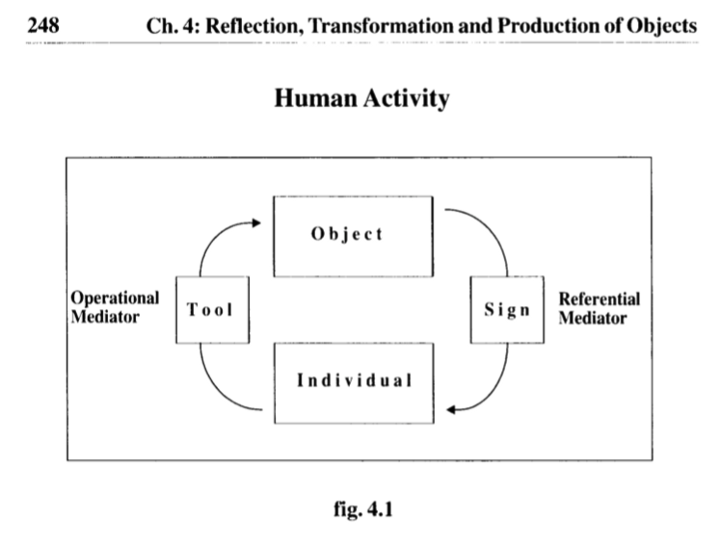
According to Karpatschof: "…the full context of activity in which the category of meaning ('ideas') is situated can be seen. In the feedback circle, there is an operational as well as a referential mediation. I call the referential side meaning production. The other side is the category of object production, where production is to be understood in a broad sense, including interventions that only modified the object. If we now consider the relation between meaning and object production in human activity, there are 3 logical types: 1. The object-reflecting meaning production, 2. The symmetric interplay of objects and meaning production, 3. The concept based object production." (2000, p.248)
Karpatschof's approach to human activity considers both Tool and Sign. This approach echoes Lev Vygotsky's two types of mediating tools — technological tools and psychological tools — which is precisely why it captured my attention.
The revisiting of Karpatschof's ideas triggered me to reflect on the earlier Relevance and Diagramming model. That model had already placed Diagram and Thought as two heterogeneous nodes — one external, one internal — without fully theorizing why. Karpatschof's framework provided the missing theoretical grounding: Diagram corresponds to the operational side (Tool), and Thought corresponds to the referential side (Sign). By abstracting from the specific domain of diagramming to the general level, the two nodes could be renamed Thing and Think — directly corresponding to Vygotsky's two types of mediating tools: technological tools and psychological tools. This alignment with Vygotsky is what led me to formally name the new model the Activity Circle, built on the foundation of the Thing-People Relation model.
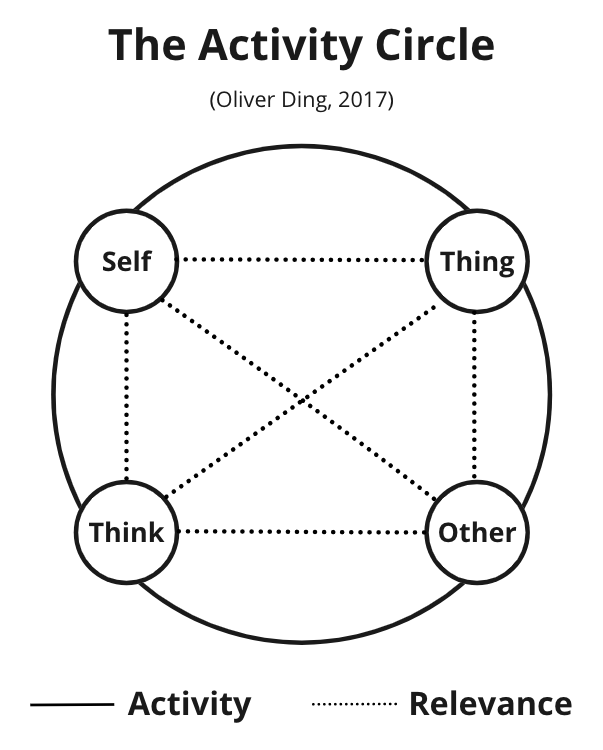
The Activity Circle focuses on four nodes: Self, Other, Thing, and Think. It is designed to discuss objects with double properties: material property and mental property. The two types of lines in the model carry distinct meanings: solid lines indicate Activity, while dotted lines indicate Relevance.
The difference between Karpatschof's model of Human Activity and the Activity Circle is significant: the former addresses only the individual–object interaction, while the latter also considers the Self–Other relevance dimension. This makes the Activity Circle a genuinely social model, not merely a cognitive one.
The Self–Relevance structure is part of the AAS framework, but the AAS is specifically oriented around "Self, Other, Present, Future." The Activity Circle fills a different need: a model for discussing material and meaning in general, at a level prior to the temporal structure of the AAS. Both models are part of the Life-as-Activity Approach.
Looking back from the vantage point of 2026, the transition from the Thing-People Relation model to the Activity Circle can now be read as the first instance of what would later be named Embodied Social Forms. The Thing-People Relation model operates at the level of Basic Ecological Forms: its organizing distinctions — Here vs. There, Homogeneous vs. Heterogeneous, Close vs. Remote — are elementary spatial and categorical structures, prior to any specific social content. The Activity Circle, by contrast, operates at the level of Significant Social Forms: it names socially meaningful nodes (Self, Other, Thing, Think) and distinguishes two kinds of connection (Activity, Relevance). The move from one model to the other is precisely the move the Embodied Social Forms sequence describes — from ecological form to social form. This distinction is a separate theoretical contribution, one that only became explicit in 2025, but whose practice was operative from the very beginning.
5
From January to March 2026, I focused on developing Anticipatory Cultural Sociology (ACS).
ACS v1.0 identified the transformation of concept systems into thematic enterprises as the core of cultural development. But it did not specify the ontological states through which a thematic creation moves as it travels from the individual mind into the social world. In February 2026, the Activity Circle was adopted to develop the Agency Cascade model, introducing it in Culture as Anticipatory Activity.
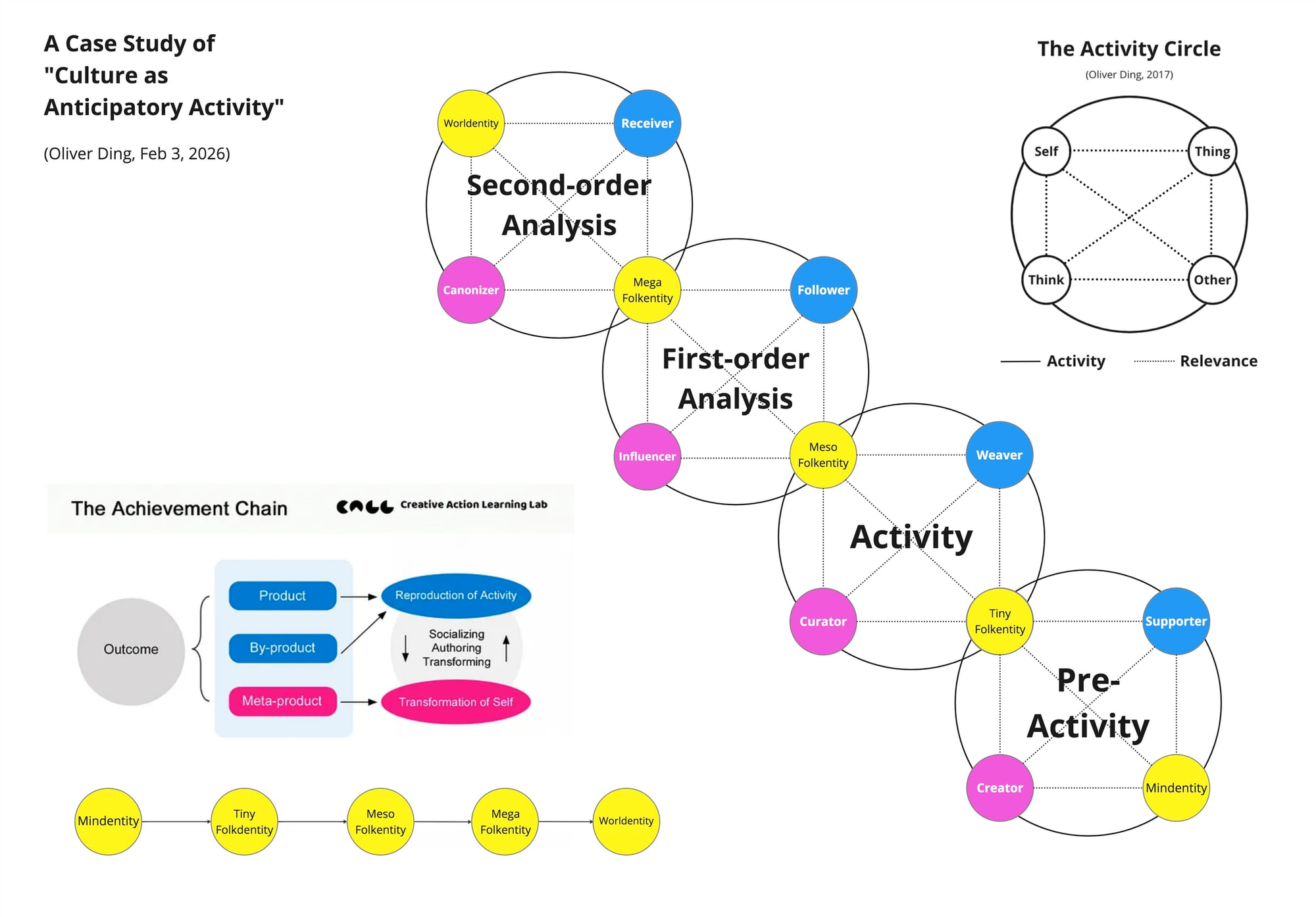
The Activity Circle provided the structural template: just as it distinguishes Self, Other, Thing, and Think as four relational nodes, the Agency Cascade describes how a thematic creation passes through three ontological states — from a mental formation within the individual, through its expression as a social artifact, to its reception and uptake by others in the cultural field. The Agency Cascade model names the transitions between these states and the conditions that make each transition possible.
The Agency Cascade model was subsequently applied to develop a series of models for the ACS project. In March 2026, building on the Agency Cascade model and the DDD model, the L3D model (Learn–Discover–Design–Deliver) was developed. The L3D model describes a complete movement of internalization followed by externalization: Learn is the internalization phase, in which a person builds the cognitive infrastructure that makes creative engagement possible; Discover, Design, and Deliver are the externalization phases, in which that infrastructure is projected outward into the social world as thematic exploration, designed creation, and cultural contribution. Viewed at a wider angle, the L3D model describes the structure of self-actualization itself — reframed, within ACS, as an anticipatory activity: not a final state to be achieved, but an ongoing process of orienting oneself toward future possibilities and acting from that orientation.
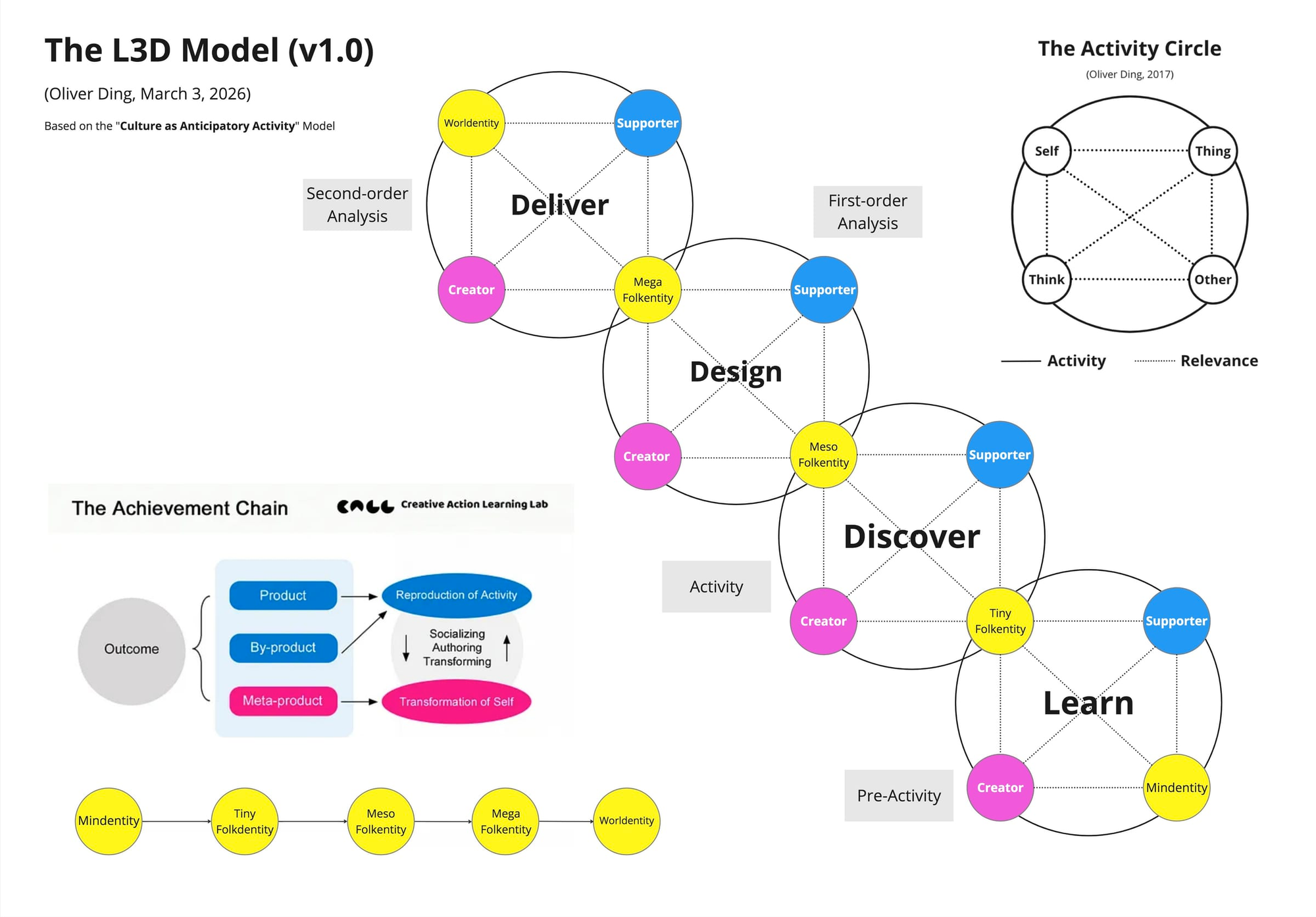
The L3D model brought two further developments: the Supportive Life Discovery (SLD) model and the Cognitive Hydrology Pedagogy. In the SLD model, the four layers of L3D map onto a four-layer service design, with the SLD practitioner's role shifting from cognitive companion (Learn) to thematic interlocutor (Discover) to framework guide (Design) to methodological resource (Deliver).
At this stage, however, the Self–Other dimension within SLD was treated only at the surface level: the two parties were named simply as Creator and Supporter, without deeper theoretical elaboration. The relational constitution of the Self — and the full complexity of what it means for one person to support another's self-actualization — had not yet been worked out. That work would come next.
6
ACS v1.0 through v1.2 developed along three axes — Thematic Creation, Cultural Projection, and Bureaus of Agency — all oriented toward cultural life at the collective scale. A fourth dimension was present in the theoretical foundations but had not been explicitly developed: the Self–Other relation as the primary site of social formation.
In practice, this dimension had already begun to be explored. The Supportive Life Discovery series, developed through the L3D model and its extensions, was working precisely in this territory: the zone where an individual's learning and discovery is shaped by the presence, support, and co-becoming of others.
On March 18, 2026, reflecting on the relationship between the LARGE Method and the ACS v1.2 Actor Model, it became clear that the Self–Other dimension was absent from the three-dimensional structure. The decision was to maintain the integrity of ACS's three-dimensional model rather than expand it to four dimensions. The Self–Other dimension would continue to develop — but within SDP (Strategic Developmental Psychology), a companion project to ACS that focuses on the individual and relational dimensions of creative life, where it more naturally belongs.
From March 20 to 29, while writing a series of articles on the Revisiting–Rebuilding practice (1, 2, 3, 4), I took a further step and constructed a comprehensive account of the Self in its relational constitution.
The key theoretical contributions of this series are four:
First, the three-layer architecture of Self — Sub-individual, Individual, Supra-individual — provides a model of the person genuinely adequate to the relational complexity of cultural life.
Second, the concept of Persons Acting in Concert, grounded in the concrete legal-practical phenomenon of aligned action and its consequences, names the specific structure through which the Self–Other whole constitutes itself as a Supra-individual.
Third, the Principle of Double Genidentity — the simultaneous development of the Genidentity of Creative Life and the Genidentity of Things — shows how self-actualization and cultural contribution are not two separate activities but two faces of the same anticipatory movement.
Fourth, the extension of this framework to a person and their own AI agents gives the Self–Other dimension immediate relevance to the emerging conditions of creative practice in the age of AI.
Within ACS, this dimension is carried by the Supportive Life Discovery series and the foundational concepts already present in ACS v1.0: Embodied Social Forms, Supportance, Double Genidentity, Social Moves, and the AAS framework's Self–Other–Present–Future structure. These concepts name the relational conditions of cultural creation — the way in which Other is not merely an audience but a constitutive presence in the unfolding of any thematic enterprise.
7
While writing the series of articles mentioned in the previous section, I found myself revisiting the 2021 Typology of Relevance. And in that moment of return, a realization surfaced: the three organizing dimensions of that typology were not arbitrary analytical choices — they were already ecological form analysis in practice. I simply had not known it at the time.
Returning now to the 2021 Typology of Relevance, we can re-examine its three organizing dimensions:
- Potential vs. Actual: Is the Other a real, present interlocutor, or one whose presence is imagined?
- Proximal vs. Pervasive: Is the Other a specific person, or a diffuse collective presence?
- Independent vs. Dependent: Is the Self–Other relationship treated as two separate entities, or as a unified whole?
The Embodied Social Forms principle, developed within ACS in 2025, provides the analytical key for understanding where these dimensions come from. Six Basic Ecological Forms were introduced in Homecoming: A Thematic Trip and the World of Activity Approach (Kindle edition, September 2025):
- Before–After
- Slow–Fast
- Up–Down
- Left–Right
- Inside–Outside
- Center–Periphery
In the Conclusion of Homecoming, these forms were expanded into the Ecological Dynamics of the World of Activity framework. Each pair names a dimension of dynamic change. More recently, three further basic forms were added: Virtual–Real, grounded in the embodied experience of dreaming and waking, Near–Far, and Part–Whole.
In the same period, several Significant Social Forms (SSF) were identified using five schemas. Among them: the Self–Other–Present–Future schema, recognized as the SSF of interpersonal interaction.
Today, revisiting the 2021 Typology of Relevance through this lens, the connection becomes clear. The three dimensions of the typology are not arbitrary analytical choices — they are rooted in Basic Ecological Forms:
Potential vs. Actual is grounded in the Virtual–Real basic ecological form. The distinction between an Other whose presence is only imagined and one with whom actual interaction takes place mirrors the fundamental bodily distinction between the world of dreams (virtual) and the world of waking life (real).
Proximal vs. Pervasive is grounded in the Near–Far basic ecological form. The difference between a specific, proximate Other and a diffuse collective presence is a social encoding of the universal spatial experience of nearness and distance.
Independent vs. Dependent is grounded in the Inside–Outside basic ecological form. Whether the Self–Other relationship is treated as two separate entities or as a unified whole maps onto the distinction between what is bounded and interior versus what is open and exterior.
This retrospective grounding extends further. The relationship between a creator and their Creative Predecessors, as discussed in the article Engaging with Others for Developing Anticipated Identity, is rooted in the Before–After basic ecological form. The Predecessor is structurally "Before"; the creative inheritor is structurally "After."
The three-layer architecture of Self — Sub-individual, Individual, Supra-individual — and the concept of Persons Acting in Concert, explored in Supportive Self-Actualization as Anticipatory Activity, are rooted in the basic ecological form of Part–Whole: the sub-individual as the constitutive components of the self, and the supra-individual as the emergent whole formed through the integration of self and others.
8
The two revisitings documented in this article — the 2017 construction of the Thing-People Relation model and its transformation into the Activity Circle, and the 2021 Typology of Relevance with its three ecologically grounded dimensions — now reveal themselves as early instances of the same practice: grounding social forms in Basic Ecological Forms. At the time, this was not a named method. It was operative without being explicit.
What is now named Embodied Social Forms is the explicit articulation of that practice as a theoretical principle. The major difference between this approach and Georg Simmel's classical theory of social forms is methodological. Simmel's social forms are derived from the observation of recurring patterns of association. The Embodied Social Forms approach follows a different sequence:
Body → Embodied Experience → Ecological Basic Forms → Cultural Interpretation (linguistic encoding + situated context) → Significant Social Forms
This sequence illustrates how bodily experiences are gradually transformed into socially meaningful forms through cognitive and cultural processes. By encoding pre-linguistic experiences into language within specific social contexts, the model links the Body System to higher-level cultural and social structures, tracing how micro-level embodied experiences shape macro-level social forms.
I use the term grounded in to express the relationship between embodied experience and social form. This is not a relation of direct causation — Basic Ecological Forms do not determine Significant Social Forms in a simple mechanical way. The connection is formal: a structural correspondence between the shape of bodily experience and the shape of social life. The universality lies in the Basic Ecological Forms, which are unavoidable and unmodifiable — they are given with embodied existence. The diversity of cultural variation lies entirely in the Cultural Interpretation step: the moment of linguistic encoding within a situated context, where the universal form is inflected by history, language, and circumstance.
This is what makes the principle analytically powerful. It establishes a unified formal structure that underlies the complexity and diversity of social phenomena, while preserving the full weight of cultural difference at the point where that difference actually enters the picture.
A similar approach has already been developed in cognitive linguistics — notably in the tradition of conceptual metaphor theory and image schema research. What is relatively new is its systematic application to sociology, where the embodied basis of social forms has rarely been addressed in this explicit manner.
9
Tracing the Self–Other relationship back to its ecological foundations — from the Thing-People Relation model of 2017, through the Typology of Relevance in 2021, the Activity Circle, the ACS development of 2026, and the Embodied Social Forms principle — reveals something implicit in the work from the very beginning, but only became visible through the accumulation of the years.
The 2017 Thing-People Relation model, in turn, can now be recognized as an ecological-form construction — a structuring of relations before their articulation as social forms. The three dimensions of the 2021 typology were already ecological in structure.
The models built around the Self–Other relationship — from the Thing-People Relation to the Activity Circle to the Supra-individual and Persons Acting in Concert — all find their formal grounding in experiences the body knows before language does.
This is not a revision of previous work. It is a deepening. The earlier frameworks remain intact; what changes is our understanding of why they have the shape they do. By connecting Activity Theory's social models to the embodied basis of social forms, this line of inquiry brings interesting insights to both Activity Theory and phenomenological sociology — and opens a path toward a more unified account of how bodily life becomes cultural life.
v1 — March 31, 2026 - 3,805 words