
[Meta-frameworks] Six Faces of the Concept System
![[Meta-frameworks] Six Faces of the Concept System](https://images.unsplash.com/photo-1565108192430-e56d322683bc?crop=entropy&cs=tinysrgb&fit=max&fm=jpg&ixid=M3wxMTc3M3wwfDF8c2VhcmNofDI4fHxvcGVyYSUyMGZhY2V8ZW58MHx8fHwxNzc1ODY4ODI1fDA&ixlib=rb-4.1.0&q=80&w=960)
This article is part of Meta-frameworks: Creative Heuristics for Individual and Social Development. A Light Edition of the book is released on Possible Press.
by Oliver Ding
December 27, 2025
In November 2023, I began a project called Evolving Concept Systems. At that time, my attention was focused on two fields: Knowledge Engagement and Product Engagement. Although these two fields differ in scope and application, they share a common pattern in how concept systems develop. Their primary difference lies in the level of complexity involved at the stage of continuous objectification.
In 2024, I shifted my focus to the Evolving Knowledge Enterprise model, which allowed me to further explore the complexity of concept objectification. In June 2025, I closed the Wonder and Wander project and edited a book draft, Wonder and Wander: Revealing The Evolving Knowledge Enterprise.
From June 2025 to the present, I have expanded my focus from knowledge frameworks to cultural frameworks, mental platforms, and strategic frameworks, investigating how concept systems operate within both individual life and social life.
In early December 2025, I completed a book draft titled The Curativity of Mind, which introduces Mental Platform Theory. In this book, I examine the mind in a broad context, with particular attention to how mental platforms function to support the development of creative enterprises in real life.
Following this book draft, I returned to the Meta-frameworks project with the intention of collecting articles written over the past twelve months and editing them into a new book draft.
On December 17, 2025, I revisited a Creative Life Discovery project that I had conducted in 2024. One of the key models developed in that project was the History[Life(Self)] framework, also known as the HLS framework.
The re-engagement also led me to revisit the HLS framework. On the following day, December 18, 2025, I employed it as a creative heuristic within the Meta-frameworks project to develop a model of concept systems. The diagram below presents the final version of this model.
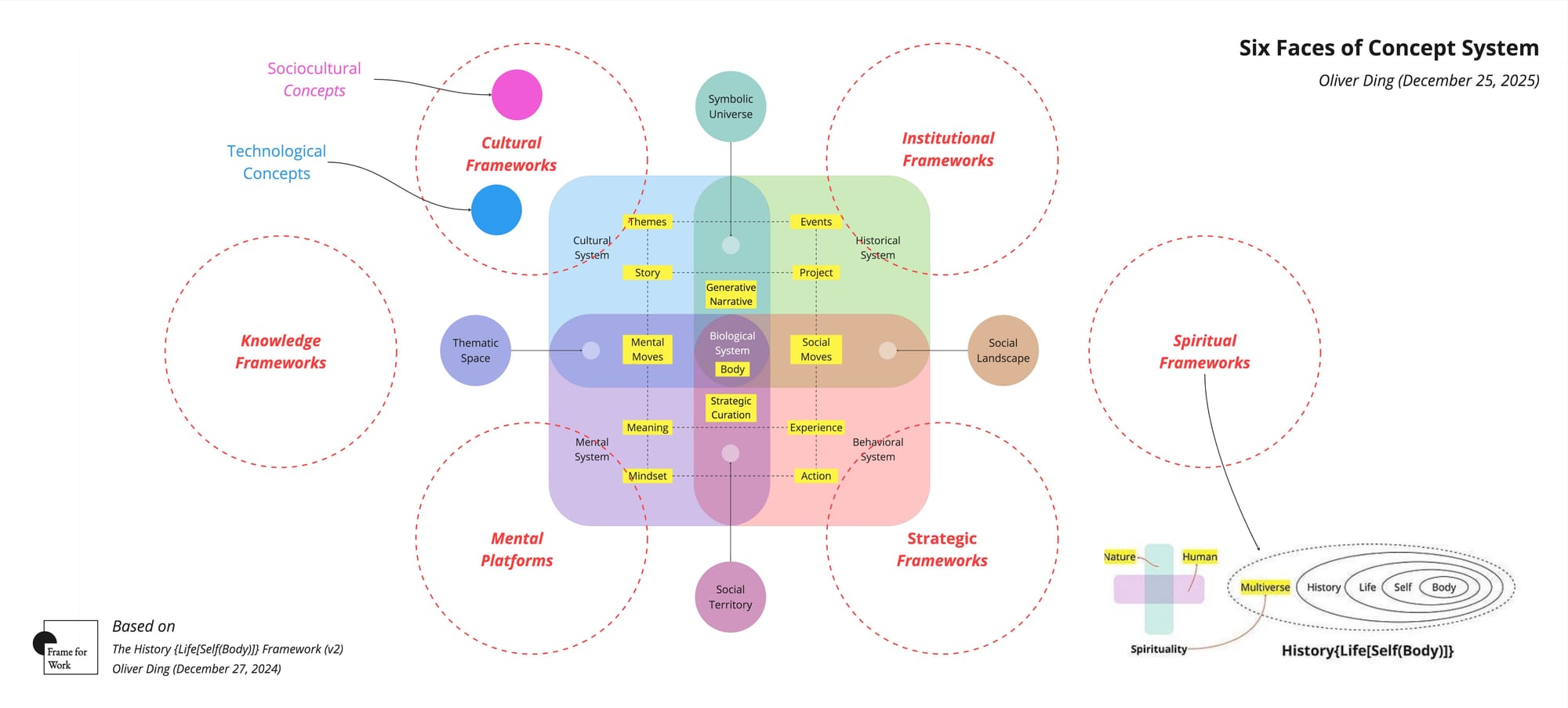
The diagram identifies six types of concept systems situated within the HLS framework:
- Knowledge Frameworks
- Cultural Frameworks
- Institutional Frameworks
- Mental Platforms
- Strategic Frameworks
- Spiritual Frameworks
This is not a simple typology, but a dynamic map of evolving concept systems.
My own journey of developing such systems is itself an evolving process.
This article tells the story and reflects on the map.
Contents
Part 1: The “Evolving Concept System” Journey
1.1 The Origin — Knowledge Frameworks (The Prototype)
1.2 The Extension — Strategic & Cultural Frameworks (The Value Turn)
1.3 The Pivot — Contextualizing via the HLS Framework
1.4 The Synthesis — The Emergence of the Six Faces
Part 2: The Essence of the Concept System
2.1 Scale: The Art of Chunking
2.2 Hierarchy: The Art of Structural Organization
2.3 Boundary: The Inside — Outside Principle
2.4 Function: The Means — End Spectrum
2.5 Representation: Strategic and Operational Levels
2.6 Genidentity: Essential Differences and Situated Dynamics
Part 3: Reflection
3.1 Two Outliers and the “Displacement” of Truth and Spirit
3.2 Meta-frameworks as Meaning Control Systems
3.3 Meta-frameworks as Creative Heuristics
Part 4: Conclusion
4.1 A Dynamic Model of Creative Life and Social World
4.2 Concept Systems as Cultural Bridge
Part 1: The “Evolving Concept System” Journey
In Part 1, I review my engagement with the Evolving Concept System from 2020 to 2025. Initially, I focused on knowledge frameworks, then gradually expanded to strategic frameworks, mental platforms, and cultural frameworks.
This recent reflection situates these practices within the context of the Meta-frameworks project. Finally, I examined the landscape of concept systems by mapping its six faces in the HLS framework.
1.1 The Origin — Knowledge Frameworks (The Prototype)
As a serial creator and lifelong thinker, I am deeply committed to intellectual development and reflective practice. I wrote my first learning autobiography in 2015 and became interested in biographical studies. At the end of 2017, I wrote a series of articles on the relationship between knowledge and personal development, through which I developed a framework called the Dynamic System of Personal Knowing.
In June 2020, I developed the HERO U framework for understanding the journey of knowledge heroes. This project led to a five-year creative journey focused on concept-centered knowledge activities.
In May 2025, I drew on developmental psychologist Robert Kegan’s Five Orders of Consciousness to reflect on the development of my own “Evolving Knowledge Enterprise” journey from 2020 to 2025 (see the diagram below).
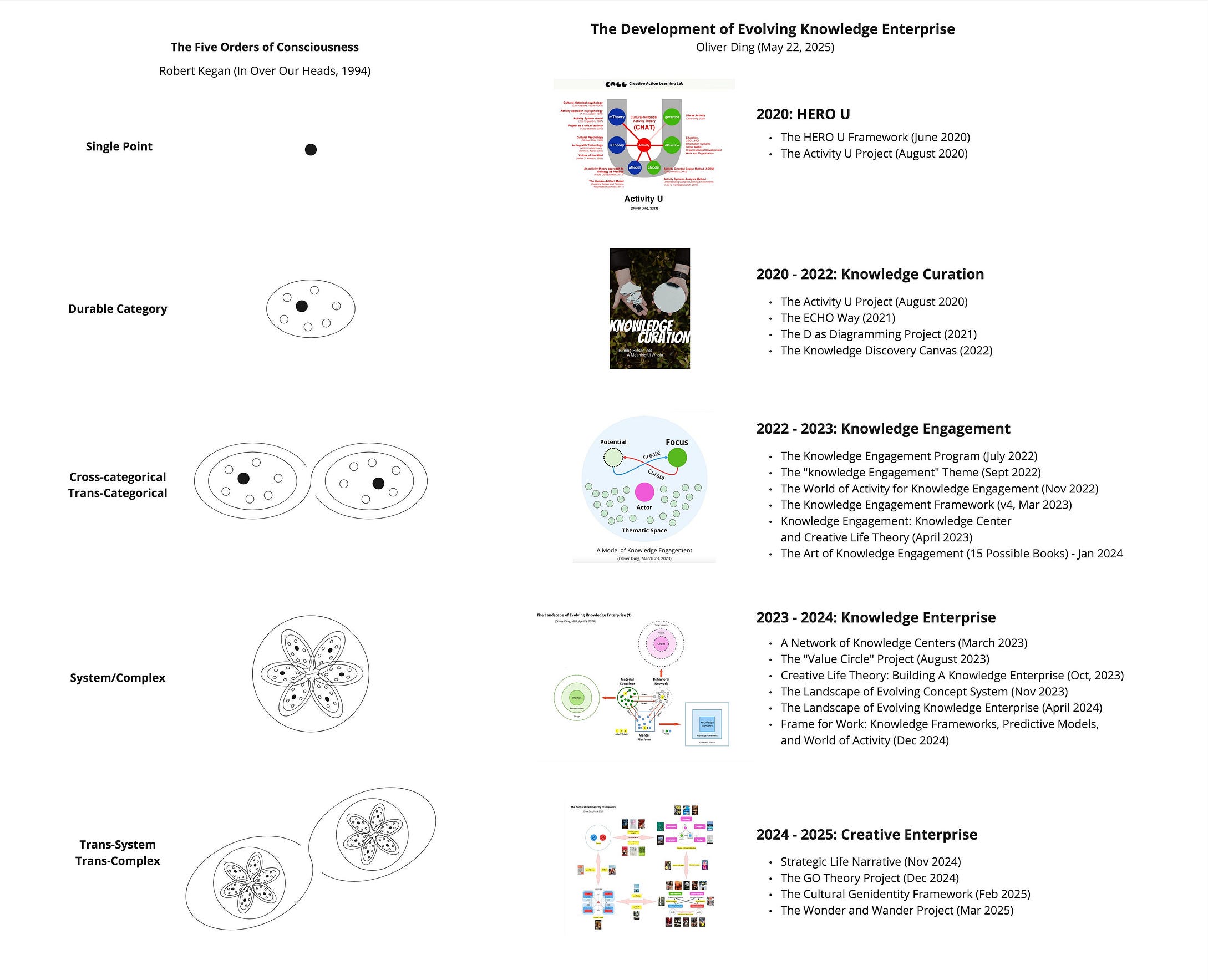
This journey is framed in five phases, each centered around a core creative theme and a constellation of knowledge projects. Remarkably, the developmental pattern of these themes aligns closely with Kegan’s model introduced in In Over Our Heads (1994).
- Single Point: “HERO U” (2020)
- Durable Category: “Knowledge Curation” (2020–2022)
- Cross-categorical/Trans-categorical: “Knowledge Engagement” (2022–2023)
- System/Complex: “Knowledge Enterprise” (2023–2024)
- Trans-system/Trans-complex: “Creative Enterprise” (2024–2025)
More details can be found in [Wander and Wander] The “Evolving Knowledge Enterprise” Journey (2020–2025).
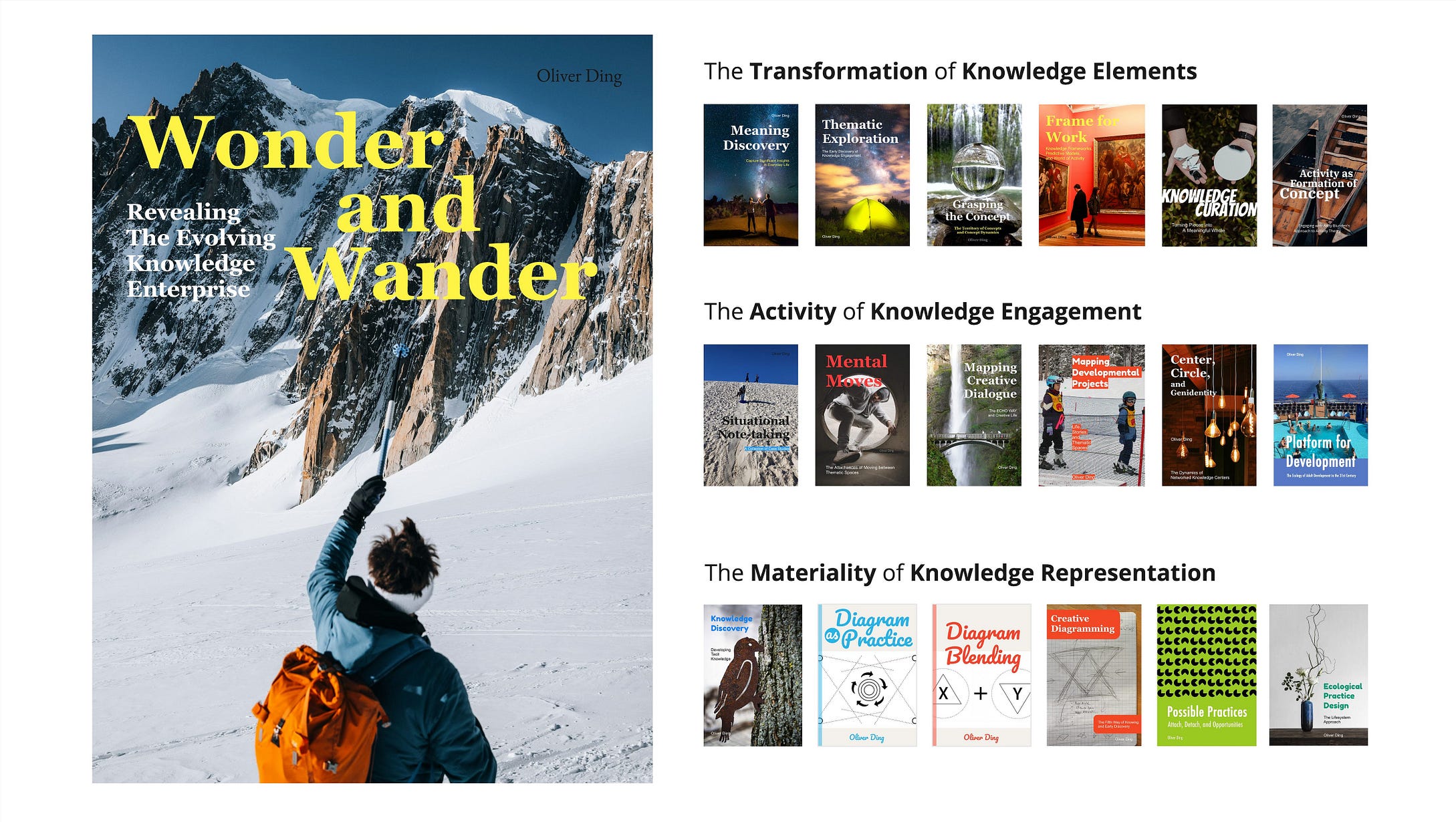
At the end of 2024, I used the picture below to highlight a series of book drafts across three dimensions. It also marks the Wonder and Wander project as the final project of the “Evolving Knowledge Enterprise” journey.
A primary object of the journey is the Theme–Concept–Framework Transformation Model, which emerged in early 2023. At that time, I worked on TALE (Thematic Analysis Learning Engagement), a knowledge center focusing on the thematic engagement approach.
As a knowledge center, TALE focuses on the “Person — Theme” relationship and its dynamics. However, this object of study is quite broad — many concrete activities and projects fall under the abstract notion of Thematic Engagement.
To maintain focus, I developed the TALE model to frame its strategic intention. See the diagram below.
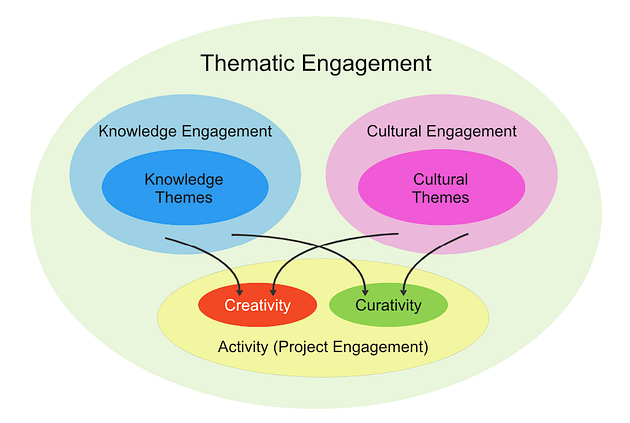
I divided Thematic Engagement into two types: Knowledge Engagement and Cultural Engagement. Drawing from the Project Engagement Approach, I redefined ‘Engagement’ and treated theme-based activities — such as projects — as its key working objects.
From 2020 to 2022, I explored knowledge engagement through a series of projects. In 2023, I decided to continue along this direction. Thus, I defined the first phase of TALE to focus specifically on Knowledge Themes, to stay aligned with my other knowledge-related initiatives.
One of the major outcomes of this project was the Strategic Thematic Exploration Framework (see the diagram below).
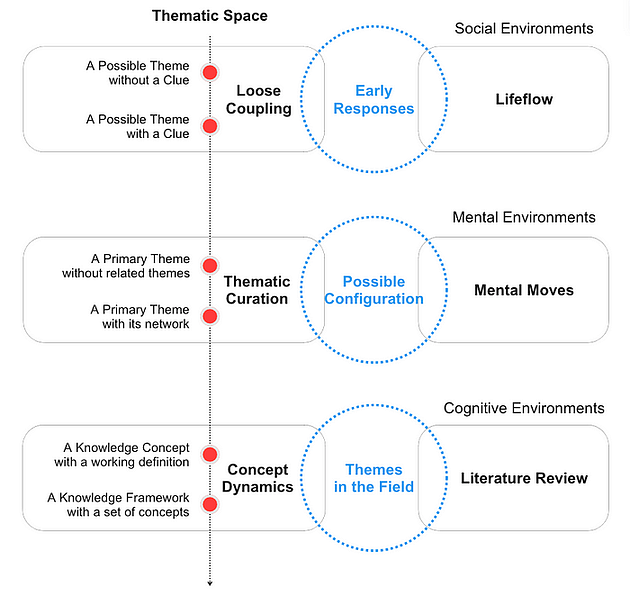
From my experience in developing knowledge frameworks and cultivating tacit knowledge in general, I have observed a consistent tendency for themes to evolve into concepts.
The Strategic Thematic Exploration Framework represents a linear process of “From Theme to Framework,” consisting of the following six stages:
- A Possible Theme without a Clue
- A Possible Theme with a Clue
- A Primary Theme without Related Themes
- A Primary Theme with its Network
- A Knowledge Concept with a Working Definition
- A Knowledge Framework with a Set of Concepts
I also identified three types of transformation that describe how this process unfolds:
- The “Possible — Primary” Transformation
- The “Theme — Concept” Transformation
- The “Concept — Framework” Transformation
The “Possible–Primary” Transformation concerns the discovery of opportunities for knowledge creation and knowledge curation. It establishes the primary strategic intent for the entire journey of knowledge engagement.
The “Theme–Concept” Transformation focuses on turning themes into concepts. It treats themes as raw materials and creative resources for generating new conceptual forms that can later be expanded or refined.
The “Concept–Framework” Transformation centers on curating conceptual components into a coherent and meaningful whole. In this stage, a knowledge framework emerges through the organization of multiple interrelated concepts.
Further details can be found in TALE: The “Strategic Thematic Exploration” Framework (v1.1).
From 2023 to the present, the Theme–Concept–Framework Transformation Model has guided my exploration into the development of knowledge systems, resulting in a series of book drafts (see the diagram below).
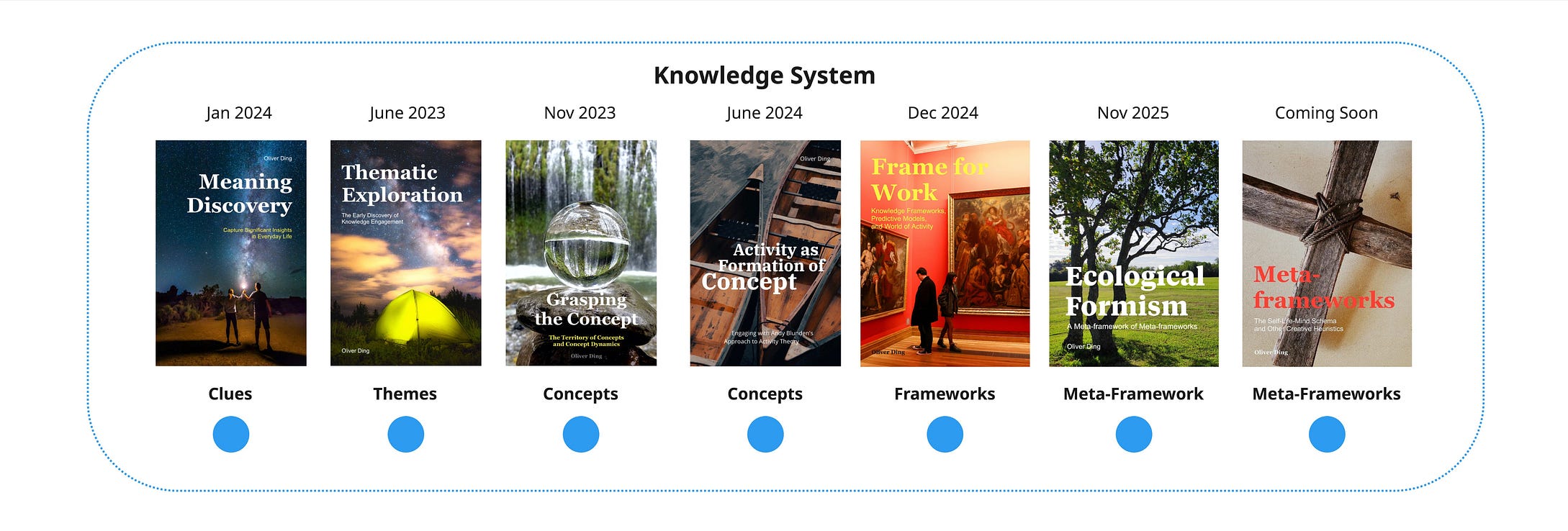
- Clues → Meaning Discovery (Jan 2024)
- Themes → Thematic Exploration (June 2023)
- Concepts → Grasping the Concept (Nov 2023)
- Concepts → Activity as Formation of Concept (June 2024)
- Frameworks → Frame for Work (Dec 2024)
- Meta-Framework → Ecological Formism (Nov 2025)
- Meta-Frameworks → Meta-Frameworks (December 2025)
By the end of 2024, I began shifting from Knowledge Engagement to Cultural Engagement. Interestingly, the entire body of knowledge created under TALE in 2023–2024 turned out to be ready for this transition. I simply rephrased parts of my frameworks — changing terms like “knowledge X” to “creative X”.
In fact, I don’t see this as a shift but rather an expansion — because all creations about themes and concepts within the context of knowledge engagement can also be applied meaningfully to cultural engagement.
This strategic model has helped me navigate the balance between Performance (as present objects) and Anticipation (as future objectives).
1.2 The Extension — Strategic & Cultural Frameworks (The Value Turn)
In 2024, the focus of the “Evolving Knowledge Enterprise” journey was the landscape of the evolving knowledge enterprise model.

It is a 3-dimensional x 3 hierarchical levels model, where the three dimensions correspond to Mental Platform, Material Container, and Behavioral Network.
To enhance the framework, I introduced three types of Engagement, aligning them with its core dimensions:
- Knowledge Engagement → Mental Platform
- Value Engagement → Behavioral Network
- Material Engagement → Material Container
I often used the middle layer of the Evolving Knowledge Enterprise model to reduce information overload (see the diagram below).

In December 2024, I applied this framework to develop a situational model for the possible book Frame for Work: Knowledge Frameworks, Predictive Models, and World of Activity.
The situational model uses a multi-perspective approach, incorporating several theoretical frameworks as resources to support diverse practices. The book highlights four perspectives:
- Frame in Make
- Frame in Use
- Frame in Diagram
- Frame in Form
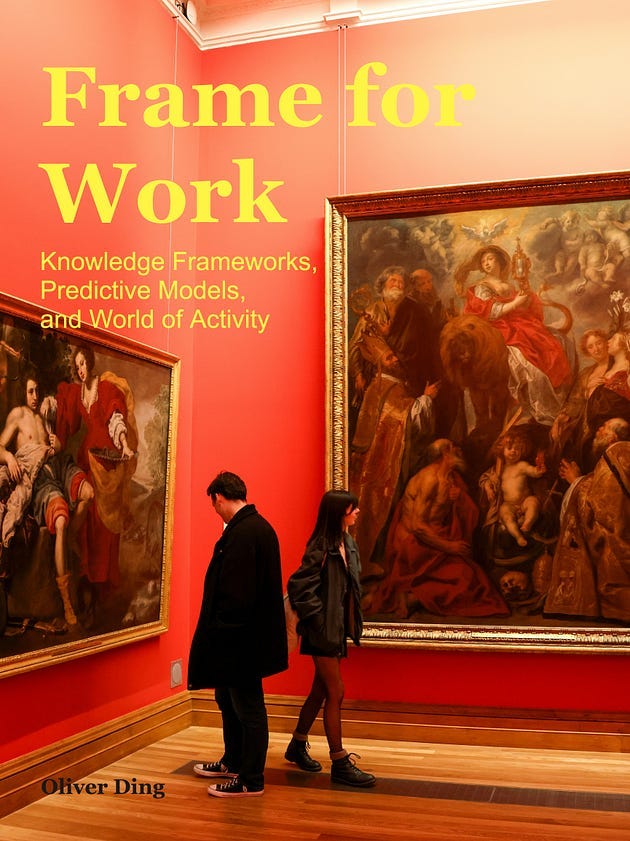
More details can be found in [Frame for Work] The “Mental — Social — Material” Schema.
A key term during this phase was the concept of Predictive Model, introduced in my 2022 book draft, Advanced Life Strategy: Anticipatory Activity System and Life Achievement. Predictive Models adopt the Frame-in-Use perspective, discussing the different contexts in which knowledge frameworks function as predictive models, including Knowledge Engagement, Material Engagement, Project Engagement, and Creative Journey.
I recently began using the term Strategic Frameworks to describe an advanced version of Predictive Models, particularly for long-term journeys encompassing a series of projects, whereas normal Predictive Models are applied to individual projects. This represented a major step beyond the cognitive dimension of the knowledge system.
This represented a major step beyond the cognitive dimension of the knowledge system, paving the way for the subsequent expansion into Cultural Frameworks.
As noted earlier, in 2023, while working on TALE, I maintained my focus on Knowledge Engagement, concentrating on Knowledge Themes.
In the last season of 2024, I took a further step, shifting my focus from knowledge engagement to cultural engagement in the Strategic Life Narrative project. In December 2024, I introduced GO Theory (The Genidentity — opportunity Approach), which emphasizes Social Life Development as its primary object.
During the 2024 Christmas holiday, I had a reflective conversation with a mentor, revisiting my work on HELLO THEORY, GO Theory, and the Strategic Life Narrative project. Through this reflection, I realized my newest focus had shifted toward Cultural Life Development, marking a detachment from Individual Life Development. This strategic move was encapsulated in the theme of “Cultural Grounding/Cultural Growing.”
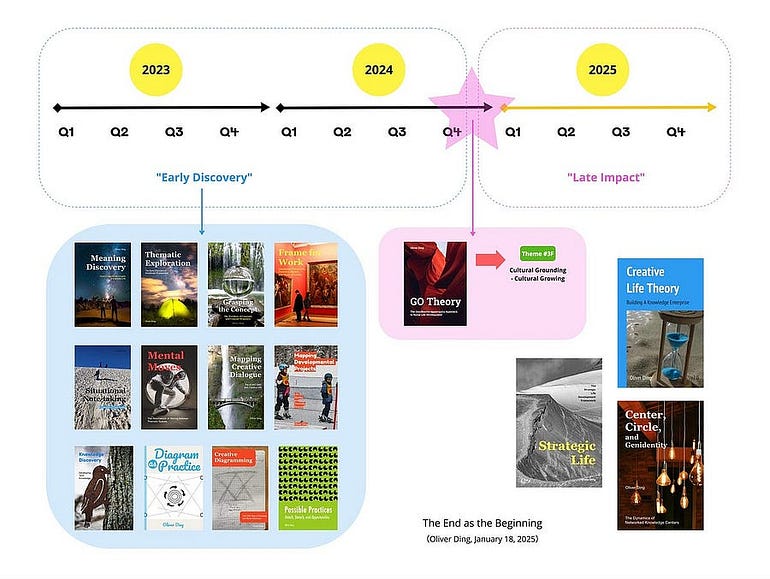
In 2025, while closing the “Evolving Knowledge Enterprise” journey (2020–2025), I also unfolded the “Cultural Development” journey, creating several knowledge frameworks about cultural development.
In September 2025, I developed the Frame for Work Canvas, which extends the original focus of the 2024 book (Knowledge Frameworks) to a broader object: Cultural Frameworks.
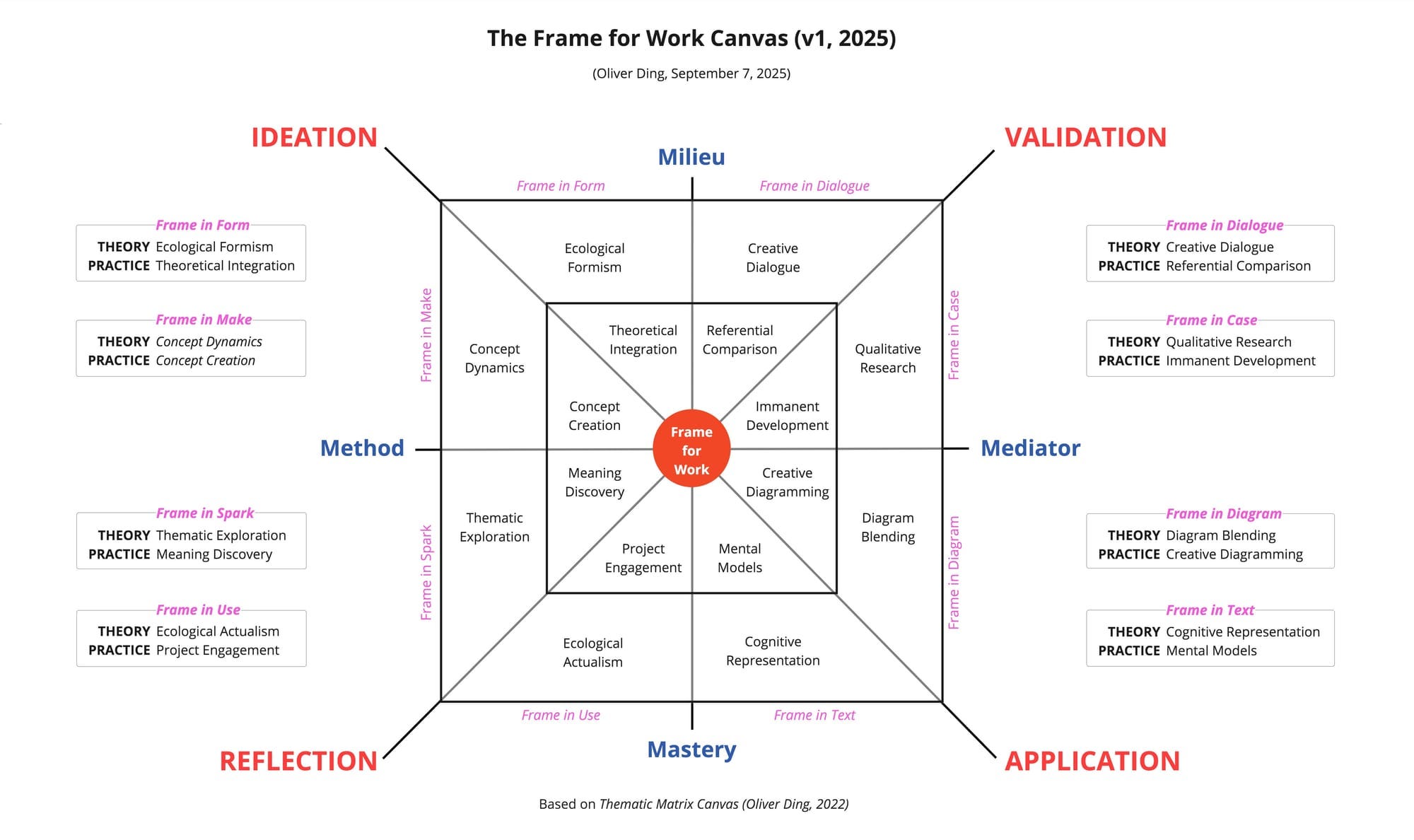
This expansion aligns with my shift from Knowledge Engagement to Cultural Innovation, a key transition I made in late 2024 and early 2025. More details can be found in Cultural Frameworks: A Canvas for Reflection and Innovation.
In the same month, I developed the “Culture as Thematic Enterprise” Framework.

The framework illustrates how individual creative exploration naturally evolves through stages: Creative Life (meaning discovery) → Tiny Culture (scalable focus) → Cultural Center (key function) → Cultural Movement. Each stage has independent value, with evolution happening organically rather than by design.
More details can be found in Tiny Culture: The “Culture as Thematic Enterprise” Framework.
This phase illustrates the progressive evolution of my approach — from focusing on Knowledge Themes and Predictive Models to embracing Strategic and Cultural Frameworks — highlighting the continuous interplay between cognitive development and cultural innovation.
1.3 The Pivot — Contextualizing via the HLS Framework
On December 13, 2025, I released a book draft, The Curativity of Mind: Mental Curation, Mental Platforms, and Mental Moves. The book draft develops a comprehensive framework for understanding the mind as a mental curation activity across extended time periods — from momentary perception to lifelong creative enterprises.

At the core of the framework is the “Perception — Action — Conception — Curation” schema. Researchers often discuss mind-related topics using the keywords “perception, conception, and action.” From the perspective of Curativity Theory, I propose expanding the foundation of these mind-related topics from three to four keywords. See the diagram below.
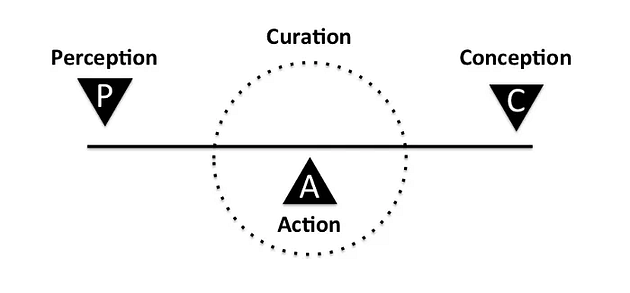
- Perception: How we sense and experience the world
- Conception: How we understand and think about the world
- Action: How we engage with and change the world
- Curation: How we turn pieces into meaningful wholes
The model above serves as a meta-framework, providing inspiration and guidance for the creation of various knowledge frameworks. The curatorial perspective allows us to see how mental elements, models, and platforms emerge through ongoing processes of organizing pieces into wholes — whether those pieces are perceptions, concepts, or actions.
Based on the core, I used the “Function — Context — Knowledge — Activity” schema to expand it into a practical framework for the Creative Life Theory (v3.0) project.

The framework is built on four dimensions:
- Function: How the mind works (by curating)
- Context: Where the mind operates (in social landscapes)
- Knowledge: What the mind uses (conceptual systems)
- Activity: What the mind does (developmental projects)
Over the past several years, I have been exploring relevant ideas in various knowledge projects. By using the “Function-Context-Knowledge-Activity” schema as a meta-framework, I can curate my articles on Mental Curation, Mental Platform, and Mental Moves into a new book.
After releasing the book draft, this Context (Mind) perspective encouraged me to examine Cultural Frameworks from a similar perspective — but in the opposite direction. While the mind is not confined to the brain, cultural frameworks do not exist solely within the cultural system; they also manifest within the mental system.
On December 17, 2025, I revisited a Creative Life Discovery project I conducted in 2024. A key model from this project was the HLS framework. This re-engagement also guided me to revisit the HLS framework, which I used as a map to integrate Mental Platforms, Cultural Frameworks, and Strategic Frameworks.

The History{Life[Self(Body)]} framework is based on the History{Life[Self(Body)]} schema and organizes a five-system map to curate a series of concepts:
- Body System
- Mental System
- Behavioral System
- Cultural System
- Historical System
The framework was inspired by Robert Rosen’s Anticipatory System Theory, particularly his concepts of Natural Systems and Formal Systems. It conceptualizes the social world as a nested Anticipatory Activity System (AAS):
- Micro-AAS corresponds to the Mental System (Natural System).
- Macro-AAS corresponds to the Cultural System (Historical System).
For the Meta-frameworks project, the HLS framework provides a theoretical ontology of the social world, offering a structured context in which concept systems can be understood and mapped.
1.4 The Synthesis — The Emergence of the Six Faces
By placing my existing focuses onto the History{Life[Self(Body)]} framework, I curated Knowledge Frameworks, Mental Platforms, Strategic Frameworks, and Cultural Frameworks together.
Moreover, I added two more concepts to the map. Reflecting on the notion of the Cultural System as an anticipation of the Historical System, I introduced Institutional Frameworks as the historical outcome of Cultural Frameworks. Revisiting the original schema in version 2.0 of the framework, I also added Spiritual Frameworks, corresponding to the “Multiverse” layer.
The result is the Six Faces of Concept System:
- Knowledge Frameworks
- Mental Platforms
- Strategic Frameworks
- Cultural Frameworks
- Institutional Frameworks
- Spiritual Frameworks
See the diagram below.

In the middle of the diagram, we observe four mappings between four faces of the concept system and four core systems of the social world:
- Mental Platforms — Mental System
- Strategic Frameworks — Behavioral System
- Cultural Frameworks — Cultural System
- Institutional Frameworks — Historical System
Outside this central area, two types of concept systems — Knowledge Frameworks and Spiritual Frameworks — do not correspond directly to the core map of the social world. Their displacement toward the extreme poles of truth and meaning will be discussed in Part 3.
These mappings also reveal that two models share the same deep structure. The HLS Framework is a nested Anticipatory Activity System (AAS) structure: the Behavioral System (Mental System) represents the micro-AAS, while the Historical System (Cultural System) represents the macro-AAS. The micro-AAS corresponds to individuals, and the macro-AAS to collective society.
At the individual level, Mental Platforms belong to people, serving as the source of Strategic Frameworks, which target particular creative enterprises composed of a series of developmental projects.
At the collective level, Cultural Frameworks belong to social groups, while Institutional Frameworks emerge as evolving outcomes of Cultural Frameworks. In other words, past generations of Cultural Frameworks serve as the source of present Institutional Frameworks.
While Institutional Frameworks represent the crystallized history of human activity, Spiritual and Knowledge Frameworks represent the anticipatory horizon, pushing the Cultural System beyond its current limits.
Concept systems at individual and collective levels can influence each other. Individuals may adopt Cultural Frameworks to develop their Mental Platforms, while publicly shared Mental Platforms can contribute to new Cultural Frameworks. Similarly, some Institutional Frameworks can inspire Strategic Frameworks, and shared Strategic Frameworks can become part of Institutional Frameworks.
I also highlight two sub-types of Cultural Frameworks: Sociocultural Concepts and Technological Concepts, a distinction derived from my early work on the Concept-fit model for Platform Innovation. In 2021, I wrote Platform Innovation as Concept-fit, introducing a model to understand the technology — culture relationship. The model employed the Theme U framework to develop three levels of concept-fit between the Sociocultural field and the Technological field.

The Technological field reflects the evolution of affordances, while the Sociocultural field reflects the evolution of supportances.
The concept of Affordance was introduced by ecological psychologist James J. Gibson in The Ecological Approach to Visual Perception. Gibson’s theoretical question was, “What is there to be perceived?” His answer was Affordances. According to Gibson, “The affordances of the environment are what it offers the animal, what it provides or furnishes, either for good or ill” (p. 119).
Inspired by affordance, I coined the term Supportance, a theoretical concept to describe potential supportive possibilities for action within the relationship between social environment and person. Supportance, like Affordance, points to potential action possibilities; however, it applies primarily to the social and cultural environment, whereas Affordance is grounded in perceptual psychology and the material world.
The distinction between Sociocultural and Technological Concepts corresponds to the distinction between social and material environments.
Within the HLS framework, the Cultural System corresponds to the Historical System. Connecting the Concept-fit framework into HLS, the technological and sociocultural fields can be seen as sub-fields of the Cultural System. Consequently, Knowledge Frameworks and Spiritual Frameworks are not isolated outliers; they are extreme functional extensions of engagement with material and social environments.
- Knowledge Frameworks emerge as a specialized, ‘de-contextualized’ subtype of Technological Concepts, stripping away practical utility to extend toward objective reality (Science).
- Conversely, Spiritual Frameworks emerge as a specialized, ‘transcendental’ subtype of Sociocultural Concepts, stripping away mundane social norms to extend toward transcendental significance (Multiverse).
This connection reveals that the Cultural System is heterogeneous. Different types of cultural frameworks may compete with each other. This is why the mechanism of Generative Narrative is crucial: it acts as the ‘coordinating force’ that selects and transforms the anticipations of the Cultural System into the structured reality of the Historical System.
It also demonstrates how concepts of ecological opportunities — such as Affordance and Supportance — can be applied within the HLS framework.
While these six types of the concept system function with different features in different contexts, they all share the same essence: a universal cognitive tool for humans. Part 2 returns to the cognitive dimension, exploring the fundamental principles that apply across all six faces.
Part 2: The Essence of Concept System
A concept system is a network of concepts with a coordinating mechanism. In this part, we explore it from six perspectives: scale, hierarchy, boundary, function, representation, and genidentity.
I will curate my explorations and insights from the past few years in these areas. Although these early investigations focused on Knowledge Frameworks, the principles they reveal are applicable across all six faces. Taken together, they form a complete and systematic meta-framework for understanding the coordinating mechanisms underlying evolving concept systems.
2.1 Scale: The Art of Chunking
The scale of a network depends on the number of its nodes. If a concept system contains too many concepts, it can become a complex and unwieldy structure.
Cognitive psychologists suggest that people use the Chunking technique to transform a large amount of information into a human-friendly scale for bypassing the limited capacity of working memory. This principle can also be applied in the practice of evolving concept systems.
For example, I often rely on the middle layer of the Evolving Knowledge Enterprise model (see the diagram below).
The model is structured as a 3×3 matrix, which exceeds the typical limits of working memory.
2.2 Hierarchy: The Art of Structural Organization
While Chunking (Section 2.1) reduces the complexity of individual units, hierarchy organizes these units into nested layers to manage systemic complexity. Hierarchy is an efficient way to structure information, and in concept systems, it typically spans 2–4 layers.
From 2023 to 2024, I developed the “Variant > Quasi-invariant > Invariant > Invariant Set” schema as a meta-framework for developing an ecological epistemological framework.
The schema defines four types of knowing. For example, it can be applied to understand knowledge frameworks.
- Invariant: Basic Forms
- Invariant Set: Frames
- Quasi-invariant: Derived Forms
- Variant: Frameworks
The diagram below illustrates how the Basic Form of “Container(Containee)” can generate multiple knowledge frameworks for different projects.

Notably, the landscape of the Evolving Knowledge Enterprise is situated at the Variant layer.
Zooming into the Evolving Knowledge Enterprise reveals its own hierarchical structure: a 3-dimensional × 3-level model:
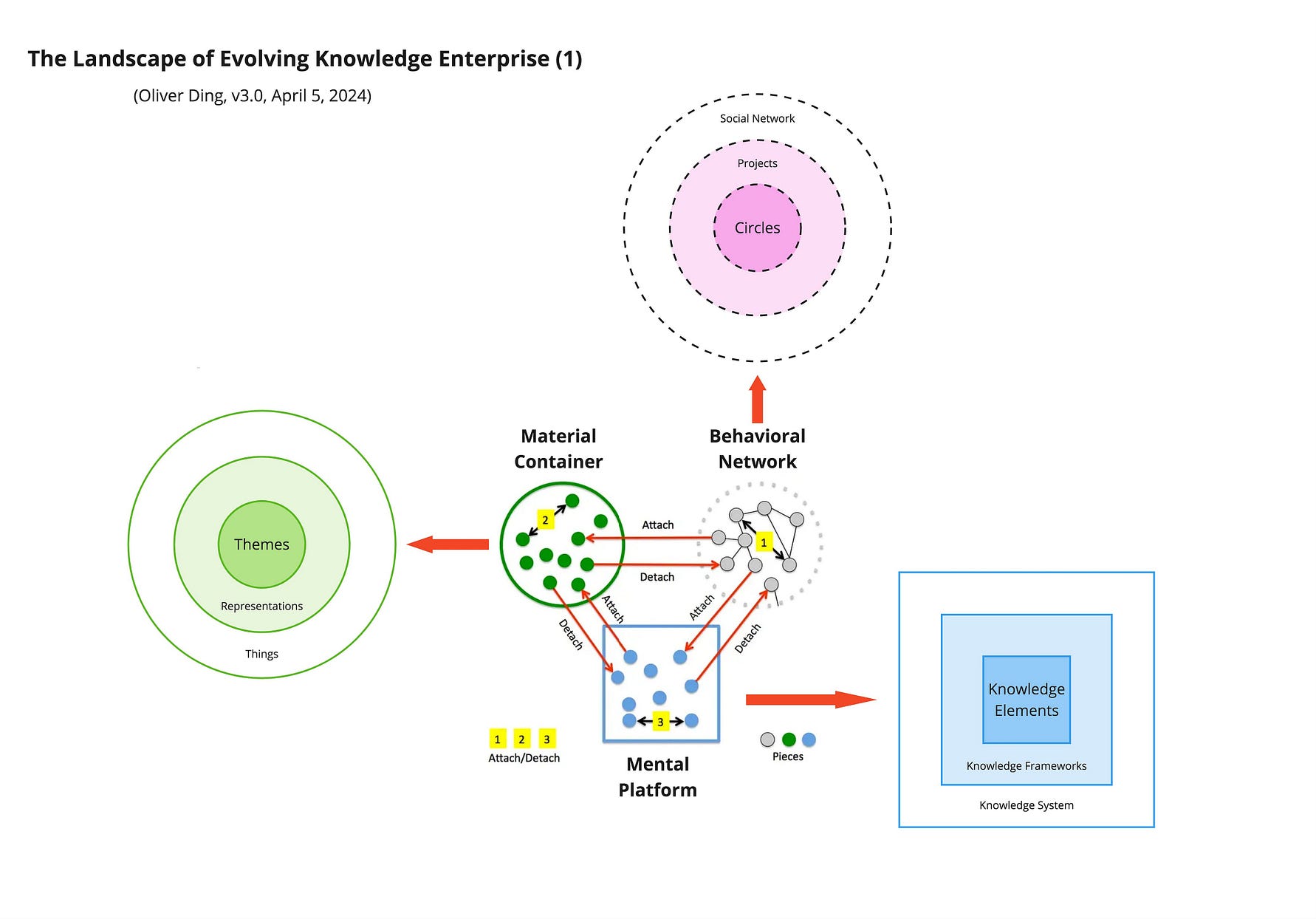
3 Dimensions
- Mental Platform: Knowledge Elements → Knowledge Frameworks → Knowledge System
- Material Container: Themes → Representations (such as Diagrams) → Things
- Behavioral Network: Circles → Projects → Social Network
The Middle Loop
- Knowledge Frameworks
- Representations (Such as Diagrams)
- Projects
Based on the above model, I expanded it into a toolkit. More details can be found in The Landscape of Evolving Knowledge Enterprise.
For the “Mental Platform” part, the following three levels are considered:
- Knowledge Element (theme, concept, diagram, case study, etc.)
- Knowledge Framework (concept system)
- Knowledge System (a large system based on a series of concept systems)

Themes, concepts, diagrams, case studies, and similar elements are individual knowledge elements. When curated together, they form a systematic knowledge framework.
When several knowledge frameworks are grouped together, they form a larger unit, a knowledge system.
In my 2025 book draft, Strategic Life Narrative, I used the following levels for the “Theme” group:
- Creative Clues
- Creative Themes
- Creative Concepts
- Creative Frameworks
Here, Clues, Themes, and Concepts correspond to Knowledge Elements. When multiple concepts work together, they form a Concept System, also referred to as a Knowledge Framework.
2.3 Boundary: The Inside — Outside Principle
In 2022, I applied the Inside–Outside Principle to design the Knowledge Discovery Canvas. The canvas was originally developed to explore the development of tacit knowledge. To distinguish external, public knowledge from internal, personal knowledge, I used the notions of inner space and outer space in its design.
The Inside — Outside Principle leads to the following distinctions:
- Mental Elements vs. Knowledge Elements
- Mental Models vs. Knowledge Frameworks
On October 26, 2025, I further connected the principle with the Container-Platform-Network schema, resulting in the diagram below.
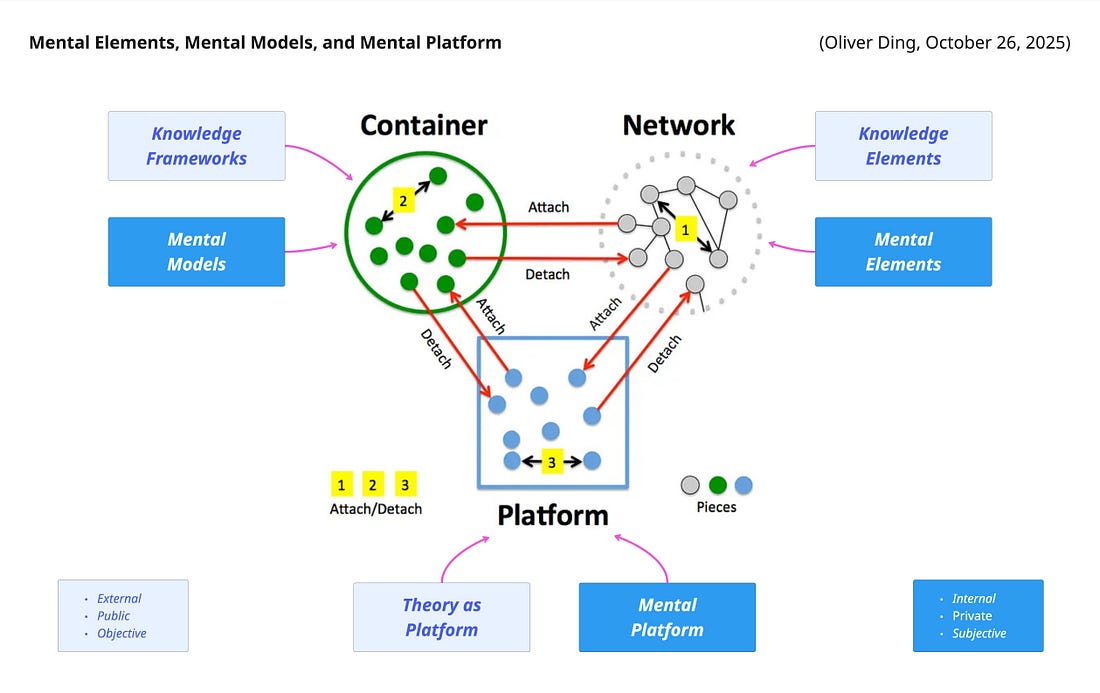
At the “Network” corner, we find:
- Knowledge Elements
- Mental Elements
At the “Container” corner, we find:
- Knowledge Frameworks
- Mental Models
At the “Platform” corner, we find:
- Theory as Platform
- Mental Platform
These concepts can also be grouped into two overarching categories:
- External, Public, and Objective
- Internal, Private, and Subjective
Moreover, there exist several types of attachances between the thematic spaces associated with these concepts.
A Knowledge Framework can be internalized and transformed into Mental Models; in this movement, we detach from the outside space and attach to the inside space.
Conversely, a Mental Platform can be externalized as a product, becoming a Theory as Platform. In this movement, we detach from the inside space and attach to the outside space.
This model represents the seed of the Six Faces of the Concept System.
2.4 Function: The Means — End Spectrum
Within the landscape of evolving concept systems, concept systems serve two distinct purposes:
- Concept System as Work: Such as Theory as Platform and the Concept System behind a product. Here, a concept system functions as an End, producing external results for others to use.
- Concept System for Work: Such as Mental Platform, Team Culture, and Beliefs and Values. Here, a concept system functions as a Means, serving as internal tools for a team.
This distinction reflects the Means — End Spectrum I introduced on November 29, 2021.
On October 23, 2025, I developed the Double Platform Framework:
- Mental Platform → Spontaneous Concept System → Concept System as Means
- Theory as Platform -> Scientific Concept System → Concept System as End

More details can be found in Weave the Concept: Mental Elements, Mental Models, and Mental Platform.
The Six Faces of the Concept System further situate these distinctions within the context of the social world.
2.5 Representation: Strategic and Operational Levels
Some concept systems are designed to analyze specific activities or social practices. When a concept system serves this purpose, it functions as a knowledge framework. While all knowledge frameworks are concept systems, not all concept systems qualify as knowledge frameworks; thus, knowledge frameworks represent a subset of concept systems.
What’s the relationship between Frameworks and Diagrams?
Knowledge Diagrams are external visual representations of knowledge frameworks. However, this correspondence is not strict. Some knowledge frameworks are represented through tables or textual formats rather than diagrams. Conversely, certain diagrams — such as meta-diagrams — represent only spatial structures, not domain-specific knowledge. The typology below illustrates different forms of cognitive representation.
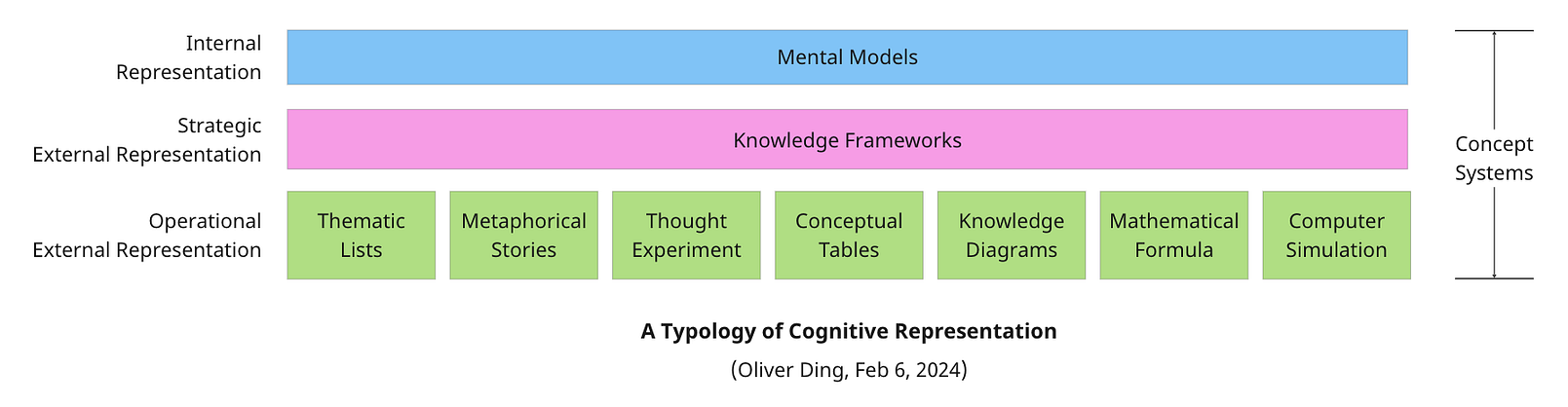
There is also a loose correspondence between networks of knowledge frameworks and Diagram Networks. A Diagram Network can be used to develop a Network of Knowledge Frameworks.
More details can be found in Diagram Explained: Concept System, Diagram Network, and Knowledge Frameworks, and Diagram Explained: Kinds of Cognitive Representation and The Fifth Way of Knowing.
Although this typology of cognitive representation was originally developed to study knowledge frameworks, it can now be applied to explore other types of concept systems.
2.6 Genidentity: Essential Differences and Situated Dynamics
In May 2022, I developed the Platform Genidentity framework to understand the Identity of a Knowledge System and a Knowledge Center over time. The framework drew from Kurt Lewin’s early 20th-century concept of genidentity, defined as the existential continuity of an object through its successive phases of development. According to Lewin, identity did not stem from static properties but from a lineage of transformation — “one has developed from the other.”
Though Genidentity was originally developed to compare scientific disciplines and their developmental logic, I interpreted it as a concept of “topology of identity” with temporal dynamics.
To operationalize the concept, I proposed the following working definition:
A thing’s Genidentity is defined by Essential Differences with Situated Dynamics. This allowed me to transform a philosophical concept into a usable one for empirical research.
In May 2024, based on the Platform Genidentity framework, I further developed a model to discuss the Genidentity of the Knowledge System. The diagram below illustrates an application of this model, developed later in December 2024.
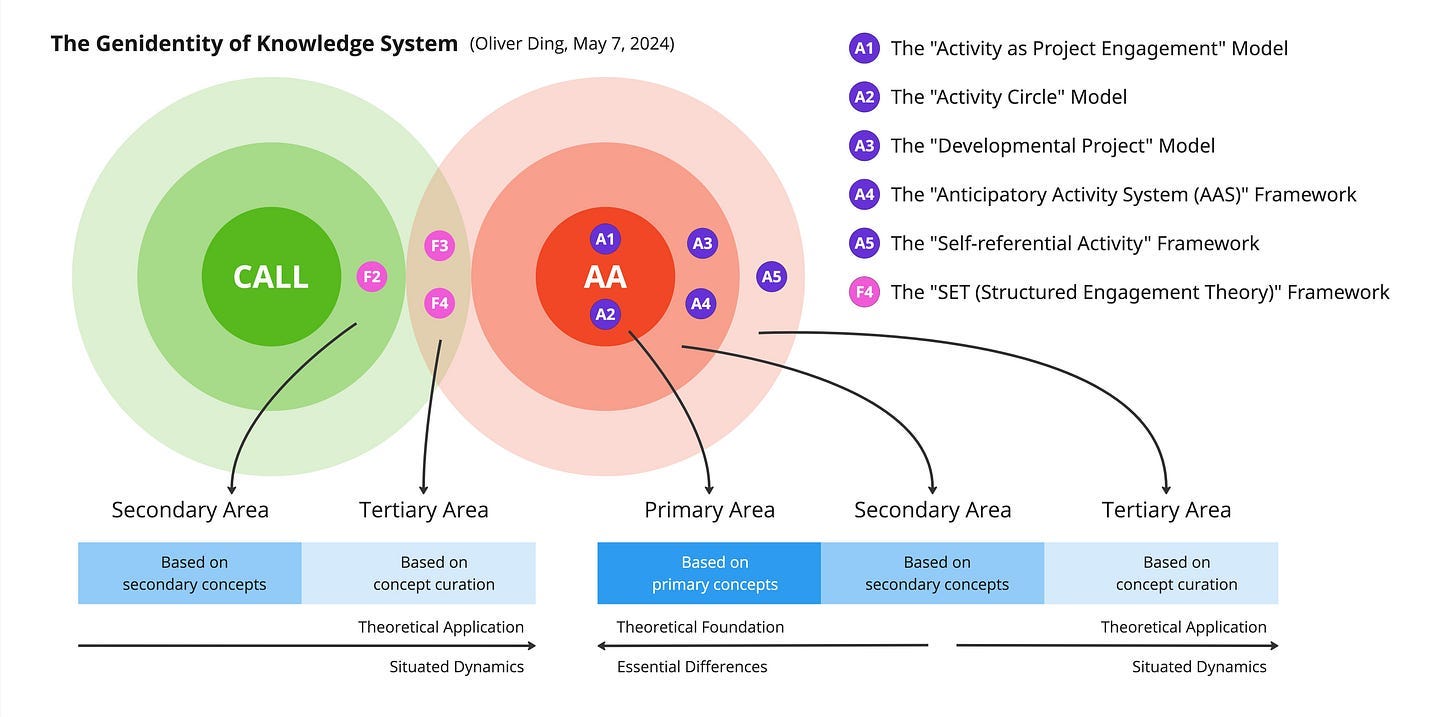
In December 2024, I launched the World of Activity toolkit, featuring five models. I later positioned these five, along with an additional one, on the Genidentity diagram.
- CALL hosted The Ecological Practice Approach, inspired by Ecological Psychology.
- AA hosted the Activity Analysis Method, rooted in Activity Theory.
I regarded a theoretical approach as a large-scale knowledge system composed of different types of knowledge entities. Some were foundational (e.g., primary concepts that define Essential Differences), and others were applied (e.g., practical frameworks that adapt to Situated Dynamics).
I also placed a series of knowledge frameworks on the diagram, assigning them to the primary, secondary, and tertiary areas. This arrangement allows us to identify which knowledge frameworks constitute the Essential Differences of a given knowledge system.
More details can be found in The Genidentity of Knowledge System.
By curating my explorations together, we can see the bigger picture, revealing six key aspects of the coordinating mechanism of concept systems: scale, hierarchy, boundary, function, representation, and genidentity.
What began as an inquiry into the specialized structure of knowledge frameworks has thus revealed itself to be the universal anatomy of all concept systems, regardless of their social faces.
Part 3: Reflection
In this part, we further discuss the outliers of the six faces of the concept system: Knowledge Frameworks and Spiritual Frameworks.
Following this track, we return to explore Meta-frameworks as Meaning Control Systems and as Creative Heuristics.
3.1 Two Outliers and the “Displacement” of Truth and Spirit
A profound observation emerges when mapping these six faces onto the HLS v3.0 framework. While four faces occupy the core quadrants of the diagram, two faces appear to be “displaced” toward the extremes: Knowledge Frameworks on the left and Spiritual Frameworks on the right.
This displacement was not designed but discovered, revealing something fundamental about the structure of human conceptual life.
When we examine the Six Faces diagram carefully, an asymmetry becomes apparent: Knowledge Frameworks (Science) is displaced to the left, outside the four core systems. Spiritual Frameworks (spirituality) displaces to the right, outside the four core systems. The Four Central Faces — Mental Platforms, Strategic Frameworks, Cultural Frameworks, and Institutional Frameworks — occupy the core quadrants, forming what we might call the operational center of everyday social life.
This spatial arrangement suggests a functional distinction. Knowledge Frameworks and Spiritual Frameworks do not fit comfortably within any single system (Mental, Behavioral, Cultural, or Historical). Instead, they appear to define the boundaries of the thematic spaces within which the other four faces operate.
- Science as the Lower Boundary: Knowledge Frameworks pursue truth independent of value judgments and social interests. In the HLS framework, this represents an attempt to reach beyond social mediation toward what we might call “objective reality” — the patterns and laws of the natural world that constrain all human activity.
- Spirituality as the Upper Boundary: Spiritual Frameworks address ultimate meaning and transcendent experience. In the HLS framework, this represents an opening toward what lies beyond immediate social life — the Multiverse, the sacred, the realm of existential significance.
- The Central Four as the Operating Zone: Mental Platforms, Strategic Frameworks, Cultural Frameworks, and Institutional Frameworks operate between these boundaries. This is where human life actually unfolds: above the constraints of natural law but below the infinite possibilities of transcendent meaning, in the realm where values are negotiated, interests clash, and practical decisions must be made.
This structure suggests that human conceptual systems require both grounding and transcendence to function. Without science, we lose contact with the constraints of reality. Without spirituality, we lose access to ultimate meaning. Without the four central faces, we cannot connect these extremes to the practical demands of living together.
3.2 Meta-frameworks as Meaning Control Systems
A concept system can function as a regular framework for normal usage, or as a meta-framework to guide other frameworks.
In the previous sections, we introduced the three-level hierarchy of the concept system. For example:
- Lower level: Mental Element
- Middle level: Mental Model
- Higher level: Mental Platform
Within this structure, the higher level can be regarded as a Meta-framework. This insight can be generalized across all six faces of the concept system.
In November 2024, I wrote an article titled The Strategic Life Narrative Practice #4: Creative Frameworks and asked a question:
Why do theoretical researchers like meta-frameworks?
A simple answer is what theoretical sociologist Thomas J. Fararo and his student John Skvoretz called “a hierarchical meaning control system” in an article titled Methods and Problems of Theoretical Integration and the Principle of Adaptively Rational Action (1993).
According to Fararo and Skvoretz, “Calling this a meaning control hierarchy is intended to emphasize that higher levels constitute commitments that ‘inform’ — enable and constrain — the lower level activities or discoveries.”
Different theorists have different models of their “hierarchical meaning control system” with different terms. For example, Fararo and Skvoretz suggested four levels:
- General presuppositions
- Representation principles
- Theoretical Models
- Invariants
We can use “Meta-theory” and “Theory” to describe the “hierarchical meaning control system.”
The benefits of using the same “hierarchical meaning control system” for theoretical creators in the same field are invaluable and critical to growing public knowledge because it offers a systematic view, logical coherence, and a common language for making, sharing, and curating abstract theoretical knowledge.
The term “Meaning Control System” can now be applied to all six faces of the concept system. Importantly, this does not imply that the higher levels “control” the lower levels in a mechanical sense. As Fararo and Skvoretz emphasize, it is better understood as informing — enabling and constraining.
Interestingly, the two outliers among the six faces — Knowledge Frameworks (Science) and Spiritual Frameworks (Spirituality) — both function as Meaning Control Systems, yet they are associated with distinct domains of meaning: “objective reality” and “transcendent significance,” respectively.
3.3 Meta-frameworks as Creative Heuristics
The Six Faces are not arranged hierarchically but rather form a topological map. The displacement of Science (Knowledge Frameworks) and Spirituality (Spiritual Frameworks) does not imply that they are “more important” than the central four faces. Rather, each face functions as a creative heuristic for individual and social development.
- Knowledge Frameworks serve as the seed — the cognitive prototype that establishes what can be known with certainty.
- Cultural Frameworks represent growth — the negotiation of values and meanings through which knowledge becomes socially operative.
- Strategic Frameworks enables action — the translation of understanding into concrete engagement with the world.
- Institutional Frameworks constitute the harvest — the historical accumulation and stabilization of practices and norms.
- Mental Platforms enable mental curation — the personal cognitive infrastructure that supports individual development.
- Spiritual Frameworks provides a transcendent opening — the connection to ultimate meaning that gives human life its deepest orientation.
From the perspective of individual development — the primary focus of The Curativity of Mind — a person’s engagement with concepts involves progressive engagement with all six faces:
- Learning (Knowledge Frameworks): Internalizing scientific and systematic knowledge that provides an objective understanding of the world.
- Curating (Mental Platforms): Building personal predictive models and cognitive structures that organize experience into meaningful patterns.
- Acting (Strategic Frameworks): Translating internal understanding into external engagement, making decisions, and pursuing goals.
- Projecting (Cultural Frameworks): Negotiating values with others, contributing to shared meanings, navigating social complexity.
- Inheriting (Institutional Frameworks): Operating within established norms and practices, while also potentially transforming them.
- Seeking (Spiritual Frameworks): Connecting to transcendent meaning, addressing ultimate concerns, finding existential orientation.
- Creating (Concept Systems): Developing new concept systems that function as the Six Faces in the social world.
The journey represented by the Six Faces thus encompasses the full spectrum of conceptual engagement — from foundational cognition, through complex social interaction, to the pursuit of ultimate meaning. This reflects the panoramic vision that the HLS framework provides.
Part 4: Conclusion
4.1 A Dynamic Model of Creative Life and Social World
The Six Faces are not a final answer but a living map — one that has emerged from my own creative journey and will continue to evolve as new insights arise. Just as the model shows concept systems developing across multiple faces, the model itself exemplifies this development:
- It began with Knowledge Frameworks (the prototype of pure cognition).
- It extended through Strategic and Cultural Frameworks (the value turns toward action and meaning).
- It found its organizing principle in the HLS Framework (the pivot toward social ontology).
- It was synthesized into the Six Faces (the integration of individual and social development).
And now, through reflection on the displacement phenomenon, it reveals its own deep structure — the need for both grounding and transcendence.
This is the pattern of conceptual development itself: starting from a single insight, extending through practical application, finding theoretical coherence, and ultimately connecting back to the fundamental questions of truth and meaning that motivated the inquiry in the first place.
The Six Faces thus serve as both a map of concept systems and a demonstration of how such maps are created — through the patient, iterative work: building mental platforms, engaging with cultural frameworks, and seeking patterns that link the finite world we inhabit to the infinite possibilities we imagine.
4.2 Concept Systems as Cultural Bridge
As I reflected further on the two outliers of the Six Faces — Knowledge Frameworks and Spiritual Frameworks — a new insight emerged.
The displacement of these extremes reveals how conceptual systems mediate between operational realities and transcendent significance. Knowledge Frameworks define the lower boundary, orienting us toward patterns and laws of the natural world; Spiritual Frameworks define the upper boundary, opening us to ultimate meaning and existential significance. Between these boundaries, the four central faces operate as the dynamic zone where individual and collective life unfold.
This perspective highlights an intriguing resonance with classical Chinese philosophy. While our analysis is rooted in modern conceptual-system theory, the HLS structure mirrors the structural logic often articulated as “Heaven‑Earth‑Human”: the upper boundary corresponds to Heaven (Spirit), the lower boundary to Earth (Science), and the operational zone to Human (the interplay of individual and collective action).
This resonance is not incidental; it belongs to an ongoing thematic journey of the West–East dialogue. A similar insight was discovered in the Cultural Projection Model, introduced in a recent book draft, Developmental Projects. The model inspired a creative dialogue between Activity Theory (Internalization-Externalization) and Confucian Thought (Inner Sageliness-Outer Kingliness).
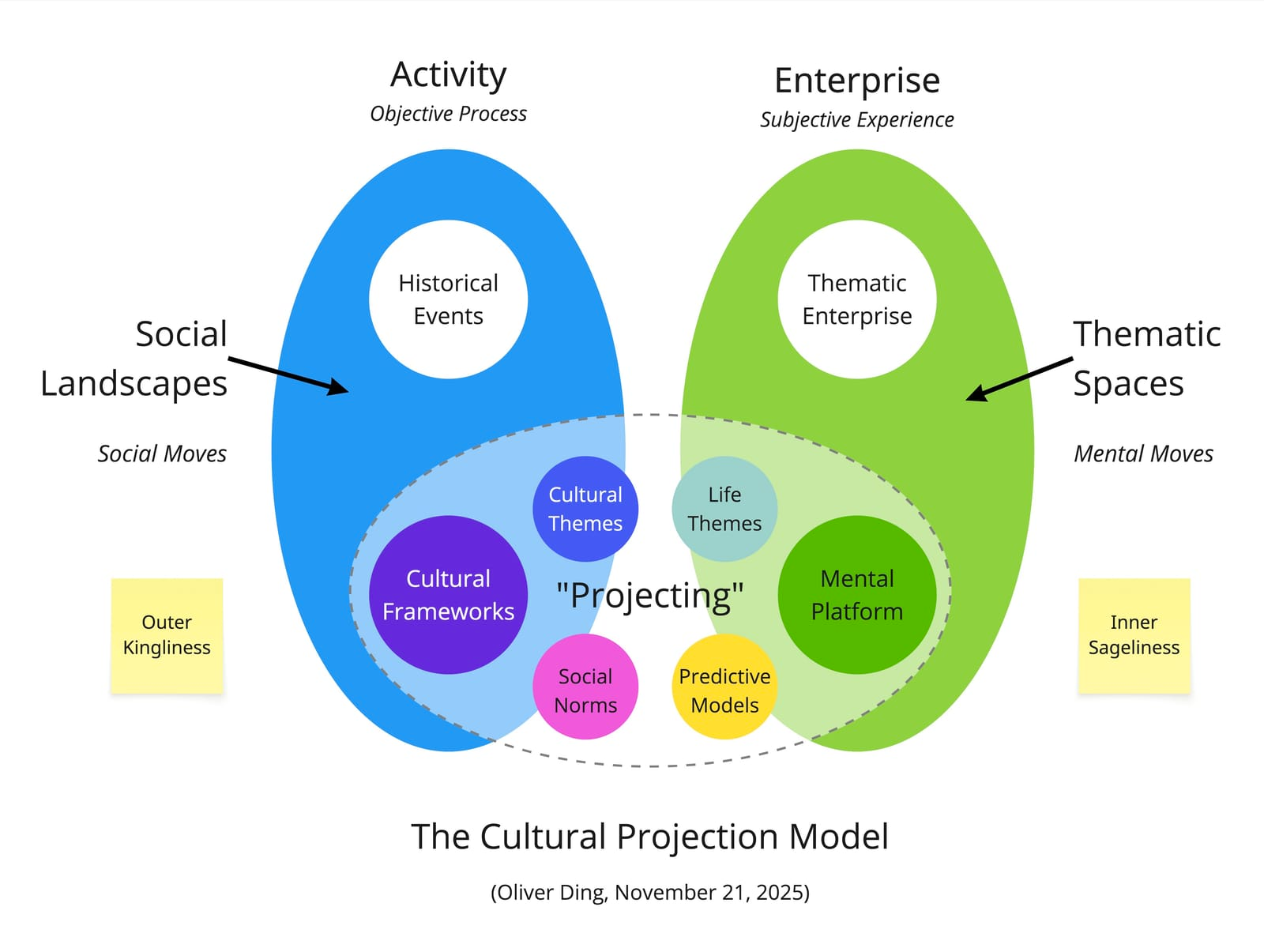
By placing Inner Sageliness (referring to subjective elements like Mental Platform, Life Themes) and Outer Kingliness (referring to objective elements like Cultural Frameworks, Social Norms) into the Cultural Projection Model, this dialogue identifies a deeper structural resonance between the two traditions.
Notably, the two main concepts of the model are Mental Platforms and Cultural Frameworks. Some terms used, such as Social Landscapes, Thematic Spaces, Social Moves, and Mental Moves, are part of the HLS framework too.
This is not a predetermined mapping, but a reflective insight: by studying the extremities of the conceptual landscape, we uncover a structural parallel with traditional wisdom.
In this way, the HLS framework no longer functions merely as a tool for understanding contemporary concept systems. It reveals itself as a deep structural map — one that helps explain how human thought, across cultures and historical periods, organizes cognition, social life, and ultimate meaning within a shared yet differentiated conceptual landscape.
v1.0 - December 17, 2025 - 6,570 words