
Spatial Heuristics: Developing a Pedagogy for Cognitive Hydrology
by Oliver Ding
March 7, 2026
Introduction: The Spatial Heuristics Series
This is the first case study in the Spatial Heuristics series. Before turning to the case itself, it is worth tracing how the series came to exist.
The starting point: a structural symmetry
In January 2026, while writing the final chapter of Lake 42: The Great Confluence, I recognized a mirror symmetry between two newly established theoretical enterprises: Anticipatory Cultural Sociology (ACS) and Strategic Developmental Psychology (SDP). ACS attends to cultural life development at the collective scale; SDP attends to individual life development at the personal scale. The two enterprises are structurally symmetric — the same fundamental pattern, wearing different disciplinary clothing.
This recognition, documented in the "Setting the Enterprise" chapter of Lake 42, was more than a theoretical observation. It was a generative signal: if the pattern was this consistent, there must be a method operating beneath it. Something was generating these symmetric structures. The question was what.
The development of the theme: ACS v1.0 to v1.1
If Lake 42 documents the Generative Confluence pattern — the development of Creative Life Theory v3.0–v3.1 through the convergence of multiple streams — then the development of ACS from v1.0 to v1.1, across January and February 2026, documents a different pattern: Spatial Heuristics.
Throughout this period, working on the ACS framework, I repeatedly found myself using the spatial construction of existing knowledge frameworks as a creative guide — placing concepts into structured positions, letting the spatial logic of a diagram call out to my conceptual archive, finding new insights not through logical derivation but through structural recognition. This operation recurred across multiple cases: the Personal Orientation of Cultural Projection, the Cognitive Container of Cultural Projection, and others. By the end of February, the pattern had a name: Spatial Heuristics.
The horizon: three streams converging
This series anticipates a new book manuscript. Like the Generative Confluence of Lake 42, this manuscript will itself be a confluence — of three distinct streams that have been developing in parallel:
The first stream is the theme-concept-framework lineage: the long arc of work connecting Themes of Practice, Thematic Space Theory, and the development of knowledge frameworks as creative tools.
The second stream is Creative Diagramming: the sustained inquiry into how diagrams function not just as representations of thought but as generative spaces for it.
The third stream is Cognitive Hydrology: the emerging theoretical enterprise that provides the pedagogical and metaphorical context for understanding how ideas flow, converge, and circulate through a creative life.
Spatial Heuristics sits at the intersection of all three. The case studies in this series are the first attempts to map that intersection — to understand, through concrete instances, what it means to let a spatial container anticipate its contents.
Contents
1. Theoretical Background: Thematic Space Theory and Spatial Heuristics
1.1 Thematic Space Theory and the Map–Moves–Models Structure
1.2 From Meta-frameworks to Spatial Heuristics
2. Developing a Pedagogy: Three Days in March
3. Key Diagrams and Models
3.1 The Agency Cascade Model
3.2 The World of Life
3.3 The Learning Landscape
3.4 The L3D Model
3.5 The FFCC Schema and the Four Cognitive Hydrology Tools
4. Spatial Heuristics in Action: Three Techniques
4.1 Spatial Heuristics in Spatial Curation
4.2 Spatial Heuristics in Structural Encounter
4.3 Spatial Heuristics in Analogical Extension
5. Mental Moves: A Thematic Space Analysis
5.1 Object Group 1: Life Discovery (2022) → Supportive Life Discovery (2026)
5.2 Object Group 2: Learning Landscape (2015–2016) → L3D (2026)
6. Synthesis: The Weave-the-Theory Pattern
6.1 This Case Study: Four Weave-Points
6.2 The Series: Creativity and Curativity Together
7. Connection to Cognitive Hydrology: The Self-Referential Dimension
Epilogue: Three Streams
1. Theoretical Background: Thematic Space Theory and Spatial Heuristics
1.1 Thematic Space Theory and the Map–Moves–Models Structure
Thematic Space Theory (TST) is an ecological approach to social cognition. It addresses a fundamental question: how do themes and concepts exist, develop, and relate to each other in creative life?
TST's most distinctive contribution to epistemology is the three-way distinction between Map, Moves, and Models. Oliver Ding introduced this distinction using a chess metaphor: the chessboard is the Map — the shared space every player uses; moves are the actual operations each player makes within that space; and models are the interpretive patterns that chess researchers and practitioners have developed to explain various game situations.
Traditional epistemology, TST argues, only distinguishes Moves and Models — phenomena and the theories that explain them. Because different theorists develop different models, model competition and ideological conflict become inevitable. TST's resolution is to add Map as a third element: an objective structural description of the thematic landscape itself, prior to any interpretation. Map provides formal context; Models provide content; Moves connect both through activity.
For thematic and conceptual creation, this structure means:
- Map describes the objective spatial features of the thematic landscape the creator is navigating — its boundaries and structural logic
- Models are the conceptual tools and frameworks the creator brings to that thematic space — the lenses through which experience is organized
- Moves are the cognitive operations through which the creator moves through the thematic space and generates new knowledge
TST thus frames creative work not as the application of models to raw experience, but as a three-way interplay among thematic landscape, conceptual tools, and cognitive operations.
1.2 From Meta-frameworks to Spatial Heuristics
To understand what Spatial Heuristics is, it helps to situate it in relation to a parallel line of work — and then to show how TST provides the bridge between them.
In 2025, Oliver Ding developed the book draft Meta-frameworks: Creative Heuristics for Individual and Social Development. The central argument of that project is that meta-frameworks — frameworks built from concept systems — function as creative heuristics. The HLS Framework (History{Life[Self(Body)]}), the Self-Life-Mind Schema, the Ecological Formism Framework, and others guide the creator's thinking by virtue of their internal conceptual structure: organizing experiences and insights, supporting ontological exploration, facilitating creative dialogue, catalyzing theoretical innovation, and deriving situational models.
Thematic Space Theory provides a bridge between that project and Spatial Heuristics. From the perspective of TST, any meta-framework — any concept system — can be expressed in the form of thematic spaces. Each concept, or cluster of related concepts, can be understood as a thematic space; a framework, then, is a combination of thematic spaces in a particular structural arrangement. This means that every knowledge framework has two faces simultaneously: a conceptual face (the concepts it contains and their relationships) and a spatial face (the positions, boundaries, and structural logic of those thematic spaces in relation to each other).
The Meta-frameworks project attends to the conceptual face — how the content of a framework guides creative work. Spatial Heuristics attends to the spatial face — how the spatial construction of the same framework generates creative heuristic value. Not the concepts themselves, but the positions they occupy, the boundaries that define their space, and the structural logic that relates them to each other.
This is not a new category of tool. It is a new angle of attention directed at tools already in use. The World of Life model, the FFCC schema, and other knowledge frameworks used in this case study are not being treated differently from how they are used elsewhere — they are simply being examined from the perspective of what their spatial construction alone can do.
Spatial Heuristics, then, names this phenomenon: the capacity of a knowledge framework's spatial construction to function as a creative heuristic, anticipating what concepts belong in its positions and thereby orienting the creator's attention through structural recognition rather than logical derivation.
One further note on the relationship between spatial construction and its visual expression. A framework's spatial construction can often be externalized through a diagram or other visual form, becoming an objectified artifact that people can perceive, hold, and work with directly. In this externalized form, the spatial construction invites embodied engagement — the creator does not merely think about the structure but encounters it as a visible, tangible object in the world. This is why diagrams play such a central role in Spatial Heuristics practice, as the case study below will show.
This objectification, however, brings an unexpected further consequence. Once a spatial construction becomes a diagram, it acquires graphic spatial affordances — properties of the graphic space itself that invite or suggest certain actions. The white space of a diagram is a particularly important example: an unfilled position or an empty region within a diagram is not merely absence. It is a visible gap — a spatial invitation that asks "what belongs here?" White space in a diagram can thus become an independent source of Spatial Heuristics, triggering concept recognition not through what is already placed but through what has not yet been placed. The blank position anticipates its content as clearly as the occupied one declares it.
At the same time, the absence of a visual representation does not mean the absence of spatial construction. Some frameworks carry their spatial logic internally, without any external diagram, and can still function as spatial heuristics for a creator who has sufficiently internalized their structure. The diagram externalizes and amplifies; it does not create the spatial construction from nothing.
This framing opens a new line of inquiry that extends the Meta-frameworks project in a specific direction: from creative heuristics grounded in conceptual systems to creative heuristics grounded in the spatial construction of those same systems. This is the territory the present case study series begins to map.
2. Developing a Pedagogy: Three Days in March
On February 28, 2026, Oliver published a newsletter issue that closed a round of projects organized around a particular theme. March 1 began with open exploration. The starting point was Supportive Life Discovery — a theme established in January — to develop a concrete framework and curate its accompanying tools.
What followed moved quickly: within three days, building on the early results of that exploration, the focus shifted toward developing a pedagogy for Cognitive Hydrology, a knowledge framework recently completed. The three days produced a finished article — and, as this case study will show, three clear instances of Spatial Heuristics at work. The episode also marks an important milestone in Oliver's 2026 focus on method development.
March 1 — Bob, SLD, and the L3D model
The starting point was not Cognitive Hydrology at all. It was a reflection on Bob — a reader of the Lake 42 manuscript, engaged with questions of personal development and self-directed learning.
In Lake 42, Oliver had documented his six-month journey of scaling a new creative center into a full theoretical enterprise, summarizing the process as eight movements. Two of those movements — Finding the Coordinate and Anchoring the Center — had been further distilled into abstract knowledge models. When Bob encountered these models, his feedback was that they felt complex and difficult to apply immediately. In subsequent exchanges, Oliver also observed something beneath the surface: Bob was navigating a period of anxiety and disorientation in the face of the rapid acceleration of AI development.
Reflecting on this, Oliver recognized that Bob was currently at the pre-activity stage: not yet ready to receive and apply the theoretical frameworks developed and documented in the Lake 42 manuscript. Without a prior period of cognitive preparation and upgrade, the frameworks would produce information overload rather than genuine insight. The cognitive ground for receiving them had not yet been prepared.
This pre-activity stage was named Learn. At that point, Oliver was using the Agency Cascade model to explore the structure of Supportive Life Discovery. He quickly realized that the Discover–Design–Deliver model, developed earlier, fit naturally into this structure alongside Learn. The four stages mapped onto the Agency Cascade as follows:
- Pre-activity: Learn
- Activity: Discover
- First-order Analysis: Design
- Second-order Analysis: Deliver
This insight gave birth to the L3D framework — the first concrete conceptual knowledge framework for the Supportive Life Discovery theme. With a suitable operational framework assigned to each stage, the whole design would become highly actionable.
Reflecting on how he himself had navigated this kind of journey, Oliver realized that ten years earlier his own focus had been precisely on the Learn stage. The knowledge models he had developed at that time about learning — he could now see — remained highly applicable for readers like Bob. Searching his memory, he quickly identified one: the Learning Landscape, a framework he had developed ten years earlier with four perspectives for engaging with knowledge. The Learning Landscape had not been active for some time. Its re-emergence here was an act of thematic recall, not design.
March 1 (evening) — Reconsidering Learning
That same evening, Oliver returned to his notes with a question: could the four perspectives of the Learning Landscape be anchored into the four boundaries of the World of Life model? The structural correspondence was confirmed — and it immediately produced two insights.
The first was strategic. In February, the World of Life model had already been used to cover two other themes: Design (through the Personal Orientation of Cultural Projection) and Medium (through the Cognitive Container of Cultural Projection). Now, through the Learning Landscape's four perspectives, it has extended its coverage to the Learning theme as well. The pattern was becoming clear: spatial curation — using the World of Life's four-boundary structure to anchor and organize concepts from different thematic areas — was emerging as a repeatable and increasingly mature creative strategy.
The second insight was theoretical — and more profound. Once the four perspectives were placed against the four boundaries, a new way of understanding learning emerged naturally: if each perspective is the mechanism through which one boundary of the World of Life is internalized, then learning as a whole is the process of internalizing the four boundaries into the mind. And if learning is internalization, then the DDD model — Discover, Design, Deliver — is its counterpart: externalization. The complete L3D cycle describes a single continuous movement, a breath in and a breath out. Learn takes the four dimensions of the social world inward, building the cognitive infrastructure — concepts, insights, experience, meaning — that makes creative engagement possible. Discover, Design, and Deliver project that internalized infrastructure back outward into the world.
This reframing transformed the theoretical status of the Learning Landscape entirely: from an empirically assembled framework to a theoretically necessary one. The four perspectives exist not because they seemed useful, but because the social world has four fundamental dimensions — and learning is precisely the process by which those dimensions are taken in.
March 2 — Cognitive Hydrology and the FFCC Toolbox
The first day had produced a concrete framework for SLD — the L3D model. The next task was to assign appropriate tools to each of its four stages. Here a difficulty emerged: SLD, as a theme, remained broad. Its scope — supporting others through life discovery across many possible contexts — made it hard to identify tools with sufficient precision. The theme was still too general to anchor a specific toolkit.
Oliver's strategy was to sidestep the generality problem by working from intuition. He selected four tools he felt a strong affinity for, then connected them to Cognitive Hydrology — a knowledge framework he had recently completed. Rather than treating Cognitive Hydrology as a separate project, he reframed it as a concrete instance of SLD: one specific pathway through the broader terrain of life discovery. This reframing immediately resolved the tool-selection difficulty. The question was no longer "what tools does SLD need in general?" but "what tools does Cognitive Hydrology practice require?" — a much more tractable question with a much more precise answer.
The four tools he selected turned out to map precisely onto the Flow–Focus–Center–Circle schema — the model at the heart of Lake 42:
- Flow → Thematic Matrix Canvas
- Focus → The ECHO Way
- Center → Generative Confluence
- Circle → Weave the Theory
What made this combination particularly striking was its coherence: all four tools concern thematic development and concept creation, which is precisely the core of Cognitive Hydrology. The match was not forced; it felt discovered. Oliver was excited by the combination. After writing up his notes, he collaborated with Claude to draft a full pedagogy document based on this architecture.
At the end of this day, two four-stage structures now existed side by side. L3D had arrived from the SLD direction; FFCC had been activated from the Cognitive Hydrology direction. Neither had been designed with the other in mind.
March 3 (morning) — A Paragraph That Would Not Settle
The pedagogy document was ready to be published on Medium. While editing, Oliver came to a paragraph in Section 4.1 that gave him pause:
These four elements do not map simply onto the four stages; rather, they operate with different emphases simultaneously at every stage: Learn is most intensive in the early stages; Discover is continuous throughout; Design is most central in the middle stages; Deliver becomes progressively prominent in the later stages.
He returned to it repeatedly. The paragraph was not wrong, but it was not satisfying either. It described the relationship between L3D and FFCC without really explaining it. Something more fundamental had not been worked out.
He brought the question to DeepSeek. In the course of that discussion, he quickly realized that Thematic Space Theory provided the key. From the perspective of TST, the Agency Cascade model is a combination of four thematic spaces. FFCC and L3D each add different elements to those thematic spaces — one contributing Form, the other Method. They are parallel structures, but operating at different dimensions and contributing different things. For Cognitive Hydrology Pedagogy, they are precisely complementary.
FFCC is Form — it describes where the learner is, the ecological configuration of their creative life at a given stage. L3D is Method — it describes what the learner does within any given form: the directed process of Learn → Discover → Design → Deliver. Form and Method are not competing descriptions; they operate at different levels.
Once that distinction was clear, a second level resolved spontaneously. L3D and the six Slow Cognition operations are also different levels: L3D is Method — directional, stage-oriented, with an overall arc; the six operations are Moves — cognitive grammar available at any moment, not bound to any particular stage. The complete three-level structure:
- Form (FFCC) — where you are: the ecological configuration of creative life
- Method (L3D) — what you are doing: the directed process of thematic development
- Moves (six operations) — how you act: the cognitive grammar of the moment
This three-level distinction was considerably clearer than anything in the earlier draft. The paragraph that would not settle had forced a conceptual clarification that the article itself had not required — until it did.
In summary, the architecture of Cognitive Hydrology Pedagogy can be described as four layers, three dimensions: four thematic spaces (the Agency Cascade structure), organized across three dimensions — Form (FFCC), Method (L3D), and Moves (the six operations).
March 3 (afternoon) — Solitary review and an unexpected discovery
After the article was complete, Oliver returned to the Session 1 notes to prepare materials for this case analysis. In reviewing the Learning Landscape insight from Day 1 — the four perspectives as internalization mechanisms of the World of Life's four boundaries — a question arose spontaneously: if this logic works for the Learn stage, does it extend to the other three L3D stages?
A search through recently published ACS v1.1 articles confirmed that it did. Three articles, each developed independently for different purposes, each turned out to share the same underlying spatial logic. The case study preparation had itself become a creative occasion.
The reflection went further. Oliver realized that the knowledge frameworks corresponding to the DDD model — Discover, Design, Deliver — already matched the last three stages of SLD precisely. This meant the original question from Day 1 had been answered from an unexpected direction: the toolbox for SLD was not something to be assembled from scratch, but something already largely in place, waiting to be recognized. And with the 3×4 structure of Cognitive Hydrology Pedagogy as a template — four thematic spaces, each organized across Map, Models, and Moves — the remaining work of building out SLD's operational framework had a clear path forward.
The unexpected discovery had circled back to the beginning. What started as a search for SLD tools ended with the realization that the architecture built for Cognitive Hydrology was already, in its deep structure, the answer.
3. Key Diagrams and Models
The three days above involved several diagrams and frameworks whose spatial construction played a central role in the events that followed. This section introduces each of them, not as history but as reference — the reader will need to understand these structures to follow the analysis in Part 4.
3.1 The Agency Cascade Model
The Agency Cascade model describes the structure of purposeful human activity across four stages:
- Pre-activity
- Activity
- First-order Analysis
- Second-order Analysis
The model provided the structural scaffolding into which L3D was assembled on March 1. When Oliver recognized that Bob was at the pre-activity stage, the Agency Cascade made visible what was missing: a systematic framework for that preparatory phase. The three existing DDD stages (Discover / Design / Deliver) slotted naturally into Activity, First-order Analysis, and Second-order Analysis, respectively, leaving Pre-activity as the open slot that Learn came to fill.
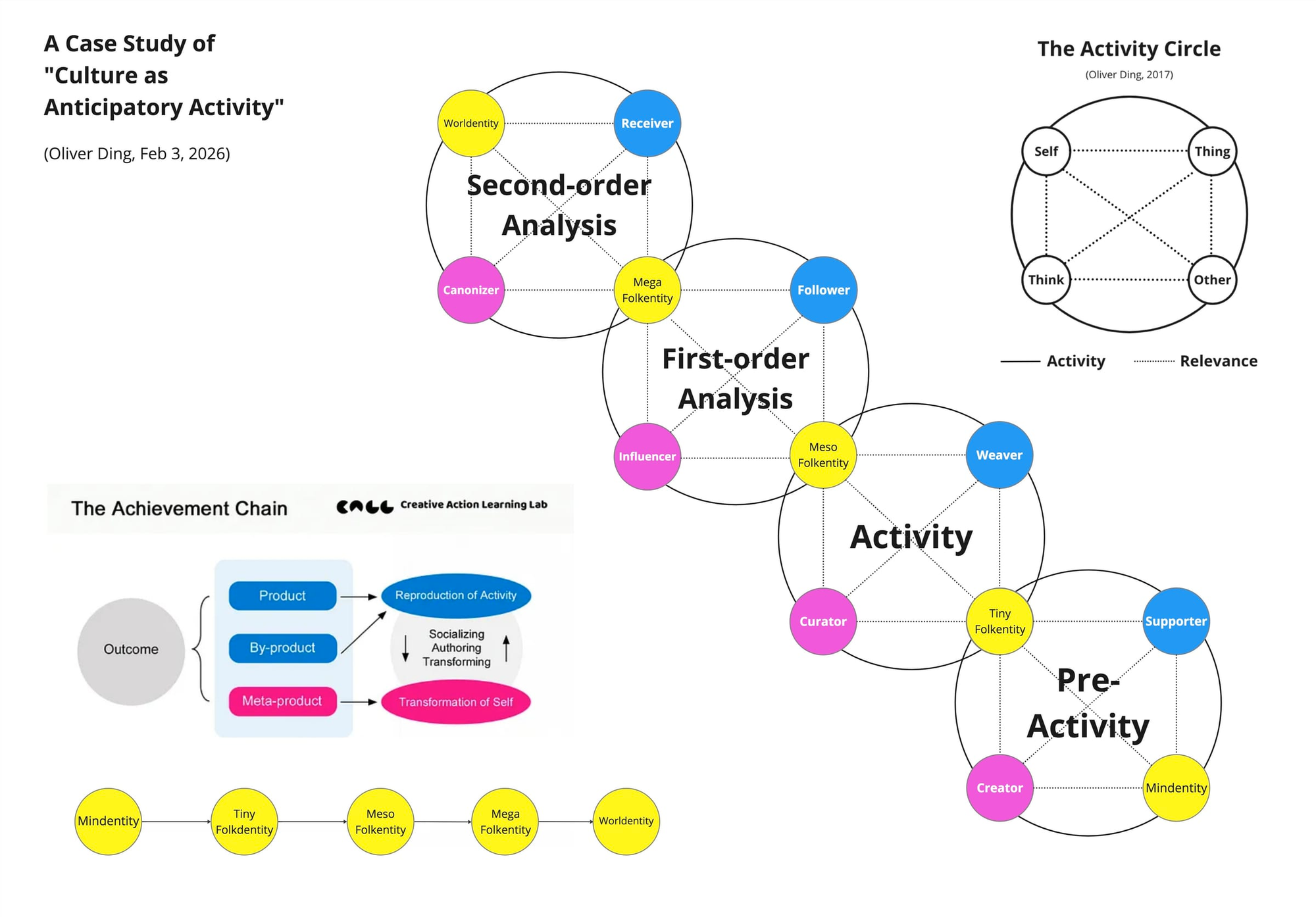
Source: Culture as Anticipatory Activity
3.2 The World of Life
The World of Life model is a square diagram with four boundaries, derived from the Six Faces of the Concept System framework. It represents the structural limits of the thematic landscape within which cultural development happens:
- Upper boundary — Spirituality: the limit of ultimate meaning and transcendent significance
- Lower boundary — Science: the limit of material patterns and natural laws
- Left side — Individuals: where life originates, where personal enterprises begin
- Right side — Collectives: where social formations emerge, where cultural movements crystallize
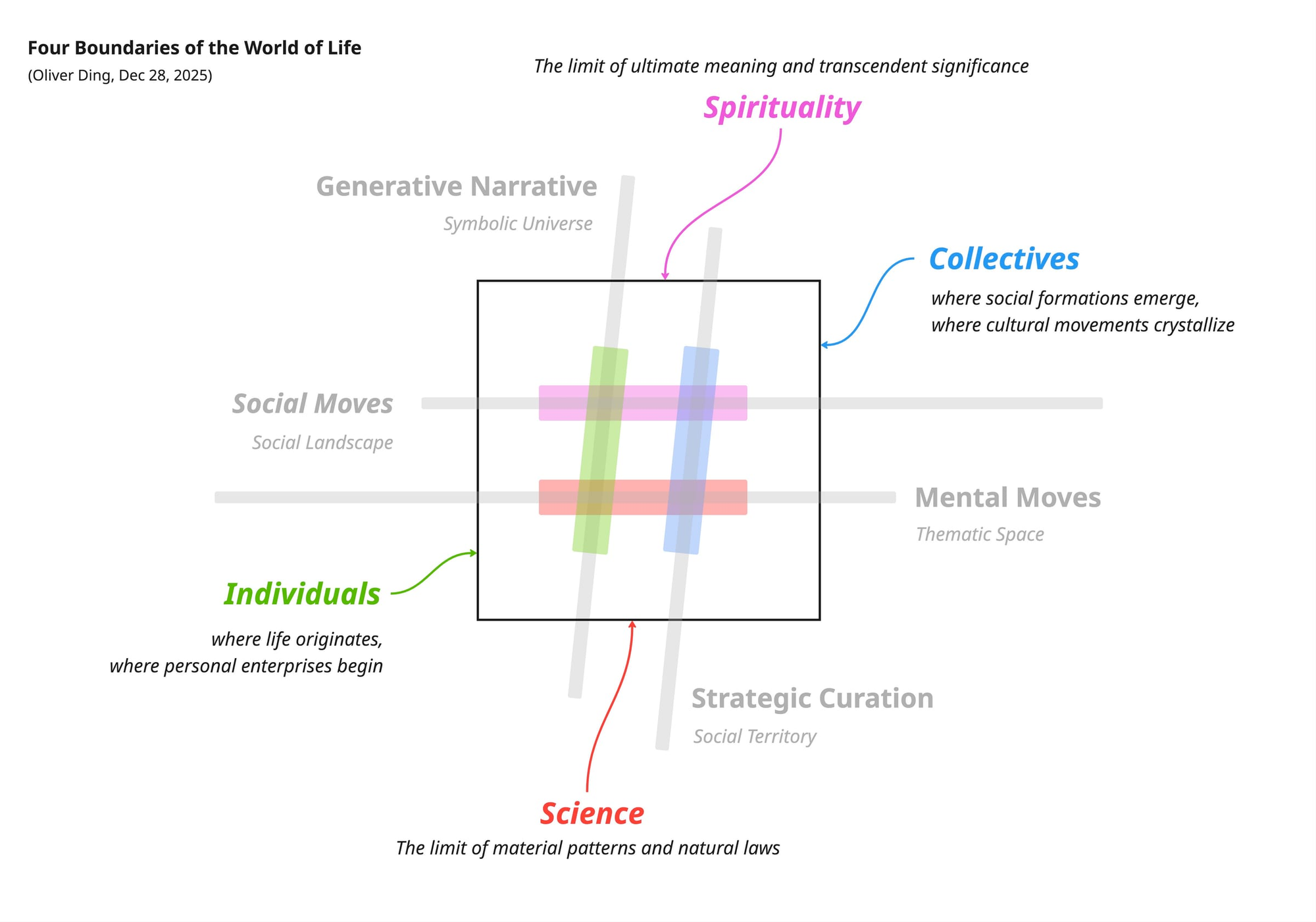
Source: The Concept of "World of Life"
This is not a descriptive map of the world's contents but a structural map of its boundaries — the four edges that define the space within which human creative life unfolds. Any set of four concepts that correspond to these four orientations can be anchored into it, gaining structural meaning through their placement. It is one of the most frequently activated spatial heuristic devices in the ACS v1.1 series.
3.3 The Learning Landscape
The Learning Landscape was a framework Oliver developed in 2015–2016 for understanding adult learning. Its original 2015 version centered on three perspectives — Disciplinary, Domain, and Project — orbiting a core of career themes. The 2016 revision added a fourth: Narrative. Each perspective was further divided into three layers, informed by James March's analysis of learning.
The four perspectives:
- Disciplinary perspective: understanding theory, acquiring concepts
- Domain perspective: interpreting phenomena, gaining field insight
- Project perspective: reflecting on practice, gaining experience
- Narrative perspective: imagining conflict, making meaning
The framework had not been actively used for some time before March 2026. Its reactivation in the context of SLD was an instance of thematic recall — an older stream rejoining a newer current.
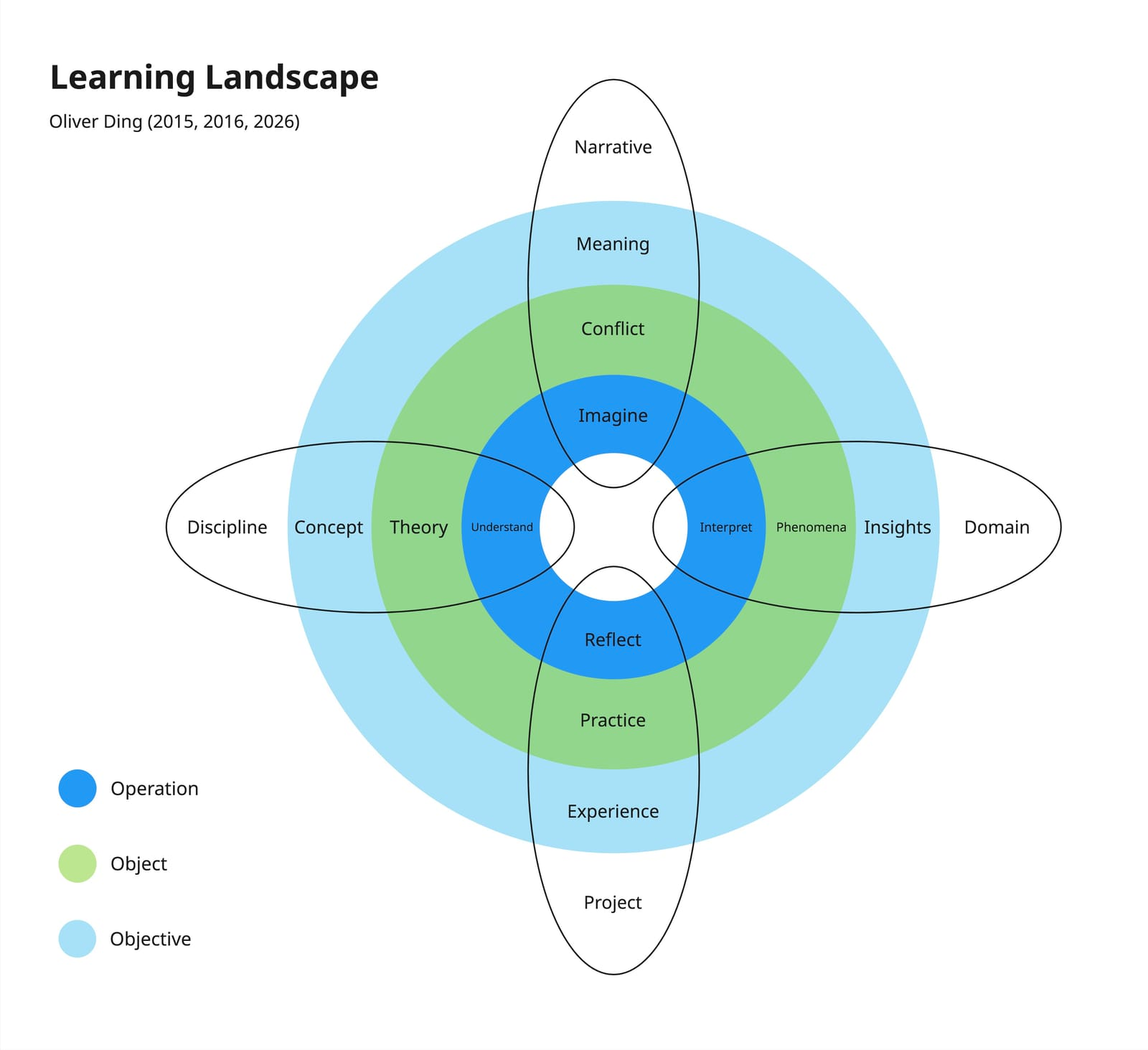
Source: Learning Landscape: Revisiting from the World of Life Perspective
3.4 The L3D Model
L3D names the four-stage structure for Supportive Life Discovery: Learn → Discover → Design → Deliver. The three core stages — Discover, Design, Deliver — were already established in the DDD framework. Learn was added as a pre-activity stage in response to Bob's situation. The model is named L3D to mark this asymmetry: Learn is preparation; the other three are the primary activities of creative life discovery.
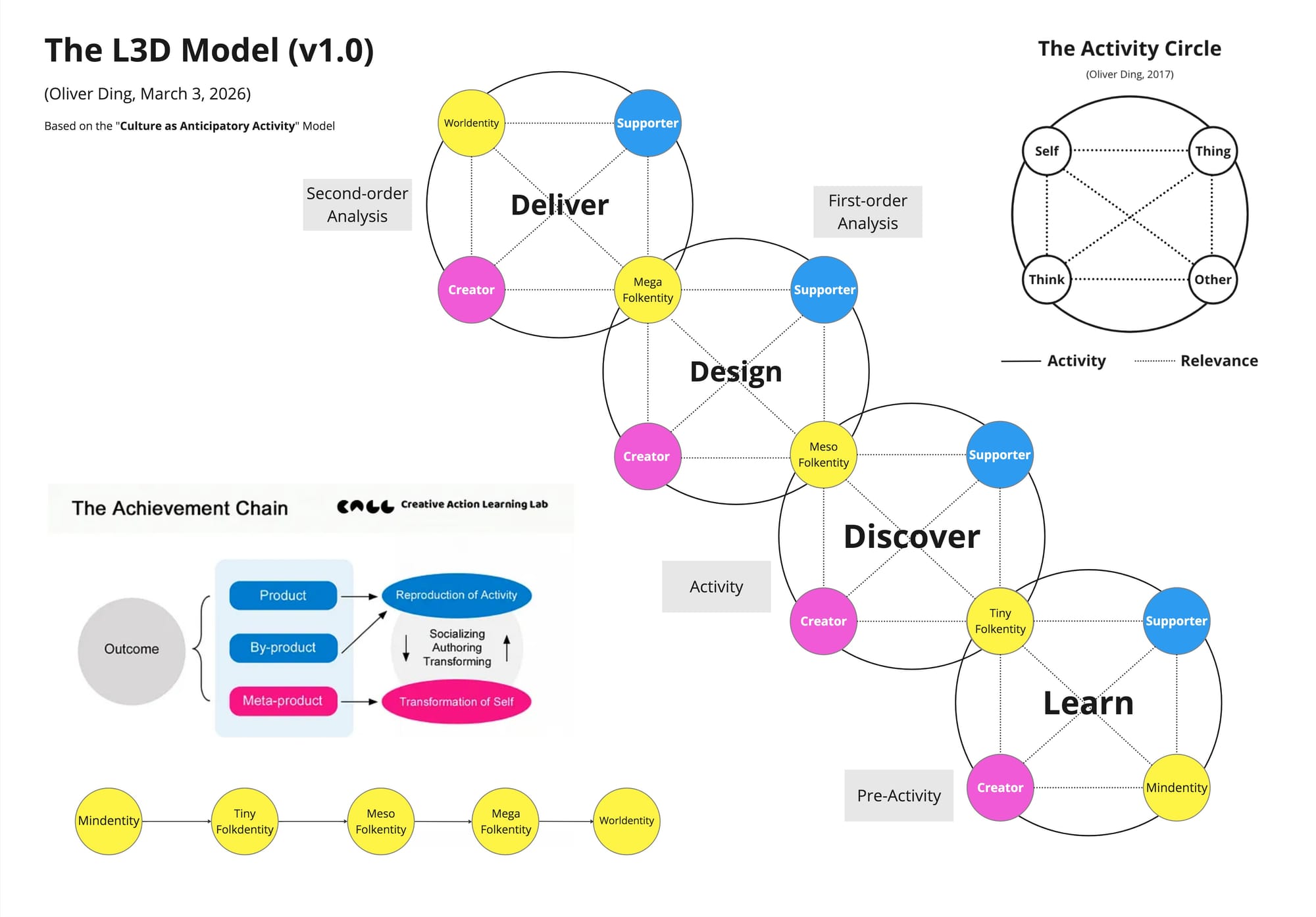
In the Supportive Life Discovery framework, the L3D model maps directly onto a four-layer service design:
- Learn: Cognitive preparation and upgrade — developing the mental orientations that make discovery possible
- Discover: Finding life themes and coordinates — the first-order activity of thematic exploration
- Design: Framework intervention and analysis — bringing theoretical frameworks to bear on the person's thematic situation
- Deliver: Methodological delivery and ongoing support — providing tools and practices the person can sustain independently
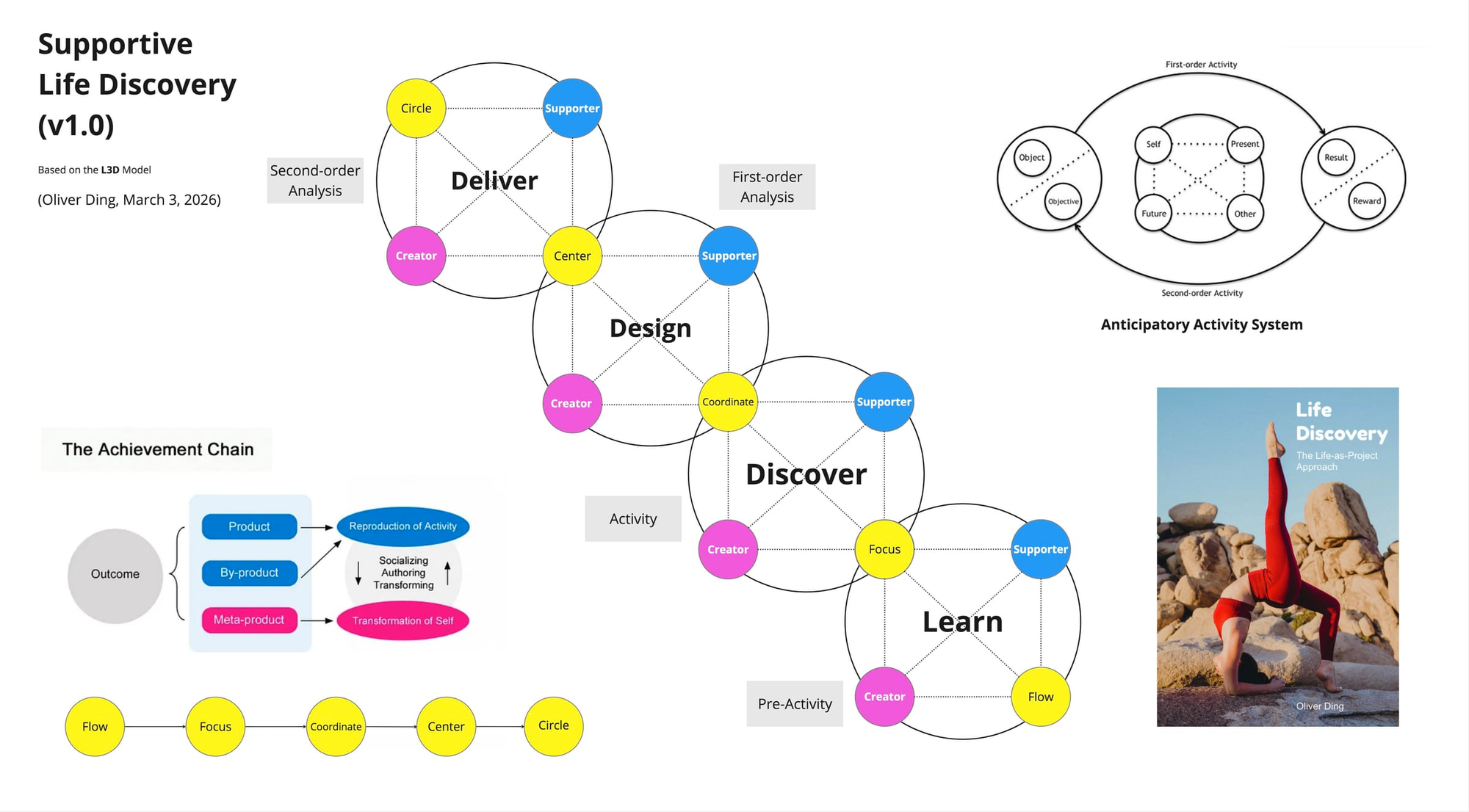
The Supportive Life Discovery diagram (v1.0) also specifies the Achievement Chain for the SLD context. The Achievement Chain is a fixed structural template applicable across models — describing the outcome structure of any activity. In the SLD diagram, its specific content is:
Flow → Focus → Coordinate → Center → Circle
This differs from the L3D model, which retains the Achievement Chain content directly from Culture as Anticipatory Activity without modification. The SLD diagram adjusts this content to reflect the specific developmental trajectory of a person moving through the life discovery process.
Source: The L3D Model (v1.0, 2026): A Knowledge Framework for Supportive Life Discoveryin
3.5 The FFCC Schema and the Four Cognitive Hydrology Tools
The Flow–Focus–Center–Circle (FFCC) schema is the core model of the World of Activity approach, describing four ecological forms of creative life ordered by their degree of stability:
- Flow (Variant, Experiential): the ongoing stream of lived experience
- Focus (Quasi-invariant, Conscious): the intentional structure of consciousness around a theme
- Center (Invariant, Active): the organizational structure of sustained creative work
- Circle (Invariant-Set, Social): the network of collective engagement
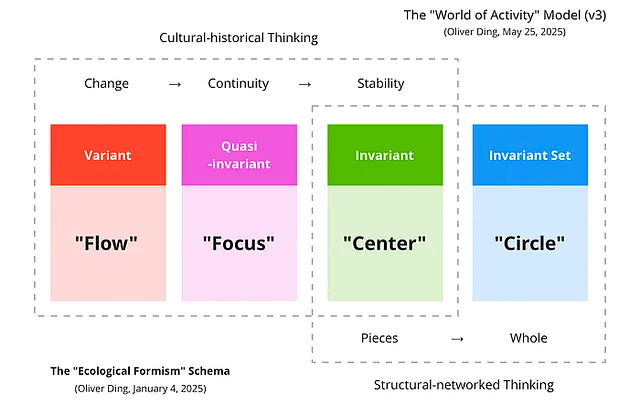
On March 2, four Cognitive Hydrology tools were curated in correspondence with these four forms:
- Flow ↔ Thematic Matrix Canvas — a structural canvas for multi-dimensional exploration of a theme, organized through four thematic fields and sixteen thematic blocks
- Focus ↔ The ECHO Way — a three-container model for curating knowledge frameworks at different levels of abstraction
- Center ↔ Generative Confluence — multiple theoretical streams converging to produce a new knowledge center without consuming the originals
- Circle ↔ Weave the Theory — a framework for theoretical activity using the Weave Basic Form, with four weave-points: Principles / Concepts / Models / Themes
This mapping was itself a Spatial Heuristics operation: the four positions of FFCC called out to the toolbox, and the four tools recognized their places.
Cognitive Hydrology Pedagogy (v1.0) is a pilot project within the Supportive Life Discovery theme — a concrete, focused instance of SLD centered on the exploratory activities that Cognitive Hydrology itself calls forth. Rather than addressing the full breadth of life discovery, it narrows the scope to one specific pathway: thematic development and concept creation as practiced within the Cognitive Hydrology framework. In this sense, it is SLD made actionable within a defined thematic territory.
Within this pedagogy, the L3D model occupies a precise theoretical position within a three-dimensional architecture: Form (FFCC) — Method (L3D) — Moves (the six Slow Cognition operations).
The Flow–Focus–Center–Circle (FFCC) schema provides Form: it describes where the learner is — the ecological configuration of their creative life at a given stage. L3D provides Method: it describes what the learner does within any given form — the directed process of Learn → Discover → Design → Deliver. The six Slow Cognition operations provide Moves: the cognitive grammar available at any moment, not bound to any particular stage or form.
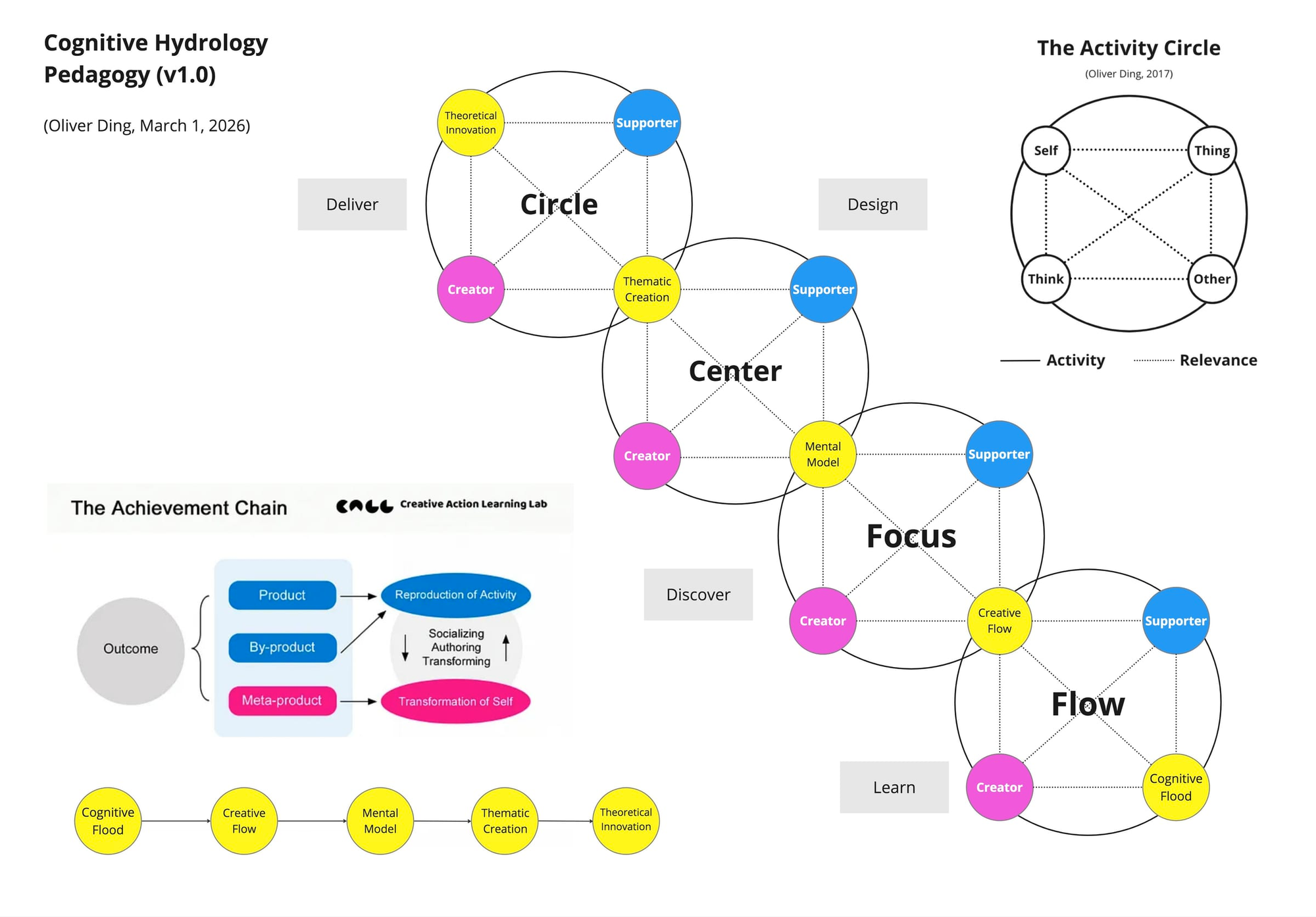
In the FFCC schema, L3D maps as follows: Learn corresponds to Flow (the pre-activity stage of navigating the cognitive flood); Discover to Focus; Design to Center; Deliver to Circle. This correspondence, however, was not obvious on March 1 — it became clear only after the events of March 3.
4. Spatial Heuristics in Action: Three Techniques
The three days described above were rich with activity — frameworks recalled, tools curated, paragraphs that refused to settle. But running through all of it, largely invisible in the moment, was a repeated pattern: a spatial structure calling out to a conceptual archive, and a recognition occurring that could not have been reached by logical inference alone. This section examines three distinct techniques through which Spatial Heuristics operated in this case — and the specific insights each technique produced.
4.1 Spatial Heuristics in Spatial Curation
Spatial Curation is the technique of using an existing map as a container, then placing other concepts into it. The spatial structure of the map — its positions, boundaries, and relational logic — guides what gets placed where, and the placement itself generates new meaning. In this case, Spatial Curation occurred three times across the three days.
Instance 1: Agency Cascade → L3D
The Agency Cascade model's four-stage structure served as the container. Oliver recognized that the existing DDD model (Discover / Design / Deliver) mapped naturally onto its Activity, First-order Analysis, and Second-order Analysis stages — leaving Pre-activity as the open slot. Learn filled it. The spatial logic of the Agency Cascade called out to the DDD model, and L3D was born from the fit.
Instance 2: Agency Cascade × Cognitive Hydrology → FFCC and the Four Tools
The same Agency Cascade structure was used again, this time with Cognitive Hydrology as the thematic focus. The FFCC schema provided the Form dimension across the four stages, while four intuitively selected tools — Thematic Matrix Canvas, The ECHO Way, Generative Confluence, and Weave the Theory — found their natural positions in the Flow, Focus, Center, and Circle slots respectively. Two spatial structures were curated into the same container simultaneously, producing the core architecture of Cognitive Hydrology Pedagogy.
Instance 3: World of Life → The Four Perspectives of the Learning Landscape
The World of Life's four-boundary structure served as the container. Oliver placed the four perspectives of the Learning Landscape — Disciplinary, Domain, Project, Narrative — into the four boundary positions. Each perspective found its boundary without forcing:
- Disciplinary perspective ↔ Science (below)
- Domain perspective ↔ Collectives (right)
- Project perspective ↔ Individuals (left)
- Narrative perspective ↔ Spirituality (above)
The spatial structure of the World of Life had called out to a ten-year-old framework, and the fit was precise.
4.2 Spatial Heuristics in Structural Encounter
Structural Encounter is the technique that occurs when a new spatial configuration emerges — through curation or any other means — and the creator draws a new theoretical insight from that configuration. The spatial arrangement itself becomes the occasion for recognition. In this case, two instances of Structural Encounter occurred.
Instance 1: World of Life × Four Perspectives → Ontological Interpretation of Learning
Once the four perspectives of the Learning Landscape were anchored into the four boundaries of the World of Life, a new spatial configuration existed. Reading this configuration, Oliver recognized something that had not been visible before: the four perspectives are not merely located at the four boundaries — they are the internalization mechanisms of those boundaries. Learning, understood through this new configuration, is the process of taking the four dimensions of the social world inward. And if learning is internalization, then DDD — Discover, Design, Deliver — is its counterpart: externalization. The complete L3D cycle is a breath in and a breath out.
This ontological interpretation did not come from the curation itself. It came from reading the new configuration that the curation had produced.
Instance 2: FFCC × L3D → Form / Method / Moves
When FFCC and L3D appeared together in the same article, a new spatial configuration was present: two four-ring structures side by side. From this configuration, a question arose immediately — what kind of thing is each? Thematic Space Theory provided the answer: FFCC is Form, L3D is Method. Once that distinction was clear, a third dimension resolved spontaneously — the six operations are Moves. The new configuration had called forth a theoretical clarification that neither structure alone could have produced.
4.3 Spatial Heuristics in Analogical Extension
Analogical Extension is the technique of taking a spatial model that has proven effective in one thematic space and asking whether the same model applies to adjacent spaces in the same series. The series structure itself becomes the search guide — local confirmation invites global inquiry. In this case, there is one instance.
Instance: World of Life × Learn → World of Life × Discover / Design / Deliver
The World of Life's four-boundary structure had successfully organized the Learn stage through the four perspectives of the Learning Landscape. This raised an immediate question: if this spatial logic works for Learn, does it extend to the other three L3D stages?
A search through recently published ACS v1.1 articles confirmed that it did:
- Discover stage: Personal Orientation of Cultural Projection — Doctrine{Position[Persona(Posture)]}, four elements each corresponding to one boundary
- Design stage: Design-oriented Project Engagement — Culture{Platform[Project(People)]}, a nested structure with four corresponding operational models
- Deliver stage: Cognitive Container of Cultural Projection — Medium{Artifact[Genre(Representation)]}, four elements derived from the four boundaries
All three articles had been developed independently, each for a different purpose. The World of Life logic had been at work in each without Oliver having explicitly connected them to L3D. Analogical Extension revealed what had been latent all along: the four stages of L3D already shared the same underlying spatial logic, one coherent set of conceptual resources per stage.
Notably, this discovery happened in solitary review, while preparing materials for this case study. Writing about Spatial Heuristics had activated Spatial Heuristics.
5. Mental Moves: A Thematic Space Analysis
The three techniques documented in Part 4 describe how Spatial Heuristics operated within the creative process. This section steps back and examines the broader trajectory of the episode through a different lens: Thematic Space Theory applied as an analytical method.
The method works as follows. A knowledge framework is selected as a Map — a structured space with defined positions. Each such framework is understood as a combination of thematic spaces. The creator's actions and orientations are then placed onto that Map, making visible the movement between positions over time. These movements are Mental Moves: shifts in where the creator is located within a given thematic landscape. For brevity, the internal structure of each framework is not elaborated here; only the specific thematic space names relevant to this case are named in the analysis below. Each Map reveals a different dimension of the same movement; together, they build a multi-dimensional picture of how the creative episode unfolded.
Two groups of objects are analyzed here.
5.1 Object Group 1: Life Discovery (2022) → Supportive Life Discovery (2026)
Map 1: The Ap-Re-Pro-Co Framework
In 2022, the Life Discovery project was located in the Toward Subject thematic space: Oliver himself was the primary actor, engaged in life discovery to enrich his own experience and advance his own theoretical frameworks. In 2026, the Supportive Life Discovery project moved to the Co-Anticipating thematic space: other people became the primary actors, Oliver assumed a supporting role, and the focus shifted to methodological development.
Map 2: Knowledge Engagement Framework (v4)
From the perspective of this framework, Oliver moved from the Subjectivity thematic space in 2022 — first-person engagement with his own life experience — to the Intersubjectivity thematic space in 2026, where the focus moved from first-person engagement with his own experience to intersubjective engagement with others.
Map 3: Knowledge Discovery Canvas
On this Map, Oliver moved from the END thematic space in 2022 — empirical research validating a theoretical framework through his own experience — to the MEANS thematic space in 2026: methodological application and intervention, developing tools and processes for others to use.
Across all three Maps, the directional logic is consistent: from self as subject, to others as subjects; from first-person inquiry, to relational and methodological practice.
5.2 Object Group 2: Learning Landscape (2015–2016) → L3D (2026)
Map 1: Flow–Focus–Center–Circle
In 2016, learning occupied the Center position in Oliver's creative life — the organizing focus of a sustained phase of activity, including two years of membership in an international learning association. By 2026, the Learning theme had moved to the Circle position: no longer a standalone center, but networked with Discover, Design, and Deliver as part of the L3D structure. The theme was not diminished — it found its essential function within a larger whole.
Map 2: Knowledge Discovery Canvas
On this Map, the Learning theme moved from the PRACTICE thematic space — Oliver's own practice and reflection on what learning is and how he himself learns — to the MEANS thematic space: how others can learn the theoretical frameworks and tools he has developed. The question shifted from "how do I learn?" to "how can I support others in learning?"
Across both Maps, the directional logic is consistent: from learning as a standalone center of attention to learning as a foundational component within a larger methodological architecture.
6. Synthesis: The Weave-the-Theory Pattern
The Weave-the-Theory Framework (v1.0, October 2025) was developed to support Theoretical Activity — the full range of work involved in building theories, curating concepts, integrating frameworks, and theorizing. It provides a structured way to understand how theoretical work unfolds across cognitive and social dimensions.
The framework defines two diachronic dimensions: Creativity (the Proliferation line — expansion and generation of new ideas) and Curativity (the Unification line — integration and synthesis of existing ideas). It also defines two synchronic dimensions: Approaches (the subjective perspective of theoretical knowledge) and Aspects (the objective reality of human activity). These four dimensions intersect at four weave-points: Principles, Concepts, Models, and Themes.
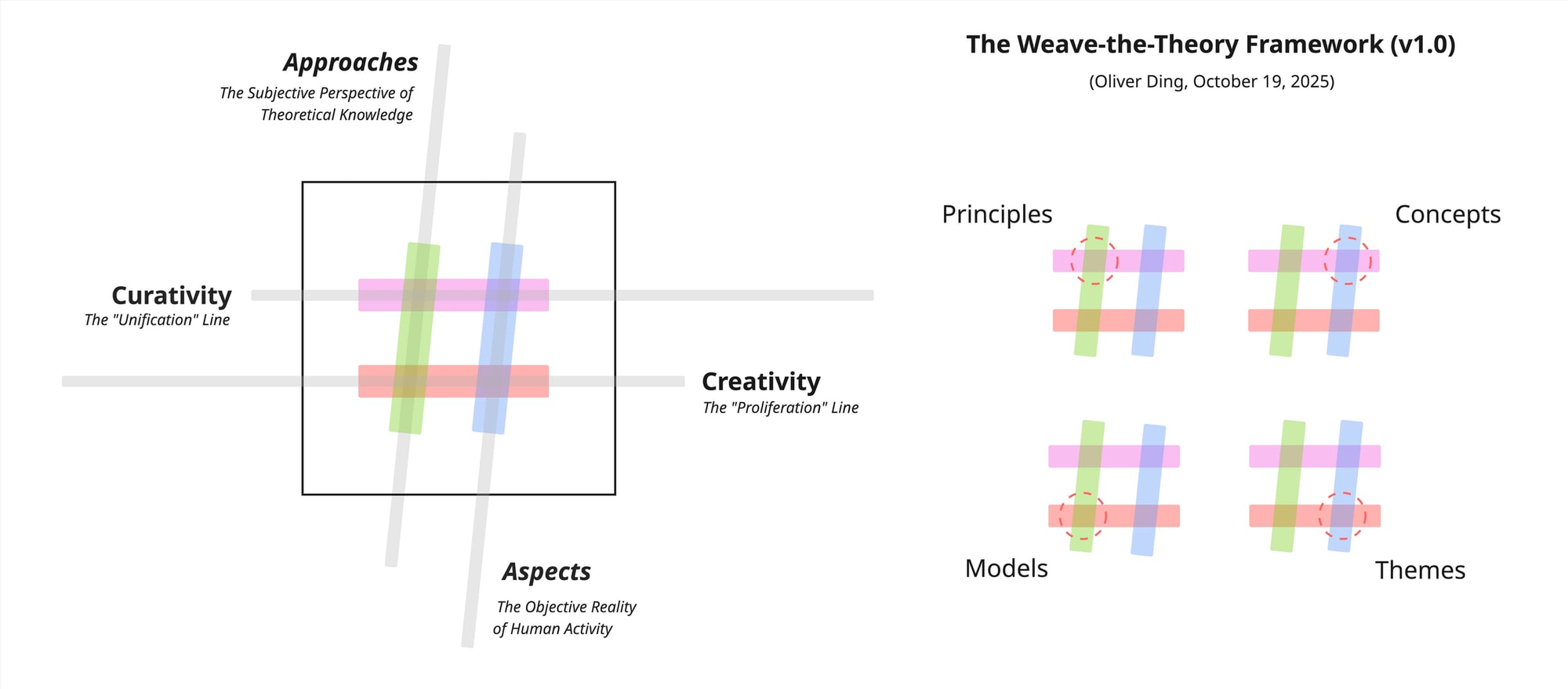
The four weave-points operate at different levels of abstraction. Concepts and Principles are located at the higher, more abstract level — on the Curativity line. Themes and Models are located at the lower, more concrete level — on the Creativity line.
To apply the framework to a case study, the analyst identifies what the creative episode has produced at each weave-point: what themes have emerged, what models have been developed, what concepts have been established, and what principles have been articulated. Together, these four elements form a map of the theoretical output of the episode — and a foundation for future development.
6.1 This Case Study: Four Weave-Points
Themes (Creativity line — concrete, directional)
This case study established four themes for the Spatial Heuristics series:
- Spatial Curation — using a map as a container to place and organize concepts
- Structural Encounter — drawing new theoretical insights from new spatial configurations
- Analogical Extension — extending a proven spatial logic across adjacent thematic spaces
- Mental Moves — analyzing a creator's trajectory through thematic spaces using knowledge frameworks as maps
These four themes define the initial thematic territory of the Spatial Heuristics case study series. Future cases will add new instances, deepen the analysis, and potentially discover new themes.
Models (Creativity line — concrete, structural)
Two models were produced or clarified through this episode:
- Form / Method / Moves — the three-dimensional structure of Cognitive Hydrology Pedagogy, where FFCC provides Form, L3D provides Method, and the six operations provide Moves
- Map / Models / Moves — the three-layer structure of each thematic space within the pedagogy, drawn from Thematic Space Theory
Concepts (Curativity line — abstract, definitional)
Two concepts were established or refined:
- Spatial Heuristics — the capacity of a knowledge framework's spatial construction to function as a creative heuristic, anticipating what concepts belong in its positions and thereby orienting the creator's attention through structural recognition rather than logical derivation
- Graphic Spatial Affordance — the property of a diagram's graphic space that invites or suggests certain creative actions, including the white space that asks "what belongs here?"
Principles (Curativity line — abstract, foundational)
Three foundational principles emerged from the case, each pointing toward future techniques not yet named:
- Space precedes semantics — the spatial structure of a framework, as a container, anticipates what belongs in its positions before the creator consciously decides; position generates meaning
- Spatial logic as creative strategy — a spatial model that works in one thematic space can be deliberately deployed in adjacent spaces as a generative strategy
- Spatial configuration as action opportunity — a new spatial configuration, however it arises, creates an opening for theoretical insight; the configuration itself is the occasion
These principles are not summaries of the three techniques documented in Part 4. They are the underlying logic from which those techniques derive — and from which future techniques may be discovered.
6.2 The Series: Creativity and Curativity Together
The Spatial Heuristics case study series, as it develops, will move across both dimensions of Weave-the-Theory. Individual cases will add new instances of the existing techniques and potentially surface new ones — this is the Creativity line, proliferating the empirical base. The series as a whole will work toward a more complete articulation of the concepts, models, and principles — this is the Curativity line, unifying the pattern across cases.
The present case study, as the first in the series, occupies both positions simultaneously: it proliferates the initial instances and begins the work of synthesis. The four weave-points identified here are a starting point, not a conclusion. The space calls; the series has only just begun to hear the answer.
7. Connection to Cognitive Hydrology: The Self-Referential Dimension
The final observation about this case study is structural, not merely metaphorical — and it points toward something unfinished.
Cognitive Hydrology, as a theoretical framework, rests on Thematic Space Theory as its ontological layer. This is explicit in the architecture of Cognitive Hydrology Pedagogy: Layer 1 is Thematic Space Theory, providing the structural principle for each learning stage through the Map–Moves–Models framework.
Spatial Heuristics, as established in Part 1, is a property of the spatial face of knowledge frameworks — the capacity of a framework's spatial construction to anticipate what concepts belong in its positions, orienting the creator's attention through structural recognition. When this property operates in the creation of a Cognitive Hydrology Pedagogy document, something structurally significant occurs: TST is simultaneously the ontological foundation of the theory being built, and the source of the spatial heuristic being used to build it. The theory is using itself to build itself.
But this self-referential observation leads to a deeper one.
Cognitive Hydrology, as developed in Themes of Practice: The Living Way of Concept, is not without spatial dimension. Thematic Space Theory already theorizes thematic spaces as cognitive containers, and the Map–Moves–Models framework is inherently spatial. The spatial face of knowledge frameworks has been present in the theory from the beginning.
What has not yet been systematically developed, however, is a different level: Spatial Heuristics as an active creative strategy — the deliberate engagement with a framework's spatial structure as a container that anticipates content, generating insights through positional recognition rather than logical derivation. TST describes the spatial architecture of thematic life; Spatial Heuristics attends to how that architecture can be actively wielded as a creative tool. This is the dimension that Cognitive Hydrology has not yet fully developed — and what this case study begins to open.
This is a particularly resonant discovery, because Cognitive Hydrology is named after a geographical and ecological metaphor: lakes, rivers, watersheds, confluence. The theory's name has always pointed toward space, toward topology, toward the shape of the landscape through which ideas flow. The spatial dimension was always implicit in the metaphor. It has simply been waiting for the theoretical development that would make it explicit.
This case study — the first in the Spatial Heuristics series — is a small step in that direction. The three techniques documented here (Spatial Curation, Structural Encounter, Analogical Extension) are early explorations of what a spatially complete Cognitive Hydrology might look like. The lake does not only receive water from outside. In mature stages, it also generates its own circulation — the water evaporates, forms clouds, falls as rain, and returns. The development of the spatial dimension of Cognitive Hydrology is one such internal circulation: the theory discovers, through its own practice, the half of itself that was always there in the name but not yet in the work.
Epilogue: Three Streams
The Spatial Heuristics series anticipates a new book manuscript. Like Lake 42 before it, this manuscript will itself be a confluence of three streams that have been developing in parallel for years, each with its own origin and its own logic.
The Theme–Concept–Framework stream
This stream began formally in 2023 with the TALE Project and the Strategic Thematic Exploration Framework, which mapped a six-stage process from "a possible theme without a clue" to "a knowledge framework with a set of concepts." From 2023 to 2025, a series of book drafts followed this arc: Thematic Exploration, Grasping the Concept, Frame for Work, Ecological Formism, and finally Meta-Frameworks — which marked the completion of the long journey of constructing the Theme–Concept–Framework Transformation Model. Each book was a tributary; Meta-Frameworks was the confluence point that closed this phase of the journey.
Spatial Heuristics opens the next phase. The question it asks is not "how do themes become frameworks?" but "how does the spatial structure of a framework become a creative tool?" — a question that could only be asked once the frameworks themselves had been built.
The Creative Diagramming stream
This stream began with a 108-page thesis on diagrams and diagramming in 2018, developed through the D as Diagramming project (2021–2024), and crystallized in the Creative Diagramming book manuscript (2024). Its core insight: a diagram is not only a representation of thought — it is a generative space for thought. The concept of "graphic spatial affordance," which appears in Part 1 of this case study, is a direct inheritance from this stream.
The Creative Diagramming stream also produced a new set of meta-diagrams and a method for diagram blending — practical tools for treating spatial structures as active creative territory.
The Cognitive Hydrology stream
This stream is the most recent, and its origin is the most personal. Cognitive Hydrology is the theoretical crystallization of the Creative Life Curation method — a research method developed over years for studying the long-term development of themes and projects in a creative life. The Cognitive Hydrology Trilogy (Homecoming, Wonder and Wander, Lake 42) is the primary research outcome of this method, applied across three distinct time scales: a lifetime, six years, six months.
The name "Cognitive Hydrology" emerged in the epilogue of Lake 42, as a unifying metaphor for the patterns that all three books had been documenting: how ideas descend, percolate, flow, converge, and circulate through a creative life — not accumulation, but movement; not management, but engagement. The trilogy was not planned as a trilogy. It grew organically, and the name found it afterward.
The confluence ahead
These three streams have been flowing in parallel, occasionally touching but never fully merging. Viewed through the Generative Confluence model — specifically the Living Coordinate Model developed in Chapter Ten of Lake 42 — what this series represents is another meeting at a creative center that has been there for years: Thematic Space Theory.
TST has not been waiting for this moment. It has already received multiple confluences over time, each with its own streams and its own number — sometimes two, sometimes more. The circles it has generated are numerous. This time, three streams arrive together — Theme–Concept–Framework, Creative Diagramming, and Cognitive Hydrology — and the circle they produce at TST is Spatial Heuristics.
The structure is the same as before: the streams do not disappear into the center; they continue along their own trajectories. What changes is that at TST, something new has become possible — again. This series is unfolding for the first time.
v1.0 - March 2026 - 7,816 words