
Spatial Heuristics: From the Margins to the Center
The second case study of the Spatial Heuristics series
by Oliver Ding
March 11, 2026
Introduction: A Library, a Sketch, and a Series
The first case study in this series documented three days in early March 2026 in which the Cognitive Hydrology Pedagogy document was developed through a process rich with Spatial Heuristics at work. Three techniques were identified and named: Spatial Curation, Structural Encounter, and Analogical Extension. The case was drawn from the near present, and the methods involved were sometimes made explicit only in retrospect — recognized in the act of preparing the analysis itself.
This second case study returns to earlier material: a single Saturday in February 2026, when a concept arrived unexpectedly in a library, and then — over the weeks that followed — set a series of spatial operations in motion that structured the entire development of Anticipatory Cultural Sociology from v1.0 to v1.1.
The concept was Posture. The spatial operation was a particular use of the World of Life diagram as a generative container — not only a map onto which concepts were placed, but a structure whose very boundaries called out to the existing conceptual archive, inviting candidates to present themselves. The result, across February through March 2026, was a cascade of new knowledge frameworks, each developed through the same underlying operation: a diagram with an empty position, and the question of what belongs there.
The title of this case study — From the Margins to the Center — names the spatial logic that drove the entire episode. The World of Life model has four boundaries: Spirituality, Science, Individuals, Collectives. These are the margins of the social world — the structural limits that frame everything within. When concepts are anchored to these margins and oriented toward the center, they do not merely find their place. They find their relationship — with the center, with each other, and with the deeper structure of the framework they are entering.
This is the story of how that operation was discovered, how it was repeated, and what it generated.
Contents
1. Theoretical Background: The World of Life as Spatial Heuristic Device
1.1 Recap: Spatial Heuristics and Its Three Techniques
1.2 The World of Life: A Structural Map of Four Boundaries
1.3 The Double Square: A New Creative Space
2. The Case: One Saturday in February
2.1 The Revisiting Experience
2.2 The Sketch and the Diagram
2.3 From Purpose to Doctrine: An Unexpected Replacement
2. The Cascade: From the Margins to the Center
3.1 February 9: The Cognitive Container of Cultural Projection
3.2 The Pattern Repeats: ACS v1.1 and Four Parallel Frameworks
3.3 The Predictive Model Emerges
4. Spatial Heuristics in Action: The Core Technique
4.1 The Four-Boundary Search
4.2 The Principle of Strategic Curation
4.3 Structural Symmetry as Generative Guide
5. Mental Moves: A Thematic Space Analysis
5.1 Object Group 1: Knowledge Engagement Framework (2023) → Posture (2026)
5.2 Object Group 2: The World of Life → Four Conceptual Frameworks
6. Synthesis: Self-Referential Spatial Curation
7. Connection to Cognitive Hydrology: The Margins and the Flow
Conclusion: What the Library Produced
Afterword: The Series in Motion
1. Theoretical Background: The World of Life as Spatial Heuristic Device
1.1 Recap: Spatial Heuristics and Its Three Techniques
The first case study introduced Spatial Heuristics as a property of knowledge frameworks — specifically, the capacity of a framework's spatial construction to function as a creative heuristic, anticipating what concepts belong in its positions and thereby orienting the creator's attention through structural recognition rather than logical derivation.
Three techniques through which this property operates were identified:
- Spatial Curation: using an existing map as a container, then placing concepts into it. The spatial logic of the container — its positions, boundaries, and relational structure — guides placement, and the placement generates meaning.
- Structural Encounter: drawing a new theoretical insight from a newly emerged spatial configuration. The arrangement itself becomes the occasion for recognition.
- Analogical Extension: taking a spatial model proven in one thematic domain and asking whether it extends to adjacent domains. Local confirmation invites global inquiry.
The present case study is primarily an extended instance of Spatial Curation — but one repeated so systematically, and generating such a coherent series of outcomes, that it becomes possible to examine a deeper layer beneath all three techniques: the constructive mechanism that makes them possible. That mechanism proceeds in three steps: the creator perceives the graphic spatial affordances of an existing diagram — its positions, boundaries, and the orientations they imply; from this perception, constructs a new situational model by adding or removing spatial elements, reshaping the structure into a form suited to the current creative context; and this situational model then becomes a template — reusable across different thematic domains, each application an instance of Spatial Curation, Structural Encounter, or Analogical Extension.
1.2 The World of Life: A Structural Map of Four Boundaries
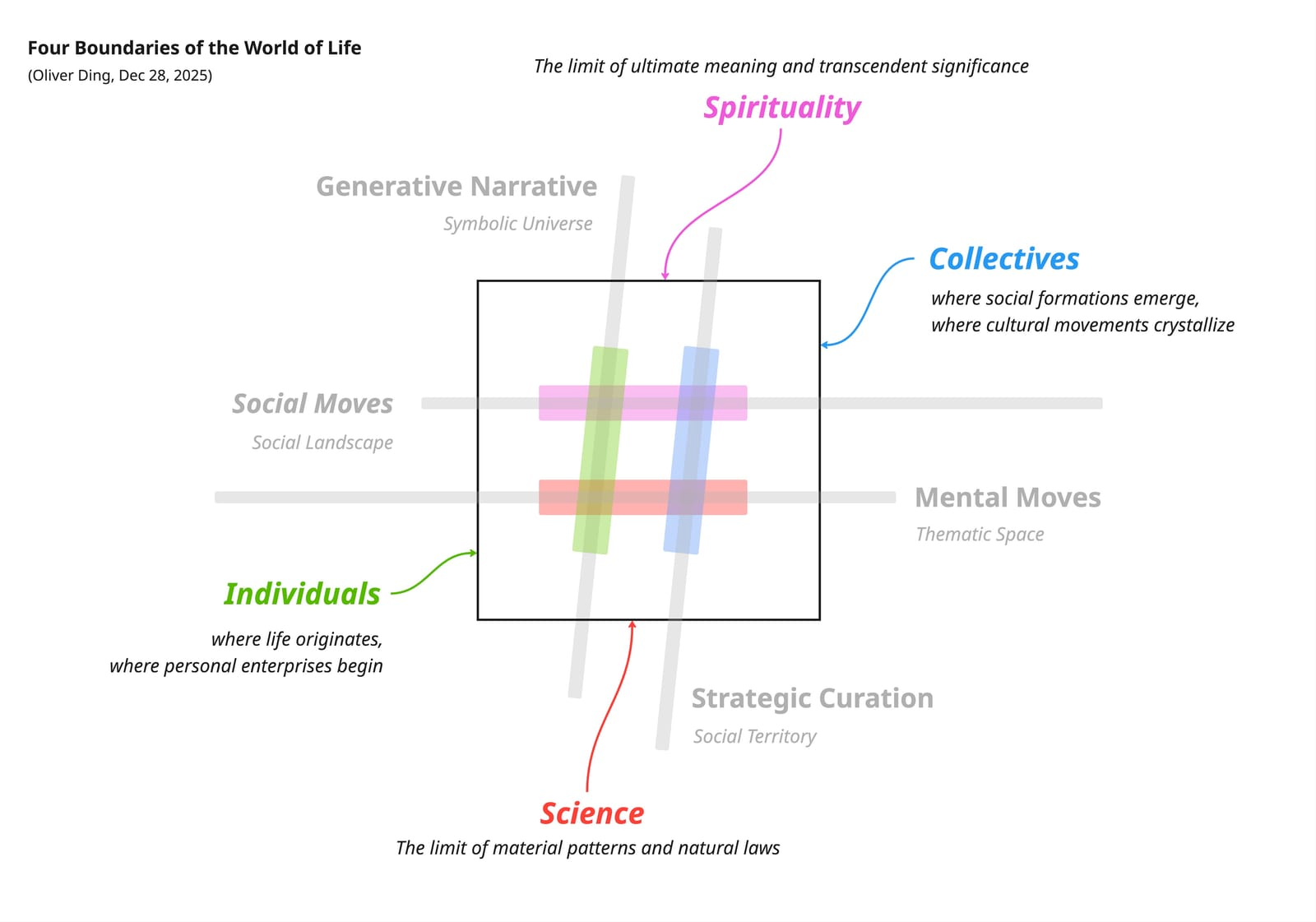
The World of Life model is a square diagram with four boundaries, derived from the Six Faces of the Concept System framework. It represents the structural limits of the thematic landscape within which cultural development happens:
- Upper boundary — Spirituality: the limit of ultimate meaning and transcendent significance
- Lower boundary — Science: the limit of material patterns and natural laws
- Left side — Individuals: where life originates, where personal enterprises begin
- Right side — Collectives: where social formations emerge, where cultural movements crystallize
This is not a descriptive map of the world's contents. It is a structural map — a map of the limits within which human creative life unfolds. The four boundaries are not categories to be sorted into; they are orientations, each pointing toward a different dimension of the human situation.
For Spatial Heuristics, this structure is unusually powerful for two reasons. First, the four boundaries are orthogonal — they point in genuinely different directions, which means that four concepts anchored to them will be structurally differentiated from one another, not merely empirically different. Second, the boundaries are exhaustive at their level of abstraction — together they name the complete set of dimensions that define the World of Life. Any set of four concepts corresponding to these four orientations will therefore constitute a complete framework at the boundary level.
This gives the World of Life a distinctive heuristic character: it does not suggest one candidate concept per boundary, but rather specifies the kind of concept that should occupy each position. The creator's task is not to fill arbitrary slots but to recognize, from the existing conceptual archive, which concepts fit the structural requirements.
1.3 The Double Square: A New Creative Space
The diagram developed on February 7, 2026 introduced an important structural innovation. Within the original World of Life square (with its four boundary-defining edges), a second, smaller square was drawn at the center.
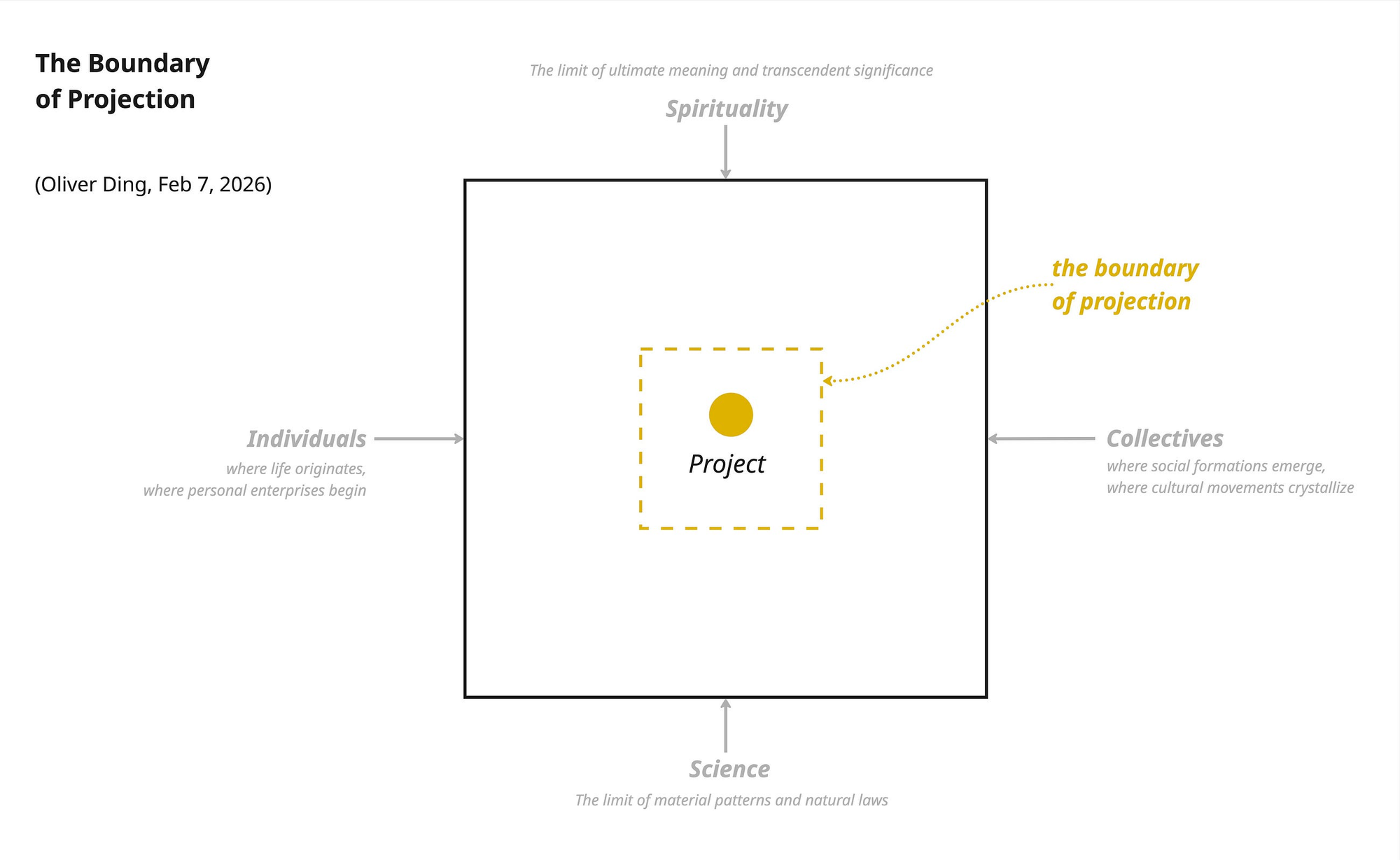
The project — the primary unit of engagement in the Life-as-Activity system — occupied this inner square. This position, however, is not reserved exclusively for Project; depending on the context, other concepts may occupy the center, with the surrounding boundary positions adjusting their orientations accordingly. Folkentity, Self-Actualization, and Knowledge Engagement are among the concepts that have since been placed at the center in different applications of the same template.
Moreover, the boundary positions themselves are not fixed in their semantic register: in the Four Negative Frontiers of Knowledge Engagement diagram (March 7, 2026), Knowledge Engagement occupies the center while the four boundary positions are filled with negative concepts — Mystification, Echo Chamber, Tragedy of the Commons, and Dogmatism — mapping the failure modes that threaten engagement from each boundary direction. The same spatial structure, inverted in valence.
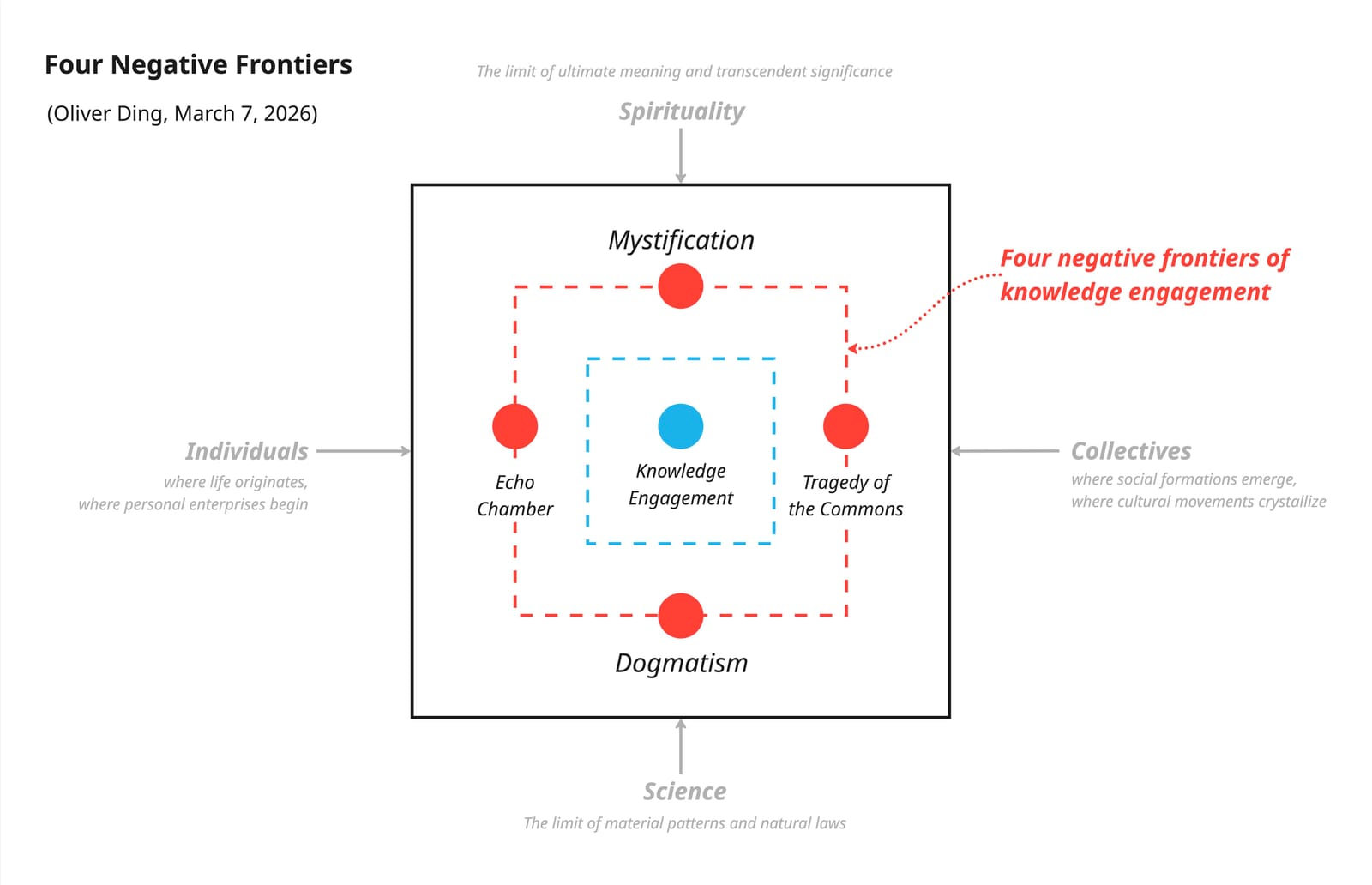
The space between the two squares — neither purely at the boundary nor purely at the center — became a creative territory. This intermediate region, named the Boundary of Projection, is where individuals stand as they prepare to enter a project. It is neither the structured interior of a project nor the open expanse of the social world; it is the zone of mediation between the two.
The Double Square diagram is itself a spatial heuristic: it creates four distinct positions within the boundary region — one near each edge — each inheriting its orientation from the nearest boundary while remaining oriented toward the project at the center. A concept placed at the lower-boundary position inherits the orientation of Science (material, ecological, quasi-invariant); a concept placed at the upper-boundary position inherits the orientation of Spirituality (meaningful, trans-situational, belief-saturated).
This intermediate region turns out to be one of the most productive creative territories in the entire ACS v1.1 development — a space that did not exist in the framework before February 7, and whose discovery unlocked a series of new frameworks across the months that followed.
2. The Case: One Saturday in February
2.1 The Revisiting Experience
It was a Saturday in early February. The children were in their Chinese school classes. Oliver was in the library — his usual weekend waiting spot.
He had been revisiting the Knowledge Engagement Framework (v4.0), a tool developed in 2023. The framework had always been understood as a knowledge project tool — a systematic way of assessing and developing one's relationship to knowledge, organized across six sections and eighteen dimensions, each framed as a binary choice. But on that morning, something shifted.
The shift began obliquely. The previous evening, Oliver had been working with an AI tool to convert the Knowledge Engagement Framework into an interactive test application, and in the course of that work had recognized that the framework's structure — the systematic mapping of a person's characteristic tendencies in relation to something — was not specific to knowledge. It applied equally to any thing: any object, tool, practice, environment, or domain of activity.
This generalization was itself significant. But what happened in the library went further. Sitting there with his notebook, Oliver recognized something about the level at which the framework operates. He had always treated it as a project-level tool — useful for assessing one's readiness for, or characteristic relationship to, a knowledge project. But the framework does not describe projects. It describes something more fundamental: the characteristic tendency through which a person encounters objects at the level of action. A project is a structured series of actions; this framework names the ecological pattern that animates actions themselves, prior to their organization into projects.
This distinction had immediate theoretical consequences. If the framework operates at the action level rather than the project level, then the concept it names belongs near the lower boundary of the World of Life — near Science, the limit of material patterns and natural laws. It is not a meaning system or a social role or an identity repertoire. It is an ecological quasi-invariant: a structured tendency, relatively stable across situations, shaped by the fit between a person's characteristic dispositions and the affordances of the material world.
A new word was needed. Oliver pulled out his notebook and sketched a diagram. By evening, the concept had a name: Posture.
2.2 The Sketch and the Diagram
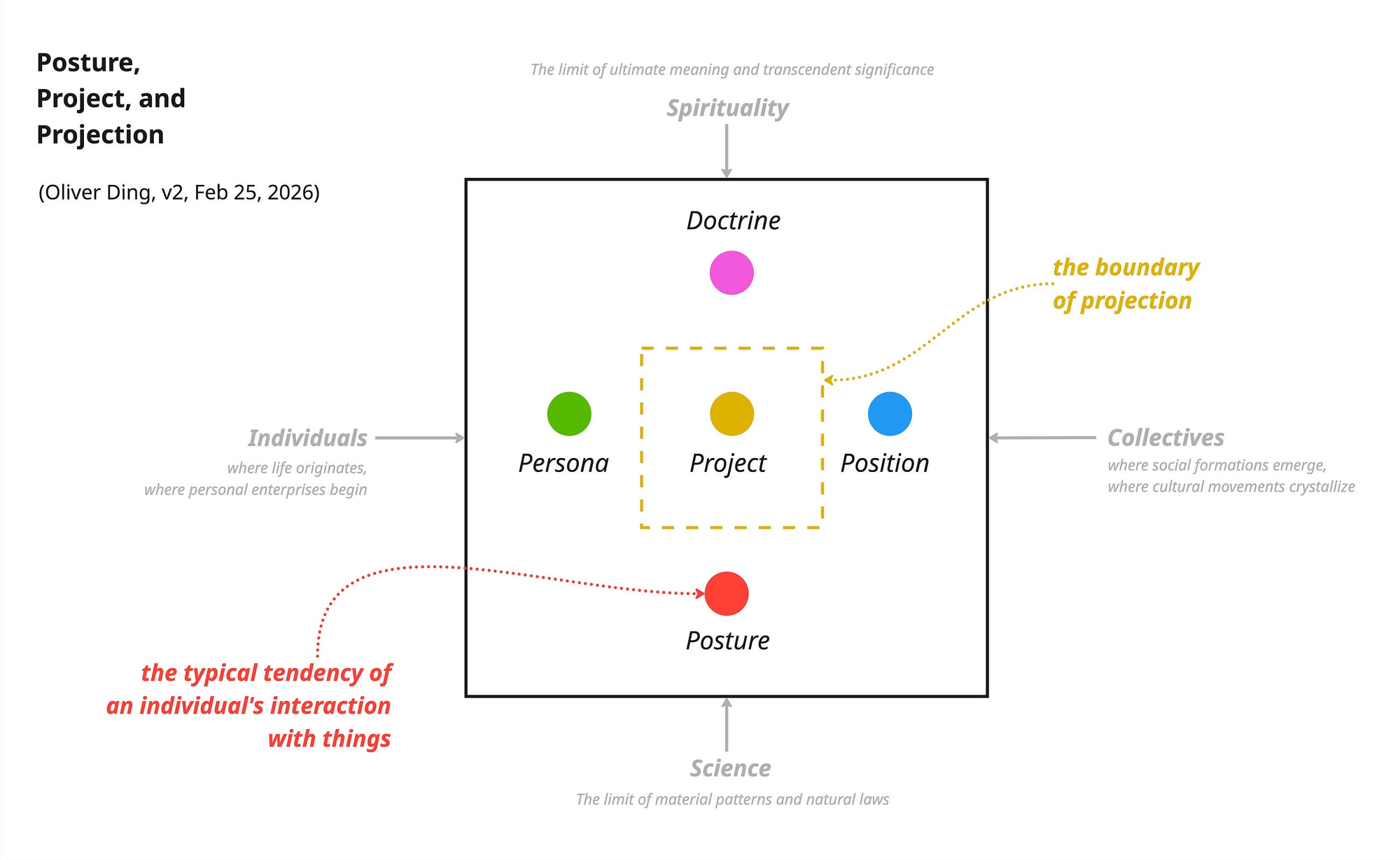
The diagram sketched on February 7 is, in retrospect, the generative center of the entire ACS v1.1 development. Its structure is simple but precise:
- An outer square representing the World of Life, with its four labeled boundaries
- An inner square at the center, labeled Project
- Four colored circles positioned in the intermediate space, each near one of the four boundaries, each oriented toward the project at the center:
- Near Spirituality (upper): Purpose — the motivational orientation toward projects
- Near Science (lower): Posture — the ecological tendency of engaging with things
- Near Individuals (left): Persona — the repertoire of possible selves one brings to projects
- Near Collectives (right): Position — the social slot, the role in a collective division of labor
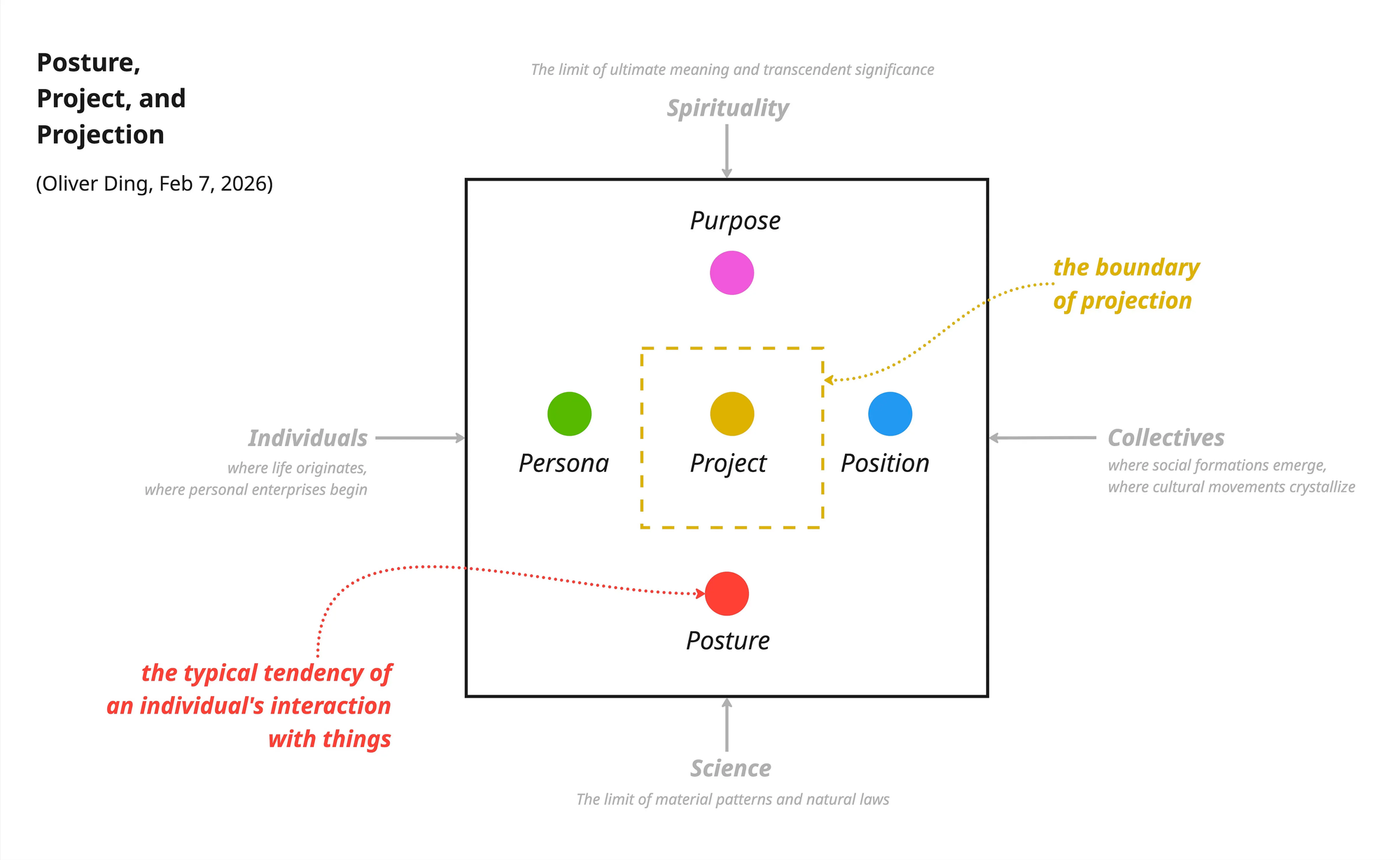
The four concepts — Posture, Persona, Position, Purpose — constitute the Personal Orientation of Cultural Projection: the structure of tendencies, imaginings, locations, and commitments that individuals bring to the Boundary of Projection as they prepare to enter a project.
What is significant about the diagram is not only what it contains but how it was produced. The World of Life's four boundaries served as a spatial heuristic: each boundary specified what kind of concept should occupy its position. The lower boundary — Science, the material and ecological — called out for a concept concerned with how individuals physically and tendentially engage with things. The upper boundary — Spirituality, ultimate meaning — called out for a concept concerned with why individuals care about their projects at the deepest level. The left boundary — Individuals — called out for a concept of identity and self-imaginings. The right boundary — Collectives — called out for a concept of role and social location.
Once the question was posed spatially — "what kind of concept belongs at each boundary?" — the search through the existing conceptual archive became structurally guided. Posture found its place at the lower boundary. Persona (from years of work on Persona Dynamics and Possible Personas) found its place on the left. Position (from DEKIN, 2018, and the Developmental Project Model, 2021) found its place on the right. And at the upper boundary, Purpose — a concept developed in the Developmental Project Model — found its place near Spirituality.
2.3 From Purpose to Doctrine: An Unexpected Replacement
The concept at the upper boundary underwent a significant transformation in the weeks that followed. Initially, Purpose — a term already in use in the Developmental Project Model — occupied that position. But the process of Strategic Curation does not end when a position is filled; it continues until the best candidate is found.
On February 20, 2026, following a thematic conversation with a connection on LinkedIn, Oliver began exploring the study of cognitive military theory. Oliver encountered Robert Frank Futrell's concept of doctrine — defined as "a network of faith and knowledge reinforced by experience." He recognized a more precise fit for the upper boundary, and Purpose was replaced by Doctrine.
Futrell's concept captures exactly what belongs near Spirituality: not merely a motivational orientation toward a specific project (that is Purpose, the inside-project instantiation), but a trans-situational belief-knowledge system that operates before and across projects, shaping what a person cares about, what counts as a good reason, and what kind of action feels meaningful. Purpose is what one is oriented toward in a particular project; Doctrine is the system of commitments and beliefs from which Purpose is drawn.
This is one of two characteristic operations in Strategic Curation: discovering a superior candidate and replacing the placeholder. The other, illustrated by the Cognitive Container of Cultural Projection, involves a different challenge — once four concepts are selected, cutting away their established academic usages and assigning each a functionally distinct definition that serves the framework's specific structural logic — if needed. Not every application requires this operation; in the Cognitive Container of Cultural Projection, it became necessary because concepts such as Medium and Artifact carry overlapping meanings in existing academic usage, making sharp functional differentiation an essential step.
In both cases, the spatial logic of the diagram continues to operate as a guide: the upper boundary had always called for something in the neighborhood of Spirituality — trans-situational, belief-saturated, foundational. Purpose partially fit; Doctrine fit more precisely. The diagram was not wrong the first time; it simply had not yet found its best candidate.
3. The Cascade: From the Margins to the Center
3.1 February 9: The Cognitive Container of Cultural Projection
Two days after the February 7 sketch, the diagram was used as a template for a new operation. On February 9, Oliver returned to the Double Square diagram and used the same spatial logic — four boundaries, each calling for a concept of a specific kind — to develop a second framework: the Cognitive Container of Cultural Projection.
The Cognitive Container organizes four concepts that describe the media and objects of cultural projection — the thematic infrastructure through which cultural engagement is enacted and transmitted. Using the same four-boundary heuristic, four concepts emerged through search and structural recognition:
- Near Individuals (left): Representation — the most personal form of cultural expression, tied to the individual
- Near Spirituality (upper): Genre — the conventional form carrying trans-individual meaning and aesthetic expectation
- Near Science (lower): Artifact — the material instantiation of cultural expression, the physical thing
- Near Collectives (right): Medium — the social infrastructure through which expression circulates and achieves collective reach
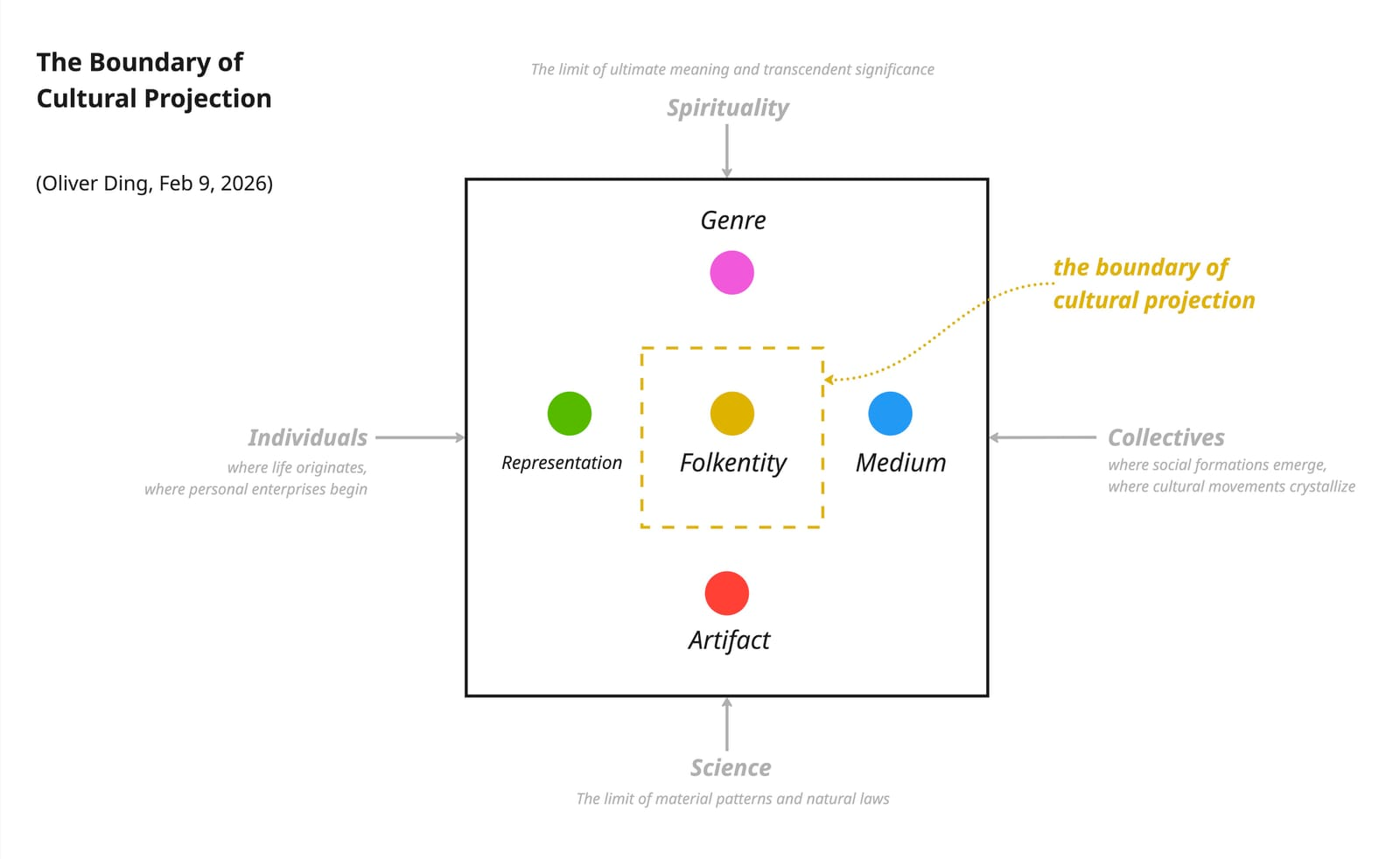
The operation was structurally identical to February 7: the World of Life's four boundaries specified what kind of concept should occupy each position, and the search through the existing archive identified candidates that fit. What had been a one-time discovery on February 7 was now a repeatable technique.
This realization — that the same spatial operation could be applied to different thematic territories within the same structural container — was a turning point. The Double Square diagram was not just the vehicle for one framework. It was a generator of frameworks, each organized by the same spatial logic but oriented toward a different dimension of cultural life. These frameworks contributed to one of the three developmental threads of ACS v1.1: the Cultural Projection series of articles.
3.2 The Pattern Repeats: ACS v1.1 and Four Parallel Frameworks
Across the weeks that followed, the pattern repeated, each time generating a new framework by anchoring four concepts to the four boundaries of the World of Life:
Personal Orientation of Cultural Projection (February 7): Doctrine, Persona, Position, Posture — the four elements of how individuals orient themselves toward projects, corresponding to the Discover dimension of the L3D model.
Cognitive Container of Cultural Projection (February 9): Representation, Genre, Artifact, Medium — the four media-objects through which the Deliver dimension of cultural engagement is enacted.
Four Perspectives of Learning Landscape (March 1–2, documented in Case Study 1): Disciplinary, Domain, Project, Narrative perspectives — the four orientations through which the Learn stage internalizes the dimensions of the World of Life.
Four Negative Frontiers of Knowledge Engagement (March 7): Beyond those edges, a second square frames the four negative frontiers: Mystification, Dogmatism, Echo Chamber, and Tragedy of the Commons. They are not distant dangers. They occupy the zone just outside the working space, adjacent to every boundary, always within drift.
Viewed together, these four frameworks form an organized set. Each corresponds to one stage of the L3D model (Learn, Discover, Design, Deliver). Each uses the same structural logic — the World of Life's four boundaries as a generative container. Each produces four concepts with the same structural relationship: anchored to a margin, oriented toward the center.
This is what the title of this case study names: from the margins to the center. The margins of the World of Life are not peripheral. Concepts that arrive from the margins carry the full weight of their boundary's orientation; they are not placed arbitrarily but summoned by structural necessity. And when four such concepts are placed together — each from a different margin, all facing the center — they constitute not a collection but a system: a complete structural description of whatever lies at that level of the framework.
3.3 The Predictive Model Emerges
The cascade of frameworks was not, in retrospect, random or spontaneous. It was driven by a predictive model — a structural anticipation of what needed to be developed — that emerged gradually over the weeks in which the work was happening.
At the outset of January 2026, only the foundations existed: the World of Life's four boundaries and the collection of frameworks assembled for ACS v1.0. The relationships between them were relatively loose. Moreover, these frameworks were highly abstract meta-frameworks — operating at a level of generality that, while theoretically powerful, could not sustain the development of ACS on its own.
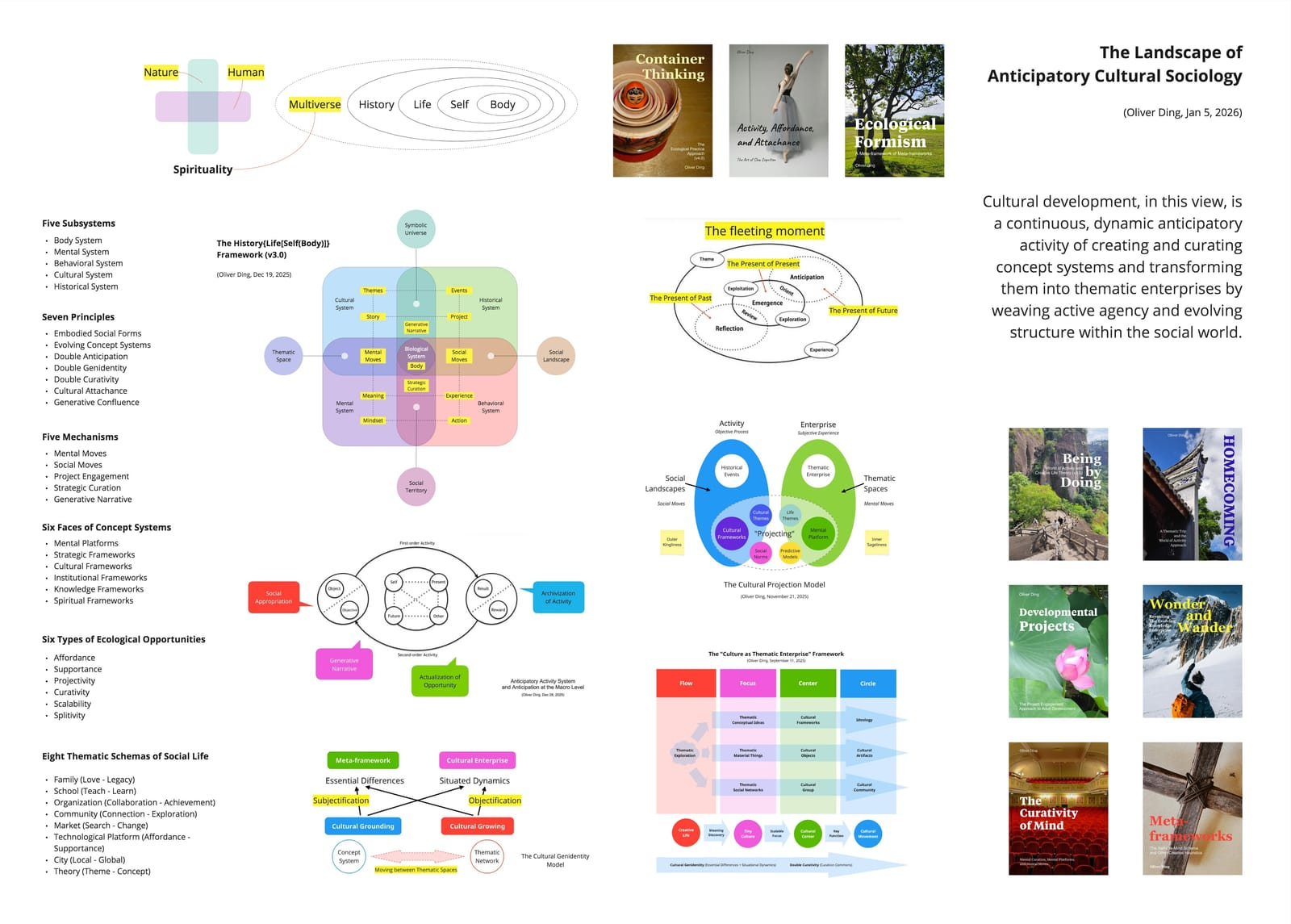
The enterprise needed to move downward in abstraction, toward more concrete and operationally specific frameworks. But as each new framework was developed — as each operation of Spatial Curation using the World of Life container yielded a new set of four concepts — the overall structure became clearer. The Double Square's intermediate space was being populated: the four positions near each boundary were being filled, each by the concepts that belonged there.
What appeared to be a series of independent creative acts — each framework developed in response to a specific occasion — was in fact the unfolding of a structural logic that had been present, implicitly, in the World of Life's spatial architecture from the beginning. The predictive model was not planned in advance; it emerged through the practice of repeated Spatial Curation. Each operation of the technique made the overall structure clearer, which in turn guided the next operation.
This is a significant feature of Spatial Heuristics as a creative method. It is not purely responsive — finding whatever fits an empty position — nor purely generative — deriving what must be there from first principles. It is a dialogue between structure and archive: the structure of the container specifies what kind of concept is needed, and the archive provides the candidates; as more positions are filled, the structure becomes more legible, and the search for remaining candidates becomes more precise.
Viewed through Thematic Space Theory, this dialogue has a precise structure. The World of Life's four-boundary configuration functions as the Map — the objective spatial description of the thematic landscape, prior to any interpretation. Each specific creative encounter — facing a new thematic domain, asking what belongs at each boundary — is a Move: a cognitive operation through which the creator navigates the Map. And each concept or knowledge framework introduced into a boundary position is a Model: an interpretive lens brought to bear on that region of the thematic space. The same Map — the World of Life — thus corresponds to many different Models across many different Moves. Its spatial structure remains constant; what varies is the conceptual content that each new creative context calls forth.
4. Spatial Heuristics in Action: The Core Technique
The events described in Part 3 are all instances of a single technique: Spatial Curation using the World of Life as the primary container. But within this technique, several specific operations deserve closer examination.
4.1 The Four-Boundary Search
The most fundamental operation is what might be called the Four-Boundary Search: given a thematic domain and the World of Life's four boundaries, identify which concept from the existing archive best fits each boundary's orientation.
The search proceeds through four distinct prompts:
- The lower boundary (Science) asks: what concept captures how individuals engage with the material and ecological dimension of this domain? What is quasi-invariant, embodied, or tendential here?
- The upper boundary (Spirituality) asks: what concept captures the trans-situational meaning system or belief-knowledge network relevant to this domain? What orients individuals toward it at the level of ultimate significance?
- The left boundary (Individuals) asks: what concept captures the personal, subjective, or identity-related dimension of engagement? What does the individual bring from their own life history and self-understanding?
- The right boundary (Collectives) asks: what concept captures the social, relational, or systemic dimension? What connects individual engagement to broader social formations and collective structures?
For each boundary, the search is not deductive — it does not derive the answer from the boundary's definition — but recognitional. The creator asks: which concept from the archive fits here? The question is structural, but the answer comes from accumulated knowledge and the capacity for analogical recognition.
4.2 The Principle of Strategic Curation
Not every concept that fits a boundary is the right concept for a given framework. The principle of strategic curation holds that each concept must satisfy two conditions simultaneously:
- It must be genuinely rooted in the boundary dimension it occupies — it must carry the orientation of that boundary, not merely be assignable to it for convenience.
- It must be functionally differentiated from the other three concepts — it must name something that the other three cannot name, serving a role exclusive to its position.
This double requirement — deep rootedness in the boundary, functional exclusivity within the framework — is what distinguishes a genuine four-boundary framework from a merely convenient grouping of four concepts. It ensures that the framework is not just organized by the spatial logic of the World of Life but generated by it.
In the case of the Personal Orientation framework, Posture satisfies this principle precisely: it is rooted in Science (the ecological, the tendential, the quasi-invariant) in a way that no other candidate is, and it names something that Persona, Position, and Doctrine cannot name. Similarly, Doctrine is rooted in Spirituality (the trans-situational, the belief-saturated, the foundational) in a way that Purpose — its predecessor — only partially captured.
4.3 Structural Symmetry as Generative Guide
The recognition in January 2026 that ACS and SDP are structurally symmetric — the same fundamental pattern at different scales — was described in the first case study as the generative signal that prompted the identification of Spatial Heuristics as a method. It is worth dwelling on this in relation to the present case.
Structural symmetry is a variant of Analogical Extension — the third technique identified in Case Study 1. But it differs from ordinary analogical extension in one important respect: it operates between thematic enterprises rather than within a single thematic space. When two frameworks at different scales share the same underlying spatial logic, the recognition of their symmetry functions as evidence that the spatial logic itself is not arbitrary — that it has some generative necessity, some claim to more than local applicability.
This symmetry also carries a practical strategic value. During this period, Oliver's focus was almost entirely on ACS; there was little time or attention available for the direct development of SDP. Yet the structural symmetry between the two enterprises meant that this was not a problem. Each concept and framework developed for ACS through the four-boundary operation simultaneously constituted a candidate member of SDP's corresponding structure. The work done on one side of the symmetry was, without additional effort, accumulating resources on the other. This is the strategy of indirect activity: advancing a second enterprise through the development of its symmetric counterpart, without directly engaging it. The symmetry does the transfer automatically.
This instance of indirect activity is worth distinguishing from an earlier version of the same strategy. In the 2024 book draft Center, Circle and Genidentity, indirect activity was discussed in the context of a value circle formed by multiple knowledge centers — a looser network in which collaboration between centers produces effects beyond what each center pursues directly. Here, the mechanism is more precise: ACS and SDP are not merely functionally related but structurally constrained within the same spatial architecture. The four boundaries of the World of Life govern both. This means the transfer of resources from one enterprise to the other requires no additional interpretation or adaptation — the shared spatial constraint guarantees the fit. Indirect activity under structural symmetry is a more powerful version of the strategy: the symmetry does not just enable the transfer, it ensures its accuracy.
This is what the cascade of frameworks in ACS v1.1 ultimately demonstrates. Four frameworks, developed for different purposes across different weeks, all organized by the same spatial logic. The World of Life's four-boundary structure is not just a convenient organizing device. It is a structural description of the dimensions of human creative life at the highest level of abstraction — and frameworks built from it inherit that structural claim.
5. Mental Moves: A Thematic Space Analysis
The previous sections have described what happened. This section examines how it happened — the cognitive operations through which the episode unfolded — using Thematic Space Theory as the analytical lens.
5.1 Object Group 1: Knowledge Engagement Framework (2023) → Posture (2026)
The Knowledge Engagement Framework (v4.0, 2023) had been dormant as an actively developed concept for nearly three years. Its reactivation in February 2026 is a clear instance of thematic recall — an older thematic space becoming relevant to a new context. But the recall was not merely a retrieval. It involved a fundamental reinterpretation of the framework's level of operation.
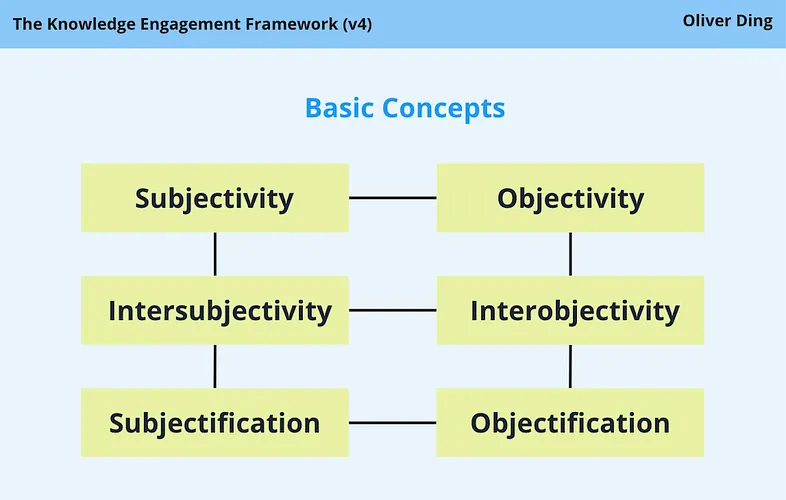
From the perspective of Thematic Space Theory, what happened in the library can be described as a level shift in the Map of a thematic space. Oliver had always mapped the Knowledge Engagement Framework as a project-level tool — its position in the conceptual landscape was defined by its relationship to Knowledge Projects. The reinterpretation moved it to the action level — closer to the Science boundary of the World of Life than to the Project center. This change in position within the conceptual Map produced a new concept: Posture.
The Posture concept then served as the seed for the entire Personal Orientation framework. In TST terms, the new concept created a new thematic space — one with a defined position in the World of Life structure, a clear functional role, and the capacity to attract and organize other concepts around it. Posture at the lower boundary called forth, through structural symmetry, the three other positions: what belongs at the left? What's at the right? What's at the top? The thematic space of Posture immediately implied a larger spatial configuration that needed to be completed.
5.2 Object Group 2: The World of Life → Four Conceptual Frameworks
The second object group is not a single concept but a structural device: the World of Life model used as a generative container. Its trajectory across the ACS v1.1 period can be described through TST as a sustained generative exploitation of a spatial heuristic tool.
In v1.0, the World of Life was the overarching Map — the structural frame within which other frameworks were positioned. In v1.1, it took on a new function: as a local template for generating new frameworks through spatial curation. Each application of the template produced a new framework, and each framework enriched the overall landscape by populating one more region of the conceptual space that the World of Life defines.
This dual function — the World of Life as both global map and local generator — is unusual and worth noting. Most meta-frameworks serve one or the other function: they are either the large structural context within which detailed work happens, or they are the generative devices through which new concepts are produced. The World of Life's spatial structure, as deployed in ACS v1.1, performs both simultaneously. It is, to use a term from Cognitive Hydrology, a self-referential tool: it provides the map within which the new frameworks are located, and it provides the method by which those frameworks are generated.
6. Synthesis: Self-Referential Spatial Curation
The first case study identified a self-referential dimension in its own episode: writing about Spatial Heuristics had activated Spatial Heuristics. The present case study has a different but related self-referential structure.
The World of Life model, which was the primary spatial heuristic tool of the ACS v1.1 episode, is itself a product of the theoretical enterprise whose development it was guiding. It is a framework within ACS — one of the maps through which ACS understands the cultural world — and it was simultaneously the generator of new ACS frameworks. The theory was using itself to build itself.
This self-referential structure is not a logical paradox. It is, rather, a sign that the theory has reached a certain level of maturity. A theoretical framework that can serve as a tool for its own development has internalized its own logic deeply enough that the logic can operate autonomously, without needing external scaffolding. The World of Life did not need to be supplemented with a different generative method; its spatial structure was itself the method.
This is what distinguishes self-referential Spatial Curation from ordinary Spatial Curation. In ordinary Spatial Curation, a creator uses an existing spatial structure to organize concepts from an adjacent domain. In self-referential Spatial Curation, the spatial structure used to organize new concepts is a product of the same theoretical tradition that the new concepts are enriching. The framework generates its own enrichment.
Viewed from outside, the ACS v1.1 development looks like a period of high productivity — multiple frameworks developed in quick succession. Viewed from inside the creative process, it looks like the systematic unfolding of a spatial logic that was always implicit in the World of Life's structure. The Double Square diagram made that logic explicit and externalized it as a diagram; from that moment, the spatial logic could operate as an active creative tool. The rest followed.
The phrase that summarizes this episode: the diagram became the method.
7. Connection to Cognitive Hydrology: The Margins and the Flow
Cognitive Hydrology, as a theoretical framework, uses the metaphor of water — lakes, rivers, watersheds — to understand how ideas develop in a creative life. The present case study suggests a specific connection between this metaphor and the spatial logic of Spatial Heuristics.
In hydrology, the margins of a watershed are not peripheral. They are where precipitation first lands — where water enters the system. The center of the watershed is where streams converge. But the margins are where new water arrives. Without the margins receiving rainfall, there would be no flow toward the center.
The spatial logic of the World of Life's four-boundary structure operates analogously. The four boundaries are the margins of the conceptual watershed: they are the dimensions from which new concepts enter the system, each carrying the orientation of its boundary. The center — the Project, the living coordinate, the active engagement — is where these concepts converge and interact. But the concepts at the boundaries are not peripheral; they are where the life of the system begins.
"From the margins to the center" is therefore not just a description of how the concepts were produced. It is a description of how any productive conceptual development works in the Cognitive Hydrology model: ideas arrive at the margins, where they carry the full orientation of the boundary dimension; they move toward the center, where they encounter each other and generate new configurations; and the center grows richer with each new arrival from the margins.
The four frameworks developed in ACS v1.1 are four such arrivals — each from a different margin, each oriented toward the center, each enriching the conceptual landscape of the enterprise. Together they constitute a kind of structural precipitation: concepts falling into position, drawn by the spatial logic of the container, forming the rich interior that the next phase of development will navigate.
This is what ACS v1.1 accomplished. It was not merely a period of high productivity. It was the structural completion of a space — the double square's intermediate region populated, the four boundary-positions of each L3D stage filled, the conceptual watershed ready to receive the next confluence. ACS v1.1 did not close a chapter. It opened a terrain.
Conclusion: What the Library Produced
On February 7, 2026, a single act of structural recognition in a library produced a concept — Posture — that found its position near the lower boundary of the World of Life. That recognition immediately implied a spatial logic: if something belongs at the lower boundary, then something also belongs at the upper boundary, and at the left, and at the right.
The search for those three other positions — guided by the Double Square diagram, constrained by the principle of strategic curation, drawn forward by the structural symmetry of the framework — produced the Personal Orientation of Cultural Projection. The same operation, applied two days later to a different thematic domain, produced the Cognitive Container of Cultural Projection. The same operation, repeated across the following weeks, produced two more frameworks.
Four frameworks in six weeks. All organized by the same spatial logic. All generated by the same technique: the World of Life's four boundaries specifying what kind of concept is needed, the conceptual archive providing the candidates, the Double Square diagram externalizing the structure and making the empty positions visible.
This is Spatial Curation at its most productive: not a one-time operation but a generative method — repeatable, structurally grounded, self-amplifying. Each framework produced by the method enriches the archive from which the next search will draw. Each confirmed fit provides evidence that the spatial logic is sound. Each empty position discovered motivates the next operation.
The library is where it started. What it produced is still unfolding.
Afterword: The Series in Motion
This second case study complements the first by examining a different temporal scale and a different manifestation of Spatial Heuristics. The first case study documented three intense days of creative work in which Spatial Heuristics was identified, named, and analyzed in the process of the work itself. The present case study documents six weeks of systematic development in which a single structural discovery — the Double Square diagram — served as the engine of an entire theoretical expansion.
Together, the two cases begin to reveal the range of Spatial Heuristics as a method. It can operate at the scale of a day or a week, producing a single insight through a single structural encounter. Or it can operate at the scale of months, generating a cascade of frameworks through sustained systematic application of the same underlying operation.
Both scales share the same core structure: a spatial container with defined positions, a conceptual archive with accumulated resources, and a creator who can recognize structural fit. What varies is the rhythm — whether the method is being used intensively for a single occasion or deployed systematically across an extended period of development.
Future case studies in this series will continue to explore this range — different thematic territories, different temporal scales, different manifestations of the three techniques. The goal is not a taxonomy but a landscape: a map of the terrain in which Spatial Heuristics operates, detailed enough that others who encounter it can find their own position and recognize their own practice within it.
The series, like the method it documents, unfolds from the margins toward a center that is still being built.
V1.0 - March 11, 2026 - 6,322 words