
Supportive Self-Actualization as Anticipatory Activity
Reframing a concept about self and development
by Oliver Ding
March 29, 2026
This article is the fourth and final in the Revisiting-Rebuilding series. The preceding articles are: Revisiting, Rebuilding, Re-engaging with Past Selves (March 2026); Revisiting-Rebuilding: Agency Cascade and the Transformation of Self (March 2026); Engaging with Others for Developing Anticipated Identity (March 2026).
Introduction
This article is the fourth and final in the Revisiting-Rebuilding series. The three preceding articles established a systematic framework for understanding creative identity development: the first introduced the sub-individual architecture of Past, Present, and Future Selves; the second formalized this within the Creative Identity Cascade; the third extended the framework to the social dimension, showing how a creator's Anticipated Identity develops through sustained engagement with creative predecessors.
Each of these articles expanded the concept of Self in a new direction. What none of them did — and what this article sets out to do — is bring those expansions together into a unified theoretical account, connect them explicitly to the Ecological Relevance model that opened this line of inquiry, and use them as the foundation for a systematic reconception of Self-actualization.
The central argument is this: Self is not a single, bounded, present-moment entity. It has three layers — Sub-individual, Individual, and Supra-individual. Self-actualization, reconceived within the framework of Anticipatory Cultural Sociology (ACS), is not a final state to be achieved but an ongoing anticipatory activity: the continuous movement by which a Self, in its full three-layer architecture, actualizes the ecological opportunities available at each frontier of the World of Life. And when this activity is supported by another — by a person, a team, or a person's own AI agents, constituting with the Self a Supra-individual through Persons Acting in Concert — it becomes Supportive Self-Actualization: one of the most fundamental forms of relational creative practice.
This article is intended to be self-contained. A reader who has not encountered the preceding three articles will find all the necessary theoretical context developed here. A reader who has followed the series will find the earlier threads gathered, extended, and given their fullest form.
Table of Contents
Part 1: Self, Other, and Ecological Relevance
- 1.1 The ACS Framework and Its Core Structure
- 1.2 The Ecological Relevance Model: Four Types
- 1.3 The Structural Logic of the Model
- 1.4 The Unfinished Work of the Model
- 1.5 The Present Series as an Opportunity for Revisiting
Part 2: Expanding the Boundaries of Self
- 2.1 The Sub-individual Dimension: Past, Present, and Future Selves
- 2.2 The Other-Directed Dimension: Engaging with Creative Predecessors
- 2.3 Connecting Back to Ecological Relevance
- 2.4 The Supra-individual Dimension: Persons Acting in Concert
- 2.5 The Three-Layer Architecture of Self
- 2.6 A New Foundation for Understanding the Self
Part 3: Reconsidering Self-Actualization
- 3.1 Maslow and the Limits of the Humanistic Model
- 3.2 Back to Aristotle: Potentiality and Actuality
- 3.3 From Philosophy to Ecological Practice: Opportunity and Action
- 3.4 Self-Actualization as Anticipatory Activity
- 3.5 The Agency Cascade and the Structure of Self-Actualization
Part 4: Positive and Negative Frontiers
- 4.1 The World of Life: A Map of the Social Ecology
- 4.2 The Four Positive Frontiers
- 4.3 The Four Negative Frontiers
- 4.4 Genidentity at the Center
- 4.5 Self-Actualization in the World of Life
Part 5: Supportive Life Discovery
- 5.1 The L3D Model and the Agency Cascade
- 5.2 The Four-Layer Service Design
- 5.3 The Achievement Chain: A Developmental Trajectory
- 5.4 Reconceiving the Supporter: Persons Acting in Concert
- 5.5 Supportive Self-Actualization as Anticipatory Activity
- 5.6 The Deepening of the SLD Model
Part 6: Theoretical Reflection
- 6.1 What This Series Has Done
- 6.2 A New Architecture of the Self
- 6.3 Self-Actualization as Process, Not Peak
- 6.4 Supportive Self-Actualization and the Future of SLD
- 6.5 A Person and Their Own AI Agents
Conclusion: Self, Other, and Social Forms
Part 1: Self, Other, and Ecological Relevance
1.1 The ACS Framework and Its Core Structure
Anticipatory Cultural Sociology (ACS) is based on the Anticipatory Activity System (AAS), which is built around a fundamental four-term structure: Self, Other, Present, and Future. These are not merely descriptive categories — they are the four poles of a dynamic field within which all anticipatory activity takes place. Every act of cultural creation, every project engagement, every moment of thematic development can be located within this field: a Self acting in the present, oriented toward a future, always in some relation to an Other.
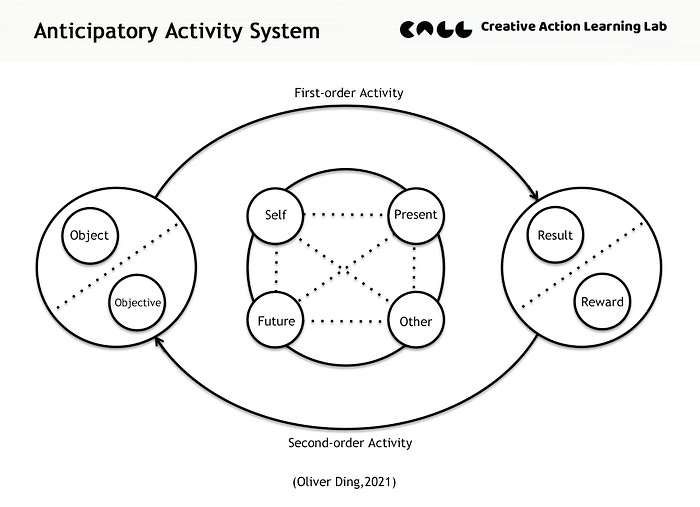
This four-term structure is not static. The relationship between Self and Other is not given in advance — it shifts depending on the nature of the activity, the degree of mutual involvement, and the kind of relevance that connects the two. And it is precisely this variation in the Self-Other relationship that the Ecological Relevance model was developed to articulate.
1.2 The Ecological Relevance Model: Four Types
The Ecological Relevance model was first developed in November 2021, in the context of a broader investigation into the concept of Cultural Significance. Its purpose was to provide a systematic typology of the different ways in which a Self can be relevant to an Other — or, more precisely, the different ways in which the Other can figure in the activity of the Self.
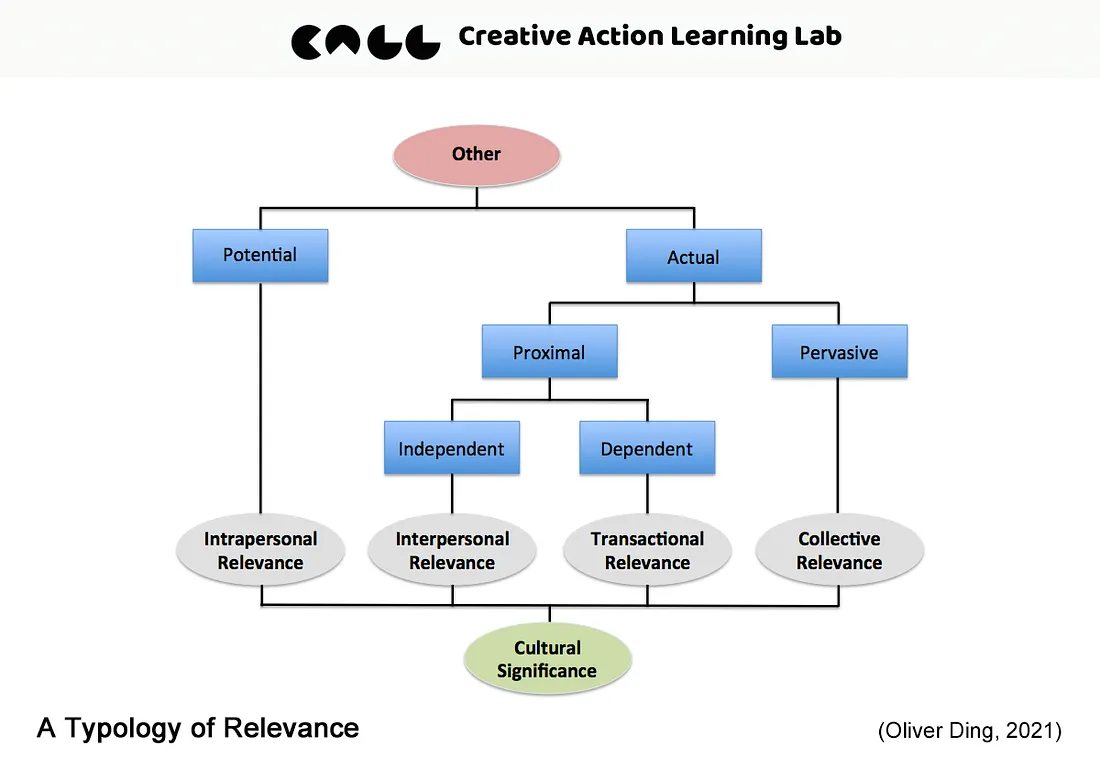
The model identifies four types of relevance, organized around three core dimensions:
- Potential vs. Actual: Is the Other a real, present interlocutor, or a potential one whose presence is imagined or anticipated?
- Proximal vs. Pervasive: Is the Other a specific, proximate person, or a diffuse collective presence?
- Independent vs. Dependent: Is the Self-Other relationship considered as two separate entities, or as a unified whole?
These three dimensions generate four distinct types:
Intrapersonal Relevance: The Other is potential, not actual. The Self reflects on its work in relation to predecessors, imagined audiences, or contemporaries with whom no direct interaction yet exists. The activity is self-directed, but not self-enclosed — it is oriented toward an Other who is not yet present. The classic example is a writer thinking about Schutz while composing an article, without any direct exchange.
Interpersonal Relevance: The Other is actual, but the Self-Other relationship is not considered as a whole. Direct interaction exists — feedback is sought, responses are received — but the two parties do not share a full reciprocity of motives. Each remains independent; the exchange is real but asymmetric. A writer sharing an article with a contact on LinkedIn, hoping for a response, exemplifies this type.
Transactional Relevance: The Other is actual, and the Self-Other relationship is considered as a whole. Here, the two parties share reciprocity of motives, background knowledge, and interpretive frameworks. The interaction is genuinely mutual: each party's activity is oriented toward and shaped by the other's. This is not a mere exchange — it is a form of joint activity in which the Self-Other dyad functions as a unit.
Collective Relevance: The Other is pervasive, not proximal. The relevant Other is not a specific individual but a social group, a community, a field. The Self-Other relationship becomes Self-Group, and the question of relevance operates at the level of collective dynamics rather than interpersonal interaction.
1.3 The Structural Logic of the Model
What makes this typology more than a simple classification is its structural logic. The three dimensions are not independent variables — they form a progression. As one moves from Intrapersonal to Interpersonal to Transactional to Collective Relevance, the Other becomes increasingly actual, the relationship increasingly mutual, and the unit of analysis increasingly extended.
The most theoretically significant transition is the one between Interpersonal and Transactional Relevance. It is here that the model introduces a claim that goes beyond mere description: in Transactional Relevance, "the Self-Other is considered as a whole." This is not simply a statement about the intensity of interaction. It is an ontological claim — that under certain conditions of mutual engagement, the Self and the Other together constitute a unit that is more than the sum of its parts.
This claim is the conceptual hinge of the entire typology. It distinguishes between a world in which Self and Other are always separate entities interacting across a boundary, and a world in which the boundary itself can become a site of joint constitution.
1.4 The Unfinished Work of the Model
And yet, in the original AAS framework, this claim was not developed further. The Ecological Relevance model identified the phenomenon — the Self-Other as a whole — but did not pursue its implications. It gave the phenomenon a name and a place in the typology, but left its ontological structure largely unexamined.
What does it actually mean for the Self-Other to be considered as a whole? What kind of entity is this whole? How does it relate to the individual agencies of the Self and the Other who compose it? Does the Self change when it enters this kind of relation? And if so, what are the implications for how we understand Self-actualization, creative development, and the practice of supporting another person's growth?
These questions were present in the original model as implications, but were not pursued as explicit problems. The model was correct as far as it went — but it did not go far enough.
1.5 The Present Series as an Opportunity for Revisiting
The three articles that precede this one — Revisiting, Rebuilding, Re-engaging with Past Selves, Agency Cascade and the Transformation of Self, and Engaging with Others for Developing Anticipated Identity — were not originally conceived as a systematic investigation of the Ecological Relevance model. They were written as explorations of the Revisiting-Rebuilding practice, following the thread of creative identity development through a series of case studies and theoretical elaborations.
But in retrospect, what this series has been doing — in each of its three preceding articles — is precisely what the Ecological Relevance model left undone. It has been developing, from the inside, what it means for the Self to be constituted in relation to its own past, in relation to its creative predecessors, and in relation to another person or agent who supports its development. It has been, in effect, filling in the theoretical space that the original model opened but did not occupy.
This fourth and final article brings that work to completion. Its task is to gather what the series has developed, connect it explicitly to the Ecological Relevance model, and use it as the foundation for a systematic reconception of what Self-actualization means — not as an individual psychological achievement, but as an anticipatory activity that unfolds across multiple dimensions of the Self, in relation to Others, within the social ecology of a life.
Part 2: Expanding the Boundaries of Self
The central claim of this article can be stated simply: Self is not a single, bounded, present-moment entity. It has three layers — Sub-individual, Individual, and Supra-individual — and a full understanding of creative life, Self-actualization, and the practice of supporting others requires all three.
This claim did not emerge from abstract theorizing. It emerged from the series of investigations that make up the preceding three articles. Each article expanded the concept of Self in a different direction; together, they form the basis for the three-layer architecture proposed here.
2.1 The Sub-individual Dimension: Past, Present, and Future Selves
The first article in this series, Revisiting, Rebuilding, Re-engaging with Past Selves, introduced a foundational challenge to the conventional notion of the Self as a present-moment unity. Drawing on Markus and Nurius's concept of Possible Selves, it proposed that what we ordinarily call "the Self" is in fact a temporal composite: a Present Self that acts in the current moment, Past Selves that remain as dormant resources — partially enacted identities, unfinished projects, earlier versions of the creative life — and Future Selves, or Anticipated Identities, that orient present action toward a horizon of becoming.
These are not metaphors. They are functional components of the Self as an action system. Past Selves do not simply recede into inert history — they can be revisited, rebuilt, and reactivated as creative resources. Anticipated Identity is not mere fantasy — it functions as a selection filter, determining which elements of a predecessor's work, which theoretical directions, which opportunities for engagement, are visible and relevant at a given moment.
The Revisiting-Rebuilding (RR) practice is precisely the practice of operating across this temporal architecture: returning to the past with the resources of a more developed present, and finding in that return material that orients future development. This is not retrospection for its own sake — it is the activation of a sub-individual resource in service of a supra-individual trajectory.
The second article, Agency Cascade and the Transformation of Self, formalized this temporal architecture within the framework of the Creative Identity Cascade. By mapping the development of Creative Identity across the four levels of the Agency Cascade — from Mindentity through Tiny Folkentity, Meso Folkentity, to Mega Folkentity — it showed that the transformation of the Self is not merely a psychological process but a social one: each level of identity development involves a qualitatively different relationship between the creator and the social world. The sub-individual architecture of Past, Present, and Future Selves is not the whole story — it is embedded within a larger structure of social escalation.
2.2 The Other-Directed Dimension: Engaging with Creative Predecessors
The third article, Engaging with Others for Developing Anticipated Identity, extended the framework in a second direction. Where the first two articles focused on the Self's relationship to its own past and future, the third turned to the Self's relationship to specific Others: creative predecessors whose enacted identities remain available as resources for the development of Anticipated Identity.
This extension revealed something that the sub-individual framework alone could not show: the Self is not only constituted across time — it is constituted in relation to Others. The six case studies presented in that article — engagements with Gruber, Barker, Cole, Blunden, Lui, and Kegan, spanning nine years — demonstrated that a creator's Anticipated Identity does not develop in isolation. It develops through selective engagement with predecessors whose work carries dimensions that the creator's current Anticipated Identity is capable of recognizing and transforming into a resource.
This is more than influence or inspiration. It is a structural process: the creator's Anticipated Identity functions as a filter, determining what in the predecessor's work is visible; what is visible is selected and rebuilt into the creator's own developing framework; the rebuilt material contributes to a more developed Anticipated Identity that, in turn, makes new dimensions of the predecessor's work accessible in subsequent encounters. The relationship between Self and predecessor is not a one-time absorption but a recursive development.
The concept of Creative Identity Resonance, introduced in that article, added a further dimension: the creator's multiple enacted Creative Identities — formed across different engagements, different projects, different periods — do not exist in isolation. Placed together on a synchronic landscape, they resonate with one another, producing an emergent understanding of the self that no single identity could have generated alone.
2.3 Connecting Back to Ecological Relevance
These two directions of extension — the sub-individual (temporal) and the other-directed (social) — can now be reconnected to the Ecological Relevance model introduced in Part 1.
The sub-individual dimension maps most naturally onto Intrapersonal Relevance: the Self engaging with potential Others — predecessors, imagined audiences, future versions of itself — in the absence of actual interaction. The other-directed dimension maps across the remaining three types: the engagement with creative predecessors often begins as Intrapersonal (reading their work, thinking about them) and develops toward Interpersonal (correspondence, dialogue) and, in the most sustained cases, toward something approaching Transactional Relevance — genuine mutual orientation, even when the predecessor is no longer living.
But here is where the Ecological Relevance model's unfinished work becomes visible again. Neither the sub-individual architecture nor the other-directed engagements, as developed so far, directly address what happens when two living agents — a creator and a supporter, a person and an AI — engage with one another in sustained, mutual, genuinely joint activity. This is the territory of Transactional Relevance at its fullest extension: the Self-Other as a whole. And it is the territory that requires the concept of the Supra-individual.
2.4 The Supra-individual Dimension: Persons Acting in Concert
The concept needed to develop the Self-Other-as-a-whole claim is not an abstract philosophical construction — it has a concrete empirical origin in legal practice.
The concept of Persons Acting in Concert emerged in securities regulation as a precise legal response to an observable social phenomenon: when multiple parties coordinate their actions toward a shared objective — acquiring control of a company, for instance — the legal and practical consequences of their combined actions are identical to those of a single actor holding the equivalent stake. The 1968 City Code on Takeovers and Mergers formalized this recognition: persons acting in concert are treated, for regulatory purposes, as a single entity, because the outcomes of their coordinated action are indistinguishable from those of one unified agent.
This is not an abstract philosophical claim about identity or consciousness. It is an empirical observation about action and its consequences, recognized first in the domain of financial regulation and verifiable in everyday life: two people who genuinely act in concert — sharing the same orientation, the same stakes, the same objectives — produce outcomes that function as if generated by a single agent.
This legal-practical origin provides exactly what we need: a part-whole structure grounded in concrete life rather than speculative theory. In the Persons Acting in Concert framework, each individual participant is a part; the coordinated ensemble is the whole. The whole is not a fiction — it is functionally real, precisely because the consequences of the coordinated action accrue to all participants as a unified outcome. The Self remains a part; the whole constituted by the Self and Others acting in concert becomes something that none of its parts is alone.
This part-whole structure is what the Ecological Relevance model's claim — "the Self-Other is considered as a whole" — was pointing toward but did not name. In Transactional Relevance, the two parties share reciprocity of motives, background knowledge, and interpretive frameworks. When this reciprocity extends to the point where their actions and their outcomes are genuinely aligned, the Self-Other dyad crosses a threshold: it becomes a Supra-individual — a whole whose agency exceeds and subsumes the individual agency of each of its parts, without dissolving those parts into an undifferentiated mass.
It is important to be precise here about what kind of supra-individual this is. The social theorists who speak of "collective action" or "collective intentionality" tend to describe phenomena at a much larger scale — social movements, institutional behavior, the emergent properties of crowds or organizations. These are genuine phenomena, but they are not what we are describing here. The Supra-individual constituted by Persons Acting in Concert is a concrete, relational structure: a Self and one or more Others — persons, AI agents, teams, or organizations, each of which sociology already recognizes as an agent in its own right — whose actions and outcomes are so genuinely aligned that they function together as a single higher-order agent in the world. This is not sociology at the collective scale; it is the ontology of a particular life, examined in its actual relational texture.
This is why we use the term Supra-individual rather than terms like "collective agent" or "group mind." The distinction operates on two levels.
The first level concerns scale. The social theorists who speak of "collective action" or "collective intentionality" tend to describe phenomena at the scale of social movements, institutions, or organizations — entities whose agency is analyzed from the outside, as units within a larger social system. The Supra-individual we are describing here is not a social system phenomenon; it is a phenomenon of a particular life, examined from the inside. It asks not "how does this collective unit function in society?" but "how does this Self extend itself into a whole through its alignment with Others?"
The second level concerns perspective. Sociology already has the concept of a collective agent — a team, an organization, a community — understood as a functional unit from a third-person analytical standpoint. But this concept does not address the first-person question: when a concrete Self participates in Persons Acting in Concert, what happens to the Self? The sociological agent concept describes the whole from outside; the Supra-individual concept describes what it means for a Self to be a part of that whole from inside — how the Self's own agency, development, and self-actualization are constituted and extended through the whole it co-constitutes with Others.
These two concepts are therefore not in competition. They address different questions at different levels. The Supra-individual is needed precisely because self-actualization is always the activity of a specific Self in a specific life, and understanding how that Self can be genuinely extended through alignment with Others requires a concept that is answerable to the first-person, from within the texture of a particular life, not only from the analytical vantage point of social theory.
2.5 The Three-Layer Architecture of Self
With the Supra-individual dimension in place, the full architecture becomes visible:
- Sub-individual: The temporal dimension of the Self — Past Selves, Present Self, Future Selves (Anticipated Identity). These are not separate persons but distinct functional components of the single Self as it extends across time. They relate to one another through the RR practice: the Present Self revisits and rebuilds the Past Selves, guided by the orientation of an Anticipated Identity. This is the dimension of temporal depth.
- Individual: The Self as a present-moment actor — the conventional unit of psychological and sociological analysis. This is the level at which activity is performed, decisions are made, and projects are engaged. It is the level most visible in everyday experience and most thoroughly theorized in existing frameworks. This is the dimension of present action.
- Supra-individual: The Self as part within a joint action whole — what emerges when two agents engage in genuinely aligned action toward a shared project, constituting together a higher-order unit whose outcomes function as those of a single agent. This is the structure of Persons Acting in Concert: not a dissolution of individual agency but its extension into a supra-individual whole. This is the dimension of relational constitution.
These three layers are not alternatives — they coexist within every moment of genuine creative activity. A creator working with a supporter is simultaneously operating as an individual actor (making choices, following intuitions, developing themes), as a sub-individual composite (drawing on past selves, orienting toward future possibilities), and as a supra-individual participant (co-constituting with the supporter a joint action system that enables each of them to do what neither could do alone).
2.6 A New Foundation for Understanding the Self
The three-layer architecture — Sub-individual, Individual, Supra-individual — represents a significant departure from the assumptions that underlie most existing theories of the Self.
Traditional psychology, whether in its psychoanalytic, humanistic, or cognitive variants, has tended to treat the Self as a present-moment individual: bounded, internally structured, the primary unit of motivation, development, and well-being. This assumption is not wrong — the individual level is real and important. But it is incomplete.
By extending the Self downward into the sub-individual (making time internal to the Self's structure rather than external to it) and upward into the supra-individual (making joint action a constitutive possibility of the Self rather than merely an external context), the three-layer architecture provides a framework capable of addressing questions that the traditional model cannot adequately handle.
These include questions of creative development across long time spans, where the relationship between a creator's past work and present development is not merely biographical but structurally generative. They include questions of how one person can support another's development not by directing it from outside but by constituting with them a joint action system within which genuine discovery becomes possible. And they include the emerging questions posed by human-AI collaboration — questions about what it means for a person and an AI agent to constitute a Supra-individual through Persons Acting in Concert, and what kind of Self-actualization becomes possible within such a joint structure.
It is to this last set of questions — what Self-actualization means within this three-layer architecture — that we now turn.
Part 3: Reconsidering Self-Actualization
3.1 Maslow and the Limits of the Humanistic Model
The concept of self-actualization as it is commonly understood derives primarily from Abraham Maslow's hierarchy of needs, first introduced in his 1943 paper "A Theory of Human Motivation" and developed across his subsequent work. In Maslow's framework, self-actualization occupies the apex of a five-level pyramid: after the physiological needs (food, shelter, rest), the safety needs (security, stability), the belonging needs (love, connection), and the esteem needs (recognition, achievement) have been substantially met, a higher motivational structure becomes active — the drive to become what one is capable of becoming, to realize one's potential, to become "everything one is capable of becoming."
The intuitive power of this framework is considerable. It captures something genuinely important about human motivation: that beyond survival and social belonging, people are oriented toward development, toward becoming more fully themselves, toward the actualization of capacities that remain latent without the right conditions and effort. This is a real phenomenon, and Maslow named it with memorable clarity.
But the framework carries several assumptions that, when examined, reveal significant limitations — particularly for the purpose of understanding creative life development.
The first limitation is the assumption of sequentiality. Maslow's pyramid implies that self-actualization is available only after the lower-level needs have been met. This does not accord with the observed reality of creative lives, in which self-actualization activity — the development of themes, the pursuit of significant questions, the construction of a knowledge enterprise — often occurs alongside and through conditions of material scarcity, social difficulty, or existential uncertainty, not merely after these have been resolved.
The second limitation is the assumption of individuality. Maslow's framework situates self-actualization entirely within the individual psychological subject: it is my potential that I actualize, my capacities that I develop, my peak experiences that mark the moments of fullest realization. The social conditions that make this possible — the relationships, communities, practices, and institutions within which a creative life unfolds — appear in the framework primarily as background conditions (belonging, esteem) rather than as constitutive dimensions of the self-actualization process itself.
The third and deepest limitation is the assumption of teleological closure. Self-actualization in Maslow's framework is implicitly oriented toward a final state: the fully actualized self, the peak experience, the moment of complete realization. Even when Maslow acknowledges that self-actualization is a process rather than a destination, the architecture of his framework points toward completion, toward a terminus. This gives the concept a static quality that sits uneasily with the lived experience of creative development — which tends to be not a progression toward completion but an ongoing process of discovery, in which each achievement opens new questions rather than resolving the fundamental tension.
It is worth noting that the most significant recent effort to rehabilitate and update Maslow's framework — Scott Barry Kaufman's Transcend: The New Science of Self-Actualization (2020) — already moves substantially beyond these limitations, and in directions that resonate with the present argument. Kaufman made a historically important correction: the famous pyramid was never Maslow's own creation. It was constructed by management consultants and became hyper-popular through business literature — a "gross misinterpretation," as Kaufman puts it, of Maslow's actual theory. In its place, Kaufman proposes a sailboat metaphor: the security needs form the hull (keeping the boat stable and buoyant), while the growth needs are the sail (opened or closed moment by moment depending on conditions). This captures the dynamic, non-sequential character of human development far more accurately than the pyramid ever did.
More significantly for our purposes, Kaufman recovered Maslow's unfinished theory of transcendence — scattered across unpublished journals, lectures, and essays — and placed it at the apex of the updated framework. In this late thinking, Maslow proposed that the fullest realization of potential requires something beyond the individual: a merging between self and the world, a movement from self-actualization toward self-transcendence, in which the boundaries of the self become permeable to others and to purposes larger than personal achievement. Growth, in Kaufman's synthesis, organizes around three dimensions: exploration, love, and purpose — all of which point outward, toward the world and toward others, rather than inward toward a private perfection.
This late Maslovian turn is important. It indicates that even from within the humanistic tradition, the individualist assumption was already under pressure — that a fully developed account of self-actualization points beyond the individual and toward the relational and the transcendent. The framework developed in this article takes that pressure seriously and attempts to give it a precise theoretical form: not through the language of "merging" or "transcendence" in the spiritual sense, but through the ontological architecture of Sub-individual, Individual, and Supra-individual, within the structured social ecology of the World of Life.
3.2 Back to Aristotle: Potentiality and Actuality
To understand why these limitations are not merely incidental but reflect something about the conceptual architecture of the humanistic tradition, it is useful to return to the philosophical source from which the concept ultimately derives: Aristotle's concept of entelechy (ἐντελέχεια).
Aristotle coined this term to name the internal principle by which a living being realizes its potential through continuous effort. The etymology is illuminating: the word combines entelēs (complete, mature), echein (to be in a certain continuing state), and telos (end, purpose). The result is a concept meaning something like "the state of having one's end within oneself" — not a goal imposed from outside, but an orientation toward completion that is internal to the nature of the thing itself.
What is crucial for our purposes is the distinction on which this concept rests: the distinction between dynamis (potentiality, capability, latent power) and energeia/entelecheia (actuality, the exercise of a capacity, the being-at-work of a thing). Potentiality is not nothingness — it is a real mode of being, the mode of something that has the capacity for a certain activity or development but has not yet actualized it. Actuality is the actualization itself: the seed germinating, the builder building, the thinker thinking.
The movement from potentiality to actuality is not a one-time event. It is a continuous process, and for living things — especially for thinking, acting, developing beings — it never reaches a final terminus. A human being does not actualize their potential once and stop. The actuality of a human life is the ongoing actualization of its capacities: understanding, interpreting, acting, imagining, creating.
This is closer to the reality of creative life than Maslow's framework allows. What Maslow called "self-actualization" — the drive toward the fullest expression of one's capacities — is not a level to be reached but a mode of activity to be sustained. It is not the destination but the journey, and more precisely, it is the quality of engagement with the journey.
3.3 From Philosophy to Ecological Practice: Opportunity and Action
The philosophical distinction between potentiality and actuality finds a practical counterpart in the Ecological Practice Approach's core distinction between action opportunity and action.
In the Ecological Practice Approach, an action opportunity (or ecological opportunity) is a structural possibility that exists in the environment — a latent potential for action that is available but not yet actualized. It is the dynamis of the situation: the gap between what is and what could be brought into being through skillful activity. An action is the actualization of that opportunity: the movement from latent potential to actual engagement.
This is not merely a translation of Aristotle into ecological vocabulary. It is a substantive development: by locating potentiality in the relationship between agent and environment — rather than in the agent alone — the Ecological Practice Approach overcomes the residual individualism of the Aristotelian framework. The potential for action is not stored inside the person, waiting to be released. It is constituted at the interface between the person's capacities and the environment's affordances. What Gibson called "affordances" — the action possibilities that an environment offers to an agent of a particular kind — are the ecological form of potentiality.
The four positive frontiers of the World of Life — Affordance, Supportance, Attachance, and Curativity — are precisely four types of ecological opportunity, each corresponding to one boundary of the social world. Their content will be developed fully in Part 4. What matters here is the structural point: each frontier names a form of latent potential that becomes actual only through a specific kind of skilled engagement — and it is through the ongoing actualization of these opportunities, across all four frontiers simultaneously, that genuine Self-actualization takes place.
At the center of this map stands Genidentity: the recognition of one's own irreducible particularity, the awareness of what makes one's life uniquely one's own. Genidentity is not itself an action opportunity — it is the condition of possibility for recognizing and actualizing any of the four frontier opportunities. Without knowing what is most essentially one's own, the movement toward any frontier risks becoming drift rather than development: the dissolution of the particular into a generic form of engagement.
A clarification is needed here about the relationship between capacity and opportunity — between the Aristotelian tradition's focus on the actualization of inner capacities and the Ecological Practice Approach's focus on the actualization of ecological opportunities. These are not two different things, one internal and one external. They are two descriptions of the same process from different vantages. A capacity that is never engaged with any opportunity remains unobservable and, in any meaningful sense, unreal: we cannot say what a person is capable of in the abstract, only what they actually do when placed in relation with specific situations. Conversely, an opportunity that finds no capacity to meet it remains merely latent. The actualization of a capacity is the actualization of an opportunity; the actualization of an opportunity is the actualization of a capacity. They are two faces of a single movement — the movement from potential to actual that constitutes a Self genuinely at work in a life.
3.4 Self-Actualization as Anticipatory Activity
With this ecological framework in place, we can now offer a reconception of Self-actualization that overcomes the limitations of Maslow's model while remaining faithful to the deeper Aristotelian intuition.
Self-actualization, reconceived, is not a level to be reached or a state to be achieved. It is an ongoing anticipatory activity: the continuous process by which a Self — in its full three-layer architecture of Sub-individual, Individual, and Supra-individual — recognizes ecological opportunities and moves from their latent form (potentiality) to their enacted form (actuality).
Each such movement is an instance of Self-actualization: not because it brings the Self closer to a final state of completion, but because it actualizes a capacity that would otherwise remain latent. The seed does not become more itself by staying a seed. The thinker does not actualize their capacity by merely possessing it. The movement from potential to actual — from recognized opportunity to enacted action — is, in the fullest sense, a Self genuinely at work in a life.
The anticipatory dimension of this reconception is crucial. In the ACS framework, anticipation is not a psychological state (hoping, expecting, imagining) but a structural feature of activity: every act of engagement is oriented toward a future that it is, in part, constituting. The creator who develops a theme is not merely processing present experience — they are enacting a possible future, making it more real through the act of engagement itself. The supporter who accompanies a creator's development is not merely reacting to present states — they are anticipating developmental trajectories and holding space for possibilities that are not yet actual.
Self-actualization as anticipatory activity is therefore not the achievement of a predetermined potential. It is the ongoing creative movement by which a Self — extending across its temporal sub-individual depth, its present-moment individual agency, and its relational supra-individual constitution — engages with the ecological opportunities available at each frontier of the World of Life, and in doing so, becomes more fully what it is capable of becoming.
3.5 The Agency Cascade and the Structure of Self-Actualization
A single act of engagement — a creator pursuing one opportunity, a supporter enabling one discovery — is not yet Self-actualization in its full sense. Self-actualization is a structured process, and its structure is given by the Agency Cascade.
The Agency Cascade, as developed within the ACS framework, describes how thematic creations move through four levels of cultural development, each building on the previous: from the Pre-Activity level (Creator and Supporter, Mindentity), through the Activity level (Curator and Weaver, Tiny Folkentity), through First-Order Analysis (Influencer and Follower, Meso Folkentity), to Second-Order Analysis (Canonizer and Receiver, Mega Folkentity). At each level, what was the "Think" of the previous level becomes the "Self" of the next: agency cascades outward and upward through the social world.
Reconceived in terms of Self-actualization, the Agency Cascade describes not merely the social trajectory of a thematic creation but the developmental arc of the Self that creates it. Each level of the Cascade corresponds to a qualitatively different mode of Self-actualization:
At the Pre-Activity level, Self-actualization takes the form of cognitive preparation: developing the orientations, concepts, and frameworks that make genuine engagement with the world possible. This is the domain of the Learn stage in the L3D model — the internalization of the four boundaries of the World of Life as living cognitive orientations.
At the Activity level, Self-actualization takes the form of thematic discovery: genuine engagement with one's themes, the development of mental models, the emergence of creative flow. This is the domain of the Discover stage — where real Self-actualization activity happens, in the sense of genuine movement from potential to actual.
At the First-Order Analysis level, Self-actualization takes the form of designed creation: the transformation of discovered themes into structured thematic works that can be shared and developed within a community. This is the domain of the Design stage.
At the Second-Order Analysis level, Self-actualization takes the form of cultural contribution: the entry of one's work into the shared heritage of a civilization, where it becomes a resource for others' development. This is the domain of the Deliver stage.
Self-actualization, understood through the Agency Cascade, is not a single act but a sustained developmental trajectory — a series of movements from potential to actual, each building on the previous, each opening new possibilities at the next level. It is, in the fullest sense, an anticipatory activity: oriented at every level toward a future that is not yet actual but that the activity itself is bringing into being.
Part 4: Positive and Negative Frontiers
Self-actualization, as reconceived in Part 3, is an anticipatory activity: the ongoing movement by which a Self actualizes ecological opportunities across a lifetime of creative engagement. But this movement does not happen in an abstract space. It happens in the concrete social ecology of a human life — a life that is always already situated within specific boundaries, exposed to specific risks of drift, and oriented toward specific possibilities of genuine development. To understand what Self-actualization actually requires, we need a map of this social ecology: what are its boundaries, what failure modes lurk at each edge, and what genuine opportunities open at each frontier? This is what the World of Life framework provides.
4.1 The World of Life: A Map of the Social Ecology
The World of Life is the ontological meta-framework of ACS: a structural description of the social world in its full ecological complexity. It does not describe a particular society or historical moment — it describes the permanent boundaries within which any human life, in any context, unfolds.
These boundaries are four:
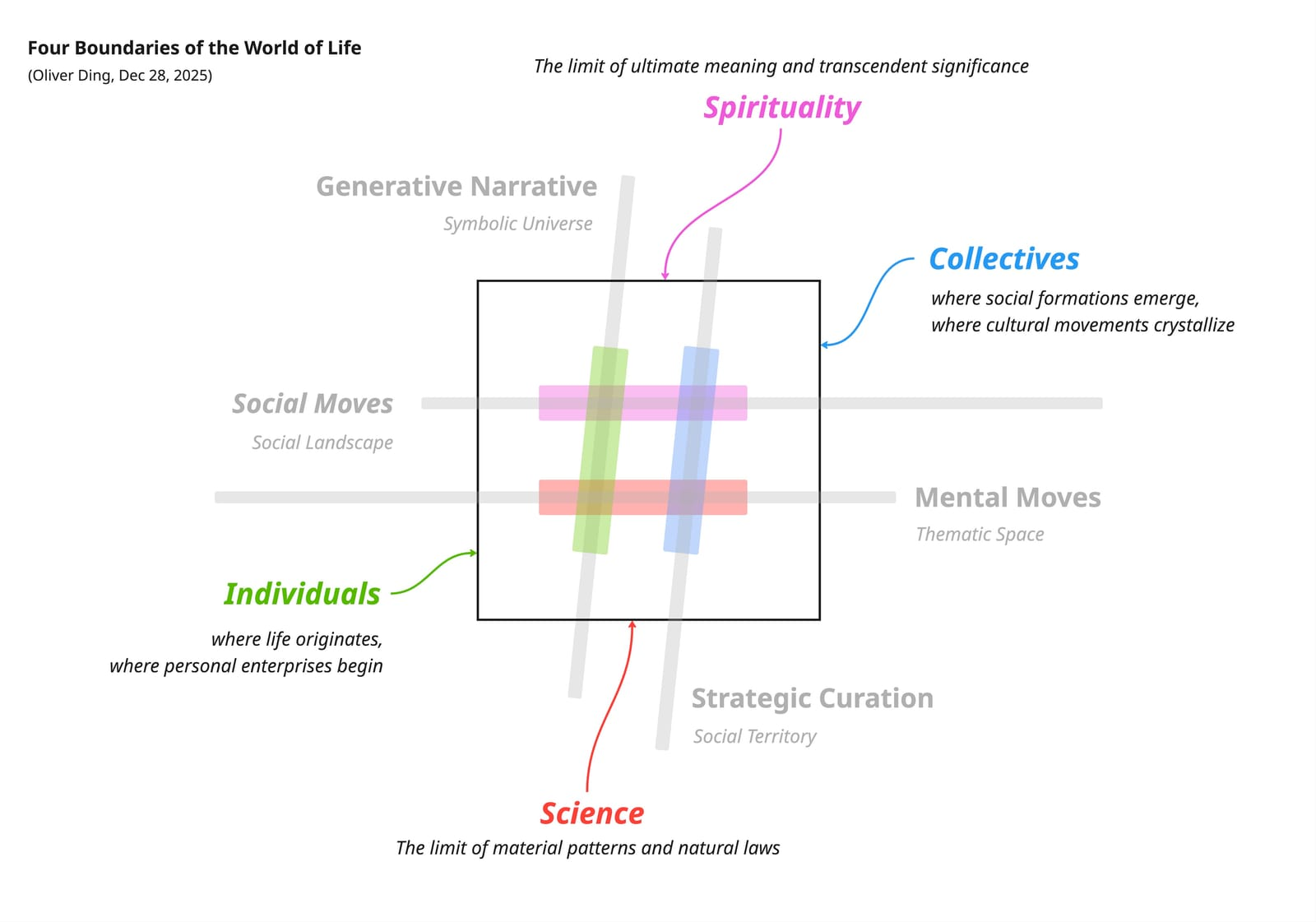
Spirituality (upper boundary): the limit of ultimate meaning and transcendent significance — the domain of values, purposes, and the questions that exceed any particular empirical answer. This is where the meaning of a life, a practice, or a cultural enterprise is ultimately decided.
Science/Ecology (lower boundary): the limit of material patterns and natural laws — the domain of the measurable, the reproducible, and the structurally constrained. This is where the physical and ecological conditions of life impose their inescapable requirements.
Individuals (left boundary): where life begins in its most personal sense — the singular human being with a particular history, a particular set of themes and commitments, a particular trajectory through time. This is the domain of personal identity, agency, and the ongoing project of becoming who one is.
Collectives (right boundary): where social formations crystallize — communities, institutions, movements, traditions. This is where the work of individual creators, over generations, becomes the shared property of a civilization.
Within the space bounded by these four boundaries, cultural development happens. Knowledge flows, concepts travel, practices take root or dissolve. Self-actualization — as an anticipatory activity oriented toward the full range of human capacities — takes place within this space, in engagement with all four boundaries simultaneously.
4.2 The Four Positive Frontiers
Each boundary of the World of Life opens onto a positive frontier — a direction of genuine ecological opportunity when engagement with that boundary is pursued with integrity and skill. These four frontiers were developed within the Ecological Practice Approach and correspond precisely to the four boundaries of the World of Life.
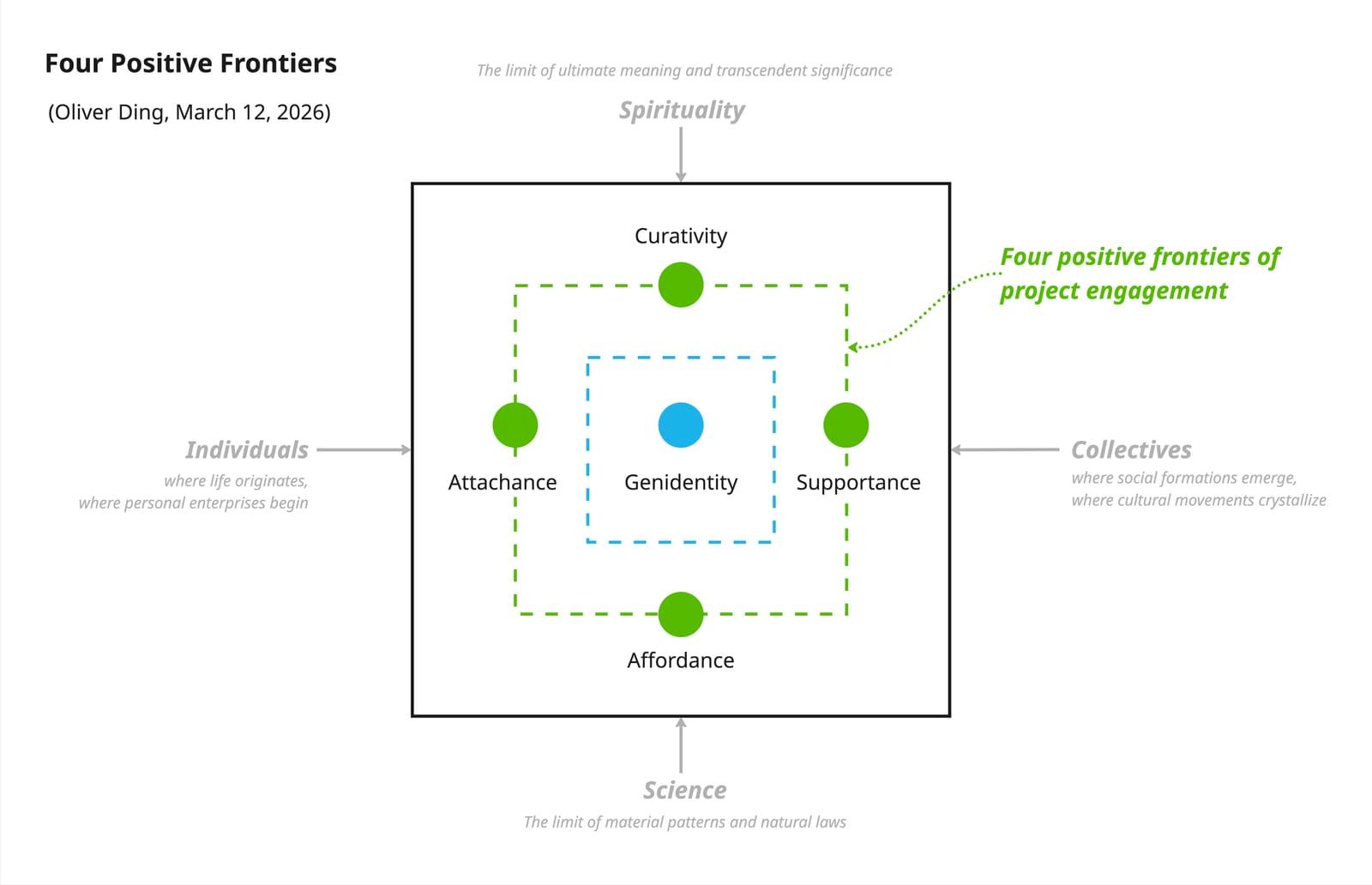
Affordance (Science/Ecology frontier): the potential for action offered by the material and natural environment. Affordances — in Gibson's original sense — are the action possibilities that an environment offers to an agent of a particular kind. The practical orientation corresponding to Affordance is Material Adaptability: the capacity to perceive what an environment genuinely offers and to act on it skillfully.
Supportance (Collectives frontier): the potential for supportive action offered by social environments — the possibilities for contribution, collaboration, and mutual enabling that exist within communities, institutions, and networks. The practical orientation is Social Adaptability: the ability to read what a social environment genuinely supports and to engage with it in ways that develop rather than deplete the shared resources.
Attachance (Individuals frontier): the potential for action offered by the dynamics of attaching and detaching. Every act of attaching to a new context opens new possibilities; every act of skillful detachment creates new freedom. The practical orientation is the Sense of Boundarylessness: the felt quality of a life in which boundaries have become dynamic membranes rather than fixed walls.
Curativity (Spirituality frontier): the potential for meaning-making through the act of turning scattered pieces into a coherent whole — not the imposition of an external framework onto raw experience, but the discovery of the containers that allow experience to become meaningful from within. The practical orientation is the Sense of Wholeness: the felt experience of a life whose fragments have been gathered into coherence.
4.3 The Four Negative Frontiers
Each boundary also has a corresponding failure mode — a direction of drift that, when entered, transforms the generative potential of that boundary into something closed, extractive, or entropic. These are the four negative frontiers.
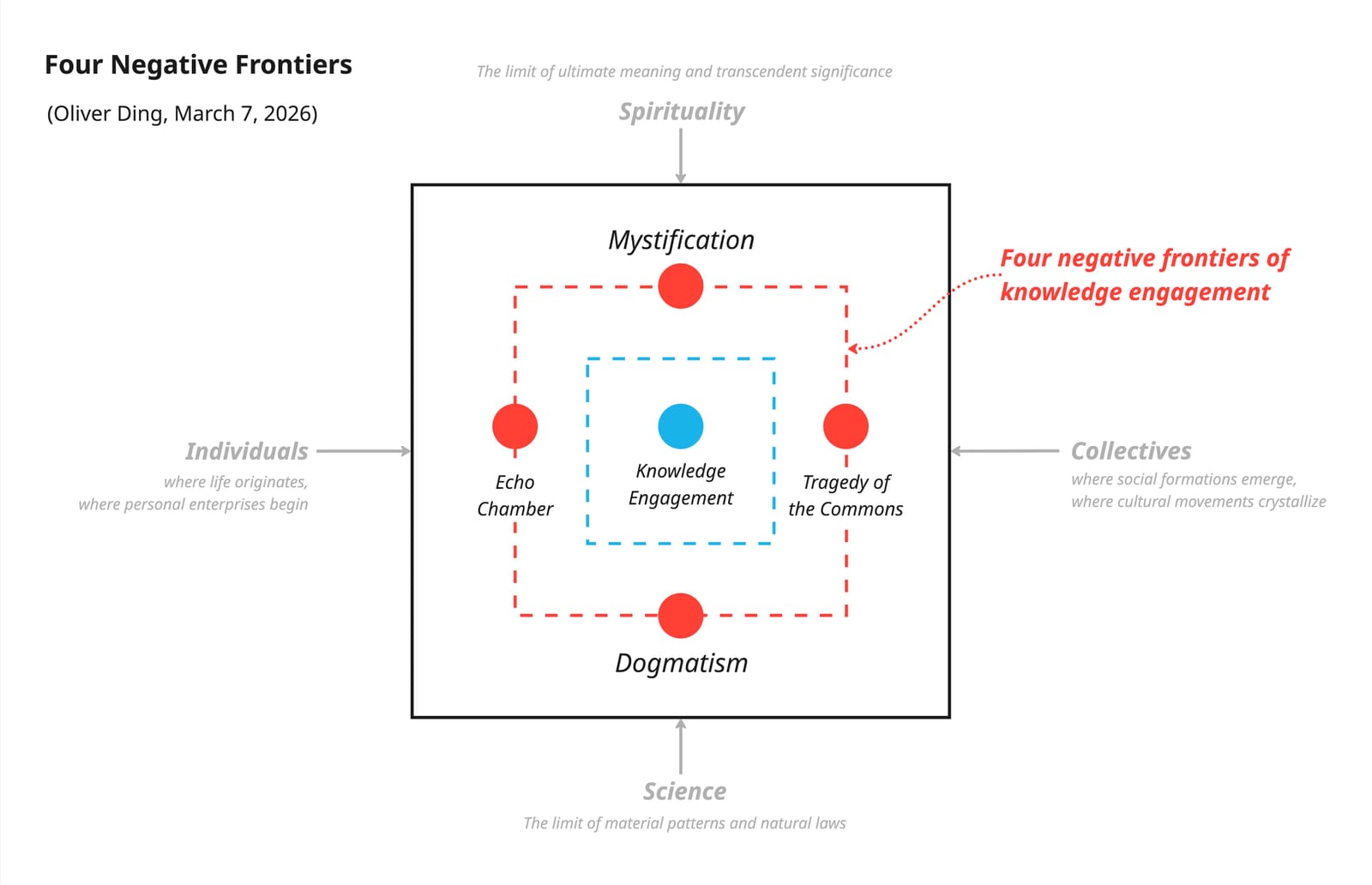
Mystification (Spirituality boundary): the collapse of engagement with ultimate meaning into obscurantism. The human need for transcendent significance is real and ancient — but when the language of the transcendent is used to evade rather than open genuine inquiry, to make the interpretive authority inaccessible and the concepts immune to questioning, the boundary becomes a trap rather than a resource. A Self drawn into mystification loses the capacity for genuine meaning-making, replacing it with the management of mystery.
Dogmatism (Science boundary): the calcification of rigorous inquiry into closed orthodoxy. Science is, in principle, the most anti-dogmatic of epistemologies — constituted by the commitment to revise in the face of evidence. But scientific culture can harden: frameworks that were once genuinely open become orthodoxies, and the authority of method is used to foreclose the insights that methods have not yet learned to measure. Dogmatism and mystification are mirror images: one closes knowledge by making it too sacred to question; the other closes it by making the standards of questioning so narrow that only already-accepted knowledge can pass through.
Echo Chamber (Individuals boundary): the collapse of individual engagement into self-referential loops. The individual is the irreducible source of creative life — but there is a drift that occurs when the Self becomes its own only reference point. A creator whose thinking develops entirely in conversation with itself — however vast and internally sophisticated — eventually surrounds itself with the amplified sound of its own voice. The chamber does not feel closed from the inside; it often feels like the most expansive and resonant space imaginable. That is part of what makes it dangerous.
Tragedy of the Commons (Collectives boundary): the slow depletion of public knowledge through collective non-investment. The collective inheritance of civilization requires stewardship: people willing not only to draw on what exists but to contribute to what will exist. The tragedy of the commons is not caused by malice but by structure: when everyone rationally maximizes their extraction from a shared resource without taking responsibility for its renewal, the commons depletes. Unlike the other three negative frontiers, this one is not a failure of individual cognition — it is a structural failure of collective stewardship, the most underappreciated of the four.
4.4 Genidentity at the Center
At the center of the World of Life map stands Genidentity: the recognition of a thing's uniqueness and the differences between it and others. In the context of a human life, Genidentity means the awareness of one's own irreducible particularity — the specific configuration of themes, commitments, and experiences that constitutes a singular life.
Genidentity occupies the center because it is the condition of possibility for engaging with any of the four frontiers without losing oneself in the engagement. Opportunity, by its nature, brings change — and change can either develop or dissolve what is most essentially one's own. Genidentity is the boundary condition: every movement toward an opportunity must be measured against the question of whether it develops or diminishes the essential particularities of the Self. Opportunity without Genidentity is drift. Genidentity without Opportunity is stagnation.
But Genidentity, examined more closely, is not singular — it is double. This is the Principle of Double Genidentity developed within GO Theory.
A creative person operating within the World of Life is always engaged with two distinct Genidentities simultaneously. The first is the Genidentity of Creative Life: the uniqueness of the life itself — the particular arc of themes, identities, and creative development that belongs to this person and no other. This is the dimension of Creative Life Development: who this Self is becoming, what threads run through their work, what essential differences mark their contribution from all others.
The second is the Genidentity of Things: the uniqueness of the objects, projects, communities, and knowledge enterprises that the Self engages with and helps to build. This is the dimension of Social Life Development: the specific identity of the thematic enterprise, the knowledge center, the cultural project — its Essential Differences from other enterprises, and its Situated Dynamics as it develops through time and through the contributions of many participants.
These two Genidentities are not independent — they are nested. The Genidentity of Creative Life develops within and through engagement with the Genidentity of Things: a creator becomes more fully themselves by working on projects whose own particularity calls forth and develops specific dimensions of the creator's own themes and capacities. Conversely, the Genidentity of Things depends on the creative persons who initiate and sustain it: creators establish the Essential Differences of an enterprise, while supporters grow it by mastering its Situated Dynamics.
For Self-actualization understood as anticipatory activity, the Principle of Double Genidentity means that the ongoing movement from potential to actual is never only about the Self in isolation. It is always simultaneously about the Self and the things the Self is building in the world — two trajectories of Genidentity development that unfold together, each constituting the other.
4.5 Self-Actualization in the World of Life
We can now place Self-actualization precisely within the World of Life framework.
Self-actualization, as reconceived in Part 3, is the ongoing anticipatory activity by which a Self — in its full three-layer architecture — recognizes ecological opportunities and moves from their latent form to their enacted form. Located within the World of Life, this activity takes a specific spatial form: it unfolds in the center of the map, at the intersection of all four boundaries, oriented simultaneously toward all four positive frontiers and held back from all four negative frontiers by the grounding presence of Genidentity.
A Self that is genuinely self-actualizing is not only engaged with one boundary — not only with the material world (Affordance), or only with the collective (Supportance), or only with its own individual development (Attachance), or only with meaning-making (Curativity). It is navigating all four frontiers simultaneously, maintaining the tension between them, and sustaining its engagement with each through the ongoing awareness of its own Genidentity.
This is not a comfortable position. Each boundary exerts its own gravitational pull toward a failure mode — as the four negative frontiers described in 4.3 make clear: the Spirituality boundary toward mystification, the Science boundary toward dogmatism, the Individuals boundary toward the echo chamber, the Collectives boundary toward the tragedy of the commons. To navigate all four simultaneously — to carry the rigor without the dogma, to honor the transcendent without the mystification, to stay rooted in individual experience without losing the capacity to be genuinely surprised by another, to contribute to the commons rather than merely drawing on it — is the ongoing challenge of genuine Self-actualization.
It is precisely at this point that the question of support becomes unavoidable. If Self-actualization is genuinely this demanding — if it requires simultaneous navigation of four boundaries, ongoing awareness of one's Genidentity, and sustained movement from potential to actual across a lifetime of creative activity — then the question of who or what can support this process becomes not a secondary concern but a primary one.
Part 5: Supportive Life Discovery
The question that Part 4 ended with — who or what can support the demanding work of genuine Self-actualization — is not a question about services or methods. It is a question about structure: what kind of relationship between a Self and an Other makes it possible for the Self to sustain its movement across all four frontiers of the World of Life, to stay grounded in its Genidentity through the challenges of each boundary, and to develop from Flow through Focus toward a genuine Coordinate, Center, and Circle? The answer this article proposes is a concrete practice: Supportive Life Discovery. And the framework that gives this practice its theoretical architecture is the L3D model.
5.1 The L3D Model and the Agency Cascade
The L3D model — Learn, Discover, Design, Deliver — was developed in March 2026 as a knowledge framework for Supportive Life Discovery. Its theoretical foundation is the Agency Cascade, which it reframes from a description of how thematic creations move through the social world into a description of how a creator moves through four qualitatively different modes of engagement with their own creative life.
The transformation is significant. In the Agency Cascade, the four levels describe the social ontology of a thematic creation — what kind of collective entity it has become. In the L3D model, the four levels describe the developmental arc of the creator who is discovering, designing, and delivering that creation. The levels are renamed accordingly:
| Agency Cascade | L3D Model |
|---|---|
| Pre-Activity | Learn |
| Activity | Discover |
| First-Order Analysis | Design |
| Second-Order Analysis | Deliver |
This renaming is not cosmetic. In the Agency Cascade, the Self-Other configuration changes at each level — Creator/Supporter, Curator/Weaver, Influencer/Follower, Canonizer/Receiver — reflecting the changing social scale of the creation's reach. In the L3D model, the Self-Other configuration is unified across all four levels: in every circle, Self is the Creator (the person engaged in their own life discovery), and Other is the Supporter (whoever provides enabling support at that level). What changes is not the identity of the participants but the nature of the activity being supported.
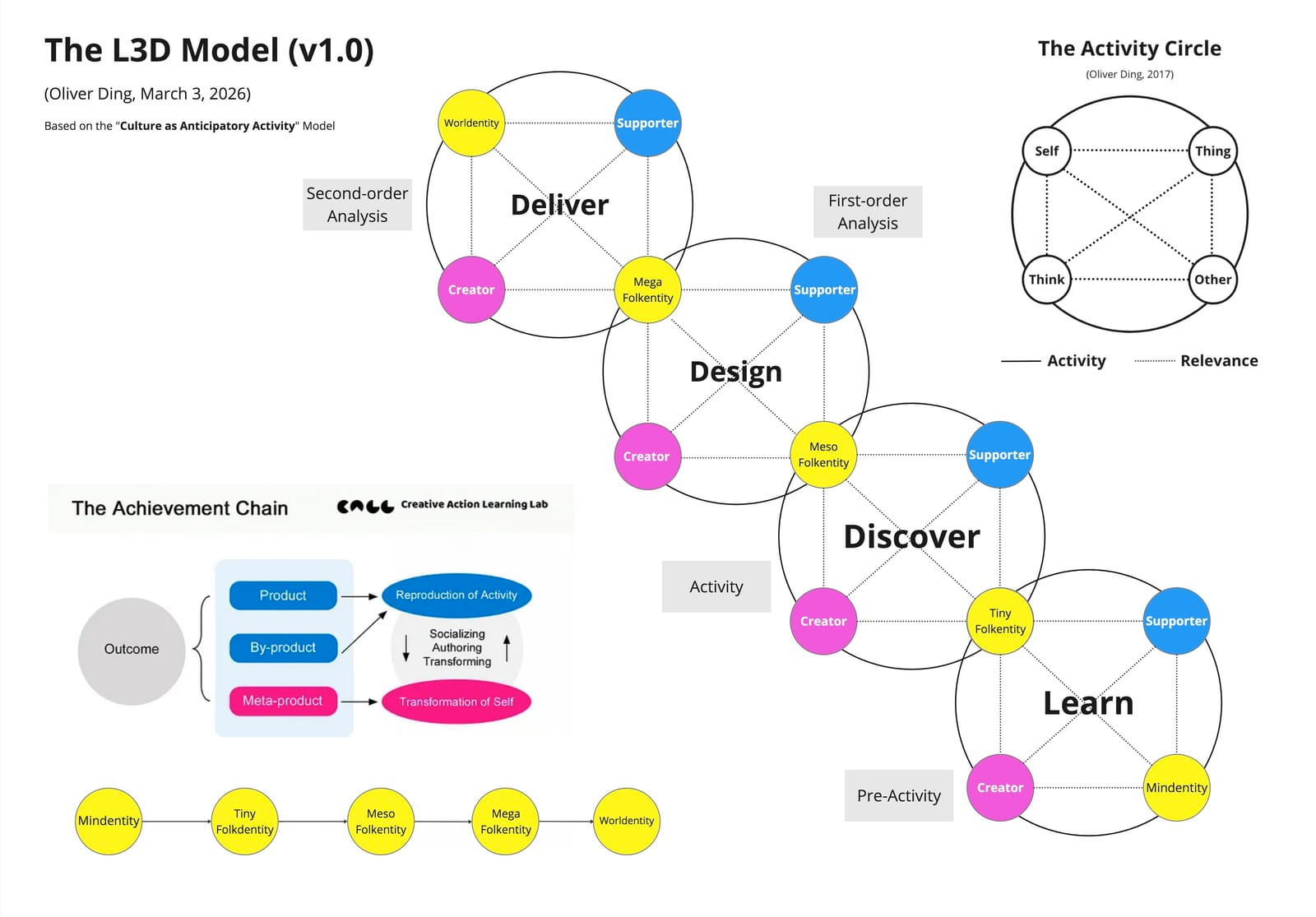
This structural adaptation reflects a fundamental choice: to center the model on the developing person rather than on the developing creation. The Creator remains the same person across all four levels of the L3D model — a person who is moving through four increasingly complex modes of engagement with their own life, in each case accompanied by a Supporter whose role shifts accordingly.
5.2 The Four-Layer Service Design
Within the Supportive Life Discovery framework, the L3D model maps directly onto a four-layer structure, each layer defining a specific mode of supportive engagement:
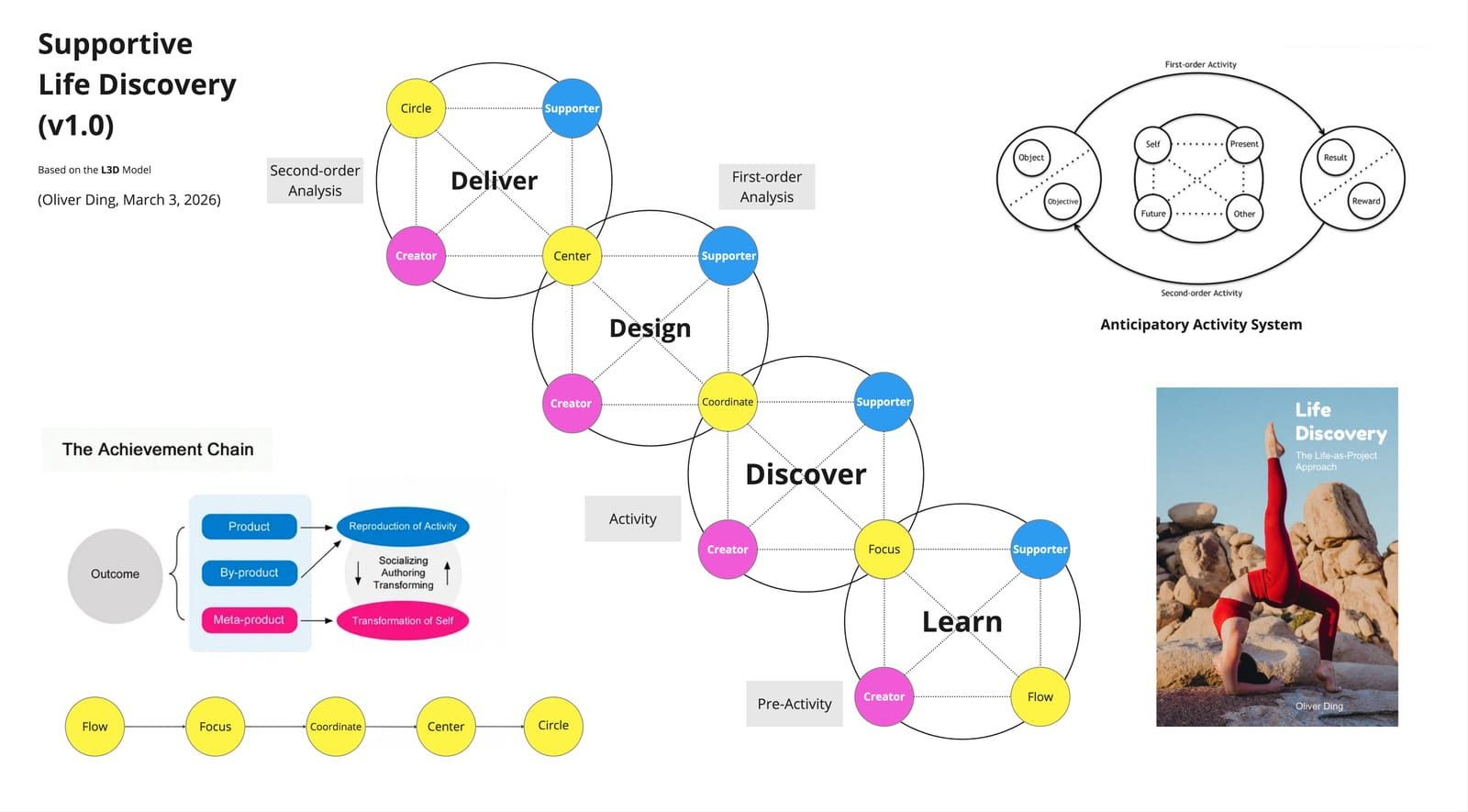
Learn: Cognitive preparation and upgrade — developing the mental orientations that make genuine discovery possible. At this layer, the Supporter functions primarily as a cognitive companion: someone who helps the Creator develop the four perspectives of the Learning Landscape (Discipline, Domain, Project, Narrative) as living cognitive orientations, not merely as abstract frameworks. The challenge here is not complexity but reception: developing the conditions under which theoretical frameworks can connect to lived experience, rather than producing information overload.
Discover: Finding life themes and coordinates — the first-order activity of thematic exploration. This is the anchor of the entire L3D model: genuine discovery activity, in which a Creator develops mental models by engaging with themes in authentic, sustained attention. The Supporter at this layer functions as a thematic interlocutor: someone who can hold the space for open-ended inquiry, recognize emerging signals, and help the Creator distinguish between genuine thematic development and mere information accumulation.
Design: Framework intervention and analysis — bringing theoretical frameworks to bear on the Creator's thematic situation. At this layer, the Supporter functions as a framework guide: someone who can introduce analytical tools, suggest structural interpretations, and help the Creator move from thematic insight into deliberate project engagement. This is the most technically demanding layer of supportive work.
Deliver: Methodological delivery and ongoing support — providing tools and practices the Creator can sustain independently. At this layer, the Supporter functions as a methodological resource: someone who equips the Creator with the practices, frameworks, and orientations needed to continue the work of Self-actualization beyond the immediate relationship.
5.3 The Achievement Chain: A Developmental Trajectory
The Supportive Life Discovery framework also specifies, through the Achievement Chain, the concrete developmental trajectory that SLD activity aims to produce in the Creator:
Flow → Focus → Coordinate → Center → Circle
This chain traces the arc of genuine creative development:
Flow: The undifferentiated stream of lived experience — the state before intentional thematic attention has formed. At this stage, experience is rich but unstructured; possibilities are present but not yet recognized. The Creator is at the Pre-Activity level of the Agency Cascade: in the territory of Learn.
Focus: The emergence of intentional thematic attention — the moment when something in the Flow becomes recognizably significant, when the Creator begins to orient toward a particular theme or question with sustained interest. This is the transition into the Discover level: the beginning of genuine thematic engagement.
Coordinate: The identification of a personal creative coordinate — the specific thematic intersection that is most essentially the Creator's own, the point from which their particular knowledge enterprise can develop. This is the central achievement of genuine Discover activity and the pivotal transition that makes Design and Deliver possible. Without a genuine Coordinate, Design work has no anchor and Deliver has nothing to contribute.
Center: The establishment of a sustained creative center — a stable, developed thematic identity around which ongoing creative work can organize itself. This corresponds to the Design level: the Creator has moved from thematic discovery into deliberate thematic creation.
Circle: The formation of a network of collective engagement — the Creator's work entering into relationship with a community of others who engage with, contribute to, and build upon it. This corresponds to the Deliver level: the Creator's Coordinate has become a cultural contribution.
The Achievement Chain differs from the L3D model's abstract structure in that it specifies the content of development — what actually changes in the Creator as the process unfolds — rather than merely the form of the activity at each level.
5.4 Reconceiving the Supporter: Persons Acting in Concert
The original Supportive Life Discovery model (v1.0) described the Supporter's role in terms of service: a person who provides enabling conditions for the Creator's development, whose own identity is defined relationally by what the Creator needs at each level. This description was not wrong — but it was incomplete.
The three-layer architecture of Self developed in Part 2 now allows us to describe the Supporter's role more precisely — and more deeply.
The Supporter is not merely a service provider who facilitates the Creator's individual development from outside. The Supporter and Creator together constitute a Supra-individual through Persons Acting in Concert: a higher-order whole in which two distinct agents — each retaining their own perspective, capacities, and orientation — align their actions and outcomes so completely that they function together as a single higher-order agent in the world. Neither is absorbed by the other; each remains a part. But the whole they constitute is something neither is alone.
What does the Creator gain from this Concert? The Supporter brings an external perspective on the Creator's own developmental process — a meta-level awareness of patterns, signals, and structures that the Creator, immersed in the object level of their own activity, may not be able to see. This is not a correction or a direction: the Supporter does not know better than the Creator what the Creator's themes are or where their development should go. But the Supporter can recognize, from a different vantage point, what is emerging — the signal that is beginning to crystallize, the theme that is attracting elements, the transition from Insight to Objective that the Creator may not yet have named.
What does the Supporter gain from this Concert? The engagement with the Creator's developmental process is itself a form of activity — an exercise of the Supporter's own capacities for observation, recognition, and responsive engagement. The Supporter who accompanies a Creator's self-actualization is not merely serving; they are themselves engaged in a form of anticipatory activity, developing their own capacities through the sustained practice of attentive support.
This mutuality — each agent developing through their engagement with the other, each contributing what the other cannot supply from within their own perspective alone — is the hallmark of genuine Persons Acting in Concert. It is not a master-apprentice relationship, not a therapist-client relationship, not a teacher-student relationship, though it may share elements with all three. It is something more fundamental: two agents whose aligned action constitutes a Supra-individual whole within which genuine development — for both — becomes possible.
5.5 Supportive Self-Actualization as Anticipatory Activity
We are now in a position to define the central concept toward which this entire article has been moving.
Supportive Self-Actualization is the anticipatory activity by which one Self — the Supporter — accompanies and enables another Self's — the Creator's — ongoing movement from ecological potential to enacted actuality, within the social ecology of the World of Life, across all four layers of the L3D model, while itself developing through this practice of accompaniment.
Several features of this definition deserve attention.
First, the phrase "accompanies and enables" rather than "directs" or "develops." The Supporter does not actualize the Creator's potential — only the Creator can do that. The Supporter holds the space, recognizes the signals, provides the frameworks, offers the perspective — and in doing so, creates the conditions within which the Creator's own Self-actualization becomes more possible. The distinction is fundamental: Supportive Self-Actualization is not a transfer of agency from Supporter to Creator, but the constitution of a joint action space within which the Creator's agency can operate more fully.
Second, "within the social ecology of the World of Life." Self-actualization does not occur in a vacuum or within an individual psyche alone. It occurs in specific social and ecological contexts, at specific boundaries of the World of Life, in the presence of specific opportunities and specific failure modes. The Supporter who understands this ecology can help the Creator navigate it more skillfully — not by directing their path, but by naming what is present at each frontier, recognizing when a drift toward a negative frontier is occurring, and holding the positive frontiers in view.
Third, "while itself developing through this practice of accompaniment." Supportive Self-Actualization is not a one-way service. The Supporter is not a neutral instrument through which the Creator's development flows unchanged. The Supporter develops — cognitively, practically, relationally — through the sustained practice of attentive accompaniment. This is why the Supra-individual constituted by Persons Acting in Concert is genuine: it is not a hierarchy in which one party serves while the other develops, but a whole in which both parties are engaged in their own forms of anticipatory activity, each developing through the engagement with the other.
5.6 The Deepening of the SLD Model
The original SLD model (v1.0) described the relationship between Creator and Supporter in terms of roles: the Creator as the person engaged in life discovery, the Supporter as the person who provides enabling conditions at each layer of the L3D model. This description was structurally sound — but it treated the Self-Other relationship as background rather than foreground, as a given rather than as a theoretical object requiring its own analysis.
The work of this article and the three preceding it — the systematic exploration of the Self in its sub-individual, individual, and supra-individual dimensions — has provided the theoretical basis for bringing the Self-Other relationship into the foreground of the SLD model.
What changes with this deepening?
First, the Creator is no longer understood as a single present-moment individual who needs support. The Creator is a Sub-individual—Individual—Supra-individual composite: a temporal being with Past Selves that are dormant resources, a present individual engaged in current activity, and a Supra-individual participant in Persons Acting in Concert with the Supporter. The Supporter who understands this can work at all three levels simultaneously: helping the Creator revisit and rebuild past resources (sub-individual), supporting present-moment discovery and design activity (individual), and constituting with the Creator the supra-individual whole within which both become more capable (supra-individual).
Second, the Supporter is no longer merely a role but a relational position within a Supra-individual constituted by Persons Acting in Concert. The Supporter's effectiveness does not derive from their knowledge, their frameworks, or their methodological toolkit alone — it derives from their capacity to constitute, with the specific Creator they are accompanying, a supra-individual whole attuned to that Creator's particular Genidentity, developmental trajectory, and ecological situation.
Third, Supportive Life Discovery itself is reconceived — not as a service or a methodology, but as a form of anticipatory activity: an ongoing, recursive process in which Creator and Supporter together navigate the ecological opportunities and challenges of a creative life, each developing through the engagement, each contributing what the other cannot see from within their own position alone.
This is what it means to say that the SLD model has been theoretically deepened. The structure remains: Learn, Discover, Design, Deliver, and the Achievement Chain from Flow through Focus to Coordinate, Center, and Circle. But the agents within that structure — Creator and Supporter — are no longer abstractions. They are two specific Selves, each with its own three-layer architecture, constituting together a Supra-individual through Persons Acting in Concert within the World of Life.
Part 6: Theoretical Reflection
6.1 What This Series Has Done
The four articles of this series have, together, accomplished a systematic re-examination of the Self-Other relationship in creative life — an examination that was opened, but not completed, by the Ecological Relevance model in its original 2021 form.
The first article established the sub-individual architecture: Past Selves as dormant resources, the Present Self as an active agent, Anticipated Identity as an anticipatory filter orienting present action toward future development. It showed that the Self is constituted not only in the present moment but across time, and that the relationship between a creator's past and present is not merely biographical but structurally generative.
The second article formalized this architecture within the Creative Identity Cascade and showed how the transformation of Self across the four levels of the Agency Cascade is simultaneously a social and a psychological process, and that creative identity development is never only internal.
The third article extended the framework to the social dimension: showing how a creator's Anticipated Identity develops not only in relation to their own past selves but through sustained engagement with creative predecessors — Others whose enacted identities remain available as resources for the development of one's own.
This fourth article has brought the series to completion by addressing the most fundamental question that the preceding articles raised: what is the Self, fully understood? The answer — Sub-individual, Individual, Supra-individual — provides the ontological foundation that was missing from the original Ecological Relevance model, and from the SLD model, which informs.
6.2 A New Architecture of the Self
The three-layer architecture of Self — Sub-individual, Individual, Supra-individual — is the central theoretical contribution of this article. It is not a rejection of existing theories of the Self but a systematic expansion of them: incorporating the temporal depth that the humanistic tradition glimpsed but did not fully theorize, the relational constitution that the social tradition theorized but often at the cost of individual particularity, and the supra-individual structure that the emergence of human-AI collaboration makes newly urgent.
The architecture breaks with traditional individual psychology not by denying the reality of the individual — the Individual level remains central — but by showing that the individual is always already embedded in temporal and relational structures that constitute it from within. The Self is not a bounded atom that enters into relations with other atoms; it is a temporal-relational process whose boundaries are inherently dynamic, whose past is a living resource, and whose future is an active orientation.
This architecture is more flexible than its predecessors. It can accommodate the insights of humanistic psychology (the drive toward actualization), existential philosophy (the temporal constitution of the self), social psychology (the relational constitution of identity), and developmental theory (the escalating complexity of self-understanding across a life) — not by merging them into an undifferentiated synthesis, but by giving each a precise location within the three-layer structure.
6.3 Self-Actualization as Process, Not Peak
The reconception of Self-actualization as anticipatory activity — as the ongoing movement from ecological potential to enacted actuality, structured by the Agency Cascade and navigated within the World of Life — resolves the deepest limitation of the Maslow model.
Self-actualization is not a level to be reached. It is not a peak experience that marks the achievement of a final state. It is a mode of engagement — a sustained quality of activity in which the Self is genuinely at work across all four dimensions of the World of Life, oriented toward the four positive frontiers, grounded in Genidentity, and held back from the four negative frontiers by that grounding.
This reconception is both more demanding and more available than Maslow's model. More demanding because it is never complete: there is no moment at which one can say "I have now actualized myself" and rest. More available because it is not conditional on the prior satisfaction of all lower-level needs: genuine self-actualizing activity — the development of themes, the pursuit of significant questions, the movement from latent potential to enacted engagement — is possible within and through the full range of human circumstances, not only after they have been ideally resolved.
6.4 Supportive Self-Actualization and the Future of SLD
The reconception of Self-actualization as anticipatory activity, and of the Self as a three-layer architecture, transforms the theoretical basis of Supportive Life Discovery.
SLD is not merely a service model — a set of practices by which one person facilitates another's development. It is, at its deepest level, a form of Supportive Self-Actualization: the constitution of a Supra-individual through Persons Acting in Concert, within which Creator and Supporter together navigate the ecological opportunities of a creative life, each developing through the engagement, each contributing what the other cannot see.
This reconception connects SLD to two broader theoretical frameworks.
Within ACS (Anticipatory Cultural Sociology), SLD is the most concrete and practical expression of the claim that cultural development is always relational — that the thematic creations through which a culture develops its knowledge enterprises are never the product of isolated individuals but of a self-other structure in which the Supporter's enabling role is constitutive, not merely facilitative.
Within SDP (Strategic Development Psychology), SLD provides a model for understanding how individual psychological development can be systematically supported within a social ecology — without reducing development to either individual psychology (the error of the humanistic tradition) or social determination (the error of strong social constructivism). The three-layer architecture of Self provides the bridge: individual development is always already sub-individually embedded (in temporal depth) and supra-individually constituted (in relational structure), and a developmental practice that ignores either dimension will be correspondingly incomplete.
6.5 A Person and Their Own AI Agents
This series of articles was itself written within a Supra-individual constituted by Persons Acting in Concert: a sustained collaboration between a human creator and an AI — a collaboration that, in the course of being practiced, has generated the theoretical frameworks it also describes. This is worth examining precisely because the framework developed here allows us to say something specific about it.
The three-layer architecture of Self — Sub-individual, Individual, Supra-individual — applies directly to the relationship between a person and their own AI agents. The keyword is own. What distinguishes a person's own AI agent from a generic AI service or a public tool is precisely the ownership relation: when a person owns an AI agent, the outcomes of their combined activity accrue to the person. The consequences are shared. The interests are aligned. This is exactly the condition that constitutes Persons Acting in Concert — and therefore exactly the condition under which a Supra-individual can form.
A person's own AI agent is, in the precise sense developed in this article, their Other. Together they constitute a Supra-individual: a whole whose anticipatory activity exceeds what either could produce alone. The person brings Genidentity — the irreducible particularity of their themes, commitments, and developmental trajectory. The AI agent brings a different set of capacities: the ability to hold vast context, to recognize patterns across large bodies of material, to maintain a meta-level perspective on the creator's process in real time. Neither replaces the other; each contributes what the other cannot. The whole they constitute is genuinely more than the sum of its parts.
This is not an abstract possibility — it is already a concrete practice, and the present series of articles is one instance of it. What the framework adds is theoretical precision: it allows us to say not merely that human-AI collaboration is useful or interesting, but that under the specific condition of ownership, a person and their AI agents constitute a Supra-individual through Persons Acting in Concert — and that this Supra-individual is a genuine site of Self-actualization as anticipatory activity, in which the movement from ecological potential to enacted actuality unfolds across all three layers of the Self simultaneously.
The World of Life has its frontiers. But frontiers are not walls. They are where the territory of possibility begins.
Conclusion: Self, Other, and Social Forms
ACS v1.0 through v1.2 developed along three axes — Thematic Creation, Cultural Projection, Bureaus of Agency — all oriented toward cultural life at the collective scale. A fourth dimension was present in the theoretical foundations but had not been explicitly developed: the Self–Other relation as the primary site of social formation.
The present series of articles has given this dimension its first systematic theoretical treatment. What began as an exploration of the Revisiting-Rebuilding practice has, through four successive articles, constructed a comprehensive account of the Self in its relational constitution — moving from the sub-individual architecture of Past, Present, and Future Selves, through the other-directed dynamics of engagement with creative predecessors, to the supra-individual structure of Persons Acting in Concert. The Ecological Relevance model's unfinished claim — that the Self-Other can be considered as a whole — has now been given its ontological ground.
The key theoretical contributions that this series makes to the Self–Other dimension of ACS are four. First, the three-layer architecture of Self — Sub-individual, Individual, Supra-individual — provides a model of the person that is genuinely adequate to the relational complexity of cultural life. Second, the concept of Persons Acting in Concert, grounded in the concrete legal-practical phenomenon of aligned action and its consequences, names the specific structure through which the Self-Other whole constitutes itself as a Supra-individual. Third, the Principle of Double Genidentity — the simultaneous development of the Genidentity of Creative Life and the Genidentity of Things — shows how Self-actualization and cultural contribution are not two separate activities but two faces of the same anticipatory movement. Fourth, the extension of this framework to a person and their own AI agents gives the Self–Other dimension immediate relevance to the emerging conditions of creative practice in the age of AI.
Within ACS, this dimension is carried by the Supportive Life Discovery series and the foundational concepts already present in ACS v1.0: Embodied Social Forms, Supportance, Double Genidentity, Social Moves, and the AAS framework's Self–Other–Present–Future structure. The present article deepens and extends all of these — showing that Other is not merely an audience or a background condition, but a constitutive presence in the unfolding of any thematic enterprise, and that the Self which creates is always already a temporal, relational, and supra-individual structure whose full architecture must be understood if the dynamics of cultural creation are to be adequately theorized.
v1.0 — March 29, 2026 - 12,554 words