
The Concept of "World of Life"
Four Boundaries of the World of Life
by Oliver Ding
The concept of "World of Life" was introduced as the context of "World of Activity" in September 2025. Later, I used it to name a new curated knowledge system in December 2025. Finally, four boundaries of the "World of Life" were introduced as well.
In September 2025, I created a large diagram to present the landscape of the World of Activity Approach.
Based on the “Variant — Quasi-invariant — Invariant — Invariant Set” schema, I organize knowledge frameworks that are considered members of the World of Activity into a hierarchical system.
- Invariant / Basic Forms: 1 (World of Activity)
- Invariant Set / Frames: 1 (World of Life)
- Quasi-invariant / Derived Forms: 7
- Variant / Frameworks: 10 examples
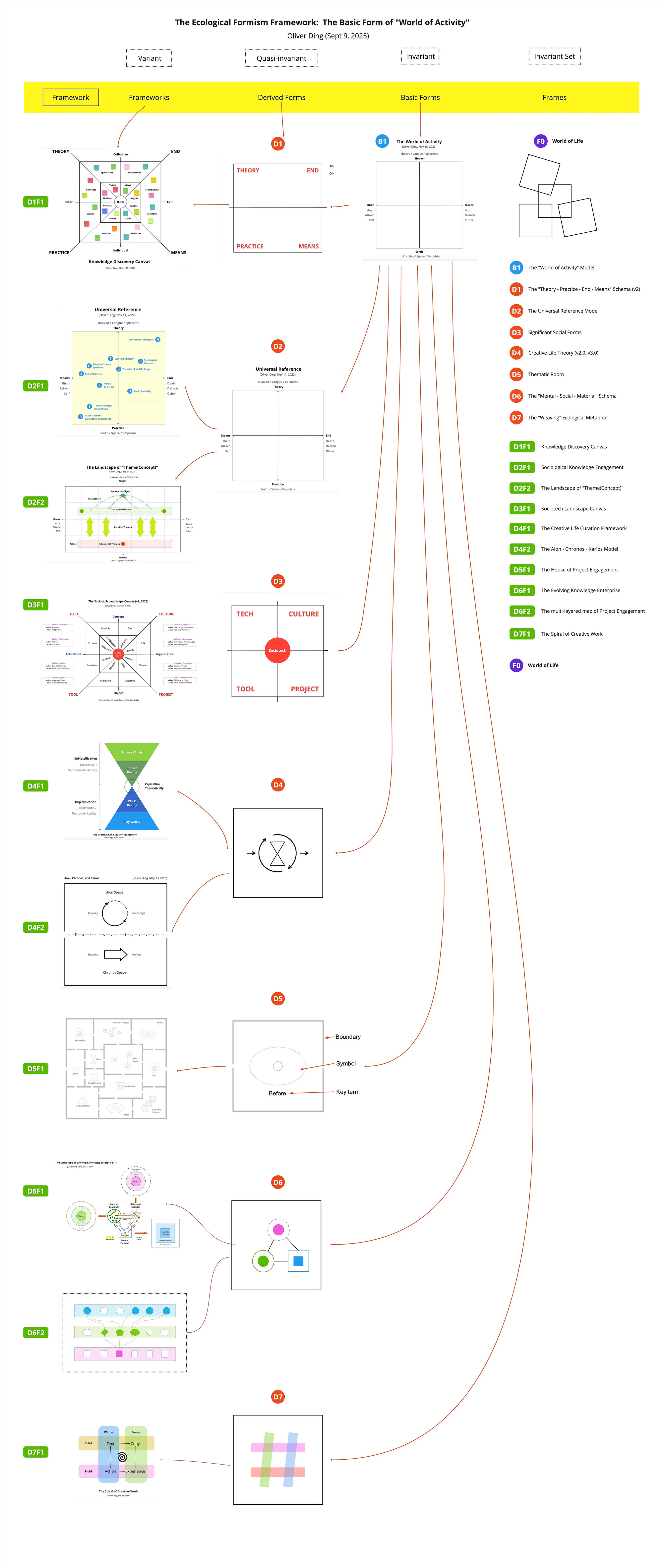
As a hierarchical system, it is an open structure. While Invariant / Basic Forms and Invariant Set / Frames represent a single, stable element, Quasi-invariant / Derived Forms and Variant / Frameworks are dynamic and changeable.
The concept of the World of Activity was inspired by the social phenomenologist Alfred Schutz’s idea of the World of Working.
According to Schutz, Working refers to action in the outer world.
Working, thus, is action in the outer world, based upon a project and characterized by the intention to bring about the projected state of affairs by bodily movements. Among all the described forms of spontaneity that of working is the most important one for the constitution of the reality of the world of daily life… The wide-awake self integrates in its working and by its working its present, past, and future into a specific dimension of time; it realizes itself as a totality in its working acts; it communicates with others through working acts; it organizes the different spatial perspectives of the world of daily life through working acts.
Source: Alfred Schutz on Phenomenology and Social Relations (1970, p.126)
Schutz’s concept captures something essential about human engagement with reality: that our most significant acts are those that project intention into the outer world through bodily action. This “Working” constitutes not just individual activity, but the very fabric of social reality — integrating time, enabling communication, and organizing our spatial experience. However, Schutz’s framework primarily focused on the practical world of daily life, treating other realms like fantasy and dreams as separate sub-worlds within the broader Life-world.
The World of Working is one sub-world within the World of Daily Life, or Life-world. There are other sub-worlds in the Life-world. For example, the worlds of fantasy and dream.
In 2022, when developing my approach to researching creative life, I recognized that Schutz’s distinction between different sub-worlds needed to be reconsidered. For creative individuals, the worlds of fantasy and dreams are not merely separate realms — they are significant sources of creative inspiration that actively inform and shape their outer-world projects. A novelist’s dream becomes the seed of a story; an artist’s fantasy transforms into a painting; a theorist’s imaginative leap leads to new frameworks.
This insight led me to coin the term “World of Activity” to capture a more integrated understanding of creative engagement. While Schutz’s “Working” emphasizes the projection of intention into the outer world through bodily movements, my “Activity” encompasses the fuller spectrum of creative engagement — including how inner experiences of imagination and reflection actively contribute to outer-world projects.
The “World of Activity” thus represents both a continuation and an expansion of Schutz’s insights. It maintains his emphasis on intentional, project-based engagement with reality, but recognizes that for creative individuals, the boundaries between inner and outer worlds are more porous and dynamic than his framework suggests.
In Creative Life Theory, the “World of Activity” refers to the world of a person’s all working activities within their life course.
From the perspective of the Ecological Practice Approach, the “World of Activity” can be understood in two complementary ways: as a large life container, where we can discover the structure and patterns of development of life activities; and as a thematic space, where we can curate a set of relevant knowledge elements together.
In this way, we can define the boundary of the container and curate the items inside.
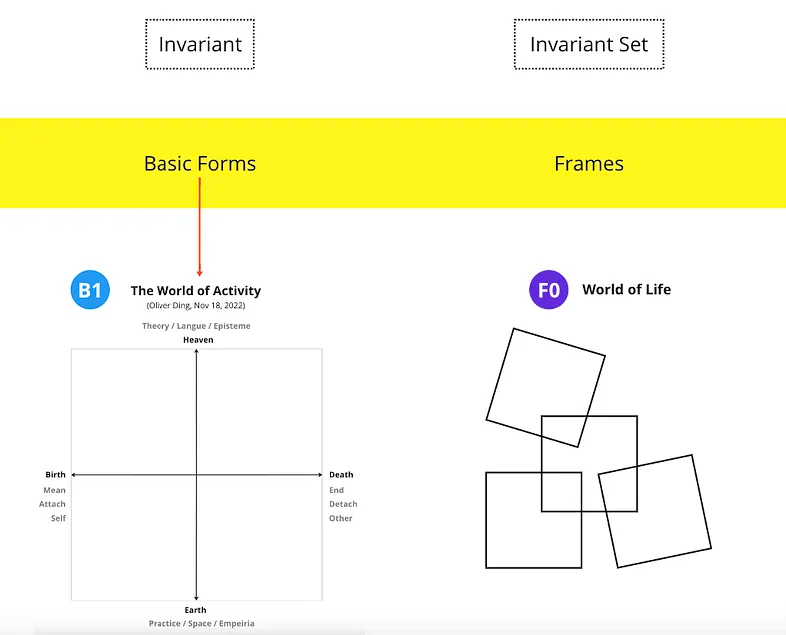
In September 2025, inspired by the Variant — Quasi-invariant — Invariant — Invariant Set schema, I considered the World of Activity as Invariant, with its corresponding Invariant Set named the World of Life. At that time, the World of Life referred primarily to the Circle of connected Centers, in other words, a network of interconnected Worlds of Activity.
The concept of “World of Activity” takes the individual subject perspective. It describes what a person sees from their viewpoint.
The concept “World of Life” refers to the network of connected people’s Worlds of Activity. The “World of Life” is similar to the “Circle” in the “Flow — Focus — Center — Circle” schema. Both can refer to the broader context of a person’s life. It can be used to describe the social world.
The World of Life Toolkit
From September 2025 to the present, a new set of knoweldge framework emerged, offering a refined way to understand the social world. Reflection on the HLS framework revealed that this set could be called the World of Life Toolkit:
- HLS framework (v3.0) → Provides a five-system structure of the social world, including individual and social life.
- Weave-the-Culture Framework (2025) → Highlights four mechanisms of cultural development.
- Cultural Projection Model (2025) → Connects Mental Platforms and Cultural Frameworks via the Projecting mechanism and Developmental Projects.
- Function — Context — Knowledge — Activity Schema (2025) → Explors Mental Platforms and Mind within the Context (Mind) layer.
- Meta-Frameworks — in — Context Framework (2025) → Identifies six faces of concept system in the social world.
- Embodied Social Forms Framework (2025) → Connects body-scale experience with deep social cognition.
Together, these knowledge frameworks provide a way to zoom in on the details of the Social World while connecting micro-AAS and macro-AAS.
Within this system, the World of Activity toolkit primarily addresses the Life(Self) layer, whereas the World of Life encompasses broader layers, including History (Culture) and Context (Mind), highlighting the hierarchical and interconnected nature of the knowledge ecosystem.
The Body System, initially presented as the Ecological Basic Forms in my book draft Homecoming: A Thematic Trip and the World of Activity Approach, has now evolved into the Embodied Social Forms Framework, which will be introduced in a forthcoming book draft on Meta-Frameworks.
The developmental loop is now complete: beginning with the Body’s flow and the Self’s focus, moving through the Centers of our developmental projects and enterprises, we ultimately locate our activities within the Historical Circle. In this way, the World of Activity has been curated into the World of Life.
During the 2024 Christmas holiday, I had a reflective conversation with a mentor, revisiting my work on HELLO THEORY, GO Theory, and the Strategic Life Narrative project. Through this reflection, I realized my newest focus had shifted toward Cultural Life Development, marking a detachment from Individual Life Development. This strategic move was encapsulated in the theme of “Cultural Grounding/Cultural Growing.”
Over the past 12 months, while I worked on closing my multi-year journey of Knowledge Engagement and Individual Life Development — culminating in Creative Life Theory v3.1 — I simultaneously unfolded a new journey of Cultural Development.
The birth of the World of Life (World of Activity) approach marks a nexus-point where the act of Closing a rich history meets the act of Unfolding a new future.
Four Boundaries of the World of Life
The diagram below represents the History{Life[Self(Body)]} framework (version 3.0), also known as the HLS framework.
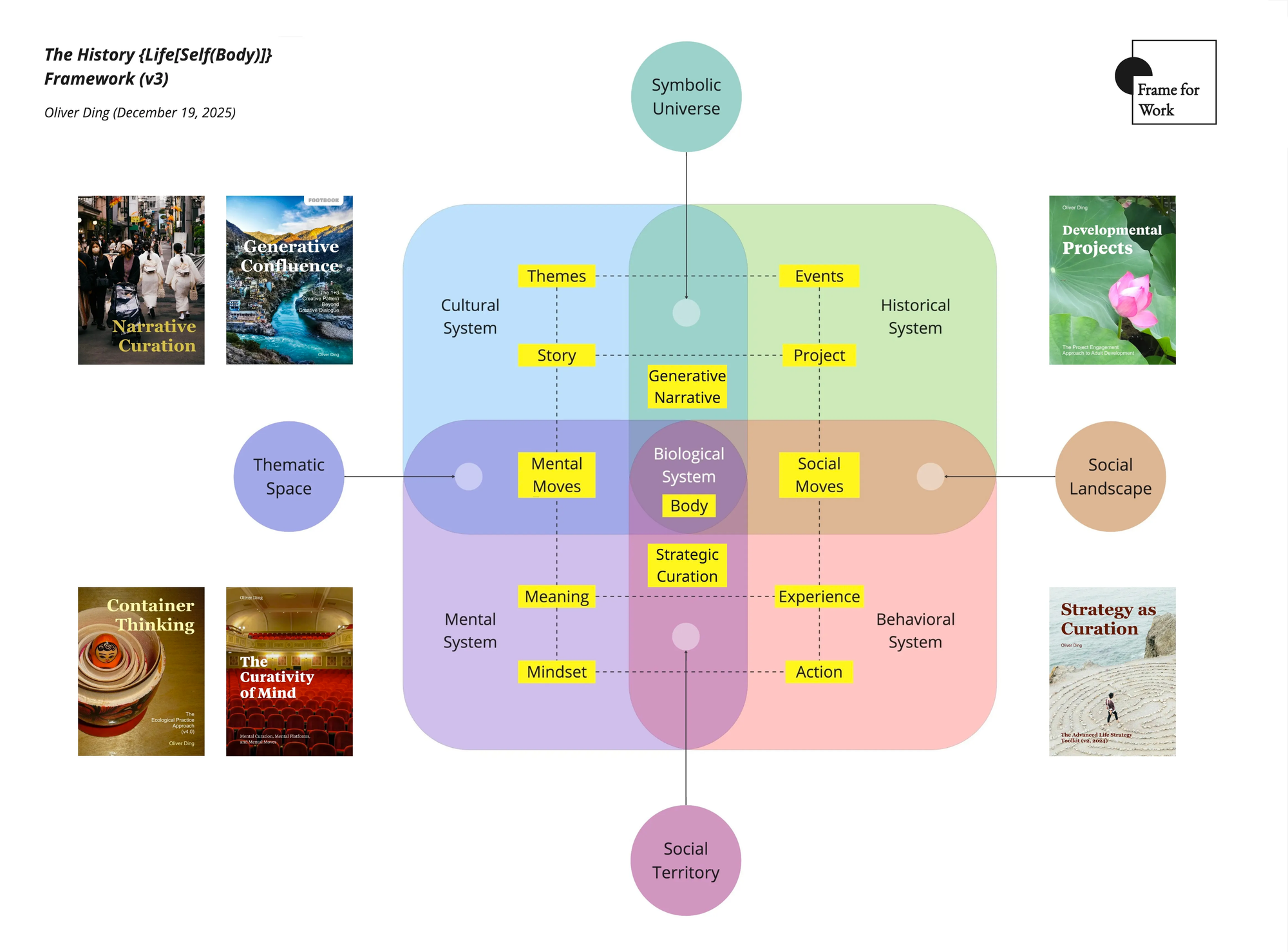
The HLS Framework evolved from the Life(Self) theme I created in 2023. The journey involved several projects between 2023 and the present, revealing an ongoing effort to search for an ontological foundation of life, both individual and collective. The story can be further explored in The History{Life[Self(Body)] } Framework — Part 1: The Historical Development.
On December 19, 2025, I added two theoretical concepts — Generative Narrative and Strategic Curation — to the HLS framework and released version 3.0.
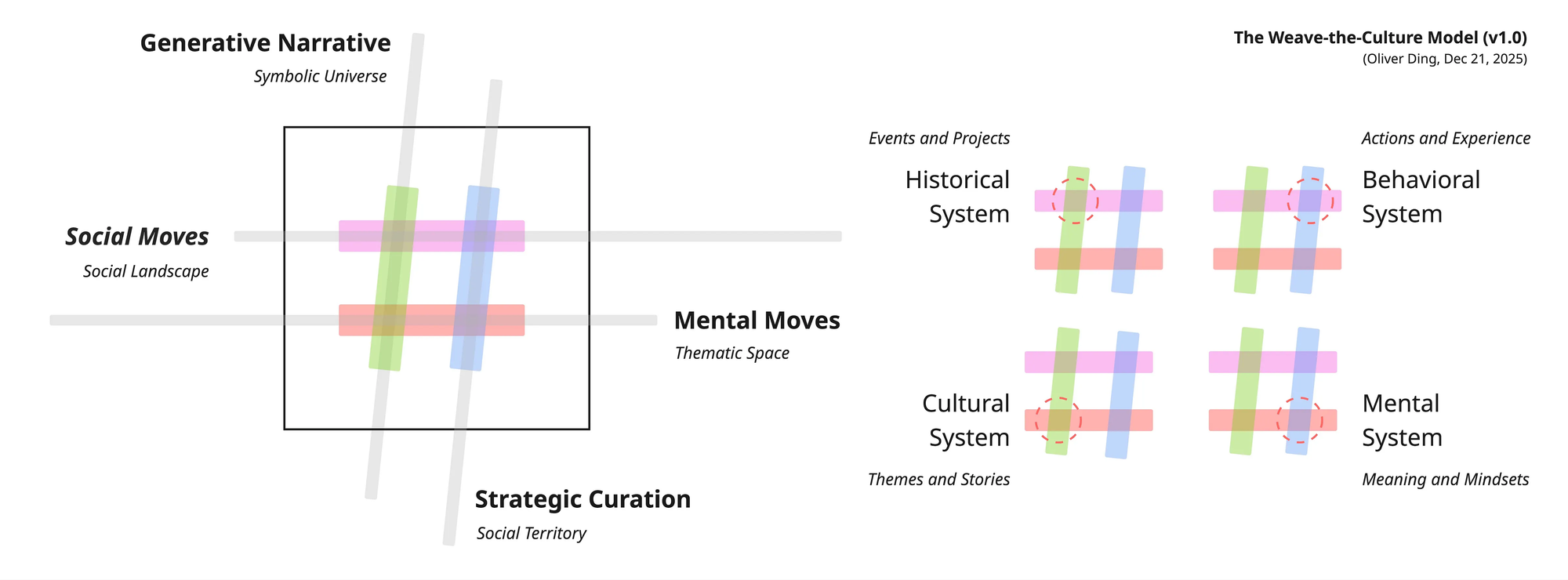
After connecting the new framework (v3.0) with the Meta-frameworks project, I realized that the following four concepts represent the Four Mechanisms of Cultural Development.
- Mental Moves
- Social Moves
- Strategic Curation
- Generative Narrative
On December 21, 2025, I created the Weave-the-Culture Model to highlight these four mechanisms. See the diagram below.
HLS Framework provides the structural foundation of the social world — History{Life[Self(Body)]} — defining five major systems (Body, Mental, Behavioral, Cultural, Historical) and their nested relationships.
Six Faces of Concept Systems identifies where concept systems are distributed within this structure: Mental Platforms, Strategic Frameworks, Cultural Frameworks, and Institutional Frameworks at the center, with Knowledge Frameworks and Spiritual Frameworks as two outliers marking the boundaries.
Weave-the-Culture Model reveals how these concept systems operate through four mechanisms — showing not just where they are, but how they weave together to drive cultural development.
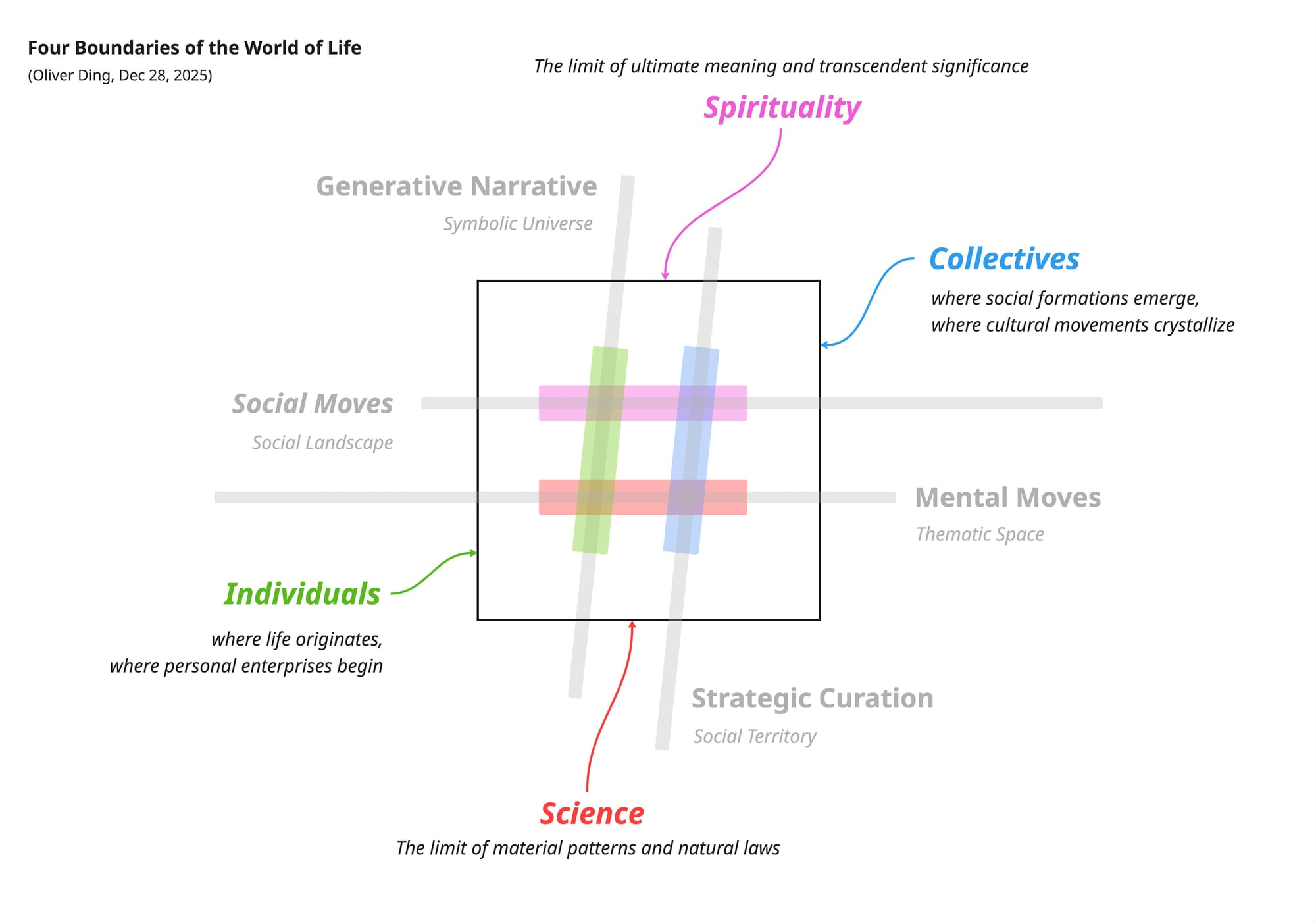
The Weave-the-Culture Model begins with a simple square representing the World of Life — the social world in which all human lives unfold. This square is bounded by four edges:
- Upper boundary: Spirituality (the limit of ultimate meaning and transcendent significance)
- Lower boundary: Science (the limit of material patterns and natural laws)
These two outliers, identified in the Six Faces model, mark the upper and lower boundaries of the operational zone where cultural development happens.
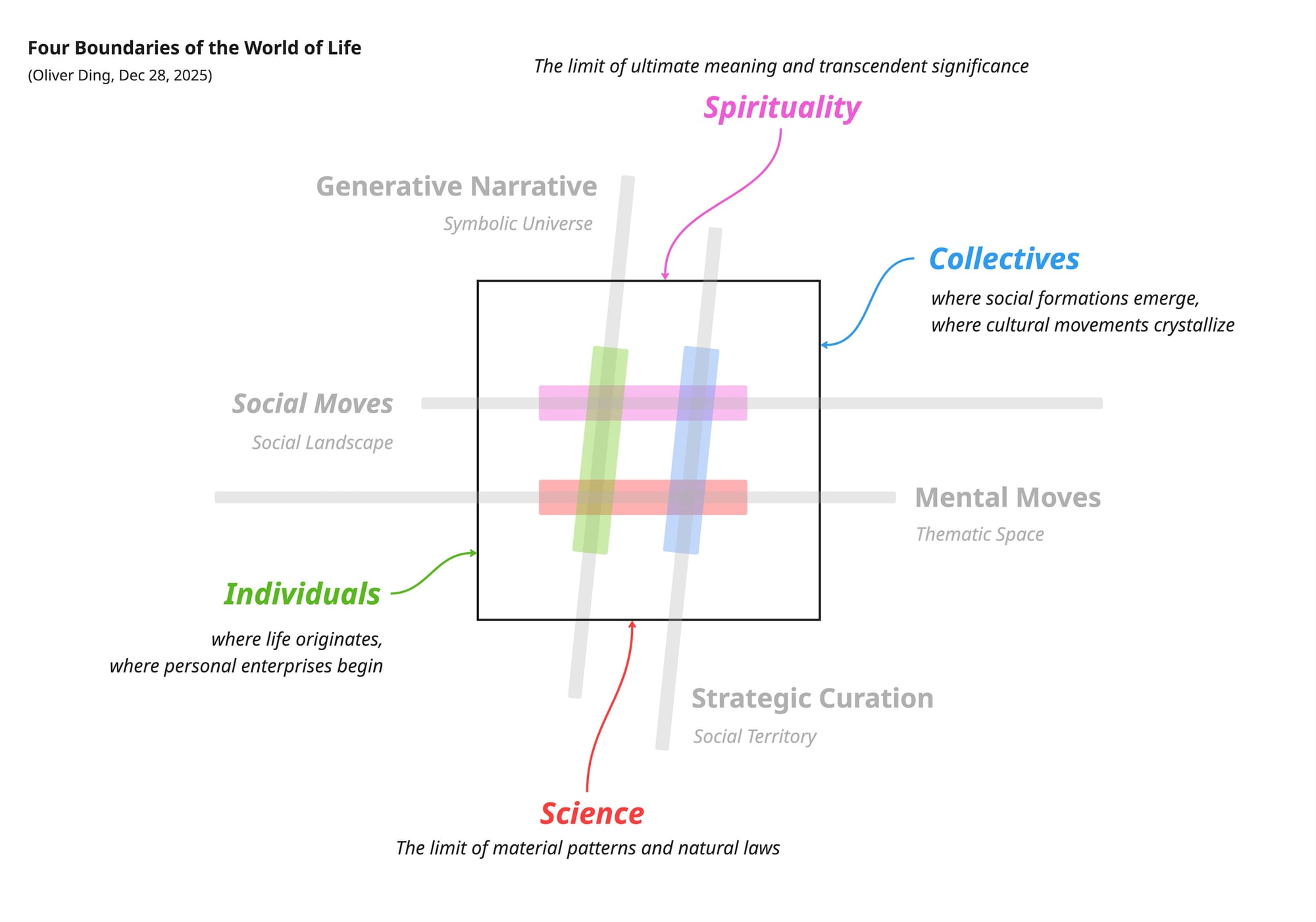
- Left side: Individuals (where life originates, where personal enterprises begin)
- Right side: Collective (where social formations emerge, where cultural movements crystallize)
This structure echoes the square of World of Activity (see the diagram below).
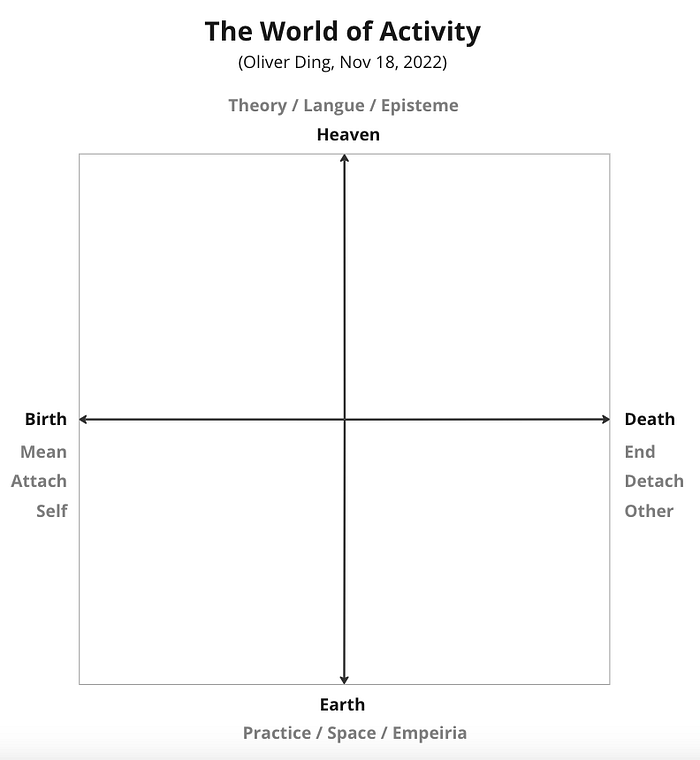
More details can be found in The Concept of "World of Activity."
Three Pathways
Based on the landscape of the World of Life, I employ three pathways to weave a series of concepts together, mapping the journey of Cultural Development:
- The Individual Pathway: Mental Platform + Strategic Frameworks → Strategic Curation → Objective — Object Fit → Achievement Chain → Thematic Enterprise → Tiny Culture
- The Collective Pathway: Cultural Frameworks + Institutional Frameworks → Generative Narrative → Sociocultural — Technological Fit → Event Chain → Social Movement → Mega Culture
- The Connecting Bridge: Project Engagement: Outside, Projecting, and Inside → Mental Platforms + Cultural Frameworks → Events + Projects → Mental Moves + Social Moves → Enterprise + Activity →Life Themes + Cultural Themes → Life + History
The model echoes the Weave-the-Life framework and related models.
The Weave-the-Life Framework bridges Activity as Project Engagement and Life-History Topology, illustrating how the former unfolds into the latter.
Activity as Project Engagement serves as the fundamental ontology of the Life-as-Activity Approach, while the other two components expand this perspective into an extended ontology, viewing life as a project chain and history as a chain of events.
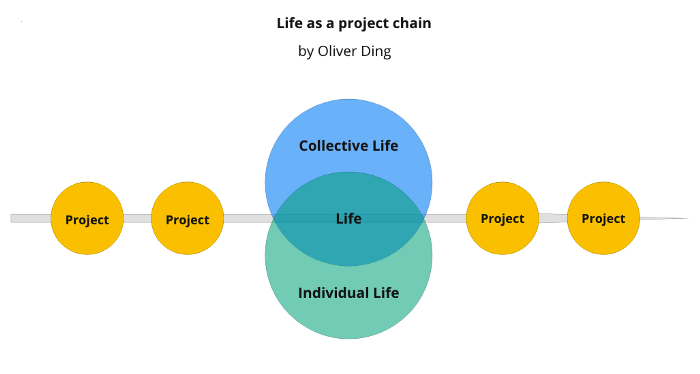
To establish this extended ontology, I employed “synchronic mapping” to describe the immediate Event–Project correspondence, and “diachronic unfolding” to capture the development of a chain of Projects and a chain of Events.
While Life emerges from the diachronic unfolding of the chain of projects, History emerges from the diachronic unfolding of the chain of events.
The Life-History Topology provides a model for understanding these processes at the macro level.
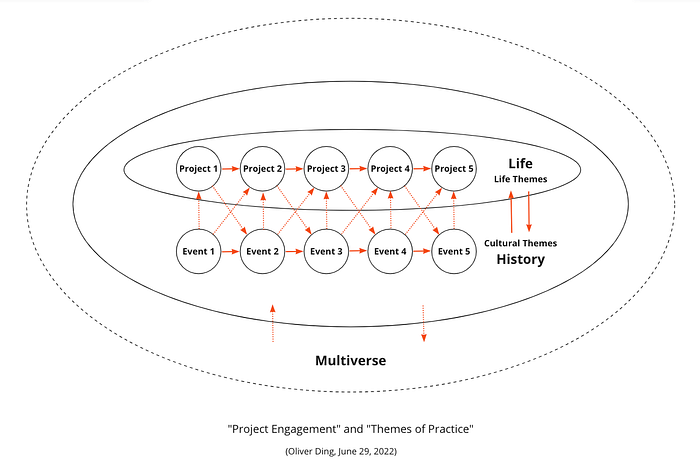
This model was inspired by the Project Engagement approach and the Themes of Practice approach. The pair of concepts “Event — Project” belongs to the Project Engagement approach, while the pair “Life Themes — Cultural Themes” comes from the Themes of Practice framework.
Andy Blunden notes that a project-oriented approach belongs to both psychology and sociology:
A project is a focus for an individual’s motivation, the indispensable vehicle for the exercise of their will and thus the key determinant of their psychology and the process which produces and reproduces the social fabric. Projects, therefore, give direct expression to the identity of the sciences of the mind and the social sciences. Projects belong to both; a project is a concept of both psychology and sociology. (2014, p.15)
In this light, the concept of Life can be understood as both Collective Life and Individual Life. The concept of Project provides a way to make sense of both. A person’s real life is a set of concrete actions, and the notion of Project offers a way to curate and integrate these actions. Likewise, Collective Life can also be curated through projects.
Life can be seen as the diachronic unfolding of a chain of projects, just as history can be seen as the diachronic unfolding of a chain of events.
While Life is a chain of projects, it can also be understood as a journey of moving between various thematic spaces. Each project has primary themes as well as secondary themes. By joining and leaving projects, we enact our significant Life Themes. In this sense, projects themselves can also be understood as Thematic Spaces.
As I mentioned on October 14, 2025, in Life-as-Activity: The Weave-the-Life Framework (v2.0):
The Life-History Topology was introduced in 2022; however, the details of unfolding the chain had not yet been fully explored.
The Weave-the-Life Framework now employs two synchronic dimensions and two diachronic dimensions to map “Activity as Project Engagement” onto the Life-History Topology, clarifying the previously missing details.
Although the framework currently presents only three diagrams, its underlying method, together with the Weave Basic Form, provides an open yet systematic approach for exploring Life as Activity.
Now, the HLS framework and the World of Life (World of Activity) landscape offer a new home for the Life-History Topology and the Weave-the-Life Framework.
v1.0 - February 12, 2026 - 2,270 words