
The Cultural Projection Model (2025)

Project Engagement: Outside, Projecting, and Inside
by Oliver Ding
This article reviews the development of the Project Engagement approach from 2021 to the present, focusing on its first principle: “Activity as Project Engagement.” The approach expands Activity Theory’s internalization-externalization principle by introducing the “Outside — Projecting — Inside” triad as a basic ecological form to describe how people engage with social environments, particularly with projects.
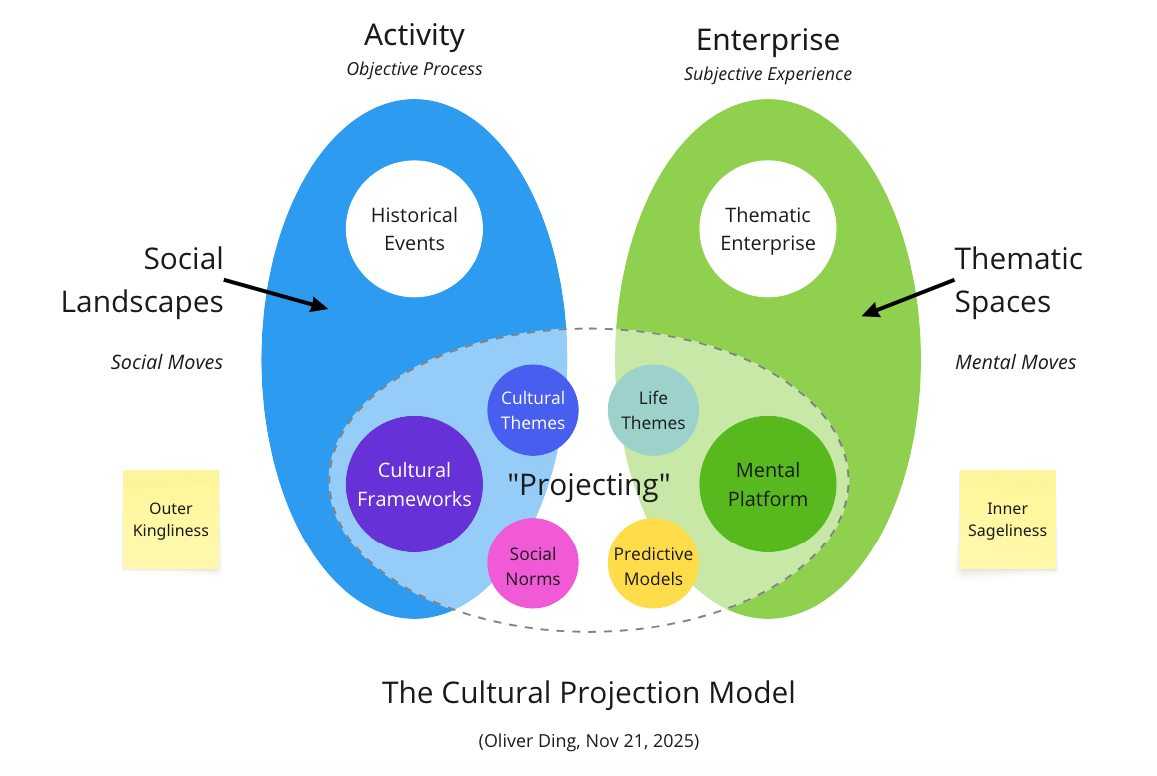
The Cultural Projection Model is also introduced to curate newly developed ideas together. See the diagram below.

Contents
Introduction
Part 1: First Principle
1.1 The “Challenge — Solution” Framework in Activity Theory
1.2 Activity as Project Engagement
Part 2: Early Development
2.1 Life Discovery: The “Engagement as Projection” Principle
2.2 Life, Events, and Projects
2.3 Event, Project, and Enterprise
2.4 Life-History: Life Themes vs. Cultural Themes
2.5 Thematic Spaces and Mental Moves
Part 3: Later Development
3.1 Social Landscape vs. Thematic Space
3.2 Mental Platform vs. Cultural Framework
3.3 Cultural Frameworks and Social Norms
3.4 Activity vs. Enterprise
Part 4: Creative Dialogues
4.1 The ECHO Way
4.2 The Project Engagement Approach vs. The Ecological Practice Approach
4.3 Activity Theory (Internalization-Externalization) vs. Confucian Thought (Inner Sageliness-Outer Kingliness)
The concept of Project Engagement was first introduced in my 2021 book titled Project-oriented Activity Theory (draft).
The book is inspired by Andy Blunden’s approach to the interdisciplinary Theory of Activity. To establish the notion of “Project as a Unit of Activity” as a theoretical foundation of the new interdisciplinary theory of Activity, Blunden adopts Hegel’s logic and Vygotsky’s theories on “Unit of Analysis” and “Concept” as key theoretical resources.
In my book, I introduced a model below to integrate Andy Blunden’s approach and Yrjö Engeström’s Activity System Model. To further explore the internal structure of “Project” and the “Person — Project” relationship, I introduced the Developmental Projects, the concept of Projectivity, and the Cultural Projection Analysis method.
Although the book is titled Project-oriented Activity Theory, the second half of the book is titled Project Engagement, curating my creations as a theoretical framework.
Later, in April 2022, I discovered the “Engagement as Projection” principle while working on the Life-as-Project project. In the same month, I reviewed the historical development of Activity Theory and claimed that “Activity as Project Engagement” was my approach to address the “Outside — inside” dualism of social spaces.
The “Internalization — externalization” principle is a key principle of Activity Theory. Internalization refers to the way culturally mediated, social, and material actions become transformed into internal psychological functions. Through participation in shared activities, individuals take up tools, signs, and practices from their environment and reorganize them as part of their own cognitive processes.
Externalization describes the opposite movement: the expression or projection of internal psychological structures into new artifacts, representations, or forms of practice. By creating tools, models, or novel patterns of activity, individuals reshape their environment and expand the possibilities for collective action. Together, internalization and externalization form a continuous cycle through which human cognition and social activity co-evolve.
While building on this principle, the “Activity as Project Engagement” principle introduces the “Outside — Projecting — Inside” triad as a basic ecological form that expands the internalization–externalization principle to describe how people engage with social environments. A project is defined as a primary type of social environment. When remaining outside a project, a person observes its ongoing activities. At some point, the person perceives an opportunity to participate and takes action to move toward the inside of the project. This projecting movement includes three types: primary projecting, the initiation of a new project, which corresponds to externalization; secondary projecting, joining an existing project, which corresponds to internalization; and tertiary projecting, leaving an existing project to initiate a new one inspired by it, which corresponds again to externalization.
The “Outside — Projecting — Inside” triad describes a cyclical pattern of movement between a person and a project as a social environment. These social moves echo the mental moves represented by the internalization–externalization cycle, linking changes in social actions with changes in psychological processes.
From 2021 to the present, the “Outside — Projecting — Inside” triad, as a basic ecological form, also supports the development of a series of new ideas emerged in the developmental journey of the Project Engagement Approach. The diagram below curates the newest developed ideas together, forming the Cultural Projection Model.
In this article, I will review the “Outside — Projecting — Inside” triad and related early key concepts and the later development of the Project Engagement Approach.
Ideas inside the Cultural Projection Model are further explored in these sections.
Part 1: First Principle
This part reviews the historical development of Activity Theory through a “Challenge — Solution” framework. Activity Theorists often address an initial challenge presented as a dual structure, then introduce a new concept to expand it into a triadic structure — from Vygotsky’s “Stimulus-Response” to Blunden’s “Practice-Sign.”
Building on this tradition, this part introduces the foundational principle of the Project Engagement approach: “Activity as Project Engagement.” It identifies the “Outside — Inside” dualism of social spaces as the key challenge and proposes the “Engagement as Projection” principle as the solution, echoing and expanding Activity Theory’s internalization-externalization cycle while emphasizing the mutual shaping of individuals and the projects they engage with.
1.1 The “Challenge — Solution” Framework in Activity Theory
In April 2022, I used a “Challenge — Solution” framework as a deep structure to reflect on the historical development of Activity Theory. Activity Theorists often describe an initial challenge using a dual structure, then introduce a new concept to expand it into a triadic structure.
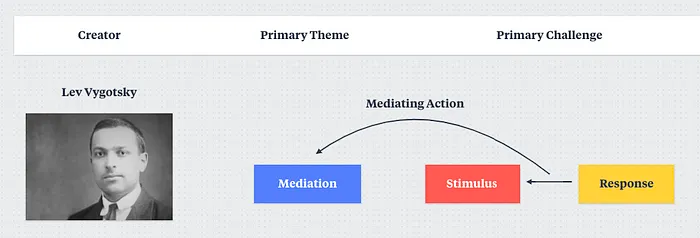
For example, Lev Vygotsky addressed the “Stimulus-Response” dualism inherent in behaviorism. His solution was to introduce the third element, Mediation, transforming the dualism into the triadic structure S-X-R. For Vygotsky, the mediating action integrates Stimulus, Mediation, and Response, establishing a new approach to psychological science: Cultural-historical psychology.
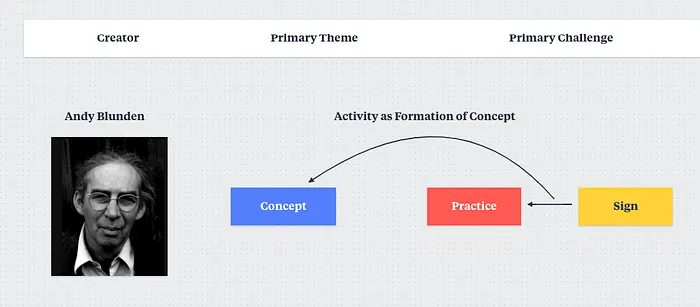
Using this analogy, I see Andy Blunden’s challenge as the dual structure of “Practice — Sign,” with the solution being Concept, which embodies the idea of “Activity as the Formation of Concept.”
1.2 Activity as Project Engagement
The concept of Project Engagement was first introduced in my 2021 book titled Project-oriented Activity Theory (draft).
The book is inspired by Andy Blunden’s approach to the interdisciplinary Theory of Activity. To establish the notion of “Project as a Unit of Activity” as a theoretical foundation of the new interdisciplinary theory of Activity, Blunden adopts Hegel’s logic and Vygotsky’s theories on “Unit of Analysis” and “Concept” as key theoretical resources. The process is documented in four books: An Interdisciplinary Theory of Activity (2010), Concepts: A Critical Approach (2012), Collaborative Projects: An Interdisciplinary Study (2014), and Hegel for Social Movements (2019).
In my book, I introduced the model below to integrate Andy Blunden’s approach and Yrjö Engeström’s Activity System Model.
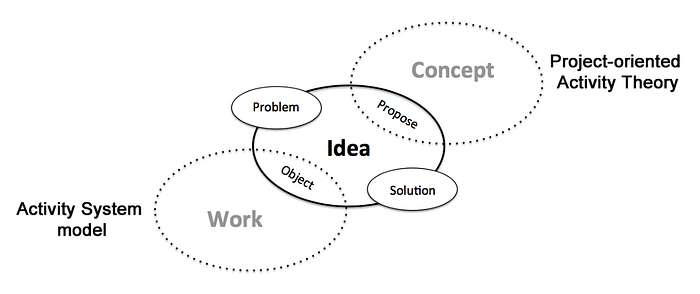
More details can be found in the Project Engagement Toolkit (v1, 2022).
While the concept of “Project Engagement” aligns with Andy Blunden’ notion of “Project as a Unit of Activity,” I also developed the idea of “Engagement as Projection” in 2022. This notion refers to refer to “Projectivity — Projecting — Projection.”
Reflecting on the “Challenge — Solution” Framework, I applied it to my work on Project Engagement. I recognized that my approach to Activity Theory should be described as Activity as Project Engagement.
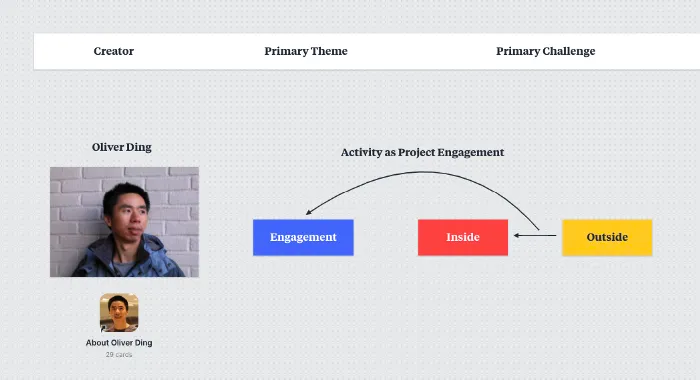
The challenge I address is the “Outside — inside” dualism of social spaces.
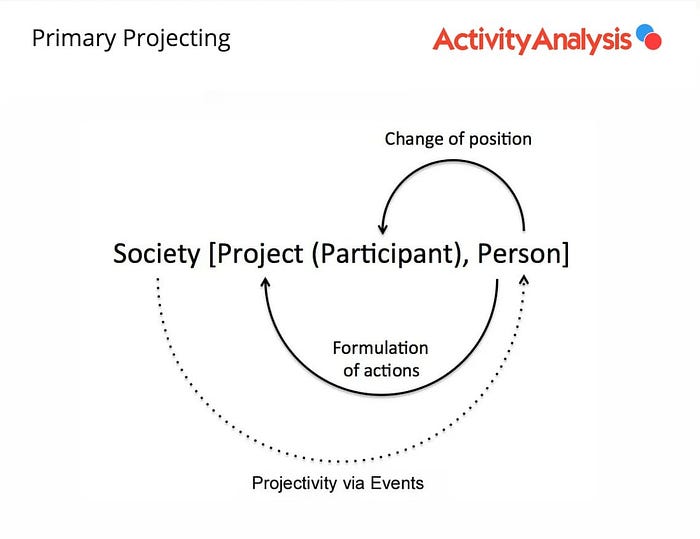
The principle of Engagement as Projection echoes the Internalization — Externalization principle of Activity Theory. Additionally, this principle provides a framework to resolve the “Outside — Inside” dualism of social spaces, emphasizing the mutual shaping of individuals and the projects they engage with.
More details can be found in The Genidentity of Activity Theory.
Part 2: Early Development
This part documents the early development of the Project Engagement approach from January to July 2022. Key developments include the Life-as-Project approach with its seven principles, the introduction of the “Events — Projects” distinction, and the conceptualization of life as moving between thematic spaces.
These early explorations established the theoretical foundation for understanding the relationship between individual biography and social contexts.
2.1 Life Discovery: The “Engagement as Projection” Principle
From January to June 2022, I worked on the Life Discovery Project, which applied Project-oriented Activity Theory, Anticipatory Systems Theory, Curativity Theory, and other theoretical resources.

The project eventually developed the Life-as-Project Approach with the following seven principles:
- Being by Doing
- Engagement as Projection
- End as Means
- Discovery as Development
- Performance as Experiment
- Curativity as Creativity
- Moving between Thematic Spaces
The slogan “Engagement as Projection” is inspired by the “Cultural Projection Analysis” method which is part of Project-oriented Activity Theory. You can find more details here: Activity U (X): Projecting, Projectivity, and Cultural Projection.
The “Cultural Projection Analysis” method can be used for research and self-reflection. For example, Last year, I started an empirical research project about an adult development program which was initiated by a friend of mine. I’d like to call the program SSL which stands for Shaper & Supporter Lab. Anyway, it is just a codename. I used the “Cultural Projection Analysis” method to research the program and reflect on my actions.
The program was designed with three components: 1) Life Purpose Awareness, 2) Personal OKR Practice, 3) Peer Review and Feedback. My friend also adopted the Building In Public approach to sharing her goals, challenges, progress, and discussions with others on social media platforms.
I use the Project Engagement approach to guide my research about the program. The approach uses a method called “Multiple-level Project Engagement”. I reflect on the following levels:
- The “My friend — Members” Engagement
- The “Member — Member” Engagement
- The “I — My friend” Engagement
In Jan 2022, the SSL (Shaper & Supporter Lab) program launched its new version of developmental service. I realized that I can apply Project-oriented Activity Theory and the Project Engagement toolkit to study its development.
Last month I joined the SSL program’s digital setting which is based on an enterprise collaboration platform and started researching the whole program. The founder of the program shares videos of their learning workshops with me on a private channel.
I moved from the outer space of the project into the inner space of the project. If we apply the Cultural Projection Analysis method to discuss this moment, then it is about Secondary Projecting.
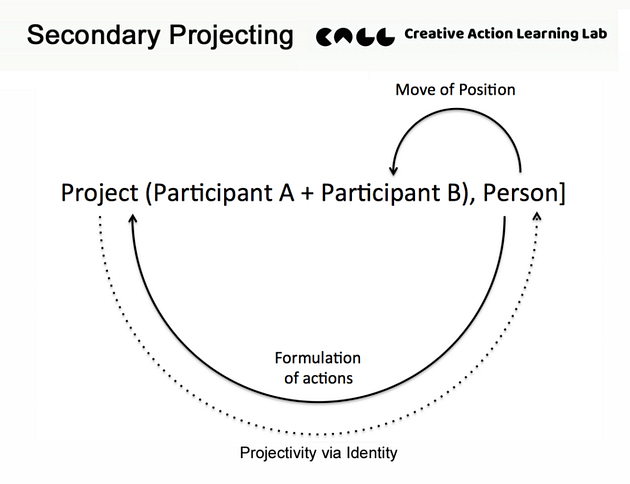
According to Project-oriented Activity Theory, at the phase of Objectification, an established project starts attracting people as its participants. Once a project is initiated, it offers Secondary Projectivity for other people to recognize the potential action opportunities of participating in the project. For the Second Projectivity, its sense-maker is the Identity of an established Project.
The above diagram shows an abstract model of secondary projecting with two people and one project. Participant A is the first person who initiates the project while Participant B is the second person who recognizes Secondary Projectivity and participates in the project.
The core of the spatial logic is the synchronization of formulation of actions and move of position. The second person moves from the outside space of the project into the inside space of the project while he actualizes the Secondary Projectivity of the project by taking real actions.
Here we have to pay attention to the spatial boundary of the project. Before becoming Participant B, the second person only can perceive the secondary projectivity of the project through its sense-maker Identity of Project because he is not in the inside space of the project.
The “Engagement as Projection” Principle considers the “Person — Project” relationship as a significant connection of social life.
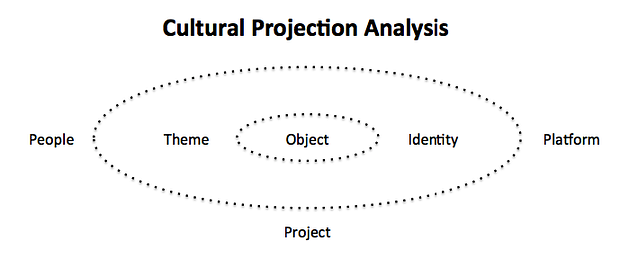
A project is a container of cultural themes which will attract a person. By participating in the project, the person could enhance his life themes or expand his life themes.
A person is attracted by a project through its identity and his Identity could be shaped by the project. On the other side, the actions of the person also could shape the Identity of the Project.
Thus, The “Engagement as Projection” Principle echos the “Internalization — externalization” principle of Activity Theory.
Researchers have been adopting Activity Theory as a descriptional and orientational framework for analysis and evaluation in a variety of empirical studies. Some researchers also developed practical tools for connecting Activity Theory and empirical studies, for example, the Activity Checklist (Kaptelinin, Nardi, and Macaulay 1999).
According to Kaptelinin and Nardi (2006), there are five basic principles of Activity Theory:
- Object-orientedness
- Tool mediation
- Internalization — externalization
- The hierarchical structure of activity, and
- Development
Additionally, the principle of Engagement as Projection provides a framework to resolve the “Outside — Inside” dualism of social spaces, emphasising the mutual shaping of individuals and the projects they engage with.
2.2 Life, Events, and Projects
The Events — Projects relationship was addressed in my 2021 book, Project-oriented Activity Theory.
My approach uses “events” and “projects” to present social context and individual biography. The difference between “events” and “projects” is individual involvement. If the person directly gets involved in an activity — it means she is the subject of the activity or part of the community of the activity — then the activity is a project of her biography. If the person doesn’t directly get involved in the activity, then the activity is an event of her biography.
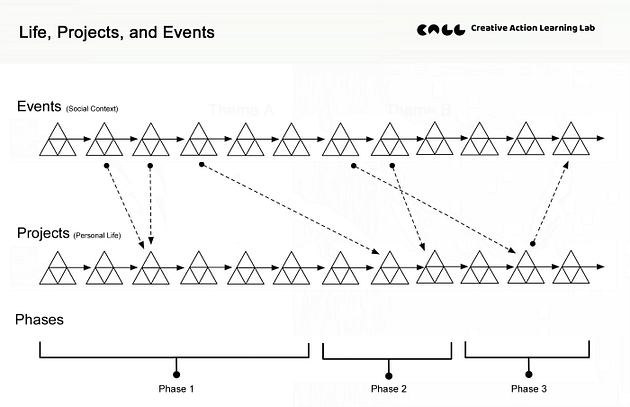
Let’s use the biography of Yrjö Engeström who is a leading Activity Theorist as an example. According to Annalisa Sannino, there are four main phases in Engeström’s development as an activity theorist, “(1) the European student movement of the 1960s and the discovery of activity theory; (2) the study of instruction and the turn from school learning to workplace learning; (3) developmental work research and the theory of expansive learning; and (4) the formation of activity-theoretical communities aimed at changing societal practices.” (2009, p.11) We can use the above diagram to represent Engeström’s biography.
Phase 1
- Event 1: the European student movement of the 1960s.
- Project 1: Engeström wrote his first book (Engeström,1970), Education in Class Society: Introduction to the Educational Problems of Capitalism (in Finnish).
- Event 2: Leontiev’s Problems of the Development of the Mind, published in East Germany in 1973 (Leontjew,1973), and Davydov’s Types of Generalizations in Instruction, which was available in East Germany in 1977 (Dawydow, 1977).
- Project 2: Engeström discovered Activity Theory by reading Davydov’s book and II’enkov’s essay on the dialectics of the abstract and the concrete.
- Project 3: Engeström adopted Activity Theory for his thesis, The Imagination and Behavior of School Students Analyzed from the Viewpoint of Education for Peace (in Finnish) in 1979. This empirical study documents the work of nearly 2,000 students who wrote essays on war and violence.
Phase 2
- Project 1: Engeström attempted to change school instruction by bringing Davydov’s ideas to politically and pedagogically radical Finnish teachers. He published a chapter in the 1984 book Learning and Teaching on a Scientific Basis.
- Project 2: Engeström started paying attention to workplace learning and human resource development in organizations. His first work-related study (1984) was concerned with janitorial cleaning, which was considered to be the occupation with the lowest prestige in Finland. The main motivation for studying the work of cleaners was to demonstrate that this work is creative and has an intellectual basis and to show the possibilities of development.
Phase 3
- Project 1: From 1986 to 1989, Engeström led a study with the primary health care practitioners and patients of the city of Espoo, where patients were facing excessive waiting times before receiving health care and a lack of continuity of care.
- Project 2: Engeström adopted Davydov (1990)’s “learning activity” to investigate/implement radical change at work.
- Project 3: Engeström developed the triangular model of activity systems and the theory of expansive learning and published Learning by Expanding (1987).
Phase 4
- Event 1: Michael Cole directed the Laboratory of Comparative Human Cognition (LCHC) at the University of California, San Diego.
- Project 1: Engeström was invited to work at LCHC.
- Project 2: Engeström initiated communities for adopting activity theory for changing societal practices in Finland.
- Project 3: Inspired by the LCHC, Engeström founded the Center for Activity Theory and Development Work Research at the University of Helsinki.
- Event 2: Georg Rückriem worked on the translations of Leont’ev’s works in Germany.
- Project 4: Engeström suggested the idea of a conference in which scholars within Germany and elsewhere could gather to discuss ways of influencing human practices on the basis of activity theory. Subsequently, Rückriem started organizing the first conference of the International Society for Cultural Research and Activity Theory (ISCRAT), which took place in 1986.
- Event 3: LCHC published a Quarterly Newsletter titled Mind, Culture, and Activity.
- Project 5: Engeström suggested the creation of the journal Mind, Culture, and Activity, which was originally published as the Quarterly Newsletter of LCHC.
- Event 4: In 1995, Finland was struggling to overcome an economic recession, as were many other countries. The problems of the Finnish economy, however, were also connected with the collapse of the Soviet Union, which had been Finland’s main trading partner. Companies were under economic pressure and needed to find short-term solutions to the crisis.
- Project 6: Developmental work research was formulated in terms of a long developmental cycle of interventionist work lasting 3 to 5 years (Engeström & Engeström,1986). Companies in these years could not afford to engage in this kind of transformative venture. The intervention methodology of the Change Laboratory, as compressed cycles of transformation within the broader frame of developmental work research, was elaborated to meet the needs of these institutions.
- Event 5: The Center for Activity Theory and Development Work Research inspired the emergence of similar institutions, such as the Centre for Sociocultural and Activity Theory Research at the University of Bath in the United Kingdom, the Centre for Sociocultural and Activity Theory Research at the University of Oxford in the United Kingdom, and the Center for Human Activity Theory at the University of Kansai in Osaka, Japan.
The above example is just for showing the concepts of “events”, “projects”, and “concepts” within our approach.
Since Activity Theory has the key concept of Object which is a sense-maker of the theory. So, I think we can assign similar sense-makers to Project and Event. For example, I think the primary sense-maker of a Project can be Identity and the primary sense-maker of an Event can be Theme.
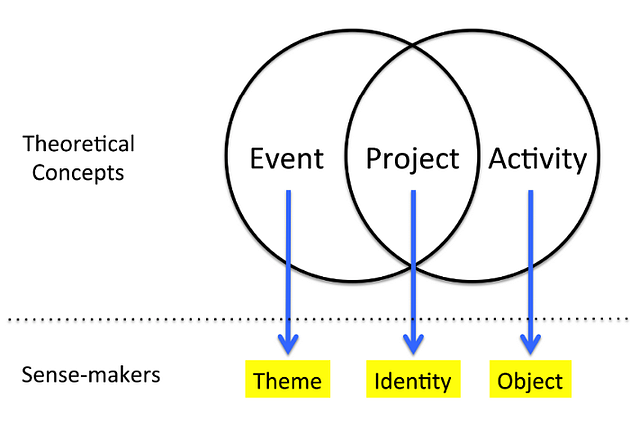
The above diagram is a possible way to conceptualize the relationship between event, project, and activity within the Life-as-Activity approach. As a core concept of the approach, Project refers to both events and activities and it shares some aspects with them. In other words, Project’s primary sense-maker is Identity and its secondary sense-makers are theme and object. Thus, we can use theme, identity, and object as sense-makers of the Life-as-Activity approach.
Furthermore, for the Life-as-Activity approach, I think we can consider the Event as Environment while the Activity as the System and consider Project as a switch between an event (environment) and an activity (system). This means people’s actions (involvement) turn events into activities.
2.3 Event, Project, and Enterprise
In June 2022, I worked on developing the Domain Discovery Activity. At that time, I connected the concept “Enterprise” with Project. See the diagram below.
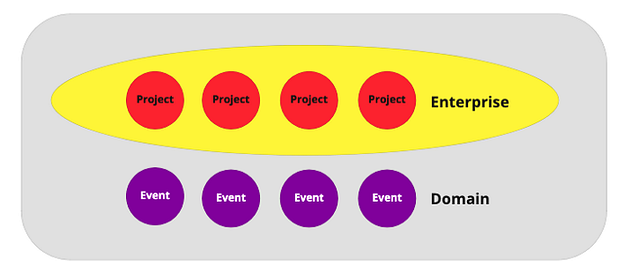
The term “Enterprise” is adopted from Howard E. Gruber’s approach Networks of Enterprise. Howard E. Gruber’s approach is titled the evolving systems approach to the study of creative work (1974,1989). It has a nickname called “Networks of Enterprise” because this is the core concept of the approach.
Gruber’s approach uses “Task — Project — Enterprise — Network of Enterprise” as a structure to understand a creative person’s work. It is different from Activity Theory’s “Operation — Action — Activity” hierarchy.
- Task
- Project
- Enterprise
- Networks of Enterprise
The concept of “Networks of Enterprise” refers to the pattern of work in the life of a creative individual. Gruber said, “We use the term enterprise to stand for a group of related projects and activities broadly enough defined so that (1) the enterprise may continue when the creative person finds one path blocked but another open toward the same goal and (2) when success is achieved the enterprise does not come to an end but generates new tasks and projects that continue it.” (1989, p.11) You can find more details here.
For the Epistemology of Domain, I consider Enterprise as a set of Projects.
The term “Event” also can be understood from the perspective of Event System Theory which is an event-oriented approach to the organizational sciences. According to the authors of Event System Theory, “Organizations are dynamic, hierarchically structured entities. Such dynamism is reflected in the emergence of significant events at every organizational level. Despite this fact, there has been relatively little discussion about how events become meaningful and come to impact organizations across space and time. We address this gap by developing event system theory, which suggests that events become salient when they are novel, disruptive, and critical (reflecting an event’s strength). Importantly, events can originate at any hierarchical level and their effects can remain within that level or travel up or down throughout the organization, changing or creating new behaviors, features, and events. This impact can extend over time as events vary in duration and timing or as event strength evolves. Event system theory provides a needed shift in focus for organizational theory and research by developing specific propositions articulating the interplay among event strength and the spatial and temporal processes through which events come to influence organizations.”
Though Event System Theory was originally developed for organizational sciences, their perspective is also useful for the Epistemology of Domain.
In summary, the “Event [Enterprise(Project)]” refers to the following three theoretical resources:
- Event System Theory
- Howard E. Gruber’s approach Networks of Enterprise
- Project-oriented Activity Theory
2.4 Life-History: Life Themes vs. Cultural Themes
In July 2022, I developed the Project Engagement Approach (v2.1), which expanded the scope from the “Person — Project” relationship to the “Project — Project” relation, adding several new models.
Based on the Event [Enterprise(Project)] Framework I developed in June 2022, I created the Life-History Topology, see the diagram below.
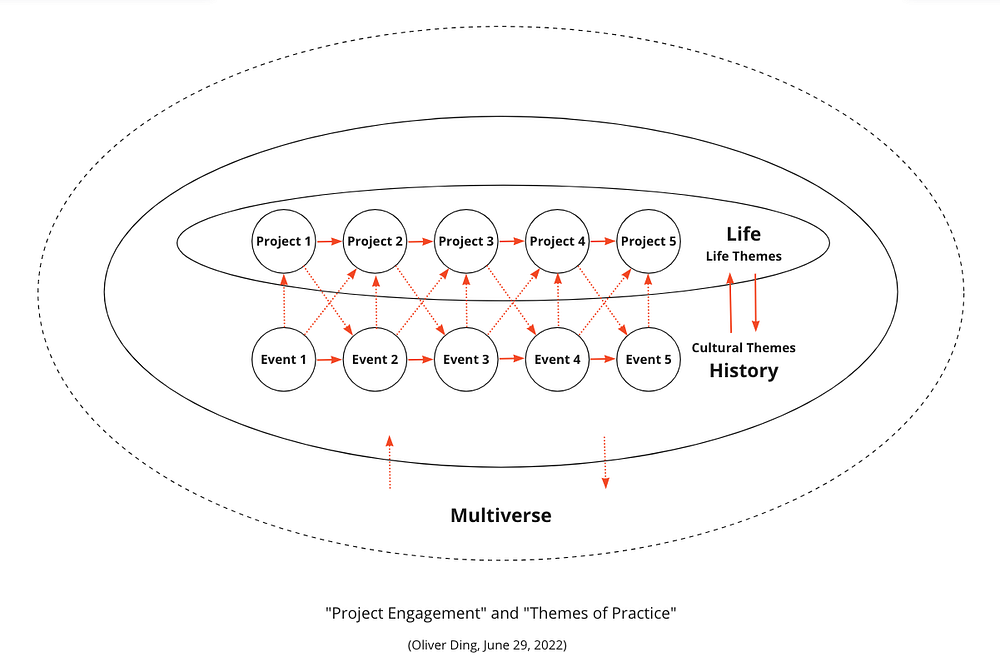
This model was inspired by the Project Engagement approach and the Themes of Practice approach. The pair of concepts “Event — Project” belongs to the Project Engagement approach, while the pair “Life Themes — Cultural Themes” comes from the Themes of Practice framework.
Andy Blunden notes that a project-oriented approach belongs to both psychology and sociology:
A project is a focus for an individual’s motivation, the indispensable vehicle for the exercise of their will and thus the key determinant of their psychology and the process which produces and reproduces the social fabric. Projects, therefore, give direct expression to the identity of the sciences of the mind and the social sciences. Projects belong to both; a project is a concept of both psychology and sociology. (2014, p.15)
In this light, the concept of Life can be understood as both Collective Life and Individual Life. The concept of Project provides a way to make sense of both. A person’s real life is a set of concrete actions, and the notion of Project offers a way to curate and integrate these actions. Likewise, Collective Life can also be curated through projects.
Life can be seen as the diachronic unfolding of a chain of projects, just as history can be seen as the diachronic unfolding of a chain of events.
While Life is a chain of projects, it can also be understood as a journey of moving between various thematic spaces. Each project has its primary themes as well as secondary ones. By joining and leaving projects, we enact our significant Life Themes. In this sense, projects can also be understood as Thematic Spaces.
Life = Projects = Thematic Spaces = Events = History
In this way, the Life as Activity approach echoes Andy Blunden’s idea that “a project is a concept of both psychology and sociology” (2014, p. 15). Here, the notion of Engagement takes on a new meaning: it refers to moving between Thematic Spaces.
More details can be found in Project Engagement (v2): Life, History, and Multiverse.
2.5 Thematic Spaces and Mental Moves
On July 2, 2022, I reflected on my journey of developing the Life-as-Project approach from Jan to June 2022 and wrote an article titled Life Discovery: Biography, Journey, Program (and a possible book, Part 2).
From the perspective of the Slow Cognition project, Life Discovery is a particular type of Knowledge Discovery and the primary theme of Life Discovery is “My Life”.
The objective of the Life Discovery Activity is to Develop Tacit Knowledge about “My Life” and turn Tacit Knowledge into resources for actions.
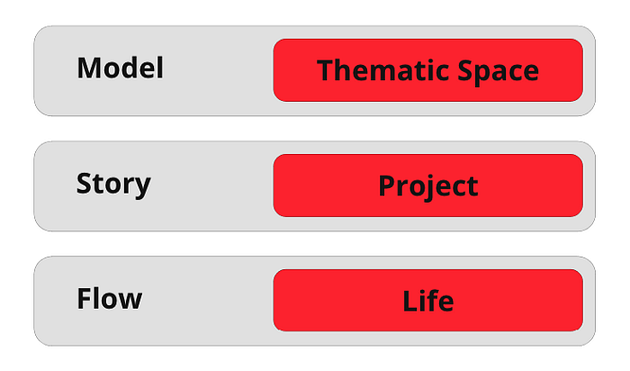
By connecting the Project-centered Approach and the concept of “Thematic Space” together, we can find the following connection:
Life = Project = Thematic Space
While Life is a chain of projects, it can be understood as a journey of moving between various thematic spaces.
Each project has its primary themes and other secondary themes. By joining projects and leaving projects, we are practicing our significant Life Themes. Thus, these projects are Thematic Spaces too.
This insight also echoes the model “Flow — Story — Model”. We can also find more details in Thematic Space: Project as Story.
In this way, I develop the 7th basic principle of the Life-as-Project approach: “Project as Thematic Space”.
In Thematic Space: Place as Container, I mentioned that Story and Model are two types of containers. If we put them together, then one is Abstract Container and the other one is Concrete Container.
A project is an Abstract Container and their environments such as digital platforms are Concrete Containers.
Now we can use my journey of developing the Life-as-Project approach as an example of the notion of “moving between thematic spaces”. In Life Discovery: Biography, Journey, Program (and a possible book, Part 3), I list the following ten themes for the six-month journey.
- 1 — LAA — The “Life as Activity” Project
- 2 — PEA — The “Project Engagement” Approach
- 3 — LAP — The “Life as Project” approach
- 4 — LDA — The “Life Discovery Activity” Project
- 5 — AAS — The “Anticipatory Activity System” Framework
- 6 — SIA — The “Significant Insights Analysis” Project
- 7 — BIO — The Biography
- 8 — MNB — The Board @ Milanote
- 9 — SSL — The Shaper & Supporter Lab (SSL) Program
- 10 — CPN — The Complexity of “Project Network”
By using the model of “Project Network”, I designed the following diagram to visualize the complexity of the about ten themes.
Press enter or click to view image in full size
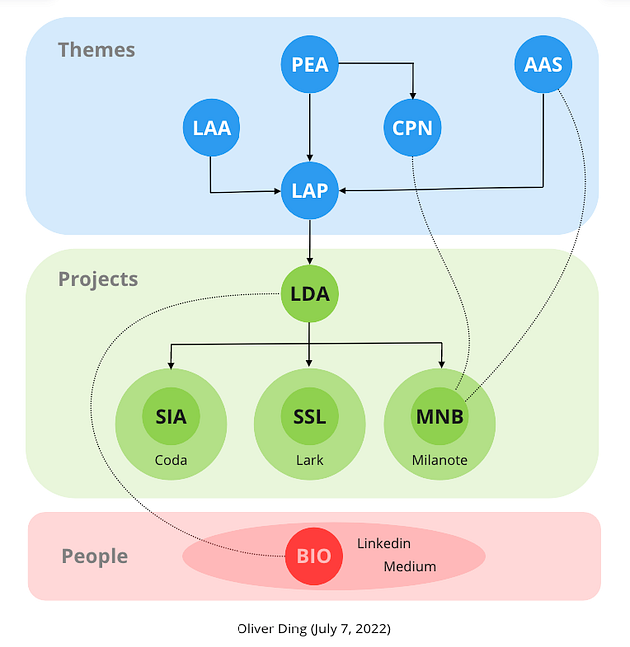
The model of “Project Network” is a multiple-level network that considers 1) a network of Themes, 2) a network of Projects, and 3) a network of People.
- All theoretical approaches and frameworks belong to the network of themes.
- All real activities such as developing a toolkit, designing a canvas, and hosting a program, are part of a network of projects.
- All things about people’s biogeography are located in the network of People.
The diagram is a map of the archive of my six-month journey in developing the Life-as-Project approach.
All theoretical approaches and frameworks belong to the network of themes. Each Theme refers to a Thematic Space.
And the network of Projects is considered as “Practices” of “Themes” from the perspective of the “Themes of Practice” framework and the perspective of Project-oriented Activity Theory. For example, the “MNB” (the AAS Board @ Milanote) is guided by the “AAS” framework. The “LDA” (the Life Discovery Activity) is guided by the “LAP” (the Life-as-Project approach).
We have to notice that the development of themes and the development of projects are intertwined in such a way that they actually all rely on each other. For example, the AAS framework was tested by watching the development of the SSL program. Some sub-frameworks are inspired by the SSL program. The MNB program was guided by a sub-framework of the AAS framework.
On June 30, 2022, I designed the Life Discovery Board (public, v2). The major difference between v1 and v2 is the following part which is about the Complexity of “Project Network”.
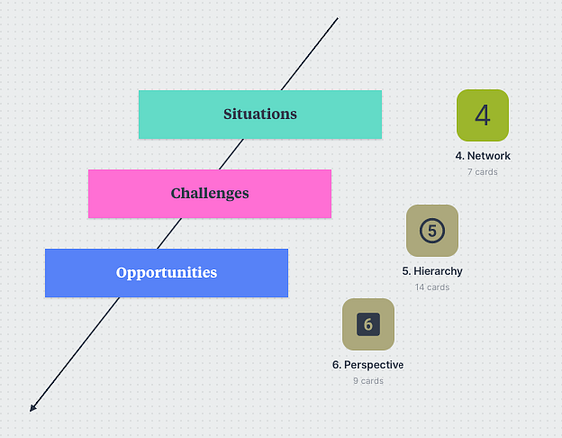
In fact, the notion of “Complexity of Project Network” (CPN) was born on June 30, 2022, when I was designing the v2 board.
Moving between various thematic spaces will impact moving between various projects and vice versa. In this way, we see a simple model of the development of life and history:
Life = Projects = Thematic Spaces = Events = History
In this way, the Life-as-Project approach echoes Andy Blunden’s notion of “a project is a concept of both psychology and sociology” (2014,p.15).
Part 3: Later Development
This part traces the evolution of the Project Engagement approach from 2024 to 2025, highlighting major expansions and refinements. The development of Social Landscape, Mental Platform, Cultural Frameworks, and the distinction between Activity and Enterprise represent significant theoretical advancements.
These later developments shift the focus from knowledge engagement to cultural innovation, incorporating multiple layers of analysis from mental models to social norms.
3.1 Social Landscape vs. Thematic Space
In May 2024, I developed version 3.1 of the Project Engagement approach — a theoretical toolkit.
From May to July 2024, I discussed Project Engagement (v3.1) with friends. I spent four weeks in China in June and July caring for a family member undergoing surgery. I developed the tool “The House of Project Engagement” during this time, using “Thematic Rooms” as a metaphor to represent different social structures. I later named this group of rooms and their social structures “Social Landscape”.
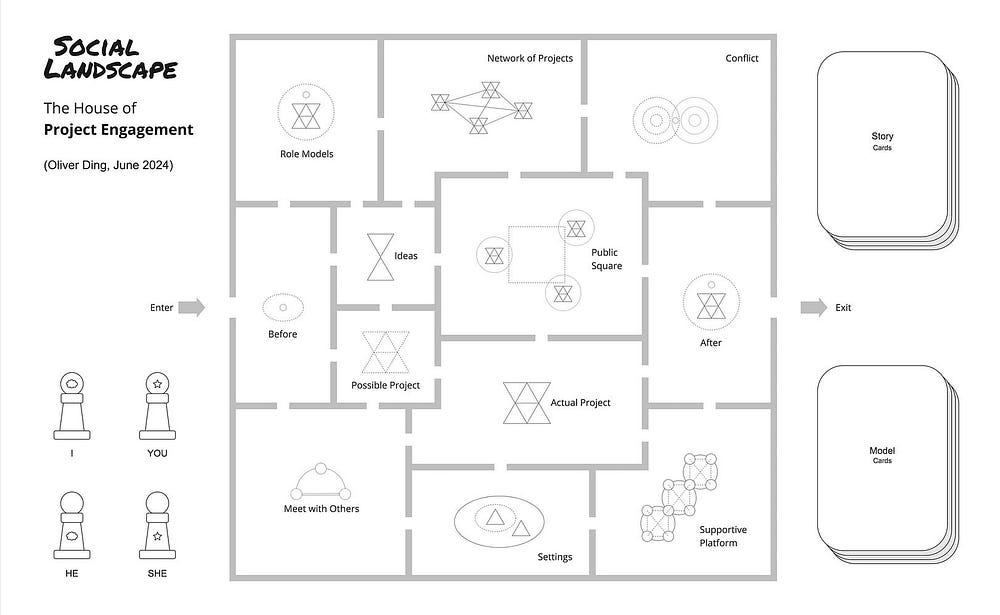
Designed as a Map, the House of Project Engagement uses a “Museum” metaphor to represent space. The House is organized into 12 thematic rooms, with each room representing a distinct type of social landscape. Together, these rooms depict the following themes:
- Before
- Role Models
- Ideas
- Possible Project
- Meet with Others
- Actual Project
- Settings
- Supportive Platform
- Public Square
- Network of Project
- Conflict
- After
The methodology behind the design is framed by the “Map — Move — Model — Method — Meaning” schema.
In July 2024, after returning to the U.S., I completed Project Engagement (v3.1) with a Chinese-language thesis. However, I detached the concept of Social Landscape from the thesis and developed it into a standalone framework, which I later applied to the Strategic Moves project in September 2024.
For example, the diagram below represents 17 Moves in my journey of engaging with Activity Theory.
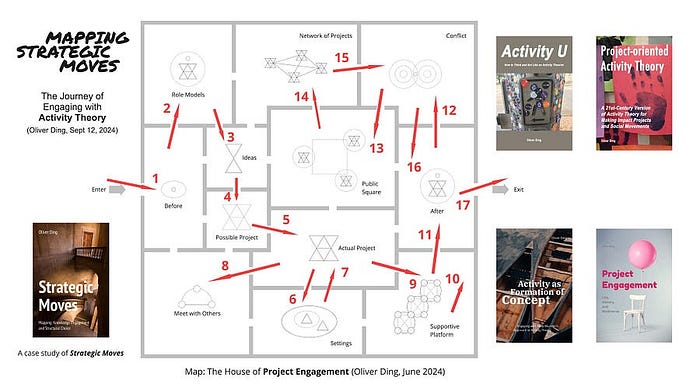
The House of Project Engagement functions as a thematic Map, structured with 12 thematic rooms that represent a series of social norms.
Each thematic room can incorporate relevant knowledge frameworks as Models.
The approach of using these 12 rooms to map life courses and creative journeys serves as a distinctive Method. For instance, I developed the Mapping Strategic Moves method within the framework of the House of Project Engagement.
By integrating Maps, Moves, and Reflection, this methodology supports life narrative practices, facilitating the process of Meaning discovery.
In early March 2025, a friend shared her latest research project with me, which focuses on a knowledge center addressing educational equity in China. The research is an in-depth case study of the knowledge center’s 20-year partnership with local schools and communities. My friend and her colleague explore the partnership’s origins, evolution, impact, and challenges, identifying it as a multi-level and multidimensional relationship. Their approach goes beyond the conventional focus on teacher and administrator professional development, addressing complex and systemic equity issues.
After reading their draft paper, I realized that these types of partnerships align with what I called Platform-ship in my 2021 book draft, Platform for Development. Moreover, these partnerships can be understood as forms of Social Landscapes within the Social Landscape Framework, which I developed in 2024.
This insight inspired me to develop a three-level map — based on their paper — to discuss Supportance-based Development. See the diagram below.
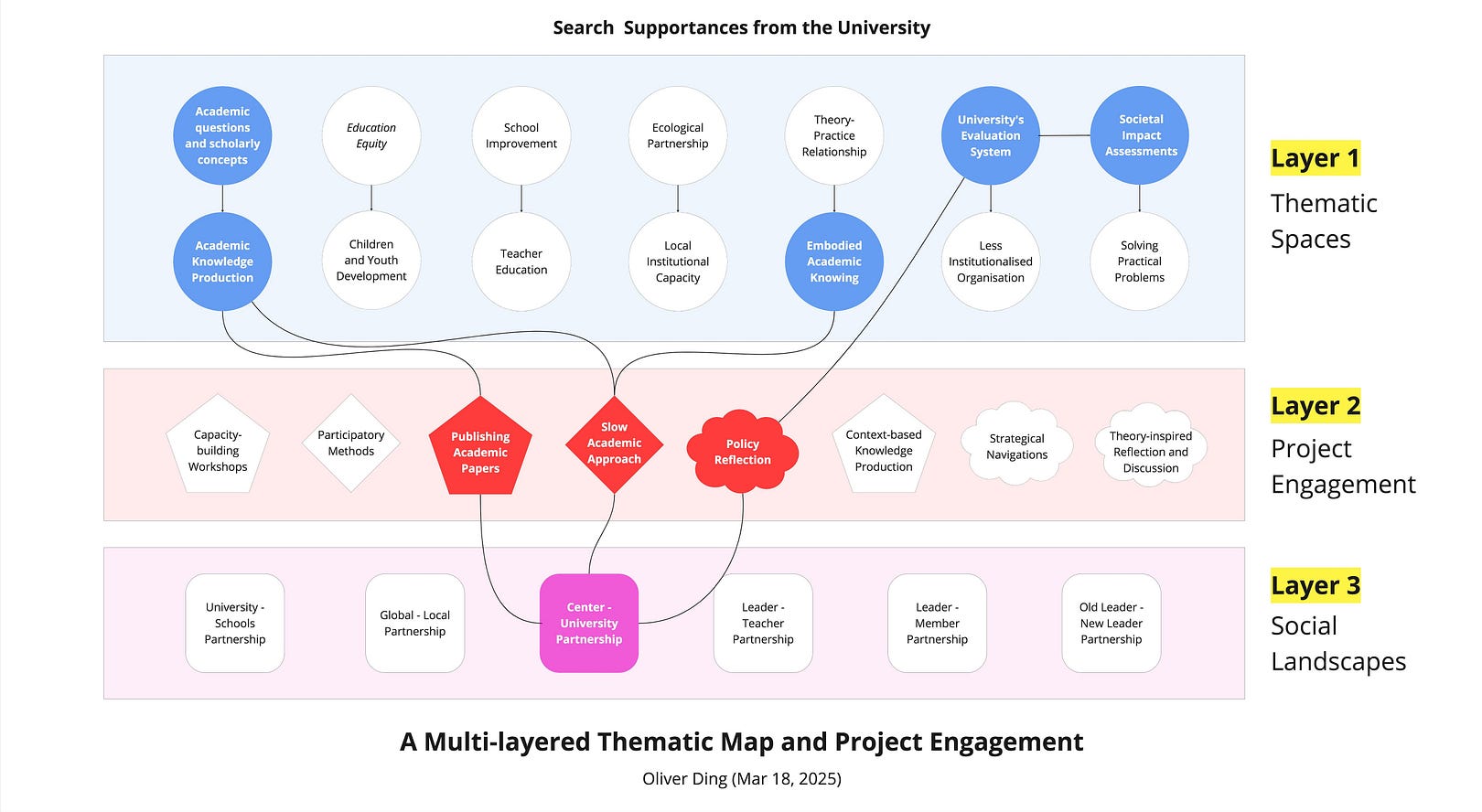
After publishing the article on Supportance-based Development, I realized that this three-layer map represents a new knowledge element of the Project Engagement approach.
It echoes my early idea of Project Network — see the diagram below.
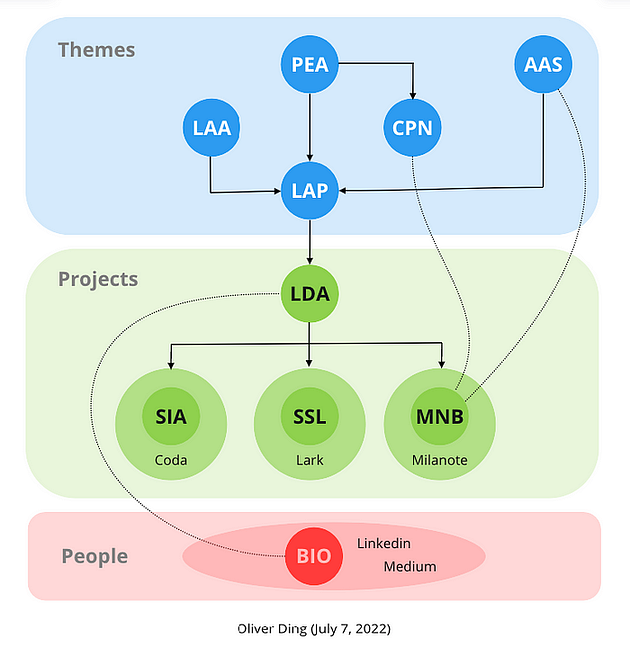
The diagram above represents an archive of my six-month journey in developing the Life-as-Project approach from January to June 2022. It serves as an example of the Project Network model.
The Project Network model is a multi-level network that consists of 1) a network of Themes, 2) a network of Projects, and 3) a network of People.
- All theoretical approaches and frameworks belong to the Network of Themes.
- All real activities — such as developing a toolkit, designing a canvas, and hosting a program — are part of the Network of Projects.
- All things related to people’s biogeography are situated within the Network of People.
In 2024, I developed the concept of Social Landscape as part of the Project Engagement approach (v3.1). Now, the Network of People can be understood as a specific type of Social Landscape.
Furthermore, the new three-layer structure functions as a meta-framework, while the Project Network model serves as a sub-framework that highlights only the network aspect of the broader meta-framework.
3.2 Mental Platform vs. Cultural Framework
When a concept system supports the development of a Creative Enterprise, it functions as a Mental Platform.
On October 26, 2025, I made adopted the Network–Container–Platform Schema to discuss a hierarchy of three concepts:
- Mental Elements
- Menal Models
- Mental Platform
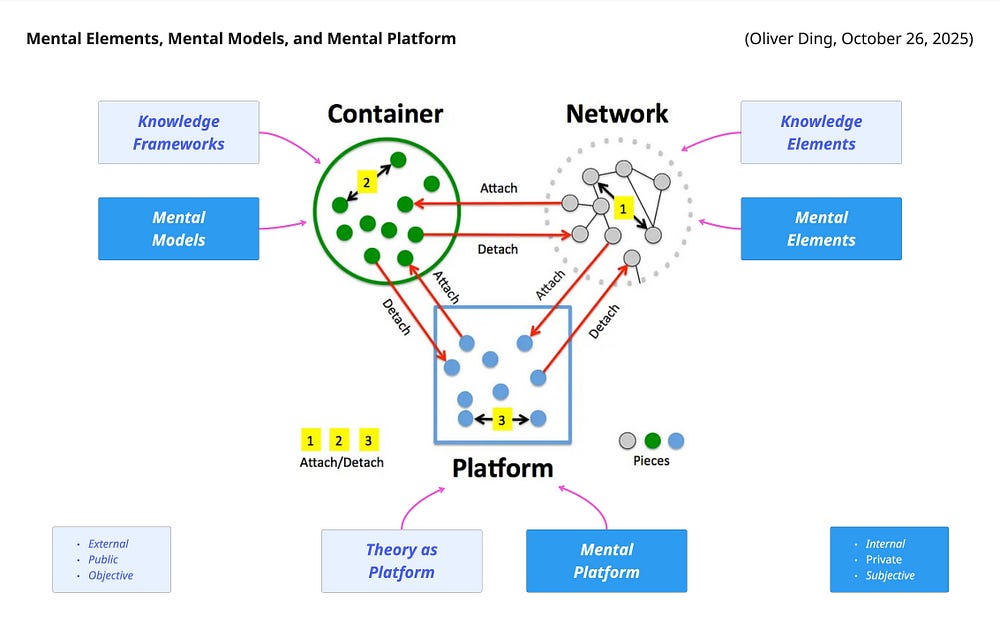
At the “Network” corner, we find:
- Knowledge Elements
- Mental Elements
At the “Container” corner, we find:
- Knowledge Frameworks
- Mental Models
At the “Platform” corner, we find:
- Theory as Platform
- Mental Platform
These concepts are also grouped into two groups:
- External, Public, and Objective
- Internal, Private, and Subjective
Moreover, there exist several types of attachances between the thematic spaces associated with these concepts.
A Knowledge Framework can be internalized and transformed into Mental Models; in this movement, we detach from the outside space and attach to the inside space.
Conversely, a Mental Platform can be externalized as a product, becoming a Theory as Platform. In this movement, we detach from the inside space and attach to the outside space.
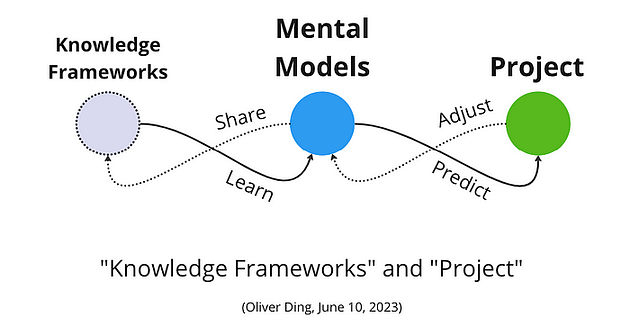
When a mental model is used to manage a project, it functions as a Predictive Model.
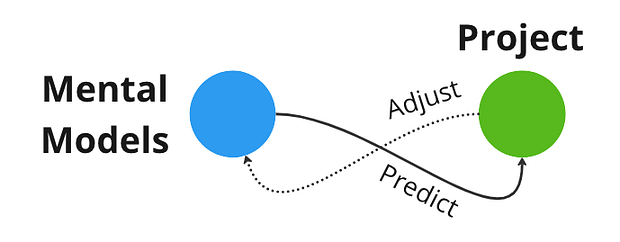
A Project can be seen as a collection of a series of actions. But how do these actions form a Project? The answer lies in the following three elements of a project:
- Objectives: The goals of a project
- Objects: The things people are working on
- Mental Models: The plans or knowledge for predicting the development of the project
The above diagram connects Mental Models with a Project, showing how Mental Models function as Predictive Models of Projects.
The term “Predictive Models” is a key element of the Anticipatory Activity System (AAS) framework.
The “Anticipatory Activity System (AAS)” framework adopts Activity Theory and Anticipatory System theory to discuss “Self, Other, Present, Future.” You can find more details here.
For a particular project, a person will develop a particular model to help her/him predict the development of the project. In other words, she/he will use a model to predict the future of the project.
The model can be explicit, such as a diagram with a document. However, the model can be tacit, the person just uses her mind without any instruments to display the model. What I found from my empirical research is that sometimes the person would like to visualize or write her model about the project because this way is a great way of thinking. But the person would like to keep the model as a private information, unless the project needs the public versin of the model for storytelling.
The mutual relationship between Mental Models (Predictive Models) and a Project is dynamic.
The model is the outcome of the “objective — subjective” knowledge curation. For example, a friend of mine adopted some psychological knowledge and the OKR method to build a model for her life development program. She modified her model several times to adapt to changes in her clients within 12 months.
The “Predict — Adjust” interactions echo the “Learn — Share” interactions. While the former is about mental moves between Knowledge and Wisdom, the latter is about mental moves between Wisdom and Activity.
If we put the above discussion together, we can see the “Knowledge — Wisdom — Activity” schema of mental moves behind the diagram below.
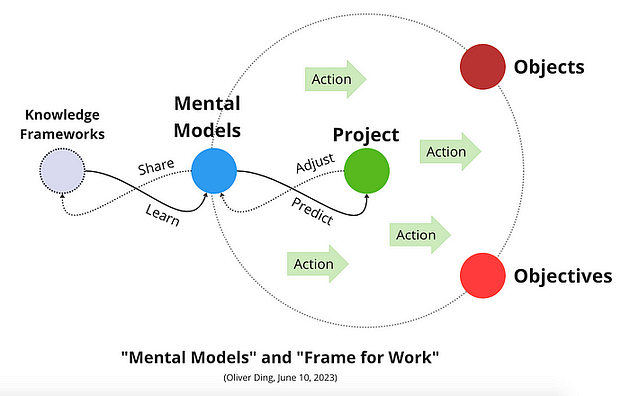
This meta-framework views a knowledge framework and a diagram not as static knowledge representations, but as a developmental dynamic process within a creative territory for exploration, reflection, and curation.
More related ideas are explored in my 2024 book draft, Frame for Work: Knowledge Frameworks, Predictive Models, and World of Activity.
3.3 Cultural Frameworks and Social Norms
The concept of Cultural Frameworks and Social Norms are understood as objective concept systems as abstract level and concrete level. While Cultural Frameworks are located at the abstract level, Social Norms are located at the concrete level.
In my 2024 book draft, Frame for Work, I introduced four perspectives to understand knoweldge frameworks, predictive models, and activity.
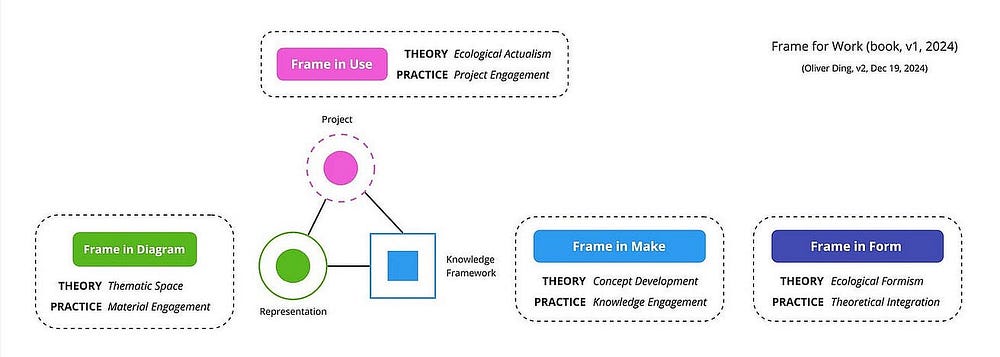
In Sept 2025, I expanded these perspectives to eight for making the Frame for Work Canvas.
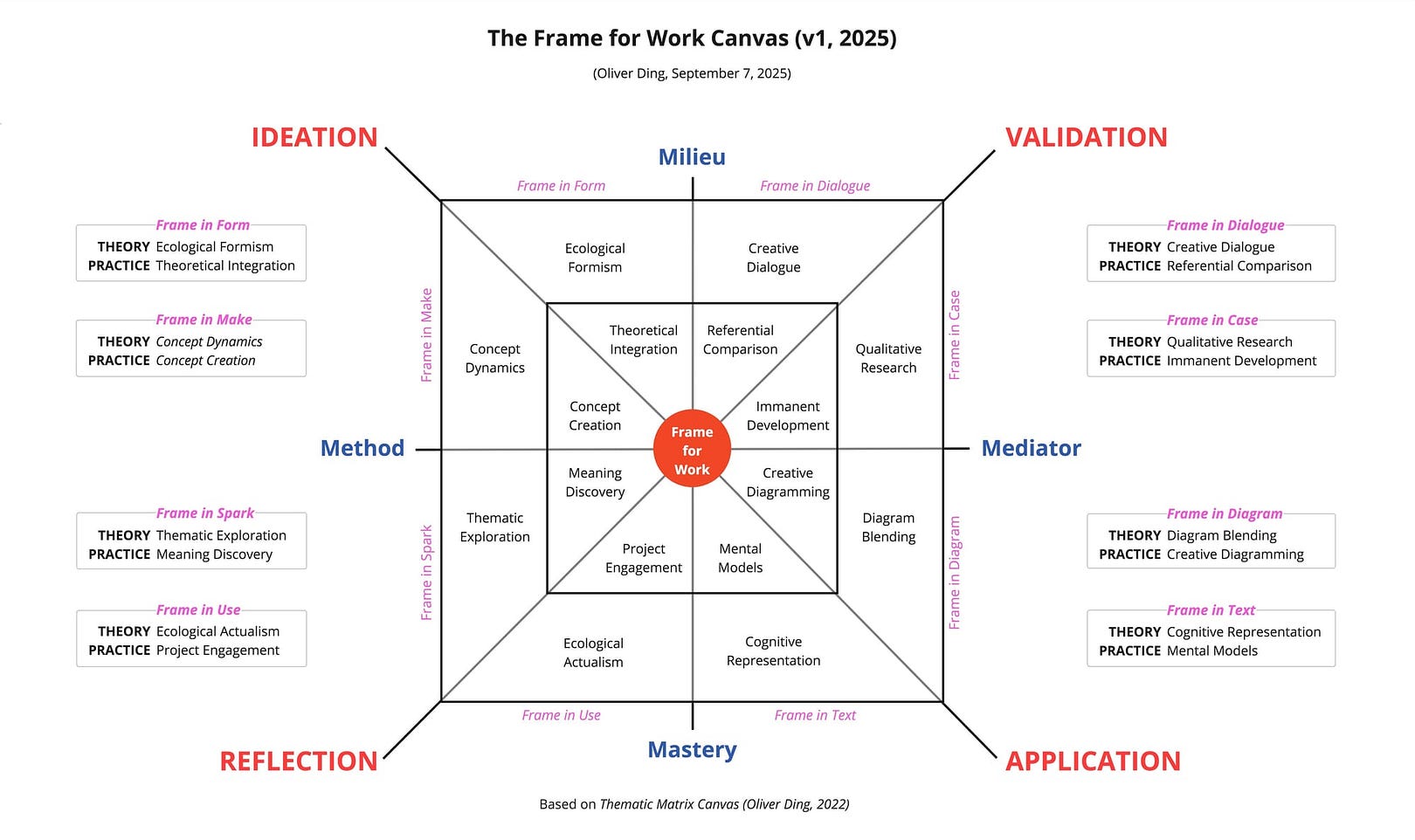
The new canvas goes beyond the original focus of the 2024 book — Knowledge Frameworks — and extends the metaphor of the “Frame” to a broader object: Cultural Frameworks. This expansion aligns with my shift from Knowledge Engagement to Cultural Innovation, a key transition I made in late 2024 and early 2025.
The canvas curates the following knowledge elements:
- The Ideation — Validation — Application — Reflection Schema
- The Milieu — Mediator — Method — Mastery Schema
- The eight perspectives of the Frame for Work
- A set of THEORY (located in the Outer Space)
- A set of PRACTICE (located in the Inner Space)
Both knowledge frameworks and cultural frameworks can be understood as concept systems. While the Knowledge Discovery Canvas focuses on developing tacit knowledge for knowledge engagement, the Frame-for-Work canvas focuses on building cultural frameworks for cultural innovation.
The Frame-for-Work canvas is part of my recent focus on cultural frameworks and cultural innovation. Since it treats a cultural framework as a concept system, it echoes my earlier work, my 2021 book draft, Project-oriented Activity Theory. In this draft, I introduced Andy Blunden’s notion of “Activity as Formation of Concept.”
According to Andy Blunden, there are three phases of the formation of concepts:
- Phase 1: Initialization;
- Phase 2: Objectification;
- Phase 3: Institutionalization.
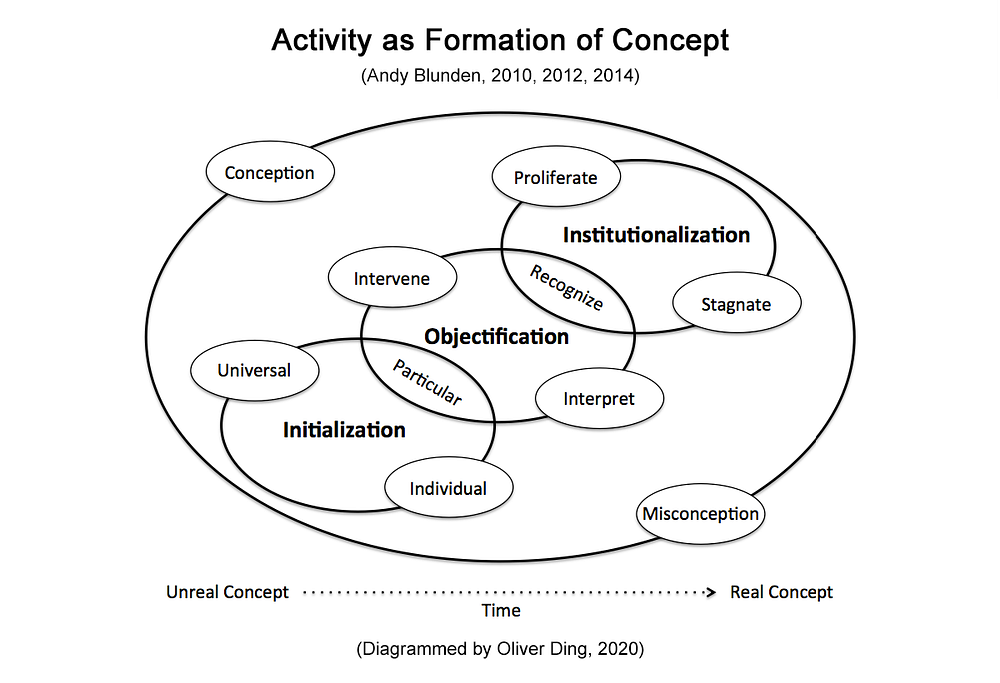
The notion of three phases is inspired by Blunden’s case study “Collaborative Learning Space”. I have to point out that Blunden is relatively unconcerned with demarcating the boundaries between the successive phases of a project. We should consider the above diagram as a rough representation. Blunden definitely uses “Objectification” and “Institutionalization” in his writings. However, he doesn’t obviously use the term “Initialization”.
Blunden clearly claims that there are three aspects of objectification of concept: symbolic, instrumental, and practical. By adopting the germ-cell diagram, we can present these ideas with the diagram below.
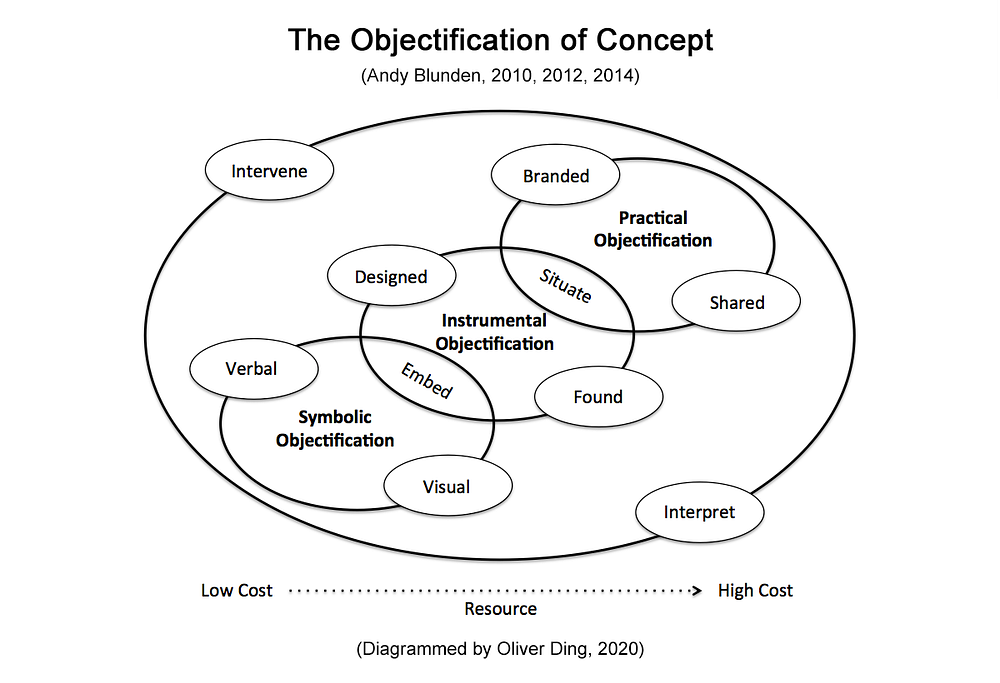
More details can be found in Project-oriented Activity Theory and a case study about TEDx.
Blunden’s approach is inspired by Hegel’s theory of concepts, which is an abstract theoretical framework.
The Frame-for-Work Canvas is based on the “Ideation — Validation — Application — Reflection” schema. It expands Blunden’s approach at the operational level, considering more significant aspects such as VALIDATION and REFLECTION.
Hegel’s creative approach emphasizes triadic structures, with each level decomposed into three elements. In contrast, my Canvas framework highlights tetradic structures, as seen in the “Ideation-Validation-Application-Reflection” schema and the “Milieu-Mediator-Method-Mastery” schema. This structural difference reflects distinct cognitive orientations toward creative engagement.
According to Blunden, Hegel’s approach also acknowledges that projects mature through four stages:
Taking a cue from Hegel, projects can be seen as passing through four stages in their development. (1) Firstly there will be some group of people who by virtue of their social position are subject to some taken-for-granted or impending problem or constraint on their freedom. These are the conditions for a project to exist, but the project has not yet come into being. (2) On becoming aware of the problem there will be a series of failed projects arising from misconceptions of the situation, until, at a certain point: (3) An adequate concept of the situation is formulated and named and a social movement is launched to change social practices so as to resolve the problem or injustice. As the project unfolds and interacts with the social environment, its object becomes clearer and more concrete. (4) Eventually, the new form of practice becomes ‘mainstreamed’ as part of the social practices of the wider community. That is, it is institutionalized and its concept enters into the language and culture of the community. These stages are to be seen as ideal-typical, not proscriptive. (Collaborative Projects: An Interdisciplinary Study, Andy Blunden, ed. 2014)
The “Ideation-Validation-Application-Reflection” schema roughly echoes these four stages. The first stage can be understood as IDEATION, the second stage as VALIDATION, and the third stage as APPLICATION. The fourth stage does not directly correspond to REFLECTION, as it does not emphasize the individual actor’s experience, which is not the primary concern in Hegel’s abstraction.
However, the Frame-for-Work Canvas adopts the “Ideation-Validation-Application-Reflection” schema to define four types of thematic areas and a series of thematic spaces. The Canvas serves as a map for social action, while Hegel’s four-stage approach outlines a particular path. Yet, there are other possible paths.
3.4 Activity vs. Enterprise
On October 3, 2025, I developed the Weave-the-Life model (V1.0), see diagram below.
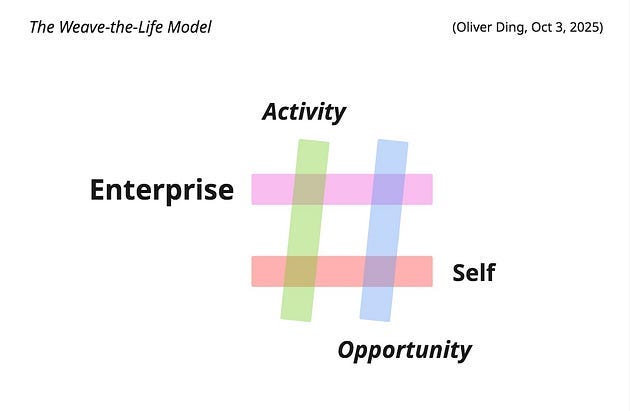
The model draws a clear distinction between researchers and actors. While traditional Activity Theorists study Activity as an object of analysis from the researcher’s perspective, the concept of Enterprise re-centers the actor’s own perspective, giving the subjective experience back to them.
In the Weave-the-Life mode, we may picture an Enterprise as a chain — an ongoing sequence of endeavors that unfolds over time — while an Activity can be seen as a node within that chain, a self-contained system composed of coordinated actions.
This metaphor is meant as an illustration rather than a structural definition, highlighting how Enterprise emphasizes temporal unfolding (diachronic), whereas Activity emphasizes systemic organization at a given moment (synchronic).
Thus, while Activity Theory provides a structural snapshot of mediated action, the notion of Enterprise restores the temporal and experiential flow of human endeavor.
On November 11, 2025, I designed a new abstract diagram to represent the deep structure of the Weave-the-Life Framework. The new version was version 2.0.
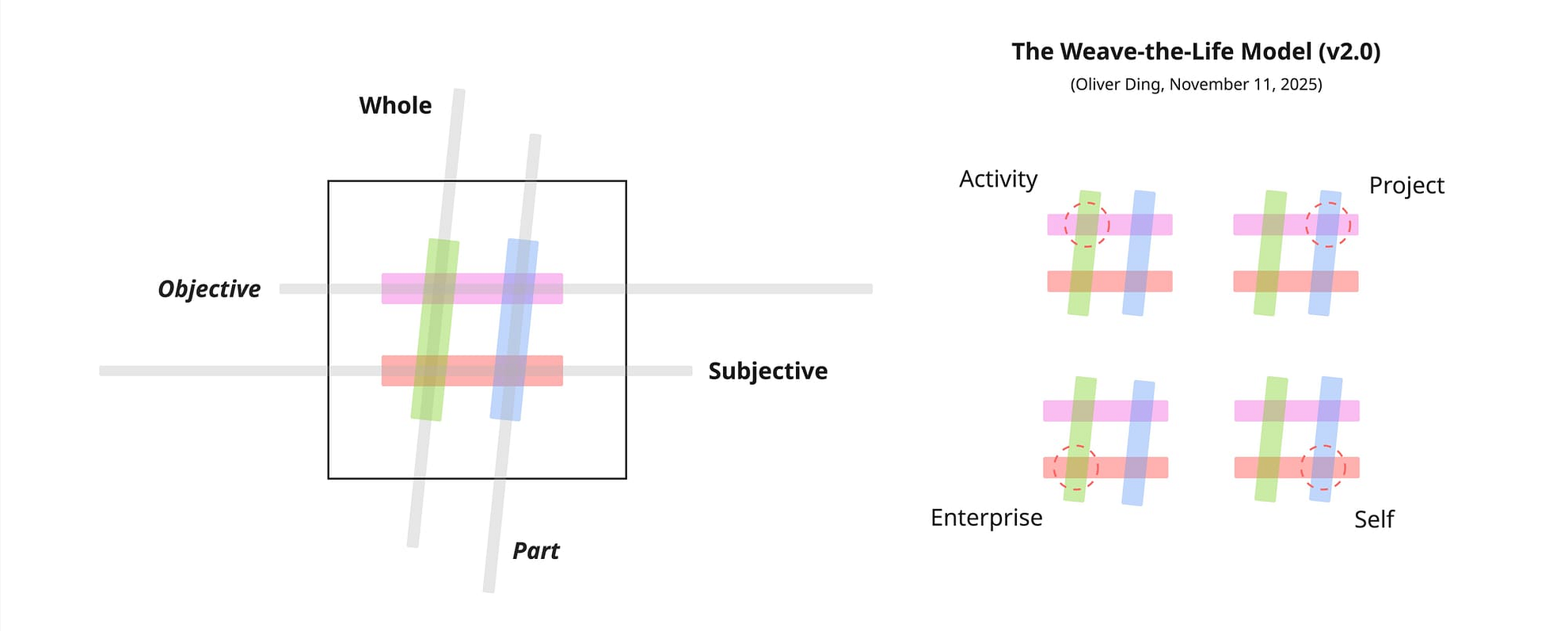
The new model integrates four dimensions: Subjective, Objective, Part, and Whole. The Subjective–Objective dimensions capture diachronic aspects of life, while the Part–Whole dimensions capture synchronical aspects. Together, these dimensions weave individual and collective life within an evolving structural, cultural, and historical landscape.
The model defines four Weave-Points, where one synchronical dimension intersects with one diachronic dimension. Concepts from v1.0 are positioned at these points: Self, Enterprise, Project, and Activity.
- At the Part dimension, the Self–Project connection represents “Project Engagement,” where an individual participates in a specific project.
- At the Whole dimension, Activity refers to the aggregation of individual projects, while Enterprise encompasses a series of self-directed actions that extend beyond immediate projects.
The distinction between Subjective and Objective reflects the dual aspects of life: individual experience versus collective existence. The Part–Whole distinction reflects the structural depth of life. These four dimensions are continuously interwoven in lived experience, forming the fabric of both personal biography and social reality.
The framework operates bidirectionally. In the forward direction, individual actions crystallize into enterprises that transcend personal will. In the reverse direction, social structures and historical events enter individual life through activities and projects. This bidirectional dynamic illuminates both individual agency and structural constraints, demonstrating how otherness — aspects of social reality beyond immediate intersubjective negotiation — becomes incorporated into personal life.
By incorporating the concept of Enterprise, the Weave-the-Life Framework emphasizes the subjective dimension of social life: a long-term, self-determined trajectory of actions.
These basic ideas set a foundation for connecting Activity and Enterprise for the Project Engagement approach to human development because it offers a subjective perspective that the traditional approaches of Activity Theory did not emphasize.
Part 4: Creative Dialogues
The Cultural Projection Model is based on a meta-framework called Container Z.
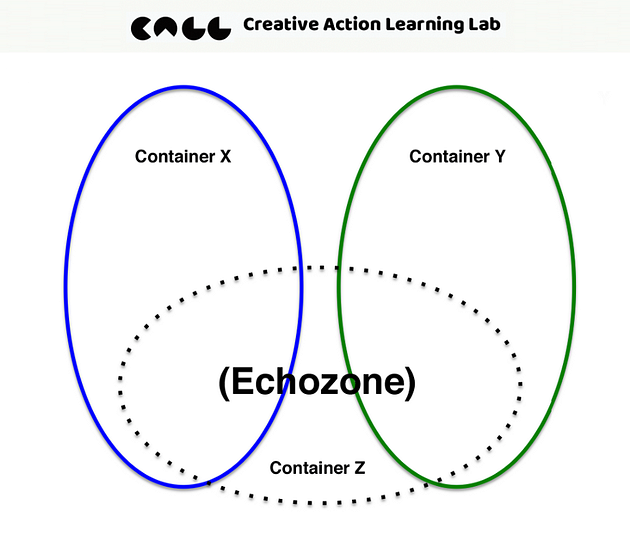
It was formed by three containers: Container X, Container Y, and Container Z.
- Container X: Activity (Objective Process) = Social Moves between Social Landscapes
- Container Y: Enterprise (Subjective Experience) = Mental Moves between Thematic Spaces
- Container Z: Projecting (Cultural Projection) = Moves between the Outside space and the Inside space of the Project.
There is a related model called The ECHO Way, which is formed by Theme U, Project I, and Container Z. It was developed to understand the boundary innovation, such as Boundaryless Careers, Cross-cultural Innovation, Platform Innovation, etc.
I also used it to develop Creative Dialogue projects. In this part, I will use the ECHO Way to highlight two possible Creative Dialogues for further development.
4.1 The ECHO Way
The ECHO way is defined as a practical framework for guiding research, design, and development in the real-life world. As a knowledge framework, it has three components: diagrams, concepts, and methods.
The core of the ECHO way is the following diagram.
- Theme U
- Project I
- Container Z
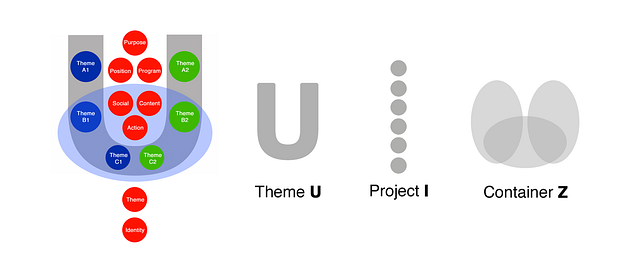
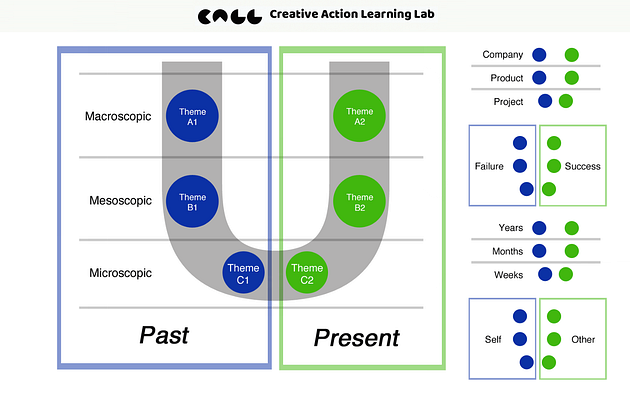
The Theme U diagram presents six themes in a U shape. I have been using the diagram many times since June 2020. Theme U is not only about six themes but also about representing complex thematic relationships with spatial mediation. For example, I used the following diagram to explain Pairs of Opposite Themes with the Theme U diagram.
The Project I diagram is inspired by the Developmental Project Model. I changed the shape and layout in order to make a Diagram Blending, which can be used for curating two or more frameworks together.
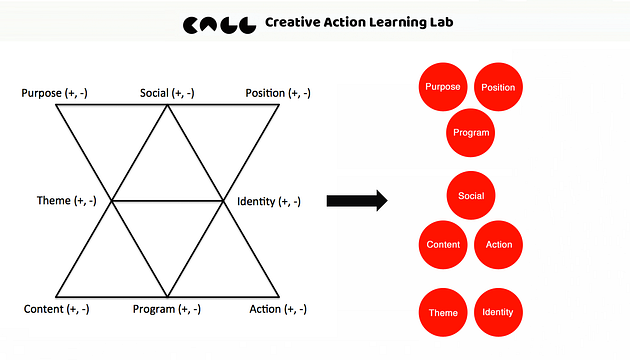
This means the ECHO Way is not a primary framework since it connects to other frameworks. You can find more details about the Developmental Project Model in this article.
The Container Z is inspired by the following meta-diagram. The ECHO Way is about the fit between the two sides. Where is the fit? It happens at the “Echozone”, which is the third container of the following model.
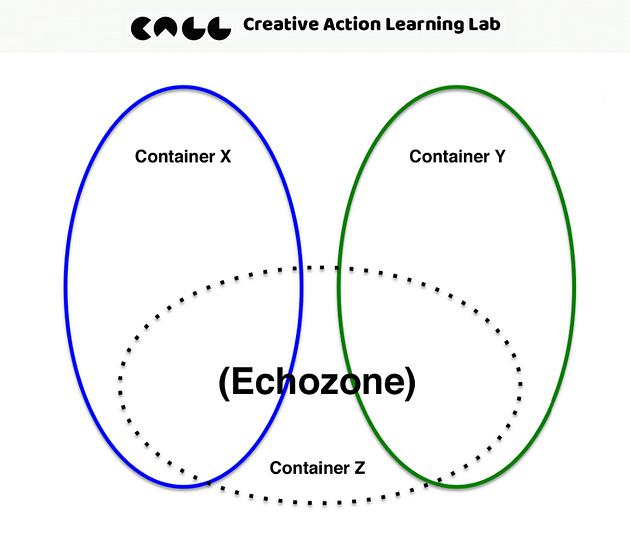
The Container Z is also called Echozone.
You can find more details from the original article: The ECHO Way (v2.0).
4.2 The Project Engagement Approach vs. The Ecological Practice Approach
The “Activity as Project Engagement” principle, the “Outside — Projecting—Inside” triad, and the Cultural Projection Model can be seen as a creative dialogue between Activity Theory and the Ecological Practice Approach.
The Project Engagement Approach follows Andy Blunden’s notion of “Project as Unit of Analysis of Activity” and many ideas of the tradition of Activity Theory, while the Ecological Practice Approach follows James J. Gibson’s Ecological Psychology and Affordance Theory on potential action activities.
On Jan 9, 2021, I published an article titled Activity U (X): Projecting, Projectivity, and Cultural Projection which introduces the concept of Projectivity and the notion of Cultural Projection. This article is an essential part of my 2021 book (draft) Project-oriented Activity Theory.
What’s Projectivity? It refers to potential action opportunities of forming or participating in a project for people to actualize their development with others.
The Concept of “Projectivity” is inspired by Ecological Psychologist James J. Gibson’s Affordance Theory and Andy Blunden’s Project-oriented Activity Theory. The chart below presents three similar concepts: Affordance, Supportance, and Projectivity.
Both three concepts share the same deep structure: the Reciprocal Relationship between Environment and Organism. For the Platform-for-Development framework, we can consider Platform as Environment. For Project-oriented Activity Theory, we can consider Project as Environment.
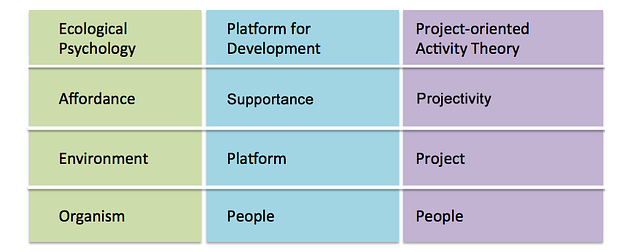
The concept of Projectivity connects Project, Projecting, and Projection together. Based on the concept, I developed the Cultural Projection Analysis method.
This creative dialogue is the foundation of the “Activity as Project Engagement” principle, the “Outside — Projecting — Inside” triad, and the the Cultural Projection Model.
4.3 Activity Theory (Internalization-Externalization) vs. Confucian Thought (Inner Sageliness-Outer Kingliness)
During the final stage of The “Evolving Knowledge Enterprise” Journey (2020–2025), I reframed my creative development through Robert Kegan’s Five Orders of Consciousness and defined a new phase of “Trans-system/Trans-complex” work. This phase originally described a micro-level dialogue between Knowledge Enterprise and Cultural Enterprise — what I called Creative Enterprise — but in early 2025 I recognized a parallel macro-level dialogue between Western and Eastern philosophical traditions. Guided by the theme of “Cultural Grounding/Cultural Growing,” I turned to Cultural Psychology, Cultural Sociology, and Philosophy, encountering Jeffrey Alexander’s cultural sociology, Margaret Archer’s critical realism, and the later work of Kwang-Kuo Hwang.
Hwang’s reinterpretation of Confucian philosophy through scientific realism — culminating in The Scientific Interpretation of Song-Ming Neo-Confucianism (2023) — resonated deeply with my own intellectual roots. Growing up in Jianyang, where Zhu Xi established the Kaoting School of Neo-Confucianism, my early creative aspirations were shaped by his cultural legacy, even though I had never fully explored his Lixue philosophy.
In March 2025, while watching Hwang’s lectures on critical realism, I realized that his creative life could serve as a new case study for the Creative Life Theory project, linking Archer’s morphogenetic approach, Hwang’s cultural psychology, and Zhu Xi’s Neo-Confucianism. This convergence opened a new pathway for my “Cultural Grounding/Cultural Growing” thematic space — I initiated a new creative theme centred on West–East dialogue, which could inspire a series of future projects.
While working on the Cultural Projection Model, I intended to add a pair of concepts from Confucianism to the diagram:
- Inner Sageliness
- Outer Kingliness
This creative action marks the starting point of a creative dialogue between Activity Theory and Confucianism.
By placing “inner sageliness” and “outer kingliness” into the Cultural Projection Model, I began to see how Confucian moral cultivation parallels the internalization–externalization principle in Activity Theory. Confucianism frames self-cultivation as an inward movement of moral refinement, while social action and governance represent an outward movement that transforms the world. This alignment suggested a deeper structural resonance between these two traditions: both describe developmental cycles in which internal transformation and external engagement mutually shape one another. Recognizing this parallel opened the possibility of constructing a cross-cultural framework that links psychological development, cultural action, and the ecology of projects.
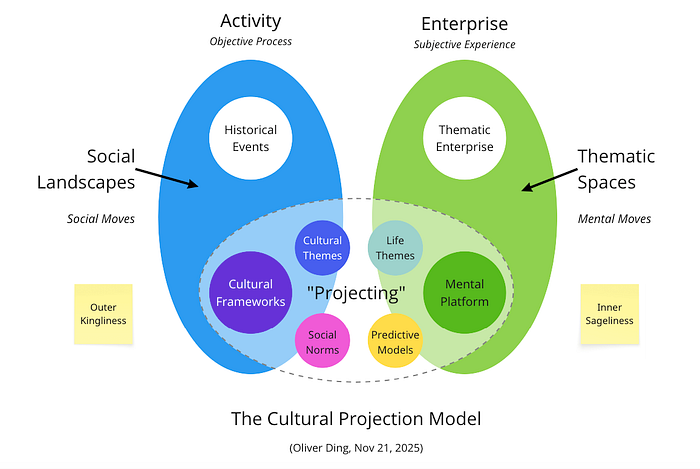
Moreover, the Cultural Project Model offers a set of operational concepts that together form a research framework capable of supporting this creative dialogue. Concepts such as Mental Platform, Predictive Models, Life Themes, Thematic Spaces, Mental Moves, Thematic Enterprise, and Subjective Experience belong primarily to the domain of “inner sageliness,” emphasizing the cultivation of mind, meaning-making, and internal organization. In contrast, concepts such as Cultural Frameworks, Social Norms, Cultural Themes, Social Landscapes, Social Moves, Historical Events, and Objective Processes correspond to the domain of “outer kingliness,” focusing on cultural structures, social action, and historical development — much as Confucianism has historically functioned in East Asia.
This creative dialogue suggests that the “Outside — Projecting — Inside” triad — as a basic ecological form — is a cross-cultural general structure of social formation. The “Activity as Project Engagement” principle can thus be understood as a general scientific principle describing how individuals and collectives move between positions in an activity or project. At the same time, the content of specific projects is shaped by local cultural–historical traditions, whether grounded in Western activity-theoretical thought or in East Asian Confucian philosophies of self-cultivation and social order.
Reference
- Weave the Concept: Mental Elements, Mental Models, and Mental Platform
- Life Discovery: The “Engagement as Projection” Principle
- Life Strategy: Moving between Thematic Spaces
- Knowledge Discovery: The “Events — Projects” Mapping
- Project Engagement (v2): Life, History, and Multiverse
- [Frame for Work] A Multi-layered Thematic Map and Project Engagement
- Cultural Frameworks: A Canvas for Reflection and Innovation
- Life Discovery: The “Present — Future” Fit and The ECHO Way
- The ECHO Way (v2.0)
- Projectivity as Cultural Attachance
Version 1.0 - November 29, 2025 - 8,781 words