
The Landscape of Anticipatory Cultural Sociology

A Situational Map
by Oliver Ding
January 5, 2026
On December 31, 2025, I released a possible book, Meta-frameworks: Creative Heuristics for Individual and Social Development (book, v1.0, 2025), to close a several-year journey of knowledge engagement.
A major by-product of the project is the History{Life[Self(Body)]} Framework (v3.0), which understands the social world as a nested AAS (Anticipatory Activity System). The book proposes that,
Cultural development, in this view, is a continuous, dynamic anticipatory activity of creating and curating concept systems and transforming them into thematic enterprises by weaving active agency and evolving structure within the social world.
This statement goes beyond the book, but covers a series of book drafts I wrote and curated in the past year.
Yesterday, I revisited an early note I wrote in April 2023. At that time, I read Ping-keung Lui's book Gaze, Actions, and the Social World (2007) and wrote 15 reading notes.
Chapter 8 of The Gaze is titled “The Conditionality of Social Structures: The Next Theoretical Task.” Its main content concerns the empirical reality and autonomy of social structures. Professor Lü argues that a “social structure” cannot possess empirical reality and autonomy unconditionally, but that it can, under certain conditions, temporarily possess—or nearly possess—them. This idea is referred to as the conditionality of social structures.
One of my notes reviewed Professor Lü’s discussion of empirical reality and autonomy, applying it to the Knowledge Engagement project and the Creative Life Theory project. In addition, starting from the theme of the next theoretical task, I also explored the potential of anticipatory sociology.
Now, that note appears as an early anticipation of my creative journey over the past six months. Interestingly, I framed the journey as the "closing" of my several-year journey on Knowledge Engagement, and the result as Creative Life Theory v3.1. If we detach the HLS framework from the Meta-frameworks project, it can be used as a large map of the social world, further curating my other frameworks together.
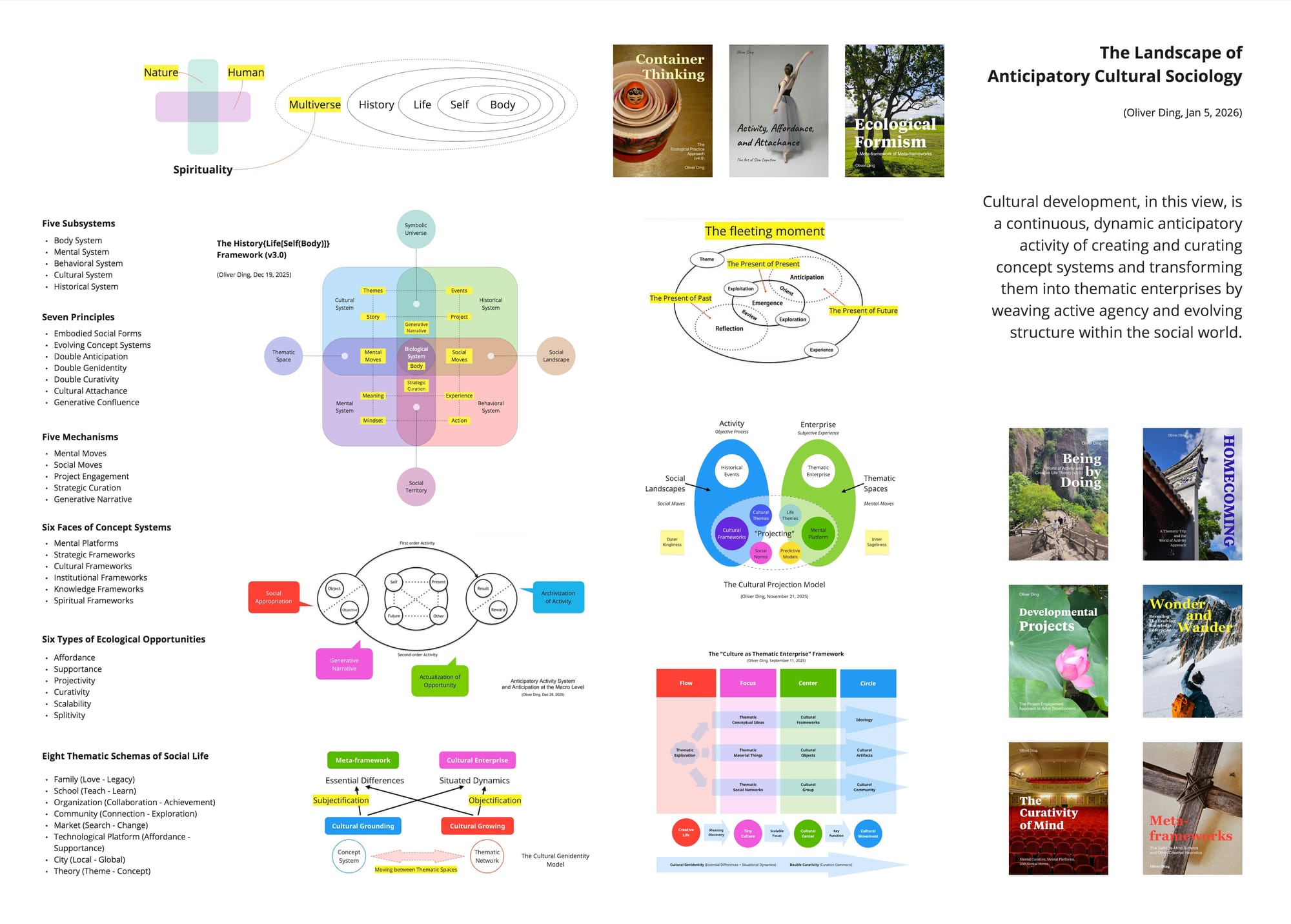
Today, I created a new diagram to curate the HLS Framework (v3.0) and other related frameworks, forming a new landscape of a thematic enterprise: Anticipatory Cultural Sociology.
This landscape (see the diagram below) echoes the early anticipation I made in April 2023.
The HLS framework was inspired by Robert Rosen’s Anticipatory System Theory, particularly his concepts of Natural Systems and Formal Systems. While Rosen's approach provides a systematic framework to understand life as an anticipatory system, it remains within the field of theoretical biology.
In 2021, drawing on Rosen’s distinctions and ideas from Activity Theory, I developed the Anticipatory Activity System (AAS) to understand adult life development. Later, in 2024, I developed the HLS framework, which conceptualizes the social world as a nested Anticipatory Activity System (AAS):
- Micro-AAS corresponds to the Mental System (Natural System).
- Macro-AAS corresponds to the Cultural System (Historical System).
For the Meta-frameworks project, the HLS framework provides a theoretical ontology of the social world, offering a structured context in which concept systems can be understood and mapped.
If we focus on the AAS framework, we see the strategic moves among three disciplines: Theoretical Biology, Theoretical Sociology, and Anticipatory Sociology.
- AS (1985) refers to Robert Rosen's Anticipatory System Theory, which belongs to Theoretical Biology
- AAS (2021) refers to the creative dialogue between my AAS framework and Lui's Theoretical Sociology, which occurred between 2022 and 2203.
- HLS (2025) refers to the landscape of Anticipatory Cultural Sociology, which should be situated within the field of Anticipatory Sociology.
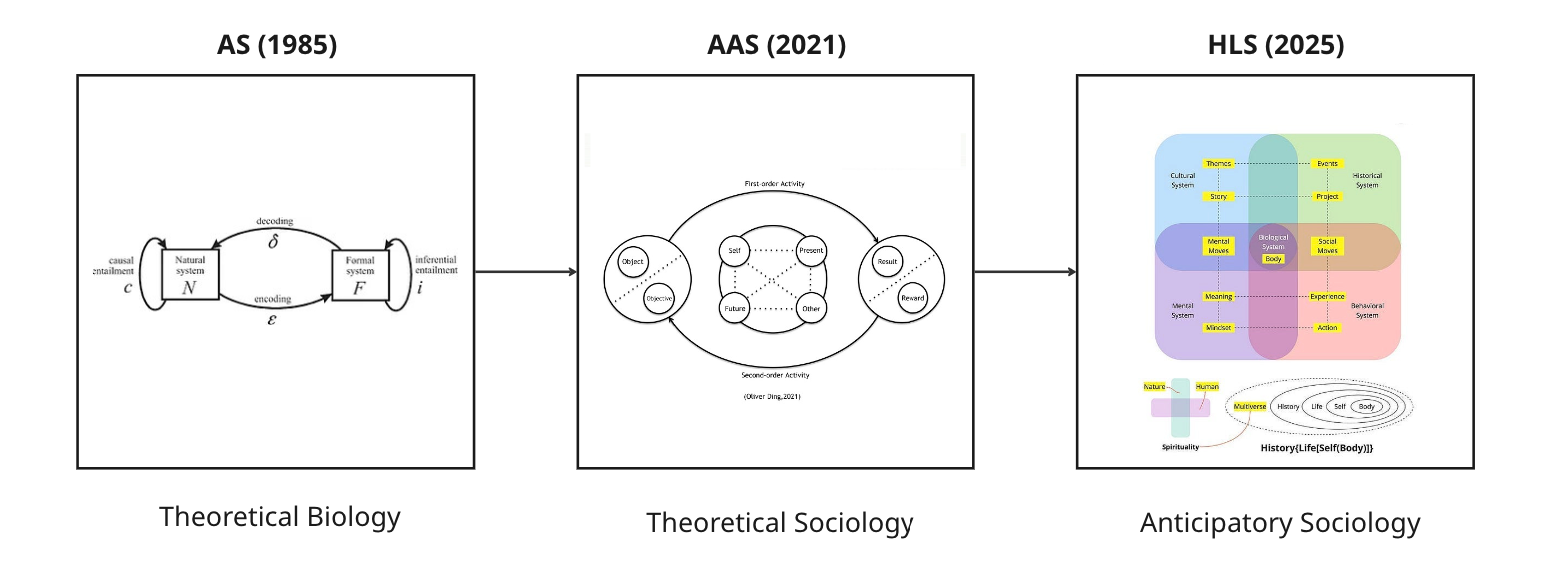
In this article, I share the story behind these moves from AAS to HLS, and the landscape of Anticipatory Cultural Sociology.
The Early Development of AAS (2021 to 2022)
In August 2021, I joined an adult development program as an advisor. The program was initiated by a young woman who is a friend of mine. The program was designed with three components: 1) Life Purpose Awareness, 2) Personal OKR Practice, and 3) Peer Review and Feedback. My friend also adopted the Building In Public approach to sharing her goals, challenges, progress, and discussions with others on social media platforms.
I discussed various themes related to the program with her for three weeks. On August 17, 2021, I realized that it was possible to develop a framework for reflecting on her project and our conversations.
I adopted the Anticipatory System Theory as the primary theoretical resource and used a meta-diagram to develop the early version of the AAS framework. See the diagram below.
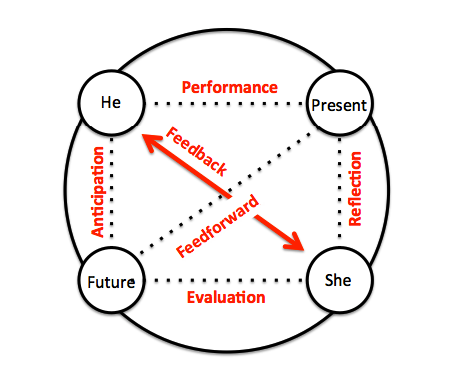
Originally, it was called iART framework. The name iART stands for i +Activity + Relationship + Themes.
In September 2021, I developed a new concept called "Second-order Activity" for applying Activity Theory to discussions of sustainable business development. The diagram of the Second-order Activity inspired me to reflect on the iART Diagram.
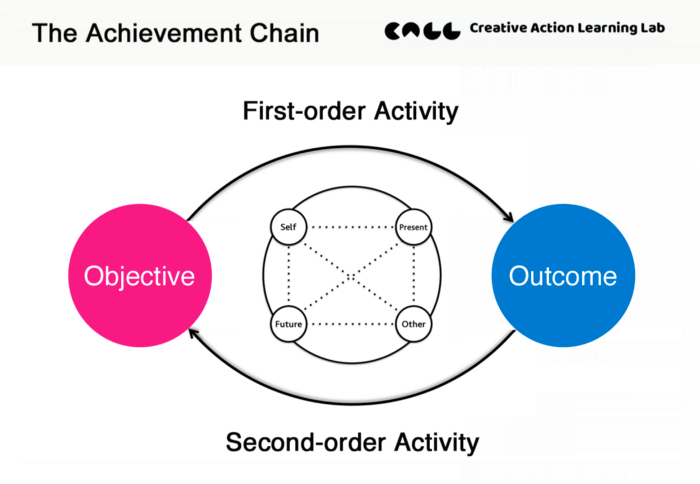
I realized that I could create a new diagram by blending:
Transactional Anticipatory System + Second-order Activity = Anticipatory Activity System
The result was a new framework with a new diagram:
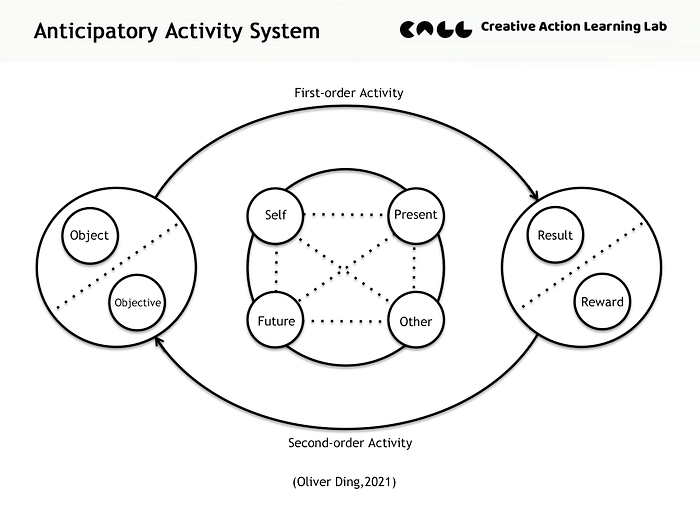
The new framework is suitable for thinking about the complex of “Self, Other, Present, and Future.” On September 15, 2021, I wrote an article titled D as Diagramming: Strategy as Anticipatory Activity System and started using a new name for the framework. Since the iART Framework was inspired by the Anticipatory System Theory, I named this new diagram Anticipatory Activity System.
From August 2021 to August 2022, I worked on developing the AAS framework and moving between different levels of abstraction. More details can be found in Slow Cognition: The Development of AAS (August 21, 2021 - August 26, 2022).
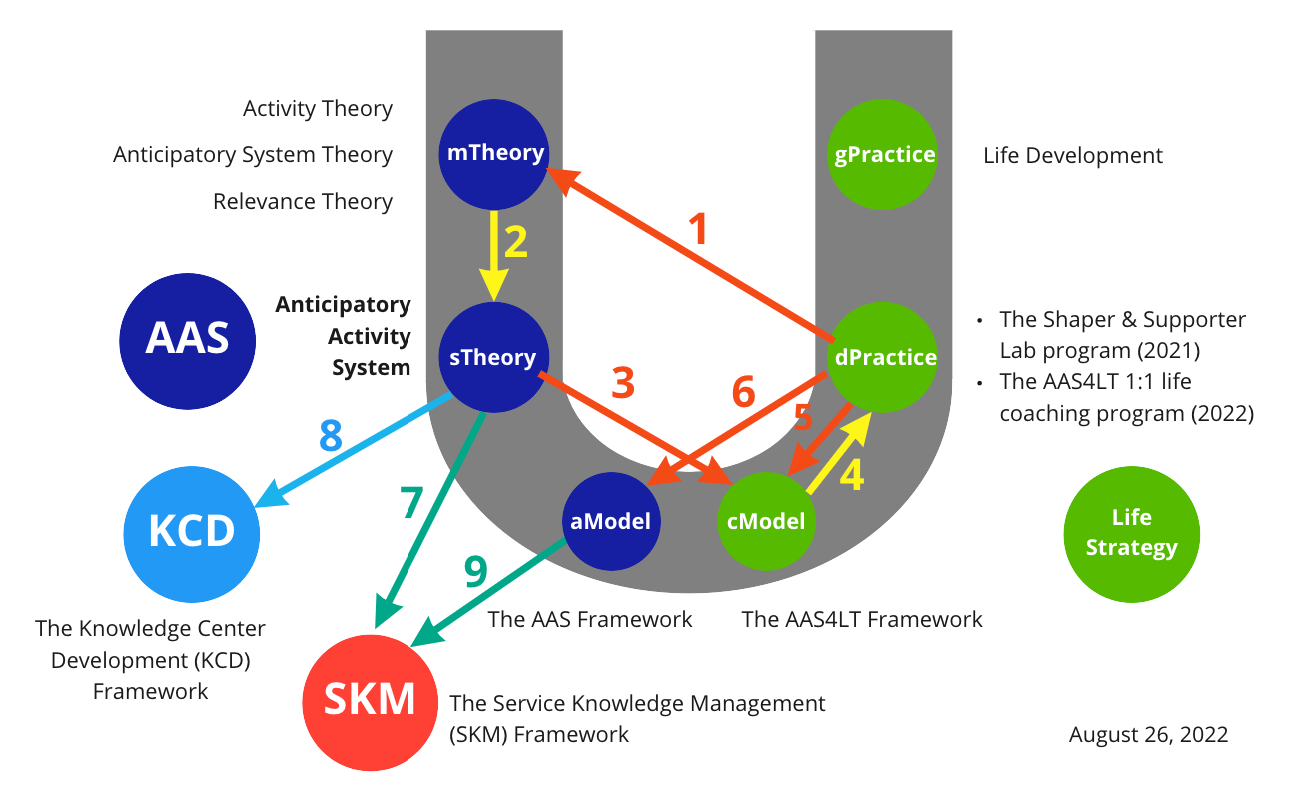
Later, in December 2022, I edited a possible book titled Advanced Life Strategy: Anticipatory Activity System and Life Achievements.
Meet with Theoretical Sociology (2022)
In April 2022, I contacted Ping-keung Lui, who is a theoretical sociologist. He was a Principal Lecturer (retired) at the Department of Applied Social Science at The Hong Kong Polytechnic University.
Lui aims to build a brand new theoretical sociology as a candidate for the paradigm of sociology. In 2007, Lui published a Chinese book titled Gaze, Action, and the Social World in which he presented his account of theoretical sociology. The fundamental starting point of his approach is an Ontology of action, which was inspired by Saint Augustine (354–430), Martin Heidegger (1889–1976), and Maurice Merleau-Ponty (1908–1961). See the statement below:
The body is in action, action is in the fleeting moment, the fleeting moment is in the body.
According to Lui, “This moment is Augustinian, it comprises at the same time the Present of the Past, the Present of the Present, and the Present of the Future. The actor Remembers in the present of the past, Pays Attention in the present of the present, Expects in the present of the future.” (p.235–236, 2010, The Scientific Project of Sociology)
The structure of Lui’s theoretical sociology is a nested structure. See the diagram below. According to Lui, “The realism comprises a subjectivist structuralism and an objectivist stock of knowledge, while the hermeneutics is an interpretation and an analysis. Second, I shall present an ontology that nests the realism within its boundaries.” (p.250, 2016, Aspects of Sociological Explanation)
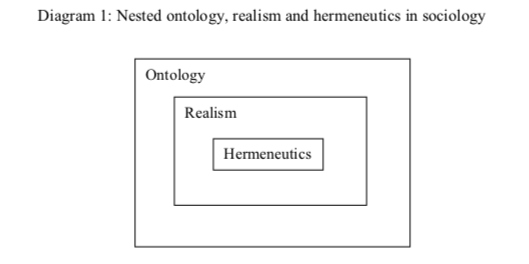
We should see this grand theory as a dialogue between philosophy and sociology because “Ontology” and “hermeneutics” are respectable terms in philosophy, but “realism” — sandwiched between them — is not. Lui emphasizes that Realism is the sociological matter proper (p.251, 2016, Aspects of Sociological Explanation).
It can perhaps be said to be the apple in the scientist’s eye,138 though the term “realism” may sound naïve to the phenomenological ear. It is much closer to “what is” than “what is the meaning of”.
In a certain sense, science is always naïve though not simple. With the freedom of imagination being exercised by the scientist to its fullest, it presupposes in the first instance that there is really a reality out there, at least in the Schutzian sense, that is, the reality is often “taken- for-granted”, “questionable but unquestioned.” The presupposition may be naïve, but its buttresses are not. The sociologist—who should be a scientist more than a philosopher—relies on empirical (or positivistic) investigations to buttress his discipline.
Lui considers the following four realities for the grand theory:
- the Weberian course of action
- the Giddensian course of action
- Social Territory
- Symbolic Universe
The Realism is determined by the Ontology. According to Lui, “I made a distinction between action and its course; that is, action is not a reality but its course is. My justification is based on a fundamental ontology.” (p.251, 2016)
The Realism leads to the Hermeneutics which considers two parts: the actors’ interpretation and the researcher’s analysis.
The whole structure of the grand theory is represented by the following semiotic system.
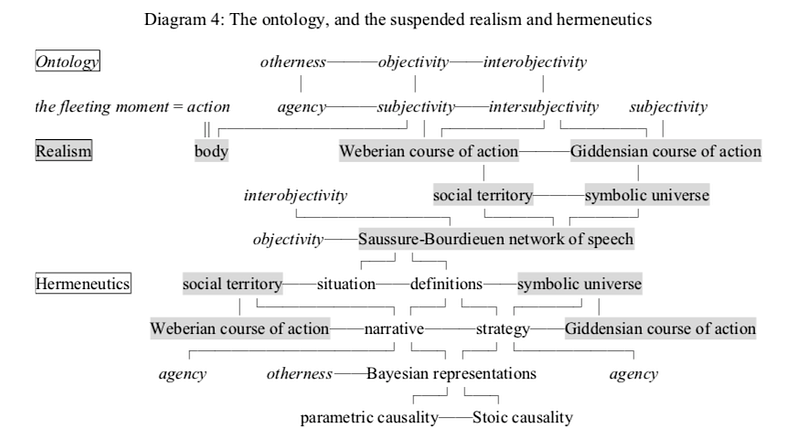
In October 2022, I discussed the connection between the AAS and Lui's theoretical sociology with Lui via email.
“Anticipatory Activity System” is a specific theory inspired by Activity Theory, Anticipatory System theory, Relevance theory, etc. It defines the basic model of the AAS framework:
- First-order Activity / Second-order Activity
- The Anticipation — Performance Complexity
- The Self-Other Relevance
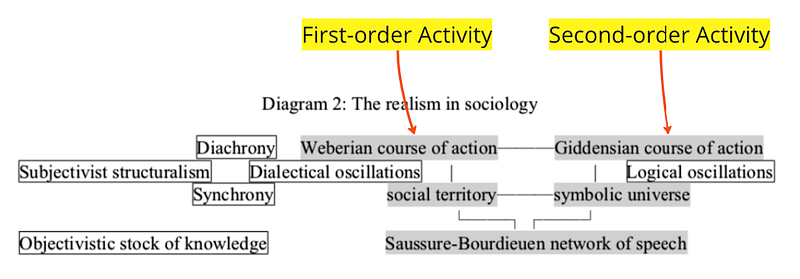
I found that the AAS framework echoes Lui's Realism. See the diagram below.
An Anticipatory Activity System is a self-referential system, and it has two parts:
- First-order Activity
- Second-order Activity
My original idea was that Second-order Activity determines First-order Activity.
I also use First-order Activity to refer to “work,” “production,” and “exploitative activity.” This notion echoes traditional Activity Theory, which is inspired by the Marxist theory of “work” and “production.”
Second-order Activity is more about “play,” “discovery,” and “exploratory activity.” This notion of Second-order Activity goes beyond the scope of the traditional Activity Theory.
Lui’s grand theory does not use “activity” as a theoretical concept. The basic unit of his approach is “the course of action.” According to Lui, there are two types of courses of action:
- The Weberian course of action: In actual intervention, the actor does not necessarily remember (in the present of the past) nor expect (the present of the future), but he must pay attention (in the present of the present).
- The Giddensian course of action: In contemplation of intervention, however, he does not need to pay attention, though he must remember and/or expect.
These two types of Course of Action are located in the part of Realism in Lui’s approach.
I roughly consider First-order Activity to echo the Weberian course of action, while Second-order Activity echoes the Giddensian course of action.
I use the term “echo,” not the word “equal,” because I am not claiming that the AAS framework is an application of Lui’s theoretical sociology.
More details can be found in Slow Cognition: Three Paths of Creative Life and A Semiotic System.
The Seed of HLS (2023)
On September 9, 2023, I wrote an article titled Knowledge Engagement: The Concept of Mindset and Theoretical Integration. I did a demo of theoretical integration by curating Carol S. Dweck’s version of Mindset theory and Peter Gollwitzer’s version of Mindset theory together. The outcome was the Mental Tuning framework.
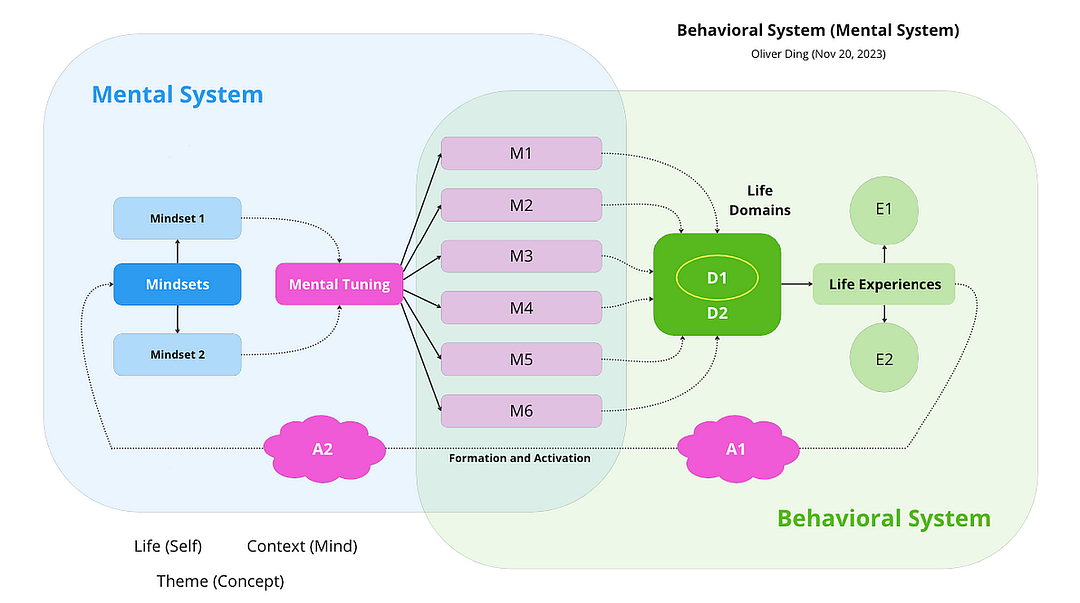
The Mental Tuning Framework is inspired by Robert Rosen’s Anticipatory Systems Theory.
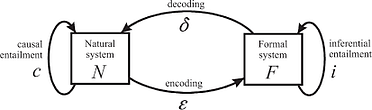
The above diagram is the basic model of Anticipatory Systems Theory. I applied this model to the analysis of behavioral and mental systems:
- Life = Behavioral System = Natural System
- Self = Mental System = Formal System
A core idea of Anticipatory System Theory is the Predictive Model. According to Robert Rosen, “An anticipatory system is a natural system that contains an internal predictive model of itself and of its environment, which allows it to change state at an instant in accord with the model’s predictions pertaining to a later instant.” In contrast, a reactive system only reacts, in the present, to changes that have already occurred in the causal chain, while an anticipatory system’s present behavior involves aspects of past, present, and future.
For the project about Mindset, I claim that Mindset is the Predictive Model of Behavioral System (Mental System).
- Life = Behavioral System = Natural System
- Self = Mental System = Formal System
- Mindset = Predictive Model
More details can be found in Four Mindsets of Knowledge Engagement and “AAI as Mental Tuning”.
This model was later called the Micro Anticipatory Activity System (Micro AAS). It doesn’t refer to two separate systems, but to a whole with two subsystems.
Version 1.0 of the HLS Framework (2024)
In April 2024, I worked on developing the Evolving Knowledge Enterprise Model. After using the model to map the landscape of the Life Strategy Center, I featured the Behavioral System (Mental System) Model on the map.
Later, I expanded the model by adding the “Cultural System — Social System” module. The new model was renamed the Life(Self) Framework.
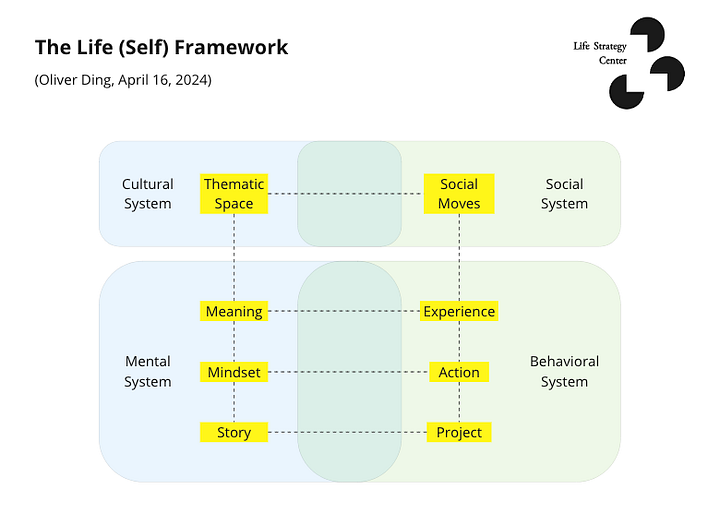
Two days later, building on the Life (Self) Framework, I developed version 1.0 of the History[Life(Self)] Framework. See the diagram below.
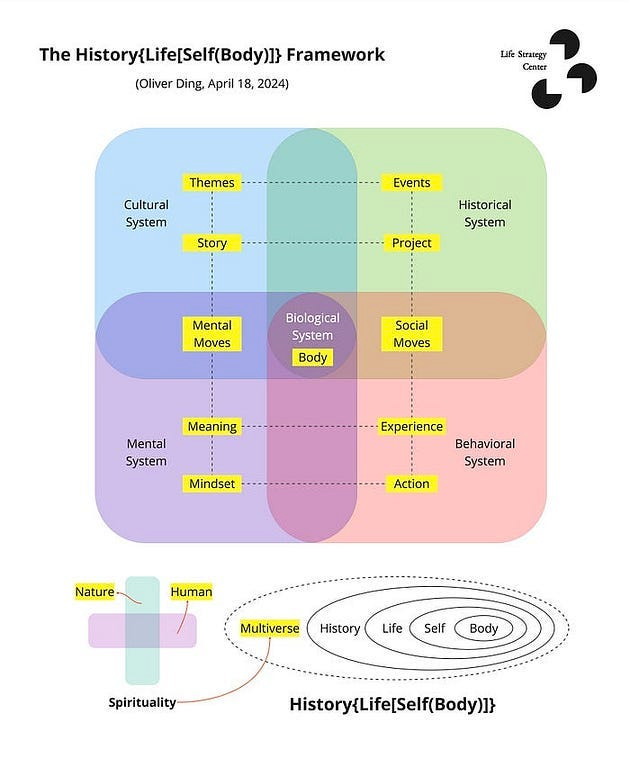
The HLS (v1.0) Framework defines a nested system with five units of analysis: body, self, life, history, and multiverse.
Version 2.0 of the HLS Framework (2024)
On December 26, 2024, I created the Advanced Life Strategy Toolkit (v2, Dec 2024) and edited a book draft titled Strategy as Curation to collect articles about the toolkit.
The toolkit features six models, including the History {Life[Self(Body)])} framework (v1.0), serving as the ontological foundation of v2.0 of Advanced Life Strategy.
The next day, I added four theoretical concepts to the framework and created its v2.0. See the diagram below.
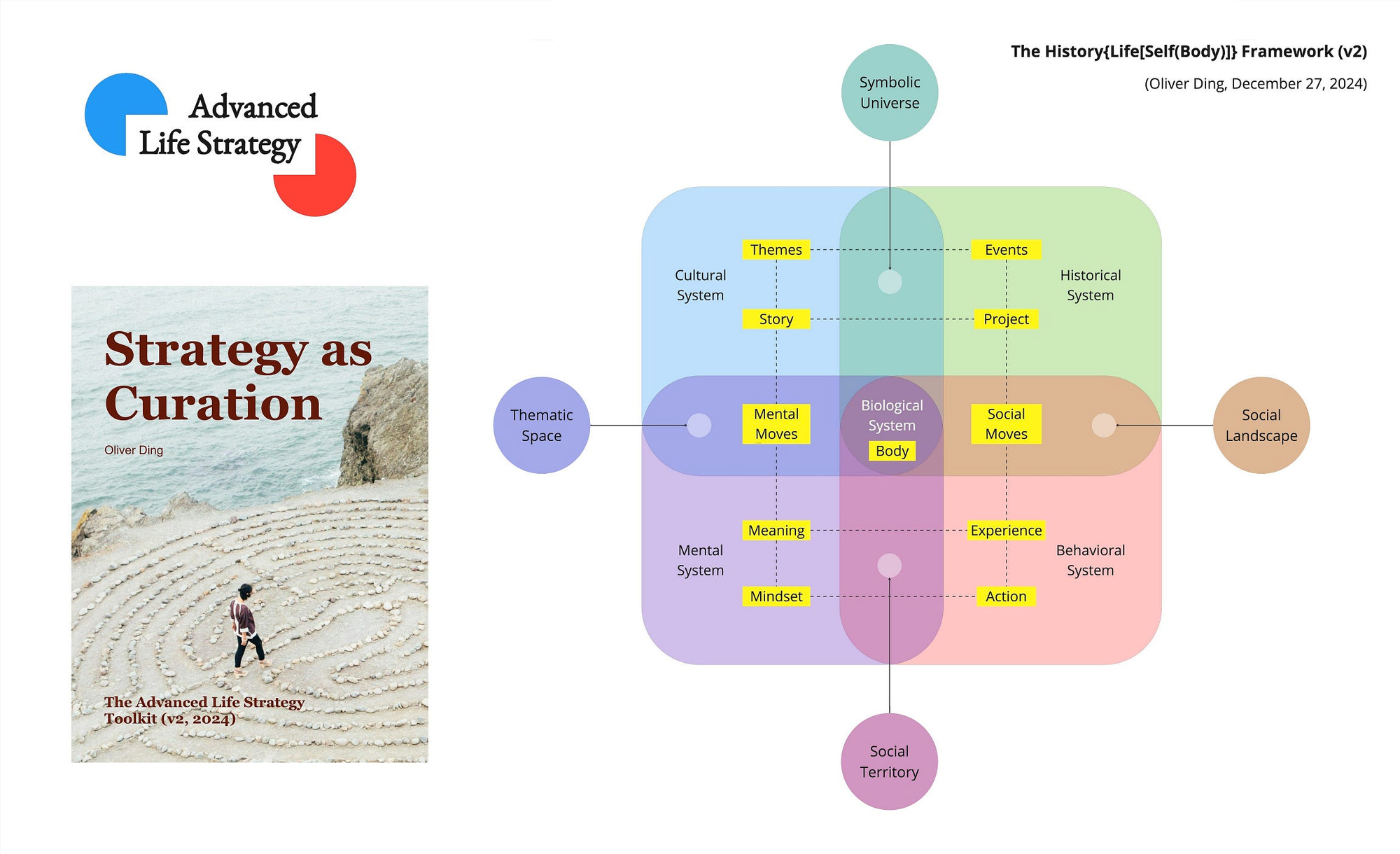
- Symbolic Universe
- Social Territory
- Social Landscape
- Thematic Space
Symbolic Universe and Social Territory come from Lui’s Subjectivist Structuralism. I have followed Lui’s work for many years, and his Subjectivist Structuralism has greatly influenced my Creative Life Theory and guided my research on Knowledge Centers.
The other two terms — Social Landscape and Thematic Space — were developed during various projects I worked on between 2023 and 2024.
The result is a meta-framework for understanding the Social World that integrates actors’ subjective experiences, mindsets, and meanings. It also offers a perspective that connects sociology and psychology as complementary disciplines within the same theoretical family.
The framework was inspired by Robert Rosen’s Anticipatory System Theory, especially his ideas on Natural Systems and Formal Systems.
It sees the social world as a nested Anticipatory Activity System (AAS).
- The Micro AAS corresponds to the Mental System (Natural System).
- The Mega AAS corresponds to the Cultural System (Historical System).
Moreover, the Advanced Life Strategy toolkit (v2) claims that actors not only take actions but also curate their actions into a meaningful whole, such as projects, journeys, landscapes, etc. The Curativity of Actions is behind the Micro AAS.
On a broader scale, both the Cultural and Historical Systems are emergent and curated. The Curativity of Actions also operates behind the Mega AAS.
This Double Curativity and its implications reveal a hidden secret of human life.
More details can be found in Strategy as Curation: The Meaning of the Social World and Its Consequences.
The HLS Framework (v3.0) and the Meta-Frameworks Project (2025)
In December 2025, I worked on the Meta-frameworks project. On December 19, 2025, I added two theoretical concepts to the HLS framework and released its version 3.0.
The two new concepts are Generative Narrative and Strategic Curation.
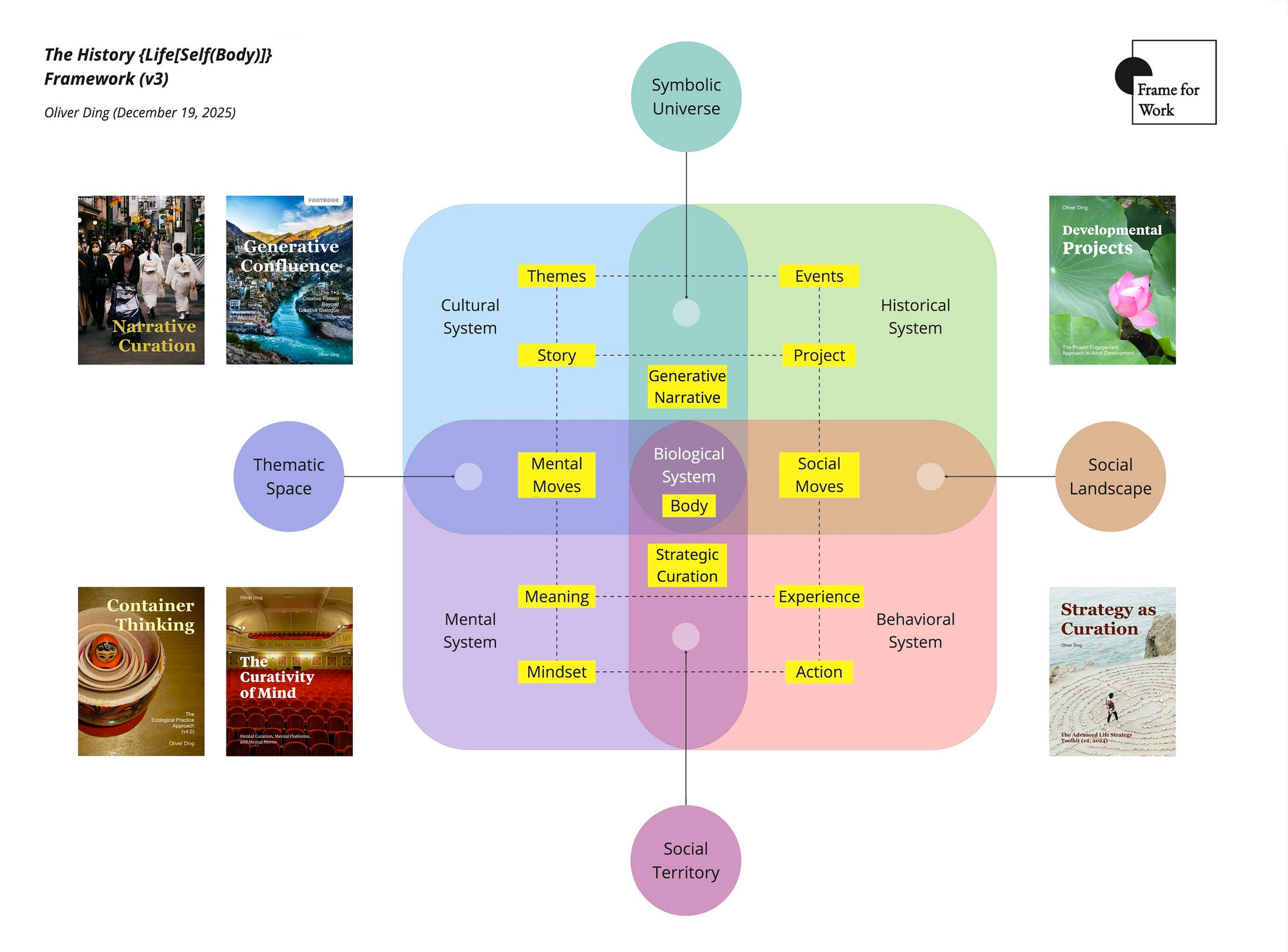
I also feature book drafts and articles I finished in 2025 as references for concepts within the framework.
For example, in November 2025, I finished a book draft titled Developmental Projects, which offers a systematic approach to understanding projects at the “Historical System” thematic space.
In December 2025, I finished a book draft titled The Curativity of Mind, which introduced a framework to understand Mind-in-Context, featuring themes such as Mental Curation, Mental Platforms, and Mental Moves.
Moreover, I also wrote several articles that are relevant to cultural innovation, such as Narrative Curation and Generative Confluence, offering a foundation for developing the “Generative Narrative” concept.
More details can be found in The History{Life[Self(Body)] } Framework (v3.0)— Part 1: The Historical Development.
The Landscape of Anticipatory Cultural Sociology (2026)
The basic ideas of the landscape of Anticipatory Cultural Sociology (ACS) are introduced in Weave the Culture: One Meta-Framework and Four Mechanisms of Cultural Development. However, there are two differences: one is that the article only served the Meta-frameworks project, so it only emphasizes four mechanisms, which refer to the main body of the book. For the ACS project, I added "Project Engagement" as a new mechanism. The other difference is the scope: while the article focuses on the Meta-frameworks book, the ACS project considers six book drafts as its main body.
The ACS project adopts the HLS framework to understand the social world through a five-system lens:
- Body System
- Mental System
- Behavioral System
- Cultural System
- Historical System
For the ACS project, the HLS framework provides a theoretical ontology of the social world, offering a structured context in which concept systems can be understood and mapped.
Building on the map, I further defined the Six Faces of Concept System:
- Knowledge Frameworks
- Mental Platforms
- Strategic Frameworks
- Cultural Frameworks
- Institutional Frameworks
- Spiritual Frameworks
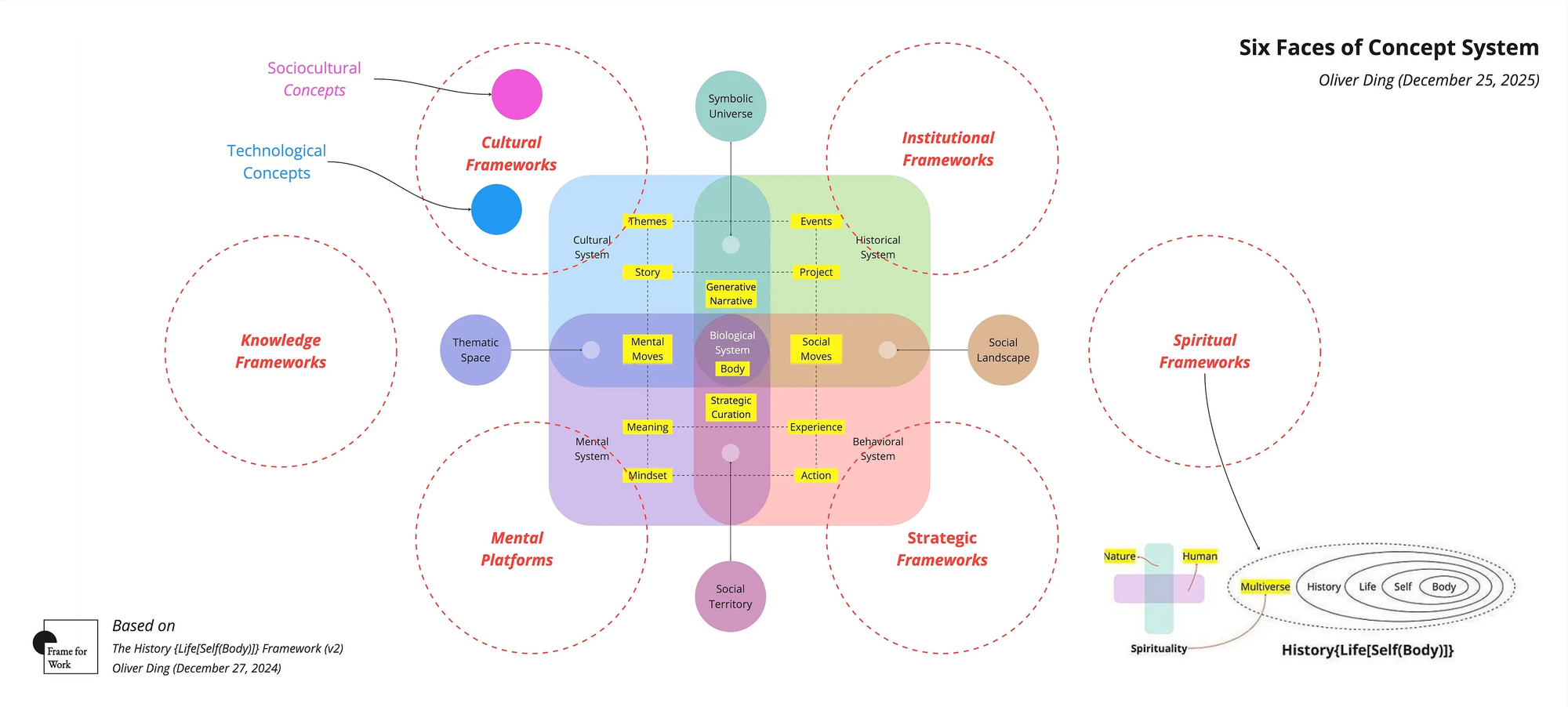
In the middle of the diagram, four mappings are observed between four faces of the concept system and four core systems of the social world:
- Mental Platforms — Mental System
- Strategic Frameworks — Behavioral System
- Cultural Frameworks — Cultural System
- Institutional Frameworks — Historical System
Outside this central area, two types of concept systems — Knowledge Frameworks and Spiritual Frameworks — do not correspond directly to the core map of the social world. Their displacement toward the extreme poles of truth and meaning will be discussed in Part 3.
These mappings also reveal that two models share the same deep structure. The HLS Framework is a nested Anticipatory Activity System (AAS) structure: the Behavioral System (Mental System) represents the micro-AAS, while the Historical System (Cultural System) represents the macro-AAS. The micro-AAS corresponds to individuals, and the macro-AAS to collective society.
At the individual level, Mental Platforms belong to people, serving as the source of Strategic Frameworks, which target particular creative enterprises composed of a series of developmental projects.
At the collective level, Cultural Frameworks belong to social groups, while Institutional Frameworks emerge as evolving outcomes of Cultural Frameworks. In other words, past generations of Cultural Frameworks serve as the source of present Institutional Frameworks.
While Institutional Frameworks represent the crystallized history of human activity, Spiritual and Knowledge Frameworks represent the anticipatory horizon, pushing the Cultural System beyond its current limits.
Concept systems at individual and collective levels can influence each other. Individuals may adopt Cultural Frameworks to develop their Mental Platforms, while publicly shared Mental Platforms can contribute to new Cultural Frameworks. Similarly, some Institutional Frameworks can inspire Strategic Frameworks, and shared Strategic Frameworks can become part of Institutional Frameworks.
In Weave the Culture: One Meta-Framework and Four Mechanisms of Cultural Development, seven foundational principles are introduced to establish a meta-framework for understanding cultural innovation:
- Embodied Social Forms
- Evolving Concept Systems
- Double Anticipation
- Double Genidentity
- Double Curativity
- Cultural Attachance
- Generative Confluence
Building on this foundation, the article maps three pathways that connect individual creative life with collective cultural movements and synthesizes these insights into an operational toolkit with three specialized modules.
Finally, the CAS project suggests five dynamic mechanisms — Mental Moves, Social Moves, Project Engagement, Strategic Curation, and Generative Narrative — that drive cultural innovation.
Cultural development, in this view, is a continuous, dynamic anticipatory activity of creating and curating concept systems and transforming them into thematic enterprises by weaving active agency and evolving structure within the social world.
Six Primary Models of Anticipatory Cultural Sociology
The Landscape of Anticipatory Cultural Sociology featured six meta-frameworks.
- The Path of Creative Life and the Fleeting Moment
- The HLS Framework (v3.0)
- The Cultural Projection Model (2025)
- The AAS Framework (2021, 2022, 2024, 2025)
- The Cultural Genidentity Model (2025)
- The Culture as Thematic Enterprise Framework (2025)
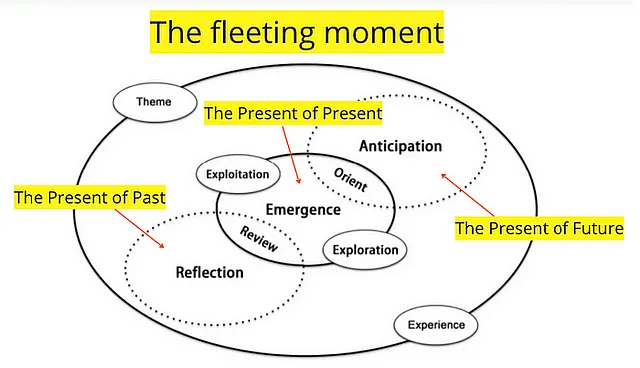
The Fleeting Moment model draws inspiration from theoretical sociologist Ping Keung Lui’s 2002 book Gaze, Action, and the Social World. Lui’s approach begins with an ontology of action, influenced by Saint Augustine (354–430), Martin Heidegger (1889–1976), and Maurice Merleau-Ponty (1908–1961). Lui expresses this concept through the statement :
The body is in action, action is in the fleeting moment, the fleeting moment is in the body.
According to Lui, “This moment is Augustinian, it comprises at the same time the Present of the Past, the Present of the Present, and the Present of the Future. The actor Remembers in the present of the past, Pays Attention in the present of the present, Expects in the present of the future.” (p.235–236, 2010, The Scientific Project of Sociology)
More details can be found in Mapping Strategic Moves #6: Before, Role Models, and After and Mapping Strategic Moves #16: The Strategic Life Development Toolkit.
The HLS Framework (v3.0) is a nested structure of the social world, in which the body system is the core, and echoes the Fleeting Moment model. As discussed above, the HLS Framework is not a simple typology of five subsystems, but a well-designed structure because they from two AAS: micro AAS and macro AAS. Moreover, as a map of the social world, I employ three pathways to weave a series of concepts together, mapping the journey of Cultural Development:
- The Individual Pathway: Mental Platform + Strategic Frameworks → Strategic Curation → Objective — Object Fit → Achievement Chain → Thematic Enterprise → Tiny Culture
- The Collective Pathway: Cultural Frameworks + Institutional Frameworks → Generative Narrative → Sociocultural — Technological Fit → Event Chain → Social Movement → Mega Culture
- The Connecting Bridge: Project Engagement: Outside, Projecting, and Inside → Mental Platforms + Cultural Frameworks → Events + Projects → Mental Moves + Social Moves → Enterprise + Activity →Life Themes + Cultural Themes → Life + History
The Cultural Projection Model (2025) serves as the connecting bridge, facilitating the flow between the “Inside” (Subjective Enterprise) and the “Outside” (Objective Activity).
- It utilizes Project Engagement as the primary unit of analysis.
- By transforming Events into Projects (and vice versa), this module explains how individual energy is channeled into social structures.
- It bridges the gap between Life Themes and Cultural Themes, making personal meaning socially relevant.
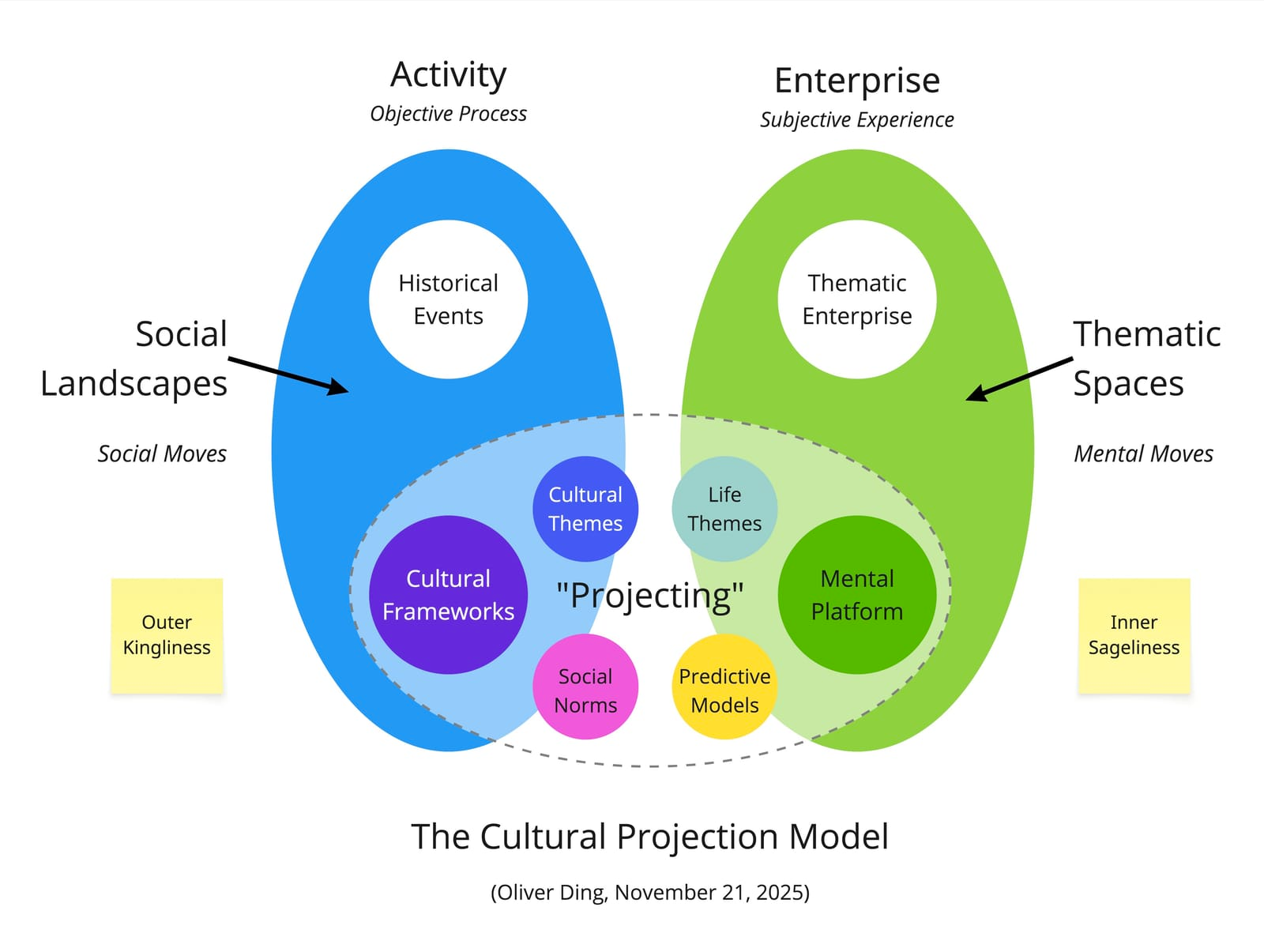
Concept systems are all involved in the project engagement process. More details can be found in The Cultural Projection Model (2025).
The AAS Framework (2021, 2022, 2024, 2025) has developed a series of sub-frameworks for the Advanced Life Strategy Toolkit. One of them is the nine aspects of strategic agency:
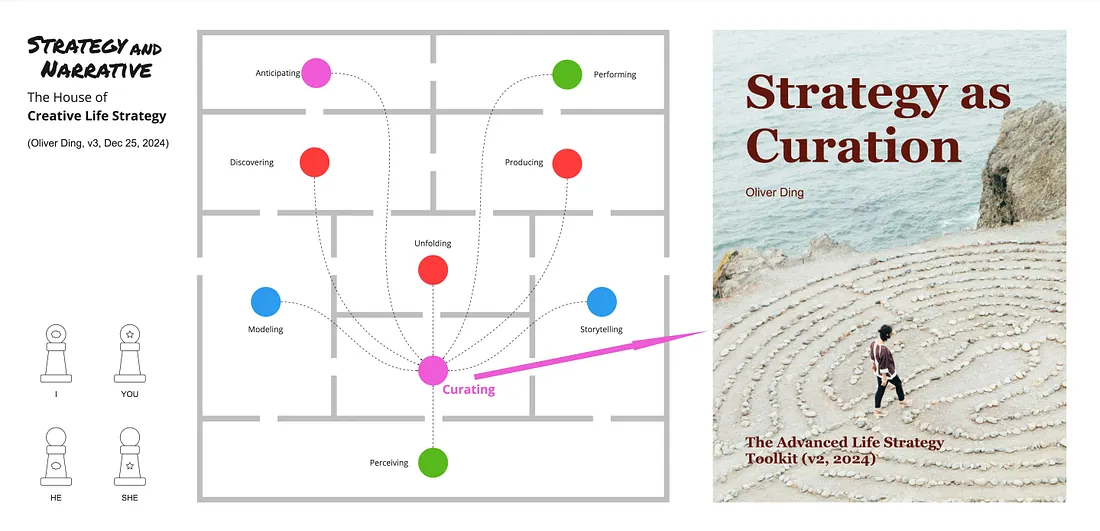
- Anticipating
- Performing
- Discovering
- Producing
- Modeling
- Unfolding
- Storytelling
- Curating
- Perceiving
More details can be found in The Journey of Strategic Life Theory (V1, 2025) and its Landscape and Advanced Life Strategy: Anticipatory Activity System and Life Achievements (Book).
The Cultural Genidentity Model refers to the Double Genidentity principle:
The primary focus of Social Life Development is the Genidentity of Things, while the primary focus of Creative Life Development is the Genidentity of Creative Life.
A creative person’s Genidentity is defined by the Project Engagement process, which involves growing a creative enterprise’s Genidentity by integrating experiences from Themes of Practice and Activities of Identity.
The model centers on the following four concepts:
- Cultural Grounding → Cultural Growing
- Meta-framework → Cultural Enterprise
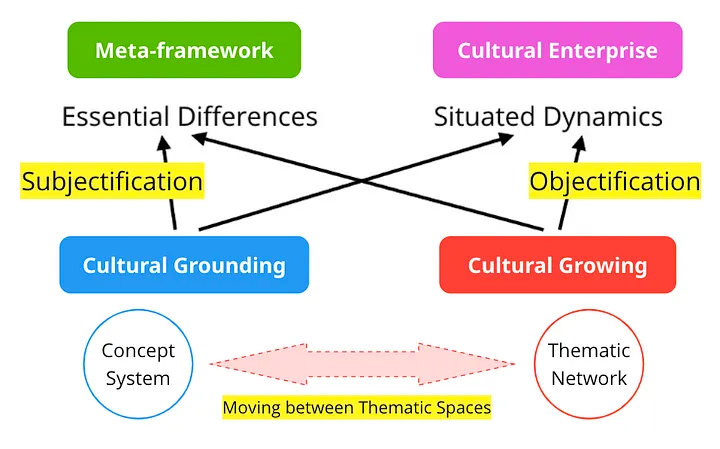
Cultural Creators are responsible for Cultural Grounding, while Cultural Supportors are responsible for Cultural Growing.
This model also highlights the Meta-framework and Cultural Enterprise. The former refers to the Essential Differences of a Thematic Enterprise, while the latter refers to the Situated Dynamics.
These ideas were later further developed into Thematic Enterprise Theory.
On September 11, 2025, I designed a new knowledge framework that completely articulates my thoughts on “Culture as Thematic Enterprise,” which I developed from June to September. See the diagram below.
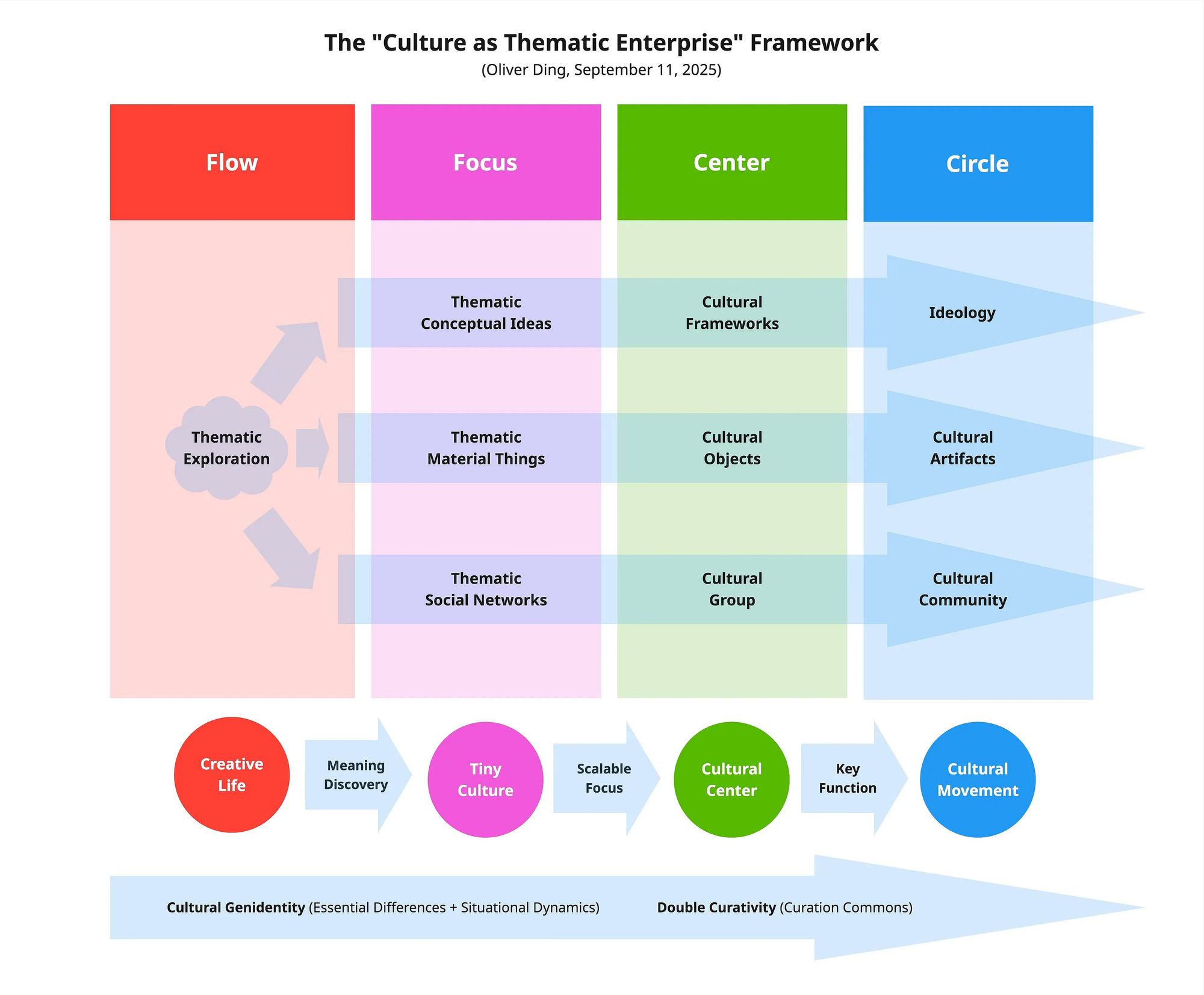
The framework illustrates how individual creative exploration naturally evolves through stages: Creative Life (meaning discovery) → Tiny Culture (scalable focus) → Cultural Center (key function) → Cultural Movement. Each stage has independent value, with evolution happening organically rather than by design.
Two foundational elements support this process: Cultural Genidentity (essential differences + situational dynamics) and Double Curativity (curation commons) — ensuring both uniqueness and continuity across cultural forms.
Nine Featured Possible Books
The Landscape of Anticipatory Cultural Sociology also features nine possible books, which are drafts that have not been published yet. All the above models and ideas are documented in these book drafts.
These book drafts are divided into two groups.
The first group is about meta-thinking behind the ACS project. It introduces the Ecological Practice Approach, including Container Thinking, Attachance Theory, and Ecological Formism.
- Container Thinking: the Ecological Practice Approach (June 23, 2025)
- Activity, Affordance, and Attachance: The Art of Slow Cognition (Jan 9, 2025)
- Ecological Formism: A Meta-Framework of Meta-Frameworks (Nov 7, 2025)
The second group is about the core of the ACS project. It introduces models of the Life(Self), the Context(Mind), the Social Moves(Mental Moves), the Narrative Curation, the Activity(Enterprise), and the History(Culture).
- Being by Doing: World of Activity and Creative Life Theory (v3.0) - Sept 20, 2025
- Homecoming: A Thematic Trip and the World of Activity Approach - Sept 7, 2025
- Developmental Projects: The Project Engagement Approach to Adult Development - Nov 30, 2025
- Wonder and Wander: Revealing The Evolving Knowledge Enterprise - June 13, 2025
- The Curativity of Mind: Mental Curation, Mental Platforms, and Mental Moves - Dec 13, 2025
- Meta-frameworks: Creative Heuristics for Individual and Social Development (V1.0) - Dec 31, 2025
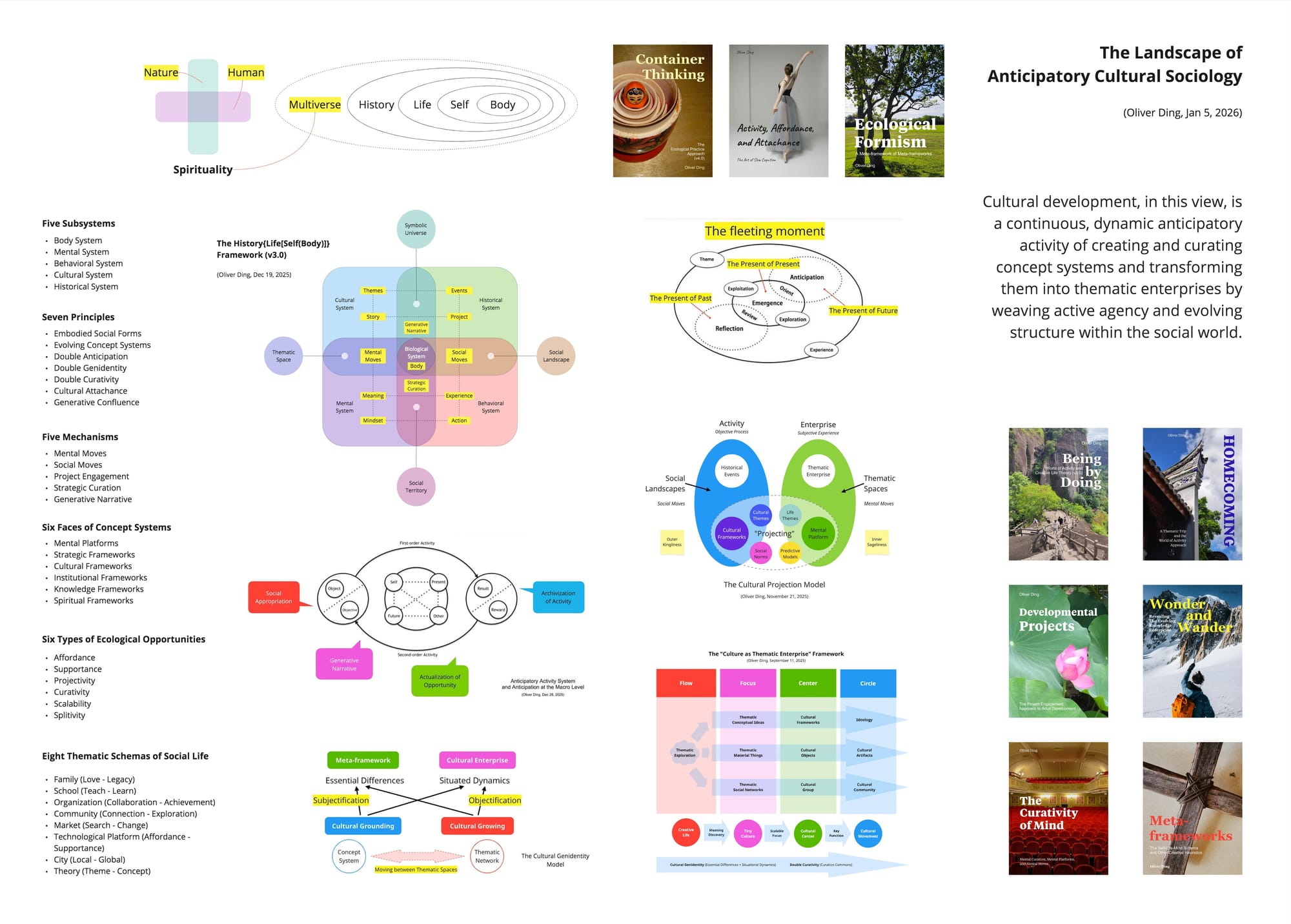
The Landscape of Anticipatory Cultural Sociology also features six types of ecological opportunities and eight thematic schemas of social life. More details can be found in the links below:
- The Weave-the-Whole Framework: the Network-Container-Platform Schema and Ecological Opportunities
- The “Difference — Conversion — Opportunity” Schema
- Social Group and Primary Meta-frameworks
During the 2024 Christmas holiday, I had a reflective conversation with Lui, revisiting my work on HELLO THEORY, GO Theory, and the Strategic Life Narrative project. Through this reflection, I realized my newest focus had shifted toward Cultural Life Development, marking a detachment from Individual Life Development. This strategic move was encapsulated in the theme of “Cultural Grounding/Cultural Growing.”
Over the past 12 months, while I worked on closing my multi-year journey of Knowledge Engagement and Individual Life Development — culminating in Creative Life Theory v3.1 — I simultaneously unfolded a new journey of Cultural Development.
Now the new journey has an official name.
v1.0 - January 5, 2026 - 4,433 words