
The Landscape of Anticipatory Cultural Sociology (v2.0)
This is the introduction of a new possible book, Anticipatory Cultural Sociology: Creation, Projection, and Agency.
by Oliver Ding
March 24, 2026
1. From v1.0 to v2.0: An Overview
Landscape of Anticipatory Cultural Sociology (ACS) v1.0, established on January 5, 2026, curated six meta-frameworks into a unified landscape, grounded in the ontological foundations of the World of Life and the HLS Framework. It anchored ACS as a creative center — defining what cultural development is and specifying the principles and mechanisms through which it unfolds.
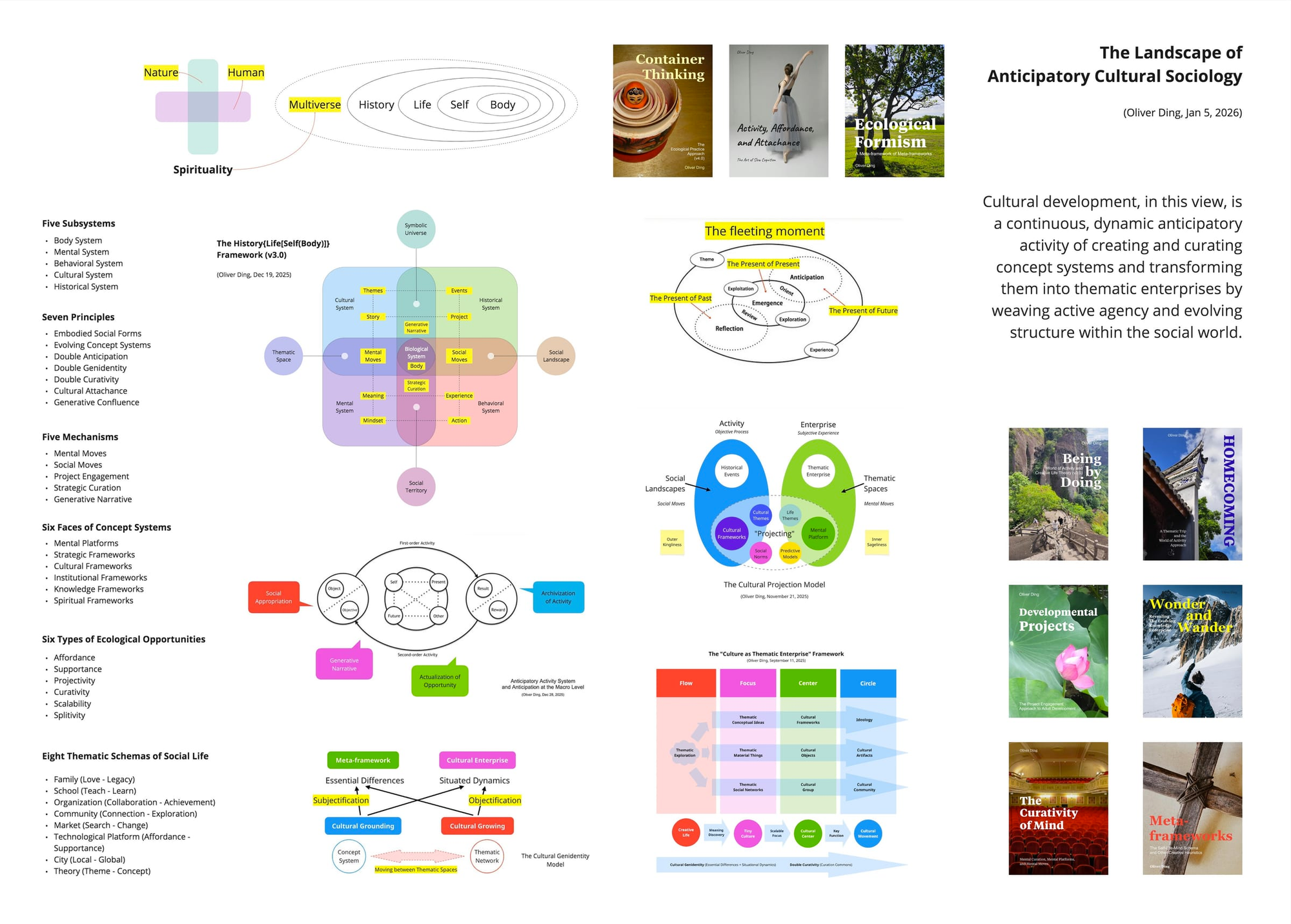
What v1.0 established was a center. What followed — across January, February, and March 2026 — was its expansion. Three axes of development advanced simultaneously: Thematic Creation, Cultural Projection, and Bureaus of Agency. A fourth development arrived through reflection: the Self–Other dimension, present in the foundations but not yet explicitly developed, was named and assigned to SDP's Supportive Life Discovery axis, while its traces within ACS were recognized and gathered. And a fifth arrived unexpectedly: as the landscape reached completion at v1.2, a model of the actor emerged from the structure itself.
ACS v2.0 marks a qualitative transition. The jump from v1.x to v2.0 is not incremental — it reflects the arrival of a complete model of the actor, the integration of the Self–Other dimension, and a structural realignment between ACS and its mirror enterprise, Strategic Developmental Psychology (SDP). The landscape that began as a map of cultural development has become, simultaneously, a portrait of the cultural actor who inhabits it.
This document introduces what is new in v2.0. Readers already familiar with v1.0 — its seven principles, five mechanisms, six faces of concept systems, and six types of ecological opportunities — will find here the developments that extend and complete that foundation.
2. The ACS v2.0 Symbol: One Culture, Many Projects
ACS v1.0 was a curation of meta-frameworks — a landscape that brought together six major frameworks under a shared ontological foundation. What it established was breadth and coherence at the meta level. What it did not yet provide were more operationally specific knowledge frameworks at finer levels of abstraction, nor a coordination mechanism that could articulate how the different parts of the landscape relate and work together. Precisely these two needs have driven the development from v1.0 to v2.0: building out the operational layer and establishing the coordination structure that holds it together.
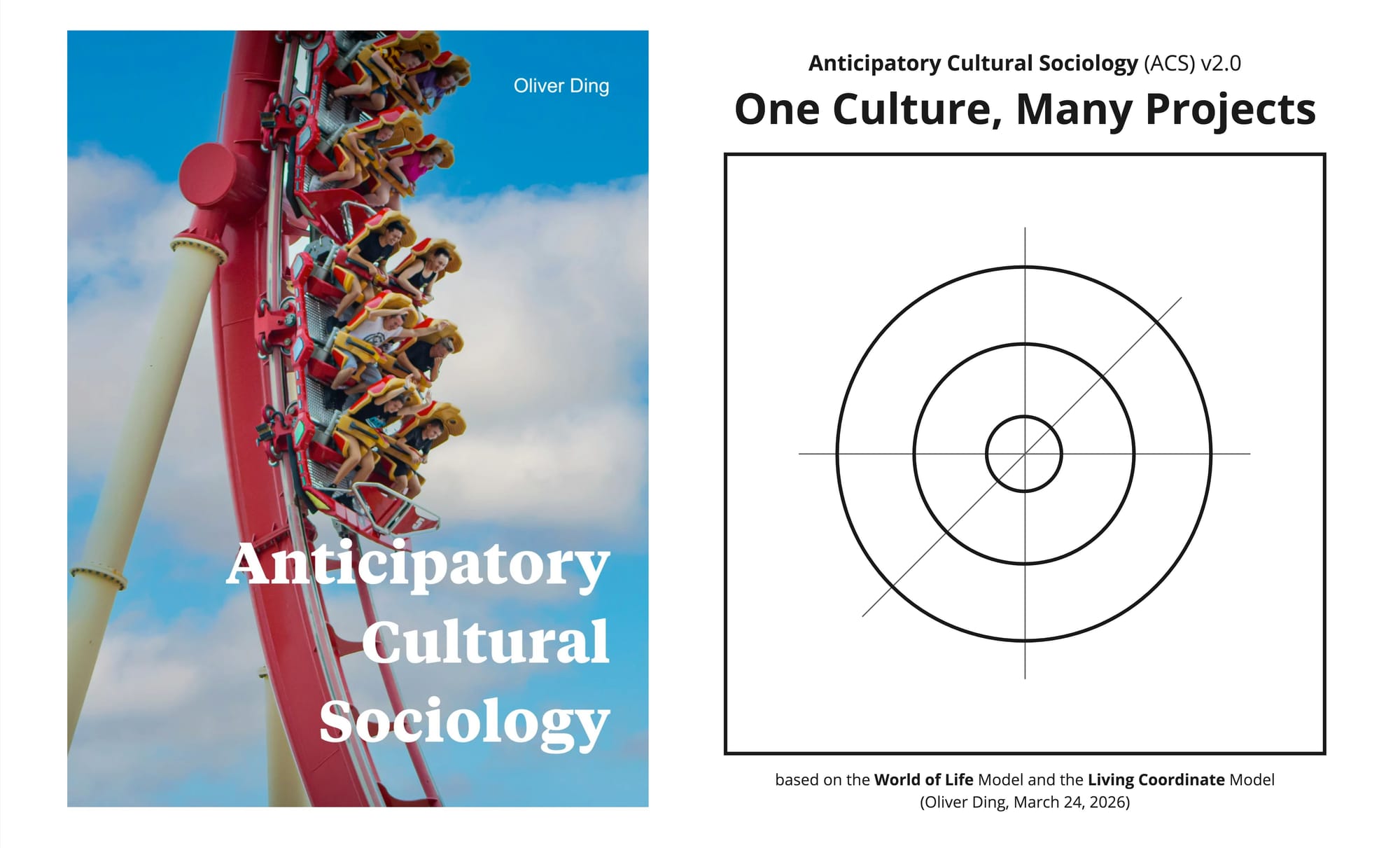
The diagram above — the ACS v2.0 symbol — captures both the foundation and the strategy of this development. It combines the World of Life's four-boundary square with the Living Coordinate's three-dimensional axes and three concentric rings into a single visual mark. It is at once a theoretical structure and a methodological declaration: the overall strategy of ACS development has been From the Margins to the Center.
Rather than immediately building out operational frameworks at every level, the development of ACS began with the four boundaries of the World of Life — Spirituality, Science, Individuals, and Collectives. These boundaries are not the property of any particular culture. They are the structural limits that all human beings share: every person is born and dies, inhabits a body in a material world, lives among others, and reaches toward meaning. This is the foundation of One Culture — the shared horizon within which cultural diversity unfolds.
In the ACS framework, moving from the boundaries toward the center corresponds to a movement from cultural universality toward cultural particularity — from what all humans share to what specific communities, traditions, and individuals make of that shared ground. In the current stage of ACS development, we remain in the domain of cultural universality — mapping what is shared before attending to what diverges.
3. The World of Life: A Structural Map of Four Boundaries
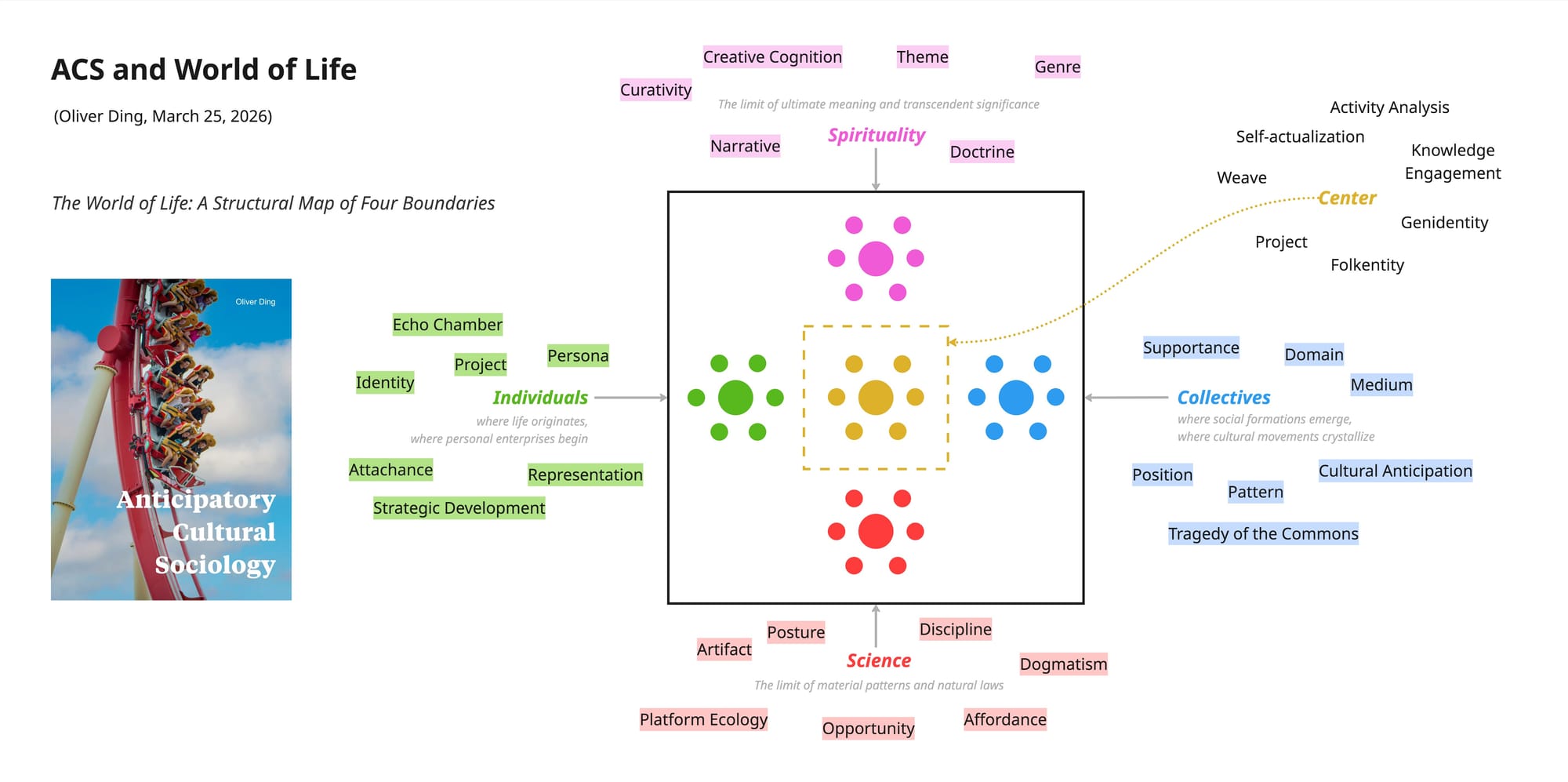
The World of Life model is a square diagram with four boundaries, derived from the Six Faces of the Concept System framework. It represents the structural limits of the thematic landscape within which cultural development happens:
- Upper boundary — Spirituality: the limit of ultimate meaning and transcendent significance
- Lower boundary — Science: the limit of material patterns and natural laws
- Left side — Individuals: where life originates, where personal enterprises begin
- Right side — Collectives: where social formations emerge, where cultural movements crystallize
This is not a descriptive map of the world's contents. It is a structural map — a map of the limits within which human creative life unfolds. The four boundaries are not categories to be sorted into; they are orientations, each pointing toward a different dimension of the human situation.
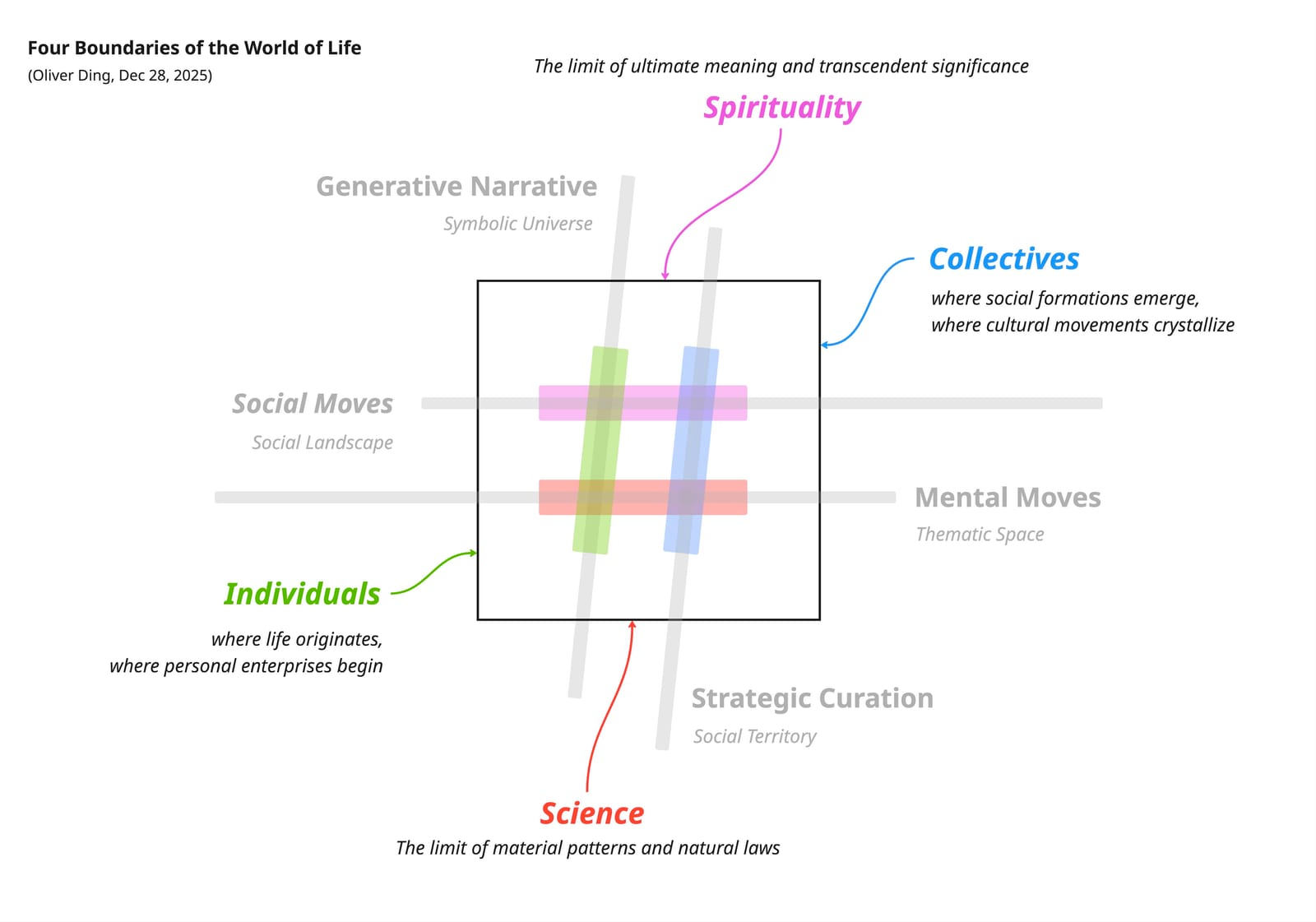
The World of Life model was introduced in ACS v1.0 as part of the Weave-the-Culture framework, where it provides the ontological foundation of the entire landscape.
This is not a model of the actor. It is a map of the world the actor inhabits. The question ACS was asking at v1.0 was not what is a person? but where does cultural development happen, and what are its fundamental mechanisms? The actor was already present in the landscape — the Culture as Thematic Enterprise Framework (September 2025), one of the six meta-frameworks curated into ACS v1.0, explicitly named the Creator and the Supporter as the foundational figures of any cultural enterprise. But the actor appeared there in a relational and functional role, not yet as the subject of a systematic account of the actor as such.
At v1.0, ACS answered the questions of what and why: what cultural development is, and why it unfolds as it does. The six meta-frameworks — including the HLS Framework, the Cultural Projection Model, the AAS Framework, and the Culture as Thematic Enterprise Framework — together constituted the theoretical architecture of this landscape. It was an anchored center. The figure of the actor remained in the background.
The core focus of ACS at this stage was captured in a definition first formulated in "Weave the Culture: One MetaFramework and Four Mechanisms of Cultural Development" (December 21, 2025) and carried forward into the ACS v1.0 landscape:
Cultural development, in this view, is a continuous, dynamic anticipatory activity of creating and curating concept systems and transforming them into thematic enterprises by weaving active agency and evolving structure within the social world.
This definition describes a process — what cultural development is and does. It says nothing explicit about the actor who performs it. That would come later, and not by design.
In the development from v1.0 to v2.0, it took on a second and equally important role: as a generative spatial heuristic. The four boundaries are orthogonal — they point in genuinely different directions, which means that four concepts anchored to them will be structurally differentiated from one another, not merely empirically different. And they are exhaustive at their level of abstraction — together they name the complete set of dimensions that define the World of Life. Any set of four concepts corresponding to these four orientations will therefore constitute a complete framework at the boundary level.
This gives the World of Life a distinctive heuristic character: it does not suggest one candidate concept per boundary, but rather specifies the kind of concept that should occupy each position. The creator's task is not to fill arbitrary slots but to recognize, from the existing conceptual archive, which concepts fit the structural requirements. Time and again across the development of ACS v1.1 and v1.2, this operation was repeated — a new thematic domain, the same four-boundary container, a new set of four structurally grounded concepts emerging from the archive. The World of Life was simultaneously the map within which new frameworks were located and the method by which they were generated.
The full story of how this spatial heuristic operated across the development of ACS v1.1 is documented in Spatial Heuristics: From the Margins to the Center (March 11, 2026).
4. The Three-Dimensional Model: An Overall Picture
On February 2, 2026, the LARGE Method was developed as a comprehensive methodological framework for organizing creative work across multiple dimensions. It subsequently became the organizing lens through which the development of ACS itself could be mapped and coordinated.
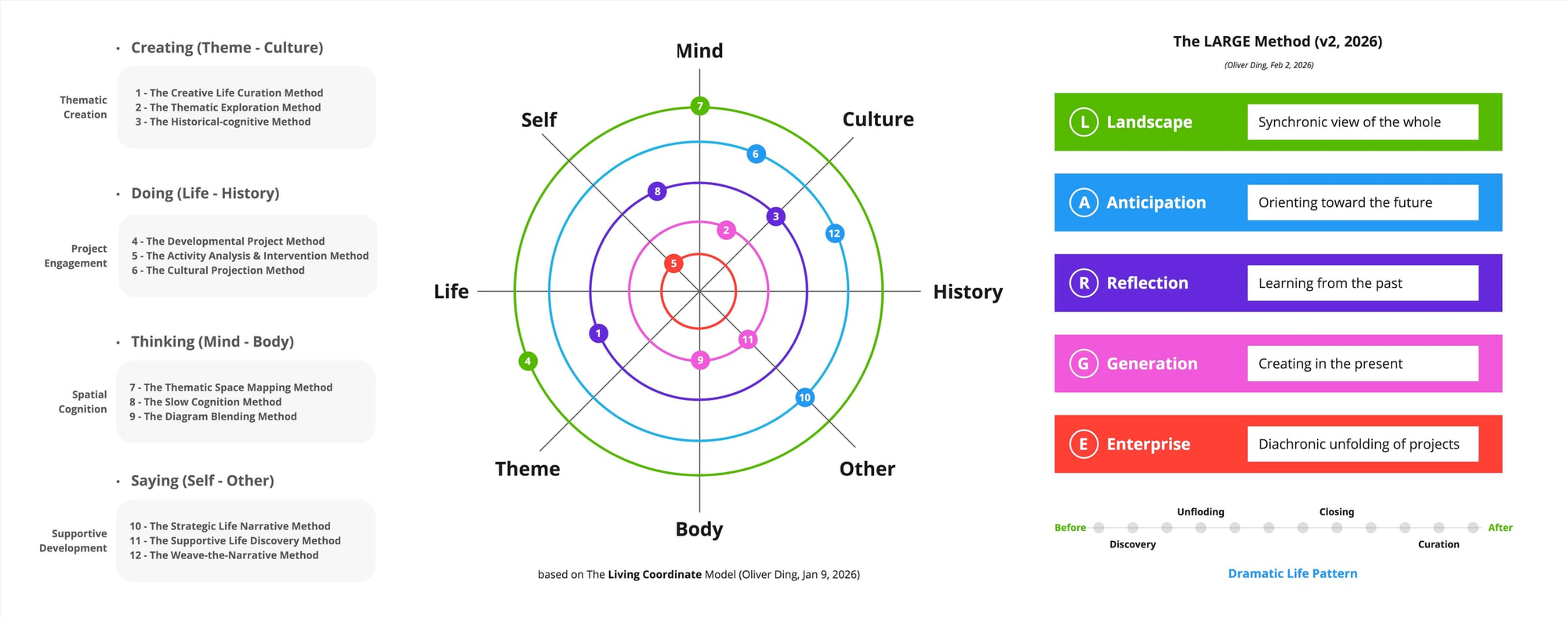
The diagram above presents the LARGE Method (v2, 2026) applied to ACS. The Living Coordinate model was originally composed of two parts: a 3D coordinate system and a series of circles. The LARGE Method extends this structure by adopting a 4D coordinate and five circles. On the right side of the diagram, five methodological principles are presented in five differently colored boxes — Landscape, Anticipation, Reflection, Generation, Enterprise — each corresponding to one of the five circles in the central diagram. On the left side, four dimensions are unfolded into four thematic spaces: Creating (Theme — Culture), Doing (Life — History), Thinking (Mind — Body), and Saying (Self — Other). The development of ACS turned out to align naturally with the LARGE Method — not by design, but by convergence. On February 27, 2026, drawing on the Living Coordinate model, the landscape of ACS v1.1 was mapped for the first time as a three-dimensional structure. Once that structure was made visible, what had been discovery-driven development became design-driven: the diagram itself became the guide.
The four dimensions of the LARGE Method found their counterparts in the theoretical axes that ACS had been developing all along:
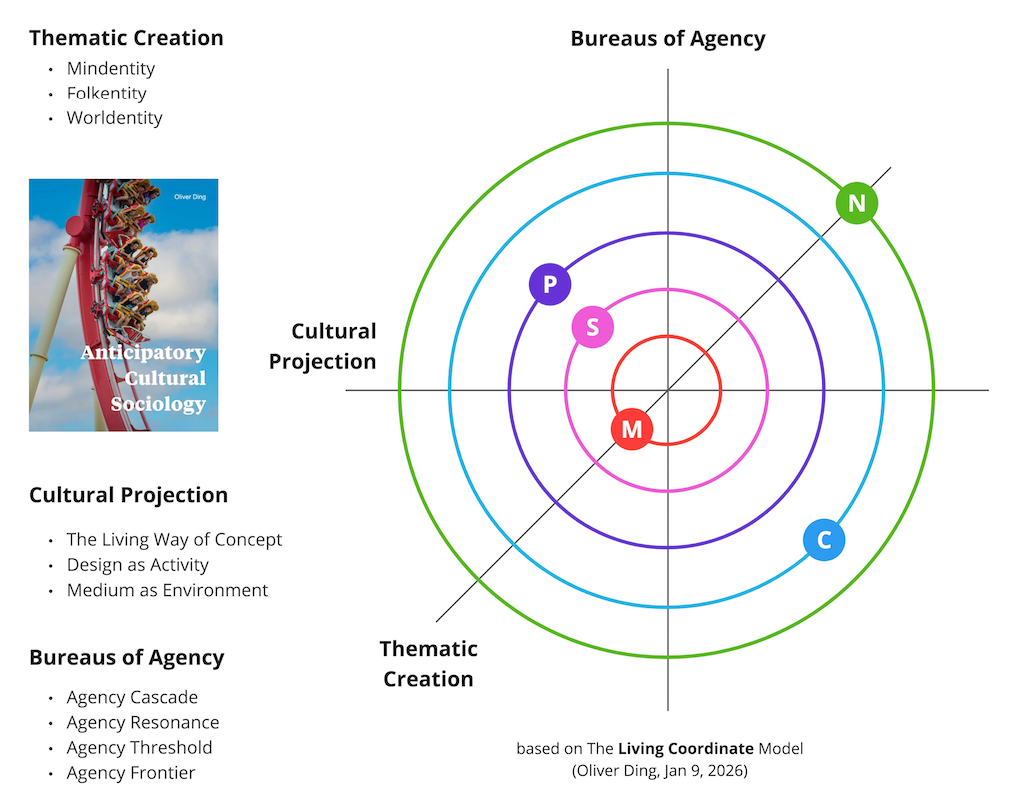
The Theme — Culture direction corresponds to Thematic Creation — the ontological axis that asks what a thematic creation is, what states it passes through, and how it moves from the individual mind into the cultural world.
The Life — History direction corresponds to Cultural Projection — the operational axis that describes how cultural actors engage with the world through the modes of Discover, Design, and Deliver, and how their activity unfolds across developmental projects and historical formations. The Project Engagement principle is elaborated here, and the Cultural Projection Model (2025) serves as the generative seed from which a series of new nested frameworks have been derived.
The Mind — Body direction corresponds to Bureaus of Agency — the structural axis that maps the configurations of the social terrain and the cognitive-structural patterns through which agency operates differently depending on position.
The Self — Other direction is the fourth dimension of the LARGE Method — the dimension that ACS has chosen not to incorporate into its three-dimensional model, in order to maintain the simplicity and integrity of the framework. This dimension is carried forward within SDP, under the axis of Supportive Life Discovery.
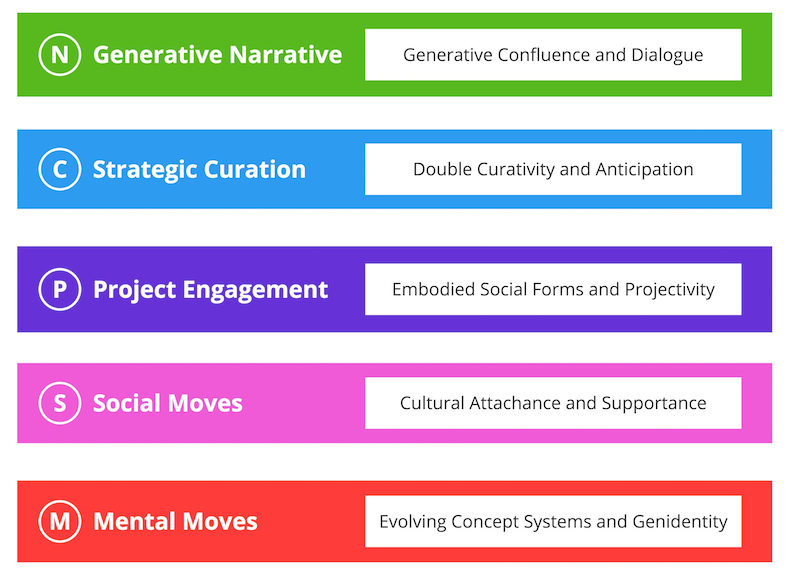
The five rings of the LARGE Method correspond to the five mechanisms of ACS v1.0: Mental Moves, Social Moves, Project Engagement, Strategic Curation, and Generative Narrative. Established in the original landscape and applied in a growing body of case analyses, they remain the operational core of ACS — the five modes through which cultural development is actually enacted. They are not elaborated further here; readers are directed to ACS v1.0 and the associated case studies for their full treatment.
The sections that follow develop each of these dimensions in turn, introducing what is new in v2.0 and its relationship to what v1.0 established.
5. Strategic Curation: The Operative Principle
Strategic Curation is one of the five mechanisms of ACS v1.0 and, across the development from v1.0 to v2.0, the operative principle most consistently at work. Every major conceptual advance in this period involved an act of Strategic Curation: selecting, positioning, and integrating concepts into the ACS framework not through logical derivation but through structural recognition — finding which existing concepts fit which structural positions, and what new relationships emerge from their placement.
The most productive form of Strategic Curation in this period was the four-boundary curation: using the World of Life's four boundaries as a generative container, identifying one concept per boundary, and thereby bringing a coherent set of four structurally differentiated concepts into ACS at a single operation. Each concept inherits the orientation of its boundary — ecological and quasi-invariant near Science, trans-situational and belief-saturated near Spirituality, identity-related near Individuals, social and role-related near Collectives.
The result is not a collection but a system: four concepts that are structurally complete at the boundary level. This operation was repeated across the development of ACS v1.1, each repetition populating a different thematic domain with a new set of four concepts — Personal Orientation, Cognitive Container, Learning Landscape, and others.
The Double Square diagram, developed on February 7, 2026, extended this creative space further. Within the original World of Life square, a second, smaller square was drawn at the center to represent the Project — the primary unit of engagement in the Life-as-Activity approach. The space between the two squares became a new creative territory: the Boundary of Projection, the zone where individuals stand as they prepare to enter a project. Four positions in this intermediate region — one near each boundary — each inherit the orientation of the nearest boundary while remaining directed toward the project at the center. This structure is itself a spatial heuristic: it specifies what kind of concept belongs at each position, and the search through the existing conceptual archive for candidates that fit is guided by structural necessity rather than arbitrary choice.
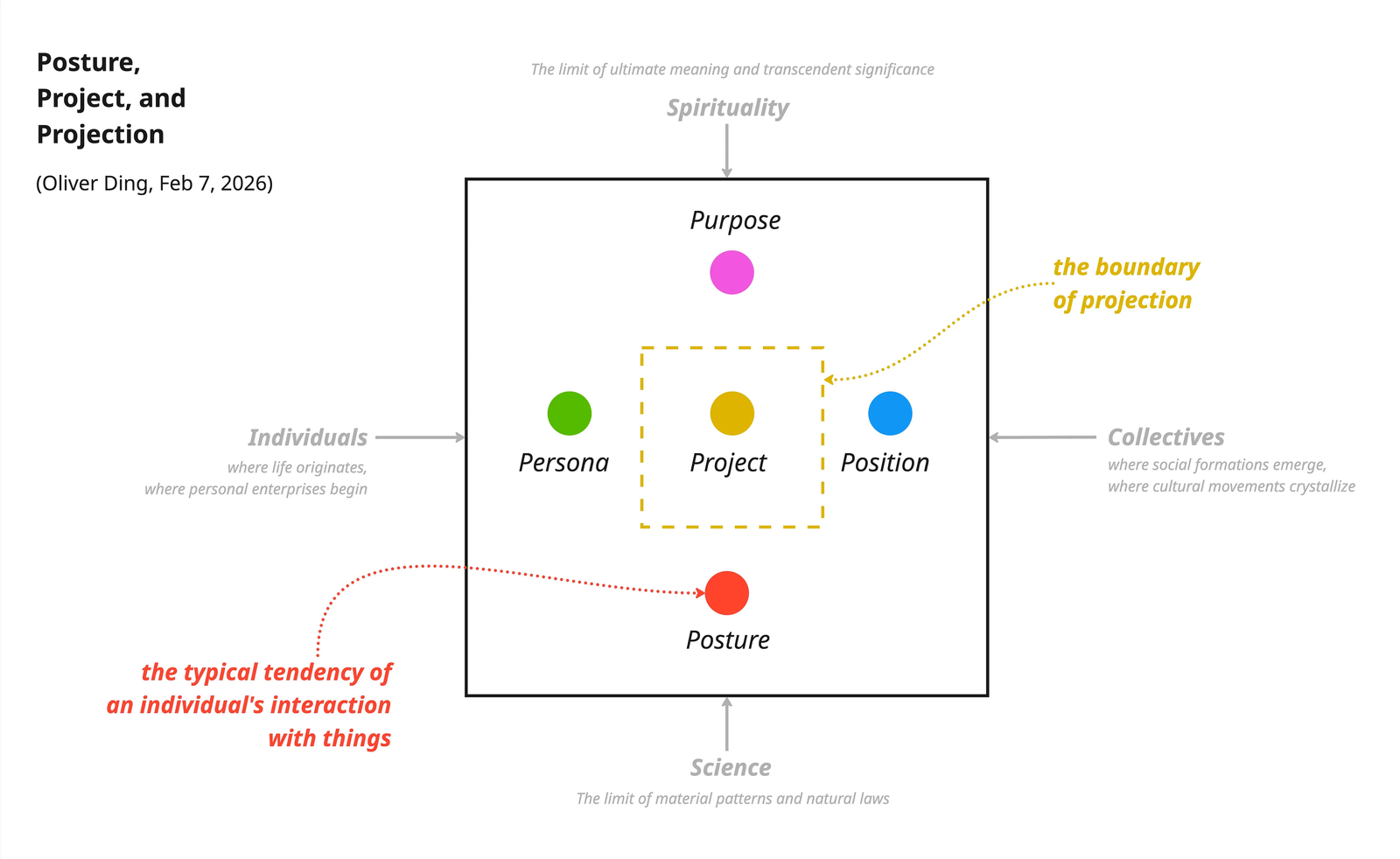
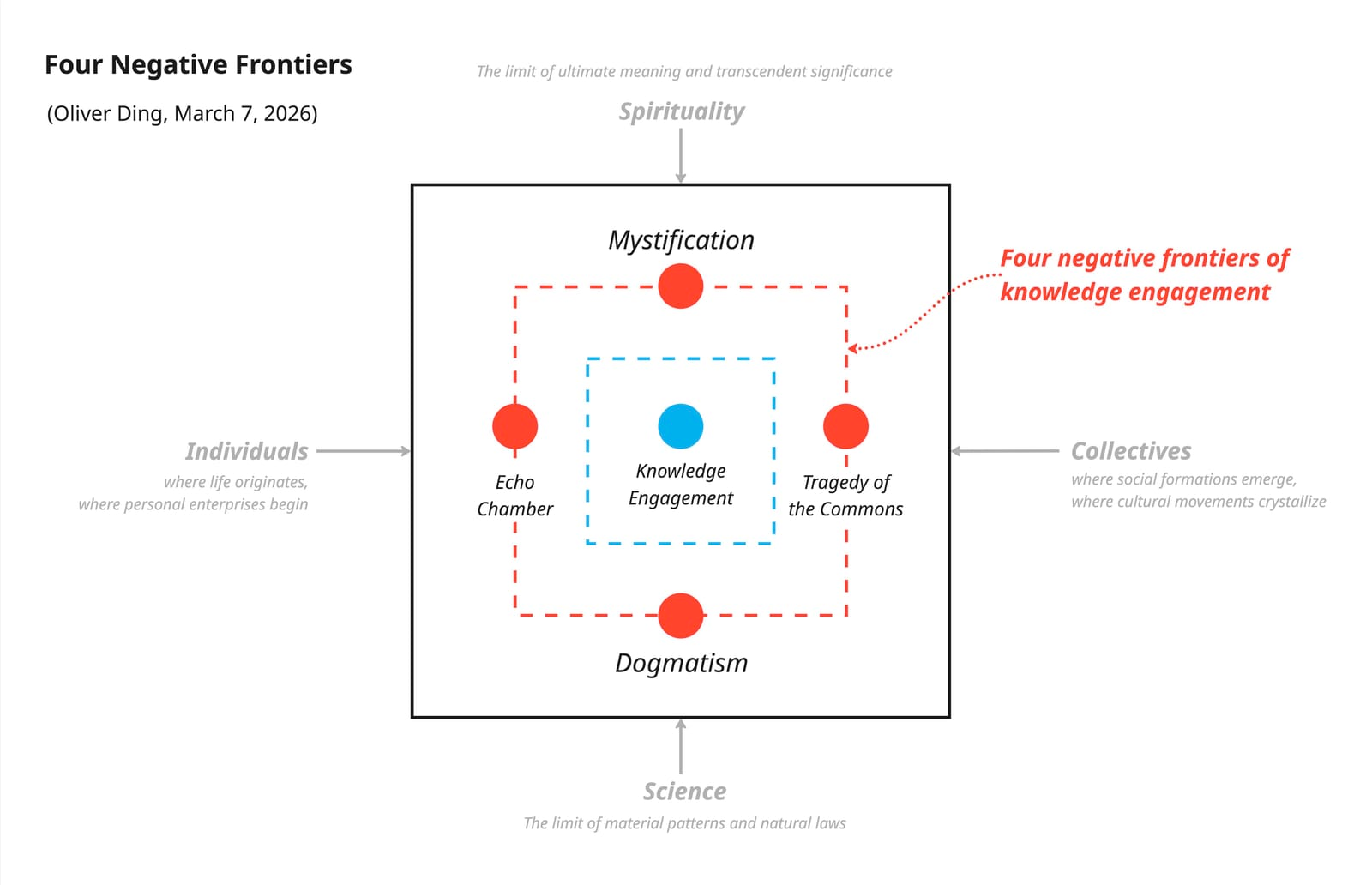
The inner square is not reserved exclusively for Project. Depending on the context, other concepts may occupy the center — Folkentity, Self-Actualization, Knowledge Engagement — with the surrounding boundary positions adjusting their orientations accordingly. The boundary positions themselves are also flexible in valence: in the Four Negative Frontiers of Knowledge Engagement diagram (March 7, 2026), the four positions are filled with negative concepts — Mystification, Echo Chamber, Tragedy of the Commons, Dogmatism — mapping the failure modes that threaten engagement from each boundary direction. The same spatial structure, inverted in register.
A further development emerged on March 16, 2026, during a review of ACS v1.2. The inner square of the Double Square diagram can serve as a docking point for an existing family of thematic maps — including the House of Project Engagement and related structures — each of which already has its own corresponding mapping method. This connection opens a new direction for Strategic Curation: not only generating new concept sets through the four-boundary operation, but also integrating the Double Square's intermediate space with an existing archive of thematic maps and methods developed over the preceding years.
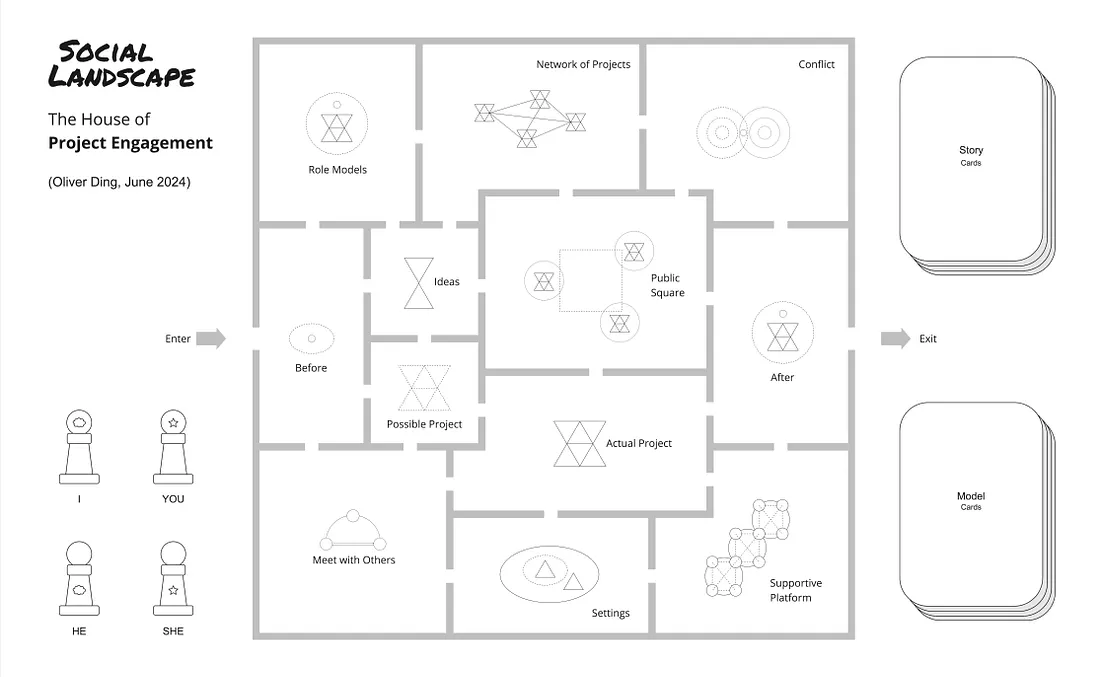
The relevant methods and maps were introduced in Strategic Moves: Mapping Knowledge Engagement and Structural Choice (2024). Their integration into the ACS framework through the Double Square represents a new layer of curation — one that is still unfolding.
6. Thematic Creation: The Ontology Completed
ACS v1.0 identified the transformation of concept systems into thematic enterprises as the core of cultural development. But it did not specify the ontological states through which a thematic creation moves as it travels from the individual mind into the social world. That gap defined the first axis of development after v1.0.
Three concepts now constitute the ontology of thematic creation:
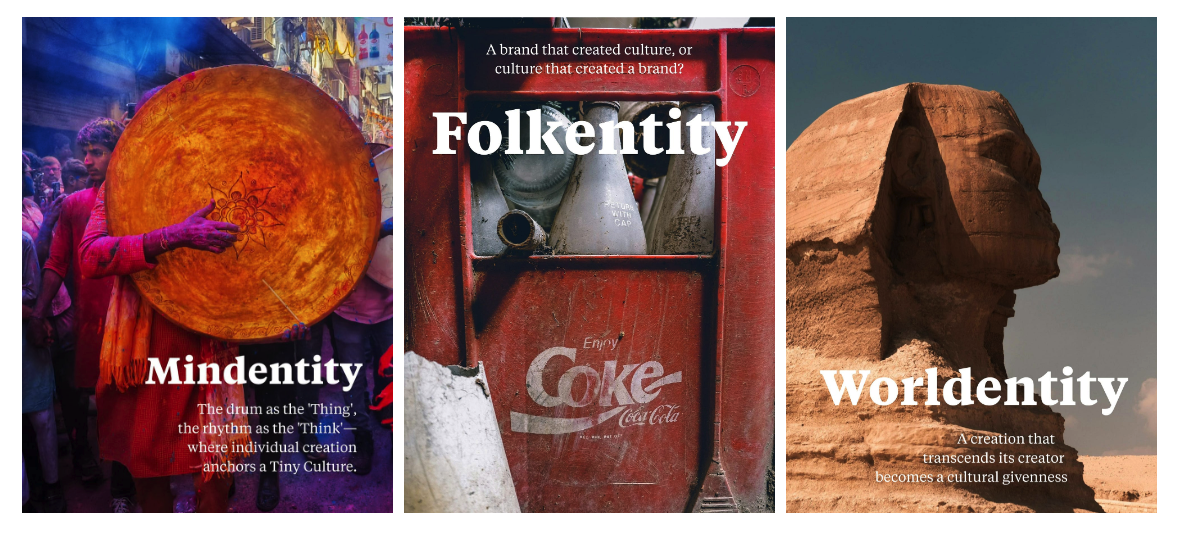
- Mindentity names the status of a thematic creation at the moment it emerges from an individual — before it has entered systems of exchange, evaluation, or formal organization. It is the creator's psychological ownership of a theme: real, operative, but not yet socially constituted. Mindentity is where cultural development begins — in the intimacy of the Self.
- Folkentity names the status of a thematic creation once it has entered the social world through engagement with others — the transition from a single creator and their first supporter toward a community of practice. Folkentity occupies the Us domain: the zone between individual creation and established cultural formation that traditional sociology has tended to skip over. It is the most fragile and most generative stage of cultural life.
- Worldentity names the status of a thematic creation when it has settled into the cultural background as an autonomous, given structure — something that subsequent generations encounter as "already there." Worldentity is Cultural Givenness: the sedimented outcome of cultural development, which becomes the starting condition for the next cycle.
The dynamic engine that drives transitions between these three states is Agency Cascade. At each level of cultural engagement — from creator and supporter, through curator and weaver, to canonizer and receiver — the Other of the current level becomes the Self of the next. Cultural development is this cascade: the movement of a thematic creation from Mindentity through the stages of Folkentity toward Worldentity, driven by the anticipatory activity of agents at every level.
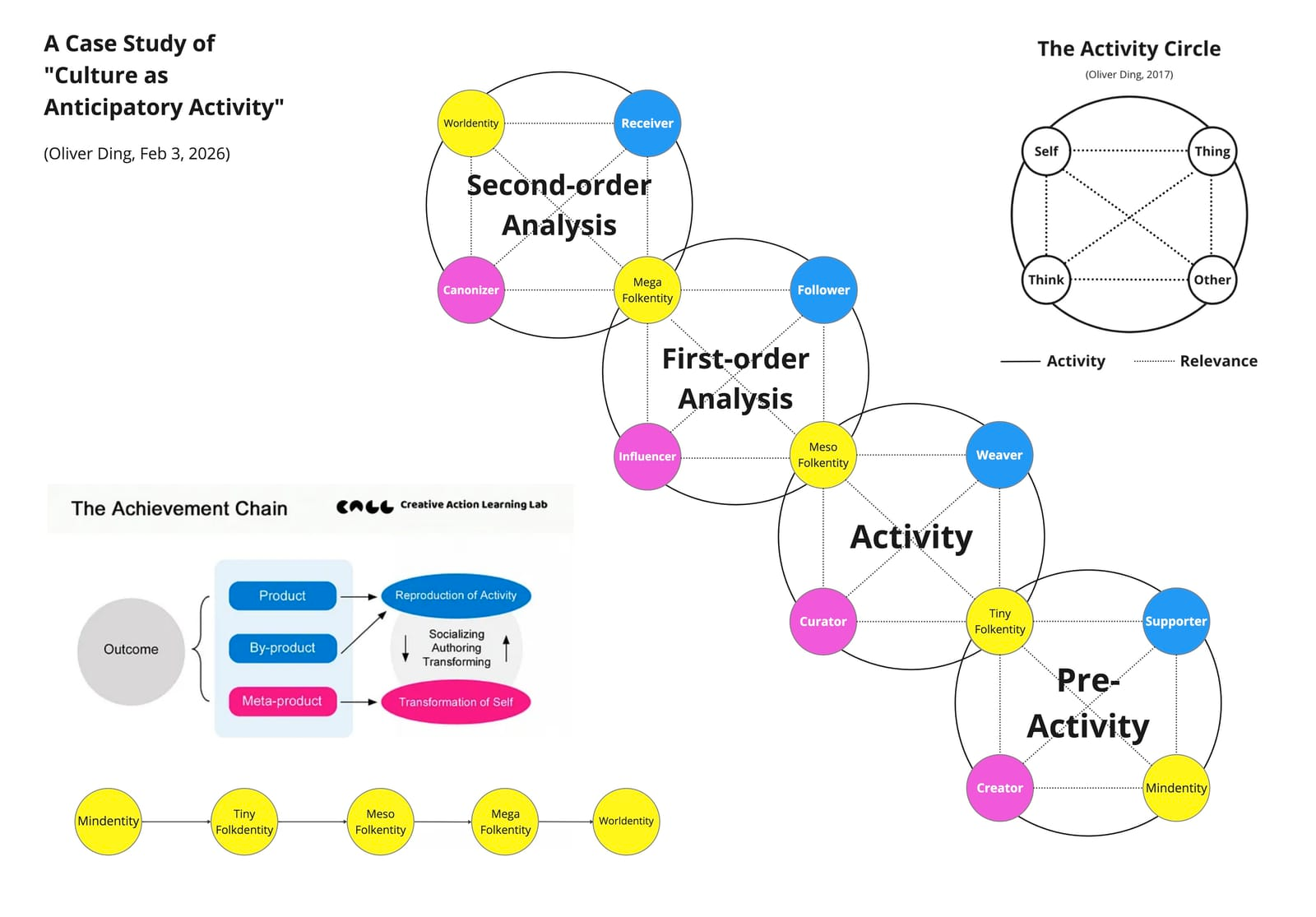
Together, the three concepts and their dynamic mechanism constitute a complete ontology of thematic creation: three states, one engine, one continuous movement.
7. Cultural Projection: The Operational Structure
Project Engagement is one of the five mechanisms of ACS v1.0. From it, a more specific model was derived in 2025: the Cultural Projection Model, which describes how individual mental platforms engage with and project into the cultural world through developmental projects. In the period from v1.0 to v2.0, Cultural Projection became the name for a series of articles and frameworks that expanded this model in two directions.
The first direction is the Discover–Design–Deliver (DDD) model, which organizes cultural engagement into three fundamental modes and generates a series of nested knowledge frameworks, each corresponding to one dimension of the model.
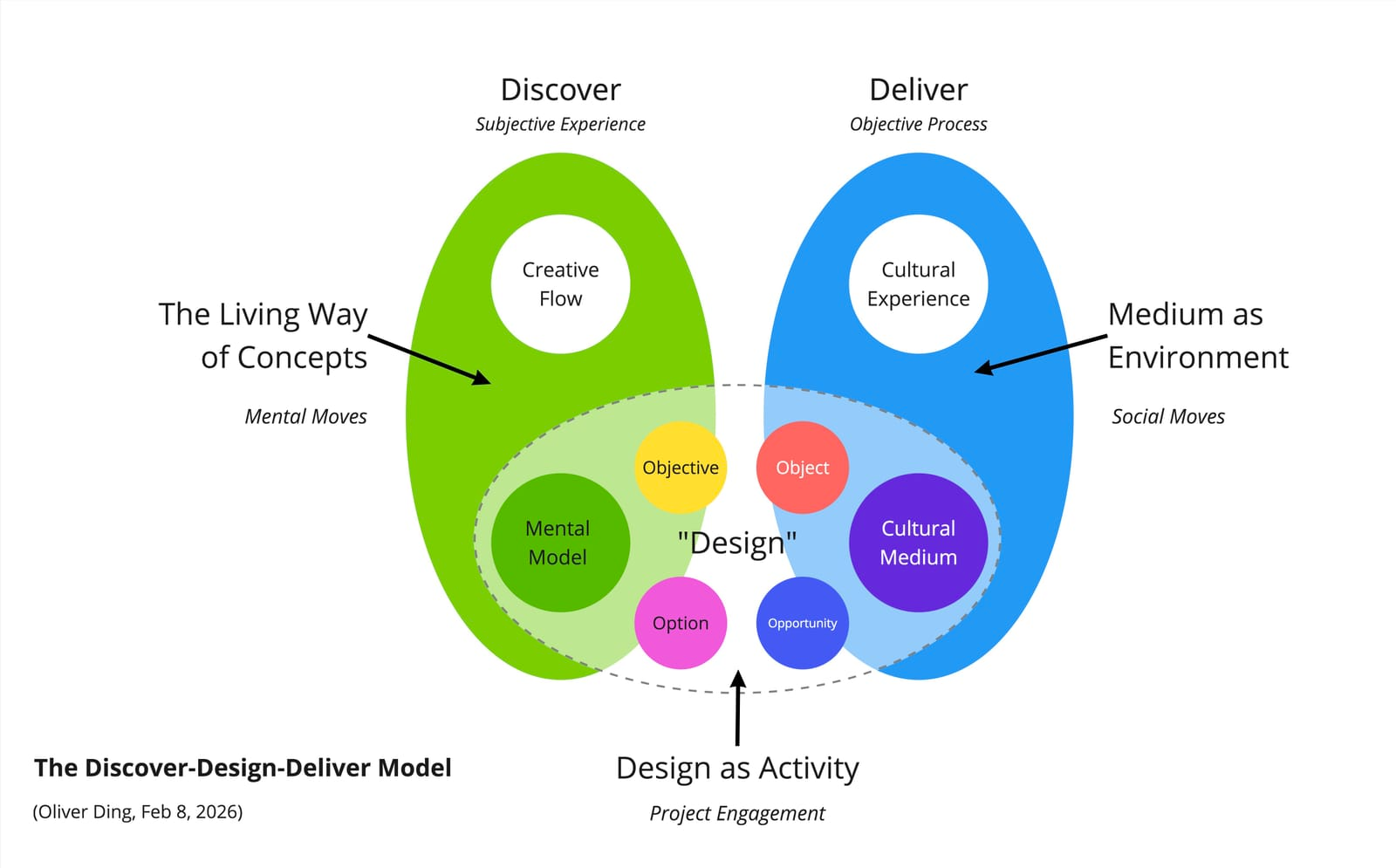
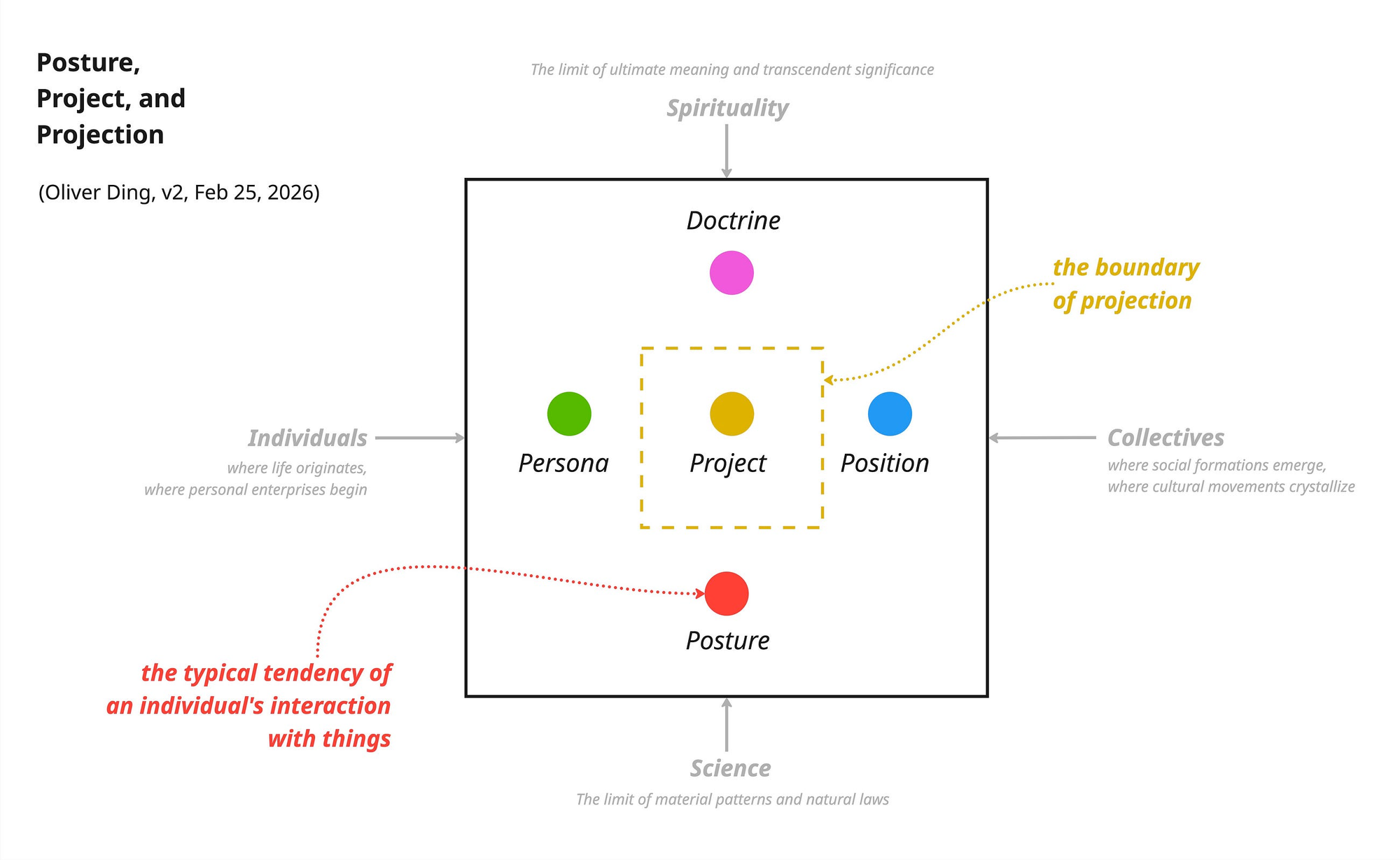
The second direction unfolds each of these frameworks further as a World of Life diagram — applying the four-boundary spatial heuristic to produce nested container structures of the form Doctrine{Position[Persona(Posture)]}. Each nested structure maps four concepts to the four boundaries of the World of Life, moving from the most individual and action-level inward layer outward to the most collective and social outer layer.
The DDD model was subsequently combined with Agency Cascade and extended into the L3D model (Learn → Discover → Design → Deliver), which brought with it two further developments: the Supportive Life Discovery model and the Cognitive Hydrology Pedagogy. These extensions mark the point at which the Cultural Projection series connects to the broader ACS ecosystem — Agency Cascade from the Thematic Creation axis, Learn from the Five Orientations, and the Self–Other dimension from v2.0's new development.
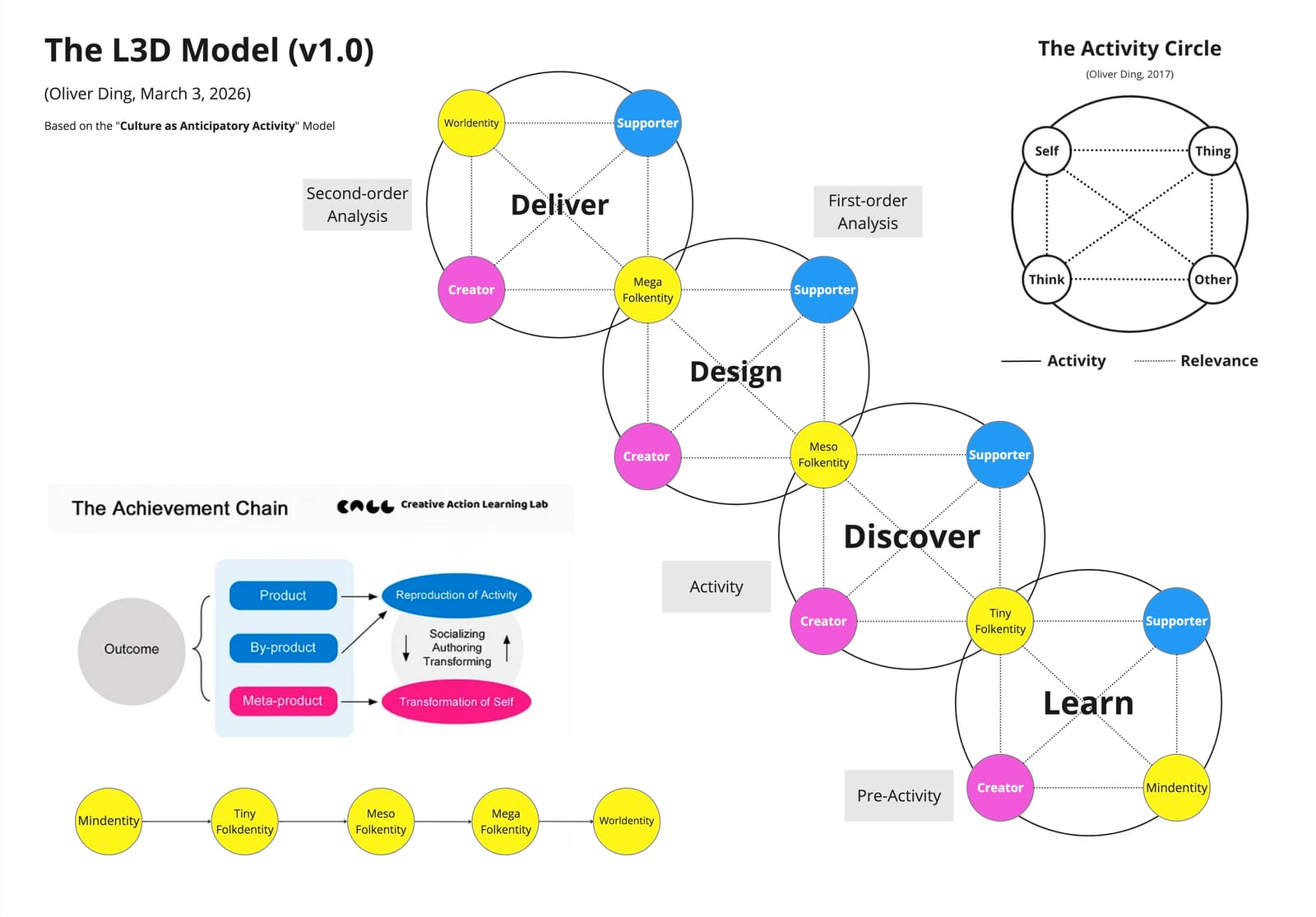
The three nested container frameworks produced by the DDD model are:
The Discover dimension unfolds as the Personal Orientation of Cultural Projection: Doctrine{Position[Persona(Posture)]}. These four concepts describe the structure of tendencies, beliefs, identities, and commitments that individuals bring to the threshold of a project. Posture — the ecological tendency through which a person engages with things at the level of action — sits at the innermost position, near the Science boundary of the World of Life. Doctrine — the trans-situational belief-knowledge system from which purpose is drawn — sits at the outermost position, near Spirituality.
The Design dimension unfolds as the Platform Structure of Cultural Projection: Culture{Platform[Project(People)]}. This structure maps the social architecture within which cultural engagement is designed and organized — from the most immediate human relationships (People) through structured activities (Project) and institutional platforms (Platform) to the broader cultural landscape (Culture).
The Deliver dimension unfolds as the Cognitive Container of Cultural Projection: Medium{Artifact[Genre(Representation)]}. These four concepts describe the media and objects through which cultural engagement is enacted and transmitted — from the most personal form of expression (Representation) through materialized artifacts (Artifact) and conventional forms (Genre) to the social infrastructure of circulation (Medium).
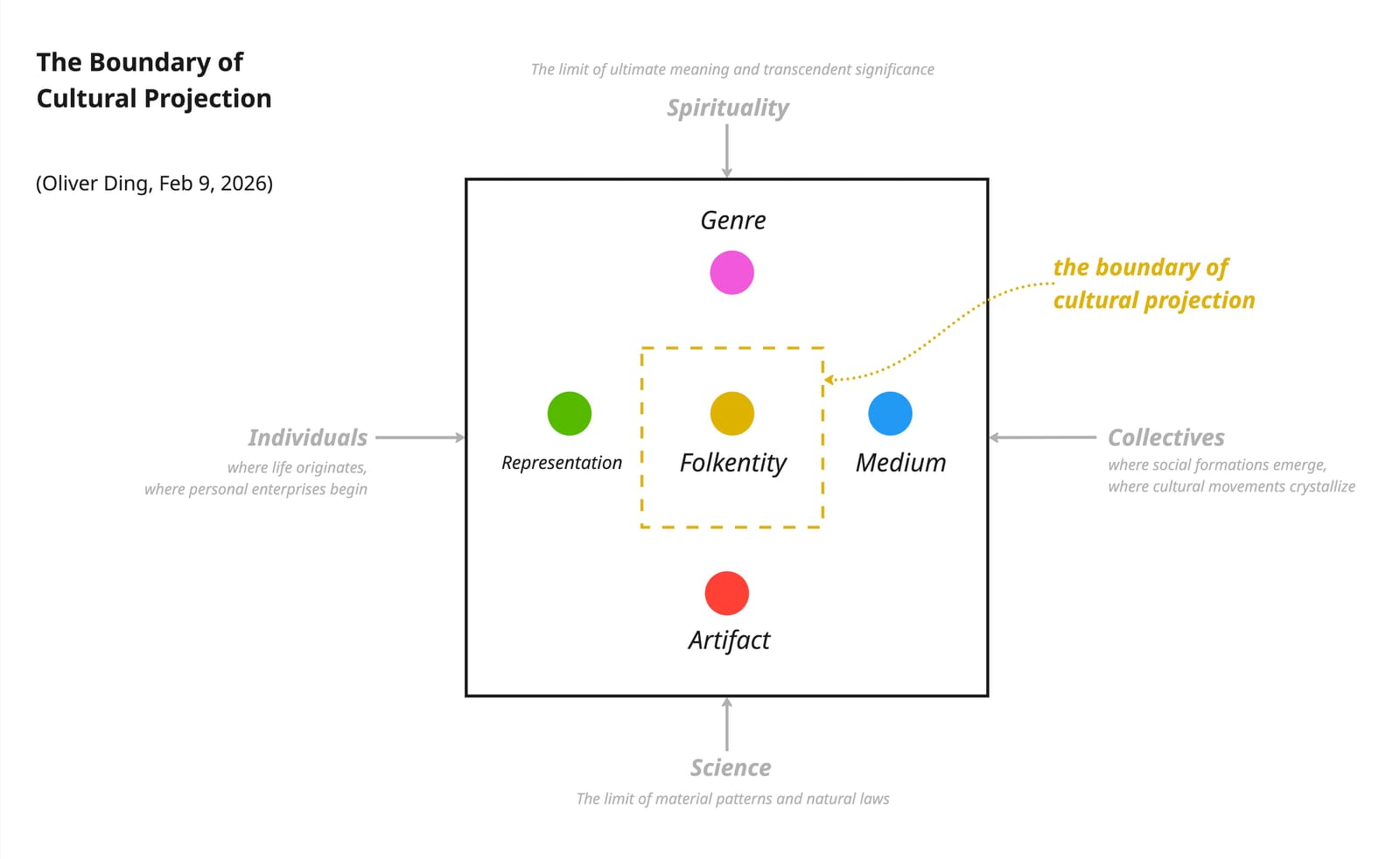
Each nested structure moves from the most individual and action-level inward layer outward to the most collective and social outer layer. Together the three structures provide ACS with its operational vocabulary: the concepts through which cultural actors discover their orientation, design their engagements, and deliver into cultural circulation.
8. Bureaus of Agency: The Structural Configurations
ACS v1.0 described cultural development as the weaving of active agency and evolving structure. But it did not map the structural configurations within which agency operates differently depending on position. That mapping is the contribution of the Four Bureaus of Agency.
The term “Bureau” is adopted here as a provisional placeholder to denote a discrete structural domain where agency operates. Its use reflects the current absence of a precise English equivalent for the Chinese concept of 格局 (geju) and remains open to future conceptual refinement.
- Agency Cascade describes the configuration in which agency flows through nested levels of social structure, each level's Other becoming the next level's Self. It is the structural pattern of hierarchical anticipatory systems — educational institutions, cultural industries, developmental sequences. To act well in a Cascade configuration is to understand which level you occupy and how your anticipations shape the conditions for those below.
- Agency Resonance describes the configuration in which multiple activity circles activate simultaneously and begin to trigger one another — producing emergent developments that no single circle would have generated alone. It is lateral and networked. A concept begins to vibrate, and nearby projects begin to vibrate with it. Resonance is not planned; it is recognized and cultivated.
- Agency Threshold describes the configuration in which agency operates at structural boundaries — the gaps between projects, the transitions between phases of a creative life. The threshold is the moment when a project ends and a new GAP opens. To act well at a Threshold is to recognize the creative potential of the gap and choose deliberately how to cross it.
- Agency Frontier describes the configuration in which agency operates at the outermost edges of established territory — where familiar frameworks reach their limits and something not yet named begins. Frontier is the condition of working at the boundaries of the World of Life itself: engaging with the structural limits of Spirituality, Science, Individuals, and Collectives, and finding what becomes possible there.
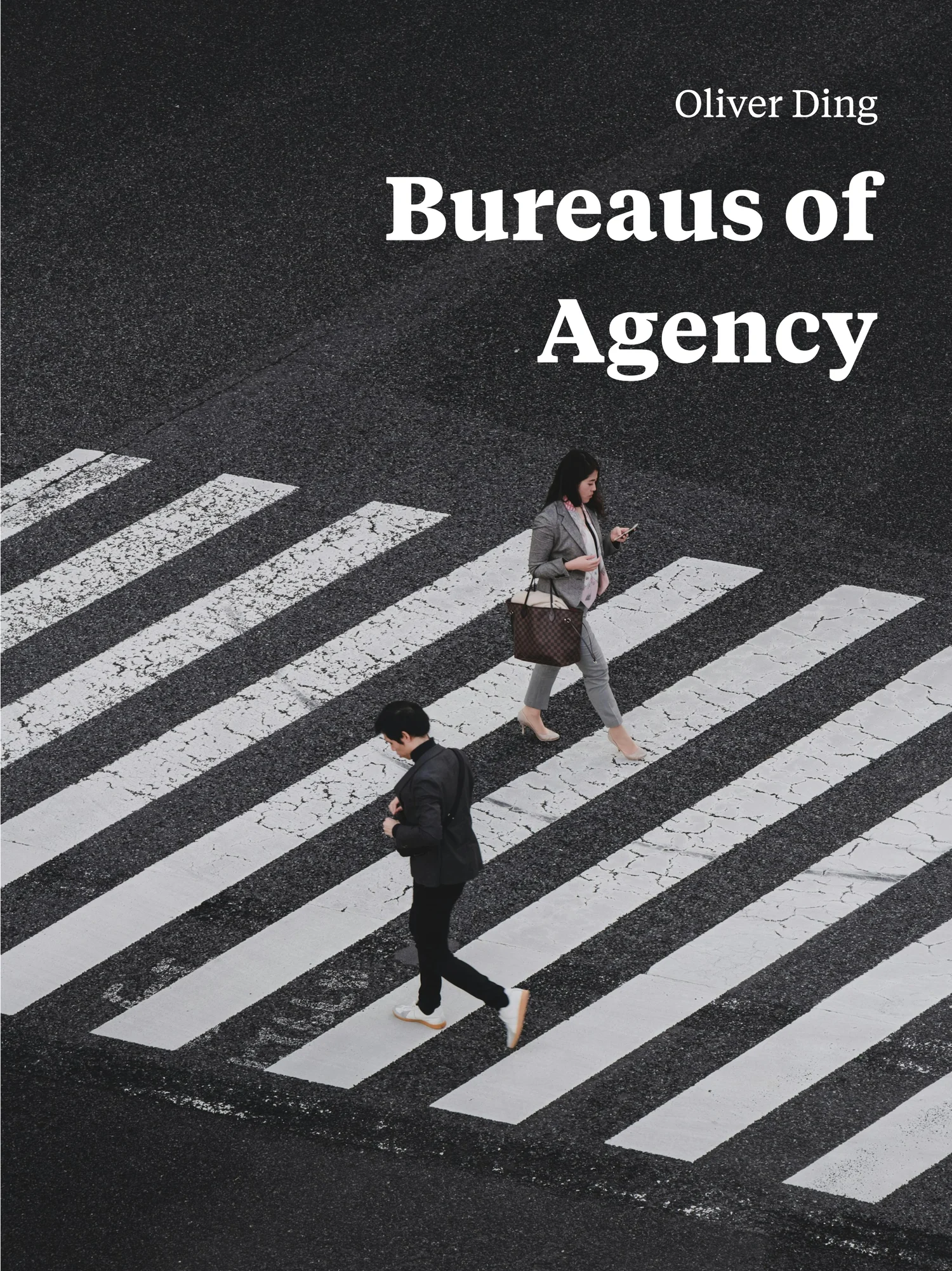
The four Bureaus form a complete framework. Together with the Nine Aspects of Strategic Agency — the cognitive-level framework that mirrors the Bureaus at the level of individual capacity — they constitute the full structure of agency in ACS: the Nine Aspects describe how agency operates from the inside; the Four Bureaus describe the structural terrain in which it is positioned.
9. Five Mechanisms: The Rings of the Living Coordinate
ACS v1.2 organized the Living Coordinate around five method-orientations — Learn, Discover, Design, Deliver, Weave — as its five concentric rings. In v2.0, these orientations are replaced by the five mechanisms of ACS v1.0, which now take their proper place as the five rings of the diagram:
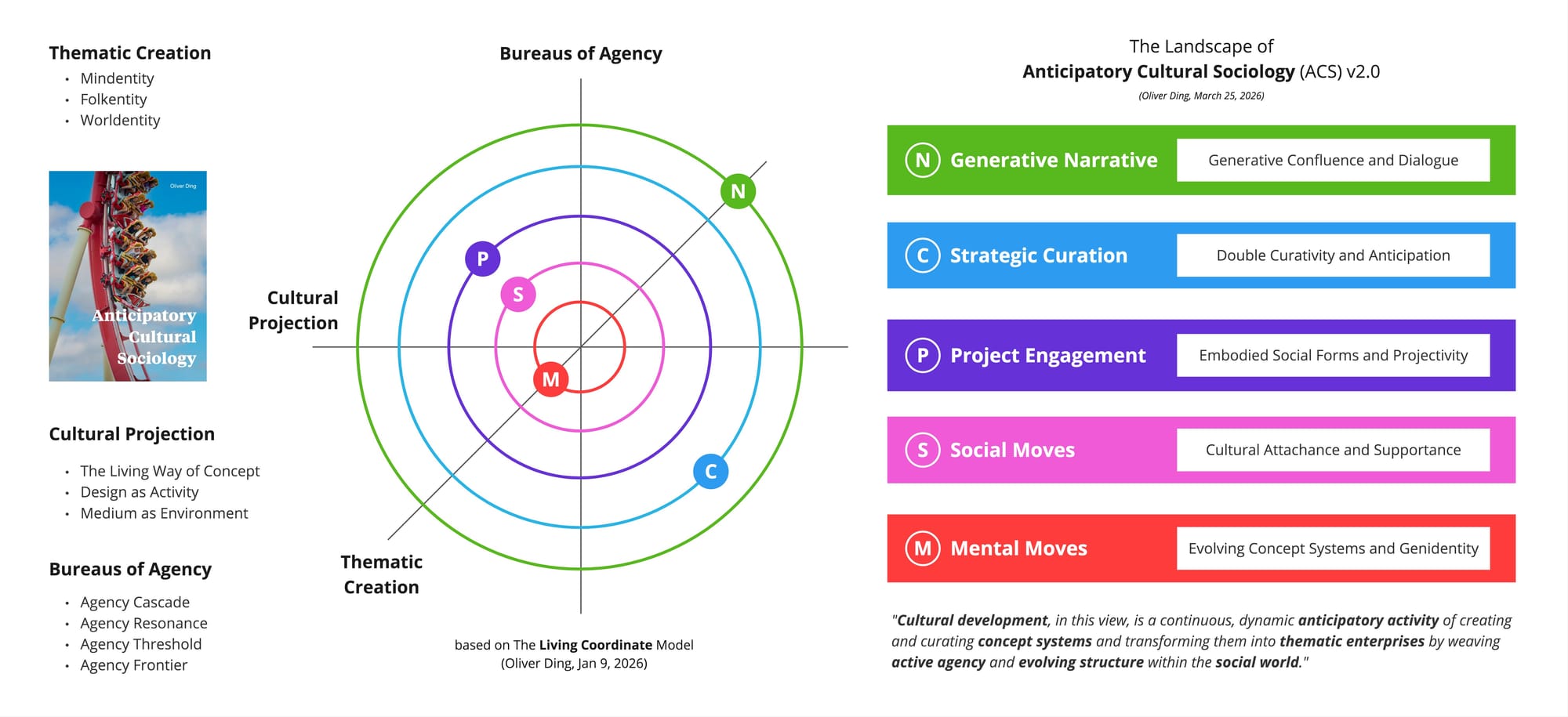
- Mental Moves (innermost ring) — the cognitive operations through which cultural actors process, organize, and transform concept systems within their mental platforms. It corresponds to Evolving Concept Systems and Genidentity in the ACS v1.0 landscape.
- Social Moves — the relational and communicative operations through which cultural engagement is enacted between actors. It corresponds to Cultural Attachance and Supportance — the ecological conditions of social formation.
- Project Engagement — the structured activity through which individuals and groups organize their creative work into developmental projects. It corresponds to Embodied Social Forms and Projectivity — the bodily and ecological basis of project-level action.
- Strategic Curation — the selective, purposive operation of gathering, positioning, and integrating concepts and frameworks into coherent knowledge systems. It corresponds to Double Curativity and Anticipation — the forward-oriented dimension of cultural creation.
- Generative Narrative (outermost ring) — the narrative and symbolic operations through which cultural enterprises achieve historical significance and social circulation. It corresponds to Generative Confluence and Dialogue — the way in which thematic enterprises enter the broader cultural conversation.
The five orientations — Learn, Discover, Design, Deliver, Weave — are transferred to SDP, where they constitute the five rings of the SDP v1.1 Living Coordinate. There, they describe the fundamental modes through which an individual actor develops: from the innermost integrative action (Weave) to the outermost receptive orientation (Learn).
The transfer is not a loss for ACS; it is a clarification. The five mechanisms describe what cultural development does; the five orientations describe how an individual acts. Each vocabulary belongs to its proper enterprise.
10. Self, Other, and Social Forms: A New Dimension
ACS v1.0 through v1.2 developed along three axes — Thematic Creation, Cultural Projection, Bureaus of Agency — all oriented toward cultural life at the collective scale. A fourth dimension was present in the theoretical foundations but had not been explicitly developed: the Self–Other relation as the primary site of social formation.
In practice, however, this dimension had already begun to be explored. The Supportive Life Discovery series — developed through the L3D model and its extensions — has been working precisely in this territory: the zone where an individual's learning and discovery is shaped by the presence, support, and co-becoming of others. The theoretical work was happening; what was missing was its explicit recognition within the ACS model.
On March 18, 2026, reflecting on the relationship between the LARGE Method and the ACS v1.2 Actor Model, it became clear that the Self–Other dimension was absent from the three-dimensional structure. The question was how to respond. The decision was to maintain the simplicity and integrity of ACS's three-dimensional model rather than expand it to four dimensions. The Self–Other dimension would continue to develop — but within SDP, where it more naturally belongs, under the axis of Supportive Life Discovery.
Within ACS, this dimension is carried by the Supportive Life Discovery series and the foundational concepts already present in ACS v1.0: Embodied Social Forms, Supportance, Double Genidentity, Social Moves, and the AAS framework's Self–Other–Present–Future structure. These concepts name the relational conditions of cultural creation — the way in which Other is not merely an audience but a constitutive presence in the unfolding of any thematic enterprise.
11. The Actor Revised: From v1.2 to v2.0
The appearance of an Actor Model in ACS v1.2 was unexpected. The enterprise had been built as a map of the social world — a sociological project, not a psychological portrait. But when the three-dimensional five-ring structure was complete, its logic applied equally to the cultural actor as to cultural development itself. The map had traced a figure.
ACS v1.2 organized the Actor Model around the five method-orientations as its five rings. In v2.0, this organization is revised: the five rings of the Actor Model are replaced by the five mechanisms of ACS v1.0 — Mental Moves, Social Moves, Project Engagement, Strategic Curation, and Generative Narrative. This revision restores the five mechanisms to their proper centrality within ACS, while the five-ring orientation structure is transferred to SDP, where it more naturally describes the developmental orientations of the individual actor.
The three dimensions of the Actor Model remain: Thematic Creation (the actor as ontological origin of cultural life), Cultural Projection (the actor as operative presence in social space), and Bureaus of Agency (the actor as positioned being in social terrain). What changes is the internal articulation of the model — the five mechanisms now name the fundamental modes of cultural action at the level of the actor, rather than the five orientations.
This revision is not a retreat from v1.2's discovery. The recognition that ACS had produced a model of the actor remains valid and important. What v2.0 clarifies is which conceptual vocabulary most properly belongs to ACS and which belongs to SDP — a clarification made possible by the structural symmetry between the two enterprises and the principle that symmetric enterprises should develop their own distinctive conceptual identities, even as they share a common spatial foundation.
12. ACS and SDP: The Symmetric Pair
The relationship between ACS and SDP has been a structural background condition since both enterprises were named in December 2025. In v2.0, this relationship becomes an explicit theoretical element.
ACS and SDP are symmetric enterprises, anchored in the same spatial foundation — the World of Life — but oriented toward different dimensions of the same social reality. ACS attends to cultural development at the collective scale; SDP attends to individual life development at the personal scale. The four boundaries of the World of Life define both: each enterprise inhabits the same structural terrain, and approaches it from a different direction.
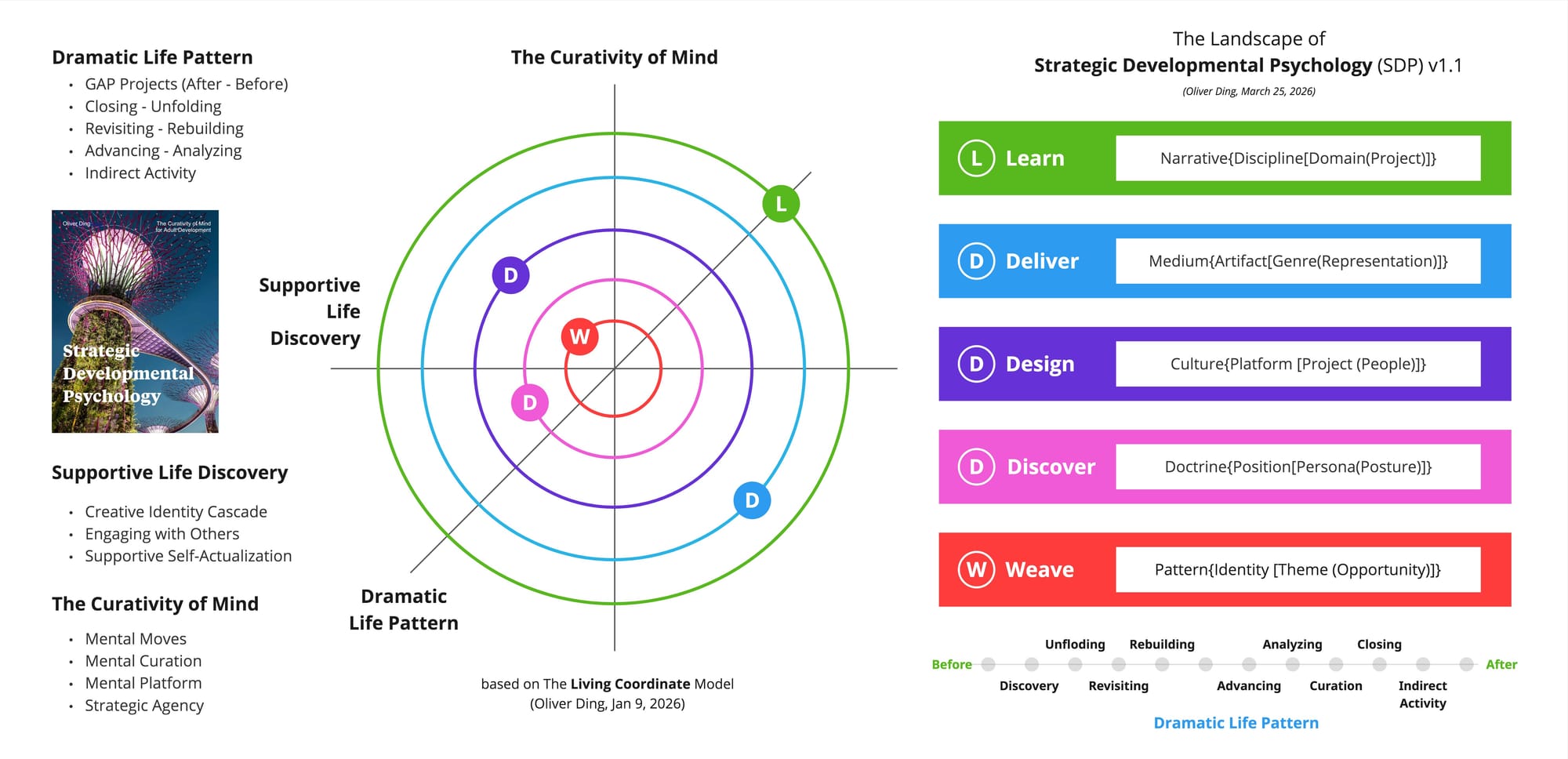
SDP's three-dimensional development — The Curativity of Mind (completed December 2025), Supportive Life Discovery (in development), and Dramatic Life Pattern (in development) — mirrors ACS's three axes, but with distinctively different theoretical content. Where ACS maps the cultural terrain through which actors move, SDP maps the inner capacities through which individuals navigate that terrain.
The practical consequence of this symmetry is what the Spatial Heuristics framework calls structural indirect activity: because ACS and SDP share the same spatial foundation, theoretical work done on one side simultaneously generates resources for the other. Each enterprise develops in its own direction; the shared structure ensures that its developments are mutually intelligible and mutually enriching.
With the Supportive Life Discovery series now developing the Self–Other dimension within ACS, and SDP advancing along the same terrain through Supportive Self-Actualization, the two enterprises have entered their most intimate zone of convergence. What ACS calls the relational conditions of cultural creation, SDP calls the supportive conditions of individual actualization. They are two descriptions of the same fundamental fact: that human development — whether cultural or individual — is always already a co-becoming.
Epilogue: From GO Theory to ACS — and Beyond
Around October 2024, I set three goals for the GO Theory project. The first was to launch a book draft around the concept of Genidentity. The second was to run a creative dialogue between Creative Life Theory and the Ecological Practice Approach. The third — the most ambitious — was to move into the field of cultural development by building a Cultural Genidentity Framework. The ambition behind all three goals was the same: to broaden the scope of my theoretical work from individual life development toward Social Life Development. GO Theory was designed to nest Creative Life Development inside a larger container: Social Life Development (Creative Life Development).
In practice, the first half of 2025 unfolded differently than planned. Rather than pursuing these goals directly, I worked on them through Indirect Activity — developing adjacent projects whose by-products fed into GO Theory. The most significant outcome was the World of Activity toolkit, which included a systematic exploration of the dialectical relationship between Theme and Identity. These were genuine achievements. But they remained at the level of individual development. The third goal — entering the territory of cultural development — had not yet been reached.
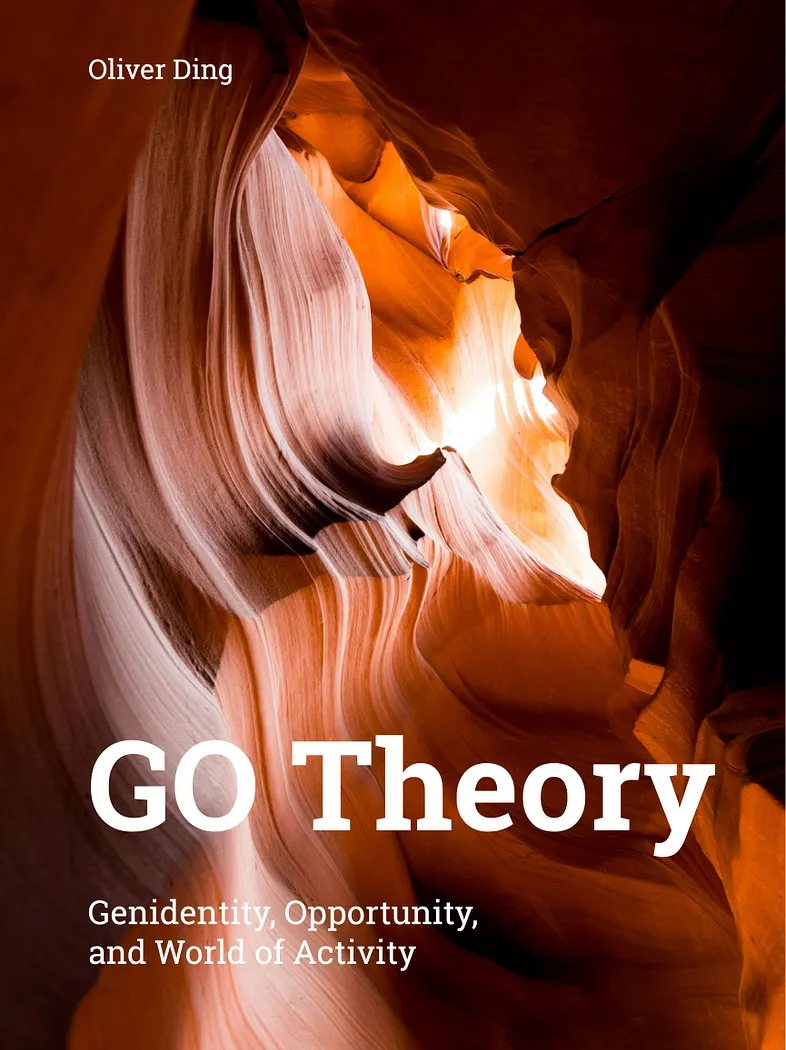
On June 18, 2025, I curated these outcomes into GO Theory: Genidentity, Opportunity, and World of Activity (book, v1.0) and declared it Phase I. The subtitle names what had actually been accomplished: Genidentity, Opportunity, and World of Activity. Phase II — the move into cultural development — remained ahead.
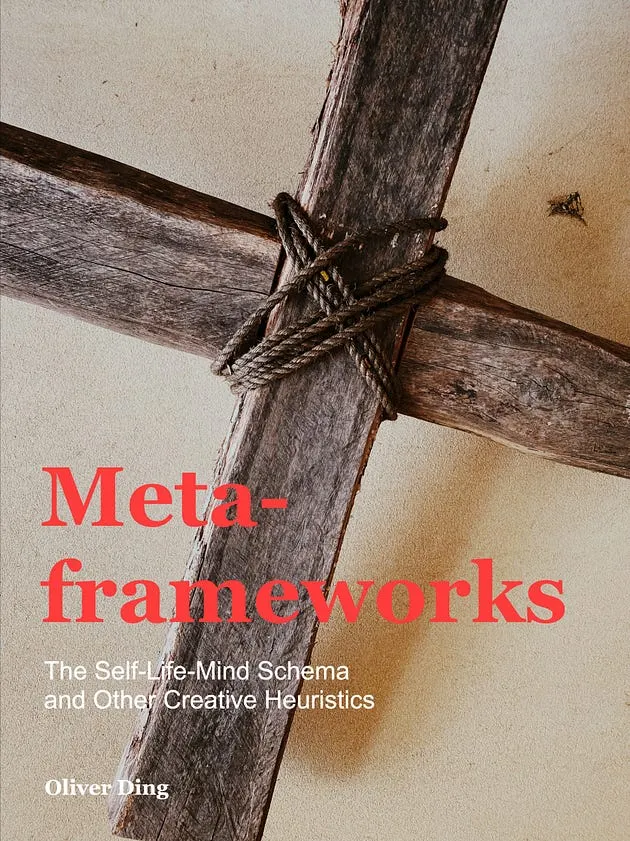
What Phase II needed was a new ontological foundation. To analyze Social Life Development at the cultural level, I needed a framework for the social world itself — not just a framework for the individual moving through it. That foundation arrived on December 31, 2025, with the completion of Meta-frameworks: Creative Heuristics for Individual and Social Development (book, v1.0, 2025). This manuscript established the World of Life as a new social world ontology — a larger container holding the World of Activity within it: World of Life (World of Activity). Where the World of Activity frames the course of an individual's creative life, the World of Life frames the broader social and cultural terrain in which that life unfolds.
On January 5, 2026, the Anticipatory Cultural Sociology (ACS) project was formally named. In the months since, the work has centered on deep exploration of the World of Life — including the landscape you are reading now.
I did not plan it this way. But looking back, it is now clear: ACS is actually Phase II of GO Theory. The third goal set in October 2024 — moving into cultural development — is now being pursued in earnest. The vocabulary is the same: Genidentity, Opportunity, World of Activity. But the container has expanded. The question is no longer only how a creative individual develops within their life course. It is how cultural enterprises develop within the World of Life.
And looking further still, a larger picture has come into view. GO Theory is not only the name for Phase II. It is the name for the theoretical platform itself — now carrying a fuller title: GO Theory: The World of Life (World of Activity) Approach.
The initials GO stand for Generation and Orientation — the two directions that define the platform's theoretical character. Generation names the productive, emergent, forward-moving dimension of cultural and individual life: things are created, enterprises unfold, meaning accrues. Orientation names the positional, directional, sense-making dimension: actors are always somewhere, always facing some directions rather than others, always situated within a World of Life that both enables and limits — and always anticipating, projecting themselves toward futures that are not yet given but are already shaping present action.
This platform has its own knowledge ecosystem, built on three meta-frameworks completed between November 2025 and February 2026:
- Ontology: The History{Life[Self(Body)]} Framework (HLS Framework, v3.0, 2025) — the map of the social world, introduced in Meta-frameworks: Creative Heuristics for Individual and Social Development (book, v1.0, 2025), December 2025
- Epistemology: The Ecological Formism Framework (v2.0, 2025) — the structure of knowledge systems, introduced in Ecological Formism (book, v1, 2025), November 2025
- Methodology: The LARGE Method (v3.0, 2026) — the meta-method governing all methods within the platform, February 2026
These three meta-frameworks are not external scaffolding. They are the internal architecture of GO Theory itself — the ontological, epistemological, and methodological foundations on which the five theoretical enterprises build.
On this platform, five theoretical enterprises operate, each occupying a distinct position within the World of Life:
- Life as Activity (including the Project Engagement Approach) — at the center, attending to the structure of activity itself, the operational language shared by all the other enterprises
- Anticipatory Cultural Sociology — at the Collectives boundary, attending to cultural development at the collective scale
- Strategic Developmental Psychology — at the Individuals boundary, attending to individual life development at the personal scale
- Cognitive Hydrology — at the Spirituality boundary, attending to the flow of ideas and meaning in creative life
- Platform Ecology — at the Science boundary, attending to the ecological and structural conditions of platform development
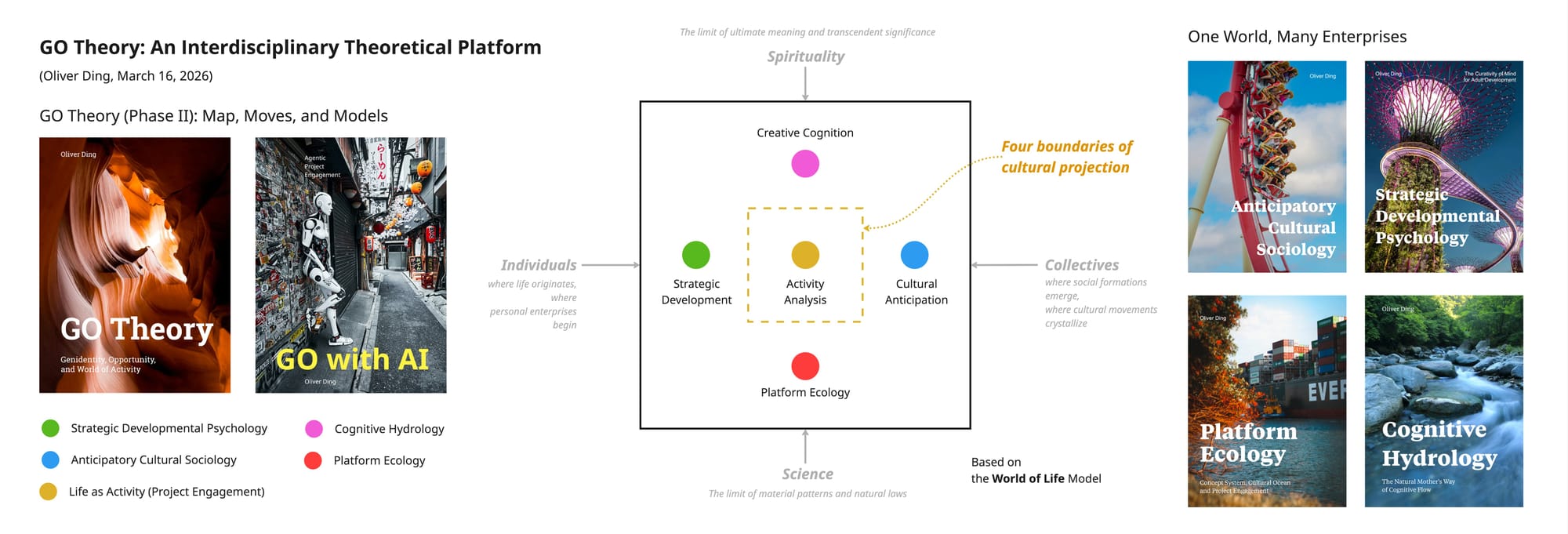
These five enterprises are equal. None is the foundation of the others. Each occupies a different position within the World of Life, which means each brings a genuinely different theoretical perspective. And because they share the same spatial foundation — the same map, the same boundaries, the same operating concepts — they naturally support one another, forming a network of enterprises rather than a hierarchy.
The development of GO Theory can now be read as a trilogy:
- GO Theory: Genidentity, Opportunity, and World of Activity (June 2025) — Phase I, the individual level
- Meta-frameworks: Creative Heuristics for Individual and Social Development (December 2025) — the ontological foundation, World of Life as a social world map
- Anticipatory Cultural Sociology: Creation, Projection, and Agency (March 2026) — Phase II, the cultural level
Three books, three movements, one theoretical platform still unfolding.
One World. Many Enterprises. The platform is open.
v1.0 - March 25, 2026 - 5,830 words