
The Landscape of Strategic Developmental Psychology (v1.2)
This is the introduction of a new theoretical enterprise.
by Oliver Ding
April 10, 2026
1. The Birth of Strategic Developmental Psychology
In April 2024, after reflecting on a five-year creative journey (March 2019 to March 2024), I asked the magical question again: What should I do for the rest of my life?
Between April and May 2024, I ran a Creative Life Discovery project and developed a set of knowledge frameworks, which I then curated into a meta-framework of Theoretical Psychology.
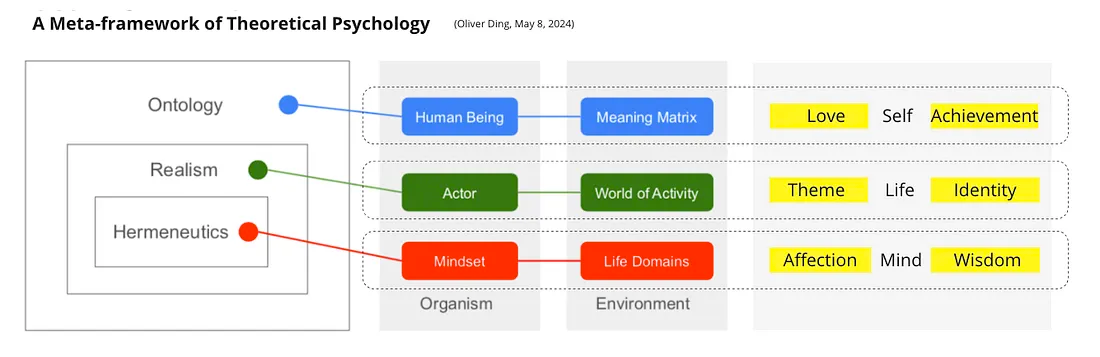
Based on this meta-framework, I developed three creative themes:
- Self (Ontology): Thematic Identity Curation
- Life (Realism): Professional Square
- Mind (Hermeneutics): The Curativity of Mind
These three themes — still rough, still early — inspired a larger question: could they be seeds of a new knowledge enterprise? The field of Developmental Psychology has not traditionally incorporated "Strategy" as a theoretical concept. If "strategy" could be established as a legitimate theoretical concept within it, that gap might become an opening.
On May 15, 2024, I initiated an Anticipatory Journey toward Strategic Developmental Psychology (2024–2030). The specific activities remained undefined. The declaration framed the journey; the journey would have to find its own shape.
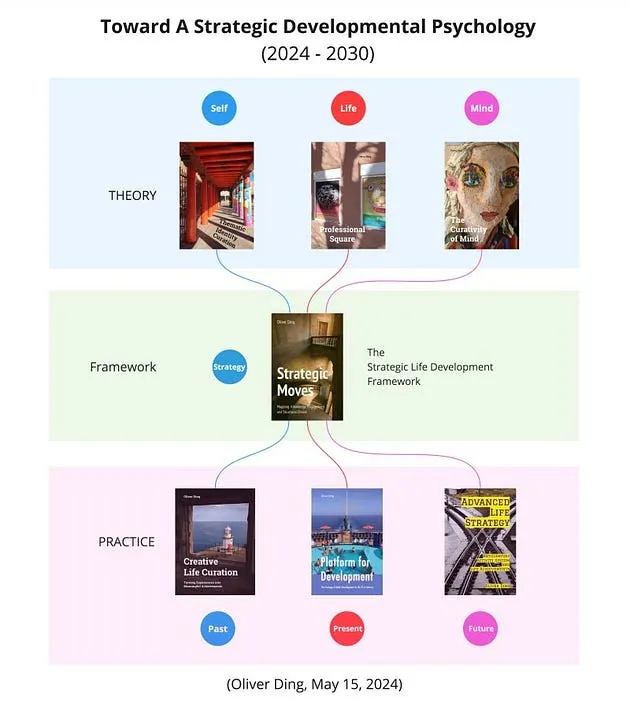
Between May 2024 and January 2025, I worked on a series of projects about adult life development, strategic life development, and advanced life strategy. On February 1, 2025, I named this evolving body of work: Strategic Life Theory. A related knowledge map features nine themes, five models, and nineteen possible books.
On December 14, 2025, the completion of The Curativity of Mind — addressing mental curation, mental platforms, and mental moves — provided the final theoretical component for what would become SDP's first fully structured landscape. The Epilogue to that book formally named Strategic Developmental Psychology (SDP) as a knowledge enterprise in its own right: a 6-year Anticipatory Journey (2024–2030) now underway.
2. From World of Activity to World of Life
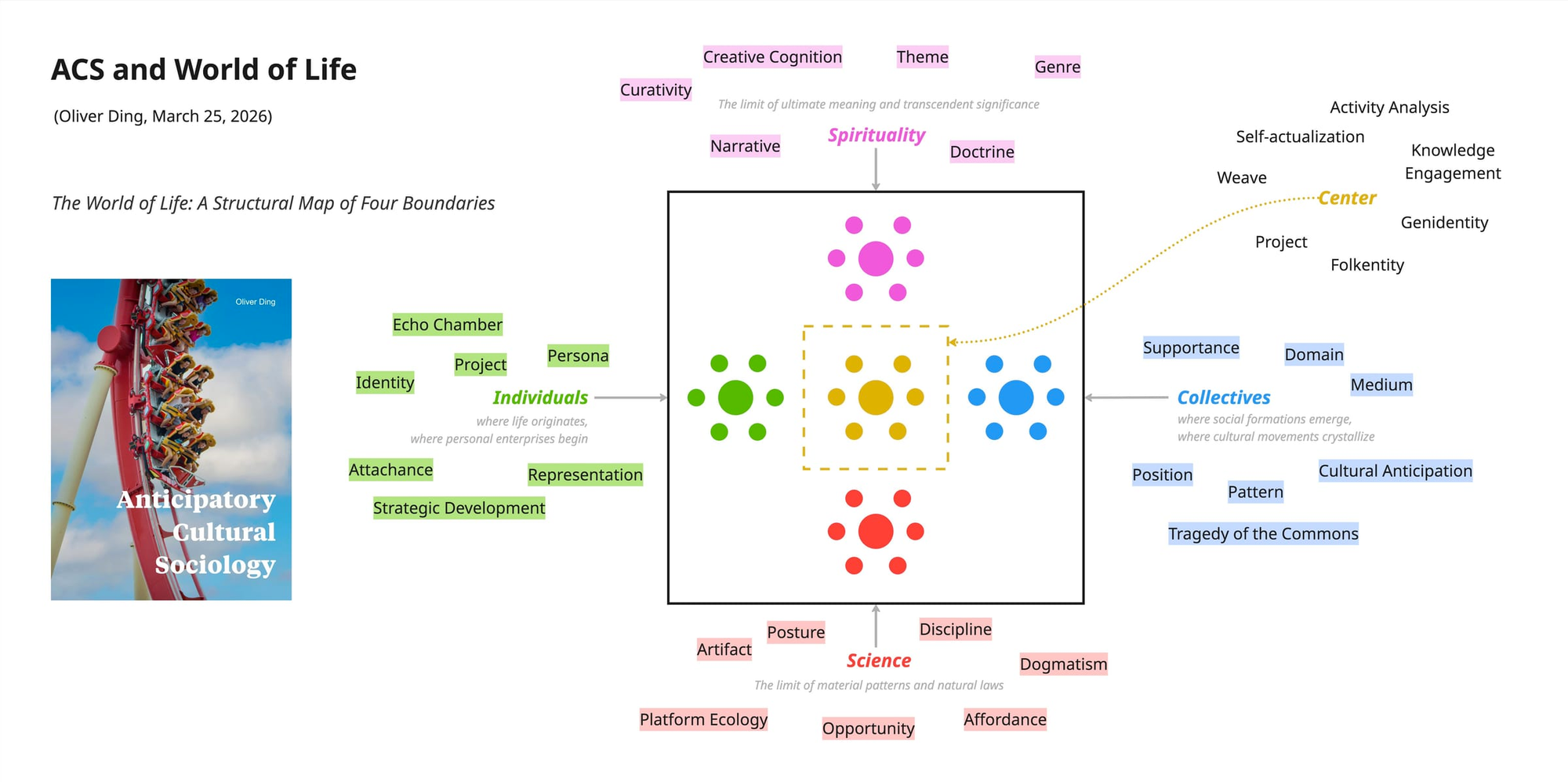
On December 31, 2025, I released Meta-frameworks: Creative Heuristics for Individual and Social Development. A key development within that manuscript was the extension of the HLS Framework, which ultimately brought forward a new social world ontology: the World of Life (World of Activity) approach. This nested formulation — World of Life holding World of Activity within it — established the structural container for everything that followed. Throughout 2025, my theoretical focus had been on the World of Activity: the elastic creative space of the individual, the terrain of personal development, and strategic life. The World of Life, by contrast, remained largely a blank concept — named but not yet inhabited.
In January 2026, I combined the Weave-the-Culture framework from the Meta-frameworks manuscript with several other frameworks and formally named the result: Anticipatory Cultural Sociology (ACS). Over the following three months, ACS became the primary site of theoretical development. In that process, the World of Life received its full elaboration — generating a rich set of new concepts and knowledge frameworks organized around its four boundaries: Spirituality, Science, Individuals, and Collectives.
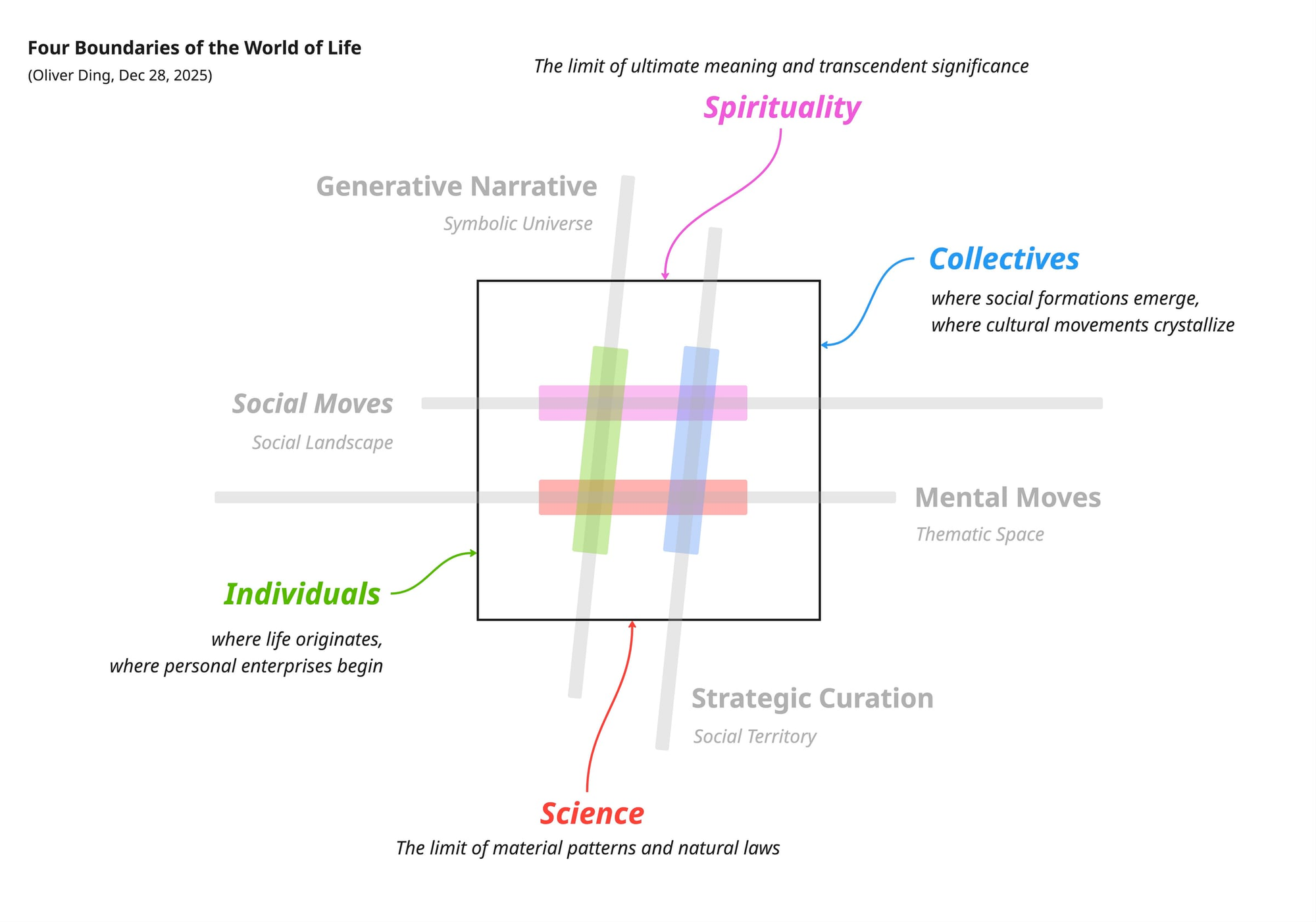
On the map of the World of Life, ACS and SDP occupy a symmetric arrangement: ACS at the Collectives boundary, attending to cultural development; SDP at the Individuals boundary, attending to personal development. This symmetry meant that the three months of intensive ACS work were simultaneously, if indirectly, advancing SDP. Concepts developed for the cultural side — the five developmental orientations, the Self–Other dimension, the ontological framework of the World of Life itself — could be brought across to SDP, enriching its theoretical foundations without requiring separate development.
At the end of March 2026, the ACS manuscript was released. In early April, the Revisiting–Rebuilding collection followed. With those closings, the natural next movement became clear: to bring SDP to the foreground and continue its development from where it now stood.
3. One World, Many Dreams
As the World of Life matured through three months of intensive ACS development — and particularly through the Double Square diagram, which had become a central spatial heuristic for mapping the relationship between the social world and the individual project — it became clear that the time had come to design a sign for SDP: a compressed visual form that could express its ontological foundations.
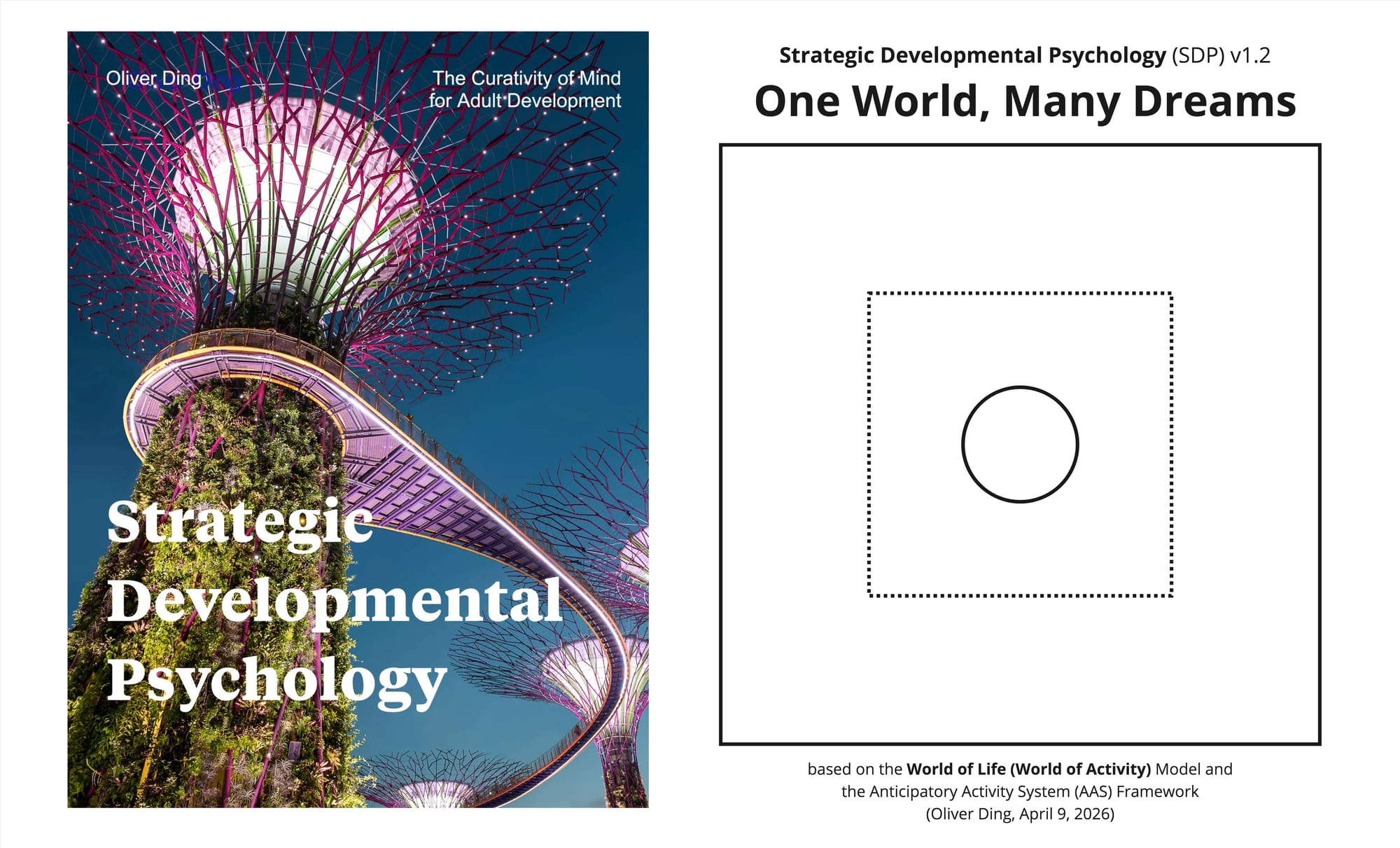
The SDP sign, finalized on April 9, 2026, consists of three concentric, center-aligned elements:
- Outer solid square — World of Life: the shared boundary of the social world
- Inner dashed square — World of Activity: each person's creative space, elastic and variable in size
- Solid circle, centered — the core of AAS: Self–Other–Present–Future
One World, Many Dreams.
The tagline requires careful interpretation. "Dream" here does not refer to the unconscious material of psychoanalytic tradition — Freud's dream as a window onto repressed desire. Nor does it refer to the short-term goals of action psychology, the proximal targets that motivate behavior in the near term. SDP's "Dream" points to something harder and longer: a person's conscious, sustained anticipation of a future they want to make happen, together with the long-term commitments that orient their life toward it.
The kinds of dreams SDP is interested in are the kind that require strategy precisely because they are difficult. Creating a new cultural enterprise. Developing a new theoretical discipline. Building something that does not yet exist and cannot be achieved through a simple sequence of planned steps. This is why "Strategy" needed to be brought into developmental psychology at all. Losing weight is a goal; it requires motivation and technique, not strategy in the deeper sense. But developing a new cultural enterprise — building it from a vague anticipation into a structured, sustainable trajectory — requires something more specific: Strategic Frameworks that orient decisions across time, Mental Platforms that support sustained creative work, and a clear understanding of what a Developmental Enterprise is and how it grows. These three concepts define the core of SDP's theoretical concern.
SDP is not interested in psychological health as a topic in itself. But it is deeply interested in the person who is developing a new theory of psychological health, or building software that changes how people access mental health support. How does such a person develop mental platforms and strategic frameworks? How do they advance their enterprise across years and decades? These are SDP's questions.
The sign encodes the ontological answer. Three theoretical layers, three historical moments, one integrated structure:
- World of Life (2026): the shared social terrain within which all individual lives unfold — one world for everyone
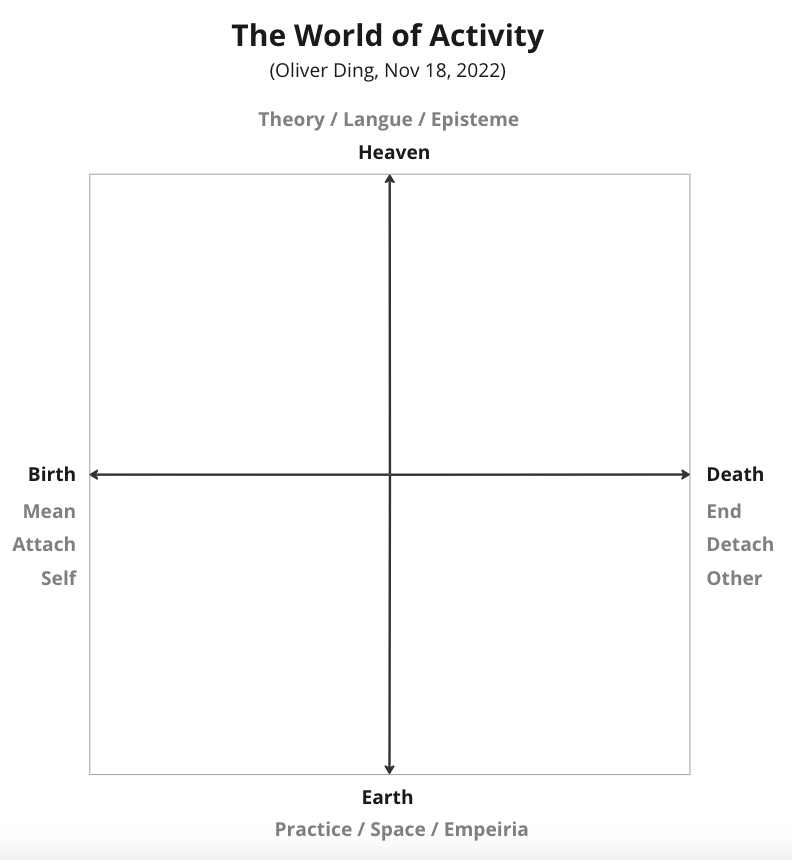
- World of Activity (2025): the elastic creative space each person carves out within that world — the dashed square signals that this space is not fixed. Different people have different scopes of activity. The form is invariant; the scale is personal.
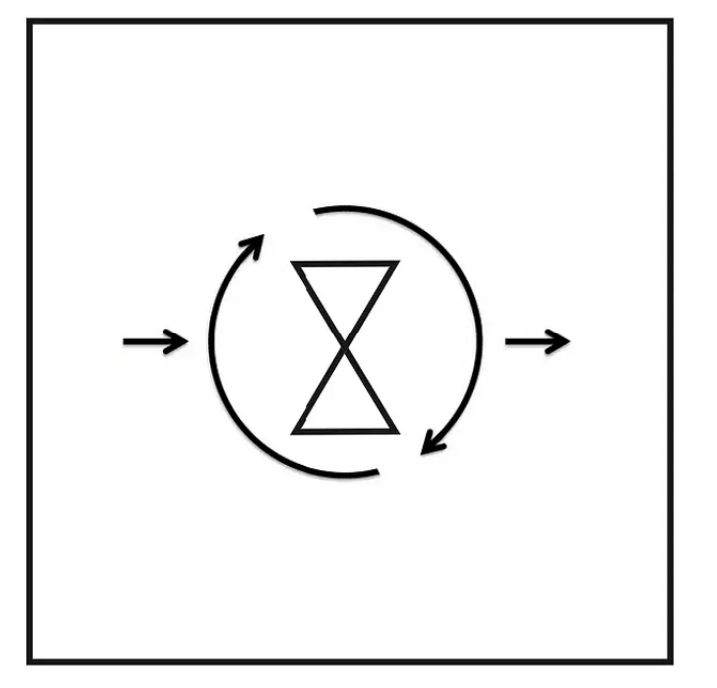
- The Core of AAS (2021): Self–Other–Present–Future — the dynamic core of anticipatory activity, always complete and always centered within the World of Activity, regardless of its scale
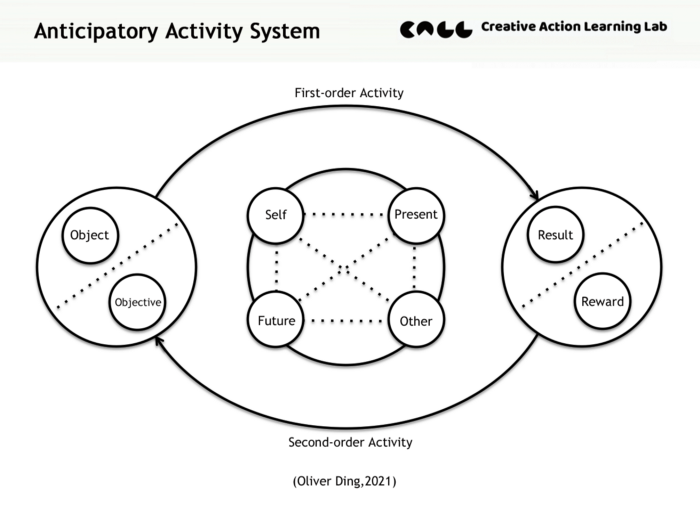
This is the ontological foundation of SDP. The sign does not describe what SDP contains — that is the diagram's task. It describes what SDP stands on.
4. The Version Story: From v1.0 to v1.2
The AAS framework — including its core Self–Other–Present–Future structure — was born from a case study of a life discovery program in 2021. Soon after, I associated it with the concept of strategy. In late 2022, the framework was introduced in a book draft titled Advanced Life Strategy: Anticipatory Activity System and Life Achievement. That was the seed of the SDP theoretical enterprise.
The version numbering, however, does not reach back that far. The Strategic Life Theory development and the AAS work are not included in the SDP version sequence. The versions mark only the creative progress beginning from December 2025.
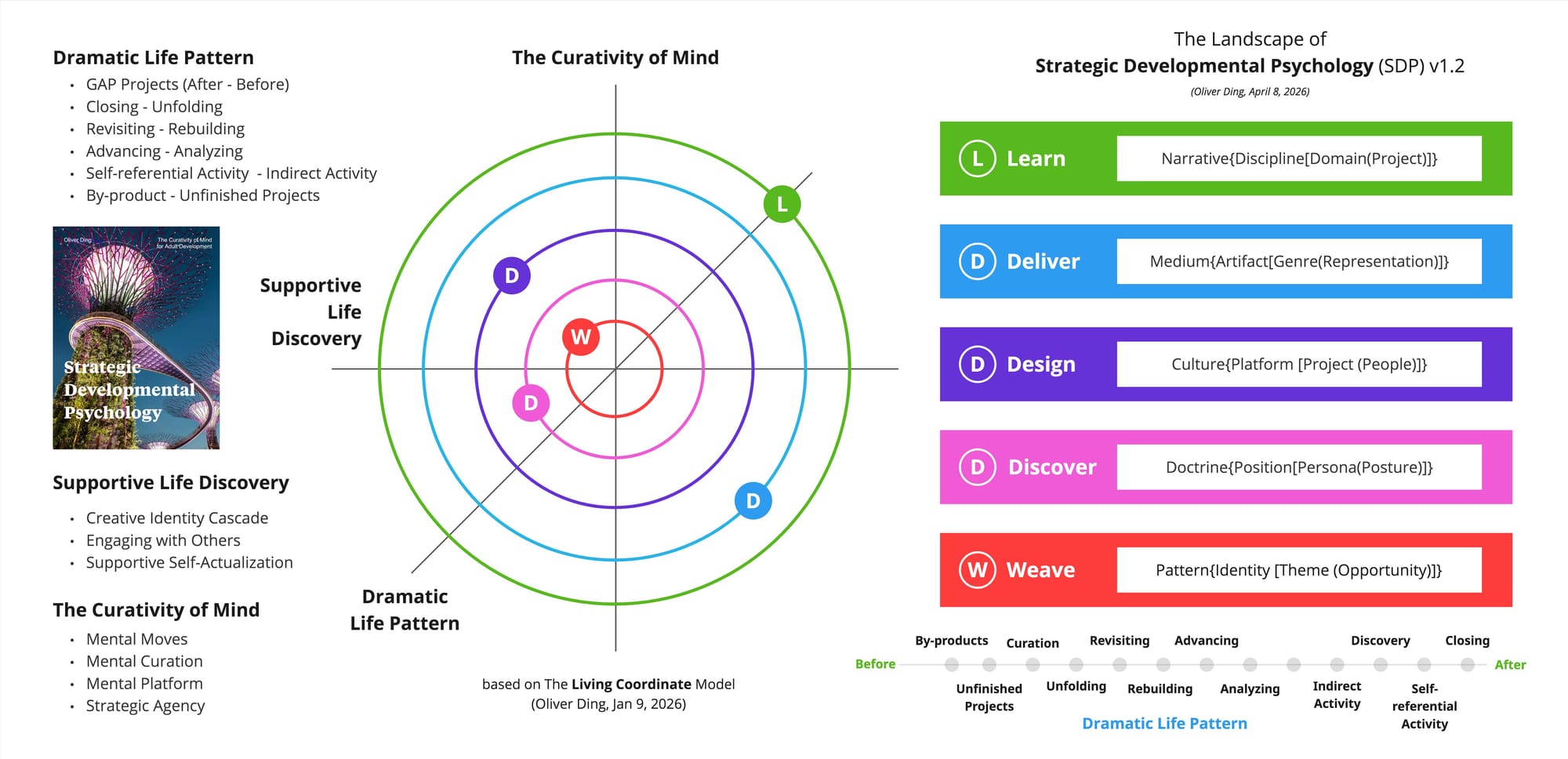
To tell the story behind these version numbers, I made the diagram below to represent the landscape of Strategic Developmental Psychology (v1.2). Each version contributes to the whole by making a special part.
v1.0 — December 2025
The completion of The Curativity of Mind established the first dimension: The Curativity of Mind itself — Mental Curation, Mental Platforms, and Mental Moves. This dimension attends to the cognitive interior of the actor: how the mind works as a creative platform, how it curates knowledge, and how it generates and deploys mental moves.
v1.1 — January–February 2026
The development of Anticipatory Cultural Sociology (ACS) during this period produced an unexpected by-product. The five-ring developmental orientation structure — Learn, Discover, Design, Deliver, Weave — emerged as part of the ACS framework (v1.2), but its natural home was SDP. It was transferred as a by-product and became the five rings of the SDP Living Coordinate. This orientation structure describes the fundamental modes through which an individual actor develops: from the innermost integrative action (Weave) to the outermost receptive orientation (Learn).
v1.2 — March–April 2026
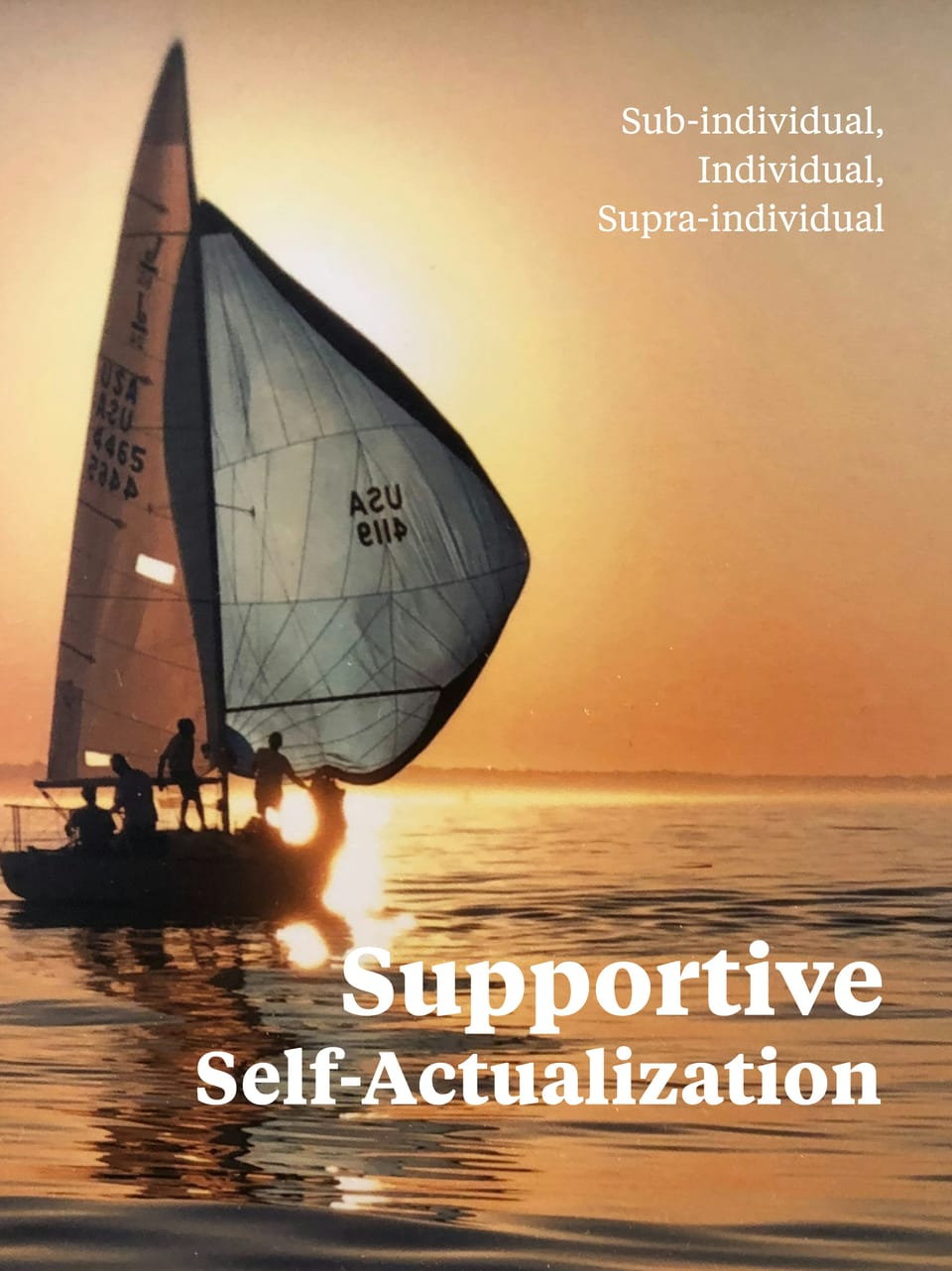
Two developments together constitute v1.2. First, a series of articles on Supportive Life Discovery — developed through the Revisiting–Rebuilding practice and the exploration of the Self–Other dimension — established the second dimension of SDP's three-dimensional landscape. This dimension addresses the relational conditions of individual development: how the presence, support, and co-becoming of others shapes the trajectory of a creative life.
Second, the formal launch of work on the third dimension: Dramatic Life Pattern — the study of how a creative life unfolds across time, structured through patterns of Discovery, Revisiting, Advancing, and Indirect Activity.
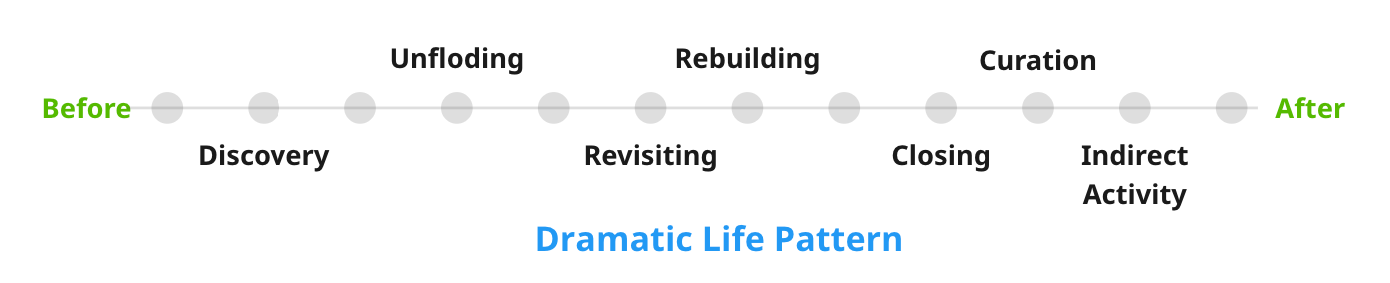
The Revisiting–Rebuilding collection, assembled in March 2026, marked the beginning of this work's systematic organization.
The v1.2 diagram presents the landscape as it stands at this moment: three dimensions, five rings, and a clear map of what remains to be developed.
5. The Three-Dimensional Model: An Overview
On February 2, 2026, the LARGE Method was developed as a comprehensive methodological framework for organizing creative work across multiple dimensions. It has been used to map the development of ACS.
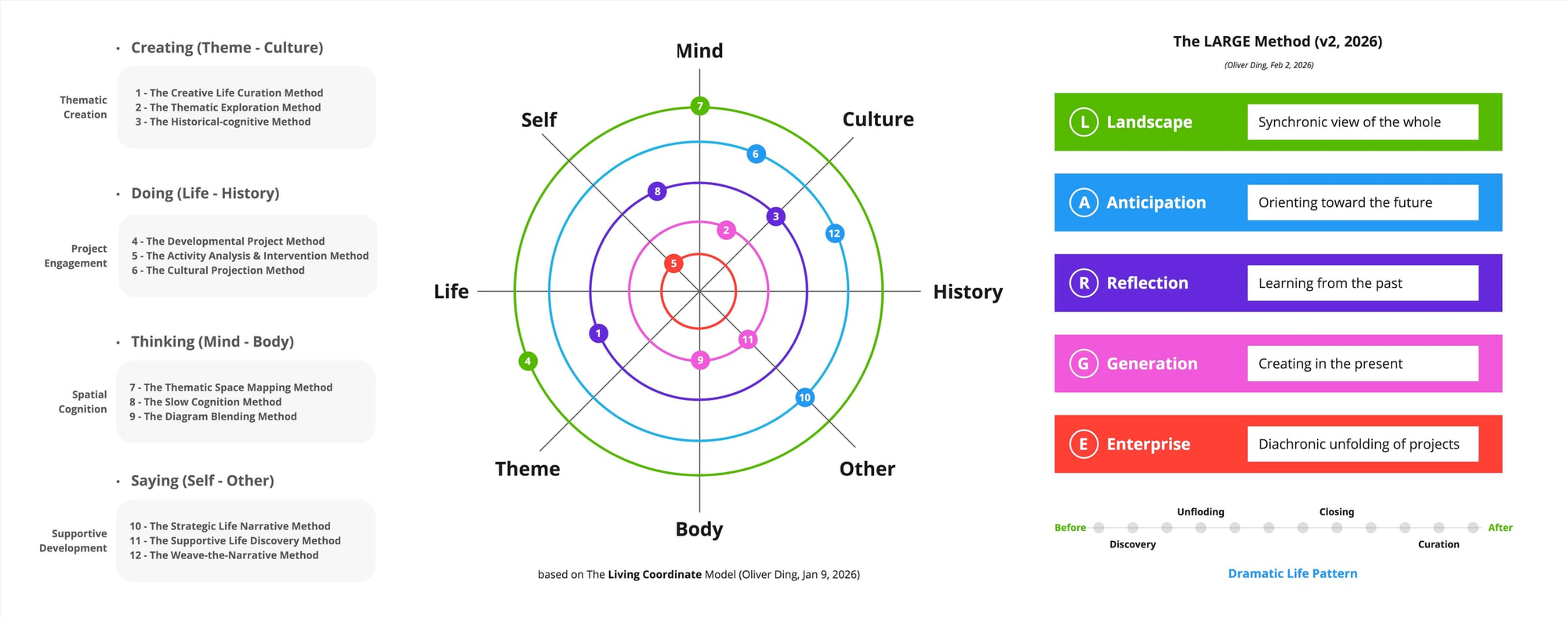
The diagram above presents the LARGE Method (v2, 2026). The Living Coordinate model was originally composed of two parts: a 3D coordinate system and a series of circles. The LARGE Method extends this structure by adopting a 4D coordinate and five circles. On the right side of the diagram, five methodological principles are presented in five differently colored boxes — Landscape, Anticipation, Reflection, Generation, Enterprise — each corresponding to one of the five circles in the central diagram. On the left side, four dimensions are unfolded into four thematic spaces: Creating (Theme — Culture), Doing (Life — History), Thinking (Mind — Body), and Saying (Self — Other).
The development of ACS turned out to align naturally with the LARGE Method — not by design, but by convergence. On February 27, 2026, drawing on the Living Coordinate model, the landscape of ACS v1.1 was mapped for the first time as a three-dimensional structure. Once that structure was made visible, what had been discovery-driven development became design-driven: the diagram itself became the guide.
The landscape of SDP (v1.2) was inspired by the landscape of ACS. SDP v1.2 is organized around three theoretical dimensions, each corresponding to a different aspect of individual development, and five concentric rings representing the fundamental developmental orientations.
The three dimensions of the SDP Living Coordinate are:
The Curativity of Mind — the cognitive dimension, corresponding to the "Body - Mind" dimension of the LARGE Method.
This is the most developed dimension at present, built on the theoretical work completed in December 2025. It addresses Mental Curation (how the mind selects, organizes, and transforms knowledge), Mental Platforms (the cognitive structures that support sustained creative work), Mental Moves (the operations through which concepts are developed and deployed), and Strategic Agency (the capacity to act strategically within a complex knowledge terrain).
Supportive Life Discovery — the relational dimension, corresponding to the "Self - Other" dimension of the LARGE Method.
Creative development does not happen in isolation: it is shaped by the presence of supporters, collaborators, teachers, and communities of practice. Supportive Life Discovery maps the conditions under which this relational support enables — and sometimes enables for the first time — the individual's capacity to discover their own direction. Key concepts include Creative Identity Cascade, Engaging with Others, and Supportive Self-Actualization.
Dramatic Life Pattern — the projection dimension, corresponding to the "Life - History" dimension of the LARGE Method.
This dimension was originally born from my practice of GAP Projects in 2023. GAP Projects represent a temporal pattern: the structural opportunities that exist between formal projects. These “After” and “Before” projects — such as Creative Life Curation and Creative Life Discovery — occupy the gaps between major endeavors. They serve as reflection points, transition spaces, and moments of strategic choice. The timing of GAP projects is itself a pattern: recognizing when to pause, curate, or explore can dramatically affect developmental outcomes.
Over the past three years, while practicing the "GAP Projects" pattern and researching its development, I detected other specific patterns of project engagement. Thus, I named this line of exploration Dramatic Life Pattern.
6. Five Orientations: The Rings of the Living Coordinate
The five rings of the SDP Living Coordinate — Weave, Discover, Design, Deliver, Learn — describe the five fundamental orientations through which an individual engages with the world and with their own development.
These five orientations describe the fundamental modes through which an individual actor develops: from the innermost integrative action (Weave) to the outermost receptive orientation (Learn).
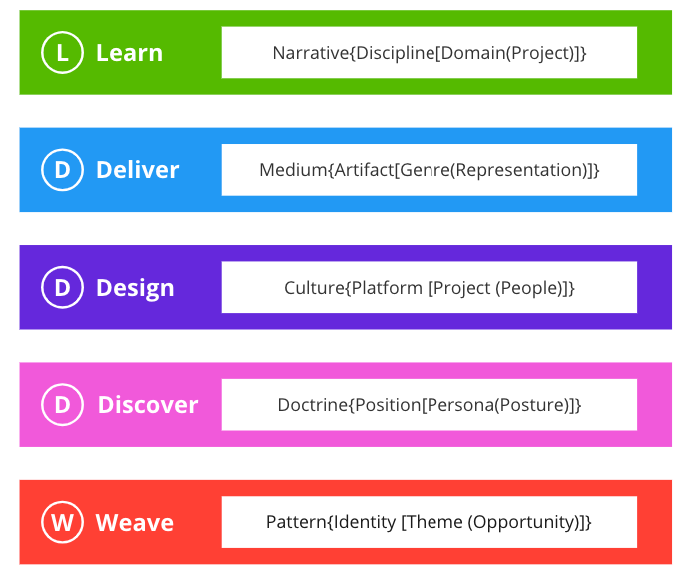
Weave is the innermost ring; it names the integrative action that holds everything together: real practice is never single-mode. A cultural actor always simultaneously discovers, designs, delivers, and learns — and the action that holds these together, that weaves them into a coherent practice, is Weave. Its position at the center is its meaning.
Learn is not merely an additional orientation. It marks the condition of possibility for all the others: an actor who cannot learn cannot act. Knowledge and skill are the necessary antecedents of every cultural engagement. Its position in the diagram — the outermost ring, green — reflects this: it is where the world enters the actor, the interface between an actor's interiority and the cultural resources that surround them.
Between them, Discover, Design, and Deliver describe the cycle of creative engagement. It was developed in Design-oriented Project Engagement (February 2026) as an operational framework for Anticipatory Cultural Sociology.
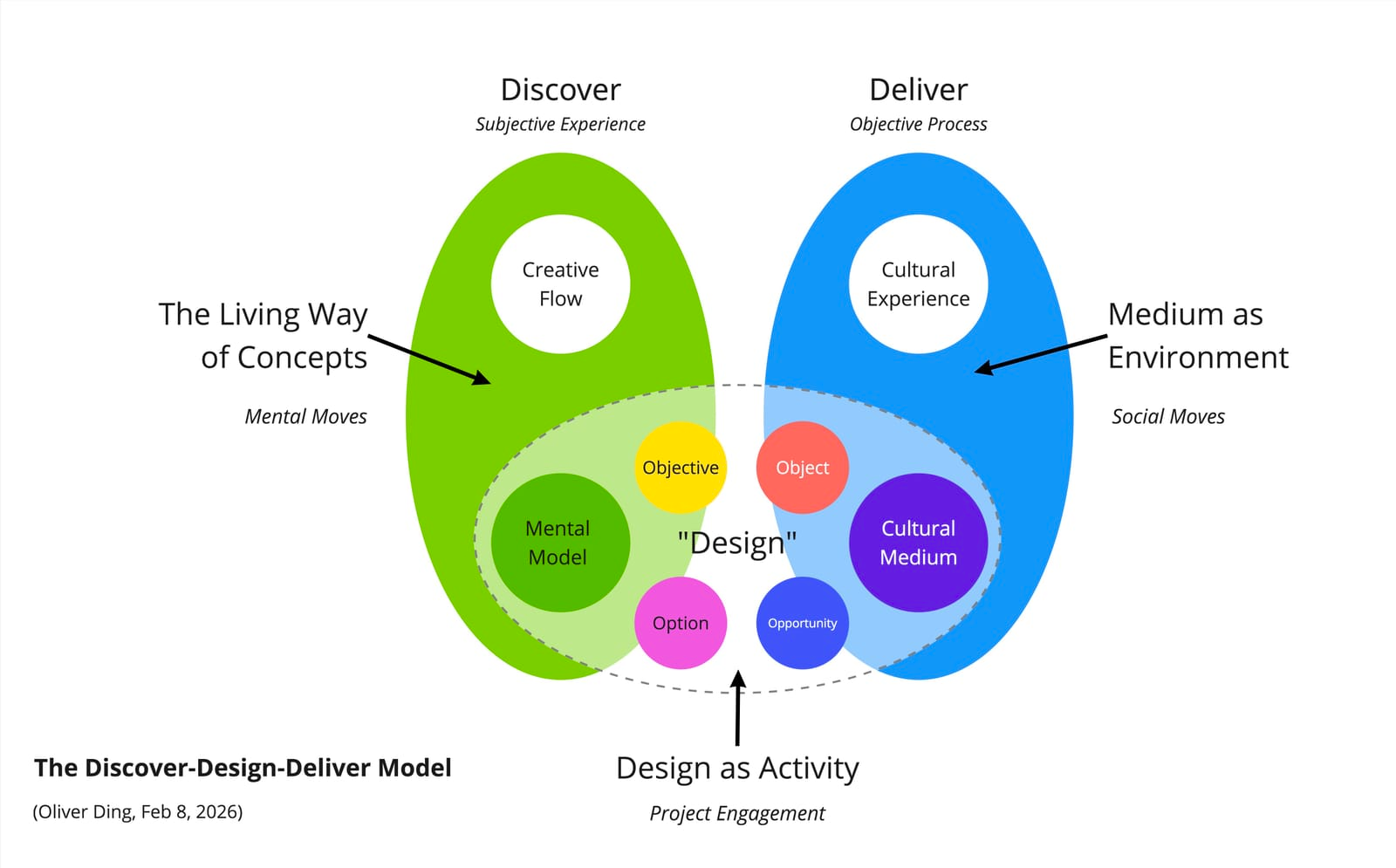
An important distinction governs the five rings. Weave and Learn applies to all people — they are two universal orientations that describe how any person develops, and it connects naturally to the existing literature in positive psychology, motivational psychology, action psychology, developmental psychology, and educational psychology.
However, the Discover–Design–Deliver model is more specifically oriented toward cultural creators — those whose development is organized around the creation of new thematic enterprises. SDP's core concern is with this latter type of actor, but its foundations in the Weave-Learn orientations give it relevance to the broader human condition.
7. Methodology: A Note
The theoretical development of SDP is grounded in a systematic methodology that has been built up over the past several months. Four frameworks constitute this methodological foundation:
- Ecological Formism — the epistemological framework governing the structure of knowledge claims within SDP, distinguishing Invariants, Quasi-invariants, and Variants.
- The LARGE Method — the comprehensive meta-method for organizing creative work across multiple dimensions: Landscape, Anticipation, Reflection, Generation, Enterprise.
- Thematic Space Theory (Cognitive Hydrology) — the framework for understanding how thematic spaces are named, developed, and connected within a knowledge enterprise.
- The Weave Method — the practical method for integrating disparate theoretical threads into coherent wholes.
These methods are not external scaffolding imposed on SDP from outside. They are the tools through which SDP develops its own internal structure. Notably, this methodology considers not only the researcher but also the actor — the person living the developmental process that SDP seeks to understand. Future articles will explore these methods in greater detail.
8. ACS and SDP: The Symmetric Pair
Strategic Developmental Psychology does not stand alone. It is one half of a symmetric theoretical pair, whose other half is Anticipatory Cultural Sociology (ACS).
ACS and SDP share the same ontological foundation — the World of Life — but are oriented toward different dimensions of the same social reality. ACS attends to cultural development at the collective scale: how thematic enterprises emerge, develop, and settle into the cultural world as Worldentity. SDP attends to individual life development at the personal scale: how a person strategically develops their capacity to contribute to and be shaped by that cultural world.
The symmetry is visible in the signs. ACS v2.0 — One Culture, Many Projects — uses a 3D coordinate system and three nested concentric circles, representing an anchored center and a scalable focus. It is a visual language of radiation, cultural diffusion, and expansion outward. SDP v1.2 — One World, Many Dreams — uses nested squares with a centered circle: a visual language of bounded containment, developmental depth, the elastic space of personal possibility held within a shared world. Same foundation, two directions. The circles radiate; the squares contain.
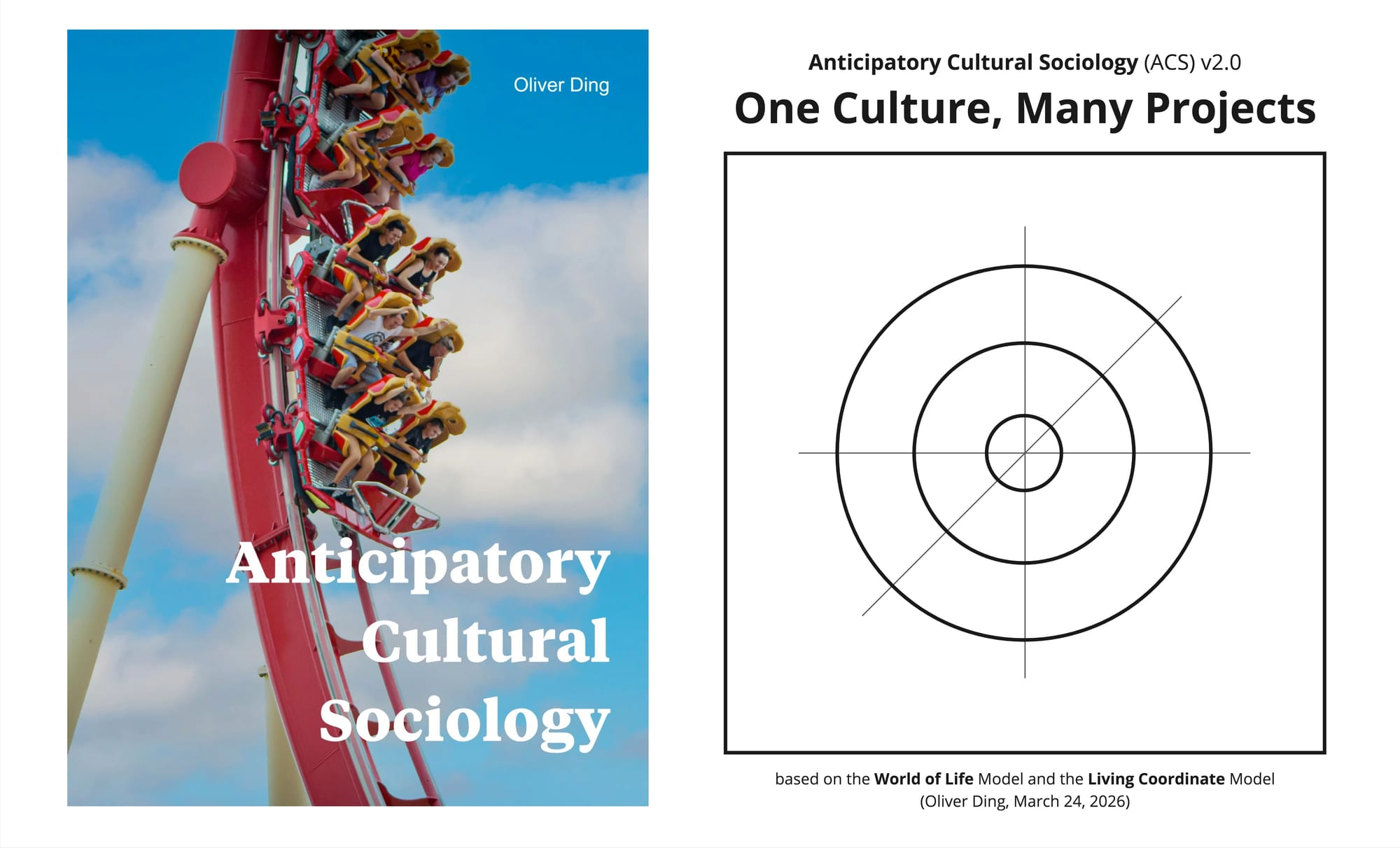
In ACS, anchoring is static while expansion is dynamic, seeking to answer how a core intention influences and ripples through the vast world; whereas in SDP, the boundary is static while the internal elasticity is dynamic, seeking to answer how a finite world can nurture an infinite self.
The structural consequence of this symmetry is what might be called mutual enrichment through indirect activity. Because ACS and SDP share the same spatial foundation — the same map, the same boundaries, the same operating concepts — theoretical work done on one side simultaneously generates resources for the other. The development of the Self–Other dimension within ACS produced, as a by-product, the theoretical core of SDP's Supportive Life Discovery dimension. The five developmental orientations developed within ACS became the five rings of SDP's Living Coordinate.
The most intimate zone of convergence between the two enterprises is precisely this Supportive Life Discovery axis. What ACS calls the relational conditions of cultural creation — the way Other is not merely an audience but a constitutive presence in the unfolding of any thematic enterprise — SDP calls the supportive conditions of individual actualization. These are two descriptions of the same fundamental fact: that human development, whether cultural or individual, is always already a co-becoming.
Within the larger GO Theory platform — which holds both enterprises, along with Life as Activity, Cognitive Hydrology, and Platform Ecology — ACS occupies the Collectives boundary of the World of Life, and SDP occupies the Individuals boundary.
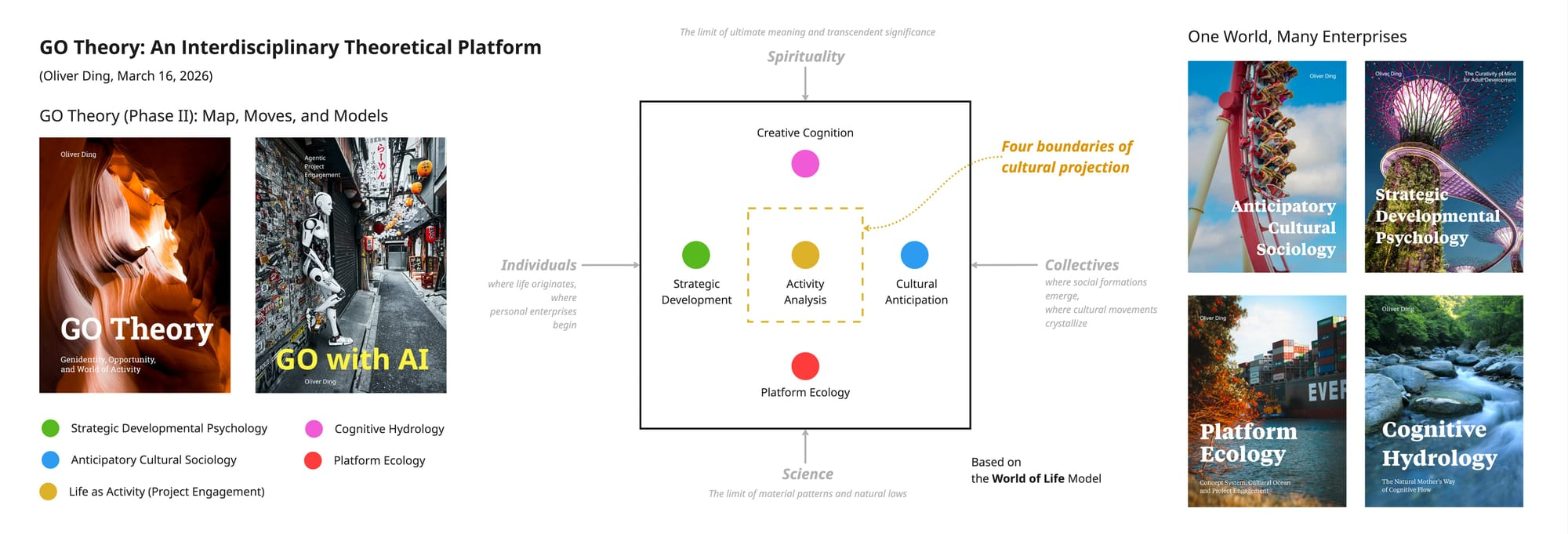
They are genuinely different enterprises, with different conceptual vocabularies and different theoretical concerns. But they face each other across the same terrain, and each illuminates what the other cannot fully see.
9. Next Steps: Closing and Unfolding
The v1.2 diagram is simultaneously a record and a map. It curates the theoretical work completed so far — three dimensions now named, five rings in place, the ontological foundation set. And it points forward to what remains.
Three tasks define the next phase of SDP development:
First, the Dramatic Life Pattern dimension requires systematic development. The Revisiting–Rebuilding collection has opened this work; what follows is the formal elaboration of the full pattern — Discovery, Revisiting, Advancing, Indirect Activity — and its theoretical grounding within SDP's three-dimensional structure.
Second, the five-ring structure requires further refinement. The functional distinction between Weave-Learn (applicable to all people) and the DDD model (specific to cultural creators) needs to be theoretically articulated. And the relationship between the five rings and the Nine Aspects of Strategic Agency — developed within Strategic Life Theory (v1, 2025) — remains to be worked out. The Nine Aspects describe strategic capacity at the level of the individual actor; the five rings describe developmental orientation. Their connection, through both the Weave-Learn and the DDD model, will be a significant theoretical contribution.
Third, the new SDP sign introduces a task that extends beyond the diagram: the coordination of the Self–Other dimension's ongoing exploration with the World of Activity's most recent theoretical developments, particularly the FFCC framework. The Afterword to the Revisiting–Rebuilding collection — The World of Activity of Mid-Life — has opened this connection. Following it is part of SDP's next movement.
The landscape of early 2026 is both a grand closing and a vital unfolding. With the release of the manuscript Anticipatory Cultural Sociology: Creation, Projection, and Agency on March 30, 2026, the ACS v2.0 era reached a triumphant conclusion. This milestone was the fruit of an intense creative sprint from January to March—a massive intellectual undertaking comprising 14 chapters, 47 articles, and over 220,000 words. It stands as a rigorous exploration of how thematic enterprises settle into the cultural world.
Yet, this completion immediately seeded a new beginning. On April 6, 2026, I released the manuscript Revisiting and Rebuilding: A Strategy for Creative Identity Development. This work captures the essential creative heuristics—the RR practices—employed during the development of ACS. Crucially, the ontological exploration of the Self-Other relationship within this book provides the missing link: it marks the official launch of SDP v1.2.
What was once a method for building sociology has now become the foundation for a new Strategic Developmental Psychology—a transition from understanding how we create culture to understanding how that creative identity, in turn, develops the self.
One World. Many Dreams. The platform is open.
v1.0 - April 10, 2026 - 3,556 words