
The Path of Creative Life in a Trip

A trip as a living theoretical model
by Oliver Ding
September 2025
This article is the Preface of a Kindle book, Homecoming Homecoming: A Thematic Trip and the World of Activity Approach.
In the summer of 2025, I returned to Fuzhou for a meaningful family visit, blending a personal journey with theoretical insight. This journey sparked reflection on my past, revisiting the autobiography I wrote ten years earlier, and inspired a unique integration of life narrative, theoretical exploration, and cultural reflection.
Homecoming was based on the Chinese notes I took during the trip, as well as my autobiography, which was originally written in Chinese. To serve readers interested in exploring the Chinese version, this Bilingual Possible Book is published as a collection on Possible Press.

A Trip as a Living Theoretical Model
The preface reflects on the thematic trip through a particular framework: the Path of Creative Life.
Contents
Self, Life, and Mind
The Path of Creative Life
Reviewing the Past
Serendipitous Emergence
Self-Referential Exploitation
Immersing the Present
Improvised Exploration
Orienting to the Future
An End as a Beginning
Notes
From late June to July 2025, I traveled to China, spending most of my time in Fuzhou, also known as Foochow. Before moving to the U.S., I had lived in Fuzhou for nearly 20 years. This journey became a deeply meaningful re-engagement with familiar places, old friends, and the memories that had shaped my earlier life.
At the beginning of the trip, I revisited Wuyi Mountain, searching for a symbolic object that had inspired my son Peiphen’s name. This moment led me to re-read my 2015 autobiography, A Freesoul.
More specifically, I reunited with an old friend from Beijing, and together we explored the city. One of my classmates served as our guide. In this process, I rediscovered his deep knowledge of local culture and his refined character.
Immersed in this rich experiential context, I began connecting the World of Activity approach with my situational experiences.
In my recent creative Flow, the theme of World of Activity has become a significant Focus. In June 2025, I formally detached the theme from the Creative Course Framework and redefined World of Activity as a general term for further theoretical development. From the perspective of the Ecological Practice Approach, “World of Activity” is understood as a broad life container — a space in which we can observe the structure and developmental patterns of life activities. It also functions as a thematic space where related knowledge elements can be curated together.
The World of Activity approach provides a lens through which we can examine human experience across multiple temporal and spatial scales, utilizing a series of knowledge frameworks.
While in Fuzhou, I mainly used the World of Activity model, also known as the “Flow — Focus — Center — Circle” schema, to reflect on my 2015 autobiography. I discovered several distinct forms of “World of Activity,” corresponding to different developmental stages of life.
- Hometown: Primordial Situatedness @ World of Activity
- Alien Land: Geographical Expansion @ World of Activity
- Domain: Professional Development @ World of Activity
- Internet: Digital Engagement @ World of Activity
- Foreign Land: Cultural Reconstruction @ World of Activity
Later, I detached my mental focus from the past and attached it to the present. When staying at Fuzhou, I had opportunities to meet with old classmates and friends. We had wonderful conversations and exciting tours around the city.
Paying attention to the present brought new insights to me. Eventually, I discovered two more forms of the World of Activity.
- Inheritance: Generative Anticipation @ World of Activity
- Homecoming: Spatio-temporal Emergence of the World of Activity
Each form represents not merely a change of location or circumstance, but a fundamental reorganization of how the World of Activity structures itself — its boundaries, centers, and internal dynamics.
I continued writing daily notes to deepen the theory-practice connection. By the end of the trip, I had written 138,352 words in Chinese. Combined with the original 2015 autobiography, the total came to nearly 211,145 words. The newest version, v2.1, is about 217,665 words.
I edited it as a new Chinese book draft titled Freesous in Fuzhou: Theme, Enterprise, and World of Activity.
Unfortunately, the original was written in Chinese. After returning to the U.S., I started rewriting it in English. The result is this English book: Homecoming: A Thematic Trip and the World of Activity Approach.
While most materials are based on my Chinese notes, the English book is not a translation of the Chinese book draft. For example, in the Chinese one, it has six parts, and I wrote notes on the World of Activity approach, and relevant ideas such as the Social Form framework, the Thematic Enterprise framework, and the Strategic Agency framework. In the English one, I will focus on the trip itself and the World of Activity approach. Other topics will be explored in other future books.
Self, Life, and Mind
This book is about Self, Life, and Mind.
The major part of the book investigates my 2015 autobiography using the “Flow — Focus — Center — Circle” schema, also known as the World of Activity model. It is a book about how the 2025 “I” employs theory-based reflection to reflect on the practice-based reflection that the 2015 “I” made about my past self. This experience of biographical engagement has been extraordinary! I hope this book can share both my method and the joy I discovered in it, encouraging you to embark on your own journey of biographical engagement.
As Chinese historian Qian Mu once said, what we cannot forget is our real life (note 1). This homecoming trip proved to be a perfect voyage — I was fortunate to reconnect with people, events, and places I had been unable to forget over the years. Those individuals, experiences, and locations I recorded in my autobiography ten years ago were, naturally, among the unforgettable elements of my life. Due to time constraints, however, this creative work based on the journey remains imperfect. The fourth section of the original Chinese manuscript, concerning the evolution of social forms, was left incomplete. Yet this imperfection is an indispensable part of life itself.
Inspired by ecological psychology, activity theory, and phenomenological sociology, I approach Mind from an ecological perspective, integrating thinking with doing. This trip involved mental movements across multilayered spatial trajectories and temporal dimensions — reflecting, interpreting, and connecting life experiences across different scales of time and space.
Since the World of Activity model will be properly introduced in the Introduction and subsequent chapters, I would like to use this preface as an opportunity to reflect on the journey itself through a particular framework that, along with the World of Activity model, belongs to the Creative Life Theory family.
The following sections present a distinctive blend of life narrative, theoretical development, and cultural reflection — a style that characterizes the book as a whole.
The Path of Creative Life
In August 2021, I created a diagram called “The Path of Creative Life” (see Figure 1). It emerged from a constellation of concepts:
- Individual actions — Activity — Collective culture
- Theme — Experience
- Reflection — Emergence — Anticipation
- Exploitation — Exploration
- Review — Orient
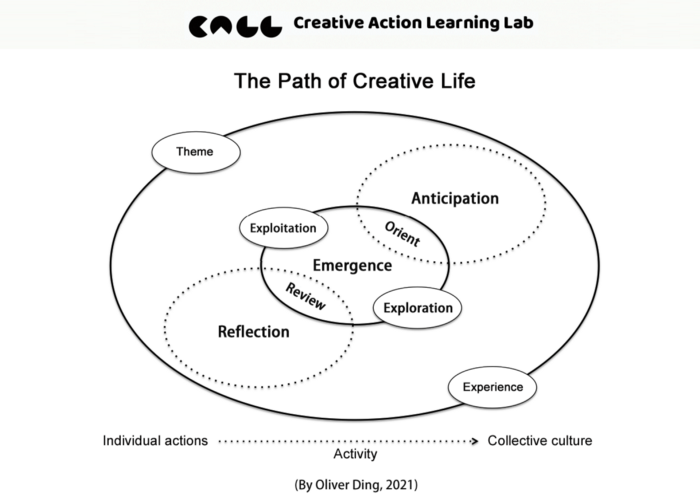
I didn’t pay much attention to this diagram in 2021 because I was immersed in developing the Life-as-Project approach, which operates within the field of Activity Theory. However, in 2022, I rediscovered its theoretical value and adopted it as the foundational model for Creative Life Theory (v1.0), which I developed that year.
On July 26, 2025, as my trip in Fuzhou drew to a close, I had a striking realization: the entire trip had organically followed this model. The trip’s arc — from initial themes and experiences through reflection and emergence to new anticipations — mirrored the creative life path I had theorized years earlier. That day, I spent time reviewing the trip through this analytical lens, uncovering patterns I hadn’t consciously planned but had intuitively enacted. The details of this retrospective analysis will be explored in the sections that follow.
Reviewing the Past
On June 8, I completed editing the manuscript Wonder and Wander, a book that brings together eight case studies. These studies were drawn from my creative journey between 2019 and 2025, which engaged with several theoretical traditions. The outcome of this project was the Thematic Enterprise framework, with one of its by-products being the World of Activity Toolkit.
On June 23, I returned to China with my family for a visit. After arriving in Fuzhou, we traveled to Wuyi Mountain, where I visited the archway of Peifeng Academy, which had been relocated from my hometown to that region. During the trip, I recalled my 2015 autobiography, A Freesoul, and the childhood experiences recorded in it. At the same time, I made some spontaneous notes in a WeChat group, reflecting on the journey as well as my thoughts about the Wonder and Wander manuscript, the Thematic Enterprise framework, and the World of Activity Toolkit.
After returning to Fuzhou, I reconnected with old classmates, sharing our respective life journeys over the years. I also revisited relevant chapters of A Freesoul, reflecting on my early career experiences in Fuzhou.
Serendipitous Emergence
On July 5, I accidentally deleted the WeChat group from my phone. After a friend helped me recover the posts I had shared, I created a community on Knowledge Planet (a Chinese membership-based sharing platform) and reposted my fragmented notes there. In the following days, I organized these scattered reflections using the desktop version of Knowledge Planet.
During those days, using the World of Activity approach as a theoretical lens, I reflected on these fragmented notes and developed a corresponding World of Activity analytical methodology. After establishing the basic theoretical framework, I used the autobiographical materials recorded in A Freesoul to test and refine the World of Activity approach.
In this way, a formal creative project was born. I titled its outcome The World of Activity of a Freesoul.
On July 12, I created a document titled “Table of Contents and Working Plan for The World of Activity of a Freesoul” to manage this spontaneously emerging creative project (note 2).
Self-Referential Exploitation
The highlight of The World of Activity of a Freesoul was its third part, “The Evolution of the World of Activity.” This part applied the World of Activity analytical methodology to discuss my 2015 autobiography, A Freesoul, treating it as case study material to examine the morphological changes and developmental patterns of the World of Activity across multiple stages of my life course.
Through these case analyses, I moved from the autobiography’s particular characteristics to develop more generalizable patterns:
- Hometown: Primordial Situatedness @ World of Activity
- Alien Land: Geographical Expansion @ World of Activity
- Domain: Professional Development @ World of Activity
- Internet: Digital Engagement @ World of Activity
- Foreign Land: Cultural Reconstruction @ World of Activity
- Homecoming: Spatio-temporal Emergence @ World of Activity
- Inheritance: Generative Anticipation @ World of Activity
If the theoretical models and methodologies of the first and second parts provided the skeleton, then the diverse forms of the World of Activity derived from the case analyses in the third part constituted their flesh and blood.
Since I found myself in the context of reconnecting with old classmates and friends, I seized the moment and used my 2015 autobiography as research material to test the World of Activity approach. This action strategy was actually a form of strategic self-reference that I had repeatedly employed in recent years.
The productive use of the A Freesoul autobiography yielded remarkable results. It directly generated concrete forms of the World of Activity corresponding to different stages of a fifty-year developmental trajectory, laying the foundation for future similar analyses. For instance, the dual-center structure and evolutionary patterns it proposed resonated strongly with findings from my research on the Anticipatory Activity System framework (note 3).
Moreover, this process led me to rediscover the value of the autobiography I had written ten years earlier. At that time, approaching it from the perspective of reflecting on my own learning patterns, I had deliberately included extensive historical and cultural background for different stages of my growth process. Looking back now, this autobiography possesses considerable representative significance, reflecting the zeitgeist of different periods in Chinese social life over the past fifty years.
Immersing the Present
In the days following July 12, I gathered with old classmates in Fuzhou and explored the city with my friend from Beijing. A friend from afar also mailed me his portfolio of creative works.
These present-moment dialogues and exchanges sparked abundant new insights, inspiring extensive mental journeys that moved back and forth between past, present, and future. The conversations created a rich experiential space where memory, immediate experience, and anticipation converged and informed one another.
The reflections and insights arising from these dialogues found expression in my daily notes for the “The World of Activity of a Freesoul” project. As my trip unfolded, my writing also followed. After finishing my reflection on the autobiography, I completed Part III of the project. Then, I moved to paying attention to the present, and new insights emerged, leading to contents for Part V, “The Evolution of Thematic Enterprise,” and Part VI, “The Flourishing of Mind-Heart.”
Improvised Exploration
While the “The World of Activity of a Freesoul” project primarily followed the World of Activity approach, I also developed additional ideas as the writing unfolded. For instance, the notion of “Thematic Objects” appeared several times in my daily notes, since I often carried such objects when meeting friends and classmates in Fuzhou. These embodied artifacts became anchors for thematic conversations. Later, it guided me to expand the Theory as Enterprise framework into a more general one: the Thematic Enterprise framework.
At a different level, Part IV of the project — The Evolution of Social Forms — evolved from my case study on the fourth form of the World of Activity: Internet: Digital Engagement. This case study revealed a higher-order structure underlying the dynamic development of Worlds of Activity, organized across four layers: Technology — Application — Behavior — Culture.
To distinguish this type of structure from Georg Simmel’s concept of Social Forms, I introduced a new category of higher-order structures, which I called Significant Social Forms. The particular one that emerged from the Internet case I named the Sociotech Landscape.
This discovery also inspired me to develop the Social Form (Action Course) framework, where the World of Activity is understood as the largest category of social forms in an individual’s life journey. Other significant forms, such as the Sociotech Landscape, are nested within this broader category — a structure reminiscent of the Creative Life Theory.
Although I was not able to complete the case studies at that time, the outline of this framework remains an open path for future exploration.
Orienting to the Future
A Freesoul ends with my life course around 2013. In my later daily notes, I briefly recorded episodes from my creative journey after that year, especially the emergence of my most recent projects.
During the trip, a friend came from Beijing to visit me. Together we explored the historic district of Sanfang Qixiang and visited the former residence of Yan Fu (note 4). This friend had once played a key role in localizing Wikipedia into Chinese — translating its structure, defining entries in terms of the Chinese knowledge system, adapting community rules, and creating some of the earliest Chinese-language pages. His very first article? “Yan Fu.” When I asked him why, he replied that it was the theme of East–West Dialogue that had inspired him.
After Sanfang Qixiang, we visited the Fujian Museum and strolled under the dense shade of trees by West Lake Park. I asked his impression of Fuzhou. Surprisingly, he compared it with Xi’an. Xi’an, though historically rich, felt disconnected from the present. Fuzhou, on the other hand, was vibrant in modern history — its many famous figures and events deeply intertwined with the nation’s fate. He felt much closer to Fuzhou’s history.
Most importantly, he said that the East–West dialogue that began a century ago is far from over. It continues, with our generation as the protagonists.
This conversation inspired me to write a note, highlighting in particular a recent project that seeks to connect Agency, a central concept in Western sociology, with Mind–Heart, a core concept in Chinese philosophy. This project directly echoed the theme of East–West Dialogue. Part VI of The World of Activity of a Freesoul took this theme as its central focus, framing nine aspects of strategic agency as a way to understand Agency within the World of Activity approach.
This part forms the conclusion of the project and resonates with the late theme of my trip.
On July 25, I met with a classmate at a café to discuss various topics related to Creative Life Theory. Several years earlier, his mother had encouraged him, before her passing, to seek meaning in life beyond the busyness of enterprise. Since then, he had embraced photography as the central theme of his creative life, transforming himself from a successful businessman into a creative environmental photographer.
Our discussion reflected on the developmental journey of his creative life and anticipated the strategic orientation of his future. Based on our conversation, I opened the thematic map of the “Nine Aspects of Agency” and identified a particularly prominent aspect of his agency, recommending an action strategy built around it.
An End as a Beginning
The trip ended on July 27. While waiting for my flight to Houston at San Francisco International Airport, I opened a book that a friend had sent to me in Fuzhou. The book was the Chinese edition of The Innovative University, written by Clayton M. Christensen and Henry J. Eyring, translated by Yang Bin, who is a professor at the School of Economics and Management at Tsinghua University and a mentor to my friend.
This is an empirical research monograph that studies the development of American higher education from the perspective of management innovation strategy. The book uses Harvard University and Brigham Young University-Idaho as case studies over many years, conducting detailed comparisons and critiquing the path dependency phenomenon in American higher education centered on the “Harvard model.” The authors propose three key responsibilities of universities as the fundamental purposes of university innovation: 1) Discovery, 2) Memory, and 3) Mentoring.
Interestingly, this research project uses “genes” as a metaphor, comparing the genes of the Harvard model with those of Brigham Young University-Idaho. “Genes,” originally a biological term, is used here to refer to the essential characteristics of Harvard University and other institutions.
On June 21 — two days before the start of this trip— I shared on social media an overview of my new manuscript, GO Theory. Its core concept is Genidentity, the unique differences that an entity maintains with other entities as it evolves over time.
The full title of my GO Theory manuscript is GO Theory: Genidentity, Opportunity, and World of Activity (book, v1.0, 2025). In this manuscript, I included the recently developed World of Activity toolkit. It marks the end of Phase I of the GO Theory project, representing the successful completion of my exploration in the direction of knowledge engagement. Phase II will focus on cultural innovation.
The case study by these two authors can actually be seen as empirical research of the “Genidentity” concept in the field of higher education. This journey began with a manuscript about Genidentity and ended with a book about Genidentity — a wonderful experience.
Very coincidentally, my thinking and writing about thematic enterprises during my travels in Fuzhou was actually the beginning of my exploration in cultural innovation. Therefore, we can say that the end of this journey is also the beginning of a new journey.
What started as a return became a new departure. That is the rhythm of life and theory — every ending is a beginning.
Now, turn to the next page, starting a new beginning.
Notes
- 钱穆说,[忘不了的人和事,才是真生活]。
- The World of Activity of a Freesoul was structured in six parts: Part I provided theoretical foundations, Part II introduced the analytical methodology, Part III examined “The Evolution of the World of Activity” through biographical analysis, Part IV explored “The Evolution of Social Forms,” Part V focused on “The Evolution of Thematic Enterprise,” and Part VI examined “The Flourishing of Mind-Heart,” exploring nine aspects of strategic agency that emerged from my work with the AAS framework. The English book you are reading draws primarily from this Chinese manuscript but focuses specifically on the trip itself and the World of Activity approach.
- The Anticipatory Activity System (AAS) is a framework I developed between 2021–2022 to analyze complex activities involving “Self, Other, Present, and Future.” The framework distinguishes between first-order activities (immediate, practical tasks) and second-order activities (reflective, strategic processes) within an anticipatory structure. The dual-center structure refers to the dynamic relationship between different levels of activity and their temporal orientations — managing present constraints while anticipating future possibilities.
- Yan Fu (严复)