
The Significant Themes Framework (2026)

Revisiting and Rebuilding the Learning Landscape conceptual deck (2015)
by Oliver Ding
March 5, 2026
In early 2026, while developing the Supportive Life Discovery project — a framework for supporting individuals through the key transitions and challenges of adult life — I found myself returning to a conceptual deck I had created in November 2015: the Learning Landscape framework.
One component of that deck was an early attempt to map significant turning points in adult career and life development, drawing on my own experience and observations of people around me. It was intuitive and practically oriented, built on direct observation rather than the theoretical frameworks I would later develop.
The slide below is quoted from the original Chinese deck. My basic observation was simple: in a person’s life, certain periods of transition may feel confusing, but they often turn out to be important turning points.
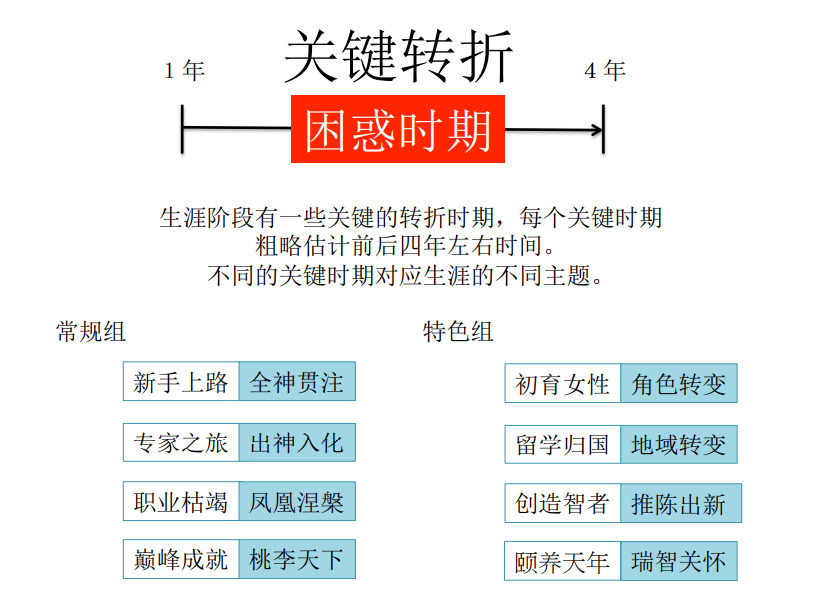
This intuition was partly inspired by my experience running a non-profit youth community, New-Four-Year Institute (NFY), around 2012. The program focused on students in their third and fourth years of college, as well as those in the first and second years after graduation. I observed that four years often constitute a natural period for a major life transition. NFY supported young people in navigating these formative years, helping them transform from students into early professionals and addressing the first key transition in a person’s career.
Based on these observations and personal experiences, I identified eight recurring themes corresponding to eight turning periods, divided into a regular group and a special group.
Each theme follows a two-part structure: the first phrase describes the life situation or stage, and the second expresses the core orientation or theme that tends to emerge during that period.
Each entry, therefore, follows a simple pattern:
Life situation → Life theme
The Regular Group (on the left side of the slide)
The first group describes a regular trajectory of professional development.
Starting Out → Wholehearted Engagement
When people first enter a field, the central challenge is learning and immersion. The natural theme of this stage is wholehearted dedication to developing competence.
Journey to Expertise → Effortless Mastery
As experience accumulates, the focus gradually shifts toward refinement and deep skill, eventually reaching a level where performance becomes fluid and natural.
Career Burnout → Transformative Renewal
Periods of exhaustion or crisis can force people to rethink their direction, sometimes opening the possibility of renewal and transformation.
Peak Achievement → Cultivating Others
At the height of one's career, attention often moves beyond personal success toward mentoring and nurturing the next generation.
While the first group reflects a relatively regular developmental trajectory in professional life, the second group captures transitions triggered by particular life situations.
The Special Group (on the right side of the slide)
The second group describes life transitions triggered by particular situations.
Again, each theme follows the same structure: a situation and the transformation it tends to call forth.
Becoming a Mother → Identity Transformation
Early motherhood often requires a deep reorganization of identity and priorities.
Studying Abroad and Returning Home → Geographic Transition
Living abroad and then returning home can reshape one’s sense of place, belonging, and cultural position.
Creative Maturity → Renewing the Tradition
For creative thinkers, a mature stage often involves challenging established ideas while renewing the traditions they emerge from.
Later-life Caregiving → Compassionate Wisdom
In later life, people may enter a period in which caring for others becomes a central orientation of life.
Revisiting and Rebuilding
When I created this slide in 2015, it was not yet a theoretical framework.
It was simply an attempt to map recurring life situations and themes they tend to generate.
Revisiting the 2015 deck through the lens of a decade of subsequent theoretical work revealed something unexpected: many of the original intuitions were largely correct. The eight Significant Themes identified in 2015 mapped naturally onto the Flow-Focus-Center-Circle schema (FFCC), the Ecological Formism framework, and the Weave-the-System analysis method — frameworks that did not exist in 2015 but that, in retrospect, give precise theoretical language to what the original deck had grasped only implicitly.
On March 5, 2026, I revisited the eight themes and rebuilt them into what is now called the Significant Themes framework.
First, the concept of Significant Themes was introduced as a new concept for the Project Engagement Approach. In November 2025, I released a book draft: Developmental Projects: The Project Engagement Approach to Adult Development, placing the Project-Theme relationship in the context of adult development. The concept of Significant Themes further clarifies that life transitions, when viewed through the Project Engagement approach, can be understood as developmental projects organized around key themes.
Second, the Regular Group (four themes) is analyzed using FFCC vocabulary and shown to form an Agency Cascade. Every naming choice in this project was a theoretical act. "Cutting the Flow" is not a translation of 全神贯注(Wholehearted Engagement) — it is a reconceptualization that brings the FFCC vocabulary to bear on what the original name expressed intuitively. The English names did more than simply translate the originals: they repositioned the themes within the current theoretical architecture.
- 全神贯注(Wholehearted Engagement) → Cutting the Flow
- 出神入化(Effortless Mastery) → Blooming the Center
- 凤凰涅槃(Transformative Renewal) → Rescue the Center
- 桃李天下(Cultivating Others) → Flourishing the Circle
Third, by using the Ecological Formism framework, the Special Group (four themes) is analyzed as Variant-layer situational themes, each structured around a specific two-person relational dynamic.
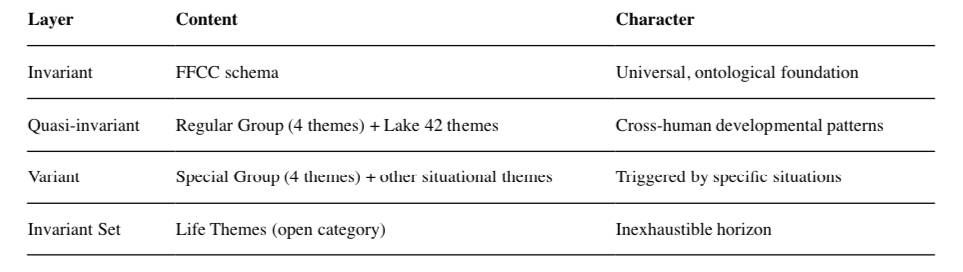
This four-layer structure did more than classify the themes — it provided the framework with a principled openness. The Variant layer can always receive new themes as new situations are analyzed. The Quasi-invariant layer can grow as new cross-human developmental patterns are identified. The Invariant layer (FFCC) remains stable. The Invariant Set remains irreducibly open.
Fourth, each theme was analyzed by the Weave-the-System analysis method, revealing the complexity of the life situation and the theme.
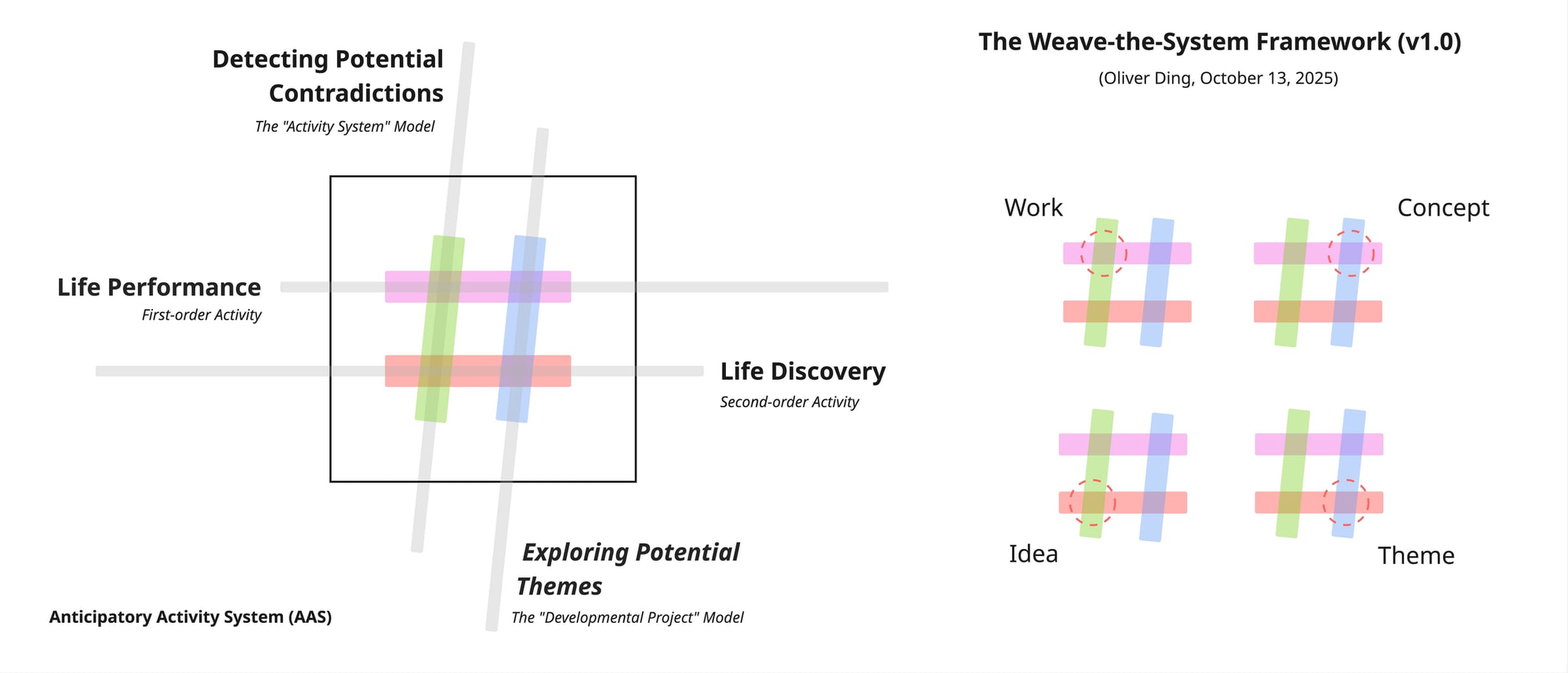
In the diagram above, the two diachronic dimensions correspond to two key principles derived from the Activity System Model and the Project Engagement approach:
- Detecting Potential Contradictions: from the "Activity System" Model
- Exploring Potential Themes: from the "Developmental Project" Model
The two synchronic dimensions of the Weave-the-System Framework refer to Life Performance and Life Discovery, representing two types of activities within the Anticipatory Activity System (AAS) Framework:
- First-order Activity: Life Performance
- Second-order Activity: Life Discovery
The Weave-the-System Framework also emphasizes four key knowledge elements located at the four Weave-points: Work, Concept, Idea, and Theme.
Finally, all eight are situated within the World of Life (World of Activity) theoretical framework — the ontology, realism, and hermeneutics of which are developed in the later sections of this document.
Strategic Curation
Based on the new Significant Themes framework, other sources were systematically curated.
The eight movements of Lake 42 (see below) were examined for their relationship to the Quasi-invariant layer:
- Awareness from Flow
- Cutting the Flow
- Finding the Coordinate
- Scaling the Focus
- Anchoring the Center
- Sustaining the Streams
- Catalyzing Curation
- Revealing the Landscape
- Setting the Enterprise
Among these, several movements correspond directly to Quasi-invariant Significant Themes:
- Awareness from Flow
- Setting the Focus (= Finding the Coordinate)
- Scaling the Focus
- Anchoring the Center
Others are not Significant Themes but reflect my individual creative development. By making this distinction, the framework more clearly delineates what qualifies as a Quasi-invariant theme.
Similarly, the seven forms of World of Activity from Homecoming were analyzed using FFCC dynamics, yielding five new Quasi-invariant themes.
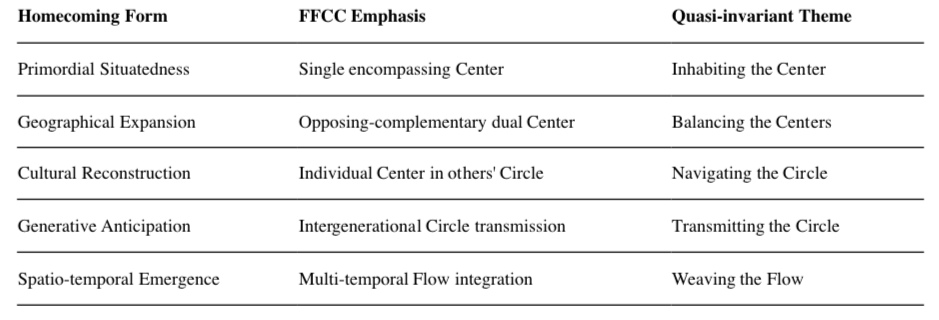
For example, Professional Development and Digital Engagement were classified as case studies of Blooming the Center rather than independent Quasi-invariant themes.
Finally, the Twelve Strategic Themes of Concept-related Activities (Castle and Forest, 2025) were identified as Variant-layer Significant Themes, triggered by the domain-specific practices of concept-related knowledge engagement. This mapping connected the Knowledge Strategy series to the Significant Themes Framework, situating both within the same Ecological Formism architecture.
Creative Outcome
The Significant Themes Framework was created over approximately 30 hours across six sessions on March 5–6, 2026.
What began as a revisit-rebuild exercise with a 2015 document evolved into a substantial theoretical development.
This process produced nine Word documents, a 541-paragraph master framework, and several new theoretical clarifications that extended beyond the original scope.
A detailed Revisiting–Rebuilding Case Study was conducted alongside a simple creative note, documenting the theoretical and practical insights generated during the process.
These materials have been edited into a package and released by Possible Press, comprising the following contents:
#00 - Introdution
#01 - The Significant Themes Framework (2026, v1)
#02 - Cutting the Flow (2026, v1)
#03 - Blooming the Center (2026, v1)
#04 - Rescue the Center (2026, v1)
#05 - Flourishing the Circle (2026, v1)
#06 - Study Abroad and Repatriation (2026, v1)
#07 - Becoming a Mother (2026, v1)
#08 - Inheritance and Transcendence (2026, v1)
#09 - Aging and Caring (2026, v1)
#10 - A Creative Note
#11 - Revisiting and Rebuilding: The Significant Themes Framework (2015–2026)
#12 - 学习图景(Learning Landscape) - original Chinese deck
The new framework also contributes to the development of the Flow-Focus-Center-Circle schema, which is the primary model of the World of Activity Approach.
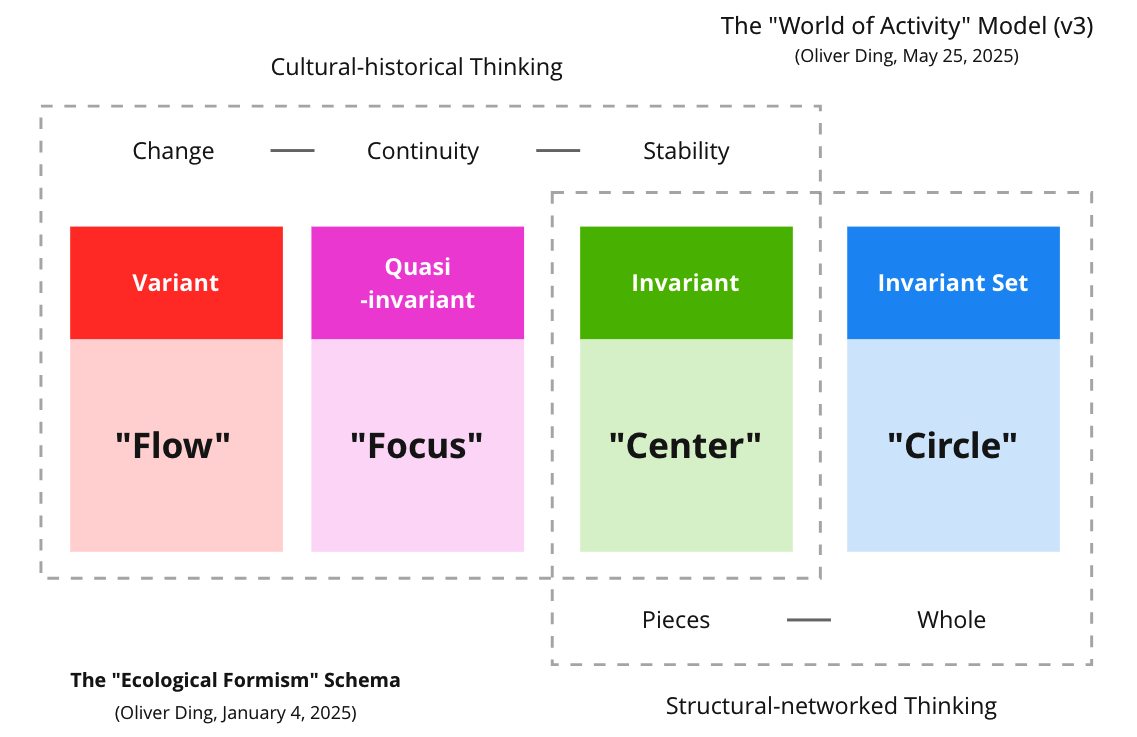
Within the Significant Themes framework (2026), the FFCC schema occupies the invariant layer, while a list of significant themes is located at the Quasi-invariant layer. Situational themes reside at the variant layer. This structure expands the FFCC model into a mature framework for exploring adult development and creative life.
What began as an intuitive slide in 2015 has now evolved into a structured theoretical architecture for understanding the themes that reveal human life.
v1.0 - March 5, 2026 - 1,614 words