
The World of Activity of Mid-life

The Epilogue of Revisiting and Rebuilding: A Strategy for Creative Identity Development (Possible Book)
by Oliver Ding
April 4, 2026
Throughout the editing of this collection, I kept thinking about a project I had abandoned in 2024: the Mid-career Curation Program. In March 2024, I had attempted to apply the Creative Life Curation method to the life development of mid-life professionals — and then let it go, drawn away by new creative developments that seemed more urgent at the time. Coming back to it now, through the lens of RR practice, I see it differently. This epilogue is that return.
1. The Mid-career Curation Program (2024)
In 2022, I completed the Life Curation project and wrote a book draft titled Creative Life Curation: Turning Experiences into Meaningful Achievements. The method was oriented primarily toward the past: extracting creative themes from accumulated experience and transforming them into resources for present creative development.
In 2023, I developed a new ontology of "Life" and explored a series of related themes — the fit between thematic space and social territory, between persona and activity, between meaning and experience, between mindset and action, between mental system and behavioral system. Alongside this, I wrote three books about Discovery: Knowledge Discovery, Life Discovery, and Meaning Discovery. The theoretical foundations were expanding.
By March 2024, it seemed the right moment to upgrade the Creative Life Curation method with these new ideas and apply it to a specific population: mid-career professionals with over eight years of work experience. Inspired by a comment from César Híjar on the theme of mid-career development, I designed a seven-module program called Mid-career Curation:
- Mapping Past Creative Journey
- Framing Primary Creative Space
- Exploring Relevant Thematic Spaces
- Mapping Strategic Moves
- Designing A Knowledge Project
- Building A Creative Rhythm
- Imagining A Possible Persona
Each module was structured around the Strategic Curation Model — a five-space model organizing Experience Space (facts of the past), Challenge Space (problems of the present), Response Space (solutions for the future), Reference Space (validated knowledge for thinking), and Speculative Space (imaginative and counterfactual thinking). After completing a 79-slide conceptual deck, I used the Knowledge Discovery Canvas to reflect on the project and quickly realized I had not yet clearly defined the concept of "Mid-career Curation" itself.
I continued developing the program through April 2024, preparing tools, methods, and case studies for each module. But that April, a series of GAP projects reflecting on my creative journey from 2019 to 2024 generated significant new insights — particularly around the Strategic Life Development framework. Those insights were too generative to set aside. I shifted my attention toward them, and the Mid-career Curation Program was suspended.
Though the program was discontinued, the ideas it had generated did not disappear. They continued developing through the second half of 2024, eventually crystallizing into Strategic Life Theory by early 2025.
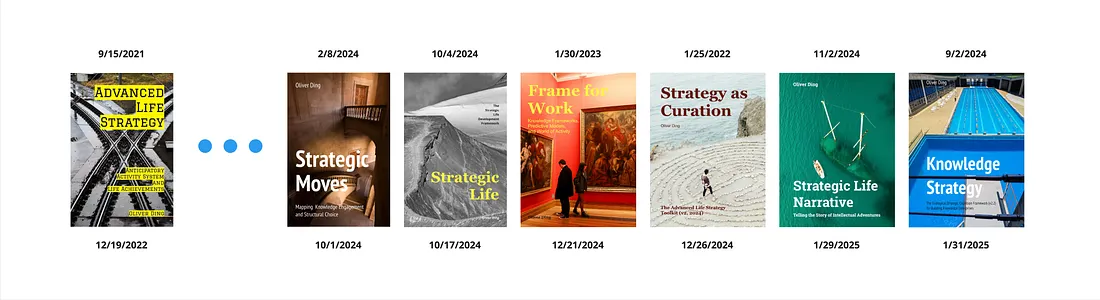
The Creative Life Curation method — focused on the past, on extracting creative themes from experience — had been the foundation. The 2024 book draft, Strategic Life Narrative, extended it into a fuller temporal structure, covering past, present, and future. Based on the five analytical units of Creative Life Curation, Strategic Life Narrative expanded into twelve thematic rooms.
The direction was becoming clear: from research to intervention, from retrospection to anticipation. The LARGE Method,, developed in early 2026, is the methodological summary of that direction.
2. From Creative Life Theory to the World of Activity
Strategic Life Theory showed its initial form in early 2025, and at that point, I began planning a significant transition: from individual development to cultural innovation. That transition was slow. I devoted an entire year to it — simultaneously closing the Creative Life Theory project (focused on individual development) and unfolding explorations in the direction of cultural innovation.
The most important theoretical development of 2025 was the establishment of the World of Life (World of Activity) approach — the social world ontological framework that allowed me to hold both individual development and cultural innovation together. The World of Activity focuses on describing the scope within which individual development can intervene, and the patterns operating within it. The World of Life addresses the boundaries of the social world and the patterns within those boundaries. The two are connected through a container-nesting structure: World of Activity nested within World of Life, the individual creative enterprise nested within the broader social ecology it inhabits.
In June 2025, the World of Activity Toolkit (v1, 2025) curated a series of knowledge frameworks for understanding the patterns within an individual's World of Activity.
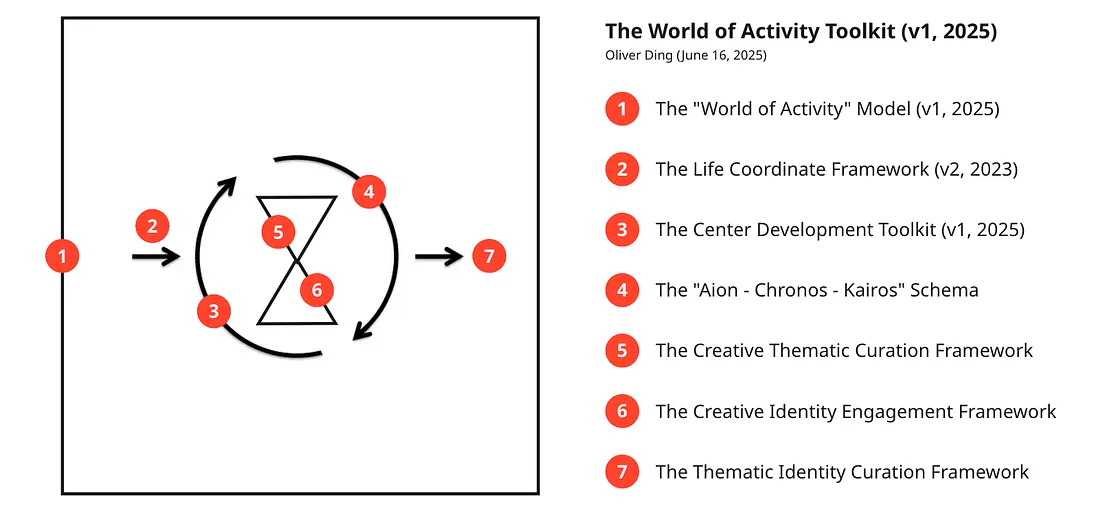
Of these, The FFCC Schema became the model I invested in most intensively through mid-2025 — first as the primary model of the World of Activity, and later as the primary model for understanding Life (Self) itself.
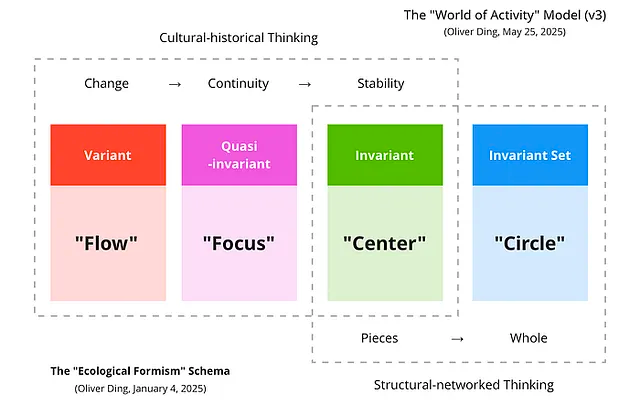
The FFCC Schema organizes the World of Activity around four basic ecological forms: Flow (the stream of experience moving through a life), Focus (the thematic concentration that gives direction to the flow), Center (the organizing core around which creative activity stabilizes), and Circle (the social relational network within which the center operates and extends). These four ecological forms are not sequential stages but simultaneously active aspects of any creative life — each shaping the others, each visible from a different angle.
The Homecoming manuscript was the empirical research project built around the FFCC Schema — analyzing my own autobiography and my 2025 journey to Fuzhou, identifying seven specific forms of the World of Activity, and using the FFCC model to explain the dynamics and differences between them. Lake 42 developed this further, articulating eight movements using FFCC terminology and integrating the Living Coordinate concept with the FFCC model into a unified framework.
The recent RR practice — particularly the Significant Themes case study — made a further contribution: several new FFCC model cases emerged, and the insights from Homecoming, Lake 42, the Knowledge Discovery Canvas, and other projects were integrated into a multi-layered structure centered on the FFCC model. The organizing architecture for this integration is Ecological Formism — a four-layer framework in which patterns are classified according to their degree of universality:
| Layer | Content | Character |
|---|---|---|
| Invariant | FFCC schema | Universal, ontological foundation |
| Quasi-invariant | Regular Group (4 themes) + Lake 42 themes | Cross-human developmental patterns |
| Variant | Special Group (4 themes) + other situational themes | Triggered by specific situations |
| Invariant Set | Life Themes (open category) | Inexhaustible horizon |
This four-layer structure does more than classify the themes — it provides the framework with a principled openness. The Variant layer can always receive new themes as new situations are analyzed. The Quasi-invariant layer can grow as new cross-human developmental patterns are identified. The Invariant layer (FFCC) remains stable as the ontological foundation. The Invariant Set remains irreducibly open.
The Significant Themes Framework occupies primarily the Quasi-invariant and Variant layers. The Regular Group of four universal themes (Cutting the Flow, Blooming the Center, Rescue the Center, Flourishing the Circle) constitutes the core Quasi-invariant layer. The Special Group of four situationally triggered themes (Study Abroad and Repatriation, Becoming a Mother, Inheritance and Transcendence, Aging and Caring) constitutes the Variant layer. The twelve Strategic Themes from Castle and Forest (2025) extend the Variant layer into the domain of concept-related knowledge engagement.
Through the RR operations of March 2026, the Quasi-invariant layer was expanded significantly by integrating insights from Lake 42 and Homecoming. The complete Quasi-invariant layer now contains thirteen themes across all four FFCC positions:
| FFCC Position | Theme | Source |
|---|---|---|
| Flow | Awareness from Flow | Lake 42 |
| Flow | Weaving the Flow | Homecoming |
| Flow | Cutting the Flow | Regular Group |
| Focus | Setting the Focus | Lake 42 |
| Focus | Scaling the Focus | Lake 42 |
| Center | Anchoring the Center | Regular Group |
| Center | Inhabiting the Center | Homecoming |
| Center | Balancing the Centers | Homecoming |
| Center | Blooming the Center | Regular Group |
| Center | Rescue the Center | Regular Group |
| Circle | Flourishing the Circle | Regular Group |
| Circle | Navigating the Circle | Homecoming |
| Circle | Transmitting the Circle | Homecoming |
The three sources are not additive by accident. The Regular Group provides the core career and professional developmental arc. Lake 42 provides fine-grained differentiation at the Flow and Focus stages. Homecoming provides ecological diversity of Center and Circle configurations. Together, they map the full developmental terrain of a creative life organized around the FFCC model.
3. The L3D Model and Supportive Life Discovery
An important by-product of recent ACS project development and RR practice is the L3D model, and the frameworks it generated: Supportive Life Discovery and Cognitive Hydrology Pedagogy.
The L3D model — Learn → Discover → Design → Deliver — emerged from a conversation with Bob in early March 2026, which I described in the preface. Preparing to articulate what cognitive preparation a person needs before genuine Life Discovery becomes possible, I recognized that the Learning Landscape framework I had developed in 2015 supplied exactly the missing first layer. Combined with the DDD model (Discover–Design–Deliver), which had taken shape in February 2026, the four-layer L3D structure was assembled in a single working session: Learn as the internalization phase, Discover, Design, and Deliver as the three externalization phases.
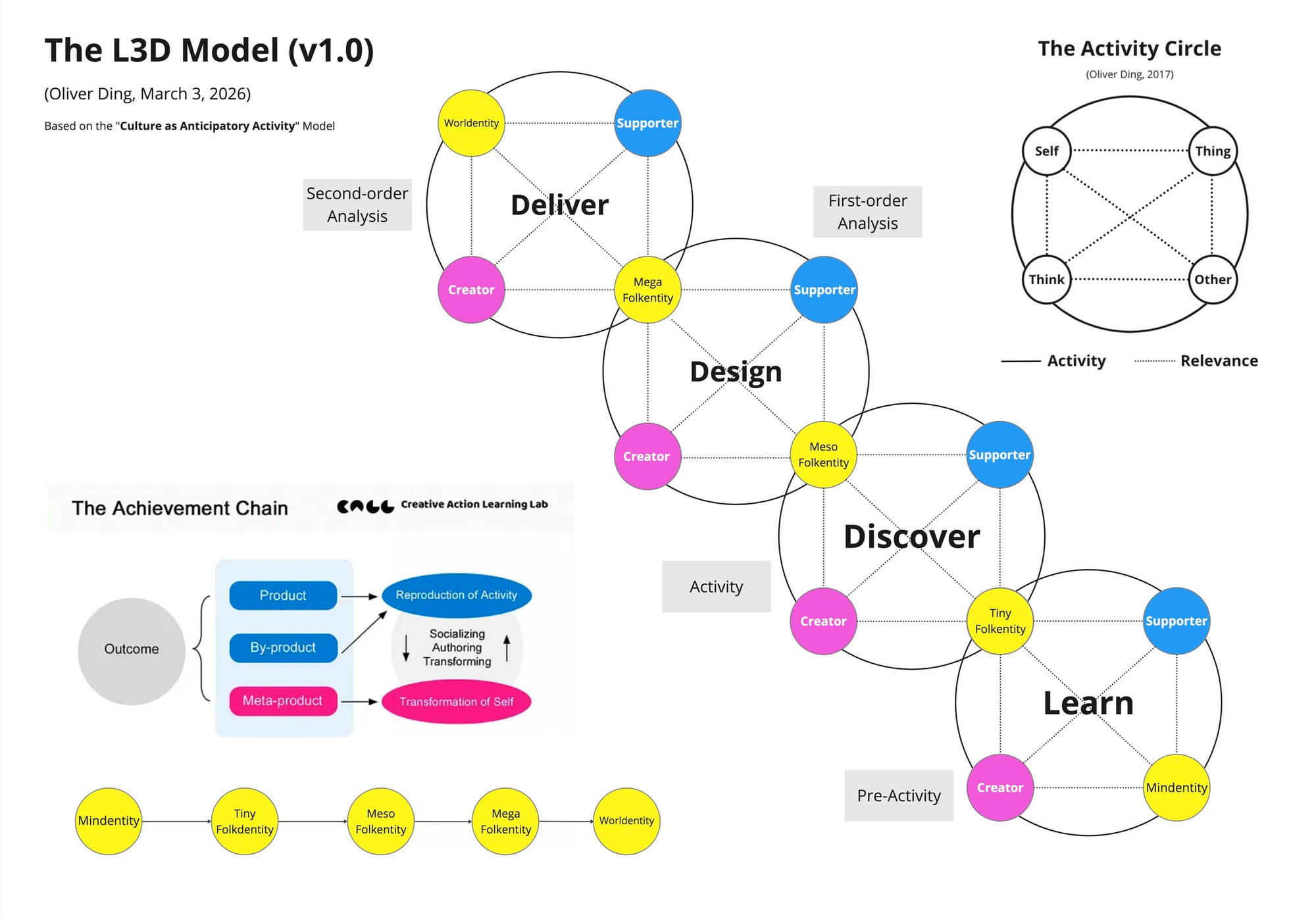
The Learning Landscape's four perspectives — Discipline, Domain, Project, and Narrative — now function as the operational framework for the Learn stage: the cognitive preparation that makes genuine engagement with the world possible. You can only genuinely discover, design, and deliver if you have first internalized the four dimensions of the world through sustained engagement with theory, domain phenomena, practice, and life narrative. Learning is not preparation for living — it is the internalization that makes genuine creative engagement possible.
Supportive Life Discovery was developed directly from the L3D model. Where the 2022 Life Discovery projects had been self-directed — I myself was both the practitioner and the subject — Supportive Life Discovery shifts the orientation: other people are the subjects of discovery, and the practitioner takes a supporting role. This shift in the Self-Other relationship is precisely the transition from Author-as-Subject to Author-as-Supporter that I described in the Thematic Space Analysis of the Learning Landscape case study.
The FFCC model plays a central role in Supportive Life Discovery as a developmental map. The four forms — Flow, Focus, Center, Circle — describe four stages of a creative life's development, each with its own characteristic challenges, transitions, and forms of support.
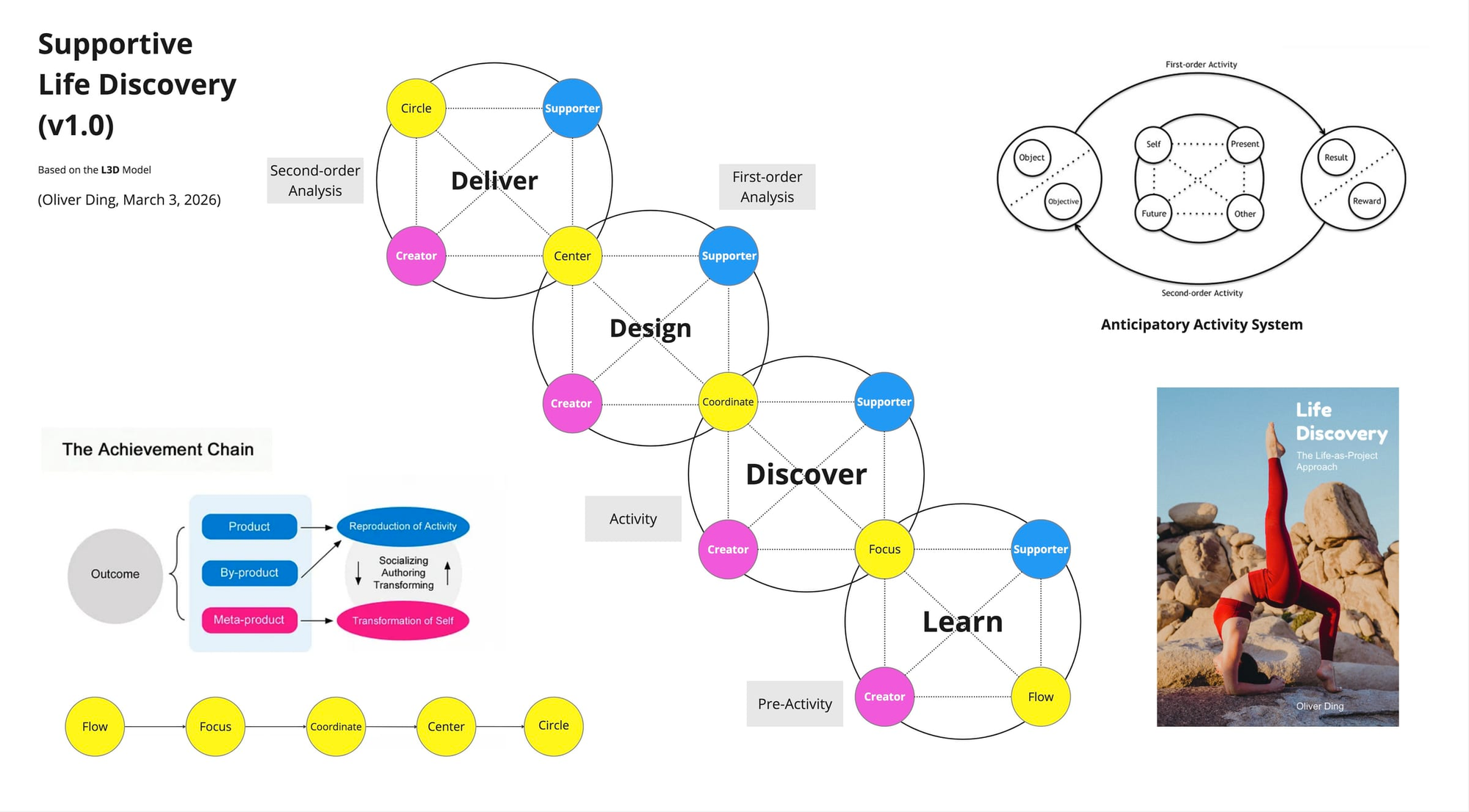
Cognitive Hydrology Pedagogy (v1.0) was built on this architecture, selecting four heuristic tools that proved most generative for thematic development and concept creation — the Thematic Matrix Canvas, the ECHO Way, Generative Confluence, and Weave the Theory — and organizing them as the foundational pedagogical instruments of the four stages.
Together, the FFCC model, the L3D model, the Supportive Life Discovery framework, and the LARGE Method constitute a new map and methodology for creative life development — one that is simultaneously abstract enough to be principled and concrete enough to be applied. The FFCC model provides the terrain. The L3D model describes the movement through that terrain. The LARGE Method provides the governing principles for navigating it. Supportive Life Discovery provides the relational and methodological framework for supporting others in that navigation.
4. The World of Activity Toolkit v2.0
Editing this collection made visible something that had not been fully legible while the individual projects were underway: a series of cumulative integrations, each building on the last, that together transformed the FFCC schema from its original role as a descriptive map into something considerably more powerful. Seen from inside any single project, each integration looked like a local development. Seen from the outside — from the vantage point of assembling the collection — they form a coherent progression.
The Significant Themes project was the first step. In the World of Activity Toolkit (v1, 2025), the FFCC schema and the Thematic Identity Curation Framework had been two parallel knowledge frameworks — related but not yet fully connected. The Significant Themes project changed that relationship by injecting the Life Themes dimension directly into the four thematic spaces defined by the FFCC schema. The FFCC model now provides the spatial architecture within which life themes are located and developed, while the Thematic Identity Curation Framework provides the analytical tools for working with those themes.
The Creative Identity Cascade model, developed in Part 5 of this collection, added a further dimension. Where the Significant Themes project injected life themes into the FFCC's four thematic spaces, the Creative Identity Cascade injected the identity development dimension — showing how creative identities cascade through the FFCC positions across a creative life, with each level's Other becoming the next level's Self. The FFCC schema became not only a map of thematic spaces but a framework for understanding how identity itself evolves as a person moves through Flow, Focus, Center, and Circle across time.
The L3D model and Supportive Life Discovery extended the FFCC framework further still, bringing method into the picture. Where the Significant Themes project had added themes and the Creative Identity Cascade had added identity, the L3D model added the methodological dimension — specifying the concrete practices (Learn, Discover, Design, Deliver) through which a person moves through the FFCC terrain. Supportive Life Discovery provided the relational and facilitative framework for supporting others in that movement. Together, these developments transformed the FFCC schema from a descriptive model into an operational one: a map carrying within it themes, identities, and methods simultaneously.
The cumulative result represents a significant milestone. Expanded through Ecological Formism into a four-layer architecture, the FFCC model now maintains its core simplicity — four basic ecological forms — while being able to accommodate rich empirical research and support diverse situational reflection. At the same time, organized through Thematic Space Theory, its four thematic spaces now carry multiple dimensions simultaneously: forms, themes, identities, methods, moves, and achievements.
What were separate knowledge frameworks in the World of Activity Toolkit v1.0 — each attending to one of these dimensions — have been curated together into a coherent whole.
This constitutes the World of Activity Toolkit v2.0. The FFCC model has become a significantly more powerful knowledge framework — one that can serve not only as a theoretical explanatory model, but also as a tool for case study analysis and behavioral intervention. The simple four-part schema that began as a descriptive map of ecological forms has grown into the primary organizing structure of an entire approach to creative life development.
5. Returning to Mid-life
Editing this collection prompted me to return to the 2024 Mid-career Curation Program — and to recognize what it has become. Looking at it now, Supportive Life Discovery is its rebuilding. What was suspended in 2024 because the theoretical resources did not yet exist has been rebuilt in 2026 with an architecture that gives it both greater depth and greater operationalizability. The program did not fail. It was unfinished.
But the deeper recognition is this: the World of Activity Toolkit v2.0 — the strengthened FFCC model carrying within it forms, themes, identities, methods, moves, and achievements across a four-layer Ecological Formism architecture — provides mid-life professionals with a theoretical framework foundation that the original Mid-career Curation Program could not have offered.
In 2024, the tools existed in fragments: Creative Life Curation for the past, Strategic Life Narrative for the full temporal arc. They were useful, but they were not yet integrated into a coherent map of the World of Activity. The v2.0 toolkit changes this. It provides a single coherent framework within which a mid-life professional can locate their current situation, identify the developmental patterns they are likely encountering, understand the creative identities they have enacted and the ones they are moving toward, and find the methods appropriate to their stage.
This matters particularly at mid-life because mid-life is the moment when all of these dimensions are simultaneously active and simultaneously at stake. The past is substantial — accumulated creative identities, dormant thematic spaces, by-products of earlier work — and the future is still genuinely open. RR practice is the strategy most suited to this moment: it is how you activate the past as a resource for the future, rather than leaving it as mere background. And the World of Activity Toolkit v2.0 is the map that makes that activation systematic rather than accidental.
This collection, in the end, completes the mission that the Mid-career Curation Program could not finish. It gives mid-life professionals not just a strategy but a theoretical home — a framework rich enough to hold the full complexity of a creative life at its midpoint, and simple enough to actually navigate.
Something could be reborn from the past. This book is evidence of that — and an invitation to make it true in your own creative life.
v1.0 - April 4, 2026 - 2,773 words