
The World of Activity (v1.0, 2022) Framework: Theoretical Foundation and Generative Confluence
Oliver Ding
February 13, 2026
Abstract
This article traces the theoretical development of the World of Activity (v1.0, 2022) framework, which defines every individual's experiential horizon through four boundaries: Heaven (天), Earth (地), Birth (生), and Death (死). The framework emerged from a generative confluence of three independent sources between November 2021 and November 2022: Activity Theory's Means-End principle, Chinese cosmological imagery (三才), and diagram research leading to the Universal Reference framework.
While acknowledging initial inspiration from Alfred Schutz's phenomenological sociology, this article demonstrates that the World of Activity represents an independent theoretical development rather than an extension of Schutz's work. The article introduces the concept of "generative confluence" to describe the creative pattern where distinct theoretical streams intersect to generate novel conceptual structures while maintaining their original developmental paths. It also clarifies the purpose-built nature of the Cultural Givenness/Natural Givenness distinction, developed specifically for understanding how creative works transcend individual ownership to become structural features of collective reality.
Keywords: World of Activity, generative confluence, Activity Theory, phenomenological sociology, givenness, theoretical development
1. Introduction: The Need for Theoretical Clarification
The World of Activity framework has been employed in recent work on creative life to understand how individuals navigate their experiential horizons bounded by four dimensions—Heaven, Earth, Birth, and Death. However, the theoretical genealogy of this framework has not been fully articulated, leading to potential misunderstandings about its relationship to Alfred Schutz's phenomenological sociology and other theoretical traditions.
This article addresses three interrelated questions:
- What is the precise relationship between the World of Activity and Schutz's "World of Working"? While Schutz provided initial inspiration, the World of Activity represents a fundamental reconceptualization rather than an extension.
- How did the four-boundary framework actually emerge? The framework resulted from a generative confluence of three independent sources, not a Schutzian derivation.
- What is the nature of "givenness" in this framework? The distinction between Natural Givenness and Cultural Givenness is purpose-built for specific theoretical needs, not derived from phenomenological tradition.
By clarifying these theoretical foundations, this article aims to establish the World of Activity framework as an independent contribution to creative life studies, while accurately acknowledging its varied intellectual sources.
2. Schutz's Phenomenological Sociology: Limited but Essential Contributions
2.1 Schutz's Specific Contributions
The theoretical development of the World of Activity framework acknowledges specific contributions from Alfred Schutz's phenomenological sociology, while making clear that the framework represents an independent theoretical development rather than an extension of Schutz's work.
Schutz's phenomenological sociology provides three specific insights that informed—but did not determine—the present framework:
First, the temporal structure of the social world. Schutz distinguished four temporal categories of social relations:
- Consociates: Face-to-face relations sharing both time and space
- Contemporaries (Mitwelt): Relations sharing time but not space
- Predecessors (Vorwelt): Past persons known through traces, texts, and reports
- Successors (Folgewelt): Future persons for whom we create
This temporal structuring of social relations provided an initial, though vague, inspiration for thinking about how creative works transcend individual lifetimes. However, the specific framework of [Birth-Death] as a dimension of the World of Activity was developed through entirely different theoretical pathways, as detailed in Section 3.
Second, the concept of 'World of Working.' Schutz distinguished "Working"—overt acts requiring bodily movements in the outer world—from mere thinking:
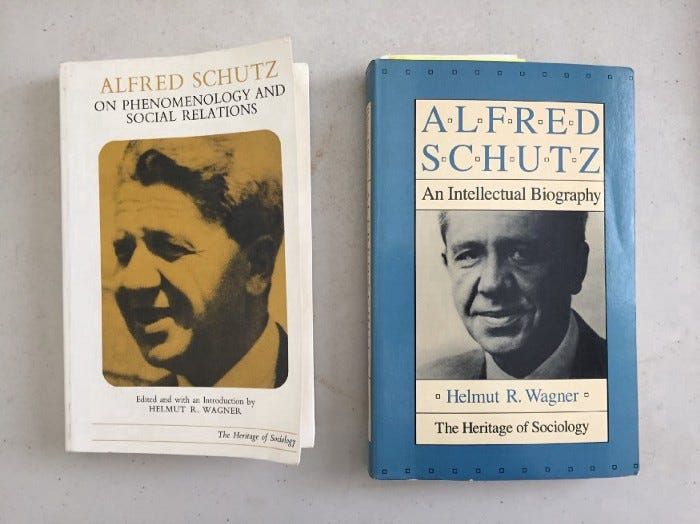
Working, thus, is action in the outer world, based upon a project and characterized by the intention to bring about the projected state of affairs by bodily movements. Among all the described forms of spontaneity that of working is the most important one for the constitution of the reality of the world of daily life... (Schutz, 1970, p.126)
This concept provided a starting point for reflection but required fundamental modification for understanding creative life, as creative individuals draw essential inspiration from the "worlds of fantasy and dreams" that Schutz treated as separate, closed realms with "empty and ghostly" quasi-We relations (Wagner, 1983, p.59).
Third, the notion of 'givenness'. Schutz's analysis of structures that are "already-there" in social reality offered a general phenomenological orientation. However, when I first employed this term in 2022, it carried only a vague inspirational quality. The specific distinction between Natural Givenness and Cultural Givenness, and the pairing of these terms, developed independently as purpose-built concepts, as explained in Section 5.
2.2 From 'World of Working' to 'World of Activity': An Independent Definition
The World of Activity represents a fundamental reconceptualization rather than an extension of Schutz's World of Working. This concept, developed in 2022 through my Creative Life Curation project, addresses the specific needs of understanding creative life:
Inclusion of Inner Experience. Unlike Schutz's focus on overt bodily action in the outer world, the World of Activity recognizes that for creative individuals, inner experiences of imagination, reflection, fantasy, and dreams actively contribute to outer-world projects. These are not separate "closed realms" but integral sources of creative inspiration and thematic development.
Integration of Subjectification and Objectification. The World of Activity encompasses both:
- Subjectification (Experience 1): Turning the world into a person's experience—the process of making meaning through engagement with cultural and natural givens
- Objectification (Experience 2): Turning a person's experience into artifacts for the world—the process of thematic creation and cultural contribution
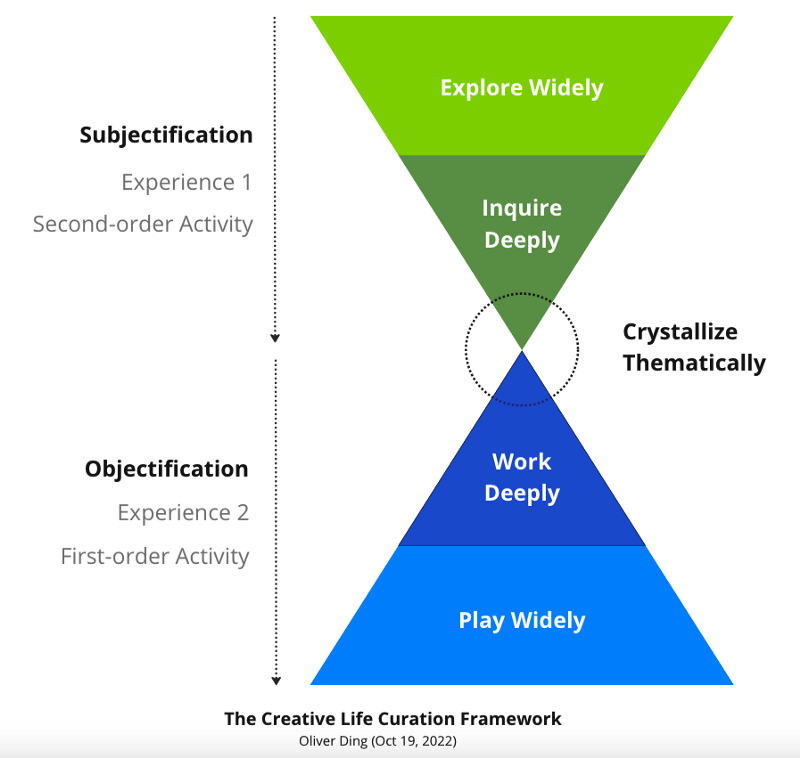
This dual movement addresses a central concern of cultural sociology: understanding how individual thematic creations become collective cultural structures.
2.3 Essential Differences from Schutz
The World of Activity differs from Schutz's World of Working in three fundamental ways:
- Scope of Activity: Includes inner cognitive and imaginative activity, not just outer bodily "working"
- Temporal Framework: Centers on the individual's biographical life course bounded by [Birth-Death] rather than focusing primarily on the "wide-awake" working consciousness
- Purpose: Developed specifically for understanding creative life and thematic creation, not for general social phenomenology
These differences reflect not merely a broadening of Schutz's concept but a reconceptualization grounded in different theoretical concerns and drawing on entirely different sources, as the next section demonstrates.
3. The World of Activity (v1.0, 2022) Framework: A Generative Confluence of Three Independent Sources
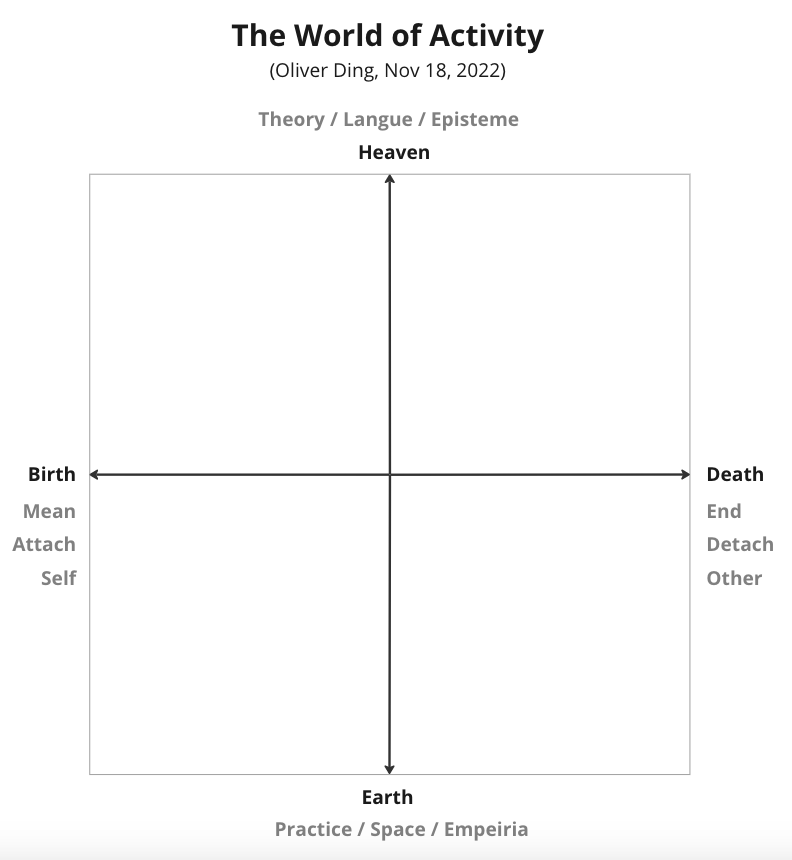
The World of Activity (v1.0, 2022) framework identifies four boundaries that define every individual's experiential horizon: Heaven (天), Earth (地), Birth (生), and Death (死). This four-dimensional structure emerged from the convergence of three independent theoretical and empirical sources between November 2021 and November 2022. This was not a Schutzian derivation but a generative confluence—a process explained in detail in Section 3.4.
3.1 First Source: Activity Theory and the Means-End Spectrum
November 2021: The Means-End Spectrum. The first theoretical pathway began with my engagement with Activity Theory's principle of tool mediation. In a November 29, 2021 article on diagramming practice, I developed the Means-End Spectrum to analyze how the same object (e.g., a diagram) could serve different roles in different activities:
- As Means (Diagram-to-Thought): Tools for thinking, with weak ontological demands
- As End (Thought-to-Diagram): Final products requiring careful construction, with strong ontological demands
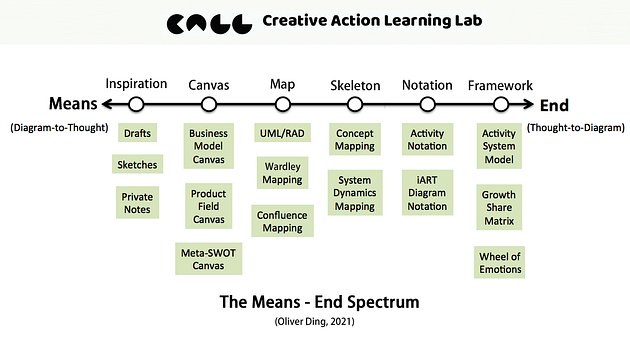
This spectrum revealed six types of diagrams from Inspiration (drafts, sketches) to Framework (formal knowledge models), ordered by increasing ontological strength.
The 'Alive' Status of Things. Crucially, this analysis revealed a temporal dimension: objects are "alive" when actively engaged in an activity and "dead" when the activity completes. This insight directly foreshadowed the Birth-Death dimension:
The "Birth—Death" dimension refers to the "alive" status of things. Actions and Activities are only "alive" when we are acting. At the end of an activity, the thing we worked on is produced. It's done. It's no longer alive. If we use it in a new activity, it becomes alive again.
This was further enriched by reflection on the Mexican concept of the "third death" (popularized by the 2017 film Coco)—the moment when the last memory of a person fades—introducing a cultural-temporal dimension to the Birth-Death axis.
Evolution: From Means-End to Birth-Death. By November 2022, the Means-End Spectrum had evolved conceptually into the Birth-Death dimension of the World of Activity, shifting from an analysis of instrumental value to a fundamental temporal boundary of human action and cultural creation. Like the Heaven-Earth dimension, Birth (生) and Death (死) function as multi-dimensional coordinates that unify multiple horizontal distinctions:
- Means — End (from Activity Theory's tool mediation)
- Attach — Detach (from ecological practice perspective)
- Self — Other (from social interaction perspective)
Birth represents the "starting point" pole across these dimensions (means, attach, self), while Death represents the "ending point" pole (end, detach, other).
3.2 Second Source: Chinese Traditional Cosmology as Meta-Framework
The Chinese philosophical concept of 三才 (San Cai—the three spheres of origin: 天 Tian/Heaven, 地 Di/Earth, 人 Ren/Humans) provided the essential meta-framework for organizing the World of Activity. This threefold structure offered a coherent approach to understanding the universe, but it required adaptation for the specific needs of understanding creative life.
From Three to Four: The Transformation of 人 (Humans). In the San Cai cosmology, 人 (Humans) occupies the middle position between Heaven and Earth. However, human activity unfolds temporally across a life course—from beginning to end. Therefore, in the World of Activity framework, the single element 人 transforms into a temporal dimension bounded by 生 (Birth) and 死 (Death):
- 人 (Human) = the process of human activity
- 生 (Birth) = the starting point of human life and activity
- 死 (Death) = the ending point of human life and activity
This is not a departure from San Cai but its developmental specification: what 三才 presents as a static middle term (人), the World of Activity unfolds as a temporal process (生-死).
The Four Symbols as Unified Meta-Framework. Thus, the World of Activity's four boundaries—天(Heaven), 地(Earth), 生(Birth), 死(Death)—represent an evolutionary transformation of the original San Cai, not a different framework:
- 天-地 (Heaven-Earth): Retained from San Cai, specifying the vertical dimension
- 生-死 (Birth-Death): Evolved from 人, specifying the temporal dimension of human activity
This transformation maintains the coherence of the San Cai meta-framework while adapting it to the temporal nature of human creative life.
Multi-Dimensional Symbolic Integration. Each of these four boundaries functions as a multi-dimensional coordinate that unifies multiple theoretical distinctions:
Heaven (天) unifies:
- Theory (Activity Theory)
- Langue (Semiotics)
- Episteme (Aristotelian epistemology)
Earth (地) unifies:
- Activity (Activity Theory)
- Space (Semiotics)
- Empeiria (Aristotelian epistemology)
Birth (生) unifies:
- Means (Activity Theory)
- Attach (Ecological Practice)
- Self (Social Interaction)
Death (死) unifies:
- End (Activity Theory)
- Detach (Ecological Practice)
- Other (Social Interaction)
The genius of adopting Chinese cosmological terms lies precisely in their capacity to serve as unifying symbols that transcend any single theoretical tradition, functioning as coordinates in a multi-dimensional conceptual space. This is why I emphasize: it is metaphorical adoption for symbolic integration, not philosophical inheritance of Chinese metaphysics.
Open Dimensionality and Reverse Contribution. Crucially, these dimensions remain open: new theoretical distinctions can be mapped onto the 天-地-生-死 coordinates as research develops. This openness represents a reverse contribution to the San Cai tradition itself. By borrowing the 三才 cosmology to name these symbolic coordinates, I simultaneously provide the ancient framework with a modern operational scheme—a method for organizing and integrating diverse theoretical perspectives within a coherent four-boundary structure.
The World of Activity framework thus does not merely draw from San Cai; it operationalizes San Cai for contemporary theoretical work, demonstrating how this ancient meta-framework can function as a living tool for conceptual integration rather than a static philosophical inheritance.
3.3 Third Source: Diagram Research and the Universal Reference Framework
October 27, 2022: The Diagramming Reference Frame. A critical breakthrough came from my empirical research on diagramming and engagement with Hong Kong theoretical sociologist Ping-keung Lui's work. Lui's Semiotic System Diagrams—which remove spatial structure and retain only conceptual relationships—embodied the distinction between langue (abstract theoretical system) and parole (concrete empirical application).
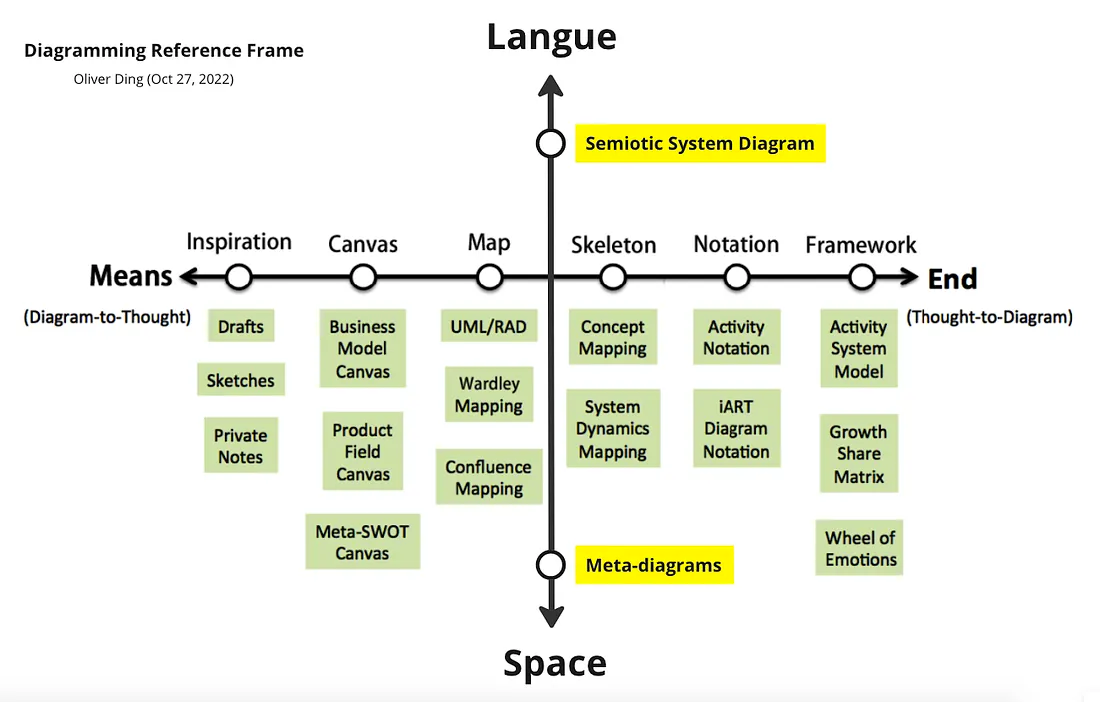
This insight led me to expand the Means-End Spectrum into a two-dimensional matrix by adding a vertical Langue-Space dimension:
- Langue (vertical, toward abstraction): Semiotic System Diagrams
- Space (vertical, toward concreteness): Meta-diagrams (spatial structure without textual elements)
This created a Reference Space—a universal tool of thought for classifying not just diagrams but all knowledge-related entities.
November 11, 2022: Universal Reference—The Birth of the Four-Dimensional Framework. One week later, on November 11, 2022, these separate streams converged. I created the Universal Reference diagram, which for the first time brought together all four dimensions in a unified framework:
Vertical Group (Degrees of Abstraction/Knowledge):
- Theory — Practice
- Heaven (天) — Earth (地)
- Langue — Space
- Episteme — Empeiria
Horizontal Group (Situations of Activity/Engagement):
- Means — End
- Birth (生) — Death (死)
- Attach — Detach
- Self — Other
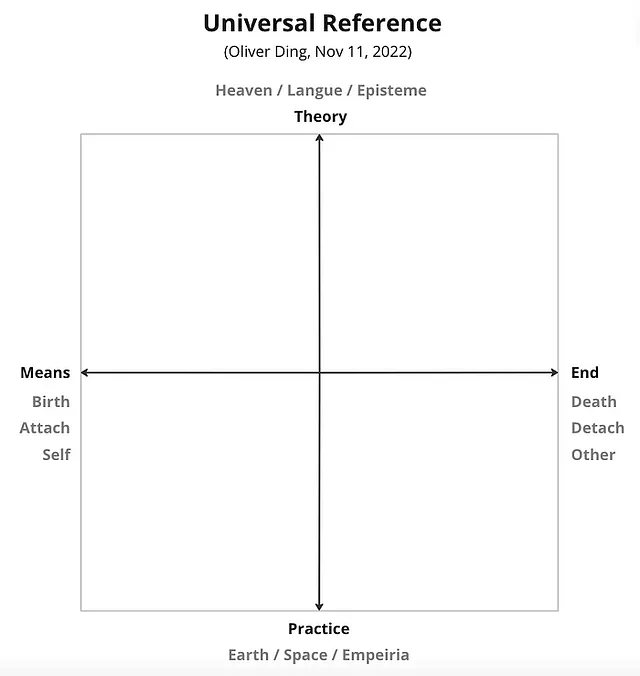
This was the moment of generative confluence—when three independent sources (Activity Theory's Means-End, Chinese cosmological imagery, and diagram research leading to the Langue-Space distinction) crystallized into the World of Activity (v1.0, 2022) framework with its four boundaries: Heaven (天), Earth (地), Birth (生), and Death (死).
November 18, 2022: Application to the World of Activity. One week after creating Universal Reference, I published the concept of the "World of Activity" and explicitly mapped the four dimensions onto it:
The Horizontal group refers to the "Activity" of Life while The Vertical group refers to the "Theory" of Life... If we see them as a meaningful whole, then we can call them the World of Activity.
3.4 The Nature of Generative Confluence
The development of the World of Activity (v1.0, 2022) framework exemplifies a creative pattern I later identified and named "Generative Confluence" (June 2, 2025). This concept emerged from reflecting on my multi-year "Theorizing Creative Life" project, which involved various theoretical explorations that intersected in unexpected ways.
Definition of Generative Confluence. Generative Confluence describes the creative pattern where distinct theoretical approaches—such as Activity Theory (Means-End Spectrum), Chinese cosmology (San Cai meta-framework), and diagram research (Universal Reference)—intersect and generate a new central theoretical enterprise while maintaining their original developmental paths. This is crucially different from:
- Theoretical extension: Building incrementally on a single source (as extending Schutz would be)
- Synthetic combination or simple merging: Deliberately combining pre-existing complete theories into a composite
- Deductive derivation: Logically deriving concepts from first principles
The Process of Generative Confluence. Unlike merging, which dissolves distinct sources into a unified whole, generative confluence involves:
- Independent development of conceptual pathways: Each theoretical stream (Activity Theory, Chinese cosmological imagery, diagram research) develops according to its own logic
- Parallel maturation over time: Multiple streams evolve simultaneously but separately (November 2021–October 2022)
- Sudden crystallization at intersection: When streams converge, a new central structure emerges (November 11, 2022: Universal Reference)
- Maintenance of original paths: The contributing theories continue their own developmental trajectories even as they generate something new
- Immediate application: The emergent structure finds immediate use in the target domain (November 18, 2022: World of Activity)
Beyond Creative Dialogue. I position Generative Confluence as an advanced stage following "Creative Dialogue"—a method I use to explore boundary zones between theories. While Creative Dialogue investigates how different theoretical perspectives interact at their edges, Generative Confluence describes the moment when such interactions crystallize into a new theoretical enterprise that transcends yet preserves its sources.
The World of Activity (v1.0, 2022) framework thus represents an independent theoretical development that, while acknowledging Schutz's initial inspiration regarding givenness and temporal structure, follows its own conceptual logic and empirical grounding. It emerged not from extending any single tradition but from the generative confluence of multiple independent streams.
4. World of Activity and World of Life
With the World of Activity (v1.0, 2022) framework established, we can now precisely define the relationship between World of Activity and World of Life.
The World of Activity refers to the world as perceived and experienced by a single individual—the social world as felt and navigated by one person within their life course. It is the experiential horizon within which an individual acts, bounded by four natural givens:
- [生] Birth: The temporal beginning—the starting state from which all activity unfolds
- [死] Death: The temporal horizon—the ending state that frames urgency and purpose
- [天] Heaven: The upper conceptual boundary—language, culture, symbolic systems
- [地] Earth: The lower material boundary—ecology, environment, material conditions
These four dimensions define the boundaries of the World of Activity—the inherited conditions that set the stage for human action. In theorizing how creative works transcend individual creators to become "already-there" structures in collective reality, I needed to distinguish between two types of "givenness": the unconditional, universal boundaries and the cultural creations that acquire structural status. This led to the purpose-built pairing of Natural Givenness and Cultural Givenness.
Natural Givenness refers specifically to these four boundaries—structures that are unconditionally present, universally necessary, temporally permanent, and non-human in origin. The term was constructed to provide a clear counterpoint to Cultural Givenness, as explained in Section 5.
The World of Life, however, represents the broader context—the shared world constituted by all individuals' Worlds of Activity together. It is the common ground where individual experiences intersect, where thematic creations circulate, and where cultural formations emerge.
Theoretical Note on "Life." The term "Life" in World of Life carries deliberate ambiguity regarding its scope. While the present framework focuses on human thematic creation and cultural formation, the concept remains theoretically open to encompass non-human life. This openness reflects a level of analysis similar to James J. Gibson's ecological psychology, which theorizes perception and action at a level applicable to various organisms without anthropocentric restriction. Just as Gibson's affordances exist in the animal-environment system regardless of species, the World of Life as a concept need not be bounded to human worlds alone.
This distinguishes our "World of Life" from the phenomenological "life-world" (Lebenswelt), which remains fundamentally anthropocentric—tied to human consciousness, intersubjectivity, and meaning-constitution. By adopting an ecological level of analysis, the World of Life opens theoretical space for understanding givenness beyond exclusively human domains, even as the current framework concentrates on human thematic creation.
This distinction is crucial for understanding how creative works transform from existing "in my world" to existing "in the world"—a transformation from individual experiential reality to collective structural reality.
5. Cultural Givenness: A Purpose-Built Concept
5.1 Not Phenomenological Tradition, But Thematic Creation Ontology
The pairing of Cultural Givenness with Natural Givenness represents a purpose-built conceptual innovation. Before developing the framework for understanding how creative works transcend individual ownership, I had used the notion of "givenness" only vaguely, loosely inspired by Schutz's phenomenological sociology. The precise distinction and the paired terminology emerged specifically to serve the theoretical needs of distinguishing two ontological types of "already-there" structures.
The Purpose-Built Pairing. When theorizing how thematic creations transform from individual projects to collective structures, I needed to differentiate:
- The four boundaries of the World of Activity—unconditional, universal, permanent
- Thematic creations that have transcended individual ownership to become structural features of the World of Life
This led to constructing the paired terms Natural Givenness and Cultural Givenness. The pairing is not derived from existing phenomenological literature but designed specifically for this ontological distinction.
In phenomenological philosophy (Husserl, Heidegger), "givenness" (Gegebenheit) carries specific technical meanings related to how objects present themselves to consciousness. Schutz's phenomenological sociology adapted this to the social world, focusing on how structures appear as "already-there" in everyday experience.
Our use of "Cultural Givenness" departs from these traditions. It is specifically designed to capture a particular ontological status in the life cycle of thematic creations:
Cultural Givenness describes thematic creations that:
- Have transcended their creator's psychological ownership
- Exist as "already-there" structures in the World of Life
- Are encountered as given by subsequent individuals entering their World of Activity
- Yet remain chooseable in how one engages with them (unlike Natural Givenness)
This is not phenomenological givenness—it is thematic creation givenness. The concept serves to mark when individual creative works become collective cultural structures, providing ontological grounding for understanding cultural transmission and transformation.
5.2 The Reverse Support for Heaven and Earth
The distinction between Cultural and Natural Givenness actually provides reverse theoretical support for the Heaven-Earth dimension of the World of Activity framework.
Natural Givenness corresponds to the [Earth] dimension:
- Material, ecological, environmental conditions
- Physical laws and biological necessities
- Spatially immediate, empirically concrete
- Unconditionally present and unchoooseable
Cultural Givenness corresponds to the [Heaven] dimension:
- Symbolic systems, language, cultural forms
- Thematic creations that have achieved structural reality
- Abstract, transmitted through representation
- Given yet chooseable in modes of engagement
This correspondence was not planned in advance but emerged through the development process—another instance of generative confluence. The [Heaven-Earth] framework, developed through the three sources described in Section 3, finds independent confirmation in the ontological distinction between types of givenness.
5.3 Purpose-Built Methodology
This approach reflects a purpose-built methodology: building on existing sociological and phenomenological insights while developing conceptual systems tailored to specific theoretical problems—in this case, understanding how individual thematic creations become collective cultural structures.
We acknowledge the phenomenological heritage of "givenness" while explicitly noting that our usage serves different theoretical purposes. This is neither conceptual imperialism (imposing old meanings on new contexts) nor semantic drift (accidentally departing from established usage), but deliberate conceptual engineering for theoretical needs.
6. Theoretical Positioning and Conclusion
6.1 Relationship to Multiple Traditions
This framework's development exemplifies what might be called thematic theoretical creation—the process by which a researcher, engaging with multiple theoretical traditions and empirical materials over time, develops novel conceptual structures that address specific problems while maintaining coherence with broader intellectual commitments.
Relationship to Phenomenological Tradition. While acknowledging inspirations from Schutz's phenomenological sociology (temporal structure, givenness as orientation, World of Working as starting point), this framework:
- Develops independently from transcendental phenomenology (Husserl)
- Diverges fundamentally from existential phenomenology (Heidegger)
- Extends beyond Schutz's social phenomenology in scope and purpose
Relationship to Activity Theory. While drawing centrally on Activity Theory (tool mediation, means-end relationships, hierarchical structure of activity), this framework:
- Integrates Chinese cosmological imagery for conceptual organization
- Incorporates semiotic theory (langue-parole) through diagram research
- Applies these to creative life and cultural creation rather than traditional work activity
Relationship to Chinese Philosophy. While adopting Chinese cosmological terms (Heaven-天, Earth-地, Birth-生, Death-死) for metaphorical richness and structural clarity, this framework:
- Does not commit to Chinese philosophical metaphysics
- Uses these terms as conceptual imagery rather than philosophical inheritance
- Operationalizes the 三才 tradition for contemporary theoretical integration
Relationship to Ecological Psychology. By adopting an ecological level of analysis (following Gibson), this framework:
- Avoids anthropocentric restriction
- Opens theoretical space for potential future extensions
- Distinguishes itself from phenomenological life-world (Lebenswelt)
6.2 Generative Confluence as Theoretical Method
The development of the World of Activity (v1.0, 2022) framework demonstrates that genuinely novel theoretical structures emerge not from single traditions but from creative engagement across multiple intellectual sources, guided by specific empirical and theoretical problems.
Generative Confluence—as both a concept and a lived methodological experience—offers insights into how contemporary theoretical work actually proceeds. Rather than:
- Extending a single theoretical tradition linearly
- Synthesizing complete theories through deliberate combination
- Deriving concepts through purely logical means
Theoretical innovation often involves:
- Multiple independent streams developing in parallel
- Sudden crystallization when streams intersect
- Maintenance of original theoretical paths even as new structures emerge
- Immediate application to concrete domains
This methodological insight has implications beyond the World of Activity framework itself, suggesting how theoretical creativity might be understood and cultivated in cultural sociology and related fields.
6.3 Conclusion: An Independent Framework for Cultural Sociology
The World of Activity (v1.0, 2022) framework, with its four boundaries, represents an independent theoretical contribution to cultural sociology and creative life studies. While acknowledging specific inspirations from Schutz, Activity Theory, Chinese cosmology, and diagram research, the framework:
- Synthesizes insights at a new level: The four boundaries function as multi-dimensional coordinates that unify diverse theoretical distinctions
- Provides purpose-built concepts: Natural Givenness and Cultural Givenness serve specific theoretical needs in understanding how creative works transcend individual ownership
- Operationalizes ancient wisdom: The 三才 cosmology gains a modern operational scheme for conceptual integration
- Opens future possibilities: The ecological level of analysis avoids anthropocentric foreclosure
- Exemplifies generative confluence: The framework's development itself illustrates a creative pattern of theoretical innovation
This clarification of theoretical genealogy aims to establish the World of Activity framework as a coherent, independent tool for understanding creative life, cultural formation, and the transformation of individual thematic creations into collective structural realities. By making its sources and development process explicit, the framework becomes more accountable to its varied intellectual debts while asserting its own distinctive contribution to contemporary social theory.
References
Schutz, A. (1970). On Phenomenology and Social Relations. Chicago: University of Chicago Press.
Wagner, H. R. (1983). Alfred Schutz: An Intellectual Biography. Chicago: University of Chicago Press.
Gibson, J. J. (1979). The Ecological Approach to Visual Perception. Boston: Houghton Mifflin.
Ding, O. (2022). "Lifescope: The World of Activity for Creative Life Curation." Activity Analysis. Retrieved from https://activityanalysis.net
Ding, O. (2021). "Appropriating Activity Theory #3: Means, End, and Creative Chaos." Activity Analysis. Retrieved from https://activityanalysis.net
v1.0 - February 13, 2026 - 4,242 words