
Wonder and Wander (book, v1.0, 2025)
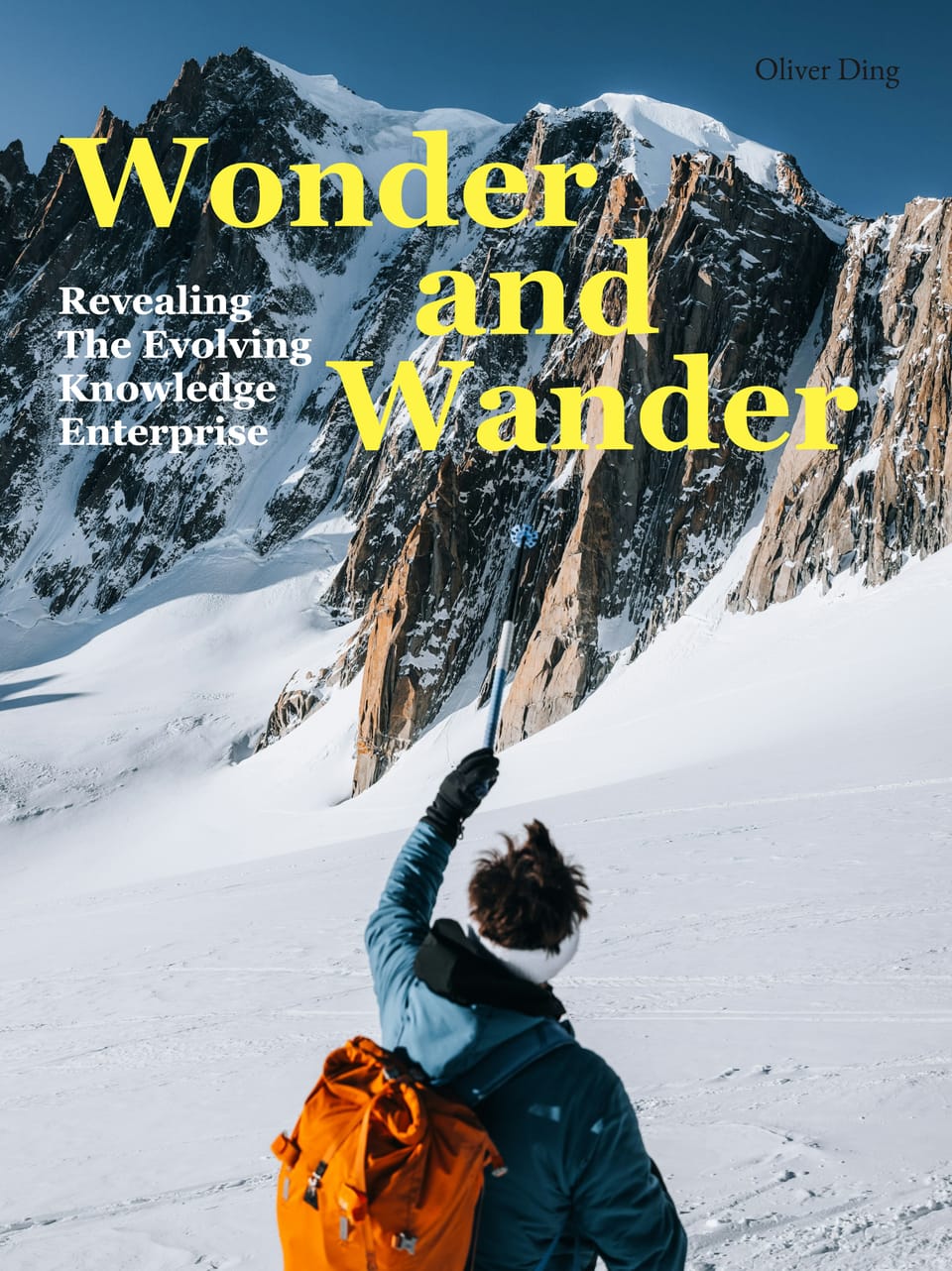
Revealing The Evolving Knowledge Enterprise
by Oliver Ding
June 13, 2025
This is the introduction of Wonder and Wander. More details can be found in Wonder and Wander (Light Possible Book) on Possible Press.
The Wonder and Wander project is an ongoing reflection on my creative journey from March 2019 to March 2025.
The “Wonder and Wander” theme was born in January 2025 while I was working on an annual review of my 2024 creative journey. From March 1, 2025, to June 8, 2025, I selected eight themes and conducted eight case studies of Creative Journeys. For each journey, I reviewed the series of projects within it, explored relevant themes, and discovered deep patterns and models.
The outcome was remarkable.
The diagram below represents these case studies, highlighting their unique thematic insights.

In this article, I will review the project and summarize key insights into a systematic framework.
It’s time to prepare a possible book for readers who want to explore further. This article serves as the introduction to the possible book.
Contents
Part 1: The Wonder and Wander Project
1.1 The Theme
1.2 The Map
1.3 The Objective and the Object
1.4 The Method
1.5 Case Studies
1.6 The Outcome
Part 2: Theory as Enterprise
2.1 Evolving Knowledge Enterprise
2.2 Theory as Thematic Enterprise
2.3 Map, Model, and Framework
Part 3: Center Development
3.1 Ontology: Self as Center, Creative Life, and Theory as Enterprise
3.2 Realism: Knowledge Center, Key Functions, and Operational Themes
3.3 Hermeneutics: Maps, Mental Models, and Mindwave Development
3.4 A Three-layer Map: The Center Development Toolkit
Part 4: Wonder, Wander, and Container Thinking
4.1 Container Thinking: The Ecological Practice Approach
4.2 Meaning Control System
4.3 Operating System
4.4 Application Programs
4.5 Interactive Interface
Part 5: The Knowledge Strategy Perspective
5.1 The Knowledge Strategy Toolkit (v2.1)
5.2 A Three-Level General Strategy for “Theory as Enterprise”
5.3 Self-referential Strategy
5.4 The Self-referential Activity of “Theory as Enterprise”
Part 6: The “Wonder and Wander” Experience
6.1 The “HERO’s Journey” Metaphor
6.2 Wonder in the Aion Space, Wander in the Chronos Space
6.3 The Moment of Recognition: When Theory Reveals Itself
Part 1: The Wonder and Wander Project
In the case study The “Evolving Knowledge Enterprise” Journey (2020–2025), I mentioned a theme within my journey of knowledge engagement: The “Theme — Concept — Framework” Transformation.
The Wonder and Wander Project also follows this theme. It starts with a theme, then a project, and finally a new knowledge framework. In this part, I share relevant background information about the project.
1.1 The Theme
On January 18, 2025, I made the diagram below to reflect on my creative journey from 2023 to 2024.
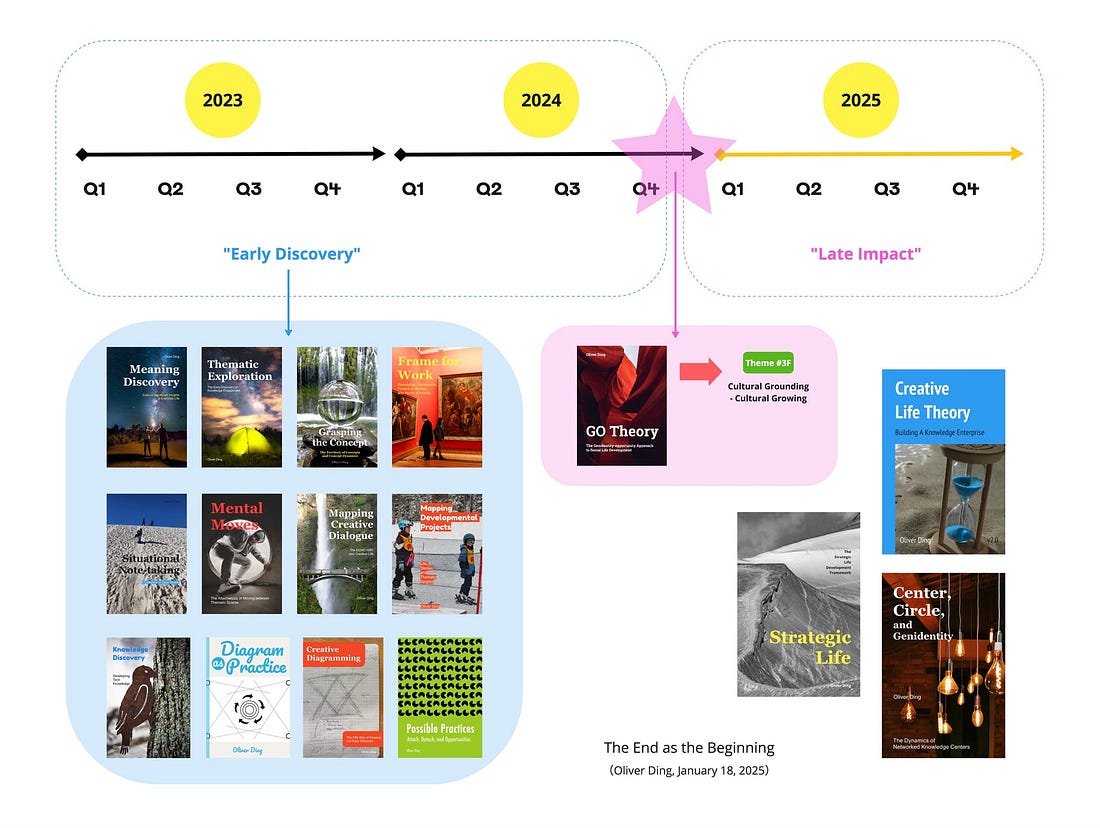
In 2023, I made four possible books focused on the Early Discovery of knowledge engagement, forming the series Aspects of Early Discovery.
By the end of 2024, the series had expanded to include 12 possible books, organized into three sub-series, focusing on three aspects:
- The transformation of knowledge elements
- The activity of knowledge engagement
- The materiality of knowledge representation
These three aspects form the foundation for building a knowledge enterprise, which was the central focus of Phase 1 of Creative Life Theory.
The diagram was named the End as the Beginning, highlighting my shift from individual life development to cultural life development.
To close a several-year journey of knowledge engagement, on January 22, 2025, I created the picture below, highlighting three aspects and the related book drafts I had written. The theme “Wonder and Wander” was born.
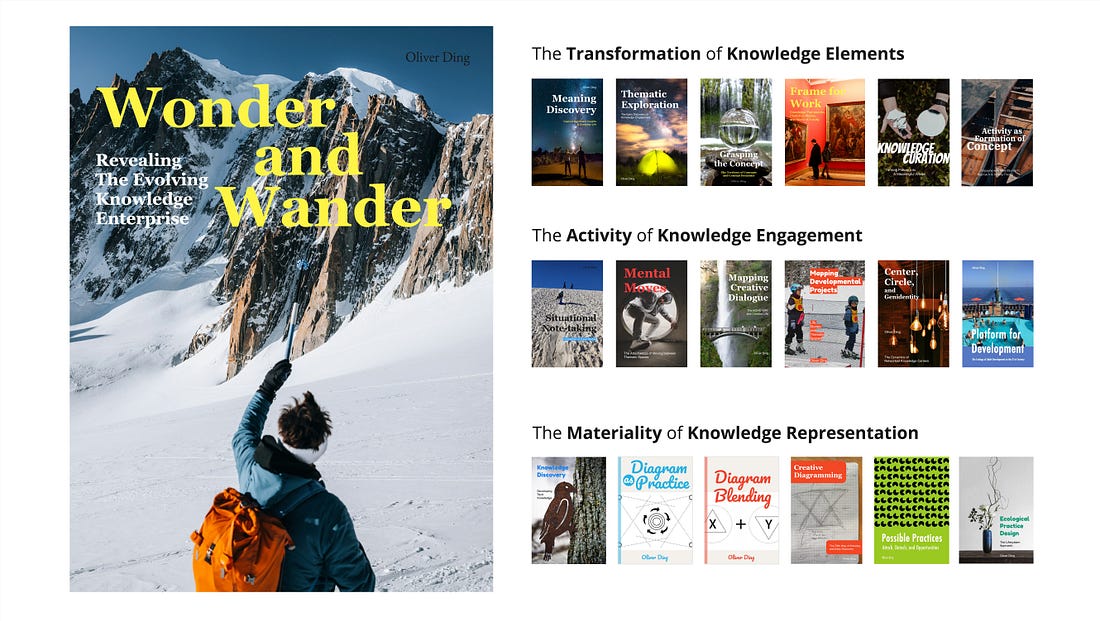
The three aspects echo three dimensions of the Evolving Knowledge Enterprise model I had been developing from 2023 to 2024. Therefore, I used “Revealing The Evolving Knowledge Enterprise” as a subtitle of the “Wonder and Wander” theme.
On March 1, 2025, I wrote a short note about the theme, kick-starting the project.
1.2 The Map
I have used different terms to describe these aspects in different frameworks. On March 26, 2025, I introduced the “Mental — Social — Material” Schema as a meta-framework to support these models.
A fully developed model, called the Landscape of Evolving Knowledge Enterprise Model, was created in April 2024. It is a model with three dimensions and three hierarchical levels. The three dimensions involve not only thinking, but also other forms of engagement such as doing, saying, and making. This model emphasizes going beyond the mental dimension to include embodied, communicative, and material practices.
- Mental Platform: How do you think?
- Behavioral Network: How do you do?
- Material Container: What do you make?
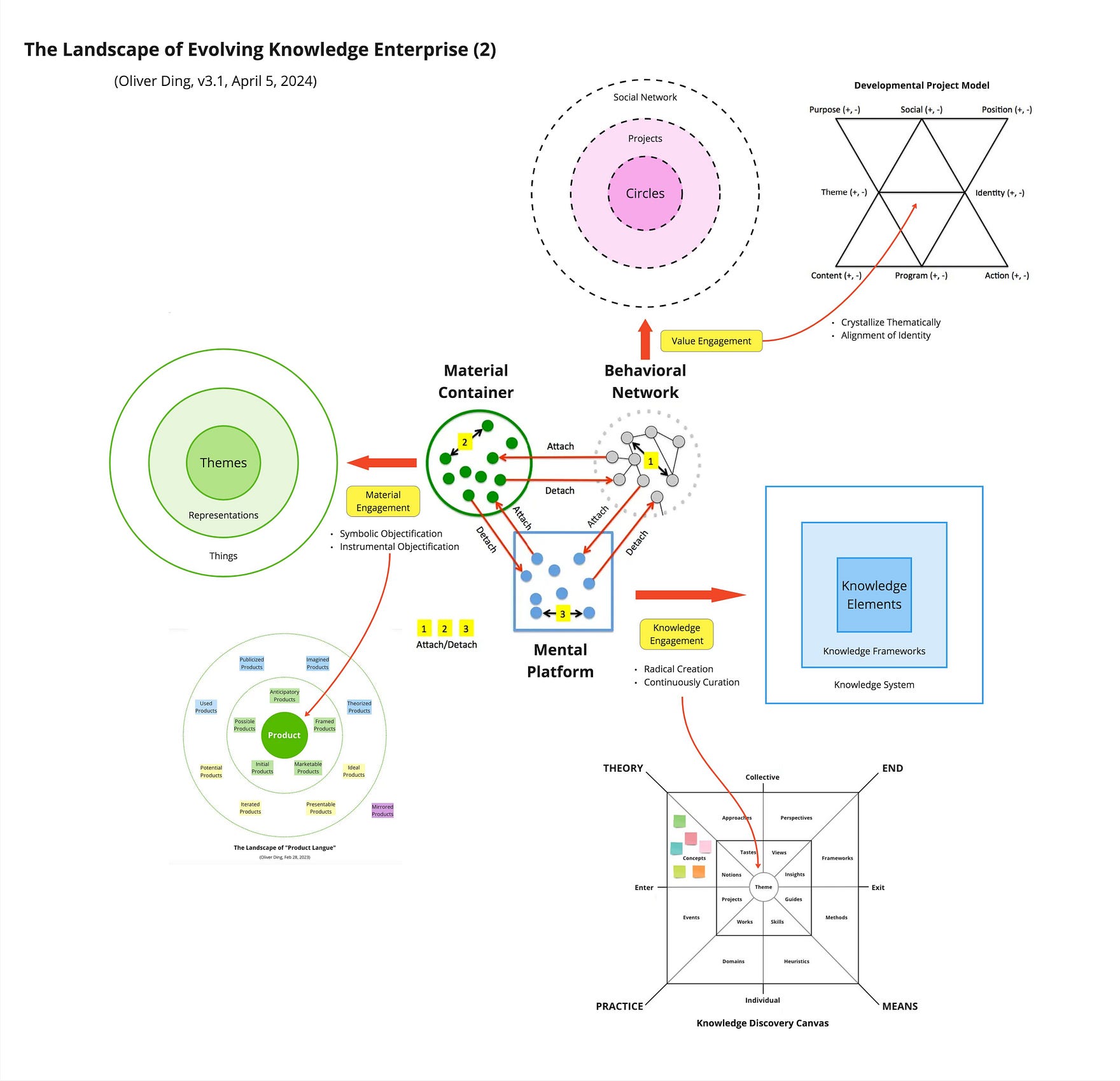
In my creative journey, I used the model as a Map to represent a landscape of a knowledge center for reflection, exploration, and narrative. The diagram below was an example, showing the landscape of TALE (Thematic Analysis Learning Engagement) in April 2024.

After mapping this landscape, I realized that TALE, as an independent knowledge center, lacked a distinctive theoretical approach. In contrast, other knowledge centers I operated had their unique theoretical approaches. This insight led me to assign Thematic Space Theory to TALE at the end of 2024.
In the case study titled The “Evolving Knowledge Enterprise” Journey (2020–2025), I traced the historical development from knowledge curation to knowledge engagement, and ultimately to knowledge enterprise, as follows:
- Single Point: “HERO U” (2020)
- Durable Category: “Knowledge Curation” (2020–2022)
- Cross-categorical/Trans-categorical: “Knowledge Engagement” (2022–2023)
- System/Complex: “Knowledge Enterprise” (2023–2024)
- Trans-system/Trans-complex: “Creative Enterprise” (2024–2025)
The Wonder and Wander project aimed to reflect upon this trajectory and edit a book draft centered on the Evolving Knowledge Enterprise model.
1.3 The Objective and the Object
In March 2025, I finished my 42nd possible book, Pieces, Whole, and Curativity. I realized that it was time to run the Wonder and Wander project, reflecting my creative journey spanning from March 2019 — when I created my 1st possible book, Curativity — to March 2025.
On April 1, 2025, I decided to run the Wonder and Wander project as a GAP project, a term I use to refer to some informal projects between two formal projects, inspired by the concept of a Gap year.
One year ago, in April 2024, I adopted the Gap Project approach, running a “Creative Life Curation” project and a “Creative Life Discovery” project. See the diagram below. More details can be found in Slow Cognition: A 5-year Creative Journey and Two “GAP” Projects.
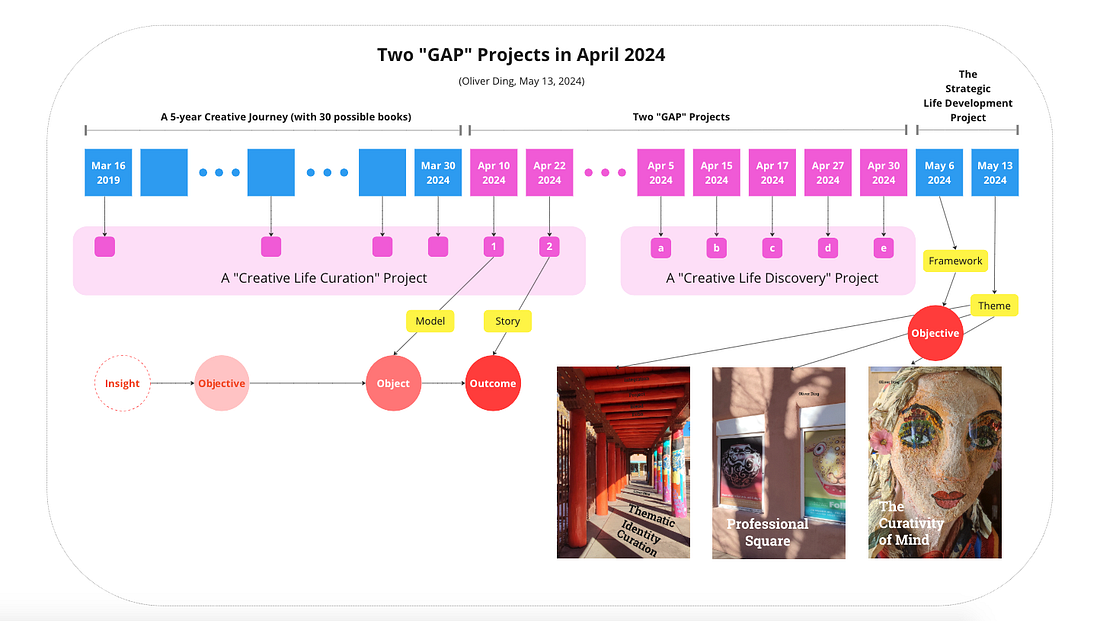
The Objective of the Wonder and Wander project was defined as a set of goals:
- 1) Reflecting on my creative journey from March 2019 to March 2025;
- 2) Running it as a Creative Life Curation project, adding one more case to the Creative Life Curation method;
- 3) Conducting case studies of developing knowledge enterprises;
- 4) Introducing the Evolving Knowledge Enterprise model to capture the complexity of the knowledge enterprises; and
- 5) Completing the Knowledge Strategy trilogy.
The last goal was defined in February 2025, while working on the Knowledge Strategy project, at which point I resolved to expand the project from one possible book into a trilogy.
- Knowledge Strategy: The Ecological Strategic Cognition Framework (v2.2) for Building Knowledge Enterprises — Introduces v1.0 of the Knowledge Strategy Toolkit, integrating various knowledge frameworks and models.
- Castle and Forest: The Landscape of Concept-related Knowledge Engagement (book, v2.0, 2025) — serves as a follow-up to my 2022 book draft, Knowledge Discovery. While it still focuses on the Knowledge Discovery Canvas and related tools, the primary theme shifts from tacit knowledge to the broader knowledge ecosystem.
- Wonder and Wander: Revealing The Evolving Knowledge Enterprise — A possible book exploring the Evolving Knowledge Enterprise model, capturing the dynamic and adaptive nature of knowledge-driven enterprises.
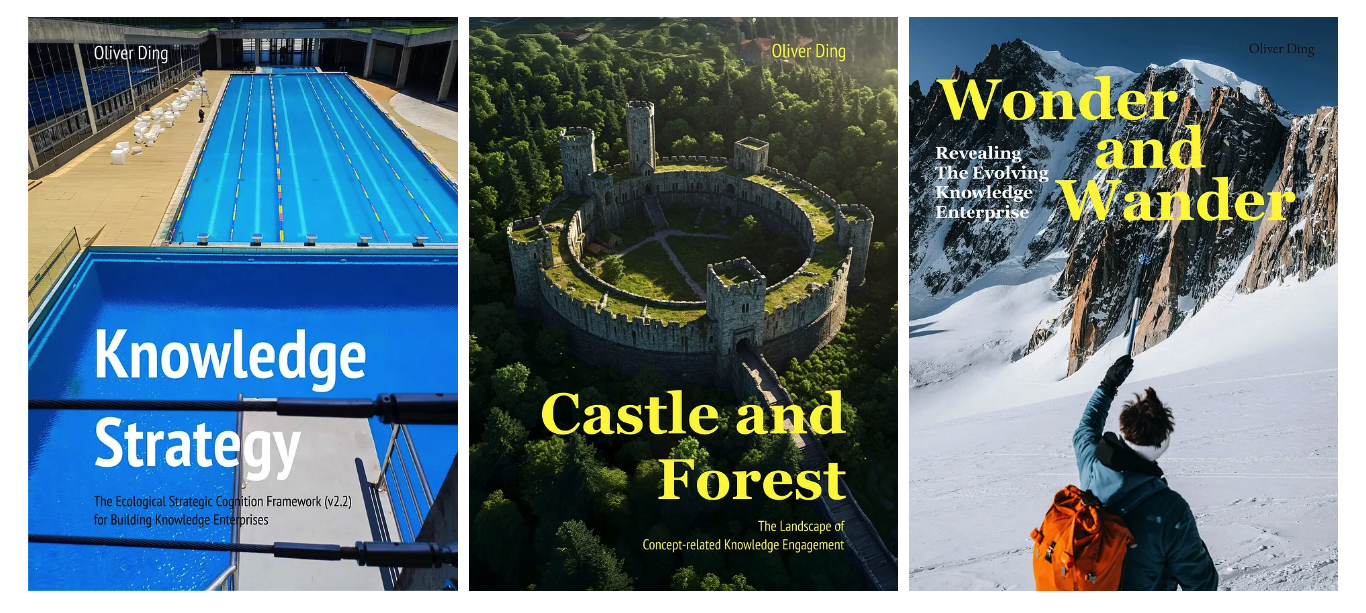
The central object of the Wonder and Wander project was the Landscape of Evolving Knowledge Enterprise Model, which served both as a tool and as a conceptual frame for organizing outcomes.
As a tool, the model was employed as a map for reflecting on the knowledge enterprise landscape and as a situational framework for structuring book drafts — a role it has fulfilled repeatedly in my work.
In December 2024, I utilized it as a meta-framework to develop a situational framework for editing the book draft Frame for Work: Knowledge Frameworks, Predictive Models, and World of Activity.

The book was curated using a multi-perspective approach, incorporating several theoretical frameworks as resources to support diverse practices. The diagram below highlights four perspectives:
- Frame in Make
- Frame in Use
- Frame in Diagram
- Frame in Form
These four perspectives are positioned around the “Knowledge Framework — Project — Representation” schema, which forms the middle layer of the Evolving Knowledge Enterprise. In my creative journey, this model has also expanded to encompass the Creative Enterprise, covering both knowledge and cultural enterprises.
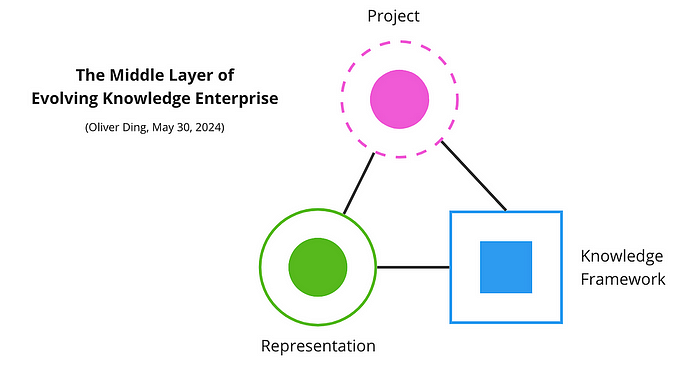
Additionally, the book incorporates four types of actors and their World of Activity in the landscape of engaging with knowledge frameworks.
On March 31, 2025, I applied the model again in editing a part for Pieces, Whole, and Curativity (book, v2.1, 2025).
Part 2: “Curativity”: An Evolving Creative Enterprise
Chapter 3: Curativity Theory
Chapter 4: Curativity Center
Chapter 5: Possible Books
Despite these applications, I had not authored or edited a book explicitly centered on this model. Consequently, I resolved that the Wonder and Wander project should fulfill this objective.
1.4 The Method
The Wonder and Wander project is similar to my 2023 Mental Moves project. Both aim to utilize data from my creative journey to conduct multiple empirical studies. The method behind these two projects shares the following aspects:
- Empirical Study
- The Creative Life Curation Method
- Historical-cognitive Research
- Multiple-theme Reflection
- Framework Development
While I often curated my articles to edit book drafts, these two projects are based on new empirical studies, not previous articles.
Based on my 2022 book draft, Creative Life Curation, the Creative Life Curation Method defines several units of analysis. The Mental Moves project focused on creative cognition and therefore selected the “Creative Action” as its unit of analysis. In contrast, the Wonder and Wander project centers on the evolving knowledge enterprise and accordingly adopts the “Creative Journey” as its unit of analysis, with each Creative Journey comprising at least four projects unified by a central theme.
These projects do not constitute laboratory experiments nor anticipatory future research but are best characterized as historical-cognitive studies. They draw upon my articles, notes, emails, and diagrams as empirical data derived from lived history. Importantly, the research is grounded in published materials and documented notes created prior to the project’s inception, primarily sourced from Medium and LinkedIn. Case study reports include extensive referencing through embedded source links.
Distinguishing itself from traditional biographic research — which typically treats a life narrative as a singular story — my approach treats real-life experience as a primary resource, guided by the principle of Multiple-Theme Reflection in both research design and execution. In the Wonder and Wander project, I selected specific actions and projects spanning from 2019 to 2025, structuring them into eight Creative Journeys, each with a primary theme, original data, and defined temporal boundaries.
A central feature of my methodology is Framework Development. Although each Creative Journey is anchored by a primary theme, the research process often reveals additional Creative Themes, which are systematically organized into comprehensive knowledge frameworks. This process involves adopting external theoretical resources serving as meta-frameworks, fostering a creative dialogue with the native framework.
While these projects maintain clearly defined objectives and objects, their outcomes demonstrate significant creative expansion beyond initial intentions — an aspect I regard as the true value of research rather than as deviations or errors.
The principal aim of the Wonder and Wander project was to articulate the evolving knowledge enterprise model; however, the actual outcomes exceeded this goal, culminating in the development of a new theoretical framework termed “Theory as Enterprise,” within which the original model is embedded.
1.5 Case Studies
Between March and June 2025, I conducted eight case studies, each centered on a distinct theme. As illustrated in the diagram below, these case studies are organized into two thematic groups.
The first group, positioned in the upper section of the diagram, focuses on the activity of Center Development:
- The Center Journey (2022–2025)
- The Aion Journey (2021–2025)
- The ECHO Journey (2019–2021)
- The Re-engagement Journey (2024–2025)
The second group is oriented around the theme of the Evolving Knowledge Enterprise and is positioned in the lower half of the diagram:
- The “Evolving Knowledge Enterprise” Journey (2020–2025)
- The “Mapping Knowledge Enterprise” Journey (2020–2025)
- The “Container Thinking” Journey (2019–2025)
- The Curativity Journey (2019–2025)
Insights gained from these case studies are presented in the following sections.
1.6 The Outcome
One of the unexpected yet significant outcomes of the project was the emergence of the “Theory as Enterprise” theme, along with its corresponding framework. Within this newly developed framework, the Evolving Knowledge Enterprise model functions as an integral component.
Viewed from the lens of Knowledge Strategy, the Theory as Enterprise framework provides a systematic approach for analyzing the internal architecture of an evolving knowledge enterprise. It complements the model introduced in Castle and Forest (February 2025), which emphasizes the external dynamics of such enterprises — particularly in relation to concept-driven knowledge engagement.
Together, these two models form a coherent and comprehensive framework for developing a knowledge strategy, addressing both internal structures and external trajectories of evolving knowledge enterprises.
Part 2: Theory as Enterprise
The “Theory as Enterprise” theme refers to 1) Theory as Thematic Enterprise, which offers a new perspective on Theory, treating it as a dynamic, collaborative, and developmental process; 2) Using the metaphor of Business Enterprise to understand the structural complexity of an evolving knowledge enterprise.
Part 2 focuses on the theme and briefly introduces the “Theory as Enterprise” theoretical framework.
2.1 Evolving Knowledge Enterprise
The “Theory as Enterprise” theme can be seen as a new version of the “Evolving Knowledge Enterprise” theme. While the term “Knowledge” is broad, the term “Theory” is narrower than it. Not all knowledge is theory, but all theory is a form of knowledge.
How did the “Evolving Knowledge Enterprise” theme come?
In the case study The “Mapping Network of Enterprises” Journey (2020–2025), I reflected on the influence of Howard E. Gruber on my creative journey exploring creative work.
Howard Ernest Gruber (November 6, 1922 — January 25, 2005) was an American psychologist and a pioneer of the psychological study of creativity. His ideas and career deeply influenced my creative trajectory between 2020 and 2025.
I have long been fascinated by creativity and discovery. Since 2017, Howard E. Gruber has been my role model in my intellectual journey. His role as a historical-cognitive psychologist inspired me to launch the Slow Cognition project in January 2022, which explores the long-term cognitive development processes of professionals. Later, the project led to what I now call Creative Life Theory.
One of the central concepts in Gruber’s Evolving Systems Approach to Creative Work (1974, 1989) is the Network of Enterprises — a framework I adopted from 2019 to 2021 to manage my own creative activities. In 2022, I transitioned to the Knowledge Center model, which eventually evolved into the Evolving Knowledge Enterprise approach.
A central issue in both Gruber’s approach and my own exploration of different ways to manage creative work is the hierarchy of creative life. Though we use different terms, we share the same focus on its hierarchical aspect.
Gruber’s evolving systems approach has long served as a valuable resource in my creative journey. However, I have never treated it as a fixed framework to inherit or extend. Instead, I engage with it dialogically, using it as one resource among many in an open-ended creative process.
The word “Evolving” in the “Evolving Knowledge Enterprise” theme was inspired by Developmental psychologist Robert Kegan’s 1982 book The Evolving Self. In late 2023, I coined the term “Evolving Concept System” after finishing a case study about Kegan’s creative life.
In the case study The “Evolving Knowledge Enterprise” Journey (2020–2025), I revisited one of Kegan’s core models — the Five Orders of Consciousness — to reflect on the development of my own “Evolving Knowledge Enterprise” journey from 2020 to 2025. See the diagram below.
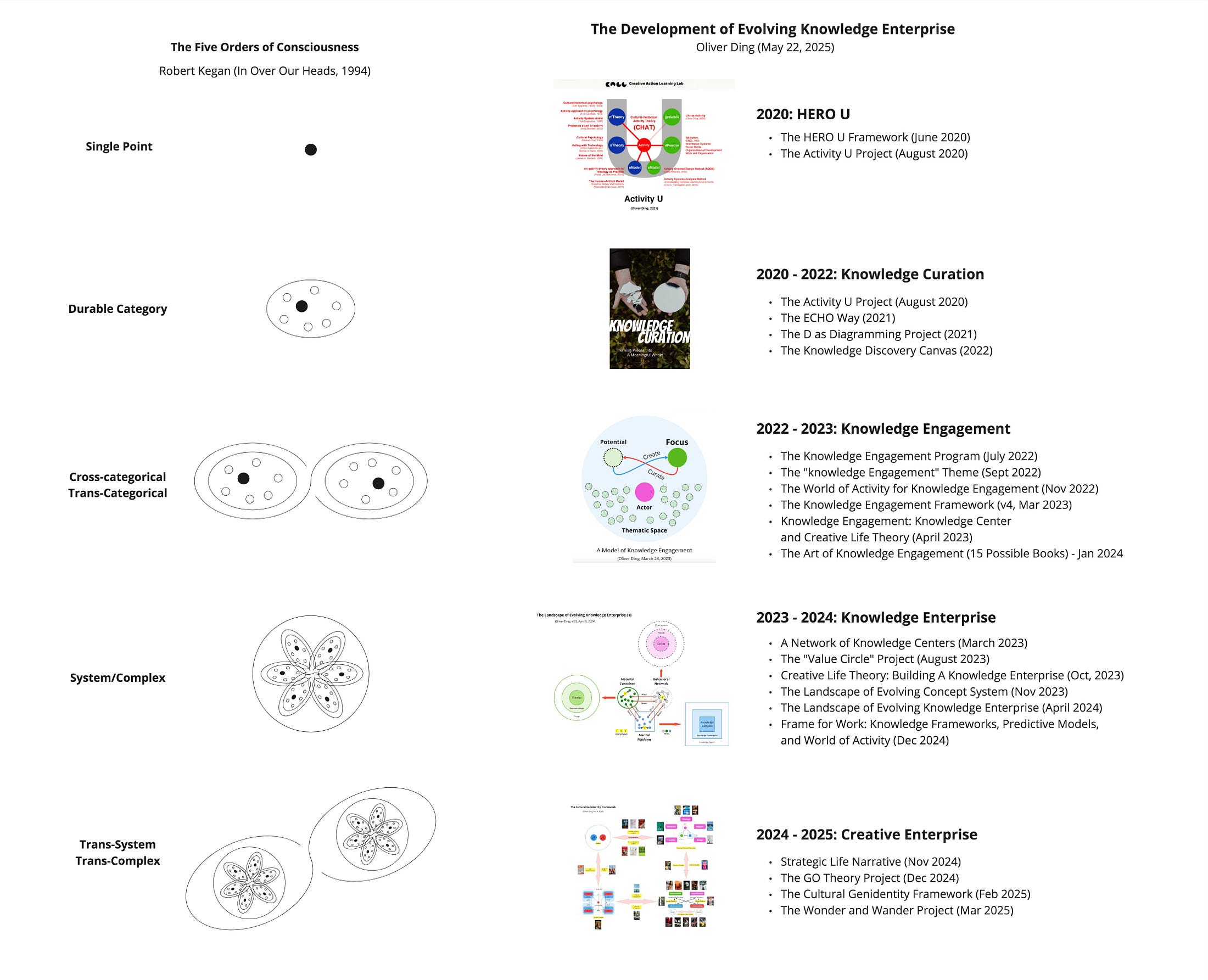
This journey is framed in five phases, each centered around a core creative theme and a constellation of knowledge projects. Remarkably, the developmental pattern of these themes aligns closely with Kegan’s model introduced in In Over Our Heads (1994).
- Single Point: “HERO U” (2020)
- Durable Category: “Knowledge Curation” (2020–2022)
- Cross-categorical/Trans-categorical: “Knowledge Engagement” (2022–2023)
- System/Complex: “Knowledge Enterprise” (2023–2024)
- Trans-system/Trans-complex: “Creative Enterprise” (2024–2025)
Although the “Evolving Knowledge Enterprise” theme was the primary theme from 2023 to 2024, it has both a rich past and an unfolding future.
2.2 Theory as Thematic Enterprise
On March 31, 2025, I released a book draft titled Pieces, Whole, and Curativity: Curativity Theory in the Field (book, v2.1, 2025).
Six years ago, I completed the draft of my first theory book, Curativity: The Ecological Approach to General Curation Practice.
To avoid unnecessary debate over the concept of curation or curatorial practice, which traditionally refers to “professional curation in the context of art and museums,” I coined the term Curativity to support my argument for an interdisciplinary view of curation. Thus, Curativity is an ontological-level invention. It points to a new space for knowing and understanding.
The diagram below shows the basic elements of Curativity: Pieces — Container — Whole. The basic assumption behind the diagram and the new term is: “In order to effectively curate pieces into a meaningful whole, we need containers to contain pieces and shape them.”
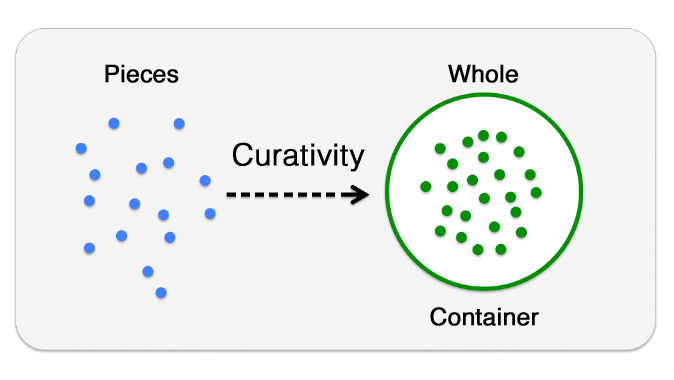
At an epistemological level, Curativity differs from mereology in philosophy and mathematical logic. While both address the relationship between parts and whole, Curativity is more concerned with action, experience, and value, whereas mereology focuses more on abstract reasoning about parts and wholes.
After March 2019, I used it as a meta-theory, applying it to various knowledge projects. This work resulted in multiple book drafts and a series of knowledge frameworks.
On March 28, 2025, I revisited the development and application of Curativity Theory (March 2019–March 2025) through the diagram below, structured around the “THEORY — PRACTICE — END — MEANS” schema. This analysis revealed four strategic themes and highlighted a series of knowledge projects.
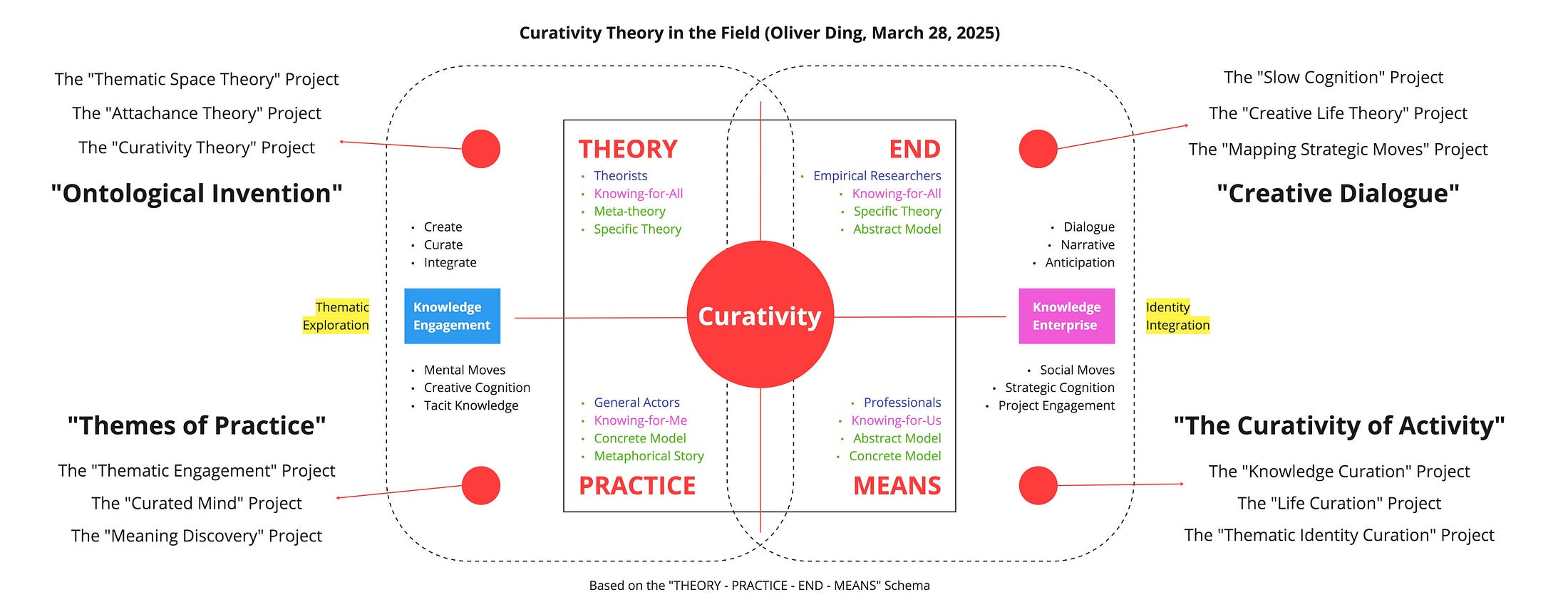
I also wrote four articles reflecting on this six-year journey, exploring four themes:
- Curativity as an Ontological Invention
- Curativity and Creative Dialogue
- Curativity: A Creative Enterprise
- Curativity for Personal Practice
This was the first case study of the Wonder and Wander project. Its key outcome was the “Theory as Enterprise” theme.
From the six-year journey of developing Curativity Theory, I came to realize a new way of understanding theory. While the traditional view treats Theory as a static knowledge system, the “Theory as Enterprise” theme sees Theory as a thematic enterprise — an evolving concept system that has its essential differences and situational dynamics.
The “THEORY — PRACTICE — END — MEANS” schema and its related artifacts, such as Knowledge Discovery Canvas, offer a toolkit to understand the social landscape of thematic enterprise. These ideas were introduced in Castle and Forest: The Landscape of Concept-related Knowledge Engagement (book, v2.0, 2025), the second book of the Knowledge Strategy trilogy.
Wonder and Wander, the third book in the trilogy, is expected to focus on the “Mental — Social — Material” Schema and related artifacts, such as the Evolving Knowledge Enterprise model, with a central focus on understanding the internal structure and complexity of a thematic enterprise.
2.3 Map, Model, and Framework
The final outcome of the Wonder and Wander project is amazing! It goes beyond the primary goal of introducing the Evolving Knowledge Enterprise model.
The outcome is a new theoretical framework for understanding the “Theory as Enterprise” theme.
The “Theory as Enterprise” theoretical framework consists of two components:
- 1) Map: a three-layer map that describes the structure of an evolving thematic enterprise, incorporating the Evolving Knowledge Enterprise model as one of the layers;
- 2) Model: drawing on core concepts from the Ecological Practice Approach, a four-level framework was developed to explain the dynamic complexity of an evolving knowledge enterprise.
The diagram below represents these ideas. The Map appears on the right side, while the Model is on the left.
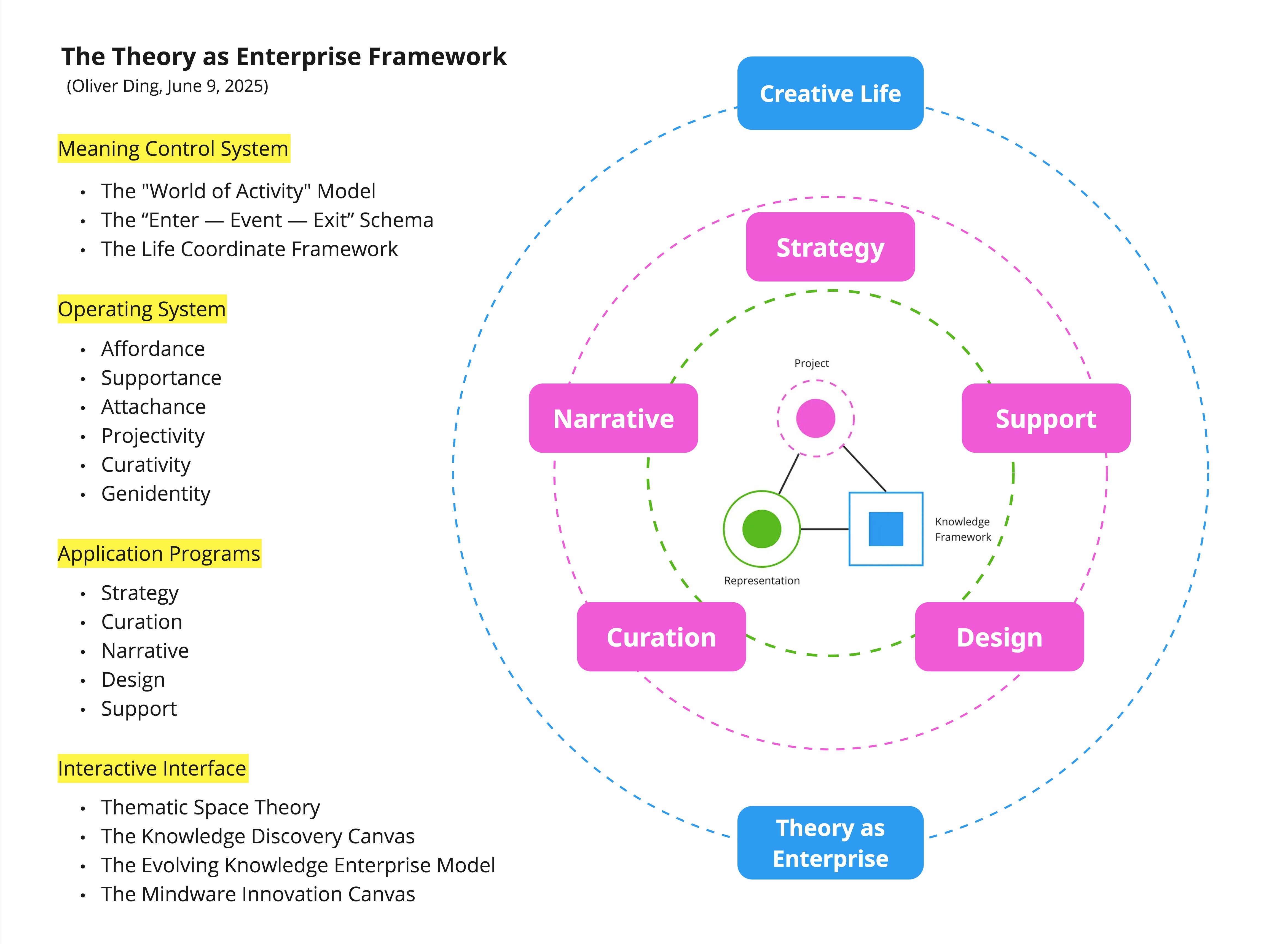
The separation between Theme, Map, and Model allows the “Theory as Enterprise” framework to remain open and developmental as a thematic enterprise. While I use the Ecological Practice Approach to build a four-level Model, others are welcome to adopt different theoretical approaches to construct alternative Models.
The more frameworks added to the Model section, the richer the “Theory as Enterprise” thematic enterprise becomes. This openness is a core principle of the framework itself.
Part 3: Center Development
Once the Wonder and Wander project unfolded from March to May 2025, a new theme called “Center Development” emerged as a new perspective for understanding the Evolving Knowledge Enterprise theme.
I realized that although the model was named Evolving, its core model was guided by the “Mental — Social — Material” Schema, a meta-framework for the landscape, not the journey.
After completing the case study on the development of the Activity Analysis Center, I decided to create a new theme titled “Center Development” to highlight the developmental perspective.
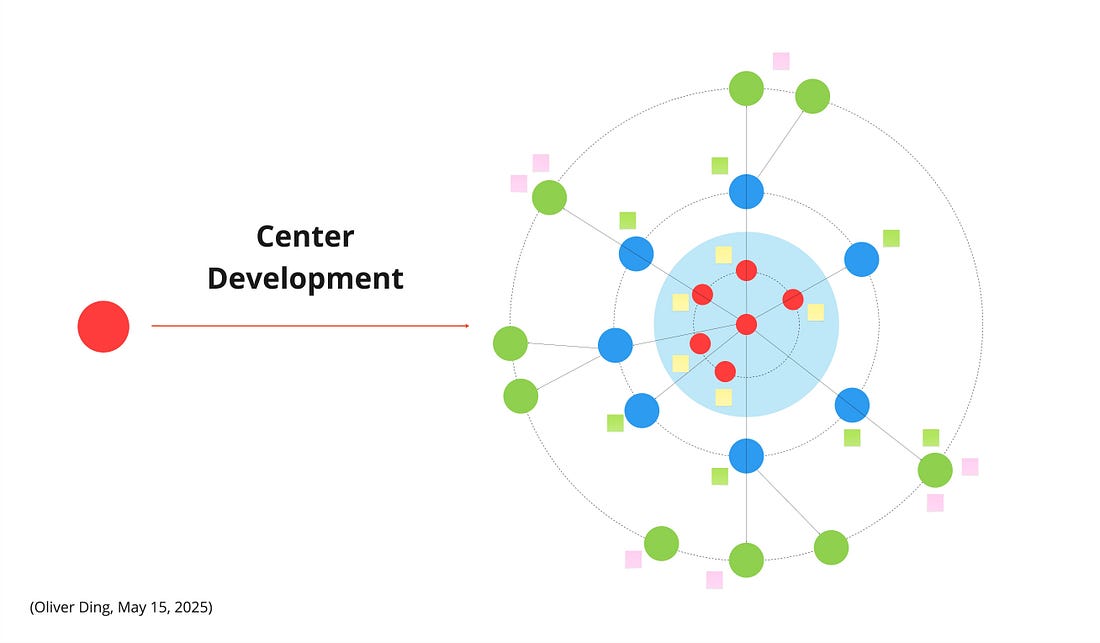
A supportive document titled The Footboot of Center Development was edited on May 16, 2025.
The Footbook of Center Development can be seen as a follow-up to Center, Circle, and Genidentity. However, the two books use different structures to curate articles and present ideas. While Center, Circle, and Genidentity remains at a broad level, offering a full-spectrum theoretical framework toward General Genidentity Theory, The Footbook of Center Development focuses solely on the development of a single creative center, offering detailed observations and reflections through case studies on three knowledge centers.
In the Wonder and Wander project, I discovered several creative themes related to the “Center Development” theme, located at three different levels:
- Ontology: Self as Center, Creative Life, and Theory as Enterprise
- Realism: Knowledge Center, Key Functions, and Operational Themes
- Hermeneutics: Maps, Mental Models, and Mindwave Development
These three levels form the first component of the “Theory as Enterprise” theoretical framework, visualized on the right side of the diagram. This component includes a three-layer map that illustrates the inner structure of an evolving enterprise — within which the Evolving Knowledge Enterprise is embedded as a distinct layer.
3.1 Ontology: Self as Center, Creative Life, and Theory as Enterprise
The Ontology level addresses the philosophical foundation of Center Development as it relates to both Creative Life and Theory as Enterprise.
While the Theory as Enterprise framework focuses on a thematic enterprise, at the ontological level, we must also consider the creator’s Creative Life, which provides the individual developmental context within which thematic enterprises unfold.
Creators may engage in multiple thematic enterprises throughout their creative lives, and a single thematic enterprise may involve collaboration among multiple creators.
In the early stages of a thematic enterprise, the “Creative Life” and the “Theory as Enterprise” themes are balanced by the “Self as Center” theme, introduced by Howard E. Gruber in his Evolving Systems Approach to Creative Work (1974, 1989).
Gruber offered a distinctive view of human progress — not as a linear trajectory, but as an expanding, multidimensional web of great complexity with no fixed or stable center.
In such a fluid and ever-evolving world, how can a creative individual orient themselves toward the future?
Gruber suggested that the answer lies in seeing the Self as the center.
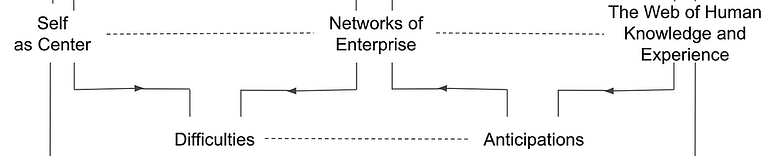
Because “outward” is only defined with regard to some particular starting point, some developmental lines might seem to be moving back toward previously developed areas. Thus the web of human knowledge and experience would grow without limit both larger and denser. In such a web would the exploring person be lost?
Not subjectively, or at least not always, for although there is no real center, she would often feel herself to be at the center.
This conception of the self as a mobile center of synthesis and orientation has profoundly shaped my later work. It inspired the development of the Knowledge Center approach, and more recently, the World of Activity model — both of which explore how individuals generate continuity and direction in complex knowledge practices.
On May 25, 2025, I adopted the Ecological Formism schema to develop a hierarchical structure for the “World of Activity” theme. See the diagram below.
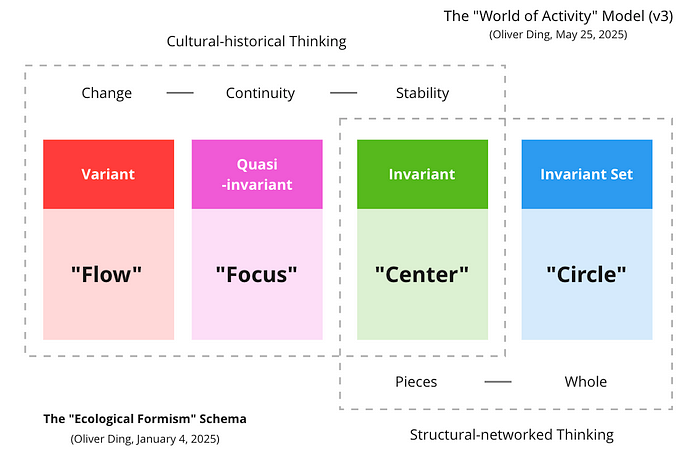
The diagram above shows the “World of Activity” model. It can be read as the following list:
- Variant: Creative Flow → the “flow” of everyday life experience.
- Quasi-invariant: Creative Focus → the mental “focus” of our mind.
- Invariant: Creative Center → the creative “center” we work with continuously.
- Invariant Set: Creative Circle → the creative “circle” of connected several creative centers.
The term Flow refers to the flow of everyday life experience. In the context of Curativity Theory, this “Flow” represents my work experience centered around the theme of curation.
Focus refers to the mental concentration of our mind. At a certain point, I realized that the “Curation” theme held significant importance in my life and career. This realization marked a specific thematic space in my mind, framing my intention and attention.
The distinction between Flow and Focus lies in the emergence of a specific thematic space, which serves as the vehicle of the focus.
Center refers to the creative center we engage with continuously. In my story, this could be my 2019 book Curativity or the Curativity Center I launched in 2022. It may also refer to earlier activities, such as a speech titled Curation Common for Education that I gave at a student event at Harvard University in 2012.
The difference between Focus and Center is that the former emphasizes intention and attention, while the latter involves action and ongoing curation.
Circle refers to the creative circle formed by connected creative centers. The previously mentioned Value Circle framework is particularly useful here.
The Ecological Formism schema combines cultural-historical thinking (inspired by Activity Theory) with structural-networked thinking (inspired by Curativity Theory), offering a unique perspective to understand change, continuity, and stability by exploring the relationship between parts and the whole.
The World of Activity model can thus be understood as a new hierarchical structure for comprehending Creative Life. This perspective resonates strongly with Gruber’s notion of the Self as Center, which views the self not as a fixed point but as a mobile center of synthesis and intention. In a complex, evolving creative world without a stable center, individuals maintain continuity and direction by actively interpreting their surroundings and reorienting themselves. Building on this, the World of Activity model offers a concrete framework to further develop and operationalize the notion of the Self as Center.
More details can be found in the case study The “Mapping Network of Enterprises” Journey (2020–2025).
3.2 Realism: Knowledge Center, Key Functions, and Operational Themes
The Realism level pertains to the sociological dimension of Center Development, focusing on a Knowledge Center (or Creative Center), its functions, and its Genidentity.
Gruber’s approach remains largely within the realm of psychological realism, focusing on the internal evolution of a creative individual over time. His analysis draws heavily from biographical case studies, emphasizing the history of ideas within the individual.
By contrast, the sociological perspective on Center Development offers not only an internal view of development but a contextual one, recognizing both creative life and thematic enterprise as socially embedded and ecologically structured.
In this view, the “Center” refers not only to a Mental Focus within a creative individual’s mind but also to a Knowledge Center (or Creative Center) situated in the person’s real-life activities, both personal and social.
In the case study The “Mapping Network of Enterprises” Journey (2020–2025), I reflected on the development of the concept of “Knowledge Center” from two trajectories. The diagram below shows the developmental trajectory of “PRACTICE,” highlighting five stages of the development of a Knowledge Center, using the Curativity Center as an example.
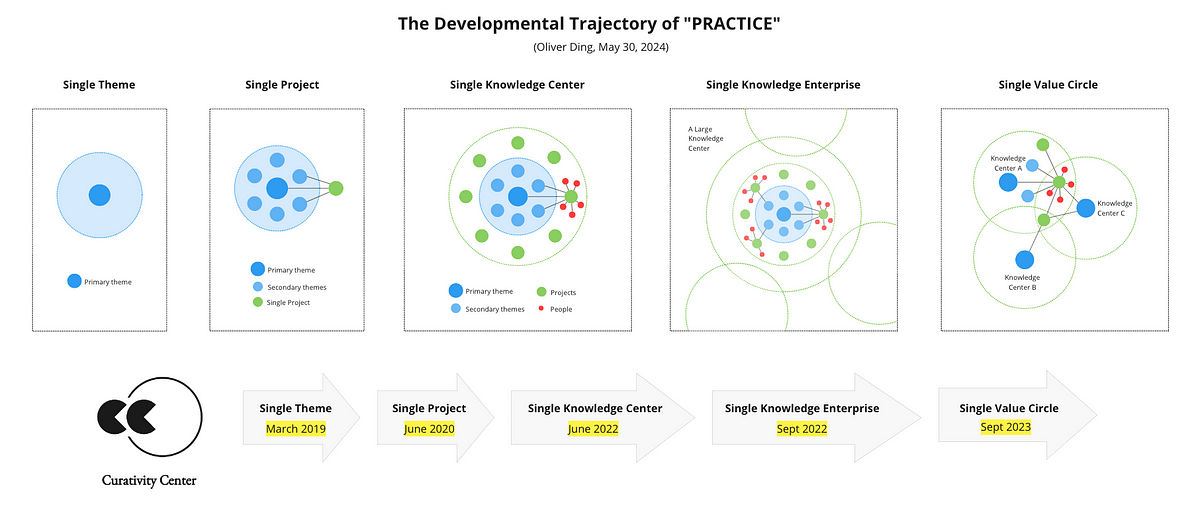
The above model uses five movements to represent situations I experienced in the past years. Curativity Center is used as an example in the model.
- March 2019: Single Theme (The theme of “Curativity” and Curativity Theory)
- June 2020: Single Project (The Knowledge Curation project)
- June 2022: Single Knowledge Center (Curativity Center)
- Sept 2022: Single Knowledge Enterprise (The “Curativity” knowledge enterprise)
- Sept 2023: Single Value Circle (A network of connected knowledge centers)
This progression represents a shift from thematic exploration to project formation, to organizational structure, and finally to an interconnected ecosystem of knowledge.
In this process, I also noticed several key functions involved in developing a knowledge center, such as:
- Strategy
- Narrative
- Curation
- Design
- Support
- etc
These key functions, along with others, require further exploration and study.
In the Wonder and Wander project, I didn’t conduct case studies that cover every function in depth.
However, through several case studies, I identified a set of specific operational themes:
- The Center Journey (2022–2025, PART A): Self, Project, and Identity Development
- The Center Journey (2022–2025, PART B): Alignment of Identity, Creative Dialogue, Synergy Effects, and Peer Support
- The ECHO Journey (2019–2021): Scalable Focus, Creative Dialogue
- The Aion Journey (2021–2025): Time Curation, Exploratory Decision-making, Strategic Shift
- The Re-engagement Journey (2024–2025): The “Before—After” Life Pattern
More details can be found in each case study report.
3.3 Hermeneutics: Maps, Mental Models, and Mindwave Development
The Hermeneutics level focuses on the psychological thinking of Center Development, particularly regarding Maps, Mental Models, and Mindwave Development.
To manage the cognitive complexity of Center Development, creators need a set of cognitive tools — such as theories, concepts, knowledge frameworks, diagrams, canvases, and creative heuristics — to enrich their competence in running a Knowledge Center.
From this perspective, the Landscape of Evolving Knowledge Enterprise model functions as a Map at this level, providing a tool for charting the global landscape of a Knowledge Center. It supports reflection, curation, discussion, sensemaking, exploratory decision-making, and strategic narrative development.
In the case study, The “Container Thinking” Journey (2019–2025, Part C), I introduced the Theorizing Creative Life Model, which curates several theoretical approaches I developed in recent years (see the diagram below).
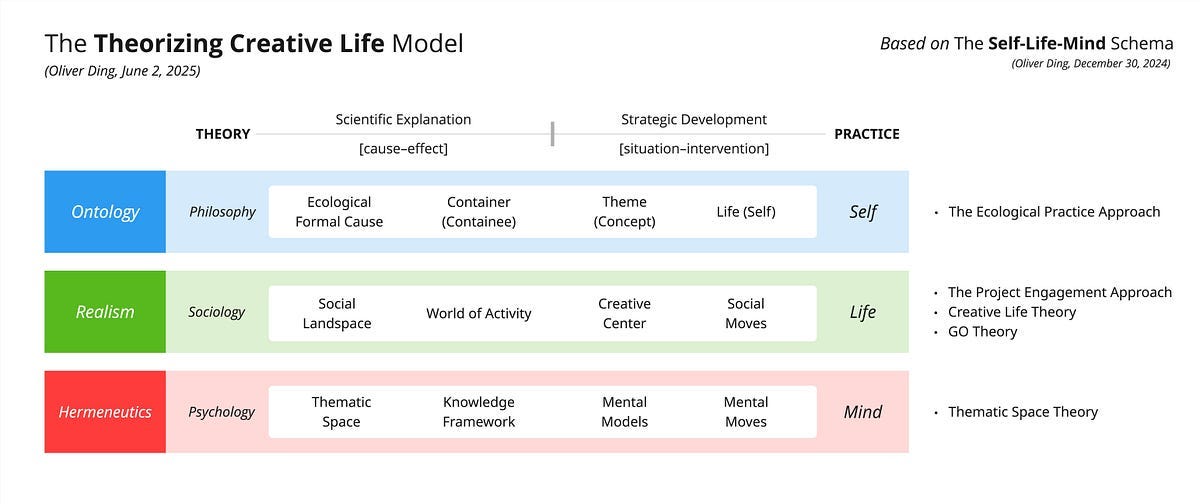
In this new model, Thematic Space Theory is situated at the Hermeneutics level.
On the THEORY side, it is framed as a scientific project that seeks to systematically explain phenomena, grounded in two objects:
- Thematic Space
- Knowledge Framework
On the PRACTICE side, it is framed as a practical project aimed at offering strategic development tools, grounded in two objects:
- Mental Models
- Mental Moves
To understand Center Development, Thematic Space Theory provides a systematic approach for learning, designing, and developing Maps, Frameworks, and Models, transforming them into mental models, and using them as mindwaves.
Building on the Landscape of Evolving Knowledge Enterprise model, I also developed the Mindware Development Canvas.
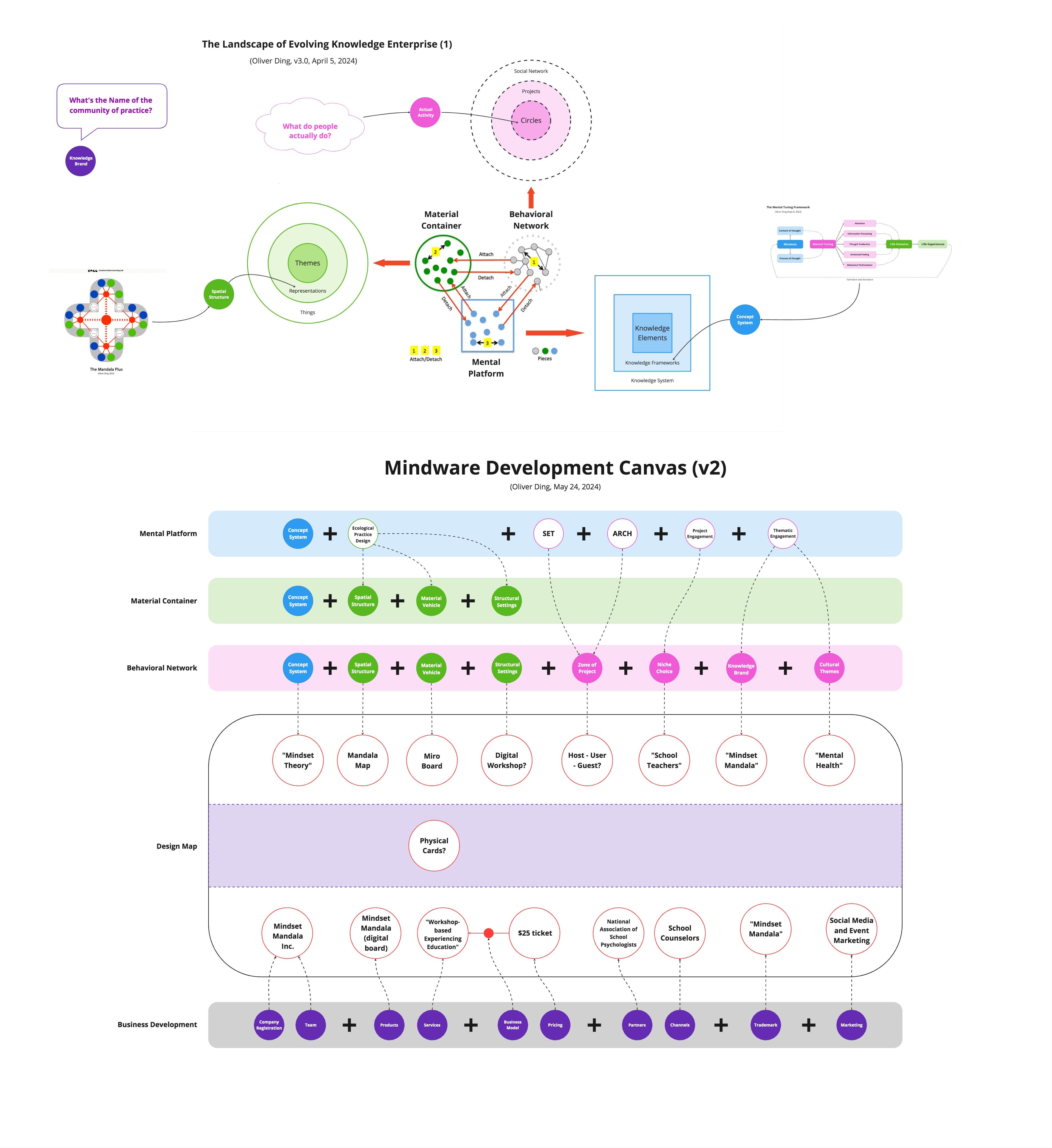
Initially created as an internal tool in April 2024, the canvas has now been curated into the Center Development Toolkit.
3.4 A Three-layer Map: The Center Development Toolkit
The above discussion presents a three-layer map of Center Development. See the diagram below.
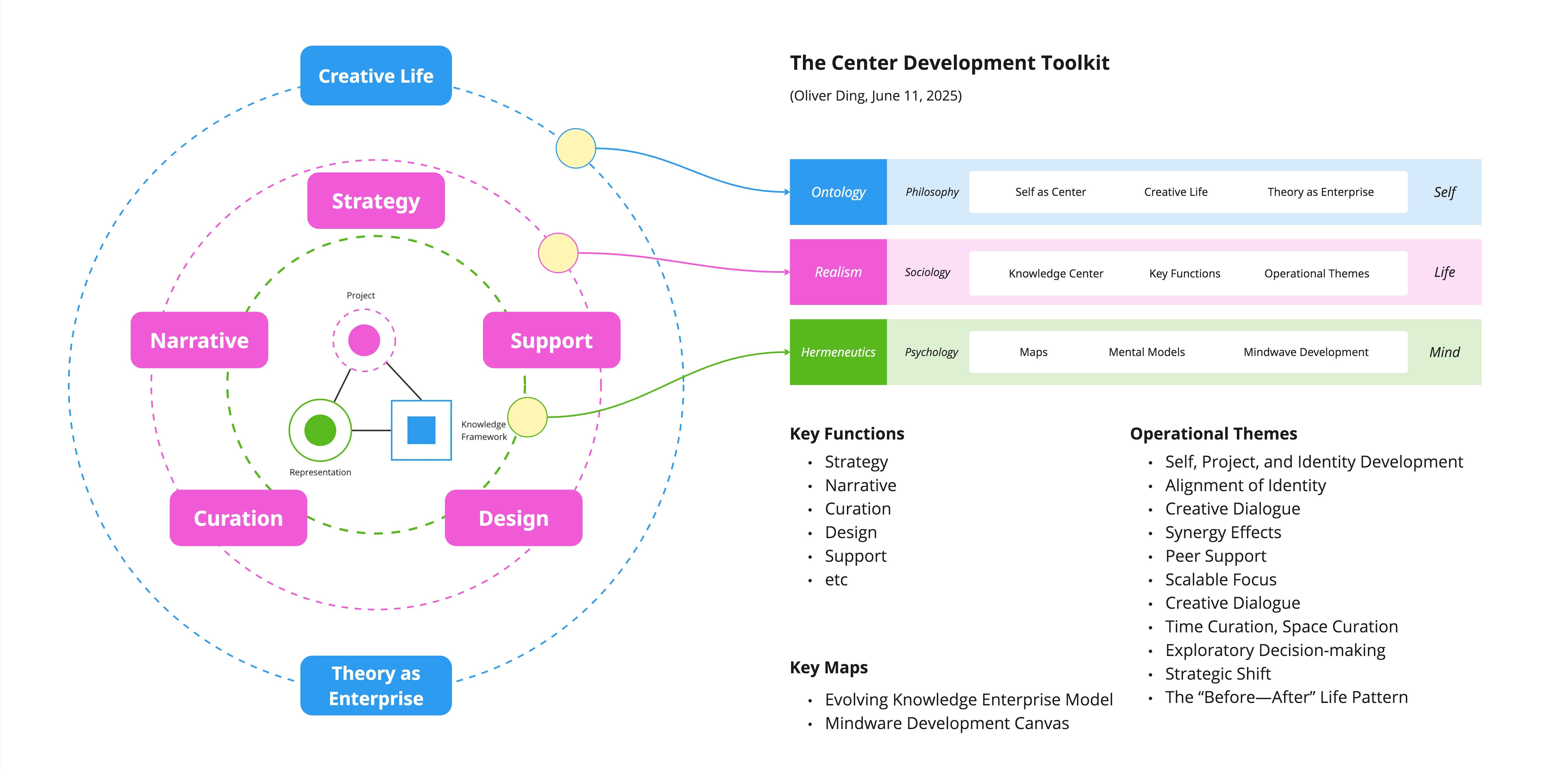
In the diagram, the three-layer map and related insights are curated as a toolkit. This map offers a structural model that represents significant aspects of Center Development.
In the next part, we will move to explore the Model — an integrated theoretical framework that helps to interpret both the Map of Center Development and the Theme of Theory as Enterprise.
Part 4: Wonder, Wander, and Container Thinking
As mentioned above, the “Theory as Enterprise” theoretical framework has two components:
- 1) Map: a three-layer map that describes the structure of an evolving enterprise, in which the Evolving Knowledge Enterprise is incorporated as one layer;
- 2) Model: developed by adopting the core concepts of the Ecological Practice Approach, offering a four-level framework to understand the dynamic complexity of evolving knowledge enterprises.
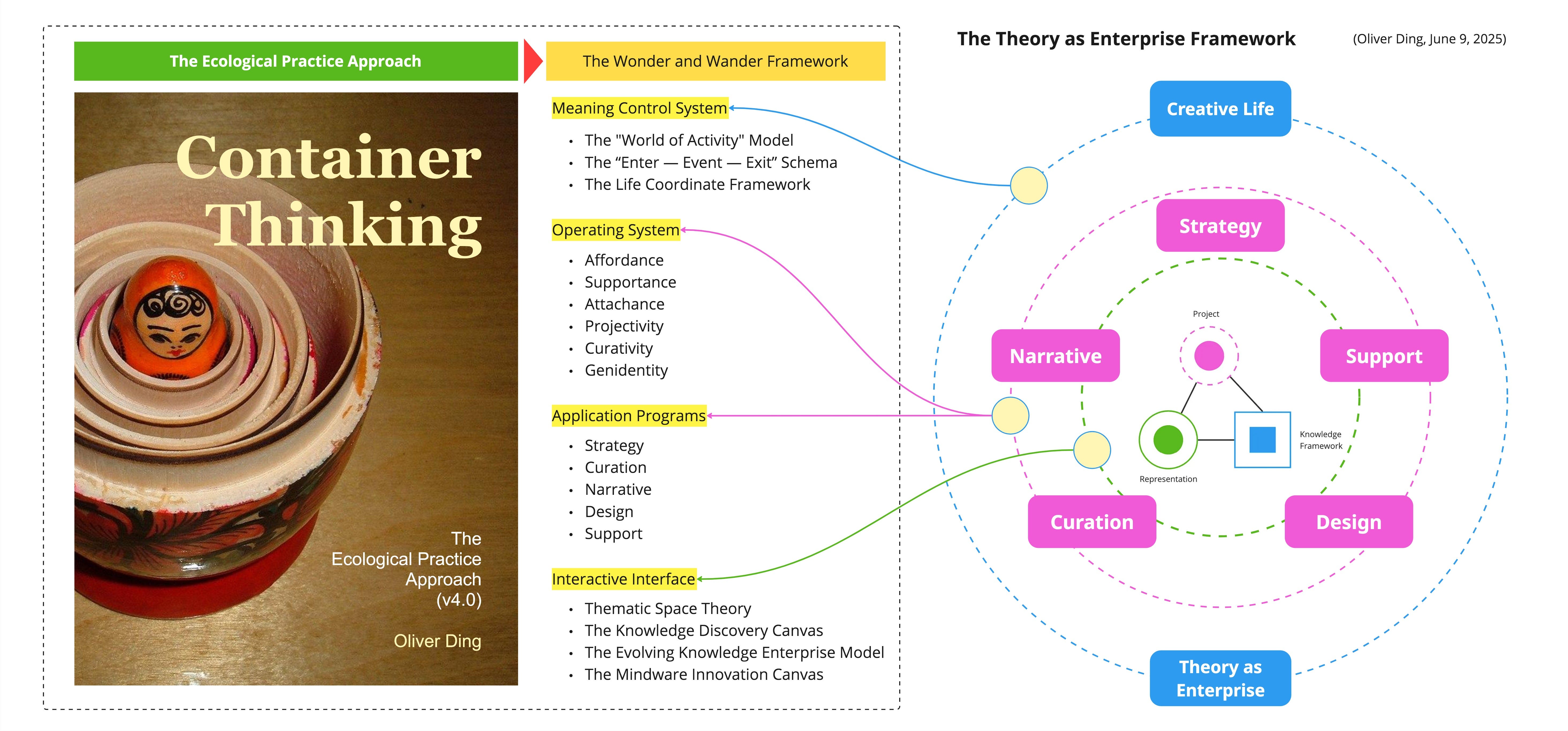
In this part. We will adopt the Ecological Practice Approach (also called “Container Thinking”) to develop a four-level framework titled the Wonder and Wander Framework. See the diagram below.
In the eighth case study, The “Container Thinking” Journey (2019–2025), I reflected on the historical development of the Ecological Practice Approach from the perspective of Knowledge Strategy. In Part 5 of the case study, I treat the approach as an example of “Theory as Enterprise.”
In this final case study, I discovered an important insight: the core concepts of the Ecological Practice Approach were used to guide the development of the approach itself.
Inspired by this, I developed a four-level framework to apply the approach to developing theory and thematic enterprise. More specifically, its core concepts work together as an operating system for action-centered social ecology:
- Meaning Control System
- Operating System
- Application Programs
- Interactive Interface
These four levels correspond to the three layers of Center Development. The “Meaning Control System” level corresponds to the “Ontology” layer. The “Operating System” and the “Application Programs” levels correspond to the “Realism” layer. The “Interactive Interface” level corresponds to the “Hermeneutics” layer.
4.1 Container Thinking: The Ecological Practice Approach
Six years ago, I completed the draft of my first theory book, Curativity: The Ecological Approach to General Curation Practice.
During the writing process, I developed a new theoretical framework called the Ecological Practice approach, which aims to build an affordance-based theory of action and apply the ideas of ecological psychology to the analysis of various social practices.
After March 2019, I continued refining Curativity and developing the Ecological Practice approach as a new project. In July 2020, I wrote another book titled After Affordance: The Ecological Approach to Human Action, in which I proposed several new theoretical ideas to extend ecological psychology into the modern digital environment.
From 2020 to 2025, I focused on advancing the Ecological Practice Approach, developing its sub-theories, and exploring their applications. The historical development of the approach can be framed as five versions:
- 2019: The “Toolkit” version (Beta)
- 2020: The “Germ-cell” version (1.0)
- 2021: The “Hierarchy” version (2.0)
- 2023: The “Social (Cognition)” version (3.0)
- 2025: The “Meta” version (4.0)
These versions present a story of the organic growth of a theoretical enterprise. Each version contributes to the enterprise by adding new knowledge elements while preserving the Genidentity of the knowledge system — its core value and uniqueness.
Building on the “Container (Containee)” model, the Ecological Practice Approach introduces a set of concepts to explore the relationship between human actors and their environments, both physical and social. It particularly focuses on the opportunities for action that emerge in these contexts.
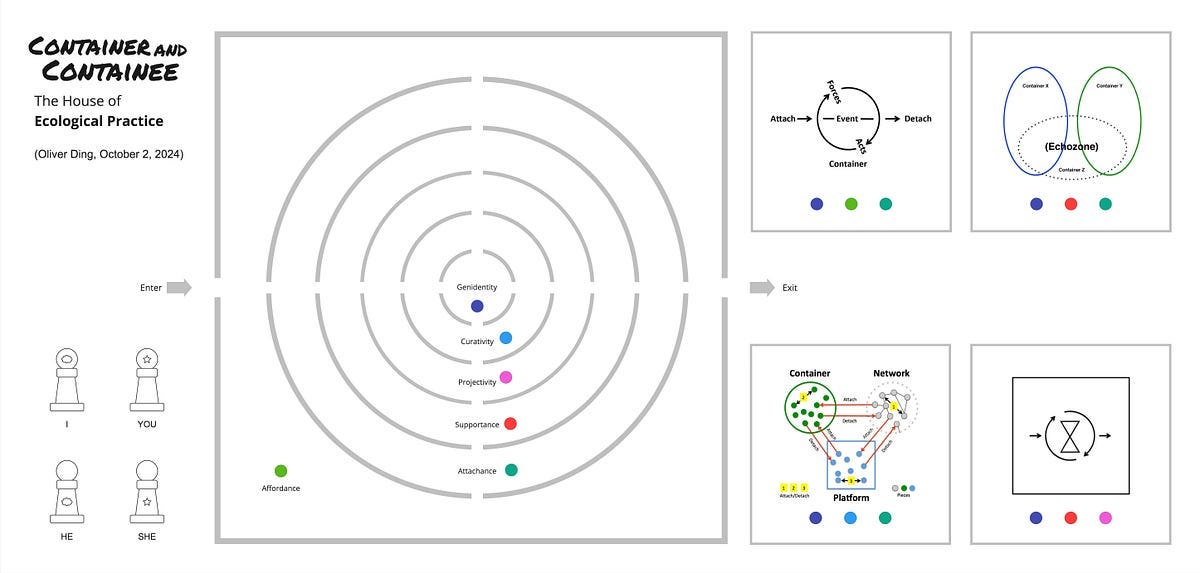
The Ecological Practice approach uses the Container (Containee) structure to represent the organism-environment relationship, visually expressed as a nested structure in the thematic map above.
In this map, four major models are shown on the right side, while six key concepts are listed on the left.
These six concepts include Genidentity and a set of ideas about potential action opportunities, or opportunities:
- Affordance
- Attachance
- Supportance
- Projectivity
- Curativity
More details can be found in Mapping Strategic Moves #15: The House of Ecological Practice.
4.2 Meaning Control System
Over the years, the Ecological Practice Approach has evolved from a simple curated model into a dynamic and multi-layered thematic enterprise. If we borrow the metaphor of a business enterprise, its developmental trajectory can be viewed in terms of several structural changes:
- Multidivisional Expansion
- Spin-offs of Sub-Theories
- Joint Ventures through Cross-Theory Dialogue
In the beginning, the Ecological Practice Approach was a simple model — a curated collection of borrowed concepts from external theoretical resources. Over time, these borrowed concepts were gradually replaced by original theoretical insights, forming the core of an emerging independent theory.
As the theory matured, it began to include multiple core concepts. Some of these grew rich and diverse enough to be managed as independent sub-theories. For instance, Curativity Theory has long operated with considerable autonomy.
It developed its own:
- Knowledge system
- Project activities
- Material representations
As project collaborations expanded, the Ecological Practice Approach increasingly resembled a holding company — one that no longer conducts specific activities itself, but instead functions as a Meaning Control System, overseeing and orchestrating the development of its thematic subsidiaries and partner initiatives.
For the Wonder and Wander Framework, I select the following meta-frameworks to form its Meaning Control System:
- The “World of Activity” Model (see the earlier discussion)
- The Enter — Event — Exit Schema
- The “Aion-Chronos-Kairos” Schema
- The Life Coordinate Framework
4.3 Operating System
The core concepts of the Ecological Practice Approach functioned as a systematic framework for developing the approach itself. For the Wonder and Wander Framework, they work as an operating system for action-centered social ecology.
Let’s revisit these core concepts from the perspective of Theory as Enterprise:
- Affordance refers to the potential action opportunities that environments and material objects offer to individuals, a term coined by ecological psychologist James J. Gibson. In the operating system, this serves as the environmental interface layer, providing the material foundation and environmental conditions for action.
- Supportance describes potential supportive action opportunities offered by social environments and interpersonal relationships. This functions as the social networking layer, providing relational energy and social support infrastructure for collaborative action.
- Attachance focuses on potential action opportunities provided by actual connecting and disconnecting operations. This operates as the execution layer, transforming environmental possibilities and social support into concrete attach/detach actions — the basic binary operations of life and historical events.
- Projectivity pertains to opportunities for forming or participating in projects, allowing individuals to realize their development alongside others. This serves as the application layer, where individual life themes and social-cultural themes converge through concrete project containers.
- Curativity refers to the potential action opportunities of turning pieces into a meaningful whole through curatorial processes. This functions as the strategic construction layer, organizing micro-operations into coherent patterns and structures through meaning control systems.
- Genidentity refers to recognizing a thing’s uniqueness and maintaining its identity across time and change. This operates as the system kernel, ensuring the continuity and consistency of the entire system throughout its historical development.
How do they work together as an operating system?
Affordances and Supportance serve as the power supply, energizing the system with potential and resources. Attachance acts as the processor, executing operations and making connections. Curativity functions as the organizer, structuring these operations into meaningful patterns. Genidentity operates as the memory keeper, preserving continuity across all changes.
Like any operating system: power → processing → organization → persistence. Each feeds into the next in a continuous cycle, creating a self-sustaining computational environment.
This operating system architecture explains how the Ecological Practice Approach can simultaneously support theoretical development and business enterprise development. The key insight is that both theory development and business development follow similar operational logic when understood as thematic enterprises. They both require:
- Environmental and social foundations (Affordance + Supportance)
- Concrete operational mechanisms (Attachance + Projectivity)
- Strategic construction processes (Curativity)
- Identity maintenance across time (Genidentity)
This Operating System works in tandem with the Meaning Control System discussed earlier. While the Meaning Control System manages the semantic coherence and value orientation of the theoretical enterprise, the Operating System provides the technical architecture and methodological tools for theoretical practice. Together, they form the dual-core infrastructure of Theory as Enterprise:
- Meaning Control System: Ensures conceptual consistency and thematic unity
- Operating System: Enables practical implementation and systematic operation
This dual-system approach has been validated through six years of practice in developing the Ecological Practice Approach, demonstrating how abstract theoretical concepts can be systematically transformed into concrete knowledge products, institutional frameworks, and collaborative networks.
4.4 Application Programs
Just as a computer operating system can run different types of applications, this theoretical operating system can “run” various types of programs: scholarly research, business ventures, social practices, and creative projects.
Over the past years, the core concepts of the Ecological Practice Approach have functioned as abstract theoretical concepts and have been used to develop knowledge frameworks for specific domains such as strategy, design, curation, support, and narrative — covering key functions of Center Development.
I often edited book drafts to curate articles that represent creations of the approach. Since these drafts are not published yet, I refer to them as Possible Books. Below is a list of possible books related to the key functions of Center Development:
- Strategy: Advanced Life Strategy (2022), Strategy as Curation (2024), Knowledge Strategy (2025)
- Narrative: Strategic Life Narrative (book, v1, 2025)
- Curation: Curativity (2019), Knowledge Curation (2022), Creative Life Curation (2022), Pieces, Whole, and Curativity (2025)
- Support: Platform for Development (2021)
- Design: Ecological Practice Design (2022)
Each possible book offers specific frameworks, diagrams, and methods. The core concepts of the approach are incorporated into these frameworks and related tools.
These tools have been used throughout my creative journey over the past several years. Even within the Wonder and Wander project, some of these tools were employed. The methodology of the project was based on the Creative Life Curation method. In the case study, The Aion Journey (2021–2025), I also used the House of Creative Life Curation map to conduct a case study on the “Situation” for the “Strategic Developmental Psychology” theme in May 2024.
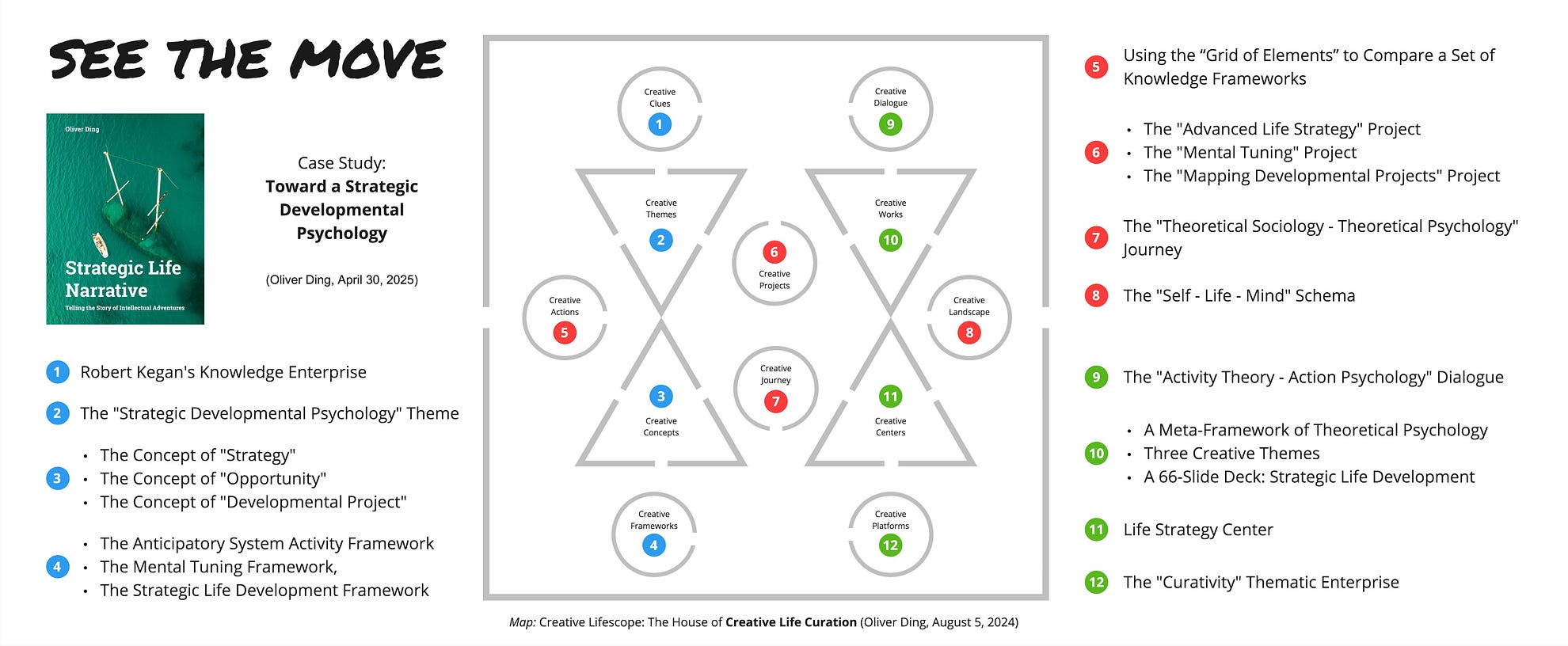
In another case study, The Center Journey (2022–2025, Part A), the same thematic map was used to discuss the “Situation” of the Activity Analysis Center.
4.5 Interactive Interface
Continuing the metaphor of a computer operating system, the final layer is the interactive interface. Within the landscape of the Ecological Practice Approach, this interactive interface corresponds to Thematic Space Theory.
In the case study The “Container Thinking” Journey (2019–2025, Part C), I introduced two diagrams:
- GO Theory (Nov 18, 2024)
- Theorizing Creative Life Model (June 2, 2025)
Both highlight Thematic Space Theory’s central role.
In GO Theory, it functions as a methodological theory, offering the “Map” section with key concepts about Moves and Mapping.

In the Theorizing Creative Life Model, it serves as a psychological theory, offering the “Hermeneutics” aspect of the “Mind” section with concepts such as “Thematic Space,” “Knowledge Framework,” “Mental Models,” and “Mental Moves.”

What is Thematic Space?
In 2022, I developed the concept of “Thematic Space”, which marked a new stage in my ideas on themes and concepts.
Thematic Space refers to a broad cognitive space surrounding a particular theme for a specific individual. It distinguishes between:
- Theme: Emphasizes subjective experience and understanding.
- Concept: Pertains more to the objective meaning and definition.
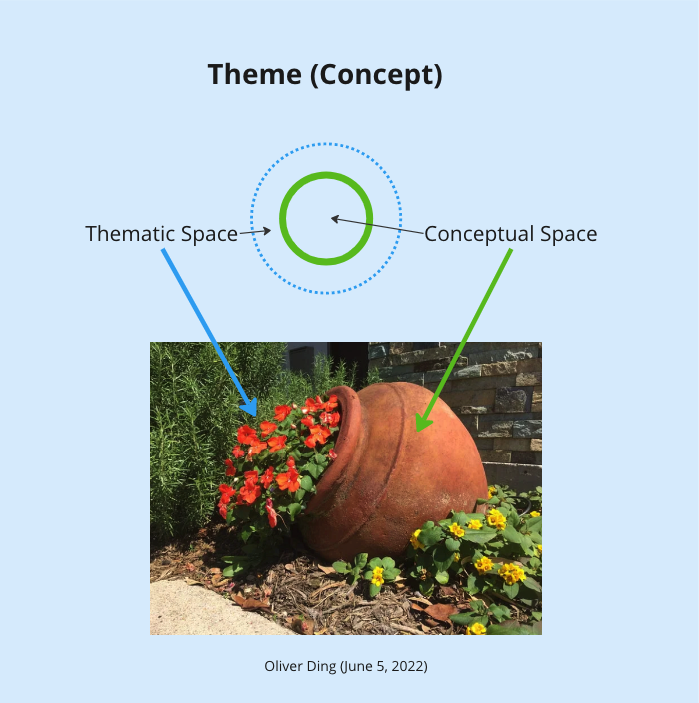
Beyond semantic relationships between themes, Thematic Space Theory incorporates genetic relationships — tracing the historical development of themes through real projects and practices. This dual aspect defines the Theme (Concept) Ontology, the functional foundation of Thematic Space Theory.
Building on this, the THEORY (PRACTICE) Realism views Concept Development as a social practice embedded in a Theory, Practice, End, Means structure (see the canvas below).
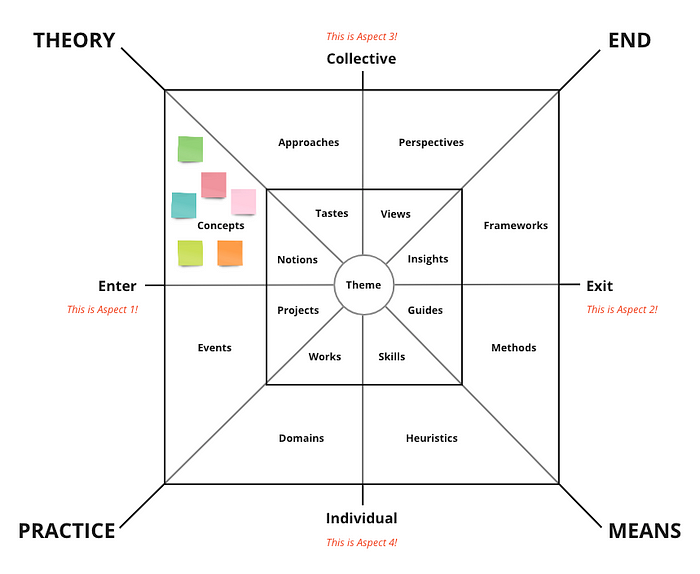
This structure was applied to design the Knowledge Discovery Canvas and, more recently, the book draft Castle and Forest: The House of Knowledge Discovery.
This structure defines four distinct thematic areas and a set of thematic zones, offering a map for understanding how a theme transforms into a concept within various social contexts.
Together, the “Theme (Concept)” Ontology and the “THEORY(PRACTICE)” Realism lay the foundation for Hermeneutics through a “Model (Map)” framework:
- Map: Objective aspects of social landscapes.
- Model: Diverse knowledge frameworks and perspectives adopted by actors.
Thematic Space Theory combines the Ecological Formism approach and the Creative Diagramming method, on one hand, discovering objective aspects of social landscapes and representing them as Maps; on the other hand, turning knowledge frameworks into visual diagrams to facilitate learning and sensemaking.
To operationalize Thematic Space Theory, I developed four models tailored for different actors:
- General Actors: Strategic Thematic Exploration Framework
- Professionals: Evolving Knowledge Enterprise Model
- Empirical Researchers: The Concept Dynamics Framework
- Theorists: Multiple Perspectives Framework
In Castle and Forest: The Landscape of Concept-related Knowledge Engagement (book, v2.0, 2025), I discovered 12 strategic themes across these actor types.
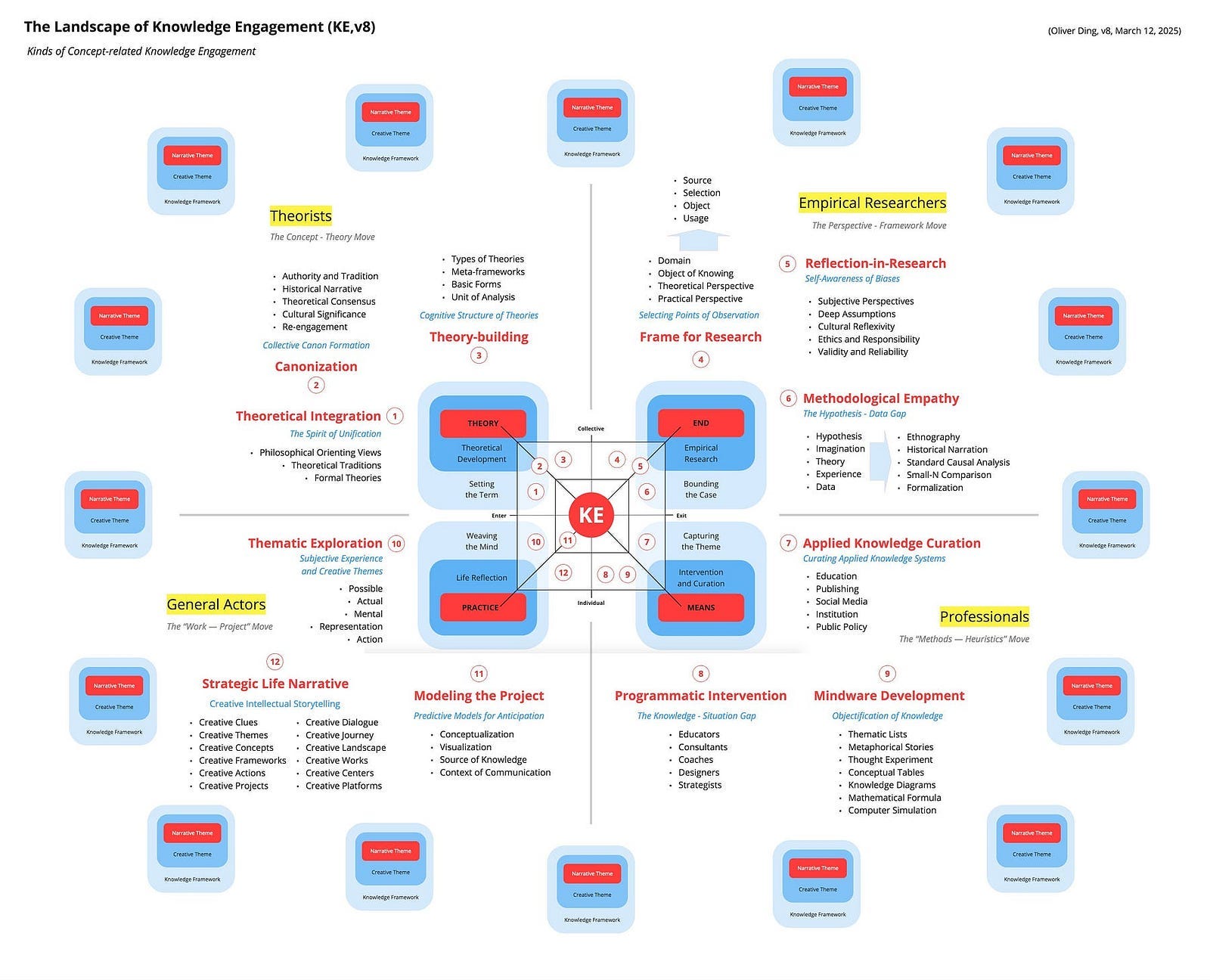
Thus, Thematic Space Theory functions as an interactive interface of Theory as Enterprise, providing dynamic tools and maps to navigate creative and cognitive landscapes.
For the Wonder and Wander Framework, I also highlighted the following maps:
- The Evolving Knowledge Enterprise Model
- The Mindware Development Canvas
- The Knowledge Strategy Toolkit (v2.1)
- The Knowledge Discovery Canvas (The “Theory-Practice-End-Means” Schema)
Part 5: The Knowledge Strategy Perspective
As mentioned above, the Wonder and Wander project was planned as the final installment in the Knowledge Strategy trilogy.
- Knowledge Strategy: The Ecological Strategic Cognition Framework (v2.2) for Building Knowledge Enterprises — Introduces v1.0 of the Knowledge Strategy Toolkit, integrating various knowledge frameworks and models.
- Castle and Forest: The Landscape of Concept-related Knowledge Engagement (book, v2.0, 2025) — serves as a follow-up to my 2022 book draft, Knowledge Discovery. While it still focuses on the Knowledge Discovery Canvas and related tools, the primary theme shifts from tacit knowledge to the broader knowledge ecosystem.
- Wonder and Wander: Revealing The Evolving Knowledge Enterprise — A possible book exploring the Evolving Knowledge Enterprise model, capturing the dynamic and adaptive nature of knowledge-driven enterprises.
In the case study, The “Container Thinking” Journey (2019–2025), I took a Knowledge Strategy perspective to examine the historical trajectory of the approach. Some insights are introduced in Part B and Part C of the research report.
In this section, I will introduce these insights. In addition, I will highlight the Self-referential Strategy for further exploration.
5.1 The Knowledge Strategy Toolkit (v2.1)
In Knowledge Strategy: The Ecological Strategic Cognition Framework (v2.2) for Building Knowledge Enterprises, I introduced version 1.0 of the Knowledge Strategy Toolkit on January 31, 2025.
Later, I continued working on improving both the Ecological Strategic Cognition framework and the Knowledge Strategy Toolkit.
On March 6, 2025, I developed version 2.1 of the Knowledge Strategy Toolkit. See the diagram below. More details can be found in [Frame for Work] The Knowledge Strategy Toolkit (v2.1).
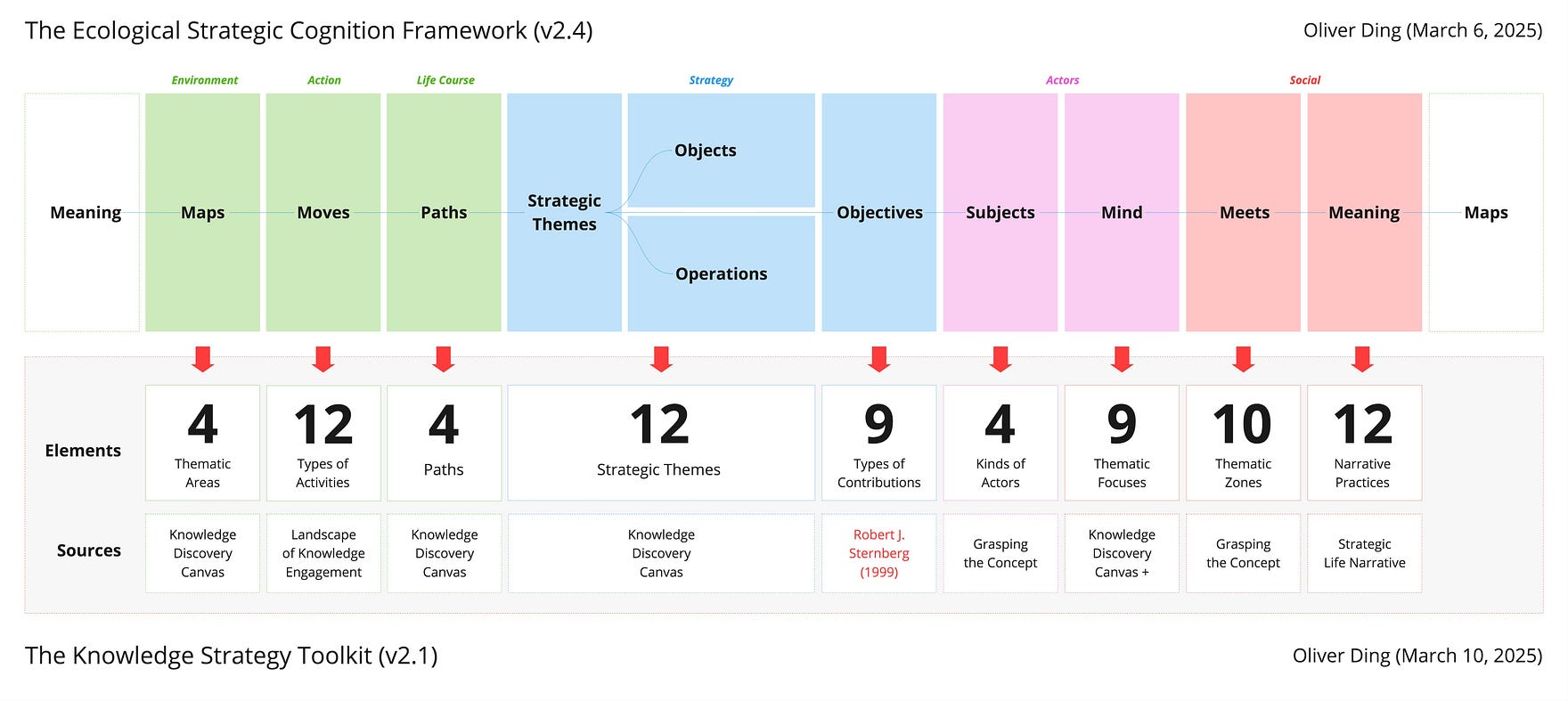
In the diagram above, the top section represents the Ecological Strategic Cognition framework (v2.4), while the bottom section represents the Knowledge Strategy Toolkit (v2.1).
It is worth noting that version 2.1 focuses on the Knowledge Discovery Canvas and related ideas.
However, the Wonder and Wander project was designed to center around the Evolving Knowledge Enterprise Model.
What is the difference between these two? And what is their connection?
The Knowledge Discovery Canvas and related ideas address the social landscape of a thematic enterprise, while the Landscape of Evolving Knowledge Enterprise model focuses on its internal structure and developmental journey.
Taken together, these distinctions reveal a deeper structure underlying the Knowledge Strategy trilogy:
- The first book introduces the Ecological Strategic Cognition approach and sets the strategic foundation.
- The second book focuses on the external dynamics of the social ecology surrounding a thematic enterprise.
- The third book explores the internal complexity of managing a creative center as the core activity of a thematic enterprise.
5.2 A Three-Level General Strategy for “Theory as Enterprise”
While the Knowledge Strategy trilogy offers systematic insights for knowledge workers, the Wonder and Wander project focuses on a specific form of knowledge engagement: Theory as Enterprise.
All case studies included in the Wonder and Wander project revolve around the development of a theoretical approach as a thematic enterprise. This makes the project not only a narrative of conceptual evolution but also a living laboratory for testing and refining strategies for theoretical innovation.
In the case study The “Container Thinking” Journey (2019–2025, Part B), I developed a three-level general strategy for “Theory as Enterprise” as a specific framework.
- Meta-framework: The “Enter — Event — Exit” Schema
- Predictive Model: The “HERO U” Framework
- Situational Model: The “Container Thinking” Strategic Themes
In 2020, I made a framework called HERO U for knowledge creators.In a recent article, I connected the HERO U framework with the Life Curation Framework. See the diagram below. More details can be found in [Frame for Work] The “Enter — Event — Exit” Schema.

After reflecting on the “Container Thinking” journey, I identified several strategic themes that constitute a general strategy. These themes are categorized using the Enter — Event — Exit Schema:
- Starting with a Genidentity (Enter)
- Ontological Invention (Event)
- Framework-first Development (Event)
- Grounding through Case Studies (Event)
- Objectification-Driven Subjectification (Exit)
- Dialogical Expansion (Exit)
More details can be found in The “Container Thinking” Journey (2019–2025, Part B).
Follow the general strategy, I also highlight several specific strategic actions, particularly those taken during the early stage. The diagram below represents five strategic moves I made from 2019 to 2021.

- Move #1: Turning a By-Product into a Strategic Object
- Move #2: Self-referential Strategy for Platform Orientation
- Move #3: Activity Theory as Role Model
- Move #4: Meta-knowledge as Strategic Object
- Move #5: The Theory—Practice Gap as Opportunity
More details can be found in The “Container Thinking” Journey (2019–2025, Part C).
5.3 Self-referential Strategy
During the case studies, I identified a significant strategic theme: the Self-Referential Strategy.
In the early development of the Ecological Practice Approach, Move #2 — titled Self-referential Strategy for Platform Orientation — highlighted the power of the Self-referential Strategy in my decision-making process.
Move #2 refers to the Strategic Move #2: shifting from Curativity Theory to the Knowledge Curation Project in June 2020.
Curativity Theory was born in 2019. Later, I faced a challenge of applying it to a particular field. If we see a theory as a Platform, then this challenge refers to Platform Orientation.
Chapter 7 of the book draft is titled Curativity Analysis. I chose four fields to test my theoretical concepts and frameworks: Toy Design, Clothing Customization, Family Curation, and Knowledge Curation. These four cases can be considered as the prototype of Curativity Analysis.
In 2020, I needed to decide on a new strategy for CALL (Creative Action Learning Lab). I chose Knowledge Curation as the primary application of Curativity Theory and started the Knowledge Curation Project.
An interesting thing was that one of the applications of Curativity theory was Knowledge Curation, which can be used to guide the development of Curativity theory. Thus, I roughly made a theoretical self-reference.
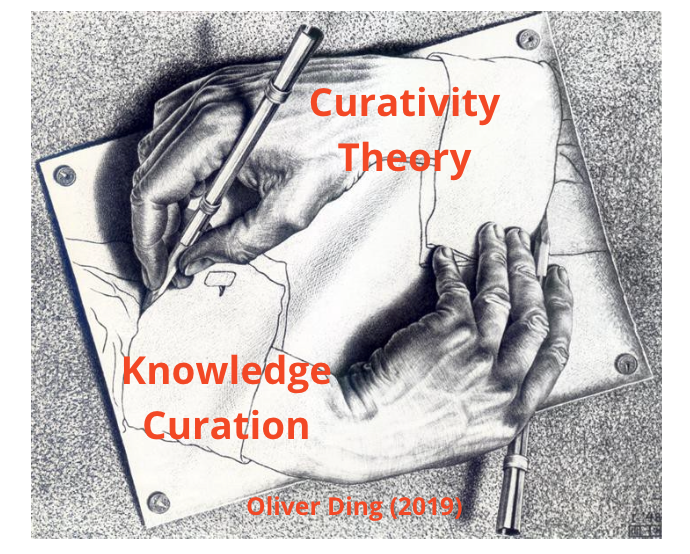
However, it depends on how we define the boundary of the “self” within Self-referential Activity. From the perspective of Curativity theory, it is too naive to claim that the pieces and parts are determined by the whole. In fact, Curativity theory embraces the dialectical hierarchy of the pieces-whole relationship. For example, as an application of Curativity theory, Knowledge Curation is a piece while the whole is the Curativity theory. The outcome of Knowledge Curation can be returned to guide the development of Curativity theory.
In the case study The “Container Thinking” Journey (2019–2025, Part D), I found that the Self-referential Strategy was applied throughout the whole journey. As discussed earlier, the core concepts of the Ecological Practice Approach were used to guide the development of the approach itself.
This case illustrates how the approach functions not only as a theoretical model but also as a systematic framework for developing both a theory and a thematic enterprise. It demonstrates the potential of self-referential strategies to drive recursive learning, adaptive refinement, and creative evolution in long-term theoretical work.
5.4 The Self-referential Activity of “Theory as Enterprise”
In November 2024, I created the thematic map below for the Strategic Life Narrative project.
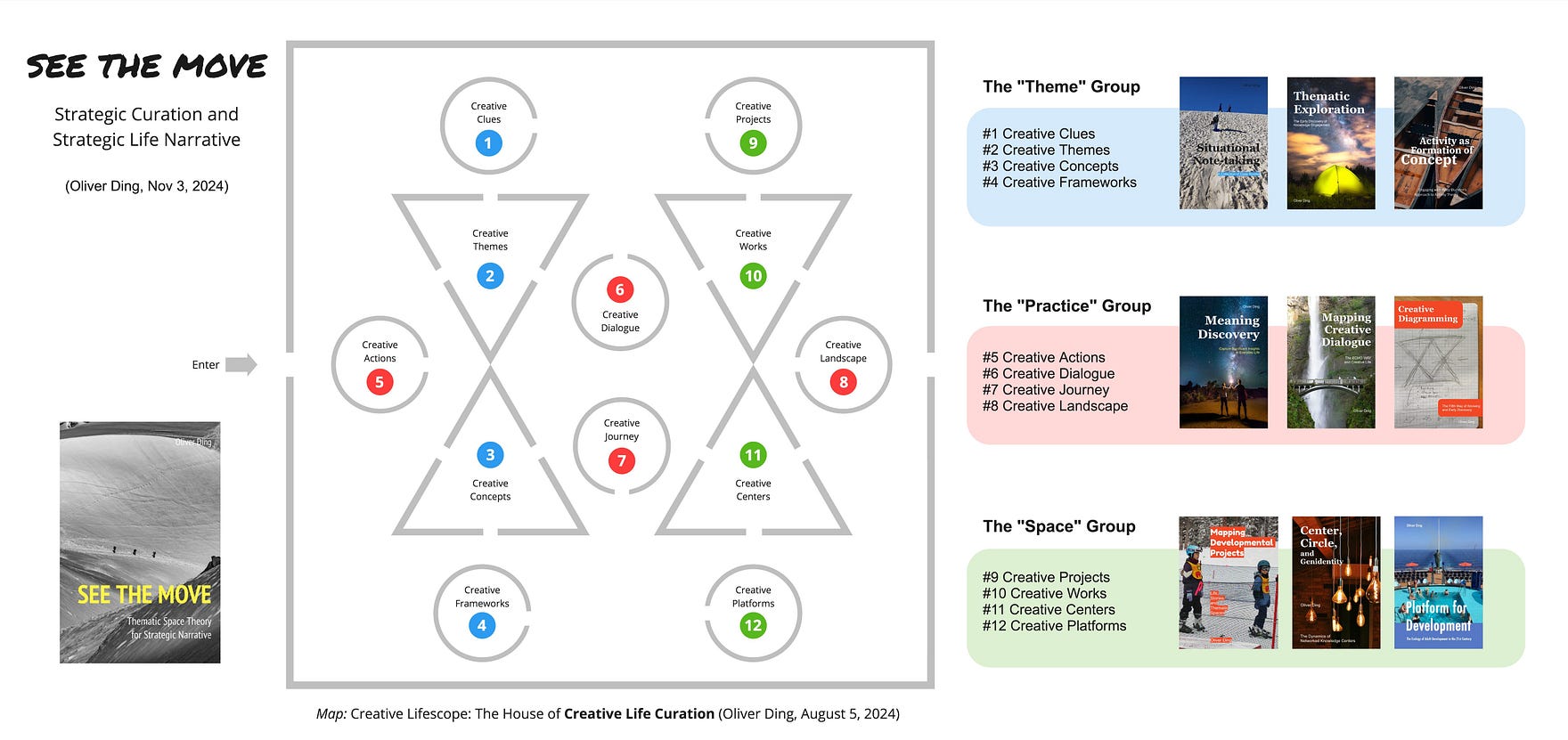
The map represents 12 types of strategic life practices. To support these practices, I employ the Self-referential Activity model. Inspired by Activity Theory and Self-referential systems theory, this model describes a specific type of activity that fosters self-referential development.
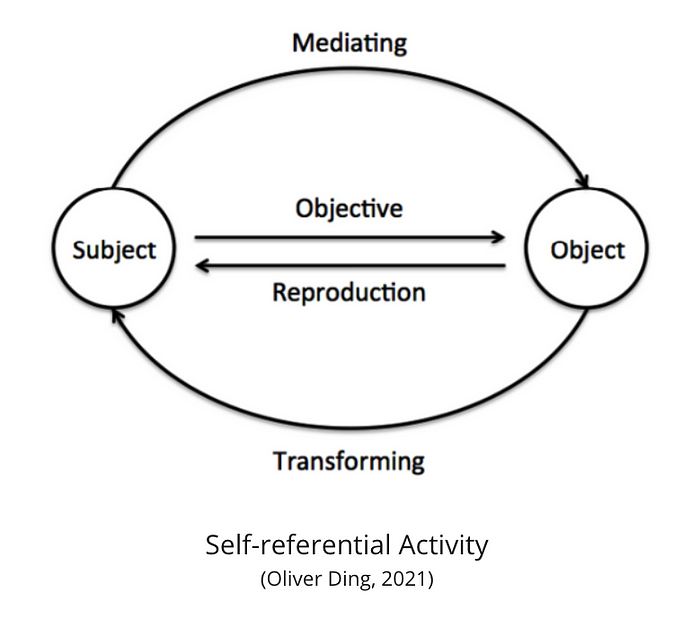
Let’s use the #4 Strategic Life Narrative Practice as an example. Its primary object is Creative Frameworks, which are about Concept Systems.
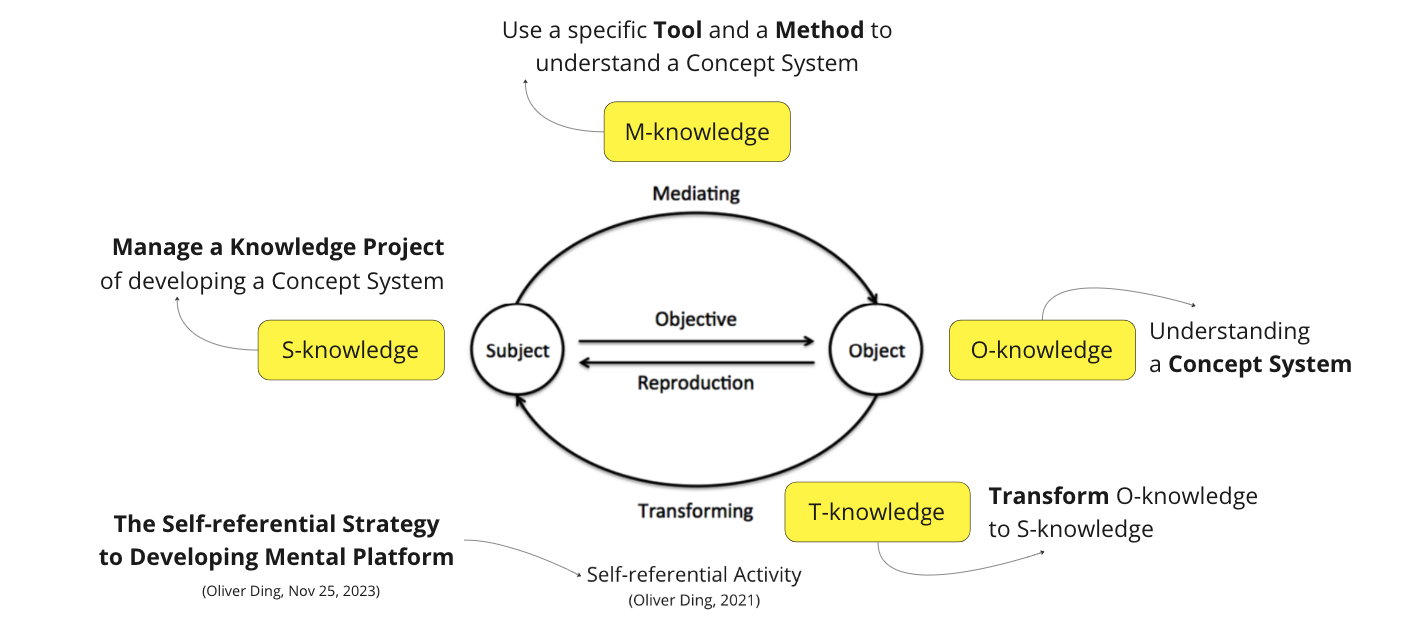
The model presented here is termed “Self-referential Strategy for Developing a Concept System.” Setting aside terms like “mental platform,” let’s concentrate on the essence of Concept Systems.
The model identifies four types of personal knowledge essential to building a Concept System.
- S-knowledge
- O-knowledge
- M-knowledge
- T-knowledge
S-knowledge refers to knowledge for self-awareness, self-improvement, self-regulation, and strategies for life discovery and management. In this context, it refers to Managing a Knowledge Project of Developing A Concept System.
O-knowledge refers to knowledge about the object of the work. For example, if the work is building a house, the O-knowledge is about how to build the house. In this discussion, O-knowledge refers to understanding a Concept System.
M-knowledge refers to knowledge about using tools and methods. For example, the skills of using some tools to build the house. For the present discussion, it means using a specific tool and a method to understand a concept system.
T-knowledge refers to knowledge about transforming O-knowledge to S-knowledge.
This model is relevant for the “Theory as Enterprise” practice. More details can be found in Self-referential Strategy for Developing Mental Platform and The Strategic Life Narrative Practice #0 (Introduction).
Part 6: The “Wonder and Wander” Experience
The phrase “Wonder and Wander” was originally chosen as a creative theme to inspire and motivate a new project. However, as the project unfolded, the phrase gradually evolved into a creative concept, gaining new layers of meaning through lived experience.
Today, Wonder and Wander has become an operational concept — a term that describes the subjective emotional experience of creators as they navigate uncertainty, curiosity, and growth.
In this part, I share three key inspirations that have emerged through this theme.
6.1 The “HERO’s Journey” Metaphor
On March 1, 2025, I wrote a short post about the Wonder and Wander project. Unlike most of my previous posts, which typically introduced structured ideas or project outcomes, this one focused on a metaphor — a metaphor meant to express the emotional dimension of my creative experience.
This metaphor has roots in a visual symbol I created in June 2020 when I launched the HERO U project. See the image below.
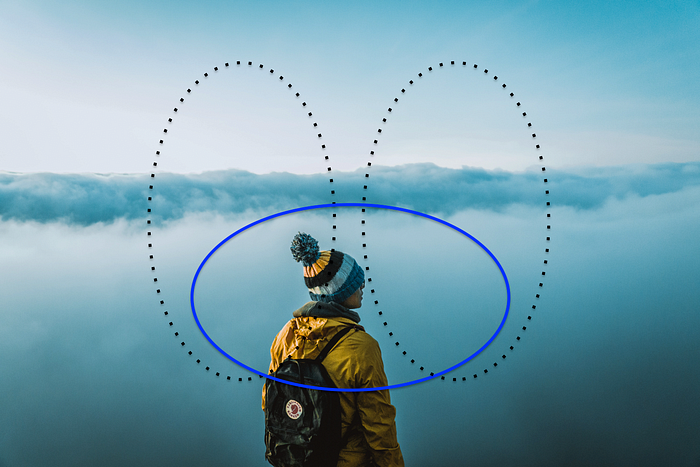
Knowing is hard. Achieving significant outcomes from knowing is even more challenging. It’s like climbing a mountain — once you reach the summit, the world unfolds from an entirely new perspective.
This project introduced the concept of Knowledge Heroes and provided them with a framework to bridge the gap between Theory and Practice.
This marked the beginning of a five-year creative journey:
From 2020 to 2022, it was called Knowledge Curation.
From 2022 to 2023, it was called Knowledge Engagement.
From 2023 to 2024, it was called Knowledge Enterprise.
This journey feels like that of an explorer on a long trek, crossing mountains and rivers to uncover the true face of a mysterious snow mountain. Now, the explorer has reached the journey’s end, standing at the foot of the mountain. What was once a blurry imagining now unfolds before him with striking clarity.
To reveal the truth — this is the mission driving the creative journey.
I hadn’t planned to use this metaphor to describe the journey. However, it naturally emerged in the cover images I selected for a set of Possible Books.
- Departure: Campfire and Campsite
- Midway: Mountain Streams and Waterfalls
- Expedition: Snowfields and Trekking
These cover images represent a series of themes that narrate the complexity of my creative journey emotionally. See them here.
6.2 Wonder in the Aion Space, Wander in the Chronos Space
In the case study The Aion Journey (2021–2025), I developed the concepts of Aion Space and Chronos Space to discuss Time Curation. While writing this article, I found a creative echo between the “Wonder and Wander” theme and the “Chronos and Aion” theme:
- Wonder in the Aion Space
- Wander in the Chronos Space
This creative echo reveals two distinct types of immediate experience within time curation and enterprise curation. While not a direct conceptual translation, this pairing offers a creative echo: Wonder resonates with the generative temporality of Aion, while Wander reflects the sequential movement within Chronos.
In the Chronos Space, our mental focus is framed by sequential actions and chronological demands; we are wandering within a limited linear space shaped by present challenges and anticipated pathways. This wandering reflects a grounded mode of movement — tied to steps, stages, and the physical constraints of time and task.
In contrast, in the Aion Space, our mental focus opens up to explore, discover, and move fluidly between Possible Journeys, Actual Journeys, Imagined Journeys, and diverse Landscapes. We wonder within a generative space that curates the Past, the Present, and the Future together. This wondering invites a freer mode of mental movement — unbound by physical limits, expanding through imagination, insight, and creative possibility.
In the Chronos Space, wander sharpens the focus — it is a flash of insight under pressure. In the Aion Space, to wonder is not to be lost, but to be transformed.
In the case study, The Center Journey (2022–2025, Part A), the “Chronos and Aion” theme was used to discuss Space Curation. Later, I added Kairos Space to expand the original idea.
More details can be found in The “Aion-Chronos-Kairos” Schema.
6.3 The Moment of Recognition: When Theory Reveals Itself
Over the past years, I worked on the “Container Thinking” Journey, which focuses on developing the Ecological Practice Approach. Other creative journeys have similar objectives, developing a particular theoretical approach into a knowledge system. However, the “Evolving Knowledge Enterprise” journey is unique, not following this rule.
Why is this the only journey without a theoretical core?
At the end of the journey, the last moment of writing the end of the last case study The “Container Thinking” Journey (2019–2025, Part D), I found the missing piece of the “Evolving Knowledge Enterprise” journey!
That trajectory wasn’t lacking a theory — it WAS the theory! The whole path from Knowledge Curation → Engagement → Enterprise was not a detour. It was me developing and practicing what I now call “Theory as Enterprise.”
Suddenly, everything made sense. Of course, it looked like “just tools” — because Theory as Enterprise is fundamentally about how we do theory, not what any specific theory says about the world. It’s a meta-theory: a theory about theory-making itself. No wonder it felt different from my other work!
The best part? I realized I’d been living and breathing Theory as Enterprise for years without naming it. Every time I felt that “water flowing naturally” sensation in my research, every time tools and cases seemed to generate each other simultaneously — that was Theory as Enterprise in action.
It’s funny how the most important discoveries can be right under your nose. I’d been the perfect case study for my own theory all along, and only now did I see it. The theory revealed itself through practice, which is exactly what Theory as Enterprise is all about.
Wonder! Wander! What a wild ride!
v1 - 9,839 words - 40 min read