
[World of Activity] The Living Coordinate Model (2026)
![[World of Activity] The Living Coordinate Model (2026)](https://images.unsplash.com/photo-1517960413843-0aee8e2b3285?crop=entropy&cs=tinysrgb&fit=max&fm=jpg&ixid=M3wxMTc3M3wwfDF8c2VhcmNofDF8fGxpZmV8ZW58MHx8fHwxNzY5MDE2MTY2fDA&ixlib=rb-4.1.0&q=80&w=960)
by Oliver Ding
This article introduces a model for the Life Coordinate Framework, a sub-framework of the World of Activity Toolkit.
A personal Life Coordinate is a conceptual framework that maps an individual’s orientation within the world of activity, integrating both worldview and life orientation. This article introduces an intermediate framework that connects a meta-framework with a situational model, forming a hierarchical model of the Life Coordinate.
On January 2, 2026, I released a thematic brief on the “Lake 42” theme on Possible Press.

The “Lake 42” theme represents a new possible project. It narrates the story behind a six-year creative journey of producing more than 42 possible books, while also documenting the unfolding of a Cenerative Confluence journey from June to December 2025.
Unlike traditional confluence in geography, where streams merge and lose their individual identities, the term “Generative Confluence” is used in Creative Life Theory with a new meaning.
It describes a pattern where ideas inspired by distinct theoretical approaches evolve from separate into interconnected, generating a new center for a brand-new possible theoretical enterprise. As the new one emerges, the original theoretical approaches still keep their developmental trajectories.
The Generative Confluence pattern goes beyond the Creative Dialogue pattern, where some new ideas are born from dialogue between two theoretical approaches.
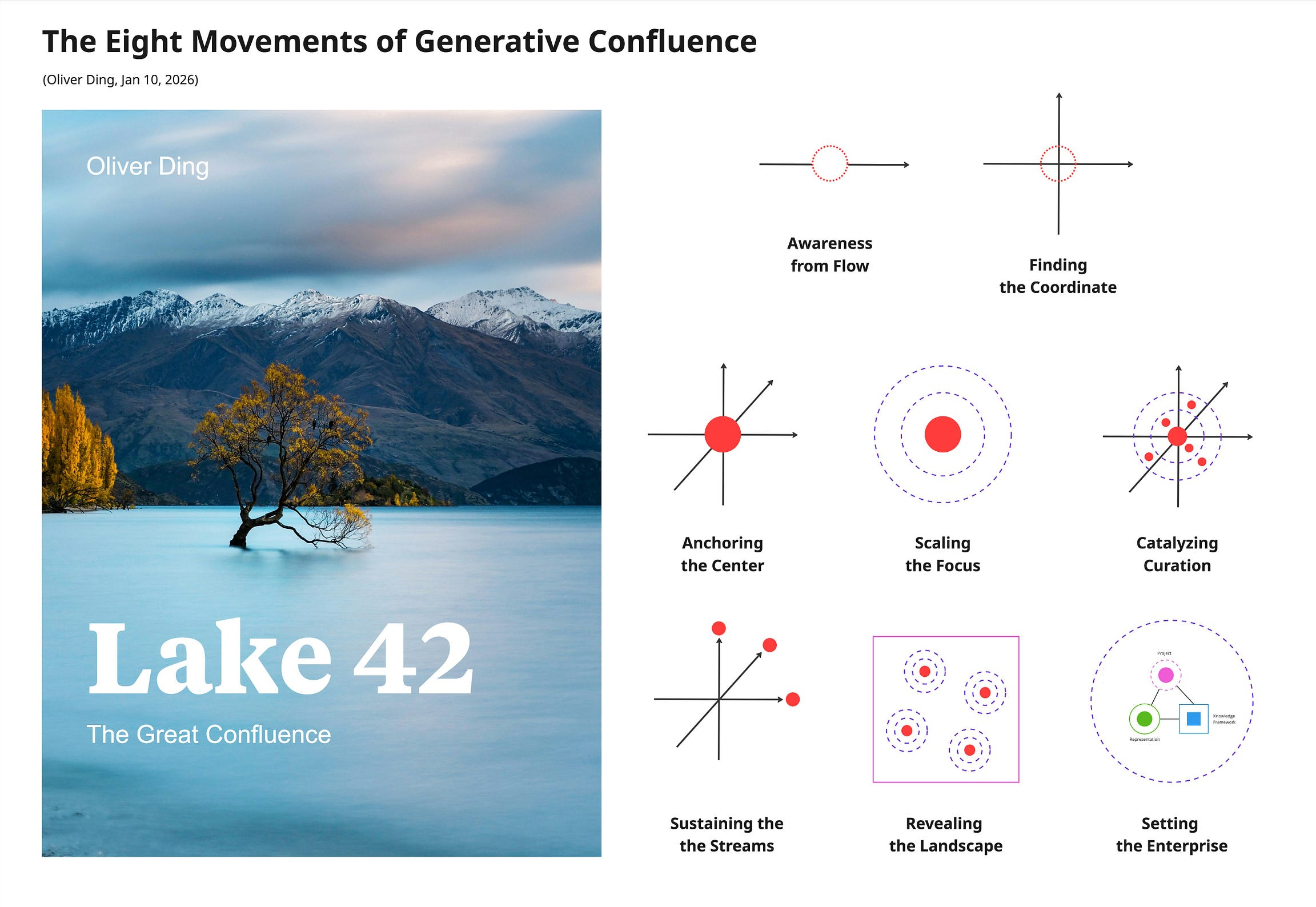
The diagram above highlights eight movements in my Generative Confluence journey.
While working on the Lake 42 project, the primary challenge has been to develop a general model of the “Generative Confluence” pattern and incorporate it into my existing knowledge system.
This article addresses this challenge by developing an intermediate framework, called the Living Coordinate Model, to connect the Theorizing Creative Life Landscape diagram (a situational model) with the Life Coordinate Framework (a meta-framework), forming a hierarchy of models:
- Meta-framework: Life Coordinate Framework
- Framework: Living Coordinate Model
- Situational Model: Theorizing Creative Life Landscape
This model will be the significant outcome of the Lake 42 project.
A Situational Model
On June 2, 2025, I used the Self-Life-Mind schema as a meta-framework to reflect on my creative journey (2014–2025), focusing on three lines of exploration, each grounded in a theoretical approach.
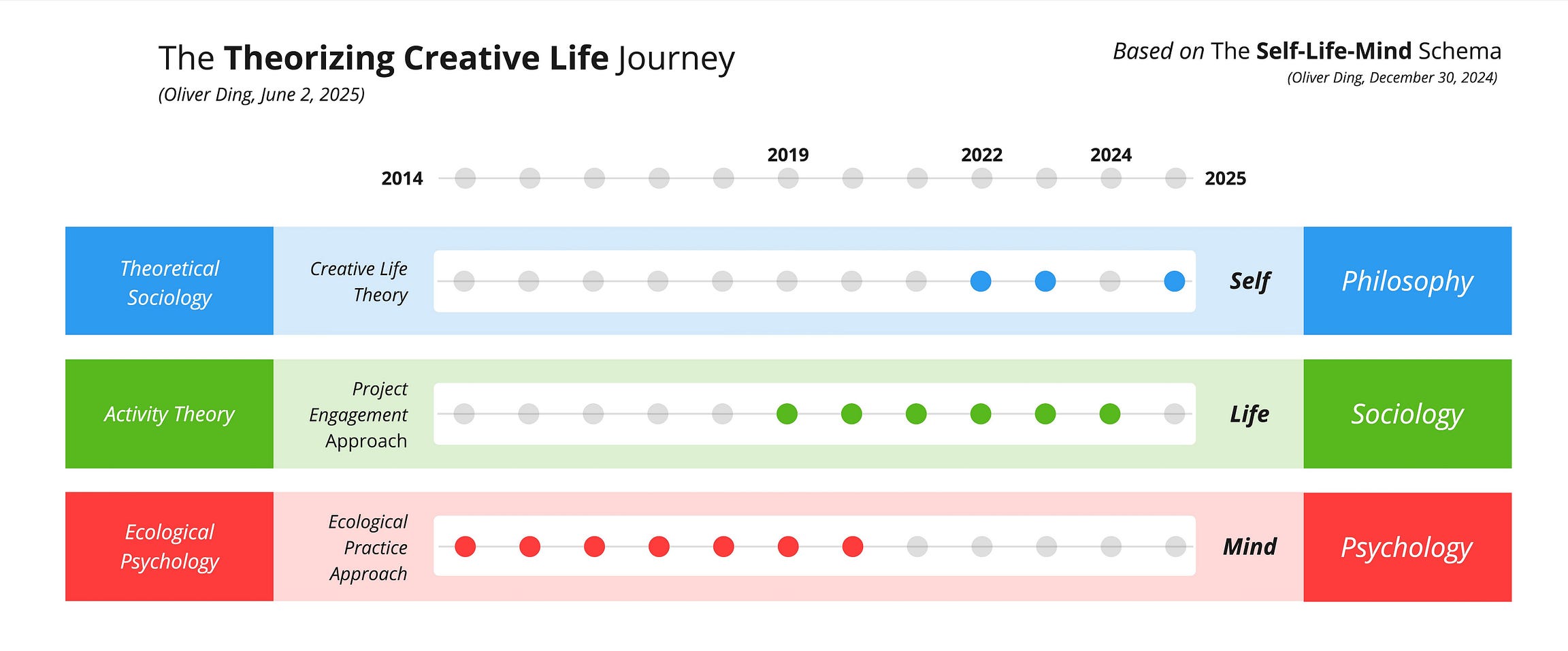
What is the major trend in this trajectory?
It represents a three-phase exploration, centered on three disciplines at each phase. Rather than being strictly sequential, these three phases reflect shifting but overlapping centers of theoretical focus.
- Early phase (2014–2020): Psychology, especially Ecological Psychology.
- Middle phase (2019–2024): Sociology, especially activity-based social practice theories.
- Late phase (2022, 2023, 2025): Philosophy, especially self and subjectivity.
The diagram only highlights my mental focus on exploring a new discipline at different periods. It does not represent my actions and projects. For example, I actively worked on the Ecological Practice Approach from 2021 to 2025.
If we use the Creative Thematic Curation Framework as a meta-framework, this three-phase journey can be seen as a different story:
- First-wave: Focusing on one approach, the Ecological Practice Approach.
- Second-wave: Engaging with multiple approaches — three in total.
- Third-wave: Moving to a large creative dialogue between Western Philosophy and Eastern Philosophy.
On the same day, based on the diagram above, I used a coordinate diagram to represent this landscape. See the diagram titled “Theorizing Creative Life Landscape” below.

Suddenly, I was shocked by the pattern within the diagram. The new landscape represents a 3+1 structure, revealing a new pattern I didn’t notice in my creative journey.
Over the past several years, I have drawn on three theoretical traditions as resources to develop three theoretical approaches. While I maintained boundaries between these approaches, across time, I applied them to study how a person achieves a creative life, resulting in different perspectives and knowledge frameworks.
My engagement with these traditions is neither a matter of inheritance nor linear expansion. Instead, I treat each as a creative resource — a reservoir of concepts, metaphors, and structural tensions that can be activated in context-specific knowledge work. This dialogical strategy is at the core of Creative Life Theory and is elaborated in one of my book drafts, Mapping Creative Dialogue.
Although I even did several creative dialogues to make new knowledge frameworks, I never thought about integrating them into one.
However, the “Theorizing Creative Life” landscape presents a new pattern to me. At some point, a set of related ideas has already been curated as a new, meaningful whole. It emerged as a new approach, not replacing any of the old approaches.
The three approaches could still be developed by following their original trajectory. The new one starts at a coordinate origin, defining a position of a new center, with the potential to grow into a new theoretical enterprise.
Inspired by geography, I named this pattern Generative Confluence.
Unlike traditional confluence in geography, where streams merge and lose their individual identities, the term “Generative Confluence” is used in Creative Life Theory with a new meaning.
It describes a pattern where ideas inspired by distinct theoretical approaches evolve from separate into interconnected, generating a new center for a brand-new possible theoretical enterprise. As the new one emerges, the original theoretical approaches still keep their developmental trajectories.
The Generative Confluence pattern goes beyond the Creative Dialogue pattern, where some new ideas are born from dialogue between two theoretical approaches.
Unpack the Diagram Blending
The “Theorizing Creative Life Landscape” diagram is the outcome of a Diagram Blending process. Let’s unpack it. The diagram has two parts:
- Left: a coordinate with three Circles
- Right: three levels
The three circles visually represent the three levels. In this way, I incorporate a new component into the traditional coordinate diagram. The coordinate plus three circles offers a simple diagram to represent the “Generative Confluence” pattern.
Later, on June 11, 2025, I developed a new diagram to unpack the three-circle component. The outcome is the Center Development Toolkit. See the diagram below.

From March to June 2025, I worked on the Wonder and Wander project, an ongoing reflection on my creative journey from March 2019 to March 2025. I selected eight themes and conducted eight case studies of Creative Journeys. For each journey, I reviewed the series of projects within it, explored relevant themes, and discovered deep patterns and models.
After closing the project, I discovered several creative themes related to the “Center Development” theme, located at three different levels:
- Ontology: Self as Center, Creative Life, and Theory as Enterprise
- Realism: Knowledge Center, Key Functions, and Operational Themes
- Hermeneutics: Maps, Mental Models, and Mindwave Development
These three levels form the first component of the “Theory as Enterprise” theoretical framework, visualized on the right side of the diagram. This component includes a three-layer map that illustrates the inner structure of an evolving enterprise — within which the Evolving Knowledge Enterprise is embedded as a distinct layer.
Thus, the Generative Confluence model refers to a network of diagrams.
- The coordinate part connects to the “Theorizing Creative Life Journey” diagram, focusing on three creative resources
- The three-circle part connects to the “Center Development Toolkit” diagram, focusing on the new creative center
This is not a traditional coordinate diagram.
More details can be found in [GAP Project] The “Theorizing Creative Life” Project.
A Meta-Framework
While working on the Lake 42 project, the primary challenge has been to develop a general model of the “Generative Confluence” pattern and incorporate it into my existing knowledge system.
After reframing the Generative Confluence journey into eight movements, I found that the “Generative Confluence” pattern represents two key movements:
- Finding the Coordinate
- Anchoring the Center
Finding the Coordinate refers to searching for a meta-framework to serve as a Life Coordinate for a person to answer the questions “Where am I?” and “Where should I be?”
Anchoring the Center refers to searching for a meta-framework to support a potential focus in transforming into a creative center by curating relevant creative elements together.
Both movements require searching for a meta-framework, understood as a conceptual system, yet the meta-framework serves different purposes in each case. The process of searching can lead to encountering, resonating with, echoing, applying, inspiring, modifying, curating, rejecting, critiquing, remixing, and creating, among others. These various activities of engaging with conceptual systems are sources of diverse forms of human life and cultural innovation.
This insight inspired me to revisit the Life Coordinate Framework I developed in 2023. See the diagram below.

The Life Coordinate Framework aimed to offer a meta-framework to represent the Horizontal Tendency and the Vertical Tendency of human activity and experience.
The Life Coordinate Framework was originally part of the Lifesystem framework, an intermediate framework of the Ecological Practice approach. In 2023, I revisited the Lifesystem Framework (v1.0) and expanded its “Life Coordinate” part by adopting the Attach — Container — Detach Flow and the Subject — Potential — Object Focus.
- Horizontal Tendency: the Attach — Container — Detach Flow
- Vertical Tendency: the Subject — Potential — Object Focus
This model is my own Life Coordinate. In simple terms, the Attach–Container–Detach Flow refers to my worldview, while the Subject–Potential–Object Focus refers to my principle of life orientation and life purpose.
At the practical level, it further links to the Developmental Project Model. See the diagram below.
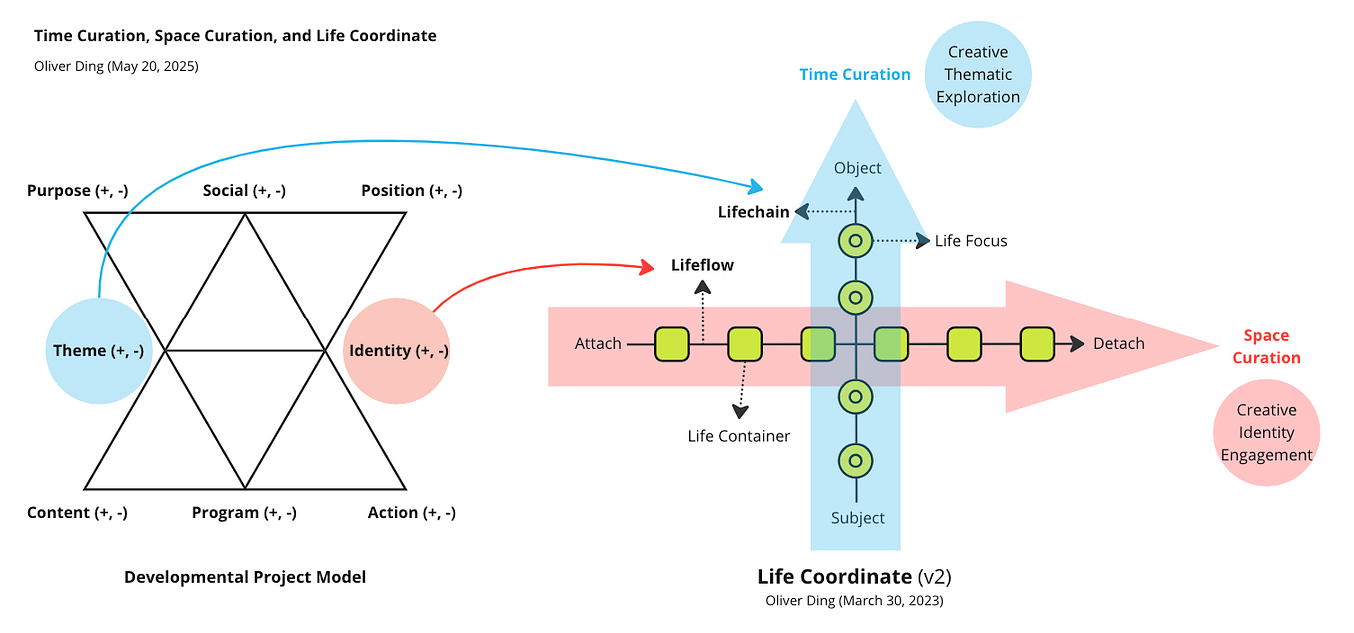
This connection highlights two meta-curation processes in creative life development:
- Time Curation: Creative Thematic Exploration within the LifeChain
- Space Curation: Creative Identity Engagement within the Lifeflow
In Curativity Theory, curation refers to the act of turning pieces into a meaningful whole. Time Curation extends this logic to temporality itself: it is the intentional practice of collecting, organizing, and composing one’s lived, remembered, and anticipated temporal experiences into coherent, strategic, and meaningful constructs. It transforms time from a neutral flow into a curatable material — something to be shaped for orientation, narrative, and action.
Space Curation concerns boundary-related experience, such as identity development. Within the Life Coordinate Framework, we focus on the dynamic evolution of both individual actors’ identities — through attaching to and detaching from life containers (such as projects) within the lifeflow — and things’ identities (such as the project itself) within the lifechain.
The meta-framework behind the model is the World of Activity Approach, which I introduced in May 2025. While the Flow-Focus-Center-Circle schema is its primary model, the Life Coordinate Framework, the Creative Thematic Exploration framework, and the Creative Identity Engagement framework are all part of the approach’s toolkit.
More details can be found in The Life Coordinate Framework (v2, 2023).
An Intermediate Framework
If we put the Life Coordinate Framework and the “Theorizing Creative Life Landscape” diagram together, we find a potential connection, as one is a meta-framework and the other is a situational model.
On January 9, 2026, I developed a new diagram to represent an intermediate framework that bridges these two. The new framework is titled the Living Coordinate Model.
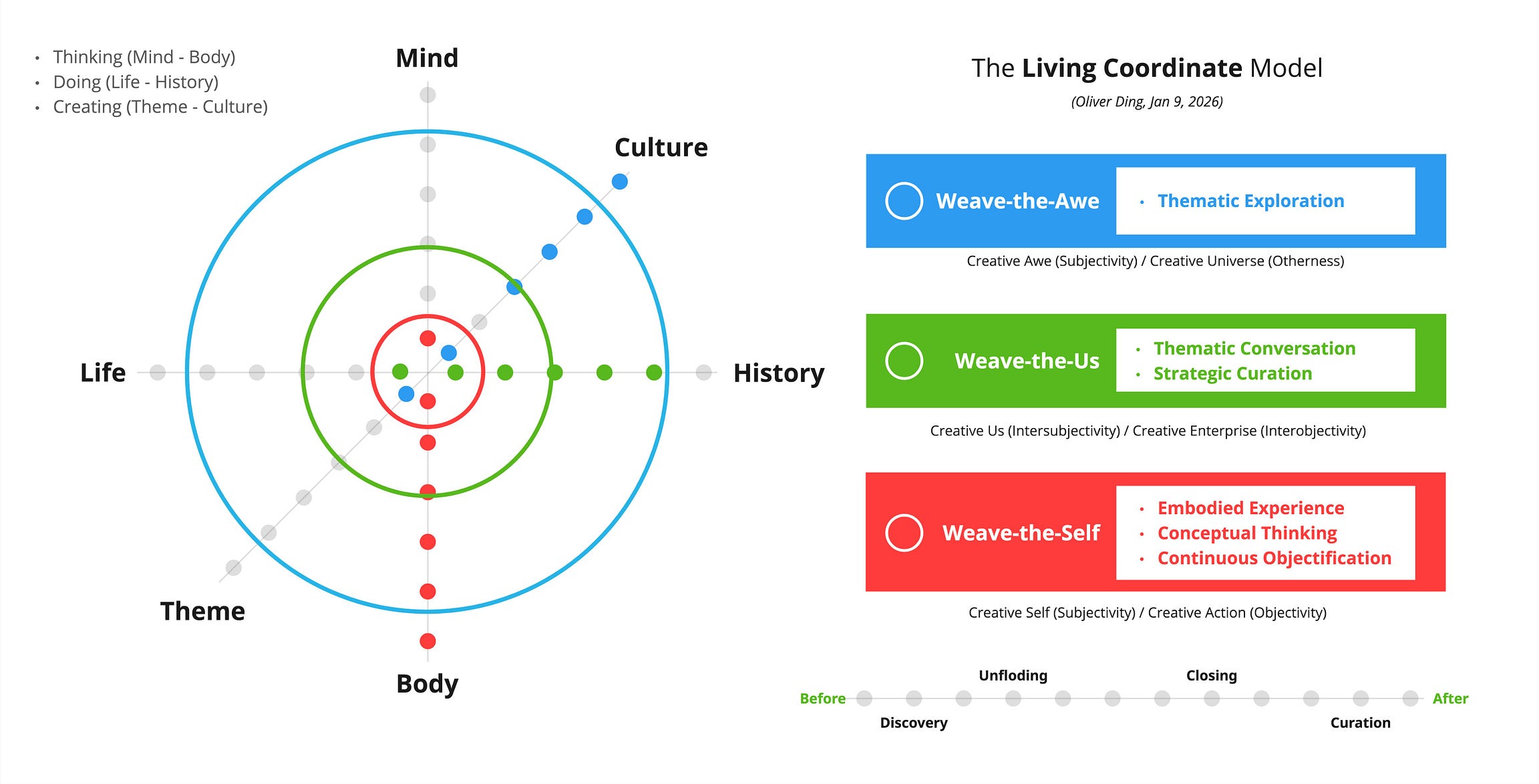
It retains the visual layout of the “Theorizing Creative Life Landscape” diagram, while all texts are replaced with new ideas.
In this new diagram, the 3D Coordinate is organized along three new dimensions:
- Thinking (Mind — Body)
- Doing (Life — History)
- Creating (Theme — Culture)
The three-circle part now refers to a new meta-framework: the Self-Us-Awe framework.
- Weave-the-Awe: Creative Awe / Creative Universe
- Weave-the-Us: Creative Us / Creative Enterprise
- Weave-the-Self: Creative Self / Creative Action
Why can this new model connect the Life Coordinate Framework and the “Theorizing Creative Life Landscape” diagram?
On October 17, 2025, building on the Enterprise Development Framework and the Self-Us-Awe schema, I added further details to the Life Coordinate framework to generate a concrete model for Creative Life Theory (v3.0). This refined model was named the Creative Life Coordinate. See the diagram below.

Along the “Attach — Detach” horizontal lifeflow, I placed six Life Containers;
- Environment
- Creative Self
- Creative Us
- Value Circle
- Developmental Platform
- Nature
The notion of Environment refers to the initial Life Container where a person is born and grows during early childhood. Using the terminology of the World of Activity approach, this can be associated with the Primordial Situatedness of the World of Activity.
The notion of Nature refers to entities larger than humans, including human-made artifacts, the social world, science, culture, and history. It represents aspects that lie beyond the Creative Enterprise, and it is associated with the concept of Creative Awe.
The “Subject — Object” vertical life chain highlights four Life Focuses:
- Action
- Project
- Enterprise
- Universe
The hierarchical structure Action → Project → Enterprise is inspired by Howard Gruber’s Network of Enterprises approach. More details can be found in [Wander and Wander] The “Mapping Network of Enterprises” Journey (2020–2025).
The Universe layer refers to the Creative Universe, which corresponds to the Creative Awe notion.
More details can be found in The Birth of the “Self-Us-Awe” Schema.
The “Thinking-Doing-Creating” Coordinate
The Living Coordinate Model uses the “Thinking-Doing-Creating” Coordinate for the “Finding the Coordinate” movement.
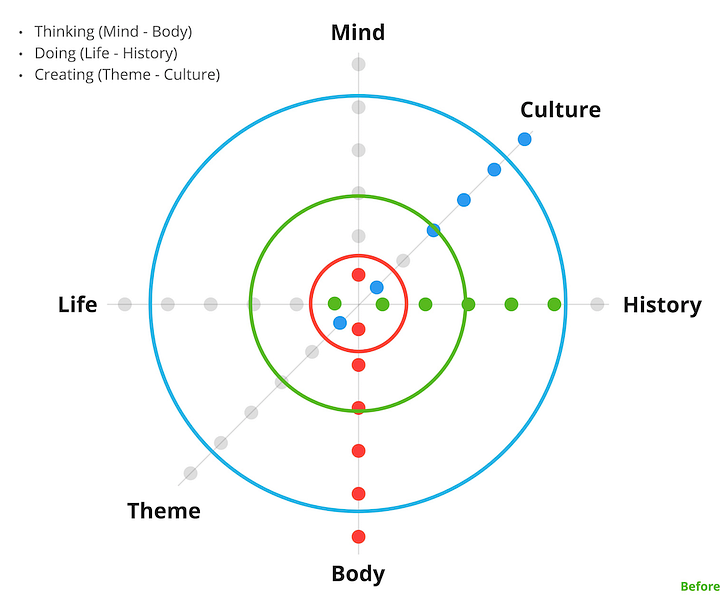
These three dimensions are quite broad, allowing readers to select ideas they resonate with to form their own life coordinate and answer the following questions:
- Where am I?
- Where should I be?
It is important to note that the Living Coordinate Model is a meta-framework; it can be used as a creative heuristic to select a meta-framework for building a life coordinate for a person.
- What does the meta-framework say about “thinking,” such as the mind?
- What does the meta-framework say about “doing,” such as life?
- What does the meta-framework say about “creating,” such as themes?
If a person finds that several meta-frameworks could be candidates for the “Finding the Coordinate” movement, the Living Coordinate Model’s three dimensions can be used to compare these candidates. In this way, the person can identify which statements offered by these meta-frameworks are suitable for their situation and needs.
For example, in my journey of “Generative Confluence”, the meta-framework I selected is the Flow-Focus-Center-Circle schema.

It represents a theoretical framework that integrates different layers of existence into a unified model for understanding creative life and activity.
- Flow → Experiential Layer: The continuous stream of lived experience
- Focus → Consciousness Layer: The intentional structure of awareness
- Center → Action Layer: The organizational structure of practical activities
- Circle → Social Interaction Layer: The networked relations of collective engagement
Traditional approaches study these layers separately. The “Flow-Focus-Center-Circle” schema reveals their mutual implication. Experience already contains consciousness structures. Consciousness embeds action tendencies. Actions are inherently social. Social interactions manifest individual experiences.
This creates a dynamic system where each layer unfolds from and returns to the others, forming what I call an ecological approach to the evolving creative self and social cognition.
Does the “Flow-Focus-Center-Circle” schema fit the “Thinking-Doing-Creating” Coordinate?
The “Flow-Focus-Center-Circle” schema was born before the “Thinking-Doing-Creating” Coordinate. So, the former was not derived from the latter.
Thus, if you have already identified a meta-framework as your life coordinate, you do not need the “Thinking–Doing–Creating” Coordinate. However, if you have not yet decided on your life coordinate, you can use the “Thinking–Doing–Creating” Coordinate as a creative heuristic for the “Finding the Coordinate” movement.
The 3D Coordinate as a Diagram
Now let’s return to the situational model I created on June 2, 2025. In that model, I also used a 3D Coordinate. However, in my journey, it is not for the “Finding the Coordinate” movement, but for the “Anchoring the Center” movement.
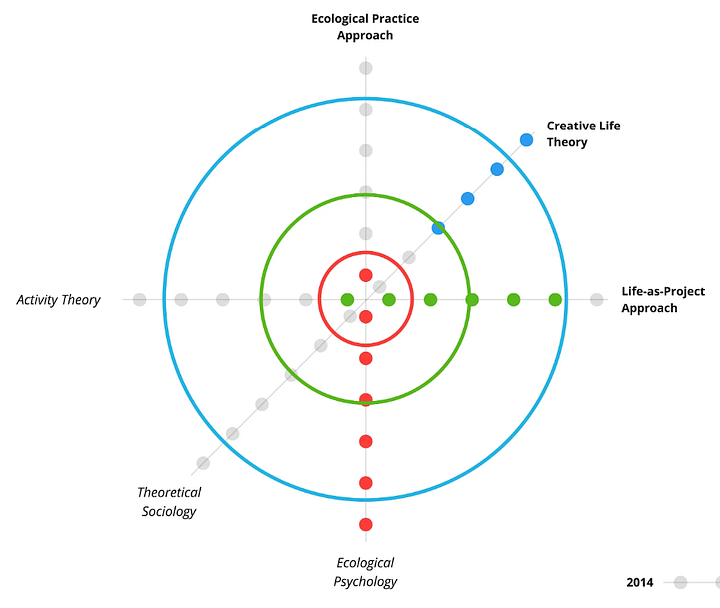
While Finding the Coordinate aims to answer “Where am I?” and “Where should I be?”, Anchoring the Center deals with the challenge: “What should I work on?”
Anchoring the Center refers to searching for a meta-framework to support a potential focus, transforming it into a creative center by curating relevant creative elements together.
Since changes in the environment are endless, the opportunities behind these changes also attract our mental focus every day. However, due to limitations of resources, we cannot capture every opportunity. Thus, identifying a scalable focus is a key step in strategic curation for life development.
Once we discover a scalable focus, we need to anchor a creative center as a foundation and set the focus as the starting point of a new journey to unfold.
In this movement, a meta-framework is also required to serve as the container for strategic curation.
In my journey of the Generative Confluence from June to December 2025, the Self-Life-Mind framework was the meta-framework used to anchor a new creative center.
The 3D coordinate is used to represent three theoretical traditions I worked on, while the three circles represent the new creative center I anchored.
This means the 3D coordinate diagram can be used for both “Finding the Coordinate” movement and “Anchoring the Center” movement.
Six Operations
While the 3D Coordinate and three circles form a map for mental moves, a key action of the Generative Confluence journey is curating creative elements to scale the focus and grow the center.
In the Living Coordinate model, I highlight six operations for scaling the focus. These operations extend beyond individual cognition to include intersubjective and material dimensions, organized across the Self-Us-Awe framework:

- Thematic Exploration
- Thematic Conversation
- Strategic Curation
- Embodied Experience
- Conceptual Thinking
- Continuous Objectification
These operations were discovered through my journey of developing independent concepts for building Creative Life Theory v3.0.
In fact, the development of the Living Coordinate model aligns with these operations:
- Thematic Exploration: the “Finding the Coordinate” theme became a focus
- Thematic Conversation: I discussed “Finding the Coordinate” with friends
- Strategic Curation: Place several case studies and models together; develop an intermediate framework to connect a situational model and a meta-framework.
- Embodied Experience: I visited the series of diagrams I created on June 2, 2025
- Conceptual Thinking: Separate the “Finding the Coordinate” and the “Anchoring the Center” movement; clarify different functions of the same 3D coordinate diagram.
- Continuous Objectification: I created the Living Coordinate model diagram on January 9, 2026.
Each creative element — such as a theoretical concept in my journey — is related to these operations. These six operations are also called the Living Way of Concept; further exploration will be shared in future articles.
Conclusion
The Living Coordinate Model fulfills the primary challenge of the Lake 42 project: transforming the Generative Confluence pattern from a situational insight into a general, operational framework.
By establishing an intermediate layer between the Life Coordinate Framework and the Theorizing Creative Life Landscape diagram, this model achieves two key objectives:
First, it generalizes the pattern. The two movements — Finding the Coordinate and Anchoring the Center — are no longer confined to my personal journey from June to December 2025. They represent universal challenges in creative life development: orienting oneself (“Where am I?”) and establishing strategic focus (“What should I work on?”).
Second, it provides operational guidance. The “Thinking-Doing- Creating” Coordinate serves as a heuristic tool for finding one’s life coordinate. The Self-Us-Awe framework supports anchoring a creative center. The six operations offer concrete practices for scaling focus and growing centers.
Most importantly, the Living Coordinate Model is now integrated into my knowledge system, positioned within a clear hierarchy. It connects abstract meta-frameworks with specific situational models, demonstrating how theoretical insights emerge from — and return to — lived creative experience.
This intermediate framework represents the significant outcome of the Lake 42 project, marking a new phase in the ongoing development of Creative Life Theory.
The Generative Confluence journey continues.
v1 - January 21, 2026 - 3,221 words