
World of Life: Four Positive Frontiers of Project Engagement

Placing Opportunity Inside the World of Life
by Oliver Ding
March 12, 2026
Today I was editing an article about the World of Life — going back to check some source material on the four boundaries of the framework.
In the process, I rediscovered a diagram I made in 2022 — The Shaman's Mandala — which maps four concepts from the Ecological Practice Approach onto a four-boundary structure: Affordance, Supportance, Attachance, and Curativity, each occupying a distinct position.
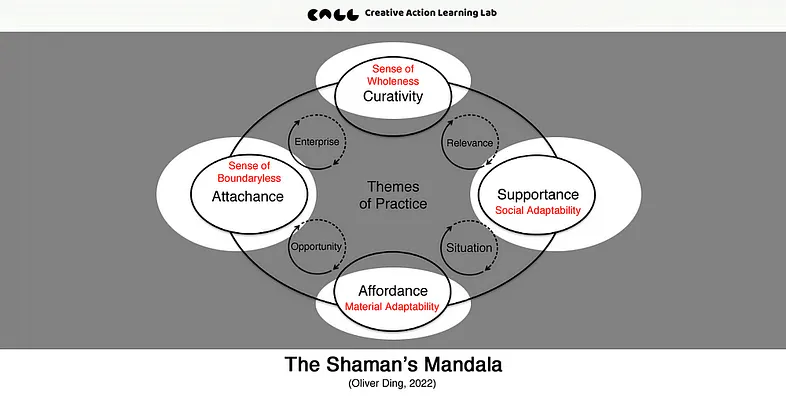
I had seen this diagram many times before. But this time, something clicked.
These four positions map directly onto the four boundaries of the World of Life.
I immediately thought of the article I wrote on March 7, 2026: World of Life: Four Negative Frontiers of Knowledge Engagement. That article identified four failure modes — one at each boundary of the World of Life, where knowledge engagement goes wrong. Mystification at the Spirituality boundary. Dogmatism at the Science boundary. Echo Chamber at the Individuals boundary. Tragedy of the Commons at the Collectives boundary.
If there are four negative frontiers, there must be four positive ones. And here they were, already waiting in the Ecological Practice Approach.
This is not a coincidence. It is a structural resonance — a sign that two theoretical projects, developed independently over several years, have been orbiting the same territory.
This article explores those four positive frontiers.
Part 1: The Ecological Practice Approach (2019–2025)
To understand where the four positive frontiers come from, it helps to know the theoretical resource behind them.
The Ecological Practice Approach was born in 2019, initially called the Gibson-Lakoff-Schön Approach, drawing from the theoretical contributions of James J. Gibson, George Lakoff, and Donald Schön. It emerged from the writing process of Curativity: The Ecological Approach to Curatorial Practice (2018–2019), which explored one of my central life themes: curation.
The approach aims to build an affordance-based theory of action and apply ideas from ecological psychology to the analysis of various social practices. In a broad sense, it has its philosophical roots in traditional Pragmatism and contemporary embodied cognitive science.
Its historical development can be understood through five versions:
- 2019: The "Toolkit" version (Beta) — A curated set of tools drawing from ecological psychology, centering on the concept of Affordance and the original concept of Curativity.
- 2020: The "Germ-cell" version (1.0) — The book After Affordance introduced the foundational triad of Affordance, Attachance, and Containance. The basic unit of the approach: a Container offers opportunities, an actor acts, an Event occurs, and new opportunities emerge.
- 2021: The "Hierarchy" version (2.0) — The concept of Supportance was added, transforming the approach from a curated toolkit into an original theoretical framework. The three-level hierarchy of Perception–Action–Curation corresponds to Affordance, Supportance, and Curativity respectively.
- 2023: The "Social Cognition" version (3.0) — Focus shifted to Attachance, Thematic Spaces, and Genidentity, culminating in an integrated ecological approach to social cognition.
- 2025: The "Meta" version (4.0) — The Difference–Conversion–Opportunity Schema was articulated as the primary model of the approach, revealing the deep structure shared by all its opportunity concepts.
Each version preserved the Genidentity of the knowledge system — its core value and uniqueness — while adding new theoretical layers.
In June 2025, these developments were curated into a new possible book: Container Thinking: The Ecological Practice Approach (v4.0, 2025). A key achievement of this version was the development of four meta-frameworks that highlight a unified worldview and scientific perspective behind the approach.
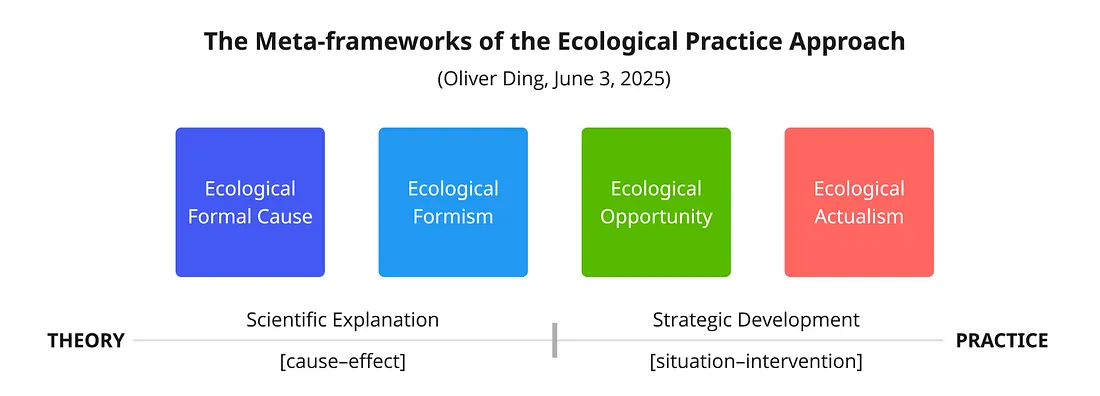
On the theory side, the approach is framed as a scientific project offering systematic tools for scientific explanation, through two meta-frameworks: Ecological Formal Cause and Ecological Formism. On the practice side, it is presented as a practical project offering tools for strategic development, through two meta-frameworks: Ecological Opportunity and Ecological Actualism. Together, these four meta-frameworks offer a unified account of what the Ecological Practice Approach is and what it is for.
This article focuses on one of them: Ecological Opportunity — and specifically, what it reveals when placed inside the World of Life.
Part 2: Placing Opportunity Inside the World of Life
The World of Life is a framework for understanding the boundaries of a human life in its full ecological context. It has four boundaries:
- Spirituality (upper): the limit of ultimate meaning and transcendent significance
- Science (lower): the limit of material patterns and natural laws
- Individuals (left): where life originates, where personal enterprises begin
- Collectives (right): where social formations emerge, where cultural movements crystallize
In my earlier article, I showed that each boundary has a corresponding failure mode — a negative frontier where knowledge engagement collapses into distortion.
Now I want to show the other side: the four positive frontiers, where engagement with each boundary opens into genuine ecological opportunity.
The new diagram (see below) places Genidentity at the center, surrounded by four opportunity concepts — one at each boundary. This is not arbitrary. Each concept was developed specifically to describe the action opportunities available in the environment that corresponds to its boundary.
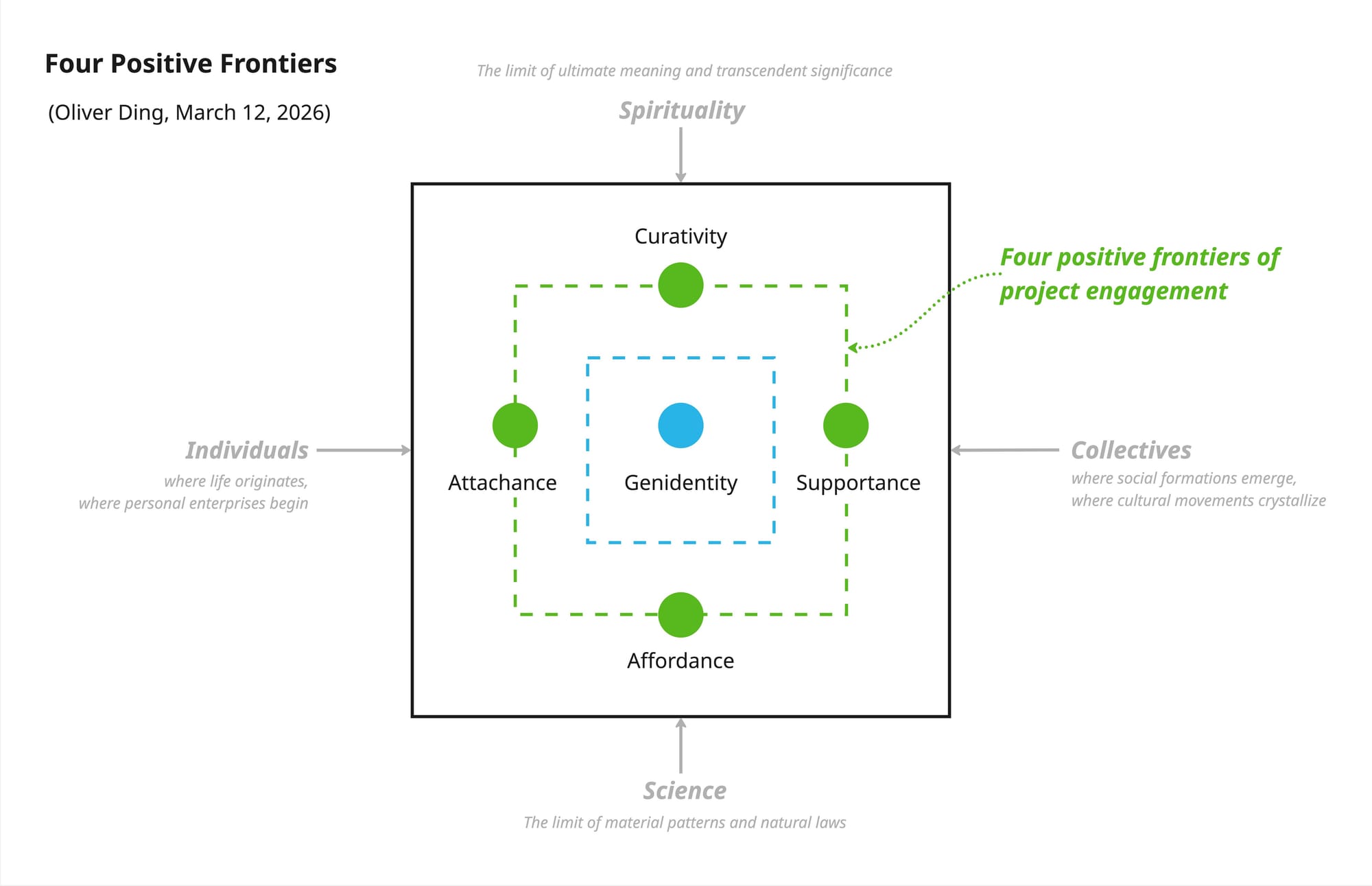
Genidentity occupies the center not as one of the four concepts, but as the condition of possibility for recognizing and actualizing all of them. We will return to Genidentity in Part 7.
The four sections that follow each introduce one positive frontier.
Part 3: Affordance — The Science Frontier
The Science boundary of the World of Life is where human activity meets the material world — the domain of physical objects, natural forces, surfaces, substances, and the regularities that govern them. This is the territory of empirical reality, of what can be measured and tested, of what exists independently of what we wish it to be.
The negative frontier at this boundary is Dogmatism: the collapse of engagement with material reality into rigid adherence to fixed frameworks, refusing to let evidence challenge theory.
The positive frontier is Affordance.
Affordance refers to the potential action opportunities that environments and material objects offer. The term was coined by ecological psychologist James J. Gibson, who observed that what an organism perceives in its environment is not abstract properties but possibilities for action. A flat surface affords walking. A handle affords grasping. A doorway affords passing through.
The practical orientation corresponding to Affordance is Material Adaptability: a person's ability to perceive and actualize the action opportunities embedded in material environments.
Material Adaptability is not passive reception. It requires cultivated perception — learning to see what an environment actually offers rather than what our habits expect. There is often a gap between the affordances that exist in an environment and the affordances a person can actually recognize and act upon. Closing this gap requires practice, curiosity, and a willingness to let the material world surprise us.
At the Science frontier, the positive move is to remain genuinely responsive to material reality — to treat the natural world not as a collection of inert resources to be exploited, nor as an incomprehensible force to be feared, but as an environment offering genuine possibilities for action, discovery, and development.
Part 4: Supportance — The Collectives Frontier
The Collectives boundary is where individual life meets the social world — communities, institutions, platforms, movements, cultures. This is the domain of shared meaning, collective action, mutual recognition, and the structures through which people coordinate and create together.
The negative frontier at this boundary is Tragedy of the Commons: the erosion of shared resources through individual overuse, the collapse of collective action when each person pursues private advantage at the expense of the whole.
The positive frontier is Supportance.
Supportance describes potential supportive action opportunities offered by social environments. It extends the logic of affordance from the physical world into the social world, asking: what does this community, this platform, this institutional context offer to someone who enters it with genuine intent to participate?
The practical orientation corresponding to Supportance is Social Adaptability: the ability to perceive and actualize the supportive opportunities embedded in social environments.
Social environments are qualitatively different from physical ones. They involve rational agents who interpret, negotiate, and sometimes resist. Language shapes what is possible. Ownership defines who has the right to act. Remote presences — institutions, norms, authorities — constrain and enable even when absent. Actions carry relational costs as well as material ones.
Actualizing Supportance requires navigating this complexity with both awareness and goodwill. It requires learning to read what a social environment genuinely offers — not merely what it appears to offer on the surface, and not merely what you want it to offer.
At the Collectives frontier, the positive move is to engage with social environments as genuine fields of opportunity, contributing to shared structures rather than depleting them, finding the supportive possibilities that emerge from genuine participation.
Part 5: Attachance — The Individuals Frontier
The Individuals boundary is where life begins in its most personal sense — the singular human being with a particular history, a particular set of themes and commitments, a particular trajectory through time. This is the domain of personal identity, agency, and the ongoing project of becoming who one is.
The negative frontier at this boundary is Echo Chamber: the collapse of individual engagement into self-referential loops, where a person's existing beliefs are only ever confirmed, never challenged, and the boundaries of the self become walls rather than membranes.
The positive frontier is Attachance.
Attachance focuses on potential action opportunities provided by actual actions, particularly those involving attaching and detaching. Every act of attaching to a new context — joining a project, entering a community, taking on a role — opens new possibilities. Every act of detaching — leaving a context that no longer serves development, releasing an identity that has been outgrown — creates new freedom.
The practical orientation corresponding to Attachance is Sense of Boundarylessness: the felt quality of a life in which the constraints that boundaries impose have been reduced through skillful attaching and detaching.
Attachance does not mean rootlessness. It means cultivated mobility — the ability to form genuine commitments and to release them when the time comes, to cross thresholds between contexts without losing oneself in the crossing. Attaching and detaching actions, practiced with awareness, reduce the sense that one's possibilities are fixed by one's current position.
At the Individuals frontier, the positive move is to treat one's own boundaries not as permanent walls but as dynamic membranes — permeable to genuine development, capable of expanding through contact with the new.
Part 6: Curativity — The Spirituality Frontier
The Spirituality boundary is the upper limit of the World of Life — the domain of ultimate meaning, transcendent significance, and the questions that exceed any particular answer. This is the territory of values, purposes, and the sense that individual life belongs to something larger than itself.
The negative frontier at this boundary is Mystification: the collapse of engagement with ultimate meaning into obscurantism, where the language of transcendence is used to evade rather than open genuine inquiry.
The positive frontier is Curativity.
Curativity refers to the potential action opportunities of turning pieces into a meaningful whole. The underlying assumption is: to curate pieces into a meaningful whole, containers are needed to hold and shape these pieces. Curativity Theory recognizes three statuses of things: Things-in-Pieces, Things-in-Container, and Things-in-Whole. The movement from Pieces to Whole — through the work of curation — is the fundamental act of meaning-making.
The practical orientation corresponding to Curativity is Sense of Wholeness: the felt experience of a life whose fragments have been gathered into coherence, whose separate pieces have been recognized as belonging together.
Curativity operates at the Spirituality frontier because it is the practice by which scattered experience is gathered into significance. It is not the imposition of an external framework onto raw experience, but the discovery of the containers that allow experience to become meaningful from within. This is why it corresponds to the spiritual dimension rather than the social or material ones: it concerns the relationship between parts and wholes at the level of a life itself.
At the Spirituality frontier, the positive move is to take up the ongoing work of curation — to find the containers that allow the pieces of one's experience to cohere, to build and rebuild the sense that one's life hangs together.
Part 7: Genidentity — The Center
The four positive frontiers describe action opportunities at each boundary of the World of Life. But what makes it possible to recognize and actualize these opportunities? What stands at the center, enabling the actor to engage with all four?
The answer is Genidentity.
Genidentity refers to recognizing a thing's uniqueness and the differences between it and others. The concept was adopted from Kurt Lewin's early work and reframed in the Ecological Practice Approach as an ecological concept. A thing's Genidentity is defined by its Essential Differences combined with its Situated Dynamics.
At the practical level, Genidentity means Uniqueness of Self: recognizing one's own irreducible particularity, the specific configuration of themes, commitments, and experiences that constitutes a singular life.
GO Theory develops the principle of Double Genidentity as its theoretical foundation. This principle holds that there are two primary dimensions of Genidentity in social life development:
- The Genidentity of Things: the uniqueness of the objects, projects, communities, and concepts one engages with — the focus of Social Life Development
- The Genidentity of Creative Life: the uniqueness of the life itself as it develops over time — the focus of Creative Life Development
These two dimensions are nested: Creative Life Development is contained within Social Life Development, as a Containee within its Container.
Why does Genidentity belong at the center of the World of Life map?
The first answer is epistemological. The four positive frontiers — Affordance, Supportance, Attachance, Curativity — are not generic opportunities available to anyone in the abstract. They are opportunities that must be recognized and actualized by a particular actor in a particular situation. The ability to perceive what an environment affords, to read what a social context supports, to navigate the dynamics of attaching and detaching, to gather experience into wholeness — all of these depend on the actor's awareness of their own particularity. Without Genidentity, the four frontiers collapse into noise. With it, each frontier becomes genuinely navigable.
But there is a second, deeper answer — and this is the core proposition of GO Theory.
Opportunity, by its nature, brings change. Every ecological opportunity, when actualized, alters the relationship between the actor and their situation. This is what opportunities do: they move things. And movement is, in general, good. Development depends on it.
But situations have dynamics, and dynamics have limits. A thing's Genidentity is defined by its Essential Differences — the qualities that make it irreducibly itself, distinguishable from everything else. These Essential Differences are not rigid. They can evolve, deepen, and become more fully themselves through engagement with opportunity. This is what genuine development looks like.
The danger arises when situational change crosses the boundary of Essential Differences. When the pressure of opportunity — the pull of what a social environment supports, the demands of a project, the momentum of attachment — overrides rather than develops what is most essentially one's own, Genidentity is not developed. It is damaged.
This is why Genidentity must stand at the center, not at one of the four frontiers. It is not simply a tool for recognizing opportunity. It is the boundary condition for pursuing it. Every movement toward an opportunity must be measured against the question: does this change develop who I am, or does it dissolve it?
The tension between Genidentity and Opportunity is therefore constitutive of GO Theory. Opportunity without Genidentity is drift. Genidentity without Opportunity is stagnation. The practice of social life development is learning to hold both — to pursue the possibilities at each frontier while remaining, through all the changes, recognizably oneself.
Part 8: The Difference–Conversion–Opportunity Schema
The four positive frontiers described in this article — Affordance, Supportance, Attachance, and Curativity — are not the only ecological opportunities available in the World of Life. They are four that have been developed and named. But the underlying mechanism that generates them can generate many more.
This mechanism is what I call the Difference–Conversion–Opportunity Schema — the primary model of the Ecological Practice Approach.
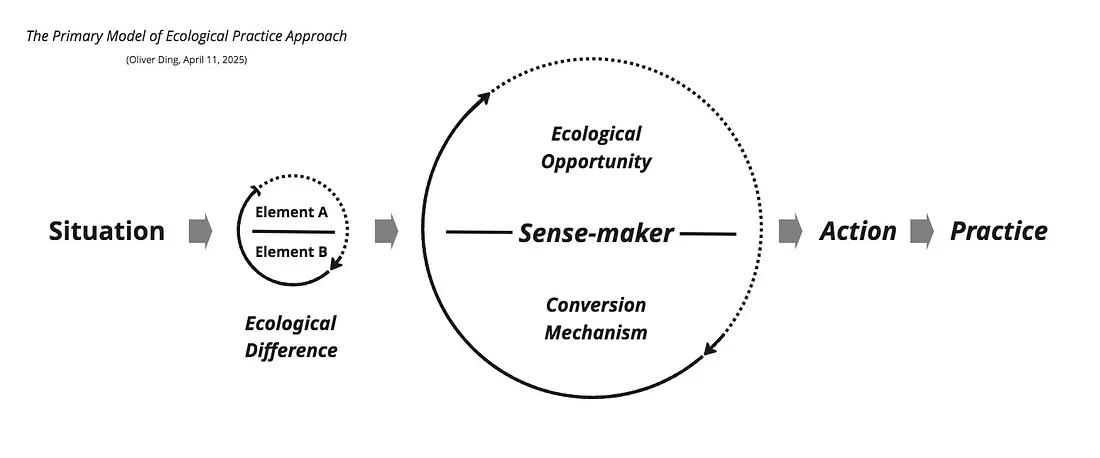
The schema works as follows:
Every situation contains Ecological Differences — structural distinctions present in the environment that, once recognized as convertible, become opportunities for action. An Ecological Difference is not merely a logical contrast (married vs. unmarried, expert vs. novice). It is a practical boundary that, when recognized and mediated, can enable new forms of action.
Between the two elements of an Ecological Difference, there are Conversion Mechanisms — processes by which one element can become another. Some are natural, arising from the regular development of things. Others are based on human intervention. What matters most is not whether the mechanism is natural or designed, but whether the actor has the capacity to operate it.
When a Conversion Mechanism is available, an Ecological Opportunity is born.
Each of the four frontier concepts embodies this schema:
- Affordance: The ecological difference between Possible and Potential in the natural environment; the conversion through Perception; the opportunity of Material Adaptability.
- Attachance: The ecological difference between Attach and Detach in the individual's movement through contexts; the conversion through Action; the opportunity of Sense of Boundarylessness.
- Supportance: The ecological difference between Intended and Unintended in social action; the conversion through Social Moves; the opportunity of Social Adaptability.
- Curativity: The ecological difference between Pieces and Whole in thematic environments; the conversion through Curation; the opportunity of Sense of Wholeness.
But the schema itself is open. Any structural difference in any environment — material, social, mental, or thematic — that contains a viable Conversion Mechanism is a potential Ecological Opportunity waiting to be named and cultivated.
This is why the four positive frontiers of the World of Life are not exhaustive. They are starting points. The Difference–Conversion–Opportunity Schema is a generative engine, capable of revealing new forms of opportunity wherever someone has the awareness to look.
The World of Life has its frontiers. But frontiers are not walls. They are where the territory of possibility begins.
Epilogue: From GO Theory to ACS
Around October 2024, I set three goals for the GO Theory project. The first was to launch a book draft around the concept of Genidentity. The second was to run a creative dialogue between Creative Life Theory and the Ecological Practice Approach. The third — the most ambitious — was to move into the field of cultural development by building a Cultural Genidentity Framework.
The ambition behind all three goals was the same: to broaden the scope of my theoretical work from individual life development toward Social Life Development. GO Theory was designed to nest Creative Life Development inside a larger container:
Social Life Development (Creative Life Development)
In practice, the first half of 2025 unfolded differently than planned. Rather than pursuing these goals directly, I worked on them through Indirect Activity — developing adjacent projects whose by-products fed into GO Theory. The most significant outcome was the World of Activity toolkit, which included a systematic exploration of the dialectical relationship between Theme and Identity. These were genuine achievements. But they remained at the level of individual development. The third goal — entering the territory of cultural development — had not yet been reached.
On June 18, 2025, I curated these outcomes into GO Theory: Genidentity, Opportunity, and World of Activity (book, v1.0) and declared it Phase I. The subtitle names what had actually been accomplished: Genidentity, Opportunity, and World of Activity. Phase II — the move into cultural development — remained ahead.
What Phase II needed was a new ontological foundation. To analyze Social Life Development at the cultural level, I needed a framework for the social world itself — not just a framework for the individual moving through it.
That foundation arrived on December 31, 2025, with the completion of a book draft: Meta-frameworks: Creative Heuristics for Individual and Social Development (book, v1.0, 2025). This manuscript established the World of Life as a new social world ontology — a larger container holding the World of Activity within it:
World of Life (World of Activity)
Where the World of Activity frames the course of an individual's creative life, the World of Life frames the broader social and cultural terrain in which that life unfolds. The World of Life — with its four boundaries of Spirituality, Science, Individuals, and Collectives — provides the spatial structure within which cultural development can be mapped and analyzed.
On January 5, 2026, the Anticipatory Cultural Sociology (ACS) project was formally named. In the months since, the work has centered on deep exploration of the World of Life — including the article you are reading now.
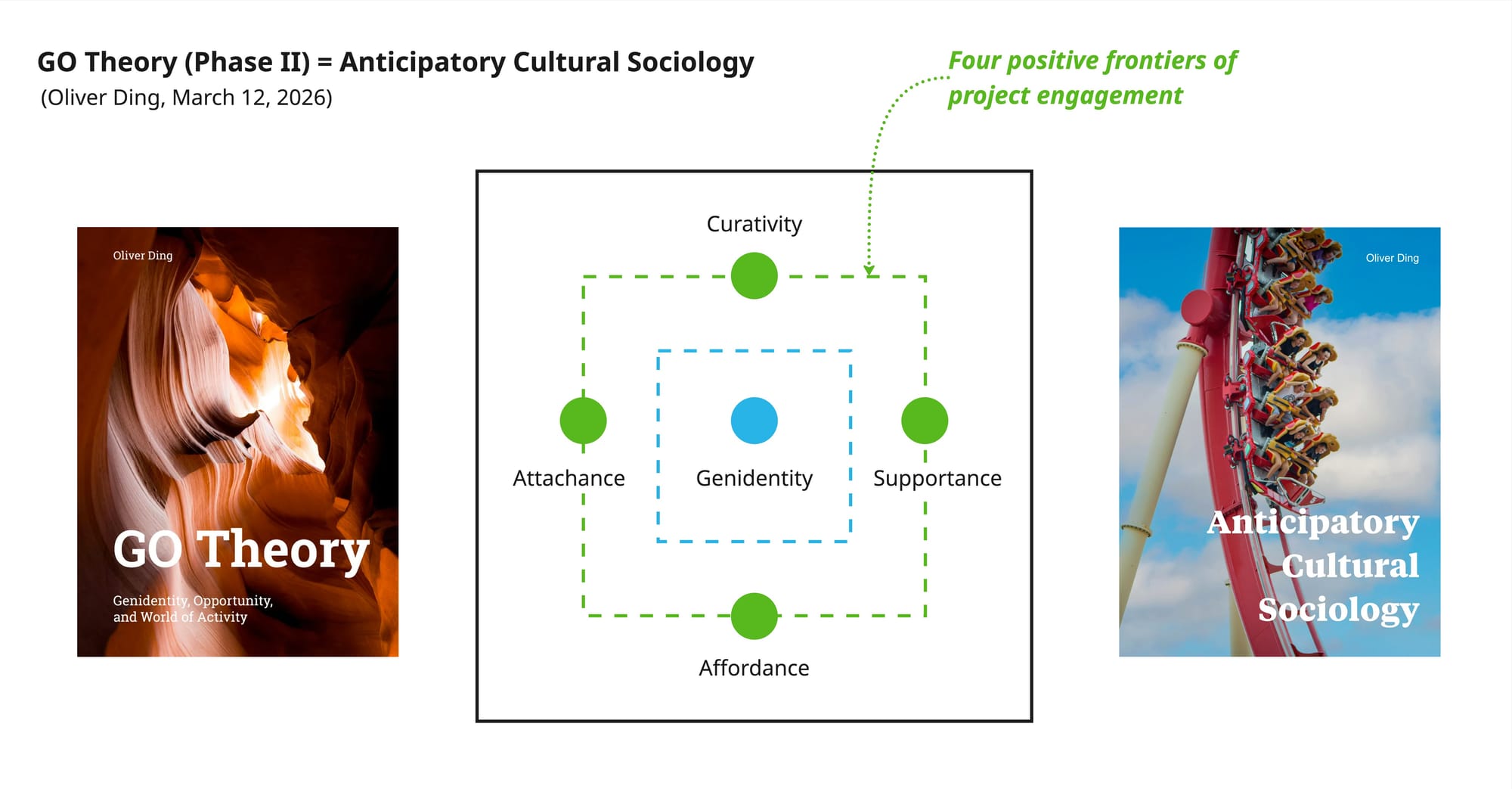
I did not plan it this way. But looking back, it is now clear: ACS is actually Phase II of GO Theory.
The third goal set in October 2024 — moving into cultural development — is now being pursued in earnest. The vocabulary is the same: Genidentity, Opportunity, World of Activity. But the container has expanded. The question is no longer only how a creative individual develops within their life course. It is how cultural enterprises develop within the World of Life.
V1.0 - March 12, 2026 - 3,526 words