
Worldentity: The Cultural Givenness of Thematic Creation
Building the Ontology of Thematic Creation
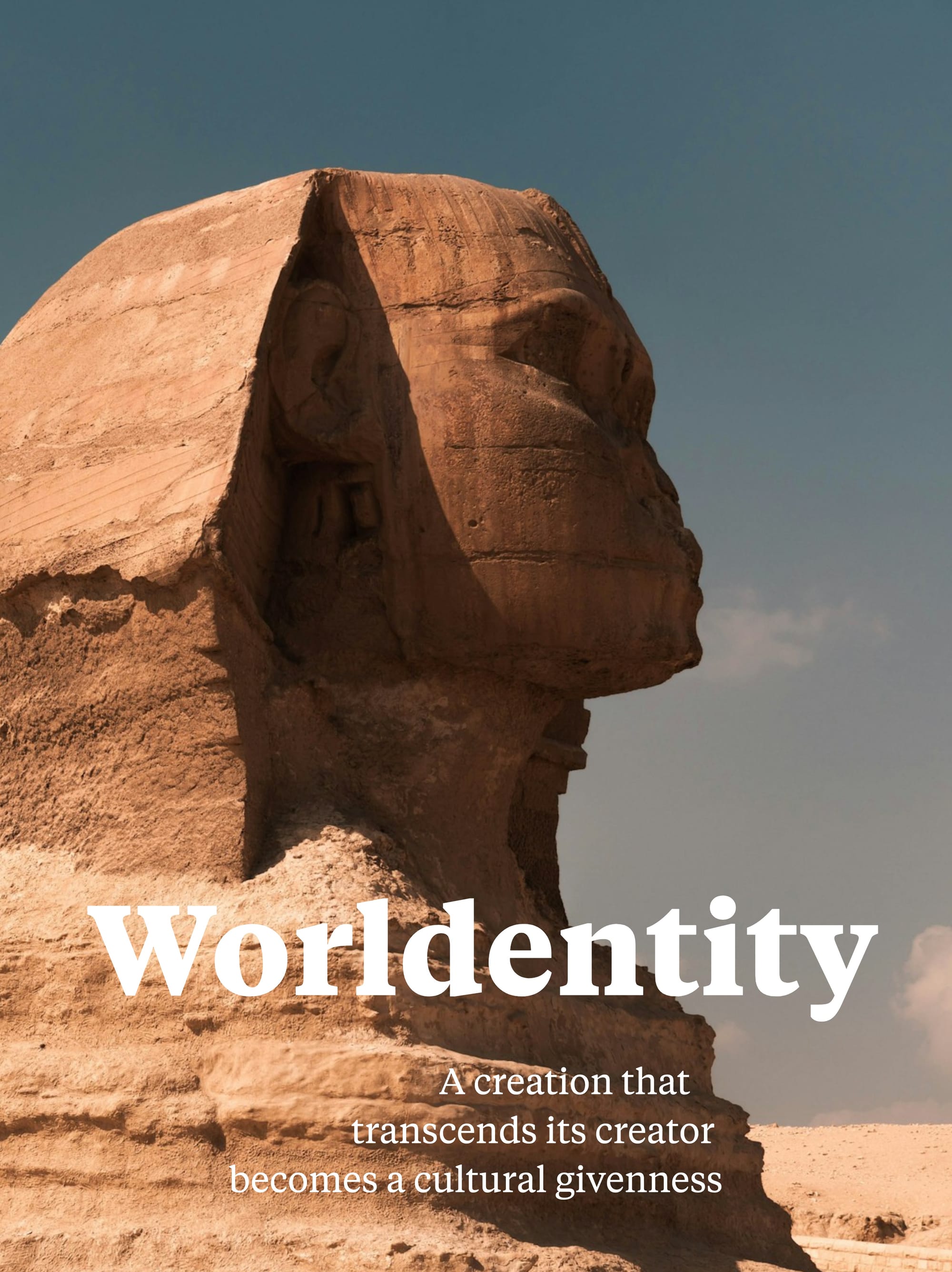
by Oliver Ding
February 13, 2026
This article is part of the ongoing development of Anticipatory Cultural Sociology (ACS), specifically contributing to the Ontology of Thematic Creation—a theoretical framework for understanding how thematic creations come into being, develop, and settle into the social world.
This is a short version of a longer paper (~9,318 words). For the full version, check it out on Possible Press.
In January 2026, I revisited the concept of Mindentity, which I originally created in August 2017 while working on emerging digital formations such as blockchain projects and virtual communities. These formations presented a paradox: they often lacked clear legal status or physical boundaries, yet possessed a distinct and undeniable reality in the minds of their participants. To address this theoretical gap, I coined the term Mindentity—combining Mind and Entity—to capture forms of social reality that exist prior to formal ownership or juridical recognition.
At that time, I formulated a first principle: All entities are mindentities, but not all mindentities are entities. This principle positioned Mindentity as a broader ontological container than the traditional legal entity.
After nearly eight years, the recent formation of Anticipatory Cultural Sociology prompted me to revisit and rebuild this concept. I redefined Mindentity as the ontological status of thematic creations at their origin—existing through psychological ownership (control, intimate knowledge, self-investment) and beginning ecological objectification (symbolic, instrumental, and practical dimensions). Mindentity describes how creative results emerge from individual consciousness into social reality, marking the first boundary crossing from the Individual toward the Collective within the World of Life.
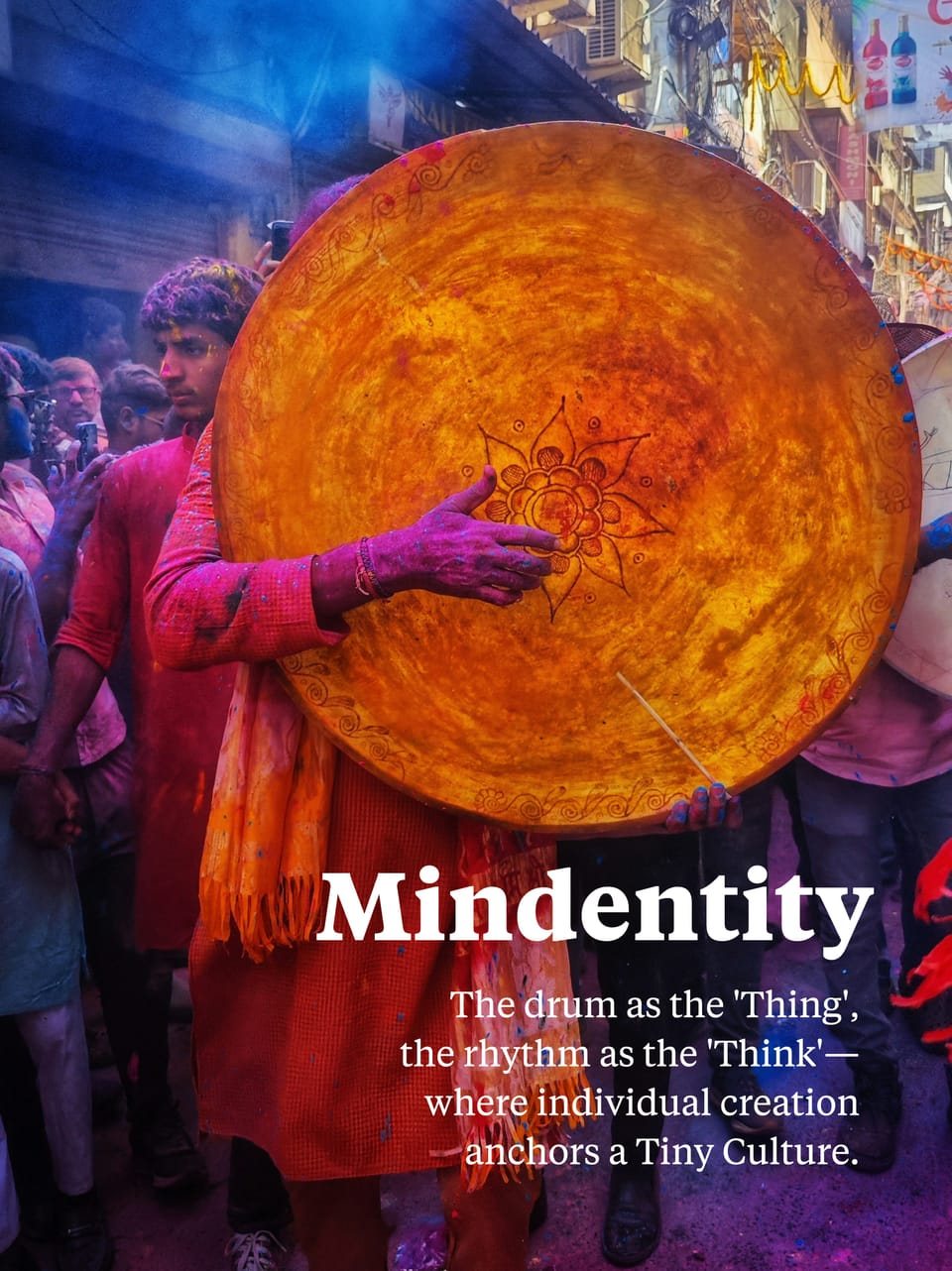
Today, I continue this ontological series. Using symmetry heuristics grounded in the Four Boundaries of the World of Life, I introduce Mindentity's symmetrical counterpart: Worldentity.
If Mindentity represents the moment when thematic creations enter the social world from the Individual side, Worldentity represents their ultimate arrival on the Collective side—when they settle into the World of Life as autonomous, given structures that subsequent generations encounter as "already there."
The Four Boundaries of the World of Life
The concept of "World of Life" was introduced as the context of "World of Activity" in September 2025. Later, I used it to name a new curated knowledge system in December 2025. Finally, four boundaries of the "World of Life" were introduced as well.
From September 2025 to the present, a new set of knoweldge framework emerged, offering a refined way to understand the social world. Reflection on the HLS framework revealed that this set could be called the World of Life Toolkit:
- HLS framework (v3.0) → Provides a five-system structure of the social world, including individual and social life.
- Weave-the-Culture Framework (2025) → Highlights four mechanisms of cultural development.
- Cultural Projection Model (2025) → Connects Mental Platforms and Cultural Frameworks via the Projecting mechanism and Developmental Projects.
- Function — Context — Knowledge — Activity Schema (2025) → Explors Mental Platforms and Mind within the Context (Mind) layer.
- Meta-Frameworks — in — Context Framework (2025) → Identifies six faces of concept system in the social world.
- Embodied Social Forms Framework (2025) → Connects body-scale experience with deep social cognition.
Together, these knowledge frameworks provide a way to zoom in on the details of the Social World while connecting micro-AAS and macro-AAS.
Within this system, the World of Activity toolkit primarily addresses the Life(Self) layer, whereas the World of Life encompasses broader layers, including History (Culture) and Context (Mind), highlighting the hierarchical and interconnected nature of the knowledge ecosystem.
The Body System, initially presented as the Ecological Basic Forms in my book draft Homecoming: A Thematic Trip and the World of Activity Approach, has now evolved into the Embodied Social Forms Framework, which will be introduced in a forthcoming book draft on Meta-Frameworks.
The developmental loop is now complete: beginning with the Body’s flow and the Self’s focus, moving through the Centers of our developmental projects and enterprises, we ultimately locate our activities within the Historical Circle. In this way, the World of Activity has been curated into the World of Life.
During the 2024 Christmas holiday, I had a reflective conversation with a mentor, revisiting my work on HELLO THEORY, GO Theory, and the Strategic Life Narrative project. Through this reflection, I realized my newest focus had shifted toward Cultural Life Development, marking a detachment from Individual Life Development. This strategic move was encapsulated in the theme of “Cultural Grounding/Cultural Growing.”
Over the past 12 months, while I worked on closing my multi-year journey of Knowledge Engagement and Individual Life Development — culminating in Creative Life Theory v3.1 — I simultaneously unfolded a new journey of Cultural Development.
The birth of the World of Life (World of Activity) approach marks a nexus-point where the act of Closing a rich history meets the act of Unfolding a new future.
The diagram below represents the History{Life[Self(Body)]} framework (version 3.0), also known as the HLS framework.
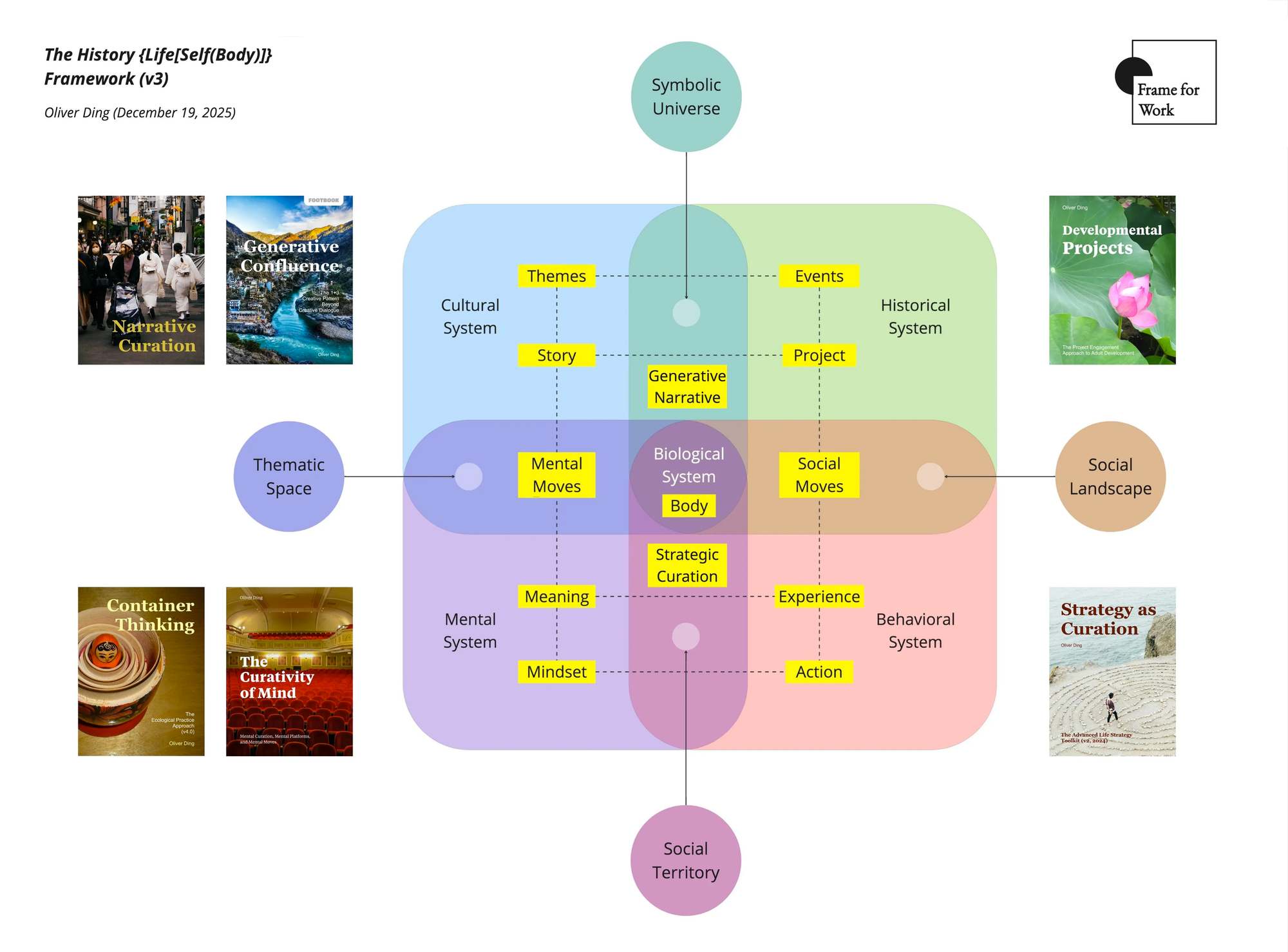
The HLS Framework evolved from the Life(Self) theme I created in 2023. The journey involved several projects between 2023 and the present, revealing an ongoing effort to search for an ontological foundation of life, both individual and collective. The story can be further explored in The History{Life[Self(Body)] } Framework — Part 1: The Historical Development.
On December 19, 2025, I added two theoretical concepts — Generative Narrative and Strategic Curation — to the HLS framework and released version 3.0.
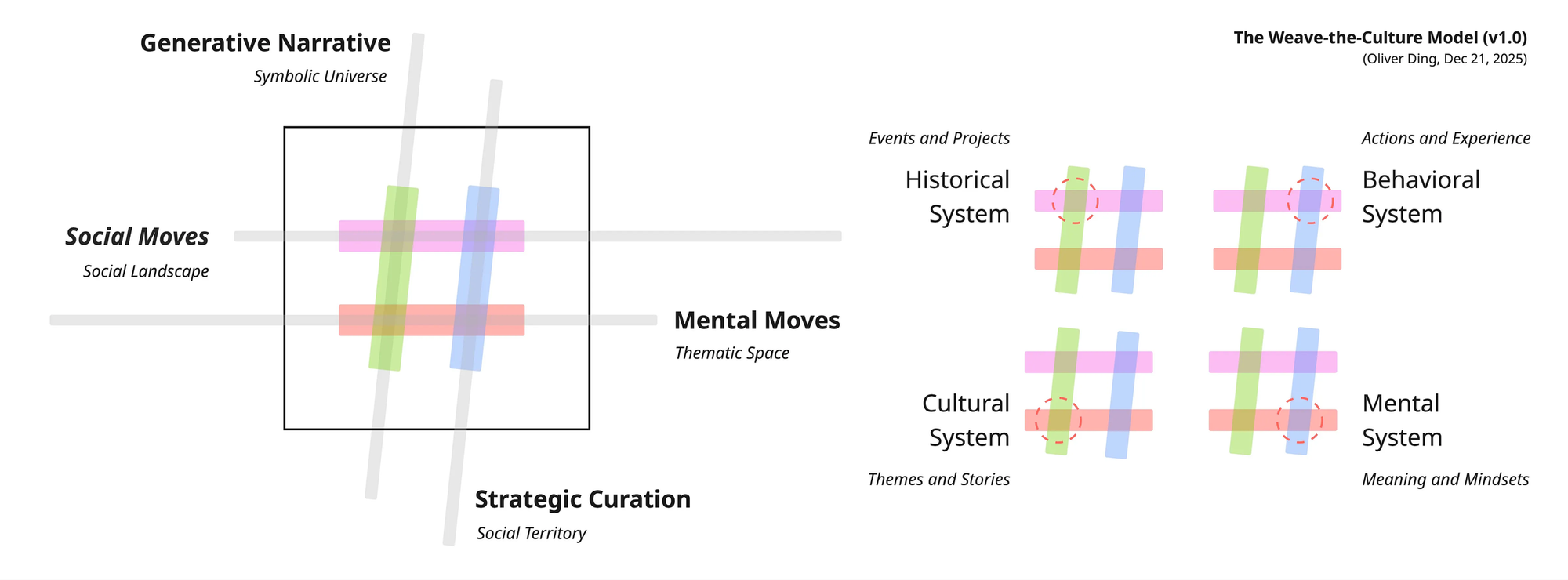
After connecting the new framework (v3.0) with the Meta-frameworks project, I realized that the following four concepts represent the Four Mechanisms of Cultural Development.
- Mental Moves
- Social Moves
- Strategic Curation
- Generative Narrative
On December 21, 2025, I created the Weave-the-Culture Model to highlight these four mechanisms. See the diagram below.
HLS Framework provides the structural foundation of the social world — History{Life[Self(Body)]} — defining five major systems (Body, Mental, Behavioral, Cultural, Historical) and their nested relationships.
Six Faces of Concept Systems identifies where concept systems are distributed within this structure: Mental Platforms, Strategic Frameworks, Cultural Frameworks, and Institutional Frameworks at the center, with Knowledge Frameworks and Spiritual Frameworks as two outliers marking the boundaries.
Weave-the-Culture Model reveals how these concept systems operate through four mechanisms — showing not just where they are, but how they weave together to drive cultural development.
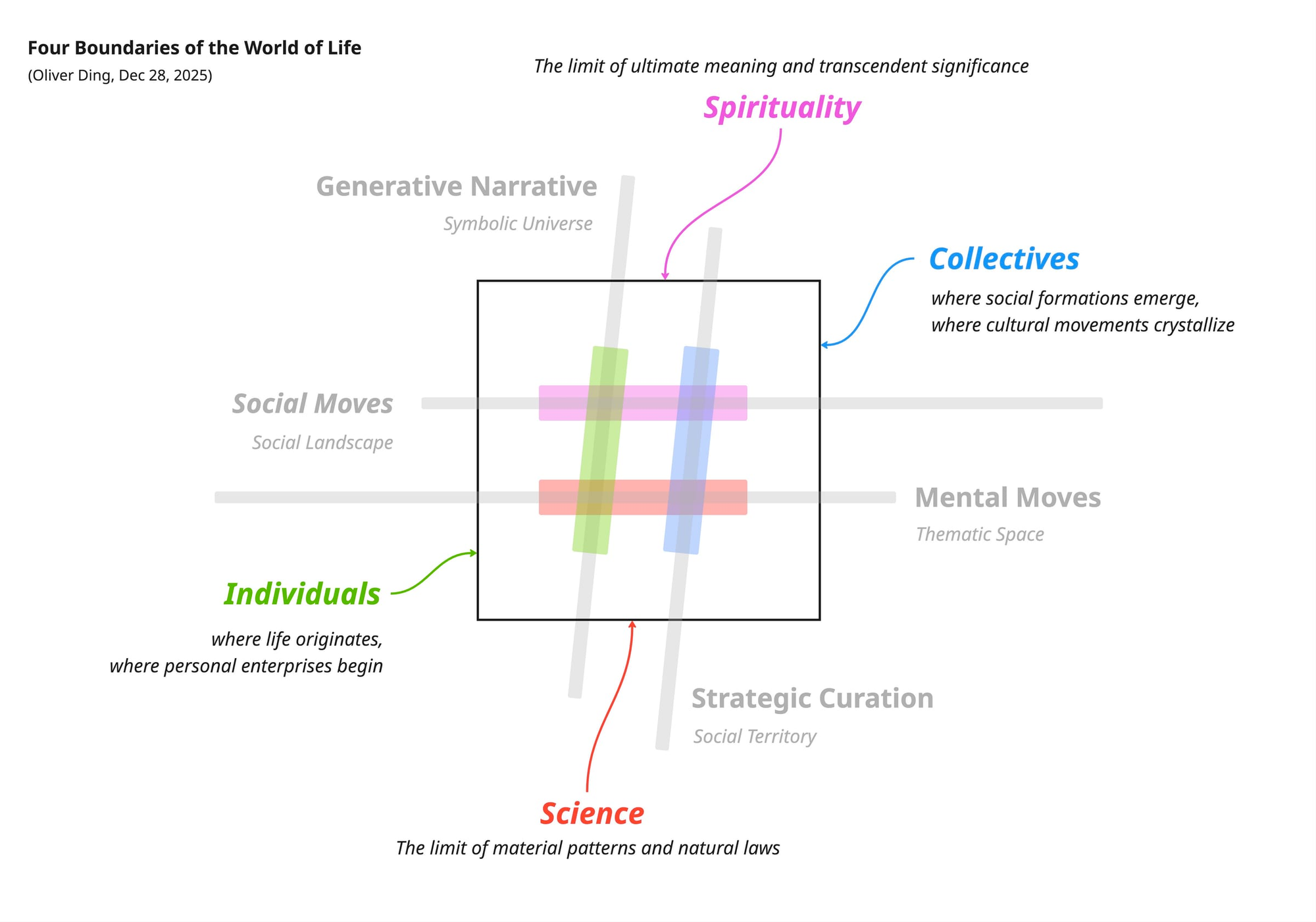
The Weave-the-Culture Model begins with a simple square representing the World of Life — the social world in which all human lives unfold. This square is bounded by four edges:
- Upper boundary: Spirituality (the limit of ultimate meaning and transcendent significance)
- Lower boundary: Science (the limit of material patterns and natural laws)
These two outliers, identified in the Six Faces model, mark the upper and lower boundaries of the operational zone where cultural development happens.
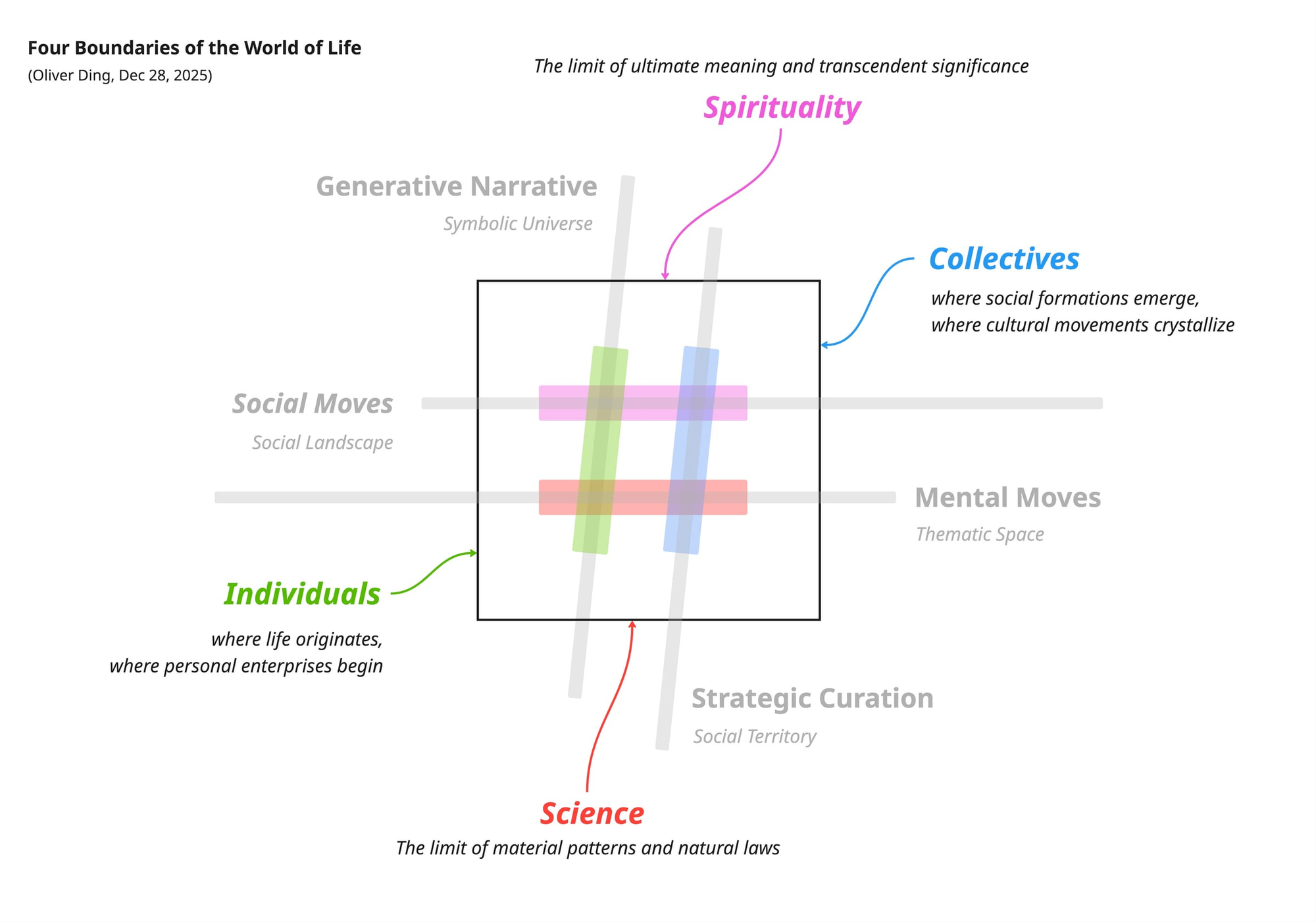
- Left side: Individuals (where life originates, where personal enterprises begin)
- Right side: Collective (where social formations emerge, where cultural movements crystallize)
This structure echoes the square of World of Activity (see the diagram below).
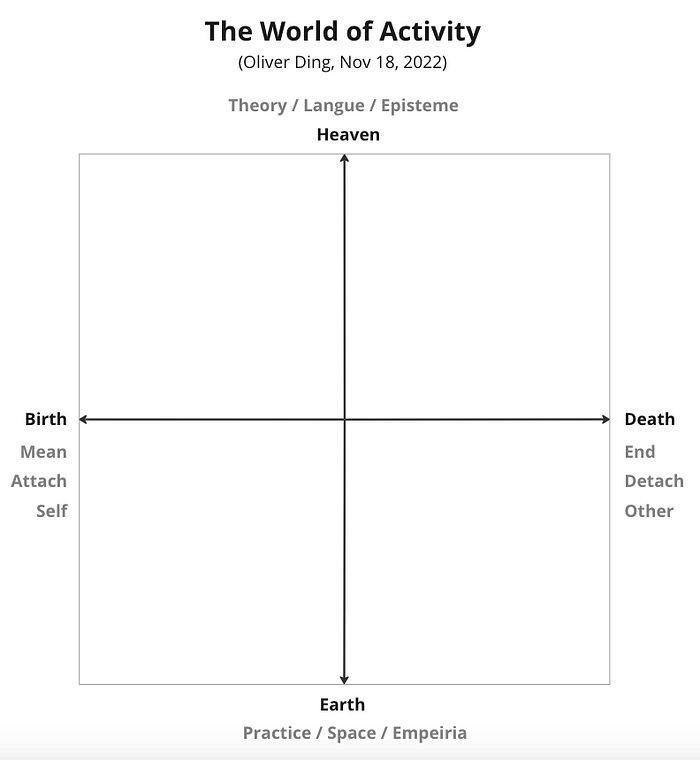
More details can be found in The Concept of "World of Activity." and The Concept of "World of Life."
Within this bounded space, cultural development unfolds through a fundamental transformation: from individual creation to collective structure, from psychological ownership to social givenness. This article introduces Worldentity as the concept that captures this transformation's endpoint.
From Mindentity to Worldentity
In recent theoretical work, I established that all results of thematic creation exist first as Mindentities—anchored in the creator's psychological ownership and beginning their journey toward social objectification. A Mindentity represents the moment when a creative result becomes a viable unit within an individual's World of Activity, possessing both psychological ownership (control, intimate knowledge, self-investment) and ecological objectification (symbolic, instrumental, and practical dimensions).
But what happens when such creations transcend their creators? When they settle into the social world as structures that subsequent generations encounter as "already there"?
This question led to the concept of Worldentity.
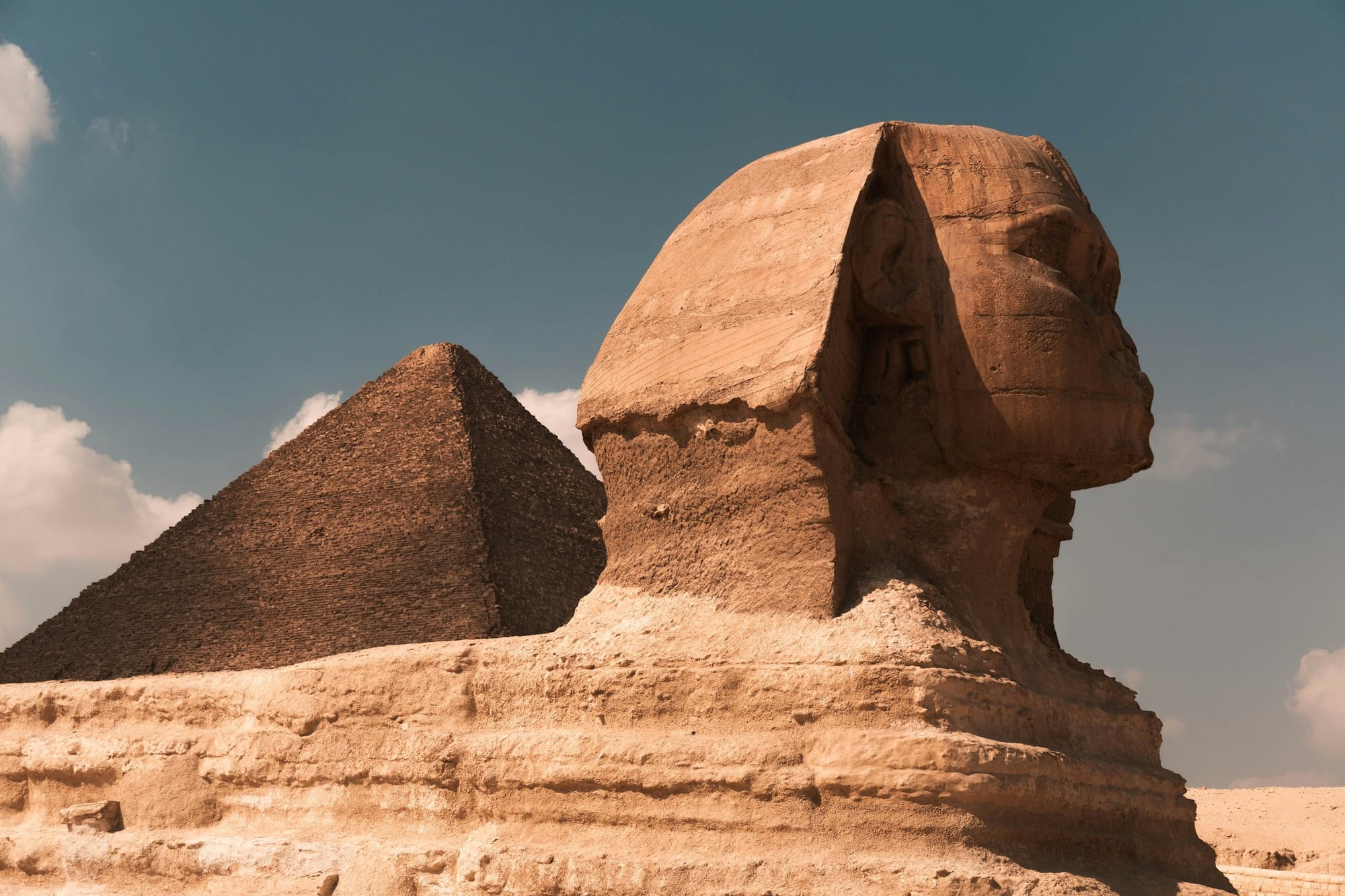
A Worldentity is a thematic creation that has become a given structure in the World of Life—something later individuals and communities encounter independently of its original creator's ownership or intention. The Egyptian pyramids exemplify this status: created millennia ago, they now exist as structural features of the world that shape millions of people's experience, yet no living individual owns or controls them.
The Mindentity-Worldentity pairing is symmetrical across the Individual-Collective axis of the World of Life. Mindentity marks the boundary crossing from Individuals toward Collectives; Worldentity marks the arrival point within the Collective domain, where creations have achieved autonomous structural reality.
Cultural Givenness: Three Dimensions
To understand how Worldentities exist, we must distinguish Cultural Givenness from Natural Givenness. Both share the quality of being "already there," but they differ fundamentally in three dimensions:
1. Temporal Precedence
Natural givenness exhibits permanence—operating on geological or cosmic timescales. Mountains existed before we were born and will remain after we die.
Cultural givenness exhibits precedence—the creation existed before the current observer encountered it. A 200-year-old couplet on a village academy gate is "already there" for current villagers, though its timescale is far shorter than natural phenomena.
This dimension captures how Worldentities transcend their creators' lifespans to become structural features of subsequent generations' worlds. The pyramids were "already there" for all contemporary people; the academy couplet was "already there" for village descendants; a mother tongue was "already there" for children learning to speak.
2. Social Presence
Natural givens present themselves directly—you encounter gravity, mortality, and the physical environment without social mediation.
Cultural givens, however, require social presence to persist and become "already there" for subsequent generations in two distinct forms:
- Interactive social presence: Active interpersonal transmission through storytelling, education, ritual practice, and dialogue. This form requires ongoing human communication and institutional support. The pyramids' significance, for instance, reaches contemporary observers through tourism infrastructure, educational curricula, cultural narratives, and guided interpretation—all requiring continuous social effort to maintain the cultural meaning attached to these physical structures.
- Material social presence: Cultural artifacts that physically endure within shared social spaces across generations, becoming "already there" through sustained encounter rather than explicit transmission. What distinguishes material presence as "social" rather than merely physical? The collective decision (active or passive) to maintain, preserve, or simply not destroy the artifact.
Both forms of social presence share a crucial vulnerability that distinguishes cultural from natural givenness: social presence can fade. Interactive presence fails when communication ceases—when no one tells the stories, performs the rituals, or maintains the institutions of cultural transmission. Material presence fails when artifacts are destroyed, spaces are reconfigured, or paths are rerouted such that subsequent generations no longer encounter what previous generations did.
3. Contingent Necessity
This is perhaps the most distinctive feature of cultural givenness: it is given but chooseable. Natural givenness is unconditional and unavoidable—you cannot choose not to face death, not to exist under gravity, not to require sustenance. Cultural givenness presents itself as a structural reality yet permits choice in engagement.
- Given: Cultural creations exist as part of your existential context. They structure the social world you navigate. They present options, constraints, and opportunities you must consider.
- Chooseable: You retain agency in how—or even whether—to engage. You can ignore, reject, reinterpret, or transform your relationship to cultural givens in ways impossible with natural givens.
Natural givenness functions as a hard constraint—violation is impossible or carries absolute consequences. Cultural givenness functions as a soft constraint—violation is possible but carries variable social, psychological, or practical costs.
This dimension explains cultural evolution and diversity. If cultural givens were as rigid as natural givens, culture would be static. Because they are chooseable, each generation can select, modify, or reject inherited structures, enabling cultural change while maintaining enough stability for givenness to operate.
The Dimensional Transformation
When a Mindentity evolves toward Worldentity, it undergoes systematic transformation across six dimensions:
Subjective Axis:
- Control → Autonomous Existence: No single individual retains control; the creation exists autonomously
- Intimate Knowledge → Distributed Understanding: Knowledge becomes scattered across specialists and communities
- Self-Investment → Collective Investment: The creation carries collective memory and identity
Objective Axis:
- Symbol → Canonical Symbol: Names achieve universal recognition within relevant communities
- Instrument → Infrastructure: Artifacts transition to fundamental infrastructure supporting multiple activities
- Practice → Institution: Individual practices crystallize into institutional forms embedded in social structure
The pyramids demonstrate complete transformation: they exist autonomously, understanding is distributed across disciplines, they carry Egyptian civilization's collective investment, "pyramid" functions as an archetypal symbol, they serve as infrastructure for tourism and research, and practices surrounding them have become thoroughly institutionalized.
Scale Independence: From Family Traditions to Global Monuments
Worldentity status is scale-independent. A 200-year-old couplet can be as fully a Worldentity for that village as the pyramids are for humanity. This has important theoretical consequences.
A 200-year-old couplet inscribed on the stone gate of an old academy in my home village exists as Worldentity for me. Composed by an ancestor, carved in stone, it was "already there" when I first encountered it as a child—a cultural given from my place of origin that later structured my naming choices for my son. I did not create it; I possess only partial knowledge of its full literary significance; it carries multi-generational investment across village lineages. Yet its scale is local, existing fully only within our village community's World of Life.
This reveals that Worldentity transformation depends not on universal recognition but on becoming structurally given for a relevant community—even if that community consists of only three people across three generations. Cultural significance doesn't correlate with scale. A Tiny Culture with its intimate Worldentity may be more structurally significant for its participants than a global monument is for distant observers.
Theoretical Implications
The Mindentity-Worldentity schema completes a crucial piece in the ontology of thematic creation. Previously, frameworks described developmental stages (Creative Life → Tiny Culture → Cultural Center → Cultural Movement) but lacked a clear concept for the endpoint—how cultural innovations ultimately settle into society's structural fabric.
This pairing reveals cultural innovation's fundamental dynamic: successful creative projects undergo ontological transformation from individual ownership to collective givenness. They don't simply scale up; they transform in their mode of existence.
Moreover, Cultural Givenness reframes culture itself. Rather than viewing culture primarily as shared meanings or symbolic systems, we can understand it as accumulated givenness—the sum of Worldentities structuring a community's existential context. Culture is not just what we share but what is "already there" for us, shaping the very possibilities of our activity.
Revisiting Heaven (Language) and Earth (Environment)
The distinction between Cultural Givenness and Natural Givenness, newly articulated in this ontological series, invites us to revisit the four boundaries of the World of Activity established in 2022. At that time, I used the vocabulary of "givenness" (Gegebenheit) broadly, but the specific inspiration came from my diagram research and Chinese traditional philosophical imagery of Heaven-Earth-Birth-Death (天地生死). Looking back now, we can see that Heaven and Earth correspond precisely to Cultural Givenness and Natural Givenness.
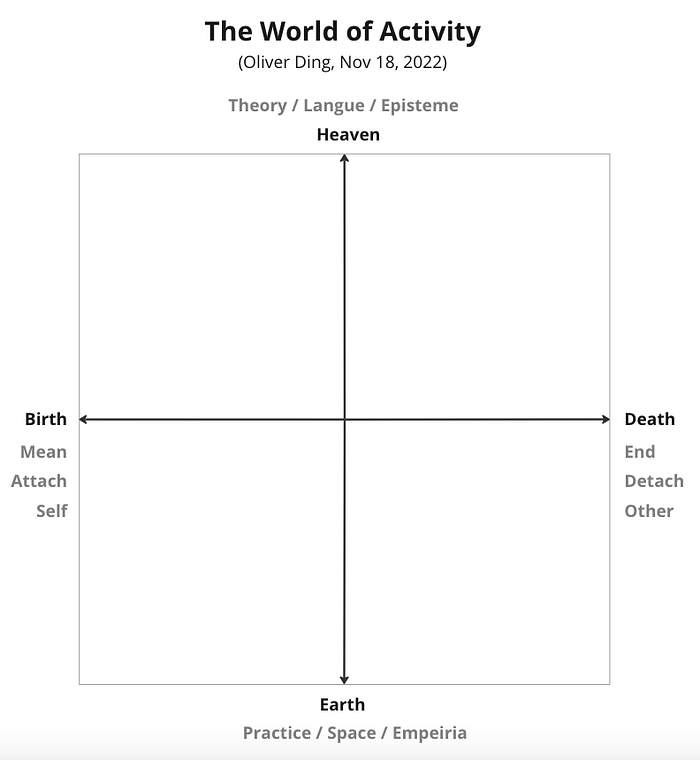
In the 2022 formulation, Heaven and Earth were defined as:
- Heaven (Language) represented "language, culture, symbolic systems, and thought—the abstract dimensions we are immersed in upon entering a World of Activity."
- Earth (Environment) encompassed "ecology, environment, and material conditions—the concrete circumstances shaping every action."
What was intuited through diagram research and cultural tradition can now be theoretically grounded: these two boundaries embody two fundamentally different types of givenness that structure human existence.
Heaven embodies Cultural Givenness. Language is the paradigmatic cultural given—it existed before we were born, shapes the very structure of our thinking, yet was created by human communities across generations. We cannot choose not to encounter it (every child enters a linguistic world), yet we can choose how to engage with it creatively. The boundary of Heaven marks the upper limit of cultural possibility: the accumulated symbolic universe, the thematic repertoire, the conceptual frameworks that subsequent generations inherit as "already there."
My adolescent engagement with the Cape of Good Hope Poetry Society exemplifies creative engagement with this cultural givenness. The Chinese poetic tradition—with its forms, themes, and expressive possibilities—was "already there" as a Worldentity when I encountered it. Yet within this givenness lay openings for creativity: participating in the broader cultural movement to expand poetic expression, transforming inherited language into personal artistic statement.
Earth embodies Natural Givenness. The physical environment, with its material affordances and constraints, operates according to patterns and laws that precede human culture entirely. We encounter gravity, mortality, ecological systems as unconditional realities that permit no choice in their fundamental operation. The boundary of Earth marks the lower limit: the material substrate, the natural patterns, the ecological circumstances that constrain and enable all human activity.
My adolescent dialogue with the Min River system exemplifies creative engagement with this natural givenness. The river's patterns—upstream and downstream, convergence of tributaries, seasonal flows—existed as natural structures long before human interpretation. Yet through attentive engagement, these natural patterns became generative resources for theoretical insight: concepts of knowledge inheritance, knowledge sharing, the confluence of streams that would later inform my intellectual frameworks.
The symmetry is striking: both boundaries present themselves as "already there," yet both permit creative engagement. The crucial difference lies in their three dimensions:
- Temporal dimension: Heaven operates on cultural-historical timescales (generations, centuries); Earth operates on geological-cosmic timescales (millennia, eons).
- Mediation dimension: Heaven requires social transmission to become given (education, immersion, practice); Earth presents itself directly (no mediation needed to encounter gravity or mortality).
- Necessity dimension: Heaven presents contingent necessity (chooseable givenness with variable costs); Earth presents absolute necessity (unchoseable givenness with absolute consequences).
This theoretical clarification also resonates with the World of Life framework's four boundaries. In the Weave-the-Culture Model, Heaven and Earth appear again as the upper and lower boundaries of the operational zone where cultural development occurs—now specified as Spirituality (the limit of ultimate meaning and transcendent significance) and Science (the limit of material patterns and natural laws). These represent the two outlying faces of concept systems: Spiritual Frameworks reaching toward the upper boundary of cultural meaning-making, and Knowledge Frameworks (including scientific frameworks) grounding understanding in material patterns. Between these boundaries unfolds the entire drama of cultural development.
The framework that began in 2022 through diagram research and Chinese philosophical reflection has now developed into a comprehensive ontological system, capable of articulating not just the structure of individual creative life but the mechanisms through which culture itself develops—through successive generations' creative engagement with what is "already there," both cultural and natural, transforming inheritance into innovation, and innovation back into inheritance for those yet to come.
Anticipatory Activity and Future Givenness
For Anticipatory Cultural Sociology specifically, this framework clarifies cultural development's ontological foundation. Cultural innovation involves creating future givenness—shaping what subsequent generations will encounter as "already there."
This is anticipatory activity in its deepest sense: not predicting the future but constructing the structural features within which future activity will unfold. The pyramids stand as exemplars: long after their creators disappeared, these creations persist as autonomous structures in the World of Life, shaping how millions experience history, culture, and human possibility.
The highest form of cultural achievement is creating Worldentities that become structural features of future worlds—adding to the givens that will shape possibilities for generations not yet born. This is the ultimate anticipatory activity: participating in constructing the very conditions of future experience.
In developing the concept of Worldentity and Cultural Givenness, we articulate the ontological foundation for understanding how culture develops through the transformation of individual creations into collective structures—how what begins "in my world" can eventually exist simply "in the world," shaping the existential horizon of those yet to come.
This article is part of the ongoing development of Anticipatory Cultural Sociology (ACS). An early thematic collection of ACS working papers is available on Possible Press.
References:
Oliver Ding (2025). Homecoming: A Thematic Trip and the World of Activity Approach. Kindle Direct Publishing.
Oliver Ding (2026). Mindentity: The Ontology of Thematic Creation. Activity Analysis Center.
Oliver Ding (2026). Four Boundaries of the World of Life. Activity Analysis Center.
v1.0 - February 13, 2026 - 3,370 words