
A Case Study of The Weave-the-Theory Framework

Developing a meta-framework to understand Cultural Innovation
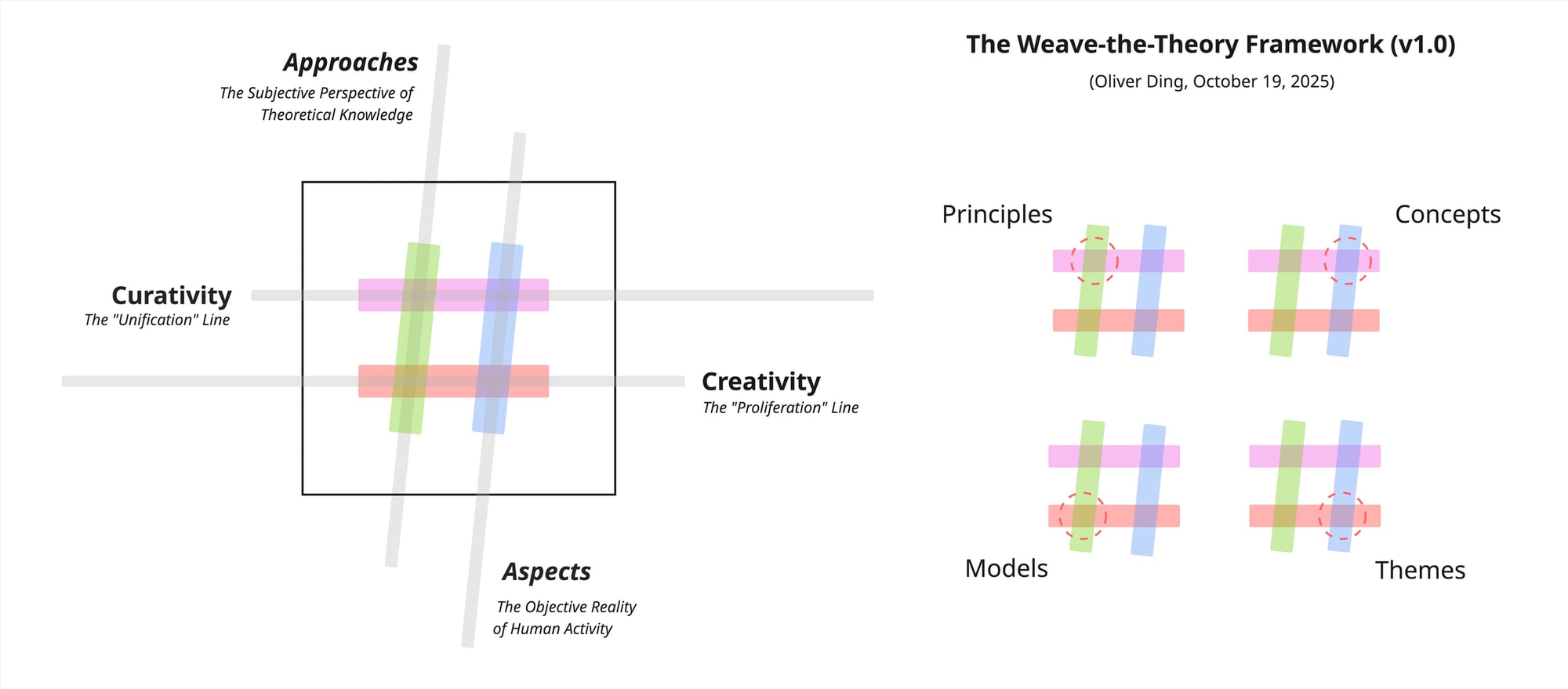
On October 19, 2025, I developed the Weave-the-Theory Framework (v1.0) to support Theoretical Activity.
Over the past few years, I have worked on connecting theory with practice and developing knowledge frameworks. Eventually, I also studied how theorists develop their theories. While theorists always deal with abstract ideas, what they do can be considered a type of activity. I call this special type of activity Theoretical Activity, which encompasses activities such as building theories, theoretical curation, theory integration, and theorizing. I also distinguish between the individual cognitive level of theoretical projects and the collective, collaborative level involved in building a theoretical enterprise. Both levels belong to Theoretical Activity.
The diagram above provides an abstract model of Theoretical Activity, applied at both the individual and collective levels. It visualizes how theoretical work unfolds across cognitive and social dimensions, offering a conceptual map for understanding the structure and dynamics of theorizing as an activity.
In this model, two diachronic dimensions are defined as follows:
- Creativity: The "Proliferation" Line, representing the expansion and generation of new ideas.
- Curativity: The "Unification" Line, representing the integration and synthesis of existing ideas.
In general, any theory aims to explain practice. This tendency can be divided into two focal objects: Approaches and Aspects.
- Aspects: The objective reality of human activity
- Approaches: The subjective perspective of theoretical knowledge
There are many types of knowledge elements within theoretical approaches. For the Weave-the-Theory framework, I focus on the following four:
- "Principles"
- "Concepts"
- "Models"
- "Themes"
They are assigned to four weave-points, providing a mapping tool for further case studies.
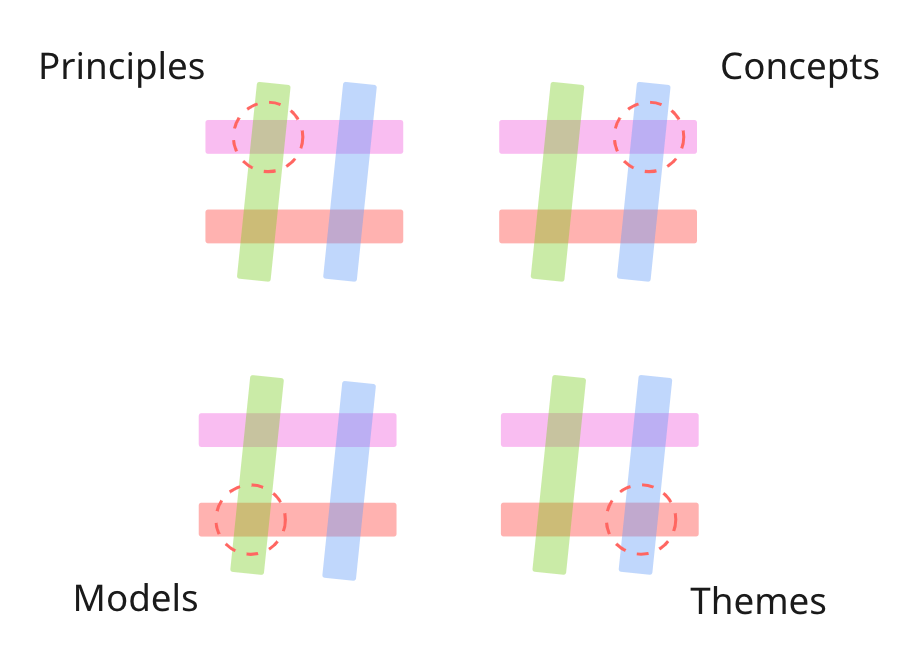
A theoretical approach is formed by a set of core concepts, while principles describe how these concepts interact.
Both concepts and principles are located at a higher, more abstract level, so I placed them at the "Unification" line, associated with Curativity.
In contrast, themes and models are located at a lower, more concrete level, associated with Creativity on the "Proliferation" line.
More details can be found in Creativity, Curativity, and Theoretical Activity.
The Situation
In December 2025, I worked on editing a new book draft to close the Meta-frameworks project. The “Meta-Frameworks” theme emerged from a thematic conversation between my mentor Lui and me in late 2024. Originally, I used “The Self-Life-Mind Schema and Other Creative Heuristics” as a creative clue to the theme. In my conversation with Lui, an anticipatory book on the Self–Life–Mind Schema was planned.
However, my creative journey throughout 2025 dramatically altered my original plan for the anticipatory book.
In 2025, particularly during the second half of the year, my creative focus centered on Creative Life Theory v3.0, which gave rise to a series of book drafts. The work during this period, especially the three drafts produced in the third quarter, explored Meta-Frameworks, Mental Platforms, and Cultural Frameworks. These developments significantly reshaped my original expectations for the anticipatory book.
- November 7, 2025 — Ecological Formism: A Meta-Framework of Meta-Frameworks
- November 30, 2025 — Developmental Projects: The Project Engagement Approach to Adult Development
- December 13, 2025 — The Curativity of Mind: Mental Curation, Mental Platforms, and Mental Moves
These lines of new insights and models encouraged me to re-conceptualize the Meta-frameworks project in a new context: creative heuristics for individual and social development. The term “creative heuristics” refers to both the creative cognitive perspective and the social development perspective. Moreover, Cultural Frameworks became the center focus of the possible book.
On December 19, 2025, I released version 3.0 of the History{Life[Self(Body)]} framework (also known as the HLS framework), utilizing it as a meta-framework for the Meta-frameworks project.
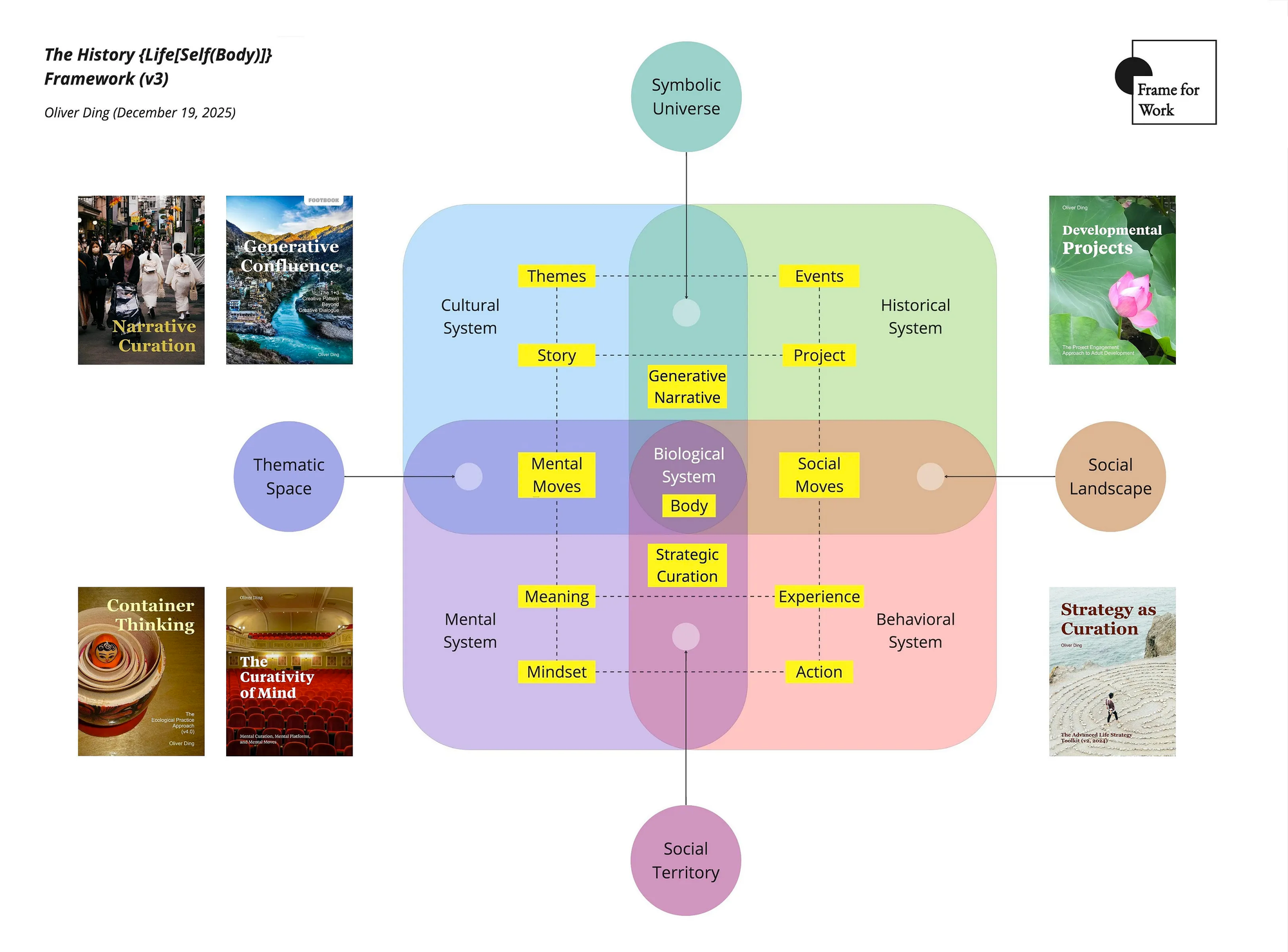
To understand how concept systems impact social life, I adopted the HLS framework to understand the social world through a five-system lens:
- Body System
- Mental System
- Behavioral System
- Cultural System
- Historical System
For the Meta-frameworks project, the HLS framework provides a theoretical ontology of the social world, offering a structured context in which concept systems can be understood and mapped.
Building on the map, I further defined the Six Faces of Concept System:
- Knowledge Frameworks
- Mental Platforms
- Strategic Frameworks
- Cultural Frameworks
- Institutional Frameworks
- Spiritual Frameworks
The HLS Framework and Six Faces of the Concept System offer a landscape of the social world to illustrate how cultural frameworks function with other concept systems to drive social life development and cultural innovation.
The knowledge frameworks I have developed within the past 12 months provide a series of concepts and insights across various perspectives.
To curate these theoretical structures and practical insights together, I need to develop a meta-framework to host these ideas.
To address this challenge, I adopt the Weave-the-Theory Framework (see the diagram below) to guide this process.
Step One: Capture Themes and Models
Over the past few years, I have worked on connecting Theory with Practice, especially the knowledge engagement journey, developing a series of knowledge frameworks, models, diagrams, and methods for understanding knowledge creators’ creative lives and adult development.
During the 2024 Christmas holiday, I had a reflective conversation with a mentor, revisiting my work on HELLO THEORY, GO Theory, and the Strategic Life Narrative project. Through this reflection, I realized my newest focus had shifted toward Cultural Life Development, marking a detachment from Individual Life Development. This strategic move was encapsulated in the theme of “Cultural Grounding/Cultural Growing.”
Over the past 12 months, while I have been working on closing my multi-year journey of Knowledge Engagement and Individual Life Development — culminating in Creative Life Theory v3.1 — I have simultaneously unfolded a new journey of Cultural Development.
In the first step, I reviewed some relevant models that emerged from this unfolding journey.
- The Narrative Curation Framework (Jan 2025)
- The Cultural Genidentity Framework (Feb 2025)
- The "Theory as Thematic Enterprise" Framework (June 2025)
- The “Culture as Thematic Enterprise” Framework (Sept 2025)
- The Frame for Work Canvas (Sept 2025)
- The Weave-the-Narrative Framework (Oct 2025)
- The Cultural Projection Model (Nov 2025)
- Six Faces of the Concept System (Dec 2025)
- The Weave-the-Culture Framework (Dec 2025)
According to the Weave-the-Theory framework, these models and their themes are located at a lower, more concrete level, associated with Creativity on the “Proliferation” line.
The next step requires shifting to the "Unification" line, associated with Curativity.
Step Two: Developing Principles
After reflecting on the HLS Framework, the Six Faces of Concept Systems, and other “themes” and “models” that emerged from my creative journey, I identified the following principles for understanding cultural development as a continuous, dynamic anticipatory activity of creating and curating concept systems and transforming them into thematic enterprises by weaving active agency and evolving structure within the social world.
- Embodied Social Forms
- Evolving Concept Systems
- Double Anticipation
- Double Genidentity
- Double Curativity
- Cultural Attachance
- Generative Confluenct
In The History{Life[Self(Body)]} Framework (v3.0) — Part 3: Reflection, I introduced the term “World of Life” to expand the HLS Framework to a toolkit.
From September 2025 to the present, a new set of knoweldge framework emerged, offering a refined way to understand the social world. Reflection on the HLS framework revealed that this set could be called the World of Life Toolkit:
- HLS framework (v3.0) → Provides a five-system structure of the social world, including individual and social life.
- Weave-the-Culture Framework (2025) → Highlights four mechanisms of cultural development.
- Cultural Projection Model (2025) → Connects Mental Platforms and Cultural Frameworks via the Projecting mechanism and Developmental Projects.
- Function — Context — Knowledge — Activity Schema (2025) → Explors Mental Platforms and Mind within the Context (Mind) layer.
- Meta-Frameworks — in — Context Framework (2025) → Identifies six faces of concept system in the social world.
- Embodied Social Forms Framework (2025) → Connects body-scale experience with deep social cognition.
Together, these knowledge frameworks provide a way to zoom in on the details of the Social World while connecting micro-AAS and macro-AAS.
Within this system, the World of Activity toolkit primarily addresses the Life(Self) layer, whereas the World of Life encompasses broader layers, including History (Culture) and Context (Mind), highlighting the hierarchical and interconnected nature of the knowledge ecosystem.
The Seven Principles can thus be called the “World of Life” Principles.
Step Three: Weaving Concepts as Pathways
After defining a set of principles for a new meta-framework, I returned to the HLS Framework and captured three pathways connecting the individual and collective parts.
The relationship between HLS, Six Faces, and Weave-the-Culture can be understood as a progression:
HLS Framework provides the structural foundation of the social world — History{Life[Self(Body)]} — defining five major systems (Body, Mental, Behavioral, Cultural, Historical) and their nested relationships.
Six Faces of Concept Systems identifies where concept systems are distributed within this structure: Mental Platforms, Strategic Frameworks, Cultural Frameworks, and Institutional Frameworks at the center, with Knowledge Frameworks and Spiritual Frameworks as two outliers marking the boundaries.
Weave-the-Culture Model reveals how these concept systems operate through four mechanisms — showing not just where they are, but how they weave together to drive cultural development.
The Weave-the-Culture Model begins with a simple square representing the World of Life — the social world in which all human lives unfold. This square is bounded by four edges:
- Upper boundary: Spirituality (the limit of ultimate meaning and transcendent significance)
- Lower boundary: Science (the limit of material patterns and natural laws)
These two outliers, identified in the Six Faces model, mark the upper and lower boundaries of the operational zone where cultural development happens.
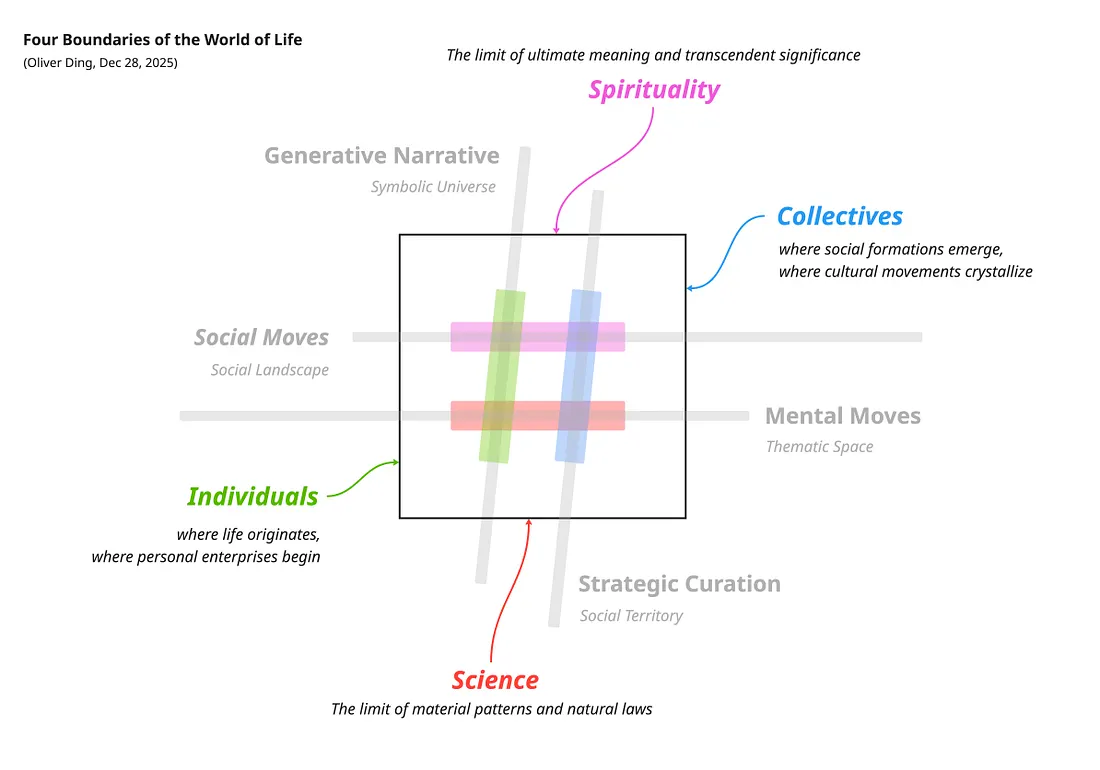
- Left side: Individuals (where life originates, where personal enterprises begin)
- Right side: Collective (where social formations emerge, where cultural movements crystallize)
Based on the landscape of the World of Life, I employ three pathways to weave a series of concepts together, mapping the journey of Cultural Development:
- The Individual Pathway: Mental Platform + Strategic Frameworks → Strategic Curation → Objective — Object Fit → Achievement Chain → Thematic Enterprise → Tiny Culture
- The Collective Pathway: Cultural Frameworks + Institutional Frameworks → Generative Narrative → Sociocultural — Technological Fit → Event Chain → Social Movement → Mega Culture
- The Connecting Bridge: Project Engagement: Outside, Projecting, and Inside → Mental Platforms + Cultural Frameworks → Events + Projects → Mental Moves + Social Moves → Enterprise + Activity →Life Themes + Cultural Themes → Life + History
The model echoes the Weave-the-Life framework and related models.
The Weave-the-Life Framework bridges Activity as Project Engagement and Life-History Topology, illustrating how the former unfolds into the latter.
Activity as Project Engagement serves as the fundamental ontology of the Life-as-Activity Approach, while the other two components expand this perspective into an extended ontology, viewing life as a project chain and history as a chain of events.

To establish this extended ontology, I employed “synchronic mapping” to describe the immediate Event–Project correspondence, and “diachronic unfolding” to capture the development of a chain of Projects and a chain of Events.
While Life emerges from the diachronic unfolding of the chain of projects, History emerges from the diachronic unfolding of the chain of events.
The Life-History Topology provides a model for understanding these processes at the macro level.

This model was inspired by the Project Engagement approach and the Themes of Practice approach. The pair of concepts “Event — Project” belongs to the Project Engagement approach, while the pair “Life Themes — Cultural Themes” comes from the Themes of Practice framework.
Andy Blunden notes that a project-oriented approach belongs to both psychology and sociology:
A project is a focus for an individual’s motivation, the indispensable vehicle for the exercise of their will and thus the key determinant of their psychology and the process which produces and reproduces the social fabric. Projects, therefore, give direct expression to the identity of the sciences of the mind and the social sciences. Projects belong to both; a project is a concept of both psychology and sociology. (2014, p.15)
In this light, the concept of Life can be understood as both Collective Life and Individual Life. The concept of Project provides a way to make sense of both. A person’s real life is a set of concrete actions, and the notion of Project offers a way to curate and integrate these actions. Likewise, Collective Life can also be curated through projects.
Life can be seen as the diachronic unfolding of a chain of projects, just as history can be seen as the diachronic unfolding of a chain of events.
While Life is a chain of projects, it can also be understood as a journey of moving between various thematic spaces. Each project has primary themes as well as secondary themes. By joining and leaving projects, we enact our significant Life Themes. In this sense, projects themselves can also be understood as Thematic Spaces.
As I mentioned on October 14, 2025, in Life-as-Activity: The Weave-the-Life Framework (v2.0):
The Life-History Topology was introduced in 2022; however, the details of unfolding the chain had not yet been fully explored.
The Weave-the-Life Framework now employs two synchronic dimensions and two diachronic dimensions to map “Activity as Project Engagement” onto the Life-History Topology, clarifying the previously missing details.
Although the framework currently presents only three diagrams, its underlying method, together with the Weave Basic Form, provides an open yet systematic approach for exploring Life as Activity.
Now, the HLS framework and the World of Life (World of Activity) landscape offer a new home for the Life-History Topology and the Weave-the-Life Framework.
Step Four: Making a Toolkit
After framing the landscape and defining the pathways, we are ready to select a collection of models to build the Weave-the-Culture toolkit, designed to manage the complexity of cultural innovation. By synthesizing the five frameworks developed throughout 2025, the toolkit can now be regarded as a unified engine comprising three specialized modules:
4.1 The HLS Mapping Module (The Landscape)
Based on the Six Faces of Concept System, this module provides the “topographic map” of the social world. It allows users to identify where their concept currently resides:
- Is it a Mental Platform supporting individual thought?
- Is it a Strategic Framework guiding a specific project?
- Or has it scaled into a Cultural Framework or Institutional Framework?
This mapping prevents “category errors” in cultural work, ensuring that we apply the right logic to the right scale.
4.2 The Projective Engine (The Connection)
The Cultural Projection Model serves as the toolkit’s engine, facilitating the flow between the “Inside” (Subjective Enterprise) and the “Outside” (Objective Activity).
- It utilizes Project Engagement as the primary unit of analysis.
- By transforming Events into Projects (and vice versa), this module explains how individual energy is channeled into social structures.
- It bridges the gap between Life Themes and Cultural Themes, making personal meaning socially relevant.
Concept systems are all invoved on the project engagement process.
4.3 The Narrative Weaver (The Operation)
The Weave-the-Narrative Framework provides the “fine-tuning” tools for social alignment.
- The Narrative Relevance Model helps actors navigate the tensions between “Voice” (individual expression) and “Speech” (collective consensus).
- It identifies the specific Weave-points where disparate knowledge elements can be curated into a new, cohesive system.
- This module is essential for managing the “misfits” that occur when moving between different meta-frameworks.
4.4. The Evolutionary Result (The Outcome)
Finally, the toolkit defines the two terminal states of cultural development:
- Tiny Culture: The successful crystallization of a thematic enterprise at the individual or small-group level (derived from the Culture as Thematic Enterprise framework).
- Mega Culture: The large-scale historical system resulting from social movements and institutionalization (derived from the HLS/Historical System transition).
- The Life-History Topology weaves life themes and cultural themes together.
In summary, the toolkit provides the Map (HLS), the Engine (Projection), and the Needle (Narrative) required to weave the fabric of a new culture.
More details can be found in Weave the Culture: One Meta-Framework and Four Mechanisms of Cultural Development.
v1.0 - December 31, 2025 - 2,660 words