
Weave the Theory: A Case Study of the Revisiting-Rebuilding Practice
Reflecting on the Revisiting-Rebuilding (RR) Practice
by Oliver Ding
March 22, 2026
From September 2025 to March 2026 — a span of just six months — an unexpectedly large body of RR practice emerged. As described in detail in the preceding sections, these practices varied in form, scale, and trigger: some arose from the editorial rhythm of the AAT column, others from spontaneous encounters, conversations, or the pressure of current theoretical work. And alongside the practices, my thinking about RR as a theme kept shifting — each new instance adding something to the picture, each new recognition changing what the previous instances looked like in retrospect.
The journey described above has told that story in full. Here, I want to step back and use the Weave the Theory model to reflect on the journey at a theoretical level — to weave what has been lived and discovered into a coherent framework.
1. The Weave-the-Theory Framework
The Weave-the-Theory Framework (v1.0, October 2025) is a model for understanding how theoretical work unfolds across cognitive and social dimensions. It organizes theoretical knowledge around two diachronic lines and four weave-points.
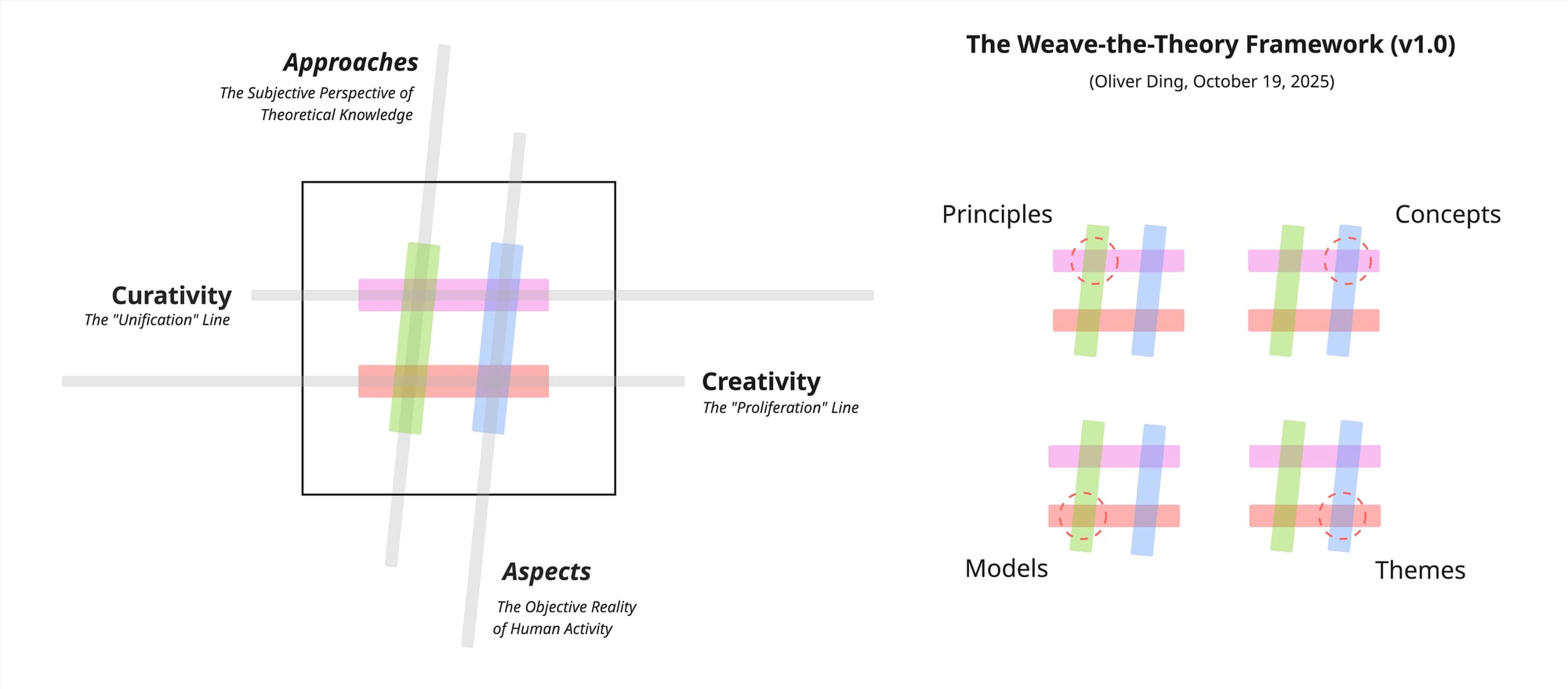
The two lines are: the Creativity Line — the "Proliferation" line, representing the expansion and generation of new ideas at a more concrete level; and the Curativity Line — the "Unification" line, representing the integration and synthesis of existing ideas at a more abstract level. Along the Creativity Line sit Themes and Models; along the Curativity Line sit Concepts and Principles.
The four weave-points — Theme, Model, Concept, Principle — are not sequential stages but intersecting dimensions of the same theoretical activity. A Theme is a lived, practiced inhabitation of an idea, giving it the texture of experience. A Model is the structural map of how that practice unfolds — its internal dynamic. A Concept is the precisely defined theoretical proposition, grounded in prior intellectual traditions, that the Theme and Model express. A Principle is the governing insight that unifies the whole — the most abstract claim that the theoretical development earns the right to make.
This article uses the framework in a specific way: taking Revisiting–Rebuilding as the starting weave-point — the Theme — and then asking what larger theoretical context surrounds it. What Model does it generate? What Concept does it express? What Principle governs it? In this way, the Weave-the-Theory Framework does not merely describe RR practice. It situates it within a living theoretical system — showing how a named practice connects upward to abstract principles and outward to a wider conceptual ecology.
The four sections that follow present the weave-points in a deliberate order: Theme and Model first (Creativity Line), then Concept and Principle (Curativity Line), moving from the concrete to the abstract.
2. Theme: Revisiting–Rebuilding
A Theme, in the Weave-the-Theory Framework, is a lived, practiced inhabitation of an idea — the texture of experience that gives it reality. That inhabitation emerged gradually, then unmistakably, across the six months documented in this article.
The journey unfolded in several recognizable stages. It began in September 2025 with the opening of the Appropriating Activity Theory column, embedded within the biweekly newsletter rhythm. The structural constraint was simple but consequential: the column article would always be written last, shaped by what the current fortnight had produced. The past was summoned by the present, not browsed at will. In these early issues, the practice was primarily Revisiting — returning to past work and writing its story. Rebuilding had not yet been named.
The naming arrived at issue #9 in January 2026, and it came through an unexpected route. A conversation with a friend — Grace, an education researcher — about Ed.D. programs and Donald Schön's metaphor of the "high ground" and the "swamp" had changed how the column operated. Previously, the column had been driven by my own revisiting: I would return to past work and write its story. This time, the present conversation came first. The dialogue with Grace triggered the revisiting — prompting a return to the 2021 manuscript The ECHO Way — and the revisiting in turn became a way of responding to the present and opening toward future discussion. Past and present were no longer sequential; they were in active dialogue.
In the AAN newsletter that accompanied that issue, I described what had happened:
This issue marks a milestone for the column. Previously, I focused on revisiting the past and writing its story. Now, the column immerses in the present, returns to the past, and moves toward the future. The once singular Re-engagement movement has expanded into a series of flows:
- Re-engagement (discussing Schön's ideas inspired a return to the ECHO Way);
- Creative Dialogue (exploring the theory–practice connection);
- Generative Anticipation (our conversation sparked the theme Education as Anticipatory Activity);
- Co-becoming (debating key issues led to new insights for both of us).
These four flows were not an abstract theoretical scheme. They were a precise description of the lived experience of that exchange with Grace. The once singular movement of Revisiting had expanded. A new pattern had emerged — and it now had a name: Revisiting–Rebuilding. At the same time, the RR strategy was operating at a larger organizational scale — structuring the entire ACS project across four consecutive issues (1, 2, 3, 4), each bureau of agency introduced through present theoretical development and grounded through a past case that had, unknowingly at the time, enacted exactly that pattern.
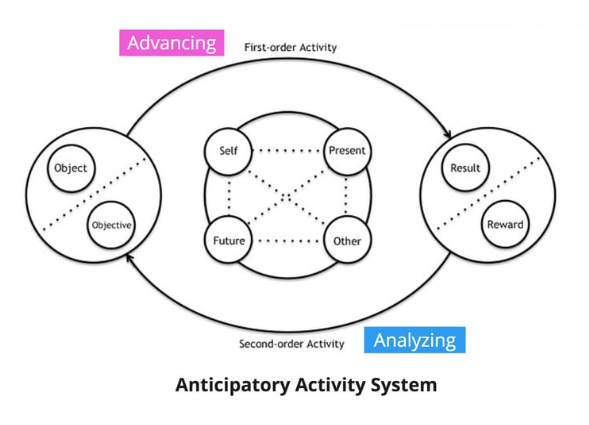
The next shift came on January 25, 2026, with the completion of the first formal RR case study: the Mindentity concept. For the first time, I was not only doing RR but analyzing it — studying the pattern while enacting it. This inaugurated the AA cycle: Advancing and Analyzing simultaneously. The RR practice had become a research project.
The deepest shift came in March 2026, through the two cases drawn from the 2015 Chinese deck — the Learning Landscape and the Significant Themes Framework — and through the recognition they triggered: that re-engaging with past work is, at its deepest level, re-engaging with past selves. The person who had created that deck was not the person revisiting it. The distance between them was not only temporal but identity-level. Revisiting–Rebuilding, understood this way, is a strategy not merely for recovering concepts but for enacting a diachronic relationship between past and present creative identities — a relationship that drives the Transformation of Self.
3. Model: AA and the Creative Identity Cascade
Two models have emerged from this journey, operating at different scales.
The first is the Advancing–Analyzing (AA) model. It describes the self-referential dynamic through which the RR practice elevated itself into a research project: Advancing (first-order activity — enacting the practice, producing new theoretical content) and Analyzing (second-order activity — stepping back to study the practice, understand its structure, and name its stages). The AA cycle does not replace the RR practice; it runs alongside it. Each new RR instance is simultaneously a creative act and a data point for the emerging theory of RR. The AA model is what transforms a creative heuristic into a research program.
The second is the Creative Identity Cascade model, developed in the article Revisiting and Rebuilding: Agency Cascade and the Transformation of Self (March 19, 2026). The model's core proposition is that creative work unfolds not as the expression of a single, stable identity but as the progressive transformation through a cascade of creative identities, each enabled by the one before it — a process in which the Other of each level becomes the Self of the next.
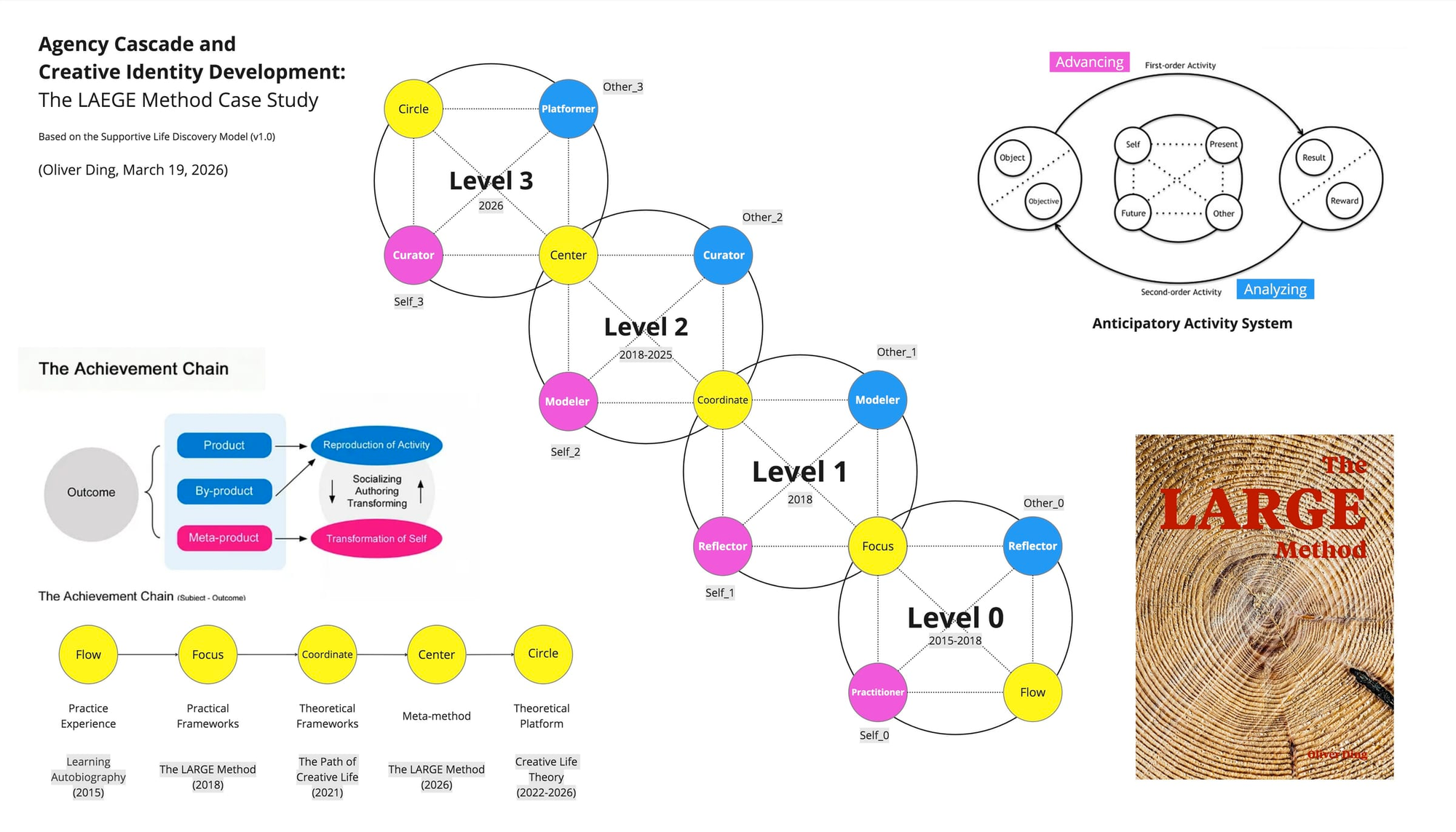
Applied to the RR journey, the cascade reveals that returning to earlier work is not merely a retrieval operation. It is the enactment of a diachronic Self-Other relationship: the past creative identity, reactivated through Revisiting, becomes the raw material that the present creative identity transforms through Rebuilding. The gap between them — measured not in years alone but in accumulated creative identities — is precisely what makes genuine Rebuilding possible.
Together, the AA model and the Creative Identity Cascade model constitute the analytical architecture of the RR Project: one describing the activity-level dynamic of practice-and-research, the other describing the identity-level dynamic of past-self-and-present-self.
4. Concept: Re-Engagement
Moving from the Creativity Line to the Curativity Line means moving from the concrete to the abstract — from the lived practice and its structural models to the underlying concept that gives them their theoretical coherence. At this level, the question is: what is the deeper idea that Revisiting–Rebuilding expresses? The answer is Re-Engagement.
The presence of Re-Engagement at this level was not a retrospective discovery. It had already been surfacing in the most natural of ways. On December 31, 2025, I chose Re-engagement as one of the two annual themes for 2026 — a cultural aspiration offered to readers as a spirit for the year ahead. Then, after the exchange with Grace, I used the same concept to name what had happened in that conversation: the four flows of Re-engagement, Creative Dialogue, Generative Anticipation, and Co-becoming were a precise description of a lived experience. The concept was already at work, already being used to make sense of what was happening — long before this theoretical reflection made the connection explicit.
The Re-Engagement concept was born in March 2020, during the early days of the pandemic. On March 6, 2020, Austin's Mayor announced the cancellation of SXSW — a 34-year annual festival scheduled for March 13–22 — due to the coronavirus outbreak. While the obvious response to canceled offline events was to move online through Zoom or virtual conferencing (Plan B), a different possibility presented itself: Re-Engagement as Plan C.
The idea drew on something universal. We all have experiences of remembering someone, someday, somewhere — of returning, across time, to something that once mattered. A son wearing mismatched socks on Dr. Seuss' birthday, March 1, 2017: a personal memory meeting a collective one, a small creative act in the space between them. Re-Engagement names the creative potential in that space — not nostalgia, but generative return.
The concept quickly found its theoretical grounding. Reading the 2019 book Perception as Information Detection — in which 16 ecological psychologists offered a chapter-by-chapter update and reflection on Gibson's landmark 1979 volume — revealed Re-Engagement operating in the academic field: a collective return to a foundational work, producing something new from the encounter. This was not mere commemoration. It was creative dialogue across time.
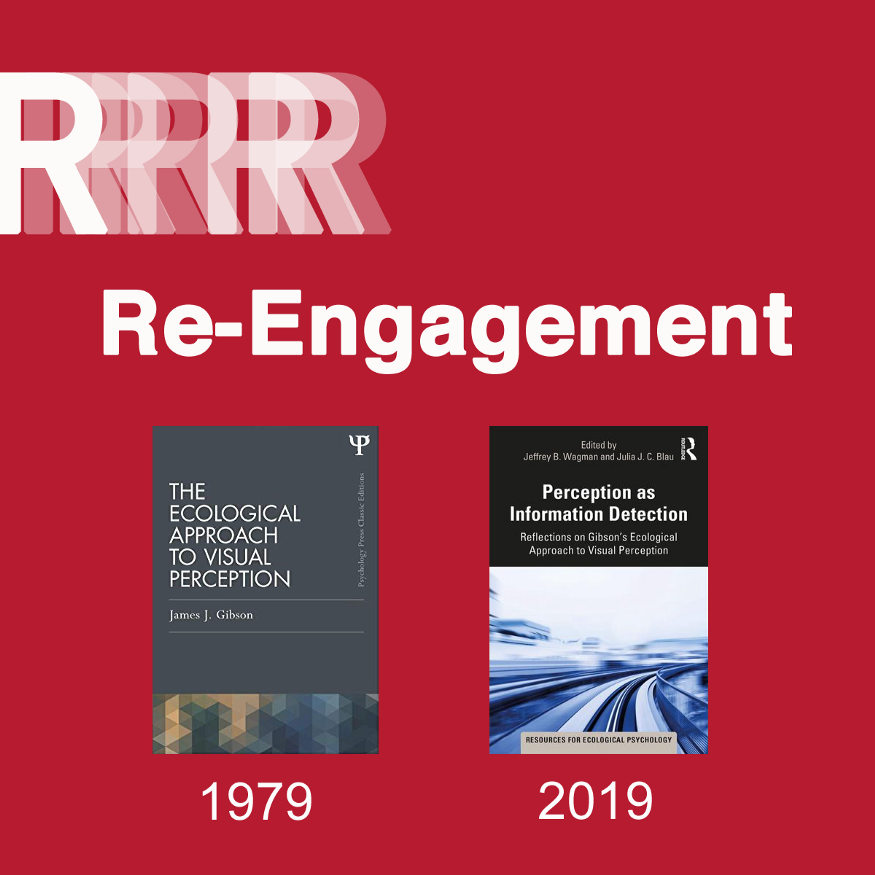
In Project-oriented Activity Theory, activity is understood as a process of formation of a concept. So the concept of Re-Engagement refers to a series of projects that embed it as their primary theme. To encourage people to practice this theme, I coined the "Re-Engagement Project" as a pattern and a call to action.
That collective dimension was concretely enacted in April 2021, when friends hosted a two-month online discussion program centered on the Whole Earth Catalog — a counterculture magazine published by Stewart Brand between 1968 and 1972. The BACK TO W.E.C. project used a virtual whiteboard to share ideas and organize weekly real-time meetings, each focusing on one chapter of the original publication. Invited to join as a researcher, I recognized that Re-Engagement was one of the program's central themes: as a social gathering, it focused not only on the content of the Catalog but on the practice of collectively returning to and re-experiencing something meaningful from the past.
The concept continued to be actively practiced in the years that followed. In the first four months of 2023, a sustained engagement with theoretical sociologist Ping-keung Lui's book Gaze, Actions, and the Social World — reading it chapter by chapter and writing a corresponding note for each — was explicitly organized as a Re-Engagement passion project. The recognition arrived after sending the first few notes to Lui: replaying another thinker's theoretical development journey, while reflecting on one's own ongoing projects, was precisely what Re-Engagement described. The project produced 15 notes totaling 228 pages, and its outcomes included the foundations of Creative Life Theory (v2.0).
Looking back now, there is an unexpected finding worth noting. On December 31, 2025, the eighth issue of the ActivityAnalysis Network was sent with the title Re-engagement and Co-becoming — a New Year greeting that designated these two themes as the spirit of 2026. At the time, they were offered as cultural aspirations: Re-engagement as the invitation to rediscover and reconnect with what has been, Co-becoming as the anticipatory movement toward what might be created together. What neither I nor the readers could have fully seen at that moment was that the six months of RR practice already underway — and the months that would follow — were precisely the enactment of those themes. The annual greeting was not prescribing a program. It was naming, in advance, what was already happening. The concept of Re-Engagement had, quietly and without announcement, begun living itself out.
This article is itself another instance of that inhabitation. The journey documented in these pages — returning to past work across seven months, tracing how concepts evolved, recognizing past selves in earlier materials — is an extended Re-Engagement practice. What changed in 2025–2026 was not the practice itself but its structural conditions: the newsletter rhythm, the editorial constraint of writing the column last, the accumulated theoretical resources that made Rebuilding — not just Revisiting — possible at a new level of depth. Re-Engagement had found its most elaborated form.
5. Principle: L(A·R·G)=E
The governing principle underlying the entire framework is the LARGE Method (2026), expressed as the formula L(A·R·G)=E — Landscape, Anticipation, Reflection, Generation, Enterprise. As developed in Agency Cascade and the Transformation of Self, each of the five principles takes on a specific meaning when applied to the question of creative identity development through RR practice.
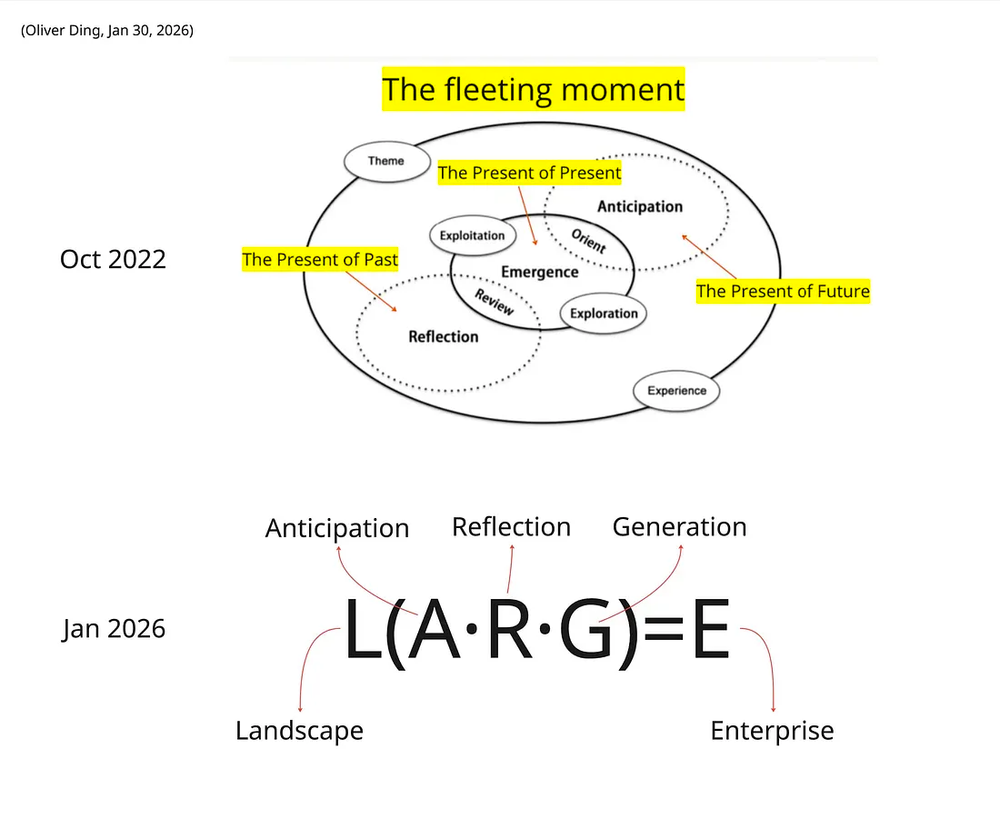
Landscape (L) is the synchronic view — the capacity to step back and see one's full creative identity cascade, recognizing which identities have been enacted, which are currently active, and which are anticipated. Without Landscape, a creator is immersed in the present level without seeing the trajectory it is part of.
Anticipation (A) is the forward orientation toward the Anticipated Identity — the Other of the current level, not yet enacted but already shaping the direction of present activity. Without Anticipation, a creator remains at the current level indefinitely, advancing without any sense of where the advancing is going.
Reflection (R) is the act of Revisiting — returning to earlier creative identities, reactivating dormant thematic spaces, recovering the generative potential of what has been lived but not yet fully built upon.
Generation (G) is the act of Rebuilding — using the current creative identity to transform what has been Revisited into something new. Not repetition but transformation: the past material reconstituted through the lens of a more developed present self.
Enterprise (E) is the Creative Identity Cascade itself — the long-arc trajectory through which successive creative identities unfold, each enabling the next, across years and decades of project chains.
The multiplicative relationship between A, R, and G — rather than additive — means that all three must be active simultaneously. Anticipation without Reflection produces forward momentum with no roots. Reflection without Generation produces retrospection with no transformation. Generation without Anticipation produces activity with no direction. Only when all three operate together, within the spatial awareness that Landscape provides, does Enterprise — the sustained development of a creative identity across time — become possible.
This is the principle that the six months of RR practice documented in this article have, in the end, distilled. The past is not a fixed archive. It is a depth that rewards those who are willing to dive — and patient enough to surface with something that could not have been found before.
V1.0 - March 22, 2026 - 2,653 words