
Developmental Projects (book, v1, 2025)

The Project Engagement Approach to Adult Development
by Oliver Ding
November 30, 2025
This article introduces a new possible book, Developmental Projects: The Project Engagement Approach to Adult Development, and outlines the intellectual trajectory that led to its emergence.
The Project Engagement Approach is a project-centered social theory inspired by Andy Blunden’s notion of the “project as a unit of analysis of activity.” Since 2021, its development has aimed to establish “Project” as a conceptual foundation for cross-disciplinary research, creative dialogue, and deeper reflection on human development.
Over the past several years, the creative journey behind the approach has produced several book drafts:
- Project-oriented Activity Theory (2021)
- Project Engagement (2022, Chinese)
- Advanced Life Strategy (2022)
- Mapping Developmental Projects (2023)
- Mapping Creative Dialogue (2024)
- Inside, Outside, and Projectivity (2024, Chinese)
- Strategic Moves (2024)
Version 3.1 of the approach was first introduced in the Chinese draft Inside, Outside, and Projectivity (August 2024). Because this major conceptual update existed only in Chinese, I had long wanted to produce an English manuscript that could present v3.1 in a systematic and accessible way. The idea of preparing an English book gradually became more concrete as I continued writing articles, case studies, and diagrams throughout 2024 and 2025.
The publication of The Creative Identity Engagement Framework on November 12, 2025, marked a turning point. It prompted me to consider gathering recent writings — on themes, identity, enterprise, and adult development — into a new book draft. Several case studies on gap projects also revealed recurring developmental patterns, suggesting that the time had come to curate and synthesize these materials.
The present article reflects the result of my work from November 15 to November 30, when I began the initial editorial work for the new English book draft. During these two weeks, I produced three theoretical articles and designed a framework to curate earlier writings.
While the forthcoming book intends to offer a practical toolkit for applying the “Developmental Project” concept to adult development, these new theoretical contributions also advance the Project Engagement Approach to version 4.0.
Contents
1. An Ecological Metaphor
2. The Living Way of a Concept
3. The Evolution of the Theory
4. Core Innovations
5. Positioning the Book: “Toward Adult Development”
6. Toward Dramatic Life Patterns
7. How to Use This Book
8. A New Possible Book
1. An Ecological Metaphor
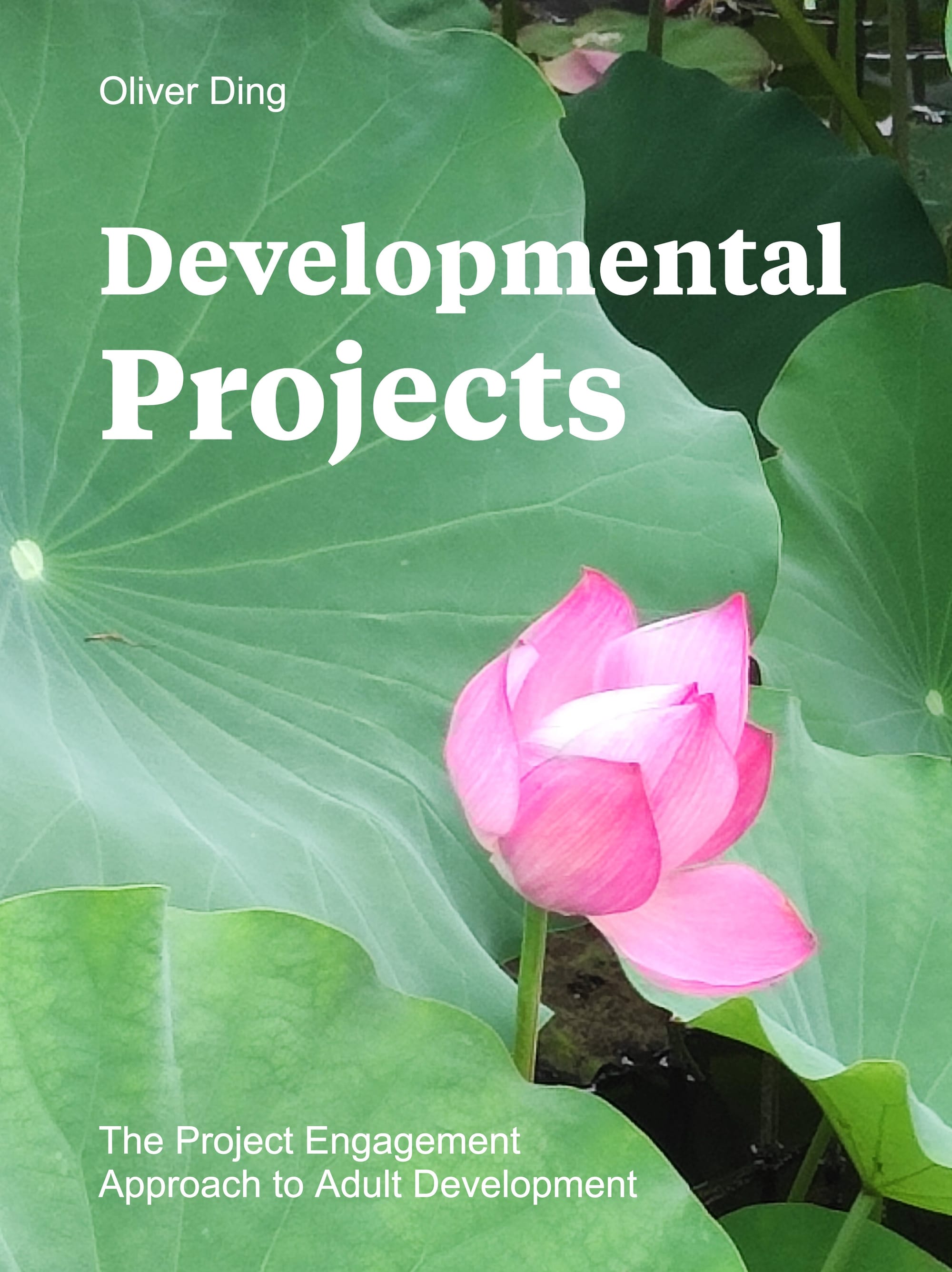
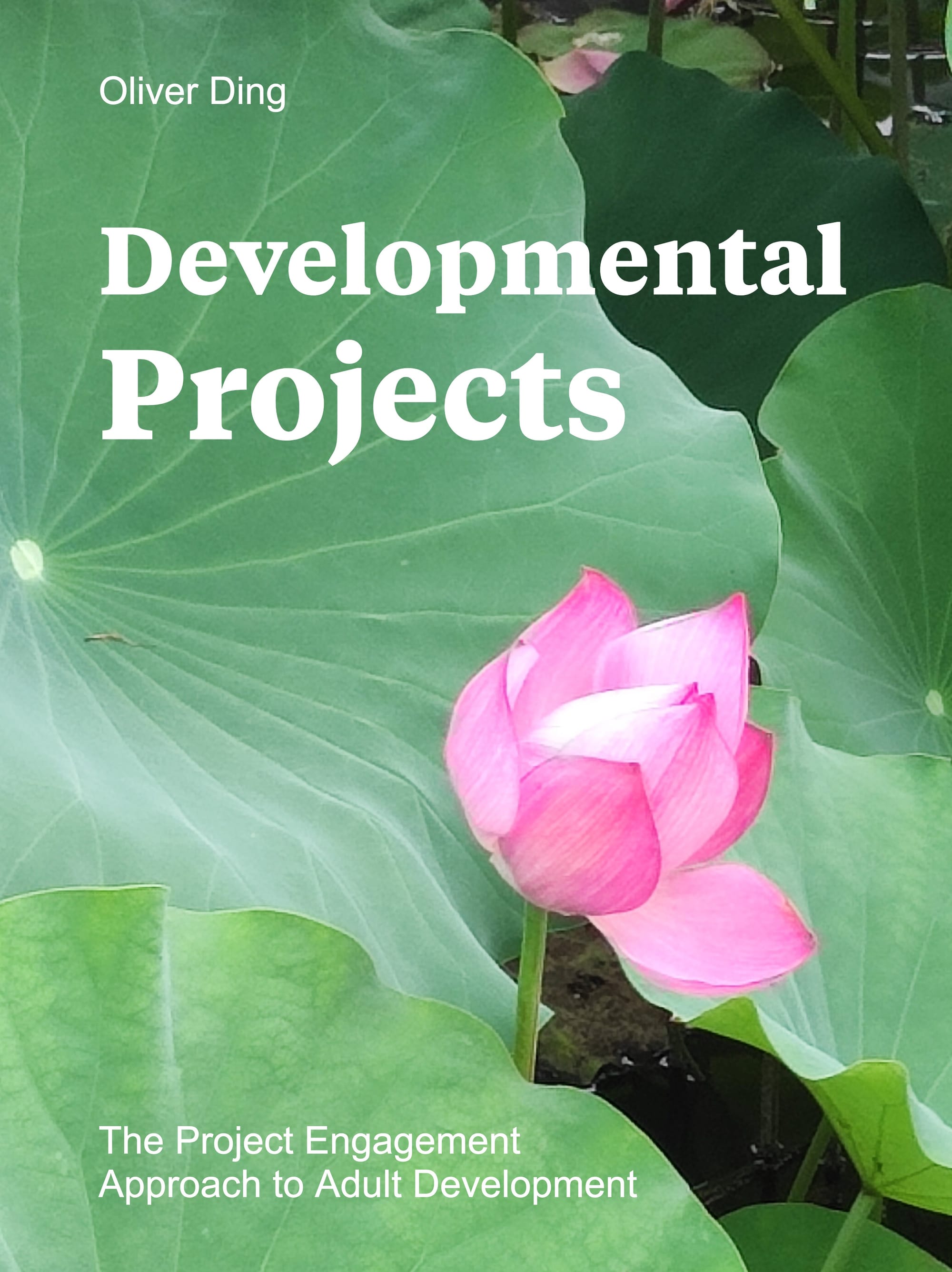
The inspiration for this book emerged from an unexpected visit to a community park in Fuzhou, China, several months ago. There, I came upon a large lotus pond, with leaves covering about a third of the water, dotted with blooming lotus flowers. This familiar yet beautiful scene suddenly brought back cherished childhood memories of lotus ponds, leaves, flowers, and seeds.
This ecological imagery serves as a guiding metaphor for the core ideas of the “Developmental Project” concept:
• The Lotus Pond represents the Social Context or environment in which an actor is situated and where developmental projects are embedded.
• The Lotus Flower symbolizes the actor’s mind and agency. It corresponds to the Theme in the Developmental Project Model, mirroring how the Theme is often the most salient and appealing part of a project.
The Lotus Leaf corresponds to the Identity in the Developmental Project Model. Each leaf has its own shape and position, reflecting its identity and governing the three elements of the situational context.
• The Lotus Seed symbolizes Project Outcomes and the larger Enterprise generated across a series of projects. Just as a seed falling into the mud grows into a new lotus, a project’s outcome can give rise to new projects, eventually forming an Enterprise.
• The Lotus Rhizome (hidden underwater) represents the Network of developmental projects, connecting different “flowers”, and is essential for connection and resource flow.
The concept of the “Developmental Project” itself is like the lotus flower, blossoming within its environment. It functions as an ecological approach intended to connect individual growth with the social environment.
2. The Living Way of a Concept
This book explores the living way of the “Developmental Project” concept. The concept was not born fully formed; rather, it emerged gradually through a series of knowledge projects undertaken between 2020 and 2025. This journey demonstrates how theoretical concepts themselves develop through practice.
Across these years, the continuous application of the concept in diverse contexts expanded both its meaning and its significance, particularly its “developmental” dimension, which had been largely overlooked in the early stages. This evolution reached a critical point in 2025 during what I later called the Creative Swapping moment.

In that moment, the theoretical focus dynamically shifted from “Project” (the central concern from 2021 to 2024) to “Development”. This shift offers a new lens for revisiting and curating earlier works within the broader context of adult development.
For further details, see The Living Way of the “Developmental Project” Concept.
3. The Evolution of the Theory
The Project Engagement Approach — the theoretical framework anchoring the “Developmental Project” concept — has undergone a multi-version evolutionary journey.
v1.0 (2020 - 2021) — Foundation Laid
Developed Project-oriented Activity Theory (draft) and the Project Engagement Toolkit. Introduced the Developmental Project Model (renamed from P4D v1.0) as a foundational framework.
v2.0 / v2.1 (2022) — Scope Expansion
Expanded the analytical scope from the Person — Project relationship to the Project—Project relationship. Introduced the Life-History Topology and the multi-level Project Network model (Themes, Projects, and People).
v3.0 / v3.1 (2024) — Ecological Perspective
Developed the concept of Social Landscape and created the House of Project Engagement as a thematic map and toolkit. Focused on curating frameworks to explore project-oriented social ecology.
v4.0 (2025) — Focus on Development & Dialogues
Marked by the Creative Swapping moment, introduced the concept of Enterprise (subjective experience) and the Cultural Projection Model; and initiated dual theoretical dialogues: one with Activity Theory and another with Confucian thought.
4. Core Innovations
The Project Engagement Approach presents three central theoretical innovations:
4.1 The "Outside — Projecting — Inside" Triad
Building on the Activity Theory principle of internalization–externalization, the Project Engagement Approach introduces the “Outside — Projecting — Inside” triad as a basic ecological form for describing how individuals engage with social environments. A project is defined as a primary type of social environment.
• Outside: The person observes ongoing activities while remaining external to the project.
• Projecting: The movement of taking action to enter the project.
• Inside: The person is actively engaged in the project.
4.2 The Cultural Projection Model
The Cultural Projection Model curates newly developed ideas, supported by the “Outside — Projecting — Inside” triad. It is framed by three conceptual containers:
- Container X: Activity (Objective Process) — Represents Social Landscapes and Social Moves
- Container Y: Enterprise (Subjective Experience) — Represents Thematic Spaces and Mental Moves
- Container Z: Projecting (Cultural Projection) — Represents the moves between the outside space and the inside space of the Project.

The model visually integrates objective processes (Activity) and subjective experience (Enterprise) through Projecting.
4.3 Dual Theoretical Dialogues
The approach facilitates two crucial intellectual conversations:
- Project Engagement Approach vs. Ecological Practice Approach: This dialogue bridges Activity Theory and Ecological Psychology. It introduced the concept of Projectivity, which refers to potential action opportunities for development. Like Gibson’s Affordance and my concept of Supportance, Projectivity captures the deep structure of the reciprocal relationship between environment and organism.
- Activity Theory (Internalization-Externalization) vs. Confucian Thought (Inner Sageliness-Outer Kingliness): By placing Inner Sageliness (referring to subjective elements like Mental Platform, Life Themes) and Outer Kingliness (referring to objective elements like Cultural Frameworks, Social Norms) into the Cultural Projection Model, this dialogue identifies a deeper structural resonance between the two traditions.
This cross-cultural comparison suggests that the “Outside — Projecting—Inside” triad is potentially a cross-cultural general structure of social formation.
More details can be found in The Cultural Projection Model (2025).
5. Positioning the Book: “Toward Adult Development”
This book, Developmental Projects: The Project Engagement Approach to Adult Development, is positioned at the intersection of Project Engagement and Adult Development. The subtitle marks the moment when the theoretical focus shifted from “Project” to “Development”.
5.1 Project as Both Unit of Analysis and Container of Development:
The book adopts two complementary perspectives, addressing both researchers and actors.
For researchers, the Project serves as a unit of analysis. Drawing on Andy Blunden’s work, the Project concept functions as an interdisciplinary concept, meeting the needs of both the sciences of the mind (psychology) and the social sciences (sociology). It acts as an indispensable vehicle for the exercise of individual will and as a key determinant of psychological processes, while simultaneously expressing the mechanisms that reproduce the social fabric.
For actors, a project functions as a container of development — a social environment for adult development. By participating in a project, a person can enhance or expand their life themes and creative identities. Projects are also conceptualized as Thematic Spaces (abstract containers), while their surrounding environments, such as digital platforms, are treated as Social Landscapes (concrete containers).
5.2 The Toolkit of Five Core Frameworks
This book is structured around the understanding that Developmental Project serve as the fundamental unit of action that drives the maturation of a Creative Enterprise. The Project Engagement Approach models this entire developmental process, from initial conceptualization to a scaled platform.
The Enterprise Development Framework, specifically, charts this journey through five primary stages: Creative Theme, Scalable Focus, Center Development, Value Circle, and eventually, the Developmental Platform. Developmental Projects are relevant at all these stages, guiding both project-level action and enterprise-level evolution.
This evolution is fundamentally supported by six key functions that are crucial for managing creative enterprises and developmental projects. These functions define the primary areas of capacity development throughout an individual’s life:
- Discovery
- Curation
- Strategy
- Narrative
- Design
- Support
Based on this overarching framework, the most relevant knowledge frameworks and models have been curated to constitute a highly practical toolkit for adult development. These frameworks provide structured methods for addressing the complex dynamics of projects, identity, and long-term enterprise development.
The core of this practical toolkit, presented in Chapter 2: Toolkit, features six foundational frameworks:
- The Developmental Project Model
- The Ecological Camp Framework
- The ECHO Way (v2.0)
- The Thematic Identity Curation Framework
- The Enterprise Development Framework
- The Weave-the-Life Framework (v2.0)
Together, these five frameworks form a robust, integrated concept system for understanding and facilitating adult development through project engagement.
6. Toward Dramatic Life Patterns
While the main body of this book establishes the theoretical foundations, toolkit, and six functional themes of development, the Epilogue introduces an emerging dimension of the “Developmental Projects” concept: Pattern.
This dimension addresses a question distinct from functions: How does development unfold? Functions describe what we do (e.g., curate experiences or develop strategies), whereas patterns describe the structural configurations through which development unfolds across time and space.
Through the case studies and projects documented in this book, several key patterns have already been identified.
- GAP Projects
- Creative Life Curation
- Creative Life Discovery
- Curation as Closure (1E)
- Write after Talk (2S)
- Anticipatory Analogy
Focusing on pattern recognition shifts development from a reactive process to an anticipatory and strategic one. It introduces a fundamental methodological innovation: reframing ecological validity as a practice for actors themselves, rather than solely for researchers.
7. How to Use the Book
The book is organized into seven parts, providing a clear and navigable structure for readers:
- Part 1 (Foundation D) — D stands for Development. This part focuses on the theoretical foundation and toolkit for adult development.
- Part 2 (Theme U) — U stands for YOU. Theme U is the name of a model. This part focuses on the concept of Theme, related knowledge frameworks, and case studies.
- Part 3 (Identity G) — G stands for Genidentity. This part emphasizes Creative Identity Engagement, applying the concept of Genidentity to the Person, Project, and Enterprise levels.
- Part 4 (Project I) — I stands for I. Project I is the name of a model. This part focuses on the Developmental Project Model and its situational versions.
- Part 5 (Enterprise P) — P stands for Platform. This part connects the Developmental Project and the Developmental Platform, forming the Enterprise Development Framework.
- Part 6 (Container Z) — Container Z refers to a model, the third container of a creative dialogue. This part focuses on Creative Dialogue, a key strategy in adult development. Related case studies and the Dialectic Room meta-diagram are introduced.
- Part 7 (Strategy A) — A stands for Agency. This part focuses on the development of the mental platform and strategic agency. Related tools and methods are introduced, such as Mapping Strategic Moves with the House of Project Engagement.
The book’s framework supports different modes of engagement:
- Theoretical Scholars: May begin with Part 1 (Foundation D) to examine the theoretical dialogues underpinning the approach.
- Practitioners and Knowledge Workers: Can utilize the tools in Part 2 through Part 7 to guide personal development, identity curation, and enterprise development. For example, Part 7 (Strategy A) provides the House of Project Engagement map for plotting life courses and strategic moves.
- Readers Seeking Reflection: Can focus on the temporal dimension discussed through GAP Projects — informal activities that occur between formal projects for reflection and exploration.
8. A New Possible Book
The new possible book curates articles written from 2020 to 2025, focusing on themes, identity, and enterprise, all deeply related to adult development.
Some numbers about v1.0 of the possible book:
- 7 parts
- 20 chapters
- 66 articles
- 1,380 minutes of reading time
- 365,700 words (about 730 single-spaced pages)
Contents
Prologue
Part 1: Foundation D
D stands for Development, and this foundational part provides the necessary theoretical base and practical toolkit for Adult Development.
Chapter 1 establishes the theoretical foundation, beginning with Lev Vygotsky’s late ideas on the “Ecological Mind,” which considers the interaction between the social environment and individual growth, positioning the project as a typical social environment for adult development. The second article in this chapter reviews the history of Activity Theory and introduces the core “Outside — Projecting — Inside” triad and the Cultural Projection Model, expanding Activity Theory’s principle of internalization–externalization. Further theoretical depth is achieved by introducing the concepts of Projectivity and Supportance, which explain the potential action possibilities present in the social environment. The chapter concludes by presenting the complete Landscape of the Project Engagement Approach for comprehensive reader reference.
Chapter 2 operationalizes this theoretical foundation. Built upon the foundational Developmental Project Model, this chapter collects five core knowledge frameworks which form a practical toolkit specifically designed for Adult Development. This collection of tools aims to translate the theoretical concepts introduced in Chapter 1 into actionable methods and frameworks for practice.
Chapter 1: Theory
- Toward a Project-Oriented Ecology of Adult Development — 35 min
- Project Engagement: Outside, Projecting, and Inside — 37 min
- The Concept of “Projectivity” — 2077 words
- Supportance and Developmental Platform — 20 min
- The Landscape of the Project Engagement Approach — 2,464 words
Chapter 2: Toolkit
- The Developmental Project Model — 2,725 words
- The Ecological Camp Framework — 2,671 words
- The ECHO Way (v2.0) — 15 min
- The Thematic Identity Curation Framework — 4,343 words
- The Enterprise Development Framework — 45 min, 10,838 words
- The Weave-the-Life Framework (v2.0) — 2,943 words
Part 2: Theme U
U stands for YOU. Theme U is the name of a model. This part focuses on the concept of Theme, related knowledge frameworks, and case studies.
Chapter 3 introduces the foundational understanding of life themes — their classifications, structure, and applications, including career-related themes.
Chapter 4 presents the Theme U diagram and the Creative Thematic Curation Framework, a systematic approach to capturing an evolving creative theme and its landscape.
Chapter 5 examines how themes unfold in context, illustrating their dynamics across different temporal scales: short-term (10-day trips), medium-term (annual themes), and long-term (life-spanning thematic spaces).
Chapter 3: Life Themes
- Creative Themes — 12 min — Nov 8, 2024
- Life Stories and Creative Themes — 9 min — Jan 6, 2023
- The Career Theme Canvas — 4 min — July 24, 2021
Chapter 4: Frameworks for Theamtic Analysis
- The Creative Thematic Curation Framework — 8965 words — Mar 25, 2025
- Theme U for Single-theory Curation — 23 min — June 19, 2022
- Theme U: The Development of AAS (2021 — 2022) — 4,012 words
Chapter 5: Themes in Context
- The ECHO Trip: A 10-day Road Trip and Creative Life Curation — 24 min — July 27, 2023
- One 10-day Road Trip, 21 Thematic Cards — 11 min — Aug 8, 2023
- Oliver Ding’s Seventeen Creative Themes of 2024 –10 min — Jan 14, 2025
- Oliver Ding’s 2025 Annual Themes — 8 min — Jan 9, 2025
- Exploring Creative Thematic Spaces with the Knowledge Discovery Canvas — 24 min — Mar 14, 2025
Part 3: Identity G
G stands for Genidentity. This part emphasizes Creative Identity Engagement, applying the concept of Genidentity across the Project, Self, and Enterprise levels.
Chapter 6 introduces the Creative Identity Engagement Framework, examining how each project develops a distinct creative identity and how it influences decision-making in project development.
Chapter 7 focuses on the individual as a member of a project, investigating the microdynamics of creative identity and its evolution over time. The Aion-Chronos-Kairos model introduces four types of individual identity.
Chapter 8 integrates both project and self perspectives, presenting the principle of Double Genidentity in the context of enterprise development.
Chapter 6: Identity Development — Project’s Perspective
- The Creative Identity Engagement Framework — 8,773 words — Nov 12, 2025
Chapter 7: Identity Development — Self’s Perspective
- The Microdynamics of Creative Identity — 13 min — Sep 2023
- The Aion Journey (2021–2025) and Time Curation — 46 min — May 2, 2025
- The “Aion-Chronos-Kairos” Schema and Four Types of Identity — 24 min — May 2025
Chapter 8: Enterprise Development and Double Genidentity
- The Principle of Double Genidentity (GO Theory: Love, Learn, and Legacy) — 23 min — Dec 2024
Part 4: Project I
In this book outline, Project I serves as a symbolic label for Part 4, organizing the discussion of Developmental Projects, which are the formal conceptual units analyzed throughout the book. This part explores how Developmental Projects develop, operate, and generate outcomes across time.
Chapter 9 introduces the foundational tools and models for analyzing and structuring Developmental Projects.
Chapter 10 illustrates how Developmental Projects operate in real-world settings, detailing methods for running, modelling, and managing them with practical examples.
Chapter 11 examines special project types and outcome structures, including GAP Projects and the Achievement Chain, highlighting extended patterns of products, by-products, and meta-products.
Chapter 9: Developmental Projects — Concept, Model, and Canvas
- Creative Projects — 30 min — Dec 12, 2024
- Developmental Project Canvas — 6 min — June 2021
Chapter 10: Project Engagement in Practice
- Running A Developmental Project — 9 min — Jun 2022
- Modeling A Developmental Project — 8 min — Mar 29, 2022
- Oliver Ding’s Project Engagement in 2024–3984 — Jan 19, 2025
Chapter 11: GAP Projects and Achievement Chain
- A 5-year Creative Journey and Two “GAP” Projects — 17 min — May 16, 2024
- SEE THE MOVE: Mapping the Strategic Life Project — 11 min — Nov 2024
- The Achievement Chain: Product, By-product, and Meta-product — 9 min — Jan 9, 2022
- The “Result — Reward” Gap and Achievement — 11 min — Feb 19, 2022
Part 5: Enterprise P
P stands for Platform, and this part connects the Developmental Project and the Developmental Platform, forming the Enterprise Development Framework. Developmental Projects are the fundamental action units driving the maturation of a Creative Enterprise toward the Platform form.
Chapter 12 describes this evolution, detailing the five primary development stages of the Enterprise Development Fraemwork: Creative Theme, Scalable Focus, Center Development, Value Circle, and eventually, the Developmental Platform. Developmental Projects remain relevant at all these stages, guiding both project-level action and enterprise-level evolution
The individual's core capacities fundamentally support this evolutionary process. Chapter 13 focuses on the six key functions required to manage Creative Enterprises and Developmental Projects. These functions — Discovery, Curation, Strategy, Narrative, Design, and Support — define the primary areas of capacity development in adult life. This chapter includes representative articles related to each functional theme, with more extensive material available in the author’s other book drafts.
Chapter 12: Enterprise Development
- The Enterprise Development Framework — 45 min — Oct 2025
- Scalable Focus (Footbook, v1, 2025) — 18 min — Apr 26, 2025
- Center Development — 15 min — May 16, 2025
- Value Circle — Center, Circle, and Genidentity (book, v1, 2024) — 27 min — June 1, 2024
- Developmental Platform — 23 min — Feb 25, 2021
Chapter 13: Six Key Functions
- Discovery: The Foolish Explorer and A Trilogy about “Discovery” — 14 min — Jan 29, 2024
- Curation: The Whole Earth Catalog and the BACK TO W.E.C. Program — 25 min — April 4, 2025
- Strategy: The Object — Objective Fit and Opportunity Discovery — 12 min — April 25, 2025
- Narrative: The Weave-the-Narrative Framework — 16 min — Nov 3, 2025
- Design: Ecological Practice Design — 14 min — May 17, 2022
- Support: The Supportive Cycle (v1.0) — 17 min — Feb 9, 2021
Part 6: Container Z
Container Z refers to the third container of a creative dialogue, focusing on Creative Dialogue as a key strategy in adult development. This part explores how structural tensions and oppositions — arising from themes, projects, and contexts — can be navigated to foster individual agency and cognitive growth. The ECHO Way serves as the central framework, integrating Theme U (Part 2), Project I (Part 4), and Container Z itself, culminating in tools such as the Dialectic Room for structured reflection and innovation.
Chapter 14 introduces the ECHO Model, presenting the development and evolution of the ECHO Way and its journey from 2019 to 2021.
Chapter 15 demonstrates practical applications through case studies, including Personal Innovation (Career-fit), Platform Innovation (Concept-fit), and Youth Development (Drama-fit).
Chapter 16 details the Dialectic Room, a meta-diagram and cognitive tool grounded in dialectical principles, providing a systematic method for analyzing creative dialogue and supporting individual agency development.
Chapter 14: The ECHO Model
- The ECHO Way (v2.0) — 15 min — July 1, 2021
- The ECHO Journey (2019–2021) — 33 min — Apr 2025
Chapter 15: Case Studies of the ECHO Way
- Personal Innovation as Career-fit — 22 min — May 25, 2021
- Platform Innovation as Concept-fit — 49 min — Mar 25, 2021
- Youth Development as Drama-fit — 6 min — Jan 2022
Chapter 16: The Dialectic Room
- The Dialectic Room: A Meta-diagram for Innovation — 3,739 words — Oct 2025
- The Dialectic Room: Theoretical Foundations — 2,025 words — Nov 2025
Part 7: Strategy A
A stands for Agency. This part focuses on the development of strategic agency and mental platforms, providing tools and methods to navigate complex life and project decisions. It emphasizes how individuals can integrate knowledge, projects, and personal goals into coherent strategies for action and reflection.
Chapter 17 introduces the Mapping Strategic Moves method and related tools, including the House of Project Engagement, for mapping key moves of projects and actions.
Chapter 18 explores Exploratory Decision-making, presenting structured paths for analyzing Situations, Projects, Journeys, and Landscapes to support informed strategic choices.
Chapter 19 presents the Mental Platform, covering the development of knowledge systems, mental models, and frameworks (including the Weave-the-Mind Framework) to strengthen cognitive and strategic capacities.
Chapter 20 details Strategic Agency, describing its nine aspects and providing practical tools such as the Strategic Thematic Exploration Framework and the Weave-the-Narrative Framework to support long-term life and project strategy.
Chapter 17: Mapping Strategic Moves
- Mapping Strategic Moves with the House of Project Engagement — 19 min — Oct 15, 2024
- Kinds of Project Engagement — 14 min — Nov 2022
Chapter 18: Exploratory Decision-making
- Exploratory Decision-making — 15 min — April 13, 2025
- Situations: The "Public Square — Meet with Others — Settings” path — 30 min — Sep 25, 2024
- Projects: The “Ideas — Possible Projects — Actual Projects” path — 29 min — Sep 20, 2024
- Journey: The “Before — Role Models — After” path — 29 min — Sep 23, 2024
- Landscape: The “Network of Projects — Supportive Platform — Conflict” path — 32 min — Sep 28, 2024
Chapter 19: Mental Platform
- Knowledge System, Mental Platform, and Strategic Agency — 10 min — Nov 10, 2025
- Mental Elements, Mental Models, and Mental Platform — 28 min — Oct 29, 2025
- The Weave-the-Mind Framework — 31 min — Oct 27, 2025
Chapter 20: Strategic Agency
- Nine Aspects of Strategic Agency — 11 min — Feb 1, 2025
- The “Strategic Thematic Exploration” Framework (v1.1) — 10 min — May 11, 2023
- SEE THE MOVE: From Creative Life Curation to Strategic Life Narrative — 14 min — Nov 5, 2024
- Weaving the Mind and Clarifying the Order — 20 min — Dec 7, 2023
Epilogue
- Toward Dramatic Life Pattern — 5 min — November 29, 2025
Appendix
- The Mind Map of Developmental Projects — 2 min — November 29, 2025