
Revisiting-Rebuilding: Agency Cascade and the Transformation of Self
A LARGE Strategy for Creative Identity Development
by Oliver Ding
March 19, 2026
Introduction
In recent months, I have been writing a series of case studies under the banner of Revisiting and Rebuilding — analyzing how intellectual assets developed years ago can be reactivated, transformed, and integrated into new theoretical frameworks. The cases span eight to eleven years: the Mindentity concept, the LARGE Method, the Learning Landscape, and Significant Themes. Each case traces a different pattern of return and transformation.
It was the LARGE Method case that triggered this article.
While analyzing that eight-year trajectory through the lens of the Agency Cascade, something became visible that I had not anticipated: the successive roles enacted across the levels of the cascade — Practitioner, Reflector, Modeler, Curator, Platformer — were not merely descriptive labels for different phases of work. They were creative identities, each one constituted through activity, each one preparing the conditions for the next. The cascade was not just a map of what was done. It was a map of who I was becoming through what I was doing.
This recognition elevated Revisiting-Rebuilding from a creative heuristic to something more fundamental: a strategy of creative identity development. When a creator returns to earlier work and rebuilds it from a more developed standpoint, they are not just producing a better theory. They are enacting a relationship between their past self and their present self — a diachronic Self-Other structure that drives the Transformation of Self.
And that phrase — the Transformation of Self — sent me back to 2020.
In the Life-as-Activity framework (v0.3), published in November 2020, I introduced the Achievement Chain and used Robert Kegan's constructive-developmental model to account for the Transformation of Self as the meta-product of temporal activity chains. It was a useful early curation — but it was not yet an original theoretical construction. The framework for self-transformation I needed was borrowed, not built.
This article rebuilds it.
The theoretical resources now available — the Activity Circle, the Agency Cascade, the Microdynamics of Creative Identity, the four types of creative identity developed in 2025 — make it possible to develop an original account of the Transformation of Self grounded entirely within the Life-as-Activity Approach (v3.2, 2025). This is that account.
The article proceeds in five parts.
- Part 1 establishes the theoretical foundations, revisiting the Achievement Chain and the Microdynamics of Creative Identity before introducing the Agency Cascade as the structural model.
- Part 2 presents the LARGE Method case, analyzed through the diachronic application of the Agency Cascade.
- Part 3 develops the Creative Identity Cascade Model and its relationship to the Microdynamics of Creative Identity.
- Part 4 places the model in dialogue with the Thematic Identity Curation Framework and the Advancing-Analyzing distinction, anchoring both in the empirically discovered dual-center pattern of the Homecoming case, and locating all three within the FFCC schema as their shared overarching framework.
- Part 5 synthesizes the whole through the LARGE Method as a first principle, the weave-points structure, and directions for future application.
The article is itself an instance of what it describes.
Part 1: Theoretical Foundations
1.1 The Achievement Chain
The Achievement Chain was first introduced as part of the Life-as-Activity framework (v0.3), published in November 2020. Its origins lie in a synthesis of three theoretical traditions.
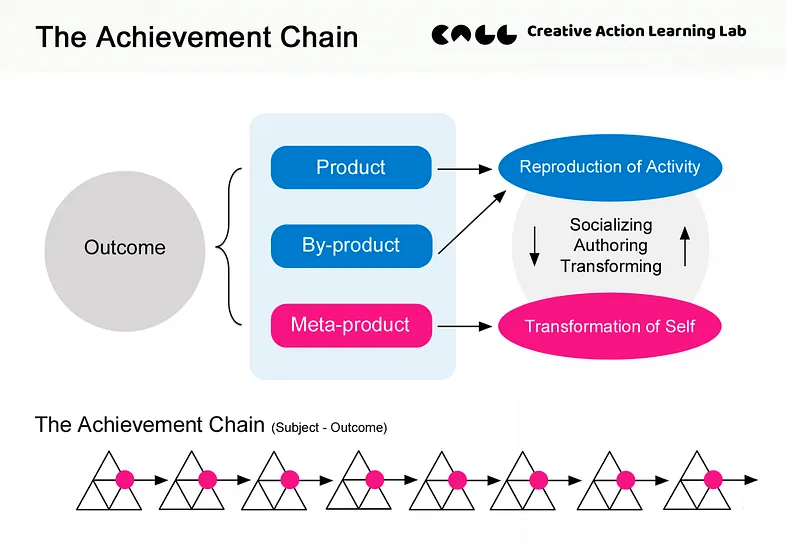
The first is Yrjö Engeström's Activity Systems Model (1987), which defines the activity system through the relationship between Subject, Object, Mediating Artifact, Community, Rules, Division of Labor, and Outcome. Within this model, the Achievement Chain focuses specifically on the Subject–Outcome relationship — the question of what a person actually produces through their activity.
The second theoretical resource is Howard E. Gruber's evolving systems approach to the study of creative work (1974, 1989). Gruber's study of Charles Darwin established the centrality of the by-product in creative development. Darwin's most significant theoretical advances did not arrive as the direct results of deliberate effort. They arrived obliquely — as by-products of efforts aimed elsewhere. Gruber showed that great creative work is not the execution of a plan but the cultivation of a complex ecology of projects, where the most important things often emerge from the edges.
The third resource is Robert Kegan's constructive-developmental approach (1982, 2009), which provided the framework for understanding the Transformation of Self as the meta-product of the Achievement Chain — what emerges from the activity system not as an external product, but as the changed person who enacted it.
In the Life-as-Activity framework (v0.3), the Achievement Chain distinguishes three types of outcomes:
- Product — the intended outcome within the original object of activity. What you set out to make, and made.
- By-product — the unintended outcome beyond the original object of activity. What arrived as a consequence of the work, without being its aim.
- Meta-product — the transformation of self as the outcome of the temporal activity chain. Not what the activity produced, but what the activity made of the person who enacted it.
The framework understands development as an interactive process of Reproduction of Activity and Transformation of Self. Products and by-products generate new activities; meta-products contribute to the Transformation of Self, which enhances individual performance within new collective activities.
1.2 The Transformation of Self
For the specific account of the Transformation of Self, the 2020 version adopted Robert Kegan's model. Kegan's constructive-developmental approach attends to the development of meaning-construction — the organizing activity through which persons make sense of experience. Kegan understood the person not as a thing but as an activity: "Like the idea of construction, the idea of development liberates us from a static view of phenomena" (1982, p.13).
Kegan identified three plateaus in adult mental development, which in the Life-as-Activity framework are designated as Socializing, Authoring, and Transforming:
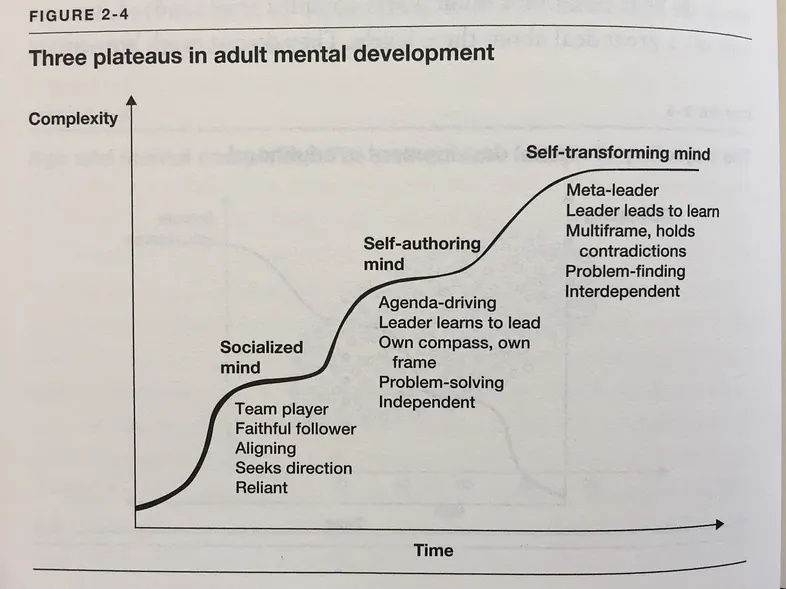
- The Socialized Mind — we are shaped by the definitions and expectations of our personal environment. The person is embedded in activities without awareness of the contradictions of the activity system.
- The Self-Authoring Mind — we are able to generate an internal "seat of judgment" or personal authority that evaluates and makes choices about external expectations. The person has their own judgment about the contradictions of the activity system, but thinks only from their own position or role.
- The Self-Transforming Mind — we can step back from and reflect on the limits of our own ideology or personal authority; we are able to hold on to multiple systems rather than projecting all but one onto the other. The person can surface contradictions and model a new activity system from different perspectives and positions.
This Keganian model provided a path of developing individual agency through activities. Combined with Activity Theory's claim that contradictions are the source of the development of activity systems, it enabled an understanding of achievement not as the accumulation of outputs but as the growth of the person through the contradictions of successive activities.
Limitation and Departure
The Life-as-Activity framework (v0.3, 2020) operated through concept curation — assembling resources from multiple theoretical traditions (Engeström, Gruber, Kegan) and presenting them as a coherent map. This was a useful early synthesis. But it was not yet a fully original theoretical construction. The frameworks imported were primarily those of others.
The current version of the Life-as-Activity Approach (v3.2, 2025) operates differently. It works entirely through original frameworks developed within the knowledge enterprise: the Activity Circle, the Agency Cascade, the Anticipatory Activity System (AAS), and the Living Coordinate Model. The Transformation of Self is no longer analyzed through Kegan's stage model but through a framework derived from the structural dynamics of the activity circle itself.
This article develops that original framework for the first time.
1.3 Self, Other, and the Microdynamics of Creative Identity
The activity circle model has four core elements: Self, Other, Thing, and Think. Self and Other define the relational dimension of any activity — who is acting and in relation to whom. Thing designates what is acted upon: the object of activity in the present. Think designates the anticipatory dimension: the objective toward which the activity is oriented in the future.
Until now, the activity circle model has rarely been brought into direct contact with the question of identity development. Yet identity is precisely what the Self-Other relation makes possible. Identity is not a solo construction. It requires an Other — someone in relation to whom the Self is recognized, shaped, and differentiated. Without the Other, there is no identity, only an undifferentiated presence.
This recognition opens the connection to the Microdynamics of Creative Identity, a framework developed within the Project Engagement approach.
The Developmental Project Model
The Project Engagement approach understands life as a chain of projects. Each project is a unit of analysis that bridges individual and collective life — connecting psychology, sociology, and the dynamics of social practice. Andy Blunden's formulation captures the essential point: "A project is a focus for an individual's motivation, the indispensable vehicle for the exercise of their will and thus the key determinant of their psychology and the process which produces and reproduces the social fabric. Projects belong to both; a project is a concept of both psychology and sociology" (2014, p.15).
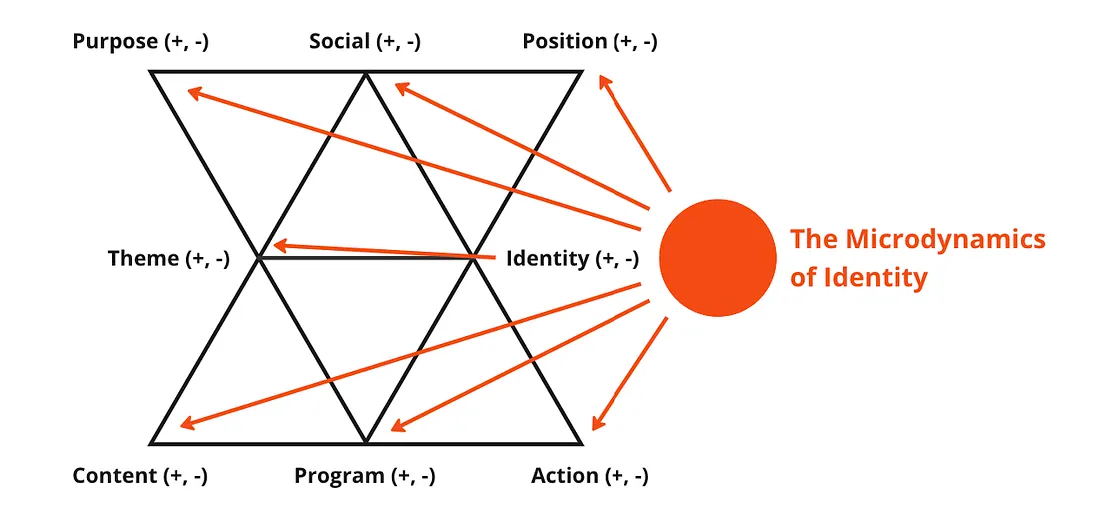
The Developmental Project Model describes any project through eight elements: Purpose, Position, Program, Social, Content, Action, Theme, and Identity. The identity element is particularly significant. Your identity is shaped by how others view "what you do" and "who you are" — but it is also a part of your self-knowledge. Identity is both externally constituted through recognition and internally developed through self-understanding.
Unlike traditional identity theories, which tend to treat identity as a stable structure that persists across situations, the Project Engagement approach understands identity as a continuously evolving process. Its unit of change is not the developmental stage or the life phase, but the project. Every time you join a project or leave a project, your identity changes. This is the Microdynamics of Identity: the continuous, fine-grained evolution of who you are through the succession of project engagements that constitute a creative life.
To describe the dimensions across which this process unfolds, in 2025 I developed four types of creative identity. These types were originally developed as components of the "Aion-Chronos-Kairos" Schema and are now understood as specific expressions of the Microdynamics of Identity:
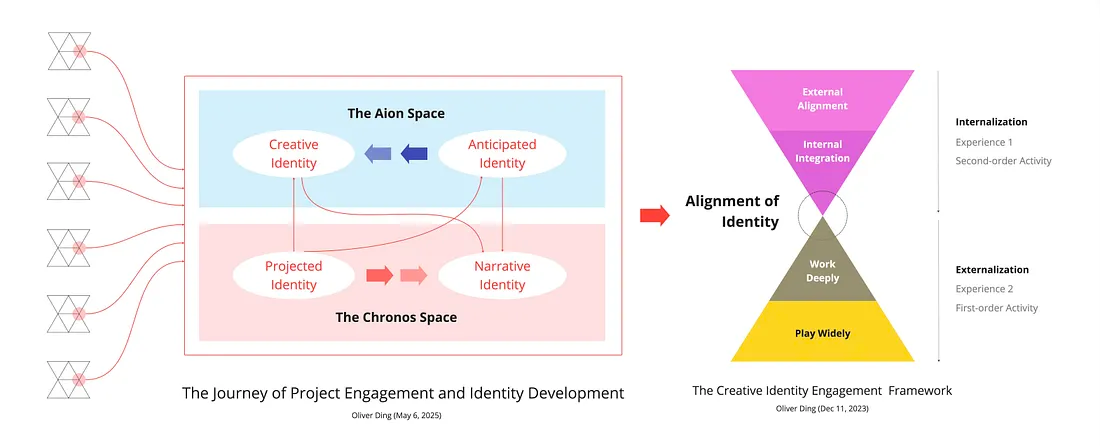
- Projected Identity — identity shaped by external roles and responsibilities in collaborative projects. This is the working identity that emerges through engagement in collective efforts, where roles and responsibilities are defined in relation to a shared project goal. It is how an individual is perceived and situated within the context of the project.
- Narrative Identity — the self that is constructed and communicated through personal storytelling. A narrative that develops over time and reflects one's sense of self across the arc of a creative life.
- Creative Identity — the identity that emerges through concrete actions guided by the actor's autonomous will and subjective exploration. An expression of agency in its most generative form.
- Anticipated Identity — a forward-looking identity that represents an individual's vision of their future self, aligning with the concept of Possible Selves (Markus and Nurius). This future-oriented identity plays a significant role in shaping motivation and long-term development.
These four types are not static categories but dynamic modes through which identity is enacted and transformed across project engagements. The Microdynamics of Creative Identity names the process; the four types name the dimensions across which that process unfolds.
This framework provides the foundation for a new model of the Transformation of Self — one that is grounded not in Kegan's developmental psychology but in the structural dynamics of the Activity Circle and the Project Engagement approach.
1.4 The Agency Cascade Model and Supportive Life Discovery
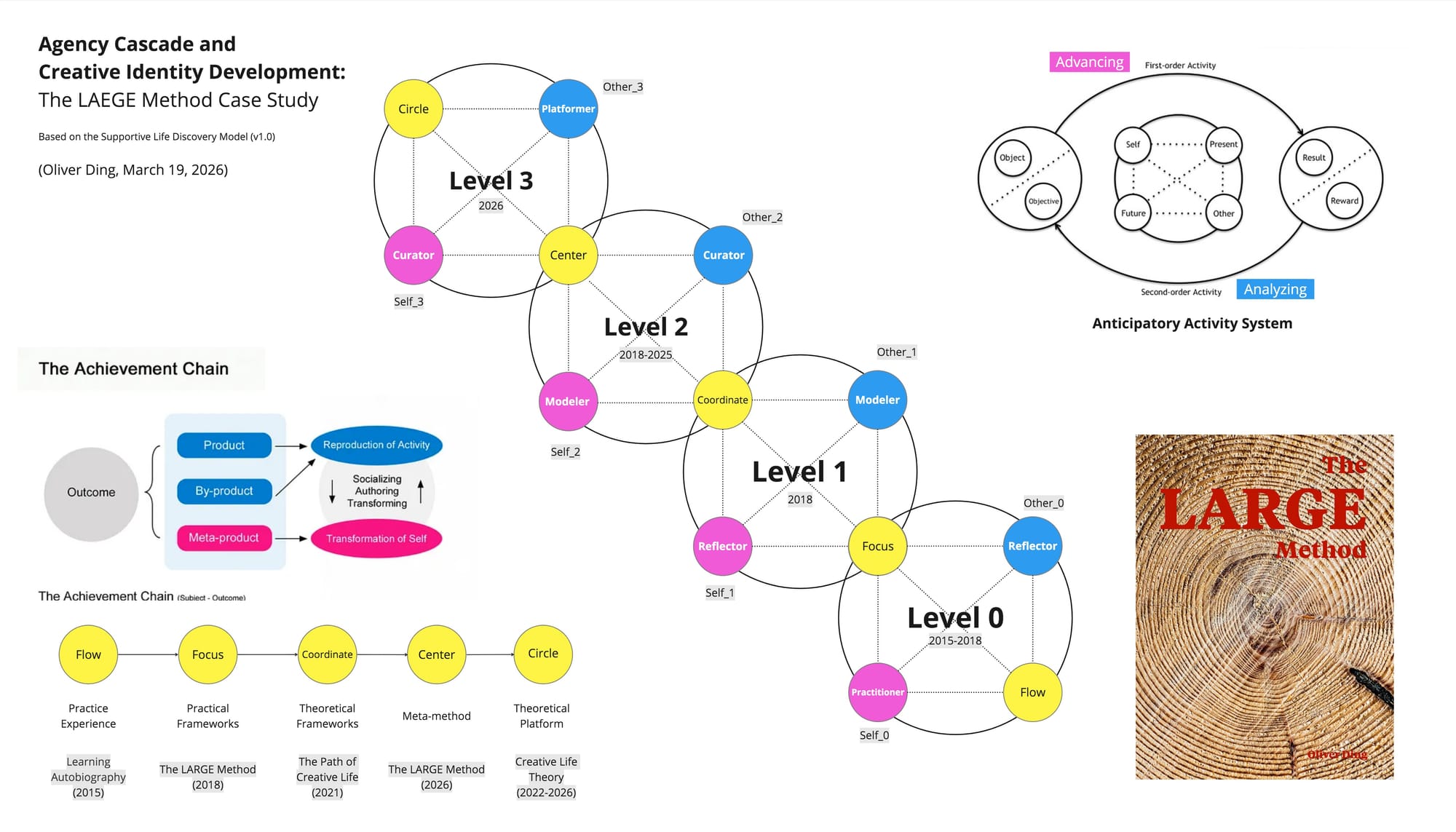
The Agency Cascade is a framework of the Anticipatory Cultural Sociology (ACS) project, first introduced in Education as Anticipatory Activity (January 2026) and further applied in Culture as Anticipatory Activity (February 2026) and other articles. It is based on the Activity Circle model, a core model of the Life-as-Activity approach (v3.2). Each specific Agency Cascade is composed of multiple Activity Circles arranged in a sequence, with the concrete roles and level meanings varying across different applications.
The core principle of the Agency Cascade is: at each level, the Other of that level becomes the Self of the next. Agency is not fixed within an individual; it cascades through levels of social structure, each anticipating and enabling the next.
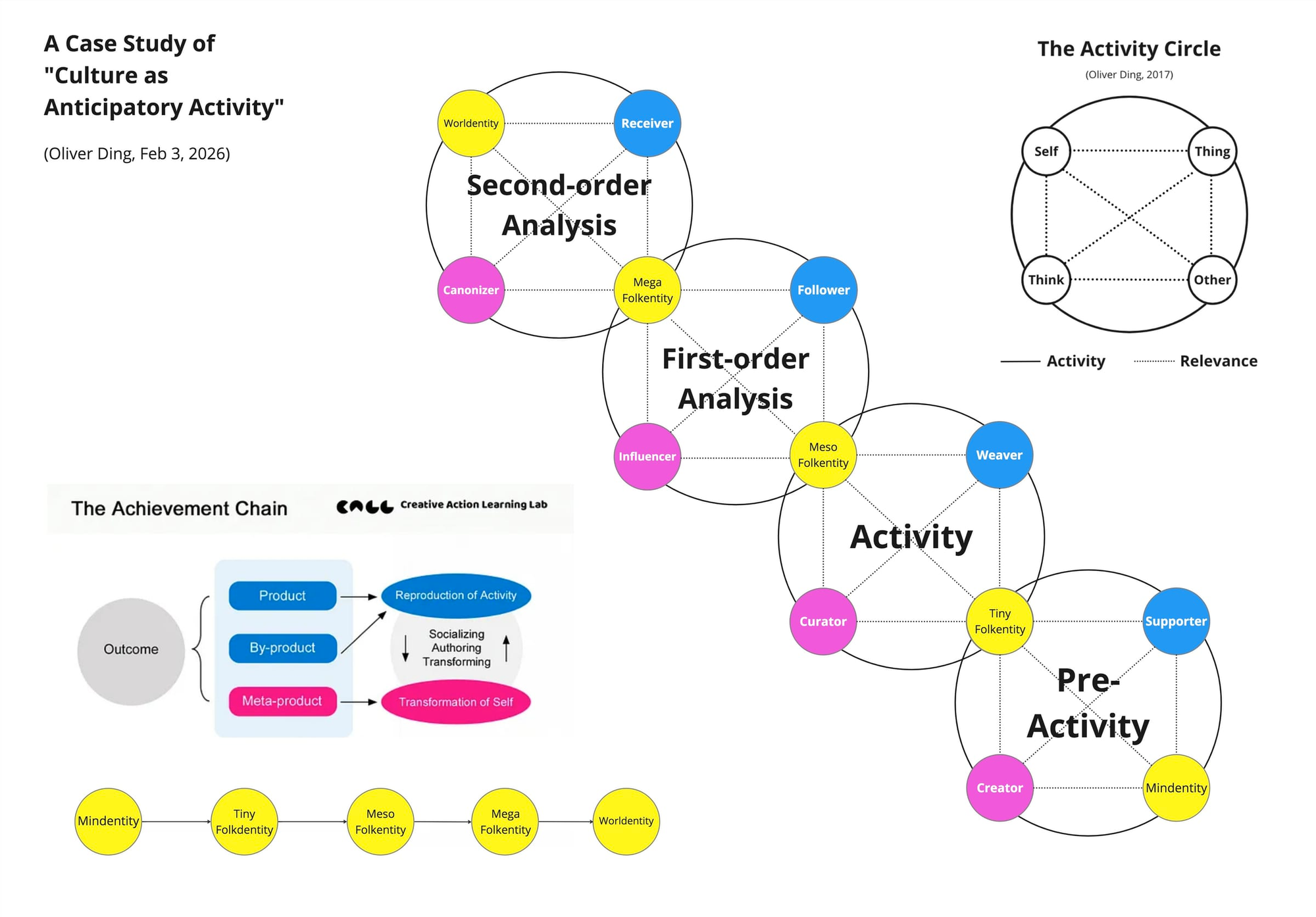
For example, the Agency Cascade model in Culture as Anticipatory Activity describes four levels through which a thematic creation passes from private genesis to cultural permanence:
Level 1 (Pre-Activity): Creator and Supporter. The thematic creation is still within the private territory of the Self. The relationship is between a Creator who originates the creation and a Supporter who provides enabling conditions for it to take its first steps into the social world.
Level 2 (Activity): Curator and Weaver. A small community has formed around the creation. The relationship is between a Curator who shapes and maintains the emerging collective identity, and a Weaver who connects threads across the growing community.
Level 3 (First-Order Analysis): Influencer and Follower. A professional community or specialized field has developed with its own norms and platforms. The relationship is between an Influencer who shapes direction across communities, and a Follower who engages from a distance.
Level 4 (Second-Order Analysis): Canonizer and Receiver. The creation is present everywhere. The relationship is between a Canonizer who fixes the creation in the cultural record, and a Receiver who inherits it as a cultural given.
The L3D Model: Supportive Life Discovery
The L3D model (v1.0, March 2026) reframes the Agency Cascade as a framework for the individual creator's own developmental journey. The four levels are renamed:
| Agency Cascade | L3D Model |
|---|---|
| Pre-Activity | Learn |
| Activity | Discover |
| First-Order Analysis | Design |
| Second-Order Analysis | Deliver |
This renaming represents a shift in perspective: from describing how a thematic creation moves through the social world to describing how a creator moves through four qualitatively different modes of engagement with their own creative life. In the L3D model, the Self is always the same person — the creator of their own life — and the Supporter's role shifts accordingly across the four circles.
The L3D model also specifies the Achievement Chain for the Supportive Life Discovery context:
Flow → Focus → Coordinate → Center → Circle
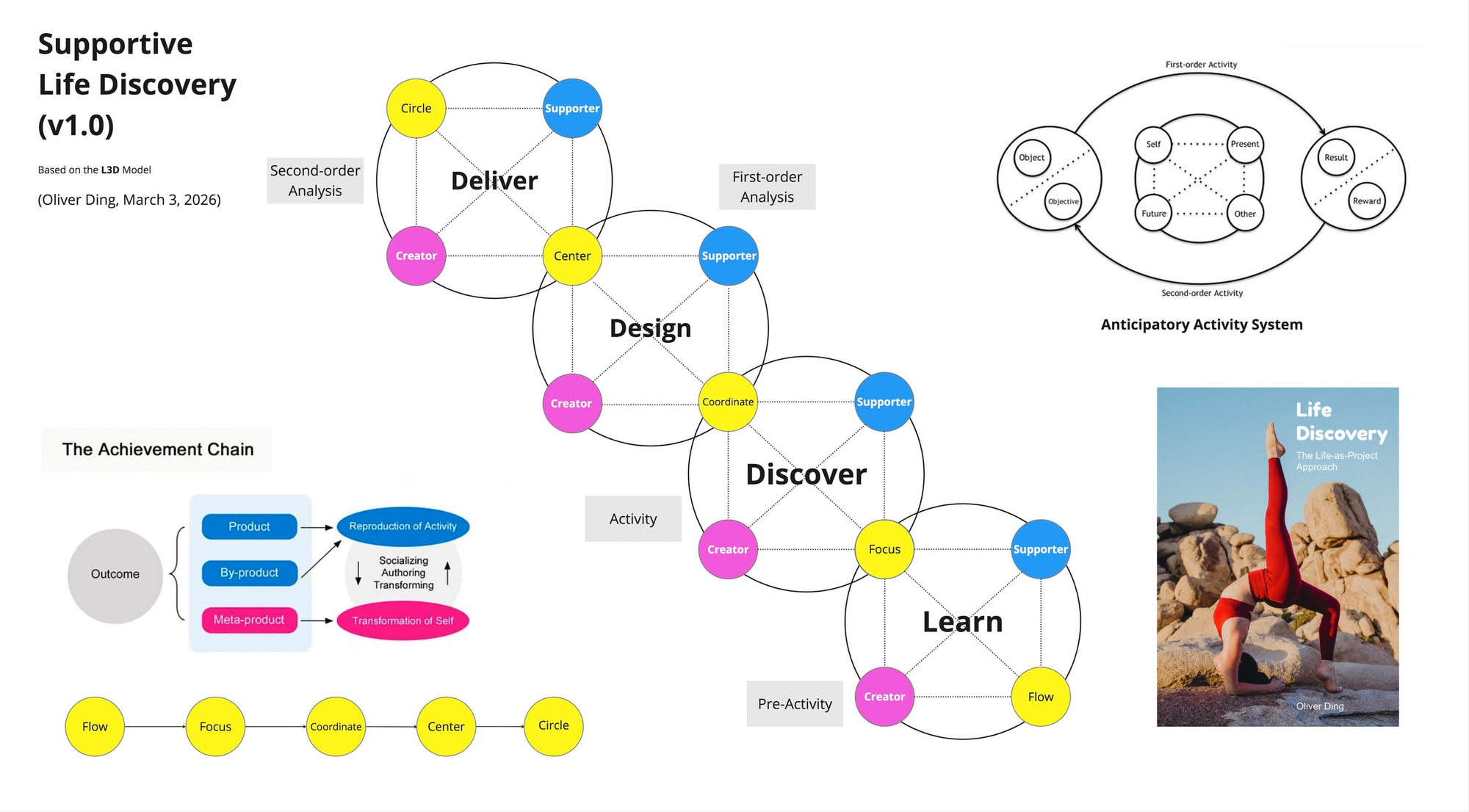
This chain describes the concrete developmental trajectory that Supportive Life Discovery activity produces: from the undifferentiated stream of lived experience (Flow), through the emergence of intentional thematic attention (Focus), to the identification of a personal creative coordinate (Coordinate), toward the establishment of a sustained creative center (Center), and finally into a network of collective engagement (Circle).
Adaptation for the Present Article
For this article, the Agency Cascade model is applied not to the cultural trajectory of a thematic creation, nor to the developmental arc of a Supportive Life Discovery program, but to the structure of a single creator's creative identity development across an extended temporal sequence.
The Achievement Chain is adapted accordingly, with the following elements:
Flow → Focus → Coordinate → Center → Circle
And the Self-Other configuration at each level is designated as follows:
- Level 0: Self 0 – Other 0
- Level 1: Self 0 – Other 1
- Level 2: Self 2 – Other 2
- Level 3: Self 3 – Other 3
The significance of this designation will become clear in Part 2.
Part 2: The LARGE Method Case Study
2.1 Overview of the Case
The LARGE Method originated on December 6, 2018, as a spontaneous creative insight — a six-keyword framework I sent to my wife via email. It was designed to elevate the Learning and Reflection (LAR) project, which had been running since 2015, to a higher methodological level. The acronym LARGE stood for: Learn, Action, Reflect, Generate, Explore, Exploit.
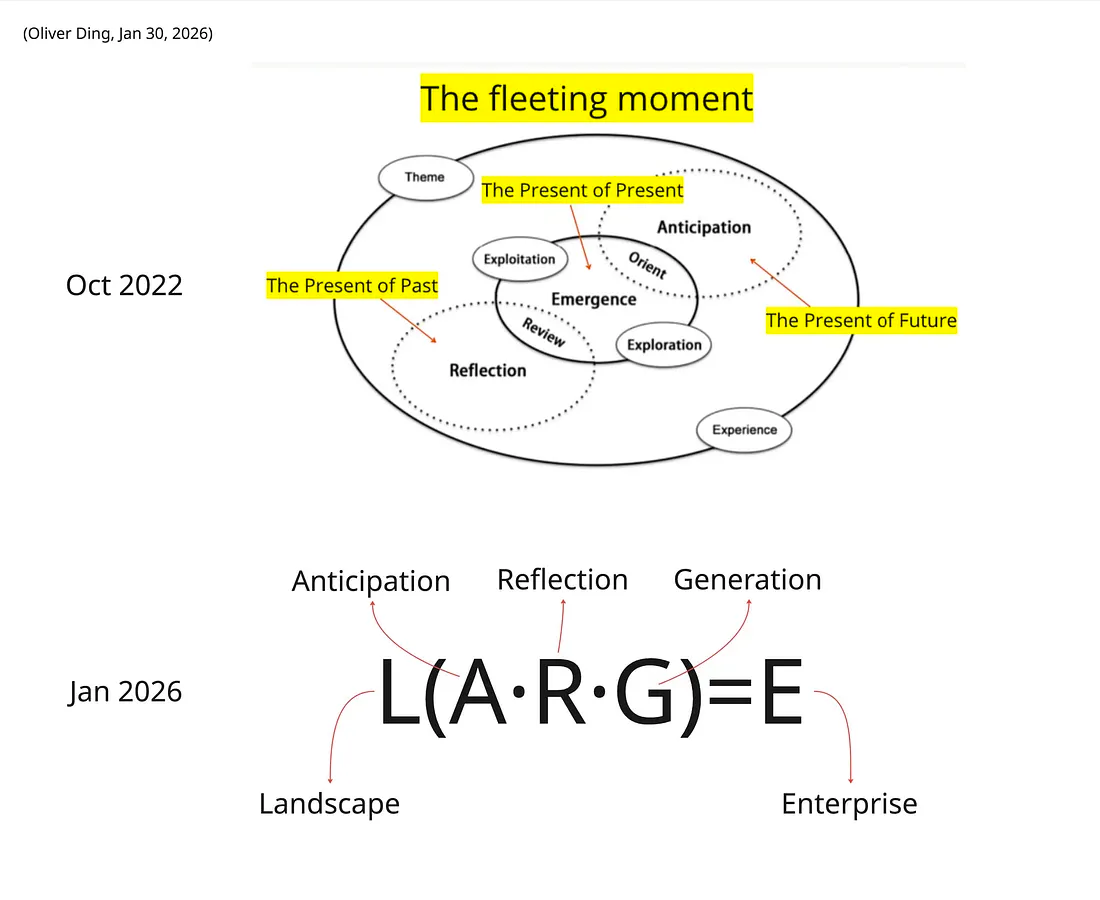
Eight years later, in January and February 2026, the LARGE Method returned — but transformed. It was now a governing meta-method: a formula, L(A·R·G)=E, organizing five methodological principles (Landscape, Anticipation, Reflection, Generation, Enterprise) across twelve methods distributed in four thematic spaces.
The trajectory between 2018 and 2026 is not a story of linear refinement. It is a story of parallel development, structural expansion, theoretical curation, and symbolic transformation — a process documented in the "Revisiting and Rebuilding: The LARGE Method (2018–2026)" case study. The present analysis does not repeat that account. It reframes it through the lens of the Agency Cascade, in order to reveal the creative identity dynamics that underlie it.
The Agency Cascade Diagram of the Case
The four levels of the LARGE Method's development can be mapped onto the Agency Cascade model as follows:
Level 0:  Self 0 (Practitioner)   —  Other 0 (Reflector)       [2015–2018]
Level 1:  Self 0 (Reflector)      —  Other 1 (Modeler)         [2018]
Level 2:  Self 2 (Modeler)        —  Other 2 (Curator)         [2018–2025]
Level 3:  Self 3 (Curator)        —  Other 3 (Platformer)      [2026]
Each level is a complete Activity Circle: a unit of analysis that contains its own Self, Other, Thing (current object of activity), and Think (anticipated objective). Each level's Other becomes the next level's Self. This is the cascade structure.
2.2 The Self-Other Shift: A Structural Discovery
The most significant structural feature of this case analysis requires explicit attention. In the standard application of the Activity Circle and the Agency Cascade, Self and Other are synchronic — they designate a person and another person engaged in the same activity at the same time.
In this analysis, the configuration is different. Self and Other are diachronic — both designate the same individual, but at different points in their development. The Other at Level N is not a different person; it is the same person at a later stage, embodying a more developed creative identity.
This diachronic configuration changes the structural meaning of the cascade. Each level is not a relationship between two contemporaneous persons but a relationship between two temporal phases of the same creator — between who the person is now (Self) and who they are becoming (Other). The Other of the present is the Self of the future.
This is not merely a formal observation. It reveals three things of theoretical significance.
First, it shows how the World of Activity of an individual, if it is to develop in the direction of an ideal Achievement Chain, requires the simultaneous development of creative identity. The structure of activity cannot advance unless the person who enacts it develops.
Second, it indicates that if the individual cannot develop the creative identity required to sustain the next level of activity, this gap can be addressed by drawing on the creative identity of significant others — people who embody the identity the individual needs in order to grow. The Supporter in the Agency Cascade model provides not just practical assistance but an identity resource: they demonstrate what the next Self can be.
This means that Supportive Life Discovery — the mode of support in which a Supporter accompanies a Creator — can come from two directions: synchronically, from another person in the present; and diachronically, from the creator themselves across time. The earlier Self supports the later Self.
But how, precisely, does the earlier Self provide support? The mechanism requires explanation. As creative identity develops across levels, earlier identities do not disappear — but they do fade from active awareness. The Practitioner who became a Modeler no longer inhabits the Practitioner identity as their primary mode of engagement. That earlier identity recedes, becomes, and is no longer consciously mobilized. This is not loss, but it is a form of forgetting.
The Revisiting-Rebuilding mechanism reverses this forgetting. When I return to earlier work, I am not simply retrieving an old framework — I am reactivating an earlier creative identity and bringing it into contact with my current one. The Revisiting is the act of finding the past Self; the Rebuilding is the act of connecting it to the present Self. This connection is the diachronic Supportance: the past creative identity, reactivated, provides the raw material, the structural DNA, and the accumulated experience that the present Self can now rebuild from a more developed standpoint.
Third, and most consequentially for this article: it shows that Revisiting-Rebuilding is not only a creative heuristic. It is a strategy of life development. When a creator returns to an earlier framework or body of work and rebuilds it from a more developed standpoint, they are not just producing better theory. They are enacting a diachronic Self-Other relationship that drives the Transformation of Self.
The future Self operates through a different but complementary mechanism. Anticipated Identity is not singular — the future holds multiple possible selves, multiple possible creative identities that could be developed from the current position. This multiplicity is not a source of confusion but of strategic flexibility. At any given moment, I can survey the range of possible future creative identities and, based on the demands of the current project, actively choose which Anticipated Identity to orient toward — and adjust my current behavior accordingly. In a different project, or at a different stage, a different choice may be made.
This transforms identity from a constraint into a resource. The past Self is a reservoir of dormant creative identities that can be reactivated through Revisiting-Rebuilding. The future Self is a field of possible creative identities that can be selectively engaged through anticipation. The present Self — the current Creative Identity — is the meeting point of these two temporal directions: shaped by what has been reactivated from the past, oriented toward what has been chosen from the future.
Identity, understood this way, is not something that happens to a person. It is something a person actively manages — across time, in both directions.
2.3 Level 0: Practitioner and Reflector (2015–2018)
At Level 0, the Activity Circle positions:
- Self 0: Practitioner — a person engaged directly in the work of learning, reflection, and career development
- Other 0: Reflector — a person who stands outside immediate practice and develops frameworks for understanding it
- Thing: The LAR (Learning and Reflection) project — a running practice with its own tools and methods
- Think: The anticipation of a higher-order framework that could unify and elevate this practice
This level encompasses the three-year development of the LAR project:
In 2015, I wrote my first learning autobiography, engaging with biographical studies and adult learning theory. The mode was that of a practitioner: direct engagement with the material of a life, without a theoretical apparatus for understanding it systematically.
In 2016, the practitioner's orientation produced a first layer of practical tools: the Career Landscape framework (inspired by Activity Theory and Communities of Practice), the Learning Autobiography Guide, the Learning & Reflective Cards, the Learning & Reflective Canvas, and the Learning & Reflective Monthly Report Template. These tools emerged from practice, for practice.
2.4 Level 1: Reflector and Modeler (2018)
By June 2018, a significant threshold was crossed. A comprehensive review introduced the concept of "Epistemic Development," elevating LAR from the domain of mere reflection to one of active knowledge expansion. This review engaged personal epistemology, metacognition, and conceptual change. The practitioner was beginning to think like a reflector — to turn the practice itself into an object of analysis.
The December 2018 LARGE Method marks the completion of Level 0 and the opening of this one. It represents the spontaneous synthesis of three years of accumulated experience — a moment when the Practitioner (Self 0) produced the Reflector (Other 0) as the outcome of their activity. The meta-product of the Achievement Chain at Level 0 is the emergence of a reflective identity capable of developing a meta-framework.
At Level 1, the Activity Circle positions:
- Self 0 / Self 1: Reflector — the identity that emerged from Level 0, now the operating Self
- Other 1: Modeler — a person who can abstract from reflection to construct transferable theoretical models
- Thing: The LARGE Method (2018) — the six-keyword framework as an object to be understood and applied
- Think: The anticipation of a theoretical model that could govern learning and reflection across contexts
One month after creating the LARGE Method, I applied it in a startup context — extending a framework developed for personal learning and reflection into the domain of organizational thinking. This application was already an act of modeling: taking a framework from one context and transferring it to another. The Reflector was becoming a Modeler.
The meta-product of Level 1 is the emergence of the Modeler: a creative identity capable of building transferable theoretical frameworks, not just applying practical tools.
2.5 Level 2: Modeler and Curator (2018–2025)
But the critical transition at Level 1 happened not through the application but through what followed it. Within months, my focus shifted dramatically toward theoretical development. In March 2019, I completed Curativity Theory — marking a transformation from practitioner-reflector to theorist. The LARGE Method receded from the foreground, but the Modeler identity had been activated. What appeared as dormancy was, in fact, the activation of a new creative identity operating at a different level of abstraction.
At Level 2, the Activity Circle positions:
- Self 2: Modeler — now the operating Self, building theoretical frameworks
- Other 2: Curator — a person who can not only build models but curate multiple theoretical streams into coherent wholes
- Thing: The evolving theoretical landscape — Activity Theory, Ecological Psychology, Anticipatory Systems Theory, Theoretical Sociology, Creativity Research
- Think: The anticipation of a unified theoretical framework for Creative Life
This level spans seven years of intensive theoretical development. Three moments mark the progressive emergence of the Curator identity.
In August 2021, while working on empirical research, I expanded the LARGE Method into a new structural framework by adding two dimensions — Anticipation (drawn from Robert Rosen's Anticipatory Systems Theory) and Emergence (drawn from Ecological Psychology and Howard Gruber's work on creative by-products). The framework was subsequently renamed "The Path of Creative Life." This was the Modeler at full capacity: restructuring a framework through theoretical resources accumulated across multiple traditions.
In 2022, I recognized an exact structural correspondence between the Path of Creative Life and theoretical sociologist Ping-keung Lui's "Fleeting Moment" ontology — both had arrived, from entirely different traditions, at the same temporal structure of human action. This structural resonance enabled a theoretical curation project in which I used Lui's framework as a meta-container to integrate three separate theoretical paths into Creative Life Theory v1.0. The method was what I call the ECHO Way: transferring structural Form from a Reference Space to curate Content from a Problem Space into a new Solution Space. This was the first act of Curation — and the first sign that a new creative identity was forming.
In June 2025, I discovered that multiple theoretical streams I had been developing separately had, without conscious design, converged into a new center. This was the discovery of Generative Confluence: a pattern where distinct theoretical approaches generate a new theoretical enterprise without losing their individual trajectories. Recognizing this pattern required the Curator's perspective — the capacity to step back from the streams and see the landscape they had produced together.
The meta-product of Level 2 is the emergence of the Curator: a creative identity capable not only of building theoretical models but of curating multiple theoretical streams into coherent systems — recognizing structural resonances across traditions, employing meta-containers, and seeing the patterns of confluence that emerge from sustained multi-stream theoretical work.
2.6 Level 3: Curator and Platformer (2026)
In October 2025, I had a thematic conversation with a friend via email about my various methods. In January 2026, I revisited that conversation — and it created a specific cognitive demand: develop a meta-framework that would unite the various methods I had developed over the years as a meaningful whole. The present need activated the dormant asset. The LARGE Method, which had been quietly accumulating theoretical resources for eight years, was ready to return.
At Level 3, the Activity Circle positions:
- Self 3: Curator — now the operating Self, governing a complex methodological landscape
- Other 3: Platformer — a person who can not only curate but build and inhabit a platform: a meta-level infrastructure that enables others to develop
- Thing: The accumulated body of methods, frameworks, and theoretical positions developed across levels 0–2
- Think: The anticipation of a governing meta-method that organizes the entire methodological landscape as a platform for creative life development
Returning to the LAR project and tracing its development, I recognized that the name "LARGE Method" was perfect for the new meta-framework — but this time, redefined as a formula:
L(A·R·G)=E
This formula is not mere symbolization. It is structural compression that reveals deeper relationships:
- The use of multiplication (A·R·G) rather than addition suggests these three elements must interact and operate together. Their product generates the outcome; the absence of any one element reduces the whole to zero.
- The formula establishes the relationship between the five themes: Landscape (L) provides the context within which Anticipation (A), Reflection (R), and Generation (G) operate multiplicatively to produce Enterprise (E).
The five themes now represent:
L: Landscape — the synchronic view of the whole field; spatial comprehension of the current state; seeing the entire terrain at once.
A: Anticipation — orienting toward the future; predictive modeling and feedforward; "Expects in the present of the future."
R: Reflection — learning from the past; retrospective examination; "Remembers in the present of the past."
G: Generation — creating in the present; producing new ideas and plans; active synthesis and construction.
E: Enterprise — the diachronic unfolding of projects; temporal development over time; the ongoing trajectory of creative work.
This transformation reveals a shift from activity-focused (learn, action) to principle-focused (landscape, enterprise) — from describing what to do to articulating governing principles.
The 2026 LARGE Method employs the Living Coordinate Model as its visualization framework, organizing twelve methods across four thematic spaces through five governing principles — transforming from a practical tool into a comprehensive meta-method for creative life.
The meta-product of Level 3 is the emergence of the Platformer identity: a creative identity capable of building and inhabiting a meta-level infrastructure that does not merely produce frameworks but enables others — and one's future self — to develop through them.
Part 3: Creative Identity Cascade
The LARGE Method case, analyzed through the Agency Cascade, reveals a pattern that has significant implications for Creative Life Theory. Creative work is not the unfolding of a single identity. It is the successive enactment and transformation of multiple creative identities, each enabled by the one before it.
This pattern is named the Creative Identity Cascade Model.
3.1 The Creative Identity Cascade Model
Core proposition: Creative work is not the unfolding of a single identity but the progressive transformation through multiple creative identities, each constituting the next level of the cascade.
In the LARGE Method case, the cascade unfolds as follows:
| Level | Self | Other | Period |
|---|---|---|---|
| 0 | Practitioner | Reflector | 2015–2018 |
| 1 | Reflector | Modeler | 2018 |
| 2 | Modeler | Curator | 2018–2025 |
| 3 | Curator | Platformer | 2026 |
This particular sequence — from Practitioner through Reflector, Modeler, and Curator toward Platformer — reflects the specific trajectory of a person moving from practice-based learning toward theoretical development and meta-level platform building. It is not a universal developmental staircase. The Creative Identity Cascade Model does not prescribe a fixed sequence of cognitive stages that all creators must pass through. Different creative lives will generate different cascades, with different identity names and different temporal rhythms.
What the model does claim is structural: that any creative life, examined over sufficient time, will reveal a cascade of creative identities — each one constituting the Self of its level, each one anticipating the Other that will become the Self of the next. The specific content of the cascade is determined by the creator's particular world of activity, their projects, their theoretical resources, and the historical moment they inhabit.
The structural principle can be represented abstractly as follows:
| Level | Self | Other | Transition |
|---|---|---|---|
| 0 | Identity 0 | Identity 1 | Other 0 → Self 1 |
| 1 | Identity 1 | Identity 2 | Other 1 → Self 2 |
| 2 | Identity 2 | Identity 3 | Other 2 → Self 3 |
| N | Identity N | Identity N+1 | Other N → Self N+1 |
The key structural claim is in the Transition column: the Other of each level becomes the Self of the next. What is anticipated at one level is enacted at the next. The cascade is driven by this recursive transformation.
This is why the Creative Identity Cascade is inseparable from the Achievement Chain. The two models are not parallel descriptions of the same thing — they are coordinated dimensions of the same process. The Achievement Chain describes what a creator produces through their activity: products, by-products, and the meta-product of self-transformation. The Creative Identity Cascade describes who is doing the producing at each level, and how that producer changes across time. Neither is sufficient alone. A cascade without an Achievement Chain is identity development without creative work. An Achievement Chain without a cascade is creative work without a developing self. Together, they constitute the full structure of creative life development.
Each creative identity is not abandoned when the next level is reached. It is retained and integrated — available as a resource for activity at all subsequent levels. The Curator remains capable of Modeling; the Modeler retains the Practitioner's capacity for direct engagement. The cascade is additive, not substitutive.
3.2 Creative Identity and Anticipated Identity: The Polar Relationship
The four types of creative identity introduced in section 1.3 — Projected, Narrative, Creative, and Anticipated — are not equally distributed across the cascade. Two of them occupy a structurally privileged position: Creative Identity and Anticipated Identity. Together, they form a polar relationship that is the engine of creative identity development.
Creative Identity is the identity enacted in the present — the identity that emerges through concrete actions guided by the actor's autonomous will and subjective exploration. It is what you are doing right now, expressed as who you are. It is the Self of the current Activity Circle.
Anticipated Identity is the identity oriented toward the future — a vision of the self one is becoming, aligned with the concept of Possible Selves. It is not yet enacted; it is imagined, anticipated, pulled toward. It is the Other of the current Activity Circle.
The relationship between them is not static. It is a dynamic polarity: Creative Identity and Anticipated Identity exist in productive tension, with the gap between them generating the developmental energy that drives the cascade forward. The creator is always simultaneously being something (Creative Identity) and becoming something (Anticipated Identity).
What happens at the transition between levels is precisely the collapse and renewal of this polarity. When a creator moves from one level to the next, the Anticipated Identity of the previous level becomes the new Creative Identity — the Other becomes the new Self. What was imagined is now enacted. And immediately, a new Anticipated Identity forms at the horizon: the Other of the new level.
In the LARGE Method case, this movement is visible across each transition:
| Level | Creative Identity (Self) | Anticipated Identity (Other) |
|---|---|---|
| 0 | Practitioner | Reflector |
| 1 | Reflector | Modeler |
| 2 | Modeler | Curator |
| 3 | Curator | Platformer |
At each level, the creator is enacting one identity while anticipating the next. The Practitioner already senses the possibility of becoming a Reflector — otherwise the LAR project would not have generated the LARGE Method. The Modeler already anticipates the Curator — otherwise the theoretical explorations of 2019–2025 would not have sustained themselves across the long gap.
This polar relationship also clarifies the role of Revisiting-Rebuilding in identity development. When a creator returns to earlier work, they are doing so from the standpoint of a developed Creative Identity — and they are doing so in the direction of an Anticipated Identity that the earlier work could not yet reach. The Revisiting activates the earlier material; the Rebuilding enacts the polar tension between who the creator now is and who they are becoming.
Revisiting-Rebuilding is thus not a retrospective act. It is a forward-oriented one. The creator does not return to the past in order to stay there. They return in order to bring the past into the service of the future — to allow the Anticipated Identity to shape what the earlier work can become.
This is the deepest structural link between the Creative Identity Cascade and the Revisiting-Rebuilding strategy: both are driven by the same polar relationship between Creative Identity and Anticipated Identity, between the enacted present and the anticipated future, between Self and Other.
3.3 Strategic Curation of Microdynamics
The Creative Identity Cascade Model and the Microdynamics of Creative Identity are not competing accounts of the same phenomenon. They operate at different levels of temporal scale, and their relationship is one of curation: the Cascade provides a framework for curating the accumulated microdynamics of a creative life into a coherent developmental narrative.
The Microdynamics of Creative Identity operates at the level of the project. Every time a creator joins or leaves a project, their identity shifts — incrementally, fine-grainedly, in response to the specific roles, relationships, and recognitions that the project makes available. These shifts are real and consequential, but they are also numerous, overlapping, and difficult to read from within. Across a single year, a person may move through a dozen projects, each leaving a small deposit in the sediment of their identity. The four identity types — Projected, Narrative, Creative, Anticipated — name the dimensions across which these micro-shifts occur.
The Creative Identity Cascade, by contrast, operates at the level of the creative life as a whole, or at least across a significant arc of it. Where the Microdynamics captures the texture of identity change at close range, the Cascade captures the structure of identity development over the long duration. It asks not "how did this project change who I am?" but "across years of projects, what trajectory of creative identities has emerged?"
It is important to note that a person does not have only one Creative Identity Cascade. Across a given span of time, multiple cascades may coexist in parallel — each one corresponding to a distinct chain of projects. A creator might simultaneously maintain a cascade oriented toward theoretical development, another toward practical application, and another toward community building or teaching. Each chain generates its own sequence of creative identities, its own rhythm of Self-Other transitions, its own developmental logic. These parallel cascades are not in competition. They may reinforce each other, generate by-products for one another, or converge at certain moments into a new synthesis. Recognizing that one inhabits multiple cascades simultaneously is itself a form of strategic self-awareness — and a precondition for understanding how different strands of a creative life relate to each other.
This difference in scale is also a difference in function. The Microdynamics is primarily descriptive and analytical — a tool for understanding what is happening to identity in the present. The Cascade is primarily curatorial and strategic — a tool for making sense of where the accumulated microdynamics have led, and where they might go next.
The act of mapping one's Creative Identity Cascade is thus an act of strategic curation of microdynamics: gathering the dispersed identity shifts of many projects and many years, and arranging them into a meaningful sequence. What appeared as a series of disconnected project engagements — each with its own Projected Identity, its own Narrative arc, its own small creative actions — reveals itself, through the lens of the Cascade, as a coherent developmental trajectory with its own internal logic.
This curatorial act is not retrospective in a passive sense. It is the precondition for Revisiting-Rebuilding. Only when a creator can see their cascade — can name the creative identities they have inhabited and the transitions between them — can they identify which earlier identity carries unrealized potential, and which Anticipated Identity is worth returning to the past in order to reach.
Part 4: Comparative Framework Analysis
4.1 Creative Identity Cascade and Thematic Identity Curation
The Thematic Identity Curation Framework (2024) addresses the dynamic transformation between Theme and Identity within the Project Engagement approach. Its developmental sequence moves through five moments: Thematic Echo → Thematic Blend → Thematic Integration → Creative Projects → Identity Development. Its unit of analysis is the thematic space — the meaningful territory within which a creator's work coalesces around primary and secondary themes.
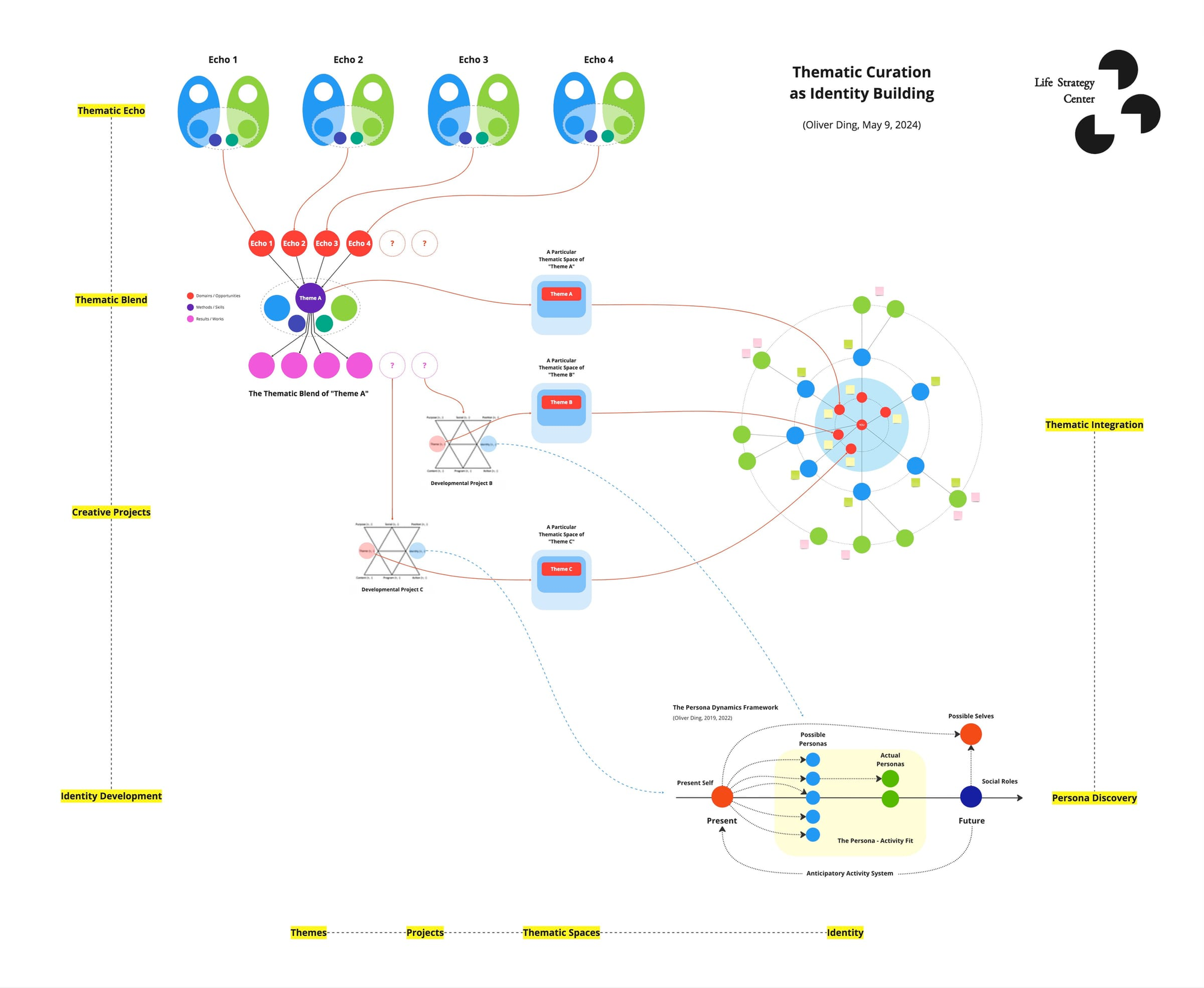
At first glance, Thematic Identity Curation and the Creative Identity Cascade appear to address the same territory: both concern how creative identity develops over time through engagement with projects and themes. But their angles of approach are fundamentally different.
Thematic Identity Curation approaches identity development through the dimension of theme. The question it asks is: what thematic spaces has a creator inhabited, how have they resonated with each other, and how has this thematic journey shaped who the creator is? Its primary movement is horizontal — discovering resonances across thematic spaces, blending them into coherent wholes, and allowing a richer creative identity to emerge from their interaction. It is particularly powerful for understanding the content of a creative identity: what subjects, domains, and thematic territories a creator has made their own.
The Creative Identity Cascade approaches identity development through the dimension of level. The question it asks is: across the succession of project chains, what creative identities has a creator enacted, and how has each one enabled the next? Its primary movement is vertical — the diachronic deepening of a creative life through the progressive transformation of the creator's identity from one level to the next. It is particularly powerful for understanding the structure of a creative identity: how a creator has grown in capacity, complexity, and scope across time.
The two frameworks are thus not competing accounts but complementary lenses. A full portrait of creative identity development requires both: the horizontal thematic map that shows what a creator has engaged with, and the vertical cascade that shows who they have become through that engagement. Thematic Identity Curation describes the landscape of a creative life; the Creative Identity Cascade describes its trajectory.
The Revisiting-Rebuilding strategy operates at the intersection of both. When a creator returns to earlier work, they are simultaneously reactivating an earlier thematic space — reconnecting with a dormant thematic identity and the echo it carries — and reconnecting with an earlier creative identity level in order to bring it forward into the present. Both the thematic and the identity-level dimensions are engaged at once.
4.2 Creative Identity Cascade and Advancing-Analyzing
The Advancing-Analyzing distinction was first developed in the article Advancing and Analyzing (2025) as an account of self-referential activity in theory building. It distinguishes two modes of engagement with one's own creative work:
Advancing (first-order activity): Acting from within the practice — using emerging tools to guide and produce new outcomes. The creator is enacting their current Creative Identity, generating the material of the next level.
Analyzing (second-order activity): Standing outside the practice — using the same tools to retrospectively understand and reflect on how that practice has unfolded. The creator is developing the reflective framework that will enable the next creative identity to emerge.
The Creative Identity Cascade reveals the structural basis of this distinction. In each Activity Circle of the cascade, the Self is in Advancing mode, and the Other is in Analyzing mode. The Analyzing Other is precisely the creative identity that the Advancing Self is in the process of becoming. Analysis — the act of stepping back from practice to develop a reflective framework — is the developmental activity through which the Advancing Self generates its next creative identity.
This means the Advancing-Analyzing distinction is not merely a methodological observation about how theory building works. It is a structural feature of creative identity development itself: every level of the cascade contains both an Advancing dimension and an Analyzing dimension, and the transition to the next level requires that the Analyzing dimension has had time to process what the Advancing dimension has produced.
This also clarifies the structural role of Supportive Life Discovery. The Supporter does not simply assist with practical tasks. Their most important function is to embody or enable the Analyzing dimension — to provide the second-order perspective that helps the creator recognize what their first-order activity is producing, and what creative identity it is developing toward. Advancing without Analyzing produces activity without development. The Supporter makes Analyzing available when the creator is too immersed in Advancing to step back.
4.3 The Homecoming Case: A Historically Independent Discovery
The structural claims of the Creative Identity Cascade — particularly the principle that Other N becomes Self N+1 — are not only theoretically derived. They are independently confirmed by an empirical discovery made in a different context and through a different analytical method.
In Homecoming (2025), an analysis of seven forms of World of Activity across a life trajectory, a remarkably consistent pattern emerged: at every developmental stage, the World of Activity organizes itself around two centers simultaneously. The specific names change across stages, but the underlying dual-center structure remains constant:
| Stage | Surviving Center | Thriving Center |
|---|---|---|
| Alien Land | Academic requirements | Cape of Good Hope Poetry Society |
| Domain | Full-service advertising work | CI (Corporate Identity) study |
| Internet | Publishing offline expertise online | Blog-based digital activities |
| Foreign Land | Multiple stabilized centers | Reflective Center + Constructive Center |
The crucial developmental principle discovered in this analysis: the Thriving Center of one stage becomes the Surviving Center of the next. What was exploratory and generative at one level becomes the stable foundation from which the next level of exploration can be launched.
This is structurally identical to the Creative Identity Cascade's core principle: Other N → Self N+1. The Thriving Center corresponds to the Anticipated Identity — the Other of the current level, not yet enacted, still exploratory. The Surviving Center corresponds to the Creative Identity — the Self of the current level, enacted, stable, the basis for current activity. And when the transition occurs, what was Thriving becomes the new Surviving, just as what was Other becomes the new Self.
The Homecoming analysis also confirms the Advancing-Analyzing correspondence. In the Foreign Land phase, two new types of center emerge: the Reflective Center (exemplified by Curativity Theory) and the Constructive Center (Creative Life Theory). The Reflective Center transforms accumulated practical experience into theoretical framework — this is Analyzing. The Constructive Center uses accumulated theoretical insight to open new pathways for action — this is Advancing. And crucially, the Constructive Center can only emerge after the Reflective Center has processed sufficient material: Advancing depends on what Analyzing has made available.
The significance of this convergence is substantial. The dual-center pattern was discovered independently, through retrospective autobiographical analysis, before the Cascade model was formalized. That the same structural principle appears in both the theoretical model and the empirical case study, arrived at through entirely different routes, provides strong evidence that Other N → Self N+1 is not a theoretical artifact but a real feature of how creative lives develop.
4.4 FFCC: The Shared Overarching Framework
The Creative Identity Cascade, the Thematic Identity Curation Framework, and the Advancing-Analyzing distinction are not three independent frameworks that happen to address related topics. They are three implementations of a single underlying structure: the Flow-Focus-Center-Circle (FFCC) schema, the primary model of the World of Activity approach.
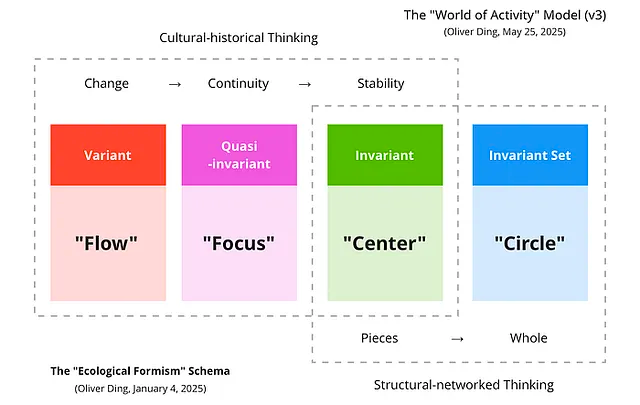
The FFCC schema describes the ideal developmental form of a creative life within the social world:
- Flow — the continuous stream of lived experience; the raw material of activity, undifferentiated and variable.
- Focus — the emergence of thematic coherence; scattered activities begin to coalesce around a meaningful thematic space.
- Center — a sustained creative center, actively developed and maintained over time. The stable organizing principle of a World of Activity.
- Circle — the network of connected centers; the broader social and cultural context that links individual Worlds of Activity to collective enterprises.
Each of the three frameworks addresses a different dimension of movement through this schema:
| Framework | Primary dimension | Movement within FFCC | Core question |
|---|---|---|---|
| Thematic Identity Curation | Theme | Flow → Focus → Center | What thematic spaces has the creator inhabited, and how have they shaped identity? |
| Creative Identity Cascade | Identity level | Center → Circle | What creative identities have been enacted across time, and how has each enabled the next? |
| Advancing-Analyzing | Activity mode | Within each level | How do first-order and second-order activity operate together to sustain development? |
These are not parallel alternatives. They are complementary dimensions of the same developmental process, each foregrounding a different aspect of how a creative life unfolds within the FFCC structure. A creator who understands all three has a far richer set of tools for navigating their own development than one who knows only one.
The Revisiting-Rebuilding strategy is the practice that most fully activates all three simultaneously. When returning to earlier work: the thematic dimension is engaged (Thematic Identity Curation — reactivating a dormant thematic space and its echoes); the identity-level dimension is engaged (Creative Identity Cascade — reconnecting with an earlier creative identity to bring it forward); and the activity-mode dimension is engaged (Advancing-Analyzing — the act of return is itself a second-order analytical move that makes new first-order Advancing possible). All three dimensions of the FFCC operate at once.
This is why Revisiting-Rebuilding is not a simple technique. It is a comprehensive strategy of creative life development — one that simultaneously engages the thematic, the identity, and the activity dimensions of a World of Activity, and brings them into productive alignment.
Part 5: Synthesis
5.1 LARGE as First Principle
The subtitle of this article — A LARGE Strategy for Creative Identity Development — is not a rhetorical gesture. The LARGE Method, which appears in Part 2 as the case study through which the Creative Identity Cascade is demonstrated, is also the meta-method that provides the first principles underlying the entire framework developed here.
This is worth making explicit. The LARGE Method (2026) is defined by the formula:
L(A·R·G)=E
where five principles — Landscape, Anticipation, Reflection, Generation, Enterprise — describe a governing meta-method for creative life. When applied to the question of creative identity development, each principle takes on a specific meaning:
L — Landscape provides the synchronic view of one's entire World of Activity at a given moment. For creative identity development, Landscape means the capacity to step back and see one's full cascade — to recognize which creative identities have been enacted, which are currently active, and which are anticipated. Without Landscape, a creator is immersed in the present level without being able to see the trajectory it is part of. The Strategic Curation of Microdynamics described in section 3.3 is a Landscape operation: gathering the dispersed identity shifts of many projects and arranging them into a visible developmental map.
A — Anticipation orients toward the future. For creative identity development, Anticipation is the active orientation toward the Anticipated Identity — the Other of the current level, the creative identity that is not yet enacted but is already shaping the direction of present activity. The polar relationship between Creative Identity and Anticipated Identity described in section 3.2 is the anticipatory engine of the cascade. Without Anticipation, a creator remains at the current level indefinitely, advancing without any sense of where the advancing is going.
R — Reflection learns from the past. For creative identity development, Reflection is the act of Revisiting — returning to earlier creative identities, reactivating dormant thematic spaces, and recovering the generative potential of what has been lived but not yet fully built upon. The Revisiting dimension of the RR strategy is a Reflection operation: it does not merely look back but looks back in order to bring something forward.
G — Generation creates in the present. For creative identity development, Generation is the act of Rebuilding — using the current creative identity to transform what has been Revisited into something new. Generation is not repetition but transformation: the past material is reconstituted through the lens of a more developed present self. The Rebuilding dimension of the RR strategy is a Generation operation.
E — Enterprise names the diachronic unfolding of the entire creative life across time. For creative identity development, Enterprise is the Creative Identity Cascade itself — the long-arc trajectory through which successive creative identities unfold, each enabling the next, across years and decades of project chains. Enterprise is not a single project but the coherent developmental structure that holds all the projects together.
The formula L(A·R·G)=E has a specific implication for creative identity development. The multiplicative relationship between A, R, and G — rather than additive — means that all three must be active simultaneously. Anticipation without Reflection produces forward momentum with no roots. Reflection without Generation produces retrospection with no transformation. Generation without Anticipation produces activity with no direction. Only when all three operate together, within the spatial awareness that Landscape provides, does Enterprise — the sustained development of a creative identity across time — become possible.
This is the first principle underlying both the Revisiting-Rebuilding strategy and the Advancing-Analyzing distinction. RR is the combination of R and G: Revisiting (Reflection) and Rebuilding (Generation), held within the orientation of A (Anticipation) and seen from the vantage point of L (Landscape). AA is the combination of A and G operating synchronically: Advancing (Generation in the present) and Analyzing (Reflection on the present), the dual-center structure that sustains development within any given level of the cascade. Both strategies are implementations of the same L(A·R·G)=E formula, applied at different temporal scales.
This is also why the LARGE Method is not merely the case study of this article. It is its governing meta-method — the framework that provides the first principles from which both the theoretical model and the practical strategies are derived. The article is itself a LARGE operation: Landscape (surveying the theoretical terrain), Anticipation (toward a new model of the Transformation of Self), Reflection (revisiting the 2020 Achievement Chain), Generation (rebuilding it through the Agency Cascade), and Enterprise (contributing a new module to Creative Life Theory).
5.2 Weaving the Pattern
When the two axes — Revisiting-Rebuilding and Advancing-Analyzing — are placed together, a two-dimensional structure emerges. This structure can be represented using the basic weave diagram:
Two diachronic lines (temporal depth):
- Revisiting: returning to an earlier creative identity or body of work
- Rebuilding: transforming it from the standpoint of the present creative identity
Two synchronic lines (relational breadth):
- Advancing: the Activity dimension — products, outcomes, works, the Achievement Chain
- Analyzing: the Identity dimension — roles, identities, skills, the Creative Identity Cascade
These two axes are not parallel tracks but intersecting threads. Where they cross, four weave-points emerge — the specific cognitive and creative operations that constitute the Revisiting-Rebuilding practice:
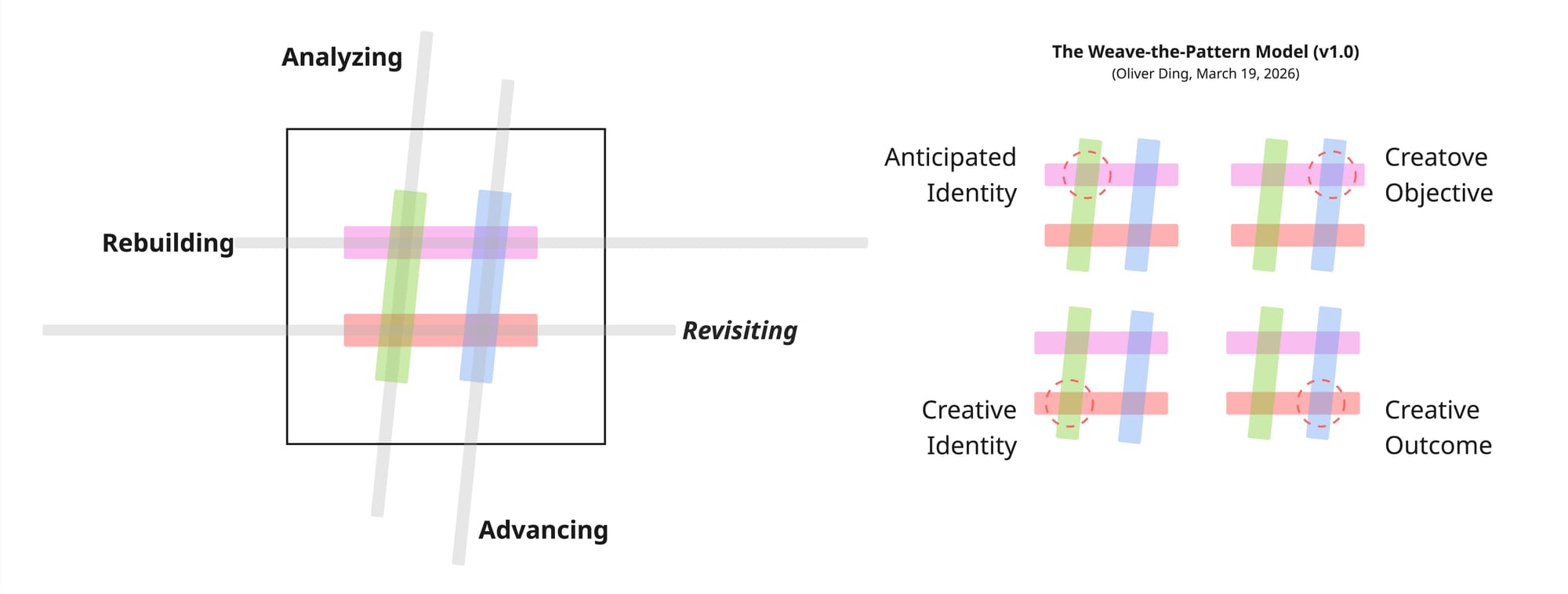
| Weave-point | Name | LARGE Description |
|---|---|---|
| Revisiting × Advancing | Creative Outcome | R: Looking back at past products, by-products, and frameworks — the accumulated outputs of earlier activity chains that carry unrealized generative potential |
| Revisiting × Analyzing | Creative Identity | R: Looking back at past creative identities — the dormant Selves that were once enacted and can be reactivated through the Revisiting move |
| Rebuilding × Advancing | Creative Object | G: The concrete object of present work — both excavated resources from the past and current materials — everything the creator is actively operating on in the present moment |
| Rebuilding × Analyzing | Anticipated Identity | G: The emerging vision of the next creative identity — the Other that Analyzing brings into focus, orienting present Rebuilding toward the future Self |
The four weave-points form a complete operational cycle. A creator engaged in Revisiting-Rebuilding simultaneously: recognizes past Creative Outcomes that carry dormant potential; reactivates past Creative Identities that have been forgotten; operates on a Creative Object that gathers both past and present materials; and develops clarity about the Anticipated Identity toward which the whole movement is oriented.
In LARGE terms: R (Reflection) activates the two Revisiting weave-points — Creative Outcome and Creative Identity — while G (Generation) activates the two Rebuilding weave-points — Creative Object and Anticipated Identity. L (Landscape) provides the spatial awareness within which all four weave-points can be seen simultaneously. A (Anticipation) is the forward orientation that gives the entire weave its direction. And E (Enterprise) is not a weave-point but the fabric itself — the long-arc trajectory produced when these four operations are sustained across time.
The weave is not a linear sequence but a fabric — with diachronic threads running through time and synchronic threads connecting the Activity and Identity dimensions — whose pattern, when viewed from a sufficient distance, reveals the shape of a creative life.
5.3 Applications of the Creative Identity Cascade Model
The Creative Identity Cascade Model, as developed in this article, is primarily a theoretical construction grounded in a single case study. Its practical applications across different creative lives, professional contexts, and cultural backgrounds remain to be explored and empirically validated. The following directions are offered as initial orientations for future investigation.
Self-understanding: The model provides a framework for reflecting on one's creative identity trajectory — not as a series of roles but as a cascade of identities, each preparing the conditions for the next.
Capacity development: The model identifies which creative identity needs to be developed next. If a creator is operating at the Reflector level, the developmental question is: what would it take to develop the Modeler identity? What activities, encounters, and theoretical resources would enable that transition?
Project planning: Different projects call for different identities. Recognizing which identity a project requires — and whether that identity has been developed — allows for more accurate project planning and resource allocation.
Team collaboration: Different people develop different creative identity trajectories. A team may include some individuals operating primarily as Practitioners, others as Modelers, others as Curators. Recognizing these differences enables better collaboration and more appropriate role allocation.
Mapping creative trajectories: The Agency Cascade provides a tool for mapping past creative trajectories, naming the Self-Other identity at each stage, recognizing patterns in one's creative identity development, and anticipating future identity transitions.
Each of these directions calls for case studies, comparative analyses, and collaborative inquiry that go beyond what a single article can establish. They are invitations, not conclusions.
Conclusion
This article has developed the Creative Identity Cascade Model as a new contribution to Creative Life Theory. Its core proposition is that creative work unfolds not as the expression of a single, stable identity but as the progressive transformation through a cascade of creative identities, each enabled by the one before it — a process in which the Other of each level becomes the Self of the next.
The contributions of this article can be summarized through the Weave-the-Theory Framework — a model for understanding how theoretical work unfolds across two axes: a Creativity line (Proliferation) operating at the concrete level of themes and models, and a Curativity line (Unification) operating at the abstract level of concepts and principles. The intersection of these two axes produces four weave-points, each naming a distinct layer of theoretical contribution.
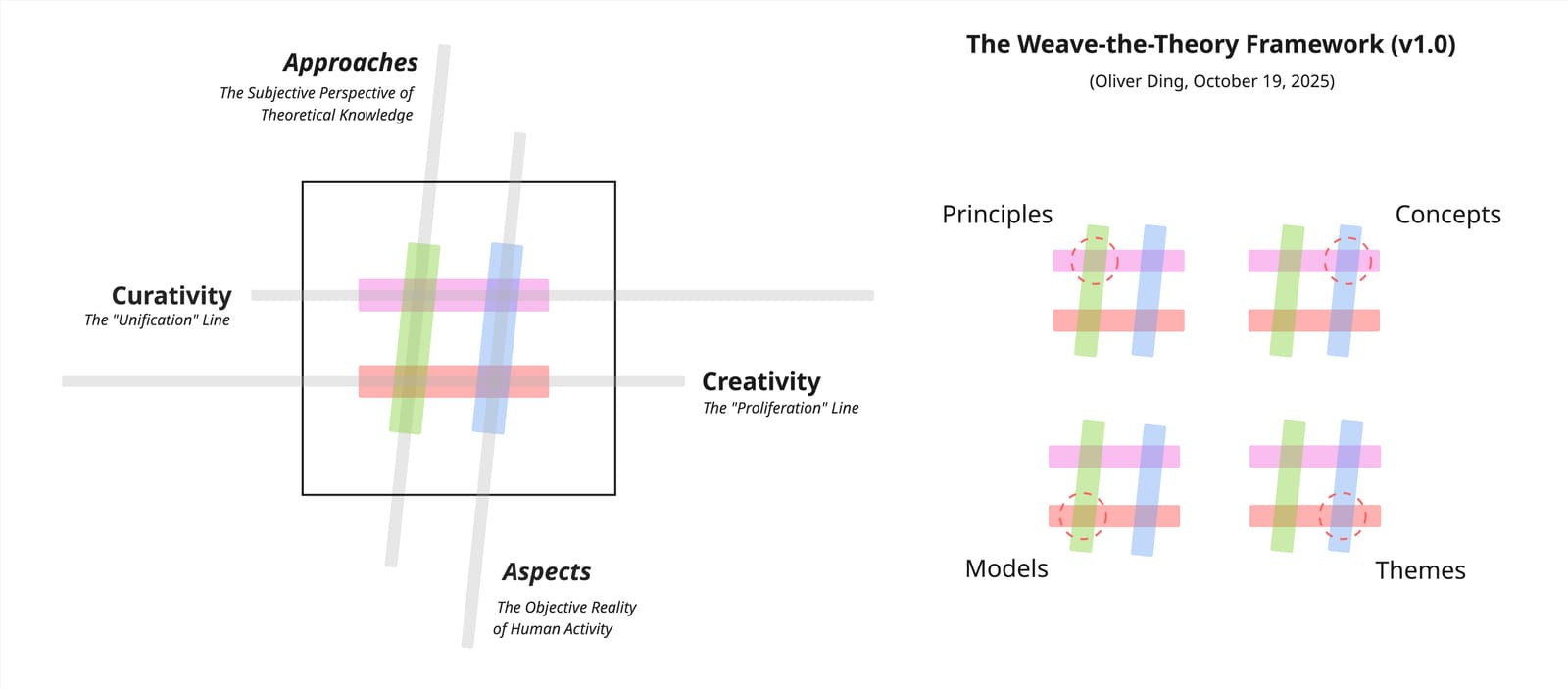
This article's work occupies all four:
Themes: Revisiting-Rebuilding and Advancing-Analyzing
Two strategic patterns are developed and connected throughout this article. Revisiting-Rebuilding elevates a creative heuristic into a strategy of life development: when a creator returns to earlier work and rebuilds it from a more developed standpoint, they enact a diachronic Self-Other relationship — the earlier Self supporting the later Self — that drives the Transformation of Self. Advancing-Analyzing names the synchronic form of the same structure: the dual-center dynamic through which first-order activity (Advancing) and second-order activity (Analyzing) operate together within any given level of the cascade to sustain creative development. Together, these two patterns constitute the operational grammar of creative identity development.
Models: Agency Cascade, Achievement Chain, and Dual-Center Pattern
Three structural models provide the analytical architecture of the article. The Achievement Chain (Life-as-Activity v0.3, 2020) establishes the Transformation of Self as the meta-product of temporal activity chains, distinguishing product, by-product, and meta-product as the three types of outcome that activity generates. The Agency Cascade (Anticipatory Cultural Sociology, 2026) provides the cascade structure itself: Activity Circles in which the Other of each level becomes the Self of the next, applied diachronically to reveal the succession of creative identities across a creator's trajectory. The Dual-Center Pattern — Surviving Center and Thriving Center, where the Thriving Center of one stage becomes the Surviving Center of the next — was discovered independently in the Homecoming case study and provides empirical confirmation of the Cascade's structural principle from a historically prior source. All three models are situated within the FFCC schema as their shared overarching framework.
Concept: The Transformation of Self
The central concept rebuilt in this article is the Transformation of Self. Originally developed in 2020 using Robert Kegan's constructive-developmental model as a borrowed framework, it is here rebuilt entirely within the Life as Activity Approach (v3.2) through the structural dynamics of the Activity Circle and the Agency Cascade. The rebuild is made possible by the four types of creative identity developed in 2025 — Projected, Narrative, Creative, and Anticipated — and by the polar relationship between Creative Identity and Anticipated Identity that drives the cascade forward. The Creative Identity Cascade Model is the formal name of this rebuilt concept.
Principles: The LARGE Method — L(A·R·G)=E
The governing meta-method underlying the entire framework is the LARGE Method (2026), expressed as the formula L(A·R·G)=E. Its five principles — Landscape, Anticipation, Reflection, Generation, Enterprise — provide the first principles from which both strategic patterns and analytical models are derived. Landscape is the synchronic view that makes the cascade visible. Anticipation is the forward orientation toward the Anticipated Identity. Reflection is the act of Revisiting. Generation is the act of Rebuilding. Enterprise is the Creative Identity Cascade itself — the long-arc trajectory through which successive creative identities unfold across years and decades. The four weave-points — Creative Outcome (Revisiting × Advancing), Creative Identity (Revisiting × Analyzing), Creative Object (Rebuilding × Advancing), and Anticipated Identity (Rebuilding × Analyzing) — name the specific operations that arise where the diachronic and synchronic axes of the weave intersect.
There is one further characteristic of Revisiting-Rebuilding that this article itself demonstrates. In the 2020 framework, the Transformation of Self was introduced as a theme — a significant concept worth developing — but the model used to articulate it was borrowed: Robert Kegan's constructive-developmental stages. That borrowing was appropriate at the time. It was the best available tool for the job.
But the situation has changed. The Life as Activity Approach (v3.2) has since developed into an independent knowledge system with its own original frameworks — the Activity Circle, the Agency Cascade, the Microdynamics of Creative Identity, the four types of creative identity. Continuing to borrow Kegan's model within this system would create an inconsistency: an external framework doing the theoretical work that the internal system is now capable of doing itself. This is not a critique of Kegan's model, which remains a powerful and valid account of adult development. It is simply that a knowledge system, once sufficiently developed, owes its central concepts an explanation grounded in its own terms.
This is also what makes the Transformation of Self a living concept. It is not a fixed definition waiting to be discovered. It is a concept that any creator can develop in relation to their own practice and knowledge system — giving it a meaning that is both theoretically coherent and personally grounded. The account offered in this article is one instance of that development. Others will produce different instances, shaped by different theoretical resources, different creative trajectories, and different worlds of activity.
This is one of the defining characteristics of Revisiting-Rebuilding as a strategy: the gap between original work and rebuilt work is not measured in years alone. It is measured in accumulated capacity — in the theoretical resources, developed frameworks, and creative identities that make a genuine Rebuilding possible. Revisiting can happen at any time. Rebuilding requires that you have grown.
This is also why Revisiting-Rebuilding tends to activate in midlife. Not because earlier work was abandoned, but because the accumulation required to rebuild it takes time — and time, in a creative life, is not empty waiting. It is the parallel development of the resources that will eventually make return possible.
The past is not a closed archive. It is a depth that rewards those who are willing to dive — and patient enough to surface with something that could not have been found before. Something could be reborn from the past.
References
Primary Sources
Ding, O. (2020). Life-to-be-Owned: The Achievement Chain. Activity Analysis Center.
Ding, O. (2023). Advanced Life Strategy: The Microdynamics of Creative Identity. Activity Analysis Center.
Ding, O. (2025). Homecoming: A Thematic Trip and the World of Activity Approach. Activity Analysis Center.
Ding, O. (2025). The Thematic Identity Curation Framework. Activity Analysis Center.
Ding, O. (2026, January). Education as Anticipatory Activity. Activity Analysis Center.
Ding, O. (2026, January). Revisiting and Rebuilding: The LARGE Method (2018–2026). Activity Analysis Center.
Ding, O. (2026, February). [Meta-framework] The LARGE Method (2026). Activity Analysis Center.
Ding, O. (2026, March). The L3D Model (v1.0, 2026). Activity Analysis Center.
Ding, O. (2026). Advancing and Analyzing (v2.0): The Dual Model of Self-Referential Activity in Theory Building. Activity Analysis Center.
Theoretical Foundations
Blunden, A. (2014). Concepts: A Critical Approach. Brill.
Engeström, Y. (1987). Learning by Expanding: An Activity-Theoretical Approach to Developmental Research. Orienta-Konsultit.
Gruber, H. E. (1974). Darwin on Man: A Psychological Study of Scientific Creativity. Dutton.
Kegan, R. (1982). The Evolving Self: Problem and Process in Human Development. Harvard University Press.
Kegan, R., & Lahey, L. L. (2009). Immunity to Change. Harvard Business Review Press.
Markus, H., & Nurius, P. (1986). Possible selves. American Psychologist, 41(9), 954–969.
Rosen, R. (1985). Anticipatory Systems: Philosophical, Mathematical, and Methodological Foundations. Pergamon Press.
Stinchcombe, A. L. (1987). Constructing Social Theories. University of Chicago Press.
v1.0 — March 19, 2026 - 11,018 words