
Toward Dramatic Life Pattern
This article is part of a possible book: Developmental Projects: The Project Engagement Approach to Adult Development.
by Oliver Ding
November 29, 2025
The journey traced in this book — from the living way of the “Developmental Project” concept to its theoretical foundations and practical applications — reveals something fundamental about how concepts develop. They do not emerge fully formed but unfold through practice, revealing new dimensions as they engage with real developmental processes.
As this book comes to a close, a new dimension of the “Developmental Projects” concept is beginning to emerge: Pattern. This epilogue briefly introduces this emerging direction, pointing toward future work that will explore how developmental projects exhibit recurring structural patterns — patterns that, once recognized, can be strategically engaged to shape life trajectories.
Beyond Functions: The Pattern Dimension
Throughout this book, we have explored the six functional themes of development: Discovery, Curation, Strategy, Narrative, Design, and Support. These functions address the question: What do we do in developmental projects?
But there is another dimension, equally important yet less obvious: How does development unfold? This is the domain of Pattern.
Patterns are not functions. While functions describe what people do (curate experiences, discover possibilities, develop strategies), patterns describe the structural configurations through which development unfolds across time and space. They are topological rather than functional — concerned with positions, relations, sequences, and timing rather than with categories of action.
Patterns are:
- Recurring structures that appear across different contexts
- Emergent from practice rather than prescribed by theory
- Dramatic in the sense that they involve turning points, stakes, and consequences
- Actionable once recognized — they can be strategically engaged
The concept of Dramatic Life Pattern refers to those structural configurations in development that are significant enough to warrant attention, study, and strategic engagement. Not every pattern is dramatic — only those that can dramatically shape developmental trajectories.
Patterns Already Discovered
Several patterns have already emerged through the projects documented in this book, though they have not yet been fully theorized.
GAP Projects represent a temporal pattern: the structural opportunities that exist between formal projects. These “After” and “Before” projects — such as Creative Life Curation and Creative Life Discovery — occupy the gaps between major endeavors. They serve as reflection points, transition spaces, and moments of strategic choice. The timing of GAP projects is itself a pattern: recognizing when to pause, curate, or explore can dramatically affect developmental outcomes.
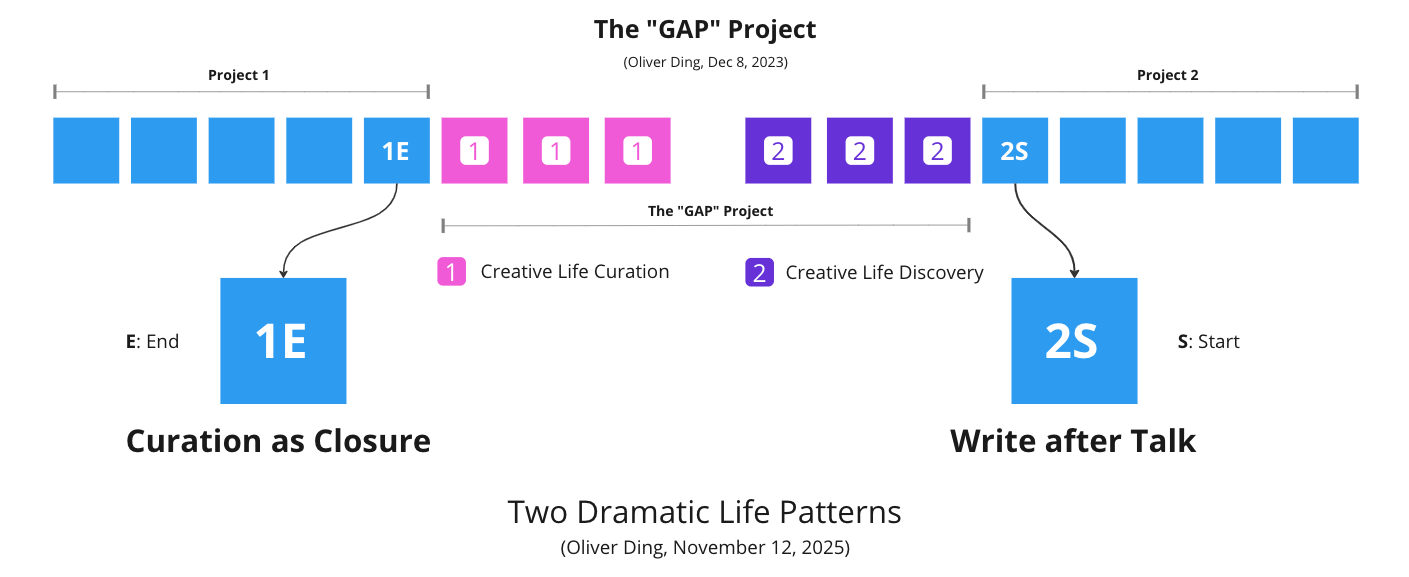
The 1E/2S Pattern describes positional patterns within project sequences:
- 1E (Curation as Closure): Curating a collection of work before a project ends, using the curation itself as a formal closure mechanism
- 2S (Write after Talk): Engaging in conversations with others after writing initial ideas at the start of a new project, using dialogue as a development mechanism
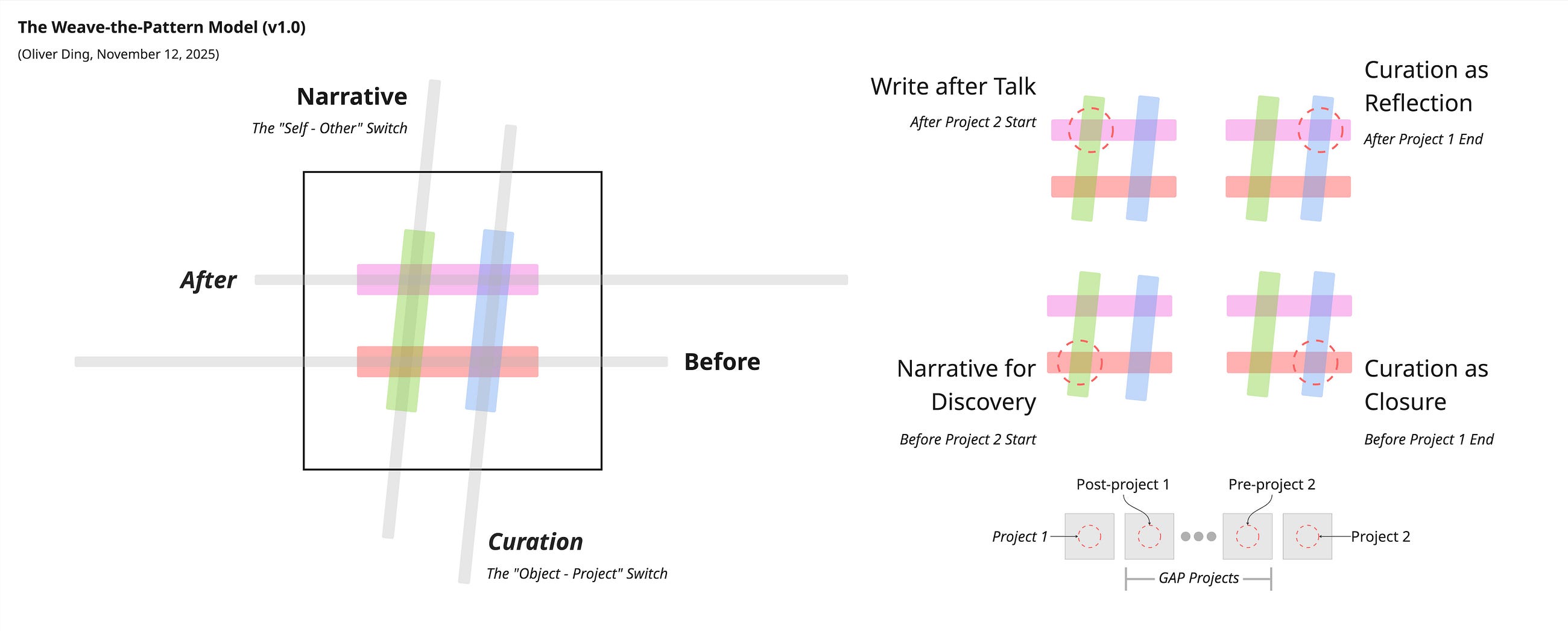
These patterns, together with others like the Weave-the-Pattern model, reveal a deeper structural dimension of development. They show that development is not random but exhibits recognizable configurations — and once these configurations are recognized, they become tools for strategic action.
Perhaps most significantly, the practice of recognizing patterns has led to the discovery of Anticipatory Analogy — a meta-pattern in which past structural similarities enable prediction of future outcomes. In my own experience, recognizing the structural isomorphism between October 2022 and March 2024 led to a strategic decision to invest time in a GAP project, predicting (correctly) that it would yield outcomes similar to those in 2022. This predictive use of pattern recognition transforms development from reactive response into strategic engagement.
A New Research Direction: Ecological Validity for Actors
The concept of Dramatic Life Pattern points toward a methodological innovation: ecological validity as a practice for actors, not just researchers.
Traditionally, ecological validity refers to whether research findings generalize to real-world settings — a concern for researchers validating theories. But the concept can be reframed for developmental actors themselves. When individuals:
- Identify patterns in their own developmental projects
- Develop anticipatory analogies based on structural similarities
- Make strategic choices to engage with recognized patterns
- Validate predictions through action in their own lives
- Accumulate knowledge from repeated cycles of pattern engagement
— they are conducting a form of self-directed developmental research. Each person becomes both researcher and actor, building a personal knowledge base of validated patterns through lived experience.
This approach transforms adult development from a passive process (being developed by environments) or a reactive one (responding to opportunities) into an anticipatory and strategic process. By recognizing patterns, predicting their recurrence, and strategically engaging with them, individuals exercise a distinctive form of developmental agency.
The cyclical process of pattern engagement — Experience → Identify → Theorize → Anticipate → Act → Validate → Update — creates a continuous loop in which personal development and personal research become inseparable. This is ecological validity in its most direct sense: validating knowledge through its consequences in one’s own ecological context.
Looking Forward
The exploration of Dramatic Life Pattern represents the next phase of the Project Engagement Approach to adult development. While the present book establishes the foundations — the concept of Developmental Projects, the six functional themes, the theoretical framework of Project Engagement — the pattern dimension opens new territory.
Future work will:
- Develop a systematic theory of patterns in development, distinguishing types, characteristics, and conditions of emergence
- Build a catalog of discovered patterns, documenting both universal structures and context-specific configurations
- Elaborate methods for pattern recognition, helping individuals identify structural opportunities in their own developmental journeys
- Explore the relationship between pattern and function, understanding how the six functional themes manifest through different structural patterns
- Integrate pattern research into Creative Life Theory, showing how pattern recognition and engagement constitute a form of creative practice
This work will be presented in a forthcoming volume, Dramatic Life Pattern: The Topological Structure of Project Engagement (tentative title, 2026), which will be integrated into the broader Creative Life Theory framework.
The Living Way Continues
This book began with a lotus pond in Fuzhou — a moment of recognition that concepts, like lotus flowers, blossom within their environments. The “Developmental Project” concept has unfolded through a series of knowledge projects, revealing new dimensions, forming new connections, expanding in meaning and significance.
The emergence of the pattern dimension is the latest expression of this living way. Concepts do not stop developing when we write about them. They continue to grow, reveal new aspects, open new questions. The “Developmental Project” concept is not finished — it is in the process of becoming, and the pattern dimension represents its newest growth.
As this book concludes, the concept continues its journey. New patterns are being discovered. New methods are being developed. New dialogues are opening between theory and practice, between Eastern and Western traditions, between individual development and social formation.
The lotus continues to blossom.