
[Creative Action] A Thematic Map of My Intellectual Development in 2019
by Oliver Ding
November 22, 2026
Today, while browsing through some old photos, I unexpectedly came across a diagram (see below). I created it at the end of 2019 as a thematic map of my intellectual development that year.
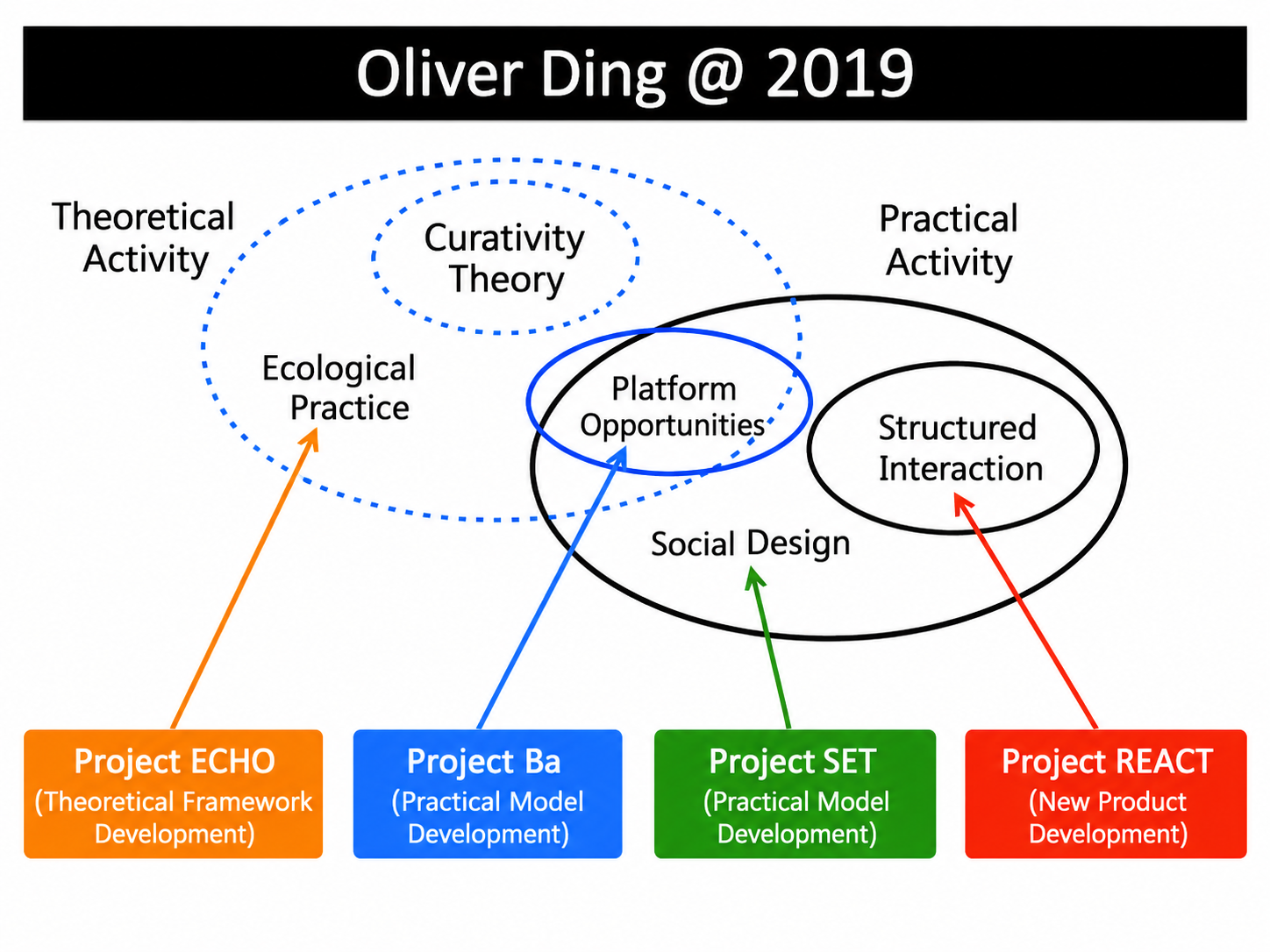
Looking at it again, I can see how it captured several thematic focuses that were taking shape through my projects and everyday work. The map distinguishes two areas of development: theoretical development, represented by dotted lines, and practical development, represented by solid lines. It also shows several projects through which these themes were explored.
At that time, I was still working at a startup, involved in digital product development and design. This professional context was an important part of my practical work, particularly my interest in Social Design.
Here is a closer look at the thematic focuses and projects in the map.
1. Theoretical Activity
The theoretical side of the map included three main themes:
- Curativity Theory
- Ecological Practice
- Platform Opportunities
Curativity Theory was already taking shape in my manuscript Curativity: The Ecological Approach to Curatorial Practice, which I completed in March 2019. The manuscript explored curation as a form of knowledge practice and developed an ecological account of curatorial activity.
During the summer of 2019, I also began a project to develop the Ecological Practice Approach. What initially emerged from my reflection on curation gradually became a broader theoretical inquiry into human action, affordances, and social practices.
Platform Opportunities appeared as another important theme. Interestingly, it occupied an overlapping area between theoretical and practical development in the map.
2. Curativity Theory and Project ECHO
The map associates Project ECHO with theoretical framework development.
In retrospect, this focus connects with my effort to develop Curativity Theory and explore how theoretical ideas could be organized into frameworks and diagrams.
Another important development in 2019 was the creation of the WXMY diagram. It became a foundational heuristic for subsequent diagrams and knowledge frameworks.
Looking back, I can see how these early diagramming activities contributed to a longer journey of exploring the relationship between theory and practice.
3. Platform Opportunities and Project Ba
Project Ba was positioned around Platform Opportunities and labeled as a practical model development project.
The idea behind Project Ba was to develop a social action platform. Unlike conventional social media platforms, which primarily revolve around content sharing, Project Ba was designed to enable users to take action. Its focus was on building narratives, connections, and collaborations around people's actions.
The name Ba comes from the Japanese term ba (場). I chose this term to express the idea of a shared space in which people come together and engage in meaningful action.
Looking back, I can see how this early platform concept continued to inform my theoretical work.
In 2020, when writing After Affordance, I introduced the Infoniche framework, which used Ba as one of its units of analysis. In 2021, I developed the manuscript Platform for Development, applying the Infoniche framework to the analysis of developmental platforms.
This trajectory—from Project Ba in 2019, through the Infoniche framework in 2020, to Platform for Development in 2021—shows how an early practical idea became a subject of theoretical development. It also illustrates the reciprocal relationship between platform design and theoretical inquiry.
4. Practical Activity and Social Design
On the practical side, the map identified two major themes:
- Social Design
- Structured Interaction
At that time, I was working at a startup on digital product development and design. Social Design was the thematic focus through which I reflected on this practical experience.
Rather than treating product design simply as a matter of designing interfaces or features, I was interested in the social interactions and practices that digital products could organize and support.
This practical interest became particularly visible in the React Project and my subsequent inquiry into Social Design.
5. Project SET: Rethinking Social Design
In 2019, I initiated a reflective inquiry called Rethink Social Design. This work led to the creation of the SET framework.
The project was closely connected to my practical experience in digital product development, but it also involved a theoretical effort to reconsider how social design could be understood.
The SET framework later became an important reference point in my reflection on the relationship between theoretical knowledge and practical development.
6. Project REACT: New Product Development
Project REACT represented the practical development side of my work. In 2019, I prototyped a web application through this project.
The project continued into 2020 with the DOO Project, which became its operational outcome. After its release, I conducted three months of user interviews and wrote a white paper integrating theoretical perspectives. This work eventually led to the Platform Container framework for analyzing digital transformation.
The React Project therefore provides a concrete example of how practical product development can generate material for theoretical reflection.
7. Possible Theme: Supportance
In 2020, while continuing to develop the Ecological Practice Approach, I introduced the concept of Supportance to address the action possibilities offered by social environments. Looking back at the 2019 map, I sometimes wonder: what if I had developed this concept one year earlier?
If Supportance had emerged in 2019, the map might have looked somewhat different. The theoretical focus would have extended beyond Curativity and the exploration of ecological practice to include a more explicit concern with the relationship between people and their social environments. Platform Opportunities, in particular, might have become an early site for exploring how social environments offer potential action opportunities.
This perspective might also have changed how I approached my practical projects. Project Ba, conceived as a social action platform, was already concerned with creating conditions for people to act, connect, and collaborate. With Supportance as a theoretical principle, my Social Design work could have gained a deeper and stronger theoretical foundation. At the same time, the Social Design projects themselves could have provided practical contexts for testing, refining, and extending the concept of Supportance. Theory would have informed design, while design practice would have contributed to theoretical development.
Of course, this is a retrospective possibility, not what actually happened. The concept did not take shape until 2020. Yet imagining this alternative helps me see a latent connection in the 2019 map: the theoretical exploration of ecological opportunities and the practical development of social platforms were already approaching a shared question — how do environments make human action possible?
8. Looking Back: The Theory–Practice Connection
Revisiting this thematic map, I am struck by how clearly it records my interest in the theory–practice connection.
The dotted and solid boundaries were not simply two separate areas of intellectual activity. They represented two directions of development that could inform one another.
On the theoretical side, I was developing Curativity Theory and the Ecological Practice Approach. On the practical side, I was working on digital products, exploring Social Design, and developing practical models.
Platform Opportunities occupied an interesting position between the two. Project Ba is a particularly clear example: an idea for a social action platform emerged from practical interests, then continued to develop through the Infoniche framework and my later work on developmental platforms.
The WXMY diagram, the SET framework, and the React Project also show how ideas and practical work could generate further frameworks and questions.
In a later reflection, I described the period from 2019 to 2021 as a journey from practice-based reflection, through theory-based curation, toward a broader dialogue between theory and practice. This 2019 map offers an earlier snapshot of that journey.
It is fascinating to rediscover an old diagram and see how many of the themes that continued to shape my intellectual work were already present there.
v1.0 - November 22, 2026 - 1,282 words