
Advancing and Analyzing: The Dual Model of Self-Referential Activity in Theory Building
A Case Study of Creative Life Theory Development (2020–2023)
by Oliver Ding
September 30, 2025 (Draft), Revised on November 23, 2026
Introduction
In 2023, I wrote a seven-part retrospective analyzing my three-year journey of developing Creative Life Theory (CLT). In it, I explicitly stated: “The Development of Creative Life Theory (2020–2023) aims to use the Creative Life Curation framework to reflect on my journey of building the Creative Life Theory.”
This statement exemplifies a unique methodological maneuver: I employed a theoretical framework to analyze the very process through which that framework came into being. Rather than being a logical paradox or a vicious circle, this is a deliberate act of constructive self-reference.
This practice is rooted in the Self-Referential Activity (SRA) model, which I developed in 2021. SRA connects the concept of constructive self-reference with Activity Theory, explaining how certain activities not only produce external outcomes but also transform the actor’s capacity to engage in future activities. I have applied SRA to the development of concept systems (what I term the "mental platform"). However, SRA is a highly abstract model. While it explains why self-referential transformation occurs, it does not provide granular details on how a theorist actually navigates the tension between doing and reflecting in daily practice.
In September 2025, I noticed a recurring behavioral pattern in my own workflow: I frequently engaged in project retrospectives, and even when writing a single article, I would immediately reflect through writing a postscript. This realization prompted me to revisit my 2023 CLT case. I realized that my 2023 retrospective only recognized SRA in the retrospective act of analysis itself, failing to see that the actual historical development of the theory was already deeply self-referential.
To articulate this dual reality, I extracted two distinct Types of Action from my 2023 case: Advancing (A1) and Analyzing (A2). The interplay between these two actions forms the AA Pattern (Advancing-Analyzing Pattern), which I propose as a specific methodological pattern for theoretical activity.
Through the case analysis of the three waves of my CLT development, this paper establishes the AA Pattern as a formal member of the "Dramatic Life Pattern" series. Although this paper focuses specifically on theoretical activity and discusses the AA Pattern in tandem with the SRA model, the exploration of the AA Pattern lays a solid foundation for future case studies.
Contents
Part 1: The Development of SRA
1.1 The Birth of SRA
1.2 SRA Applied to Knowledge Activities
Part 2: The 2023 Case of Creative Life Theory
2.1 What is Creative Life Theory (CLT)?
2.2 The 2023 Case Study
2.3 A Case of Self-Referential Activity
Part 3: From Kinds of Actor to the AA Pattern
3.1 Kinds of Actor
3.2 The AA Pattern and Types of Action (A1 & A2)
3.3 Scales and Nesting of the AA Pattern
Part 4: The AA Pattern of Three Waves
4.1 The First Wave: Expanding Units of Analysis
4.2 Second Wave: Supportive Theoretical Development
4.3 Third Wave: Strategic Thematic Exploration
Part 5: Discussion and Conclusion
5.1 Formalizing the Everyday: From Intuitive Practice to a Named Pattern
5.2 Scaling the "Self": From Individual to Meaningful Whole
5.3 Implications for Knowledge Workers and Creators
Conclusion
Part 1: The Development of SRA
I proposed the Self-Referential Activity (SRA) model in 2021 and subsequently applied it to knowledge activities. In this part, I will briefly review the birth of this model and how it was operationalized in my knowledge projects, providing the necessary context for the 2023 CLT case study that follows.
1.1 The Birth of SRA
The SRA is a model I created by integrating the concept of self-reference with Activity Theory. Traditional Activity Theory emphasizes the triadic relationship between Subject, Mediating Tool, and Object.
What is self-reference? According to the general definition, self-reference occurs when a sentence, idea, or formula refers to itself. In philosophy, it also refers to the ability of a subject to speak of or refer to itself. There are three types of self-reference:
- Destructive Self-reference: The ancient symbol Ouroboros (the dragon that continually consumes itself) represents this type. The damage is caused by the self-reference of a system.
- Neutral Self-reference: It doesn't refer to real damage, but is just for a logical game (e.g., a tweet that describes its own character count).
- Constructive Self-reference: It generates productive outcomes.
I particularly focus on Constructive Self-reference and want to apply it to my work and life. Therefore, I coined the concept of "Self-referential Activity" (SRA). It refers to a special type of activity that can support self-reference development.
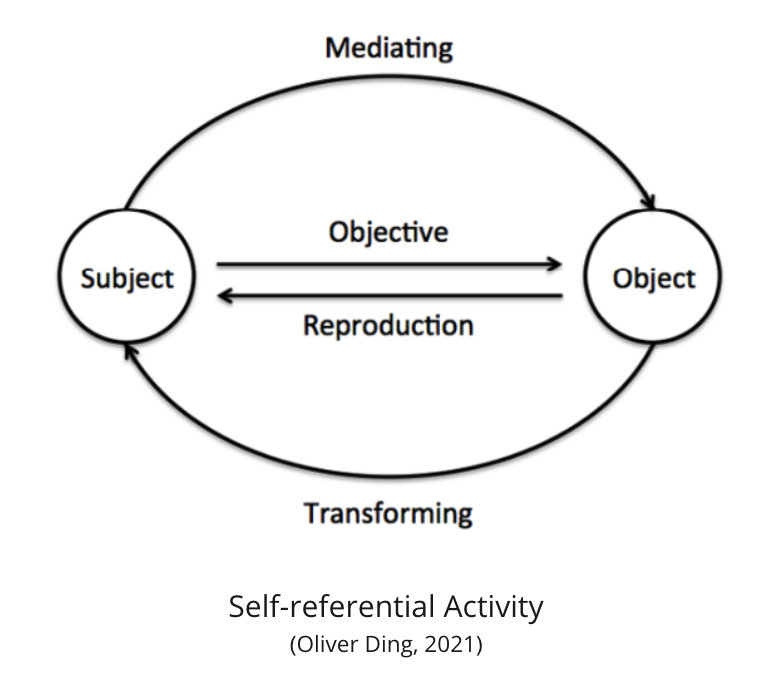
As shown in the SRA diagram (Oliver Ding, 2021), I built upon Activity Theory by incorporating several components:
- Subject and Object: The fundamental relation in activity.
- Mediating: Tool-mediated action.
- Objective: The goal that gives activity direction.
- Reproduction: How activity reproduces itself.
- Transforming: A crucial component that captures the self-referential loop. It shows how the subject is transformed through the activity itself.
In SRA, the activity not only produces external outcomes but also transforms the actor's capacity to engage in future activities.
1.2 SRA Applied to Knowledge Activities
In 2023, based on the model of Self-referential Activity, I made a new model called Self-referential Strategy to develop Mental Platforms. See the diagram below.
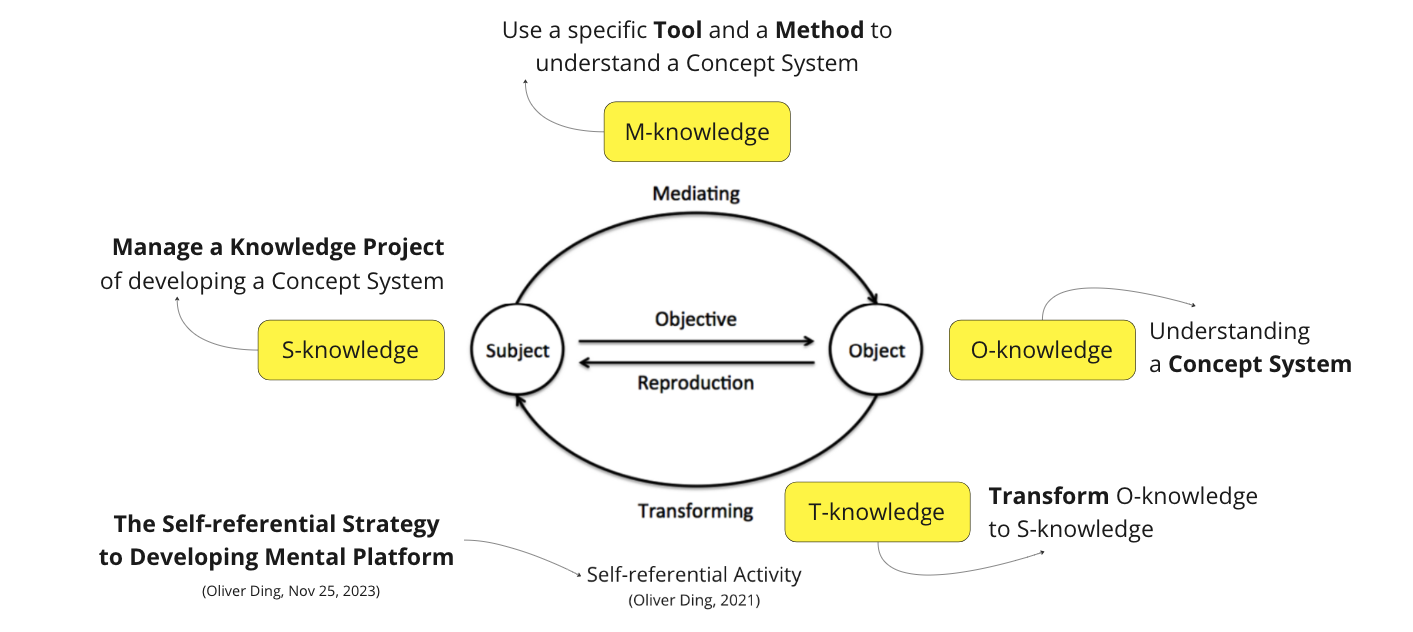
The new model defines four types of knowledge:
S-knowledge refers to knowledge for self-awareness, self-improvement, self-regulation, life discovery, life strategy, etc. For the present discussion, it refers to Manage a Knowledge Project of Developing A Concept System.
O-knowledge refers to knowledge about the work’s object. For example, if the work is building a house, the O-knowledge is about how to build the house. For the present discussion, O-knowledge refers to understanding a Concept System.
M-knowledge refers to knowledge about using tools and methods. For example, the skills of using some tools to build the house. For the present discussion, it means using a specific tool and a method to understand a concept system.
T-knowledge refers to knowledge about transforming O-knowledge to S-knowledge.
T-knowledge is the engine of self-referential activity. It involves a crucial switching of Means and End. In traditional learning, theory is the End (the goal is to understand it), and O-knowledge is the outcome. In self-referential activity, theory becomes the Means (a tool for my own work), and S-knowledge is the outcome.
Let’s see an example:
- O-knowledge: I wrote an article about Robert Kegan’s Knowledge Enterprise. My understanding of it is my O-knowledge.
- M-knowledge: I used the Knowledge Discovery Canvas to represent Kegan’s core ideas in a map. My skills in using the canvas are my M-knowledge.
- T-knowledge: I used Kegan’s “Five Orders of Consciousness” framework to reflect on my two knowledge projects: the development of Project Engagement approach and the development of Possible Life Theory (Creative Life Theory). This strategy is my T-knowledge.
- S-knowledge: Now I can use the “Five Orders of Consciousness” framework for my future projects.
This is T-knowledge in action: it transforms theoretical understanding (O-knowledge) into a tool for self-development (S-knowledge), bridging the gap between my role as a researcher and my role as an actor.
While the SRA model and the four knowledge types provide a powerful theoretical lens to explain how self-referential transformation occurs, they remain at the abstract level. They do not offer granular details on the specific operational patterns a theorist actually enacts during the daily practice of theory building. To observe these concrete dynamics, we must turn to an empirical case. In the following section, I will examine my 2023 retrospective of Creative Life Theory (CLT), a case that vividly illustrates SRA in practice but also reveals a missing piece in our understanding of its operational mechanics.
Part 2: The 2023 Case of Creative Life Theory
My journey of developing Creative Life Theory (CLT) began in 2019 when I started researching Creative Action. In 2022, through the Creative Life Curation project, I proposed a series of analytical units and established CLT v1.0, which resulted in four book drafts.
Between January and April 2023, I conducted an in-depth study of theoretical sociologist Ping-keung Lui’s book Gaze, Actions, and the Social World. Drawing on several theoretical concepts from his theoretical sociology, I developed the Creative Course Framework, which laid the core foundation for CLT v2.0. In October 2023, I began editing a book draft to systematically introduce CLT v2.0 by collecting a series of articles.
It was during the preparation of this book draft, between late September and early October 2023, that I looked back at the developmental process of Creative Life Theory from 2020 to 2023 and conducted a case study using the Creative Life Curation method. This case study became the empirical foundation for the analysis in this paper.
2.1 What is Creative Life Theory (CLT)?
Creative Life Theory (CLT) is the central knowledge enterprise of my intellectual journey. My primary interest lies at the intersection of Knowledge, Creativity, and Adult Development. I designed CLT specifically for Knowledge Workers and Creators, aiming to understand a fundamental question: How do individual actions transform into collective culture?
CLT is not a single static framework; it has evolved through two distinct phases:
- CLT v1.0 (2022) focused on expanding the units of analysis. It mapped the creative life through a continuum: Action — Project — Journey — Landscape — Lifescope. This phase resulted in a series of "Aspects of Creative Life" book drafts.
- CLT v2.0 (2023) is centered on the Creative Course Framework. I used this meta-framework to build an expanded model that curates several other frameworks together. Specifically, this expanded model integrates the Universal Reference Framework, the Anticipatory Activity System (AAS) Framework, the Value Circle Framework, and the Knowledge Circle Framework. This comprehensive integration presents the full landscape of CLT v2.0.
While the frameworks evolved and expanded across versions, the entire Creative Life Theory is anchored by three core metaphors:
- The Sandglass (S-T-O Tendency): Subjectification, Crystallize Thematically, and Objectification.
- The Circle (Knowledge Center): The container for knowledge engagement and collaborative projects.
- The Square (Lifescope / World of Activity): The boundary of a person's creative space across their entire life.
These three metaphors also served as the organizational structure for my 2023 CLT v2.0 book draft.
Most crucially, CLT was built using its own tools. The theory wasn't developed first and then reflected upon later; the reflection was embedded in the construction. I explicitly stated in the 2023 book: "I often used these tools to reflect on my journey of developing Creative Life Theory... The insights I learned from these reflections also guided the new development of my knowledge projects. In this way, I build a Self-referential Activity of connecting THEORY and PRACTICE." The theory became both the product of my creative life and the analytical lens through which I examined my creative life.
2.2 The 2023 Case Study
To prepare this book draft, I conducted a systematic study between late September and early October 2023, retrospectively analyzing the development of Creative Life Theory from 2020 to 2023. The outcome of this study was a seven-part article series titled The Development of Creative Life Theory (2020–2023). The series is structured as follows:
- Part 1: First-wave Development
- Part 2: Second-wave Development
- Part 3: Third-wave Development
- Part 4: Three Themes of a Journey of Theory Building
- Part 5: Creative Dialogue and Mental Moves
- Part 6: Four Perspectives and Creative Identities
- Part 7: The World of Works and Five Possible Books
To structure this reflective inquiry, I used the Creative Life Curation framework as the primary analytical model. Also known as the "Life as Sandglass" model, this framework highlights the S-T-O Tendency (Subjectification, Crystallize Thematically, and Objectification). As illustrated in the Sandglass diagram, the upper part represents Subjectification (Experience 1 / Second-order Activity), involving Exploring Widely and Inquiring Deeply. The middle point is Crystallize Thematically. The lower part represents Objectification (Experience 2 / First-order Activity), involving Working Deeply and Playing Widely.
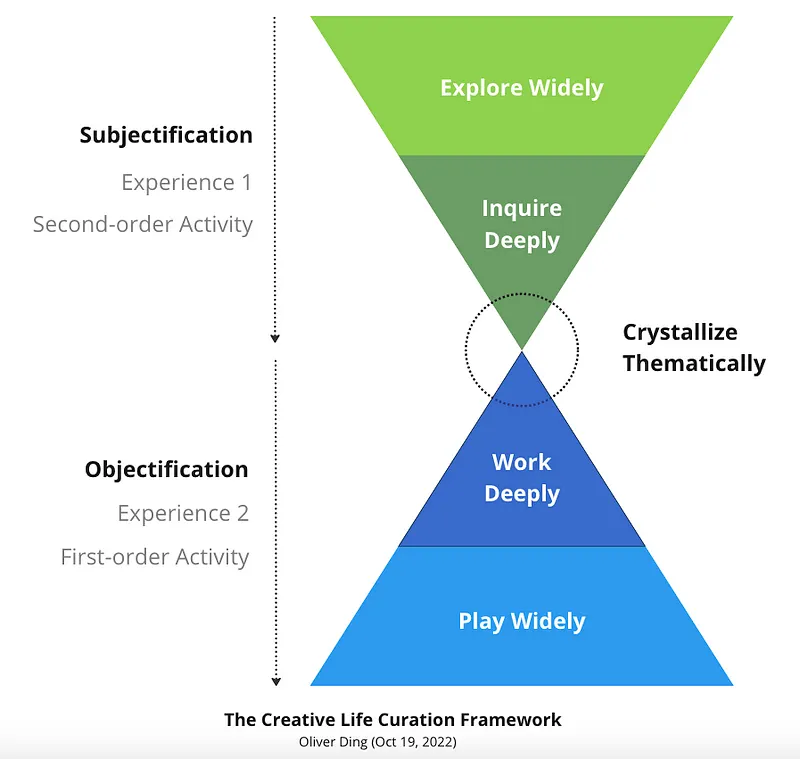
Crucially, the Sandglass model is not merely a linear framework for describing static stages. In order to consider the dynamics of creative processes, the model itself utilizes the concept of "waves" (First-wave, Second-wave, and Third-wave) to capture the complex, overlapping nature of a creative journey.
Applying this wave-based Sandglass model to my own intellectual history, I analyzed the 2020–2023 journey and identified three specific developmental waves:
- First Wave (Expanding Units): Creating new analytical units (like the Thematic Landscape Map) to understand increasingly complex knowledge work.
- Second Wave (Supportive Theoretical Development): Engaging in a deep theoretical dialogue with sociologist Ping-keung Lui and adopting his meta-framework to restructure CLT.
- Third Wave (Strategic Thematic Exploration): Developing concepts like the "Meaning Matrix" to synthesize ongoing projects across Curativity Theory, Activity Theory, and Mindset.
In writing this seven-part series, I did not just narrate chronological events. I actively used the conceptual tools that had emerged during those three years to dissect the very process that produced them. The 2023 case was a massive, multi-layered text where the theory was deployed to explain its own genesis.
2.3 A Case of Self-Referential Activity
As I noted in the introduction of my 2023 book draft, the Creative Life Theory has developed a set of tools for discussing creative life and knowledge engagement. I selected some of these tools to reflect on the landscape and the development of Creative Life Theory itself. These tools include:
- The Knowledge Discovery Canvas
- The Creative Life Curation Framework
- The ECHO Way
- Themes of Practice
- Kinds of Actors
- Persona Dynamics
- Thematic Scrapboard
I used a unique method to develop the Creative Life Theory because the mission of my own creative life is to connect THEORY and PRACTICE. I didn't only work on developing theoretical concepts but also made tools for real-life practice. Moreover, I often used these tools to reflect on my journey of developing Creative Life Theory and other knowledge projects. The insights I learned from these reflections also guided the new development of my knowledge projects.
In this way, I built a Self-Referential Activity (SRA) of connecting THEORY and PRACTICE.
Looking back at the 2023 case from the vantage point of 2025, I can now see a profound conceptual limitation in my earlier interpretation. In 2023, I only recognized SRA in the retrospective act of analysis itself (what I now call A2). I treated SRA merely as a methodological tool for reflection—a way to look back and make sense of the journey.
However, I failed to realize that the actual historical development of CLT (2020–2023) was already deeply self-referential. The process of building the theory (what I now call A1) was not a pre-requisite to SRA; it was SRA in action. The tools I created were already transforming my own capacity to create better tools during the development process, not just after it.
To articulate this dual reality—that both advancing (A1) and analyzing (A2) are forms of SRA—I found that the AA Pattern provides the most precise language. I realized that AA is not merely a descriptive narrative framework; it is the actual operational pattern of SRA in theory building.
Part 3: From Kinds of Actor to the AA Pattern
The central mission of my creative journey is the theory-practice connection. Because of this, I have developed a habit: I frequently use my own theoretical frameworks to guide and reflect on my own creative work.
This self-referential habit, however, involves more than just shifting between two different types of actions (Advancing and Analyzing). It also involves shifting between two or more different identities or roles. Traditional theories of reflection (such as Donald Schön's "reflection-in-action") primarily focus on the temporal relationship between action and thinking, but they do not adequately address this dimension of identity shifting.
To deeply explore how different roles shape the nature of my reflective actions, I turned to my own theoretical framework and introduced the Kinds of Actor model as the starting point for defining the AA Pattern.
3.1 Kinds of Actor
In my CLT enterprise, I identified four actor types:
- Actors: Taking creative actions and projects.
- Curators: Transforming experiences into meaningful wholes.
- Empirical Scientists: Researching specific themes.
- Theoretical Sociologists: Curating semiotic system diagrams.
The key insight is that I, as a single person, move between these domains, shaping multiple identities. This identity shifting is the prerequisite for the types of action that constitute the AA Pattern.
When I shift from an Actor to a Theoretical Sociologist, my motive and object of activity change, which in turn dictates whether I am Advancing or Analyzing.
3.2 The AA Pattern and Types of Action (A1 & A2)
The AA Pattern is an action pattern I extracted from my own practice. It consists of two distinct types of action:
- Advancing (A1): Type of Action 1. As an Actor, I use theoretical tools to intervene directly in the object to generate and advance projects or theories. A1 is performative and productive. It is the first-order activity of writing, designing, or building (e.g., developing a new framework, writing a draft, or organizing a project).
- Analyzing (A2): Type of Action 2. As a Researcher, I objectify the process and products of A1. Using the same theoretical tools, A2 retrospectively deconstructs, analyzes, and extracts patterns. A2 is explanatory and reflexive. It is the second-order activity of reviewing, mapping, and synthesizing (e.g., writing a retrospective, creating a diagram of the journey, or mapping the developmental process).
The AA Pattern is a universal and relatively simple pattern that many creators experience in their daily work. It is a basic feedback loop: the insights gained from A2 inform the next cycle of A1. This iterative process bridges my understanding as a researcher with my capability as an actor.
However, real creative life is far more complex than a single pattern. The AA Pattern does not operate in isolation; it is interwoven with many other patterns and dynamics. SRA (Self-Referential Activity) is one such independent pattern. SRA and AA are not in a parent-child relationship; they describe phenomena from different angles. SRA captures the self-referential dynamic (where the tools created during development are used to analyze that very development), while AA captures the alternating rhythm of advancing and analyzing.
In real practice, these two phenomena become entangled. When an SRA occurs, it is almost always enacted through the alternating actions of A1 and A2. In this paper, my analytical strategy is to use the AA Pattern as a lens to dissect and better understand the SRA cases embedded within the three waves of CLT development.
3.3 Scales and Nesting of the AA Pattern
The AA Pattern is not a one-off event; it operates across different scales and exhibits recursive nesting.
Scales refer to the temporal duration or granularity of the action. An AA cycle can occur in a micro-scale (e.g., spending an hour writing a draft as Advancing (A1), and then writing a postscript as Analyzing (A2)), or a macro-scale (e.g., spending three years developing a theory as Advancing (A1), and spending months writing a book draft as Analyzing (A2)).
Nesting, on the other hand, refers to the phenomenon where the AA Pattern turns back on itself. This is where Analyzing the Analyzing (A3) emerges. Analyzing the Analyzing (A3) is not just a larger scale; it is an action type that takes an Analyzing (A2) process as its object.
This multi-scalar nesting is beautifully illustrated in the very structure of this paper:
- Macro-Advancing (A1): The actual development of CLT from 2020 to 2023 was a primary Advancing (A1) process.
- Macro-Analyzing (A2): My 2023 retrospective article and book draft were an Analyzing (A2) of that Advancing (A1) process. It mapped the journey and extracted insights.
- Macro-Analyzing the Analyzing (A3): This 2025 paper is an Analyzing the Analyzing (A3). I am treating my 2023 retrospective (which was A2) as my new object of analysis, using it as empirical data to extract and formalize the AA Pattern.
This demonstrates that theory building is a highly self-referential activity. By moving between different scales and creating nested loops, the theorist can continuously spiral upwards, driving the theory deeper and deeper.
Part 4: The AA Pattern of Three Waves
Now, let me use the AA Pattern to revisit my history of CLT development (2020–2023).
To understand the structure of this journey, we must first distinguish between the macro and micro levels of analysis. At the macro level, the entire development of CLT from 2020 to 2023 represents an Advancing (A1) process. The 2023 retrospective and book draft represent an Analyzing (A2) of that process. Because the tools created during A1 were used in A2, and the object analyzed by A2 (CLT) was exactly what generated those tools, A1 and A2 together constituted a grand Self-Referential Activity (SRA) of CLT.
However, in this section, we will focus specifically on the internal dynamics of A1 itself. If we zoom in on the 2020–2023 development process, it unfolded through three distinct waves. Through my analysis, I have found that the development process of each wave contains at least one SRA case. The following analysis will employ the AA Pattern to dissect these cases. This analysis perfectly exemplifies the Nested AA Pattern discussed in Part 3.
4.1 The First Wave: Expanding Units of Analysis
The most important development during the first wave occurred in the second half of 2022. At that time, I was concluding my three-year Knowledge Curation project (2020–2022) and began applying Curativity Theory to a new domain: Life Curation. During this transition, I noticed that my three-year creative journey (2020–2022) could perfectly serve as the research material for the Creative Life Curation project. Therefore, I began analyzing my own creative process over those three years.
From today's perspective, the Knowledge Curation project was A1 (Advancing), and the Creative Life Curation project was A2 (Analyzing). Did this A1-A2 interaction constitute an SRA? Yes, because both projects belonged to the same theoretical enterprise—Curativity Theory.
A more explicit example is the case study titled Mapping Thematic Landscape (Curativity, 2019–2022). In order to discuss the outcome of knowledge production around a particular theme, I coined the term "Thematic Landscape," which refers to a landscape of personal explicit knowledge and related activities. The core of this mapping is a new type of diagram: the Thematic Landscape Map, which can be used to 1) Reflect on Present Situations, 2) Discover Potential Themes, and 3) Explore Possible Projects. I used my "Curativity" Thematic Landscape as an example to design the map and develop the method.
How A1 and A2 Constitute SRA:
In this case, A1 was the development journey of Curativity Theory itself, and A2 was the mapping of the "Curativity" Thematic Landscape. We can see the SRA mechanism clearly through the Activity Theory components:
- Subject: I, as the author of Curativity Theory.
- Object: The three-year developmental journey of Curativity Theory.
- Mediating: The co-emergence of the Thematic Landscape Map and its mapping method during the analysis of the Curativity case.
- Transforming: see below.
It is crucial to clarify the Transforming mechanism here. The Thematic Landscape Map was not a pre-existing tool that I later applied to the Curativity case. Instead, the tool, the method, and the analysis of the case emerged simultaneously. I developed the Map because I needed to analyze my own theoretical development.
Furthermore, Mapping Thematic Landscape is, in itself, a form of curation. Therefore, a specific curation tool and method were applied to analyze Curativity Theory itself. This reveals an even deeper layer of self-reference: I used a curation-based tool to curate the very history of a theory about curation.
This is a true self-referential transformation: the process of looking back at my own knowledge production (A1) directly produced a new curation model and method, which in turn deeply transformed my understanding of the Curativity theory's architecture. The distinction between the "case" and the "tool" dissolved in this co-emergence, perfectly demonstrating how the AA Pattern constitutes a generative SRA.
4.2 Second Wave: Supportive Theoretical Development
The second wave was deeply intertwined with my engagement with theoretical sociologist Ping-keung Lui. Through the lens of the AA Pattern, I have found two SRA cases within this wave.
Case 1: From Analyzer (A2) to Learner (A1)
Initially, I reached out to Lui via email, expressing my admiration for his theoretical sociology enterprise. My original intention was to use his creative journey as a research case for CLT. In the early stage, I indeed conducted the analytical work by applying my existing tools—specifically, the "Mapping Thematic Enterprise" method and the "Creative Life Curation" model—to analyze his creative journey. This was clearly an (A2) Analyzing action.
However, as Lui shared more of his works with me, I realized my lack of a deep background in sociological theory made this project extremely challenging. I had to read his books slowly while simultaneously learning sociology to catch up. At this point, a fascinating shift occurred: I transformed from a researcher analyzing him into a learner (A1) studying his theoretical sociology.
- How A1 and A2 Constitute SRA here: This illustrates that the AA Pattern does not always start with A1. It can be a continuous, interwoven process of A1 and A2, depending on where we cut into the timeline. The Subject (I) and the Object (Lui's theory) remained the same, but the Type of Action shifted from A2 to A1. The Mediating tools changed from my analytical frameworks to his books and my learning notes. Through this shifting process, I transformed myself—upgrading my sociological literacy—which constituted a profound SRA.
Case 2: From Theoretical Borrowing to a Value Circle Case
Between January and April 2023, I conducted a deep reading of Lui's book Gaze, Actions, and the Social World, writing a series of reading notes. Inspired by his theoretical concepts—particularly his subjectivist structuralism—I developed the Creative Course Framework. I then used this framework as a core to expand and curate several of my own knowledge frameworks, including the Value Circle Framework, ultimately establishing the full landscape of CLT v2.0.
A profound self-referential twist happened next. I did not continue with my original plan to write a case study about Lui's own journey. Instead, in 2024, during my Value Circle project, I viewed the interaction between Lui and me as the interaction between two knowledge centers (his theoretical sociology and my Curativity Theory). I used the Creative Life Curation method to analyze our interaction, producing a case study on how one knowledge center supports the development of another.
How A1 and A2 Constitute SRA here:
To understand this case, we must first redefine the concept of "Self" in SRA. The "Self" does not necessarily refer to a single individual; rather, it refers to a meaningful whole whose boundary must be clearly defined before the analysis. In this case, the "Self" is the collaborative enterprise formed by two knowledge centers: Lui's theoretical sociology and my Curativity Theory.
- A1 (Advancing): This was the development of CLT v2.0 via the Creative Course Framework. It was also the process where our two distinct theoretical frameworks began to merge into a shared interactive space.
- A2 (Analyzing): This was the retrospective analysis of our interaction. Crucially, this analysis was driven by combining tools from both sides. I used the Value Circle framework (from my side) alongside concepts derived from Lui's subjectivist structuralism (from his side) to analyze the relationship between us.
- The SRA Mechanism: By combining our respective toolkits to analyze the interaction that produced this meaningful whole, the "Self" (the collaborative enterprise) successfully explained its own genesis. This demonstrates that SRA can operate between multiple actors. The shift from analyzing a "person" to analyzing a "relationship" marks the deepest level of self-referential activity in this wave, proving that self-reference can be collectively enacted.
4.3 Third Wave: Strategic Thematic Exploration
The third wave focused on the "Territory of Concepts" and the exploration of the "Mindset" theme. Through the lens of the AA Pattern, another SRA case emerges here.
Advancing (A1): I worked on a project focused on the theoretical integration of the "Mindset" concept. I made a demo by curating Carol S. Dweck’s version of Mindset theory and Peter Gollwitzer’s version of Mindset theory together. This was an exercise of playing with some techniques of theoretical integration—techniques I had learned from theoretical sociologists and applied to a project about curating psychological theories. This was a clear (A1) action of advancing my knowledge enterprise.
Analyzing (A2): This experience triggered a profound self-reflection: "Am I a Theoretical Psychologist?" I stepped back and analyzed my own actions and identity based on this exercise. This reflection inspired me to write a new article about the microdynamics of identity. In this article, I continued to discuss the Persona Dynamics framework (which I had originally developed in 2022), adding the concept of "microdynamics of identity" and using the Mindset project as a new case study.
How A1 and A2 Constitute SRA here:
- Subject: I, as a knowledge worker navigating the boundaries between sociology, psychology, and creativity.
- Object: The Mindset project (in A1) and subsequently my own professional identity (in A2).
- Mediating: The techniques of theoretical integration (in A1) and the existing Persona Dynamics framework combined with the new concept of "microdynamics of identity" (in A2).
- Transforming (The Self-Referential Loop): The act of integrating psychological theories (A1) unexpectedly became the object of my own identity inquiry (A2). By asking "Am I a Theoretical Psychologist?" and analyzing the microdynamics of my own identity, I transformed my understanding of myself. I used an existing theory (Persona Dynamics) to explain the identity shift triggered by my current action. The theory was used to explain the theorist's own lived experience, perfectly closing the self-referential loop.
Part 5: Discussion and Conclusion
This article began with a methodological phenomenon from 2023: using a theoretical framework to analyze the very process through which that framework came into being. In 2023, I treated this phenomenon as an exercise in analyzing (A2). However, through the analysis in this paper, I have come to realize that the actual historical development of Creative Life Theory (CLT) from 2020 to 2023—the advancing (A1) process itself—was already deeply embedded with self-referential dynamics.
By formalizing the AA Pattern, this article provides the operational mechanics to understand this dual reality. It reveals that theory building is not a monolithic act of creation, but a continuous, alternating dialogue between Advancing (A1) and Analyzing (A2), enacted as the theorist shifts between different Kinds of Actor.
5.1 Formalizing the Everyday: From Intuitive Practice to a Named Pattern
The primary contribution of this paper lies not in inventing a completely new behavior, but in elevating an everyday phenomenon into a formalized pattern.
In reality, the AA Pattern is a highly universal and simple dynamic. Many theoretical creators and knowledge workers intuitively engage in this loop on a daily basis: they draft a new framework (Advancing/A1), step back to reflect on what they just did (Analyzing/A2), and then adjust their next move. Because this behavior is so natural and pervasive, it is often taken for granted and remains underexplored in methodological literature.
This paper takes this taken-for-granted phenomenon and formalizes it into the AA Pattern. By naming it and defining its underlying mechanics (such as the types of action and the role of T-knowledge), this study transforms an intuitive, implicit habit into a conscious, explicit strategy. Once formalized, creators can deliberately activate this pattern, optimize their alternating rhythms, and better understand how their daily micro-actions drive their long-term theoretical advancements.
5.2 Scaling the "Self": From Individual to Meaningful Whole
A crucial insight from this study is that the "Self" in Self-Referential Activity does not necessarily refer to a single individual. As demonstrated in the second wave of CLT development, the "Self" can be a "meaningful whole" formed by multiple actors or knowledge centers.
By combining tools from both sides to analyze their shared interaction, the AA Pattern scales from the introspection of a single theorist to the collaborative knowledge production between distinct entities. This makes the AA Pattern a highly scalable methodology for understanding complex, multi-actor knowledge enterprises.
5.3 Implications for Knowledge Workers and Creators
For Knowledge Workers and Creators, the AA Pattern demystifies the daunting task of building complex theoretical systems. It transforms self-reference from a philosophical paradox (like the Ouroboros) into a productive engine. By consciously breaking down their work into the continuous loop of Advancing (A1) and Analyzing (A2), creators can extract insights from their own actions and feed them back into the next cycle. It is a practical heuristic for lifelong learning, intellectual growth, and continuous self-transformation.
Conclusion
In conclusion, this paper has traced the evolution from the abstract SRA model to the concrete AA Pattern. By revisiting the three waves of CLT development through this new lens, I have demonstrated that the AA Pattern is not just a narrative device; it is the actual operational pattern of SRA in theory building.
Through the alternating cycles of Advancing (A1) and Analyzing (A2), we do not merely construct theories; we transform ourselves into the kinds of actors our theories describe.
This exploration formally establishes the AA Pattern as a member of the "Dramatic Life Pattern" series, laying a solid foundation for future case studies. As the "Self" expands from an individual to a meaningful collaborative whole, the AA Pattern will continue to illuminate the deep structures of creative life and knowledge production.
v1.0 - September 30, 2025 / v2.0 - November 23, 2026 - 5,719 words