
Epilogue: Weave the Theme and Toward Cognitive Hydrology v2.0
This article is part of the Developmental Theme: The Weave-the-Theme Framework and Thematic Engagement (Book, 2026)
by Oliver Ding
November 3, 2026
In the introduction of this book, I said that the book comes from a two-week Revisiting-and-Rebuilding (RR) project. The project began with a straightforward plan. Having just completed the Developmental Strategy manuscript on October 14, 2026, I wanted to apply the same meta-frameworks to the theme of “theme” itself, and integrate the results into Cognitive Hydrology, upgrading it to v2.0. The first three articles carried the prefix “Cognitive Hydrology” in their titles.
But the third article exposed a paradox. Thematic Engagement had hosted a rich theoretical enterprise, yet it had never been elevated to the level of a formal concept. This paradox changed the project. The question was no longer “how do we integrate these findings into Cognitive Hydrology?” It became “why did Thematic Engagement never become a concept, and what would it take to rebuild it as one?”
When I edited the final draft of Developmental Theme, the early thinking about Cognitive Hydrology v2.0 was not included in its main parts, such as the Introduction, the Table of Contents and the main chapters. Yet this early thinking and these creative outcomes are part of the two-week project.
In this epilogue, I share some details of that early thinking about Cognitive Hydrology v2.0, so that readers can see the full course of the two weeks.
The plan to upgrade Cognitive Hydrology to version 2.0 was not abandoned. During this two-week cycle it gave way to the editing of the Developmental Theme book, and the files written for it were moved to private notes. The plan remains the next step of the enterprise.
Contents
Part 1: From Themes of Practice to Thematic Engagement
1.1 The Watershed of September 2022
1.2 A Large Enterprise Without a Concept
1.3 Rebuilding Thematic Engagement by Matching Principles and Concepts
1.4 How the Work Was Carried Out
1.5 From Part to Whole
Part 2: Cognitive Hydrology Version 1.0 Revisited
2.1 The Name
2.2 The Trilogy
2.3 The Three-Level System
2.4 The Pedagogy
2.5 After Version 1.0
Part 3: Cognitive Hydrology as a Program
3.1 The Meta-frameworks That Took Part
3.2 The Flow–Focus–Center–Circle Model as the Common Ground
3.3 Toward Cognitive Hydrology v2.0
Part 4: The Position of Version 2.0 on the GO Theory Platform
Part 5: When Someone Is Weaving the Theme
Conclusion
Part 1: From Themes of Practice to Thematic Engagement
My inquiry into themes runs from the concept of Themes of Practice in Curativity theory to the appearance of thematic engagement as a theme in September 2022. That moment is a watershed. It led to the knowledge center TALE in 2023, and from there to a series of projects and outcomes. Yet thematic engagement, for years, appeared only as a theme. It pointed to a direction of inquiry, the relation between a person and a theme, but it was never given the form of a theoretical concept.
The two-week RR project was a revisiting and rebuilding of this situation. It asked how a large theoretical enterprise could be given a formal concept, and its answer became the basis of the Developmental Theme book.
1.1 The Watershed of September 2022
The concept of Themes of Practice belongs to the Curativity of Mind theory. It was the starting point of my inquiry into themes, and in the years that followed I explored it in several directions: in 2019 as Themes of Practice, in 2020 as Themes and Human Activity, in 2021 as Themes and Career Development and as Possible Themes, in 2022 as Themes and Tacit Knowledge and as Thematic Space, and in 2023 as Themes and Strategic Innovation and as Theme (Concept).
In September 2022, a new theme appeared: thematic engagement. Its name joins two theoretical enterprises. "Thematic" is drawn from the Themes of Practice approach, and "engagement" from the Project Engagement approach. The Thematic Engagement Toolkit (v1.0) was launched on September 15, 2022, and it marks the watershed. In early 2023 I launched TALE (Thematic Analysis Learning Engagement) as an independent knowledge center to explore the theme further. From TALE came a series of projects, book drafts, and outcomes, and the Theme–Concept–Framework transformation that ran from 2023 to 2025.
1.2 A Large Enterprise Without a Concept
Thematic engagement, for years, remained at the level of a theme. It named a direction of inquiry: the relation between a person and a theme, and the way each shapes the other. The projects that followed were rich, and they produced frameworks, diagrams, and a whole body of work. But the enterprise as a whole had no formal theoretical concept to lead it. Thematic engagement was an object of inquiry and the name of a project, but it was never defined as a concept that could organize the work across its many parts.
The Weave-the-Theme project began from this finding. A large theoretical enterprise had grown without a concept to lead it, and the task was to supply one.
1.3 Rebuilding Thematic Engagement by Matching Principles and Concepts
The project reflected on the whole landscape of thematic engagement with the Weave-the-Theory model. The model has four interweaving points: principles, concepts, models, and themes. The project matched principles with concepts.
Four principles had been summarized over years of inquiry:
- T as Theme. It concerns the theme itself and its crystallization. Its concept is Thematic Cognition, which forms the invariant layer.
- S–T–O. It adds subjectification and objectification to the theme, so that the theme is embedded in concrete activity. Its concept is Thematic Activity, which forms the quasi-invariant layer.
- Themes of Practice. It adds the social situation in which the activity takes place. Its concept is Thematic Situation, which forms the variable layer.
- Evolving Concept System. It describes how concepts develop and grow into an enterprise over time. Its concept is Thematic Enterprise, which forms the invariant set.
Thematic engagement is therefore understood as the combination of these four concepts. The four concepts are distributed across the four layers of Ecological Formism: invariant, quasi-invariant, variable, and invariant set. The first three principles are nested, each containing the one before it. The fourth provides the wider context within which the other three operate. Theory as Enterprise, which I proposed in Wonder and Wander (2025), is an output of specific cases, and it belongs to the thematic level of the enterprise.
Each layer carries a principle and a model. The principle is fixed. The model is an example that may be revised.
1.4 How the Work Was Carried Out
The Weave-the-Theme project was carried out in three kinds of activity: modeling, drawing, and writing.
Modeling came first, and it carried most of the thinking. In modeling, I worked out what the four principles and the four concepts were, how they matched, and how they distribute across the four layers. The thinking was done until the structure was clear.
Drawing went along with modeling. As the thinking took shape, it was drawn: the Weave 16 diagram, the 4×4 structure, the diagram of the landscape of thematic engagement, and the diagrams of the four layers were drawn on Miro, together with several related diagrams. Drawing tested the structure and showed where it needed to change.
Writing came only after modeling and drawing had matured. When the outcomes of the project were clear, and it was settled how they would be gathered into Cognitive Hydrology v2.0, the formal writing began.
1.5 From Part to Whole
The modeling passed through several directions of move, and the direction of the whole was from part to whole, and from local to global. I will analyze these moves in the Spatial Heuristics case series.
The modeling began with the Flow–Story–Model schema of 2022. From there I reviewed related models, and then turned to my own years of creative work on themes. The GO Theory platform gave a view from which the theme-related outcomes, scattered across several knowledge systems, could be understood together. Finally I decided to gather some of these outcomes into Cognitive Hydrology.
Once the conception was mature, the formal writing began. It was written as a series, one article for each step. The first article established the Experience–Narrative–Framework–Ecology schema, which names four thematic spaces and states them as a schema rather than as a model. The second built the Weave-the-Theme framework on that schema, as a 4×4 structure whose sixteen weave-points were numbered from the core outward. The third assembled the Thematic Engagement Toolkit, which organizes the four concepts in four layers, each with its principle and model.
This epilogue records the result of the cycle. It does not repeat the details of the three articles.
Part 2: Cognitive Hydrology Version 1.0 Revisited
In early 2026, I launched Cognitive Hydrology 1.0 as a new theoretical enterprise to focus on thematic development and concept creation.
Version 1.0 of Cognitive Hydrology centered on Themes of Practice. Its concern was the individual: how a person forms, uses, and develops a theme in practice. A theme in this sense is not only a word or an abstract concept. It appears in the situations of a person's practice, and it is shaped by what that person does in those situations.
Cognitive Hydrology 1.0 went through four steps. The name came first, then the trilogy, then the three-level system, and finally the pedagogy.
2.1 The Name
I gave the name to the epilogue of Lake 42, the third of the three books. At the time it was only the title of that epilogue. The name took its meaning from the image of water. Hydrology studies how water moves across the earth through precipitation, percolation, convergence and flow. I borrowed that frame to study how ideas move through a person’s creative life: how inspiration descends, how it percolates into daily practice, how it flows between themes, and how it gathers, at certain moments, into a lake.
The metaphor carries a structural point. When two rivers meet in nature, the confluence is absorptive: one stream loses its identity. In knowledge development, the confluence can be generative. Several theoretical streams meet to produce something new, and each keeps its own course. This is the pattern Lake 42 calls Generative Confluence.
2.2 The Trilogy
In February 2026 I found that three manuscripts I had already written formed a single work. They were not planned as a trilogy. They grew out of one creative journey, and looking back, they apply the Creative Life Curation method at three time scales:
- Wonder and Wander (2019–2025), a study of my knowledge creation journey in those years, with eight thematic case studies.
- Homecoming (1974–2014), a study of my life from childhood to midlife, with the 2025 return to Fuzhou as a field test of the World of Activity toolkit.
- Lake 42 (June to December 2025), a record of six months in which three theoretical streams converged into Creative Life Theory v3.0.
The years in brackets are the periods each book covers, not the dates of writing. The name I had given to the epilogue of Lake 42 could hold all three, so I called them the “Cognitive Hydrology” trilogy.
The trilogy makes explicit the method I had held for years: treating one’s own lived experience as primary research data, extracting creative themes from it, and developing those themes into concepts and frameworks.
After I finished editing the Appropriating Activity Theory manuscript in June 2026, I placed it beside the trilogy and decided to expand the trilogy into an open series, one that could hold more than three books. The new book also fills two absences the trilogy had left. One is a missing decade, my 2015–2025 journey with activity theory. The other is a missing genre: Wonder and Wander is modeling rather than narrative, and no book braided life story, theoretical discovery and cultural reflection around that decade.
2.3 The Three-Level System
The name then became the frame for a three-level system. I took the schema of Ontology, Realism and Hermeneutics from the theoretical sociologist Ping-keung Lui and used it to curate ideas that had been developing in separate book drafts.
The first layer is Ontology, Thematic Space Theory, which asks how themes exist and operate. It begins from the distinction between theme, held by a person in the living flow of experience, and concept, defined and shared. Each theme forms a living cognitive container with its own operations.
The second layer is Realism, Slow Cognition, which asks how knowledge develops over long time scales. Its six operations, Thematic Exploration, Thematic Conversation, Strategic Curation, Embodied Experience, Conceptual Thinking and Continuous Objectification, were identified through the six-month journey in Lake 42. I present them as a long-term cognitive way of life, not as productivity techniques.
The third layer is Hermeneutics, Creative Life Curation, which asks how to work with themes in practice. Its core relation is theme and project: a theme unfolds through projects, and projects gain continuity through a theme.
I offer the three layers as a method of delivery, not a finished doctrine. They are vessels that practitioners can fill with their own content and test against their own experience.
2.4 The Pedagogy
The most important outcome of version 1.0 in practice is its pedagogy. In early March 2026, I developed A Pedagogical Framework for Thematic Development and Concept Creation on the basis of version 1.0.
The main part of the pedagogy is organized in four stages, each corresponding to one of the forms of the Flow–Focus–Center–Circle model: Entering the Flow, Developing Focus, Establishing Center, and Entering the Circle. Each stage has its own map, its own models, and its own dominant moves drawn from the six operations. Across the four stages runs the L3D model, which names four methods of learning and creation: Learn, Discover, Design, and Deliver.
A fifth, integrative stage, Thematic Identity Curation, invites the learner to review the whole journey as a creative person. Assessment in the pedagogy is a practice of self-knowledge, carried out through continuous delivery of one's own thinking in visible forms.
2.5 After Version 1.0
The account above is a brief review. The Revisiting-and-Rebuilding of Cognitive Hydrology 1.0 is still in progress, and it has not been formally completed.
Version 1.0 was a mature and complete body of knowledge. That is why I could write a pedagogy on its basis. After I began the Spatial Heuristics series, I brought it into Cognitive Hydrology as a central concern, and the enterprise shifted its focus to thematic development, concept creation and spatial heuristics. The addition made the body of knowledge unstable, and the series has not yet matured enough to be called finished.
Over the past few months, I have also advanced the development of thematic space on the GO Theory platform. It has brought out new cases and insights, and these have in turn shaped my thinking about Cognitive Hydrology. The two-week Revisiting-and-Rebuilding project on theme has added its own inspirations: the Weave-the-Theme framework and the Thematic Engagement Toolkit, both of which bear on how Cognitive Hydrology should be understood.
As a result, Cognitive Hydrology now stands in a state after version 1.0, and I might call that state version 1.5 for now.
Part 3: Cognitive Hydrology as a Program
This book uses the concept of Developmental Theme to name a knowledge ecology formed around the theme of “theme,” and Cognitive Hydrology is one of its programs. The ecology is not an umbrella that contains Cognitive Hydrology. Cognitive Hydrology is one way of working within it.
Cognitive Hydrology is therefore supported by the GO Theory platform and by the knowledge ecology of Developmental Theme. This part reviews the meta-frameworks used in the two-week RR project. They are the resources on which the development of version 2.0 will draw.
3.1 The Meta-frameworks That Took Part
Version 2.0 was not written as a map of pre-existing work. It was developed within the GO Theory platform, and several of the platform's meta-frameworks took part in the work. They can be grouped by their roles.
Structure and layering. Ecological Formism supplies the four-layer structure of invariant, quasi-invariant, variable, and invariant set, within which the four concepts are placed. The Weave Basic Form, introduced on October 9, 2025, is the basis of the weave-points. Weave-the-Life (v3.0), released on April 26, 2026, gave the Weave 16 diagram, from which the 4×4 structure was derived.
Dimensions and patterns. The Milieu–Mediator–Method–Mastery schema, developed in September 2025, supplies the horizontal dimensions of the 4×4 structure. The Experience–Narrative–Framework–Ecology schema supplies its vertical axis. The Flow–Focus–Center–Circle model of the World of Activity, which describes the basic ecological forms of an individual's career and activity, has the same generative structure as the four thematic spaces.
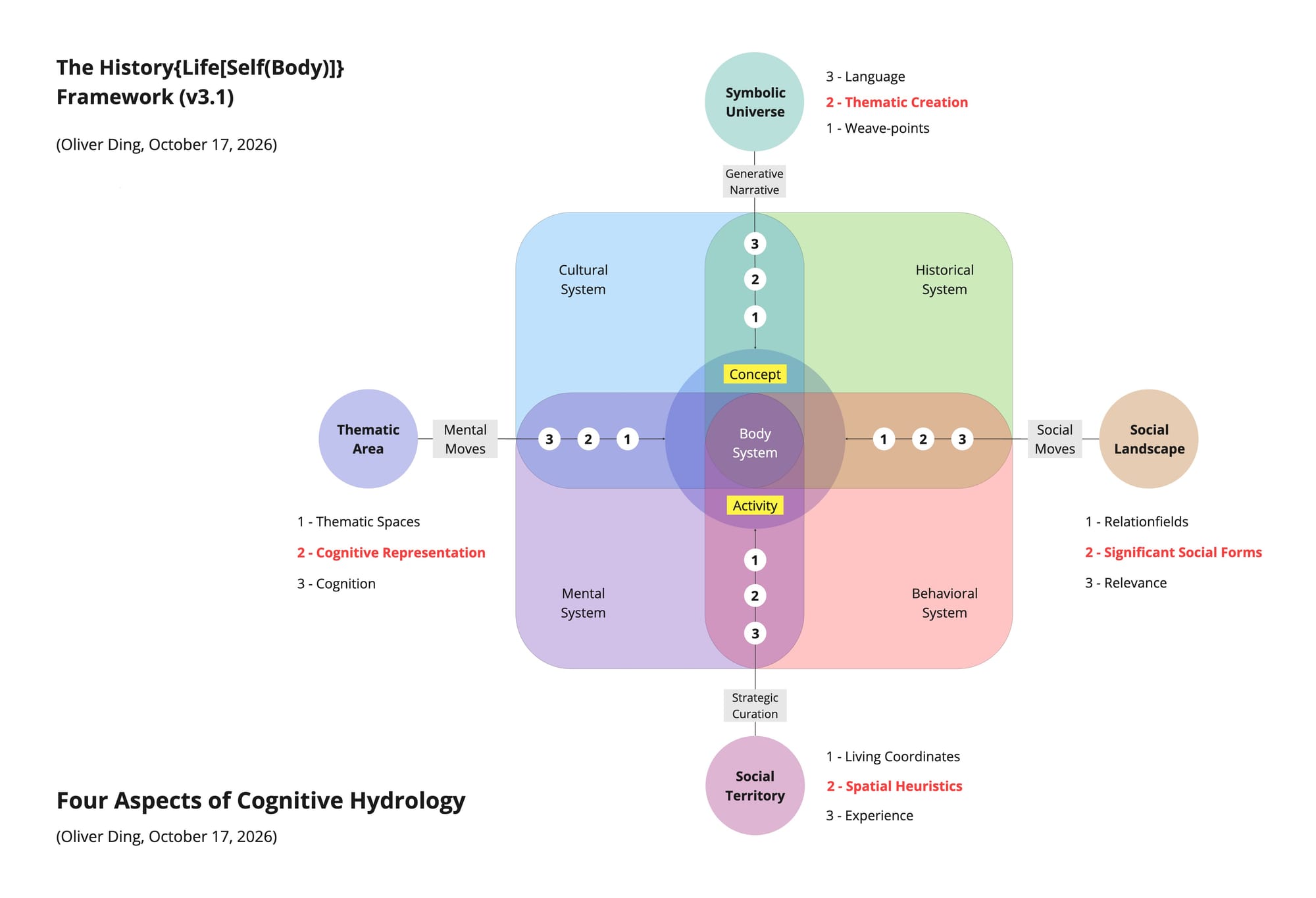
Platform spaces and diagrams. GO Square, and the Creative Life Square of 2026 within it, provide the sixty-four cells through which the S–T–O principle is expanded. The History{Life[Self(Body)]} framework, with the four aspects of Cognitive Hydrology on its map of version 3.1, locates the enterprise on the platform. The Creative Life Curation Framework (2022), which is the semiotic system diagram of the Creative Life Curation book, and the Creative Thematic Curation framework, also called the sandglass model, express the S–T–O principle at earlier stages.
Enterprise and method. The Mental–Social–Material schema, introduced on March 26, 2025, supports the three dimensions of Wonder and Wander. The Evolving Knowledge Enterprise model, built in April 2024, supplies the levels of an enterprise that goes beyond thinking. The Meta-frameworks collection, released on December 31, 2025, supplies the distinction between a meta-framework and the concept of meta-framework. The LARGE Method (v3.0, 2026) names the epistemological and methodological position of the platform. The Thematic Space Theory Toolkit supplies the five operations of the thematic space.
These frameworks did not sit beside the work as labels for it. Each was used to decide something. Ecological Formism decided how the layers were separated. The Weave 16 diagram decided the shape of the 4×4 structure. The Milieu–Mediator–Method–Mastery schema decided the dimensions. The Creative Life Square decided how the S–T–O principle could be extended to more forms of experience and product. In each case the platform took part in the development of the work, and the work then returned to the platform with new content.
3.2 The Pedagogical Framework and the Flow-Focus-Center-Circle Model
Cognitive Hydrology 1.0 was published at the beginning of 2026. In early March, I used version 1.0 as the basis for a pedagogical framework, A Pedagogical Framework for Thematic Development and Concept Creation. The framework has five parts: a philosophical foundation, a theoretical architecture, four stages with an integration stage, mediation, assessment, and facilitation, and a statement of scope and limitations.
The pedagogy is built on the Flow-Focus-Center-Circle model, which sets four thematic spaces: Flow, Focus, Center, and Circle. The teaching activities of the pedagogy are arranged across these four spaces, so that each space corresponds to one teaching stage: Stage One, Entering the Flow; Stage Two, Developing Focus; Stage Three, Establishing Center; and Stage Four, Entering the Circle. The pedagogy also includes an integration stage, Thematic Identity Curation. Several dimensions of the pedagogy run across all four spaces.
The Flow-Focus-Center-Circle model itself is derived from the levels of Ecological Formism. It describes the basic ecological forms through which an individual organizes experience and activity over a life course. It is the core model of the World of Activity, the theoretical orientation to which Cognitive Hydrology belongs.
The Experience-Narrative-Framework-Ecology schema was also developed from Thematic Space Theory and Ecological Formism. The two models therefore share an isomorphic structure: the four positions of Flow-Focus-Center-Circle and the four spaces of Experience-Narrative-Framework-Ecology are the same kind of object, produced by the same principle. Experience aligns with Flow, Narrative with Focus, Framework with Center, and Ecology with Circle. Both move in the same generative direction, from the fluid to the focused, to the centered, and finally to the wider social and ecological range. To avoid confusion, the Experience-Narrative-Framework-Ecology schema does not reuse the Flow-Focus-Center-Circle terms, and it keeps its own nomenclature.
The fact that the pedagogy's dimensions run across four spaces also prepares the next step. Four spaces crossed by several dimensions is the structure that would allow the Experience-Narrative-Framework-Ecology schema to develop into a mature knowledge framework.
3.3 Toward Cognitive Hydrology v2.0
The creation of the Experience-Narrative-Framework-Ecology Schema marks a significant milestone, moving Cognitive Hydrology toward v2.0.
In version 1.0, we used the Flow-Focus-Center-Circle model and pedagogy to understand the progression of creative life forms. In version 2.0, the Experience-Narrative-Framework-Ecology schema allows us to understand not just the spaces, but the evolution of Themes and Concepts flowing through them.
It acts as both a microscope—explaining how a single concept travels from raw experience to a structured framework—and a telescope—explaining how a framework finds its niche within a vast knowledge ecology.
These four spaces are not just a cognitive ladder. They are the complete journey of water: surging from the spring of Experience, forming a Narrative stream, gathering into a Framework lake, and finally merging into the vast ocean of the Ecology.
Part 4: The Position of Version 2.0 on the GO Theory Platform
On the GO Theory platform, Activity Analysis sits at the centre. Four enterprises occupy four directions around it. Strategic Development concerns individuals. Cultural Anticipation concerns collectives. Platform Ecology concerns science. Cognitive Hydrology concerns creative cognition, and its outer end points toward the limit of meaning, which the platform calls spirituality.
Cognitive Hydrology is located in the direction of creative cognition. Its scope and its boundary are set by the platform. Within that direction, it concerns the individual's thematic cognition: the way a person recognizes, develops, and articulates a theme in practice, and the way that theme is carried through the four concepts.
Each enterprise on the platform handles a different kind of matter. Strategic Development handles the individual's development as a strategic actor. Cultural Anticipation handles the anticipation of culture and the development of collectives. Platform Ecology handles the place of knowledge within science. Cognitive Hydrology handles thematic cognition at the level of the individual. The concept Thematic Enterprise, whose principle is Evolving Concept System, describes a wider enterprise, and the complex interpersonal interaction and social cooperation that such an enterprise also involves belong to the other enterprises. Cognitive Hydrology does not take them up.
On the History{Life[Self(Body)]} map of version 3.1, Cognitive Hydrology appears in four aspects, one in each region of the map. Thematic Creation is located in the Symbolic Universe. Cognitive Representation is located in the Thematic Area. Significant Social Forms is located in the Social Landscape. Spatial Heuristics is located in the Social Territory. Each aspect is numbered, and each is related to a Gejunction aspect and to a dimension of the map. Thematic cognition runs through all four aspects.
The basic tone of version 1.0 has not changed in version 2.0. What has changed is that the theory has become a more systematic and larger whole, organized by a formal concept. Version 1.0 centered on Themes of Practice; version 2.0 thinks from the concept system of thematic engagement. The extension is one of concept, not of scope. The pedagogy of the enterprise controls the precision with which the whole is taught, and it may be subdivided into versions of different depth.
Part 5: When Someone is Weaving the Theme
The scope of version 2.0 is the same as that of version 1.0: the individual's own thematic cognition. Version 2.0 does not turn Cognitive Hydrology into a theory of collective development. It is an enterprise that helps an individual develop their thematic cognition, and the four concepts describe that development from its thematic, activity, situational, and enterprise sides.
Until now, "weave the theme" has named a 4×4 framework. The word "weave" came from the 4×4 Weave form, which is the structure on which the framework was built. But the same word has a second meaning, and this meaning arises from the actor, not from the diagram.
The second meaning is set out in the article "Weave: A Model of the Actor," where I give a model of the actor in which Weave names the orientation that holds the others together. The model has five orientations: Learn, Discover, Design, Deliver and Weave. Learn is the condition of all other action: an actor who cannot learn cannot act. Discover, Design and Deliver describe the movement from exploring, to building, to contributing to cultural circulation. Weave is the orientation that holds these together in a single practice. It sits at the center of the diagram, and its position is its meaning.
The word had been in use for some time before it took this role. In 2023, on a road trip through the Cherokee region, I saw an unfinished basket and thought about the difference between a basket and a web. A basket is a container, while a web is a network. Both are made by weaving, and the word named something I had been doing intuitively for years: bringing theory, practice and lived experience into a coherent pattern. In September 2025 the metaphor was formalized into the Weave basic form. A year later, in the 4×4 structure, it became the frame for the thematic engagement diagram.
The formula that gives Weave its structure reads from the inside out. Every project begins from an opportunity for action, which is the ground of the whole formula. A project takes up a theme, the subjective crystallization of what it is about, and aims toward an identity, the objectification of that theme into a recognizable role or enterprise. Theme and identity are the two core elements of the Developmental Project Model. When projects are combined over time, they take on a form of their own: a sequence of projects that closes and reopens, revisits and rebuilds, advances and analyzes, or leaves its by-products and unfinished projects behind. This combined form is the pattern. It is the subject of the Dramatic Life Pattern research.
Seen from the actor, the framework has a different reading. The actor is not a single coordinate on the diagram. The actor is the capacity to move through the diagram: to occupy different coordinates at different times, and to activate different thematic spaces as developmental needs change. The weave, in this sense, is the way the actor holds several orientations at once, and the framework describes that holding.
This reading gives Cognitive Hydrology a concrete actor. Its aim is to help an individual develop thematic cognition, and the actor model says who that individual is and how they move. The individual is not only someone who learns a theme, designs with it, or delivers it to others. The individual is someone who holds these together, and the framework is a map of where that holding takes place.
The two meanings of weave therefore correspond to theory and practice. The first is the name of a theoretical framework: the 4×4 structure in which the weave-points are placed and the theme can be located. The second is the orientation of an actor in practice: the way a person holds theme and identity together through projects. This pairing brings us back to the starting point of the whole inquiry, Themes of Practice. The concept was never only a classification of themes, nor only a description of practice. It names the place where theory and practice meet, and Cognitive Hydrology takes this place as its core.
Conclusion
Looking back, the name Cognitive Hydrology has been woven by me over several months. It began as an image in the epilogue of Lake 42, became the name of a trilogy, then the frame of a three-level system and a pedagogy, and now stands behind the Developmental Theme book. At each step the theme was taken up in a new project and gained new content. In that sense, the enterprise is itself an instance of what it describes: the weave of a theme through a person’s practice, in which theory and practice meet. The name has been the theme, and Cognitive Hydrology has been the weaving of it.
The plan for version 2.0, drawn up on 16 and 17 October, still stands. It takes the four concepts of thematic engagement as its conceptual system, and it keeps the scope of the individual’s own thematic cognition. What it still has to do is clear: cover the sixteen weave-points, develop the pedagogy in several versions, and place Cognitive Hydrology within cognitive science and the other enterprises of the platform. The two-week cycle set the plan aside for the editing of the book, and it remains the next step.
This book is the outcome of a two-week Revisiting-and-Rebuilding project. This epilogue closes that project and opens another.
v1.0 - November 3, 2026 - 5,013 words