
Activity Analysis Network #27: Developmental Theme, Weave the Theme, and Thematic Engagement
Revisiting the theme of "Theme" from the GO Theory Perspective
by Oliver Ding
October 31, 2026
Hi, and welcome to Activity Analysis Network, a newsletter hosted by the Activity Analysis Center.
Each issue is organized around the "Flow - Focus - Center - Circle" schema, the primary model of the World of Activity Toolkit (v1, 2025).
In this biweekly newsletter, I share summaries of new articles from the Activity Analysis Center, along with updates on related activities, including some of my own published work elsewhere.
This issue covers the second half of October. It records the completion of the Developmental Theme book, born from a two-week revisiting-and-rebuilding project about theme.
Flow
The historical development of the Activity Analysis Center and my experience of daily life
In the past two weeks, I worked on a two-week Revisiting-and-Rebuilding project on Thematic Engagement. The project took me back to the early years of the Activity Analysis Center (2020–2022), when the theme of "Thematic Engagement" first took shape.
Thematic Engagement is, at its core, a simple theme. It names the “Person–Theme” relationship and interaction: how a person engages with a theme, and how that engagement shapes both the person and the theme.
The naming of this theme is not arbitrary: “Thematic” is drawn from the Themes of Practice approach (2019, 2021), and “Engagement” from the Project Engagement approach (2021, 2022). While the theme itself is simple, its birth is not.
Between 2019 and 2022, this emerging dialogue produced six distinct echoes that eventually crystallized into the Thematic Engagement framework.
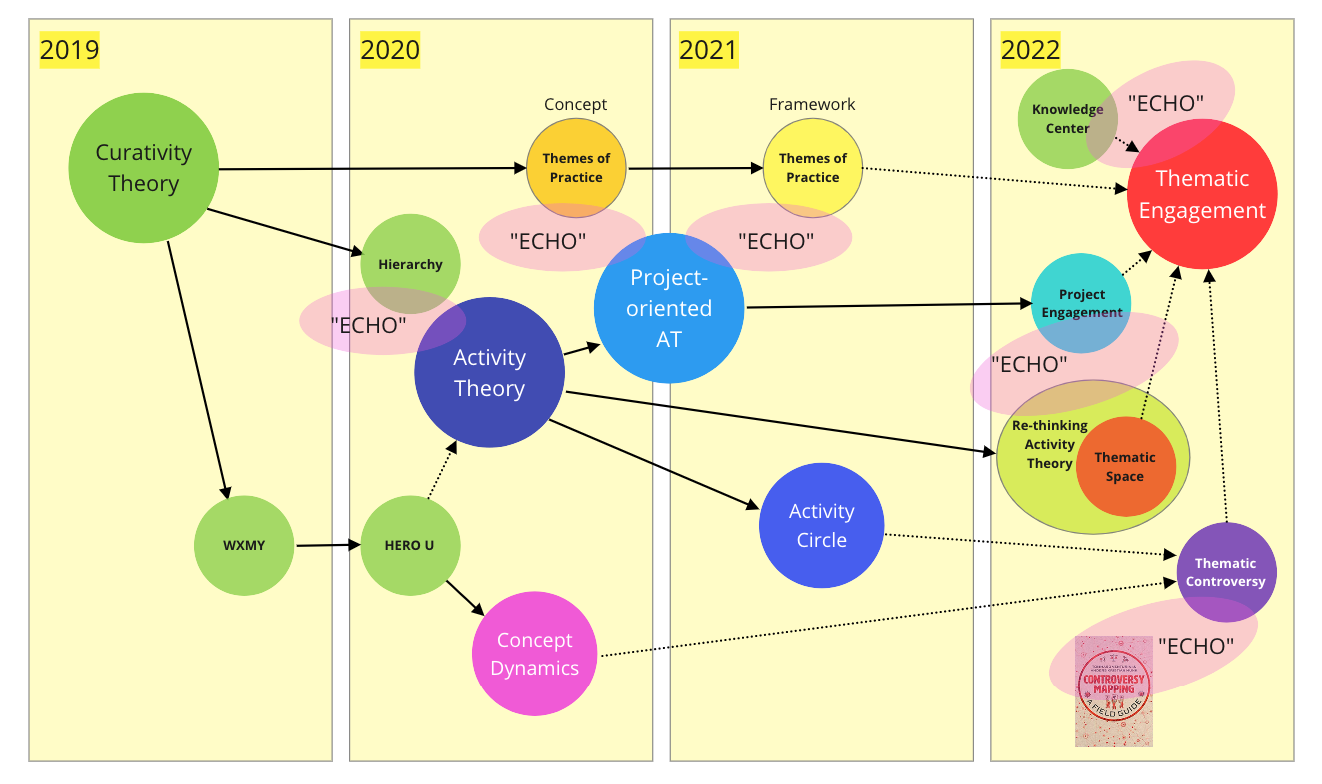
These echoes were not merely a sequence of events but a meaningful whole. On September 15, 2022, this multi-year dialogue culminated in the launch of the Thematic Engagement Toolkit (v1.0). The toolkit was the outcome of this thematic dialogue, marking both the end of one specific conversation and the beginning of the Thematic Engagement project.
The emergence of Thematic Engagement marks an important moment in the historical development of the Activity Analysis Center.
Revisiting this theme brought me back to its early development and prompted a broader reflection on my years of exploration. During this two-week RR project, I first developed a new schema for understanding the theme of "theme" itself. I then returned to the Thematic Engagement Toolkit, revisiting and rebuilding it within this new conceptual context.
The project eventually led to the creation of the concept of Developmental Theme, opening a new perspective on the knowledge ecology of themes and completing another structural task within the GO Theory platform.
Here are some LinkedIn posts from the past two weeks — fragments of daily thinking, traces of ongoing conversations:
- 10/18/2026 - [Meta-discussion] How Do You Revisit a Creative Theme?
- 10/22/2026 - [Meta-discussion] How Does Destruction Lead to Creation?
- 10/25/2026 - [Meta-discussion] How Do You See the Chaos of Fields?
Some new articles published on the Activity Analysis Center's site:
- 10/19/2026 - The Experience-Narrative-Framework-Ecology Schema
- 10/22/2026 - The Weave-the-Theme Framework (v1.0, 2026)
- 10/23/2026 - Revisiting and Rebuilding the Thematic Engagement Toolkit
- 10/26/2026 - Weave the Theme: The Typology of Theme and Beyond
- 10/26/2026 - Spatial Heuristics: The Art of Alignment
- 10/28/2026 - When Themes of Practice Meet Project Engagement (Part A)
- 10/29/2026 - When Themes of Practice Meet Project Engagement (Part B)
- 10/29/2026 - Spatial Heuristics: Four Views of Knowledge Ecology
- 10/30/2026 - A Two-week Revisiting-and-Rebuilding (RR) project about Theme
- 10/30/2026 - The Concept of Developmental Theme
- 10/30/2026 - Developmental Theme and the Genesis of the Concept System
- 10/30/2026 - Developmental Theme: The Weave-the-Theme Framework and Thematic Engagement (Book, 2026)
Focus
The Thematic Foci of the Activity Analysis Center
For the past two weeks, my attention has been on one possible book: Developmental Theme: The Weave-the-Theme Framework and Thematic Engagement (Book, 2026), which I finished editing on October 30, 2026.
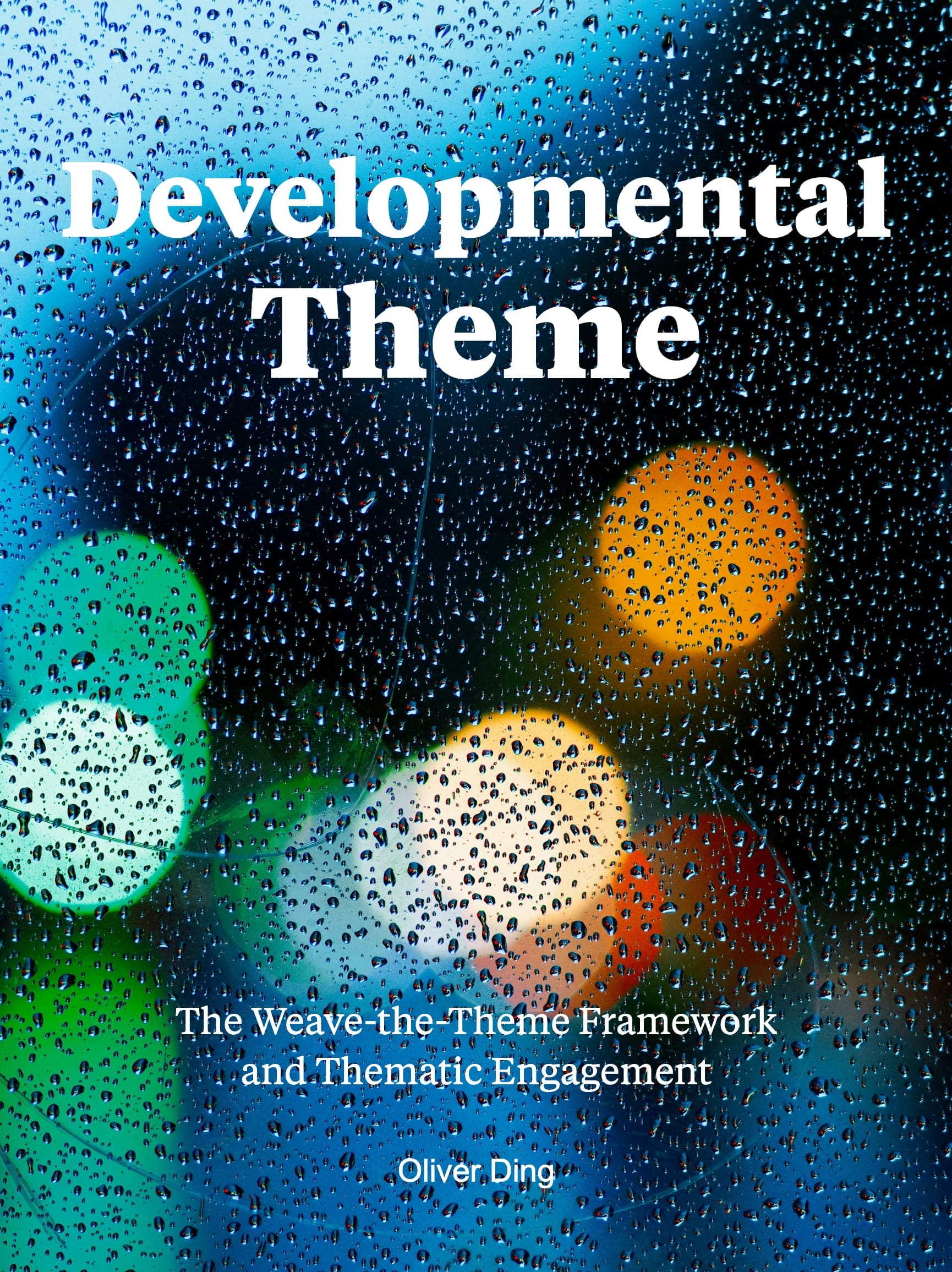
This book is the outcome of a two-week Revisiting-and-Rebuilding (RR) project. The project itself was a very distinctive experience. It was like a journey, though it did not take place in a physical geography.
This resonance led me to revisit the Preface of my 2025 book, Homecoming, where I used the Path of Creative Life model—Reflection, Emergence, and Anticipation—to narrate the story of that Fuzhou trip. I realized that this model could also be used to tell the story of this RR project. As a compromise, I adopted Saint Augustine's temporal structure—the Present of the Past, the Present of the Present, and the Present of the Future—as the overarching framework for this book.
- Part 1: The Present of the Past collects retrospective articles I wrote at different times over the past few years on several key themes and concepts.
- Part 2: The Present of the Present focuses on the rebuilding phase of the RR project. The articles collected here show how I rebuilt step by step, bringing forth the Weave-the-Theme Framework (v1.0, 2026) and the Thematic Engagement Toolkit (v2.0, 2026).
- Part 3: The Present of the Future focuses on the new creative visions that emerged from the RR project. It uses the new concept of Developmental Theme to frame my exploration of "theme" as a knowledge ecology, anticipating its future space for development. At the same time, it proposes a theoretical account of the genesis of the concept system within the GO Theory platform.
- Part 4: Following the Theme is a collection of case studies that demonstrate how "theme" functions in four different types of projects.
- Part 5: The Chain of Genesis serves as an extended reading guide. This part organizes a selection of previously published articles according to the four layers of the Thematic Engagement Toolkit (Cognition, Activity, Situation, Enterprise).
Earlier this year, while working on Lake 42, I noticed that I had frequently used imagery of streams, rivers, lakes, and oceans for my manuscript covers. This unintentional observation inspired me to name my theoretical enterprise Cognitive Hydrology, treating the movement of water as a metaphor for thematic development. For this book's cover, I chose an image of water droplets; as the smallest unit of water in my visual vocabulary, the droplet perfectly echoes this book's focus on the genesis of concept systems. Meanwhile, the blurred, colored circles in the background subtly suggest Thematic Focus—the critical concept in early thematic development where attention sharply lands on a specific point while the rest recedes into the background.
Center
The Core of the Activity Analysis Center
The Activity Analysis Center hosts two major theoretical enterprises:
- The Life-as-Activity Approach (including the Project Engagement Approach)
- The World of Activity Approach, now operating within a nested structure: World of Life (World of Activity).
In the past two weeks, while working on the Revisiting-and-Rebuilding (RR) project on theme, the several connections between Thematic Engagement and these two approaches are highlighted below.
In April 2026, while working on the Weave 42 project, I developed a new version of the Weave Basic Form, a 4×4 edition that I call the Weave 16 diagram. Based on the new diagram, I created the Weave-the-Life framework (v3.0) and used it to curate 16 key concepts of the Life-as-Activity Approach. The outcome was featured in Weave the Life: The Life-as-Activity Approach (v4.0) and Personal Knowledge Ecology (Possible Book, v1, 2026).
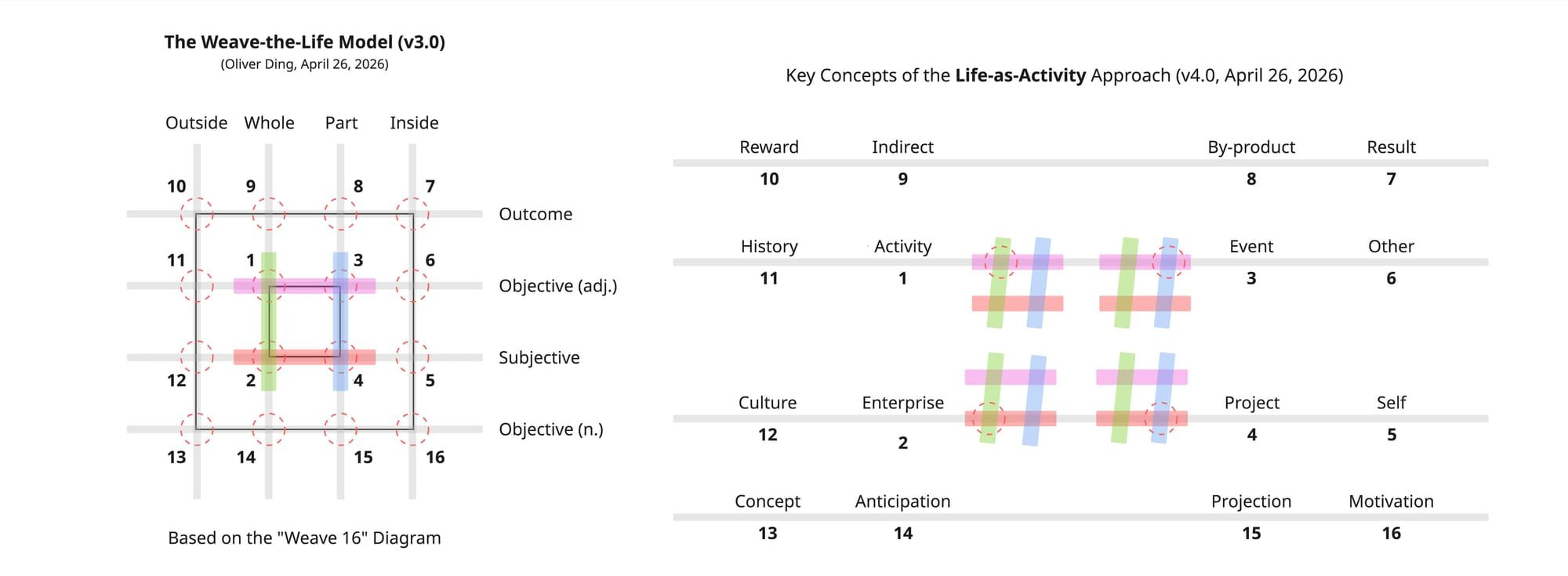
Inspired by the Weave-the-Life Framework (v3.0), I adopted the "Weave 16" diagram as the meta-diagram to curate a series of knowledge elements about thematic engagement together. The outcome was named as Weave-the-Theme.
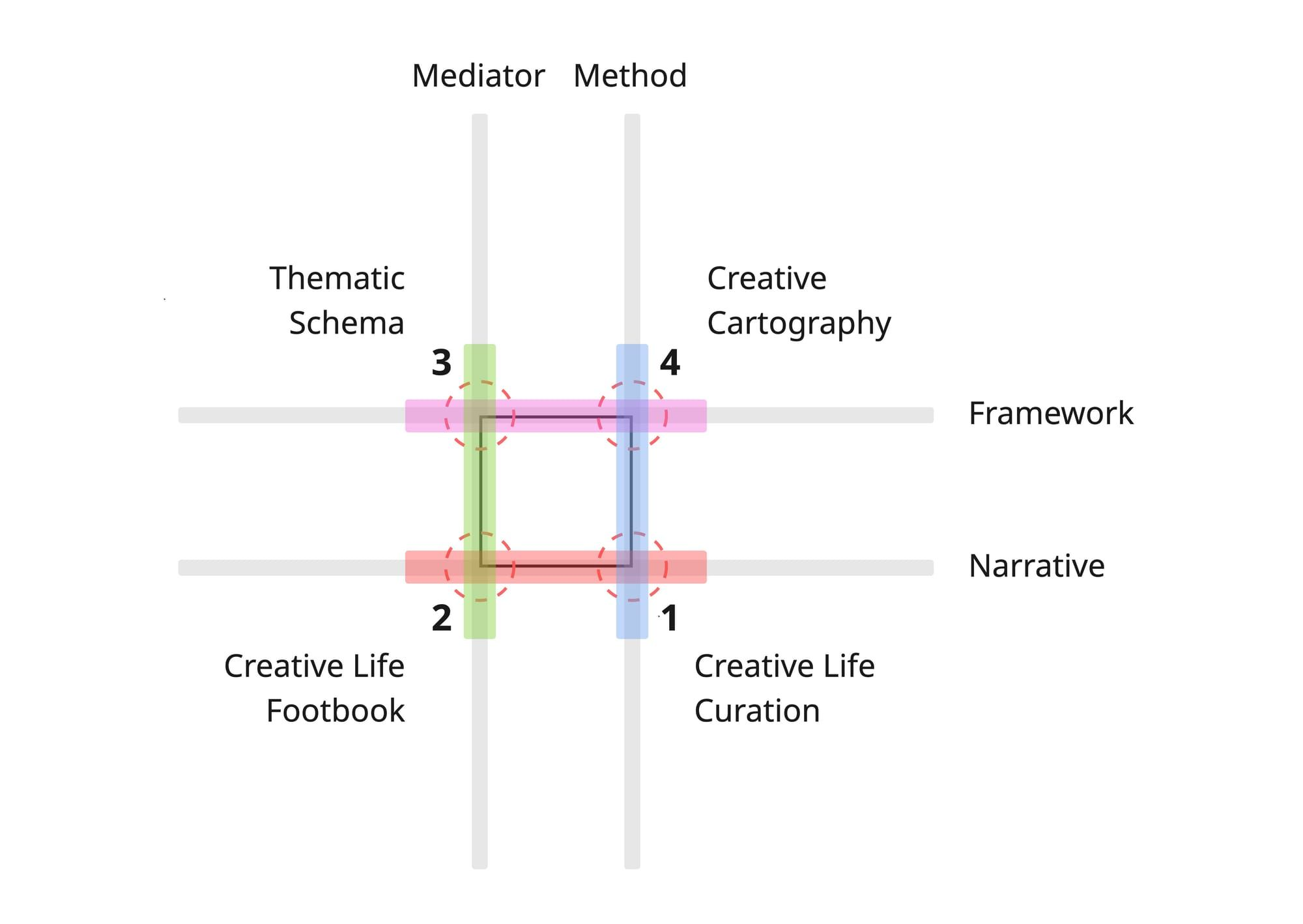
The new framework is designed with two schemas: the Experience—Narrative—Framework—Ecology Schema and the Milieu—Mediator—Method—Mastery Schema. The completed 4×4 Weave-the-Theme Diagram is presented below.
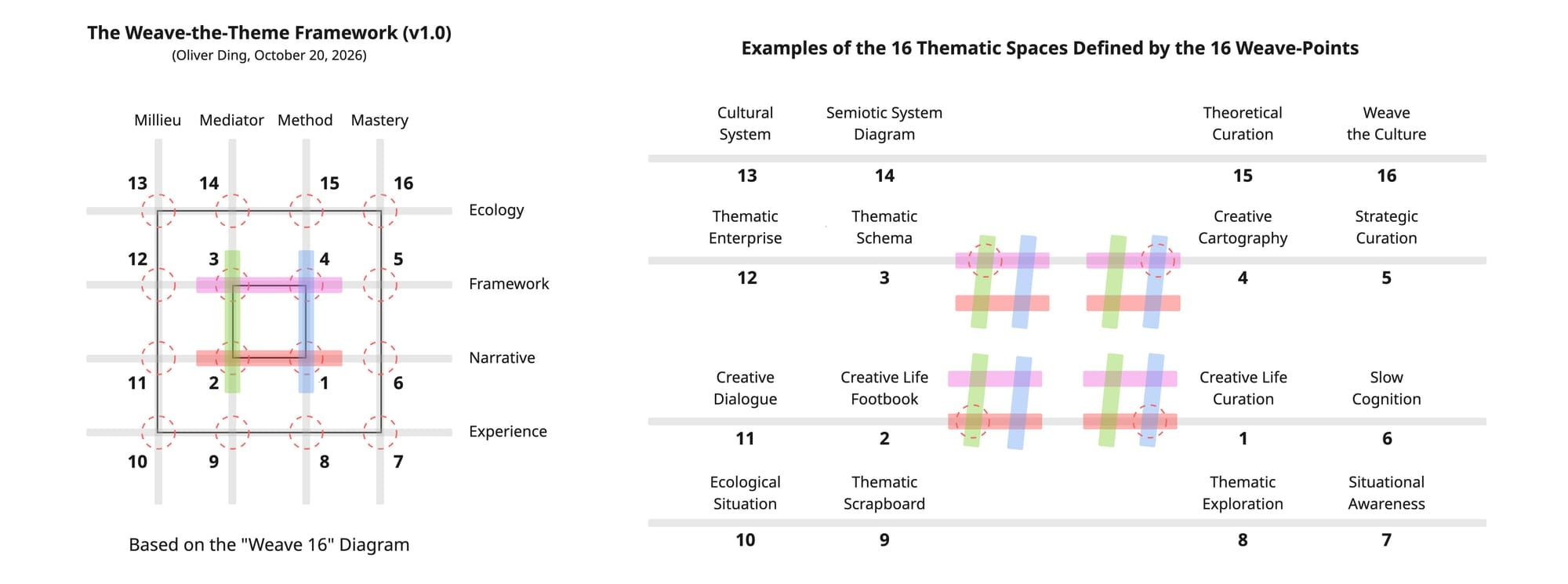
To navigate the 16 weave-points systematically, the diagram employs a specific numbering sequence. The numbering begins at the "Method × Narrative" Weave-point (#1), because its representative thematic element is Creative Life Curation—the core methodology of Cognitive Hydrology. From this starting point, the numbering moves left and then clockwise in a spiral around the matrix, concluding with "Mastery × Ecology" (#16), represented by Weave the Culture.
The first four weave-points form the inner 2×2 core of the matrix. This inner ring represents the essential methodologies and output forms of Cognitive Hydrology:
- #1 — Creative Life Curation (Method × Narrative): This is the foundational research method of Cognitive Hydrology, focusing on the systematic curation of one's own lived experience and thematic development.
- #2 — Creative Life Footbook (Mediator × Narrative): This represents the primary output form of this methodology. The books in the Cognitive Hydrology series are all "Footbooks"—narratives that use personal stories to illuminate abstract concepts.
- #3 — Thematic Schema (Mediator × Framework): This represents the components used to combine and develop knowledge frameworks.
- #4 — Creative Cartography (Method × Framework): This represents the use of creative diagramming methods to explore and map various themes.
For several years I have been working on the theme of theme. Most of that work took the form of projects. Looking back, I have identified approximately fifteen creative journeys. By my method, a chain of four or more interconnected projects constitutes a creative journey. These fifteen journeys span seven years and are organized around three distinct developmental stages of my knowledge enterprise:
- The "Container" Stage (2019–2020): Where the foundational concepts were born.
- The "Network" Stage (2020–2025): Where multiple knowledge centers formed a Value Circle, generating a highly diverse range of thematic explorations.
- The "Platform" Stage (2025–2026): Where the GO Theory platform emerged to support and integrate the earlier enterprises.
At the "Network" Stage, there are three creative journeys under the "Life as Activity" thread:
- The "Shared Themes" Journey (2021-2023)
- The "Thematic Enterprise" Journey (2020/21-2026)
- The "Thematic Identity Curation" Journey (2021-2025)
Details can be found in When Themes of Practice Meet Project Engagement (Part A).
The Thematic Engagement Toolkit (v2.0, 2026), the primary outcome of the RR project, highlights four principles and four concepts:
- T as Theme. It concerns the theme itself and its crystallization. Its corresponding concept is Thematic Cognition (the Invariant layer).
- S-T-O. It adds S (subjectification) and O (objectification) to T, embedding the theme in concrete activity. Its corresponding concept is Thematic Activity (the Quasi-invariant layer).
- Themes of Practice. It adds the social situation in which the activity takes place. Its corresponding concept is Thematic Situation (the Variable layer).
- Evolving Concept System. It describes how concepts develop and scale into broader enterprises over time. Its corresponding concept is Thematic Enterprise (the Invariant Set).
However, the Weave-the-Theory model itself does not dictate how these principles and concepts should correspond to one another or how they should be organized. To provide a structural foundation for this relationship, I rely on the four-layer structure of Ecological Formism (see the Appendix).
| Layer of Ecological Formism | Layer of thematic engagement | Principle |
|---|---|---|
| Invariant | Thematic cognition | T as Theme |
| Quasi-invariant | Thematic activity | S–T–O |
| Variable | Thematic situation | Themes of Practice |
| Invariant set | Thematic enterprise | Evolving Concept System |
The first three principles are nested: each contains the one before it, unfolding within a wider field. The fourth principle provides the wider context within which the other three operate.
Because both Thematic Engagement and the World of Activity approach are built upon the grammar of Ecological Formism, they are structurally isomorphic.
The World of Activity model organizes the social world around the FFCC Schema:
- Flow (the stream of experience)
- Focus (the thematic concentration)
- Center (the organizing core)
- Circle (the social network)
We can clearly see the direct isomorphism between the two frameworks:
- Variant corresponds to Flow.
- Quasi-invariant corresponds to Focus.
- Invariant corresponds to Center.
- Invariant Set corresponds to Circle.
What makes this connection particularly powerful is how the World of Activity Toolkit (v2.0, 2026) has evolved. In v2.0, the four FFCC thematic spaces are no longer just descriptive; they now simultaneously carry multiple dimensions: forms, themes, identities, methods, moves, and achievements.
This directly mirrors the logic of the Thematic Engagement toolkit, especially regarding the Themes dimension. In World of Activity v2.0, the Quasi-invariant layer is populated with thirteen cross-human developmental themes described in FFCC vocabulary (such as Cutting the Flow, Setting the Focus, or Anchoring the Center). Meanwhile, the Variant layer remains an open category receiving "situational life events and themes." This perfectly echoes our conclusion in Section 6.2: while the structural Principles and Concepts are fixed, the Themes remain a highly open frontier.
Beyond themes, World of Activity v2.0 also integrates Identities (via the Creative Identity Cascade) and Methods (via the L3D model). This shows that the Thematic Engagement toolkit is not an isolated system. Because they share the same ontological grammar, Cognitive Hydrology, Weave-the-Theme, and the World of Activity can be seamlessly nested and integrated. Thematic Engagement provides the methodological framework for curation and cognition, while World of Activity provides the rich, lived landscape of ecological forms. This shared foundation facilitates future collaborative operations, allowing creators to translate concepts and practices smoothly across different theoretical systems.
Circle
The Context of the Activity Analysis Center
Since September 2025, the Activity Analysis Center has been operating as a meta-center, using GO Theory as my theoretical platform to host several theoretical enterprises. These enterprises constitute the Center's Circle—the broader context within which the Center operates.
On this platform, five theoretical enterprises operate, each occupying a distinct position within the World of Life:
- Life as Activity (including the Project Engagement Approach) — at the center, attending to activity itself
- Anticipatory Cultural Sociology (ACS) — at the Collectives boundary, attending to cultural development
- Strategic Developmental Psychology (SDP) — at the Individuals boundary, attending to individual life development
- Cognitive Hydrology — at the Spirituality boundary, attending to the flow of ideas and meaning
- Platform Ecology — at the Science boundary, attending to ecological and structural conditions of platform development
These five enterprises are equal. Each occupies a different position within the World of Life, which means each brings a genuinely different theoretical perspective. And because they share the same spatial foundation—the same map, the same boundaries, the same operating concepts—they naturally support one another, forming a network of enterprises rather than a hierarchy.
The Developmental Theme book is the sister volume to Developmental Strategy: Strategic Actor and the Weave-the-Strategy Toolkit.
The symmetry between these two works is not accidental. It extends a structural pairing that began earlier this year with two other manuscripts: Anticipatory Cultural Sociology and Strategic Developmental Psychology. In that earlier pair, one book explored the cultural and collective dimensions of anticipation, while the other focused on the psychological and individual development of strategic agency. This new pair—Developmental Strategy and Developmental Theme—follows the same logic. Developmental Strategy addresses how a strategic actor navigates the unfolding of their life and enterprise. Developmental Theme addresses the conceptual and thematic foundations upon which that navigation takes place.
Beyond their structural symmetry, these two books share three fundamental similarities.
First, both employ a Weave knowledge system for curation. Just as Developmental Strategy reorganized the strategy theme through the Weave-the-Strategy Toolkit, this book curates years of exploration through the Weave-the-Theme Framework.
Second, both use Developmental Functionalism to frame a new knowledge ecology. Instead of asking what a concept is in essence, both books ask what a concept does in the process of human and enterprise development. This functional lens provides the boundary that distinguishes these new ecologies from traditional academic inquiries.
Third, both books position themselves explicitly on the GO Theory platform. They are not isolated theoretical projects; they are localized, structural components within a broader ontological and epistemological architecture.
From the perspective of Platform Ecology, the RR project itself can be understood as a Developmental Episode in the evolution of the GO Theory platform.
A Developmental Episode is a special type of Project—one that makes a distinctive contribution to the Center-Platform development process. It restructures the foundational logic and leaves a lasting mark on what the enterprise ultimately is.
The RR project fits this definition. It did not merely produce new articles. It:
- Named a new knowledge ecology (Developmental Theme).
- Rebuilt Thematic Engagement from a theme into a formal concept with four layers.
- Completed the genesis account for the Six Faces of the Concept System by adding the Ecology layer.
- Clarified the relationship between Developmental Theme (Platform) and Cognitive Hydrology (Program).
- Demonstrated the Weave-the-Theme Framework as an open map through two test cases.
- Reduced five analytical lenses to four spatial dimensions.
These are not incremental additions. They restructure the foundational logic of the platform. The GO Theory platform now has a named ecology for theme inquiries, a concept that describes how themes become concept systems, and a methodology for building such concepts without falling into linear extraction.
World
Me, You, and We
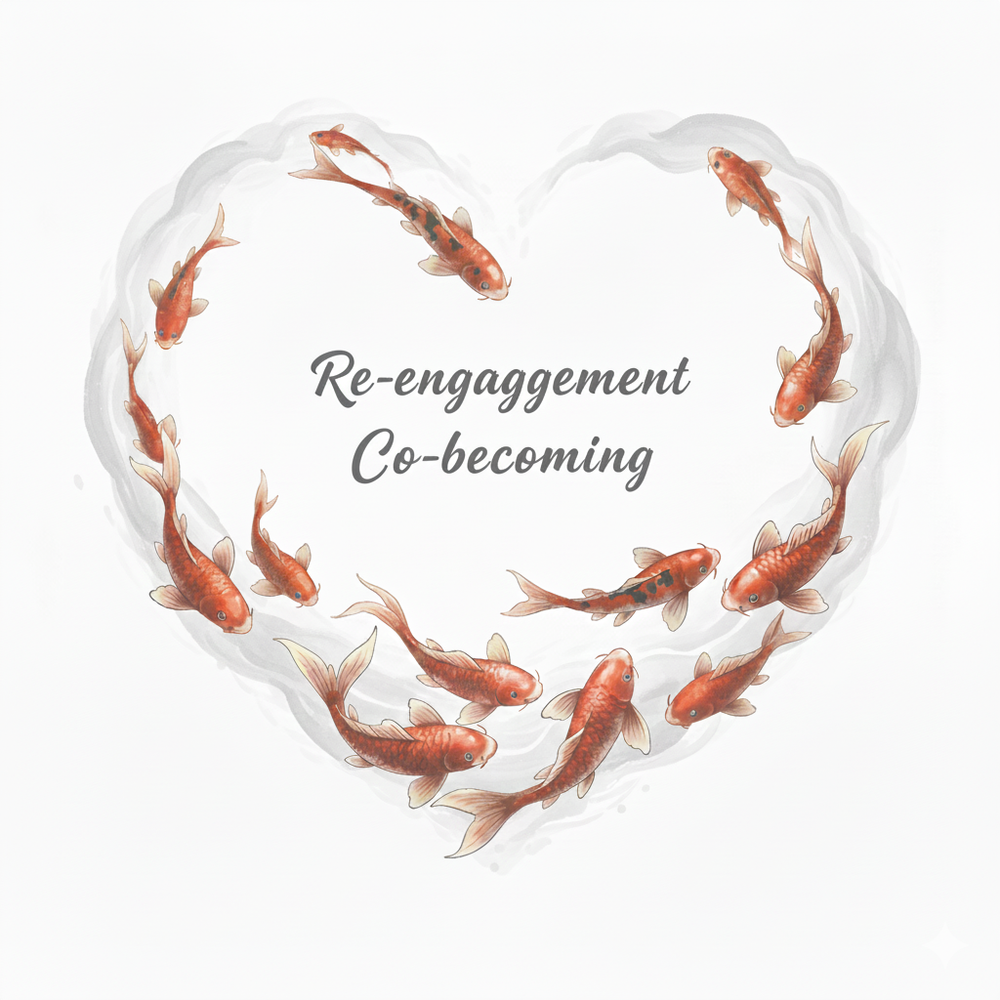
A Revisiting-and-Rebuilding project is an act of re-engagement. Engagement with a cultural theme is an act of re-engagement, too.
Just now, I returned from trick-or-treating with my kids. And here I am, wrapping up this newsletter.
Trick-or-treating is itself a classic cultural theme in action. Children revisit it year after year, participating in a familiar practice that is embedded in a wider thematic network organized around Halloween. Its thematic objects are immediately recognizable; its thematic events have their own distinctive forms. Costumes, candy bags, decorated doorsteps, and the familiar ritual of going door to door—all come together to make this theme tangible.
This is how a cultural theme stays alive: not simply as an idea or a tradition to be remembered, but as a Theme of Practice, a lived activity, renewed year after year and passed from one generation to the next. It continues to shape the World of Activity in which people actually live.
Re-engagement and Co-becoming. I placed them there in January. The year answered.
Happy Halloween!
Oliver Ding
Founder of the Activity Analysis Center
October 31, 2026
v1.0 - October 31, 2026 - 3,042 words