
Developmental Theme and the Genesis of the Concept System
A Developmental Episode of the GO Theory Platform
by Oliver Ding
October 30, 2026
This article is part of a possible book: Developmental Theme: The Weave-the-Theme Framework and Thematic Engagement (book, 2026).
In late December 2025, the Meta-frameworks manuscript introduced the Six Faces of the Concept System. It mapped out what a concept system is in its social context: Knowledge Frameworks, Mental Platforms, Strategic Frameworks, Cultural Frameworks, Institutional Frameworks, and Spiritual Frameworks. The Six Faces provided a taxonomy—a way of locating different types of concept systems within the five-system ontology of the HLS framework.
But a taxonomy is not a genesis. The Six Faces described what a concept system is, not how a concept system comes to be. It lacked a developmental account of its origins.
This article supplies that missing piece. It argues that Developmental Theme—the new knowledge ecology introduced during the past two weeks—provides the genesis account that the GO Theory platform requires. The argument proceeds in three parts: first, a review of what the Six Faces established; second, an account of the missing genesis; third, a description of how Developmental Theme fills the gap.
1. What the Six Faces Established
The Six Faces of the Concept System were built on the HLS framework, which organizes the social world into five nested systems: Body, Mental, Behavioral, Cultural, and Historical. The Six Faces mapped four concept systems directly onto four of these systems:
- Mental Platforms correspond to the Mental System.
- Strategic Frameworks correspond to the Behavioral System.
- Cultural Frameworks correspond to the Cultural System.
- Institutional Frameworks correspond to the Historical System.
Two faces—Knowledge Frameworks and Spiritual Frameworks—did not map directly onto the core systems. They were displaced toward the extremes of truth and meaning, representing what the Six Faces article called "the anticipatory horizon" that pushes the Cultural System beyond its present limits.
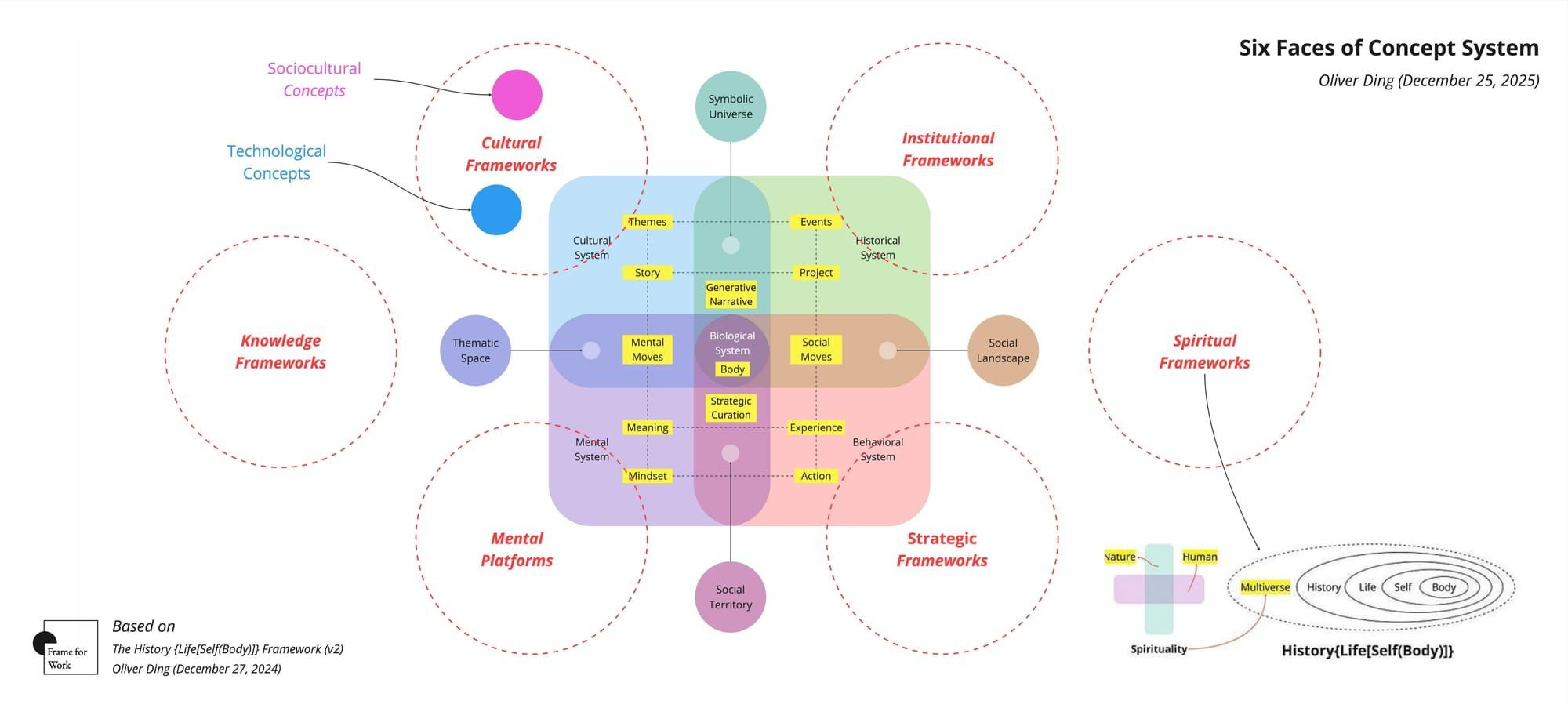
The Six Faces thus provided a topological map of concept systems in their social context. It showed where each type of concept system is located, how it relates to the others, and why certain types (Knowledge and Spiritual Frameworks) operate at the boundaries of the social world rather than within its operational center.
But this map was static. It described the coordinates of concept systems, not their trajectories. It answered the question "What is a concept system?" but not "How does a concept system come to be?"
2. The Missing Genesis
The answer to the genesis question was implicit in a different line of work: the Theme-Concept-Framework transformation, developed in 2023 through the TALE project.
The Strategic Thematic Exploration framework mapped a linear, six-stage process:
- A Possible Theme without a Clue
- A Possible Theme with a Clue
- A Primary Theme without Related Themes
- A Primary Theme with its Network
- A Knowledge Concept with a Working Definition
- A Knowledge Framework with a Set of Concepts
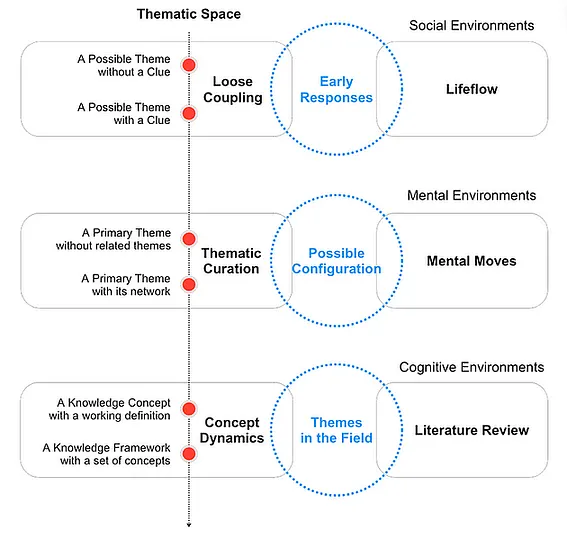
This framework identified three types of transformation: the "Possible-Primary" Transformation (discovering strategic intent), the "Theme-Concept" Transformation (turning raw themes into conceptual forms), and the "Concept-Framework" Transformation (curating concepts into a coherent whole).
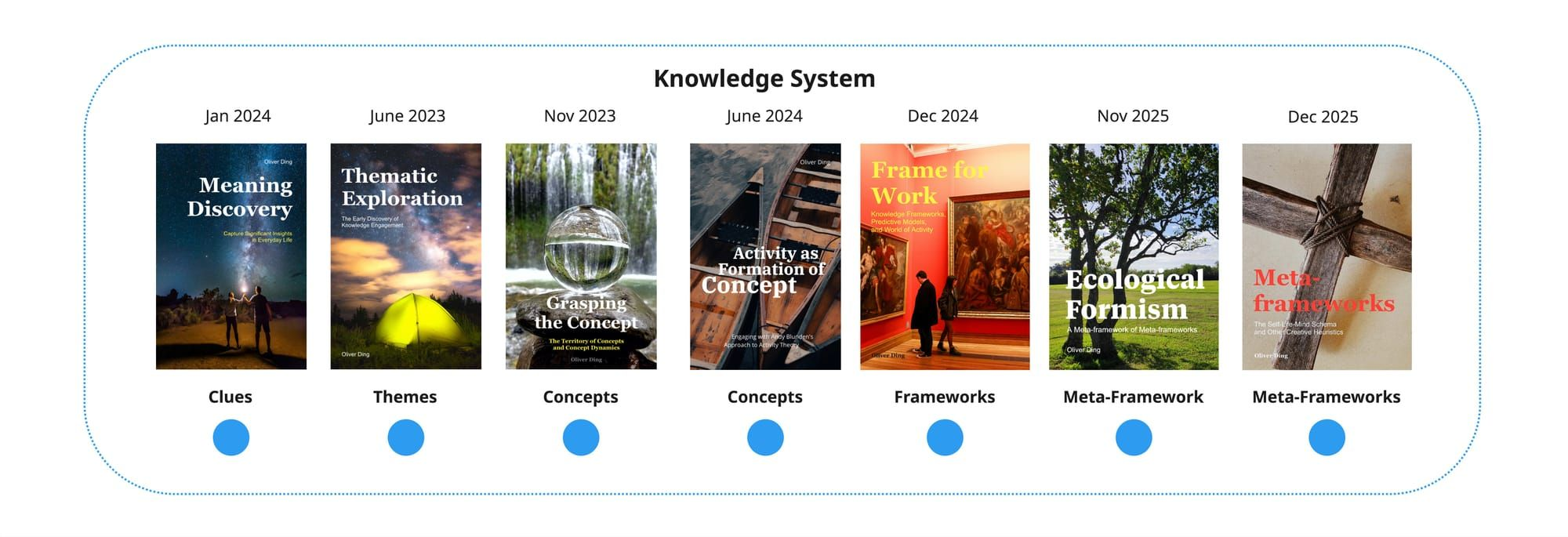
From 2023 to 2025, this model guided a series of projects and book drafts: Meaning Discovery (clues), Thematic Exploration (themes), Grasping the Concept (concepts), and Frame for Work (frameworks). By the end of 2025, with the publication of Meta-frameworks, the entire Knowledge System layer was complete.
But the Strategic Thematic Exploration stopped at the Framework stage. It was a one-way street for building a framework, but it did not account for what happens when the framework is placed into a knowledge ecology. It described the genesis of a concept system up to the point of the framework, but not beyond.
The missing piece was Ecology.
3. How Developmental Theme Fills the Gap
The Revisiting-and-Rebuilding (RR) project of October 2026 supplied the missing piece. By extending the Theme-Concept-Framework transformation into a fourth space—Ecology—it completed the genesis account.
The connection is direct. Strategic Thematic Exploration Stages 1–2 map to Experience. Stages 3–4 map to Narrative. Stages 5–6 map to Framework. The endpoint of Strategic Thematic Exploration is only Space 3 of the new schema. The Experience–Narrative–Framework–Ecology schema completes the picture by adding Space 4: Ecology.
This extension is not merely a logical deduction. It is rooted in a practical realization: a Framework does not exist in isolation.
It is important to clarify the specific meaning of "Ecology" here, as it differs from my earlier usage in Weave the Theory (May 2026). In that book, the case studies were centered on public theoretical traditions such as Activity Theory, so "knowledge ecology" referred specifically to a public knowledge ecosystem. But in the Experience–Narrative–Framework–Ecology schema, Ecology is defined as a higher-level unit of analysis above a single knowledge framework or a single knowledge system. This unit is not exclusively personal or exclusively public; it can be applied to both. A Knowledge Ecology is formed when multiple knowledge frameworks gather around a central theme, and this configuration can operate at the scale of an individual creator or a collective tradition.
The journey from Experience to Ecology is, ultimately, the journey of how a personal insight becomes part of the public commons.
4. The Chain of Genesis
If the four layers of the Thematic Engagement Toolkit describe the architecture of genesis, we still need a more concrete picture of the sequence. What follows is an attempt at such a picture—a provisional chain, offered not as a finished model but as a heuristic for the reader to see how a concept system may come into being.
The chain runs as follows:
Body(Self) → Action/Project → Experience → Thematic Supportance → Thematic Exploration → Thematic Focus → Thematic Living Coordinate → Themes of Practice → Thematic Creation → Concept System → Thematic Enterprise → Thematic Attachance → Creative Life Curation → Thematic Identity Curation → History[Life(Self)]
A few notes on how to read this chain.
First, the chain is not a rigid sequence of stages. It is a sketch of dependency. Each link names a condition that makes the next link possible, but the actual movement may loop, skip, or return. Thematic Exploration may lead back to Experience; Creative Life Curation may reopen Thematic Focus. The chain shows the logic of genesis, not its empirical chronology.
Second, some links use the word "thematic" in a narrow sense. Themes of Practice here does not refer to the broad 2019 concept that bridges individual life themes and collective cultural themes. It refers specifically to the thematic network that forms around a Creative Center through the operation of Developmental Projects. Similarly, Thematic Attachance here does not refer to the general mechanism of attaching and detaching mental focus, but specifically to the movement of thematic elements between multiple Thematic Enterprises.
Third, the chain is anchored at both ends by the HLS framework. It begins with Body(Self)—the embodied individual, the starting point of subjectivity—and ends with History[Life(Self)]—the self as situated within historical and cultural contexts. The middle links describe the transformations through which a lived experience becomes a concept system, and a concept system becomes a life history.
Fourth, the chain is offered as an attempt, not a conclusion. The genesis of a concept system is a complex phenomenon, and any single chain risks over-simplifying it. The value of this sketch lies not in its completeness but in its visibility: it allows the reader to see, at a glance, how the concepts developed across this book might relate to one another. It is a thread to be tested, revised, and perhaps replaced.
What the chain does suggest, however, is that the genesis of a concept system is not a single event but a long chain of transformations—from embodiment to experience, from experience to theme, from theme to center, from center to system, from system to enterprise, and from enterprise to history. The RR project, in this sense, did not merely name a new knowledge ecology. It traced a chain along which any concept system might come to be.
5. The Four Layers of Genesis
The Thematic Engagement Toolkit (v2.0) organizes this genesis into four layers:
- Thematic Cognition (T as Theme) describes how a theme crystallizes within a concept, how it lives in a Thematic Space, and how the Weave-the-Theme Framework maps this cognitive evolution.
- Thematic Activity (S-T-O) describes how a theme is not merely thought but lived and acted upon, through the cycle of Subjectification, Thematic Crystallization, and Objectification.
- Thematic Situation (Themes of Practice) describes how a thematic activity is situated within a social ecology, mapped by canvases like the Knowledge Discovery Canvas and the Frame for Work Canvas.
- Thematic Enterprise (Evolving Concept System) describes how a concept system scales beyond a single project into a sustained enterprise, sustained by Center Development and Project Engagement.
Together, these four layers describe the genesis of a concept system from a single theme to a full ecological niche. This is not a static taxonomy. It is a developmental account. It explains how a theme becomes a concept, how a concept becomes a framework, how a framework becomes an enterprise, and how an enterprise finds its place in a knowledge ecology.
Conclusion: The RR Project as a Developmental Episode
From the perspective of Platform Ecology, the RR project itself can be understood as a Developmental Episode in the evolution of the GO Theory platform.
A Developmental Episode is a special type of Project—one that makes a distinctive contribution to the Center-Platform development process. It restructures the foundational logic and leaves a lasting mark on what the enterprise ultimately is.
The RR project fits this definition. It did not merely produce new articles. It:
- Named a new knowledge ecology (Developmental Theme).
- Rebuilt Thematic Engagement from a theme into a formal concept with four layers.
- Completed the genesis account for the Six Faces of the Concept System by adding the Ecology layer.
- Clarified the relationship between Developmental Theme (Platform) and Cognitive Hydrology (Program).
- Demonstrated the Weave-the-Theme Framework as an open map through two test cases.
- Reduced five analytical lenses to four spatial dimensions.
These are not incremental additions. They restructure the foundational logic of the platform. The GO Theory platform now has a named ecology for theme inquiries, a concept that describes how themes become concept systems, and a methodology for building such concepts without falling into linear extraction.
The task is complete. The map is open. The journey continues.
v1.0 - October 30, 2026 - 1,759 words