
Cognitive Hydrology: The Experience-Narrative-Framework-Ecology Schema
A new meta-framework for Cognitive Hydrology v2.0
by Oliver Ding
October 19, 2026
On October 14, I finished editing the manuscript for Developmental Strategy: Strategic Actor and the Weave-the-Strategy Toolkit. A core premise of that book was using the meta-frameworks of the GO Theory platform to reflect on my years of exploration regarding the theme of "strategy."
As I wrote in the book:
"Since January 2026, GO Theory has been developing its meta-frameworks into a working whole, and this book asks whether that whole can hold a theme that first appeared in one project and then spread across several enterprises. In this test, the concept of Developmental Strategy emerged. It brought out a 3 × 3 framework, and framed my past exploration of the strategy theme as a cross-disciplinary, multi-perspective, multi-role theoretical enterprise. This outcome is, without doubt, a proof that GO Theory has matured as a developmental platform."
Encouraged by this outcome, I began to revisit my years of exploration regarding the theme of "theme" itself using the same approach. Over a two-day period (October 16–18), I organized a new schema and decided to formally integrate it into my theoretical enterprise of Cognitive Hydrology.
This article introduces that new schema, tests it against recent case studies, traces its evolution from my previous models, and grounds it in my broader theoretical resources.
Part 1: A New Schema
The exploration of the "theme" theme over those two days in September was not merely an exercise in organization; it was a process of crystallization. As I revisited my past models—the 2022 Flow-Story-Model, the 2024 addition of Meta, and the 2023 Strategic Thematic Exploration—and held them up against my recent case studies, particularly the Lake 42 manuscript, a new pattern emerged. The scattered pieces of my past thinking suddenly aligned into a coherent structure. This structure needed a name and a precise articulation. It became the Experience-Narrative-Framework-Ecology Schema.
This part introduces the schema, defines its four thematic spaces, and immediately puts it to the test. By mapping the Lake 42 case against these four spaces, we can see not only what the schema is, but how it operates in the messy, nonlinear reality of actual creative work.
1.1 Introducing the Schema
I name this new meta-framework the Experience-Narrative-Framework-Ecology Schema. It defines four thematic spaces, each representing a distinct epistemological state and scale of thematic cognitive development:
Space 1: Experience
- Core Definition: Pre-linguistic (Thematic Focus).
Moving from action to experience. Inspiration and intuition surge before they are named. It is the state where a thematic focus is forming, but language has not yet captured it.
Space 2: Narrative
- Core Definition: Single Structure (Linguistic Existence).
Moving from theme to concept. A fuzzy inspiration gains linguistic existence through naming. It forms a "single theme + single concept" simple structure, represented through stories or preliminary models.
Space 3: Framework
- Core Definition: Composite Structure (Concept System).
Moving from a single element to an advance structure. The simple structure evolves into a composite structure—a network of themes and a system of concepts. This space includes the cognitive meta: the high-level abstraction within a single system (e.g., meta-frameworks, meta-diagrams), which ensures internal coherence.
Space 4: Ecology
- Core Definition: Ecology (Ecological Niche).
Moving from the knowledge system to the knowledge ecology. The framework enters the larger knowledge-cultural ecosystem. It focuses on cross-system connections, evolutionary potential, and the public-value meta: the meta-position that certain systems occupy in a larger knowledge ecology. Because they sit at the meta level, these systems are naturally oriented toward shared public value, governing or connecting other systems. Professor Lü's theoretical sociology is one example.
Crucial Note: The terms Theme and Concept do not appear in the names of the spaces, but they are the core focus and the underlying current of the entire model. The spaces are the containers; the evolution of themes and concepts is the water flowing through them.
Narrative as a space. Cognitive Hydrology is concerned with thematic cognition, not with scientific theory alone. For this reason, not every outcome of thematic cognition has to take the form of a model. The works of Creative Life Curation are mainly narrative, and the books of the Cognitive Hydrology series are narrative too. Narrative is therefore a space in its own right, and it is a legitimate outcome of the process.
Why a schema. The Experience-Narrative-Framework-Ecology schema is a new schema, not a successor of the 2022 model. It does not owe an account of every detail of the 2022 model. Its purpose is to name four thematic spaces and fix their order. A framework or a model would also require the dimensions and the diagrams that give it its form, and those are not part of this article. A schema, in this sense, is a set of named spaces described in language, which can be detached from any particular diagram.
1.2 Testing the Schema: The Lake 42 / Living Coordinate Case
To test this schema, we return to the Lake 42 manuscript. The story begins on the first day of 2026, when I walked around a lake near my home with my wife. As we reflected on the past year, I revisited my long journey of writing and curating more than 42 possible books between 2019 and 2025. That evening, a new idea emerged: the lake could serve as an ecological metaphor for what had gradually taken shape through these 42+ possible books—a point of convergence rather than a destination.
Reflecting on the preceding six months (June to December 2025), I discovered eight movements that captured the complexity of this journey: Awareness from Flow, Finding the Coordinate, Anchoring the Center, Scaling the Focus, Sustaining the Streams, Catalyzing Curation, Revealing the Landscape, and Setting the Enterprise. This book documents that specific period, culminating in Creative Life Theory v3.0. It stands as the third volume in a trilogy applying the Creative Life Curation method to my own creative life, following Homecoming (1974–2014) and Wonder and Wander (2019–2025).
This case provides a rich testing ground for the ENFE Schema. Let us map the journey across the four thematic spaces:
#1 Experience:
Space 1 encompasses the raw, embodied material of the entire six-month journey from June to December 2025, not just a single moment of realization. During this period, I was deeply immersed in the unfolding creative process of writing several book manuscripts, ultimately developing Creative Life Theory v3.0. The starting point was June 2, 2025, when, while using the Self-Life-Mind schema, I was "suddenly shocked by the pattern within the diagram." The 3+1 structure was a pre-linguistic, bodily shock of insight that set the direction.
The experience continued through the daily actions, reflections, and iterations of those six months. Later, on January 1, 2026, walking around a lake, I reflected back on this entire lived period, recognizing that the 3+1 structure was not just a momentary diagram, but the lived reality of my creative journey. Thus, Space 1 represents the continuous flow of action, encounter, and intuition—the pre-linguistic ground from which the eventual narrative would emerge.
#2 Narrative
I organized this experience into a narrative, but it is important to clarify what this story actually is. The narrative is not merely about that single moment of insight on June 2, 2025. Rather, it is about the unfolding of the six-month creative journey from June to December 2025. The "8 Movements" were distilled to narrate how the numerous creative projects within these six months constituted a complete creative journey, culminating in Creative Life Theory v3.0.
It is worth noting that while I used the "Creative Confluence" theme in the manuscript to retrospectively examine experiences at other points in my creative history—and found multiple cases that fit this theme—those cases did not strictly follow the 8 movements. Therefore, the 8 movements serve as a narrative structure specific to the Lake 42 manuscript, tailored exclusively to that six-month period.
#3 Framework
After completing the 8-movements narrative of the six-month journey, I focused specifically on two of those movements: "Finding the Coordinate" and "Anchoring the Center." I distilled from them a knowledge framework, hoping it would serve as the primary intellectual outcome of the manuscript. However, I then encountered a narrative tension: "How does a model summarized from a single case have value for others?" This tension forced me to move beyond the narrative and construct the Living Coordinate Model as an intermediate framework. I established a three-tier structure (Meta-framework: Life Coordinate Framework -> Framework: Living Coordinate Model -> Situational Model: Theorizing Creative Life Landscape) and developed the Thinking-Doing-Creating coordinate and the Self-Us-Awe framework to operationalize it.
#4 Ecology
At the end of the article, I positioned the Living Coordinate Model within my knowledge system: "Most importantly, the Living Coordinate Model is now integrated into my knowledge system, positioned within a clear hierarchy." It became an intermediate layer, finding its ecological niche between abstract meta-frameworks and specific situational models.
The test is a perfect pass. The model explains not just what happened, but why the transition from Narrative to Framework was driven by the need for public value, and why the transition to Ecology was driven by the need for hierarchical positioning.
Part 2: Revisiting and Rebuilding
This new schema is not a sudden invention. It is the outcome of a Revisiting and Rebuilding (RR) project conducted over two days, tracing the evolution of my thematic models from 2022 to 2026.
2.1 The 2022 Flow-Story-Model and the 2024 Update
In Thematic Space: Flow, Film, and Floor Plan, I proposed a three-layer model: Flow → Story → Model. Flow represented life as a continuous stream (inspired by William James' Stream of Thought). Story represented a project as a film with a prominent theme. Model represented the Thematic Space as a floor plan—a cognitive representation and mediating instrument. In that design, Story stood between Flow and Model.
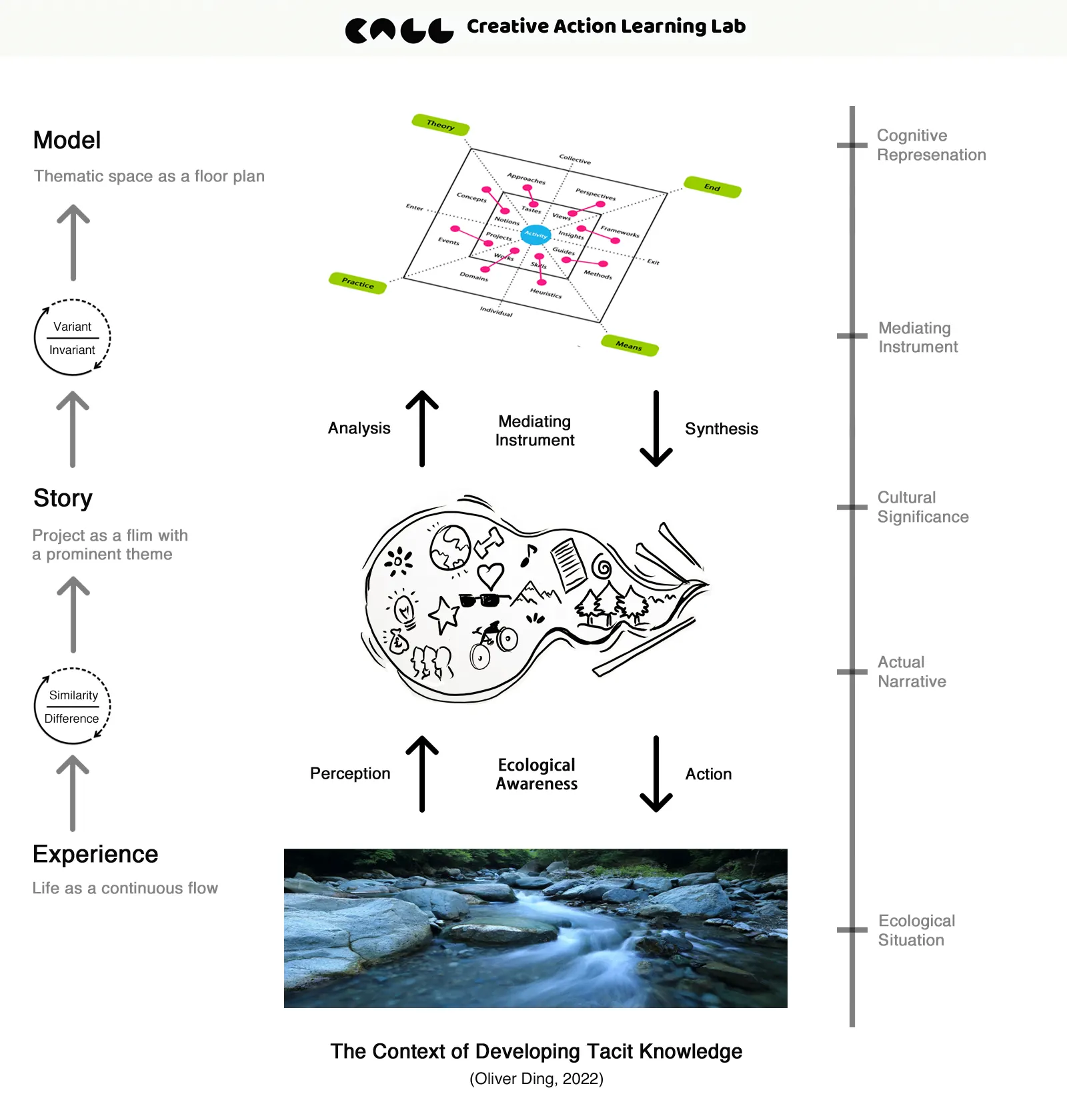
The new schema maintains this exact ordering, though the terminology is updated. As discussed earlier, "Flow" is renamed "Experience" and "Story" is renamed "Narrative." These are not conceptual shifts, but clarifications of naming. Narrative (formerly Story) has always been a thematic space of its own—a container for the single thematic/conceptual structure—not merely a transitional step between experience and model. By calling it "Narrative," we simply give it a more precise, academically grounded name that better reflects its role in organizing lived experience into a communicable form.
The new schema maintains this exact ordering, though the terminology is updated. As discussed earlier, "Flow" is renamed "Experience" and "Story" is renamed "Narrative." These are not conceptual shifts, but clarifications of naming. Narrative (formerly Story) has always been a thematic space of its own—a container for the single thematic/conceptual structure—not merely a transitional step between experience and model. By calling it "Narrative," we simply give it a more precise, academically grounded name that better reflects its role in organizing lived experience into a communicable form.
However, while the structural ordering remains consistent, the emphasis has shifted across projects. In 2022, during the Knowledge Discovery project, the Story layer was not the primary focus; the Model layer was, because the project was fundamentally based on the Knowledge Discovery Canvas, which is itself a model. In 2026, for the Cognitive Hydrology Project, Narrative becomes the primary focus. This shift reflects a crucial realization: not every project should lead to academic-style knowledge frameworks (models). The books in the Cognitive Hydrology series were not written in an academic style, but in a cultural narrative style. For these works, Narrative is not just a stepping stone to a Framework; it is the essential, primary mode of expression and meaning-making.
In 2024, the model was expanded and renamed The Curativity of Mind (v1) Model. The structure became Action — Experience — Story — Model — Meta. This modification emerged from linking the Flow–Story–Model framework with the Knowledge Discovery Canvas. The newly added layer, Meta, represented the level of general terms, basic forms, and ontological settings. The transformation from Model to Meta was characterized as Creation/Curation. This shift was inspired by my research on Ping-Keung Lui’s theoretical sociology, where he positions theoretical sociology as a meta-framework that curates and organizes various sociological theories.
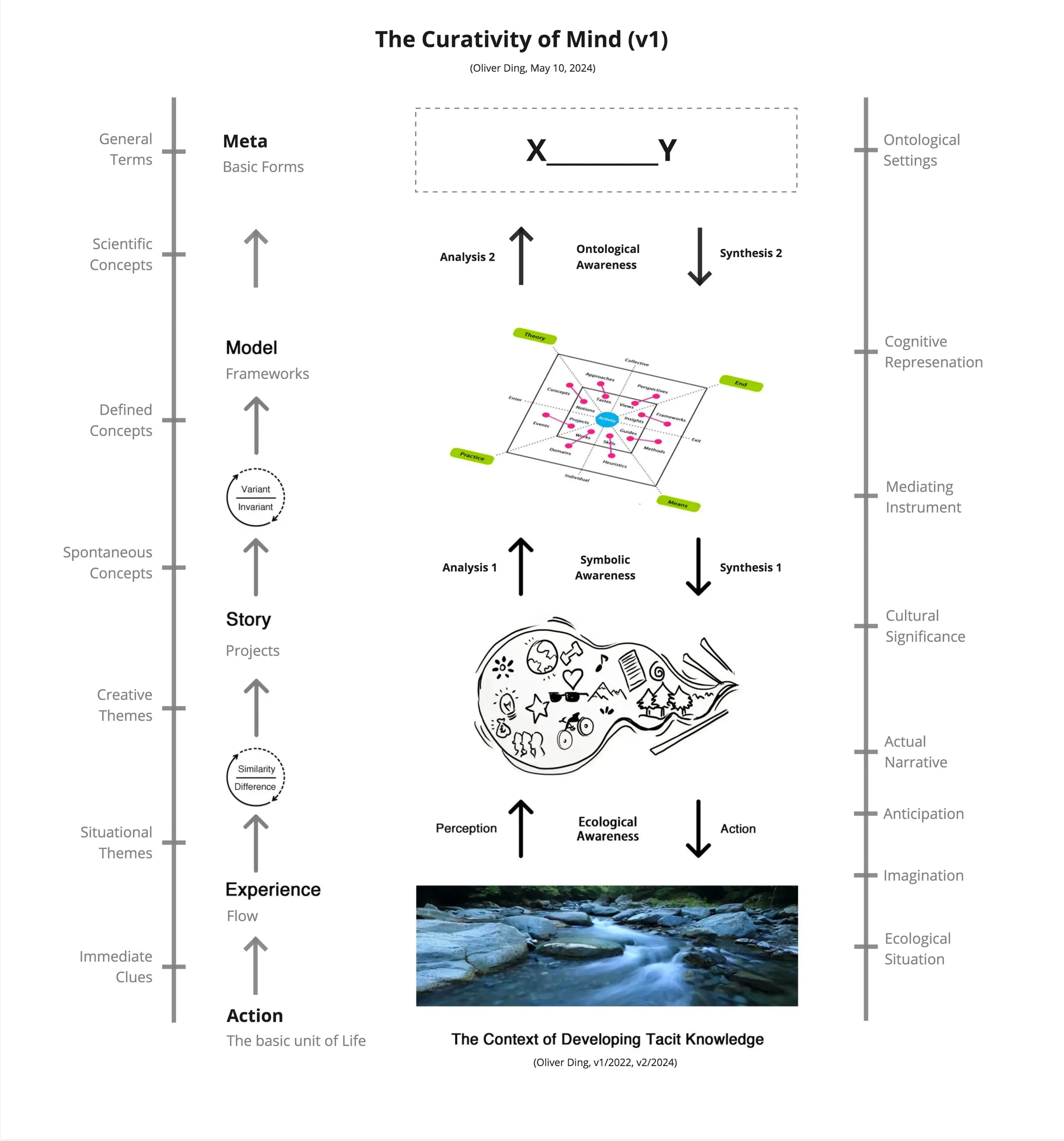
Revisiting this today reveals a crucial distinction. The 2024 "Meta" actually encompassed two different meanings. First, it referred to the cognitive dimension—the further abstract development of a knowledge system itself (which we now understand as Internal Meta within a single system). Second, it referred to the value dimension—the public value within a knowledge ecology. In a knowledge landscape, certain frameworks or systems naturally occupy a meta-position (such as Lui's theoretical sociology). This is the early form of what we now call Ecological Meta. The transition from this 2024 "Meta" to the new schema's "Ecology" represents a shift from a unified concept of abstraction to a clearer division between internal systemic abstraction and ecological positioning.
2.2 Testing the 2023 Strategic Thematic Exploration
In early 2023, I worked on the TALE Project — short for Thematic Analysis Learning Engagement. One of the major outcomes of this project was the Strategic Thematic Exploration Framework.
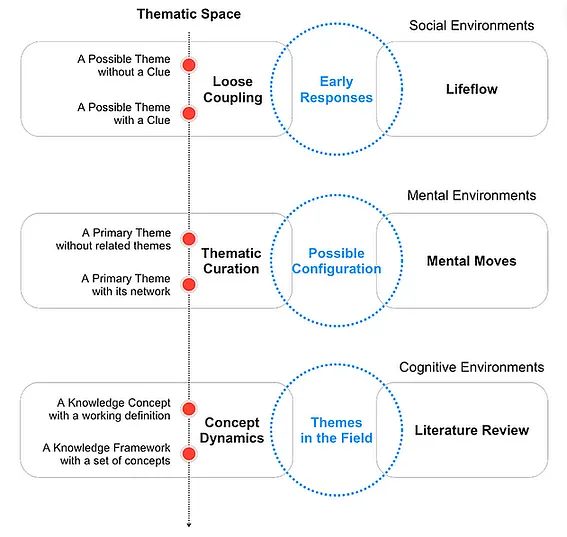
From my experience in developing knowledge frameworks and cultivating tacit knowledge in general, I have observed a consistent tendency for themes to evolve into concepts. The Strategic Thematic Exploration Framework represents a linear process of "From Theme to Framework," consisting of the following six stages:
- A Possible Theme without a Clue
- A Possible Theme with a Clue
- A Primary Theme without Related Themes
- A Primary Theme with its Network
- A Knowledge Concept with a Working Definition
- A Knowledge Framework with a Set of Concepts
I also identified three types of transformation that describe how this process unfolds.
- The "Possible–Primary" Transformation: Concerns the discovery of opportunities for knowledge creation and curation. It establishes the primary strategic intent for the entire journey.
- The "Theme–Concept" Transformation: Focuses on turning themes into concepts, treating themes as raw materials for generating new conceptual forms.
- The "Concept–Framework" Transformation: Centers on curating conceptual components into a coherent and meaningful whole—the stage at which a knowledge framework emerges through the organization of multiple interrelated concepts.
From 2023 to the present, the Theme–Concept–Framework Transformation Model has guided my exploration into the development of knowledge systems, resulting in a series of book drafts:
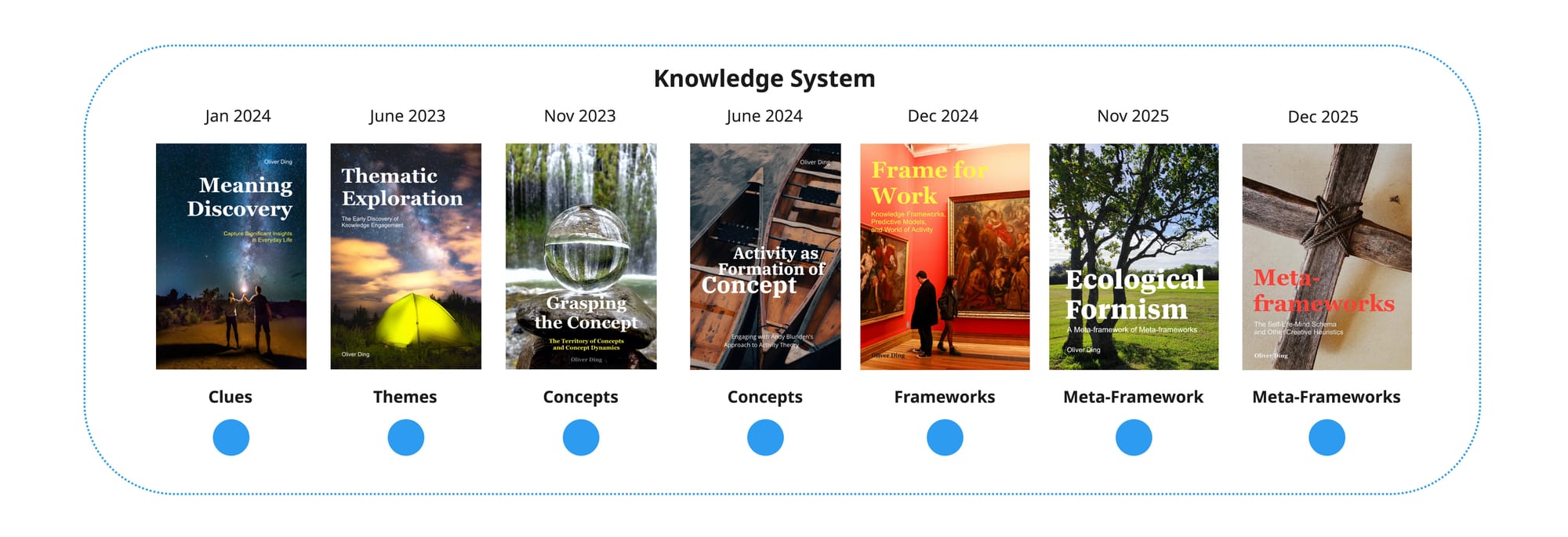
- Clues → Meaning Discovery (Jan 2024)
- Themes → Thematic Exploration (June 2023)
- Concepts → Grasping the Concept (Nov 2023)
- Concepts → Activity as Formation of Concept (June 2024)
- Frameworks → Frame for Work (Dec 2024)
- Meta-Framework → Ecological Formism (Nov 2025)
- Meta-Frameworks → Meta-Frameworks (Dec 2025)
When we test the Lake 42 case against Strategic Thematic Exploration, we find that Strategic Thematic Exploration perfectly explains the first three spaces of the Experience-Narrative-Framework-Ecology schema:
- Strategic Thematic Exploration Stages 1-2 map to Experience.
- Strategic Thematic Exploration Stages 3-4 map to Narrative.
- Strategic Thematic Exploration Stages 5-6 map to Framework.
The Critical Finding: The endpoint of Strategic Thematic Exploration (Stage 6) is only Space 3 of the new schema. Strategic Thematic Exploration is a brilliant "one-way street" for building a framework, but it stops there. It does not account for what happens when the framework is placed into a knowledge ecology. The Experience-Narrative-Framework-Ecology schema completes the picture by adding Space 4: Ecology.
This recent expansion of the schema into the fourth space—Ecology—is not merely a logical deduction. It is deeply rooted in the recent emergence of the "knowledge ecology" theme within my own creative journey. As I discussed in the postscript of Weave the Theory: The Art of Activity and Knowledge Ecology (May 2026), my focus has gradually shifted from personal epistemology to the broader dynamics of knowledge ecologies. I have been attempting to "unlock the gap between individual micro and collective macro"—finding that the same structural dynamics (Create, Curate, Weave) operate whether a single creator is building a personal framework over fifteen years, or a theoretical tradition is evolving over a century.
The new schema perfectly captures this ecological turn. Space 4 represents the moment when an individual's constructed Framework enters the larger ecology of Theoretical Activity. It is no longer just about my own cognitive system; it is about how that system finds its ecological niche, interacts with other enterprises, and contributes to the ongoing evolution of a collective knowledge landscape. The journey from Experience to Ecology is, ultimately, the journey of how a personal insight becomes part of the public commons.
Part 3: Theoretical Resources
The Experience-Narrative-Framework-Ecology schema is deeply rooted in my existing theoretical toolkit. Three resources provide its philosophical and structural foundation.
3.1 Thematic Space Theory
Thematic Space Theory offers a method for building knowledge models. Its basic move is to name a small set of thematic spaces, each a stage or region in which a theme can be found, and then to place the concrete details of earlier models into those spaces. The naming comes first, and the placing, which I call curation, follows.
The method was first used in the 2022 Knowledge Discovery project, where a theme was mapped on the Knowledge Discovery Canvas with eight dimensions and described as a floor plan. Over the following years the same method produced several models, each with its own details: the Flow, Story, and Model levels of 2022; the six stages of the 2023 Strategic Thematic Exploration; the sidebars of the Curativity of Mind model; and the vertices and edges of Concept Dynamics. Each detail was built for a particular purpose and in a particular context. Taken together, they risked competing with one another.
The Experience-Narrative-Framework-Ecology schema applies the method at a larger scale. It first names four thematic spaces: Experience, Narrative, Framework, and Ecology. It then curates the existing details into those spaces. The distinction between Story 1 and Story 2 belongs to the Narrative space. The stages of the Strategic Thematic Exploration fall into the spaces in pairs: stages 1 and 2 in Experience, stages 3 and 4 in Narrative, and stages 5 and 6 in Framework. The three vertices of Concept Dynamics are read across Experience, Narrative, and Framework, and its context is read as Ecology. Each earlier detail thus receives a position in one sequence.
This is also what allows the schema to be tested. A new case is placed into the four spaces, and any detail that does not fit a space reveals a gap in the curation, which is then corrected.
3.2 Ecological Formism
Ecological Formism is a meta-framework for organizing any object of knowledge. It sorts objects into four layers along one continuum. A variant is a particular, situation-bound case. A quasi-invariant is a pattern that recurs across cases but adjusts to each one. An invariant is a stable basic form. An invariant set is a group of invariants that stand in a part-to-group relation.
Two features matter for readers new to the framework. First, it is scale-free: the same principle applies to a single concept, a life, a diagram, or a whole platform, and an object's layer is relative to the scale at which it is seen. Second, many of the knowledge frameworks discussed in this article were created based on this principle. For example, the Flow-Focus-Center-Circle model, the four-stage pedagogy of Cognitive Hydrology, and the Living Coordinate Model were all organized in this way.
The relation to the Experience-Narrative-Framework-Ecology schema follows from the same principle. A theme moves from Experience, which is variant and situated, through Narrative and Framework, which are quasi-invariant and invariant, to Ecology, which is an invariant set in relation to a wider field. The Experience-Narrative-Framework-Ecology schema and the Flow-Focus-Center-Circle model are therefore two applications of one principle, applied to the same kind of object at the level of the theme and at the level of the whole life. Each application fills the four positions with its own content.
3.3 Concept Dynamics (2020)
The most profound theoretical support comes from the Concept Dynamics framework I developed in 2020. This model uses a triangle inside an ellipse to describe a concept as a system.
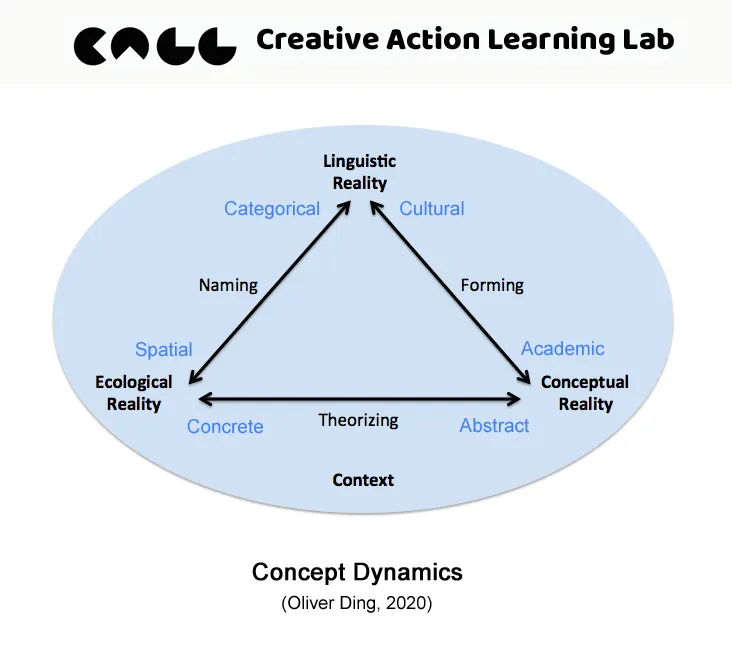
The Three Vertices:
- Ecological Reality (Real experience) maps directly to Space 1: Experience.
- Linguistic Reality (Expressional form, verbal/rhetorical effects) maps directly to Space 2: Narrative.
- Conceptual Reality (Outcome of creative conceptualization, public knowledge) maps directly to Space 3: Framework.
The Edges (Dynamics):
- Naming connects Experience and Narrative.
- Forming connects Narrative and Framework.
- Theorizing connects Experience and Framework. I summarize the return to experience as the "I See It" test—have you seen this concept in your own real experience?
The Context (Ecology):
The ellipse holding the triangle is the Context. This maps directly to Space 4: Ecology. It is the dynamic background of a concept across its development, where re-conceptualization produces polysemy and ambiguity.
The Experience-Narrative-Framework-Ecology schema is essentially Concept Dynamics expanded into a long-term, macro-scale spatial progression.
Part 4: Toward Cognitive Hydrology v2.0
Within the two-day RR project, I decided to intgegrate the new schema into my theoretical enterprise of Cognitive Hydrology.
In early 2026, I launched Cognitive Hydrology 1.0 as a new theoretical enterprise to focus on thematic development and concept creation. The new schema marks the transition toward Cognitive Hydrology v2.0.
This final part outlines what this new phase means for the future of the project.
4.1 The Pedagogical Framework and the Flow-Focus-Center-Circle Model
Cognitive Hydrology 1.0 was published at the beginning of 2026. In early March, I used version 1.0 as the basis for a pedagogical framework, A Pedagogical Framework for Thematic Development and Concept Creation. The framework has five parts: a philosophical foundation, a theoretical architecture, four stages with an integration stage, mediation, assessment, and facilitation, and a statement of scope and limitations.
The pedagogy is built on the Flow-Focus-Center-Circle model, which sets four thematic spaces: Flow, Focus, Center, and Circle. The teaching activities of the pedagogy are arranged across these four spaces, so that each space corresponds to one teaching stage: Stage One, Entering the Flow; Stage Two, Developing Focus; Stage Three, Establishing Center; and Stage Four, Entering the Circle. The pedagogy also includes an integration stage, Thematic Identity Curation. Several dimensions of the pedagogy run across all four spaces.
The Flow-Focus-Center-Circle model itself is derived from the levels of Ecological Formism. It describes the basic ecological forms through which an individual organizes experience and activity over a life course. It is the core model of the World of Activity, the theoretical orientation to which Cognitive Hydrology belongs.
The Experience-Narrative-Framework-Ecology schema was also developed from Thematic Space Theory and Ecological Formism. The two models therefore share an isomorphic structure: the four positions of Flow-Focus-Center-Circle and the four spaces of Experience-Narrative-Framework-Ecology are the same kind of object, produced by the same principle. Experience aligns with Flow, Narrative with Focus, Framework with Center, and Ecology with Circle. Both move in the same generative direction, from the fluid to the focused, to the centered, and finally to the wider social and ecological range. To avoid confusion, the Experience-Narrative-Framework-Ecology schema does not reuse the Flow-Focus-Center-Circle terms, and it keeps its own nomenclature.
The fact that the pedagogy's dimensions run across four spaces also prepares the next step. Four spaces crossed by several dimensions is the structure that would allow the Experience-Narrative-Framework-Ecology schema to develop into a mature knowledge framework.
4.2 Toward the T-only Model
This article sets a schema and nothing more. It names four thematic spaces, Experience, Narrative, Framework, and Ecology, and it states how the earlier models relate to them. It does not yet carry out the curation. The detailed content of the earlier models has not been placed into the four spaces, and no case has yet been fully analyzed within the schema. The four spaces are therefore a frame waiting for its contents.
When that curation is complete, the resulting model will be named the T-only model. The T in the name stands for theme. The model will describe how a theme moves through the four thematic spaces, with the details of each earlier model set in its proper place. Until then, the four spaces should be read as a proposed schema, not as a finished model. The dimensions that will cross these spaces are not set out here; they will be presented in a following article. Building a framework in this way follows Thematic Space Theory: one first sets a few thematic spaces, then curates the existing material into them, and only then do clear dimensions slowly emerge. This process of curation is itself a process of slow cognition.
The name follows from a principle already in use. The method of Creative Life Curation is organized by the S–T–O principle. S is subjectification, the lived experience of a person. T is thematic crystallization, the middle stage in which a theme takes shape. O is objectification, the outward products through which a theme becomes shared. Creative Life Curation is a formal member of Cognitive Hydrology 1.0, and S–T–O is its basic principle. Within that principle, the T-only model concerns the T alone: the crystallization of a theme, with S and O held as the two sides that the model does not itself describe. The name therefore states its scope directly. It is the T of S–T–O, and only the T.
To make the three letters concrete, take the Lake 42 case as an example. The S, subjectification, is the lived, embodied experience of the entire six-month creative journey from June to December 2025—a continuous immersion in writing several book manuscripts, sparked initially by the bodily shock of the "3+1 pattern" on June 2, and later reflected upon during that walk around the lake. The T, thematic crystallization, is the moment this vast experience took a name and a direction: the theme of Generative Confluence, in which three theoretical streams meet and generate a new center. The O, objectification, is the set of outward products through which the theme became shareable: the Lake 42 manuscript, and the Living Coordinate Model drawn as a diagram. In short, S is what happened to a person over time, T is what that experience came to mean as a theme, and O is what the person made from it so that others can see it.
The principle is therefore a simple sequence of three transitions: from lived experience to a theme, and from a theme to a product that can be shared. The T-only model is concerned with the middle of that sequence, the way a theme forms and develops.
4.3 Toward Cognitive Hydrology v2.0
The creation of the Experience-Narrative-Framework-Ecology Schema marks a significant milestone, moving Cognitive Hydrology toward v2.0.
In version 1.0, we used the Flow-Focus-Center-Circle model and pedagogy to understand the progression of creative life forms. In version 2.0, the Experience-Narrative-Framework-Ecology schema allows us to understand not just the spaces, but the evolution of Themes and Concepts flowing through them.
It acts as both a microscope—explaining how a single concept travels from raw experience to a structured framework—and a telescope—explaining how a framework finds its niche within a vast knowledge ecology.
These four spaces are not just a cognitive ladder. They are the complete journey of water: surging from the spring of Experience, forming a Narrative stream, gathering into a Framework lake, and finally merging into the vast ocean of the Ecology.
v1.0 - October 20, 2026 - 4,709 words