
Cognitive Hydrology: The Weave-the-Theme Framework (v1.0, 2026)
Introduce a new meta-framework
by Oliver Ding
October 22, 2026
This article is part of the Cognitive Hydrology v2.0 series.
The previous article in this series, Cognitive Hydrology: The Experience-Narrative-Framework-Ecology Schema, established the vertical architecture of Cognitive Hydrology v2.0. It mapped the diachronic evolution of a theme: how a pre-linguistic Experience crystallizes into a Narrative, solidifies into a Framework, and eventually finds its niche in a broader Ecology.
However, a schema is a static skeleton. It tells us where a theme goes, but not how it is actually lived and practiced in the messy reality of creative work. To bridge this gap, we need a dynamic model. We need to answer the question left open by the previous article: what does the T-only Model actually look like?
The answer lies in the act of weaving. A theme does not evolve in a vacuum; it must be interwoven with the concrete conditions of action. I am pleased to introduce the Weave-the-Theme Framework, a 4×4 diagram that serves as the operational core of the T-only Model.
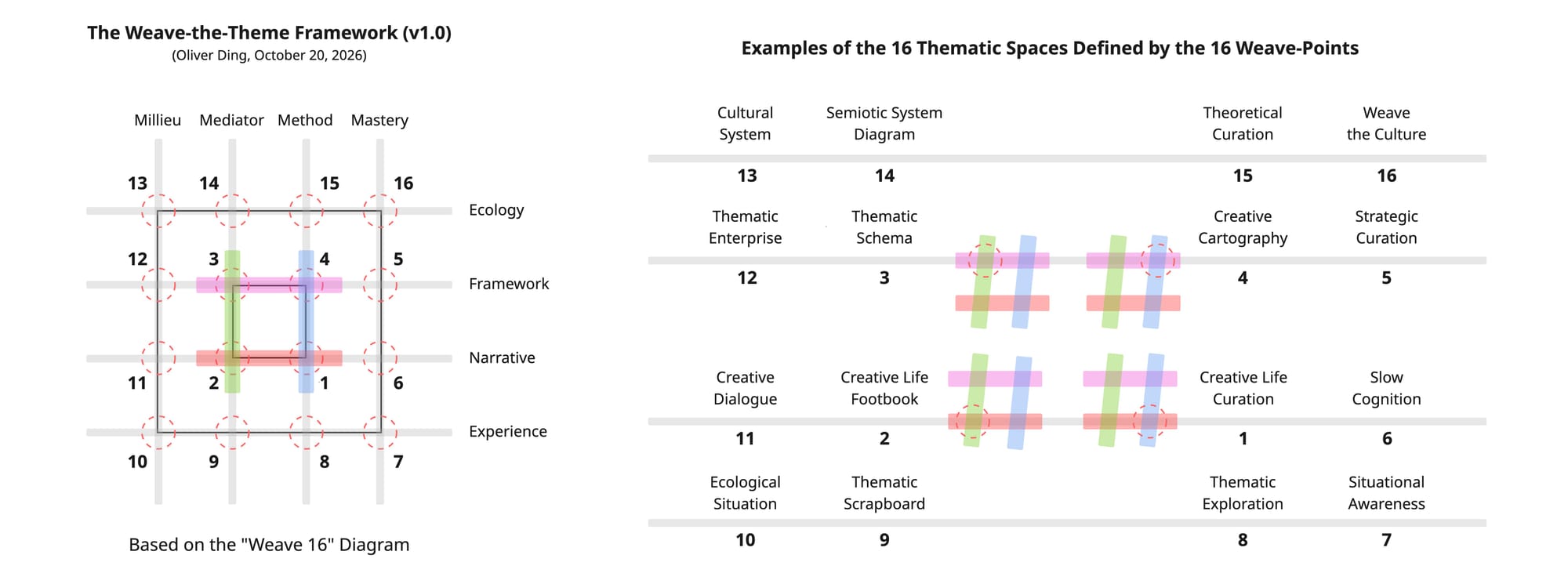
The term T-only Model was introduced as a placeholder at the end of the previous article. Its purpose was to signal the next step, but its structure remained undefined. Today, that placeholder becomes concrete. The T-only Model is exactly what I am presenting here under a new name: the Weave-the-Theme Framework. They are two sides of the same coin—one emphasizes its focus on "Thematic Crystallization" within the S-T-O principle, while the other emphasizes its structural logic of weaving.
Contents
Part 1: Why Weave? Why 4×4?
1.1 The Weave Basic Form
1.2 The Weave-the-Insight Framework (2025)
1.3 Why the 4×4 Structure?
Part 2: The 4×4 Weave-the-Theme Diagram
2.1 The Experience—Narrative—Framework—Ecology Schema
2.2 The Milieu—Mediator—Method—Mastery Schema
2.3 Examples of the 16 Thematic Spaces Defined by the 16 Weave-Points
2.4 Numbering, Inner Ring, and Outer Ring
Part 3: Weaving the Experience Space
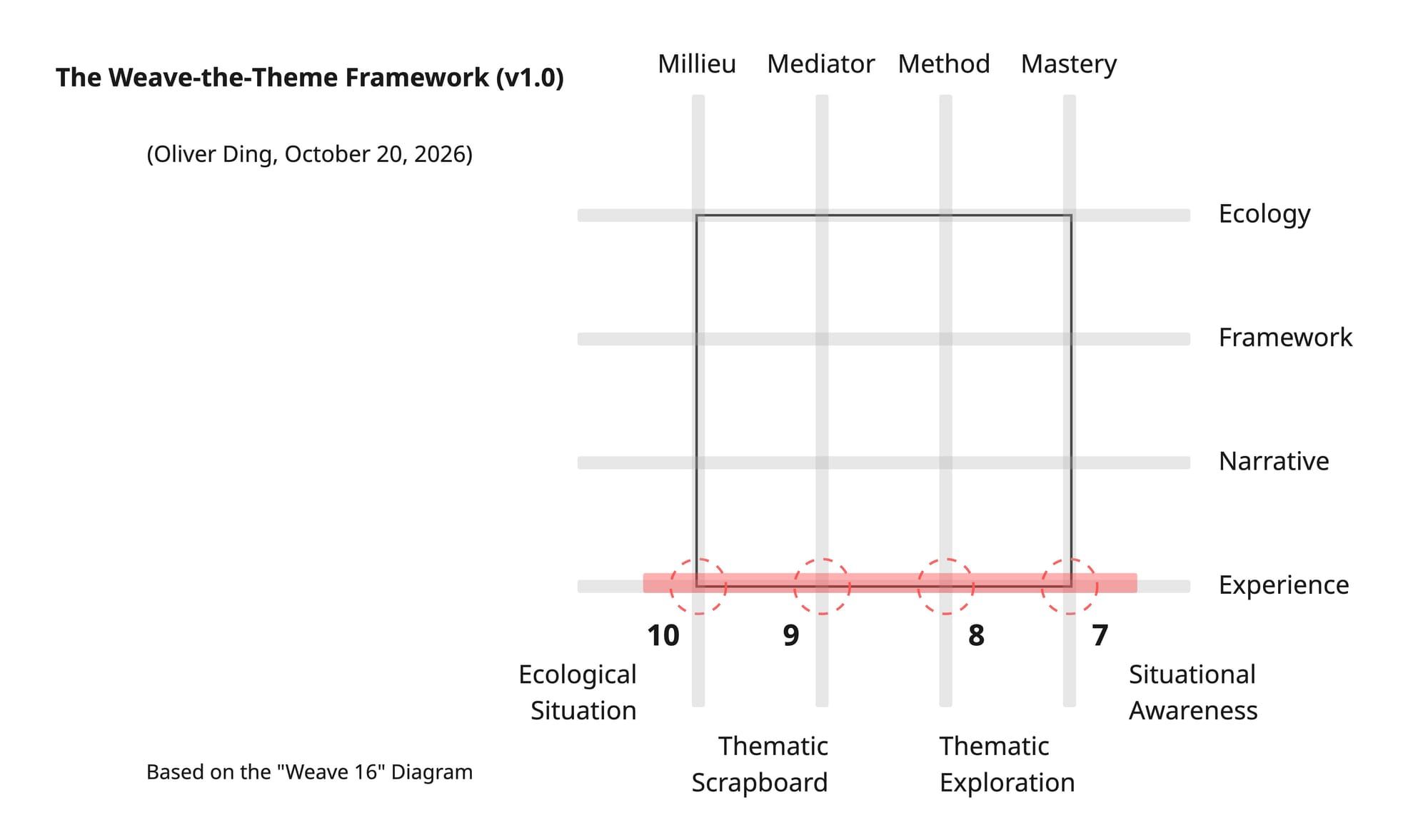
3.1 The "Milieu × Experience" Weave-point: Ecological Situation
3.2 The "Mediator × Experience" Weave-point: Thematic Scrapboard
3.3 The "Method × Experience" Weave-point: Thematic Exploration
3.4 The "Mastery × Experience" Weave-point: Situational Awareness
Part 4: Weaving the Narrative Space
4.1 The "Milieu × Narrative" Weave-point: Creative Dialogue
4.2 The "Mediator × Narrative" Weave-point: Creative Life Footbook
4.3 The "Method × Narrative" Weave-point: Creative Life Curation
4.4 The "Mastery × Narrative" Weave-point: Slow Cognition
Part 5: Weaving the Framework Space
5.1 The "Milieu × Framework" Weave-point: Thematic Enterprise
5.2 The "Mediator × Framework" Weave-point: Thematic Schema
5.3 The "Method × Framework" Weave-point: Creative Cartography
5.4 The "Mastery × Framework" Weave-point: Strategic Curation
Part 6: Weaving the Ecology Space
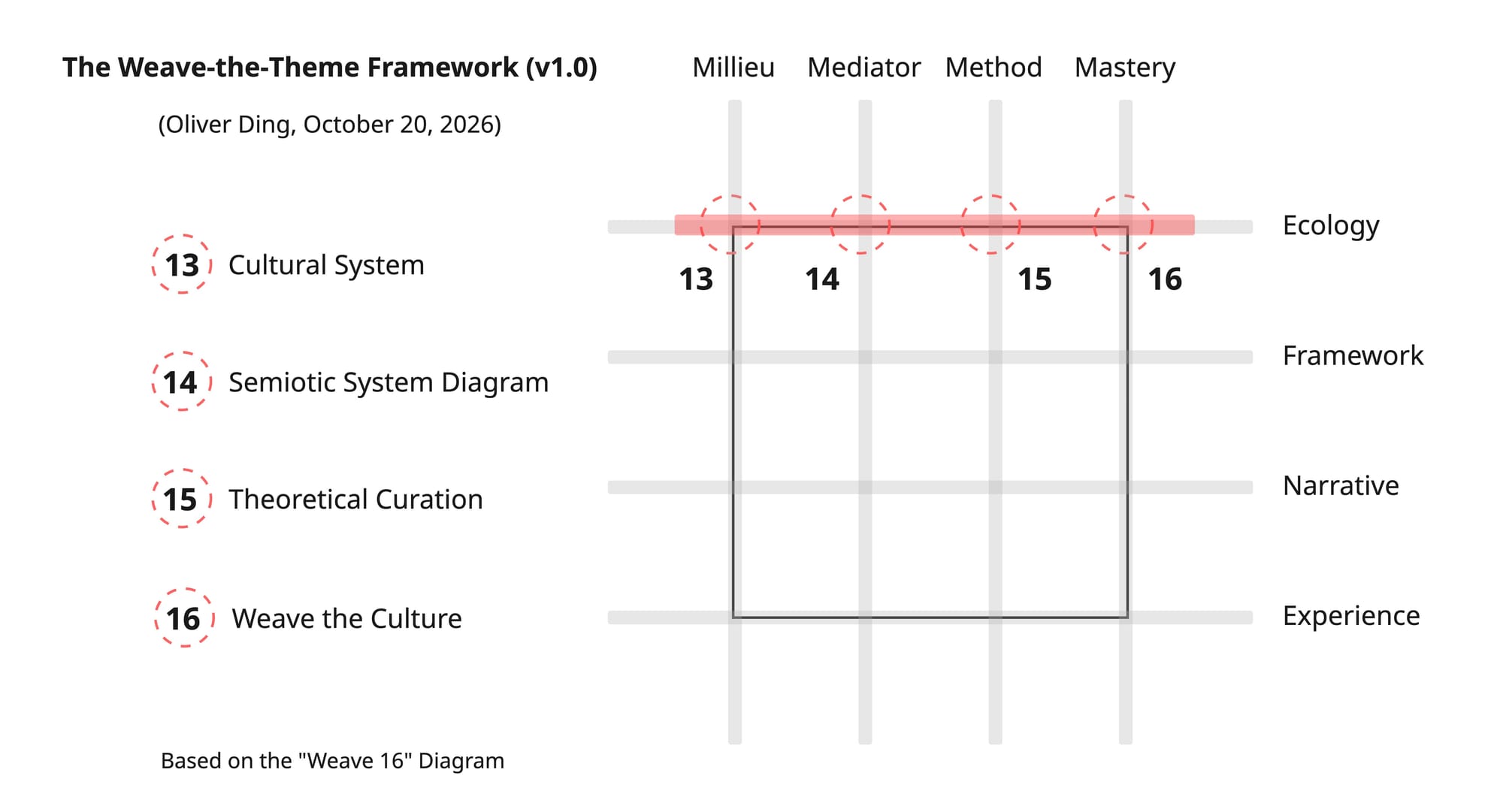
6.1 The "Milieu × Ecology" Weave-point: Cultural System
6.2 The "Mediator × Ecology" Weave-point: Semiotic System Diagram
6.3 The "Method × Ecology" Weave-point: Theoretical Curation
6.4 The "Mastery × Ecology" Weave-point: Weave the Culture
Part 7: The Framework as an Open Map
7.1 Case 1: Locating Thematic Supportance
7.2 Case 2: Locating Thematic Focus
7.3 The Map is Open
Conclusion
The T-only Model and the Curatorial Map
Part 1: Why Weave? Why 4×4?
Inspired by the Weave-the-Life Framework (v3.0), released on April 26, 2026, I adopted the "Weave 16" diagram as the meta-diagram to curate a series of knowledge elements together. The outcome was named as Weave-the-Theme.
In this part, we explore the foundation of "Weave 16" diagram.
1.1 The Weave Basic Form
On October 9, 2025, I introduced the “Weave” Basic Form as a meta-framework (see the diagram above).
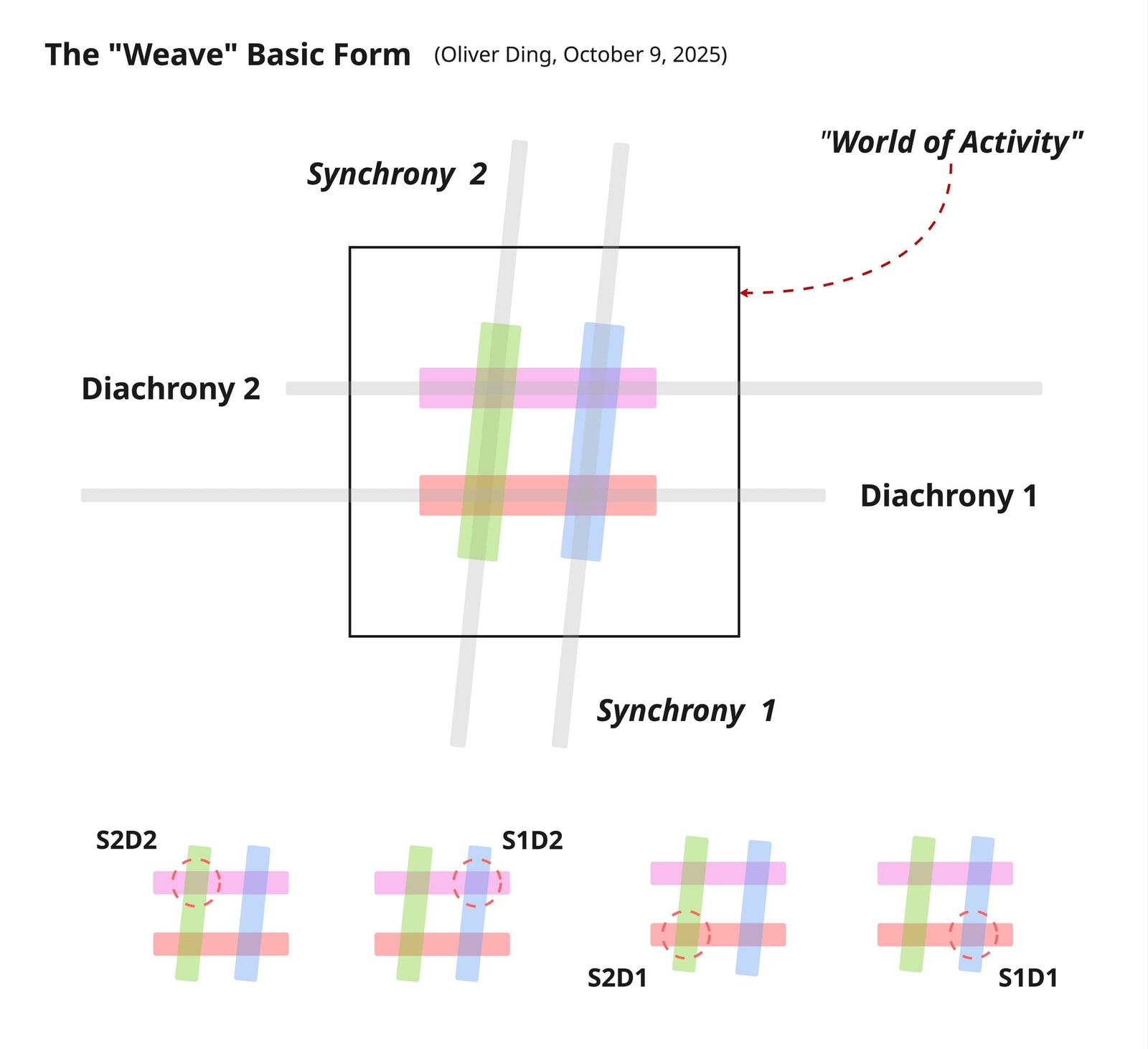
This is a super-simple diagram that frames the activity within the World of Activity as the synthesis of two diachronic dimensions and two synchronic dimensions. The model consists of four Weave-points (S1D1, S1D2, S2D1, S2D2), each representing a structural nexus where one synchrony dimension intersects with one diachrony dimension.
As an abstract model, the “Weave” basic form serves as the foundation for generating derived forms and situational frameworks. More details can be found in [Meta-framework] The “Weave” Basic Form.
1.2 The Weave-the-Insight Framework (2025)
In October 2025, while developing the Weave-the-Mind Framework (v2.0), I made the Weave-the-Insight Framework which is inspired by the 2022 Flow-Story-Model framework.
The Weave-the-Insight Framework builds on the original Weave-the-Mind Framework (v1.0). To align with the Curativity of Mind framework, I replaced the original Self–Other schema with the Analysis–Synthesis schema.
I also added notes to both the “Analysis — Synthesis” schema and the “Story — Model” schema:
- Analysis → Structural & Cultural
- Synthesis → Inward & Outward
- Story → Experience & Narrative
- Model → Perception & Representation
This approach treats each dimension as a spectrum of meaning, including multiple sub-themes; in the Weave diagram, at least two sub-themes are assigned per dimension. This allows Analysis 1 and Analysis 2 to coexist within a single dimension.

I identified four weave-points, each representing a specific intersection:
- Model (Representation) × Analysis (Structural) → Ontology (Ontological Awareness)
- Model (Perception) × Synthesis (Outward) → Affordance (Ecological Awareness)
- Story (Narrative) × Analysis (Cultural) → Symbol (Symbolic Awareness)
- Story (Experience) × Synthesis (Inward) → Imagery (Imaginal Awareness)
These concepts are inspired by the Spark Space Canvas.
Comparing the Curativity of Mind (v2) Model and the Weave-the-Insight Framework, a major difference is that the latter adds a fourth type of awareness. Specifically, Situational Awareness is divided into:
- Outward → Ecological Awareness → Perceiving Affordances
- Inward → Imaginal Awareness → Imagining Imagery
Together with the Spark Space Canvas, these frameworks form a toolkit for exploring, representing, and curating knowledge and mental activity.
However, the Weave-the-Insight diagram was based on Weave 2×2 diagram.
1.3 Why the 4×4 Structure?
In my April 2026 work on the Weave-the-Life Framework, I discovered that the Weave 2×2 diagram was insufficient. It was too cramped, forcing concepts to compete for space and obscuring the structural relationships between them. By expanding the grid to a 4×4 structure, we unlock several critical capacities:
- The Interweaving of Diachrony and Synchrony: A weave-point is formed by the intersection of one diachronic dimension (the vertical flow of a theme's evolution) and one synchronic dimension (the horizontal condition of a specific practice). This intersection provides a precise coordinate, telling us not only where a theme is in its lifecycle, but also how it is being engaged with in that moment.
- Weave-points as Portals to Thematic Spaces: Each of the 16 weave-points is not a fixed label or a definitional box. It is a portal that activates a Thematic Space—a living cognitive container.
- Thematic Elements within Each Space: Inside each thematic space resides a multitude of Thematic Elements. These are the various cognitive materials related to that coordinate: frameworks, diagrams, case studies, notes, book drafts, and even years of lived experience.
- Dynamic Development and Mutable Relationships: The contents of these thematic spaces are never static. The thematic elements within them evolve over time. As new elements are added, their relationships—how they connect, contradict, or synthesize with one another—can shift and recombine.
These four features together give the "Weave 16" diagram an unprecedented capacity. It is capable of curating a vast array of knowledge models simultaneously while retaining its structural coherence. Unlike previous knowledge models of "theme" I have developed, which often focused on a single linear process or a static classification, the Weave system possesses a continuous vitality. It can grow with the creator, absorbing new knowledge without breaking its underlying structure.
Part 2: The 4×4 Weave-the-Theme Diagram
The new framework is designed with two schemas: the Experience—Narrative—Framework—Ecology Schema and the Milieu—Mediator—Method—Mastery Schema.
2.1 The Experience—Narrative—Framework—Ecology Schema
The vertical axis consists of the four spaces from the Experience—Narrative—Framework—Ecology Schema. It defines four thematic spaces, each representing a distinct epistemological state and scale of thematic cognitive development:
Space 1: Experience
- Core Definition: Pre-linguistic (Thematic Focus).
Moving from action to experience. Inspiration and intuition surge before they are named. It is the state where a thematic focus is forming, but language has not yet captured it.
Space 2: Narrative
- Core Definition: Single Structure (Linguistic Existence).
Moving from theme to concept. A fuzzy inspiration gains linguistic existence through naming. It forms a "single theme + single concept" simple structure, represented through stories or preliminary models.
Space 3: Framework
- Core Definition: Composite Structure (Concept System).
Moving from a single element to an advance structure. The simple structure evolves into a composite structure—a network of themes and a system of concepts. This space includes the cognitive meta: the high-level abstraction within a single system (e.g., meta-frameworks, meta-diagrams), which ensures internal coherence.
Space 4: Ecology
- Core Definition: Ecology (Ecological Niche).
Moving from the knowledge system to the knowledge ecology. The framework enters the larger knowledge-cultural ecosystem. It focuses on cross-system connections, evolutionary potential, and the public-value meta: the meta-position that certain systems occupy in a larger knowledge ecology. Because they sit at the meta level, these systems are naturally oriented toward shared public value, governing or connecting other systems. Professor Lü's theoretical sociology is one example.
2.2 The Milieu—Mediator—Method—Mastery Schema
The Milieu—Mediator—Method—Mastery Schema was developed in September 2025, while I was designing the Frame-for-Work Canvas.
Originally, the schema was inspired from my reading of Clay Spinuzzi's Triangles and Tribulations (2025), where he used the sociology of translation to analyze the evolution of CHAT (Cultural-Historical Activity Theory).
Spinuzzi employs a method based on the sociology of translation, also known as actor-network theory (ANT), to examine the historical evolution of CHAT as a theoretical framework and its practical applications across various domains. While reading, I realized that this method could go beyond the CHAT case, offering potential for studying other knowledge enterprises.
In his detailed translation analysis, Spinuzzi uses the following categories of translations:
- Empirical Focus: In its studies, what scope of human interaction did CHAT investigate? What methods did researchers draw upon to adequately examine that scope of interaction?
- Mastery: What were human beings portrayed as mastering within that scope? How was human agency portrayed?
- Mediators: What means were human beings portrayed as using in their attempts at mastery? What means were theorized and investigated?
In our conversation, Spinuzzi explained that these three categories are not original to the sociology of translation but were developed by him to address aspects specific to the CHAT case.
These categories inspired me to develop the “Milieu–Mediator–Method–Mastery” schema for the Frame for Work project. I chose the term Milieu to replace the original term Empirical Focus, in order to cover a broader range of applications beyond empirical research. I also added Method to create a conceptual link between Mastery and Mediators.
2.3 Examples of the 16 Thematic Spaces Defined by the 16 Weave-Points
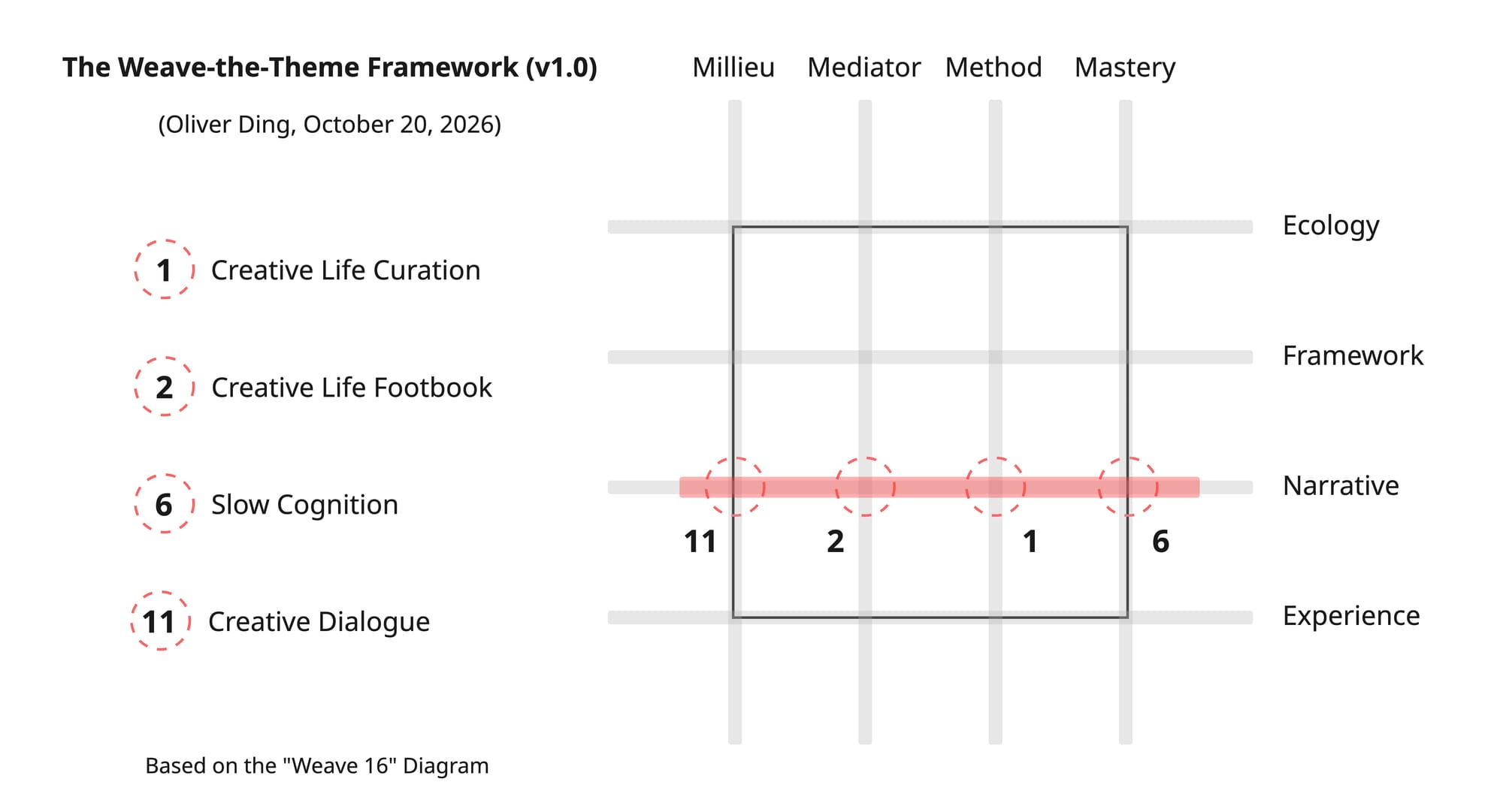
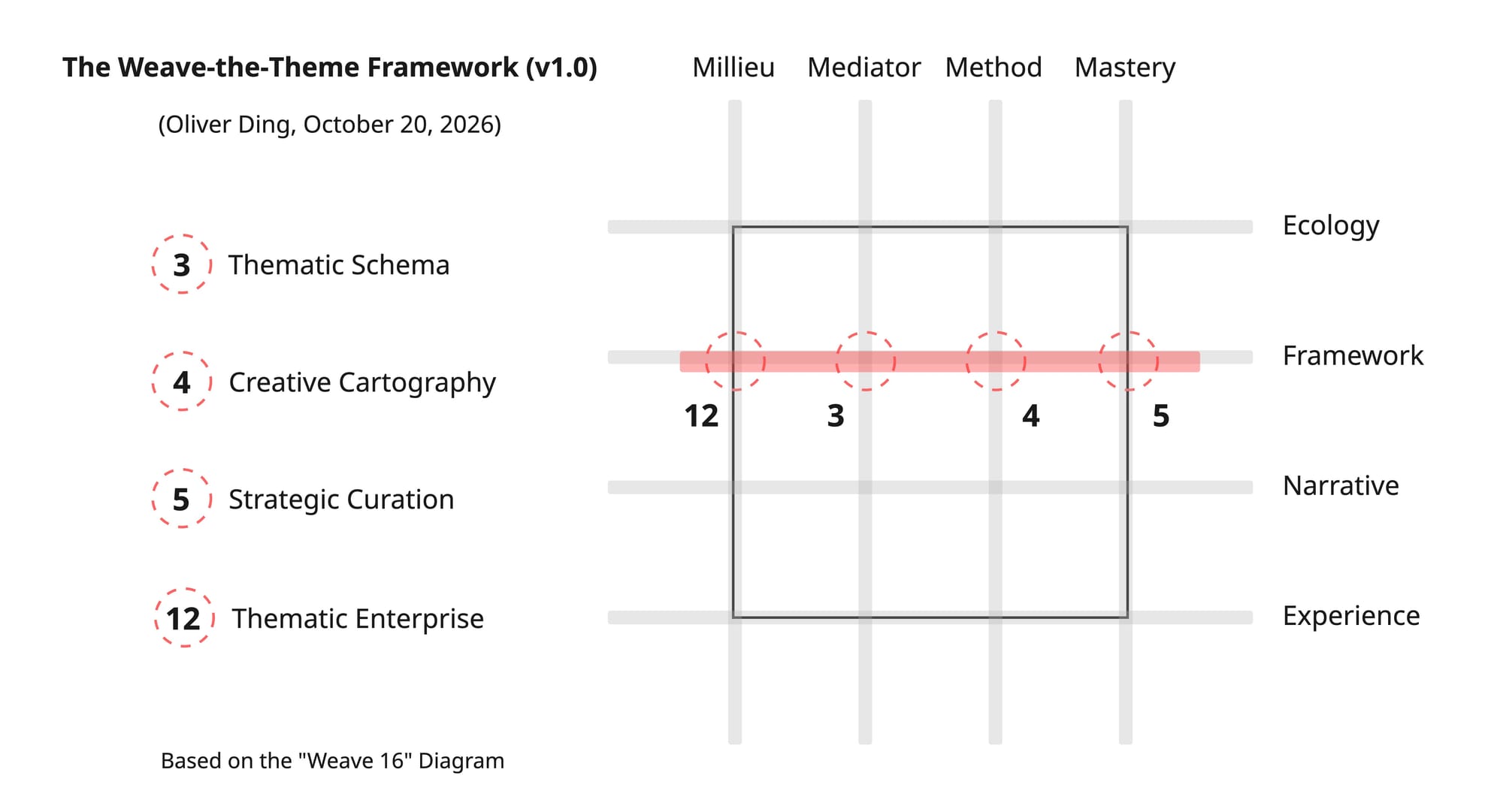
The completed 4×4 Weave-the-Theme Diagram is presented below. To navigate this matrix, the 16 weave-points are numbered sequentially from #1 to #16. Each weave-point is named using the format "Dimension × Space" Weave-point (e.g., "Milieu × Experience" Weave-point), which describes its precise coordinate in the diagram.
Because each weave-point serves as a portal to an entire Thematic Space, it can contain a vast multitude of cognitive materials. To make the diagram practical and legible, each of the 16 weave-points is anchored by a single Thematic Element. This element acts as a representative entry point—a concrete example of the kind of cognitive material that lives within that specific space.
Below is the index of the 16 weave-points and their representative thematic elements, moving vertically through the four spaces and horizontally across the 4M dimensions:
The Experience Space
- The "Milieu × Experience" Weave-point (#10) — Ecological Situation
- The "Mediator × Experience" Weave-point (#9) — Thematic Scrapboard
- The "Method × Experience" Weave-point (#8) — Thematic Exploration
- The "Mastery × Experience" Weave-point (#7) — Situational Awareness
The Narrative Space
- The "Milieu × Narrative" Weave-point (#11) — Creative Dialogue
- The "Mediator × Narrative" Weave-point (#2) — Creative Life Footbook
- The "Method × Narrative" Weave-point (#1) — Creative Life Curation
- The "Mastery × Narrative" Weave-point (#6) — Slow Cognition
The Framework Space
- The "Milieu × Framework" Weave-point (#12) — Thematic Enterprise
- The "Mediator × Framework" Weave-point (#3) — Thematic Schema
- The "Method × Framework" Weave-point (#4) — Creative Cartography
- The "Mastery × Framework" Weave-point (#5) — Strategic Curation
The Ecology Space
- The "Milieu × Ecology" Weave-point (#13)— Cultural System
- The "Mediator × Ecology" Weave-point (#14)— Semiotic System Diagram
- The "Method × Ecology" Weave-point (#15) — Theoretical Curation
- The "Mastery × Ecology" Weave-point (#16) — Weave the Culture
It is important to note that the 16 elements listed above are examples, not a fixed taxonomy. The true power of this diagram lies in its openness. As the creator's thematic enterprise grows, new elements will be added to these spaces, and the relationships between them will continue to evolve. The 16 items are simply the first threads woven into the fabric.
2.4 Numbering, Inner Ring, and Outer Ring
To navigate the 16 weave-points systematically, the diagram employs a specific numbering sequence. The numbering begins at the "Method × Narrative" Weave-point (#1), because its representative thematic element is Creative Life Curation—the core methodology of Cognitive Hydrology. From this starting point, the numbering moves left and then clockwise in a spiral around the matrix, concluding with "Mastery × Ecology" (#16), represented by Weave the Culture.
This numbering sequence does more than just label the points; it spatially and conceptually distinguishes the diagram into an Inner Ring and an Outer Ring.
The Inner Ring (Core Method and Output)
The first four weave-points form the inner 2×2 core of the matrix. This inner ring represents the essential methodologies and output forms of Cognitive Hydrology:
- #1 — Creative Life Curation (Method × Narrative): This is the foundational research method of Cognitive Hydrology, focusing on the systematic curation of one's own lived experience and thematic development.
- #2 — Creative Life Footbook (Mediator × Narrative): This represents the primary output form of this methodology. The books in the Cognitive Hydrology series are all "Footbooks"—narratives that use personal stories to illuminate abstract concepts.
- #3 — Thematic Schema (Mediator × Framework): This represents the components used to combine and develop knowledge frameworks. The Experience—Narrative—Framework—Ecology Schema and the Milieu—Mediator—Method—Mastery Schema presented in this article are prime examples of such thematic schemas.
- #4 — Creative Cartography (Method × Framework): This represents the use of creative diagramming methods to explore and map various themes. It is the visual and structural counterpart to the narrative curation in #1.
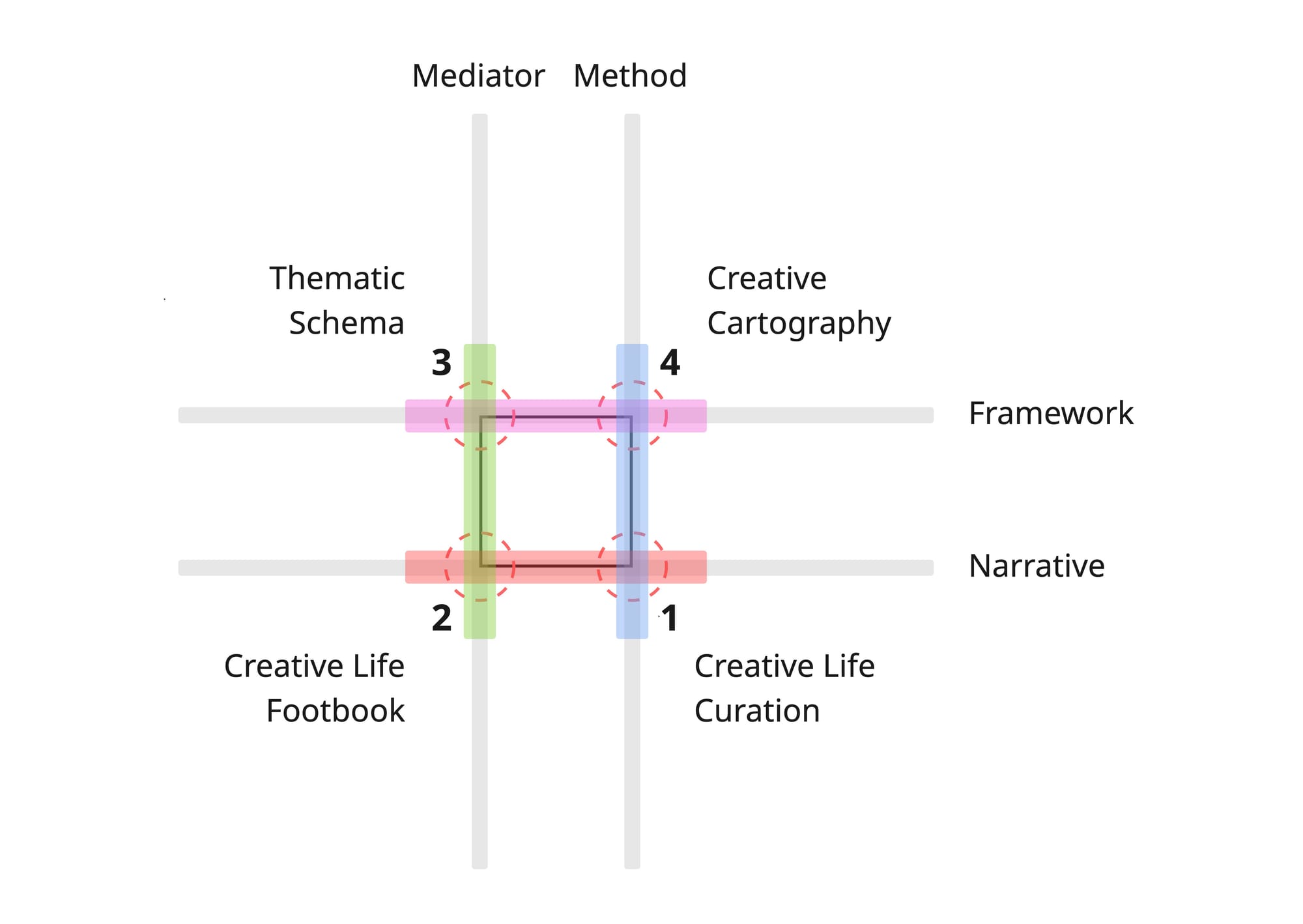
Together, the Inner Ring provides the operational core of the entire framework: the method of curation, the narrative output, the structural schema, and the cartographic tool.
The Outer Ring (Contexts and Expansions)
Continuing clockwise from #4, points #5 through #16 form the Outer Ring. This outer ring represents the broader contexts, extended practices, and environmental conditions that surround the core. For example, the sequence moves through #5 Strategic Curation (Mastery × Framework) and #6 Slow Cognition (Mastery × Narrative), expanding the framework into strategic life management and long-term cognitive development. The spiral finally culminates in #16 Weave the Culture (Mastery × Ecology), representing the ultimate state where individual thematic creation contributes to the evolution of the broader cultural ecosystem.
The inner ring secures the creator's core practice, while the outer ring connects that practice to the vast world beyond.
With the vertical and horizontal axes now established, we can begin to weave the fabric of the theme. In the following four parts, we will explore the 16 weave-points, starting from the foundational space of Experience.
Part 3: Weaving the Experience Space
In the Experience space, the theme is a fluid, pre-linguistic force. The actor is navigating the raw, unmediated data of lived reality. Here, we explore the four weave-points that structure this foundational space.
3.1 The "Milieu × Experience" Weave-point: Ecological Situation
The "Milieu × Experience" weave-point represents the intersection of the environmental context and the pre-linguistic stage of thematic development. It is where the external world first makes contact with the creator's raw perception.
One key Thematic Element located at this point is the Ecological Situation. This refers to the immediate physical and social environment where experience occurs. It is the "here and now" of raw encounter—the sights, sounds, conversations, and physical spaces that surround the creator before any theoretical abstraction takes place. The ecological situation provides the primordial data that will eventually become the seed of a theme.
This concept of the ecological situation directly corresponds to the "Flow" level in the 2022 Flow-Story-Model, where life is understood as a continuous stream of subjective experience. It also perfectly aligns with the first "F"—Flow—in the FFCC (Flow-Focus-Center-Circle) model within the World of Activity approach. To better understand the rich texture of this pre-linguistic stage, I recently developed a diagram titled The House of Flow Dynamics. In this mapping, I organized a series of experiential objects of Flow through the lens of four distinct time views, providing a more nuanced vocabulary for what constitutes this raw, ecological situation.
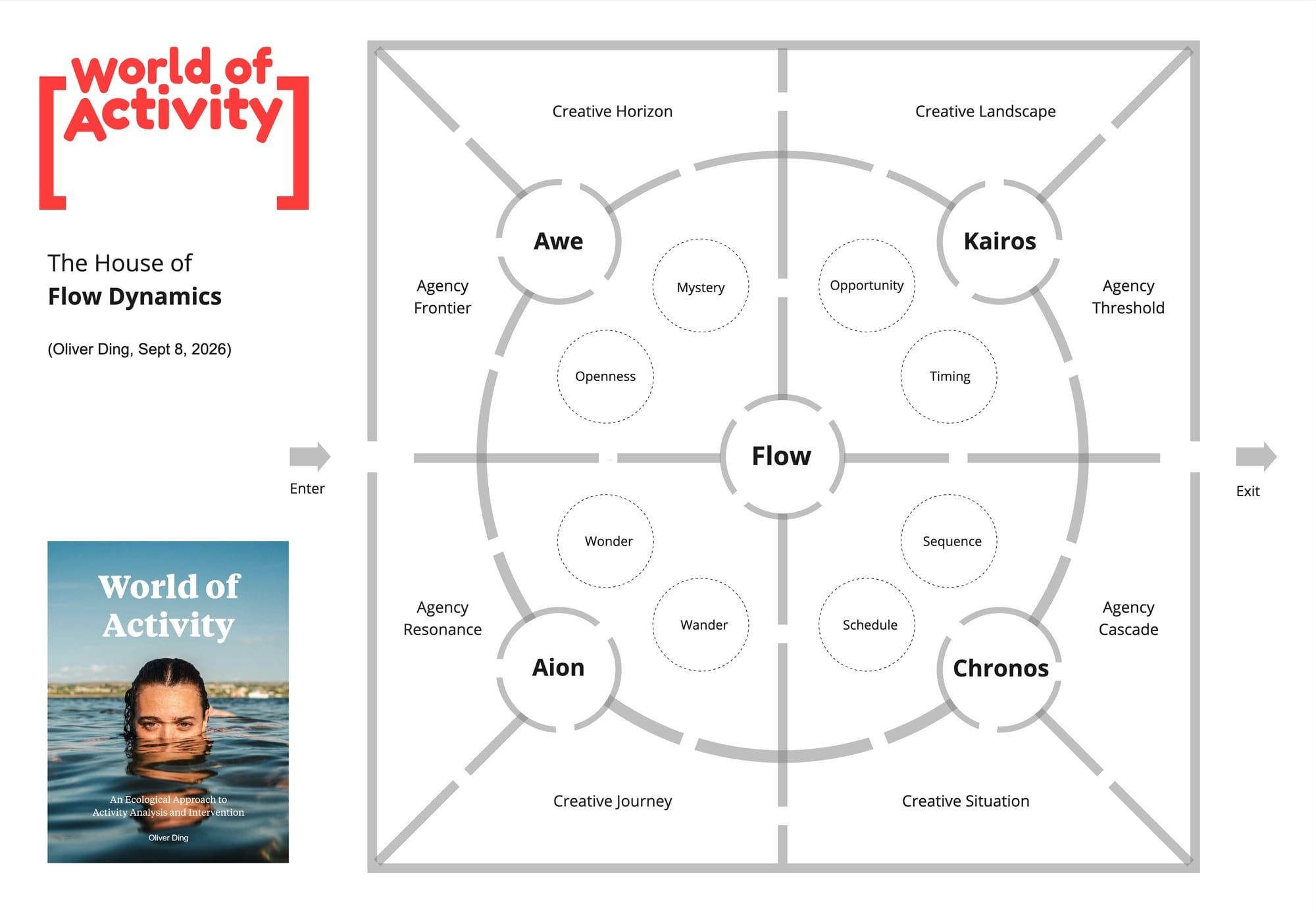
The four time views—Aion, Chronos, Kairos, and Awe—are highly abstract. We cannot see Aion, touch Chronos, grasp Kairos, or measure Awe. They are temporal modes, not physical things. However, we can experience them through the objects that appear within them. These are the experiential objects of Flow, represented as the eight inner themes in the map: wonder, wander, schedule, sequence, timing, opportunity, mystery, and openness. When read in order, these eight objects trace a distinct arc:
wonder → wander → schedule → sequence → timing → opportunity → mystery → openness
This sequence follows the four time views themselves. Aion gives us wonder and wander—the open, receptive mode of deep time. Chronos gives us schedule and sequence—the structured, linear mode of everyday time. Kairos gives us timing and opportunity—the discerning, threshold mode of time. Awe gives us mystery and openness—the transcendent, horizon mode of time.
By mapping these experiential objects, the "Ecological Situation" is no longer a static background; it becomes a dynamic temporal landscape filled with perceptible forms that the creator encounters before they are crystallized into a narrative.
3.2 The "Mediator × Experience" Weave-point: Thematic Scrapboard
The "Mediator × Experience" weave-point sits at the intersection of the tools used to capture the theme and the pre-linguistic surge of experience. It is the first attempt to materialize the intangible.
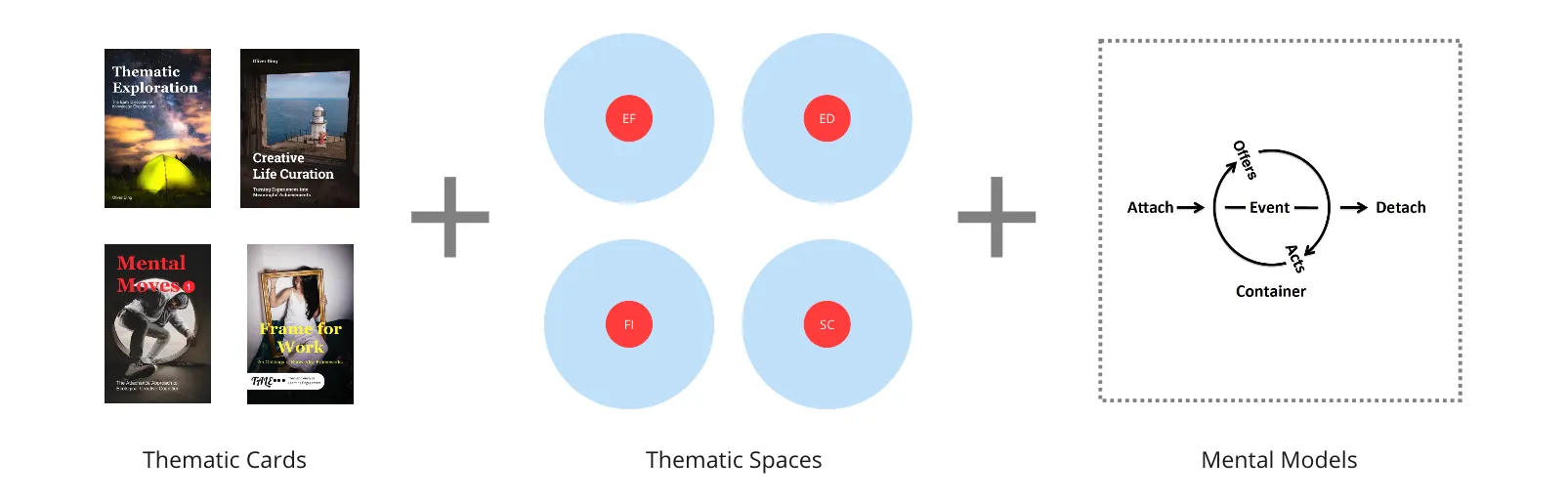
A representative Thematic Element here is the Thematic Scrapboard. This is not merely a collection of loose notes; it is a specific type of visual diagram designed for Thematic Exploration and Thematic Card Sorting. The medium at this stage is informal and highly personal, but it follows a distinct visual structure to make personal tacit knowledge visible.
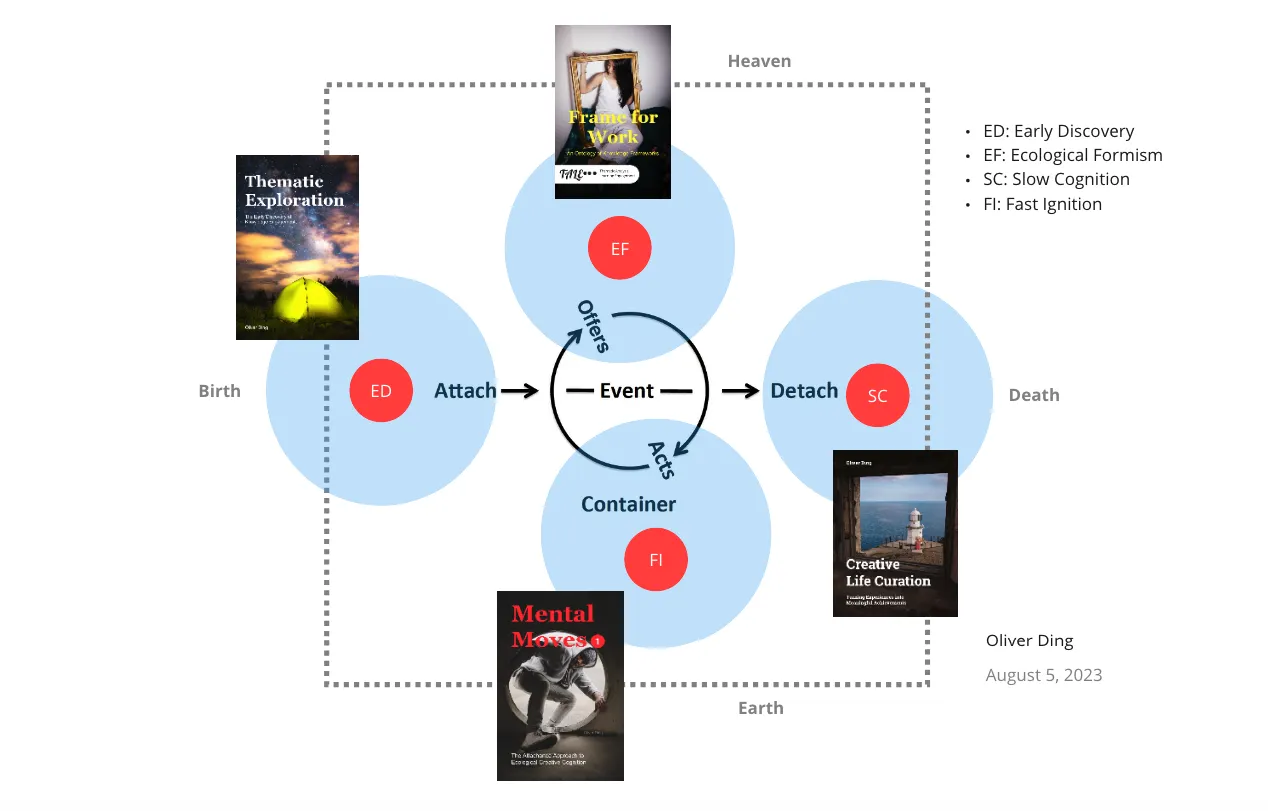
A Thematic Scrapboard typically involves three key components:
- Thematic Cards: Often designed as fake book covers or pictures, these cards represent "possible themes." They are a technique of Continuous Objectification, turning abstract ideas into concrete, visible, and touchable objects.
- Thematic Spaces: Represented by red dots and light blue circles, each space has a name representing a primary theme (such as "Early Discovery" or "Slow Cognition").
- Mental Models: Used as the underlying context for the diagramming. These represent the creator's private, subjective knowledge, which mediates between public knowledge frameworks and the project at hand.
The Scrapboard acts as a "holding environment" for the cognitive flood. By using loose connections and juxtaposing these thematic cards and spaces around a mental model, the creator can perceive various possible configurations of a theme network. It allows patterns to emerge naturally from the fragmented, pre-linguistic experience before they are forced into a coherent narrative.
While the Thematic Scrapboard serves as a foundational medium for juxtaposition, other types of mediators also populate this weave-point, each offering a different way to materialize the pre-linguistic:
- Thematic Card: A standalone visual mediator that uses a single image to showcase a theme, typically including a short theme name and a one-sentence prompt. It acts as a tangible anchor for a fleeting idea.
- Thematic Brief: A short essay used as a mediator. It briefly outlines the meaning of a theme, narrates its genesis, and sketches out potential project ideas associated with it. This provides more narrative context than a card or scrapboard.
- Diagram Notion: A mediator created by adding text and visual annotations directly onto an existing diagram to express thoughts and ideas. It leverages visual structures to capture specific thematic sparks as they occur.
In summary, these mediators share a common function: they support the translation of thematic ideas from vague, pre-linguistic intuitions into concrete language, naming, and tangible objects. Once created, these objects return to support the ongoing process of thematic exploration, creating a continuous feedback loop where the act of materializing a theme further deepens the exploration itself.
3.3 The "Method × Experience" Weave-point: Thematic Exploration
The "Method × Experience" weave-point defines the cognitive operation that bridges the environment and the pre-linguistic mind. It is how the creator actively navigates the flow of raw experience.
The primary Thematic Element at this point is Thematic Exploration. While it conceptually involves tracing a theme back to its origins—like a hydrologist finding the spring—it is more accurately understood as a systematic methodology.
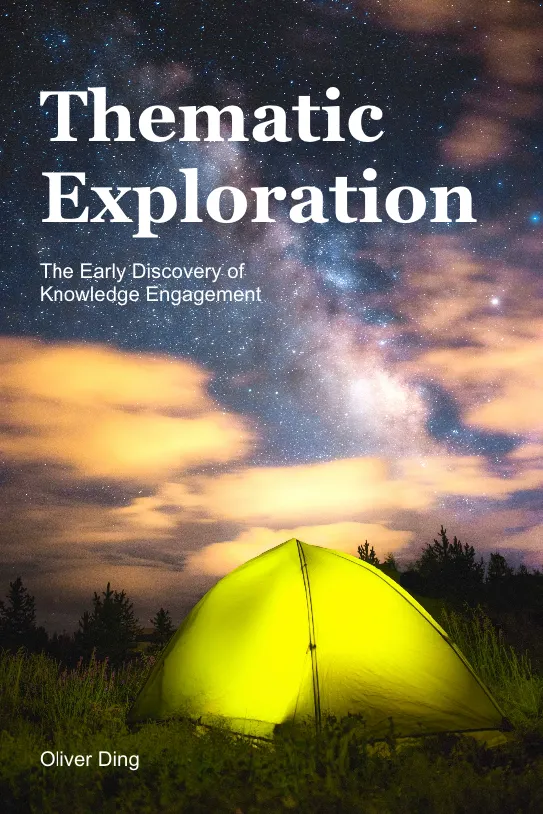
In my 2023 book draft, Thematic Exploration: The Early Discovery of Knowledge Engagement, I formalized this process. It frames the "Person–Theme" relationship as a long-term creative space (a "Workfield") and outlines the "Early Discovery" journey. This journey maps how a creator moves from a vague "Possible Theme" to a "Primary Theme" with a network, and eventually to a "Knowledge Concept" and "Knowledge Framework." The cognitive operation here requires deep attention to discern which streams within the cognitive flood carry real significance, systematically turning subjective, pre-linguistic experiences into a structured "Spontaneous Concept System."
Beyond this systematic framework, several other distinct methods also operate at this weave-point, all sharing a common purpose: they are all forms of Second-order Activity. In the Anticipatory Activity System (AAS) framework, First-order Activity is goal-directed execution, while Second-order Activity is about discovering a goal for First-order Activity.
Specifically, these methods include:
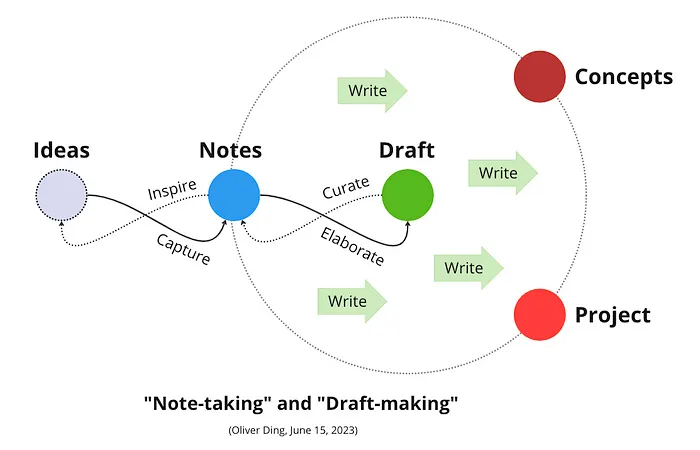
- Situational Note-taking: This is a fundamental action of the Slow Cognition method. As detailed in my 2024 collection, it is not just about recording facts; it is a dynamic system. It involves capturing insights in real-time within a specific situation, moving from "Ideas" to "Notes" (inspiration and capture), and eventually curating them into "Drafts" (elaboration and curation) that feed into Concepts and Projects. It is the mechanism by which fleeting, pre-linguistic thoughts are anchored to the physical and social environment before they fade.
- The Discovery Trilogy (Knowledge, Life, and Meaning Discovery): These are three specific types of Second-order Activity that lead to "Significant Insights."
- Knowledge Discovery focuses on developing tacit knowledge, exploring possible themes, and constructing concept systems.
- Life Discovery turns the lens inward, reflecting on life transitions, self-awareness, and personal trajectory.
- Meaning Discovery operates at the existential level, capturing significant insights from everyday life and transforming them into a meaningful whole, as mapped in the Meaning Discovery Canvas.
Together, these methods provide a comprehensive toolkit for the Experience space. Whether through the systematic unfolding of Thematic Exploration, the immediate capture of Situational Note-taking, or the deep introspection of the Discovery Trilogy, the creator actively shapes the chaotic flood of experience into a navigable stream of significant insights.
Crucially, these insights are not left as vague, abstract feelings; they are deliberately captured and expressed as distinct themes. In my own practice, a significant insight is almost always crystallized into a theme, which then becomes the foundational anchor for further exploration and development.
3.4 The "Mastery × Experience" Weave-point: Situational Awareness
The "Mastery × Experience" weave-point represents the achieved state of engaging with the pre-linguistic environment. It is the culmination of the Experience space.
Previously, in the Weave-the-Insight Framework, I mapped this mastery position strictly to "Ecological Awareness," which corresponded only to the perception of Affordance—the real interactions between a human and their material environment. However, a much broader and more accurate term for this mastery is Situational Awareness. This is the heightened capacity to notice subtle patterns and "shocks of insight" within the cognitive flood, recognizing what is significant in a given situation before it is articulated.
To understand what the creator is actually becoming aware of, we can look at the basic unit of tacit knowledge: the Spark. In my 2022 work on knowledge discovery, I defined four distinct types of Sparks, organized along a "Fact — Fiction" dimension. Situational Awareness is the mastery of perceiving all four:
- Imagery: Sparks inspired by literary works or other sources that evoke a visual mental image or sensory impression. (Located in the Fiction zone).
- Semantics: Sparks inspired by the meaning of a word, phrase, sentence, or text. (Located in the Fiction zone).
- Narrative: Sparks inspired by storytelling, performance, or conversation in a situational activity. (Located in the Fact zone, emphasizing human-to-human communicative activities).
- Affordance: Sparks inspired by real, embodied interactions between a human, an object, and an environment. (Located in the Fact zone, emphasizing human-to-environment interactions).
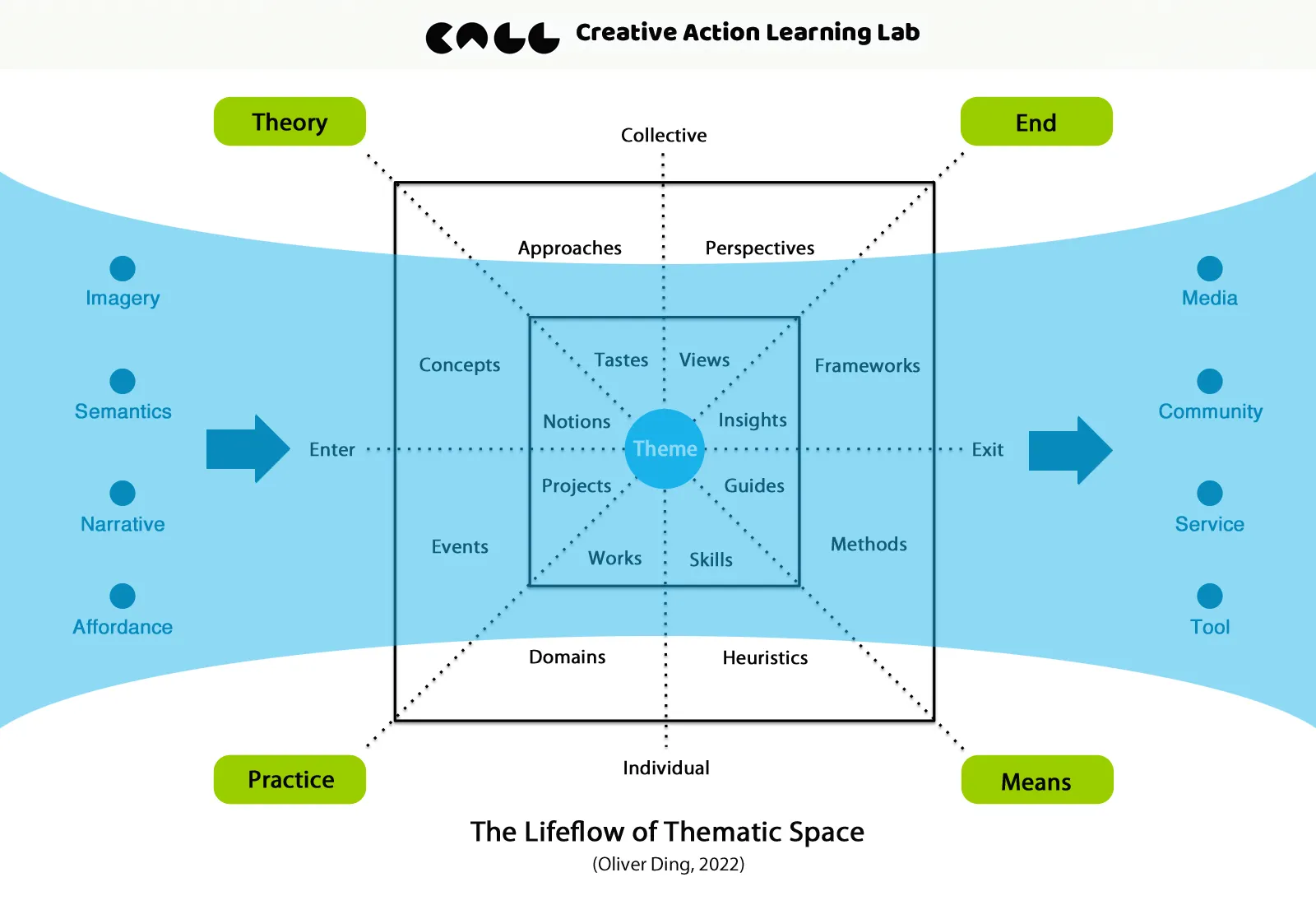
The mastery of the Experience space, therefore, is Situational Awareness: the ability to stand in the flow of everyday life and recognize when an Image, a Semantic nuance, a Narrative thread, or a Material Affordance has sparked. It is the capacity to catch these potential themes hidden within the everyday before they dissolve back into the cognitive flood, preparing them for the "Many Sparks In, One Statue Out" process of objectification.
It is worth noting that while this typology of four Sparks was originally developed in 2022 specifically for the context of developing tacit knowledge, it has since proven to be universally applicable. It now serves as a robust framework for thematic exploration across all kinds of situations. Regardless of whether one is exploring a theoretical concept, a cultural phenomenon, or a personal life theme, these four types of Sparks reliably capture the diverse sources of insight that drive thematic development.
Part 4: Weaving the Narrative Space
In the Narrative space, the theme gains linguistic existence. The scattered fragments of experience are organized into a story, giving the theme a name and a direction.
4.1 The "Milieu × Narrative" Weave-point: Creative Dialogue
The "Milieu × Narrative" weave-point is the intersection of the social context and the formation of a single narrative structure.
To understand this precisely, we must revisit the distinction I made in 2022 between Story 1 and Story 2. Story 1 refers to the Actual Narrative—the real, lived experiences that possess an implicit structure but have not yet been told. In the current framework, Story 1 actually belongs to the "Milieu × Experience" weave-point; it is the raw material of life before it is framed by public relevance.
The "Milieu × Narrative" weave-point, therefore, is strictly about Story 2: the told story. This is the moment an experience is given a theme and expressed through text or narrative, in response to Cultural Significance.
The Thematic Element that defines this transformation is Creative Dialogue. In this specific context, Creative Dialogue refers to the narrative-making milieu where the creator negotiates meaning with an "Other" to transform an internal theme into a communicable story. It describes the [Author–Reader] structure inherent in all narrative-making. This dialogue can take three specific forms:
- Thematic Conversation: A real, lived interaction between two or more people. Here, the theme is presented in a narrative format, negotiated through speech, and sharpened by immediate feedback from actual listeners.
- Writing as Dialogue: Though writing is often a solitary act, it is inherently a dialogue between the author and an imagined reader. The author writes with the anticipated cultural significance and expectations of this virtual audience in mind, shaping the narrative to be understood and received.
- Dialogue with the Past/Future Self: The narrative can also be formed through an internal dialogue between the present self and past or future selves. By curating past experiences (past-self) into a story, one prepares for an anticipated future (future-self).
Through these three modes of Creative Dialogue, the fuzzy edges of an internal theme are sharpened, given a name, and woven into a Story 2—a narrative that can be recognized, shared, and responded to by the wider cultural world.
(Note: While this section focuses on the narrative-specific application of Creative Dialogue, the term is also a broader unit of analysis in Creative Life Theory. For a comprehensive exploration of its fundamental form X___Y and its derived models—such as the ECHO Way, ARCH, and Activity Circle—which cover dialogues between objects, people, and social entities, see my 2024 book draft, Mapping Creative Dialogue.)
4.2 The "Mediator × Narrative" Weave-point: Creative Life Footbook
The "Mediator × Narrative" weave-point sits at the intersection of the medium and the linguistic organization of the theme. It is the tool through which a story is made shareable. Before examining specific examples, it is important to clarify that when we refer to "narrative" or "text" here, we are using these terms in the broadest sense—they are not limited to written stories. As technology rapidly evolves, the media formats available to creators have become incredibly diverse, and the ways to express and narrate a creative theme are equally multifaceted. The mediator, in this context, can be any medium that carries the narrative.
In my own creative practice, I have spent years using the Creative Life Curation method to narrate themes. Historically, my primary medium has been the written book manuscript. However, over the course of creating multiple works, I have developed a distinctive writing style that weaves together three dimensions: life narrative, theoretical exploration, and cultural reflection. Recently, I began calling these specific types of manuscripts Creative Life Footbooks. Inspired by the traditional academic Handbook, a Footbook is a new media format: a collection of personal stories that illuminate a single abstract concept through the lens of lived experience. It serves as the medium through which lived experiences are translated into shareable, accessible narratives, bridging the gap between abstract ideas and tangible life.
The "Cognitive Hydrology" series is a prime example of this approach. The trilogy—Homecoming, Wonder and Wander, and Lake 42—serves as a collection of Creative Life Footbooks. In these works, I do not simply present abstract theories; instead, I weave my theoretical frameworks directly into the narrative of my own creative journey. Abstract concepts like World of Activity, Thematic Enterprise and Generative Confluence are made tangible and accessible through the stories of my lived experiences, demonstrating how the Footbook format can turn complex ideas into a relatable narrative.
Beyond the Footbook, other media formats play equally important mediating roles in narrating a theme. Based on my own experience, these include:
- Situational Models: I frequently use knowledge frameworks and their diagrams to process and organize my insights, eventually generating a Situational Model. These models then serve as the narrative skeleton for telling the story of my creative journey.
- Thematic Mapping Reports: This is a narrative method based on juxtaposition, developed from the 2022 Knowledge Discovery Canvas. Users focus on a single theme and describe everything related to it across the 16 blocks of the KDC. This allows for the narration of a theme without the constraints of a traditional linear narrative structure.
- Thematic Maps: Developed since 2024, these thematic canvases metaphorically treat a thematic space as a "thematic room," with the entire canvas acting as a "museum." Within this canvas, users can perform various "moves" and subsequently narrate their stories based on those moves, turning the act of spatial exploration into a narrative experience.
These different mediators demonstrate that the "Narrative" space is highly versatile. Whether through a written Footbook, a visual Situational Model, a structured Mapping Report, or an interactive Thematic Map, the goal remains the same: to provide a tangible, shareable medium through which a theme can be communicated and understood by others.
4.3 The "Method × Narrative" Weave-point: Creative Life Curation
The "Method × Narrative" weave-point defines the cognitive operation of organizing raw experience into a coherent story. It is the act of deliberately shaping the narrative and giving it a meaningful structure.
The primary Thematic Element at this point is the Creative Life Curation method. When I first formalized this framework in the 2022 book draft, it was primarily positioned as a specific life strategy for knowledge creators. However, the underlying theoretical model and knowledge framework are fundamentally about the intentional act of turning individual life experiences into developmental resources and meaningful achievements. It is not merely about recording events; it is the curation of one's lived history—discovering hidden patterns, distilling them into present knowledge, and weaving scattered pieces into a coherent thematic narrative.
As outlined in the Creative Life Curation Framework, this method unfolds through five dynamic movements:
- Explore Widely: Encountering diverse theories, experiences, and practices.
- Inquire Deeply: Diving deeply into specific domains to build tacit knowledge.
- Crystallize Thematically: The pivotal turning point where one discovers a match between individual life themes and collective cultural themes.
- Work Deeply: Transforming the crystallized theme into concrete artifacts, knowledge frameworks, or books.
- Play Widely: Engaging with a broader audience, turning these outcomes into shared cultural experiences.
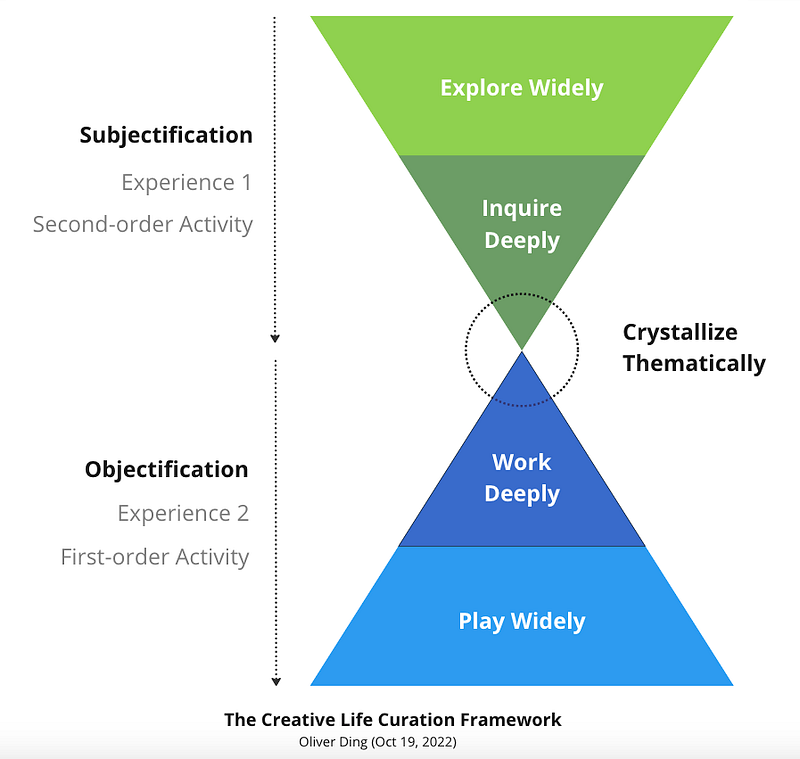
This entire process is governed by the S-T-O principle, a core logic within Creative Life Theory. It unfolds in three sequential yet interconnected stages:
- S (Subjectification): Turning the world into personal experience, which corresponds to Second-order Activity.
- T (Thematic Crystallization): This is the pivotal center of the entire method, explicitly manifested as the movement of Crystallize Thematically. It is the moment of insight where a creator discovers a profound match between their individual life themes and collective cultural themes.
- O (Objectification): Turning that crystallized personal experience into shareable artifacts for the world, which corresponds to First-order Activity.
While Creative Life Curation serves as a foundational methodology, other narrative-mapping methods also operate at this weave-point, each using a different cognitive framework to generate the story:
- Mapping Creative Dialogue (2024 book draft): This method uses the
X___Ybasic form to map the structural tension or gap between two entities. Through derived models like the ECHO Way, the ARCH Model, and the Activity Circle, it constructs a narrative about how ideas, people, or social entities engage in dialogue, conflict, and synthesis. It is a way of narrating the story of co-creation. - Mapping Strategic Moves (2024 book draft): This method utilizes the House of Project Engagement, a thematic map structured as a "museum" with 12 thematic rooms representing diverse social landscapes (such as Ideas, Possible Project, Actual Project, Public Square, Conflict, and Network of Projects). Instead of focusing merely on a single project, it organizes the narrative around the "strategic moves" a creator makes across these rooms. By following specific thematic pathways (for example, the "Ideas — Possible Project — Actual Project" path to model a strategic journey), the creator constructs a forward-looking strategic narrative that connects their past actions to future possibilities.
- Strategic Life Narrative (2025 book draft): Developed using the House of Creative Life Curation (also known as the Creative Lifescope), this method organizes narrative around 12 thematic rooms categorized into three groups: Theme (Clues, Themes, Concepts, Frameworks), Practice (Actions, Projects, Dialogue, Journey, Landscape), and Space (Projects, Works, Centers, Platforms). While it builds upon Creative Life Curation, it differs fundamentally in three aspects: Purpose (focusing on strategic personal development and actionable next steps rather than solely creating works), Temporal Structure (integrating the past, present, and future through anticipation rather than just organizing past experiences), and Interpersonal Interaction (assuming a background of social engagement and communication from the outset). Ultimately, it guides creators to narrate the story of their "intellectual adventures," aligning their personal narrative with long-term visionary goals.
Together, these methods provide a diverse array of narrative structures. Whether through the S-T-O transformation and thematic crystallization of Creative Life Curation, the structural tensions and co-creation found in Creative Dialogue, the spatial navigation of strategic moves across the social landscapes of Project Engagement, or the multi-temporal anticipation of an intellectual adventure in Strategic Life Narrative, the creator is equipped with a powerful toolkit. Ultimately, each method serves as a distinct mediator, allowing the creator to transform the chaotic cognitive flood of experience into a meaningful, coherent, and shareable story.
4.4 The "Mastery × Narrative" Weave-point: Slow Cognition
The "Mastery × Narrative" weave-point represents the achieved state of narrative development. It is the deep understanding that emerges from the story.
The Thematic Element anchoring this point is Slow Cognition. Within my creative journey, Slow Cognition is not merely a static term; it is a specific Thematic Space that has continuously evolved, gathering various cognitive elements and transforming them over time.
Within this Thematic Space, several distinct elements have accumulated and developed:
- The 2022 Research Project: Initially, it named a research project inspired by Howard Gruber's "historical-cognitive" method. It was a methodological orientation used to study the long-term development of thoughts and tacit knowledge of creators across months, years, and decades.
- The Creative Theme: After the project concluded, Slow Cognition transitioned into a generative creative theme. It connects to various theoretical concepts from Thematic Space Theory, applied to analogous contexts, and used as a lens to understand how ideas evolve over extended periods.
- The Strategy Framework (2025): In the Weave-the-Strategy Framework (v1.0), I developed "Strategy as Slow Cognition" to form a new theoretical framework. Here, strategy is understood not as a static plan, but as a long-term cognitive process encompassing mental moves across thematic spaces and social moves across social landscapes.
- The Six Operations (2026): In Cognitive Hydrology v1.0, Slow Cognition was used to name the "Realism" layer, while six operations were suggested: Thematic Exploration, Embodied Experience, Thematic Conversation, Conceptual Thinking, Strategic Curation, and Continuous Objectification.
Therefore, based on the three-level toolkit recently developed in the Weave-the-Strategy Toolkit (v2.0, 2026) and integrating the six operations introduced in Cognitive Hydrology v1.0, I have now curated a four-level toolkit specifically for mastering the Narrative space:
- Level 0: The Six Operations (types of Moves) — The foundational cognitive actions that animate every move: Thematic Exploration, Embodied Experience, Thematic Conversation, Conceptual Thinking, Strategic Curation, and Continuous Objectification.
- Level 1: The Map-Move-Model Schema — The epistemological lens for reading any narrative as a set of thematic spaces, where these operations are performed.
- Level 2: The Creative Workfield Map (the House of Slow Cognition) — The structural meta-map that locates where these operations take place across seven thematic rooms (Aspects, Attachments, Approaches, Maps, Models, Methods, Meanings).
- Level 3: The Thematic Map Method (Thematic Mapping) — The concrete practice of visualizing knowledge frameworks and tracing the actual moves of a narrative journey.
These four levels (0 through 3) are not a hierarchy of importance, but a hierarchy of abstraction. The six operations at Level 0 provide a categorization of what we call "moves"—the different types of cognitive actions involved. The subsequent three levels (1–3) offer the specific ways to understand and operationalize these moves through the lens of Thematic Space Theory.
Therefore, mastering the Narrative space means knowing how to deploy this entire stack: using the six operations to identify and drive the moves, and using the theoretical frameworks at Levels 1–3 to frame, locate, and visualize those moves. Mastery here is the practical fluency of wielding this complete architecture.
Part 5: Weaving the Framework Space
In the Framework space, the narrative is forged into a composite structure. The theme becomes a system, a network of concepts, demanding internal coherence and external utility.
5.1 The "Milieu × Framework" Weave-point: Thematic Enterprise
The "Milieu × Framework" weave-point is the intersection of the broader creative context and the formation of a composite structure. It is where the single narrative expands into a larger, sustained undertaking.
The Thematic Element that characterizes this point is the Thematic Enterprise. A thematic enterprise is not a static knowledge system, but an evolving concept system that develops over time. While it contains thematic engagement, it cannot be reduced to it. Running an enterprise requires work that goes beyond mere thematic cognition.
For instance, it involves Center Development (making concrete decisions about a center's functions, operations, collaborators, and relations with other centers) and Project Engagement (treating projects as the fundamental unit of activity to plan, make, deliver, and sustain work over time). These are just two examples of the non-thematic work an enterprise requires.
To understand the full scope of this enterprise, the Wonder and Wander book (v1.0, 2025) offers a specific model outlining three core dimensions:
- The transformation of knowledge elements
- The activity of knowledge engagement
- The materiality of knowledge representation
These dimensions are supported by the "Mental — Social — Material" Schema introduced on March 26, 2025. A fully developed model based on this schema—the Landscape of Evolving Knowledge Enterprise Model (April 2024)—emphasizes going beyond the mental dimension to include embodied, communicative, and material practices across three hierarchical levels:
- Mental Platform: How do you think?
- Behavioral Network: How do you do?
- Material Container: What do you make?
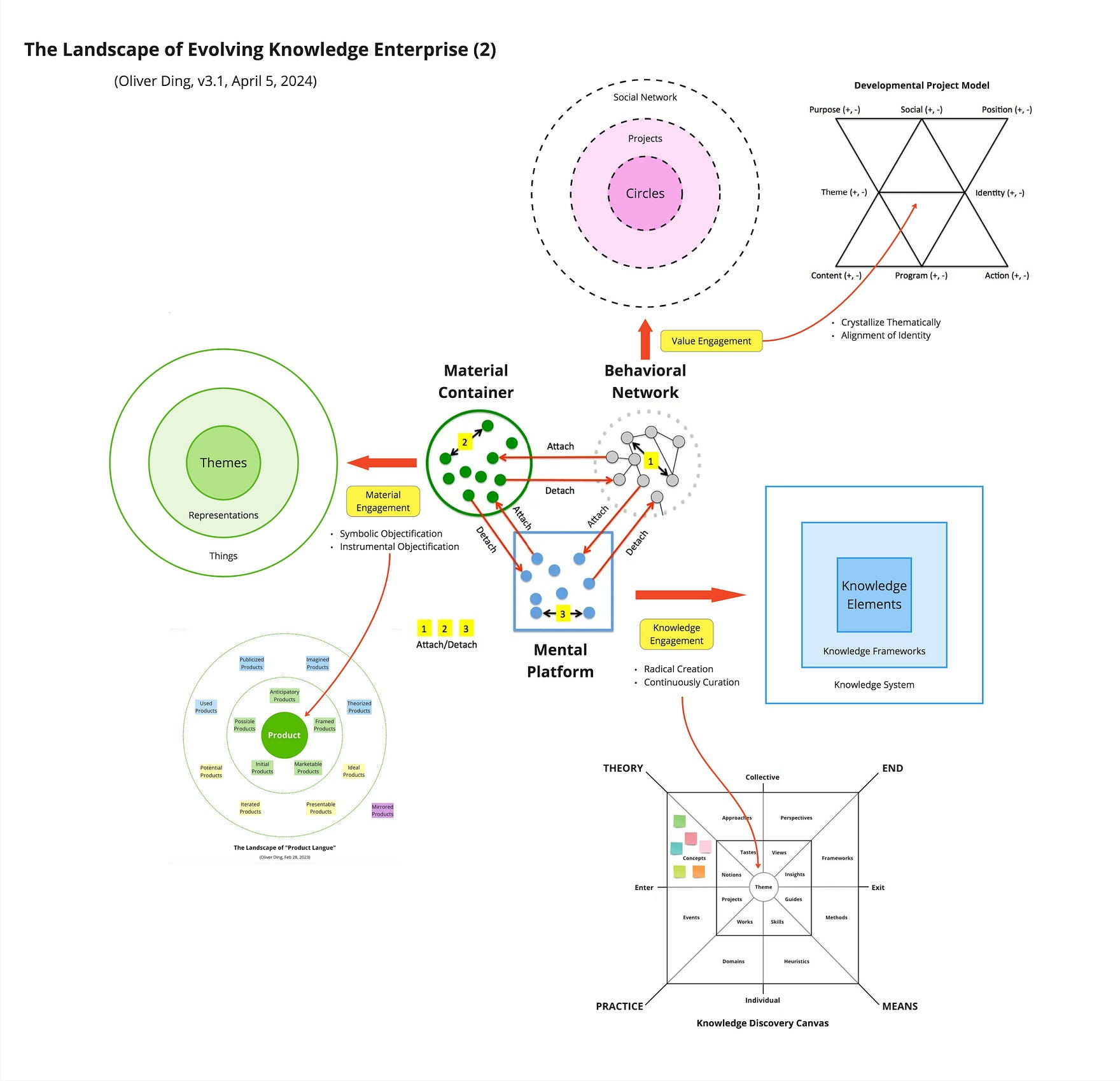
Therefore, the Thematic Enterprise provides the complex landscape of multiple projects, time scales, and social relationships where a framework is tested, refined, and sustained. It is the structural milieu that gives the framework its purpose and scale, making the "Milieu × Framework" weave-point the birthplace of a true thematic enterprise.
5.2 The "Mediator × Framework" Weave-point: Thematic Schema
The "Mediator × Framework" weave-point sits at the intersection of the tools used to structure the theme and the composite nature of the framework itself. It is the scaffold that gives the system its form.
The Thematic Element here is the Thematic Schema. First introduced in my article published on March 4, 2025, a Thematic Schema is defined as a stable configuration of a thematic network, consisting of multiple interrelated themes.
At the Framework level, the central challenge is how to organize multiple themes or concepts into complex structures. Based on my years of experience in creating knowledge frameworks, I have found that multiple themes or concepts can be organized into a basic unit in the form of a Thematic Schema, which serves as the foundation for building complex knowledge frameworks.
To understand its specific role, we must distinguish it from other knowledge entities. While Knowledge Frameworks represent public, complex knowledge systems, and Mental Models refer to learned frameworks internalized by individuals, a Thematic Schema serves as the fundamental building block for both. A prime example is the "Theory-Practice-End-Means" Schema, which can exist purely as text (naming its four themes) or be visualized as a matrix. When applied, it acts as an architectural scaffolding; by overlaying additional elements (such as actors, purposes, and objects) onto this four-square schema, it generates concrete, operational frameworks like the Knowledge Discovery Canvas.
A Thematic Schema can be detached from one knowledge framework to become an independent knowledge element. Two or more Thematic Schemas can be combined and used together to construct complex structures, such as Thematic Maps and comprehensive toolkits. Furthermore, if multiple knowledge frameworks share the same Thematic Schema, they can be curated together. This shared structural foundation significantly lowers the organizational complexity of the entire knowledge system.
While the Thematic Schema is the primary focus here, there are three other mediators that are equally useful at the Framework level, and they frequently work together with it:
- Thematic Spaces: A thematic space is a cognitive container built around a specific theme. It can be filled with related thematic elements—insights, models, cases, and materials—all gathering around that central theme.
- Meta-diagrams: A meta-diagram is a diagram that contains no substantive text. It expresses only spatial structure. It could be used to generate domain-specific diagrams.
- Meta-frameworks: A meta-framework is a knowledge framework used to organize other knowledge frameworks. It provides the higher-order structure needed to curate and integrate multiple frameworks into a coherent whole.
These four constructs are closely connected in practice. A Thematic Schema typically specifies a set of Thematic Spaces. A Meta-diagram can then be used to give those spaces a spatial structure, which together forms a knowledge framework. Finally, that knowledge framework can itself serve as a Meta-framework, used to organize and make sense of other knowledge frameworks. In this way, the four mediators form a practical chain of construction at the Framework level.
5.3 The "Method × Framework" Weave-point: Creative Cartography
The "Method × Framework" weave-point defines the cognitive operation of mapping and building the composite structure.
The Thematic Element that defines this point is Creative Cartography. The name emerged directly from my long-term creative practice. When using knowledge frameworks—especially those represented in diagrammatic forms—I found that I was constantly drawing situational models titled "the landscape of XXX." Over time, these mapping practices accumulated into a vast body of work.
This observation led to a crucial insight: these mapping practices are deeply and intrinsically tied to the development of a thematic enterprise. This insight goes beyond my previous book drafts on Creative Diagramming. It shifts the focus from the technique of drawing diagrams to the cartographic practice of using maps for Exploratory Decision-making.
To organize this practice, I used the Weave Basic Form as a meta-framework to categorize these maps into four distinct purposes:
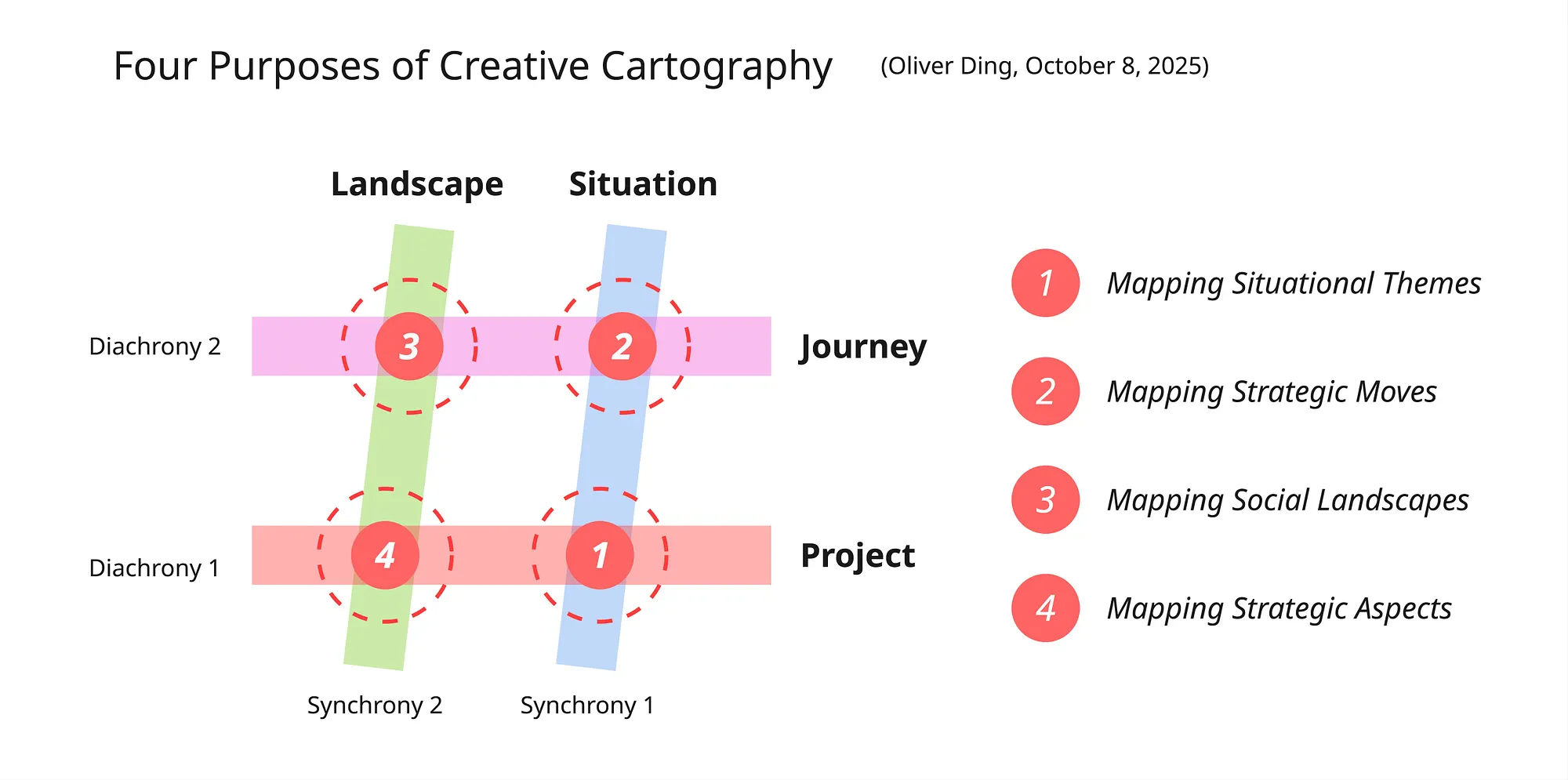
- Project + Situation → Mapping Situational Themes: Capturing challenges, inspirations, and the immediate contexts of a specific project.
- Journey + Situation → Mapping Strategic Moves: Tracking the sequence of actions, history, and future trajectories across a longer journey.
- Journey + Landscape → Mapping Social Landscapes: Mapping the broader contexts, environments, and networks of projects over time.
- Project + Landscape → Mapping Structural Aspects: Analyzing the internal structures and systemic frameworks of a given enterprise.
An example can be found in [Situational Map] Knowledge System, Mental Platform, and Strategic Agency.
As a cartographer, the creator maps the territory of the mind by deliberately deploying specific maps and canvases. These maps are not static records; they are dynamic instruments that make abstract relationships visible, navigable, and actionable, directly supporting the ongoing development of a thematic enterprise.
5.4 The "Mastery × Framework" Weave-point: Strategic Curation
The "Mastery × Framework" weave-point represents the achieved state of framework building. It is the ability to orchestrate the entire system—not just to build a single framework, but to know which frameworks to use, when to switch between them, and how to integrate them into a coherent whole.
The Thematic Element anchoring this point is Strategic Curation. The concept has evolved significantly across several years of practice:
- 2022 (The Five-Space Model): First introduced in Advanced Life Strategy, Strategic Curation was defined as using a specific strategy to curate pieces of experience, knowledge, and resources into a meaningful whole for a better future. It operates across five spaces: the Experience Space (facts of the past), the Challenge Space (problems of the present), the Response Space (solutions for the future), the Reference Space (reliable knowledge for thinking), and the Speculative Space (imaginative thinking such as counterfactual and prefactual reasoning).
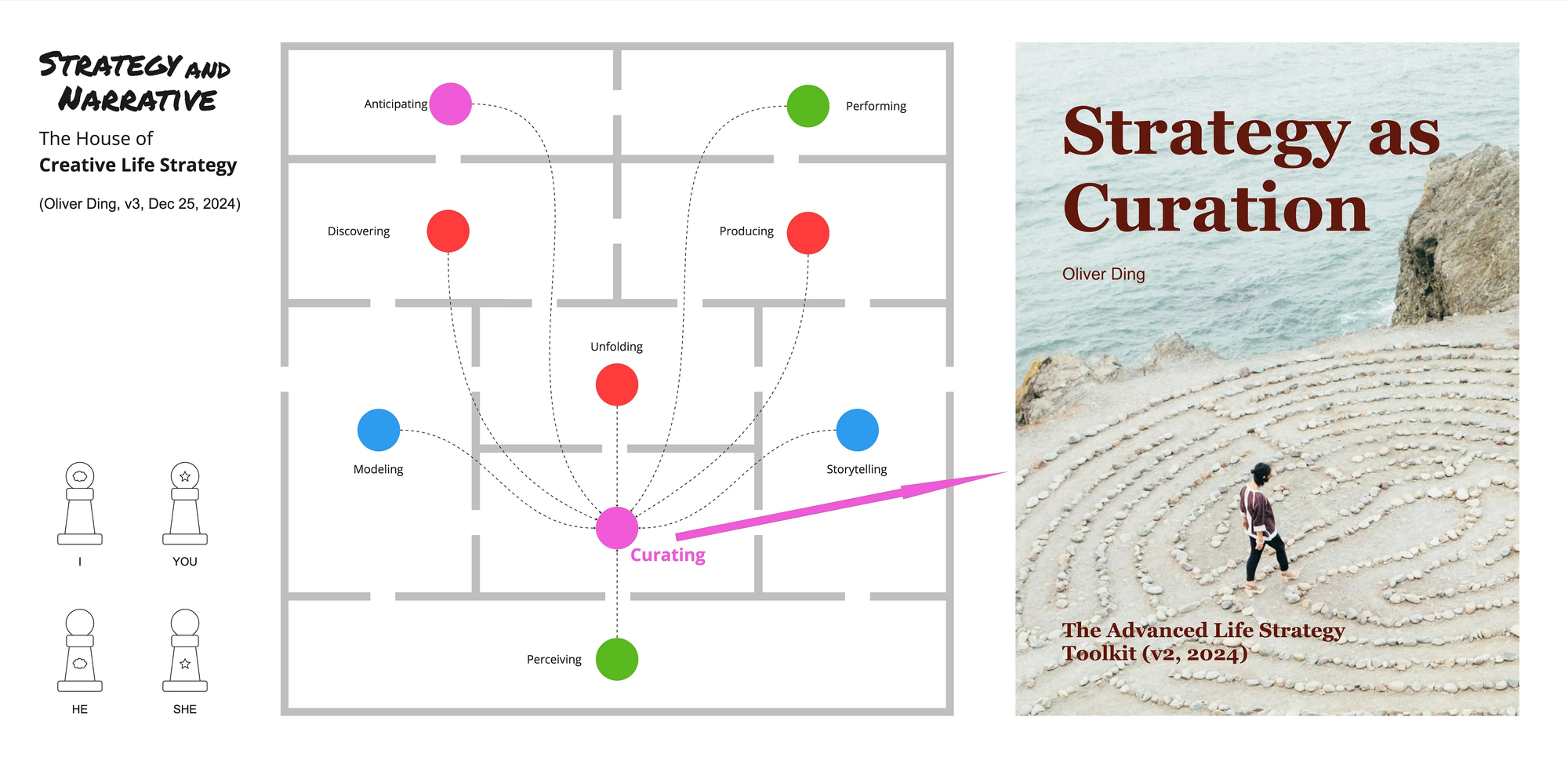
- 2024 (The Nine Aspects of Strategic Mind): In Strategy as Curation, the concept was expanded to include nine aspects of strategic cognition: Anticipating, Performing, Discovering, Producing, Modeling, Unfolding, Storytelling, Curating, and Perceiving. These nine aspects form the core of what I call the Strategic Mind.
- 2025 (A Mechanism of Cultural Development): In the Meta-frameworks book draft, Strategic Curation was featured as one of four mechanisms of cultural development. Here, it refers to the art of weaving disparate elements—ideas, objects, and people—into a meaningful whole. Operating primarily on the individual side, it focuses on the Achievement Chain. It explains how a creator curates various frameworks to achieve an Objective-Object Fit, transforming fragmented life experiences into coherent Thematic Enterprises (or Tiny Culture).
As the mastery of the Framework space, Strategic Curation is the capacity to see the structure of one's own work and to make deliberate choices about what to include, what to exclude, and how to organize the whole. It is the difference between having a collection of frameworks and having a coherent, navigable, and generative system. It is the mastery of orchestration—the ability to curate frameworks into a living enterprise.
However, Strategic Curation alone does not capture the full complexity of mastery at this weave-point. Three other capabilities are equally essential, each addressing a different dimension of orchestrating a thematic enterprise:
- Cultural Projection: Introduced in the 2025 Developmental Projects book draft, Cultural Projection refers to the alignment between an individual's personal themes and the broader cultural themes available in the environment at the moment a project is initiated. It is the capacity to recognize when a personal theme resonates with a cultural need—when the timing is right, when the audience is ready, and when the project can find its place in the larger cultural landscape. Without Cultural Projection, a framework may be internally coherent but externally irrelevant.
- Center Development: Developed in the 2025 Wonder and Wander book draft, Center Development is the operational map for running a thematic enterprise. It treats a creative center at three levels: ontology (self as center, creative life, theory as enterprise), realism (knowledge center, key functions, operational themes), and hermeneutics (maps, mental models, mindwave development). Developing a center requires decisions about its functions and operations, its collaborators, and its relations with other centers. It is the mastery of building and sustaining the organizational structure that holds a framework in place over time.
- Platform Genidentity: This concept addresses a crucial question: as a concept system develops into a thematic enterprise and gradually begins to support others in developing their own thematic enterprises—that is, as it becomes a developmental platform—how does it maintain its essential identity and distinctiveness over the long term? Genidentity is the continuity of identity through change. Platform Genidentity is the mastery of maintaining the core essence of an enterprise while it grows, adapts, and supports others. It is the difference between a platform that loses itself in its own expansion and one that remains recognizably itself while enabling new growth.
Together, these four capabilities—Strategic Curation, Cultural Projection, Center Development, and Platform Genidentity—reveal the full complexity of the Mastery × Framework weave-point. Mastering this space is not a single skill but a constellation of interrelated capacities. It requires the ability to curate frameworks strategically, to project them into the cultural landscape, to build centers that sustain them, and to maintain their essential identity as they grow into platforms that support others. This is why mastery at the Framework level is so demanding: it is not just about building structures, but about orchestrating their birth, growth, and enduring identity across time.
Part 6: Weaving the Ecology Space
In the final space, the Framework enters the broader knowledge-cultural ecosystem. It is no longer about the individual's cognitive system, but about the system's relation to the world.
6.1 The "Milieu × Ecology" Weave-point: Cultural System
The "Milieu × Ecology" weave-point is the intersection of the vast environmental context and the final stage of thematic development. It is where the framework meets the wider world.
The Thematic Element that defines this point is the Cultural System. In the HLS framework, which serves as the ontological foundation for the ACS (Anticipatory Cultural Sociology) project, the social world is understood through a five-system lens:
- Body System
- Mental System
- Behavioral System
- Cultural System
- Historical System
Within this framework, the Cultural System is mapped directly to Cultural Frameworks in the Six Faces of Concept System. The Six Faces include: Knowledge Frameworks, Mental Platforms, Strategic Frameworks, Cultural Frameworks, Institutional Frameworks, and Spiritual Frameworks. Four of these faces map directly onto the four core systems of the social world:
- Mental Platforms — Mental System
- Strategic Frameworks — Behavioral System
- Cultural Frameworks — Cultural System
- Institutional Frameworks — Historical System
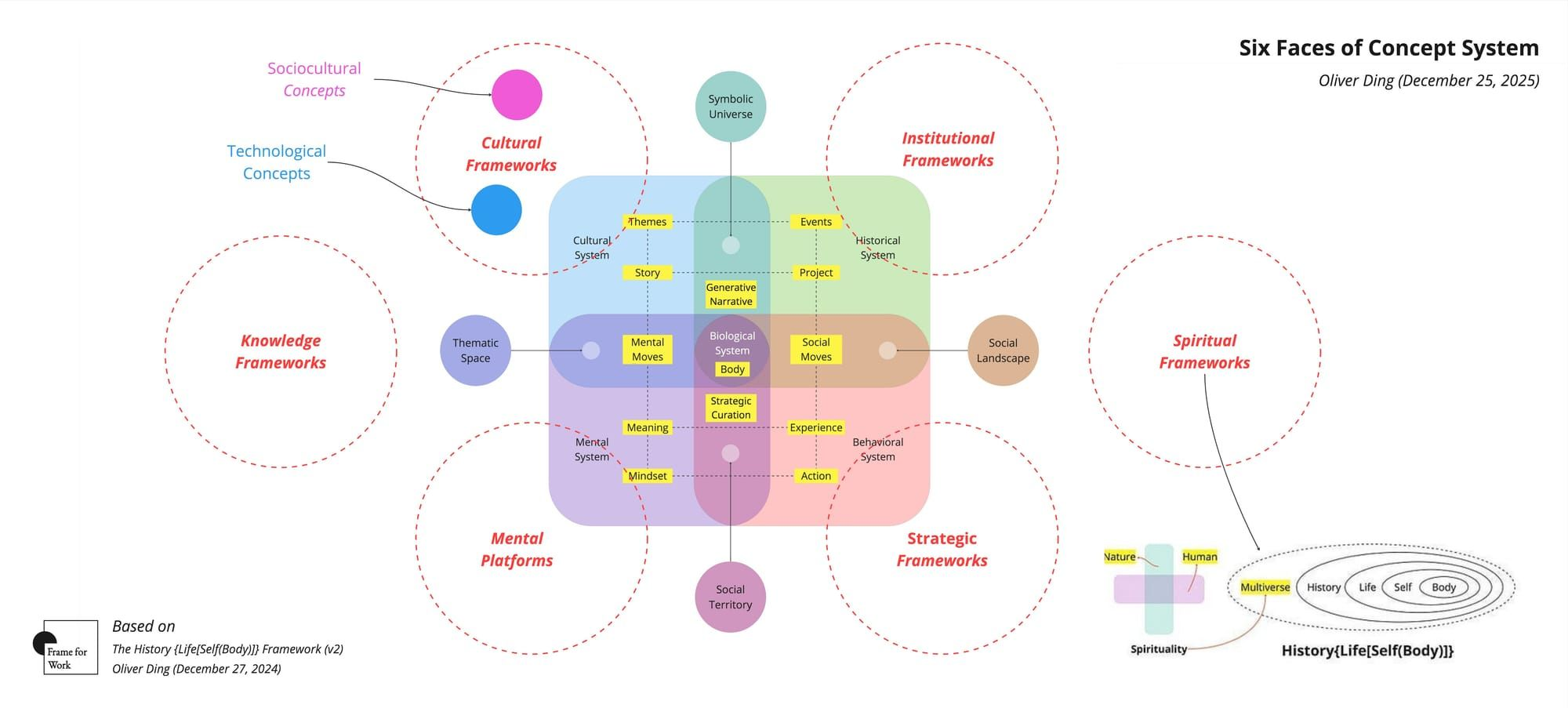
At the collective level, Cultural Frameworks belong to social groups, while Institutional Frameworks emerge as their evolving outcomes. Past generations of Cultural Frameworks serve as the source of present Institutional Frameworks. While Institutional Frameworks represent the crystallized history of human activity, Spiritual and Knowledge Frameworks represent the anticipatory horizon, pushing the Cultural System beyond its current limits.
The Cultural System is therefore not a static background but a dynamic ecology of evolving concept systems. It provides both the resources and the constraints for a framework's eventual acceptance or rejection. When a new framework enters this space, it must find its place within this nested structure—drawing on existing Cultural Frameworks, potentially reshaping Institutional Frameworks, and engaging with the anticipatory horizons of Spiritual and Knowledge Frameworks. This is the macro-AAS ecology in which a thematic enterprise must ultimately locate itself.
Three additional concepts are essential for understanding how this ecology operates:
- Anticipatory Activity System (AAS): The HLS Framework is a nested AAS structure. The Behavioral System (Mental System) represents the micro-AAS, while the Historical System (Cultural System) represents the macro-AAS. The micro-AAS corresponds to individuals, and the macro-AAS to collective society.
- Mental Platform: A Mental Platform is the internal concept system of an individual or an organization, used to support cognitive operations. It serves as the source of Strategic Frameworks, which target particular creative enterprises composed of a series of developmental projects.
- Concept-fit: Within Cultural Frameworks, there are two types of concepts: Sociocultural Concepts and Technological Concepts. A quintessential example of structural tension is the conflict between these two types. To resolve this, the Concept-fit model (developed in 2021) serves as a specialized tool within this narrative process, harmonizing technical possibilities with cultural meanings to ensure that innovation is both functional and socially resonant. More details can be found in Platform Innovation as Concept-fit.
Together, the nested AAS structure, the Mental Platform, and the Concept-fit model reveal how the Cultural System operates as a living ecology—one in which individual cognition, organizational strategy, and collective meaning-making continuously interact to shape what a framework can become and where it can belong.
6.2 The "Mediator × Ecology" Weave-point: Semiotic System Diagram
The "Mediator × Ecology" weave-point sits at the intersection of the tools of representation and the ecological stage. It is how the framework communicates with the broader world.
The Thematic Element here is the Semiotic System Diagram. This is a unique method developed by Ping-keung Lui, a theoretical sociologist, in the course of building his theoretical sociology as a candidate paradigm for the discipline. Lui's work aims to construct a grand theory that nests ontology, realism, and hermeneutics within a single coherent structure. To represent this structure, he developed the Semiotic System Diagram—a diagrammatic language that removes spatial structure entirely and keeps only concepts and their interconnections.
Inspired by Ferdinand de Saussure's structural linguistics, Lui distinguishes between Langue (the abstract system of language) and Parole (concrete speech). He uses "Language" to refer to his theoretical sociology, while "Parole" refers to all empirical sociologies. As Lui writes: "A semiotic system can be likened to a wetland in which innumerable speeches live and breed like birds." The Semiotic System Diagram is the map of that wetland—a purely conceptual network that shows how a theoretical system can contain and support countless empirical investigations.
This is a significant moment for the Weave-the-Theme Framework. The Semiotic System Diagram is the only thematic element in this entire article that was created by another thinker. Every other example—from Thematic Scrapboard to Creative Life Footbook, from Thematic Schema to Strategic Curation—was developed within my own creative journey. Lui's Semiotic System Diagram is different. It comes from outside my theoretical enterprise entirely.
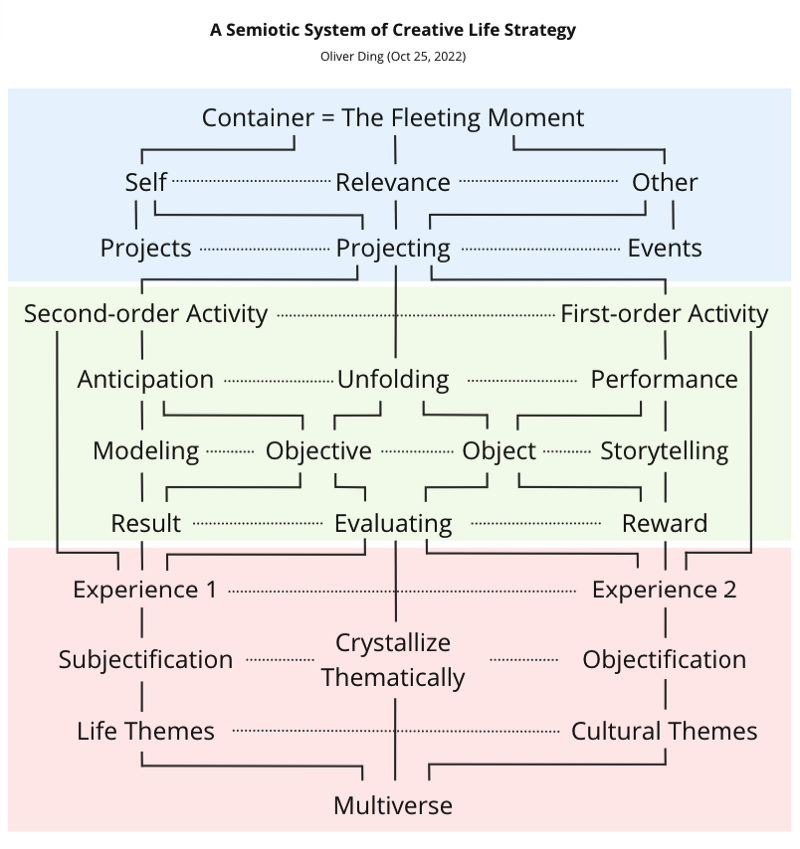
And yet, it fits perfectly within the Mediator × Ecology weave-point. This demonstrates something crucial about the framework: the Weave-the-Theme Framework is not limited to curating one's own work. It can curate the work of others. The 4×4 structure provides a shared map of thematic spaces, and different creators can bring their own concepts, frameworks, and diagrams into those spaces. The Semiotic System Diagram occupies the Mediator × Ecology coordinate not because I put it there, but because its structural position—a tool for representing how a theoretical system communicates with the broader ecology of empirical research—makes it a natural fit.
This is what it means for the framework to be an open map. It is not a closed system that only admits the creator's own creations. It is a shared cartography of the creative mind, capable of locating and integrating the contributions of multiple thinkers across different traditions.
Three other mediators also operate at this weave-point, each offering a distinct way of representing how a framework communicates with the broader world:
- Diagram Network: Introduced in the 2021 book draft Diagram Blending: Building Diagram Networks, a Diagram Network is formed when several diagrams connect together to form a larger structure. From the perspective of Activity Theory, each diagram refers to an activity, and a Diagram Network refers to an Activity Network. It can be built through Diagram Blending (combining two or more diagrams into a new one) or Diagram Expanding (using one diagram to explain parts of another).
- Weave Basic Form / GO Square: The Weave Basic Form, introduced in October 2025, is a super-simple diagram that frames activity as the synthesis of two diachronic dimensions and two synchronic dimensions. From this basic form, a series of derived diagrams has been developed: the 2×2 series (four weave-points), the 4×4 series (sixteen weave-points), and the 8×8 series (sixty-four weave-points). The GO Square is based on the 8×8 series, and its sub-squares are designed to be freely customized by individual creators. This makes the GO Square a highly scalable mediator—capable of accommodating both very simple and very complex knowledge structures while maintaining its underlying spatial logic.
- Ecological Formism: A four-layer meta-framework for organizing any knowledge system, introduced in the 2025 book draft of the same name. It sorts objects into four layers along one continuum: Variant (situational, particular cases), Quasi-invariant (patterns that recur but adjust), Invariant (stable basic forms), and Invariant Set (groups of invariants standing in part-to-group relations). It is scale-free: the same principle applies to a single concept, a life, a diagram, or a whole platform. Ecological Formism provides a universal structure for organizing knowledge systems, making it an essential mediator for any framework that needs to locate itself within a larger ecology of ideas.
Together with the Semiotic System Diagram, these four mediators reveal the diversity of tools available at the Mediator × Ecology weave-point. Each offers a different way of representing the framework's relationship to the broader world—through conceptual networks, spatial structures, or layered organizational schemas. The choice of mediator depends on the nature of the framework and the ecology it seeks to enter. And the fact that the primary example comes from another thinker's work demonstrates that this framework is an open map, capable of curating not only one's own creations but also the contributions of others across different traditions.
6.3 The "Method × Ecology" Weave-point: Theoretical Curation
The "Method × Ecology" weave-point defines the cognitive operation of integrating a framework into the larger knowledge landscape. It is where a creator moves from building a framework to positioning it within the broader ecology of existing theoretical traditions.
The Thematic Element that defines this point is Theoretical Curation. This method emerged directly from the Knowledge Curation Project (Phase 1), conducted from June 2020 to October 2022. The project's mission was to bridge the theory-practice gap by turning pieces into a meaningful whole, and it produced a comprehensive toolkit for curating knowledge frameworks. The toolkit includes eleven tools, each addressing a different curation challenge. Below are examples:
- Theme U for single-theory curation (curating one theoretical approach)
- WXMY for interdisciplinary curation (connecting two theories)
- Hamburger for contextual curation (understanding a framework's context)
- WIDENESS for multi-theory curation (integrating multiple frameworks)
Theoretical Curation is not a single technique but a family of methods. It involves comparing, connecting, and integrating different knowledge systems. The Knowledge Curation Project demonstrated this at multiple scales: curating a single theory, connecting two theories in dialogue, and weaving multiple theories into a coherent whole. The book draft Knowledge Curation (2022) documents this journey and serves as the primary case library for Theoretical Curation.
Three other methods also operate at this weave-point, each offering a different way of integrating a framework into the larger ecology:
- Thematic Identity Curation: Developed in May 2024 as part of the Project Engagement Approach, this method addresses the dynamic transformation between Theme and Identity. It traces how a person's identity is not a fixed label but a process of thematic curation—moving through different thematic spaces across a life course, discovering meaningful connections (Thematic Echo, Thematic Blend), integrating them into a coherent whole (Thematic Integration), designing new projects (Creative Projects), and continuously refining identity (Identity Development). At the ecological level, Thematic Identity Curation positions a person's entire creative life as an evolving thematic enterprise, locating it within the larger ecology of cultural themes and identity possibilities.
- Supportance Analysis: Developed in June 2026, this is an open analytical layer for understanding how a theoretical platform supports creative work. It deploys three complementary models: a diachronic model tracing how a platform's developmental waves open different types of supportance, a synchronic model mapping how supportances are distributed across Conceptual, Social, and Material dimensions simultaneously, and a relational model tracing how individual contributors perceive and actualize specific action opportunities. At the ecological level, Supportance Analysis reveals how a framework, once it has matured into a developmental platform, generates structured support for others—and how contributors positioned in different ways can perceive and actualize those supports.
- Gejunction Analysis: Developed in August 2026 as a Unit of Synthesis within GO Theory, Gejunction Analysis examines a person's overall standing through four aspects: Thematic Spaces (what thematic territory one inhabits), Living Coordinates (where one is positioned strategically), RelationFields (the relational configuration one is situated within), and Weave-points (the symbolic forms through which experience is crystallized). At the ecological level, Gejunction Analysis does not analyze a framework in isolation; it analyzes how a framework is situated within a person's entire life configuration—the field of opportunities (Affordance, Supportance, Attachance, Curativity) that defines what is possible and what is not yet actualized. The August 2026 "Gejunction in the Wild" collection documents a theorist using this framework to understand his own transition in real time.
Together, these four methods—Theoretical Curation, Thematic Identity Curation, Supportance Analysis, and Gejunction Analysis—reveal the diversity of operations available at the Method × Ecology weave-point. Each offers a different way of integrating a framework into the larger ecology. The choice of method depends on the nature of the framework and the ecology it seeks to enter.
6.4 The "Mastery × Ecology" Weave-point: Weave the Culture
The "Mastery × Ecology" weave-point represents the ultimate achieved state within the framework. It is the culmination of the entire journey—the point at which a creator's thematic enterprise is no longer merely a personal project, but a contribution to the ongoing evolution of culture itself.
The Thematic Element anchoring this point is Weave the Culture. This concept emerged from the Weave-the-Culture Model, which identifies four mechanisms of cultural development: Mental Moves, Social Moves, Strategic Curation, and Generative Narrative. These four mechanisms are grounded directly in the HLS Framework (the History[Life[Self(Body)]] Framework), which defines the five systems of the social world. Each mechanism corresponds to a distinct dimension of how concept systems operate within and across these systems.
These four mechanisms are not independent operations. They form a coherent system:
- Mental Moves refer to the internal shifts in an individual's cognitive perspective—switching between predictive models, reframing problems through new mental platforms. They are the starting point of all cultural creation.
- Social Moves describe changes in an actor's position within a social landscape—navigating norms, institutional boundaries, and collective expectations. Through social moves, an individual's subjective intent begins to acquire objective weight in the outside world.
- Strategic Curation is the art of weaving disparate elements—ideas, objects, and people—into a meaningful whole. Operating primarily on the individual side, it focuses on the Achievement Chain, explaining how a creator curates various frameworks to achieve an Objective-Object Fit, transforming fragmented life experiences into coherent Thematic Enterprises, or Tiny Culture.
- Generative Narrative is the mechanism that shifts focus from individual subjectivity to social intersubjectivity. Inspired by Generative Confluence, it posits that cultural evolution is not merely the preservation of tradition but the active production of new thematic enterprises. By weaving disparate social experiences and creative dialogues into a coherent narrative, it facilitates the emergence of new traditions that extend beyond existing cultural frameworks.
Together, they describe the full arc of cultural development: from internal cognitive shifts to social positioning, to strategic curation, and finally to the generative narrative that connects a creator's Tiny Culture to the broader collective and to what the HLS Framework calls Mega Culture—the large-scale historical system resulting from social movements and institutionalization.
Three other thematic elements also operate at this weave-point, each representing a distinct dimension of mastery:
- The Unfolding of Subjectivity: This concept describes how a creator's subjectivity—lived experience, sense of self, creative identity—gradually unfolds across the HLS Framework's nested layers: from Body(Self) to Life(Self) to History[Life[Self(Body)]]. As subjectivity matures, it becomes increasingly capable of engaging with and contributing to the collective cultural landscape. Mastery here means letting one's subjectivity unfold in dialogue with the world, rather than retreating into isolation or dissolving into the collective.
- Supportive Self-Actualization: Developed in the 2026 Supportive Self-Actualization as Anticipatory Activity article, this concept reconceives Self-actualization as an anticipatory activity unfolding across three layers of the Self: Sub-individual, Individual, and Supra-individual. The fullest realization of a creator's potential requires a Supporter—a person, a team, or even a creator's own AI agents—who, together with the Creator, constitutes a Supra-individual whole through Persons Acting in Concert. Mastery here means the capacity to both give and receive support in the co-constitution of a creative life, recognizing that Self-actualization is never a solitary achievement but always a relational one.
- Becoming a Strategic Actor: In the 2026 book Developmental Strategy, I proposed several new perspectives for understanding strategy. The book then turns to the strategic actor through three dimensions: Strategic Actor as Weaver (Ch5), which presents the actor as one who integrates creation and curation into a coherent life through the Weave-the-Life Framework; Strategic Agency (Ch6), which describes how a person exercises agency across social worlds through the LARGE Method, the L3DW Model, and the four models of agency; and Strategic Mind (Ch7), which presents the cognitive structures that organize strategic thought—the mental platform, strategic frameworks, and the nine aspects of strategic cognition. Mastery here means becoming a strategic actor who can weave, act, and think strategically as an integrated practice.
At this weave-point, mastery is not merely the ability to build a framework or curate a knowledge system. It is the capacity to weave one's work into the fabric of culture itself.
Part 7: The Framework as an Open Map
A 4×4 diagram can easily be mistaken for a rigid classification system—a box for every concept. But the Weave-the-Theme Framework is designed as an open map. It provides the coordinates and thematic spaces, but it does not prescribe what must live there. The true test of any map is not how well it restricts new territories, but how well it can accommodate and locate unexpected discoveries.
To demonstrate this openness, let us test the framework with two recent concepts from my own practice. Neither was designed with this diagram in mind, yet both can find their place within it.
7.1 Case 1: Locating Thematic Supportance
The first case is Thematic Supportance. This concept emerged from a recent book manuscript on supportance theory. It refers to the potential action opportunity of symbolizing lived experience into a Creative Theme. The concept was first developed through the analysis of a specific case: a chair in the former residence of the scholar Yan Fu. That chair, encountered during a visit, became a carrier of meaning across time—a physical object that triggered a chain of thematic reflection.
How should we map this into the framework? Let us explore the possibilities:
- Possibility A: Method × Experience. While discussing this placement, I realized that I had already developed a set of techniques for how to extract Thematic Supportance in practice, but this method had never been formally named. To place it properly at
Method × Experience, I coined a new term, prefixing it with an action verb: Capturing Thematic Supportance. The act of mapping forced the naming. - Possibility B: Mediator × Experience. The chair itself acts as the medium. Here, we introduce the concept of a Thematic Object. The chair is a thematic object—a physical entity that holds a thematic space and bridges the raw physical world and the symbolic theme. It is the mediator through which the Thematic Supportance is encountered and materialized.
- Possibility C: Milieu × Experience. The situation where the encounter happens provides the broader context. Here, we use the concept of RelationField. The scholar's former residence, the historical atmosphere, and the observer's presence form a relationfield that offers the potential for supportance to emerge.
The most interesting finding is that Thematic Supportance does not belong to just one single point. Instead, the concept system generated by Thematic Supportance is distributed across multiple weave-points within the Experience row.
This distribution beautifully demonstrates how the Weave-the-Theme Framework operates as an open map. A complex theoretical concept like Thematic Supportance is not forced into a single box; rather, it unfolds into a cluster of related concepts that populate the matrix precisely where they operate. And in this case, the map even actively demanded the creation of a new name—Capturing Thematic Supportance—to fully articulate the method that had always been there.
7.2 Case 2: Locating Thematic Focus
The idea behind Thematic Focus had been with me for a long time, but I had never written it out formally. It was only last month, while designing the House of Focus Dynamics map and writing its introduction, that I finally articulated what Thematic Focus actually involves. The map clarifies that Focus is not a single state; it develops through three stages:
- Attention Focus: Noticing something that stands out from the background.
- Thematic Focus: Holding that something as a named theme, giving it linguistic existence.
- Scalable Focus: Selecting which named themes are worth developing into sustained Centers.
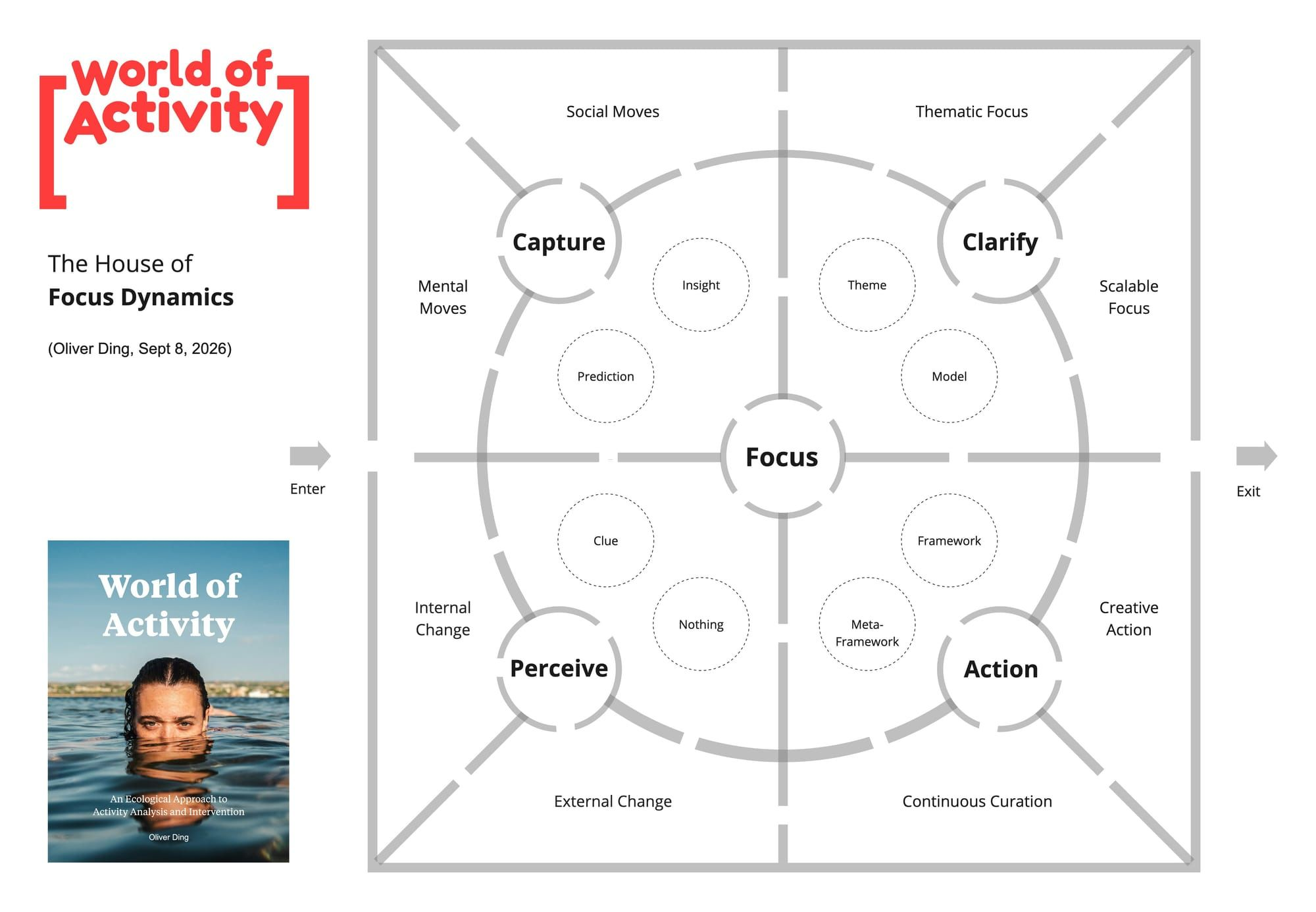
The critical transition is from Attention Focus to Thematic Focus. This is the moment of naming—the act of giving a precise word or phrase to a diffuse experience. Naming transforms a raw sensation into a stable cognitive object (a Theme). This is precisely the transition from the Experience space (pre-linguistic) to the Narrative space (linguistic existence).
Given this, let us explore the possibilities for mapping Thematic Focus:
- Possibility A: Milieu × Experience. The milieu here is the World of Activity—a concept that describes the maximal boundary of an individual's lived world, and which is also the name of an entire theoretical system. Its core framework is the FFCC model (Flow–Focus–Center–Circle). Within this framework, Thematic Focus sits precisely between Flow and Focus: it emerges from the fluid stream of experience and begins to consolidate into a focused thematic space. This placement captures the milieu in which Attention Focus is born.
- Possibility B: Mediator × Narrative. Thematic Focus itself can be seen as a mediator. Once a theme is named, it becomes a linguistic object—a cognitive container that mediates between raw experience and further reflection. The Theme is the name of a Thematic Space; the Thematic Space is the container. This container holds insights, observations, and questions, enabling them to relate to one another and generate new meaning. In this sense, Thematic Focus is not just a state of mind but a tangible mediator that carries the theme forward.
- Possibility C: Method × Narrative. Naming is a method—a cognitive operation. Thematic Focus is the result of this operation. This placement acknowledges that Thematic Focus belongs to the Narrative space, where themes gain linguistic existence.
- Possibility D: Method × Framework. From the perspective of Focus Dynamics, the three-stage process (Attention Focus → Thematic Focus → Scalable Focus) brings forth a new method: Mastering Focus Dynamics. This method is crucial for the development of the World of Activity. Thematic Focus is, in essence, the seed of a future Creative Center. But a creator will generate many Thematic Foci, and only a few can become Centers. Mastering Focus Dynamics is therefore not merely about naming; it is about the strategic selection and cultivation of which themes are worth developing into sustained Centers.
Thematic Focus is not a static element confined to a single coordinate. It is a boundary-crossing process. Its emergence begins at Milieu × Experience (the World of Activity milieu, between Flow and Focus), its naming operation is captured at Method × Narrative, its manifestation as a mediator is captured at Mediator × Narrative, and its strategic cultivation into a Scalable Focus is captured at Method × Framework (Mastering Focus Dynamics).
This distribution reveals a deeper insight: Thematic Focus is not a static element but a process that unfolds across multiple spaces. More importantly, this case demonstrates how an entire theoretical system—the World of Activity with its FFCC model—can interface with the Weave-the-Theme map. Since FFCC was developed according to Ecological Formism and is structurally isomorphic to the Experience–Narrative–Framework–Ecology schema, its other concepts (Flow, Center, Circle) can also be gradually placed onto this map.
This test therefore expands the theoretical space of the Weave-the-Theme knowledge system significantly. It shows that the framework is not limited to a single theoretical perspective; it can serve as a shared map for multiple theoretical enterprises, allowing different systems to be located, compared, and woven together.
7.3 The Map is Open
These two cases—Thematic Supportance and Thematic Focus—demonstrate the power of an open map.
When we encounter a new concept, we do not ask, "Which existing box does this fit into?" Instead, we ask, "Where on the map does this new concept emerge, and what does it transform?"
Thematic Supportance was not originally designed as a "method." But placing it on the map revealed that it functions as a specific cognitive operation—a way of capturing hidden meanings in the Experience space. Thematic Focus was not originally a coordinate name. But the map allowed us to re-examine it and discover that it is a container in its own right, not just a byproduct of the environment.
More importantly, these two cases reveal a deeper principle about how a concept system maps onto the Weave diagram. A concept system does not simply correspond to a single weave-point and a single thematic space. Its multiple concepts can be concentrated at one weave-point, gathering within a single thematic space, or they can be distributed across multiple weave-points, spanning several thematic spaces. This pattern was already visible in the Weave-the-Life Framework (v3.0), where a single concept system was curated across several coordinates. Below is an example.
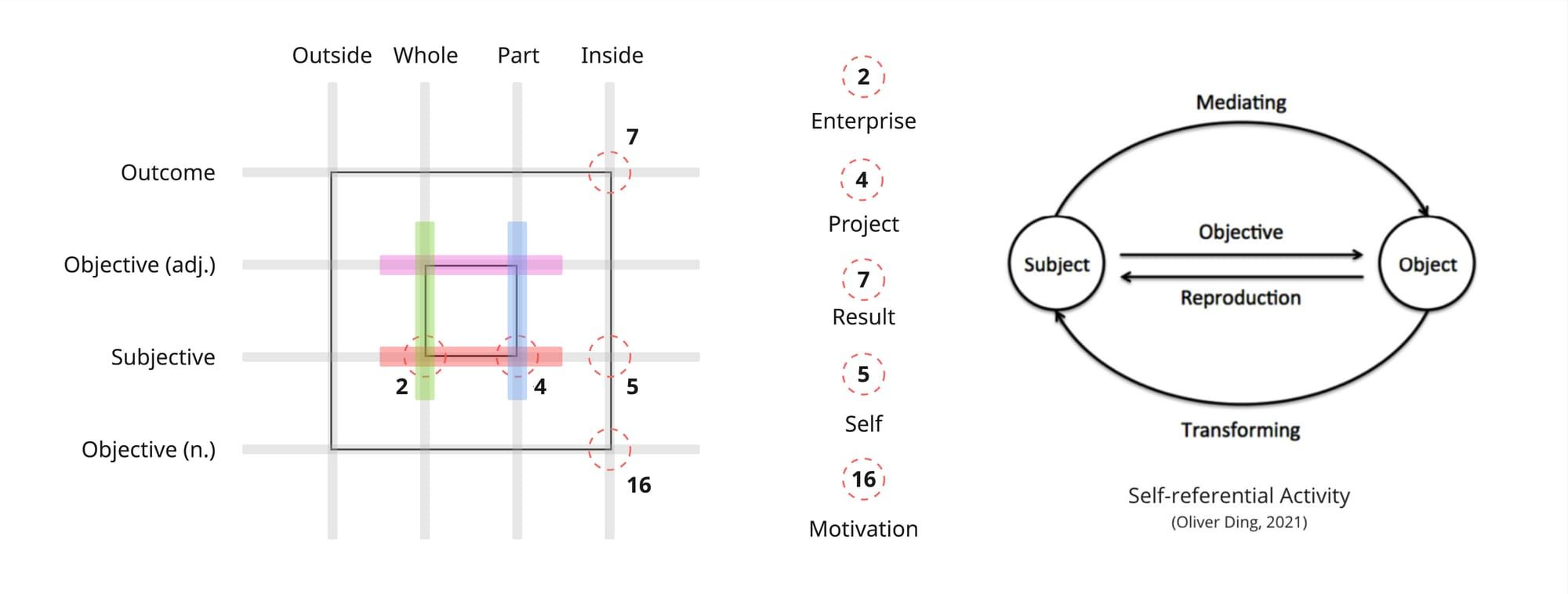
The reason is structural. A concept system—or a knowledge framework—is itself a large thematic space. When it connects to the Weave diagram, this large thematic space is divided into several smaller thematic spaces, each specified by a weave-point. This division is not a fragmentation but a mediation. It is the intermediate construct produced when two knowledge systems enter into dialogue: the Weave diagram provides the coordinates, and the concept system provides the content. The result is a new, navigable structure that neither system could have produced alone.
The Weave-the-Theme Framework is a living map. It is meant to be tested, stretched, and re-drawn. The 16 points we have explored are not the final territory. They are merely the first coordinates in an ongoing cartography of the creative mind.
Conclusion: The T-only Model and the Curatorial Map
The Weave-the-Theme Framework represents the operational completion of the T-only Model. As discussed in the previous article, within the S-T-O (Subjectification – Thematic Crystallization – Objectification) principle of Creative Life Curation, this framework focuses exclusively on the “T”—the intricate process of how a theme crystallizes and unfolds across different spaces and conditions.
However, it is essential to remember that this 4×4 diagram is not a rigid classification system. It is a curatorial map. The 16 weave-points organize the territory, but the thematic spaces they activate are vast and living. The two cases tested in Part 7—Thematic Supportance and Thematic Focus—already demonstrate this openness. Neither was designed with this diagram in mind, yet both found their place within it, and one of them even demanded a new name.
I have been exploring the theme of “theme” for many years. Across that journey, I have run numerous knowledge projects and produced a wide range of creative outcomes—frameworks, diagrams, book drafts, case studies. But these outcomes have always lived in separate knowledge systems, each organized around its own project or enterprise. They were connected in my practice, but they had never been gathered into a single view.
The 4×4 structure changed that. For the first time, a simple diagram allowed me to curate these scattered outcomes and bring them together in a new configuration. Ideas that had developed in different contexts suddenly became adjacent; frameworks that had seemed unrelated revealed their structural positions relative to one another. The experience was genuinely exciting—not because the diagram was complex, but because its simplicity made the whole visible.
As your creative life continues to evolve, new concepts will settle at these coordinates, and existing containers will combine into new configurations. The map is open. The journey continues.
v1.0 - October 20, 2026 / v1.1 - October 22, 2026 - 13,252 words