
GO Square: Introducing the Knowledge Ecology Square
A Sub-square of GO Square for Tracing Discipline-Practice Weaves
by Oliver Ding
September 19, 2026
Early this month, one thematic focus emerged from my daily creative flow: [Revisiting-and-Rebuilding] The Knowledge Strategy series.
Last year's Castle and Forest left a question largely untouched: what happens when two knowledge creators meet? The answer I gave then was thin. This month I revisited that part with new tools and wrote a new article — The Relationfield of Knowledge Engagement. It introduces a formula — RelationField = Subject-Subject(Subject-Object) — and uses it to finish what Castle and Forest left undone.
After finishing that article, I realized the Gejunction framework could be used to reflect on the entire Knowledge Strategy trilogy from last year.
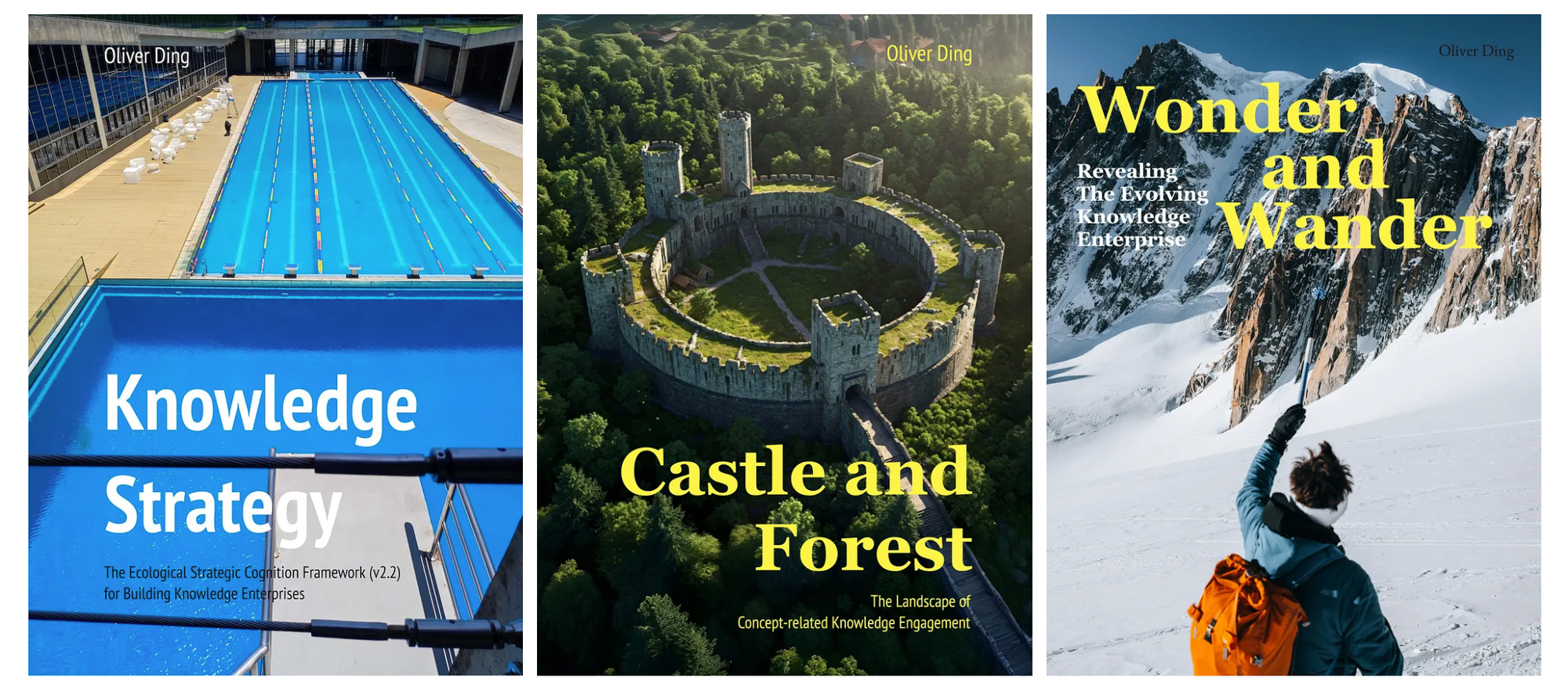
So I continued with a second article — Marinate the Mind: The Living Coordinate of Knowledge Engagement. Together they open a new Revisiting-and-Rebuilding (RR) series, upgrading last year's work.
- The Relationfield of Knowledge Engagement
- Marinate the Mind: The Living Coordinate of Knowledge Engagement
While writing "Marinate the Mind: The Living Coordinate of Knowledge Engagement," I was thinking of using GO Square to map the concept systems that appear in the original material: Boyd's OODA, Ivari's HEM papers, and, through them, Luhmann's social systems theory. However, the original GO Square was designed as a master map, not for the particular need. What I need was to develop a new sub-square, just like the Creative Life Square map I released two weeks ago.
After finishing Marinate the Mind, I sat down and began working properly on the new square. Several rounds of revision later, here is where it landed: The Knowledge Ecology Square. See the diagram below.
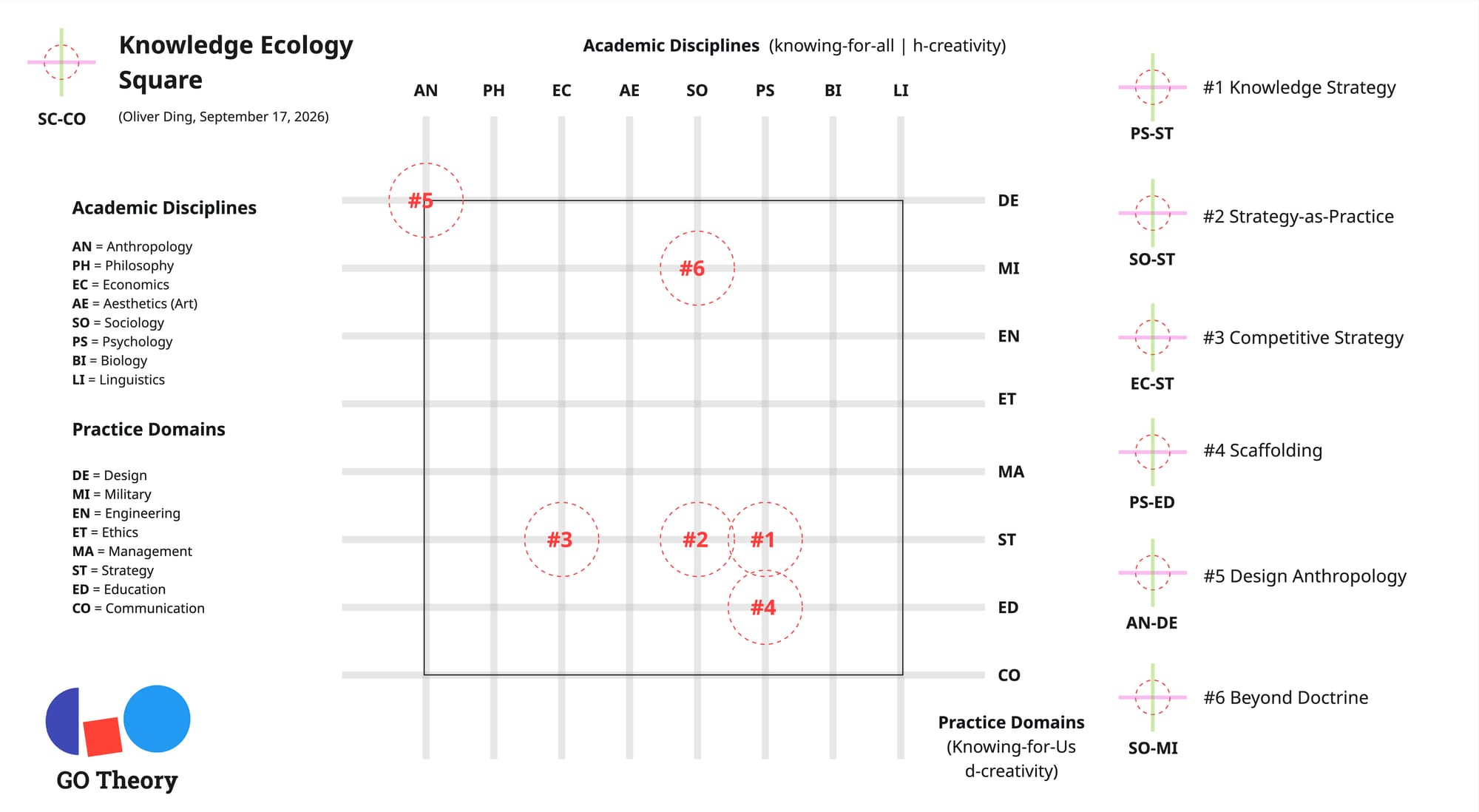
This article tells the story of how that square came to be.
Contents
1. When Academic Disciplines Meet Practice Domains
2. Knowing-for-All vs. Knowing-for-Us
3. H-Creativity vs. D-Creativity
4. The Name: Knowledge Ecology
5. Case Studies
#1 Knowledge Strategy
#2 Strategy-as-Practice
#3 Competitive Strategy
#4 Scaffolding
#5 Design Anthropology
#6 Beyond Doctrine
6. What This Mapping Reveals
7. Looking Back
8. Looking Ahead
1. When Academic Disciplines Meet Practice Domains
The Knowledge Ecology Square is a sub-square of the GO Square mapping system.
GO Square gives every thematic space in the Symbolic Universe a coordinate. Eight Units — Heaven, Earth, Birth, Death (Natural Givenness) and Collectives, Individuals, Spirituality, Science (Cultural Givenness) — cross with themselves to produce 64 GO Coordinates. The architecture is fractal: any one of those 64 coordinates can host its own locally-derived sub-squares, built from whatever material accumulates there once that material outgrows what the master map alone can show.
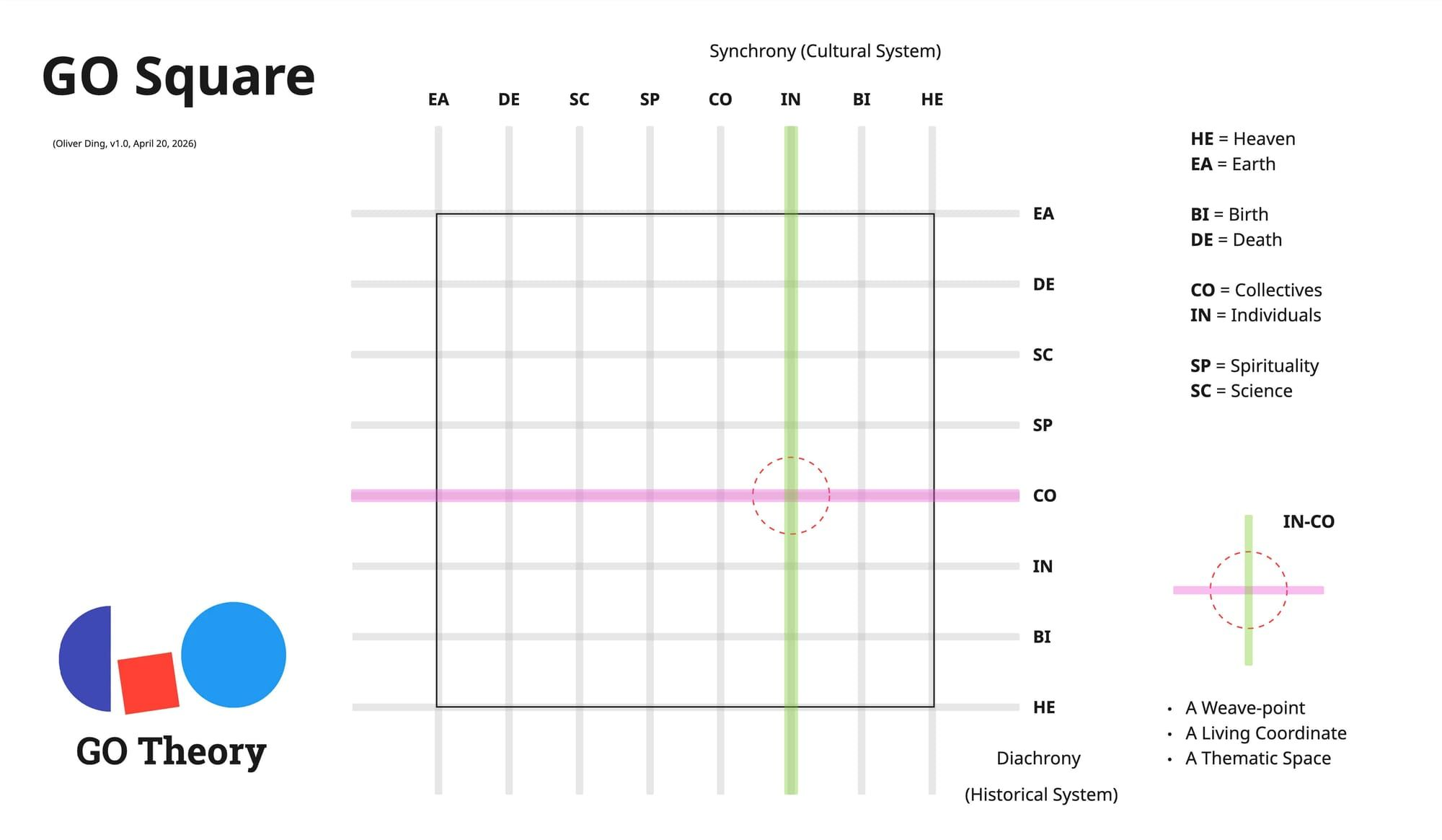
One principle runs through every level of this system, master map and sub-square alike: every weave-point is the intersection of a synchronic dimension and a diachronic dimension. A GO Coordinate names a Unit's present structural landscape (synchronic) crossed with a Unit's historical unfolding (diachronic) — even where the same Unit occupies both positions, the two readings differ, one naming the present, one the history. This is not a special rule invented for any one coordinate. It is the basic design principle a sub-square inherits before it settles on a single element, and it is the principle that guided this one.
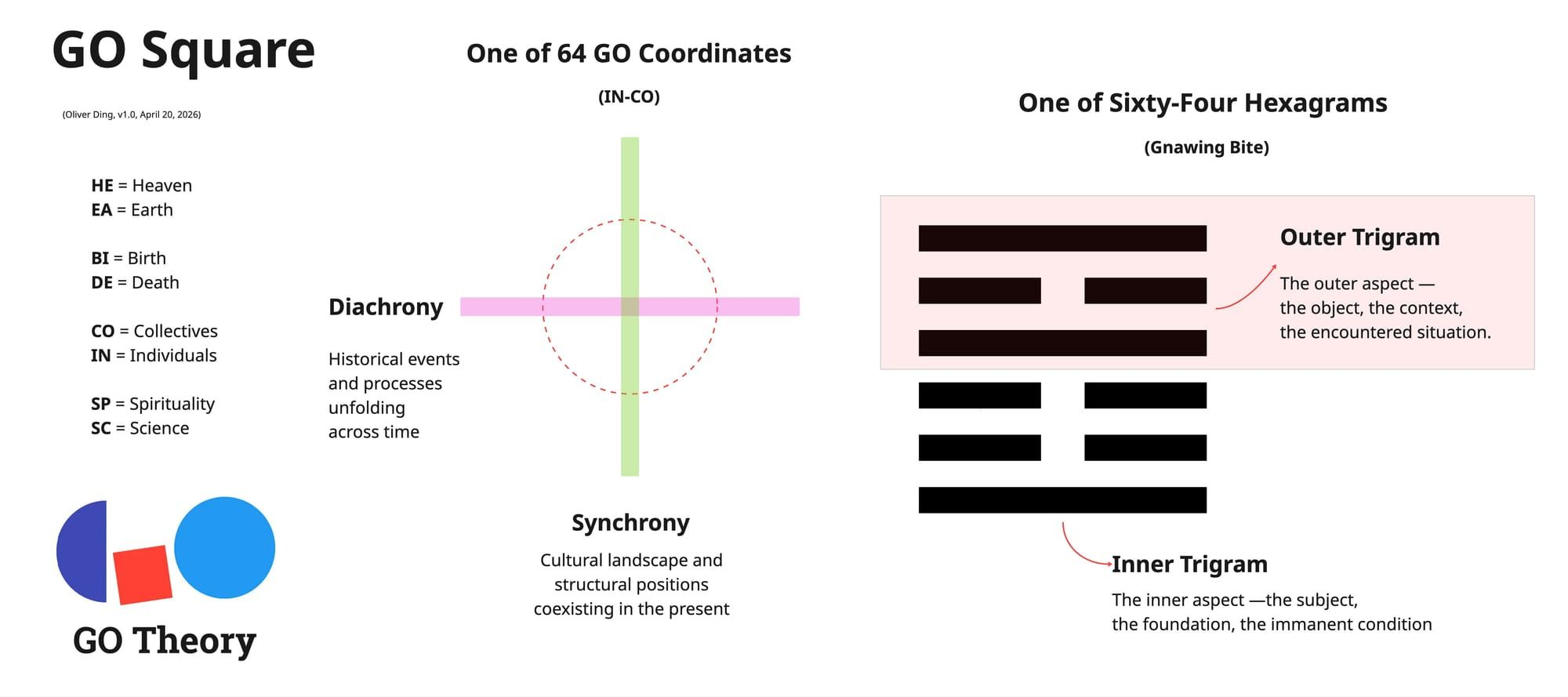
The gap this square was built to close was specific. Writing "Marinate the Mind: The Living Coordinate of Knowledge Engagement," I was working with material — Boyd's OODA, Ivari's HEM papers, and, through them, Luhmann's social systems theory — that GO Square's master map could locate only at a very coarse resolution. Ivari's borrowing from Luhmann wasn't a crossing of Death and Collectives in the abstract; it was Sociology, specifically, meeting Military, specifically. The master map's eight archetypal Units couldn't hold that level of detail. A finer-grained square was needed, built on the master map's own synchronic/diachronic logic but populated with elements at a different scale: academic disciplines and practice domains.
The sixteen elements themselves were chosen directly, not derived from GO Square's Eight Units. Starting over from the elements themselves gave eight disciplines, chosen for how far their concepts actually travel into other people's work — Anthropology, Philosophy, Economics, Aesthetics, Sociology, Psychology, Biology, Linguistics — and eight practice domains, chosen first for their horizontal, cross-cutting reach, then adjusted for what this era makes unusually active — Design, Military, Engineering, Ethics, Management, Strategy, Education, Communication.
These sixteen elements carry their own local codes, meant to be read only on this square's own legend, not cross-referenced against any other sub-square or against the master Unit letters they happen to sit beside:
Academic Disciplines (synchronic — knowing-for-all, h-creativity):
- AN = Anthropology
- PH = Philosophy
- EC = Economics
- AE = Aesthetics (Art)
- SO = Sociology
- PS = Psychology
- BI = Biology
- LI = Linguistics
Practice Domains (diachronic — knowing-for-us, d-creativity):
- DE = Design
- MI = Military
- EN = Engineering
- ET = Ethics
- MA = Management
- ST = Strategy
- ED = Education
- CO = Communication
Only once these sixteen were chosen did the master GO Square's own eight-Unit sequence was consulted — not to generate content, but to decide where to place content already chosen. AN (Anthropology) and DE (Design) both went under Earth. PH (Philosophy) and MI (Military) both went under Death. EC (Economics) and EN (Engineering) under Science. AE (Aesthetics) and ET (Ethics) under Spirituality. SO (Sociology) and MA (Management) under Collectives. PS (Psychology) and ST (Strategy) under Individuals. BI (Biology) and ED (Education) under Birth. LI (Linguistics) and CO (Communication) under Heaven. It is worth being precise about the order in which this happened: the semantic fit visible in several of these pairs — Death holding both Philosophy's ultimate questions and Military's literal destructiveness, Earth holding both Anthropology's fieldwork and Design's material practice — was noticed once the alignment was attempted, not built in as the point of the exercise.
This alignment also answers where the whole square sits inside the master GO Square: SC-CO, Science crossed with Collectives. This whole sub-square is an attempt to give the structural production of knowledge (Science) a coordinate system for how it moves through collective practice (Collectives).
With the sixteen elements aligned this way, the discipline axis reads synchronically — the present structural landscape of a field — and the practice axis reads diachronically — the historical unfolding of a practice. Every coordinate on this square, like every coordinate on the master map, is a synchronic reading crossed with a diachronic one. The position is precise. The interpretation — which direction a given weave-point actually ran — stays open, to be discovered case by case.
2. Knowing-for-All vs. Knowing-for-Us
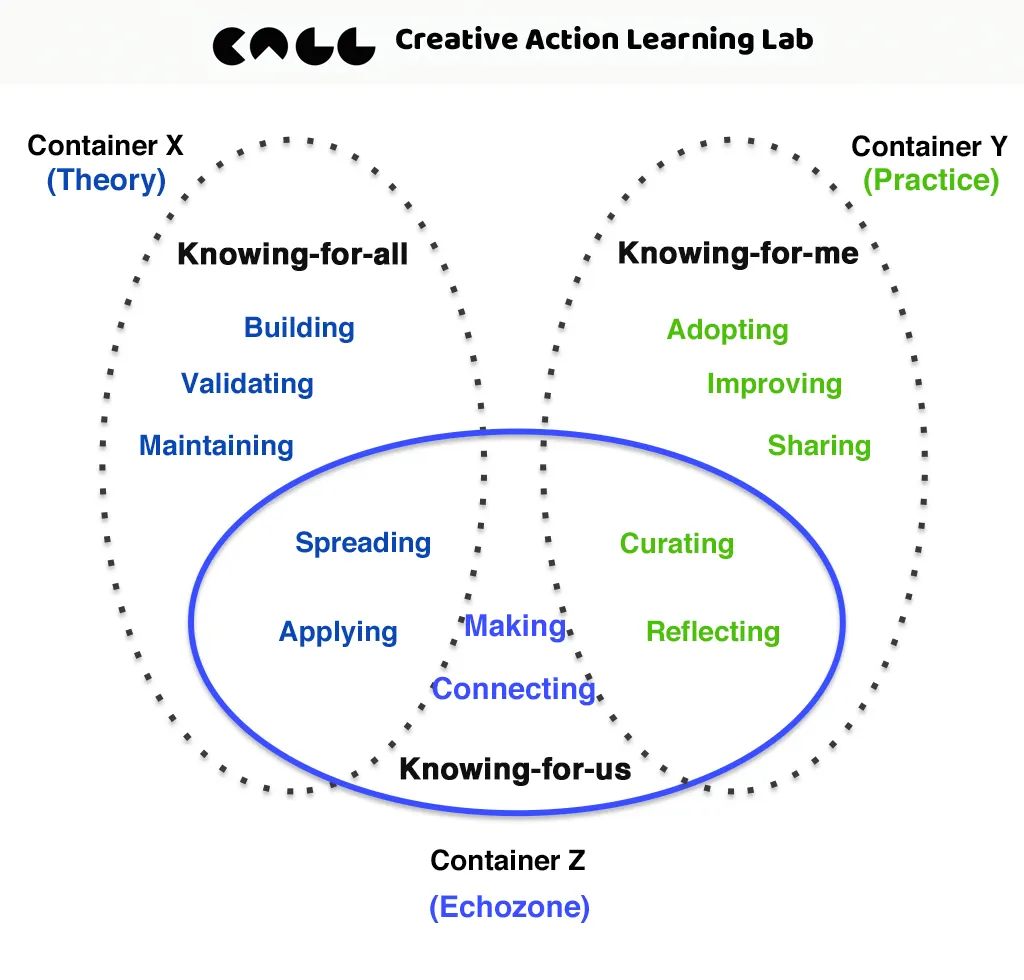
The two axis labels — knowing-for-all for academic disciplines, knowing-for-us for practice domains — come from a distinction that has been part of my work since 2020, in a framework I called HERO U.

HERO U distinguished knowing not by its object but by its outcome and motivation: the same concept — "Activity" was the example at the time — can sit inside a Theory container (knowing-for-all, building and validating public knowledge), an Echozone container (knowing-for-us, applying public knowledge to domain practice and curating personal experience into shared knowledge), or a Practice container (knowing-for-me, adopting knowledge for one's own work and daily life without any commitment to public knowledge). The three containers, I wrote then, "are not separate but intertwined." Novelty was never a property of the object itself. It was always a question of which container was being asked about, and for whom.
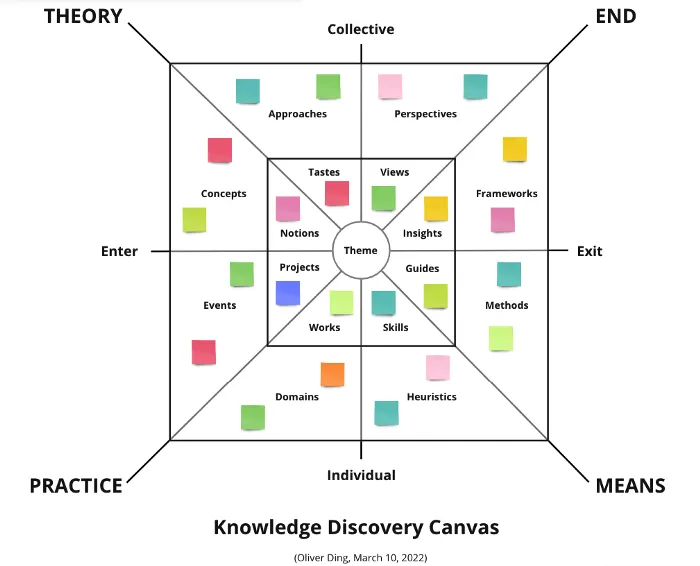
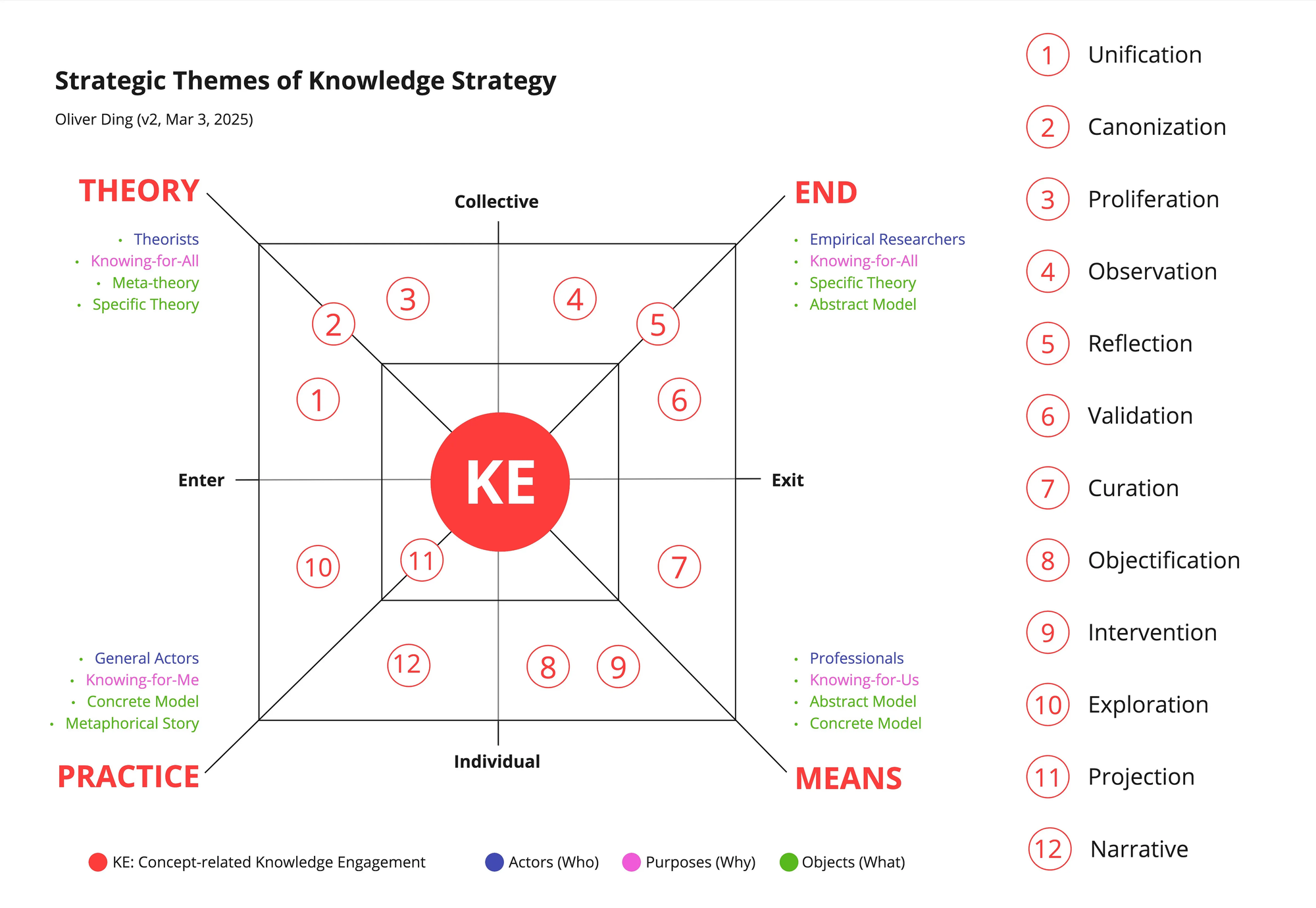
That principle didn't stay fixed in 2020. In 2022, it became the Theory-Practice-End-Means structure of the Knowledge Discovery Canvas. In November 2023, the Grasping the Concept model gave it actors — Theoretical Researchers in the THEORY space, Empirical Researchers in END, Professionals in MEANS, General Actors in PRACTICE — each with their own construal level, practical interest, and point of observation.
By 2025, writing Castle and Forest, I had named it directly: the Theory-Practice Gap, the first of four gaps the whole book was built to address, framed explicitly around "concept-related knowledge, particularly in the context of the Theory-Practice Connection."
The Knowledge Ecology Square's academic disciplines axis carries knowing-for-all — the present structural landscape of a field, addressed to the whole of it. The practice domains axis carries knowing-for-us — the historical unfolding of a domain of applied activity, addressed to the specific community of professionals who work in it, per HERO U's own Echozone/dPractice register, not to daily life in general (HERO U's Practice container, knowing-for-me, plays no role on this square).
3. H-Creativity vs. D-Creativity
A second label extends the first, but shifts the focus to how creative output is measured.
In academic disciplines, creativity is under an obligation to be new: research cannot simply repeat prior scholarship, and its novelty is judged on a global scale. In practice domains, by contrast, there is no obligation to pursue the latest knowledge. Practitioners care more about how knowledge can be used to solve concrete problems in their domain, whether the knowledge they use is ancient or cutting-edge. Competition within an industry means innovation still occurs. The important point is that the pursuit of novelty is obligatory on one side and optional on the other.
My intuition here resonates with the distinction creativity scholar Margaret Boden draws between p-creativity and h-creativity. p-creativity refers to novelty that is new only to the individual person; h-creativity refers to novelty that is new to the whole of human history.
But I did not directly use p-creativity on the new square. I considered that p-creativity does not fully fit the situation of practice domains, because ideas in a practice domain need to be shared within a collective, whereas an individual's p-creative idea may only need to be judged as such in their own mind. So, imitating this pair, I propose d-creativity (domain-based creativity). I specify that it differs from p-creativity in that it requires a public vehicle for the creative idea so that others can encounter it, and it differs from h-creativity in that it does not need to be the newest in the world, only a localized innovation within the practice domain.
4. The Name: Knowledge Ecology
Once the grid was built, I didn't know what to call it. I sat with it for a while, and then it arrived. It should be called the Knowledge Ecology Square. Only after I'd said the name did I stop and ask myself where I'd gotten it - and realized I'd been building toward it for years without quite naming it until recently.
In 2025, writing the overview article for Castle and Forest, I had already used the phrase "the contemporary knowledge ecosystem" as the book's governing metaphor — forest as public knowledge, castles as personal knowledge and specialized schools of thought — without yet calling the underlying theme "knowledge ecology" by name.

The name itself arrived in April 2026, while editing Weave the Life: The Life-as-Activity Approach (v4.0) and Personal Knowledge Ecology. That book's introduction gathered years of separate work — Knowledge Discovery's 2022 focus on individual tacit knowledge, Castle and Forest's 2025 focus on the broader knowledge landscape — under one name: Personal Knowledge Ecology, expanded to include the individual's social interactions and collaborative activity systems as essential contexts for cognitive development, with the tools built along the way — canvases, maps, frameworks — treated as integral parts of that ecology rather than just instruments for studying it. A month later, Weave the Theory used the same word again, this time to understand theoretical activity itself from three perspectives: Theoretical Enterprise, Theoretical Tradition, Theoretical Platform — each, in its own way, "a distinctive knowledge ecology."
So by the time this new square needed a name, "knowledge ecology" wasn't an available word picked up for the occasion. It was a theme already built across 2025 and 2026, retroactively assembling three possible books — Knowledge Discovery, Castle and Forest, Weave the Theory — into a trilogy moving from the individual cognitive level, to the landscape level, to the ecology level. This square is not a new coinage. It is the newest weave-point on a thematic space that already had a name waiting for it.
5. Case Studies
Once the grid existed, I didn't wait to test it. I started placing cases — and the first one I placed was my own.
#1 Knowledge Strategy
Weave-point: PS–ST (Psychology × Strategy)
Knowledge Strategy is one of my ongoing creative themes. On the Knowledge Ecology Square, I place it at the PS–ST weave-point: Psychology × Strategy.
This weave-point reflects my own creative trajectory.
In 2025, I approached Knowledge Strategy through thematic space theory, using the Ecological Strategic Cognition framework to explore the theme. This eventually developed into a three-part body of work: the first part focused on ecological strategic cognition; the second explored knowledge activities, especially concept-centered knowledge activities, in their ecological context; and the third examined the internal structure of a theory enterprise through eight historical-cognitive cases from my own creative history.
The trilogy established a substantial thematic space around Knowledge Strategy.
In 2026, I began approaching the same theme through Strategic Developmental Psychology. The new concepts developed through this work, including Gejunction, provide another psychological framework that can be brought into the study of strategy and used to develop new cases.
This makes the PS–ST weave-point particularly interesting for my own work.
The weave-point itself is only a coordinate in the Knowledge Ecology Square. But the thematic space it points to has already accumulated a considerable creative history: the Knowledge Strategy trilogy from 2025, the new work emerging from Strategic Developmental Psychology in 2026, and the new cases and concepts that can grow from them.
So a single weave-point can point toward a thematic space that is much richer than the coordinate itself suggests.
For me, this is one of the values of the Knowledge Ecology Square: it allows an ongoing creative theme to be located precisely while keeping the larger space of its development visible.
#2 Strategy-as-Practice
Weave-point: SO–ST (Sociology × Strategy)
Strategy-as-Practice emerged in the 1990s as part of the broader "practice turn" in the social sciences, but its explicit formation as a perspective in strategy is closely associated with Richard Whittington.
In his 1996 article Strategy as Practice, Whittington proposed looking at strategy through the lens of social practice rather than treating strategy primarily as a property of organizations or as a problem of choosing the right competitive position. He later developed this perspective more systematically. In a 2002 paper, he explicitly proposed a practice perspective on strategy alongside the established strategy-content and strategy-process perspectives. In 2006, Whittington argued that the "practice turn" in strategy research needed to be completed by connecting activity inside organizations with its wider social consequences.
What makes this case particularly interesting at the SO–ST position is how directly strategy research drew on social theory. Whittington identified five important practice perspectives from social theory: Pierre Bourdieu, Michel de Certeau, Michel Foucault, Anthony Giddens, and Alasdair Maclntyre. From these traditions he developed three central concepts for studying strategy: strategy praxis, strategy practices, and strategy practitioners.
The theme then developed into a broader research community rather than remaining Whittington's individual theoretical proposal. An important milestone was the publication of the first edition of The Cambridge Handbook of Strategy as Practice in 2010, edited by Damon Golsorkhi, Linda Rouleau, David Seidl, and Eero Vaara. It brought together an international group of scholars and provided a systematic overview of the emerging field, including its epistemological, methodological, and theoretical dimensions.
The second edition, published in 2015, shows how much the thematic space had expanded in only five years. The editors added twenty new chapters and substantially revised the original ones. More importantly, the handbook expanded the theoretical resources available to Strategy-as-Practice by adding perspectives from organization and management theory, including institutional theory, routine dynamics, identity theory, the communicative constitution of organizations, power perspectives, and critical perspectives. It also introduced substantive areas such as strategic planning, strategy meetings, materiality, middle managers, participation, and emotions.
The social-theoretical diversity is especially visible in the handbook's treatment of practice theory. The second edition includes work drawing on Bourdieu, Giddens, Foucault, activity theory, actor-network theory, Wittgenstein, and other practice-oriented and constructivist traditions. For example, its Bourdieusian contribution uses the concepts of field, capital, and habitus to investigate strategizing and to reconsider the relationship between structure and agency, as well as between planning and emergence.
By this point, Strategy-as-Practice had become a substantial thematic space rather than a single theoretical proposition. Many authors were bringing different philosophical and social-theoretical traditions into strategy research, while also developing different empirical and methodological approaches. The 2015 handbook therefore captures an important moment in which Sociology × Strategy had generated a much larger and more internally diverse research space.
The theme is still active. In 2026, thirty years after the publication of Whittington's original Strategy as Practice article, Whittington published a retrospective titled Strategy as practice at 30: Humanist and post-humanist, reviewing the field's development and proposing directions for its future.
The history of Strategy-as-Practice therefore shows how a theme can grow around a particular weave-point: a strategy scholar brought practice theory and sociological thinking into strategy research; subsequent scholars introduced additional philosophical and social-theoretical resources; and over three decades, the theme developed into a substantial and still-evolving research space around SO–ST.
#3 Competitive Strategy
Weave-point: EC–ST (Economics × Strategy)
Competitive Strategy is a major theme in the development of modern strategic management, and Michael Porter is one of its central figures. His work began with industry competition and company strategy, and developed into a much broader body of research on competitive advantage, national and regional competitiveness, clusters, and other forms of competition. His representative books include Competitive Strategy: Techniques for Analyzing Industries and Competitors (1980), Competitive Advantage: Creating and Sustaining Superior Performance (1985), The Competitive Advantage of Nations (1990), and On Competition (1998). Harvard Business School describes his early contribution as using economic theory to develop a more rigorous understanding of industry competition and the choices companies make to compete.
The Five Forces model and Value Chain analysis are already well known, so there is no need to explain them here. What interests us is something else: Porter was developing his thematic enterprise at the EC–ST weave-point. What actually happened there?
Porter's own 1998 Introduction to the reissue of Competitive Strategy gives us an unusually clear account. Looking back at the intellectual situation in which the book emerged, he wrote:
"The book also signaled a new direction and provided an impetus for economic thinking."
He then described the limitation he saw in economic thinking about competition at the time. Economists focused mainly on industries; companies were largely treated as equal or as differing only in size or unexplained efficiency; industry structure was understood through a relatively narrow set of variables; and managers were "all but absent in economic models." Economics was primarily concerned with the societal and public-policy consequences of alternative industry structures, rather than with the question of how particular companies actually competed.
Porter connected this problem directly to his own intellectual trajectory:
"My training and assignments—first an MBA, then an economics PhD, then the unique Harvard Business School challenge of using the case method to teach practitioners—revealed the gap between actual competition and the stylized models."
This is the interesting moment at EC–ST. Porter was not simply taking an existing economic theory and applying it to business strategy. His movement went in both directions. His economics training gave him a way to analyze industry structure, while his encounters with companies, industries, and managerial decisions exposed phenomena that the prevailing economic models did not adequately capture. He therefore wanted to develop analytical tools that could connect economic understanding with actual strategic choices:
"They also created a sense of urgency to develop tools that would inform actual choices in real markets."
From there, Porter reconstructed the problem of competition. Industry structure became more elaborate; competitive position could be understood through cost, differentiation, and scope; and, crucially, managers were given room to act rather than being treated simply as participants trapped inside an externally given structure:
"In my theory, managers had important latitude to influence industry structure and to position the company relative to others."
Porter also saw his work as feeding back into economics. He noted that Competitive Strategy had identified phenomena that economists, equipped with emerging game-theoretic techniques, subsequently began to explore mathematically. In this sense, the movement at EC–ST was not a one-way transfer from economics into strategy. Economic concepts were reorganized around strategic problems, while observations of strategic behavior also exposed new questions for economic theory.
This helps explain why Porter's work did not remain a single framework. Competitive Strategy led to Competitive Advantage, then to The Competitive Advantage of Nations, On Competition, and later work on competitiveness, clusters, health care, social value, and other domains. His thematic enterprise kept returning to the relationship between economic structures of competition and the strategic choices of actors within those structures.
The EC–ST weave-point, then, is not merely where "economics meets strategy." It is a place where a researcher can move back and forth between economic explanation and strategic inquiry, allowing each side to generate new questions for the other.
#4 Scaffolding
Weave-point: PS–ED (Psychology × Education)
Scaffolding has become one of the most widely used concepts in educational research, especially in discussions of teaching, learning, tutoring, literacy, and instructional design. Its modern history is associated with David Wood, Jerome Bruner, and Gail Ross, whose 1976 paper The Role of Tutoring in Problem Solving examined how an adult tutor helps young children accomplish a problem-solving task that they could not yet complete independently. The paper appeared in the Journal of Child Psychology and Psychiatry and became the point of departure for the subsequent development of the scaffolding metaphor.
The metaphor quickly became influential because it provided an intuitive way to describe how a more knowledgeable person can temporarily support another person's performance. Over the following decades, scaffolding moved from developmental and cognitive psychology into educational research, including classroom instruction, literacy, language learning, special education, and computer-supported learning. Its association with Vygotsky's Zone of Proximal Development also became increasingly prominent, although the historical relationship is more complicated than the standard textbook story suggests. Wood, Bruner, and Ross did not cite Vygotsky in their 1976 paper, and later scholarship has argued that the widespread identification of scaffolding with Vygotsky's ZPD obscures important differences between the two ideas.
This history makes PS–ED interesting. We are not simply looking at a psychological concept being applied to education. A metaphor developed around a particular form of tutoring became a much larger educational vocabulary. The original situation—an adult helping a child perform a task—was gradually generalized to many kinds of instructional support, learning environments, pedagogical interventions, and educational technologies. The term became increasingly useful as a way of naming supportive relations in education, but this expansion also made the boundaries of the concept less clear.
The criticism appeared relatively early. In 1998, C. Addison Stone published The Metaphor of Scaffolding: Its Utility for the Field of Learning Disabilities, explicitly reviewing the metaphor's history and criticisms and arguing for a richer account that would pay attention to communicational dynamics and conceptual reorganization in adult–child interaction. In the same issue, Deborah Butler went further in In Search of the Architect of Learning, arguing that the scaffolding metaphor was "fundamentally flawed" and proposing an alternative way of understanding the dynamics of teaching and learning.
The issue was not simply whether scaffolding was a useful metaphor. It was what happened when the metaphor was treated as if it were a sufficiently precise explanation of learning. Once scaffolding came to describe almost any form of teacher support, the original theoretical conditions could easily disappear. A later critical review of scaffolding research in literacy education made this problem explicit: the term had been "inconsistently invoked," and its meaning had become so broad that its relationship to learning outcomes was difficult to establish.
The connection with Vygotsky produced another layer of conceptual transformation. In popular educational discourse, "Vygotsky," "ZPD," and "scaffolding" are often presented almost as a single package. But later scholarship has challenged this conflation. One line of criticism argues that the short-term instructional image implied by scaffolding can reduce the much broader developmental concerns of Vygotsky's work to a problem of helping an individual child perform a task. In this sense, the history of scaffolding is also a history of theoretical compression: a broader developmental tradition became attached to a compact and highly portable instructional metaphor.
What happened at PS–ED, then, was not simply the successful migration of a psychological concept into education. The concept changed as it moved. It gained enormous practical and linguistic reach, while its theoretical boundaries became increasingly difficult to maintain. The metaphor could now be used to describe teachers, peers, instructional materials, digital systems, classroom routines, literacy practices, and many other forms of support. At the same time, researchers repeatedly returned to the question of what should actually count as scaffolding and what distinguishes it from ordinary support or good teaching.
This makes Scaffolding a particularly revealing thematic space on the Knowledge Ecology Square. Its history shows that when a concept travels across a weave-point, expansion does not necessarily mean theoretical development. A concept can become more widely used, enter more fields, and acquire more applications while simultaneously becoming less determinate. The history of scaffolding therefore gives us a case in which conceptual diffusion and conceptual clarification do not necessarily move together.
#5 Design Anthropology
Weave-point: AN–DE (Anthropology × Design)
Design Anthropology is a relatively young interdisciplinary field that emerged through the sustained encounter between anthropology and design. Its development has a longer history, particularly through the increasing use of ethnographic approaches in design from the late twentieth century onward. Lucy Suchman, for example, brought ethnographic attention to situated action and technology through her work at Xerox PARC. As anthropologists and designers increasingly worked together, ethnography, participation, collaboration, and intervention became part of an expanding space between the two fields.
What interests us here is a different question: How could this particular place on the Knowledge Ecology Square grow into a field of its own?
It turns out that Ton Otto and Rachel Charlotte Smith had already explored something very close to this question. In their 2013 chapter "Design Anthropology: A Distinct Style of Knowing," published in Design Anthropology: Theory and Practice, edited by Wendy Gunn, Ton Otto, and Rachel Charlotte Smith, they traced the emergence of Design Anthropology and examined how anthropology and design, originally possessing different traditions of knowledge and practice, had increasingly become intertwined.
Their account points to a long process rather than a single founding event. Ethnographic methods entered design contexts; anthropologists began working with designers and other practitioners; design researchers became interested in anthropological approaches; and new forms of collaboration emerged around making, intervention, participation, and material engagement. The important development was therefore not simply the movement of one discipline into another, but the gradual formation of a space in which the two traditions could interact.
This also changed the relationship itself. Anthropology could contribute ways of understanding social practices, cultural meanings, and situated contexts, while design introduced stronger orientations toward intervention, making, and future possibilities. As these interactions accumulated, the relationship between the two fields became an object of inquiry in its own right. Otto and Smith described the emerging configuration as a "distinct style of knowing."
The story did not stop with the recognition of the field. In 2016, Rachel Charlotte Smith and Ton Otto published "Cultures of the Future: Emergence and Intervention in Design Anthropology," in Design Anthropological Futures. The title itself points to a further development: Design Anthropology was no longer being considered only in terms of how anthropology and design had come together historically, but also in terms of emergence, intervention, and future-making. The thematic space continued to develop through questions about how anthropological and design practices could participate in shaping possible futures.
This makes AN–DE particularly interesting as a weave-point. The coordinate itself eventually became the name of a field. The thematic space did not exist fully formed in advance. It grew through encounters, borrowings, collaborations, methodological experiments, and theoretical reflection, until the interaction between the two fields became substantial enough to be recognized as a field in its own right.
The case therefore shows a distinctive possibility for a weave-point: the intersection itself can become the field. Rather than anthropology simply supplying knowledge to design, or design simply borrowing methods from anthropology, sustained activity at the intersection produced a new intellectual and practical space with its own questions, practices, and identity.
#6 Beyond Doctrine
Weave-point: SO–MI (Sociology × Military)
“Beyond Doctrine” is the main title of Ivari's paper, and it names the case I place at SO-MI.
This is the case that started the whole search, so it belongs last in this mapping exercise — the origin point, placed only once I had the rest of the grid to place it against. Johan Ivari's HEM papers borrow a specific mechanism from Niklas Luhmann's social systems theory: irritation, which in Ivari's reading never occurs in isolation but arises through the ongoing reciprocity of actors in a shared environment. The concept that makes this legible is Luhmann's double contingency — each actor simultaneously a subject and object of the other's orientation, knower and known, evaluator and evaluated. Double contingency, in this reading, is inseparable from managing ambiguity: too little, and heterogeneous perspectives can't coexist; too much removed, and the system freezes.
Ivari resolves this by introducing languaging, drawn from Cuffari et al.'s account of participatory sense-making, as HEM's own operational answer — holding enough ambiguity in place to keep a coalition planning process open, while producing enough clarity to let it converge on coordinated action. What SO–MI shows, more clearly than any other case here, is a discipline arriving already metabolized into a working concept rather than announced as a citation. Luhmann's wider apparatus — autopoiesis, operational closure — stays almost entirely off the page. What crosses over is one load-bearing mechanism, repackaged under a new name, doing real work at its destination while barely visible as what it originally was.
6. What This Mapping Reveals
Six cases. Six weave-points.
| Case | Weave-point |
|---|---|
| Knowledge Strategy | PS–ST |
| Strategy-as-Practice | SO–ST |
| Competitive Strategy | EC–ST |
| Scaffolding | PS–ED |
| Design Anthropology | AN–DE |
| Beyond Doctrine | SO–MI |
The most visible pattern is the one I noticed first: three of the six — mine included — land on the same column, Strategy, reached from three completely different disciplines, Psychology, Sociology, and Economics. That's a confirmation of something I built into the map's design before I had any cases to test it with — Strategy was chosen as a horizontal practice domain precisely because it cuts across disciplinary lines rather than belonging natively to any one of them. Psychology also shows up twice, at two different destinations, PS–ST and PS–ED — the same discipline isn't a single doorway either.
But reading the six cases again, more slowly, a second layer of pattern shows up — not where the weaves land, but what kind of event each weave actually was. They are not six instances of the same thing.
Some weaves are a single, dateable act that a whole community then keeps building on. Strategy-as-Practice began with one article, Whittington's 1996 "Strategy as Practice," but the coordinate didn't stay his. Over thirty years, other scholars kept bringing in more social-theoretical resources — de Certeau, Foucault, Giddens, MacIntyre alongside Bourdieu — until a single proposal had become a Handbook, then a second, larger edition, then a thirty-year retrospective. The weave-point acted less like a bridge one person crossed and more like a site successive people kept building on. Beyond Doctrine, by contrast, is the opposite shape: a specific mechanism — double contingency — crossing once, doing one job, staying almost entirely uninstitutionalized as sociology at its destination. Both are real weaves. One accumulates into a field; the other stays a tool.
Some weaves run in both directions. Porter's own account of Competitive Strategy makes this explicit: his economics training gave him a way to analyze industry structure, but his encounters with actual companies exposed what those economic models couldn't yet explain — and he says outright that his own book then fed observations back into economics, which later formalized them with game theory. EC–ST isn't a one-way transfer. It's closer to a working relationship between two disciplines, each generating questions for the other over time. None of the other five cases show this two-way traffic as clearly.
Some weaves show that reach and precision can pull apart. Scaffolding is the case that resists being a success story. It travelled further than almost any other concept here — into classrooms, literacy instruction, special education, computer-supported learning — and became less exact the further it travelled, to the point that critics called it "fundamentally flawed" as an explanation within twenty years of its introduction, and later reviews couldn't reliably connect it to learning outcomes at all. The concept's popular attachment to Vygotsky's Zone of Proximal Development compounds this: the two are widely treated as one idea, even though Wood, Bruner, and Ross never cited Vygotsky, and the equation is now considered a distortion by scholars who've looked closely. PS–ED shows a weave that succeeded by one measure — adoption — while failing by another — conceptual stability.
Some weaves produce a place rather than a transfer. Design Anthropology didn't happen because anthropology gave something to design, or design borrowed a method from anthropology. Otto and Smith's own account describes a long, undramatic accumulation — ethnographic methods entering design contexts, practitioners from both sides working alongside each other — until the intersection itself became substantial enough to need its own name and its own literature. AN–DE is the only coordinate among the six that has, in effect, stopped being a coordinate and become a field with its own address.
And one weave is not yet settled at all. Knowledge Strategy, the case I placed at PS–ST, is the only one of the six still actively unfolding in the same present tense as the article describing it — a multi-year trajectory (the 2025 trilogy, the 2026 work through Strategic Developmental Psychology) that hasn't reached whatever form it will eventually take. Every other case here is a finished or long-running story I can look back on. This one is being lived while it's being mapped, which is a different kind of case from the other five, not a lesser one.
Seen this way, the six cases aren't just six dots that happen to cluster or scatter. They're six different answers to the question "what does it mean for something to cross from a discipline into a practice domain" — a founding act versus an accreting field, a one-way transfer versus a working exchange, successful diffusion versus successful precision, a bridge versus a new place, a finished case versus a live one. Design Anthropology and Beyond Doctrine each still sit alone at their coordinates, with no second case yet to compare against; that's simply where the map currently stands, not a verdict on those weave-points. Military, unlike Strategy, is not a horizontal domain in this square's design — it earned its seat through this era's particular importance, not through timeless cross-cutting reach — so a thin cluster there may just reflect how recently that importance has surfaced.
7. Looking Back
Sitting with the finished grid, I recognized the same thing I'd recognized with Creative Life Square: this wasn't an invention. The knowing-for-all / knowing-for-us judgment had been running underneath my work since 2020; the name "knowledge ecology" had already been earned across 2025 and 2026; the discipline/practice distinction had been doing quiet analytical work in how I already read Ivari's case. The square didn't create any of these. It gave them, together, a spatial form I could place cases against, move around on, and test — rather than just gesture at, one piece at a time, in prose.
And the sixteen elements themselves are not a neutral, exhaustive catalog of Disciplines and Practices in general. They are my own list, assembled from where I've noticed knowledge actually traveling, shaped by a career that started in advertising and design and moved through business strategy into academic theory-building. Someone starting from a different creative history would very likely fill this square with a different sixteen, and a different Unit alignment might follow. That's not a weakness of the design. It's the same principle GO Square has held from the start: the structure is shared, but what fills it is not required to be uniform.
In this respect nothing here departs from Creative Life Square. The basic principle is the same one that square already established: recognize an existing distinction, give it spatial form, let the material fill it in its own way. What's new is not a principle but a tool. For years I have circled the question of how knowledge actually crosses from one discipline into a practice domain — it runs through the Theory-Practice Gap in Castle and Forest, through Personal Knowledge Ecology, through Weave the Theory's account of how a theoretical enterprise develops — but I never had a place to put a specific instance of that crossing and hold it still long enough to compare it against another one. Mapping weave-points does exactly that. It's a small addition to the toolkit, but it's the piece that turns a long-running interest into something I can actually place cases on.
8. Looking Ahead
Everything in section 6 comes from six cases — chosen because I already knew them well enough to write about clearly, not from any systematic survey of the square. The patterns I named there are readings of this particular small set, not settled properties of the map itself. A larger set of cases could sharpen them, complicate them, or replace them outright.
One question in particular is worth flagging rather than answering here: does a weave-point reliably produce a new field, the way AN–DE did with Design Anthropology? Janine Benyus's biomimicry — biology crossing into engineering — shows the same shape: sustained activity at an intersection accumulating into a named field with its own literature and its own institute, not a one-time borrowing. I haven't worked that case through in this article, but its resemblance to Design Anthropology suggests "the coordinate becomes a field" might be a genuine, repeatable pattern rather than a coincidence specific to anthropology and design — and confirming that would take more cases than I set out to gather here.
This article has stayed within one register of the Knowledge Ecology Square — an academic discipline crossed with a practice domain. Two further pieces extend the picture. One follows Niklas Luhmann's own knowledge ecology through a different register — discipline crossed with discipline — tracing a shape this article deliberately left out: convergence into sociology, followed by divergence back out into law, education, art, and communication. The other tells a story I've only partly told here: the false starts this square went through before settling into its current form, including a detour through a much more elaborate three-map design that turned out, on testing, to be more clever than useful.
All three belong, in the end, to the same place this whole exploration started: Knowledge Strategy. The square, the cases, even the act of building the square — they're not a departure from that theme. They're its latest weave-point.
v1.0 - September 19, 2026 - 6,765 words