
The Social Science Square: Mapping Objects and Things of Knowing
A Sub-square of GO Square for Tracing Scales of Analysis, Means, and End
by Oliver Ding
September 24, 2026
The recent Revisiting-and-Rebuilding of the Knowledge Strategy trilogy pulled my focus back toward several years of work on Knowledge Engagement — work I had deliberately stepped away from earlier this year, when I redirected my creative attention toward Cultural Innovation.
That creative journey unfolded through three projects: ACS (Anticipatory Cultural Sociology), SDP (Strategic Developmental Psychology), and GO Theory. In the first half of 2026, I produced several new book drafts and created a series of knowledge frameworks. Among them, the Gejunction framework led me back to the Knowledge Engagement work, especially the Knowledge Strategy series of book drafts I created in 2025.
The reach of this Revisiting-and-Rebuilding keeps widening. Several days ago, I revisited the Infoniche framework I introduced in the 2020 book draft After Affordance: The Ecological Approach to Human Action, and reflected on its relationship with Creative Life Theory, which I have developed since 2022. I realized I had not incorporated the Infoniche framework into the Creative Life Theory family.
This reflection inspired me to design a new sub-square in the GO Square series: The Social Science Square. This article tells the story of how it came to be.
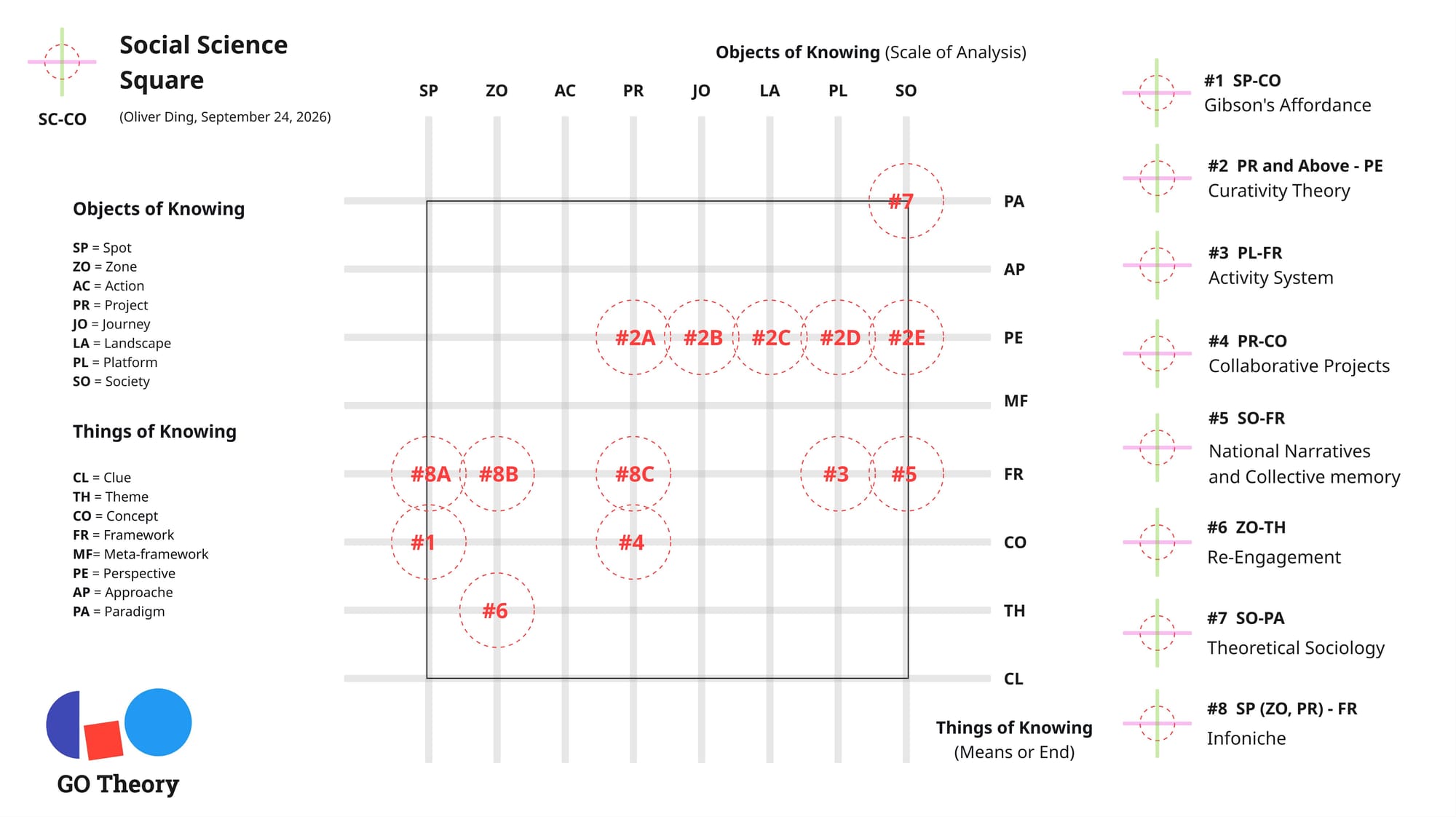
Contents
- One Schema, Two Kinds of Knowing
- Object of Knowing: Eight Scales of Analysis
- Things of Knowing: Means or End
- Spot and Zone: Two Minimal Units
- Paradigm: Disciplinary Matrix
- The Name
- Local Codes for This Square
- Case Studies
- What This Mapping Reveals
For years, I used to take my two children to the Houston Museum of Natural Science. On the bottom floor, as part of a larger exhibit, there was an interactive station inspired by Powers of Ten, the 1977 film by Charles and Ray Eames. The station moved through a sequence of scales, each step ten times larger or smaller than the last. Wherever a visitor happened to be standing counted as scale zero. Press one button and the view expanded outward, past the room, past the building, past the city, out to the scale of the universe. Press the other and it contracted inward — past the hand, past the cell, into the DNA, ending inside a proton of a carbon atom.
The idea behind Powers of Ten stayed with me. It shows something almost nobody notices in ordinary life: that "how big" or "how small" is never a fixed fact about the world, only a fact about where you chose to stand and look. But that station was about natural science. In social science, the underlying idea remains, though the concrete scales change.
This article introduces a tool built for that domain: the Social Science Square. It is meant to help anyone with an interest in social science find their own scale, the way that museum floor let my children find theirs.
1. One Schema, Two Kinds of Knowing
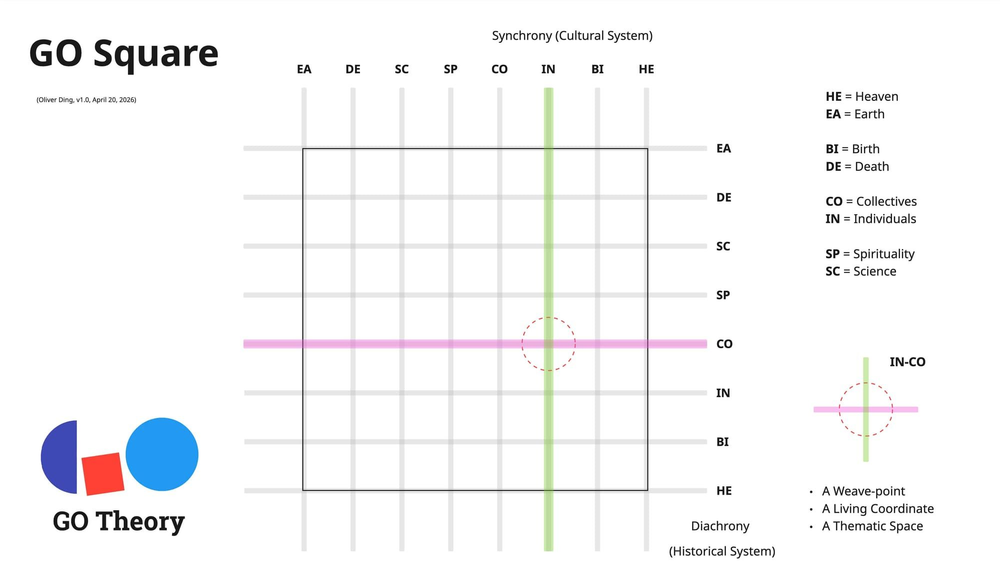
The Social Science Square is a sub-square of the GO Square mapping system. GO Square gives every thematic space in the Symbolic Universe a coordinate. Eight Units — Heaven, Earth, Birth, Death (Natural Givenness) and Collectives, Individuals, Spirituality, Science (Cultural Givenness) — cross with one another, including themselves, to produce 64 GO Coordinates. The architecture is fractal: any one of those 64 coordinates can host its own locally derived sub-squares, built from whatever material accumulates there once that material outgrows what the master map alone can show.
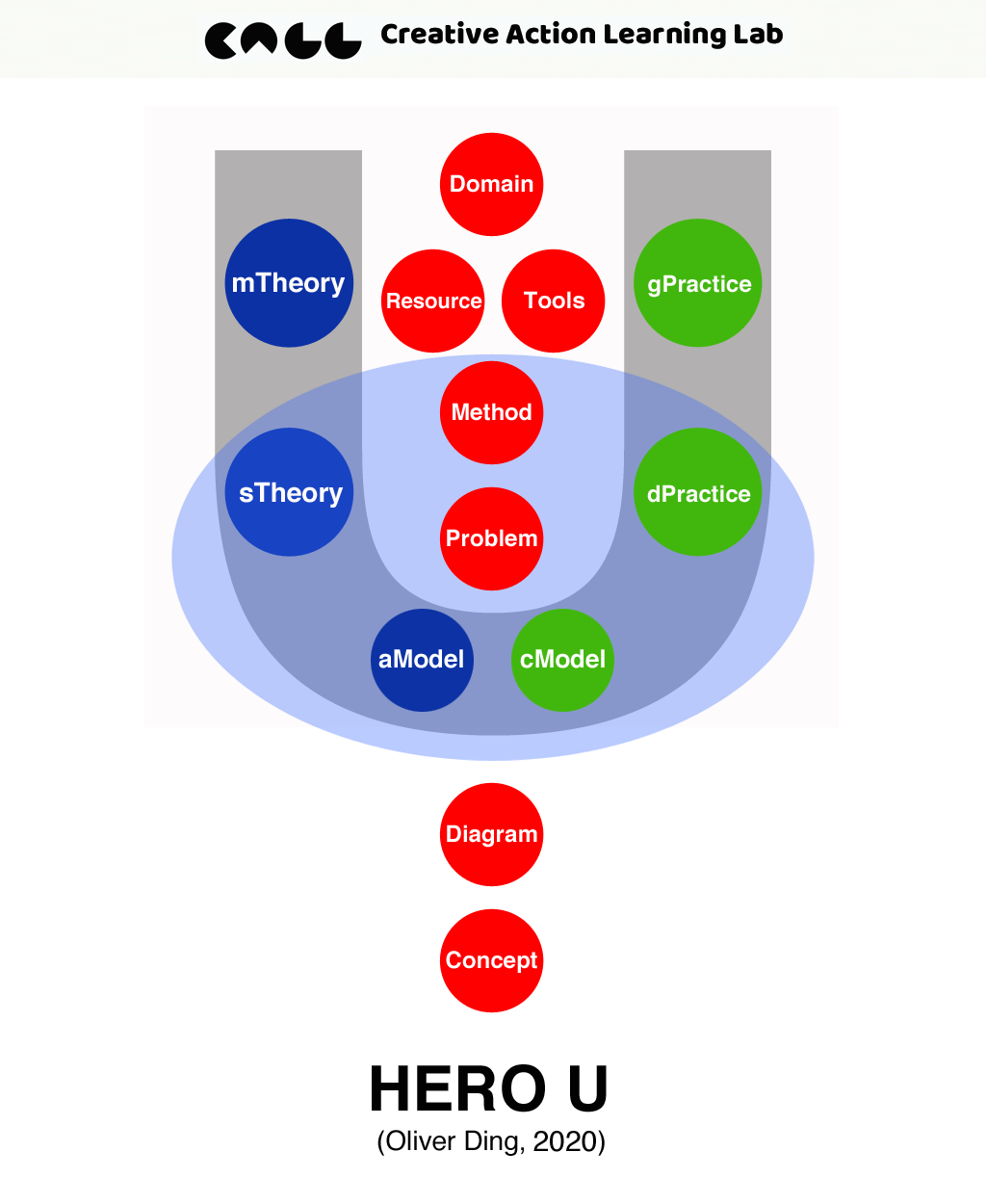
This square's own two crossing dimensions — Objects of Knowing and Things of Knowing — did not come from GO Square's Eight Units and were not derived to fit them. They come from an older schema, which I will call the "object of knowing – condition of knowing" schema, first named in "HERO U — A New Framework for Knowledge Heroes" (June 26, 2020). For this square, I later replaced "condition of knowing" with "things of knowing," since the new square does not cover all the kinds of conditions of knowing that the HERO U framework originally addressed.
Originally, these were simply the two dimensions I used while building the HERO U framework itself. Once HERO U was finished, they receded into the background — hidden behind the specific content they had been used to organize. What follows is that specific content, before I explain what I did with it this time.
HERO U's "U"-shaped diagram represented six types of Objects of Knowing, ordered from the most abstract to the most concrete:
- mTheory (Meta-theory) — philosophical approaches or theoretical perspectives guiding a whole domain, e.g. Activity Theory, Structural Functionalism, Self-Determination Theory
- sTheory (Specific Theory) — discipline-dependent theories, e.g. Event System Theory, Job Crafting Theory
- aModel (Abstract Model) — high-level models connecting a theoretical approach to a special domain, e.g. Jarzabkowski's activity-system framework for Strategy as Practice
- cModel (Concrete Model) — lower-level models directly guiding domain practice, e.g. Mwanza's Activity-Oriented Design Method for HCI
- dPractice (Domain Practice) — a professional's own reflection on the domain they work within
- gPractice (General Practice) — daily life as a general context of knowing: personal growth, productivity, mental health, career, life meaning
Paired against these was a second dimension, Personal Conditions of Knowing, organized into three groups:
- Outside setting — Domain, Resource, Tools
- Source of competence and solution — Method, Problem
- Representation format of the outcome — Diagram, Concept
For this square, I detached the "object of knowing – condition of knowing" schema from HERO U's specific content, cutting the connection to what these thirteen original terms meant. I also modified it: the second dimension became "things of knowing" rather than "condition of knowing," since the new square does not cover all the conditions of knowing that HERO U originally addressed. The two dimensions were then named on their own — as an independent thematic schema, no longer bound to any one framework's content. That is the point of detaching and modifying: a thematic schema, once separated from what it was first used to organize and adjusted for a new setting, can work as a meta-framework, available for reuse anywhere the same relationship applies.
This is the same strategy the S-T-O schema (Subjectification – Crystallize Thematically – Objectification) uses to frame Creative Life Square — a distinction pulled free of the specific material it first organized, kept only as a relationship between two dimensions, and put back to work elsewhere. Developing the actual content of each dimension here — eight units apiece — required going back to other material, described in the next two sections.
2. Objects of Knowing: Eight Scales of Analysis
spot · zone · action · project · journey · landscape · platform · society
In social science, the choice of a unit of analysis is a constitutive decision. It is one of the first things any social science project must settle, because it determines what counts as evidence, what can be compared, and what kind of claim the project can make. This is why, for the Objects of Knowing dimension, I began from the principle of unit of analysis: the question of what, exactly, a given piece of theoretical or empirical work takes as its basic object.
But I call this aspect "scale of analysis" rather than "unit of analysis," deliberately avoiding the second term's complicated history. That history is worth naming directly: Andy Blunden (2017) traces "unit of analysis" back to Vygotsky's own appropriation of the term from social science, where it meant, in Blunden's words, "the resolution of the analytical microscope" — the smallest entity a given theory takes account of. I first quoted this in "Activity U (II): Unit of Analysis, Niches of Analysis, Levels of Analysis" (August 14, 2020), an article built around exactly the question this square now answers with a grid instead of a scattered set of examples.
The eight scales extend a sequence I have been developing since 2022. Creative Life Curation set out five units of analysis — Creative Actions, Creative Projects, Creative Journey, Creative Landscape, Creative Lifescope. Each unit carried its own time scale, spatial scale, and theoretical focus; a Journey is a set of curated Projects, a Project a set of curated Actions.

By 2024–2025, the Strategic Life Narrative project expanded the same lineage again, into twelve thematic rooms grouped under Theme, Practice, and Space.
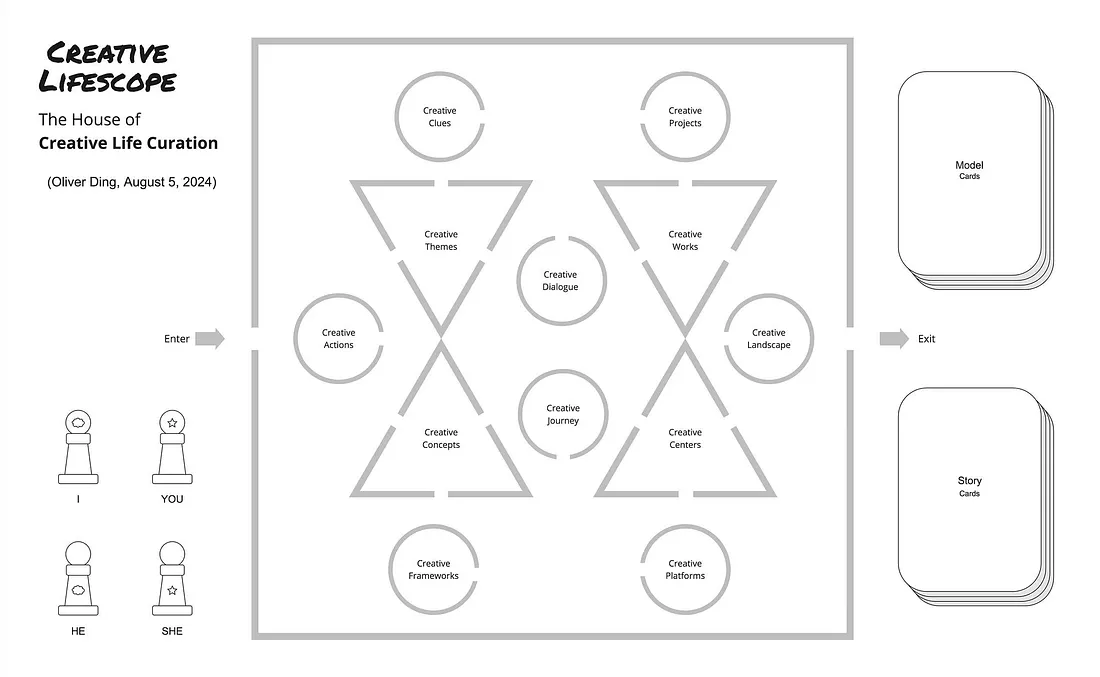
The “Theme” Group
- Creative Clues
- Creative Themes
- Creative Concepts
- Creative Frameworks
The “Practice” Group:
- Creative Clues
- Creative Actions
- Creative Projects
- Creative Dialogue
- Creative Journey
- Creative Landscape
The “Space” Group:
- Creative Projects
- Creative Works
- Creative Centers
- Creative Platforms
For this square, I extended that lineage in the other direction as well — adding two smaller extremes (spot, zone) and two larger ones (platform, society) — so the sequence now runs continuously from the scale of a single embodied moment to the scale of a whole society. What each of the eight scales means:
- spot — the minimal Subject-Object unit; a single moment of interaction with the environment
- zone — the minimal Subject-Subject unit; a single moment of interaction between two people
- action — a bounded creative act
- project — a set of curated actions
- journey — a set of curated projects, strung along a theme
- landscape — a panorama of a creator's projects at a given point in time
- platform — an ongoing structure many people's activity accumulates on
- society — the scale at which activity becomes collective, historical fact
Some of these units — spot, zone, project, and platform — were also used in the Infoniche framework I mentioned earlier. The new square can thus be seen as a connection between the Infoniche framework and Creative Life Theory.
3. Things of Knowing: Means or End
clue · theme · concept · framework · meta-framework · perspective · approach · paradigm
This dimension draws on a different lineage: my multi-year exploration of the "Theme–Concept–Framework" transformation. That earlier work tracked how a creative element develops — how a clue becomes a theme, a theme a concept, a concept a framework.
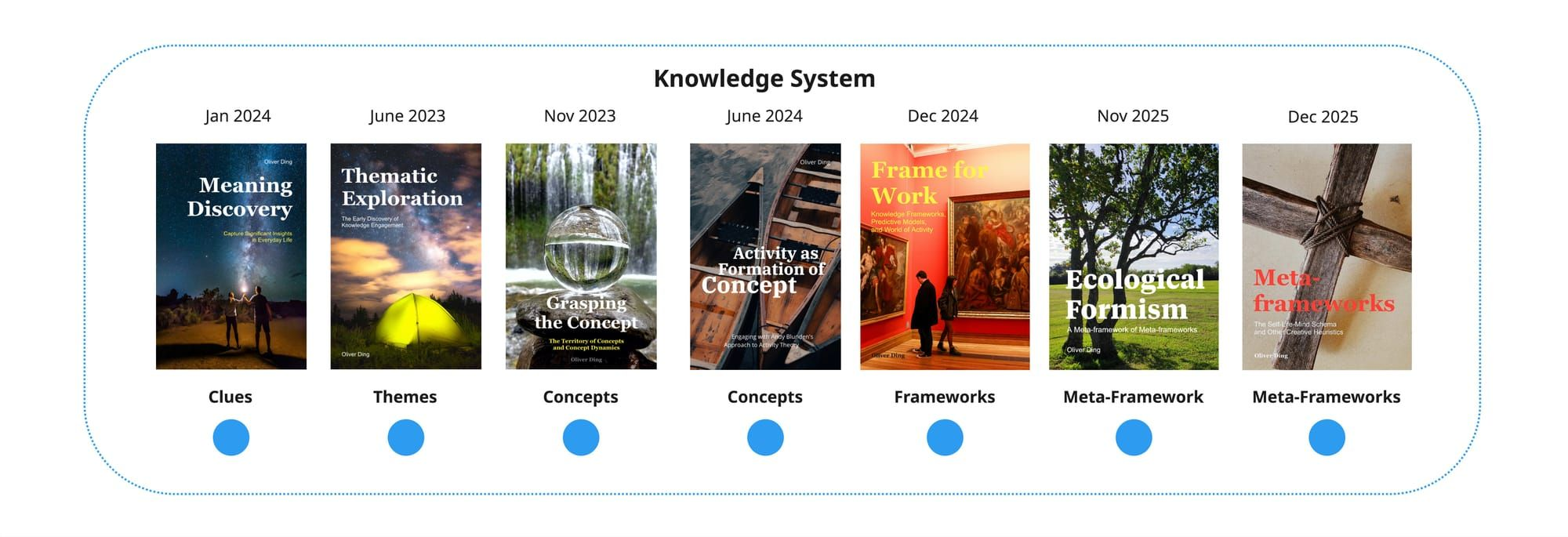
In this square, we also consider another possibility: these creative elements are used as tools within theoretical activity. In fact, the new square maps the developmental sequence onto a spatial grid, so that each stage can be seen both as a position in a developmental lineage and as a thing of knowing available for use in a given piece of theoretical or creative work.
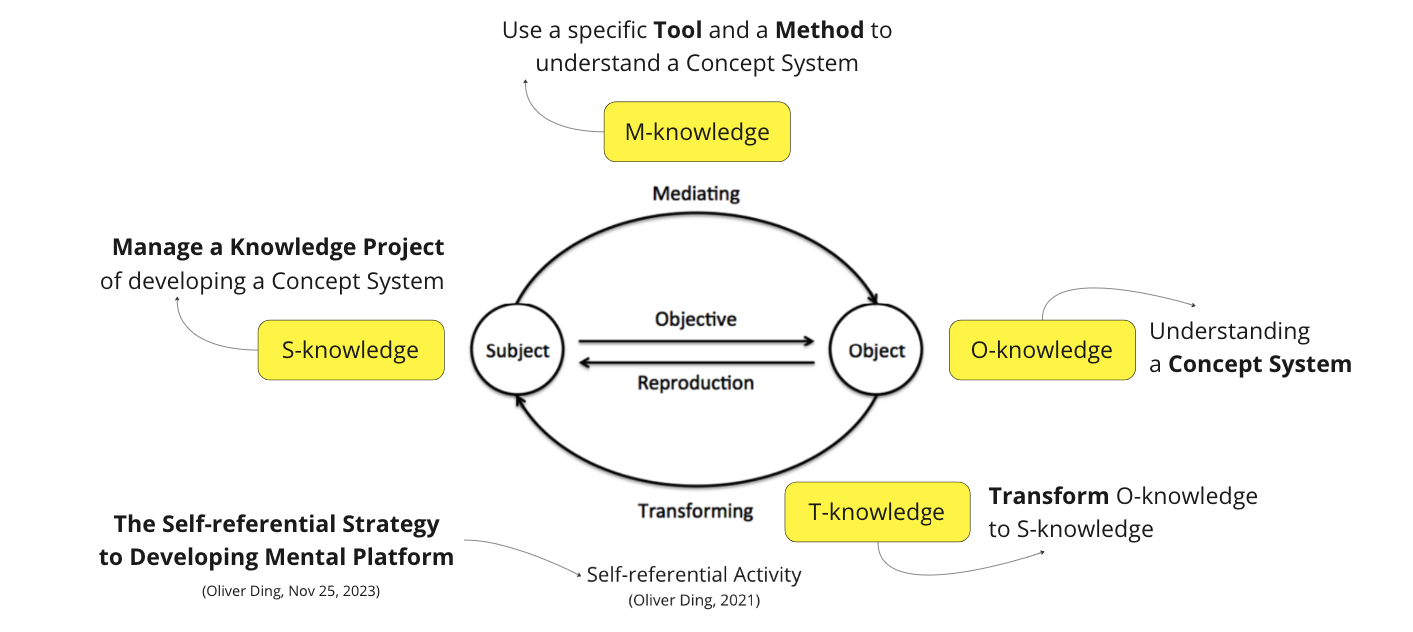
The shift in the dimension's name — from "condition of knowing" to "things of knowing" — carries a second shift with it. In any given case, at any given unit of theoretical activity, each of these eight things can function in one of two ways. It can operate as a means — a heuristic tool, a mediational resource, something enlisted to carry a piece of theoretical or creative work forward. Or it can operate as an end — a creative outcome, an objective of work, something being pursued and realized.
In a concrete case, the thing occupies one position or the other. It does not do both at once. A clue can be a means when it opens a line of inquiry; it can be an end at the scale of a spot, zone, or action, where the whole point is to notice and capture it. It is less likely to be the end of a project, where the end tends to be a more formed thing — a concept, a framework, a deliverable. A concept can be a means when it helps analyze a case; it can be an end when a paper is written to introduce it. A framework can be a means when it organizes analysis; it can be an end when a book or article is written to deliver it.
This two-position reading follows from a principle that runs through the whole GO Square architecture: every weave-point is neutral with respect to content and direction. A coordinate does not prescribe what kind of material belongs there, what kind of claim should be made there, or which way the work should move. Each weave point points to a thematic space — an open region that a user enters with their own material, questions, and purposes. The Means/End distinction gives that openness a minimal structure: it asks the user to locate their thing of knowing in relation to their activity, without telling them what the thing must be. The freedom to decide what fills the space remains with the user.
This two-position structure also connects to a model I developed in my earlier work on self-referential activity and mental platforms. In that model, I extended the traditional three-component Activity Theory model of Subject, Mediating, and Object by adding a fourth component, "Transforming," to mark the self-referential connection through which an activity turns back on its own products and tools.
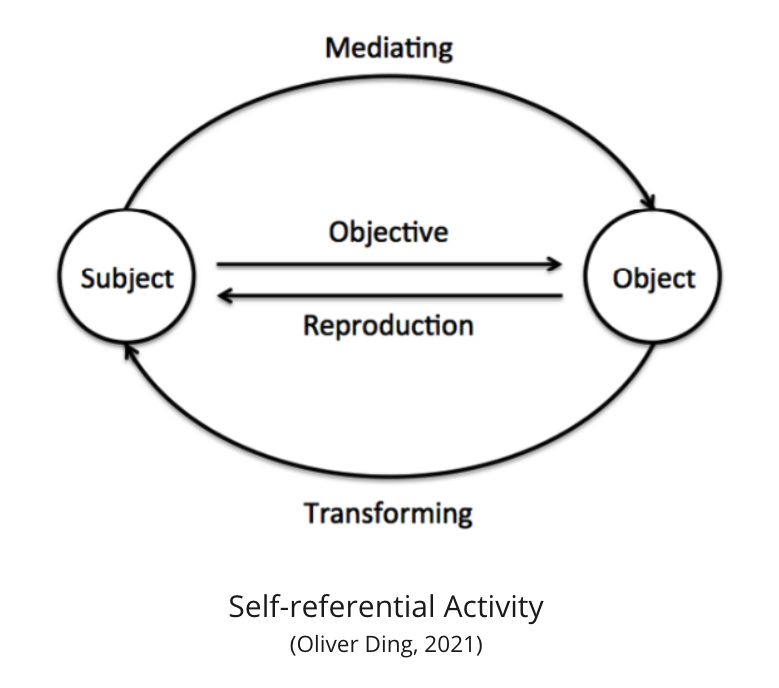
A mental platform — a spontaneous concept system a thinker builds to support their own activity — is a case in point: what starts as the Mediating component in an activity can become an object of work in its own right, and what starts as an object of work can become the Mediating component of later activity. The Means/End distinction in this square carries that same insight into the grid: the eight things of knowing are not fixed in either position. The square records which position a thing occupies at a given weave point, in a given case, without settling the question in advance.
Reoriented this way, three further stages — perspectives, approaches, paradigms — extend the sequence past frameworks, toward increasingly general orientations a thinker can adopt. Four of the eight — concepts, perspectives, approaches, frameworks — are also members of the Knowledge Discovery Canvas's sixteen blocks, giving this axis a second point of contact with existing work, not just the Theme–Concept–Framework lineage alone.
4. Spot and Zone: Two Minimal Units
Two entries on the Object of Knowing axis carry special weight, because they answer a question the rest of the sequence leaves open: what counts as the smallest unit at all, before "small" resolves into "how small, and along which relation"?
Spot is the minimal Subject-Object unit. Zone is the minimal Subject-Subject unit. Neither is new. Both come from the infoniche framework I introduced in 2020, in the "Infoniche" chapter of the book draft After Affordance: The Ecological Approach to Human Action, and applied that same year to the Ecological Physics Method in "ReEngagement with Twitterville." A spot is a single point of interaction between an agent and its environment — one click, one glance, a screenshot of a page mid-scroll. A zone is a single point of interaction between two agents — a reply, an exchange, a moment two people share the same object of attention.
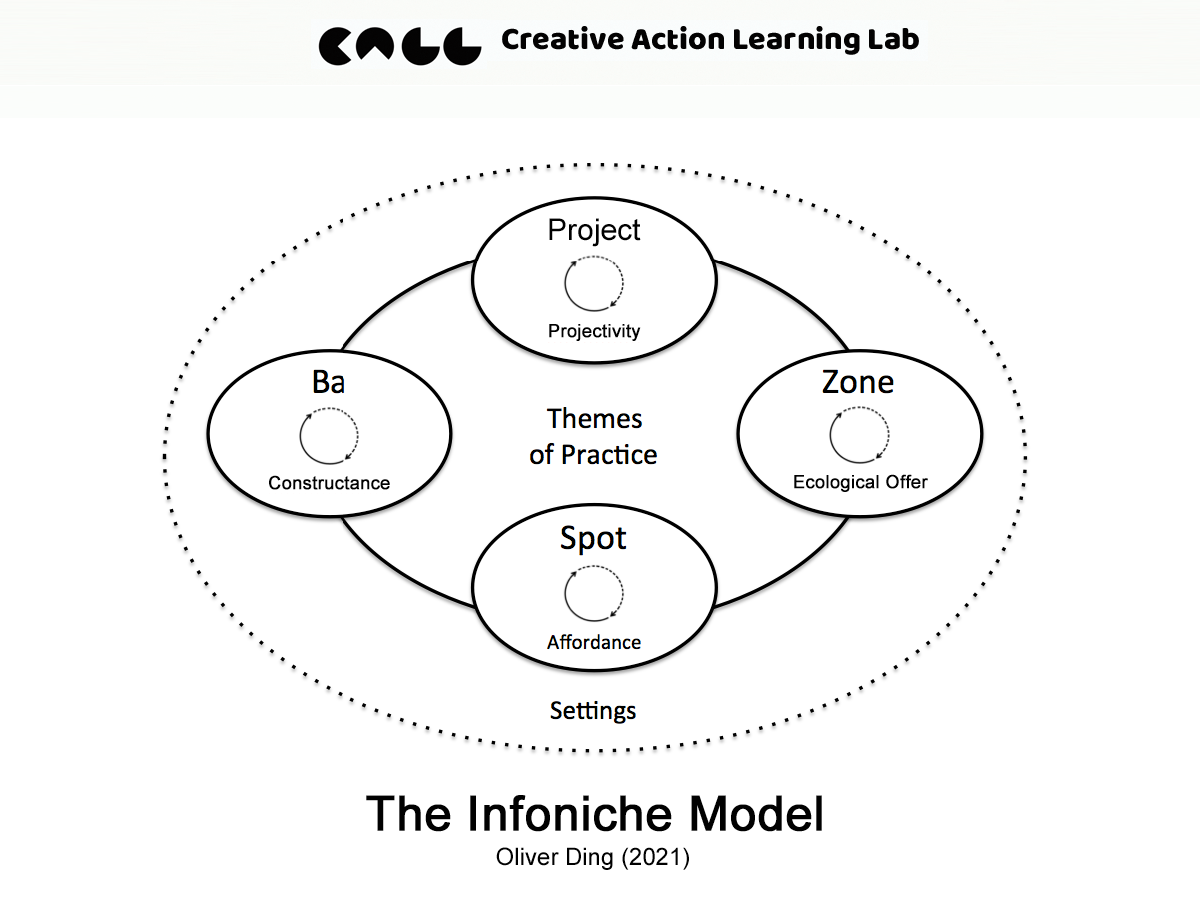
The distinction matters here because it means "minimal" is not one thing on this square. There are two different floors, not one — a Subject-Object floor and a Subject-Subject floor — and every scale above spot and zone inherits, in some proportion, both.
5. Paradigm: Disciplinary Matrix
Paradigm sits at the far end of Things of Knowing, and it is the newest addition to that axis. Kuhn's term has several competing versions, and the choice among them is not neutral. Which version one adopts determines what paradigm names and what kind of theoretical work it can support. For this square, I adopt Kuhn's "disciplinary matrix" as the version of paradigm that the Paradigm unit represents.
Kuhn's disciplinary matrix sorts the various uses of the term "paradigm" into four components: symbolic generalizations, beliefs in particular exemplars, values, and exemplars. These four components belong to two kinds of subject matter. Symbolic generalizations and exemplars are internal to the scientific project itself; beliefs and values are external to the project but internal to the scientific community that carries it out.
This is the version I use here because the Paradigm unit is meant to hold the largest, most influential kind of element a thinker can adopt — an orienting formation that shapes what counts as a problem, a solution, and a legitimate claim. What exactly that element is in a given case is not something the square decides in advance. It is for the user to specify.
Lui's own choice illustrates this. In a 2023 case-analysis article, "TALE: A Possible Theme called 'Concept Choices,'" I worked through his theoretical enterprise as an example. Lui makes his choice at two levels. At the level of Universal Concept, where Kuhn's paradigm competes with Lakatos's Scientific Research Programmes and other accounts, Lui chooses Kuhn's paradigm. At the level of Individual Concept, where several versions of Kuhn's paradigm compete with one another, Lui chooses one half of the disciplinary matrix: he retains symbolic generalizations and exemplars, and sets aside beliefs and values, because his primary interest is the scientific project itself rather than the scientific community that carries it out. He then builds his own symbolic generalizations by adapting Saussure's langue/parole distinction into what I called, in that 2023 article, a "Sociological Langue/Speech" account.
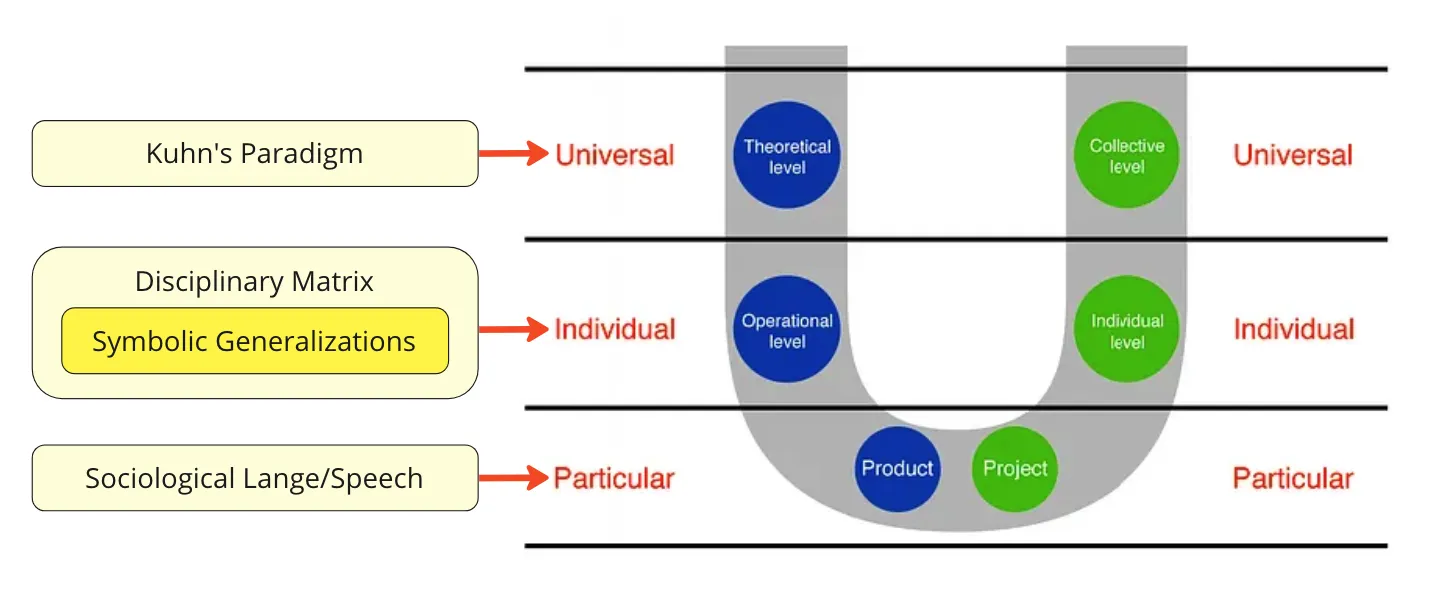
For the square, Lui's choice is not the definition of Paradigm. It is an example of how a user can give the Paradigm unit a concrete interpretation. The square provides the unit; the user decides what fills it.
6. The Name
The name is a matter of personal preference, not a theoretical claim, for the reason already given in the opening: my own creative range sits entirely within social science, and calling this the Social Science Square simply marks that boundary honestly, rather than implying anything about how knowledge is produced in physics or biology.
This consideration also answers where the whole square sits inside the master GO Square: SC-CO, Science crossed with Collectives. Social science is the study of social life — of collectives, institutions, shared practices, and historical formations — not merely of individuals. That is why it belongs on the Collectives side rather than the Individuals side (SC-IN). The sub-square takes that placement seriously: it is a tool for social science as a scientific inquiry into collective life.
More precisely, within that placement, the square's purpose is to understand theoretical activity in social science. In earlier work, I developed the Weave-the-Theory model, worked through a large number of cases with it, and edited the Weave the Theory book draft.
The Social Science Square is an extension of the Weave-the-Theory toolbox — a new instrument added to the same line of work, built to help users locate and examine theoretical activity at different scales and in different positions of means and end.
7. Local Codes for This Square
The sixteen elements in this square carry local two-letter codes, following the same convention used across the sub-squares in this series. These codes are local to this square and need only be unique within it.
A weave-point is written as [scale code] × [thing code] — for example, SP × CL for spot × clue, or SY × PD for society × paradigm.
Scales of Analysis
SP = spot
ZO = zone
AC = action
PR = project
JO = journey
LA = landscape
PL = platform
SO = society
Things of Knowing
CL = clue
TH = theme
CO = concept
FR = framework
MF = meta-framework
PE = perspective
AP = approach
PA = paradigm
These codes are for navigation and cross-reference. They do not add theoretical weight beyond what the elements themselves carry.
These codes are local to this square. They are not cross-referenced against other sub-squares or against GO Square’s master Unit letters. When relating this square to other sub-squares or to the master GO Square, use full names rather than these codes.
8. Case Studies
The cases below are not all new. Some come from the same 2020 article that supplied this square's name for its own missing term — "Activity U (II)" — where I first built a comparable 16-niche grid, "Niches of Analysis," crossing four dimensions (individual, compositional, systematic, historical) with two components (artifact, human). To these I have added several new cases, so that the eight together cover a wider range of coordinates.
Reused or newly added, each case is now translated onto the new axes and read through the Means/End distinction: in the specific instance described, the thing of knowing occupies one position or the other.
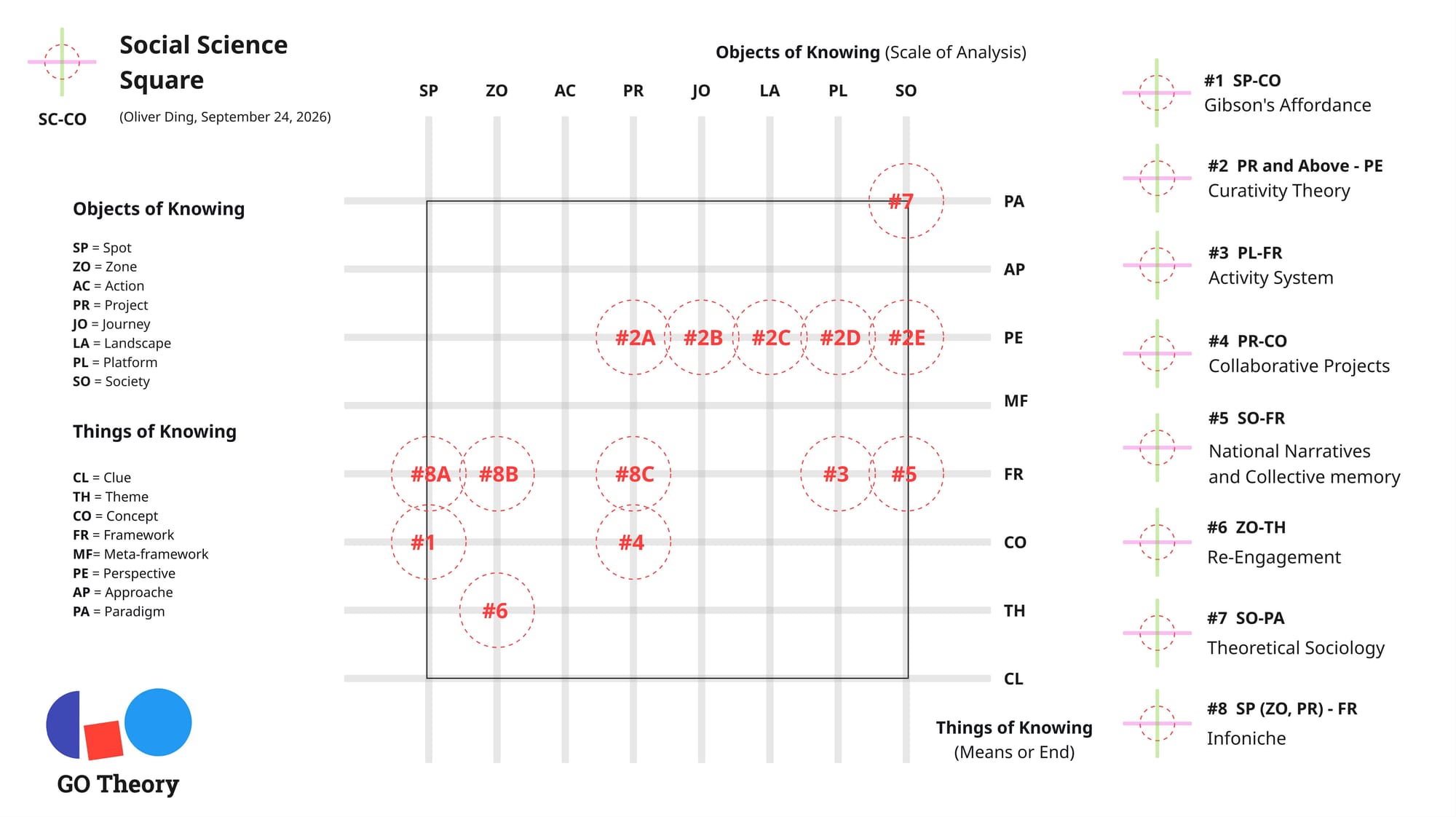
- #1 Gibson's affordance — spot × concept, as a means. Placed in 2020 at the individual/artifact niche, affordance sits here as a concept operating at the scale of a single bounded act of perception-and-response. In this case, the concept is used as an analytical tool to understand that act; it is not itself the outcome being pursued.
- #2 My own Curativity theory — Project and above × Perspective, as both means and end. Curativity — curating dispersed pieces into a meaningful whole — is not a framework tied to one scale. It is an approach that covers every unit from Project upward. A Project is a set of curated Actions; a Journey is a set of curated Projects; a Landscape requires curation to become a panorama rather than a pile; and Platform and Society, at their respective scales, likewise depend on curation to hold together and to be read as wholes. In a given case, this perspective can function as a means — a lens for reading how dispersed pieces are made into a whole at that scale — or as an end, when the theory itself is what is being proposed.
- #3 Leontiev's Activity System and Engeström's Multiple Interacting Activity Systems — platform × framework, as a means. Placed in 2020 at the systemic-level niche, these frameworks are built to describe structures many actors' activity accumulates on over time. In this case, they function as analytical instruments for reading platform-scale activity, in contrast to Vygotsky's own mediated action, which sits closer to action × concepts.
- #4 Andy Blunden's "Collaborative Projects" — project × concept, as means or end. Proposed as a unit for the human sciences, the concept's entire argument is that "project" deserves recognition as its own scale. As a means, the concept can be used as a tool to understand concrete collaborative projects — to read what holds them together, what they are trying to accomplish, and how they unfold. As an end, it turns toward practice: the question becomes how to do a concrete collaborative project well, and the concept names what such a project should be aiming at. The square does not decide between these two readings in advance; it records which one a given case is enacting.
- #5 James Wertsch's work on national narratives and collective memory — society × framework, as a means. Placed in 2020 at the historical dimension, these themes only resolve at the scale of a people's shared, historically transmitted account of itself. In this case, they serve as analytical lenses for reading collective memory at the societal scale.
- #6 My own Re-Engagement theme — zone × theme, as an end. Placed in 2020 in the niche "historical event # compositional people," Re-Engagement names what happens when a past interaction between people is deliberately reopened. Here the theme is the conceptual outcome itself — the thing the work is trying to name and establish.
- #7 Ping-keung Lui's theoretical sociology — society × paradigm, as an end. Discussed above, Lui's enterprise sits at the coordinate this square's most macro scale and most macro tool were built to hold together. The paradigm is what the theoretical enterprise is competing to become; it is the end, not a means.
- #8 The Infoniche framework — spot, zone, and project × framework, as a means. The Infoniche framework is not tied to a single scale. It covers spot, zone, and project: it can be used to read a single Subject-Object moment, a single Subject-Subject moment, and a bounded set of curated actions. In each case it functions as an analytical instrument for tracing how interaction unfolds at that scale. It is a means of noticing, tracing, and analyzing — not a final product.
Read this way, the eight cases are not evenly spread, and they do not fall into a single pattern of means or end. Some coordinates are occupied by a thing functioning as a means; others by a thing functioning as an end. The square does not enforce a correlation between scale and position — between how large a unit is and whether the thing at that coordinate is a tool or a goal. It only asks, at each weave point, what a given thing of knowing is doing in that specific case, and leaves the answer to the user.
8. What This Mapping Reveals
Laid out this way, the eight cases are not evenly spread. Taken together, they suggest a rough diagonal tendency: smaller scales often appear with more concrete things of knowing, while larger scales tend to appear with more abstract ones. Gibson sits near Spot × Concept, while the Wertsch and Lui cases appear at Society × Framework and Society × Paradigm. This is not a rule the square enforces. Nothing prevents a small-scale coordinate from taking a highly abstract thing, or a society-scale coordinate from being read through nothing more than a clue. The pattern may simply reflect that the eight cases available here come from a period when I was building exactly this kind of correspondence, not from a survey of every possible combination.
Most of the grid remains empty. Whether that emptiness reflects genuine gaps in how knowledge gets produced at particular scales, or simply gaps in the cases I have gotten around to placing, is not something this article can settle.
Sitting with the finished grid, I recognize the same thing I recognized with Creative Life Square and with Knowledge Ecology Square: this was not an invention, but an act of ongoing strategic curation. The Object/Things distinction had been part of my work since a 2020 article. The scale sequence had already grown from four units to five to twelve across three separate books. Some of the things of knowing had emerged through the Theme–Concept–Framework lineage, while others had developed later through my work on knowledge, theory, and inquiry. None of these elements was created for this square, nor do they need to remain attached to the forms in which they first appeared. They can be extracted from an earlier configuration, recombined with other elements, and put to work in a new one. The creative work lies partly in recognizing when an existing element can be released from its previous form and curated into a new configuration.
This is also what I meant by the principles of Attachance and Curativity discussed in the earlier article How to Navigate the Symbolic Universe: Three Principles of Spatial Heuristics. Attachance concerns the movement of an element across locations or configurations: an idea does not have to remain where it first appeared. Curativity concerns what happens after such movement: elements can be brought together, recombined, and organized into a new whole. The construction of this square is therefore not simply a matter of arranging existing elements on a grid. It is an instance of both principles at work — releasing elements from their previous attachments and curating them into a new configuration.
v1.0 — September 24, 2026 - 4,525 words